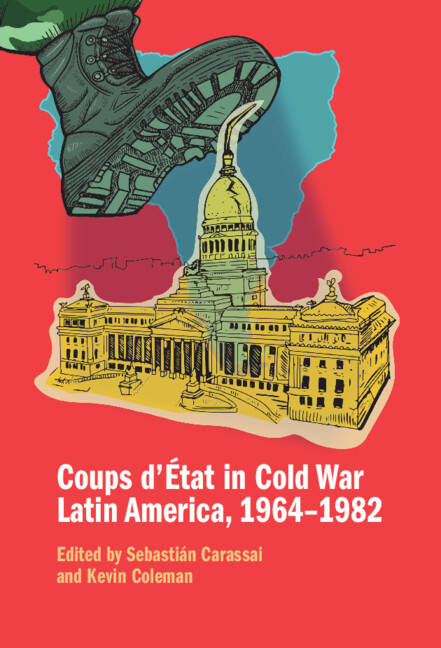
Coups d'État in Cold War Latin America, 1964–1982

-
Select format
-
- Publisher:
- Cambridge University Press
- Publication date:
- 24 April 2025
- 08 May 2025
- ISBN:
- 9781009344821
- 9781009344838
- Dimensions:
- (229 x 152 mm)
- Weight & Pages:
- 0.56kg, 288 Pages
- Dimensions:
- Weight & Pages:
You may already have access via personal or institutional login
Show more authors 
You may already have access via personal or institutional login
Book description
The latest series of coups d'état in Latin America has left an enduring impact on the region's contemporary landscape. This book employs a comparative methodology that illuminates distinct national contexts, scrutinizing the fundamental causal factors that precipitated coups in Brazil, Bolivia, Peru, Honduras, Uruguay, Chile, Argentina, El Salvador, and Guatemala. The essays answer the following questions: when was a given transfer of power defined as a coup d'état? What were the objectives in overthrowing an existing regime? What role did the US government play, as well as local political actors? What were the various options considered by different sectors within each country? What kinds of resistance did the coups face? What were their sources of support? By comprehensively exploring these questions across each national case, this book dismantles the belief that the coups can be grouped into a single category, and marks the culmination of an era in the subcontinent.
Reviews
A welcome assessment of the various Latin American military coups. In critical dialogue with the available interpretations of each case, these excellent studies take their cue from substantive common questions to illuminate both the singularities of each scenario and the broad lines that connected the multifaceted regimes of the late twentieth century.
Lila Caimari - CONICET (Consejo Nacional de Investigaciones Científicas y Técnicas), Argentina
‘… the most disruptive question that might be asked about the causes of the coups examined by the contributions of this book is, as Weinstein notes with refreshing candour, whether these reflected not too little democracy - but too much. If even contemplating such a notion takes your breath away, then it is doing precisely what challenging scholarship should be doing, especially in an era when we are struggling to understand the rise of anti-democratic forces in our own midst.’
Gavin O'Toole Source: Latin American Review of Books
Contents
Contents
References
Metrics
Altmetric attention score
Full text views
Full text views helpTotal number of HTML views: 0
Total number of PDF views: 0 *
 Loading metrics...
* Views captured on Cambridge Core between #date#. This data will be updated every 24 hours.
Usage data cannot currently be displayed.
Accessibility standard: Unknown
Why this information is here
This section outlines the accessibility features of this content - including support for screen readers, full keyboard navigation and high-contrast display options. This may not be relevant for you.
Accessibility Information
Accessibility compliance for the HTML of this book is currently unknown and may be updated in the future.