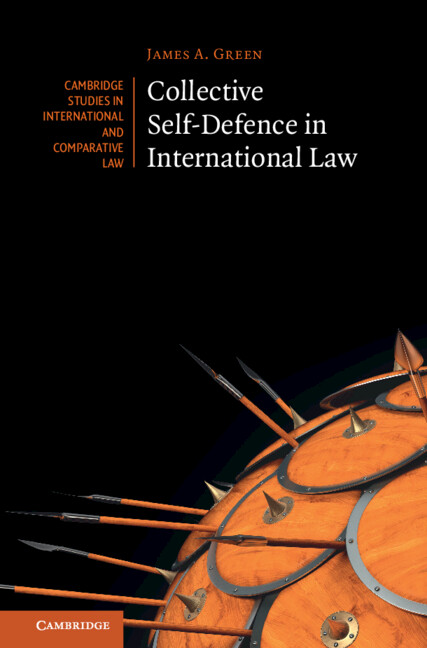

Collective self-defence can be defined as the use of military force by one or more states to aid another state that is an innocent victim of armed attack. However, it is a legal justification that is open to abuse and its exercise risks escalating conflict. Recent years have seen an unprecedented increase in the number of collective self-defence claims. It has been the main basis for US-led action in Syria (2014-) and was advanced by Russia in relation to its full-scale invasion of Ukraine (2022-). Yet there still has been little analysis of collective self-defence in international law. This book crucially progresses the debate on various fundamental and under-explored questions about the conceptual nature of collective self-defence and the requirements for its operation. Green provides the most detailed and extensive account of collective self-defence to date, at a time when it is being invoked more than ever before.
‘Following a thorough research of both the theory and practice of collective self-defence, Green articulates the importance of collective self-defence as a much-nuanced notion in international law, which has been consistently misinterpreted and overlooked. The originality of Green’s work is the fact that it rebuts the myth of recognising the nature of collective self-defence as a concept attributed to Article 51 of the UN Charter. In his work, he reveals that collective self-defence has a long history dating back to the seventeenth century based on military alliances … Overall, James Green’s work represents a valuable contribution to the ongoing discussions and debates surrounding this important topic of international law.’
Punsara Amarasinghe Source: Israel Law Review
‘The book provides a descriptive study of the contours of collective self-defence, which has received very limited scholarly attention. It debunks the misconception of collective self-defence as a mere post-UN development, tracing the historical events that contributed to the progressive development of the doctrine.’
Atul Alexander Source: International & Comparative Law Quarterly
‘Green advances academic and policy debates on CSD. By clarifying the law and exposing areas requiring further study, it makes a timely and original contribution. The extensive examination of state practice ensures it will be an invaluable and essential reference for scholars, practitioners, and courts.’
Source: Asian Journal of International Law
Loading metrics...
* Views captured on Cambridge Core between #date#. This data will be updated every 24 hours.
Usage data cannot currently be displayed.
This section outlines the accessibility features of this content - including support for screen readers, full keyboard navigation and high-contrast display options. This may not be relevant for you.
Accessibility compliance for the HTML of this book is currently unknown and may be updated in the future.
