
This book is about the Anthropocene: the geological period during which the human species multiplied steeper than exponentially, its impact came to be seen from space, and it began to heat up the air and the oceans. The book describes and measures some historical macro-trends, tying in two facets of human activity over 5,000 years and more: The surge in our population and the evolution of our political structures. Both phenomena were propelled by technological advancements while reciprocally fueling further technological growth. The human historical journey does offer bits of millennial regularity, yet several of them have begun to fail during recent centuries. We live in interesting times.
How did states come into being, and what led to the emergence and growth of various institutional structures that allowed these states to thrive and expand? The history of political systems is well worth studying because they expose the paths of their development. These tell us a great deal about the factors determining their growth and decline, but also reveal some important information about future possibilities. World population growth supplies an ever-present framework to political development. Today’s eight billion people are bound to organize differently from the twelve million 5,000 years ago.
While our primary focus lies in examining political systems and using relatively straightforward metrics such as population and area sizes, we must not overlook the profound impact of cultural, linguistic, economic, religious, technological, and military factors in shaping political culture. These elements intertwine to shape the fabric of governance throughout history. Moreover, to gain a comprehensive understanding, we must also delve into the brief histories of significant polities, taking into account their geographical context and demographic characteristics. These additional dimensions provide valuable insights into the broader evolution of political systems.
Most of the polities discussed herein belong to the largest entities of their respective eras. This emphasis stems from a dual rationale. First, history tends to be written by the victors, favoring our knowledge of aggressive rulers over more benevolent, smaller neighbors. The second, and better, reason is that innovative political structures often manifest in large entities, either contributing to their expansion or being necessary to administer unprecedentedly large territories and populations.
However, focusing on large polities carries the risk of unintentionally adopting an imperialist vocabulary. In history, we rarely accept that “small is beautiful”; the only major exception is Athens facing Persia. Elsewhere, we tend to empathize with the Persians of world history. It is not value-free to say that an empire lost a province (rather than that a country escaped the imperial grip). To “subdue” a territory is a euphemism that covers up torture, rape, death, and ashes. We try to avoid such biases, but they are deeply ingrained in our habitual style of writing.
As befits a study that extends into many millennia, it has been long in the making. The senior author published his first work on “Growth Curves of Empires” (1968) and developed his initial (and incomplete) world population model more than fifty years ago. Some sections of this book were drafted long ago, but, over the years, this undertaking evolved. Exploring the entire history of political institutions demanded research into commonalities across various regimes and a nuanced analysis of factors influencing political stability and longevity. The junior author fortuitously stumbled upon this project by being in the right place at the right time. By asking the simple question “How is it going with your book on the history of political systems?” he became intricately involved in this monumental work on the past and future of world population and empire sizes, contributing insights and essential technical skills to help this book reach its fruition.
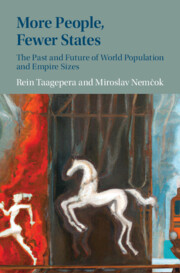
As we have come to understand the origins of our present institutions more deeply, our perception of them has undergone appreciable transformation. We hope the readers will embark on a similar journey of enlightenment. The cover design hints at the three main phases of empire growth: Runner, Rider and Engineer Empires.
We extend our sincere thanks to Josep Colomer, Aare Abroi and, in particular, Matthew S. Shugart. Their keen insights and constructive feedback have significantly enriched the content and quality of this book. Additionally, we wish to extend our thanks to the esteemed readers from Cambridge University Press. Their meticulous review and thoughtful suggestions have been instrumental in shaping the final version of this manuscript. Last but not least, we want to extend our appreciation to Robert, Sable, and all the other dedicated members of the Cambridge University Press team. Their unwavering support and tireless efforts behind the scenes have been instrumental in bringing this book to life.
Miroslav wishes to express his gratitude to the Johan Skytte Institute of Political Studies at the University of Tartu, and to Rein in particular, for granting him a five-month fellowship, during which he was greeted with scholarly hospitality, enabling him to make considerable progress on this manuscript. He is also deeply thankful to his wife, Kai, whose support, understanding, and much-needed disruptions were invaluable during times when the workload felt overwhelming.
It is our hope that this book will find its way into the hands of curious minds, sparking new insights and furthering the exploration of political systems throughout history.
