Book contents
- On Helping One’s Neighbor
- Reviews
- Series page
- On Helping One’s Neighbor
- Copyright page
- Dedication
- Contents
- Preface
- Acknowledgments
- Abbreviations
- 1 Religious Ethics and Obligations to Others
- 2 Universalism and Relativism, Minimalism and Maximalism
- 3 Institutions, Severe Poverty, and the Obligations of Affluence
- 4 On Helping One’s Neighbor
- 5 Moral Demandingness and Obligations to Special Relations and Self
- Conclusion
- Coda
- Appendix I
- Appendix II: Dignity, Indeterminateness of Sense, and Human Rights
- Bibliography
- Index
Coda
Published online by Cambridge University Press: 04 April 2024

Book contents
- On Helping One’s Neighbor
- Reviews
- Series page
- On Helping One’s Neighbor
- Copyright page
- Dedication
- Contents
- Preface
- Acknowledgments
- Abbreviations
- 1 Religious Ethics and Obligations to Others
- 2 Universalism and Relativism, Minimalism and Maximalism
- 3 Institutions, Severe Poverty, and the Obligations of Affluence
- 4 On Helping One’s Neighbor
- 5 Moral Demandingness and Obligations to Special Relations and Self
- Conclusion
- Coda
- Appendix I
- Appendix II: Dignity, Indeterminateness of Sense, and Human Rights
- Bibliography
- Index
Summary
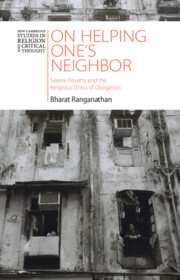
Exploring what he calls “the moral horror that is severe poverty,” Bharat Ranganathan develops a demanding account of the obligations that affluent people have to assist severely impoverished people. He argues that this is an immediate ethical as much as a social or structural imperative. Noting that developmental economists and moral and political philosophers have focused on wealth inequalities in increasingly sophisticated ways, Ranganathan observes that – within religious ethics – normative issues around severe poverty have nevertheless received insufficient attention. Bringing together general moral, religious, and philosophical principles with particular economic, social, and political realities, and engaging constructively with the writings of John Rawls and Peter Singer, this passionately argued book boldly challenges deleterious trends within ethics by unpacking, in a much more systematic way than hitherto, the pressing dilemmas around acute impoverishment. It will find an eager readership among scholars of religion, ethics, developmental studies, and theology.
Information
- Type
- Chapter
- Information
- On Helping One's NeighborSevere Poverty and the Religious Ethics of Obligation, pp. 178 - 179Publisher: Cambridge University PressPrint publication year: 2024
Accessibility standard: Unknown
Why this information is here
This section outlines the accessibility features of this content - including support for screen readers, full keyboard navigation and high-contrast display options. This may not be relevant for you.Accessibility Information
Accessibility compliance for the HTML of this chapter is currently unknown
and may be updated in the future.