

In the first part of this book, the focus is on the key approaches that are developed to understand sustainability transitions and to conceptualize processes of socio-technical change. Chapters 2–7 in this part share a commitment to understanding change as something that cannot be reduced to (simple) technological substitutions or singular policy mandates, but instead requires fundamental shifts across technological and social domains. In engaging with these matters, the different approaches grapple with the relationship between agency and structure, though they place different emphasis on where the key leverage points for change might lie. Each approach contributes a unique perspective while reinforcing a common theme: that sustainable futures emerge from the intricate dance between innovation, established practices and broader societal dynamics.
In Chapter 2, the Multi-level perspective will be introduced, where transitions are understood through the interactions between niche innovations, socio-technical regimes and the landscape. It offers a structured approach to understanding how transitions occur across different societal levels. In Chapter 3, the focus is on transition governance, with special attention given to the concept of Transitions Management, the chapter highlights the role of institutions and policy-making in guiding transitions. Further, in Chapter 4, the evolution of innovation systems will be discussed, with a focus on Technological Innovation Systems (TIS) as a framework for understanding the dynamics around emerging (sustainable) technologies. After that, Chapter 5 introduces Strategic Niche Management and explores how protected spaces can be created to nurture emerging innovations until they are robust enough to compete in the mainstream market and thereby contribute to sustainability transitions. In Chapter 6, the focus will be on social practices, where the chapter examines how everyday practices and routines influence sustainability transitions. Finally, in Chapter 7, the concept of Deep Transitions will be introduced, examining how multiple, interconnected systems undergo fundamental shifts over extended periods. By analysing long-term patterns of socio-technical change, it provides insights into the co-evolution of systems and the cumulative impact of multiple transitions.
By covering these foundational concepts, Part I equips readers with a fundamental theoretical grounding to understand the complexities of sustainability transition dynamics. This foundation is essential for analysing how profound changes in socio-technical systems can be conceptualized and facilitated, setting the stage for the more in-depth examinations in the subsequent parts of the book.
2.1 Introduction
The Multi-level perspective (MLP), which has become the dominant conceptual approach in sustainability transitions research (Hansmeier et al., Reference Hansmeier, Schiller and Rogge2021), focuses on transitions in socio-technical systems (such as energy, transport, housing, and agri-food systems), which are the prime drivers of persistent sustainability problems such as climate change, biodiversity loss, and resource depletion (EEA, 2019). To understand the dynamics of sustainability transitions, the MLP distinguishes three analytical levels. At the first level, radical ‘green’ innovations that form the seeds of sustainability transitions emerge in protected niches. Table 2.1 provides some examples with varying degrees of maturity and radicality.
| Mobility | Agri-food | Energy (electricity, heat) | |
|---|---|---|---|
| Radical technical innovation | Battery-electric vehicles, (plug-in) hybrid electric vehicles, biofuel cars, hydrogen cars | Permaculture, agroecology, artificial meat, plant-based milk, manure digestion | Renewable electricity (wind, solar, biomass, hydro), heat pumps, passive house, biomass stoves, smart meters |
| Grassroots and social innovation | Car sharing, bike clubs, modal shift to bicycles and buses, tele-working, tele-conferencing | Alternative food networks, organic food, less-meat initiatives, urban farming | Decentralised energy production (‘prosumers’), community energy, energy cafés |
| Business model innovation | Mobility services, car sharing, bike sharing | Alternative food networks, organic food | Energy service companies, back-up capacity for electricity provision, vehicle-to-grid electricity provision |
| Infra-structural innovation | Intermodal transport systems, compact cities, revamped urban transport systems (tram, light-rail, metro) | Efficient irrigation systems, agroforestry, rewilding, multi-functional land use | District heating system, smart grids, bio-methane in reconfigured gas grid |
Green niche-innovations face uphill struggles against existing unsustainable systems and the associated rules and institutions (which are called ‘regimes’), which form the second level. These systems and regimes are difficult to change because they are entrenched and stabilised by various lock-in mechanisms (Geels, Reference Geels2004; Klitkou et al., Reference Klitkou, Bolwig, Hansen and Wessberg2015). These include techno-economic lock-in mechanisms such as sunk investments (in plants and infrastructure), low cost (because of scale economies), and high performance (because of decades of learning-by-doing improvements); social and cognitive lock-in mechanisms such as routines and mindsets that blind actors to developments outside their focus (Nelson, Reference Nelson2008), social capital resulting from long-standing relations between actors, and user practices and lifestyles that have become organised around particular technologies; and political lock-in mechanisms such as existing regulations that favour incumbents (Walker, Reference Walker2000) and lobbying efforts by vested interests to maintain the status quo and hamper radical innovation (Geels, Reference Geels2014).
The third level, called the socio-technical landscape, captures broad exogenous developments that shape niche and regime developments, either through rapid shocks (such as wars, recessions, and pandemics) or gradual changes (such as macro-economic, macro-cultural or geopolitical trends) that exert pressures or create favourable contexts.
The MLP explains transitions as resulting from developments within and between these three levels, which are always enacted by multiple social groups, as later sections elaborate. The MLP has become an attractive and widely used middle-range theory for many sustainability transitions scholars because of its approach to several foundational social science sustainability debates.
Its meso-level systems focus enables the MLP to overcome the unfortunate dichotomy in other sustainability approaches that either have a macro-focus (aimed at changing capitalism or consumerism) or a micro-focus (aimed at changing individual behaviour, attitudes, and motivations) (Geels et al., Reference Geels, McMeekin, Mylan and Southerton2015).
Its conceptualisation of systems as socio-technical configurations, involving alignments between technologies, consumer practices, cultural meanings, governance arrangements, business models, markets, and infrastructures (Geels, Reference Geels2004), further enables the MLP to overcome the long-standing dichotomy between behaviour change or technical change as sustainability transformation strategies.
The MLP’s focus on actors and social groups (e.g. firms, consumers, social movements, policymakers, researchers, and investors), who act and interact in the context of (gradually changing) rules and institutions, enables it to accommodate recursive interactions between both agency and structure (Geels, Reference Geels2004).
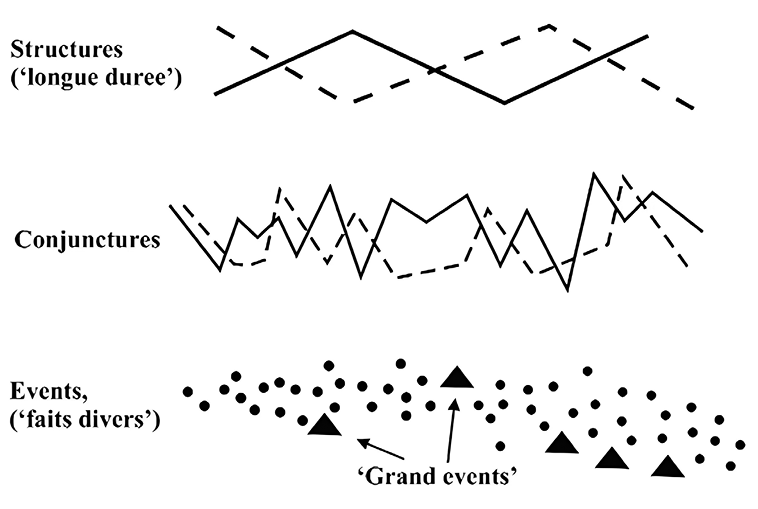
And the MLP’s attention for both lock-in mechanisms of existing systems and the emergence of radical innovations in niches enables it to accommodate both stability and change. Lastly, the MLP’s attention for unfolding processes at different levels enables it to accommodate different timescales (Geels, Reference Geels2022), which resonates with Braudel’s (Reference Braudel1970) approach to explaining long-term historical processes as involving slow-changing developments (‘longue durée’), conjunctural developments and cycles, and short-term (smaller and bigger) events (Figure 2.1).
Schematic representation of Braudel’s timescales and developments
Section 2.2 further describes the MLP’s basic concepts and historical backgrounds. Section 2.3 provides a brief empirical illustration. And Section 2.4 addresses ongoing debates and current research topics.
2.2 Historical Background and Overview of Basic Concepts
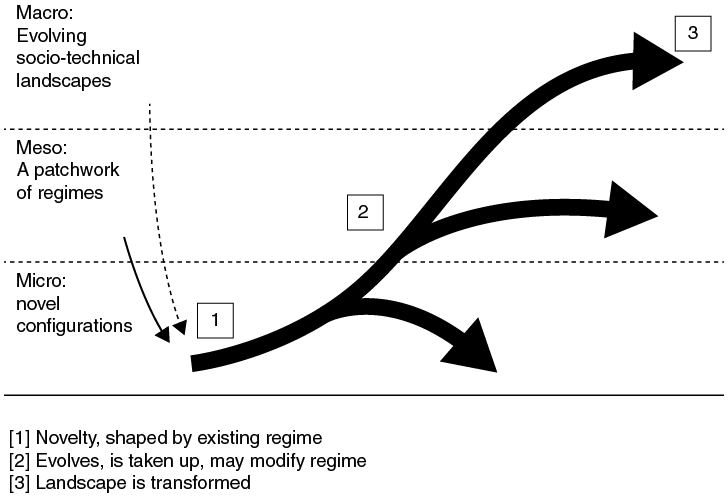
The MLP emerged from the Twente school’s quasi-evolutionary model of technological development (Rip, Reference Rip1992; Schot, Reference Schot, Coombs, Saviotti and Walsh1992), which combined concepts from evolutionary economics (e.g. search routines, innovation, selection environment, and technological regimes) and sociology of innovation (e.g. social interactions and networks, cognitive interpretations, and co-construction of technology and society). Drawing on these concepts, Rip and Kemp (Reference Rip and Kemp1996) developed a basic MLP version to understand the biography of radical innovations as emerging in small niches, followed by selection and uptake into existing technological regimes, and finally becoming part of a slowly evolving socio-technical landscape (Figure 2.2).
The Three-layered model of socio-technical change
Shifting the focus from bottom-up innovation journeys to socio-technical system transitions, Geels (Reference Geels2002) elaborated this into a more full-fledged MLP, which broadened the focus from technological to socio-technical regimes and placed greater emphasis on the alignment of emerging niche-innovations with ongoing developments at regime and landscape levels (Figure 2.3). This full-fledged MLP conceptualises socio-technical transitions as progressing through four phases.
Multi-level perspective on socio-technical transitions
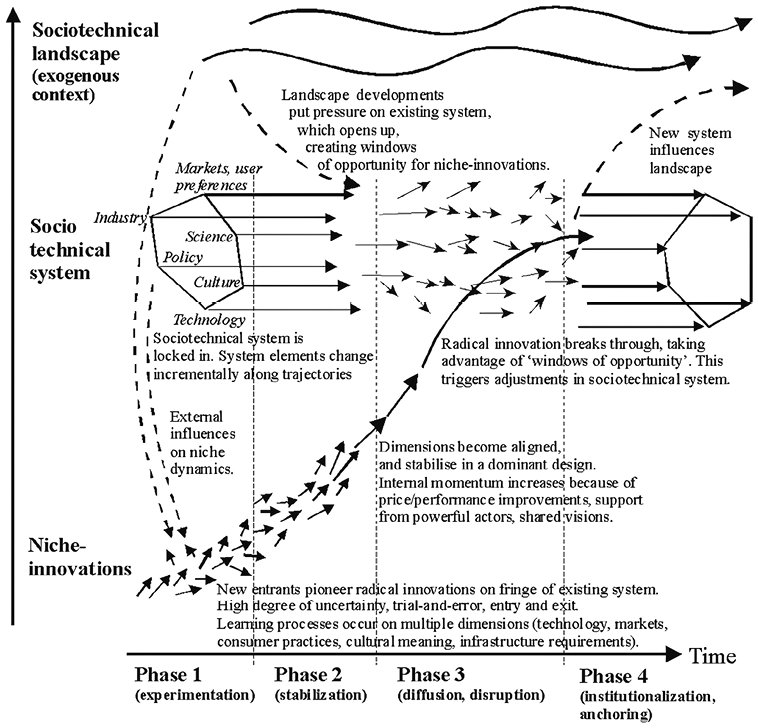
In the first phase, radical innovations emerge in small niches at the periphery of existing systems, through pioneering activities of entrepreneurs, start-ups, activists or other relative outsiders (Schot and Geels, Reference Schot and Geels2008). Niches form ‘protected spaces’ that provide shelter from mainstream market selection and nurture learning processes and the development of radical innovations (Smith and Raven, Reference Smith and Raven2012). Meanwhile, developments in the existing system and regime continue through incremental adjustments along predictable trajectories (represented as straight lines in Figure 2.3).
In the second phase, radical innovations establish a foothold in one or more market niches, which provides a more reliable flow of resources. Learning processes gradually stabilise the innovation into a dominant design, which becomes institutionalised in product specifications, design guidelines, and best practice formulations (Geels and Raven, Reference Geels and Raven2006). Niche-innovations face up-hill struggles against deeply entrenched systems, which continue to develop along incremental trajectories because of stabilising lock-in mechanisms. The niche-innovations are still more expensive than existing technologies and there may be deep uncertainties about users and their specific preferences (Oudshoorn and Pinch, Reference Oudshoorn and Pinch2003).
In the third phase, the innovation diffuses into mainstream markets, where it competes head-on with the existing system. On the one hand, diffusion depends on niche-internal drivers such as price/performance improvements, scale economies, development of complementary technologies, and support from powerful actors (Geels and Johnson, Reference Geels and Johnson2018). On the other hand, diffusion depends on external landscape developments that pressure the regime, leading to tensions and an ‘opening up’ of the regime (represented by diverging arrows in Figure 2.3). The diffusion phase is often characterised by heated multi-dimensional struggles, including business struggles between new entrants and incumbents, which may lead to the downfall or reorientation of existing firms (Penna and Geels, Reference Penna and Geels2015), political struggles over adjustments in policy goals and policy instruments such as subsidies, taxes, and regulations (Meadowcroft, Reference Meadowcroft2009), and discursive struggles about the framing of problems and solutions and the rationales for action or inaction (Roberts and Geels, Reference Roberts and Geels2018).
In the fourth phase, the new socio-technical system replaces the old one and becomes anchored and institutionalised in regulatory programs and new agencies, habits of use, views of normality, professional standards, and technical capabilities. System transitions are not only about single technologies (e.g. renewable energy) but also involve complementary innovations (e.g. smart meters, energy storage), infrastructure adjustment (e.g. smart grids, bi-directional electricity flows), new business models (e.g. capacity markets), and user practices (e.g. demand response, self-generation) (Geels and Turnheim, Reference Geels and Turnheim2022).
2.3 Empirical Application: The German Electricity Transition (1986–2022)
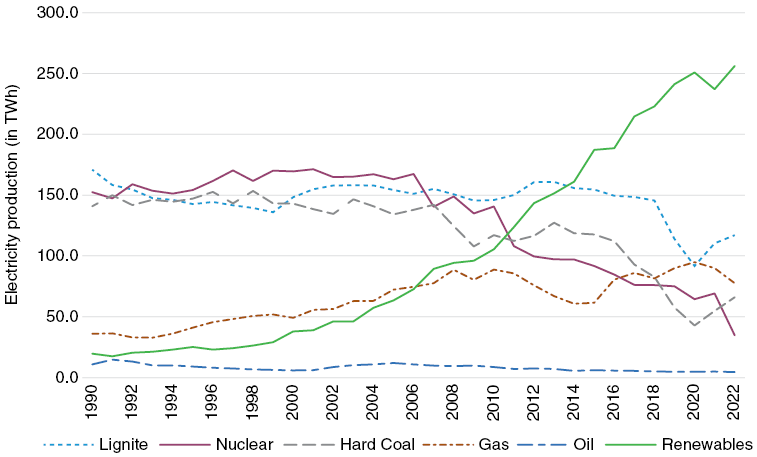
Early MLP conceptualisations have been criticised for being unclear about the operationalisation of core concepts such as ‘regime’ for empirical research (Genus and Coles, Reference Genus and Coles2008; Holtz et al., Reference Holtz, Brugnach and Pahl-Wostl2008). Scholars therefore subsequently more clearly distinguished the socio-technical system (as consisting of interacting tangible elements) from the socio-technical regime (consisting of rules and institutions), and reconceptualised the latter using ideas from neo-institutional theory (such as regulative, normative, and cultural-cognitive institutions) rather than from Giddens’s structuration theory (Fuenfschilling and Truffer, Reference Fuenfschilling and Truffer2014; Geels, Reference Geels2020b). To make the MLP’s basic ideas more concrete, this section applies the MLP to the German electricity transitionFootnote 1 (Geels et al., Reference Geels, Kern, Fuchs, Hinderer, Kungl, Mylan, Neukirch and Wassermann2016). Electricity from renewable energy technologies (RETs), which includes niche-innovations such as solar-PV, biomass, and wind turbines, increased from 3.6% in 1990 to 44.6% in 2022, while regime technologies such as nuclear energy, brown coal (lignite), and hard coal declined substantially (Figure 2.4). Natural gas increased until 2010 and has fluctuated since then.
Gross electricity production (in TWh) in Germany, by source, 1990–2022
Although one can always quibble about the precise demarcation of transition phases, the unfolding German electricity transition has so far progressed through three periods. In the first period (1986–1998), niche-innovations were nurtured in the context of stable regimes. Wind turbines and solar-PV were supported by R&D programs introduced after the oil crises in the 1970s, but deployment remained limited in the 1980s because of poor performance and high costs (Jacobsson and Lauber, Reference Jacobsson and Lauber2006). The 1986 Chernobyl accident was a landscape shock that stimulated some deployment of wind turbines by new entrants such as environmentally motivated citizens, farmers, and anti-nuclear activists who wanted to demonstrate the feasibility of alternatives. The accident also created negative public attitudes towards nuclear power, which continued to be supported, however, by successive Conservative-Liberal governments.
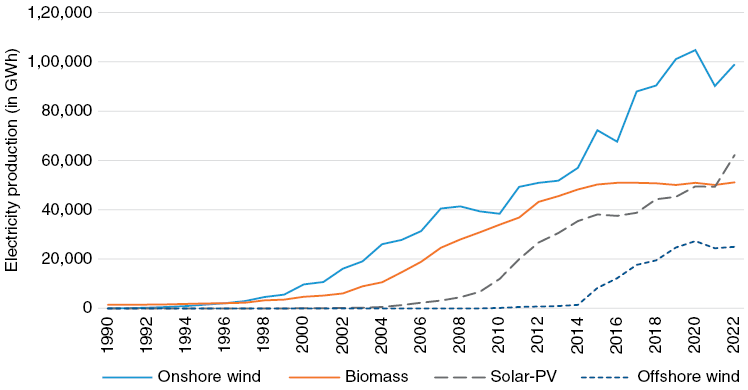
Several proposals for RET market support were defeated in Parliament, but the 1990 proposal succeed ‘by accident’ as the government was preoccupied with German re-unification (Jacobsson and Lauber, Reference Jacobsson and Lauber2006). It was not expected that the resulting Feed-In-Law would have major effects and, in 1994, the Minister of Environmental Affairs (Angela Merkel) thought it unlikely that Germany would ever generate more than 4% renewable electricity (Lauber and Jacobsson, Reference Lauber and Jacobsson2016). But the Feed-In-Law, which obliged utilities to purchase renewable electricity at 90% of the retail price, made onshore wind deployment economically feasible and stimulated significant deployment in the 1990s (Figure 2.5). The success of German turbine manufacturers also attracted industrial policy support in the peripheral regions of Northern Germany, which expanded the RET advocacy coalition (Geels et al., Reference Geels, Kern, Fuchs, Hinderer, Kungl, Mylan, Neukirch and Wassermann2016).
Electricity generation from German renewable energy technologies, excluding hydro, 1990–2022 (GWh)
To hinder RETs, incumbent utilities lobbied the government, which in 1997 proposed to reduce feed-in tariffs. But public protests by the RET advocacy coalition (including environmental groups, solar and wind associations, metal and machine workers, farmer groups, and church groups) led to the rejection of the proposal by the German Parliament (Jacobsson and Lauber, Reference Jacobsson and Lauber2006).
In the second period (1998–2009), the election of a ‘Red-Green’ coalition government between the Social Democratic Party and the Green Party (1998–2005) was another landscape shock, which disrupted the cosy regime-level relations between utilities and policymakers (Geels et al., Reference Geels, Kern, Fuchs, Hinderer, Kungl, Mylan, Neukirch and Wassermann2016). The new government decided to phase-out nuclear energy and support RETs with the Renewable Energy Act, which guaranteed fixed, premium payments for renewable electricity over a 20-year period, with tariffs varying with the maturity of the technology.
Renewable electricity subsequently diffused rapidly from 6.6% in 2000 to 15.9% in 2009 (Figure 2.4), because of reinforcing developments in multiple environments. In the policy environment, generous and stable feed-in tariffs created attractive market opportunities. In the business environment, new entrants (like households, farmers, municipal utilities, project developers, and other industries) dominated RET deployment, while the incumbent utilities produced only 6.5% of renewable electricity in 2010. The very rapid diffusion of solar-PV after 2006 (Figure 2.5) was unforeseen and driven by feed-in tariffs that exceeded generation cost as the price of solar-PV panels decreased rapidly. This stimulated strong interest from households, who deployed small-scale rooftop PV systems, and from farmers, who deployed large-scale roof- and field-mounted systems (Dewald and Truffer, Reference Dewald and Truffer2011). Solar-PV became an industrial success story, as total sales of the German PV industry grew from €201 million in 2000 to €7 billion in 2008. Export sales grew from €273 million in 2004 to approximately €5 billion in 2010 (BSW-Solar, 2010). In the public domain, broad advocacy coalitions and positive discourses about renewable energy, ecological modernisation, and green growth supported and legitimated RET diffusion and policy support (Geels et al., Reference Geels, Kern, Fuchs, Hinderer, Kungl, Mylan, Neukirch and Wassermann2016).
Instead of addressing renewable energy, incumbent regime actors focused on other issues. Liberalisation of the electricity sector in 1998 triggered a wave of mergers and acquisitions, which resulted in the Big-4 utilities (RWE, E.ON, Vattenfall, and EnBW) that captured 90% of the wholesale market by 2004. By the mid-2000s, the Big-4 were investing in new coal- and gas-fired power plants to meet expected demand growth (Kungl and Geels, Reference Kungl and Geels2018). They also focused on European and global expansions, which boosted growth and stock prices. After years of lobbying, the utilities also scored a political victory when the newly elected (2009) Conservative-Liberal government decided to overturn the earlier nuclear phase-out decision.
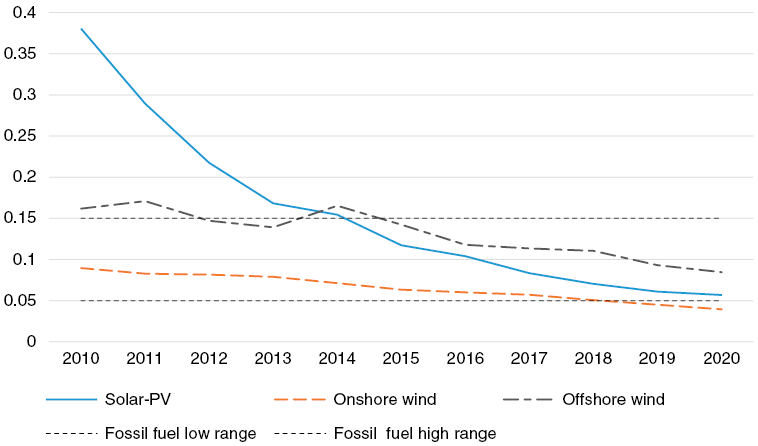
In the third period (2009–2022), RETs further diffused because of feed-in tariffs, positive discourses, and declining RET prices. Between 2010 and 2020, the global average levelised cost of electricity decreased by 85% for utility-scale solar-PV, 56% for onshore wind, and 48% for offshore wind (Figure 2.6).
The global weighted average levelised cost of electricity for solar-PV, onshore wind, and offshore wind in 2020 USD/kWh
RET-diffusion was also facilitated by a landscape shock (the 2011 Fukushima accident), which destabilised the regime because the government performed a U-turn and re-introduced a nuclear phase-out policy, with a target date of 2022. The government also adopted an official energy transition policy (Energiewende) that included ambitious future targets for renewable electricity (35% by 2020, 40–45% by 2025, 55–60% by 2035, and 80% by 2050).
The existing regime destabilised and experienced various problems in this period (Geels et al., Reference Geels, Kern, Fuchs, Hinderer, Kungl, Mylan, Neukirch and Wassermann2016): (a) the expansion of renewables reduced the market share of existing fossil plants and decreased wholesale electricity prices because of the ‘merit order effect’ (meaning that solar-PV and wind, with low marginal costs, were dispatched first in power generation), (b) the aftermath of the 2007/8 financial crisis (another landscape shock) depressed economic activity and reduced electricity demand, which eroded the economic viability of the newly build fossil plants, and (c) the nuclear phase-out decision implied write-off costs. These developments reduced net incomes of the Big-4 utilities after 2011 and created doubts about the viability of traditional business models. Consequently, incumbent utilities began strategic reorientation activities (Kung and Geels, Reference Kungl and Geels2018). In 2014, E.ON split into two companies: one focused on renewables, distribution grids, and service activities; the other holding conventional assets in large-scale electricity production and trading activities. In 2015, Vattenfall offered its German lignite activities for sale. And in 2015, RWE announced plans to separate its renewables, grid and retail business into a new sub-company.
Diffusing RETs also experienced several unforeseen problems (Geels et al., Reference Geels, Kern, Fuchs, Hinderer, Kungl, Mylan, Neukirch and Wassermann2016): (a) many German PV manufacturers went bankrupt because of increasing imports of cheaper Chinese solar panels; this eroded the salience of the green growth discourse; (b) renewables deployment (especially solar-PV) increased EEG-surcharges from 1.3 eurocent/kWh in 2009 to 6.24 eurocent/kWh in 2014, making German retail electricity prices the highest in Europe, (c) the increasing surcharges provided ammunition for political opposition from utilities and the Economics Ministry, and (d) intermittent renewables threatened grid stability and increased price volatility, leading to negative prices on sunny, windy days when supply exceeded demand.
These RET-related problems and the economic problems of utilities (which were seen as ‘too big to fail’) led to government efforts to slow RET expansion and increase support for the utilities: (a) feed-in tariffs were reduced in several rounds (Hoppmann et al., Reference Hoppmann, Huenteler and Girod2014), (b) from 2017 onwards, feed-in tariffs were replaced by a bidding system for target capacity (which required capabilities and resources that suited big players), and (c) offshore wind deployment was stimulated, which provided attractive diversification opportunities for incumbents because of size and cost structures.
Recent landscape shocks such as the COVID-19 pandemic, Putin’s war in Ukraine, and the energy crisis (particularly for gas) have not disrupted the diffusion of RETs, although the latter two shocks did lead to increased use of hard coal and lignite (Figure 2.4). While increased coal use is expected to be temporary, German and European policymakers have further increased RET targets and support schemes, which are expected to accelerate the low-carbon electricity transition in the coming years.
This brief case study shows that the German electricity transition resonates very well with the phases, levels, and conceptual dimensions of the MLP, which together with many other case studies have enhanced the framework’s empirical robustness and analytical appeal.
2.4 Further Thematic Developments and Current Research Topics
In the past decade, the MLP has been further developed in response to criticisms and through interactions with hundreds of MLP-based case studies. In response to early criticisms about over-emphasis on bottom-up substitution processes, one important further development has been the articulation of different transition pathways (Geels and Schot, Reference Geels and Schot2007; Geels et al., Reference Geels, Kern, Fuchs, Hinderer, Kungl, Mylan, Neukirch and Wassermann2016; Rosenbloom, Reference Rosenbloom2017), based on types and sequences of multi-level interactions. Transition pathways include not only the basic substitution pattern of Figure 2.3 (in which niche-innovations replace (parts of) the existing system) but also transformation (in which incumbent actors gradually adjust the existing system and regime to accommodate landscape pressures), reconfiguration (in which symbiotic niche-innovations are incorporated into the existing system, followed by knock-on effects that gradually alter the system architecture) and de-alignment and re-alignment (in which strong landscape pressures destabilise the system, which creates space for multiple emerging niche-innovation, followed by re-alignment of a new system around one of them). The substitution pathway is increasingly considered the exception rather than the rule, especially if one is interested in whole system change, which is more likely to follow a reconfiguration pattern, as will be discussed further (McMeekin et al., Reference McMeekin, Geels and Hodson2019; Bui, Reference Bui2021; Geels and Turnheim, Reference Geels and Turnheim2022; Andersen et al., Reference Andersen, Markard, Bauknecht and Korpås2023a).
In response to early criticisms about lack of agency, another major development has been the elaboration of various actor roles and agentic processes in socio-technical transitions (see Chapters 17 and 20). Mobilising concepts from political science, cultural discourse theory, business studies, and other social science disciplines, transition scholars have elaborated the MLP by further conceptualising varying roles, sub-processes, and temporal phases with regard to politics and power (Kern and Rogge, Reference Kern and Rogge2018; Roberts and Geels, Reference Roberts and Geels2018), discursive framing struggles (Rosenbloom et al., Reference Rosenbloom, Berton and Meadowcroft2016), grassroots innovation and community initiatives (Seyfang et al., Reference Seyfang, Hielscher, Hargreaves, Martiskainen and Smith2014), intermediary actors (Kivimaa et al., Reference Kivimaa, Hyysalo, Boon, Klerkx, Martiskainen and Schot2019), users (Schot et al., Reference Schot, Kanger and Verbong2016), and incumbent firm reorientation (Bergek et al., Reference Bergek, Berggren, Magnusson and Hobday2013). This research strand continues to be important and vibrant because actors engage in many different types of activities, which often vary between systems and countries.
Transition scholars have also identified new topics, which invited new conceptualisations. One topic is niche–regime interaction (see Chapter 9), which has led to more differentiated understandings of multi-level interactions. Smith (Reference Smith2007) identified ‘translation’ as an important process through which elements of niche-innovations are selectively appropriated into established regimes. Smith and Raven (Reference Smith and Raven2012) further emphasised the importance of niche ‘empowerment’, which are externally oriented activities through which niche advocates aim to change rules and selection criteria in socio-technical regimes. This concept led them to distinguish two kinds of diffusion and niche–regime interaction patterns: ‘fit-and-conform’ (in which niche-innovations diffuse because they fit in existing selection environments) and ‘stretch-and-transform’ (in which niche-innovations diffuse because advocates succeed in transforming existing regimes). Diaz et al. (Reference Diaz, Darnhofer, Darrot and Beuret2013) further suggested that niche actors can attempt to enrol regime actors with more resources to help further develop niche-innovations, while Ingram (Reference Ingram2018) highlighted the roles of knowledge flows from niche-innovations into regimes (via certification, standardisation, networking, learning, and frame linkage). This research topic remains important, because its multi-dimensional approach offers important correctives to the techno-economic approaches that dominate mainstream sustainability and policy debates.
A second new topic that has invited conceptual elaborations is regime destabilisation, decline, and phase-out, which can be seen as the flipside of transitions (Turnheim and Geels, Reference Turnheim and Geels2013; Kungl and Geels, Reference Kungl and Geels2018). Work on this topic not only aims to correct the innovation bias in transitions research but also emphasises that addressing time-constrained sustainability problems may require deliberate phase-out policies to increase the speed of change (Rogge and Johnstone, Reference Rogge and Johnstone2017). This research strand is becoming more important as the diffusion of niche-innovations like solar-PV, wind turbines, and electric vehicles is increasingly causing the decline of existing technologies like coal and internal combustion vehicles, while deliberate phase-out policies are also being implemented or considered (e.g. for incandescent lightbulbs, diesel and petrol cars, nuclear power, gas boilers).
Thirdly, diffusion and acceleration are increasingly important topics (see Chapter 8), leading to increasing research interest in the drivers and challenges in the shift from phase 2 to phase 3 in the MLP (Geels and Johnson, Reference Geels and Johnson2018; Markard et al., Reference Markard, Geels and Raven2020). Although diffusion has been studied for decades with relatively simple adoption models, analysis of this topic for sustainability transitions throws up new research puzzles because of the important role of socio-political drivers in shaping markets and supporting innovations. Analyses of solar-PV, wind turbines, and electric vehicles (Markard and Hoffman, Reference Markard and Hoffmann2016; Kern et al., Reference Kern, Rogge and Howlett2019; Geels and Ayoub, Reference Geels and Ayoub2023) show that rapid diffusion usually stems from the interactions between multiple processes, including: (a) technological performance improvements, resulting from R&D activities, learning-by-doing, and complementary innovations, (b) cost reductions resulting from scale economies, improved manufacturing, and lower financing costs, (c) increasing interests from consumers as preferences change or new technologies become better or cheaper, (d) societal debates, which shape consumer preference and policy agendas, (e) increasing confidence and commitment by companies, leading to increased investments and marketing, (f) stronger policy support for innovations through R&D subsidies, purchase subsidies, regulations, direct infrastructure investment, often in response to public debates and industrial lobbies.
This research topic is increasingly important, because meeting agreed policy targets (for climate change, biodiversity or sustainable development goals) will require acceleration of many niche-innovations. Additionally, real-world acceleration of several low-carbon innovations is giving rise to innovation races where companies and countries are increasingly competing for future markets and industries. The Inflation Reduction Act, for example, which the United States introduced in 2022, is widely seen as a game changer because of the commitment and large sums ($369 billion over 10 years) that are being allocated to supporting the development and deployment of carbon capture and storage, green hydrogen, electrolysers, fuel cells, solar-PV, batteries, wind turbines, electric vehicles and heat pumps. In response, the European Commission rushed out its Green Deal Industrial Plan for the Net-Zero Age in 2023, which aims to support similar innovations in various ways, giving rise to industrial policy competition that is likely to accelerate net-zero transitions.
A fourth new topic that is attracting more attention is multi-system interaction (see Chapter 10). Early research (Geels, Reference Geels2007; Raven and Verbong, Reference Raven and Verbong2007) explored the phenomenon and proposed basic MLP distinctions (such as regime–regime, niche–niche and regime–niche interactions between different systems) and types of interaction such as competition, symbiosis, integration and spillover. Increasing commitments in recent years to net-zero targets have stimulated a new wave of research on the topic (Rosenbloom, Reference Rosenbloom2020; Andersen et al., Reference Andersen, Geels, Steen and Bugge2023b), because reaching these targets will require interacting transitions across mobility, heating, buildings, electricity, agri-food and industrial systems as they will require inputs from or have effects on other systems. Current research aims to better understand the causal drivers and barriers in the material flows between systems, actor diversification from one system to another, the role of pervasive technologies and institutional (mis)alignment between systems (Andersen and Geels, Reference Andersen and Geels2023).
A fifth new topic is whole system reconfiguration (McMeekin et al., Reference McMeekin, Geels and Hodson2019; Bui, Reference Bui2021; Geels and Turnheim, Reference Geels and Turnheim2022; Andersen et al., Reference Andersen, Markard, Bauknecht and Korpås2023a). Research on this topic takes more seriously the idea that systems consist of multiple sub-systems and components that can change sequentially. The electricity system, for example, consists not just of electricity generation but also of a distribution sub-system (e.g. transmission and distribution grids) and a consumption sub-system, which are each characterised by different actors, institutions and technologies (McMeekin et al., Reference McMeekin, Geels and Hodson2019). Whole system transitions thus involve multiple regimes and multiple niche-innovations, which interact in many ways (Bui, Reference Bui2021). Component changes in one sub-system (e.g. solar-PV, wind turbines, bio-power replacing coal-fired power generation) can then trigger knock-on effects in other sub-systems (e.g. smart grids, battery storage and demand-side response in distribution and consumption sub-systems to address intermittency issues). Conceptualisations of whole system reconfiguration thus change the transition imagery from bottom-up substitution patterns to more gradual reconfiguration processes involving successive changes in technical components, institutional adjustments and changes in actor’s views and strategies (Geels and Turnheim, Reference Geels and Turnheim2022).
A new sixth topic that is gaining more attention is incumbent reorientation. This is partly a corrective of early transitions research, which arguably presented transitions too much in ‘David-versus-Goliath’ terms, over-emphasising the importance of outsiders, start-ups, entrepreneurs and grassroots actors in developing niche-innovations and challenging regimes. While early transitions research presented incumbents mostly in terms of lock-in, inertia and resistance, subsequent empirical research showed that incumbent firms can reorient their perceptions, strategies and investments towards niche-innovations like electric vehicles, trams, wind parks, bio-electricity, light emitting diodes, smart grids and battery storage (Bergek et al., Reference Bergek, Berggren, Magnusson and Hobday2013; Berggren et al., Reference Berggren, Magnusson and Sushandoyo2015; Apajalahti et al., Reference Apajalahti, Temmes and Lempiälä2018; Turnheim and Geels, Reference Turnheim and Geels2019; Kattirtzi et al., Reference Kattirtzi, Ketsopoulou and Watson2021; Geels and Ayoub, Reference Geels and Ayoub2023). This reorientation typically involves pressures from policymakers, markets and civil society, and progresses through several phases (including hedging and diversification). Although incumbent reorientation is not an easy process, it can accelerate sustainability transitions when incumbents mobilise their large financial, technical and organisational resources.
A seventh new topic is increasing attention for potential trade-offs between the speed and depth of change (Geels and Turnheim, Reference Geels and Turnheim2022; Newell et al., Reference Newell, Geels and Sovacool2022). The empirical evidence indicates that accelerating niche-innovations are mostly technologies (e.g. electric vehicles, solar-PV, wind turbines) that do not require the overhaul of existing systems. Niche-innovations that imply ‘deeper’ change and social innovation (e.g. car sharing, mobility-as-a-service, agroecology, passive house, whole-house retrofit) have remained small and appear to limitedly diffuse or scale up. The reason is that modular technical change is easier, less disruptive and better fits the interests of incumbent firms, mainstream consumers and policymakers. While many sustainability transitions scholars have a normative preference for the deepest, most radical kinds of innovations, real-world developments in recent years suggest that the transitions community should investigate more deeply the feasibility of change at the scale and speed required. Instead of repeating calls for ‘deeper’ change, it may be more fruitful to investigate how and under which conditions rapid changes in system modules can have knock-on effects that trigger whole system reconfiguration.
In sum, MLP-based transition research has been generative in identifying new topics and asking new kinds of questions, which stems from a desire and willingness to follow and reflect on real-world developments that throw up new puzzles as sustainability transitions are unfolding and accelerating. Since different questions require different conceptual tools, the MLP has continued to evolve conceptually and empirically, which has enabled it to become a generative research program that continues to appeal to a broadening group of academics (and policymakers, whom this brief chapter was unable to discuss).
3.1 Introduction
Transition governance is an area of sustainability transitions research that explores how transitions can be influenced and steered (Loorbach et al., Reference Loorbach, Frantzeskaki and Avelino2017). Transition governance refers to the agency, processes, structures and strategies actors employ to influence the speed and direction of complex societal transitions (Smith et al., Reference Smith, Stirling and Berkhout2005, Grin et al., Reference Grin, Grin, Rotmans and Schot2010). Some transition governance research takes a more descriptive, evaluative, or purely historical approach, but in this chapter, we expand on research that takes an explorative and engaged approach to transition governance. However, both are connected as explorative researchers draw lessons from historical transitions and how agency influenced their trajectories and outcomes and translate these to ‘transitions in the making’. Combining these insights with knowledge from complex system theories, resilience theory and social sciences, they experimentally develop insight into how emerging transitions can be influenced in terms of their speed and direction (Hebinck et al., Reference Hebinck, Diercks, von Wirth, Beers, Barsties, Buchel, Greer, van Steenbergen and Loorbach2022).
‘Transitions in the making’ are the patterns of transformative change that emerge today and that might lead to full transitions that future historians can analyse. These ‘transitions in the making’ are hypothesised to be needed to achieve future sustainability within time frames that still allow for liveable futures. However, it is still undetermined whether they will occur and, if they do, there is uncertainty regarding their speed and direction. Take, for example, the transition from fossil-fuel dependence towards renewable energy sources: while it is acknowledged as vital for a sustainable society, it is dependent on a myriad of factors – social, technological, ecological, etc. – and how it will ultimately unfold and at what speed is unclear. Explorative transition governance is about understanding how actors influence dynamics of ‘transitions in the making’ and developing support for actors to navigate the inherently complex, ambiguous and uncertain contexts towards just sustainability (Loorbach et al., Reference Loorbach, Frantzeskaki and Avelino2017).
Analyses of historic transitions have been key to the development of transition governance more generally, enabling scholars to make sense of this complexity and better understand the visible dynamics of change, see Chapter 2. However, while historic transitions can be described retrospectively as moving from ‘A’ to ‘B’, being part of ‘transitions in the making’ is explorative, speculative and experimental (Hebinck et al., Reference Hebinck, Diercks, von Wirth, Beers, Barsties, Buchel, Greer, van Steenbergen and Loorbach2022). Societal actors find this increasingly difficult to gauge and respond differently to the transformative pressures that build up. Explorative transition governance as a field aims to both analyse and support societal actors that challenge incumbent regimes, develop transformative alternative practices, visions, or models, or otherwise explore just sustainability transitions. Key to explorative transition governance is an indirect, network and multi-actor perspective to transitions: transition dynamics are not so much influenced by singular actors (‘the government’, ‘the market’), but by civil servants, activists, entrepreneurs, scientists and citizen (Avelino and Wittmayer, Reference Avelino and Wittmayer2015), see also Chapter 17. Explorative transition governance then seeks to identify what strategies, processes and structures these actors can employ to navigate sustainability transitions and engages these in action research to facilitate their learning and agency.
The concept of transition governance emerged in the early 2000s as a response to the recognition that enabling and accelerating sustainability transitions requires deliberate and coordinated efforts across diverse actors, sectors and levels (Loorbach et al., Reference Loorbach, Frantzeskaki and Avelino2017; Smith et al., Reference Smith, Stirling and Berkhout2005; Voß et al., Reference Voß, Smith and Grin2009). While initially with a predominant focus on government policy (Loorbach, Reference Loorbach2007), this quickly evolved towards a societal perspective by including decision-making processes of (and between) public, private and civic actors (Wittmayer et al., Reference Wittmayer, Schäpke, Steenbergen, Omann, Maria, Schäpke and Steenbergen2014). Such as in the Rotterdam neighbourhood Carnisse, where Transition governance approaches were applied to ‘facilitate the self-organisation of inhabitants to address persistent sustainability problems’ (Wittmayer et al., Reference Wittmayer, van Steenbergen, Bach, Frantzeskaki, Hölscher, Bach and Avelino2018).
There are various analytical perspectives and approaches within the field of explorative transition governance that integrate principles of sustainability transitions with theories and models on governance, innovation, policy and management (Grin, Reference Grin, Grin, Rotmans and Schot2010; Loorbach, Reference Loorbach2010; Voß and Kemp, Reference Voß, Kemp, Voss, Bauknecht and Kemp2006). Within that scope, explorative transition governance research ranges from being analytical – aimed at analysing how actors use processes, structures and strategies to interact with(in) systems, to being action-oriented – providing actionable knowledge towards influencing ‘transitions in the making’ by taking a normative perspective to sustainability transitions (Loorbach et al., Reference Loorbach, Frantzeskaki and Avelino2017). Here, action-oriented approaches are strongly linked to and dependent on the analytical approaches to explorative transition governance: requiring analysis of the ‘state of transition’ prior to developing actionable knowledge on how to navigate and accelerate transitions.
This chapter continues by outlining analytical approaches to explorative transition governance, explicating its origin and synthesising diverse applications throughout the field. It also highlights the ‘X-curve framework’ (Hebinck et al., Reference Hebinck, Diercks, von Wirth, Beers, Barsties, Buchel, Greer, van Steenbergen and Loorbach2022; Loorbach et al., Reference Loorbach, Frantzeskaki and Avelino2017), an analytical explorative transition governance framework developed to make sense of the continuously evolving dynamics of ‘transitions in the making’, which may also be used in actionable ways. This is followed by a synthesis of key action-oriented approaches in the field of explorative transition governance. This starts with a recall of the action-oriented turn in sustainability transition studies (Wittmayer and Schäpke, Reference Wittmayer and Schäpke2014), which allowed for various action-oriented approaches to transition governance to emerge. Further in this section, we zoom in on ‘Transition Management’ approach, a much-used action-oriented approach aimed at devising strategies to navigate sustainability transitions (Loorbach, Reference Loorbach2010). This chapter concludes with reflections on how the field of transition governance might progress.
3.2 Analytical Approaches to Understand Transition Governance
The foundation of transition governance is the understanding that transitions are the outcome of patterns of agency that respond to structural change dynamics, with emphasis placed on the exploration of how the two influence one another. This is rooted in Giddens (Reference Giddens1984) ‘structuration’ perspective (arguing that neither agency nor structures can be viewed in isolation), understanding societal transitions in terms of how actors interact with each other, ‘regime’ dimensions and ‘landscape’ changes. Over time, these dynamics constitute a fundamentally changed dominant culture, structure and practice (regime) in a specific societal (sub)system (Kok, Reference Kok2023). In other words, by understanding structures as both giving shape to actors and as being shaped by actors, transitions are not seen as autonomous processes. Therefore, transition governance considers the engagement of a diverse set of actors as necessary to destabilise incumbent regimes and accelerate alternatives (Delina and Sovacool, Reference Delina and Sovacool2018; Loorbach and Lijnis Huffenreuter, Reference Loorbach and Lijnis Huffenreuter2013). Similarly, analytical approaches to explorative transition governance are then interested in making sense of agency processes, structures and strategies that influence the speed and direction of transitions in different ways.
Research taking an analytical approach to explorative transition governance, highlighting how actors interact with transition dynamics, has thus far yielded diverse kinds of insights related to the governance of transitions. For one, it has revealed diverse strategies actors employ to reinforce business-as-usual or even lock-in: for example, by capturing innovation (Pel, Reference Pel2016), through greenwashing (Yildirim, Reference Yildirim2023), by using crises to restabilise the regime (or ‘shock doctrine’ see Klein, Reference Klein2007), by ‘hindering through cooperation’Footnote 1 (Smink et al., Reference Smink, Hekkert and Negro2015), or less obviously by using innovation to optimise existing regimes (also described as reinforcing path-dependency) (Wells and Nieuwenhuis, Reference Wells and Nieuwenhuis2012). On the other hand, this understanding has also revealed different types of transformative agency that help to advance dynamics that accelerate and (re-)orient dynamics towards desired societal transitions: such as activism (Bruno et al., Reference Bruno, Dekker and Lemos2021; Pierri, Reference Pierri2023), social entrepreneurship (Bolton and Hannon, Reference Bolton and Hannon2016; Proka et al., Reference Proka, Beers, Loorbach, Moratis, Melissen and Idowu2018), intermediary actors (Kivimaa et al., Reference Kivimaa, Boon, Hyysalo and Klerkx2019), entrepreneurial policymaking (Jhagroe and Loorbach, Reference Jhagroe and Loorbach2018; Kivimaa and Kern, Reference Kivimaa and Kern2016), proactive incumbents or ‘regime-niches’ (Greer et al., Reference Greer, von Wirth and Loorbach2020; Turnheim and Sovacool, Reference Turnheim and Sovacool2020) and action research (Wittmayer et al., Reference Wittmayer, Schäpke, Steenbergen, Omann, Maria, Schäpke and Steenbergen2014). These are all examples of types of agency that ‘seek to challenge, alter and/or replace incumbent ways of thinking, doing and organizing’ (Avelino et al., Reference Avelino, Wittmayer, Pel, Weaver, Dumitru, Haxeltine, Kemp, Jørgensen, Bauler, Ruijsink and O’Riordan2019). Such analytical insights on the roles, behaviour and transformative agency of actors within processes of transition are vital to understand the governance of transitions. Rather than understanding transitions as ‘manageable’ or ‘controllable’, transition governance seeks to explore the diverse ways in which actors shape and are shaped by the system and how these influence the governance of transitions (Avelino and Grin, Reference Avelino and Grin2017). Depending on the change dynamics that a context presents, explorative transition governance’s focus on actors within transitions provides different insights.
But over time, the dynamics of transition in the making evolve and so does the type of agency that drives it – in terms of positions, roles and contributions to acceleration sustainability transitions. To make sense of these continuously evolving dynamics, explorative transition governance analyses are often supported by research on diverse issues salient to transition governance. Such as the role of politics and power (Avelino, Reference Avelino2017; Grin, Reference Grin2012 – see also Chapters 12 and 14), democratic legitimacy (de Geus et al., Reference de Geus, Wittmayer and Vogelzang2022; Hendriks, Reference Hendriks2009), spatial dynamics and interactions (Loorbach et al., Reference Loorbach, Wittmayer, Avelino, von Wirth and Frantzeskaki2020; Skjølsvold and Ryghaug, Reference Skjølsvold and Ryghaug2020 – see also Chapter 21), the directionality of transition governance (Fischer et al., Reference Fischer, Joosse, Strandell, Söderberg, Johansson and Boonstra2023; Pavloudakis et al., Reference Pavloudakis, Karlopoulos and Roumpos2023; Pel et al., Reference Pel, Raven and Est2020), governance at diverse scale levels (Bosman and Rotmans, Reference Bosman and Rotmans2016; Wittmayer et al., Reference Wittmayer, Schäpke, Steenbergen, Omann, Maria, Schäpke and Steenbergen2014), the role of emotions in transitions (Bogner et al., Reference Bogner, Kump, Beekman and Wittmayer2024) and capacities needed for transformative governance (Hölscher et al., Reference Hölscher, Frantzeskaki and Loorbach2019a; Wolfram et al., Reference Wolfram, Borgström and Farrelly2019).
Such advancing research is crucial to further refine the understanding of transition governance amid the continuously evolving dynamics of ‘transitions in the making’. For example, when the need for transitions is increasingly acknowledged and alternatives become increasingly appealing, new collaborations and partnerships between ‘niche’ and ‘regime’ actors can start to emerge (Costa et al., Reference Costa, Bui, De Schutter and Dedeurwaerdere2022; Ingram, Reference Ingram2015; Scharnigg, Reference Scharnigg2024). When a societal regime becomes destabilised or disrupted, therewith creating the ‘transition space’ for rapid institutional change, interventions and collaborations tend to be more top-down and structural in nature (Bosman, Reference Bosman2022; Burnett and Nunes, Reference Burnett and Nunes2021). Consequently, transition governance then builds on such analyses in a specific domain of interest, once it becomes relevant to the state of the transition in the making, to identify the actors who and how they fundamentally challenge, alter, or replace unsustainable regimes.
Various analytical frameworks exist within the field of sustainability transitions that support an analytic approach to explorative transition governance: each allowing to make sense of specific dynamics in governance processes. For example, the multi-level perspective (Geels, Reference Geels2011) illustrates the interactions and dynamics between different levels of governance (niche, regime, landscape), enabling governance analysis of the role of actors and institutions at each level. While the S-curve (Rotmans et al., Reference Rotmans, Kemp and van Asselt2001) depicts the ideal-type progression of innovation adoption, supporting the development of strategies to support the shift from niche innovations to mainstream adoption. Or the Technological Innovation Systems framework (Bergek et al., Reference Bergek, Hekkert, Jacobsson, Markard, Sandén and Truffer2015) that aims to identify and leverage strategic points where policy interventions can effectively influence and steer socio-technical transitions. These foundational frameworks have evolved over time as the actual societal transitions matured.
Initially, stable regimes could be identified, and the emphasis lay on (socio-technical) innovation and experimentation. In the current transitions in the making, issues of breakdown, destabilisation, scaling and diffusion as well as broader socio-cultural, political and institutional aspects have come to the fore. Each of these frameworks builds on the complexity of sustainability transitions research and reveals insights relevant to transition governance enabling analysis of the agency, processes, structures and strategies that actors employ to influence societal transitions. In Section 3.3, we will focus on the X-curve (Hebinck et al., Reference Hebinck, Diercks, von Wirth, Beers, Barsties, Buchel, Greer, van Steenbergen and Loorbach2022) as a framework that not only synthesises a lot of insights from these frameworks and the analytical governance thinking but also provides a basis for navigating future transition dynamics.
3.3 Understanding Evolving and Future Transition Dynamics: The X-Curve Framework
An analytical framework that emerged to make sense of the evolving dynamics of transitions in the making is the ‘X-curve framework’ (Hebinck et al., Reference Hebinck, Diercks, von Wirth, Beers, Barsties, Buchel, Greer, van Steenbergen and Loorbach2022; Loorbach et al., Reference Loorbach, Frantzeskaki and Avelino2017). It captures the idea that sustainability transitions are made up of two interacting patterns of build-up towards the desired system and breakdown of the unsustainable incumbent system (Hebinck et al., Reference Hebinck, Diercks, von Wirth, Beers, Barsties, Buchel, Greer, van Steenbergen and Loorbach2022). By sketching an ideal-type situation, the X-curve distinguishes several different patterns and mechanisms that influence and structure transitions and that can be associated with different types of actors and roles. Here we reflect on four types of dynamics that occur throughout and ideal-typical transition process and how the X-curve helps explore and analyse agency in transition (see Figure 3.1).
The X-curve framework which illustrates interacting patterns of build-up and breakdown that enable societal transition. The different dynamics one can distinguish in an ideal-type situation are outlined in the framework.

First, transitions generally start out from a context that is characterised by a largely stable regime – or a ‘dynamic equilibrium’ – that is barely contested and broadly supported in society. This enables the regime to continue to optimise through incremental changes and strengthen the dominant practices. Take, for example, the packaging industry and the reliance on plastic: while the negative impact of plastic pollution is increasingly acknowledged, the industry continues to optimise its practices through incremental changes such as lighter plastic or more recyclable plastics, allowing it to maintain its dominance (Bauer et al., Reference Bauer, Hansen and Nilsson2022). Meanwhile, change agents and frontrunning actors who are aware of the unsustainabilities start to voice their concerns and argue for the need for change (Kuokkanen et al., Reference Kuokkanen, Nurmi, Mikkilä, Kuisma, Kahiluoto and Linnanen2018; Turnheim and Geels, Reference Turnheim and Geels2013). These also allow for ‘niches’ to emerge at the fringes of the system, experimenting with alternative modes of doing, thinking and organising (Smith and Seyfang, Reference Smith and Seyfang2007). Continuing the example of the packaging industry, alternatives such as biobased or reusable options surface as niche practices. However, their immaturity combined with the lack of a shared sense of urgency for change within the regime leads to the inability of these niches to challenge or alter the regime (Bauer et al., Reference Bauer, Hansen and Nilsson2022), allowing the regime to continue to optimise and attempt to re-stabilise (Unruh, Reference Unruh2002).
Second, a regime becomes increasingly unable to address the sustainability challenges it faces, meaning signs of crises become visible (Leipprand and Flachsland, Reference Leipprand and Flachsland2018): decreasing societal support, increasing landscape pressures and internal tensions lead to the system being ‘out of equilibrium’. Take the energy transition: while the fossil-based energy system is losing societal support and its negative impacts are increasingly visible, it is still the dominant system. But the regime’s inability to structurally address these pressures – also ‘destabilisation’ – enables transformative agency and alternative narratives of change to emerge and accelerate. Now becoming adopted by broader groups of citizens, entrepreneurs and policymakers, practices and discourses around energy slowly start to change (Loorbach et al., Reference Loorbach, Wittmayer, Avelino, von Wirth and Frantzeskaki2020). Leadership of actors within the regime begin to proactively seek and create spaces for experimentation and transformation (Bosman and Rotmans, Reference Bosman and Rotmans2016). Transition governance can support the search for broader policy commitments for change, increasing the pressures for transformative change, making it more and more difficult for business as usual to continue without contestation (Kramm, Reference Kramm2012; Oxenaar and Bosman, Reference Oxenaar, Bosman, Wood and Baker2019).
Third, escalating crises and societal instability undermine and lock-out the regime, opening ‘transition space’ and driving actors within the regime apart. ‘Transition space’ describes a phase during transitions when there is no clear dominant regime, and thus a lack of common direction and grip within the system (Bosman, Reference Bosman2022). This chaotic dynamic is visible in electricity regimes where incumbent companies are transforming, struggling, or scaling into wind and solar, energy cooperatives and decentralised systems mainstream and consumers become prosumers (Horstink et al., Reference Horstink, Wittmayer and Ng2021). In this context, societal norms rapidly shift, allowing new markets, practices and norms to emerge, diffuse and institutionalise. The previously dominant institutions are increasingly delegitimised as being the norm (Markard, Reference Markard2018). This adds to social instability and uncertainty in which tensions and (socio-political) crises surface and resistance to change starts to mount (Hebinck et al., Reference Hebinck, Diercks, von Wirth, Beers, Barsties, Buchel, Greer, van Steenbergen and Loorbach2022). Simultaneously, early symptoms of institutional ruptures and breakdown might appear in the form of mass mobilisations, court rulings that further complicate business-as-usual and commitments for transformative change from a broad range of actors that previously were the dominant structure to the regime – i.e. private, financial and public actors.
Fourth, as a broader social consensus emerges around the need and overall direction of change alongside tangible alternative practices and structures, a process of (managed) decline and institutionalisation takes place – allowing for institutionalisation of previously alternative practices and norms and ‘(re)stabilisation’ of the new regime (Hebinck et al., Reference Hebinck, Diercks, von Wirth, Beers, Barsties, Buchel, Greer, van Steenbergen and Loorbach2022). This entails that the undesired elements, practices and technologies that were part of the ‘old’ system are phased-out (Oei et al., Reference Oei, Brauers and Herpich2020; Rogge and Johnstone, Reference Rogge and Johnstone2017), creating the needed space for new institutions to develop and both social and behavioural changes to unfold (Bosman, Reference Bosman2022). These changes allow for the norm to shift and enable the stabilisation of a new regime to become the new normal (Kemp et al., Reference Kemp, Schot and Hoogma1998), marking the societal transition from one regime configuration to another. Whereas the first three types of dynamics have been occurring in real life over the past decades – providing opportunities for in-depth explorative research, the dynamics beyond the transition space are much more speculative and require drawing on historical examples. Such as the agricultural transition in the Netherlands, during which this phase saw political decisions that led to large-scale institutional reform, mainstreaming of new professional practices, establishment of knowledge and education systems, codification and formalisation of new economic and social norms (Grin, Reference Grin2012).
While these dynamics provide analytical insights useful for the governance of transitions, portraying these dynamics as sequential and building on each other, it is important to note that they do not happen in a controlled, gradual, or linear way. So far, many of the desired ‘transitions in the making’, such as the potential transitions towards just and sustainable energy, mobility, food, or health care that are visible today, appear to be ‘stuck’ in the first and second types of dynamics. There are only a few examples of transitions that have graduated to the later stage dynamics – such as the electricity or fossil fuel-car regimes (Loorbach, Reference Loorbach2022). In this later stage, completely new questions come to the fore, such as how to maintain resilience, adaptivity and reflexivity, while at the same time, a new path dependency or lock-in is developing. In addition, it is important to recognise that these dynamics are observable regardless of the specific content or normative direction: when discussing sustainability transitions, we might anticipate and even imagine going through this process towards a desired future. But, transitioning from the present state to an even more unsustainable or unjust future regime could follow the same sequence of dynamics (Ghosh et al., Reference Ghosh, Ramos-Mejía, Machado, Yuana and Schiller2021b; Marín and Goya, Reference Marín and Goya2021; Sovacool, Reference Sovacool2021).
Building on the analytical insights gained from understanding transitions as dynamic processes, the action-oriented side of explorative transition governance then seeks to engage and empower actors who already shape, contribute to and support sustainable niches and alternatives that could integrate into the new system.Footnote 2 Having identified the increasing destabilisation and emergence of ‘transitions in the making’, action-oriented transition governance supports the formulation of a desired direction of change and explores ways to experimentally empower, connect and diffuse niches and alternatives that aim for just and sustainable futures to become mainstream.
3.4 Action-Oriented Approaches to Navigate Governance of Transitions
In light of the increasingly turbulent processes of change associated with transitions in the making, a part of the explorative transition governance field has evolved to anticipating transformative changes initiated by actors and navigate transitions. In doing so, it has explicit action-oriented aims: in addition to seeking to understand the governance of transitions, it aims to actively support actors in steering and guiding these processes of change. To better understand action-oriented approaches within explorative transition governance, we first explore the emergence of problem-oriented science and how that leads to certain key principles for action-oriented approach to explorative transition governance.
3.4.1 An Action-Oriented Turn in Sustainability Transitions
Transition governance more generally emerged in a time when social sciences were strongly influencing the debate on the role and ‘objective’ position of researchers in relation to policy (Loorbach et al., Reference Loorbach, Frantzeskaki and Avelino2017). It was during that time that the notion of ‘uncertainties’ (van Asselt, Reference van Asselt2000) introduced the idea that sustainability challenges were unlikely to be solved by the then-dominant reductionist and positivist knowledge approaches (Jasanoff, Reference Jasanoff2004). In the decades that followed, a broader trend of research taking on the responsibility to support sustainability transitions became visible. Research that aimed to better understand processes of societal and environmental change and, in so doing, to shape action-oriented knowledge (Fazey et al., Reference Fazey, Schäpke, Caniglia, Patterson, Hultman, van Mierlo, Säwe, Wiek, Wittmayer, Aldunce, Al Waer, Battacharya, Bradbury, Carmen, Colvin, Cvitanovic, D’Souza, Gopel, Goldstein, Hämäläinen, Harper, Henfry, Hodgson, Howden, Kerr, Klaes, Lyon, Midgley, Moser, Mukherjee, Müller, O’Brien, O’Connell, Olsson, Page, Reed, Searle, Silvestri, Spaiser, Strasser, Tschakert, Uribe-Calvo, Waddell, Rao-Williams, Wise, Wolstenholme, Woods and Wyborn2018; Jasanoff, Reference Jasanoff2004; Kirchhoff et al., Reference Kirchhoff, Lemos and Dessai2013; Wittmayer and Schäpke, Reference Wittmayer and Schäpke2014). With these attempts to close the gap between the production of scientific knowledge and its applicability (Jasanoff, Reference Jasanoff2004; Stirling, Reference Stirling2008), expectations of science to deliver ‘action-oriented’ knowledge fitting the needs of diverse societal actors also grew (Dilling and Carmen, Reference Dilling and Carmen2011; Kirchhoff et al., Reference Kirchhoff, Lemos and Dessai2013).
Action-oriented knowledge for sustainability can be defined as ‘the “knowledge how” that emerges from and informs the (i) intentional design, (ii) shared agency, and (iii) contextual realization of actions for sustainability’ (Caniglia et al., Reference Caniglia, Luederitz, von Wirth, Fazey, Martín-López, Hondrila, König, von Wehrden, Schäpke, Laubichler and Lang2020). Development of action-oriented knowledge should be driven by a desire to enhance individual and collective learning about the inherent dynamics and potentials for (local) action. As such, action research moves beyond the idea that knowledge is generated through research, after which it is translated or disseminated into society (Caniglia et al., Reference Caniglia, Luederitz, von Wirth, Fazey, Martín-López, Hondrila, König, von Wehrden, Schäpke, Laubichler and Lang2020). Instead, it considers action-oriented knowledge as the product of co-creation. That means, new knowledge and (transformative) capacities of involved actors emerge from an entangled process that combines action and capacity building through the co-creation and transdisciplinary involvement of diverse societal actors (Lang et al., Reference Lang, Wiek, Bergmann, Stauffacher, Martens, Moll, Swilling and Thomas2012). With that, a key characteristic of this growing body of research is the acknowledgement that actors beyond the traditional science–policy interface – civil society, entrepreneurs and so on – likewise have a contribution to make when it comes to sustainability transitions (Avelino and Wittmayer, Reference Avelino and Wittmayer2015). Supporting these varied actors in furthering sustainability transitions then requires both generation and mobilisation of action-oriented knowledge (Caniglia et al., Reference Caniglia, Luederitz, von Wirth, Fazey, Martín-López, Hondrila, König, von Wehrden, Schäpke, Laubichler and Lang2020).
Attempts to align to the needs of ‘users’ of scientific knowledge have resulted in well-curated action-oriented frameworks. Depending on the user and their understanding of societal phenomena, these frameworks are fluid to interpretation, giving way to plural understandings (Stirling, Reference Stirling2011). As such, supporting processes of change requires offering ‘adaptive, reflexive, collaborative and impact-oriented research’ (Fazey et al., Reference Fazey, Schäpke, Caniglia, Patterson, Hultman, van Mierlo, Säwe, Wiek, Wittmayer, Aldunce, Al Waer, Battacharya, Bradbury, Carmen, Colvin, Cvitanovic, D’Souza, Gopel, Goldstein, Hämäläinen, Harper, Henfry, Hodgson, Howden, Kerr, Klaes, Lyon, Midgley, Moser, Mukherjee, Müller, O’Brien, O’Connell, Olsson, Page, Reed, Searle, Silvestri, Spaiser, Strasser, Tschakert, Uribe-Calvo, Waddell, Rao-Williams, Wise, Wolstenholme, Woods and Wyborn2018, p. 54). This demands that action-oriented frameworks aid in the (1) translation of scientific knowledge to create and maintain spaces for learning (Beers et al., Reference Beers, Sol and Wals2010; Wittmayer and Schäpke, Reference Wittmayer and Schäpke2014), (2) building of capacity for stakeholder collaboration and (3) co-production of knowledge (Clark et al., Reference Clark, Kerkhoft, Lebel and Gallopin2016).
3.4.2 Key Action-Oriented Approaches to Explorative Transition Governance
Action-oriented approaches to explorative transition governance build on the analytical research that provides insights to rethink the positions, roles and contributions of actors within transitions in an action-oriented manner (Fischer and Newig, Reference Fischer and Newig2016; Halbe and Pahl-Wostl, Reference Halbe and Pahl-Wostl2019; Hölscher et al., Reference Hölscher, Frantzeskaki, Pedde, Holman, Hölscher and Frantzeskaki2020; Kivimaa et al., Reference Kivimaa, Bergek, Matschoss and van Lente2020; Wittmayer et al., Reference Wittmayer, Avelino, Steenbergen and Loorbach2017). Action-oriented explorative transition governance uses these analytical insights to make sense of the current multi-actor configurations of transitions in the making, with the aim to explore the diverse ways in which transitions are and can be influenced (Avelino and Wittmayer, Reference Avelino and Wittmayer2015). It seeks to conceptualise how different types of agency interact to destabilise incumbent regimes and navigate non-linear transition dynamics to establish desired futures. In doing so, an action-oriented approach aims to challenge the dominant perspective of policy and decision-making as only intended to support the status quo and to enable optimisation of the regime (Loorbach et al. Reference Loorbach, Schwanen, Doody, Arnfalk, Langeland and Farstad2021). Action-oriented approaches intend to create space for more fundamental change towards previously unimaginable futures, which allows to refocus on supporting emerging alternatives to incumbent regimes and explore empowerment of these alternatives to the extent to which they can challenge, alter and replace the undesired parts of the regime.
Several different action-oriented approaches have emerged that each challenge ‘traditional’ policymaking processesFootnote 3 and empower multi-actor configurations to decision-making in transitions. The predominant ones being transition management, reflexive governance and strategic niche management. These three different streams have different foci: Transition management is rooted in social sciences and emphasises concepts of networks and governance, while linking to theories of social movements and social innovation. It emerged as an approach for sustainable development building on the idea of ‘long-term planning through small steps’ with a strong emphasis on foresight methods (Loorbach, Reference Loorbach2010; Rotmans et al., Reference Rotmans, Kemp and van Asselt2001; Rotmans and Loorbach, Reference Rotmans, Loorbach, Grin, Rotmans and Schot2010) (see further on in this chapter). Reflexive governance builds on public administration and political science, orienting itself to the role of policy and government institutions in transitions. Strongly influenced by learning theories, it focuses on ‘second-order learning’ by encouraging institutions and (policy) actors to continually reflect on their principles and adapt their strategies to enable transitions (Voss et al., Reference Voss, Bauknecht and Kemp2006; Voß and Bornemann, Reference Voß and Bornemann2011; Voß and Kemp, Reference Voß, Kemp, Voss, Bauknecht and Kemp2006). Strategic niche management has its roots in innovation policy and niche markets, leading to strategies for government and research to advance specific (technological) innovations (Hoogma et al., Reference Hoogma, Kemp, Schot and Truffer2002; Kemp et al., Reference Kemp, Schot and Hoogma1998 and see also Chapter 5).
Work in these three areas has evolved considerably over the past decades, laying the foundations for recent work on transformative innovation policy (Diercks et al., Reference Diercks, Larsen and Steward2019; Schot and Steinmueller, Reference Schot and Steinmueller2018) and mission-oriented policy (Hekkert et al., Reference Hekkert, Janssen, Wesseling and Negro2020; Mazzucato, Reference Mazzucato2018). While their origins and foci differ, what they have in common is a normative perspective to sustainability, being rooted in transition research and considering the engagement of diverse stakeholders as necessary to furthering sustainability (Upham et al., Reference Upham, Virkamäki, Kivimaa, Hildén and Wadud2015). Section 3.5 showcases how transition governance enables action-oriented knowledge by zooming in on Transition Management, a much-used action-oriented approach that aims to support actors in navigating societal transitions.
3.5 Transformative Social Learning to Navigate Transitions: Transition Management
Within the field of transition governance ‘transition management’ emerged as an action-oriented approach for sustainable development, building on the idea of ‘long-term planning through small steps’ (Kemp et al., Reference Kemp, Loorbach and Rotmans2007; Loorbach, Reference Loorbach2007; Rotmans and Loorbach, Reference Rotmans, Loorbach, Grin, Rotmans and Schot2010, p. 140). The approach was designed to operationalise analytical insights from transition governance and action research to provide action-oriented insights for ‘transitions in the making’. Seeking to generate action-oriented knowledge, the transition management approach was made operational through a cycle made up of four dimensions through which actors in the context of a specific transition can be influenced to structure the speed and direction of transitions.
The Transition Management Cycle (see Figure 3.2) builds on insights from sustainability transitions and action research and is designed for use in applied multi-actor settings called transition arenas. The cycle describes four dimensions that include strategic, tactical, operational and reflexive activities, which are intended to create concrete and actionable steps that can address sustainability challenges (Loorbach Reference Loorbach2010). Since its early development, transition management too has undergone changes and iterations in response to the changing dynamics that the real world presents – adapting the activities of the cycle depending on the state of transition (Loorbach et al., Reference Loorbach, Schwanen, Doody, Arnfalk, Langeland and Farstad2021; Loorbach, Reference Loorbach2022). The cycle builds upon several principles for transition management that draw upon the analytical perspective described. For any intervention to influence agency in transitions, it needs to adhere to the following principles:
Systemic: Take a system perspective into account, map the system and the agency dynamics within it to develop a transition narrative.
Back-casting: Take desired future regimes as a starting point for the identification of niches and for the development of transition pathways.
Selective: Identify and select specific actors based on their roles and contributions to the sustainability transition to connect transformative agency.
Experimental: Take a doing-by-learning and learning-by-doing approach to push transitions forward.
Reflexive: Embed (social) learning within the process to adapt and evolve within a changing context.
From these principles, the Transition Management cycle identifies different dimensions through which the agency can be influenced. Depending on the observed broader transitions dynamics, the starting point or the weight of different dimensions might vary. Within every dimension, different tools and methods might be used, ranging from visioning and backcasting to co-creation, design and reflexive monitoring (Wittmayer and Loorbach, Reference Wittmayer, Loorbach, Loorbach, Wittmayer, Shiroyama, Fujino and Mizuguchi2016).
The transition management cycle activities and instruments to support the cycle’s activities.

These instruments and interventions aim to influence societal transition dynamics in different ways. First, in a strategic manner by influencing the way of thinking: how does society understand its problems (e.g. as persistent or systemic?) and what is its long-term future orientation? Typical instruments transition research uses here are frontrunner networks (arenas) and foresight methods such as envisioning and scenario building. Secondly, by influencing the structures in a specific transition context in a tactical manner: changing actor-networks and coalitions in support of sustainability transitions, changing targets and strategies, through transition pathways and roadmaps. Third, in an operational manner by empowering, guiding and developing the transformative potential of alternative practices and solutions that fit within the desired transition through labs, experiments, or initiatives. Finally, by stimulating learning and reflexivity in transition contexts by introducing reflexive monitoring or learning dialogues. Roorda et al. (Reference Roorda, Wittmayer, Henneman, van Steenbergen, Frantzeskaki and Loorbach2014) offer a more detailed process description of a transition management approach, taking the example of an urban context.
3.6 Progressing the Field of Explorative Transition Governance
The eternal dilemma that explorative transition governance faces is that it is extremely difficult to evaluate the extent to which an intervention contributes to desired long-term transitions. While some attempts to evaluate have been made to signal whether processes of change are moving in the desired direction (e.g. Transformative Innovation Policy (Ghosh et al., Reference Ghosh, Kivimaa, Ramirez, Schot and Torrens2021a)), or the Capacities framework (Hölscher et al., Reference Hölscher, Frantzeskaki and Loorbach2019b), only time can tell if a transition is. In general, this means that moving from theory and description to action and prescription necessarily requires modesty, reflexivity and a learning-by-doing attitude. In addition, explorative transition governance is entering an interesting phase in its development. The need for more transformative policies and the engaged role of researchers is becoming more accepted, thereby bringing explorative transition governance closer to being part of the ‘regime’, also into other contexts – such as the Global South. These dynamics pose challenges for future research.
But over the past decades, explorative transition governance has shown a remarkable ability to use the concept transition as a basis for exploring and engaging in societal transition dynamics. In doing so, progressing not only theoretical insights but also contributing to actual sustainability transitions. Now that transitions in many areas, such as mobility, health, housing, energy, water and food transitions, increasingly unfold and are contested and resisted, explorative transition governance needs to stay ahead of the curve. How might transition space occur and be encountered, especially if it is met with deep socio-cultural conflict, polarisation, regression and conservative resistance? How could societies shift towards fundamentally sustainable and just economies while avoiding the type of conflict or unmanageable breakdown that possibly does more bad than good? How could governance institutions develop to provide stability in transitions while being transformative and reflexive? While ‘old’ questions and the need to address early-stage transition dynamics are as relevant as ever, these new fundamental challenges will no doubt inspire and necessitate future research as societal dynamics demand it.
An important question in this context, where interest and demand for transformative policy and transition governance surges, is how to maintain the critical and action-oriented core of explorative transition governance while mainstreaming? Standardisation, repetition and optimisation are useful, but it might also include the mechanisms for capture and watering down (Pel, Reference Pel2016). As explorative transition governance becomes part of established departments, schools and curricula: how can we guarantee the needed critical and creative attitude? How can it be embedded based on the underlying values of just sustainability? How to institutionally shape contexts within which diverse teams of academic practitioners can work together in transformative ways? In the spirit of the explorative transition governance approach, we consider this a work-in-progress: the community of action-oriented transition researchers is growing and in demand, but they often have to find their own way and fight an uphill battle within more traditional academic environments. Diffusing and scaling action-oriented explorative transition governance as academic practice is thus a core challenge.
Mainstreaming of transition research to create societal contexts for transformative change needs to co-evolve with a shift to a new governance culture. While the call for transformative change is broadly shared, dominant policy and market logics of innovation, optimisation and risk management still persevere (Loorbach, Reference Loorbach2022). A new, transformative governance culture will need to embrace a plurality in perspectives (Ghosh et al., Reference Ghosh, Ramos-Mejía, Machado, Yuana and Schiller2021b; Scoones et al., Reference Scoones, Leach and Newell2015) and engage with diverse societal actors by overcoming the dichotomies among state, market and community (Avelino and Wittmayer, Reference Avelino and Wittmayer2015). Not only does this broaden the notion of what is considered expert knowledge used for governance, but it also empowers different type of actors as ‘agents of change’, enabling change in a multitude of ways. This, in turn, creates space for transformative social innovations to flourish and experiment with alternatives to the dominant structures in diverse locations.
Similarly, given the strong bias to and origin of the field of sustainability transitions pertaining to the Global North and specifically the North of Europe, more attention to the application of explorative transition governance theories in the Global South and elsewhere is urgently needed (Ghosh et al., Reference Ghosh, Ramos-Mejía, Machado, Yuana and Schiller2021b; Ramos-Mejía et al., Reference Ramos-Mejía, Franco-Garcia and Jauregui-Becker2018). For example embedded understandings of how institutions function might limit the use of analytical frameworks. But also, when it comes to action-oriented approaches, this might be the case. While explorative transition governance approaches have been applied in various contexts across the globe, underlying assumptions on how actors interact might lead to unexpected tensions in a co-creative setting in a different cultural context (Hebinck et al., Reference Hebinck, Von Wirth, Silvestri, Pereira and Lawrence2023).
To enable this, a rephrasing of ‘power’ is paramount to acknowledge and empower the various capacities needed for transformations in diverse contexts (see Chapter 12). Here, we refer to the work of Avelino (Avelino, Reference Avelino2017), who argues for overcoming ‘the illusion of powerlessness’ and distinguishes between different types of power that are important to governing sustainability transitions: innovative power, pointing to ‘the capacity to invent and create new resources’; reinforcive power, emphasising the ‘capacity to reinforce and reproduce existing institutions and structures’; and transformative power, describing the ‘capacity to invent and develop new institutions and structures’. This allows for a governance culture that goes beyond a dichotomous ‘niche–regime’ power struggle and instead facilitates more diverse and hybrid power dynamics that can challenge the status quo and overcome vested interest.
This also means that transition management needs to engage with politics further and more deeply. While it has been a political idea from the start (empowering transformative forces in society and destabilising regimes), societal dynamics now move more towards a decisive and chaotic phase in which powerplay is needed. This implies rethinking strategies and instruments: new narratives, bottom-up experiments and exploring possible transitions need to be complemented with lobbying for specific institutional changes, mobilising large critical mass, achieving social tipping points and rapid phase out of unsustainable vested practices. How top-down and bottom-up interact in this context is something to find out: research and niche experiments can identify what is unsustainable and unjust as well as what potential just sustainability futures might look like. However, regardless of how these futures will materialise, they will require profound cultural and behavioural change and are likely to negatively affect government and market interest and stability.
4.1 Introduction
Over the past 40 years, the way innovation processes are understood has changed substantially. Earlier thinking was often limited and linear, focusing on just a few key actors in the innovation process. Today, however, we know that innovation dynamics are much more complex. It involves a wide range of actors, is dependent on a multitude of external factors and is shaped by interactions and feedback loops – both positive ‘virtuous circles’ and negative ‘vicious cycles’ – that influence how new technologies emerge, develop and spread. This shift in thinking has given us a more comprehensive means to study the development and diffusion of innovation, which we refer to as ‘innovation systems’ (Carlsson & Stankiewicz, Reference Carlsson and Stankiewicz1991; Nelson & Rosenberg, Reference Nelson, Rosenberg and Nelson1993; Nelson & Winter, Reference Nelson and Winter1977).
Edquist defines systems of innovation as the ‘all important economic, social, political, organizational, institutional, and other factors that influence the development, diffusion, and use of innovations’ (Edquist, Reference Edquist and Fagerberg2004, p. 182). With an original focus on national innovation systems (NIS), regional innovation systems (RIS) and sectoral innovation systems (SIS), scholars maintained the premise that innovation was key to economic success, development and growth (Edquist Reference Edquist and Hommen1999). In the 2000s, innovation systems (IS) showed an interest in products and services that had the potential to address sustainability challenges, such as renewable energy technologies, but struggled to find a clear path to market (Deknatel & van der Loos Reference Deknatel and van der Loos2025). The focus within IS on specific technologies, rather than nations, regions or industrial sectors, became known as technological innovation systems (TIS). Indeed, TIS is named as one of the four foundational theoretical frameworks on sustainability transitions, the others being the multi-level perspective (MLP) (Chapter 2), transitions management (Chapter 3) and strategic niche management (Chapter 5); indeed, over 20,000 scientific articles were published on sustainability transitions between 2000 and 2018 (Köhler et al., Reference Köhler, Geels, Kern, Markard, Onsongo, Wieczorek, Alkemade, Avelino, Bergek, Boons, Fuenfschilling, Hess, Holtz, Hyysalo, Jenkins, Kivimaa, Martiskainen, McMeekin, Mühlemeier and Wells2019).
TIS thus emerged as a prominent perspective to frame the development and diffusion of specific technologies, driven by the urgency to address sustainability concerns. The systemic approach helped scholars and policymakers move beyond the narrow concept of market failures and introduced a broader set of system failures. Identifying barriers, drivers and intervention points to target poorly performing systems proved critical in policymaking (Kieft et al. Reference Kieft, Harmsen and Hekkert2020).
The field of IS has grown internationally into a mature and widely accepted theoretical framework, guiding research agendas, educational programs, science–policy engagement and business strategy. IS have resulted in substantial research output, PhD theses, policy papers and consultancy reports, but have also been subject to criticism. Recently, mission-specific innovation systems (MIS) have emerged to address grand societal problems – known as wicked problems – that require a comprehensive set of technological and non-technological solutions.
The core of this chapter addresses technological IS as the most widely used of the IS frameworks and most applied to sustainability transitions. To do so, we first provide a historical background leading up to IS, including the crucial break from the linear model of innovation. We discuss how IS was conceived as a framework for the competitiveness of nations and economic growth through NIS. We touch upon RIS and SIS before delving into technological IS, the role of TIS in sustainability transitions and the conceptual developments of the framework. Afterwards, we address several ongoing debates and criticisms in IS, including life cycles, decline and resilience. Finally, we look towards the future of IS, including tackling grand societal challenges and system complexity.
4.2 Technological Innovation Systems
4.2.1 Historical Background: From the Linear Model to Innovation Systems
Innovation systems were introduced to address the shortcomings of the classic linear model of innovation theory (Balconi et al. Reference Balconi, Brusoni and Orsenigo2010). The linear model asserts that the successful production and diffusion of an innovation originates with basic research, followed by applied R&D, production and marketing. It is a model remit of feedback loops and only considers commercial actors who are presumed to be fully rational in nature, meaning that they can perfectly weigh the advantages and disadvantages of all options and make a rational choice (Price & Bass Reference Price and Bass1969). Furthermore, the linear model ignores the fundamental role institutions (i.e. ‘the rules of the game’) play in innovation dynamics (Godin, Reference Godin2006), These rules, regulations, customs, norms and values strongly guide decision-making processes, and therefore the directionality that innovation takes. Additionally, the linear model proposes that innovation diffusion occurs through a ‘technology push’ pathway, suggesting that with enough basic science, R&D, production and marketing, a market will begin to form, thus achieving success (Di Stefano et al., Reference Di Stefano, Gambardella and Verona2012).
In the 1970s and 1980s, scholars questioned the restrictive nature of the linear model, in particular, whether a narrow set of commercial actors could account for all relevant activity and if full rationality was realistic (Balconi et al. Reference Balconi, Brusoni and Orsenigo2010; Price & Bass Reference Price and Bass1969). Additionally, innovation processes are circuitous in nature, influenced by a wide range of constantly evolving and shifting factors, leading to many positive and negative feedback loops. It also became evident that rules, regulations and other institutions play a critical role in innovation processes, guiding the directionality that innovators take. Finally, many innovations are reliant on a market pull-strategy, and particularly those with a perceived societal benefit (in the eyes of the decision-makers): sustainable technologies – such as renewable energy technologies – are oft-cited examples, but other technologies that affect society at large can include telecommunications, military procurement, healthcare or civil infrastructure. A market-pull approach preemptively generates demand through regulatory requirements, public procurement, national research agendas, subsidies, tax breaks, government discourse, voluntary private certification systems or societal expectations (Mowery & Rosenberg, Reference Mowery and Rosenberg1979; Nemet, Reference Nemet2009; Deknatel & van der Loos, Reference Deknatel and van der Loos2025). By generating demand, companies will subsequently invest in R&D to produce a viable product.
As a result of this more holistic thinking, the notion of a ‘system’ emerged. ‘This more systemic view of the innovation process explicitly recognizes the potentially complex interdependencies and possibilities for multiple kinds of interactions between the various elements of the innovation process’ (Edquist & Hommen, Reference Edquist and Hommen1999, pp. 64–65).
4.2.2 Early Models: National, Regional and Sectoral Innovation Systems
While being more holistic and comprehensive than the linear model, economic growth remained a central element in IS. IS theory originally centred on the nation-state and was technology neutral, known as ‘NIS’ (Edquist, Reference Edquist and Fagerberg2004; Freeman, Reference Freeman, Dosi, Freeman, Nelson, Silverberg and Soete1998). NIS is framed around individual countries, constantly in competition; the ones with the most successful IS are the most likely to emerge as the most economically successful and industrially developed, and thereby gain competitive advantage (Dosi et al., Reference Dosi, Freeman, Nelson, Silverberg and Soete1988; B.-A. Lundvall, Reference Lundvall1985; B.-Å. Lundvall et al., Reference Lundvall, Johnson and Andersen2002; R. R. Nelson & Rosenberg, Reference Nelson, Rosenberg and Nelson1993). The works by Freeman on the industrial emergence of Japan and Nelson & Rosenberg on the United States laid the groundwork for IS (Freeman, Reference Freeman, Dosi, Freeman, Nelson, Silverberg and Soete1998; R. R. Nelson & Rosenberg, Reference Nelson, Rosenberg and Nelson1993). As countries play a fundamental role in innovation policy setting, knowledge bases and industrial capacity, their ability to generate successful IS became fundamental to their economic growth (Furman et al., Reference Furman, Porter and Stern2002; Fagerberg & Srholec, Reference Fagerberg and Srholec2008).
Two additional strands of IS theory – RIS and SIS – emerged in the mid-1990s, also with an emphasis on economic growth. RIS takes a similar approach as NIS, but bounds its scope to regions rather than nations, with regions being defined as sub-national (rather than supra-national) spaces (Asheim & Gertler, Reference Asheim and Gertler2009; Cooke, Reference Cooke1992). Classic examples of successful regions are Silicon Valley in California, USA, Route 128 in Boston, Massachusetts, USA, or the Dutch Randstad agglomeration of Amsterdam, The Hague, Leiden, Rotterdam and Utrecht. While not discounting the relevance of the nation-state in policy setting, financial investments or national agendas, RIS highlights the unique characteristics within a region that make one more successful than another, regardless of the specific innovation in question (Doloreux & Parto, Reference Doloreux and Parto2005). Here, proximity plays a critical role in knowledge exchange and networking (Asheim & Gertler, Reference Asheim and Gertler2009).
Sectoral IS scholars are particularly interested in the way in which a group of actors can operate (and influence) a particular institutional arrangement to sell, provide and produce a set of goods or services (Malerba, Reference Malerba2002, p. 247). A sector contains a range of products that are designed to serve a specific good, such as fossil fuel energy provision, the automotive sector, telecoms or electricity (Pavitt, Reference Pavitt1984; Yoon-Zi & Lee, Reference Yoon-Zi and Lee2008; Dolata, Reference Dolata2009; Weber & Schaper-Rinkel, Reference Weber and Schaper-Rinkel2017). It essentially addresses the difference in innovation processes across industries. Fundamentally, none of these three strands of IS explicitly address sustainability challenges, a key condition that led to the popularisation of TIS.
4.2.3 The TIS Framework
Innovation systems emerged as a heuristic through which to frame the development of innovation. Technological innovation systems (TIS) home in on the specifics of emerging technologies and the factors that influence their success (Carlsson & Jacobsson, Reference Carlsson and Jacobsson1994). While all other IS had remained technology-neutral, opting to concentrate on the conditions that affect innovation in general, TIS positioned a given technology as the central unit of analysis.
A technological system may be described as a network of agents interacting in the economic/industrial area under a particular institutional infrastructure and involved in the generation, diffusion, and utilization of technology.
Hereby, TIS is a theoretical lens predicated on the notion that a core structure of interdependent elements – actors, institutions and networks – will have a positive or negative influence on the emergence of innovation and that many feedback loops influence the innovation trajectory (Hekkert et al., Reference Hekkert, Suurs, Negro, Kuhlmann and Smits2007; Bergek, Jacobsson, & Sandén, Reference Bergek, Jacobsson, Carlsson, Lindmark and Rickne2008; Carlsson & Stankiewicz Reference Carlsson and Stankiewicz1991). Important to note is the conceptual ambiguity concerning the distinction between TIS as a heuristic – a theoretical lens through which to understand or assess a given situation – or TIS as something tangible and real – that is, the electric vehicle technological IS in Japan. While TIS has certainly been used and applied extensively to empirical cases, we suggest that the concept of a TIS, at its core, is a heuristic that can be used to study innovation activity within a socio-technical system. TIS is thus an analytical construct used to describe and appraise the totality of factors and actors that, knowingly and unknowingly, contribute to the development and diffusion of innovation (Edquist, Reference Edquist and Fagerberg2004; Edquist & Hommen, Reference Edquist and Hommen1999).
Within TIS, a wide variety of actors strongly influence the innovation process, namely those beyond the private sector. Actors, also commonly referred to as agents, constitute all individuals organisations, businesses and other entities that play a role in the emergence of any given innovation (Nelson & Rosenberg, Reference Nelson, Rosenberg and Nelson1993; Bento & Fontes, Reference Bento and Fontes2019). These actors, which can also form constellations, can include start-ups, large companies, government organisations, consumers, suppliers, financial entities, educational bodies and NGOs (Edquist & Hommen Reference Edquist and Hommen1999; Musiolik et al. Reference Musiolik, Markard, Hekkert and Furrer2020; Wesche et al., Reference Wesche, Negro, Dütschke, Raven and Hekkert2019) (see Chapter 17 on Actors).
Institutions are the rules of the game and are categorised as either formal or informal (Fuenfschilling & Truffer, Reference Fuenfschilling and Truffer2014). Formal institutions are those codified and dictated by a governing authority, such as a government, a company or a standardisation organisation. Laws, regulations and rules fall into this category and often entail consequences for non-compliance, such as fines or penalties. Informal institutions govern behaviour through norms, values and cognitive understandings (Scott Reference Scott1995). Norms and values persist through moral significance, thereby guiding specific behaviour, such as recycling. Cognitive understandings underpin collective mindsets, such as a broad consensus that climate change is a societal challenge that needs to be tackled. These informal institutions affect the way in which individuals behave without resulting in physical repercussions or being legally binding.
Networks can be tangible or intangible; tangible networks include formal networking organisations or associations, which can be either publicly governed or privately led (van Lente et al., Reference van Lente, Hekkert, Smits and van Waveren2003; Musiolik et al., Reference Musiolik, Markard and Hekkert2012; Kivimaa et al., Reference Kivimaa, Boon, Hyysalo and Klerkx2019). For example, a public networking organisation can use government resources to help connect start-ups with incumbent actors. Private networking organisations include industry associations or lobbying groups (Kivimaa, Reference Kivimaa2014; Sovacool et al., Reference Sovacool, Turnheim, Martiskainen, Brown and Kivimaa2020). Alternatively, informal networks include prior collaborations, ‘friends-of-friends’ or the figurative rolodex (van der Loos et al., Reference van der Loos, Negro and Hekkert2020a). Intermediaries are key actors that support or build networks (see Chapter 18 on Intermediaries).
Actors, institutions and networks form the structure of TIS within which the dynamics of innovation occur and thereby influence the emergence of innovation (Jacobsson & Bergek, Reference Jacobsson and Bergek2004; Jacobsson & Johnson, Reference Jacobsson and Johnson2000). Importantly, it does not automatically presume a well-organised or defined structure with clear goals, policies, visions or actor groups. On the contrary, many TIS are very messy from the outset due to a wide range of factors, such as changes in political directionality, policy uncertainty, industry resistance and the entrance and exit of actors (Agterbosch et al., Reference Agterbosch, Vermeulen and Glasbergen2004; Kamp et al., Reference Kamp, Smits and Andriesse2004; van der Loos et al., Reference van der Loos, Negro and Hekkert2020a, Reference van der Loos, Langeveld, Hekkert, Negro and Truffer2022; Verhees et al., Reference Verhees, Raven, Kern and Smith2015; Wieczorek et al., Reference Wieczorek, Hekkert, Coenen and Harmsen2015).
4.2.4 Sustainability Transitions and the Popularisation of TIS
Throughout the 2000s, TIS gained widespread popularity for two key reasons. First, it arose at a time when sustainable technologies struggled to emerge; TIS was an ideal framework to identify the barriers to the generation (production) and diffusion (distribution) of technologies needed to address severe sustainability challenges. Second, TIS offered a new and valuable analytical lens, providing improved mechanisms to evaluate performance and provide policy advice.
TIS’s popularity was fueled by a need to address many of the world’s environmental concerns, including climate change, air pollution, traffic congestion and environmentally destructive agricultural practices. While TIS was not explicitly founded on the grounds of addressing sustainability challenges – indeed, one of the seminal works by Carlsson and Jacobsson (Reference Carlsson and Jacobsson1994) analyzed factory automation in Sweden – the majority of TIS studies to date have concentrated on sustainable technologies, coinciding with the rise of sustainability transitions as a broader epistemic field (see Chapter 1) (Bergek, Reference Bergek, Boons and McMeekin2019; Markard et al., Reference Markard, Hekkert and Jacobsson2015; Weckowska et al., Reference Weckowska, Weiss, Schwäbe and Dreher2025).
Through the lens of TIS, many scholars study energy (cf. Dewald & Truffer, Reference Dewald and Truffer2011; Hanson, Reference Hanson2018; Hillman & Sandén, Reference Hillman and Sandén2008; Negro, Alkemade, et al., Reference Negro, Alkemade and Hekkert2012; Negro, Vasseur, et al., Reference Negro, Vasseur, Van Sark and Hekkert2012; van der Loos et al., Reference van der Loos, Negro and Hekkert2020a, Reference van der Loos, Negro and Hekkert2020b; Wesche et al., Reference Wesche, Negro, Dütschke, Raven and Hekkert2019; Wesseling et al., Reference Wesseling, Kieft, Fuenfschilling and Hekkert2022; Wieczorek et al., Reference Wieczorek, Negro, Harmsen, Heimeriks, Luo and Hekkert2013), mobility (cf. Trencher & Wesseling, Reference Trencher and Wesseling2022; Wesseling, Reference Wesseling2016; Gong & Hansen, Reference Gong and Hansen2023; Weiss et al., Reference Weiss, Asna, Ashari and Blind2024), agriculture/agri-food (cf. Klerkx et al., Reference Klerkx, van Mierlo, Leeuwis, Darnhofer, Gibbon and Dedieu2012; König et al., Reference König, Janker, Reinhardt, Villarroel and Junge2018; Schiller et al., Reference Schiller, Klerkx, Poortvliet and Godek2020; Tziva et al., Reference Tziva, Negro, Kalfagianni and Hekkert2020; Vermunt et al., Reference Vermunt, Negro, Van Laerhoven, Verweij and Hekkert2020, Reference Vermunt, Wojtynia, Hekkert, Van Dijk, Verburg, Verweij, Wassen and Runhaar2022; Pulmer et al., Reference Plummer, Andersson and Lennerfors2024) and water & sanitation systems (Binz et al., Reference Binz, Harris-Lovett, Kiparsky, Sedlak and Truffer2016; Bichai & Murthy, Reference Bichai, Kajenthira, Grindle and Murthy2018; Weile et al., Reference van Welie, Truffer and Yap2019, Reference van Welie, Boon and Truffer2020; Heiberg & Truffer, Reference Heiberg, Truffer and Binz2020). Beyond these themes, scholars have also applied TIS to the fields of digitalisation (Liu et al., Reference Liu, Gao, Chen, Yu and Zhang2018; Gherher et al., Reference Gherhes, Vorley, Vallance and Brooks2022; John et al., Reference John, Wesseling and Frenken2024) and health (Kukk et al., Reference Kukk, Moors and Hekkert2015, Reference Kukk, Moors and Hekkert2016; Zhang et al., Reference Zhang, Li, Hu and Wang2015; Hidefjäl, Reference Hidefjäll2016; Larisch et al., Reference Larisch, Amer-Wåhlin and Hidefjäll2016; Fisher et al., Reference Fischer, Hekkert, Hüsing and Moors2020).
Importantly, TIS was popularised within the global European north and its growing epistemic community of sustainability transitions scholars (Carlsson & Jacobsson, Reference Carlsson, Elg and Jacobsson2010; Markard et al., Reference Markard, Hekkert and Jacobsson2015; Dhiman et al., Reference Dhiman, Singh, Arjune, Yadav, Yadav and Bansala2023); most empirical studies were (and still are) carried out in European countries. More recently, scholars have used TIS to address similar questions in the Global South, notably China, Brazil, India and certain African nations (Edsand, Reference Edsand2019; Quitzow, Reference Quitzow2015; van Welie et al., Reference van Welie, Truffer and Yap2019; Schiller et al., Reference Schiller, Klerkx, Poortvliet and Godek2020; Dhiman et al., Reference Dhiman, Singh, Arjune, Yadav, Yadav and Bansala2023; Fartash & Ghorbani, Reference Fartash and Ghorbani2023). Amongst this geographic diversification, energy, mobility, agri-food and water & sanitation continue to be the most popular topics (cf. Sixt et al. Reference Sixt, Klerkx and Griffin2018).
4.3 Conceptual Developments of TIS
This section addresses how TIS evolved from a broad theoretical framework to an operationalisable concept that underwent a series of key evolutionary steps and is continuing to grow today.
4.3.1 Functions
As a novel theoretical framework, TIS in the 1990s necessitated refinement. First, the definition of an actor or institution remained vague, and it was not always clear where the boundaries of the system fell. Studies lacked reproducibility and comparability, meaning that it was difficult to consistently determine which conditions ultimately influenced the success of an innovation (Andersson et al., Reference Andersson, Hojcková and Sandén2023). The relation between an innovation and its success hence remained vague, making it challenging to provide policy advice (Klein Woolthuis et al., Reference Klein, Woolthuis, Lankhuizen and Gilsing2005). Initially, IS focused on its core structural elements (the actors, networks and institutions), which largely remain static.
In the early 2000s, the functions of IS emerged. The TIS functions are the key processes – or ‘dynamics’ – carried out by the actors in the IS according to a set of institutions and interact through formal and informal networks (Jacobsson & Bergek, Reference Jacobsson and Bergek2004; Johnson, Reference Johnson1998; Johnson & Jacobsson, Reference Johnson, Jacobsson, Coombs, Green, Walsh and Richards2001). The functions hence shifted the focus to what the structural elements do and how they interact (Jacobsson & Bergek, Reference Jacobsson and Bergek2004; Johnson & Jacobsson, Reference Johnson, Jacobsson, Coombs, Green, Walsh and Richards2001).
In 2007 and 2008, two seminal works emerged to provide greater insight and specificity into these functions and the dynamics that occur within a given system (Bergek, Jacobsson, Carlsson, et al., Reference Bergek, Jacobsson, Carlsson, Lindmark and Rickne2008; Hekkert et al., Reference Hekkert, Suurs, Negro, Kuhlmann and Smits2007). In Table 4.1, two sets of functions (key processes) are presented based on work from Hekkert et al. Reference Hekkert, Suurs, Negro, Kuhlmann and Smits2007 and Bergek et al. Reference Bergek, Jacobsson, Carlsson, Lindmark and Rickne2008. The functions represent the key processes and determinants for successful innovation upon which to carry out rigorous, comparable and substantive studies.
| Hekkert et al. (Reference Hekkert, Suurs, Negro, Kuhlmann and Smits2007) | Bergek et al. (Reference Bergek, Jacobsson, Carlsson, Lindmark and Rickne2008) | Description |
|---|---|---|
| F1 Entrepreneurial activities | F1 Entrepreneurial experimentation | Entrepreneurial activities to develop the focal technology and the formation/inclusion of new actors. |
| F2 Knowledge development | F2 Knowledge development and diffusion | Create knowledge, facilitate information and knowledge exchange |
| F3 Knowledge diffusion | ||
| F4 Guidance of the search | F3 Influence on the direction of the search | Guide the direction of search by aligning expectations to see the potential for growth |
| F5 Market formation | F4 Market formation | Regulation and formation of markets. Articulation of demand |
| F6 Resource mobilisation | F5 Resource mobilisation | Supply of (financial, human and/or infrastructural) resources for innovation |
| F7 Counteract resistance, creation of legitimacy | F6 Legitimation | Development of advocacy coalitions for processes of change |
| F7 Development of positive external economies | Facilitate information and knowledge exchange to promoting positive externalities |
Notably, Bergek et al. (Reference Bergek, Jacobsson, Carlsson, Lindmark and Rickne2008) combine ‘knowledge development and diffusion’ into Function 2 and introduce ‘positive externalities’ as Function 7. Hekkert et al. (Reference Hekkert, Suurs, Negro, Kuhlmann and Smits2007) split ‘knowledge development’ (Function 2) and knowledge diffusion (Function 3) into two functions but do not explicitly incorporate positive externalities. These two articles by Hekkert et al. (Reference Hekkert, Suurs, Negro, Kuhlmann and Smits2007) and Bergek et al. (Reference Bergek, Jacobsson, Carlsson, Lindmark and Rickne2008) have been cited over 1,700 and 1,440 times, respectively.Footnote 1
Despite the significant progress made with the introduction of system functions, its operationalisation for empirical cases still left room for improvement; in particular, there were no metrics used to guide the analysis of functional performance – for example, how ‘guidance of the search’ is measured – thereby making it challenging to compare and assess research output, provide policy advice or ensure reproducibility (Hekkert & Negro, Reference Hekkert and Negro2009; Negro et al., Reference Negro, Hekkert and Smits2007). Attention shifted to the operationalisation of the suggested functions; for example, a new pilot project could be a positive indicator of entrepreneurial activity, while a government diffusion target indicated positive guidance of the search. Cancelling a subsidy system would be a negative indicator of resource mobilisation (cf. Negro et al. Reference Negro, Hekkert and Smits2007; Hekkert & Negro, Reference Hekkert and Negro2009; Suurs et al., Reference Suurs2009). While non-exhaustive, the new metrics provided a first classification system through which to measure how well a system is performing at any given time. By identifying weak functions, it became possible to identify the specific root causes of poorly performing IS. These root causes, or systemic problems, could then be linked back to weaknesses within the structure of the system, meaning that the cause of a weak function was due to either the absence or incapability of the system’s actors, institutions and/or networks (Wieczorek, Reference Wieczorek2012).
4.3.2 Motors of Innovation
Following the introduction of functions, the next conceptual step explored how functions interlink and whether they follow a typical sequence or pattern. Building on this idea, the ‘motors of innovation’ specify how functions interact with each other and how their interactions vary depending on the technology’s phase of development (Suurs, Reference Suurs2009; Suurs & Hekkert, Reference Suurs, Hekkert, Verbong and Loorbach2012). The motors of innovation lay out the role of feedback loops and how interactions amongst functions influence and explain functional performance. The four motors of innovation – the Science-technology push motor, Entrepreneurial motor, System building motor and the Market motor – follow the diffusion of innovation pathway from experimentation to wide-scale adoption. Certain functions play a stronger or weaker role in each phase of development and the way in which they interact will change over time. Fulfilling the functions in specific ways for specific phases helps the system progress to the next phase of development, making the functional feedback loops evolve as the system develops (Suurs, Reference Suurs2009; Suurs et al., Reference Suurs, Hekkert, Kieboom and Smits2010; Walrave & Raven, Reference Walrave and Raven2016; Wesseling et al., Reference Wesseling, Kieft, Fuenfschilling and Hekkert2022). For example, ‘resource mobilisation’ should target R&D in early phases of development whereas it should support market formation in later phases. Moreover, ‘market formation’ should create protected niche spaces early on whilst establishing stringent market uptake goals later in the innovation’s development (i.e. x% of electric vehicles by year y). The motors of innovation were further expanded upon to address transformational failures by considering systemic dynamic models (Walrave & Raven, Reference Walrave and Raven2016; Raven & Walrave, Reference Raven and Walrave2020).
4.3.3 TIS-in-Context
While making theoretical and analytical progress, TIS was criticised for failing to encapsulate influential contextual factors (Coenen et al., Reference Coenen, Benneworth and Truffer2012; Wirth & Markard, Reference Wirth and Markard2011). Context plays a substantial role in TIS development but is not incorporated into the functions or structure. In contrast, the MLP explicitly focuses on the interaction dynamics between a niche and the regime (Markard & Truffer Reference Markard and Truffer2008; Weber & Rohracher Reference Weber and Rohracher2012).
To address the issue of context, four conditions were proposed: TIS–TIS, TIS–sectoral, TIS–geographic and TIS–political (Bergek et al., Reference Bergek, Hekkert, Jacobsson, Markard, Sandén and Truffer2015; Hojckova et al., Reference Hojckova, Ahlborg, Morrison and Sandén2020; Šćepanović et al., Reference Šćepanović, Warnier and Nurminen2017; van der Loos et al., Reference van der Loos, Normann, Hanson and Hekkert2021). The TIS–TIS context addresses the potential influence and interaction of one TIS on another TIS. These TIS–TIS interactions can be horizontal in nature, when two TIS offer similar products or services, such as solar photovoltaics and wind power generating electricity (Ulmanen & Bergek, Reference Ulmanen and Bergek2021). They can also be vertical in nature, when a TIS along the supply chain, such as a lithium-ion battery TIS, influences the electric vehicle TIS, but would also be relevant for home battery systems or computers. Positive interactions can include collective lobbying and technological complementarity, while negative interactions might relate to competition over limited resources (e.g. subsidies), labour or feedstock. The TIS–sector context suggests that established sectors play a fundamental role in the development of an emerging TIS, either positively or negatively, because the TIS is inherently embedded in a sector. For example, the oil and gas sector plays a substantial role in the offshore wind TIS by leveraging resources and knowledge (Mäkitie et al., Reference Mäkitie, Andersen, Hanson, Normann and Thune2018, Reference Mäkitie, Normann, Thune and Sraml Gonzalez2019; van der Loos Reference van der Loos, Negro and Hekkert2020a, Reference van der Loos, Negro and Hekkertb). The TIS–political context goes beyond the politics of a TIS and rather addresses long-standing, established and overarching political mechanisms, systems and traditions. Lastly, the TIS–geographic context looks at a country’s geographical positioning and its influence on TIS. This can refer to not only its geographic proximity to markets but also the resources the country possesses that may make it well- or ill-suited for an emerging TIS. Studies include the role of TIS-in-context for Brazilian biogas (De Oliveira & Negro, Reference De Oliveira and Negro2019), offshore wind (Mäkitie et al., Reference Mäkitie, Andersen, Hanson, Normann and Thune2018; van der Loos et al., Reference van der Loos, Normann, Hanson and Hekkert2021), shipping (Bach et al., Reference Bach, Mäkitie, Hansen and Steen2021) and food-waste processing (Ulmanen & Bergek, Reference Ulmanen and Bergek2021).
4.3.4 Place and Scale: Geographic Challenges
An additional challenge that TIS faced was how to address questions of geography (Binz et al., Reference Binz, Truffer and Coenen2014). While TIS has no formal geographic bounds (unlike NIS or RIS), it suffered (and still suffers) from ‘implicit methodological nationalism’, meaning that most TIS studies are carried out within the scope of a particular nation-state. This is due to the important role that nations play in rule setting and knowledge development, as well as the practicalities of research feasibility; indeed, this is an issue that arises in transitions studies more broadly (Coenen & Truffer Reference Coenen and Truffer2012; Fuenfschilling & Binz, Reference Fuenfschilling and Binz2018, p. 737; Truffer & Coenen Reference Truffer and Coenen2012; Truffer, Murphy & Raven Reference Truffer, Murphy and Raven2015). Furthermore, most scholars previously studied a subset of highly developed, wealthy northern European countries, thereby neglecting southern European countries (Bento & Fontes, Reference Bento and Fontes2015, Reference Bento and Fontes2019), and developing countries (Edsand, Reference Edsand2019). Nonetheless, even an expansion to the Global South reproduced the notion of nationally delineated TIS and neglected territorial sensitivities. By focusing on the nation-state, many regional subtleties are lost (Coenen et al., Reference Coenen, Benneworth and Truffer2012; Rohe, Reference Rohe2020; Rohe & Chlebna, Reference Rohe and Chlebna2021). See Chapters 21–23 on the Geography of Transitions for a detailed reflection.
While some scholars homed in on the regional sensitivities of TIS, others directed their attention towards the influence of global dynamics on TIS (Gosens & Coenen, Reference Gosens, Lu and Coenen2015). Binz and Truffer (Reference Binz and Truffer2017) introduced the concept of global innovation systems (GIS) for emerging technologies; they proposed a quadrant within which technologies develop at the global level: one axis refers to a technology’s ‘innovation mode’, based either on ‘science-technology-push’ or ‘doing-using-interacting’; the other axis is the technology’s ‘valuation mode’, based on ‘spatially sticky’ versus ‘globally footloose’ (Binz & Truffer, Reference Binz and Truffer2017). Furthermore, four key resources were identified as essential to the successful emergence of technology on a global scale: knowledge, niche markets, financial investment and legitimacy (Binz et al., Reference Binz, Harris-Lovett, Kiparsky, Sedlak and Truffer2016). While still limited in its research, a few studies have emerged using this framework; however, efforts so far have failed to attain a truly global focus. For example, GIS geographic bounds include the European Union (Heiberg & Truffer Reference Heiberg and Truffer2022), regions (Rohe Reference Rohe2020), national innovativeness (Hopp et al., Reference Hopp, Baeza-González and Sjøtun2024; Cho & Park, Reference Cho and Park2022; Yu et al., Reference Yu, Shi, You and Zhu2021; Tsouri et al., Reference Tsouri, Hanson and Normann2021; Hipp and Binz, Reference Hipp and Binz2020) or how specific regions influence the emergence of the global wind energy IS (Rohe, Reference Rohe2020; Rohe & Chlebna, Reference Rohe and Chlebna2021). GIS studies have used a global patent analysis (Yuan & Li, Reference Yuan and Li2021) and reflected on the governance of global and multi-scalar systems (Binz & Truffer, Reference Binz, Coenen, Murphy and Truffer2020). One study focused on the emergence and evolution of the green methanol GIS at a global scale (Snijders & van der Loos, Reference Snijders2025).
4.3.5 Methodological Approaches
A final challenge that TIS faced was empirical operationalisation. The TIS functions provided an excellent roadmap, which introduced new questions about how to measure them and where to collect data. One of the original methods was to conduct an event-history analysis, derived from newspaper articles (Hekkert and Negro, Reference Hekkert and Negro2009). However, event-history analyses struggle to grasp the deeper complexities of TIS dynamics as they only focus on specific events as reported by the media; these studies have therefore generally been complemented by interviews (De Oliveira & Negro, Reference De Oliveira and Negro2019; Reichardt et al., Reference Reichardt, Negro, Rogge and Hekkert2016; Snijders & van der Loos, Reference Snijders2025). Indeed, interviews are the most used data source for IS studies. A diverse array of actors is included to best capture the system in its entirety and display the interacting dynamics between different actors or actor groups, such as business, government officials, networking organisations, non-governmental organisations and citizens. Patent studies, surveys, process tracing methods and modelling have also been used to generate quantitative or comparable analyses (see Part III for a reflection on Studying Sustainability Transitions) (De Oliveira et al., Reference De Oliveira, Subtil, Lacerda and Negro2020; Li et al., Reference Li, Heimeriks and Alkemade2022; Normann & Hanson, Reference Normann and Hanson2018; Stephan et al., Reference Stephan, Schmidt, Bening and Hoffmann2017). Furthermore, text and media-based methods have been used to quantitatively measure the functional dynamics, using similar datasets as event-history analyses (Weiss & Nemeczek, Reference Weiss and Nemeczek2021, Reference Weiss and Nemeczek2022).
4.4 Ongoing Debates and Developments
During the early 2000s, scholars made excellent progress in developing TIS, improving its specificity and unpacking its challenges. As a prominent theoretical framework, new questions and debates continue to arise, including destabilisation, end-of-life, lifecycles and resilience, which we address here.
4.4.1 Destabilisation, End-of-Life, Lifecycles and Resilience
Innovation systems have been criticised for being too focused on developing specific technologies, without necessarily questioning the value of the innovation itself (Markard et al., Reference Markard, van Lente, Wells and Yap2021; Reference Markard, Wells, Yap and van Lente2023), its life-cycle, resilience or destabilisation (see Chapter 11 on Disruption and Chapter 7 on Deep Transitions) (Elzinga et al., Reference Elzinga, Janssen, Wesseling, Negro and Hekkert2023; Markard, Reference Markard2020; Schot & Steinmueller, Reference Schot and Steinmueller2018; Weckowska et al., Reference Weckowska, Weiss, Schwäbe and Dreher2025). Since TIS is oriented towards the emergence of new technologies, a focus on diffusion and upscaling prevailed, rather than ‘what comes after’ and ‘what does this mean for society’ (Suurs, Reference Suurs2009; Hekkert et al., Reference Hekkert, Negro, Heimeriks and Harmsen2011). The classic phases of technological development (pre-development, development, take-off, acceleration and stabilisation) only describe how a TIS emerges from an idea to a commercially available product but ignore subsequent phases, the impact on other innovations or effect on existing systems. The rise of new innovations undoubtably leads to the decline or transformation of existing innovations and the IS in which they are embedded (Markard et al. Reference Markard2020).
More recent work introduces a life-cycle perspective to conceptualise the later stages of TIS development, including decline (Markard Reference Markard2020). A life-cycle perspective assumes that a TIS has a beginning and an end. In its beginning, an innovation diffuses and matures, the TIS structure grows and formalises, and then becomes rigid and path-dependent. In the decline phase, TIS structures weaken and disband, actors switch to different technologies and the existing structure deteriorates (Weiss & Nemeczek, Reference Weiss and Nemeczek2022). Markard (Reference Markard2020) identifies several factors characterising TIS decline. First, TIS decline may be triggered by major shocks or the emergence of novel competing technologies (e.g. streaming services replacing DVD rentals). Actors seize opportunities to enter a new TIS and develop new business ventures, thereby contributing to the decline of the focal technology. Second, the context in which the IS is situated can change, creating misalignment and conflict, exerting pressure on the TIS. For example, centralised power systems (e.g. coal power plants) may be threatened in times of conflict, driving their decline while decentralised power systems (like rooftop solar PV) may emerge (Harmash Reference Harmash2024). This can lead to destabilisation, where technology-specific institutional structures, such as regulatory support, are weakened. Additionally, resource flows may decrease due to novel technologies capturing market share or firms reallocating R&D resources to new TIS. Complementary technologies or industries may also destabilise alongside the TIS. These factors can create vicious cycles and negative feedback loops, accelerating decline (Markard, Reference Markard2020).
Inspired by the literature on regional resilience, scholars have also explored how and in what ways a TIS can be resilient by contextualising variety according to threatening and non-threatening innovations to balance exploitation versus experimentation (Boschma Reference Boschma2015; van der Loos et al., Reference van der Loos, Frenken, Hekkert and Negro2024).
4.4.2 Innovation Systems for Societal Transitions
Although TIS was not designed to specifically assess sustainability transitions, as discussed above, researchers have been able to suggest intervention strategies to enable the successful diffusion of sustainable technologies (Kieft et al. Reference Kieft, Harmsen and Hekkert2020). However, with its focus on technology-specific systemic change, TIS is less suited to tackle societal challenges across socio-technical regimes (Hekkert et al., Reference Hekkert, Janssen, Wesseling and Negro2020; Schlaile et al., Reference Schlaile, Urmetzer, Blok, Andersen, Timmermans, Mueller, Fagerberg and Pyka2017). Moreover, the breakdown of existing structures is equally important in transitions, which TIS lacks (Bergek et al., Reference Bergek, Hekkert, Jacobsson, Markard, Sandén and Truffer2015; Bergek, Reference Bergek, Boons and McMeekin2019; Markard, Reference Markard2020). To address grand societal challenges, singular technological solutions might prove inadequate and should be complemented with solutions of a non-technological nature. Thus, there remains a need for a new generation of IS frameworks which can address the complex, uncertain and contested nature of societal transitions.
This led to the emergence of the dedicated innovation system for sustainability (DIS) and the problem-oriented innovation system (PIS). The DIS highlights national innovation capabilities while emphasising the connection between economic growth and sustainability (Pyka, Reference Pyka2017). The PIS, on the other hand, argues IS research has long overlooked the social side of innovation and focuses on macro-level societal problems (Ghazinoory et al., Reference Ghazinoory, Nasri, Ameri, Montazer and Shayan2020). What both these approaches share is a sense of direction towards a specific societal problem. Moreover, the notion of social IS, in which the development and diffusion of innovation are tailored to tackle social issues and needs, has been studied by Fulgencio and Le Fever (Reference Fulgencio and Fever2016).
A more recent approach, which also centres around the concept of directionality, is Mission specific innovation systems (MIS) (Hekkert et al., Reference Hekkert, Janssen, Wesseling and Negro2020; Elzinga et al., Reference Elzinga, Janssen, Wesseling, Negro and Hekkert2023). The MIS framework is a heuristic that encapsulates transformative dynamics by looking at path dependencies and sectoral lock-ins along with their associated IS. Therefore, MIS uses a mission as the central unit of analysis to break away from such path dependencies (Elzinga et al., Reference Elzinga, Janssen, Wesseling, Negro and Hekkert2023; Wesseling & Meijerhof Reference Wesseling and Meijerhof2023).
4.4.3 Mission-Specific Innovation Systems
MIS originates from the work on mission-oriented innovation policy, which is seen as a promising policy tool to tackle societal problems; missions can be characterised as having a measurable, ambitious and timebound objective, suitable for engaging diverse stakeholders in mission governance and in the development as well as the diffusion of innovative solutions (Kattel & Mazzucato, Reference Kattel and Mazzucato2018). Missions that address societal problems aim to counter the complex and uncertain nature of societal transitions; grand societal challenges – also known as wicked problems – are hence the central unit of analysis.
An MIS can be defined as a network of agents and set of institutions that influence the development and diffusion of innovative technological and social solutions and the transformation of existing production and consumption systems with the aim to complete a societal mission (Hekkert et al., Reference Hekkert, Janssen, Wesseling and Negro2020). MIS provides a lens through which to study the interactions among actors and institutions relevant to the focal point that defines the IS – in this case, a mission. An MIS is not a pre-existing institutionalised network that starts to emerge when a mission is launched, but rather a lens for studying how existing actors, institutions and networks are geared towards delivering a real or imaginable mission goal. Analyzing innovation development and diffusion through the lens of a MIS should, therefore, offer insights into whether and where momentum for change is gaining traction, who is involved and what the barriers impeding its progress are. The first empirical MIS studies appeared only recently, including Jütting (Reference Jütting2020; Reference Jutting2024) on mission-oriented innovation ecosystems, Cappellano and Kurowska-Pysz (Reference Cappellano and Kurowska-Pysz2020) on a regional MIS, Klerkx and Begemann (Reference Klerkx and Begemann2020) on agriculture, Coenen et al. (Reference Coenen, Visscher and Volker2023) on the circular economy of the infrastructure sector and Reike et al. (Reference Reike, Hekkert and Negro2023) on the circular economy of the textile industry.
Recently, Elzinga et al. (Reference Elzinga, Janssen, Wesseling, Negro and Hekkert2023) introduced the first outlines of an analytical framework to provide more concrete insights into what underpins MIS. The framework is inspired by TIS but introduces transformative components to capture the dynamics of aligning efforts across sectors and domains to collectively accomplish a mission. This approach addresses criticisms of IS frameworks by incorporating the processes of system decline and regime destabilisation. It therefore transcends a strict technological focus and includes organisational and social solutions, such as shifting mobility patterns to walking and bicycling rather than simply introducing electric vehicles to replace combustion engine vehicles. MIS hence comprehensively encapsulates regime change and the complexities of societal transitions (Hekkert et al., Reference Hekkert, Janssen, Wesseling and Negro2020; Elzinga Reference Elzinga, Janssen, Wesseling, Negro and Hekkert2023). To do so, MIS specifically splits the function ‘guidance of the search’ into ‘providing problem directionality’ and ‘providing solution directionality’ and adds the function ‘coordinating the transition’.
To underpin these dynamics, Elzinga et al. (Reference Elzinga, Janssen, Wesseling, Negro and Hekkert2023) propose a three-step analytical approach. The first is the problem-solution diagnosis, which identifies the different causes of a grand societal challenges that are addressed by the mission and the solutions considered potentially viable by any relevant stakeholder to address these problems. Second, the structural analysis involves mapping the number, type and composition of actors involved in coordinating and executing the transition. A MIS structural analysis requires more elaboration than a classic TIS analysis, mapping not only multiple solutions but also unearthing problematic regime practices and supporting structures, a vital step given the critical role of regime transformation in mission success. The final step, the functional analysis, assesses the performance of different solution directions. The functions offer a means to monitor and evaluate transformational processes within the MIS, acknowledging that mission completion hinges on both destabilising and innovative forces. Importantly, the inclusion of multiple, often contested and competing solution directions within the IS gives rise to additional dynamics concerning the interaction amongst these solution directions.
However, before these frameworks can be applied by policymakers and practitioners, further operationalisation is required. A key value of TIS can be attributed, in part, to its well-defined protocols and indicators for analysis. In contrast, the newer generation of IS perspectives currently lacks this level of analytical clarity, hindering policymakers and practitioners from making informed decisions. Moreover, contextual disparities may play a significant role in the context of diverse societal transitions. By conducting a diversity of studies across varying problem domains and geographical settings, MIS has the potential to yield prescriptive recommendations on how to govern, steer and evaluate grand societal challenges.
4.5 Conclusion
Innovation systems represented a radical shift in framing the processes and dynamics that underpin the generation and diffusion of new innovations, breaking from the traditional linear model guided by a narrow set of commercial actors in which institutions are effectively ignored. Innovation systems underpin the development and diffusion of innovations by framing the interaction of actors, networks and institutions, thereby creating feedback loops. Such systemic approaches first focused on NIS and the competitiveness of nations. RIS tackled the competitiveness of sub-national regions and emphasised the importance of proximity, while SIS targeted the innovation dynamics necessary to produce a good or service, such as electricity or telecommunications. TIS are guided by a specific technology as the central unit of analysis, for which sustainable technologies – such as renewable energies, mobility or water systems – gained relevance and lent credibility to tackle societal issues. Since the 2000s, the continued development of IS by scholars from around the world highlights the value as both a basket of theoretical frameworks and a policy tool embedded in empirical relevance. More recently, scholars are beginning to address the next phases of technological IS – such as lifecycles, decline and resilience. Emerging IS frameworks stress grand societal challenges by incorporating both technological and non-technological solutions as well as the decline or transformation of existing, unsustainable systems. In the future, scholars will continue to push the bounds of the many different IS frameworks, generating new empirical observations and further advancing theory. Research topics on the horizon include complex societal transitions where many systems interact, giving space to both technological and social innovation to assess and accelerate the transition to a sustainable future.
5.1 Introduction
Strategic niche management (SNM) has been recognised as one of four foundational frameworks in the field of sustainability transitions (Markard et al., Reference Markard, Raven and Truffer2012). This is somewhat remarkable given its relatively small number of publications compared to three other foundational frameworks – technological innovation systems (TIS), transition management (TM) and the multi-level perspective (MLP) – and noting that these four frameworks no longer make up the majority of frameworks in the field anyway (Zolfagharian et al., Reference Zolfagharian, Walrave, Raven and Romme2019). Moreover, key SNM concepts, such as niche, protective space, experimentation, learning, expectations, networks or upscaling, as well as their relationships, are arguably subject to a degree of interpretative flexibility. Yet, as I will argue in this chapter, despite this flexibility (or perhaps because of it), its central arguments have shaped ideas beyond the SNM framework. Likewise, SNM as an evolving research program has been influenced by and mirroring developments and ideas in the broader sustainability transitions field.
This creates a challenge for writing an introductory chapter to the framework. Boundaries around what belongs to SNM and what sits outside of the framework are not straightforward to draw and are subject to debate. For instance, the notion of experimentation – a central concept in SNM – has been developed and used far beyond the SNM field, such as in urban geography and science and technology studies (Karvonen and Heur, Reference Karvonen and van Heur2014). This chapter is predominantly informed by my 20+ years of experience with SNM research in the context of evolving research agendas in the wider field of sustainability transitions.Footnote 1
The remainder of this chapter will first define what strategic niche management is and briefly position its thinking in the broader sustainability transitions field. Sections 5.3 and 5.4 follow a combined historical and thematic logic. Section 5.3 discusses the foundations and early developments of SNM up until about the late 2000s. In Section 5.4, this chapter will take a thematic turn and hone in on four aspects of strategic niche management around which SNM development has progressed since then: politics, geography and institutional aspects. Section 5.5 discusses challenges and ambiguities of SNM in practice. Section 5.6 will conclude with a brief outlook.
5.2 What Is Strategic Niche Management and Where Does It Sit in the Transitions Field?
Definitions of SNM go back to as early as 1994, when Schot et al. (Reference Schot, Hoogma and Elzen1994: 1073) defined it as ‘the controlled development and breakdown of protected spaces for new technical applications aiming at market introduction’. A more elaborate definition was put forward by Kemp et al. (Reference Kemp, Schot and Hoogma1998). In what remains one of the most cited publications in the transition studies field to this day, SNM is defined as: ‘the creation, development, and controlled phase-out of protected spaces for the development and use of promising technologies by means of experimentation, with the aim of (1) learning about the desirability of the new technology and (2) enhancing the further development and the rate of application of the new technology’. Early SNM research particularly highlighted and characterised three key ‘internal niche processes’ (Hoogma, Reference Hoogma2000): (1) articulation and coupling of expectations, (2) facilitating learning processes and (3) social networks.
The definition by Kemp et al. (Reference Kemp, Schot and Hoogma1998) highlights several key concepts and underpinning ideas of strategic niche management, including the conceptualisation of niches as ‘protective spaces’, the idea that ‘protective spaces’ can be deliberately created, developed and phased out, the focus on experimentation as a key enabling mechanism in niche creation and development, the importance of learning, the notion of ‘promises’ as a social mechanism shaping convergence or divergence around development pathways and finally a normative-political agenda of achieving sustainable development through promoting new technologies. Sections 5.3–5.5 will further discuss such ideas in more detail, their origins and rationales, as well as highlight critiques and limitations that subsequent contributions highlighted. But first, the remainder of this section articulates how SNM is broadly situated in the evolution of the wider sustainability transitions field.
In a recent 10-year anniversary publication of the journal Environmental Innovation and Societal Transitions, Truffer et al. (Reference Truffer, Rohracher, Kivimaa, Raven, Alkemade, Carvalho and Feola2022) reviewed all publications in the journal in the past 10 years using a co-occurrence and network analysis approach to map focal concepts, theoretical frameworks applied and policy implications formulated. The analysis demonstrated that at the journal’s inception, the niche concept was a central part of the journal publications’ conceptual apparatus, and closely aligned with the MLP and the other two levels in that framework, that is, ‘socio-technical regime’ and ‘landscape’. As shown in Figure 5.1, SNM operated at the fringes of the field and has continued to do so in subsequent years. In the years following the establishment of the journal, the niche concept took less central stage, but continued to receive substantial attention (indicated by the size of the bubble), often in relation to newly emerging disciplinary crossovers in the field such as political science, human geography, sociology and (more recently) psychology. This also indicates the co-evolutionary nature of SNM research with the wider sustainability transitions field as will be discussed in Section 5.4.
The evolving field-positioning of SNM and the niche concept in the journal Environmental Innovation and Societal Transitions
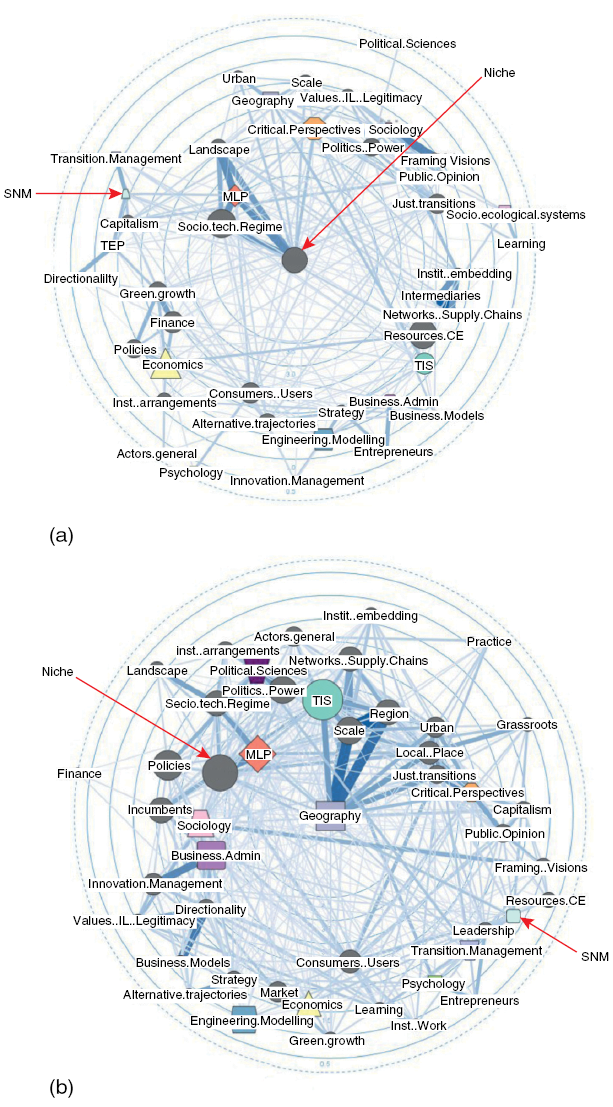
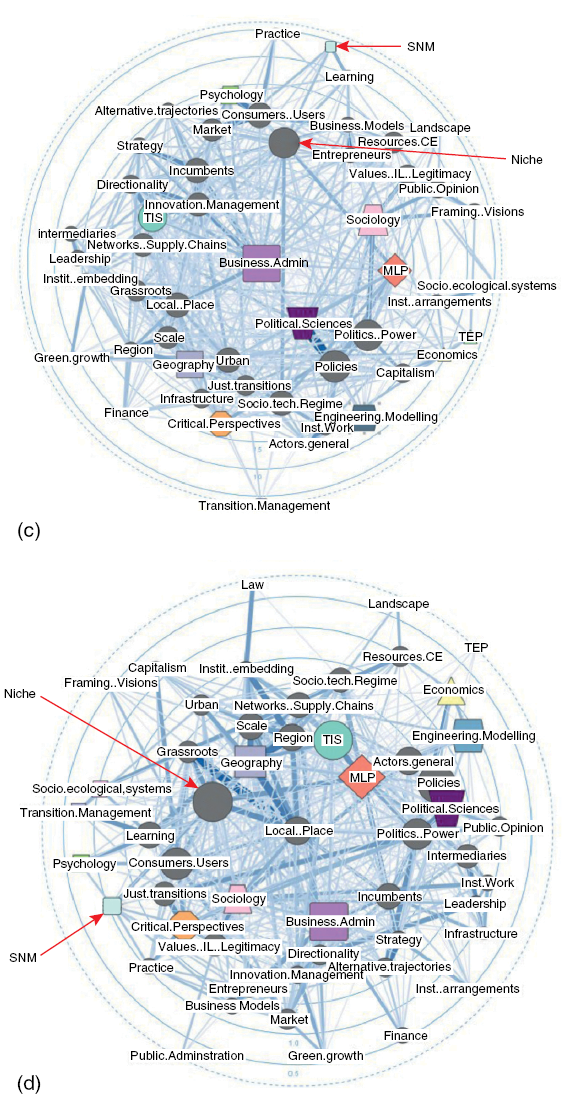
The concepts of niches and experimentation, which are central to the idea of SNM as Section 5.3 will further explore, have also been influenced by and influencing other frameworks in transition studies (Figure 5.2). In the original approach to Transition Management (Loorbach, Reference Loorbach2010), the idea of experimentation is one of four activities in the transition management cycle. In the MLP (Geels, Reference Geels2002), niches are one of three analytical levels considered to be central in shaping sustainability transitions. And in the Technological Innovation Systems approach, ideas on niches and experimentation are routinely mentioned in relation to entrepreneurial activities and market formation. See Chapters 2–4 for further discussion of these frameworks.
Niches and experimentation in foundational sustainability transitions frameworks TM
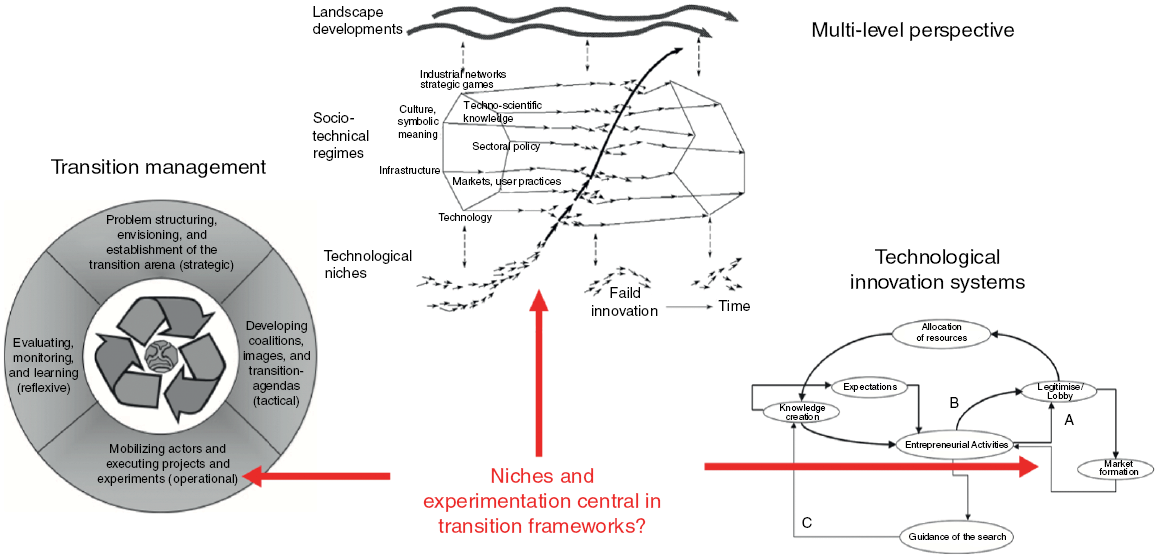
5.3 Background and Early Developments
The early development of SNM took inspiration from three fields of research: evolutionary economic theories on technological change, Science and Technology Studies (STS) and historical research. Evolutionary theories were mobilised to unpack how processes of variation, selection and retention explain radical change and stability in technological innovation, and the role of niches as protective spaces in technological evolution against the backdrop of path-dependent regimes. STS was mobilised to unpack the role of actors and agency in these processes, including the role of expectations, learning and social networks. Historical research provided ample empirical examples and illustrations of historical transitions. The next paragraphs will elaborate on this.
From evolutionary economic theories, in the work of scholars such as Dosi (Reference Dosi1982) and Nelson and Winter (Reference Nelson and Winter1982), a key starting point was that technological change can be best understood as evolving through processes of variation, selection and retention – like biological processes of Darwinian evolution (Raven, Reference Raven2005). Technological variation refers to the discovery and creation of new inventions and innovations, for instance in corporate R&D laboratories. Like new biological species, such innovations become successful or forgotten through processes of selection – referring to markets and users preferring certain innovations over others. Retention in economic evolutionary theory generally is used to consider shared heuristics and routines that engineers and other actors in the variation environment develop to guide their R&D processes, as they learn what users and markets prefer. This ultimately gives rise to technological change as a structured process that occurs through technological trajectories, leading to dominant designs that undergo incremental change once dominant. Only under rare, punctuated circumstances, or as a result of long evolving processes of incremental change, prior dominant designs may loose ground to new ones. Dosi (Reference Dosi1982) used the notion of ‘technological paradigm’ to indicate the structuring nature of shared heuristics and routines, while Nelson and Winter (Reference Nelson and Winter1982) referred to ‘technological regimes’.
Early transition and SNM scholars such as Ari Rip, Johan Schot and Rene Kemp, and later on Frank Geels, took inspiration from evolutionary reasoning too (in economics, but also adjacent evolutionary thinking in for instance management theory or biological evolution, e.g. Leventhal, Reference Levinthal1998; Schot and Geels, Reference Schot and Geels2007), but grounded their perspectives in insights from Science and Technology Studies and historical studies of technology. They were inspired by and contributed to STS research on large technical systems (Hughes, Reference Hughes1983), social construction of technology (Bijker et al., Reference Bijker, Hughes and Pinch1989) and sociology of expectations (Lente, Reference Lente1993). Their work firmly added attention to actors and agency in evolutionary processes of generating variations, as well as broadening and unpacking the role and dynamics of the selection environment. For instance, particular emphasis was put on user involvement in niche experimentation to shape learning about their preferences or the need to involve policymakers earlier on to inform debate about regulating the potential negative impacts of new innovations (Hoogma et al., Reference Hoogma, Kemp, Schot and Truffer2002). More attention for actors and agency in processes of variation led Rip (Reference Rip1995) and Schot (Reference Schot1998) to propose a quasi-evolutionary theory of technological change, which argues that, in contrast to biological evolution where variation through gene mutation is an undirected and ‘blind’ process, in technological change variation is to some extent socially constructed. Engineers not only anticipate future selection environments for their innovations but also actively engage in shaping them, for instance through educating users or lobbying regulators or financial institutions.
Broadening and unpacking the role of the selection environment involves moving from a narrow economic view of selection pressures (prices) to a more multi-dimensional and socio-technical understanding of what shapes selection pressures, including institutional pressures such as policy frameworks, financial framework conditions or social norms, as well as technological aspects such as the type and characteristics of material infrastructures that are build up in co-evolution with the diffusion of prior dominant innovations (such as existing road infrastructure favouring car mobility over active or public transport). Naturally, this also broadened the types of actors that need to be included in transition analysis (and governance frameworks) beyond firms and end-users, to include attention for social groups such as policymakers, NGOs, community groups, civil society organisations or financial institutions, each of which engages with transitions with particular capabilities, resources, needs and interests. Geels (Reference Geels2004) captured this debate and reframed the original notion of ‘technological regime’, defined by Rip and Kemp (Reference Kemp, Schot and Hoogma1998) as ‘the grammar or rule-set embedded in a complex of engineering practices, production process technologies, product characteristics, skills and procedures, ways of handling relevant artefacts and persons, ways of defining problems – all of them embedded in institutions and infrastructures’. Geels (Reference Geels2004) extended this definition by incorporating social groups beyond engineers, and selection pressures beyond the variation environment, and referred to this as ‘socio-technical regimes’.
Historical research (Schot, Reference Schot1998) into how large-scale, paradigmatic technological change evolves as well as contemporary case study research on sustainable transport (Hoogma et al., Reference Hoogma, Kemp, Schot and Truffer2002) has further informed the early development of SNM, and in particular by putting the centre stage and unpacking the role of ‘niches’. The basic argument put forward is that because of the structured nature of socio-technical regimes and associated selection pressures for radical innovations, radical innovations that substantially deviate from the dominant design, will generally have a hard time surviving in pre-existing selection environments. Niches (defined as protective spaces), such as geographically dispersed areas where infrastructure is underdeveloped, or market niches where environmentally conscious consumers are willing to pay higher prices for lower performance, provide space for the early survival and development of radical innovations, because they shielded these innovations from mainstream selection pressures. Through a process called niche branching – innovations moving and diffusing from one niche to another – radical innovations improve and adapt, and ultimately compete and diffuse into mainstream markets.
SNM scholarship further proposes that insights into these patterns of radical technological change can provide ground for a new, evolutionary-informed approach to deliberate policy design for managing regime shifts to sustainability. Kemp et al. (Reference Kemp, Schot and Hoogma1998) comprehensively spell out this perspective and argue that niches can be deliberately created by experimenting with innovations in real-life contexts such as in pilot and demonstration programs and, more recently, in living labs. Empirical research finds that successful experimentation and strategic niche management enable key internal niche processes (Hoogma, Reference Hoogma2000; Raven, Reference Raven2005). Three types of processes are highlighted and characterised: (1) articulation and coupling of expectations in a way that they become shared, tangible and specific; (2) facilitating multi-dimensional and reflexive learning processes that question underpinning assumptions; and (3) the formation of heterogenous and deep social networks that build a constituency behind an innovation. Weber et al. (Reference Weber1999) further formulated seventeen management suggestions that policymakers and innovators can use to implement a Strategic Niche Management approach in practice.
This initial phase of developments and research into SNM in the 1990s and early 2000s has led to two broad reflections and critiques. The first critique that was voiced as early as 1995 pointed to experimentation and niche development occurring outside of the formal structures of government, firms and research organisations. Verheul and Vergragt (Reference Verheul and Vergragt1995) argue that in the development of environmental technologies, many initiatives are taken by citizen groups or non-governmental organisations. Through three cases of windmill cooperations, wastewater treatments and freezers, they propose the notion of social niche management to foreground these developments and their relevance in regime shifts and sustainability transitions. In a similar vein, others have pointed to the role of non-state and non-corporate actors in countries that gave rise to early renewable energy transitions such as Denmark (Garud and Karnoe, Reference Garud and Karnøe2003) and Germany (Dewald and Truffer, Reference Dewald and Truffer2011). This line of thought has been echoed and advanced in grassroots innovation research. Seyfang and Smith (Reference Seyfang and Smith2007) elegantly contrast market-based innovation with grassroots innovation, characterising the latter as innovation and experimentation occurring in the social economy rather than the market economy; driven by social needs and different types of values than profit, prices and policies; occurring through a range of organisational forms such as voluntary and informal community groups; and drawing on resources beyond commercial ones, including voluntary input, civil society grants and mutual exchanges. Subsequent empirical work into the transition town movement (Seyfang and Haxeltine, Reference Seyfang and Haxeltine2012) and community currency (Seyfang and Longhorst, Reference Seyfang and Longhurst2015) explored the relevance and limitations of SNM in these grassroots contexts. Building on this and other SNM work, Smith et al. (Reference Smith, Fressoli, Abrol, Arond and Ely2016) reflect that experimentation in grassroots contexts has a pivotal role in critiquing and challenge regimes and pointing towards alternative, emancipatory development trajectories and policy agendas.
A second reflection on the limitations of SNM is offered in Hoogma et al. (Reference Hoogma, Kemp, Schot and Truffer2002). Synthesising the results from a multi-year research program into sustainable transport, they argue that ‘For one thing, we were certainly over-optimistic about the potential of SNM as a tool for transition. The positive circles of feedback by which a technology comes into its own and escapes a technological niche are far weaker than expected and appear to take longer than expected (5 years or more)’. This critical observation informed a new research direction in SNM that was oriented towards (1) analysing niche dynamics over longer periods of time, and (2) improving understandings of niche–regime interaction. Following and comparing the development of biogas technologies in the Netherlands and Denmark, Raven (Reference Raven2005) and Geels and Raven (Reference Geels and Raven2006), informed by Hård (Reference Hård1991) and Deuten (Reference Deuten2003), reconceptualised niche development as occurring through both local and global processes (Figure 5.3). Local processes refer to the experimentation in particular places and projects, whereas global processes refer to the aggregation of local knowledge into shared socio-cognitive structures through constructs such as shared agendas, search heuristics, expectations and theories. I refer to Chapter 11 in this book for further discussion on niche–regime interactions.
The local-global model of strategic niche management
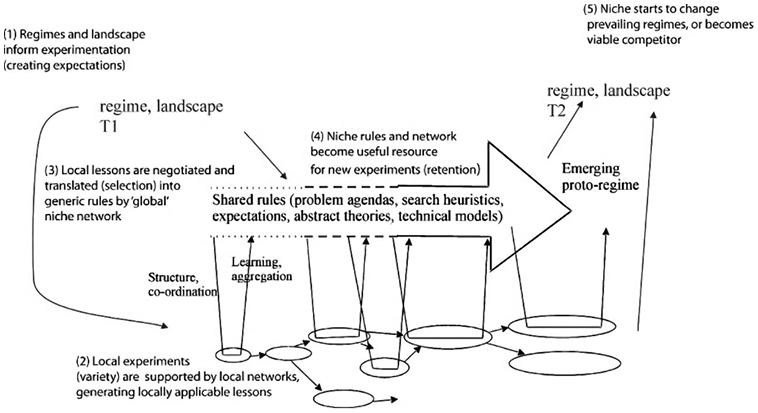
With a growing and expanding transitions research community and increasing visibility of ongoing sustainability transitions in the real world, by the early 2010s sustainability transitions scholarship branched into new topical and scholarly directions, and in particular topics related to political, geographical and institutional aspects of transitions. This is also reflected in new directions for SNM research scholarship, which I will discuss in Section 5.4.
5.4 Elaborations of SNM
5.4.1 The Politics of SNM
Research on the politics of SNM has been influenced by a broader movement in the transition studies field to engage with questions around politics and power. This was the result of scholarly reflections on initial applications of transition thinking in policy processes, such as in the energy transition policies in the Netherlands (Kemp et al., Reference Kemp, Rotmans and Loorbach2007; Hendriks and Grin, Reference Hendriks and Grin2007, Smith and Kern, Reference Smith and Kern2009). This was also informed by more attention for the governance of sustainability transitions (Smith et al., Reference Smith, Stirling and Berkhout2005; Voss et al., Reference Voss, Bauknecht and Kemp2006), understanding and unpacking power in transitions (Avelino, Reference Avelino2011), as well as scholarship in adjacent communities such as human geography that started to offer critical reflections (Shove and Walker, Reference Shove and Walker2007).
Research on the politics of SNM particularly focussed on unpacking the concept of protective space. An initial critique of this notion of protection is offered by Hommels et al. (Reference Hommels, Peters and Bijker2007a) who pitched SNM against another framework for introducing radical innovations, called PROTEE. While the resulting brief exchange (Geels and Schot, Reference Geels and Schot2007; Hommels et al., Reference Hommels, Peters and Bijker2007b) following the original publication did not pick up on it, Hommels et al. (Reference Hommels, Peters and Bijker2007) made the relevant observation that, in contrast to the PROTEE framework, SNM has an explicit political objective, which is aimed at realising sustainable development through the promotion of new innovations. Another relevant contribution is made in the PhD thesis by Ulmanen (Reference Ulmanen2013), who extends SNM with a discourse analysis approach to show how different outcomes between biofuel developments in the Netherlands and Sweden can only be understood if it is considered how dynamics in diverse biofuel advocacy coalitions and policy discourses in the Netherlands were more mutually exclusive and antagonistic than in the more collaborative Swedish context. These differences are in turn related to different national industrial structures and histories. This politically informed analysis of niche protection (see also Byrne, Reference Byrne, Mbeva and Ockwell2018) provides an improved understanding of the shrinking and/or growing of protective space.
Smith and Raven (Reference Smith and Raven2012) and Raven et al. (Reference Raven, Kern, Verhees and Smith2016) expand on these debates. The key idea introduced and explored through this work is to move SNM beyond a focus on protection as shielding and nurturing new innovations (which is labelled as inward-oriented niche development work), to incorporate analytical attention for the outward-oriented, socio-political work that niche advocates engage in. This work involves the different types of activities that niche advocates such as advocacy groups, trade associations, entrepreneurs, social movements, user groups, engaged academics or political leaders undertake to create and shape empowering narratives supporting a particular niche innovation. Empowerment is a political process, because it is characterised by an interplay of multiple actors and their (divergent or converging) interests. As Smith and Raven (Reference Smith and Raven2012: 1032) argue: ‘Not all actors enter into these negotiations equally: some are able to exercise greater influence owing to their resource attributes, experience, institutional positions and connections with other influential actors, all relative to the task in hand; but neither does any single actor, such as an industrial lobby, or a government department, have sufficient power to force through decisions, strategies, and implementation activities unilaterally’. Smith and Raven (Reference Smith and Raven2012) furthermore characterise and contrast two overarching empowering narratives, i.e. fit-and-conform versus stretch-and-transform narratives. The objective in fit-and-conform narratives is to convince the wider social world that the niche can become competitive within conventional regime criteria and selection pressures. That is, the innovation will ultimately be able to perform profitably in existing markets and does not require radical changes to regime structures. The objective of stretch-and-transform is to convince the wider social world that the rules of the game need to be changed. The selection pressures constituted by prevailing regimes need to be transformed for niche innovations to flourish, which means that the political challenges to convey stretch-and-transform narratives are substantially larger than for fit-and-confirm narratives. Subsequent case study research in domains such as energy (Raven et al., Reference Raven, Kern, Verhees and Smith2016) and health (Boon et al., Reference Boon, Moors and Meijer2014) illustrate the relevance of this approach in understanding the political dynamics of SNM.
5.4.2 The Geography of SNM
Like attention for the politics of SNM was influenced by a ‘political turn’ in sustainability transitions literature, around the early 2010s a ‘spatial turn’ (Coenen et al., Reference Coenen, Benneworth and Truffer2012; Truffer et al., Reference Truffer, Murphy and Raven2015) in the transitions community influenced and was shaped by emerging critiques of a lack of attention for geography in sustainability transitions. Three debates and questions on the geography of sustainability transitions are relevant for discussing the geography of SNM (Coenen et al., Reference Coenen, Benneworth and Truffer2012). First, geography of transitions research questions the relative naivety in the ways in which prior transitions research has engaged with spatial questions and concepts. Concepts such as space, scale, upscaling, level and place are routinely used in transition studies, without reference to long-standing debates in geography. Second, geography of transitions points attention to the uneven distribution of where transitions happen and why they happen where they happen. Third, geography of transitions research critiques pre-existing transitions literature for conflating systems levels with spatial scales and lacking attention for multi-scalar dynamics and points to a need to look beyond the national scale as the only scale at which transition dynamics unfold.
Together, these critiques and developments translated into several new research themes and dynamics in SNM scholarship. For one, a vivid and rapid expansion of research in urban studies scholarship on experimentation and urban living labs has led to a very productive expansion of research outputs and debates extending way beyond the boundaries of SNM scholarship. This has resulted in diverging views on what experimentation entails and with what purposes actors engage with experimentation. In traditional SNM research experimentation is conceptualised as a mechanism to nurture and grow radical innovation with a view to influence system-level transitions towards sustainability. Sengers et al. (Reference Sengers, Wieczorek and Raven2019), based on a systematic review of experimentation literature in the context of sustainability transitions, capture this focus in their definition of an experiment: ‘an inclusive, practice-based and challenge-led initiative designed to promote system innovation through social learning under conditions of uncertainty and ambiguity’. They also recognise, nevertheless, an emerging stream of urban geography literature on experimentation and living labs. In contrast with the innovation focus in sustainability transitions literature, urban geography literature focuses on governance dynamics in the context of urban politics. Bulkeley and Castán-Broto (Reference Bulkeley and Castán Broto2013), Bulkeley et al. (Reference Bulkeley, Castán Broto and Edwards2014), Evans et al. (Reference Evans, Karvonen and Raven2016) and Marvin et al. (Reference Marvin, Bulkeley, Mai, McCormick and Palgan2018) all observe and analyse a global mushrooming of urban experimentation and urban living labs taking place in the context of city governments and other urban actors seeking new ways of governing and navigating the political complexities of responding to climate change and other societal challenges and technological developments (such as smart cities). These contributions often take a critical perspective on the neoliberal conditions within which this navigation is framed and taking place.
Coenen et al. (Reference Coenen, Raven and Verbong2010) provide an early response to critiques of spatial naivety in SNM studies by extending and ‘spatialising’ niche-based frameworks through the concept of proximity. Proximity is a concept from economic geography that reflects the notion that innovation tends to be geographically uneven, and often concentred in regional clusters in which knowledge, networks and institutions have developed over longer periods of time. Drawing on five types of proximity (cognitive, organisational, social, institutional and geographical) as identified by Boschma (Reference Boschma2005), Coenen et al. (Reference Coenen, Raven and Verbong2010) find in a case study on the Dutch thermal aquifer storage niche that proximity relationships in local experimentation indeed improve understandings of scaling and aggregation into a global niche level. However, they also find that proximity literature can benefit from incorporating a more agency-based and dynamic perspective on proximity advantages and should acknowledge that too much proximity can also inhibit innovation processes.
Raven et al. (Reference Raven, Schot and Berkhout2012) further expand on spatialising the niche concept in the context of the MLP. This contribution makes an explicit attempt to incorporate a spatial scale into the MLP, which is an extension of the two existing scales of temporality and structure in the MLP. In the conventional MLP, the niche level is considered to operate at a temporal scale of 0–10 years and is conceptualised as a protective space that shields experimentation from mainstream regime structures. Mobilising insights from proximity theory and conceptualising space from a relational perspective, a spatial scale of the niche level is then proposed to consist of networks that exhibit relatively low levels of proximity and power, relative to the regime and landscape levels. This reconceptualisation of the MLP allows for analysis of transition dynamics that take multi-scalar spatial dynamics into account (see Box 5.1 for an example of transition dynamics from a multi-scalar perspective). This also allows for better accounting for the ways in which the spatial heterogeneity of regimes shapes the uneven spatial emergence of niche innovation, as demonstrated for car-sharing in the Netherlands by Meelen et al. (Reference Meelen, Frenken and Hobrink2019).
1. Transitions evolve through a process of multi-scalar interactions (time, structure, space);
2. The spatial reach of niches, regimes and landscapes is not a given. Space is always negotiated and constructed by networks of actors;
3. Actor networks allow for the distribution of flows such as knowledge, money and natural resources between socio-spatial locations;
4. Socio-technical regimes are nested both horizontally and vertically (for instance, electricity regimes have national, international and regional features) and specificities (vertically nested), as well as exhibiting horizontal differentiation between regimes for households, large industries and so on (horizontally nested);
5. The multi-level nesting of regimes is a source for tensions and misalignments, which can be mobilised by actors in attempts to vision and innovate alternative spaces (niches);
6. Nested regimes have spatially differentiated features; specific niches are more likely to materialise in reconfigured networks and infrastructures in some places than in others, which offer initial spaces for innovative practices;
7. Spatially situated niches can become (inter)nationally connected through existing or new networks and reconfigure the flows constituting them and the institutions developed to regulate them;
8. To trace how these new connections are made, by whom, when and where are of particular importance for a multi-scalar analysis, because it would provide insight into how and where niches may be upscaled and come to shape regime shifts;
9. Niches can also remain localised initiatives and stabilise into sub-national regimes, when they stay disconnected from (inter)national spaces, or become international niches when they become connected, but fail to reconfigure existing regimes;
10. Socio-technical landscapes tend to be transnational since they are the results of choices made in many spatially distributed and (partially) connected regimes. Yet, at the same time, landscapes might be perceived differently by spatially separated regime and niche actors and therefore exert a different influence over their development.
Another area of SNM research responding to geographical critiques has investigated the ways in which international relations influence niche dynamics and experimentation, in particular as occurring in the global south and between the global south and the global north. Wieczorek et al. (Reference Wieczorek, Raven and Berkhout2015) develop a typology of transnational linkages consisting of actors, knowledge, capital, institutions and technology and identify their existence or absence in 65 solar PV experiments in India, including lanterns, grid connected PV systems, solar home systems, micro-grids, off grid power plants, rooftop solar and solar cities. They find a total of 214 out of 325 possible linkages in the sample, indicating a strong international presence in the Indian PV experimentation portfolio. Wieczorek et al. (Reference Wieczorek, Raven and Berkhout2015) acknowledge their work did not include an assessment of the influence or challenges present in transnational linkages. Hansen and Nygaard (Reference Hansen and Nygaard2013) through a case study of donor interventions in the palm oil biomass waste-to-energy niche in Malaysia provide additional evidence about the role of transnational linkages in niche development, but also raise concerns about challenges in the mobility of energy policy across diverse nations and cultures.
Sengers and Raven (Reference Sengers and Raven2015) also take a relational perspective to unpack the supranational networks and dynamics that influence the diffusion of Bus Rapid Transit systems from South America to Asia in particular. Drawing on human geography literature on buzz-pipelines, global production networks and policy mobilities they identify and characterise how multi-scaler international arenas of mobility-experts-cum-advocates shape mobilities of niche innovations across national borders, and into global circulation. The case study also demonstrates how experimentation is both anchored in and influenced by sectoral regime structures as well as territorial, place-based structures and they argue that national actors in this way continue to play an important role in SNM, for instance in relation to fundraising and providing political legitimacy to projects. This contribution (see also Fontes et al., Reference Fontes, Sousa and Ferreira2015) recasts the upscaling and global diffusion of niche experimentation from a ‘mechanistic’ aggregation perspective in the traditional local-global niche model into a deeply agentic and political process.
A final stream of geography informed SNM research that I will discuss here are several contributions that are concerned with exploring what makes certain contexts and environments conducive to experimentation and niche development. Torrens et al. (Reference Torrens, Johnstone and Schot2018) argue that SNM research has extensively explored how protective spaces for experimentation emerge, but only deals in a limited way with why this happens in particular places, and how these places evolve to become experimental. Through a historical case study of the Bristol civic energy scene, they show how Bristol has become a vibrant place for energy experimentation through four phases, each of which is characterised by patterns of experimentation and modes of governing, and each reconfiguring the city context, which set the stage for the next phase. Ultimately, this leads to a city with vibrant grassroots activism, municipal voluntarism, alternative milieus, strategic urbanism and municipal self-righteousness, all of which are supportive for further experimentation. Based on this pioneering work, Torrens et al. (Reference Torrens, Schot, Raven and Johnstone2019) and Heiligenberg et al. (Reference Heiligenberg, Heimeriks, Hekkert and Raven2022) broaden the framing of niches from protective spaces that offer a seedbed for innovation, to niches as harbours, and as battleground. These subsequently foreground complementary enabling functions of niches as providing connectivity and as spaces to resolve conflict, tensions and struggles (on conflicts, see also Yuana et al., Reference Yuana, Sengers, Boon, Hajer and Raven2020).
In contrast to the process approach taken by Torrens et al. (Reference Torrens, Johnstone and Schot2018), Dignum et al. (Reference Dignum, Dorst, Schie, Dassen and Raven2020) mobilise a variance approach to identify the key context factors that are conducive to experimentation. They identify seven urban factors that shape the emergence, degree of radicality and the nature of urban experimentation (social, technological or systemic). These factors are policy visions and plans, governance and stakeholder networks, localised learning processes, financial resources and funding structures, localised information institutions, natural endowments and urban materiality. Drawing on a large database of nature-based solutions they identify what characterises an innovative city environment, including factors such as stakeholder diversity, the presence of non-traditional innovators, a wide range of funding structures, diverse governance arrangements and explicit mechanisms for localised learning, including involvement of citizens.
5.4.3 Institutional Perspectives on SNM
A third development in the wider transitions literature with which SNM research has co-evolved relates to institutional perspectives. Institutional perspectives on sustainability transitions offer critique and insights into two aspects of sustainability transitions (Fuenfschilling, Reference Fuenfschilling2019). The first aspect relates to addressing and advancing understanding of the heterogenous nature and semi-coherence of socio-technical regimes, drawing on insights from literature such as institutional logics (Fuenfschilling and Truffer, Reference Fuenfschilling and Truffer2014) and institutional pillars (Geels, Reference Geels2004). From an institutional perspective, regimes differ in their degree of institutionalisation and coherence (see also Chapter 11). Moreover, regimes display different degrees of coherences and institutionalisation across territories (Fuenfschilling and Binz, Reference Fuenfschilling and Binz2018). The second aspect relates to accounts of actors and their embedded agency. Drawing on institutional work and institutional entrepreneurship (Hoogstraaten et al., Reference Hoogstraaten, Frenken and Boon2020), this branch is concerned with investigating how actors that are embedded within institutional fields and subject to regulative, normative and cognitive pressures, are able to envision and enact divergent change (Garud et al., Reference Garud, Hardy and Maguire2007).
SNM scholarship has engaged with these institutional debates. With regards to heterogeneity of regimes, as mentioned earlier, Meelen et al. (Reference Meelen, Frenken and Hobrink2019) investigate how the adoption of car-sharing is spatially uneven in the Netherlands, which they explain by characterising the incumbent car regime as a patchwork of localities where the regime is more or less institutionalised. Raven et al. (Reference Raven, Sengers, Spaeth, Xie, Cheshmehzangi and de Jong2017) mobilise neo-institutional literature to investigate how and why institutional arrangements for urban experimentation differ between cities. They analyse the cognitive, normative and regulative institutions that together make up institutional arrangements within which smart city experimentation in the cities of Amsterdam, Hamburg and Ningbo are embedded. They find ample differences between the cities and on that basis argue that experimentation is imprinted by unique combinations of institutions at play in each location. These institutional arrangements are considered multi-scalar as actors involved not only draw on local or regional institutions (such as the presence of research organisations) but also on what arguable are national institutional characteristics, such as national governance styles and policy programmes. Likewise, in each case, strategic work to develop institutional arrangements tapped into the wider institutional environments across national boundaries (such as EU Funding and transnational learning). In a similar vein, van Waes et al. (Reference Waes, Farla and Raven2020) demonstrate how bike-sharing entrepreneurs strategically responded very differently to diverging institutional pressures in localised regimes in Amsterdam versus Shanghai.
With regards to accounts of actors and agency through a lens of institutional theory, several contributions use institutional theory to explore the role of actors and agency in the Australian water sector transition (Brown et al., Reference Brown, Farrelly and Loorbach2013; Fuenfschilling and Truffer, Reference Fuenfschilling and Truffer2016). Van Doren et al. (Reference Doren, Runhaar, Raven, Giezen and Driessen2020) (see also Jolly et al., Reference Jolly, Spodniak and Raven2016) mobilise a typology of institutional work to investigate the type of agency niche actors undertake to influence their institutional environments. They characterise 13 intermediary organisations in the Dutch low-carbon housing niche as institutional entrepreneurs that are mobilising political, technical and cultural strategies to develop the niche and transform the incumbent build environment regime. They find that these strategies differ depending on the context in which intermediaries are operating. For instance, market-based intermediaries mobilise only political strategies (such as coalition building) and technical strategies (such as standardisation efforts), whereas community-based intermediaries also draw on cultural strategies such as the creation of new identities. They also find that intermediaries that are oriented towards directly influencing regimes (rather than creating and maintaining niche institutions) also engage in lobbying strategies and efforts to educate and raise awareness. Similar findings have been reported by Kivimaa (Reference Kivimaa2014) and Bush et al. (Reference Bush, Bale, Powell, Gouldson, Taylor and Gale2017), who both mobilise SNM scholarship to explore the role of intermediary organisations in system-level transitions, as well as by Farrelly and Brown (Reference Farrelly and Brown2011) who use the notion of bridging organisations as critical agents in changing regimes so that they become conducive to niche experimentation. For more discussion of the role of intermediaries, see also Chapter 20.
5.5 SNM in Practice: Challenges and Ambiguities
SNM has been predominantly used as a tool for analysing niche developments and experimentation and making recommendations based on those analyses. A few attempts have been made to codify and generalise these lessons into guidelines, toolkits and handbooks for managing and designing experiments, niches and transition pathways more generally (Weber et al., Reference Weber1999; Caniels and Romijn, Reference Caniëls and Romijn2008; Raven et al., Reference Raven, van den Bosch and Weterings2010; Ceschin, Reference Ceschin2014). While there are limitations to what can be prescribed for managing niches and transitions, because of their non-linear and long-term dynamics, such attempts are arguably useful for conveying knowledge to a non-academic audience. Most recently, Schraven et al. (Reference Schraven, Arghandeh Jouneghani, Jonkers and Hertogh2021) propose that SNM can be used to enhance design thinking by increasing the preparedness of an innovation team for a successful market implementation of sustainable innovations. These developments in SNM scholarship align with broader engagements in the field of sustainability transitions that aim to position transition scholarship in relation to innovation policy debates (Nill and Kemp, Reference Nill and Kemp2009; Schot and Steinmueller, Reference Schot and Steinmueller2018), in relation to design disciplines (Ceschin and Gaziulusoy, Reference Ceschin and Gaziulusoy2016), as well as in embedding transition perspectives directly into policy design (Geels et al., Reference Geels, Turnheim, Asquith, Kern and Kivimaa2019).
Besides making recommendations or positioning SNM in wider policy and innovation debates, several contributions in SNM scholarship offer reflections on the challenges and ambiguities involved in doing SNM in practice. An early warning came from Lovell (Reference Lovell2007) who contrasts the development of the UK low-energy housing niche with recommendations in SNM theory. She argues that SNM needs to paid more attention to the messiness and non-linearity of socio-technical systems change, an insight that is supported by findings by Verhees et al. (Reference Verhees, Raven, Veraart, Smith and Kern2013) and Smith et al. (Reference Smith, Kern, Raven and Verhees2014) regarding solar PV niche developments in the UK and the Netherlands. Van Waes et al. (Reference Waes, Nikolaeva and Raven2021) confront insights from SNM with actual experiences in four smart cycling living labs. They find that creating a shared vision, aligning expectations and facilitating learning processes are considered most challenging by participants in the living labs, while creating broad and deep networks is less challenging. They also find that experimentation is deeply shaped by local political agendas and resources and that terminology on niches, experimentation and living labs may itself be contested or confusing. Regarding the latter, see also Heiskanen et al. (Reference Heiskanen, Jalas, Rinkinen and Tainio2015) who argue that SNM scholars engaging in experimentation involving ordinary people should attend to the social and personal reasons why these people engage in experimentation and, importantly, why they might quite sensibly be averse to a great degree of experimentalism, and for good reasons be risk-averse and not willing to accept failure.
Recently, Hodson et al. (Reference Hodson, Geels and McMeekin2017) and Sharp and Raven (Reference Sharp and Raven2021), echoing Lovell’s earlier concerns, have started to highlight the complexity, ambiguity and multiplicity within and through which experimentation in cities evolve, and that there is a need for SNM and experimentation to find ways to accommodate this. Torrens and von Wirth (Reference Torrens and von Wirth2021) warn of a ‘projectification’ of urban experimentation and provide three suggestions to address this: don’t assume that experiments should work as projects; render traditional projects more experimental; and establish hybrid spaces that mediate between projects, experiments and permanent organisations. Bulkeley (Reference Bulkeley2023) suggests we may be entering a condition of permanent urban experimentation and that it may neither be possible nor even desirable to return to more centralised and controlled responses to climate change. These emerging insights on the challenges and ambiguities of SNM suggest that future research on SNM and experimentation continues to be necessary and relevant to understanding and governing transitions in the context of major societal challenges. Section 5.6 provides a few directions for future research.
5.6 Outlook and Conclusion
This chapter has presented an overview of SNM scholarship since its inception in the early 1990s. SNM has been a cornerstone in the development of the wider sustainability transitions field as a foundational framework. Ideas, concepts and arguments on niches and experimentation have informed and been influenced by evolving agendas in the field. In this section, I briefly highlight several themes for future research. First, SNM scholarship and practice should pay more attention to engaging with ordinary people, behaviour change and everyday perspectives (Verbong et al., Reference Verbong, Beemsterboer and Sengers2013; Heiskanen et al., Reference Heiskanen, Jalas, Rinkinen and Tainio2015; Kaufman et al., Reference Kaufman, Saeri, Raven, Malekpour and Smith2021; Sharp et al., Reference Sharp, Pink, Raven, Farrelly and Araújo2022). How can ordinary people, their behaviours and practices, and everyday sites such as households (Raven et al., Reference Raven, Reynolds, Lane, Lindsay, Kronsell and Arunachalam2021) inform deliberate processes of experimentation and SNM. Second, SNM scholarship could engage in debates on incumbency and discontinuation (Turnheim and Geels, Reference Turnheim and Geels2019). Can deliberate experimentation with discontinuing unsustainable practices and technologies inform the acceleration of sustainability transitions? Third, SNM scholarship and practice can engage in debates on just transitions (Jenkins et al., Reference Jenkins, McCauley, Heffron, Stephan and Rehner2016). How can distributional, recognition and procedural justice be (better) accounted for in niche experimentation? Fourth, and finally, SNM scholarship can broaden its methodological preference of case studies to include approaches such as modelling, qualitative comparative analysis, large-scale database approaches, ethnographic methods and action research.
6.1 Introduction
Social practice theories (SPT) have become increasingly prominent in sustainability transitions research. By drawing attention to everyday life and social dynamics as key issues in sustainability transitions alongside technologies, infrastructures and policies (e.g. Sovacool et al. Reference Sovacool, Hess and Cantoni2021), SPT provide valuable contributions to transition research and practice. Notably, SPT neither focus on individual behaviour nor on structures. Instead, they view practices as central and the most crucial unit of analysis, emerging from and at the same time shaping (structures and infrastructures) structures and behaviours. SPT therefore can be, and already are, fruitfully utilised as an alternative and to some extent complementary perspective on sustainability transition models, such as the Multi-level perspective (MLP), to identify, explain and address the social dynamics of change.
In this chapter, we will show how SPT can be used to study – as well as to bring about – innovations (Backhaus et al. Reference Backhaus, Genus and Lorek2018) and disruptions (Kivimaa et al. Reference Kivimaa, Laakso, Lonkila and Kaljonen2021) in sustainability transitions. We start by providing a concise overview of SPT, of what practices are and how they change. After that, we showcase an example of an SPT-inspired change initiative and discuss the main differences, similarities and synergies of SPT and MLP. We end with outlining some of the ongoing debates and further research needs.
6.2 What Are Social Practice Theories?
SPT build on many scholarly traditions, including sociology, science and technology studies, anthropology and pragmatism; as well as on several theories such as structuration theory and actor-network theory and on methodologies like phenomenology and ethnomethodology (see, e.g. Shove et al. Reference Shove, Pantzar and Watson2012; see also Table 6.1). The historical development of SPT can be divided into three phases, starting from works of Pierre Bourdieu, Anthony Giddens and Michel Foucault, among others, who during the 1970s and 80s sought to address and resolve the agency-structure dilemma (Warde Reference Warde2014). Although the conceptual roots of SPT thus stretch further into history, the works by the second phase theorists like Andreas Reckwitz (Reference Reckwitz2002), Theodore Schatzki (Reference Schatzki2002), Elizabeth Shove (Reference Shove2003) and Alan Warde (Reference Warde2005), explored the dynamics of practices, thereby paving the way for SPT to become one of the main theoretical approaches in numerous social science research fields from consumption to organisational studies (and many other fields, see e.g. Nicolini Reference Nicolini2013; Shove Reference Shove2023). This so-called ‘practice turn’ in contemporary social theory (Schatzki et al. Reference Schatzki, Knorr-Cetina and Von Savigny2001) inspired the third phase, characterised by applications of the theory in diverse empirical settings, including research and policy programmes directed at sustainability transitions. As this theoretical and empirical variety suggests, there is no one grand or synthetic version of SPT, but rather different ways of theorising social practices with strong ‘family resemblances’ (see Nicolini Reference Nicolini2012: 9).
| MLP | SPT | |
|---|---|---|
| Main theoretical roots and inspirations | Structuration theory (conceptualisation of rules and resources, practices as phenomena ‘between’ agents and structures, e.g. Giddens) Actor-network theory (e.g. Latour) | |
| Evolutionary economics (e.g. Nelson and Winter) Neo-institutional theory (e.g. DiMaggio and Powell, Scott) Various strands of Science and Technology Studies (e.g. Hughes, Law, Callon, Bijker, etc.) | Philosophical: phenomenology (e.g. Heidegger), language and rules (e.g. Wittgenstein); pragmatism (e.g. Dewey and Mead). Social: praxeology (e.g. Bourdieu), bodies, agency and knowledge (e.g. Foucault), neo-hermeneutical model (e.g. Taylor); ethnomethodology (e.g. Garfinkel) | |
| Understanding of the properties of social phenomena | Duality of agency and structure, overcoming dualism Relational approach to social phenomena Neither subjects nor objects seen as taking supremacy | |
| Ontological assumptions about the organisation of the social | Various degrees of structuration and/or institutionalization | |
| Involves levels of niche, regime, landscape as a nested hierarchy, later MLP (e.g. Geels Reference Geels2011): hierarchy concept less prevalent (see next row) | Involves a flat ontology of nexuses of practices, with no hierarchy between practices or practice elements | |
| Explanatory scope | Socio-technical transition over a course of time, with an emphasis on transition pathways | General principles of the social and cultural world, including but not solely about social change |
| Main constitutive concepts | Routines as important ways of understanding social action Rules as both medium and outcome of social action Regimes/systems and practices are configurations of interconnected elements; they cannot be reduced to any of these elements | |
| Socio-technical systems; Regimes Niches Landscapes Systems comprised of elements such as markets, technologies, regulations, culture, user practices | Interlinked social practices comprised of elements (e.g. competences, meanings, materials) Regimes and landscapes can be viewed as comprised of practices, not as separate concepts | |
| Understanding of agency/subject | Non-individualism Actors as embedded in systems and practices Multi-actor approach to social change Routine-based and interpretive/creative action | |
| Agency is attributed to different actors as part of niche, regime and landscape dynamics. | Agency is distributed across elements of practices, including people as carriers of practices. | |
| Understanding of social change | Tension between reproduction of stability and emerging transitions/practices Change as a non-linear co-evolution of multiple elements, reconfiguration Processual approach Recognition of systemic lock-in mechanisms and obduracy of practices | |
| Separate developments of change in interacting niches, regimes and landscapes, emergence and transformation of systems according to different transition pathways | Changes caused by emergence, replacement or disappearance of practice elements and inter-linked practices or by changing (the population type/size of) carriers of practices | |
| Impetus and means of effecting change | Change and reconfiguration of system elements, using different measures through intervention points into niches, systems and landscape | Re-shaping of all practice elements (meanings, things, competences and interaction), re-designing their relations as well as links between practices within systems; Changing the population of practice carriers. |
| A nexus of various related factors (social relations, material objects, events, etc.) that re-shape the configuration of practice or system elements and relations between practices and systems Acknowledgement that deliberate interventions can never fully guarantee desired results, societal change cannot be driven from a ‘cockpit’ | ||
| Transfer of experience and lessons from transition efforts | All cases are socio-culturally and historically specific, the potential of transference is limited | |
| Relevant empirical objects of interest | Transformations towards ecological and social sustainability | |
A much-used definition characterises a social practice as ‘a routinized way in which bodies are moved, objects are handled, subjects are treated, things are described, and the world is understood’ (Reckwitz Reference Reckwitz2002: 250). Furthermore, a practice ‘consists of several elements, interconnected to one another: forms of bodily activities, forms of mental activities, “things” and their use, a background knowledge in the form of understanding, know-how, states of emotion and motivational knowledge’ (Reckwitz Reference Reckwitz2002: 249). Practices are hence combinations of components called elements, often divided into materials, meanings and competences (Shove et al. Reference Shove, Pantzar and Watson2012). Materials include things, technologies, tangible physical entities, the human body and other material objects. Meanings include ideas, symbolism, aspirations and other cognitive dimensions. Competences include skills, habits, knowledge and technique. These elements are brought together in the performance of practices, such as heating the home, cooking, teaching, urban planning or legislating laws. In the practice of doing laundry, for example, the skills of using detergents and different programmes of the washing machine, as well as techniques of avoiding washing and airing clothes instead, are combined with judgements of cleanliness. An important commonality of practice-theoretical approaches is a so-called flat ontology: an understanding of all social phenomena – small and large, local and global – sharing the same basic ingredients without a particular hierarchical order (Schatzki Reference Schatzki2002).
Rather than individual behaviour, technologies or social structures, social practices are the analytical focus of SPT and viewed as the core of social life. To trace and understand social change, SPT-inspired transition research therefore focuses on the ways in which practices shape and are shaped by changes in technologies, policies or infrastructures. As a central matter of concern, studies explore the extent to which social norms and cultural conventions prescribe appropriate ways of consumption and in how far shared infrastructures and the availability of goods and services shape consumption patterns. For instance, rather than considering how to get people to purchase energy-efficient washing machines, SPT investigate how and why they wash so much laundry in the first place (Sahakian et al. Reference Sahakian, Rau and Grealis2021). Doing laundry requires electricity and water and is connected to urban development, as well as to socially shared ideas of cleanliness, hygiene and care. Changes in consumption patterns can thus be difficult if they run counter to shared cultural, infrastructural and market conventions and expectations (Heiskanen and Laakso Reference Heiskanen, Laakso and Mont2019). Practices do, however, change, and next we discuss interventions in practice.
6.3 Empirical Example: ENERGISE Living Labs
Despite much of the research on sustainability transitions focusing on technological innovations, existing evidence shows that these alone do not suffice to avoid developments detrimental to life on earth. ‘Rebound effects’, referring to resources saved through increased efficiency being used elsewhere, ‘performance gaps’, denoting the failure of technologies to meet the expected energy savings in practice, and ‘value-action or attitude-behaviour gaps’, describing the lack of transfer from pro-environmental attitudes into action, have all been identified as reasons why sustainability transitions are not only a matter of technological innovation and individual behaviour change but also – or especially – of cultural conventions, social norms and systems of provision locking in the existing and escalating patterns of resource consumption. These underline the importance of the ‘social’ in socio-technical transitions (Shove and Walker Reference Shove and Walker2010). Social norms, conventions and relations have also increasingly been the target of interventions inspired by SPT. Here, to provide an example, we briefly present the EU-project ENERGISE (GA 727642), which set out to disrupt and innovate practices in heating and doing laundry through Living Labs involving real-life experimentation and co-creation of knowledge with 306 households across eight European countries.
The participating households were invited to attempt drastic changes, namely, to heat their living rooms to not more than 18°C and to reduce the amount of weekly laundry loads by half, over the course of four weeks each (preceded by a baseline and succeeded by a follow-up period) during the winter of 2018/19. The experiments addressed all elements comprising a practice by introducing new materials (such as warm socks and clothes brushes), meanings (such as critique of unsustainable practices and encouragement to experiment with alternatives) and competences (such as information on energy use and monitoring tools). On average across all countries, households reduced the temperature in their living room by 1°C and the number of weekly laundry cycles by one. Notably, the follow-up survey found that the downward trends in terms of both room temperatures and the laundry cycles continued beyond the experiments in most countries. As such, the Living Labs supported the households in innovating ways to perform their everyday practices with lower levels of energy use while still feeling sufficiently clean and comfortable (Sahakian et al. Reference Sahakian, Rau and Grealis2021). Moreover, the less energy-consuming practices seem to have persisted, based on a follow-up survey conducted among the Dutch and Finnish participants in 2023 (Matschoss et al. Reference Matschoss, Laakso and Heiskanen2024; Vasseur et al. Reference Vasseur, Backhaus, Fehres and Goldschmeding2024).
Overall, experiences and findings from the ENERGISE and similar projects on heat pumps (Judson et al. Reference Judson, Bell and Bulkeley2015), clothing (Jack Reference Jack2016), smart meters (Mela et al. Reference Mela, Peltomaa and Salo2018) and mobility (Svennevik et al. Reference Svennevik, Dijk and Arnfalk2021), among others, point to the contribution SPT can make to intervention design to facilitate transitions in everyday life. These findings do not negate the importance of more efficient and sustainable appliances and infrastructures. However, they highlight the centrality of social norms as well as the repetition of routines in the formation of more sustainable practices. SPT can hence provide an important perspective to complement transition research and practice.
6.4 Ongoing Debates between Social Practice Theories and the Multi-level Perspective on Socio-Technical Transitions
Research on transitions combining the approaches of SPT and the influential and widely used approach in sustainability transitions studies, the MLP, has burgeoned recently (see Keller et al. Reference Keller, Sahakian and Hirt2022b). Previously, Shove and Walker (Reference Shove and Walker2007) cautioned against the very idea of deliberately orienting and shaping transition trajectories as they are by necessity partially inclusive, contingent and potentially unstable due to evolving material forms and practices, while SPT and their flat ontology were criticised for their complexity and descriptive nature, supposedly lowering their ability to capture transition dynamics (Geels Reference Geels2011). The field has come a long way since (Köhler et al. Reference Köhler, Geels and Kern2019), yet combinatory studies do not attempt a synthesis of the two but rather explore and build on their complementarity while acknowledging their incompatibilities.
The conceptual premises of MLP presuppose a micro-meso-macro organisation from niches to landscapes (Geels Reference Geels2011, see also Chapter 2 in this book), while SPT stress a flat ontology. Also, there is some divergence in the respective understanding of agency: MLP attributes it to various actors on the niche, regime and landscape level (including powerful ‘incumbents’ such as market-leading energy companies or car manufacturers). In SPT, agent – the carrier of practices – is a somewhat vaguer concept which suggests targeting interventions not so much at actor groups, but at practices. This can pose difficulties for the intervention design because the borderlines between practices may be difficult to pinpoint (Vihalemm et al. Reference Vihalemm, Keller and Kiisel2015).
Further, both approaches see the source of change differently. For MLP, the basic transition ‘formula’ consists of mature niches ready to challenge the existing regime, especially if a landscape pressure (e.g. climate policy urging to retrofit houses or cut down emissions from transport) creates ‘cracks’ in the existing regime and opens windows of opportunity which enable niches to break through along specific pathways (Geels and Schot Reference Geels and Schot2007). In SPT, and as illustrated by our empirical example above, every practice contains seeds of both stability and change. The latter can emerge when practice elements are replaced with novel ones or combined differently, or if the populations of carriers of practices change. Practice-based conceptualisations of intervention distinguish types of practice change that range from novel practices emerging, modifying or substituting existing practices, to shifts in practice interlinkages and complete disruption and disappearance (Spurling et al. Reference Spurling, McMeekin and Shove2013; Keller et al. Reference Keller, Noorkõiv and Vihalemm2022a). Connections between practices may offer opportunities for more sustainable socio-material configurations, particularly through spatial and temporal organisation. By understanding how practices co-locate and co-evolve, such as within home settings or urban layouts, we can identify leverage points to alter practices toward greater sustainability (Klitkou et al. Reference Klitkou, Bolwig and Huber2022).
However, the commonalities between MLP and SPT, especially in understanding social change, are multiple: both are non-individualist and non-linear co-evolutionary approaches. They stress how human activities are always embedded in broader structures which both enable and constrain action. Over time, relatively stable configurations of social practices and socio-technical systems emerge that are characterised by lock-ins (i.e. path-dependency) and obduracy (Stanković et al. Reference Stanković, Dijk and Hommels2021). This explains why unsustainable everyday habits of driving or eating meat, firmly entrenched in modern western car-centric urban planning and meat-centric diets (embedded in specific socio-technical systems), are so complicated to ‘un-lock’.
As various studies have demonstrated, it is possible to nimbly combine MLP and SPT in a ‘zoom-in’ (granular SPT view of the unfolding of everyday action) and ‘zoom-out’ (a broader view of socio-technical systems) fashion. One fruitful line of inquiry is joining (MLP-based) vertical and (SPT-based) horizontal analysis to identify points of intersection between regimes and practices highlighting possible points of friction that can be turned into points of opportunity (Seyfang and Gilbert-Squires, Reference Seyfang and Gilbert-Squires2019). This adds complexity but also explanatory power, necessary context and detail sensitivity. For transition analysis and design this helps to avoid linear and an over-simplified ‘silver bullet’ understanding of individualistic awareness raising and behaviour change models, as well as techno-fixes that attempt to solve fuzzy socio-technical and socio-ecological problems with technological innovations only (Fuchs et al. Reference Fuchs, Sahakian and Gumbert2021: 56–58). Table 6.1 below juxtaposes the main tenets of both MLP and SPT primarily from the point of view of societal transition.
6.5 Emerging and Further Research
In this section, we point out some emerging lines of inquiry and potential avenues for further research and conceptual endeavours.
Firstly, within the field of SPT, the focus on large social phenomena is growing. Although a sizable body of existing research on everyday life and consumption has been, and still is, helpful for understanding transitions, the recent conceptualisations of, for example, trade, environmental pollution and inequality and accumulation of wealth as aspects and outcomes of relations between practices (Shove Reference Shove2023) provide a complementary perspective to transitions and generate a fundamentally different way of thinking about social change and ways to initiate it: all social phenomena are produced and reproduced through practices and it is these practices and their relations that need to change for sustainability transitions to occur.
Secondly, another emerging area is the practical application of SPT in policy making. While SPT have for years been considered as difficult in terms of their policy relevance (e.g. Keller et al. Reference Keller, Halkier and Wilska2016), the recent applications of SPT to reframe policy problems (e.g. Watson et al. Reference Watson, Browne and Evans2020) and our experiences from the ENERGISE project provide some avenues to engage policy actors with socio-technical complexity. These applications of SPT support the imagination and innovation of systems of provision that are less resource intensive than those with which we are familiar today, as well as the development of ‘disruptive practices’ (Kivimaa et al. Reference Kivimaa, Laakso, Lonkila and Kaljonen2021) such as prosumerism or veganism impacting on other practices in both systems of consumption and production.
Yet, it must be noted that SPT are hard to operationalise and hence to use for intervention design. Most challenging in this regard is the discrepancy between the clear-cut nature of the social practice as a heuristic device and the messiness of and diversity in everyday life. Aside from the difficulty to tell where one practice ends and another begins, the spatio-temporal extent of practices is hard to define. As practices are interdependent, consist of uncountable individual actions and involve complex material flows, an analysis of, for example, the environmental impacts of online shopping, becomes problematic. The comprehensiveness of SPT nevertheless points to more levers for change than simpler behavioural models, enabling more complex intervention design and analysis (for an example from the medical field, see Frost et al. Reference Frost, Wingham and Britten2020).
Thirdly, there is a need to design an integrated assessment conceptualisation and methodology that proceeds from SPT and helps evaluate the progress and success of transition-oriented interventions. Some beginnings of this have been laid out in Vihalemm et al. (Reference Vihalemm, Keller and Kiisel2015). As Watson et al. (Reference Watson, Browne and Evans2020) point out, SPT-informed policy design invites to think differently from mainstream ways of planning and evaluation and seeks ways for policy and intervention assessments to reflect complex system and practice change adequately and context-sensitively. A recent integrated framework to evaluate transformative innovation policy (Haddad and Bergek, Reference Haddad and Bergek2023) can provide useful guidance and inspiration in this regard.
Fourthly, we contend that as the sustainability transitions debate largely involves people’s relations to nature, it is noteworthy that neither socio-technical transition studies nor SPT have explicitly conceptualised the ecological dimension. Studies on resilience and complex socio-ecological systems (for the seminal texts, see e.g. Berkes and Folke Reference Berkes, Folke, Berkes and Folke1998), socio-technical transitions and social practices have so far mostly run in parallel. There is some emerging, yet scarce, literature discussing ‘socio-eco-technical systems’ (Wesselink et al. Reference Wesselink, Fritsch and Paavola2020), as well as uniting complex systems thinking and SPT (Labanca et al. Reference Labanca, Guimarães Pereira and Watson2020, Andersson et al. Reference Andersson, Lennerfors and Fornstedt2024). However, the material component in social practices, central as it may be, does not unequivocally theorise the distinction between man-made materials and environments and biophysical ones. This theoretical and empirical work on ‘socio-ecological practices’ remains to be done.
Fifthly, as has been recently highlighted in connection with multi-system dynamics research and deep transitions, there is a growing need to address justice in transition research and action, as multi-system transition creates multiple injustices between which a balance must be sought (Kanger et al. Reference Kanger, Schot and Sovacool2021; see also Chapter 16 in this book). Literature creating a dialogue between (particularly energy) transition justice and SPT is also making its first steps. For example, Sovacool et al. (Reference Sovacool, Hess and Cantoni2021) proposed an analytic framework for energy transitions from ‘cradle to grave’ where the Responsible Research and Innovation approach provides tools to analyse energy systems design, SPT to shed light on how energy is used by various social groups, and the justice perspective to look at societal, governance-related and moral consequences of transition. While this synergistic approach has a lot of merit, there is still considerable work to be done to understand how power and (in)justice are enacted on the level of everyday practices (see also Watson Reference Watson, Hui, Schatzki and Shove2016).
The sixth research topic resonates with the previous one. There is an emerging body of studies on the Global South that successfully co-employ MLP and SPT (e.g. Gazull et al. Reference Gazull, Gautier and Montagne2019; van Welie et al. Reference van Welie, Cherunya, Truffer and Murphy2018; see also Chapter 23 in this book), including reflections on shortcomings of MLP to capture ‘informal’ or ‘splintered’ socio-technical regimes. These are not well amenable to the analytic tools of the Global North socio-technical system concepts due to lacking regulation, standardisation and predictability, while being deeply embedded in cultural conventions thus resulting in remarkable system resilience. Yet, as these studies demonstrate, SPT concepts (such as the main practice elements) prove helpful in their relative universality and flexibility, especially when a socio-technical regime in its Global-North sense is analytically difficult to apprehend.
Finally, digitalisation permeates everyday practices in very diverse ways: not only are material elements of practices (e.g. home appliances and cars) becoming deeply digitalised, but the digital technologies reconfigure practices (e.g. mobility and health), and replace and reshape them (e.g. online working) (Klitkou et al. Reference Klitkou, Bolwig and Huber2022; Ryghaug et al. Reference Ryghaug, Skjølsvold and Heidenreich2018). All these emergent phenomena have considerable (positive and negative) sustainability impacts. On the other hand, digital methods can open new empirical avenues for SPT research. Relatedly, major new avenue for understanding emerges in connection with artificial intelligence and automation when the ‘human’ practices become fully or partly performed by non-human agents, which has been explored, for example, in energy demand-side management studies (Adams et al. Reference Adams, Kuch and Diamond2021).
6.6 Conclusions
To conclude, and as we have shown in this chapter, SPT provide valuable contributions to sustainability transitions research and in the contexts and situations in which the MLP – or other transition approaches – might need more explanatory power. SPT are malleable, flexible and universal in the sense that all social phenomena comprise practices and the change lies in the organisation and relations of practices. Hence, SPT are widely applicable to different kinds of transitions and allow a focus on intersections of systems as well as cross-sectoral scrutiny of stability and change, offering an alternative and complementary way to see social change. Sustainability transitions require not only technological innovations but also demand reduction by challenging the escalating norms, conventions and expectations towards appropriate actions and related resource use. SPT steer the attention to social innovations and people doing things differently. SPT-based interventions can hence act as disruptions, but lessons learned from them can also be helpful in getting through disruptions – which may be very useful for transition efforts requiring major changes in everyday life and social organisation.
7.1 Introduction
The Deep Transition framework and research stream can be understood as an attempt to move beyond the dominant orientation within sustainability transitions of investigating single systems over a maximum of a few decades. Instead, it centres upon an analysis of the co-evolution of multiple system over many decades or even centuries, exploring how such processes shape the entire economy and/or broader society. The need for such a framework results from three core observations regarding prior sustainability transitions scholarship, here given as rationales.
First, there is a need and ambition to develop a theoretical framework which connects multiple, if not all, systems and complexes of systems which make up an entire economy and/or society. A core strength of the sustainability transitions field is its granular and deep understanding of systems implicated in major global ecological challenges such as the climate crisis. It is argued that the basics of life are not only provided by income but relate in a fundamental way to access to socio-technical systems for the provision of energy, healthcare, food, mobility, water, housing, water, security, communication and education. At the same time, the current configuration of these systems is put forward as the root cause of the various environmental and social challenges we face. The bulk of such work, however, has typically focused on specific single systems like energy, food and mobility, to the detriment of a multi-systemic perspective. Even so, a previously small but steady stream of research on multiple-system interactions has focused on functional and structural couplings that link systems of interest (Konrad et al., Reference Konrad, Truffer and Voß2008); sites of interaction, such as cities or ports; actors or governance structures that link systems and facilitate couplings (Hiteva & Watson, Reference Hiteva and Watson2019, Ohlendorf et al., Reference Ohlendorf, Löhr and Markard2023); parallel but linked developments in various systems or sectors (Rosenbloom, Reference Rosenbloom2020); the role of niches in linking systems (Kanger et al., Reference Kanger, Schot, Sovacool, van der Vleuten, Ghosh, Keller, Kivimaa, Pahker and Steinmueller2021); and patterns in the dynamics of system interaction, such as competition, symbiosis, integration and spillover (Raven & Verbong, Reference Raven and Verbong2009). This work has mainly focused on linking single systems to other systems, rather than providing an analysis of system complexes as a unit of analysis, although recent attempts to look at whole-system reconfiguration are moving in that direction (see, for example, Geels & Turnheim, Reference Geels and Turnheim2022).
Second, there is a need to explore systemic explanations for and entanglements between not only environmental but also social challenges. A core feature of sustainability transitions as a field has been its focus on wicked environmental problems, such as the climate crisis, resource depletion and biodiversity loss and on the specific systems responsible for these problems, such as energy, mobility and food. The argument is that the root causes of these problems are inherent in the current configuration of these systems. This focus on environmental issues was unfortunately initially accompanied by an almost total neglect of enduring social issues such as poverty and inequality during the first waves of sustainability transitions work (see, for example, the recent research agenda, Köhler et al., Reference Köhler, Geels, Kern, Markard, Onsongo, Wieczorek, Alkemade, Avelino, Bergek, Boons, Fünfschilling, Hess, Holtz, Hyysalo, Jenkins, Kivimaa, Martiskainen, McMeekin, Mühlemeier, Nykvist, Pel, Raven, Rohracher, Sandén, Schot, Sovacool, Turnheim, Welch and Weels2019). Instead, the social dimension of the sustainable development concept was typically captured through an interest in or acknowledgement of topics such as inclusive participation, power and governance. In various ways, the field is picking up on this failing, most notably by introducing and developing concepts such as ‘Just Transitions’ (Jenkins et al., Reference Jenkins, Sovacool and McCauley2018; Jenkins et al., Reference Jenkins, Sovacool, Błachowicz and Lauer2020; Swilling & Annecke, Reference Swilling and Annecke2012). This development is driven primarily by the recognition of a need to address the context of developing countries, with Swilling in particular pointing out that the focus on environmental issues at the expense of social challenges is a typical western bias (Swilling, Reference Swilling2020). Deep Transition research aspires to address this bias by focusing on the double challenge of addressing social and environmental issues together in one frame and investigating trade-offs and synergies between them across systems.
Third, there is a need to go beyond research that only covers a few years or decades and to explore much larger timeframes. As a field, sustainability transitions misses a longer historical timeframe that connects systems reconfigurations to slower-moving changes in the wider context of the modern world. In sustainability transition studies, this context is often referred to as the landscape, a concept that remains undertheorised. The landscape is seen as an external context of slow-changing developments, trends and shocks which serve as an externalised backdrop for much of the studied transition dynamics. This is valid for research that focuses on a shorter time period, spanning only a few years or even decades, yet examination of longer time frames invites us to consider more deeply the interactions between the landscape and systems (re)configurations on both conceptual and empirical levels. One implication is that it becomes important to endogenise (parts of) the landscape and ask new questions about its formation and long-term impact on transition dynamics.
Taking the three rationales together means that Deep Transition research promises to provide a fresh and new perspective on what Polanyi has called the Great Transformation (Reference Polanyi2001; original 1944), and historians and macro-sociologists have referred to variously as the Industrial Revolution, or modernisation (for overview, Schot & Kanger, Reference Schot and Kanger2018). Deep Transition work offers an alternative view on these big historical processes by claiming that they have been shaped by socio-technical system change and should be studied through this lens. In effect, Deep Transitions seeks to explain the rise, maturation and crisis of modern societies through the lens of long-term multi-system co-evolution, captured through the notion of the First Deep Transition.
Central to the First Deep Transition is the notion of industrial modernity, conceptualised within Deep Transitions as a constellation of ideational, institutional and practice-related traits embedded within the landscape have come to characterise all industrial societies to a degree, even despite historical and enduring distinctions in their economic, political and cultural character. This concept rests on two pillars. First, the idea that a core and defining feature of modern industrial societies is that they organise systems around science, technology and innovation (STI) activities, using them to address their societal challenges and fulfil their ambitions and visions. Following Schumpeter, Deep Transition research claims that over the past 250 years, and for the first time in history, STI activities became the engine of capitalism, leading to and fueled by capital accumulation (Schot, Reference Schot2016). This central role for STI activities is combined with the idea that STI activities are inherently neutral and are not connected to their social and environmental consequences, thus encouraging human actors to develop new technological solutions without embedding them upfront in society and the natural environment. The second pillar of this notion of industrial modernity is a disregard for the environment, evident both in its externalisation from societal dynamics and in its reduction to being a source of inputs for economic activity and sink for the waste of that activity. In modern societies, a divide is created between humans and the natural environment, with the latter being brought under control by STI activities because resources are framed as a basis of modernity and welfare (Veraart et al., Reference Veraart, Aberg and Vikström2020). Both social and environmental consequences are treated as externalities, including in spatial terms. They are often exported to (former) colonies and are not seen as the responsibility of the actors who are developing socio-technical solutions (Latour, Reference Latour1991; Schot, Reference Schot, Misa, Brey and Rip2003). A key proposition of Deep Transitions is that the modern age is the first time in history that STI activities have acquired this central role as mobilisers for change, and as distributors of social and ecological consequences. This is the reason why the Industrial Revolution is equated with the First Deep Transition, in place of other major transitions in history, such as the Agricultural Revolution, as this maturation of STI’s function within this process is an important step towards the development of fully realised socio-technical systems. This argument is further related to the suggestion that the world has entered a new geological epoch, set in motion by human activities, the Anthropocene (Crutzen & Stoermer, Reference Crutzen and Stoermer2000).
Following the general perspective in sustainability transitions that the root causes of our present environmental and social challenges are found in the configuration of socio-technical systems, the Deep Transitions perspective suggests that the re-configuration of these systems must account for a multi-systemic and long-term lens. The successive waves of socio-technical systems development throughout 250 years of the First Deep Transition have introduced inertia in the form of inter-system linkages and couplings, shared rules and meta-rules, and intractable landscape-level trends that will be difficult to overcome (these concepts are further explored in Section 7.2).
The implication of a Deep Transition analysis is the identification of a need not just for single or multiple system changes or reconfigurations, but for a Second Deep Transition towards a new global economy and society. Such a transition should ensure the world is re-embedded within its planetary boundaries while generating a social foundation that gives people access to the basics in life, allowing human flourishing and enlarging human capabilities (Sen, Reference Sen2005; Rockström et al., Reference Rockström, Steffen, Noone, Persson, Chapin, Lambin, Lenton, Scheffer, Folke, Schellnhuber, Nykvist, de Wit, Hughes, can der Leeuw, Rodhe, Sörlin, Snyder, Costanza, Svedin, Falkenmark, Karlberg, Corell, Fabry, Hansen, Walker, Liverman, Richardson, Crtuzen and Foley2009; Raworth, Reference Raworth2017). It is crucially important that this Second Deep Transition is a Just Transition, and thus does not reinforce post-colonial extractive relationships in which social and ecological consequences are carried by the Global South as well as the poorer part of the population in the Global North (Swilling, Reference Swilling2020).
7.2 Historical and Thematic Development
The Deep Transitions framework not only elaborates on sustainability transitions work, it also seeks to integrate the work of economists, historians and sociologists studying long-term change. In doing so, it aims to connect dynamics of single system transitions to broader theories of historical development. In particular, it draws on the work of Carlota Perez (Perez, Reference Perez1983; Reference Perez2003) by suggesting that the First Deep Transition consisted of five Great Surges of Development, each taking 40–60 years to develop. These surges can each be understood as socio-technical system transitions (taking a similar 40–60-year timespan), and their internal dynamics can be studied using sustainability transitions research insights. Accordingly, in each surge a specific set of systems driven by a shared set of rules (or techno-economic paradigms as they are called by Perez) was built through a wide range of niches, leading not only to the substitution or reconfiguration of single systems, but also to new couplings across the systems, driving the development of the economy and society.
Schot and Kanger leveraged this transitions-based analysis of Perez’s five Great Surges of Development to produce a general framework of Deep Transition, defining such processes as a series of connected and sustained fundamental transformation of a wide range of socio-technical systems in a set of similar directions (Schot & Kanger, Reference Schot and Kanger2018). Examples of such directions for the First Deep Transition include:
increased labour productivity through mechanisation, the quantification and hyper-management of time, mass production and more recently digitalisation, all with huge implications for the quality of work and employment;
relentless reliance on and exploitation of fossil fuels (and other resources), for example for production of plastics, artificial fertiliser, detergents, pharmaceuticals and dyestuff, leading to large integrated chemical complexes;
a historically extreme drive for individual mass consumption and abundance of products and services;
attempted homogenisation of cultures and peoples within a single economic system on a global level;
building of a linear economy, partly in service of growing economic activity, resulting in a massive amount of waste to be dumped;
move towards resource-intensive development and an energy-intensive economy and society;
pushing of global value chains, often embedded in (post-)colonial relationships;
externalising of both ecological and social costs, leading to inequality and poverty.
The importance of shared directions – directionalities in the framework – for systems development is central within this definition, and so the framework introduces several novel concepts and dynamics, alongside leveraging existing ones, to further explore and explain the apparent emergent coordination between systems. In particular, the introduction of the notion of meta-rules and meta-regimes as a coordinating mechanism across multiple systems is one of the central conceptual contributions of the Deep Transition framework. Meta-rules and meta-regimes (as sets of meta-rules), embody the preferred ways of operating and optimising multiple systems. For example, for the meta- regime of mass production such meta-rules include: ‘make parts interchangeable’; ‘standardise products’; ‘separate planning from production’; ‘decouple production from consumption; execute production globally and in real time’ (for a full list of 45 rules, see Kanger et al., Reference Kanger, Bone, Rotolo, Steinmueller and Schot2022a, appendix B). As such, they set and guide shared directionalities for systems reconfiguration.
The notion of rules is an important building block of the MLP, and more broadly in the sustainability transitions field systems change is often conceptualised as institutional (i.e. rule) change (see Fuenfschilling & Truffer, Reference Fuenfschilling and Truffer2014). Yet, in a lot of theoretical and empirical work sustainability transitions are not systematically studied by zooming in on rule change. Instead, the focus is often on system components, such as policies, technologies, business models, user preferences or on power relationships between actors. The Deep Transitions framework instead builds on a rule-focused MLP approach, aligned with an institutionalist interpretation of sustainability transitions. In addition, Deep Transitions research deploys the concepts of niche, regime and landscape (Rip and Kemp, Reference Rip, Kemp, Rayner and Malone1998; Geels, Reference Geels2002). These concepts are rooted in MLP; however, they are also used more widely in the field, outside an MLP context. For the study of multiple systems and regimes, the Deep Transition framework also builds on the idea of functional and structural couplings between systems (Konrad et al., Reference Konrad, Truffer and Voß2008; see also Bergek et al., Reference Bergek, Hekkert, Jacobsson, Markard, Sandén and Truffer2015). These couplings are positioned as carriers of and spaces for building meta-rules. In addition, international organisations and transnational networks are positioned both as organisers of these couplings and as meta-rule learning process organisers.
In combining the two foundations of Perez’s Great Surges and the MLP, the Deep Transition framework can move beyond limitations of by explaining, from a systems perspective, how multiple socio-technical systems have become aligned throughout the First Deep Transition. This integration is achieved by Kanger and Schot (Reference Schot and Kanger2018; Reference Kanger and Schot2019) through a series of 12 core propositions for empirical exploration (Table 7.1). Each of these propositions aims to tie particular periods or phases of Perez’s Great Surge life cycle to corresponding MLP dynamics, either providing a rules- regime- niche- and landscape-based explanation of each phase, or identifying potential mechanisms of systems dynamics at play.
| No | Proposition | Empirical example |
|---|---|---|
| 1 | Before the Great Surges of Development (GSoD), rules emerge and compete in several niches of individual socio-technical systems without much coordination | The varied origins of the basic principles of mass production, e.g. interchangeability in the French military in the eighteenth century, moving work to workers in the US meat industry in the nineteenth century |
| 2 | During irruption (1st phase of GSoD) the emerging and incumbent rules and regimes come to compete against each other in individual systems, resulting in transitions | The alignment of many formerly independent rules (e.g. electrification, work process optimisation, sub-division of tasks) into the regime of mass production in Ford’s Highland Park factory between 1913 and 1915 |
| 3 | During frenzy (2nd phase of GSoD), many rules increasingly start to cross the boundaries of a single system and partially align to each other, leading to the formation of alternative, possibly competing rule-sets | Attempts of varying success to apply mass production, as practiced in the automobile industry, in agriculture, food processing, consumer durables and housing in the 1920s as specialty production gradually starts to wane |
| 4 | Two mechanisms for achieving more coordination across the boundaries of a single system are structural and functional couplings | Beginning from the interwar era, the mechanisation of transport enlarges the markets for agricultural products (functional coupling between mobility and food systems); both systems benefit from a shared infrastructure of paved roads (structural coupling) |
| 5 | Additional mechanisms, further facilitating and accelerating the creation of between-system links, are the aggregation and intermediation work of inter- and transnational organisations | League of Nations, International Labor Organization, Marshall Plan, Productivity Mission and Fulbright Program as channels of influence by which mass production diffused to Europe |
| 6 | Competition between meta-rules is finally resolved at the turning point of a GSoD, tipping the scales decisively in favour of one meta-regime that becomes dominant | WWII requirements increasing the need for standardised production of machines and goods (e.g. tanks, airplanes, food) in the Transatlantic region (e.g. USA, Germany, France, UK) |
| 7 | During synergy (3rd phase of GSoD) the dominant meta-regime selects niches compatible with its logic, diffuses to various systems and starts to shape the landscape | Post-war era: product standardisation in agriculture (e.g. new breeds) to enable a better applicability of mass production techniques, take-up of some principles of mass production in the housing system and emerging environmental impacts of mass production/consumption |
| 8 | During maturity (4th phase of GSoD), the dominant meta-regime loses its grip and the cycle restarts with other niches, systems and rules becoming central to the new surge. The formerly dominant meta-regime shapes the new surge as part of the landscape through feed-in and sedimentation mechanisms | Oil shocks of 1973 and 1979 signal the crisis of traditional mass production; emphasis shifts to new information and telecommunications technologies as the new hotspot of innovative activities. However, many new ICTs and their components are mass produced |
| 9 | Industrial modernity as a macro-level selection environment is built up through successive Great Surges of Development, creating a very long term path dependency in the evolution of socio-technical systems | The success of mass production contributes to beliefs about continuous societal progress, technology-fuelled economic growth and consumer expectations of the availability of increasing variety of goods at lower prices |
| 10 | Over the very long term, the First Deep Transition has created a dominant set of directionalities that gradually intensifies the double challenge | The ongoing contribution of mass production to environmental degradation through the creation of waste, pollution and resource depletion, and the development of capital-intensive products and services for the wealthy |
| 11 | The aggregate outcome of the evolution of Deep Transitions is the formation of a portfolio of directionality | Mass production has become a fundamental part of industrial societies yet it has been, and continues to be, challenged by both internal and external alternatives (e.g. automated factories, specialty production, appropriate technology movement) |
| 12 | The double challenge stimulates the emergence of the Second Deep Transition | The current problems of mass production might contribute to reshaping the broader context in a manner that would eventually come to support the emergence of sustainable mass production (e.g. design for durability, circular economy, sharing economy, lowering of accessibility thresholds) in a range of socio-technical systems |
Propositions 1, 2, 3, 6, 7 and 8 relate the pre-surge, irruption (1st phase), frenzy (2nd phase), turning point, synergy (3rd phase) and maturity (4th phase) phases of Perez’s Great Surges of Development to emergence, competition, diffusion, alignment, consolidation and weakening of niches, (meta-)rules and (meta-)regimes, respectively. Propositions 4 and 5 identify structural and functional couplings and the aggregation and intermediation work of inter- and trans-national organisations, respectively, as mechanisms for greater cross-system coordination. Finally, propositions 9, 10, 11 and 12 address the build-up over time of a dominant path dependency, arguing that over successive surges, a set of meta-rules and meta-regimes gradually accumulate within the landscape to provide a macro-level selection environment that supports a common portfolio of directionality. Initial Deep Transitions research has begun to test each of these propositions (see section on Empirical Application), with additional propositions being suggested addressing spatial dynamics (Kanger, Reference Kanger2022).
The Deep Transition framework further highlights that the historical First Deep Transition is in fact a history of the technological ‘winners’, while a separate history of alternative socio-technical practices in niches is needed. Furthermore, many of these alternatives still exist today, even if they remain hidden, and carry the potential to be developed into cornerstones of future systems. The Second Deep Transition is partly about building upon these alternatives, recognising the opportunities afforded by changing landscape conditions to pursue deeper, more fundamental change. Thus, Deep Transitions argues that there is an alternative to building a next Great Surge of Development which simply builds upon and consolidates what has come before, but which instead involves challenging the long-term continuity built up through all six previous surges. This is seen as being vitally important as the First Deep Transition has created a set of wicked environmental and social problems, expressed in the trespassing of the planetary boundaries and erosion of the social foundation of life.
These problems cannot be solved by optimising the meta-rules of the First Deep Transition, because they are ingrained within and a result of its meta-rules. Hence, the argument is that the future of our societies is to be found in enabling a shift to a new development paradigm, enabling a Second Deep Transition.
7.3 Empirical Application
The long-term and large-scale nature of the Deep Transitions framework has necessitated the development of new mixed-method approaches that combine qualitative and quantitative research, with research often focused on testing propositions in ‘most likely’ cases. These are cases one would most likely expect to match the Deep Transitions framework, and which can therefore be used to test it for rejection (should even the most likely case fail to conform to the framework, the framework is likely inaccurate).
7.3.1 Evolutionary Patterns of Great Surges (Studies on Mass Production)
Sillak and Kanger (Reference Sillak and Kanger2020) aimed to assess whether the evolution of mass production followed the patterns hypothesised by the Deep Transitions framework. (They re-formulated propositions 1–8 into 6 (adding ‘gestation’ and ‘turning point’ to Perez’s original 4 Great Surge phase-specific patterns of rules and meta-rule development) for validation, testing these through a qualitative historical case study of mass production in the transatlantic region from 1765 to 1972. This qualitative work was later built upon with complementary quantitative text mining analysis to enable the quantification of the emergence and alignment of rules and meta-rules (Kanger et al., Reference Kanger, Bone, Rotolo, Steinmueller and Schot2022a). The methods were integrated in a sequential exploratory mixed-methods research design, in which the findings of the qualitative historical case study were used to specify inputs for the quantitative text mining analysis of two historical corpuses.
These studies generally confirmed the propositions of the Deep Transitions framework, however with some notable novel additions. First, there was a lack of empirical evidence of the role of transnational actors as organisers of the coupling process (proposition 5) in the frenzy phase, but it was noted this may have been caused by lack of readily available suitable historical source material. Second, in addition to structural and functional couplings (proposition 4), a third type of coupling – rhetorical – was identified connecting different systems. Third, the emergence of alternative versions of the dominant meta-regime even during synergy and maturity phases challenged propositions 7 and 8, which propose consolidation of the dominant meta-regime during synergy followed by the emergence of entirely new rules and meta-rules during maturity (as opposed to variations on the existing meta-regime). This finding led to a new proposition regarding the evolutionary dynamics of mature post-surge meta-regimes: that crisis in the mature meta-regime does not only stimulate the emergence of a new surge, but also an internal transformation of the existing meta-regime. This transformed incumbent meta-regime may then also become part of the next surge, surviving on as a key building block of its successor. This notion challenges the simple idea of replacement. Fourth, the landscape was found to have a larger influence on meta-regime development than was captured in the propositions, including through spatial dynamics.
7.3.2 Industrial Modernity
The Deep Transitions framework proposes the notion of industrial modernity as a macro-level selection environment built up and embedded as a layer within the socio-technical landscape through successive great surges of development (proposition 9). Propositions 10 and 11 note that this can be expressed in the form of a dominant directionality, which has led to or otherwise exacerbated the ‘double challenge’ of environmental (un)sustainability and social (in)justice. Finally, proposition 12 suggests that the presence of this double challenge stimulates the emergence of a Second Deep Transition, necessitating a change in directionality and thus ruptures in industrial modernity. This final proposition is translated into the claim that, since the 1960s, ruptures in industrial modernity have begun to emerge – first signs of a potential Second Deep Transition.
A second line of empirical work, then, focused on testing the validity of these propositions. Kanger et al. (Reference Kanger, Tinits, Pahker, Orru, Tiwari, Sillak, Šeļa and Vaik2022b) and later Kanger et al. (Reference Kanger, Tinits, Pahker, Orru, Velmet, Sillak, Šeļa, Mertelsmann, Tammiksaar, Vaik, Penna, Tiwari and Lauk2023) sought to operationalise these propositions by conceptualising industrial modernity in terms of ideal-typical ideational, institutional and practice-related traits across environmental and technological domains, then examining evidence of its presence and ruptures within it across several countries with notably distinct economic, political cultural characteristics. In both studies the authors mobilised their multi-dimensional and multi-domain approach to provide empirical evidence of long-term continuities and emerging ruptures in industrial modernity, assessing the extent to which ideal-typical traits of industrial modernity manifest themselves in various countries between 1900 and 2020, and to which it is possible to observe ruptures in these traits. A mixed-methods research design was again employed, with text mining of newspapers and magazines deployed alongside analysis of existing databases to simultaneously measure the ideational, institutional and practice-related dimensions.
The findings qualified and expanded the claims of the initial Deep Transitions framework in three ways. First, in relation the environmental domain, the 1960s were indeed a decade of rupture in the ideational dimension, but not in terms of institutions or practices. Second, again for the environmental domain, there is a possible empirical pattern where changes in ideas are followed by institutional shifts, followed, in turn, by very modest and only nascent changes in practices. This pattern was absent from the propositions. Third, whereas new ideas of human–nature relationships have emerged, the dominance of the idea of technology as a neutral fixer of problems has not been broken. Critically, the study found that the ideational, institutional and practice-related similarities cross-cut societies as different as the Soviet Union, USA and India, which supports the validity of industrial modernity as a universally applicable notion. This in turn has been carried forwards by Pahker et al., Reference Pahker, Kanger and Tinits2024b, who developed and applied an index for measuring the ‘thickness’ of industrial modernity in 63 countries, suggesting that such an index could be used as a proxy for assessing the readiness or potential for a Second Deep Transition in each case.
7.3.3 System Entanglers (Studies on International Organisations)
Kern et al. (Reference Kern, Sharp and Hachmann2020) sought to test proposition 5 on the aggregation and intermediation work of transnational and international actors. The paper focuses on the role of the European Union (EU) in developing and diffusing the circular economy meta-regime. The study adopted a combination of primary literature review and interview analysis, expanded through iterative snowballing of both interview subjects and further document analysis until saturation was reached in terms of identifying new mechanisms through which the EU attempted to diffuse circular economy meta-rules. The study challenged the findings of Sillak and Kanger (Reference Sillak and Kanger2020) and Kanger et al. (Reference Kanger, Bone, Rotolo, Steinmueller and Schot2022a), finding ample evidence of the role of the EU as an international actor in diffusing meta-rules through a variety of mechanisms. The discrepancy between this and earlier findings may be the result of differences in data availability (discussed previously). System entanglers have been further examined by Groß et al. (Reference Groß, Streeck, Magalhães, Krausmann, Haberl and Wiedenhofer2022) and Löhr and Chlebna (Reference Löhr and Chlebna2023), who investigated the European Recovery Program (ERP) in relation to France’s post-WWII energy system and a comparative case study analysis of hydrogen-based sector couplings within mobility, heating and industry in Germany, respectively. The former study found evidence that alignment through transformation of various socio-technical systems was accelerated by the ERP, guided by the pursuit of the objective of ‘hidden integration’. Löhr and Chlebna similarly found evidence confirming the role of system entanglers, identifying cross-sectoral competencies and learning and the creation of inter-system linkages as key to their impact.
7.3.4 Turning Points (Studies on Wars)
Among the findings of the studies on mass production was an increased importance of the landscape in shaping transitions. Proposition 6 of the Deep Transition framework describes the central role of landscape shocks as defining features of turning points in Great Surges, forcing a choice between a portfolio of directionalities and meta-regimes. World wars are given as an archetypical example of such shocks, acting to ‘tilt’ the landscape both by changing meta-rules across many systems, and by causing literal physical destruction of infrastructures that would otherwise provide a material inertia to change. In a series of case studies, Johnstone and McLeish examined wars as exogenous landscape shocks, exploring in what ways socio-technical developments during wartime influenced lasting change with respect to socio-technical systems. These study explored, inter alia, the role of the First World War (WWI) and Second World War (WWII) in the turning point of the 4th surge within the First Deep Transition (this is the 1908–1971 period) (Johnstone & McLeish, Reference Johnstone and McLeish2020), their relationship to transitions in energy, food and mobility more broadly (Johnstone & McLeish, Reference Johnstone and McLeish2022), and chemical warfare and transitions in the chemicals systems (McLeish et al., Reference McLeish, Johnstone and Schot2022).
The studies found support for proposition 6, finding strong evidence that world wars, as landscape shocks, indeed played an important role in resolving competition between meta-regimes, leading in this case to the consolidation of the oil based meta-regime and destabilisation of the incumbent coal regime, the geographical transnational integration of various countries into this meta-regime, and the shaping of post-war developments maintaining abundant supply. The authors extended the proposition by identifying four mechanisms created by the context of total war which were responsible for forcing a choice between meta-regimes across several systems. The four mechanisms were: (1) immense demand- pressures placed on the economy and related immense logistical challenges that reoriented patterns of production and consumption; (2) the war demanding a single focus on victory shaping the directionality; (3) the immediate build up of new national and international institutions for coordination purposes leading to new policy capacities and (4) the readiness of actors for cooperation and shared sacrifice (Johnstone & McLeish, Reference Johnstone and McLeish2022).
The mechanisms did not just facilitate rational choice of threats and opportunities provided by the window of opportunity (WoO) of a war, the usual way of analyzing landscape shocks in the sustainability transitions literature. Instead, the authors proposed to analyze the working of a shock with the concept of imprinting, previously used in organisational studies to study how behavior in industries, organisations and networks continue to reflect the conditions of a particular sensitive period. An important aspect of the imprinting concept is that this process occurs not only for actors, but also directly within the landscape, which may experience direct and lasting change in its constituent meta-rules during the shock (McLeish et al., Reference McLeish, Johnstone and Schot2022). Johnstone and Schot (Reference Johnstone and Schot2023) focused on tracing imprinting in the cases of a total war such as WWII, but also the economic shock of the 1973 oil crisis, framing imprinting in contrast with WoO. They found imprinting can explain the lasting impact of WWII of the directionality of change, while the same is not true for the 1973 oil crisis, precisely because this shock opened up a WoO that led to niche development (in particular of renewables), but not a change of meta- regime. Thus, the imprinting mechanism was not activated.
7.3.5 Additional Academic Literature Engaging with Deep Transitions
The above stream of literature aimed at testing, refining and developing the Deep Transitions framework itself is embedded within a much larger body of literature that builds upon similar ideas and provides constructive criticism while referring to or deploying Deep Transitions concepts. This includes literature not only in sustainability transitions, but across other fields too. Each of the below referenced studies either cites the two fundamental Deep Transitions framework papers (Schot & Kanger, Reference Schot and Kanger2018; Kanger & Schot, Reference Kanger and Schot2019), or otherwise engages with core ideas and concepts.
The proposition that our present environmental and social challenges are driven by dysfunctional systems configurations linked to industrial modernity (Korsnes et al., Reference Korsnes, Loewen, Dale, Steen and Skjølsvold2023; Navickiene et al., Reference Navickienė, Meidutė-Kavaliauskienė, C & inčikaitė, Morkūnas and Valackienė2023a; Reference Navickienė, Valackienė, C & inčikaitė and Meidutė -Kavaliauskienė2023b); that multiple systemic change and a Second Deep Transition are needed to address these challenges (Keller et al., Reference Keller, Noorkoiv and Vihalemm2022a; Reference Papanikolaou, Centi, Perathoner and Lanzafame2022b; Soberón et al., Reference Soberón, Sánchez-Chaparro, Smith, Moreno-Serna, Oquendo-Di Cosola and Mataix2022; Eum & Maliphol, Reference Eum and Maliphol2023; Song et al., Reference Song, Rogge and Ely2023; Tapiloa et al., Reference Tapiola, Varho and Soini2023); that this change can be conceptualised through the application of meta-rules change at the landscape level (Simoens et al., Reference Simoens, Fuenfschilling and Leipold2022; Ba & Galik, Reference Ba and Galik2023). Further to this, the importance and utility of the landscape and its dynamics (Bodrozic & Adler, Reference Bodrozic and Adler2022), couplings between systems (Rosenbloom, Reference Rosenbloom2020; Markard, Reference Markand2020; Groß et al., 2020; Nevzorova, Reference Nevzorova2022; Tscherisich & Kok, Reference Tscherisich and Kok2022) and meta-rules (Keller et al., Reference Keller, Noorkoiv and Vihalemm2022a; Reference Papanikolaou, Centi, Perathoner and Lanzafame2022b; Cairns et al., Reference Cairns, Hannon, Braunholtz-Speight, McLachlan, Mander, Hardy, Sharmina and Manderson2023; Ohlendorf et al., Reference Ohlendorf, Löhr and Markard2023; Andersen & Geels, Reference Andersen and Geels2023) to creating transformative change have been recognised. Deep Transitions has also begun to be embedded within specific contexts and conversations, such as in historical analyses the role of system entanglers in organizing coupling processes (van der Vleuten, Reference van der Vleuten2019), in reference to the need for systemic change within the chemicals sector (Papanikolaou et al., Reference Papanikolaou, Centi, Perathoner and Lanzafame2022a; Reference Papanikolaou, Centi, Perathoner and Lanzafame2022b; Centi & Perathoner, Reference Centi and Perathoner2022), and in relation to emerging concepts of ‘earth-space sustainability’ (Yap & Truffer, Reference Yap and Truffer2022; Yap & Kim, Reference Yap and Kim2023). Of note is the discussion of the importance of ports for Deep Transitions as critical infrastructure coupling multiple systems (Bjerkan & Ryghaung, Reference Bjerkan and Ryghaug2021; Bjerkan & Seter, Reference Bjerkan and Seter2021). Furthermore, Deep Transitions has also been recognised within key texts and handbooks on Sustainability Transitions (Geels, Reference Geels2024) Sustainability Science (Clark & Harley, Reference Clark and Harley2019) and Sustainability in general (Cohen, Reference Cohen2020). Finally, Deep Transitions and key concepts have been recognised within the Intergovernmental Panel on Climate Change (IPCC)’s Working Group 3 (Mitigation) 6th Assessment Report.
The framework has also received critical attention. Kemp et al. (Reference Kemp, Pel, Scholl and Boons2022) engage extensively with Deep Transitions, arguing that the framework should engage more with socio- economic developments such as marketisation, changes in the character of labor contracts, changing human beliefs, aspirations, needs and wants. Kemp et al. argue that such developments are evidence of the conflict- and tension-ridden nature of transitions that should be more stressed within the framework. Stirling et al. also point to greater complexity than is captured within the framework, citing Deep Transitions as an example of ‘presumptively self-evident visions for transformations’ (Reference Stirling, Cairns, Johnstone and Onyango2023, p.3) which do not capture sufficiently the diversity of actual transitions. Of specific importance is the work of Swilling (Reference Swilling, Acar and Yeldan2019). He extends the notion of Deep Transition by integrating work on socio-metabolic transitions, which focuses not only on the flow of materials and energy through socio-ecological systems, but also on long-term growth cycles, pairing them with the Great Surges of Development. The unit of analysis of socio-metabolic transitions is the exchange between human (or one may say socio-technical systems) and ecological systems (Fischer-Kowalski & Haberl, Reference Fischer-Kowalski and Haberl2007: Fisher-Kowalski & Swilling, Reference Fischer-Kowalski and Swilling2011). This perspective allows one to conceptualise in a detailed way the impact of socio-technical systems change on resource flows. It advances a necessary discussion on de-coupling of well-being and economic growth from rising rates of resource use. Swilling argues that this work documents the resource limits of the industrial modernity and establishes empirically the need for a Second Deep Transition. He also argues that the way these resource limits currently are addressed contain a distinct danger that a decarbonised ecologically sustainable future is realised while leaving existing inequalities intact. Therefore, Swilling argues it is crucially important to focus on the governance and implicated power struggles of Deep Transitions.
7.3.6 Application of Deep Transitions to the Financial Sector
Following Perez’s observation that Great Surges are built around investment, the Deep Transitions framework has in recent years been applied to the context of public and private investment in systems change. Although the Deep Transition framework stresses the multi-actor nature of transitions, from a Deep Transitions framework the finance industry plays a pivotal, yet too often neglected role (Naidoo, Reference Naidoo2020; Loorbach et al., Reference Loorbach, Schoenmaker and Schramade2020; Penna et al., Reference Penna, Schot and Steinmueller2023). Sustainability transitions research favors transdisciplinary work that tries to change highly contested issues from within by directly working with actors in power, while maintaining a critical and independent position (for various roles of transition researcher see Wittmayer and Schäpke, Reference Wittmayer and Schäpke2014). Aligned with this tradition, the Deep Transition framework has been taken to the finance industry to explore whether and how investors would make sense of it. Schot and colleagues created a Global Investors Panel in 2019, and through a series of interactions the panel developed a new transformative investment philosophy (Schot et al., Reference Schot, Benedetti del Rio, Steinmueller and Keesman2022; Penna et al., Reference Penna, Schot and Steinmueller2023). The core contribution of this philosophy is to argue that investors should put the question upfront whether specific cluster of investments lead to transformative change. To answer this question the research team developed a series of tools and practices focused on defining intervention points (Kanger et al., Reference Kanger, Sovacool and Noorkoiv2020) and transformative outcomes (Ghosh et al., Reference Ghosh, Kivimaa, Ramirez, Schot and Torrens2020) and integrating various future methodologies. The work of the Panel has led to the establishment of a Deep Transition Lab together with a set of investors who are beginning to experiment with these methods (Deep Transitions Lab, 2024).
7.4 Emerging Research and Future Needs
The empirical research discussed above should be understood as first steps towards testing, validating and refining the Deep Transition framework. We identify various areas for future research, covering a suite of distinct yet complementary themes.
First, the 12 propositions of the Deep Transition framework would benefit from additional historical testing, not just in commonly explored systems (energy, food and mobility), but in system complexes which include under-explored systems (such as textiles, housing, healthcare, communications and defence). A related opportunity for future work and departure point for this research may include efforts to define lists of all systems or systems complexes and their accompanying rules and meta-rules as well as industrial modernity traits which make up entire economies and societies, and which have been built up through successive Great Surges of Development. Special attention must be paid in any such work to account for inter-and intra-state and regional variations in these systems, rules and meta-rules and industrial modernity traits, and to study spatial dynamics responsible for these variations (see Kanger (Reference Kanger2022) for propositions on these dynamics). This research must consciously and explicitly reject artificially narrow lenses focused only on the Global North. An important implicated research question is whether it is possible to identify which localities have been responsible for the start up and acceleration of Great Surges of Development of the First as well as Second Deep Transition.
Second, there is a need to explore the conceptual relationship between Deep Transitions and the impact they have had and will have on planetary boundaries, social foundations or human needs and a just transition. This relationship can be conceptualised as a struggle for dominance of specific meta-rules and the distribution of social and ecological consequences among social groups within and between the Global South and Global North. It is important to pay attention to the significant and at times decisive roles of violence, conflict, security concerns and war (see Davies and Schultz (Reference Davies and Schultz2023) for an exploration of role of conflict in future Deep Transition scenarios). We expect that this work will allow the Deep Transition work to build bridges with numerous adjacent fields that have long used the concepts such as socio-ecological systems to organise their analysis and pay attention to the role of conflict (for example, various work in Environmental Political Theory, Political Ecology, Ecological Economics, etc.). Such research is particularly relevant within the context of the Anthropocene, in which rapidly changing environmental systems may fundamentally and irreversibly change the possible viable options for future socio-technical system configurations, and lead to shocks and enact violent conflicts between various areas of the world shaped by post-colonial dynamics, deepening inequalities across class, race and gender dimensions.
Third, the Deep Transition framework would benefit from further research on the governance of Deep Transitions. The complementary roles of various actors need further articulation, in particular in relation to the organisation of various couplings across systems. For example, the historical and future organisation of global value chains by system entanglers, and the implicated sustainability trade-offs (distribution of social and ecological impacts). Additionally, the creation of narratives that can organise the way multiple actors consider the future can be viewed as an important coupling mechanism. This can be seen as a form of anticipatory governance that has shaped the First Deep Transition and will shape the Second Deep Transition too.
Fourth, research should also focus on the application of the Deep Transition framework, including, in particular, engaging in transdisciplinary research alongside societal partners (for example investors, entrepreneurs, policymakers, civil society actors). Such work may, for example, focus on testing through experimentation with a range of actors various intervention points and transformative outcomes (frameworks of leverage points and processes). This would lead to a better assessment of the potential of the Deep Transition framework for enabling actors to catalyze, accelerate and consolidate processes of systems change. Such work may also contribute to developing new methodologies for engaging societal partners in transdisciplinary Deep Transitions research.
7.5 Conclusion
Deep Transition is a new idea. It moves sustainability transitions work out of its comfort zone, asking bigger questions about multi-system change, the interplay of social and ecological issues and long-term change of entire societies. Debate exists on whether this is indeed a desirable direction for the field, however, if accepted, a major advantage will be to enable sustainability transitions to overcome its failure to engage with broader debates on, inter alia, de-growth, development, planetary boundaries, the social contract and the future of capitalism (for exceptions see Feola, Reference Feola2020; Vandeventer et al., Reference Vandeventer, Cattaneo and Zografos2019; Khmara & Kronenberg, Reference Khmara and Kronenberg2020; Pahker et al., Reference Pahker, Kaller, Karo, Vihalemm, Solvak, Orru, Tammiksaar, Ukrainski and Noorkõiv2024a; Escobar, Reference Escobar2015).
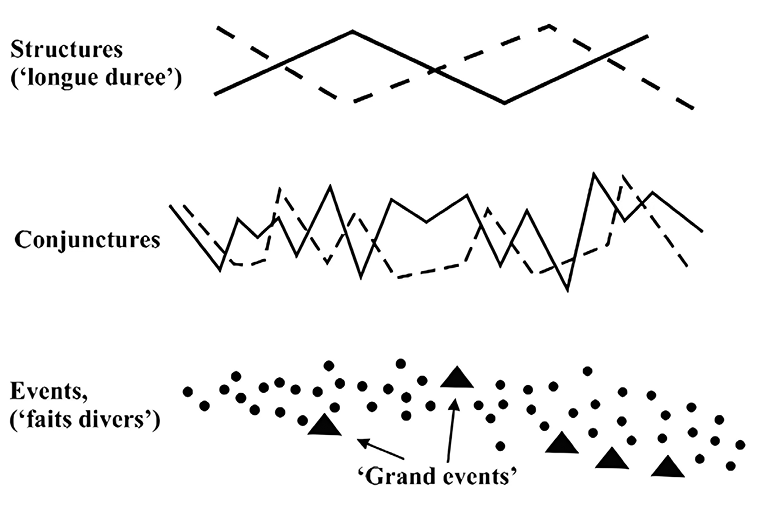
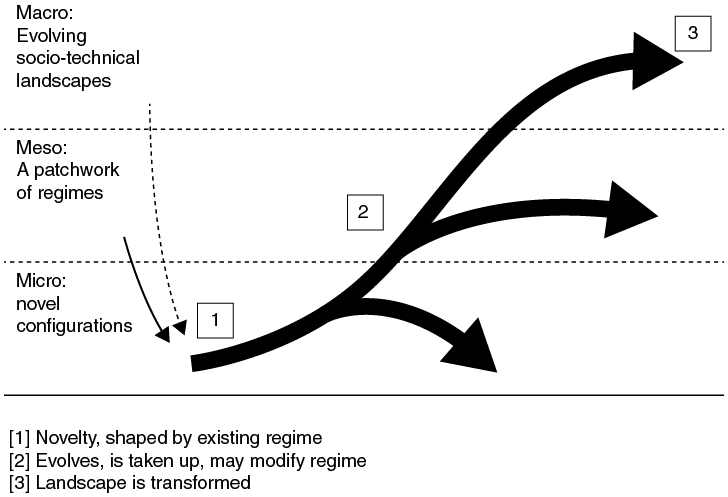
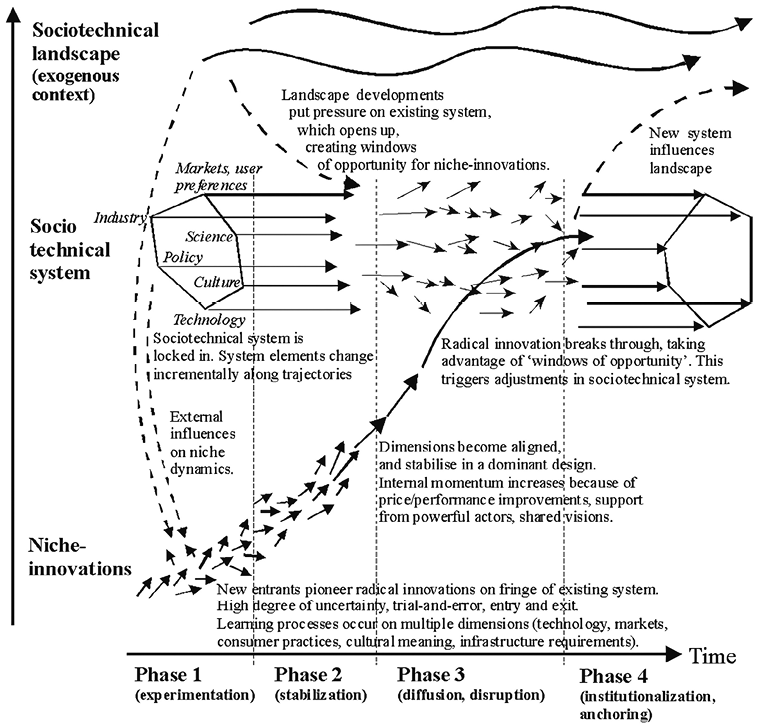
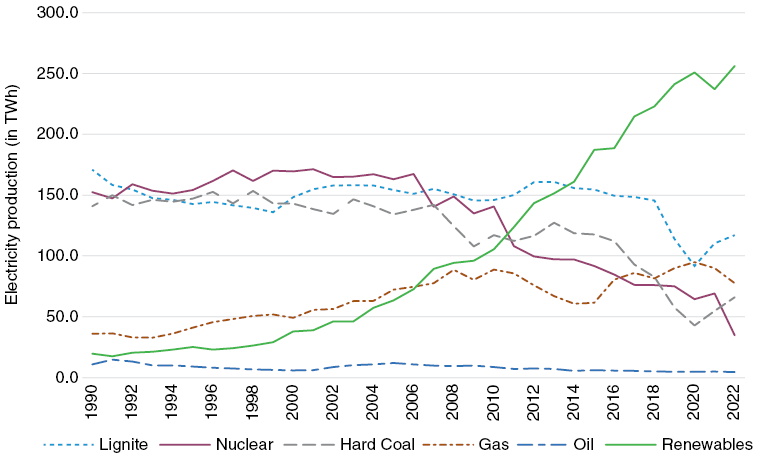
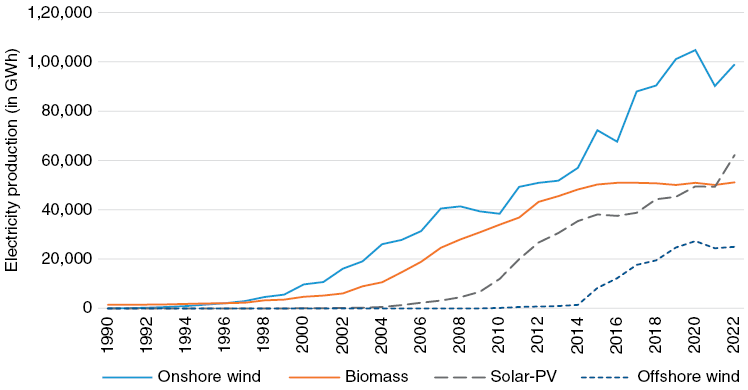
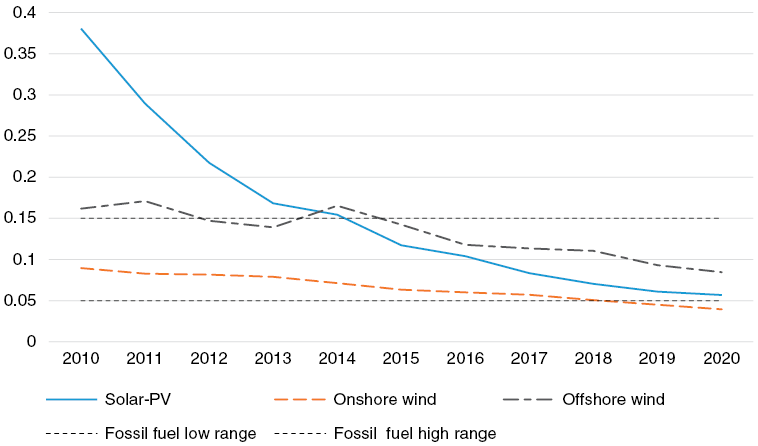


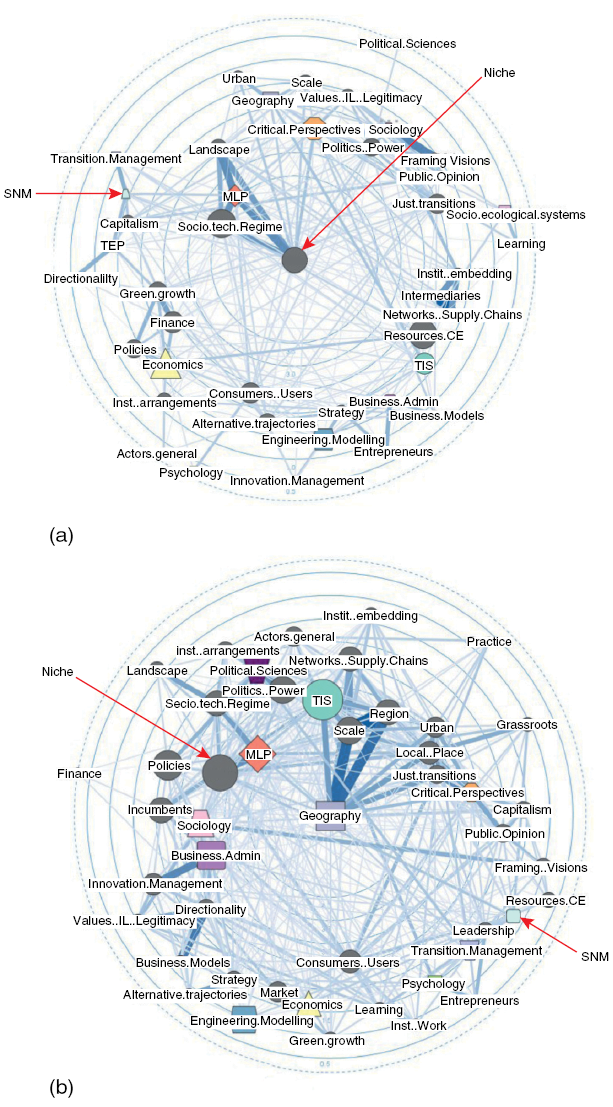
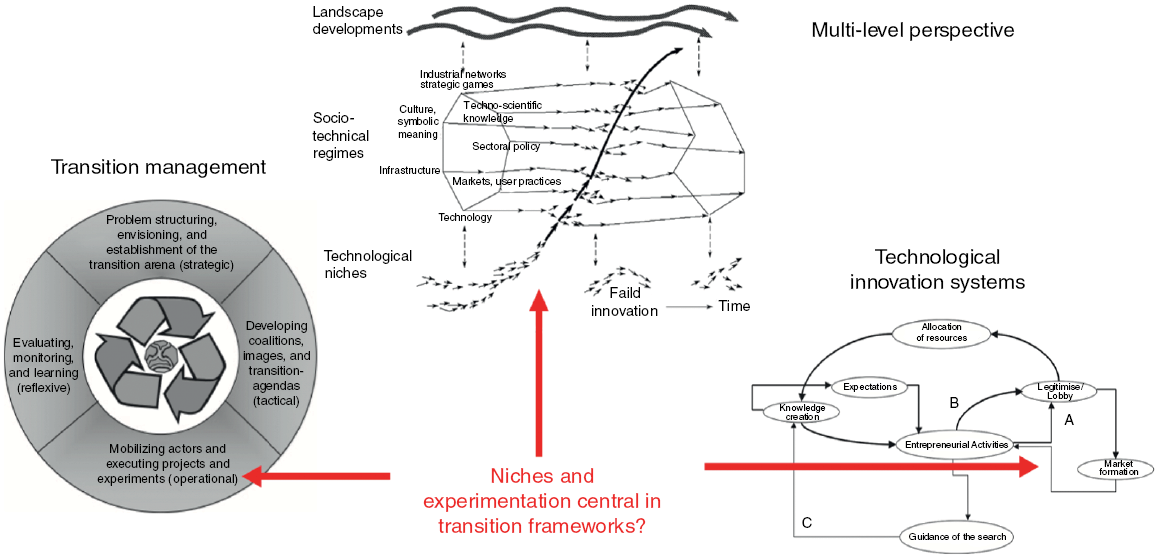
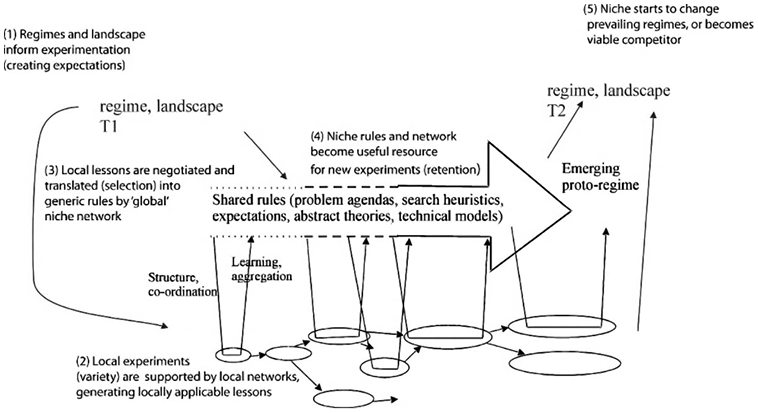

 Open access