

Acknowledgements
I am deeply grateful to many individuals and communities who contributed their time, energy, friendship, advice, and solidarity at various stages of the research and writing journey. The greatest debt is to my students, friends, colleagues, and many interlocutors, interviewees, and research participants over the years. Without the time and generosity of people and communities across Oman, this book would not have been possible. I hope my deep respect for you comes through in my writing. I do my utmost to do justice to your ideas, experiences, and perspectives.
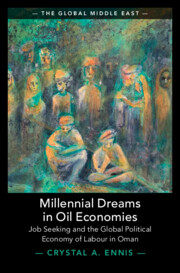
I am overwhelmed with gratitude to Raya Al-Maskari, the inspiring artist of the painting featured as the cover illustration on the book, for allowing me to use her beautiful work. It is truly an honour. Her painting is entitled bāḥthūn ʿan āmal, meaning ‘hope seekers’, which is a play on words in Arabic to bāḥthūn ʿan ʿamal – job seekers. The painting, to me, encapsulates both an awareness and a yearning for hope among a generation of citizens – a hope that is wrapped up in the dream of working.
I thank the Oman Studies Centre, and its director Joachim Düster, for awarding me the Omani Studies Fellowship that allowed me to spend the Fall of 2021 at the Leibniz Zentrum Moderner Orient (ZMO) in Berlin, German. I benefitted tremendously not only from the time to write but also for the vibrant intellectual community at ZMO. Special thanks to Ulrike Freitag, Kai Kresse, and Katrin Bromber for many thoughtful exchanges, as well as to Olly Akkerman, Zahir Bhalloo, and Taha, and to Kadara Swaleh, Jacob Nerenberg, Silke Nagel, and many others who made Berlin or ZMO feel like home.
There are many other people and institutions to thank, and I apologise in advance if I have unintentionally left anyone out. I am grateful to Bank Al-Markazi, the Chamber of Commerce, the Ministry of National Economy (and its various name changes), and the National Centre for Statistics and Information in Oman for giving me access to their respective archives. I have also benefitted from archives at the International Institute for Social History in Amsterdam and the British National Archives in Kew, United Kingdom.
In Oman, I thank Yahya Al-Jabri and the SEZAD team for facilitating my research visit to Duqm, Col Yousef Al-Nabhani and Ahmed Al-Darai at the National Survey Authority for permitting me to include the NSA map of Oman at the start of the book, and Omar Al-Mahrizi, CEO of Sohar Port and Freezone, for the map of the port area. I am grateful to Said Al-Saqri for his friendship through the years and willingness to exchange ideas, offer advice, perspectives, and support. I thank Aisha for her abundantly generous friendship that has stood the test of time. Kawthar AlHarthi’s friendship, teaching, and intellectual debate has been both sustaining and heartwarming. Many thanks also to exchanges and conversations with Khalid Al-Azri, Riyadh Al-Balushi, Khalid Al-Haribi, Ann Al-Kindi, Nawra Al-Lawati, Hatem Al-Shanfari, Abbas al-Zadjali, M. Reda Bhacker and Bernadette Millard, Sandhya Rao Mehta, and many others who must remain anonymous. I am grateful for so many friendships I have made along the way, from Sohar to Nizwa, to Muscat, to my hiking group from near and far. All arguments and opinions in the book remain my own and do not represent the views of the generous people who supported me with their knowledge and friendship.
Several colleagues have read and commented on drafts and exchanged ideas along the way. I am especially indebted to Omar Al-Shehabi and Talal Al-Rashoud who took the time to offer detailed feedback on complete drafts. I presented an early introduction to this book at the European Workshop on International Studies, of the European International Studies Association (EISA), in Krakow, Poland in 2019. The fantastic workshop organised by Hannes Baumann and Roberto Roccu, ‘IPE and the Middle East: Beyond Mutual Neglect’, offered me the opportunity to exchange ideas and benefit from feedback from a wonderful group of scholars. Adam Hanieh, Michael Herb, Adam Fishwick, and Toufic Haddad commented on different drafts of chapters at various stages of readiness. I presented chapters at several International Studies Association and Middle Eastern Studies Association annual conventions. My reflection for the roundtable ‘Citizenship and Belonging in the Arabian Peninsula’ convened by Gwenn Okruhlik in International Journal of Middle East Studies 52, no. 4 (2020) grew out of Chapter 5 of this book. Gwenn and the other roundtable participants offered me insightful reactions to my arguments. I first developed the analysis of intersecting logics at work in entrepreneurship promotion (in Chapter 6) in my New Political Economy article ‘The Gendered Complexities of Promoting Entrepreneurship in the Gulf’ (24, no. 3 [2019]). Reactions to this piece have allowed me to strengthen and clarify the approach. Establishing a good foundation in Arabic was also key, and I am grateful to the many Arabic teachers I have had over the years, including Kawthar AlHarthi, Kanan Al-Ali, Khadige Abboud, among others.
A wealth of thanks are due to many other friends, colleagues, and comrades who, in one way or another, have helped with this project, including Sahar Al-Khulaidi, Aziz Al-Riyami, Wafa Al-Sayed, Fahad Al-Sumait, Anique Bakker, Fahad Bishara, Lindsay Black, Nicolas Blarel, Malia Bouattia, Martijn Boven, Christa Braccio, Patricia Chraiteh, Sai Englert, Beatrix Futak-Campbell, Radhika Gupta, Emily Hemlow, Christian Henderson, Yih-Jye Hwang, Michelle Johnson, Stella Morgana, Eftychia Mylona, Mari Nakamura, Tsolin Nalbantian, Amber Neumann, Gwenn Okruhlik, Nicola Pavanini, Namrata Raju, Cyrus Schayegh, Saori Shibata, Remy Sirls, Cristiana Strava, Sanjukta Sunderason, Limin Teh, Abdel Razaq Takriti, Keye Tersemette, Maghiel van Crevel, Gerdien Verheuvel, Tracey Wagner-Rizvi, Jue Wang, Nira Wickramasinghe, Rafeef Ziadah, and Rawan Ziadah. A special thanks to my writing group filled with inspiring creatives, especially to Megin Jimenez, Janelle Ward, and Katie Sweeney.
Thanks to the three anonymous reviewers, whose comments and engagement with the text helped me strengthen the final outcome. At Cambridge University Press, I am grateful to Arshin Adib-Moghaddam for believing in the project and to the numerous editors I have worked with along the way including Daniel Brown, Maria Marsh, Natasha Burton, and Biju Singh. Thanks to Trent Hancock for careful copy editing, and Francis Young for expertly compiling the index.
Writing took place in many locations but mostly in Leiden, Muscat, and Berlin. The love and companionship of my husband Ra’id, and our many adventures together, sustained me through the long writing process. I am immensely grateful to his family as well, Um Ra’id, Najla, and Wa’il. An incredible amount of gratitude also belongs with my beautiful blended family, my mother and father and stepmother and stepfather, and siblings, Tawnya, Vince, and Shaylyn, and Sarah, Lisa, and David.
