

This book started due to a confluence of several unexpected influences in my life. The seed was first planted when I watched an online debate in the summer of 2013 by the live debating organization Intelligence Squared. The title of the debate was “The US Drone Program Is Fatally Flawed.” As a young doctoral student deeply interested in issues of international security, as well as political psychology and the politics of the Middle East and broader Islamic world, I was struck by the competing claims about how people in societies such as Pakistan understood and reacted to the US drone campaign there. This spurred my interest, and deeper investigation confirmed that there was wide variation in public perceptions of drone strikes in the country. The first fuzzy outlines of a project about understanding and unpacking variation in people’s perceptions of wartime violence were beginning to emerge.
The budding project was aided greatly by two fortuitous factors early on. One was the US State Department’s Professional Fellows Program (PFP), an exchange program that brings groups of emerging leaders from foreign countries to the US and places them into a relevant government or corporate office in an American city for 5–6 weeks. It so happened that a PFP delegation from Pakistan was sent to Columbus, OH, while I was in the early stages of my PhD at The Ohio State University (OSU), and I was able to meet dozens of young dynamic Pakistanis, learn much more about Pakistani society and politics from them, and probe some of the ideas that were swimming around in my head about the disagreements around drones in the country. Based on this and other networking that I was able to do at OSU, it began to be clear that the most interesting and dramatic variation in Pakistani perceptions of drones was between people who were from the targeted areas and those who lived elsewhere – and that these audiences had not only very different opinions but also very different factual understandings of the campaign. The project thus shifted to focus more on people’s factual perceptions and misperceptions in war, with an emerging idea that proximity to or removal from the actual events in question was the critical part of the story.
The other key development around this time was meeting Mujtaba Ali Isani, a doctoral student in the same program as me at OSU who would go on to become a close friend and collaborator. Muj would help me not only better refine my ideas about Pakistan but also conduct field and survey research there during the winter of 2014–15. My success on that front owes thanks to many people, including Muj’s brothers and broader family, Tariq Junaid and the Institute for Public Opinion Research in Islamabad for an excellent introduction into the world of working with survey research firms, and the many generous Pakistanis I had met from the PFP group and at OSU such as Waseem Qureshi, Rashid Kazmi, Riaz Akbar, Zeesha Khawaja, Farooq Afridi, and Muhammad Ali Paracha who showed me around the country. From a scholarly perspective, my exploratory fieldwork in Pakistan and experience studying the Pakistani case were tremendously illuminating. They helped me provide hard evidence about several things related to the spread and influence of factual misperceptions in conflict. However, because the tribal regions of the country – where the strikes overwhelmingly occur – were not open to large-scale attitudinal data collection at the time, I realized I would need to turn to other cases to more fully and rigorously test crucial parts of the argument.
In that regard, I was fortunate to forge a relationship toward the end of my time as a PhD student at OSU with Karl Kaltenthaler of the University of Akron and Munqith Dagher of IIACSS Research Group in Iraq. Karl and Munqith had been working as a team to publish academic studies and policy briefings using data collected from Munqith’s survey research firm in Iraq, and I began to contribute to some of this work. The connection was due completely to happenstance, as I asked Karl a question during a panel on which he was presenting at a major political science conference and then struck up a discussion with him afterward. A reminder that conference-based networking can be extremely fruitful and meaningful! I soon realized that a survey of Iraqis that Munqith had fielded for an unrelated purpose offered an excellent opportunity to further test my argument about factual misperception and misinformation in conflict. After obtaining Institutional Review Board (IRB) approval, I analyzed the data and wrote up the results with support from Munqith and Karl, finding evidence that those who had lived in areas targeted by anti-ISIL airstrikes were less likely to believe falsehoods about them. In addition, I was able to obtain data from the non-governmental organization (NGO) Airwars on the airstrikes themselves, and used this in combination with the survey data to provide added rigor to the findings. The results of this study were crucial for the continued development of the project, as they departed from the case in which the theory was originally developed (Pakistan) and confirmed its validity in a wholly new context (Iraq) for the first time. I am immensely grateful to Karl and Munqith for encouraging me to draw on portions of this article for Chapter 4 of the book. I am also thankful to Christopher Woods and his colleagues at Airwars for sharing their data for that research.
A third major layer of evidence for the book also came to me in a fortuitous way. Notably, as a postdoctoral fellow at Carnegie Mellon University (CMU), I began to collaborate with Justin Schon, a thoughtful junior-level scholar who was then at the University of Florida. Justin had recently published a book on the Syrian civil war entitled Surviving the War in Syria. As I became more familiar with Justin’s work, and he with mine, I realized that the rich interviews he had done for the project with Syrian refugees could be very useful in providing another major test of my argument because they dealt at some length with civilians’ engagement with new information during the war. Thankfully, Justin generously agreed to share the de-identified interview transcripts with me. Working with an excellent research assistant named Yousef Khanfar from Carnegie Mellon University-Qatar (CMU-Q), I then coded up a number of new variables from the interviews for quantitative analysis and mined them qualitatively in new ways with an eye toward my theory. The results helped further substantiate and support the book’s central argument, while pushing it into new terrain in a number of different ways (including with a substantial and welcome infusion of qualitative evidence).
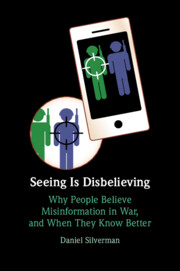
Several other important things that helped incubate the book must be acknowledged here. To begin with, this book grew out of a dissertation I completed in the Political Science Department at The Ohio State University, and I am tremendously grateful for all of the support I received there. My supremely patient and thoughtful dissertation advisor Chris Gelpi helped me hone and shape my initially fuzzy ideas into a real contribution. Rick Herrmann, Jan Pierskalla, and Jake Shapiro rounded out a fantastic dissertation committee that continuously challenged me to improve the project but did so from a solid foundation of support and encouragement. Other faculty such as the brilliant Bear Braumoeller played key secondary roles, and trusted peers such as Kyle Larson, Vittorio Merola, Reed Kurtz, and Marzia Oceno all helped in important and distinct ways as well. I am lucky to have had continuing support from excellent senior mentors at CMU, including Baruch Fischhoff, Kiron Skinner, Mark Kamlet, and Audrey Kurth Cronin. A strong group of junior faculty members and postdoctoral fellows at CMU including John Chin, Ignacio Arana, Daniel Hansen, Dani Nedal, Takiyah Harper-Shipman, Giorleny Altamirano Rayo, Dov Levin, Pearce Edwards, Ben Helms, and other participants in the Politics and Strategy Research Workshop/Political Science Research Workshop (PSRW) offered immensely valuable feedback about parts of the research. I am also grateful to John Haslam, Carrie Parkinson, and others at Cambridge University Press for their steady support of the project, as well as several unusually comprehensive peer reviewers that pushed me to significantly add to and reorganize the manuscript in ways that produced a much stronger and tighter final product. I am also very appreciative of Ben Schachter’s excellent and patient work on the book’s cover art, which brought the book’s thesis to life in a visually elegant way.
Finally, on a personal level, I am deeply indebted to my wife, Ruth Silverman, for her constant love and support as well as her encouragement of my writing time; our baby boy, Levi Silverman, for filling my life with joy and excitement as I pursued the latter stages of this project, and for taking so many naps in his first half year of life that I could finish my revisions; my parents Fern and Barry for being unwavering supporters, useful sounding boards, and ruthless editors; and my friends – those of the lifelong hometown variety and many others whom I have gained more recently – for their positive roles in my lives and for their support and encouragement.
Ultimately, as I worked on preparing the book over the last couple of years, two major wars of world historical impact broke out: one when Russia invaded Ukraine in February of 2022 and the other when Hamas attacked Israel in October of 2023. The latter conflict in particular hit home to me due to my extensive connections to people in both communities, and in fact has made me understand the dangerous dynamics of wartime misinformation better than ever before. I have watched up close as a deluge of fake news, conspiracy theories, and rumormongering has flooded social media during the dispute – and as many figures I recognize from the public sphere and even from the ranks of academia have embraced or fallen for such claims. Indeed, the war has deepened my understanding of the power of misinformation in conflict, its strategic utility in inciting anger, denying harm, and concealing misdeeds, and the ease with which it can ripple through potentially sympathetic communities. Yet at the same time, both of these conflicts show dynamics consistent with the book’s central thesis about the limits of wartime misinformation, and the complex, painful, powerful leaning process that enables communities on the front lines to see through its false allure. Whether this has made me more optimistic about the book’s core argument and the extent to which it can be harnessed for prosocial purposes are unclear. I now understand the politics arrayed against the amplification of local accurate voices from the front lines of war better than ever before. But I also understand the forces that actively work to do that amplification and the powerful credibility of those voices when they are able to be widely shared and heard. Perhaps I am ever the optimist, but I believe that – while the problem of factual misinformation and manipulation in war may only have metastasized in recent conflicts – there is significant potential to push in a positive direction when people are properly armed with deep ideas and insights about the problem.
