
Skip to main content Accessibility help
×
  • Cited by 1
    • Show more authors
    • You may already have access via personal or institutional login
    • Select format
    • Publisher:
      Cambridge University Press
      Publication date:
      01 September 2025
      07 August 2025
      ISBN:
      9781009602099
      9781009602075
      9781009602082
      Dimensions:
      (229 x 152 mm)
      Weight & Pages:
      0.6kg, 320 Pages
      Dimensions:
      (229 x 152 mm)
      Weight & Pages:
      0.48kg, 320 Pages
    You may already have access via personal or institutional login
  • Selected: Digital
    Add to cart View cart Buy from Cambridge.org

    Book description

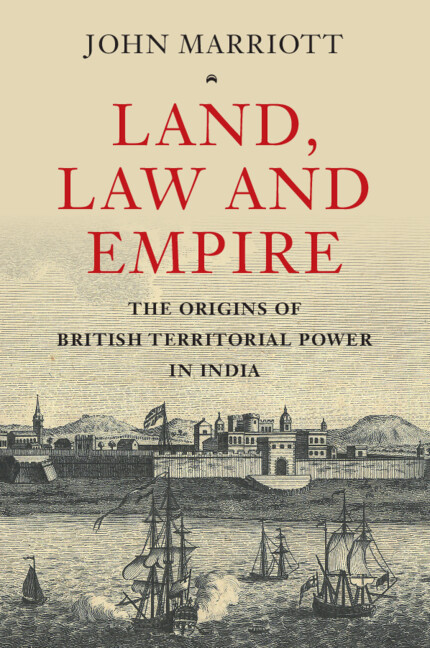
    In this innovative exploration of British rule in India, John Marriott tackles one of the most significant and unanswered questions surrounding the East India Company's success. How and when was an English joint stock company with trading interests in the East Indies transformed into a fully-fledged colonial power with control over large swathes of the Indian subcontinent? The answer, Marriott argues, is to be found much earlier than traditionally acknowledged, in the territorial acquisitions of the seventeenth century secured by small coteries of English factors. Bringing together aspects of cultural, legal and economic theory, he demonstrates the role played by land in the assembly of sovereign power, and how English discourses of land and judicial authority confronted the traditions of indigenous peoples and rival colonial authorities. By 1700, the Company had established the sites of Madras, Bombay and Calcutta, providing the practical foothold for further expansion.

    Reviews

    ‘Marriott makes a valuable and decisive intervention in the ongoing debate around the way we conceptualise and characterise the East India Company's expansion in Asia in the early modern period. He skilfully reorientates the debate towards the all-encompassing issue of the Company's quest for territory in India, unspooling the complex negotiations and accommodations of the seventeenth century between the English and the Indigenous powers of the subcontinent. In a work of serious scholarship and impressive archival research, Land, Law and Empire reveals how the Company and its servants acquired the key foundations of later Imperial British power in India: Madras, Bombay, and Calcutta.'

    David Veevers - Bangor University

    ‘By carefully scrutinizing the legal precedents and authorities to which the East India Company's agents in South Asia turned in the century before the Battle of Plassey, Land, Law and Empire convincingly demonstrates that the early modern roots of British imperialism lay as much in questions of law and land as they did in matters of trade and commerce.'

    Douglas M. Peers - University of Waterloo

    Refine List

    Actions for selected content:

    Select all | Deselect all
    • View selected items
    • Export citations
    • Download PDF (zip)
    • Save to Kindle
    • Save to Dropbox
    • Save to Google Drive

    Save Search

    You can save your searches here and later view and run them again in "My saved searches".

    Please provide a title, maximum of 40 characters.
    ×

    Contents

    Metrics

    Altmetric attention score

    Full text views

    Total number of HTML views: 0
    Total number of PDF views: 0 *
    Loading metrics...

    Book summary page views

    Total views: 0 *
    Loading metrics...

    * Views captured on Cambridge Core between #date#. This data will be updated every 24 hours.

    Usage data cannot currently be displayed.

    Accessibility standard: Missing or limited accessibility features

    Why this information is here

    This section outlines the accessibility features of this content - including support for screen readers, full keyboard navigation and high-contrast display options. This may not be relevant for you.

    Accessibility Information

    The HTML of this book is known to have missing or limited accessibility features. We may be reviewing its accessibility for future improvement, but final compliance is not yet assured and may be subject to legal exceptions. If you have any questions, please contact accessibility@cambridge.org.

    Content Navigation
    Table of contents navigation

    Allows you to navigate directly to chapters, sections, or non‐text items through a linked table of contents, reducing the need for extensive scrolling.

    Index navigation

    Provides an interactive index, letting you go straight to where a term or subject appears in the text without manual searching.

    Reading Order and Textual Equivalents
    Single logical reading order

    You will encounter all content (including footnotes, captions, etc.) in a clear, sequential flow, making it easier to follow with assistive tools like screen readers.

    Short alternative textual descriptions

    You get concise descriptions (for images, charts, or media clips), ensuring you do not miss crucial information when visual or audio elements are not accessible.

    Structural and Technical Features
    ARIA roles provided

    You gain clarity from ARIA (Accessible Rich Internet Applications) roles and attributes, as they help assistive technologies interpret how each part of the content functions.
