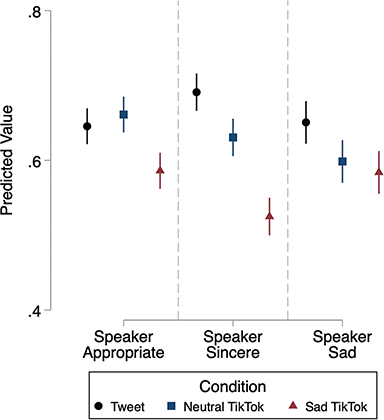
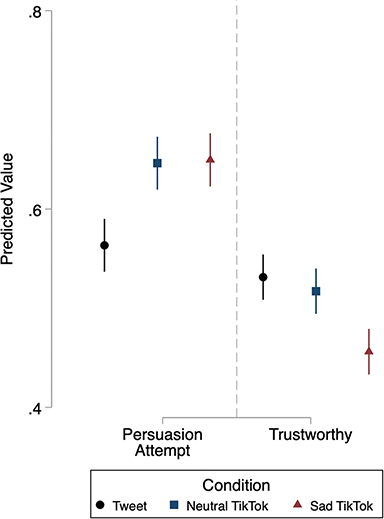
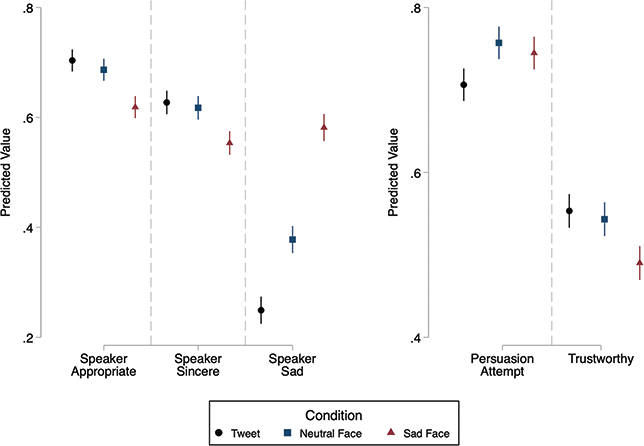
1 Introduction
“I’m so sad,” a reader who identified as “E” from Chicago wrote in a comment to the New York Times about the 2020 Presidential Primary.Footnote 1 The primary made another reader, Barbara from Minnesota, feel “grieved and angry …” Elsewhere, on Instagram, a user told their followers that they were so anxious about climate change that they had to hold back their tears.Footnote 2 On TikTok, posts about politics are “deeply emotional, ranging from roaring laughter to rolling tears” (Literat & Kligler-Vilenchick Reference Literat and Kligler-Vilenchick2023, p. 2).
Emotions have long had a place in political communication. It is not an overstatement to suggest that a tremendous amount of research has focused on felt emotions – the idea that politics can make people feel emotions which then shape their political attitudes and behaviors (e.g., Gadarian & Brader Reference Gadarian, Brader, Huddy, Sears, Levy and Jerit2023; Hiaeshutter-Rice & Weeks Reference Hiaeshutter-Rice and Weeks2021; Phoenix Reference Phoenix2019; Valentino et al. Reference Valentino, Wayne and Oceno2018; Weeks Reference Weeks2024, and many more). Strategic political messages are often designed to incite emotional responses (e.g., Albertson & Gadarian Reference Albertson and Gadarian2015; Brader Reference Brader2005; Webster Reference Webster2020; Zulli & Towner Reference Zulli and Towner2021). Emotional content in political news can both increase the likelihood that political information will be shared (Hasell Reference Hasell2021) and avoided (Toff and Nielsen Reference Toff and Nielsen2022). Politics – whether far-flung and abstract or highly personal – has long had the power to make people feel, a strategy that political actors have often exploited (see Webster & Albertson Reference Webster and Albertson2022 for review).
The notion that political messages can stir emotions is not new for anyone who has had even a passing interaction with political communication research. But this Element is not about how (strategic) political messages can make people feel. Rather, our goal is to consider the consequences of the way in which our informational environments have evolved. People have long had feelings about politics, but they now have the remarkable capacity to share those feelings with far-away friends and even more distant strangers (Bazarova et al. Reference Bazarova, Choi, Schwanda Sosik, Cosley and Whitlock2015). As new communication channels have emerged, people have become increasingly privy to the expressed emotions of others (Zillmann Reference Zillmann2006). Through social media platforms (e.g., Goldenberg & Gross Reference Goldenberg and Gross2020; Literat & Kligler-Vilenchick Reference Literat and Kligler-Vilenchick2023), and even the news (e.g., Beckers Reference Beckers2020; Wahl-Jorgensen Reference Wahl-Jorgensen2020), the expressed emotions of others now flicker across people’s screens. “Crying online,” wrote journalist Harmeet Kaur in January 2025, “is a vast internet genre spanning spontaneous shows of emotion.”
Research has long focused on the emotional impact of political messages. But seeing the emotions of others could also have profound implications. The expressed emotions of others could inspire empathy (e.g., Zillmann Reference Zillmann2006) and, in turn, motivate political action. And, through the process of emotional contagion, emotions may spread to larger groups of people (Goldenberg & Gross Reference Goldenberg and Gross2020). Seeing how others feel could underscore their “humanity” (McDonald et al. Reference McDonald, Porat and Yarkoney2017) and, perhaps, the “human toll” of political decisions – maybe even for political elites. In their broadest implications, the expressed emotions of others could shape how people understand fairness and justice in a democracy (e.g., Celis et al. Reference Celis, Knops, Van Ingelgom and Verhaegen2021).
Provided, of course, that we find these expressed emotions believable.
So, what do we think about E from Chicago? Do we trust Barbara from Minnesota? Do we think the user on Instagram is sincerely near tears about climate change? What happens when other people’s emotions end up flashing across our screens?
1.1 Emotions on Our Screens
People don’t only feel emotions in response to politics; they also express their emotions. Sharing feelings is an important part of how we relate to others (Choi & Toma Reference Choi and Toma2014), often helping us make sense of what has happened around us (Rimé Reference Rimé, Russell, Fernández-Dols, Manstead and Wellenkamp1995, Reference Rimé2009). Expressing negative emotions is cathartic (e.g., Gračanin et al. Reference Gračanin, Bylsma and Vingerhoets2018; Vingerhoets Reference Vingerhoets2012). In a context as complex and abstract as politics, it makes sense why E from Chicago, Barbara from Minnesota, and countless people on TikTok all want to express the emotions politics has made them feel.
While people have long felt emotions about politics, what has changed is the ease of sharing these emotions (Bazarova et al. Reference Bazarova, Choi, Schwanda Sosik, Cosley and Whitlock2015). New communication technologies give people a means of sharing emotions even “across geographical distances” (Choi & Toma Reference Choi and Toma2014, p. 530). Through “interpersonal media” – phones, text messages, and emails – people can immediately tell others how something made them feel (Choi & Toma Reference Choi and Toma2022). This form of sharing is not limited to friends. Through social media platforms, someone can share their feelings with a much larger audience (e.g., Literat & Kligler-Vilenchick Reference Literat and Kligler-Vilenchick2019). Social media also increases the visibility of emotional expression (Bazarova et al. Reference Bazarova, Choi, Schwanda Sosik, Cosley and Whitlock2015); sharing one’s emotions “online” has become “ubiquitous” (Goldenberg & Gross Reference Goldenberg and Gross2020, p. 320). Emotional content on social media is also more likely to get attention and spread (Brady et al. Reference Brady, Gantman and Van Bavel2020b), such that people may now experience a “tremendous volume of emotion expressions” (Goldenberg & Gross Reference Goldenberg and Gross2020, p. 320).
Contemporary news stories are also increasingly likely to include the emotions of ordinary people (e.g., Bas & Grabe Reference Bas and Grabe2016; Wahl-Jorgensen Reference Wahl-Jorgensen2016, Reference Wahl-Jorgensen2020). Although news is often connected to a “dispassionate, serious style of delivery” (Edgerly & Vraga Reference Edgerly and Vraga2020, pp. 424–425), news norms also rely on the use of exemplars (such as quotes from emotional individuals) to make complex events more engaging (e.g., Beckers Reference Beckers2022; Brosius Reference Brosius, Jennings Bryant and Cantor2003). How E from Chicago and Barbara from Minnesota felt about a presidential primary, for example, was highlighted by the New York Times alongside other coverage of the primary.
Yet it is not always clear what to expect when people encounter the expressed emotions of people who are, by all accounts, strangers.
On the one hand, observing the emotions of others could increase empathy, “humanize” complex political issues, and, potentially, change political behavior (McDonald et al. Reference McDonald, Porat and Yarkoney2017; Muradova Reference 76Muradova2025; Roeser Reference Roeser2012). Indeed, expressed emotions could be “powerful tools for persuasion” (Gregersen & Bye Reference Gregersen and Bye2023, p. 2). But expressed emotions are most consequential when people perceive the emotion as genuine and sincere. Being certain that someone is genuinely feeling something, however, may be more challenging when people encounter the expressed emotions of strangers through screens and platforms that reward “performance,” “self-promotion,” and public attention (Duffy & Hund Reference Duffy and Hund2019; Hogan Reference Hogan2010). Indeed, writing about television nearly twenty years ago, Zillmann (Reference Zillmann2006) already worried that “the sheer magnitude of exposure to others’ emotions must be expected to diminish the intensity of empathic reactivity” (pg. 176).
Emotional expression could inspire empathy, humanize strangers, and lead to action, but there is an unresolved tension: Do people believe in the sincerity of these expressed emotions or dismiss them as an attempt to build “clout”? Our goal in this Element is to shed some light on how people sift through, perceive, and evaluate the emotions they see expressed on their screens.
Our interdisciplinary approach brings together research in communication, political science, and psychology. While previous research has focused on the extent to which emotions are persuasive (e.g., Albertson & Gadarian Reference Albertson and Gadarian2015), how emotional terms affect information-sharing (e.g., Hasell Reference Hasell2021), or which communication channels people feel most easily allow them to express their emotions (e.g., Fox & McEwan Reference Fox and McEwan2017), we shift the lens. We are interested in how people understand and perceive the expressed emotions of others when they encounter these emotions through their screens.
Our approach begins with a theoretical framework. How people perceive the expressed emotions of others, we argue, depends on how people perceive the affordances of different communication channels. Our theoretical premises lead us to a series of preregistered experiments to track how people understand and evaluate emotions in a mediated setting. Ultimately, we find results that complicate existing narratives on the power of emotional expression. People, our studies suggest, can be cynical when they encounter the emotions of others “online.”
1.2 Issue Focus
Politics, as Schattschneider (Reference Schattschneider1957) suggests, is “billions of conflicts” (p. 935). These different conflicts may inspire emotions in different people, and we could not possibly consider all the political issues and topics (the “billions of conflicts”) that make people feel emotions. Our approach, then, is to focus on variation in platforms and expressions, while keeping the issue constant. In this way, our studies will allow us to highlight how emotional expression intersects with different communication channels.
We focus on an issue that has recently inspired a great deal of emotional expression both online and offline: climate change. We select this issue deliberately. First, people feel increasingly emotional about climate change. Nearly every year since 2008, the Yale Program on Climate Change Communication has conducted a national survey of the American public assessing their concern about climate change. As of 2023, 66% of Americans are at least “somewhat” worried about climate change, and 55% believe they’ve already experienced some of the negative effects of climate change (Leiserowitz et al. Reference Leiserowitz, Maibach and Rosenthal2024). The degree of emotions people feel around climate change leads the American Psychological Association to officially define ecoanxiety: a chronic fear of ecological and environmental disaster (Schreiber Reference Schreiber2021).
Second, emotions about climate change are not only increasingly felt but also expressed through various communication channels. In 2021 alone, there were 5.31 million tweets about climate change (Smirnov & Hsieh Reference Smirnov and Hsieh2022). The number of news articles discussing climate change has consistently increased since the early 2000’s (e.g., Bohr Reference Bohr2020; Merkley & Stecula Reference Merkley and Stecula2021). As of September 2021, TikTok videos with the hashtag “Climate Change” have been viewed over 650 million times (Basch et al. Reference Basch, Yalamanchili and Fera2022). The majority of these social media posts emphasize that climate change is real and include expressions of sadness or worry as opposed to positive emotions such as joy and surprise (Basch et al. Reference Basch, Yalamanchili and Fera2022).Footnote 3 News coverage of the issue similarly includes emotional language and imagery (Höijer Reference 73Höijer2010). Still, the way people respond to such emotional expression is a continuing question in research (e.g., Salama and Aboukoura Reference Salama, Aboukoura, Filho, Manolas, Azul, Azeiteiro and McGhie2018; Swim and Bloodhart Reference Swim and Bloodhart2015). While climate change may not be the issue at the top of most people’s minds (e.g., Egan & Mullin Reference Egan and Mullin2017), it is an increasingly pressing problem that has inspired a substantial amount of emotional expression across platforms.
1.3 Element Overview
In the next sections, we consider the intersections of communication technologies and expressed emotions. We begin in Section 2 by laying out a theory of how people perceive emotional expression online. Then, in Section 3, we consider the operationalization of our main concepts – emotional expression and communication channels. In this section, we also present our empirical approach, as well as explanations of our measures, treatments, and samples. The subsequent three sections turn to our empirical evidence.
In Section 4, we begin with a context in which emotional expression is filtered through a gatekeeper: emotional expression in news articles. Here, we first track how people evaluate emotional “vox pops” included in news articles. In a final study in this section, we extend this approach and consider how including emotional quotes in news articles changes evaluations of the journalist – the gatekeeper – who made the decision to include someone’s emotional expression in their news story.
While Section 4 focuses on how different messages are perceived on a single platform (news), in Section 5, we flip the approach: Keeping the emotional expression constant, we track whether the communication channel shapes people’s perceptions of the emotional expression. We focus first on social media and text messages, contexts where people do not need a gatekeeper, such as a journalist, to share their emotions. These types of spaces, however, have different levels of visibility: They allow people to reach audiences of different sizes. Here, we identify the extent to which increasing visibility shapes perceptions of the expressed emotion. We then compare perceptions of this “ungated” emotional expression to “gated” emotional expression in the news.
In Section 6, we introduce visual cues of emotional expression and shift the modality of emotional expression by considering another platform: TikTok. We present two studies identifying the effect of whether emotions are expressed through words or whether people can see the facial expressions associated with emotions. In this section, we also leverage open-ended responses to consider how people explain their perceptions of emotional expression in their own words.
Taken together, the six studies in this Element point to the possibility that people are often cynical of the expressed emotions they see on their screens – especially when they can see visual manifestations of these emotions. At the same time, we also find results which do not follow from our theoretical expectations. We consider these unexpected results and what they mean for understanding people’s perceptions of expressed emotions in our concluding section.
2 A Theory of Emotions on Our Screens
Emotions have long been a part of the media environment (Mutz & Gerke Reference Mutz and Gerke2022; Sullivan & Masters Reference Sullivan and Masters1988). Changes in our informational environment have given people many more channels by which they can communicate their emotions (e.g., Chen et al. Reference Chen, Yan and Leach2022; Choi & Toma Reference Choi and Toma2022). In the context of politics, how others feel is increasingly part of news coverage (e.g., Wahl-Jorgensen Reference Wahl-Jorgensen2019), and the rise of digital communication – including social media – has exposed people to the way virtual strangers feel about various political events (Zulli & Towner Reference Zulli and Towner2021).
What happens when strangers on our screens tell us how they feel? And what happens when strangers tell us how they feel about politics? We consider the answers to these questions in a series of steps. First, we distinguish between felt and expressed emotions in political communication. Next, we bridge theories from communication, psychology, and political science to consider how people perceive the expressed emotions of others. We initially consider these ideas broadly, then focus on how different communication channels may shape these processes. In the final section of this section, we apply our theoretical conditions in the context of the political issue at the heart of our empirical work: climate change.
2.1 Felt versus Expressed Emotions
Before considering how people respond to the emotions of others, it is important to distinguish between felt emotions and expressed emotions.Footnote 4 We begin with felt emotions. Despite the central importance of emotions in everyday life, as well as in political communication, there is no single definition of what it means to feel an emotion. Emotions can be considered psychological, physiological, and behavioral reactions to internal or external stimuliFootnote 5 (Brader & Marcus Reference Brader, Marcus, Huddy, Sears and Levy2013; Gadarian & Brader Reference Gadarian, Brader, Huddy, Sears, Levy and Jerit2023)
These reactions are often “transient” and “targeted” (Nabi Reference Nabi1999, p. 295). Feeling an emotion, then, can be considered a “short-lived mental state that [varies] in intensity” (Hasell Reference Hasell2021, p. 1088). There are debates about how exactly to define and delineate emotions (see Brader and Marcus (Reference Brader, Marcus, Huddy, Sears and Levy2013) and Gadarian and Brader (Reference Gadarian, Brader, Huddy, Sears, Levy and Jerit2023) for reviews). It is neither our focus nor our goal to adjudicate between these approaches.
Rather, we focus on the communication of emotions and how such expressions are interpreted by observers. Expressed emotions are “outwardly perceptible clue[s] suggesting the presence of an emotion in the expresser” (van Kleef and Côté Reference van Kleef and Côté2022; see also Keltner and Haidt Reference Keltner and Haidt1999; Van Kleef Reference Van Kleef2016). This might include statements of one’s emotions (e.g., “this made me angry” or “I am so sad”), facial expressions like smiling or frowning, behaviors such as crying, or even the use of emojis in written communication (Choi & Toma Reference Choi and Toma2022; van Kleef & Côté Reference van Kleef and Côté2022).
We are, of course, not the first to consider the communication of emotion. The idea that people share their own emotions with others has long been acknowledged as an important component of emotional regulation (Rimé Reference Rimé2009). Research has analyzed conditions under which people may feel more or less comfortable sharing their emotions with others (e.g., Finkenauer & Rimé Reference Finkenauer and Rimé1998; Rimé Reference Rimé2009; Rimé et al. Reference Rimé, Bouchat, Paquot and Giglio2020), in both interpersonal and mediated contexts (e.g., Chen et al. Reference Chen, Yan and Leach2022; Toma Reference Toma, Nabi and Myrick2023). Our interest here is not on the conditions under which someone is more likely to communicate their emotions to others. Rather, we ask: How do others perceive the communication of emotions? Put simply, what happens when people encounter a person who reports that they are sad or fearful?
In theory, expressed emotions could serve as uniquely important signals. Decades of psychological research have underscored the central and innate communicative role of emotional expression. Across cultures, the same facial expressions are perceived as communicating the same emotion (Ekman et al. Reference Ekman, Friesen and O’Sullivan1987),Footnote 6 and there is a general consensus about the perceived appropriateness of emotional displays (e.g., Matsumoto Reference Matsumoto1990; Rozin et al. Reference Rozin, Lowery, Imada and Haidt1999). Emotions also draw people’s attention (Anderson Reference Anderson2005) – which is reflected in how emotional expression is received online. Social media posts containing “emotional terms” are more likely to be shared (Berger & Milkman Reference Berger and Milkman2012; Hasell Reference Hasell2021) in large part because they draw higher levels of attention (Brady et al. Reference Brady, Gantman and Van Bavel2020b).
The potential influence of expressed emotions, then, could carry broad implications in the context of political communication. First, existing research hints at the possibility that observing the emotions of others may prove politically powerful by giving people insights into the lived experiences of others, instilling empathy in observers (e.g., Chouliaraki Reference Chouliaraki2006; Kubin et al. Reference Kubin, Puryear and Gray2021; Wahl-Jorgensen Reference Wahl-Jorgensen2019, Reference Wahl-Jorgensen2020). Such empathy then motivates a desire to help those expressing their emotions by addressing the issue that caused the expression (e.g., Vingerhoets Reference Vingerhoets2012). In the context of climate change communication specifically – to which we will turn more closely at the end of this section – observing the emotions of others can also personalize a complex and often distant issue (Keller et al. Reference Keller, Marsh, Richardson and Ball2022; Spence et al. Reference Spence, Poortinga and Pidgeon2012).
Second, expressed emotions may spill over via contagion, a process through which observers automatically begin to mimic and ultimately feel the emotions of the expressor (e.g., Hatfield et al. Reference Hatfield, Cacioppo and Rapson1993). Such contagion is not limited to interpersonal environments: People “catch” the emotions of others they encounter in mediated environments, including both the news and social media (e.g., Dubèl et al. Reference Dubèl, Schumacher, Homan and Bakker2024; Goldenberg & Gross Reference Goldenberg and Gross2020; Kramer et al. Reference Kramer, Guillory and Hancock2014).Footnote 7 Observers’ own emotions, caught through contagion, then have the potential to affect their policy preferences and political behaviors (for review, see Brader & Marcus Reference Brader, Marcus, Huddy, Sears and Levy2013).
Finally, emotional expression has the potential to persuade observers. For example, expressing a negative emotion about climate change signals that the expressor is experiencing a negative emotion, but also that climate change must be very serious. Expression, therefore, could play an informational role, highlighting which issues are worth worrying about and convincing observers to support policies to address those issues (e.g., Van Kleef Reference Van Kleef2016).
However, the potential influences of emotional expression in political communication likely hinge on how such emotions are perceived by observers. Emotional expression that is perceived as inauthentic or inappropriate does not inspire empathy (e.g., Warner & Shields Reference Warner and Shields2009b). Emotional contagion is similarly not always automatic: For example, observers are less likely to mimic and feel emotions expressed by opposing party members (e.g., Homan et al. Reference Homan, Schumacher and Bakker2023). The persuasive power of more traditional (nonemotional) types of information underscores that, in order to persuade, information must be perceived as authentic (e.g., Lupia & McCubbins Reference Lupia and McCubbins1998). While we increasingly have access to others’ emotions online, the ultimate impact of such emotionality depends on whether observers take those expressions seriously.
2.2 Responding to the Emotions of Others
Emotional expression can be something spontaneous that a person cannot help, but it can also be a deliberate “communicative signal to others” that can be exaggerated, concealed, or changed altogether (Zloteanu & Krumhuber Reference Zloteanu and Krumhuber2021, p. 2). Indeed, researchers have often worked to identify the relationship between felt emotion and expressed emotion, with the goal of considering conditions under which the felt and the expressed emotions “match” (e.g., Lange et al. Reference Lange, Heerdink and van Kleef2022). Here, we will not adjudicate how closely expressed emotions reflect felt emotions, rather we aim to understand how observers perceive the emotional expressions of others.
People’s perceptions of expressed emotions are conditional and contextual (Gardner et al. Reference Gardner, Fischer and Hunt2009; Grandey Reference Grandey2000). First, people consider whether they perceive the emotional expression to be appropriate: Does the expressed emotion seem suitable given the circumstances and the context? Second, people consider whether they believe the emotional expression is authentic: Does it genuinely reflect the underlying emotion felt by the expresser? The empathetic, bridging, and persuasive power of expressed emotions is likely to emerge only if a person perceives the expressed emotion to be appropriate and authentic (Keller & Becker Reference Keller and Becker2021).
2.2.1 The Perceived Appropriateness of Expression
People consider the appropriateness of emotional expression contextually, where context encompasses several ideas. Context can mean the situation precipitating the emotion, whether the level of emotion observed is appropriate given the context (e.g., Gračanin et al. Reference Gračanin, Bylsma and Vingerhoets2018; Vingerhoets Reference Vingerhoets2012). Context can also mean the environment in which an emotion occurs; some people may perceive a certain space (e.g., work) as especially inappropriate for emotional expressions (Warner & Shields Reference Warner and Shields2009a). More recently, communication channels have also shaped perceptions of appropriateness: More private communication channels (e.g., text messages) are seen as more appropriate means of transmitting negative emotions than more public channels (e.g., social media, see Choi & Toma Reference Choi and Toma2022). And, context could mean who is expressing the emotion – research has long suggested that people respond differently depending on the identity of the “emoter” (e.g., Albertson & White Reference Albertson, White and Rudolph2022; Shields Reference Shields2005). Race, for example, can profoundly shape how people respond to expressions of anger (Phoenix Reference Phoenix2019).
Another contextual factor affecting perceptions of appropriateness is agreement with the reaction (Gračanin et al. Reference Gračanin, Bylsma and Vingerhoets2018; Kottler Reference Kottler1996; Vingerhoets Reference Vingerhoets2012). Because politics is often considered in terms of “sides” – whether partisan divisions or issue disagreements (e.g., Druckman et al. Reference Druckman, Klar, Krupnikov, Levendusky and Ryan2024) – agreement with the reaction may also proxy for political agreement.
In sum, the perceived appropriateness of emotional expression hinges on people’s beliefs about the context in which the emotion is expressed. We deliberately qualify the term “appropriateness” as perceived so as not to suggest that there are universal norms about emotional expression (e.g., Shields Reference Shields2005). And, as we will discuss later, it is this perceptual nature of appropriateness that often creates tension in how people evaluate and respond to the expressed emotions of others. The way people evaluate the expressed emotions of others speaks to the assumptions and beliefs of the person observing the expressed emotion about what constitutes the “right situation” and the “right place” (Shields Reference Shields2005).
2.2.2 The Perceived Authenticity of Expression
People have some ability to control how they describe or express the way they’re feeling – that is, they have some control of their emotional expression (Grandey Reference Grandey2003; Keller & Becker Reference Keller and Becker2021; Vingerhoets Reference Vingerhoets2012; Zloteanu & Krumhuber Reference Zloteanu and Krumhuber2021). Such control is a part of emotional regulation, or “the processes by which individuals influence which emotions they have, when they have them, and how they experience and express these emotions” (Gross Reference Gross1998, p. 275). Researchers have referred to this control as “acting” (Grandey Reference Grandey2003; Keller & Becker Reference Keller and Becker2021). Acting may include a person suppressing their tears at work, for example, waiting until they are in the car after work or home alone after a stressful day to cry (Warner & Shields Reference Warner and Shields2009a). On the other hand, acting could also mean exaggerating an emotional response. A person working a service job may attempt to seem especially happy for the sake of their customers (Grandey Reference Grandey2003). Notably, these examples foreshadow a tension pivotal to our manuscript: An observer only sees the external communication of emotion – the explanation of this expression is perceptual.
The idea that people can, in theory, regulate and “act” their emotional expression means that not all emotional expressions are “authentic,” and, perhaps more importantly, not all emotional expressions are perceived as authentic (Ekman & Rosenberg Reference Ekman and Rosenberg1997). This umbrella of perceived authenticity includes a variety of considerations. Judgments about the sincerity of the expressed emotion, the trustworthiness of the person expressing the emotion (Lee & Eastin Reference Lee and Eastin2021), and the perceptions about whether “one’s emotional expression display reflects one’s current emotional experience” (Ashforth & Tomiuk Reference Ashforth, Tomiuk and Fineman2000, p. 195) all comprise evaluations of authenticity.
How, then, do people form perceptions about whether an expression of emotion is authentic? People do try to distinguish between authentic and inauthentic emotional expression – even if they are not always successful (Hideg & Van Kleef Reference Hideg and Van Kleef2017; Wang et al. Reference Wang, Nguyen, Johnson and Groth2021). Central to this is the perception of the spontaneity of the emotion – is the expression something that “emerge[d] quite spontaneously from our construal of the situation” (Salmela Reference Salmela2005, p. 214)? Is the emotional expression “automatic” because a person is “living through it” – or is a person very deliberately trying to display and express this emotion (Salmela Reference Salmela2005, p. 214–215)? People read emotional expressions as less sincere and less authentic when the display appears to them to be effortful, rather than spontaneous (Keller & Becker Reference Keller and Becker2021; Pinheiro et al. Reference Pinheiro, Anikin and Conde2021).
These perceptions of authenticity play a central role in how observers respond to the emotional expression. Perceptions of authenticity increase both “compliance [and] cooperation” (Keller & Becker Reference Keller and Becker2021, p. 407), while people respond more negatively to emotional expressions that they perceive to be inauthentic (Keller & Becker Reference Keller and Becker2021). For example, people are less likely to trust or cooperate with partners who seem emotionally inauthentic (Krumhuber et al. Reference Krumhuber, Manstead and Cosker2007). Again, however, it is important to return to the tension at the heart of these perceptions: The extent to which people can accurately evaluate authenticity varies (Lechner & Paul Reference Lechner and Paul2019; McLellan et al. Reference McLellan, Johnston, Dalrymple-Alford and Porter2010). People are, generally, poor (and sometimes, biased) evaluators of the authenticity of others (Bailey & Levy Reference Bailey and Levy2022). In sum, perceiving an emotional expression as authentic is important – but again, it is just that, a perception.
2.2.3 Intersection of Perceived Appropriateness and Perceived Authenticity
Perceptions of appropriateness and authenticity could be somewhat orthogonal, though they are likely related. Shields (Reference Shields2005) offers an example: People may perceive happiness as an appropriate response when given a candy bar, but may come to perceive an extended, days-long expression of happiness about this gift to be less authentic. Similarly, perceived authenticity is not sufficient for perceived appropriateness. A person may fully believe that someone is authentically upset but perceive that sadness is inappropriate to the context. Ultimately, however, both perceptions of appropriateness and authenticity need to be in place for people to respond with empathy – and potentially action – to an expressed emotion.
Given the perceptual nature of both appropriateness and authenticity, it would not be surprising to suggest that a multitude of contextual factors likely shape how people arrive at their perceptions. In what follows, we focus on one such set of contextual factors: The communication channels through which people encounter the expressed emotions of others.
2.3 Emotions on Our Screens
When emotions are expressed in interpersonal contexts, people can observe not only someone’s words but also their body language and facial expressions (e.g., Gračanin et al. Reference Gračanin, Bylsma and Vingerhoets2018; Grandey Reference Grandey2003; Vingerhoets Reference Vingerhoets2012). Increasingly, however, people may encounter expressions of emotions in mediated settings (Toma Reference Toma, Nabi and Myrick2023). Not only do they encounter emotions in mediated contexts, but they also encounter the emotions of strangers. In the wake of a political event, people may encounter a total stranger expressing their fear or sadness about the event – either via social media posts or quotes included by a journalist in the news. The modern media environment offers many more communication channels, which give expressed emotions the means to travel.
These channels, we suggest, may change the way people perceive expressed emotions. Through their screens, people see emotions that were expressed hours, days, or even weeks after someone felt and shared the emotion. Ideas like “spontaneity,” “inciting event,” and “context” – which guide perceptions of appropriateness and authenticity – become muddier. Incorporating the mediated context into the way people form perceptions of appropriateness and authenticity, we theorize, centers on how people answer three umbrella questions about the emotions on their screens: What? How? and Why? We suggest that people’s beliefs about the answers to each of these questions shape whether they perceive the expressed emotion as appropriate and authentic.
2.3.1 What Is the Expressed Emotion About?
People tell others about important events that happen to them and how they felt when these events occurred (Rimé Reference Rimé2009). This precipitating event is important: People consider the appropriateness of the emotional expression based on their own understanding of the event that caused the emotion (MacArthur & Shields Reference MacArthur, Shields, Hess and Hareli2019; Vingerhoets Reference Vingerhoets2012). Sometimes these inciting events have a clear near-consensus about valence. For example, people generally agree that a family member falling ill is a negative event (even if they disagree on how much emotional expression is appropriate in response). Political context is more complicated. People disagree about politics and, as a result, they may also disagree about the valence of a given political event and the appropriateness of a given emotional response. If a person believes a new policy is good, that person is unlikely to perceive expressions of anger and sadness about that same policy as appropriate.
It is possible that people may also disagree about the extent to which politics generally is an appropriate reason to express emotions (e.g., Krupnikov & Ryan Reference Krupnikov and Ryan2022). In this case, a person might perceive any emotional expression about politics as inappropriate. That said, even here, disagreement with the valence of a particular political event should still lead to still lower perceptions of appropriateness.
Expectation 1: When someone disagrees about the valence of the inciting event, they will perceive the expression of emotion as less appropriate than when they agree with the valence.
2.3.2 How Did the Emotion Get on Our Screens?
Central to the question of “how” is the idea of “access.” One definition of access is ease of use – requiring a particular app, for example, may make a channel less accessible (e.g., Choi & Toma Reference Choi and Toma2022). Here, we consider access as the extent to which a gatekeeper is required for this transmission (Barzilai‐Nahon Reference Barzilai-Nahon2009). A person has more access to a social media platform relative to a newspaper, where a journalist and an editor would be the gatekeepers. When a person has their own access to transmission and makes their own decision to share an expressed emotion, to some, the expression may seem more “effortful” (Keller & Becker Reference Keller and Becker2021), and, therefore, less spontaneous. Put another way, encountering someone’s feelings because that person decided to share them via social media may seem less spontaneous than encountering their feelings because a journalist decided to broadcast them.
Underscoring this idea of access is editability (e.g., Chen & Toma Reference Chen and Toma2024) – can a person “delete or polish messages before sending them via mediated channels” (p. 435). A person-on-the-street interview or reaction to an event shared with a journalist someone likes has “one take” – they cannot ask a journalist to rerecord an interview. They also cannot delete a published article with their comments. Communication channels without gatekeepers, however, often allow for more editability; people can revise, change, and perfect what they are about to share (Leonardi & Treem Reference Leonardi and Treem2012). Not all people edit their posts even when the affordances allow them to do so (e.g., Walther Reference Walther2007), nor are all “non-gatekept” channels equally editable. Yet these ideas of editability are, ultimately, tied to broader behaviors of self-presentation: The goal of perfecting and revising content is in service of “curating” how one is seen by the audience (Duffy and Hund Reference Duffy and Hund2019). Thus, a context that seems more editable may undermine the perceived spontaneity of expressed emotion, which, in turn, undercuts the perceived authenticity.
Expectation 2: When a channel does not require a gatekeeper, the expressed emotion will seem less authentic than when a channel does require a gatekeeper.
2.3.3 Why Did Someone Share This Emotion?
Communication channels vary in their visibility (e.g., Treem & Leonardi Reference Treem and Leonardi2013) – that is, they have differential “capacity to make messages visible to large audiences” (Choi & Toma Reference Choi and Toma2022, p. 141). Some channels (e.g., text messages) have “private message visibility,” while others (e.g., social media platforms) have “public message visibility” (Choi & Toma Reference Choi and Toma2022, p. 141). A “public message visibility” channel implies the possibility of reaching an audience that moves beyond a network of close ties to a much broader set of people.
We expect that emotions transmitted via channels that seem closer to “private message visibility” (e.g., text messages) may seem more authentic than the same emotions transmitted via a channel that has more public visibility (e.g., Instagram) (Waterloo et al. Reference Waterloo, Peter and Valkenburg2018). This expectation stems from a number of theoretical mechanisms. For one, people differentiate between the intended reach of different communication channels; channels with “public” visibility will reach a broader network of weaker ties and strangers, while channels with more “private” visibility are often designed to reach close confidants (e.g., Choi & Toma Reference Choi and Toma2022; Malhotra Reference Malhotra2024). In turn, people may perceive emotions transmitted to close confidants as more sincere (e.g., Hendriks et al. Reference Hendriks, Croon and Vingerhoets2008; Warner & Shields Reference Warner and Shields2009a). Another factor is that people may generally associate authenticity with these less visible channels (Kreling et al. Reference Kreling, Meier and Reinecke2022) and “performance” with more visible ones (Enli Reference Enli, Bruns, Enli, Skogerbo, Larsson and Christensen2015). This is perhaps why social media – with its “public message visibility” – is perceived as a means of achieving “self-promotion” (Duffy & Hund Reference Duffy and Hund2019). People also seem to see less persuasive intent in messages transmitted via less visible communication channels relative to those with more public visibility (Malhotra & Shin Reference Malhotra and Shin2025).
Ultimately, it is unlikely that the relationship between perceived authenticity and communication channel visibility is a function of only one specific mechanism. More likely, these mechanisms work in tandem. Our focus here, however, is on the role of channel visibility in shaping perceptions of authenticity.
Expectation 3: When a channel is perceived as more visible, the expressed emotion will seem less authentic than when a channel is less visible.
2.3.4 An Aside: Who Is Expressing the Emotion?
We have focused on conditions specific to the content of the emotional expression (the “what”) and the way in which the expression is communicated (the “how” and the “why”). Research, however, has also shown that the “who” matters – the person expressing emotions can shape perceptions of appropriateness and authenticity (e.g., Keller & Becker Reference Keller and Becker2021; Shields Reference Shields2005). A person’s gender and race, for example, can affect how people perceive their emotional response (Phoenix Reference Phoenix2019; Shields Reference Shields2005; Warner & Shields Reference Warner and Shields2009b). And, people are more likely to perceive those they like as authentic (Bailey and Levy Reference Bailey and Levy2022) – a pattern that could extend to the partisanship of the expressor. To further complicate things, the “who” may also extend to the identity of the observer – for example, some research suggests that men and women respond differently to the emotional expression of others (Stadel et al. Reference Stadel, Daniels, Warrens and Jeronimus2019).
In this Element, our focus is on the what, how, and why. In the first study we completed (Section 4, Study 1), we did consider the gender of the person expressing emotions. We did so because gender is one of the most commonly studied identities that moderates evaluations of emotional expression (e.g., Vingerhoets et al. Reference Vingerhoets, Boelhouwer, van Tilburg, van Heck, Vingerhoets and Conelius2001; Warner & Shields Reference Warner and Shields2009b). Moreover, a body of work suggests that gender may be important in emotional expression around politics (see Boussalis et al. Reference Boussalis and Coan2021), though empirical patterns are mixed (e.g., Brooks Reference Brooks2011).
To be clear, gender is only one of many dimensions of the “who” – and one that we consider largely as an initial “check.” Tracking how the “who” intersects with the other conditions we identify here is an important direction for future research.
2.4 Scope Conditions
Politics can lead people to experience and share emotions on an almost hourly basis. Indeed, there are multitudes of contexts, communication channels, people, and emotions that can be expressed. Therefore, before considering our empirical approach in Section 3, we want to pause and address what we term the “scope conditions” of our approach.
2.4.1 A Focus on Climate Change
Our theoretical conditions apply broadly to political communication. In our empirical approach, however, our application is to climate change. As we note in Section 1, climate change is one of the most important issues of contemporary politics, is a highly emotional issue for some and, in recent years, expressed emotions on the topic have been present across social media platforms and news articles (e.g., Basch et al. Reference Basch, Yalamanchili and Fera2022; Smirnov & Hsieh Reference Smirnov and Hsieh2022). This issue context, we argue, establishes climate change as an ideal application to consider how people respond to the expressed emotions on their screens.
2.4.2 A Focus on Negative Emotions
We focus on expressions of discrete negative emotions: fear and sadness. Expressions of negative emotions are an especially interesting consideration for several reasons. First, in the context of social media platforms, norms point to more positive expression (e.g., Chen et al. Reference Chen, Yan and Leach2022; Waterloo et al. Reference Waterloo, Peter and Valkenburg2018), but negative emotional content is more likely to be spread (e.g., Hasell Reference Hasell2021). Second, research suggests that the negative emotions of others may be especially powerful. For example, expressing sadness through crying can facilitate bonds between people and mobilize help for the crier (Balsters et al. Reference Balsters, Krahmer, Swerts and Vingerhoets2013; Gračanin et al. Reference Gračanin, Bylsma and Vingerhoets2018; Kottler Reference Kottler1996; Stadel et al. Reference Stadel, Daniels, Warrens and Jeronimus2019; Vingerhoets Reference Vingerhoets2012). Observing others’ fear motivates attention and action (e.g., Derryberry & Tucker Reference Derryberry, Tucker, Niedenthal and Kitayama1994; Neubert et al. Reference Neubert, Kacmar, Carlson, Chonko and Roberts2008).
Speaking theoretically, questions of appropriateness and authenticity also apply to the way people perceive positive emotions (and their negative emotions, like anger). In our case, expectations about the “what” and “how” questions should generalize to positive emotions. It is possible that negative emotions may draw special attention to the “why.” Negative emotions, and especially sadness, are likely to draw sympathy (e.g., Hendriks & Vingerhoets Reference Hendriks and Vingerhoets2006; Vingerhoets et al. Reference Vingerhoets, Boelhouwer, van Tilburg, van Heck, Vingerhoets and Conelius2001). In turn, the visibility platform may exacerbate perceptions that a person is expressing negative emotions as a way of seeking an audience – that is, that the emotion is not authentic.
2.4.3 A Focus on Broad Policy
In addressing the intersection between the topic and the expression, we focus on expressions of fear and sadness about the potential future impacts of climate change, rather than responses to specific disasters. This focus on broad political policy – rather than very specific events – distinguishes us from previous work on the social sharing of emotions (e.g., Toma Reference Toma, Nabi and Myrick2023). In our studies, people express sadness about the possibility of climate change rather than about direct personal harms (e.g., lost homes) due to a disaster.
Despite the centrality of disaster in the national conversation about climate change, this choice was deliberate. How observers respond to victims of disaster varies along a multitude of factors, such as the characteristics of the disaster (e.g., Friedman Reference Friedman2019), the emotional predispositions of the observer (e.g., Andrews & Smirnov Reference Andrews and Smirnov2020), evaluations of whether observers believe victims should have taken more steps to protect themselves (e.g., Friedman Reference Friedman2019), or whether observers even believe climate change causes extreme weather events. Whether a direct experience with a climate disaster or general concern about future impacts precipitated emotional expression may play a role in how such expression is evaluated – but we leave this important consideration for future work.
2.4.4 A Focus on Perceptions, Not Content Creation
We want to underscore that we do not suggest that there is some objective standard or method for producing appropriateness or authenticity when expressing emotion about climate change. Indeed, we agree with Shields (Reference Shields2005) that evaluations of emotions are inherently subjective, perceptual, and likely “political.” Our goal is not to challenge the authenticity of people who communicate their emotions about climate change on social media – indeed, our treatments are designed with the assumption that the speaker is, ultimately, sincere. Moreover, it is not our aim to produce some objective catalog of the types of emotional reactions people should be having about climate change. Our focus is entirely on the way people perceive the expression of emotions in the context of climate change.
2.4.5 A Focus on Specific Social Media Platforms
In considering visibility, we focus on two particular social media platforms: X/Twitter and TikTok. There are other social media platforms where people can and do share their emotions, which we do not consider here (Leon Reference Leon2021). X/Twitter and TikTok are platforms that may be perceived as more “public” spaces for reaching wider audiences (Malhotra Reference Malhotra2025) – which allows us to consider expectations about visibility. These are also platforms that vary in their use of visuals and text (Hase et al. Reference Hase, Boczek and Scharkow2024), an idea we address in Section 6. Still, as platforms vary in the way they facilitate expression – for example, through platform norms (Thorson et al. Reference Thorson, Vraga, Kligler-Vilenchik, Hendricks and Schill2015), audiences and affordances (Literat & Kligler-Vilenchick Reference Literat and Kligler-Vilenchick2023) – our focus on two platforms is a limitation.
Of course, many people do not use either X/Twitter or TikTok. Indeed, for this reason, in some studies, we also present results conditioned on use. At the same time, use of social media platforms is increasing among all Americans (Tomasik & Matsa Reference Tomasik and Matsa2025). Moreover, exposure need not happen in the platform itself – posts from X/Twitter and TikTok may be cross-posted to other platforms (Barta & Andalibi Reference Barta and Andalibi2024) and embedded in other outlets entirely (McGregor Reference McGregor2019; Oschatz et al. Reference Oschatz, Stier and Maier2022). In short, someone who is not a TikTok user, but does, for example, read People Magazine or visit Facebook, may still come across the expressed emotions of a stranger.
3 A Roadmap
The expectations in Section 2 lead to a roadmap for our empirical tests. We test the “what” question by considering how a match or mismatch between the observer and expressor’s issue position affects responses to emotional expression. We consider the “how” question by comparing whether the presence of a gatekeeper changes perceptions of authenticity. To address the “why” question, we study reactions to the same emotional expression communicated through channels that vary in visibility. In total, we rely on six preregistered studies, along with some smaller studies designed as checks (Table 1). Here, we first consider the operationalization of ideas key to our theoretical premises. We then justify our empirical approach by addressing the measures, treatments, and samples used throughout the coming sections.
Our approach follows from Druckman (Reference Druckman2022), who suggests that there is a benefit to variation across experiments. The goal is not only generalizability but also robustness of findings: If patterns replicate across differences, then the results do not hinge on a very particular combination of sample or treatment. Therefore, we rely on different sampling approaches and deliberately vary the treatments used.
| Communication channel | Sample | Section | Preregistration | |
|---|---|---|---|---|
| Study 1 | News | N = 865, CloudResearch | 4 | aspredicted.org/8VL_X1S |
| Study 2 | News | N = 1,200, YouGov | 4 | aspredicted.org/MN8_BHD |
| Study 3 | News (journalist evaluation) | N = 1,000, YouGov | 4 | aspredicted.org/L7L_LLJ |
| Study 4 | Text message, Comment on news article, X/Twitter Post, News | N = 1,171, Prolific | 5 | aspredicted.org/s5cj-g4gg.pdf |
| Study 5 | X/Twitter Post, TikTok Still | N = 1,001, Prolific | 6 | aspredicted.org/2gb2-kmf6.pdf |
| Study 6Footnote 8 | X/Twitter Post, TikTok Still | N = 1,159, CloudResearch | 6 | aspredicted.org/2sfz-tgsx.pdf |
3.1 Operationalizing Emotional Expression
Research has long paid attention to “emotional content” (e.g., Hasell Reference Hasell2021): Messages with emotional terms, which could include but are not limited to direct expressions of how someone is feeling (Brady et al. Reference Brady, Wills, Jost, Tucker and Van Bavel2017, Reference Brady, Gantman and Van Bavel2020b; Hasell Reference Hasell2021). A social media post that says, “this policy should make people very afraid” is emotional content, but it is different from a post where a person expresses an emotion – “I am very afraid of this policy” or “This policy makes me feel sad and scared.” Our focus is specifically on the latter case – people communicating how they are feeling.
In Sections 4 and 5, we focus on text-based expressions of emotion. Text-based expressions are common across platforms (e.g., Basch et al. Reference Basch, Yalamanchili and Fera2022; Smirnov & Hsieh Reference Smirnov and Hsieh2022; Wahl-Jorgensen Reference Wahl-Jorgensen2019). We can also more easily generalize from any detected effects from text-based emotional expression, whereas effects from image-based emotional expression (i.e., pictures of someone on Instagram expressing sadness about climate change) may depend on the specific combination of micro-expressions, degrees of emotionality, or other subtle visual characteristics of the person in the picture. Given the automaticity and ease with which people can evaluate images of others’ emotions (MacArthur & Shields Reference MacArthur, Shields, Hess and Hareli2019), text-based treatments are also likely a more conservative test of our theory. In Section 6, we include visual components (as would occur on TikTok or Instagram).
3.1.1 The Person Expressing an Emotion
While many communication channels allow people to engage with their friends directly (Walther Reference Walther, Knapp and Daly2011) and even post their emotions for an assumed audience of close friends on social media (Toma Reference Toma, Nabi and Myrick2023), people also encounter the emotional expressions of strangers. These types of emotional encounters are more difficult to predict – there is no history, no relationship, and less certainty in the interpretation of the emotion (Walther Reference Walther, Knapp and Daly2011). Our goal is to consider what happens in an informational environment that increasingly features the emotions of strangers. We note, however, that this aspect of our treatment acts as a scope condition to our findings: It is possible (and, research suggests, likely) that people would respond more positively if the same emotion were transmitted by a friend or even an influencer or celebrity they liked (e.g., Haugseth & Smeplass Reference Haugseth and Smeplass2023; Mede & Schroeder Reference Mede and Schroeder2024). Alternatively, our results would likely be more negative if the message came from a known person who was strongly disliked.
3.1.2 The Emotion Expressed
As we note in Section 2, we focus on negative emotions: sadness and fear. The studies in Section 4 include both discrete emotions; the studies in Sections 5 and 6 focus on sadness. We consider these negative emotions (e.g., rather than anger) because these are the emotions most often felt in the context of climate change (Hickman et al. Reference Hickman, Marks and Pihkala2021; Leiserowitz et al. Reference Leiserowitz, Maibach and Rosenthal2024). They are also often expressed, as illustrated by the current focus on climate anxiety and climate grief (e.g., Kligler-Vilenchik & Literat Reference Kligler-Vilenchik and Literat2024). We also focus on sadness because it is an emotion that can be most easily conveyed in a nonverbal treatment.
3.2 Considering Communication Channels
Underlying our argument is the idea that the way people are exposed to the emotions of relative strangers shapes their perceptions of these expressed emotions. Our focus is on a broad perspective of communication channels – including social media, direct messaging (e.g., Fox & McEwan Reference Fox and McEwan2017), and the news. Our first theoretical premise focuses on the ideas of access (e.g., Barzilai-Nahon Reference Barzilai-Nahon2009), which we consider through the presence of a gatekeeper; here, we manipulate channel type as news versus non-news. Our premises also suggest that channel visibility matters (Choi and Toma Reference Choi and Toma2022; Fox and McEwan Reference Fox and McEwan2017). Using a measure of perceived affordances, Fox and McEwan (Reference Fox and McEwan2017) find that people vary in the extent to which they perceive a channel to be private and the extent to which they perceive it to be visible. We rely on this research on perceived visibility in the design of our studies.
3.3 Measurement
Our studies rely on two main outcome measures: perceived appropriateness and perceived authenticity. Some initial studies also include additional measures, such as evaluations of the person expressing the emotion and posttreatment climate change attitudes. Finally, we also capture pretreatment measures to consider the demographics of the samples as well as preregistered tests for heterogeneous treatment effects.
3.3.1 Main Measures: Perceived Appropriateness and Authenticity
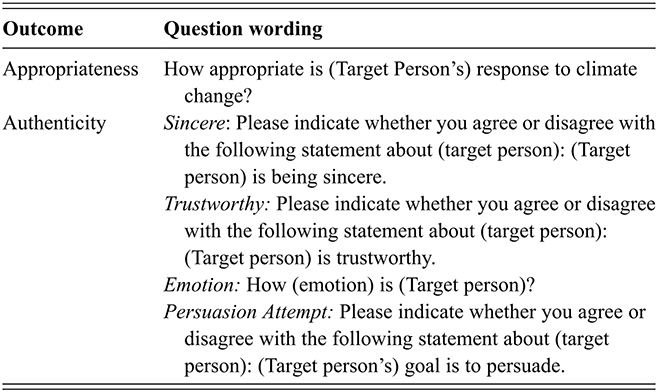
As we discuss in Section 2, people’s responses to the expressed emotions of others hinge on perceptions of the authenticity and appropriateness of these emotions. Our studies rely on outcome measures that capture these ideas (Table 2).
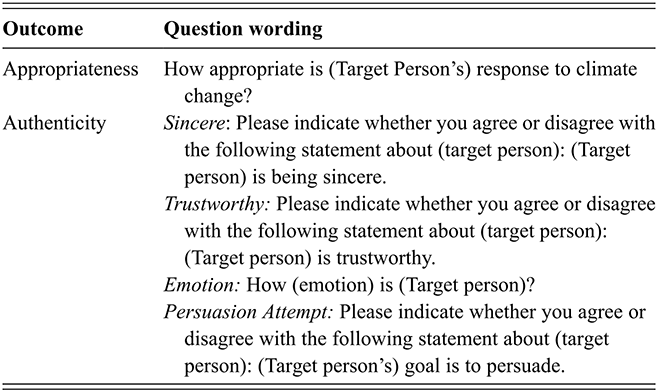
Table 2Long description
The table shows how each outcome of interest is measured. The two outcomes of interest are perceived appropriateness and authenticity. Appropriateness is measured using a single question, while authenticity is measured using four. The questions wordings are as follows: Appropriateness: How appropriate is (Target Person’s) response to climate change? Authenticity (Sincere): Please indicate whether you agree or disagree with the following statement about (target person): (Target person) is being sincere. Authenticity (Trustworthy): Please indicate whether you agree or disagree with the following statement about (target person): (Target person) is trustworthy. Authenticity (Emotion): How (emotion) is (Target person)? Authenticity (Persuasion Attempt): Please indicate whether you agree or disagree with the following statement about (target person): (Target person’s) goal is to persuade.
Measuring Perceived Appropriateness
Evaluations of appropriateness are judgments about whether an expressed emotion conforms to expectations for emotional expression given the context (Shields Reference Shields2005). Underlying appropriateness are beliefs about the extent to which an expressed emotion suits the particular context or precipitating event (Shields Reference Shields2005; Warner & Shields Reference Warner and Shields2009a). Our measure follows from previous research, and we rely on a single global measure asking respondents to assess appropriateness (e.g., Vingerhoets Reference Vingerhoets2012; Warner & Shields Reference Warner and Shields2009a, Reference Warner and Shields2009a). As the inciting event or context is key to the evaluation of appropriateness, participants are asked to indicate how strongly they agree or disagree that the content (which is an expressed emotion) is an appropriate response to climate change.
Measuring Perceived Authenticity
Perceptions of authenticity involve evaluations of whether the emotional expression reflects the expressor’s true underlying feelings (e.g., Ashforth & Tomiuk Reference Ashforth, Tomiuk and Fineman2000). Perceptions of authenticity capture several sub-considerations, and we rely on multiple measures to identify these perceptions (Lee & Eastin Reference Lee and Eastin2021). As we note in our preregistrations, these are not intended to be used jointly as a scale.
First, we ask respondents if they agree that the speaker is sincere. This measure follows from Lee and Eastin’s (Reference Lee and Eastin2021) measure of perceived influencer authenticity. While the underlying construct of authenticity is difficult to observe, sincerity is “a reflection of honesty and truthfulness” (Lee and Eastin Reference Lee and Eastin2021, p. 825, see also Beverland Reference Beverland2005). So, if people believe the speaker is more sincere, the less likely they are to perceive the speaker as engaging in an inauthentic display. In a similar vein, we asked respondents how strongly they agree that the speaker is trustworthy – another measure based on ideas in Lee and Eastin (Reference Lee and Eastin2021).
Next, we ask respondents how strongly they agree that the speaker is truly feeling the target emotion being studied. For example, in one set of experiments, we manipulate whether the speaker indicates they are sad about climate change; the question then asks how strongly participants agree the speaker is sad. If participants believe these expressions are authentic, then they should agree that the speaker is, in fact, sad.
An attempt to deliberately misrepresent emotions may seem manipulative (Grandey et al. Reference Grandey, Fisk, Mattila, Jansen and Sideman2005). In the context of politics, the emotion may seem like an attempt at persuasion. Previous literature underscores that persuasion attempts undermine perceptions of authenticity. When observers feel they are facing a persuasion attempt rather than an authentic expression, they are much more skeptical of the message (e.g., Ham et al. Reference Ham, Nelson and Das2015). Therefore, alongside other measures designed to capture authenticity, we include a measure that speaks to the unique nature of climate change as a political issue: Do participants believe that the speaker’s goal is to persuade others about climate change? This measure follows from previous approaches to capturing “persuasive intent” (Ham et al. Reference Ham, Nelson and Das2015).
3.3.2 Other Outcome Measures
In Studies 1 and 2, we track measures that consider other evaluations of the person expressing the emotion – such as their perceived knowledge of climate change (Study 1) and general affinity toward the expressor (Studies 1 and 2). Further, our two initial studies also measure posttreatment opinions about the importance of climate change. Finally, in Studies 5 and 6, we also include an open-ended measure to track people’s own explanations of their responses to treatments.
3.3.3 Pretreatment Measures
Each study measured pretreatment sociodemographic characteristics and political affiliation. These include age, race/ethnicity, income, gender, education, and partisan affiliation on a seven-point scale ranging from strong Democrat to strong Republican. The exact question wording is available in Online Appendix A.1. We also include predispositions toward climate change, which allow us to consider how people feel about the “inciting situation” – addressing the “what” question from Section 2. Participants are first asked to indicate whether they believe in climate change via the same measure that is used in the American National Election Studies and in the Yale program on Climate Change Communication’s annual Climate Change in the American Mind survey (see Ballew et al. Reference Ballew, Leiserowitz, Roser-Renouf and Maibach2019). Second, participants indicated how much they worry about climate change on a 1–10 scale. While typical measures of climate change worry only include five response options ranging from “not at all” to “very” worried, the ten-point scale allows for more variation in pretreatment worry.
In some studies, we also included additional pretreatment measures for preregistered tests of other heterogeneous treatment effects. Some came from previous research on response to emotions (e.g., perspective-taking, see de Waal Reference de Waal2008). Others were specific to our experimental context (e.g., use of social media and TikTok specifically). For each study, we preregistered looking at the effect of the treatment with and without controlling for sociodemographic characteristics. Additionally, we preregistered looking at treatment effects by specific pretreatment measures – most notably, belief in climate change.
3.4 Treatments
Our treatments are designed to reflect a given communication channel. In each case, they appear as they would on a person’s screen – for example, a text message appears as a message would on a phone. The content is also designed to reflect the types of thoughts that people would share – whether in an interview (Sections 4 and 5) or via a social media post (Sections 5 and 6). We developed these treatments based on actual social media posts, comments on news articles, and “person on the street” interviews in the news. We present more information on how our treatments compare in Online Appendix A.3. In some treatments, we include information about recent reports on climate change. In all cases, these are real reports, and the information included is actual information from a given report.
3.5 Samples
Our data come from two different types of samples: non-probability representative internet panels (i.e., YouGov), and convenience samples with quota-sampling to approximate the national population (i.e., Prolific, CloudResearch).
Convenience samples are less representative than their internet panel counterparts, and the efficacy of using representative internet panels for experiments has been well established (e.g., Vavreck & Rivers Reference Vavreck and Rivers2008). However, recent sample comparisons suggest relatively high response quality via Prolific and CloudResearch relative to other online opt-in samples that strive for representativeness (e.g., Stagnaro et al. Reference Stagnaro, Druckman and Berinsky2024). While the convenience sample does not perfectly match census demographics, so long as it does not systematically over- or under-represent respondents who are differentially affected by the treatment, the results are still generalizable to the broader adult population (Druckman Reference Druckman2022; Krupnikov et al. Reference Krupnikov, Nam, Style, Druckman and Green2021). Experiments conducted on such convenience samples generally replicate on probability samples (e.g., Coppock et al. Reference Coppock, Leeper and Mullinix2018).
Relying on a variety of sample types offers an additional benefit: replicating the experiments across samples with variation in research designs provides evidence for the consistency and external validity of our results (Campbell & Cook Reference Campbell and Cook1979; Druckman Reference Druckman2022). We observe no systematic differences in treatment effects by sample across all studies.
4 Emotions in the News
Although communication technologies have evolved to give people more and more access to the thoughts and feelings of others (e.g., Choi & Toma Reference Choi and Toma2014), we have long been privy to the feelings of strangers through news coverage. The classic “person on the street” interview – or “vox pop” – offers audiences the emotional reactions of people whom they do not know (Lewis et al. Reference Lewis, Inthorn and Wahl-Jorgensen2005; Pantti & Husslage Reference Pantti and Husslage2009; Stenvall Reference Stenvall2014). These “vox pops” are there “to provide mood, background, emotional reaction,” (Lewis et al. Reference Lewis, Inthorn and Wahl-Jorgensen2005, p. 143). The inclusion of these emotions is widespread. From 1995 to 2001, 82% of Pulitzer Prize-winning articles included sources expressing their emotions (Wahl-Jorgensen Reference Wahl-Jorgensen2013, Reference Wahl-Jorgensen2019). Editors prioritize emotional stories when selecting which letters to the editor to publish (Wahl-Jorgensen Reference Wahl-Jorgensen2001).
In this section, we consider what it means to encounter expressed emotion in the news. In the news, access is gatekept, meaning the person expressing their emotions has little editing control. For now, we keep the “how” and the “why” questions constant to focus on the “what” of the expressed emotion. Specifically, we focus on the first expectation emerging from Section 2:
When someone disagrees about the valence of the inciting event, they will perceive the expression of emotion as less appropriate than when they agree with the valence.
These first three studies allow for more direct tests of whether the climate change position taken by the expressor affects evaluations. We find that observing a stranger express emotions led study participants to perceive the expressor more negatively. The effect was consistent whether the stranger conveyed sadness or fear, or whether they were described as a man or a woman. Perhaps most importantly, expressions of emotions were perceived as less appropriate regardless of whether the participant agreed with the stranger’s beliefs about climate change.
4.1 Empirical Approach
In all three studies, participants were randomly assigned to read a short article about climate change. The article included a “vox pop” – a quote from a person about their thoughts on climate change. In some cases, the person interviewed also expressed an emotion. The three studies build on each other. In Study 1, we randomly assign the expression of emotion – but keep the position of the speaker constant. In Study 2, we manipulate the position of the speaker, which allows us to consider how the participants’ own position on climate change shapes their response to the emotion (the “what” question directly). Finally, given that in all cases our treatments are news articles, in Study 3, we focus on the “gatekeeper” and analyze how people view the journalist who decides to include an emotional quote in their story.
We begin with these studies first because these were, sequentially, the initial three studies we conducted in testing the way people perceive expressed emotions. Second, in these studies, we also check whether the gender of the person expressing emotions affects evaluations of the emotional expression, which shapes the remainder of the studies in this Element. Third, in these initial studies, we also consider multiple negative discrete emotions, again shaping the remaining studies.
We focus on our main dependent variable: perceived appropriateness of the emotion. In the subsequent sections, we will turn to our second focal measure: perceived authenticity. In Studies 1 and 2, we also include posttreatment measures of climate change efficacy, which are often featured in studies of climate change communication (Duan et al. Reference Duan, Zwickle and Takahashi2022; Hornsey & Fielding Reference Hornsey and Fielding2016; Kellstedt et al. Reference Kellstedt, Zahran and Vedlitz2008). Across our studies, we note the posttreatment climate change results in text, with the full details included in the Online Appendix.
4.2 Study 1: Expressing Emotions about Climate Change
4.2.1 Study 1 Design
Participants (N = 865, CloudResearch survey platform) read a short hypothetical newspaper article that included factually correct information from a Morning Consult poll along with a mention of a Morgan Stanley report discussing climate change. Morgan Stanley has issued a climate change report in recent years, and in 2023, the report raised the issue that a growing number of people are choosing not to have children due to fears about the increasing threat of climate change. Each article also included a quote from a ninth-grade teacher about the issue.
In this first study we completed, we manipulated the gender of the person quoted (either Patrick or Patricia Merrill). We included this manipulation as, given previous research, we anticipated questions about the role of gender. The manipulation in Study 1 serves as a check; given the results, we keep the identity of the expressor constant in the remaining studies (see section 4.2.2 for full results).
In the control condition, participants read the following:
In 2020, a Morning Consult poll found that a quarter of adults without children say climate change is part of the reason they didn’t have children. A Morgan Stanley analysis found that the decision “to not have children owing to fears over climate change is growing and impacting fertility rates quicker than any preceding trend in the field of fertility decline.”
“It is something that I think about often,” [Patrick/Patricia] Merrill, a 9th grade teacher said. “I think about bringing kids into an uncertain future and an uncertain world.” Merrill said [he/she] spends a good deal of time reading about climate change.
The first paragraph – factually correct information – was consistent across all conditions. In the emotional conditions, we manipulated the quote and the description of the speaker in the second paragraph. In the sadness condition, the second paragraph instead read:
“It is something that I think about often and it makes me very sad,” [Patrick/Patricia] Merrill, a 9th grade teacher said. “I am overwhelmed by the sadness of bringing kids into an uncertain future and an uncertain world.” Merrill said [he/she] spends a good deal of time reading about climate change and becomes so sad that [he/she] has a difficult time getting through the day.
The fear condition was similar, with Merrill instead noting they “felt afraid,” were “overwhelmed” by fear, and became so “fearful” they had a hard time getting through the day. In this first study, we focus on appropriateness, asking respondents to evaluate the emotional expression across conditions.Footnote 10
4.2.2 Study 1 Results
To identify the effects of the treatment, we follow our preregistered analytic approach and rely on a series of regressions (full results and robustness checks are available in Online Appendix B.1).Footnote 11 We consider our results in a series of steps. First, we treat the gender of the speaker as a nuisance factor (a factor that may affect evaluations of emotional expression but is not our primary focus). We focus on the role of emotions, tracking the effects of emotional expression on our focal variable – perceived appropriateness. Then, we consider the role of gender, tracking whether people respond differently to women expressing their emotions.
The Perceived Appropriateness of Emotions
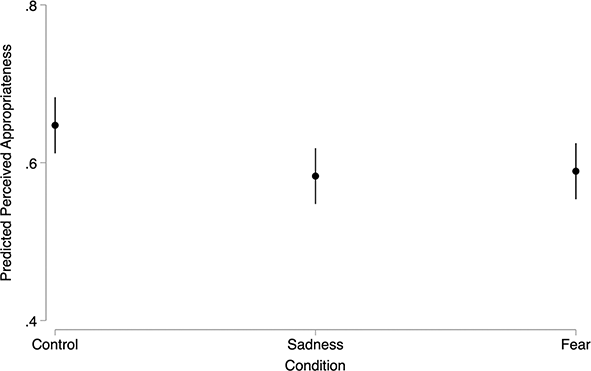
People perceive the speakers quoted in news articles as significantly less appropriate than when they express an emotion (Figure 1, sadness: p = 0.01, fear: p = 0.03). This is not to suggest that people believe it is inappropriate to express emotion on climate change: Across all conditions, the quoted person is evaluated as more appropriate than not. Rather, this suggests that people perceive the expression of emotion to be a somewhat less appropriate response than stating concerns alone. We see no statistical difference between the expression of sadness and that of fear.

Figure 1 Predicted agreement that the speaker’s response to climate change is appropriate. Full results in Online Appendix B.2.
The Role of Gender
While many different characteristics might shape evaluations of the expressor, one possibility is that people may perceive and evaluate emotions differently when they are expressed by a woman rather than a man (Shields Reference Shields2005). Yet research on the intersection of gender and evaluations of emotional expression is mixed. In the domain of the emotional expression of political candidates, for example, some studies find that men and women candidates both lose support in equal amounts if they cry (Brooks Reference Brooks2011) and are equally rewarded when they express anger (Boussalis & Coan Reference Boussalis and Coan2021). Therefore, in Study 1, we also consider whether the gender of the person in the story shapes the way people respond to their emotional expression.
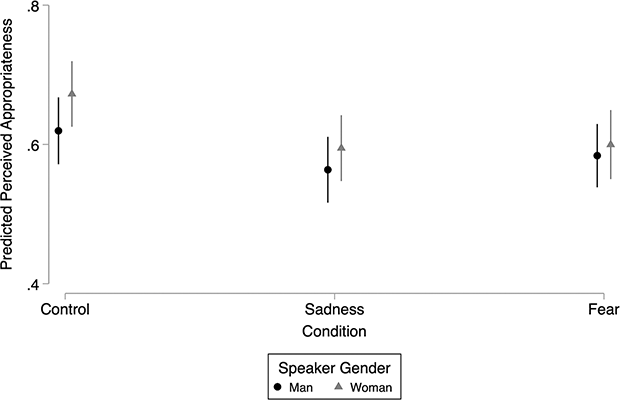
We regress evaluations of evaluations of the speaker’s appropriateness on an interaction between the emotion condition and the gender of the speaker while controlling for sociodemographic characteristics of the respondent (see Online Appendix B.2 for full coefficient tables). Doing so, we find no evidence that the gender of the speaker shapes evaluations (Figure 2). Expressing emotion decreases perceptions of appropriateness regardless of whether it is Patrick or Patricia who expresses emotions.Footnote 12

Figure 2 Predicted evaluations of the speaker’s appropriateness across all conditions. Full results are available in Online Appendix B.1.
Another possibility is that there could be interactive gender effects: Previous research suggests women are less put off by the emotional expression of all genders; however, men may find other men’s emotional expression inappropriate while being willing to assist emotional women (e.g., Warner & Shields Reference Warner and Shields2009b). Yet in exploratory analyses, we find no moderating effects of respondent gender (Online Appendix B.2).
4.2.3 An Emotional Vox Pop
Randomly assigning whether a “person on the street” expresses emotion when quoted by a journalist, we find that people perceive emotional expression as a less appropriate response to climate change. Notably, we do not find that the gender of the speaker (nor the gender of the receiver) shapes how people perceive the emotional expression. In other words, whether the “person on the street” was Patrick or Patricia, their emotional response in the context of climate change was still perceived as less appropriate than a response that contained no emotion.
This study, however, leaves open important questions. As we suggested in Section 2, perceptions of appropriateness are connected to people’s beliefs about the reason for the emotion – the “what” question. People may find emotional expression more appropriate when they agree that the “inciting incident” is actually negative. In our case, people may respond differently when they agree with the speaker’s position on climate change. In Study 1, we did not preregister analyses by participants’ climate change positions. Moreover, the design of the study was not well-suited to considering the role of the “what” – the position of the speaker was always constant and was not randomly assigned. Therefore, in Study 2, we consider the “what” question more directly.
4.3 Study 2: The “What” of Emotional Expression
Whether an expression of emotion is appropriate is, inherently, perceptual. One of the factors shaping this perception we call the “what” of the emotional expression. An expression of emotion may seem more appropriate when it is coming from “our side” – when we agree with the substance of the position taken by the emotional person.
In Study 1, all participants were asked to evaluate speakers who were concerned about the future under severe climate impacts. But there is wide variation in how people think about climate change in the United States: While many are concerned and support significant action to address climate change, others deny climate change exists at all (e.g., Egan & Mullin Reference Egan and Mullin2017). If emotional expression is seen as more appropriate when we agree with the speaker (e.g., Gračanin et al. Reference Gračanin, Bylsma and Vingerhoets2018; Kottler Reference Kottler1996; Vingerhoets Reference Vingerhoets2012), participants’ climate change positions should matter. So, hypothetically, if someone believes climate change is a hoax and is devastated watching others perpetuate this hoax, they might believe crying about the future of climate impacts is inappropriate. On the other hand, this same person might see crying about how we shouldn’t fight climate change as valid. From this perspective, the effects we observed in Study 1 could therefore be driven by climate deniers who disagree with the speaker.
4.3.1 Study 2 Design
Study 2 tests the moderating effects of agreeing with the position of the speaker. Much like in Study 1, participants (N = 1,200, YouGov) were randomly assigned to read news about climate change.Footnote 13 The news – this time set up as a transcript of a TV program – described a plan to teach climate change in middle and high schools. Much like Study 1, the news once again had a “vox pop.” Given our results in Study 1, in all conditions here and in the remaining experiments in this Element, the speaker was a woman, Patricia Merrill.
In this 2×2 design, we first randomized whether the speaker was emotional: All participants read a quote, but some were randomly assigned to see the speaker described as very sad. Second, we randomized whether the person quoted was opposed to discussing climate change in schools or in favor.
For example, the emotional, anti-climate change condition was as follows (the full text of the treatments and questions is available in Online Appendix B.2):
Anchor: The Franklin County school district is planning on teaching climate change in county middle schools and high schools beginning next academic year. Advocates say that students need to hear about this important issue, though not everyone thinks this is a good idea. But Patricia Merrill, a mother of a ninth grader, strongly opposes the program. [She says thinking about this issue makes her cry.]
Merrill Soundbite: The activists supporting this are pushing proposals that are going to destroy our economy. They say they care about kids, but they aren’t thinking about their future.
The Franklin County school board will hold a meeting on the proposal in January.
We highlight the “anti” treatment because it allows us to make an additional consideration: In this study, Patricia Merrill is not directly crying about climate change, but rather about the school policy. We can consider these treatments in Study 2 as a check on our effects: Do we see different patterns when the emotion is not directly about climate change itself, but about a specific policy?
Once again, our main measure is the perceived appropriateness of the response. Participants were also asked to indicate how strongly they agreed with the speaker’s position (which can also serve as a check on our pretreatment measures). We once again included measures about climate change concern and climate change behaviors, this time asking respondents how likely they were in the next six months to: Sign a petition, attend a rally or protest, talk to their friends and neighbors about the issue, and turn out to vote in favor of climate change. These measures identify whether encountering emotional expression has downstream consequences beyond just the evaluation of the expression.
Pretreatment, we asked participants about their climate change positions. Relying on their responses, we coded participants as in a consistent or inconsistent condition. First, participants who indicated that climate change “definitely is happening” or “probably is happening” were coded as believers, and those who said climate change “probably is not happening” or “definitely is not happening” as nonbelievers. Consistent with our preregistration, those who said “don’t know” were excluded from the analysis (112 participants). Then, believers who read about how climate change should be taught in schools or deniers who read about how it shouldn’t be taught in schools were coded as in consistent conditions. The rest of the participants were in inconsistent conditions.
There is research suggesting that evaluations of others’ emotions might vary based on observers’ perspective taking: the tendency to automatically feel the emotional state of others (e.g., Davis Reference Davis1980). Therefore, we included pretreatment perspective-taking measures and preregistered analyses that track the moderating role of perspective-taking.
4.3.2 Study 2 Results
In our analyses, we regressed our outcome measures on an interaction between whether a participant was in a consistent or inconsistent condition (given their position on climate change relative to the speaker’s support for teaching climate change in schools) and whether they were in the emotional expression condition. For ease of interpretation, all dependent variables were rescaled to range from 0 to 1. Before turning to our focal relationship – emotional expression and appropriateness – we can consider whether our categorization of conditions as consistent or inconsistent reflects our participants’ positions.
We find that participants in the consistent conditions agreed with the speaker more, and rated their response as more appropriate than in the inconsistent condition, regardless of whether the speaker was emotional. Treating the emotional expression manipulation as a nuisance factor, we see that appropriateness (
 = 0.28, p < 0.001) and agreement with the position (
 = 0.45, p < 0.001) are significantly higher in the consistent – relative to the inconsistent – condition. Therefore, we now turn to the main question at hand: the role of emotional expression (Figure 3).

Figure 3 Predicted evaluations of speaker appropriateness, agreement with the speaker, worry about climate change, and willingness to take climate action across conditions. Full results are available in Online Appendix B.2.
Agreement and (In)Appropriate Emotional Expression
In the inconsistent conditions – when people encountered someone they disagreed with – emotional expression made the speaker’s reaction seem less appropriate (
 −0.060, p = 0.02). This is in line with our theory; appropriateness is highly perceptual, and a person crying over an idea with which one disagrees is less likely to seem like an appropriate emotional reaction. What is somewhat more surprising, however, is that emotional expression is seen as less appropriate than a more neutral response even when the observer and emoter hold consistent opinions (
 −0.095, p < 0.001).
Certainly, the relative levels of perceived appropriateness are higher in the consistent conditions; perceived appropriateness, for example, is at its lowest point when the emotional expression is from a person with whom you disagree.Footnote 14 Still, we see decreases in perceived appropriateness across conditions. Even those who believe in climate change perceive emotional expression advocating for teaching climate change in schools as less appropriate than a more neutral response. And those who deny climate change are similarly put off by emotional expression from someone who wants to keep it out of schools.
As a next step, we consider our results another way – analyzing the “con” and “pro” treatments separately (Figure 4). In the “con” treatment, the fictitious parent is upset about the possibility of a climate change program in schools, while in the “pro” condition, the speaker is in favor. Rather than considering them in relation to respondents’ belief in climate change, we consider the conditions separately because the expressed emotions are not about climate change directly, but instead a policy related to discussing the issue.

Figure 4 Predicted evaluations of speaker appropriateness, agreement with the speaker, worry about climate change, and willingness to take climate action across conditions. Results pool across the climate attitudes of the respondents. Full results are available in Online Appendix B.2.
We find that in the “con” treatment, emotional expression leads to a significant decrease in perceived appropriateness (
 = −0.081, p = 0.002). The negative effect of emotional expression persists even when the emotion is not about climate change itself, but about climate change in the curriculum (Figure 4). Still, this negative effect persists even in the “pro” condition (
 = −0.08, p = 0.001). Even when we limit the analysis to participants who believe climate change is real and are in the “pro” climate education condition, the group who, arguably, should be most sympathetic to the emotional expression, we still observe a negative response (
 = −0.09, p = 0.002, see Online Appendix B.2).
Additional Analyses
We preregistered an analysis that tracked the moderating role of perspective-taking. We find no evidence that perspective-taking moderates the way participants respond to our treatments (Online Appendix B.2). We also preregistered a check to see if participants who identify as women respond differently to our treatments, finding no evidence to this point. Moreover, we once again conduct analyses focusing on downstream effects – focusing here on observers’ willingness to take action to address climate change – and find null effects (see Online Appendix B2.1).
4.3.3 (Dis)Agreement and Emotional Expression
As expected, people perceive the emotional reactions of those with whom they agree to be more appropriate. Indeed, it is the emotional expression of a person with whom they disagree that is seen as least appropriate. At the same time, emotional expression leads to negative reactions compared to more neutral responses, regardless of agreement; an emotional reaction is seen as less appropriate even among people who agree with the general position of the “emoter.”
Both studies thus far leave an open question: How do people evaluate the gatekeeper who chose to include these emotional quotes? In our treatments, emotional expression is transmitted by the journalist, who describes the speaker as crying (or afraid, in Study 1). This rhetorical strategy is common in the news (e.g., Wahl-Jorgensen Reference Wahl-Jorgensen2020). At the same time, the idea that the description of the emotion comes from the journalist intersects with another idea we consider in Section 2: How did the emotion get on the screen? We will address the “how” directly in Sections 5 and 6; for now, however, we want to address a dimension of this idea: Does including emotions in the news shape people’s perceptions of the journalist – that is, the person who made the decision to highlight the expression of emotion?
4.4 The Journalist Reports the Emotion
In the news, the journalists are the gatekeepers – they can select the person who is quoted, and they can select whether that quote is included (though, of course, the editor has the final say). When ordinary people are included in the news as “vox pops,” it is possible that their emotional expression can be considered through different lenses. On the one hand, the person quoted did express an emotion; on the other hand, the journalist opted to include this expression so that it reaches a broader audience. In Section 2, we theorize that the journalist’s role in this process may lead people to be less cynical of the person expressing the emotion (an idea we will revisit in Section 5). Yet, Section 2 also hints at a question: Even if people could perceive the emotional expression more positively when it is the journalists who broadcast it, could they perceive the journalist more negatively?
To consider this possibility, we conducted a study that shifts the participants’ perspective. In Studies 1 and 2, participants focus on a person whose emotional expression is included in an article; in Study 3, participants are asked to focus on the journalist who decided to include the expression. Although people’s perceptions of journalists can be part of broader questions about people’s trust in media and perceptions of media credibility (e.g., Jahng & Littau Reference Jahng and Littau2019; Kiousis Reference Kiousis2001; Thorson et al. Reference 78Thorson, Vraga and Ekdale2010), our design is not intended to track the way the inclusion of emotions in the news shapes multidimensional credibility and trust (an important question which other researchers have considered – see Baum and Rahman Reference Baum and Rahman2021). Our aim is to consider people’s quick response to the inclusion of emotion in an article and whether that reflects positively or negatively on the journalist.
4.4.1 Study 3 Design
Building on Studies 1 and 2, we randomly assigned participants (N = 1,000, YouGov) to read an article that included either an emotional or neutral quote. Each treatment noted the (hypothetical) journalist, Casey Smith.Footnote 15 In the control condition, the article included a neutral quote in which an interviewee mentions regularly thinking about bringing kids into an uncertain future brought about by climate change. In the sadness condition, the person quoted instead emphasizes how sad she is thinking about this uncertain future, and in the fear condition, she emphasizes being overwhelmed by fear. For example, the fear condition was as follows:Footnote 16
This is the snippet from an article on climate change written by journalist Casey Smith:
Patricia Merrill, a 9th grade teacher is concerned about climate change.
“It is something that I think about often and it makes me very afraid. I am overwhelmed by the fear of bringing kids into an uncertain future and an uncertain world.” Merrill said she spends good deal of time reading about climate change and becomes so fearful that she has a difficult time getting through the day.
Merrill is just one of a quarter of adults who, in a recent poll, say climate change is part of the reason they didn’t have children. A Morgan Stanley analysis found that the decision “to not have children owing to fears over climate change is growing and impacting fertility rates quicker than any preceding trend in the field of fertility decline.”
By Casey Smith
Much as would happen outside of the lab environment (Peters Reference Peters2011; Stenvall Reference Stenvall2014), the article included emotionality in two ways. First, the speaker being quoted expressed her emotion by saying she was “overwhelmed by fear.” Second, the journalist described the emotionality of the speaker, stating she “becomes so fearful she has a difficult time getting through the day.”
Participants were first asked whether they agreed that “Casey Smith’s article on climate change was appropriate.” Unlike Studies 1 and 2, the measure shifts perspective: Study 3 does not capture whether people believe the emotional expression itself is appropriate, rather the study considers whether the decision to include the emotional expression is appropriate.
Given our focus on the journalist, we also consider whether reporting on emotion shapes other perceptions of the journalist. Again, our goal here is limited to tracking people’s immediate responses to the journalist, rather than to offer a test of perceived media credibility (e.g., Jahng & Littau Reference Jahng and Littau2019). Therefore, we ask direct questions about the journalist’s perceived credibility and whether the participants would read an article by this journalist again. We also ask whether people perceive that the journalist is attempting to persuade them (Coleman et al. Reference Coleman, Thorson and Chen2025).
As we did in Study 2, we measured participant beliefs about climate change pretreatment. Participants who indicated climate change is “definitely happening” or “probably happening” were categorized as believers (831 respondents), while those who indicated climate change “probably is not happening” or “definitely is not happening” were categorized as deniers (169 respondents). Consistent with the preregistration, those who indicated they “don’t know” were excluded from the analyses (only 72 respondents).Footnote 17
4.4.2 Study 3 Results: Emotional Expression and Perceptions of the Journalist
Evaluations of the journalist do not change depending on whether or not they include emotional expression in their article (all variables in Online Appendix B.3). We see no evidence, for example, that including either a sad quote (
 = −0.002, p = 0.934) or a fearful quote (
 = −0.005, p = 0.830) changes perceived appropriateness. Although we see the largest effect sizes for perceptions of persuasion, the effects still do not meet conventional levels of significance for either sadness (
 = 0.026, p = 0.254) or fear (
 = 0.033, p = 0.142).
There are significant and largely unsurprising differences between how those who believe in and deny climate change evaluate the journalist across treatments. Holding the inclusion of the emotional quote as a nuisance factor, those who believe in climate change, for example, are significantly more likely to think the article is appropriate (
 = 0.29, p < 0.001) and think the journalist is more credible (
 = 0.30, p < 0.001). We note, however, that there are no differences by climate change beliefs in evaluations of whether the goal of the journalist is to persuade (
 = −0.010, p = 0.746); across climate attitudes, respondents believe the journalist is at least somewhat trying to persuade their audience. We see similar differences in climate change attitudes within conditions as well (full results in Online Appendix B.3).
We also see similar treatment effects within climate change positions: There are no significant differences in any of our other outcome measures. The null effects are also robust to combining both the sadness and fear conditions into a single emotional condition, compared to the control (see Online Appendix B.3). We underscore, however, the difference in sample size between the number of participants who believe in climate change and those who do not. Therefore, in the Online Appendix, we conduct a test of a negligible effect (e.g., Rainey Reference Rainey2014). We note that this test still leaves uncertainty due to the low sample size.
4.5 Emotions as News
In this section, we consider how people respond to emotional expression in the news – focusing on emotional expression by ordinary people included as “vox pops.” In the first two studies, we find that participants perceive the reactions of those quoted to be less appropriate when they include emotional expression. This effect persists even when participants agree with the position of the person quoted. In Study 3, we shift the lens – after all, it is the journalist who made the decision to broadcast the emotional expression of an ordinary person. Here, we find that the inclusion of emotional expression does not change individual perceptions of the journalist who made the decision. The expression of emotion, these results hint, may reflect more on the person who is doing the emoting. How people feel about the journalist is an idea we will revisit in the next section.
In Section 2, we suggest that the way people perceive the expressed emotions of others depends on questions of what, how, and why. In our first two studies, we kept the “how” and “why” constant – instead focusing more directly on the “what” of expression. In all cases, the emotional expression made it to the screen in the same way, but the person expressing the emotion and the events leading to the emotional expression changed. Still, we turn our focus to the journalist in Study 3 because the process by which the emotions reach the screen – the “how” and the “why” – also matters. If people believe that “sincere” emotions should be “spontaneous” eruptions, then the way these emotions become broadcast to the public may shape these beliefs about their spontaneity and, consequently, their authenticity. In the next section, then, we address these ideas of “how” and “why”; specifically, we will manipulate the communication channel and turn to our second (and perhaps more important) outcome – the perceived authenticity of emotions.
5 The Visibility of Emotional Expression
In Section 4, our focus was on the question of “what.” To this end, in our first three studies, we manipulated the message (as well as the messenger) while holding constant the communication channel. In this section, we shift our approach: We keep the message constant, instead randomly assigning the communication channel through which the message is transmitted. Our goal in this section is to consider the way questions of how a given emotion came to be on the screen and assumptions about why a given emotion was shared shape people’s perceptions of the expressed emotion.
In our first set of analyses, we keep access (e.g., Barzilai‐Nahon Reference Barzilai-Nahon2009) constant: In all cases, we rely on communication channels where any person can share a message without a gatekeeper. All of these communication channels are also of similar “editability” – a person can delete and edit until they are happy with what they are sharing (e.g., Chen & Toma Reference Chen and Toma2024). What distinguishes these channels is their visibility – the extent to which the channel is perceived to have “public message visibility” (Choi & Toma Reference Choi and Toma2022, p. 141). We compare the same messages sent via text (lower visibility) to those sent via a social media platform (higher visibility). Social media platforms are not only more, potentially, “public” than text messages but may also be perceived as places where people are deliberately trying to be “visible” (Duffy Reference Duffy2017), making these platforms seem more “self-promotional” (Duffy & Hund Reference Duffy and Hund2019). In turn, this variation in platforms allows us to consider the possibility that emotions shared via some more communication channels will be perceived as, potentially, less authentic.
As a second step, we consider the “how” question – whether it matters that another person (in our case, a journalist) decided to make the expressed emotion public. Unlike in Section 4, where all treatments were quotes in news articles, here, respondents read the expression as a quote in the news (limited access) or a social media post. As a result, we can directly track the expectation from Section 2 that the presence of a gatekeeper in sharing an emotion may lead the expression to seem more authentic.
5.1 Visibility and Authenticity
Consider three places someone could share their feelings through a screen: a text to a friend, a comment on a news article, or a post on Twitter/X. These communication channels are similar in their editability – people can continue to revise their words until they hit “send” or “post” (Chen & Toma Reference Chen and Toma2024). People also have direct “access” (Barzilai‐Nahon Reference Barzilai-Nahon2009) – there is no gatekeeper required to register and post.Footnote 18 A way in which these channels vary, however, is visibility. A text, for example, is less visible relative to a post on Twitter/X. Comments on a news article fall in a grey area – more visible than a text, but less visible than a social media post. Compared to posting on social media, commenting on a news article may seem less like it’s for “clout.” Considering these different communication channels, we work to address the following expectation from Section 2: When a channel is perceived as more visible, the expressed emotion will seem less authentic than when a channel is less visible.
5.1.1 Study 4 Design
In Study 4, all conditions centered on the same Morgan Stanley report as in Study 1, which raised the issue that a growing number of people are choosing not to have children due to fears about the increasing threat of climate change. All participants were first told: “Morgan Stanley recently released a report that the decision to not have children owing to fears over climate change is growing and impacting fertility rates quicker than any preceding trend in the field of fertility decline.”
They were then shown a screenshot of someone’s response to this factual information. Across every condition, the response to this information came from someone named “Patricia Merrill,” who wrote: “People don’t want to have kids because of climate change. That makes sense! I read so much about climate change and get so sad that I honestly have trouble getting through the day sometimes.”
While the content remained the same across all conditions, we manipulated the communication channel through which this message was transmitted. Study participants were randomly assigned to see the quoted response as a private text sent to a friend, a comment on a news article, or a Twitter/X post (see Figure 5).Footnote 19 After exposure to the treatment, participants (N = 1,171, Prolific) evaluated Merrill’s authenticity using the set of measures discussed in Section 3: Sincerity, the extent to which Merrill is trying to persuade, the extent to which they are sad, and their trustworthiness. As we did in our other studies, we also measured climate change beliefs pretreatment.
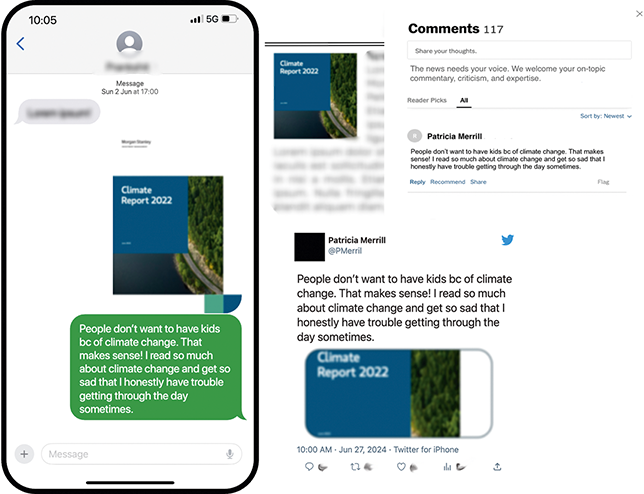
Figure 5 Images of each condition. Participants were randomly assigned to read the response as a text message, comment on a news article, or a Twitter/X post.
Study 4 also included a fourth condition in which participants encountered the same content, but instead included as a quote in a news article. This fourth condition reflects the treatments in the studies in Section 4: It is the journalist who made their quote public. In this first empirical section of Section 5, our focus is on non-gatekept channels; therefore, we begin with a focus on the first three conditions. In the second half of Section 5, we will return to this fourth condition to consider how the presence of a gatekeeper shapes responses to the expressed emotion. All analyses, including this two-part analytic approach, were preregistered.Footnote 20
5.1.2 Study 4 Results: Different Communication Channels
Contrary to our theoretical expectations in Section 2, we find limited evidence that these different communication channels undermine perceptions of the authenticity of emotional expression (Figure 6). Here we present results regressing each dependent variable on an indicator for each treatment condition, and in Online Appendix C.1, we present preregistered robustness checks with sociodemographic controls as well as results by belief in climate change. Results are substantively the same across each robustness check.
There are no significant differences in perceptions of authenticity on any of our measures between the text message and comment conditions. A comment on a news article is more visible than a text, yet participants did not think Patricia Merrill was consistently significantly less authentic on any dimensions: Trustworthiness (
 , sincerity (
 , or actually reflecting the stated emotion (
 . On average, participants did lean toward thinking both were persuasion attempts – the average respondent fell somewhere between “agreeing” and “neither agreeing nor disagreeing” that Merrill’s goal was to persuade – but this response did not vary significantly between the text and comment conditions (
 .
.

Figure 6 Predicted evaluations of whether the message is a persuasion attempt, trustworthy, authentic, and whether the speaker is actually sad by the treatment. Results are from linear regressions, regressing each dependent variable on indicators for the treatment condition. Error bars are 95% confidence intervals. Full model results and robustness checks are available in Online Appendix C.1.
Compared to a text, posting to Twitter/X is substantially more visible (e.g., Choi & Toma Reference Choi and Toma2022). Still, we observe a few consistent differences in evaluations of authenticity between the text and social media conditions. Participants do perceive Merrill as somewhat less trustworthy (
 , and slightly less sincere in the Twitter/X condition compared to the text condition (
 , but these effects do not consistently reach conventional levels of significance. Effects on evaluations of whether Merrill is sad (
 , and engaging in a persuasion attempt (
 , are in the expected direction, but also do not reach statistical significance.
We also do not see any significant differences between the Twitter/X and the comment conditions. Still, comparing our conditions to the least visible communication channel, texting, we see that even as visibility increases, there is no consistent evidence of decreased evaluations of authenticity.
5.1.3 Communication Channels and Limitations
In Section 2, we argued that visibility would lead people to perceive expressed emotions as less authentic. Although we see suggestive patterns, we see little consistent evidence to this end. Further, we do not see that pretreatment characteristics – like our participants’ positions on climate change – shape their evaluations. There are different ways to consider these findings. One possibility is a limitation: These communication channels may vary beyond visibility alone – perhaps these other differences diluted effects. It is also possible, however, that visibility matters much less than we expected – in short, our theoretical expectations were incorrect. Moreover, although we showed the treatments as “screenshots,” the experimental context could not fully transport people into the communication channel, even as they understood that these communication channels had different levels of visibility. And, it is possible that the affordances that may most fundamentally alter perceptions of authenticity were not present in this study. Perhaps it is images and videos that matter most – for example, someone sharing an image of themselves crying (as news articles about crying on social media would suggest – e.g., Kaur Reference Kaur2025). We return to this idea in Section 6.
For now, however, we underscore that to this point our results do not follow our theoretical expectations in Section 2. As a next step, then, we consider the second part of our analysis – the extent to which the “how” matters. Specifically, we next turn to the fourth condition in our study: What happens when the emotional expression is transmitted via the news.
5.2 The Role of the Gatekeeper
In Section 2, we argue that the extent to which people have access to a platform – and consequently, their ability to craft and edit their messages before making them public – also matters. An emotional expression may seem less like an authentic moment of fear or sadness when a person chooses to share it themselves and could, in theory, have carefully polished their post. On the other hand, if someone is interviewed for a news article, the decision to make the emotion (and, to some extent, the content of that expression) public is up to the journalist – the reason that an emotion has appeared on a screen rests with a gatekeeper. Therefore, we now turn to the final condition in Study 4 to test the following expectation from Section 2: When a channel does not require a gatekeeper, the expressed emotion will seem less authentic than when a channel does require a gatekeeper.
5.2.1 Revisiting Study 4: Access to the Gate
In the conditions discussed thus far, there was no gatekeeper, but the visibility differed. We now turn to our fourth condition: The same emotion is expressed via the news. This condition allows us to compare a case in which the decision to share the emotion is made by a gatekeeper, rather than the person expressing the emotion. The first three conditions are shown in Figure 5, and the new condition is shown in Figure 7. If assigned to this condition, participants were told that Patricia Merrill made the comment to a journalist. All outcome measures remain the same.

Figure 7 Images shown to participants in the news condition.
5.2.2 Does the “Gate” Matter?
We see limited evidence that “gating” affects how our participants perceived this expression of emotion. Following the preregistration, in the main text, we present results by condition without additional control variables. In Online Appendix C.1, all analyses are replicated with sociodemographic controls. In Figure 8, we focus on the comparison between the news and the Twitter/X condition – the conditions with, arguably, the largest audiences. When we compare the news condition to the other conditions – text messages and comments on a news article – we see similarly null results.

Figure 8 Mean predicted evaluation of the speaker on each dimension. Differences are as follows: Persuasion = −0.03 (p = 0.145); trustworthy = 0.001 (p = 0.942); sincere = −0.03 (p = 0.122); sad = −0.02 (p = 0.360). Point estimates are predicted values from OLS regression, regressing each dependent variable on an indicator for the treatment condition, and error bars are 95% confidence intervals. Full results are available in Online Appendix C.1.
There are no significant differences between the news quote to a post on Twitter/X and on any of our outcome variables. Regardless of whether the decision to share the expressed emotion was made by Patricia Merrill or a journalist, the emotional expression appears just as sincere (
 and sad (
 . Regardless of the communication channel, Merrill herself seems just as trustworthy (
 and aiming to persuade (
 . Substantively, we see that participants are mostly middling in their perceptions of authenticity. For example, the average respondent falls somewhere between disagreeing and neither agreeing nor disagreeing that Merrill is trustworthy. They are similarly neutral, though lean toward agreeing, that Merrill is sincere and sad. We do not see evidence that the presence of a “gatekeeper” significantly shapes these perceptions.Footnote 21
5.2.3 Limited Role of the Gatekeeper
Ultimately, we do not find that the presence of a gatekeeper matters. The patterns point to a question. In Section 2, we note that it matters how the emotional expression made it to our screens; in particular, that when the decision to share the expressed emotion was made by another person (e.g., a journalist) and could not be edited by the “emoter” before sharing, people might view the emotion as more authentic. This idea, however, hinges on people viewing the journalist as the gatekeeper. Is it possible that people do not view the journalist in this way?
5.3 Reconsidering Perceptions of “Gates”
To this point, we have twice considered the role of journalists. In Section 4 (Study 3), we tracked how participants evaluate a journalist who includes emotions in their story. In this section, we consider whether people distinguish between emotions shared by a journalist and emotions shared by the person themselves via social media. Both of these studies stem from our expectation that the presence of a gatekeeper matters. This expectation, however, hinges on the idea that people perceive the news context as one that is inherently gatekept and see the journalist as the ultimate “decider.” Given our results, as a final step in this section, we conducted a separate study to track whether this was, indeed, the case.
In a post hoc check, we asked participants (N = 1,159, CloudResearch) to once again look at a quote included in a news article.Footnote 22 Here, we used the same treatment as we did in Study 4; however, we randomly assigned whether the person quoted was just described as a “person” (as in Study 4) or as a “teacher” (as in Study 3). As we note in our preregistration, we had no a priori expectations about the way this random assignment should affect participants’ responses. In fact, we intended to make sure that people saw both in the same way and then treat the “teacher” description as a nuisance factor.
After seeing the news quote, we asked our participants three questions (full question wording in Online Appendix C.2). First, participants were asked if they believed it was the journalist who sought out the person to interview – a measure of perceived gatekeeping. Second, we asked participants whether they perceived the quoted person to be representative of the public – again, an idea pointing to the journalist’s role as a selective gatekeeper (e.g., Beckers Reference Beckers2020). Finally, we asked participants who had more control over the final quote – the journalist or the quoted speaker – addressing the idea of editability that stems from the presence of a gatekeeper.
We find that across all three measures, it does not matter whether the person quoted is described as a teacher or just a person.Footnote 23 Turning to the patterns in our outcome measures, 85.6% believe that the journalist sought out the person to interview, 71.2% believe that the person selected was not representative, and 74.7% believe that the journalist had more control than the person being interviewed over the final quote. The majority of participants, then, do view the journalist as a gatekeeper and attribute the editing to the journalist.Footnote 24 In short, the patterns in Studies 3 and 4 seem unlikely to be due to people’s misunderstanding of the gatekeeping role of the journalist.
Of course, there is the possibility of a limitation: The presence of a gatekeeper could be intertwined with more general perceptions of media credibility. Keeping this in mind, however, our results still suggest that emotion filtered through and presented through the news media did not seem to have a different reception.
5.4 How Authentic?
Across all conditions, Study 4 results show few consistent patterns. That said, we note that the communication channel in which the emotional expression is perceived as most authentic is the text message. This is consistent with previous research, which suggests that people view “private visibility” channels – like text messages – as the best suited for the communication of bad news and negative events (Choi & Toma Reference Choi and Toma2014). Still, we do not see that text messages are viewed as significantly and consistently more authentic – on any of our measures – relative to other communication channels.
We again underscore potential limitations in Study 4. First, it is possible that these communication channels were too different – varying in ways beyond visibility. Although research points to visibility as a “root affordance” (Treem et al. Reference Treem, Leonardi and van den Hooff2020), we do want to acknowledge that this possibility is in the interpretation of our results.
Second, people can express their emotions in many ways, but a part of emotional expression is often visual – people’s facial expressions and other nonverbal behavior also speak to the expression of emotion (van Kleef & Côté Reference van Kleef and Côté2022; Wahl-Jorgensen Reference Wahl-Jorgensen2019). Just as different communication channels shape the methods and audiences for a given expression of emotion, they can also shape the extent to which these more visual elements are transmitted (Chen & Toma Reference Chen and Toma2024; Fox & McEwan Reference Fox and McEwan2017). Different communication channels, for example, have different “bandwidth” – that is, they differ in the extent to which people can transmit the nonverbal components associated with emotional expression (Fox & McEwan Reference Fox and McEwan2017).
The level of bandwidth of a given communication channel may shape when people choose to use it (Chen & Toma Reference Chen and Toma2024). People, for example, may decide to rely on a given channel precisely because it will hide their nonverbal behavior. But the extent to which a particular channel – or even a particular message – includes visual components can also change the experience for the audience. There is a possibility, for example, that people may perceive the expressions of emotions that come across their screens differently depending on whether they can see the facial expressions and nonverbal behavior alongside people’s descriptions of what they are feeling. On top of that, people may respond differently to someone simply writing how they’re feeling compared to someone taking the time and effort to pose and record their emotional expression. In Section 6, we explore whether seeing an expression of emotion changes how people perceive its appropriateness and authenticity.
6 Feelings You Can See
Access to others’ emotions online isn’t limited to text – people regularly encounter visual evidence of people expressing their feelings. People will post videos of themselves expressing their feelings, for example (e.g., Basch et al. Reference Basch, Yalamanchili and Fera2022). The expression of emotions is a key part of communicating about politics on TikTok (e.g, Kligler-Vilenchik & Literat Reference Kligler-Vilenchik and Literat2024). Whether a person can see the expression of emotion, in addition to reading about a description of how someone is feeling, could have different effects on perceptions of authenticity and appropriateness.
On the one hand, an audience may perceive images as more authentic because they offer proof that the person posting is genuinely feeling the emotion. Someone can spend as much time as they’d like revising a text post and creating the exact message they want to send, but facial reactions are more difficult to control or create artificially. Perhaps to this end, research suggests that influencers who visibly express (positive) emotions are perceived as more authentic (Gu et al. 2024).
On the other hand, including a picture of oneself crying along with text of how sad they are may make the emotion seem even more exaggerated and inappropriate. If the concerns about communication channel visibility are about the extent to which someone is aiming to seek “clout” and “attention” – rather than genuinely expressing an emotion – a visual representation of that emotion may do little to assuage these concerns. Moreover, research suggests that people are not always capable of correctly categorizing facial expressions as genuine versus “deliberate” or “strategic” (e.g., McLellan et al. Reference McLellan, Johnston, Dalrymple-Alford and Porter2010; Zloteanu & Krumhuber Reference Zloteanu and Krumhuber2021). Rather than attenuating the undermining effects of encountering emotions online, images may exacerbate skepticism and the sense that such emotionality is inappropriate.
In this section, then, we consider what happens when a discussion of how someone is feeling is accompanied by facial cues. Our goal here is not to suggest that including a visual component in an emotional post will always function in a particular way. Indeed, it is possible that small shifts in the way the person is using a given communication channel may have broad consequences. Emotional expression in a live-stream may be viewed as more authentic than a posted video. A video where a person is seen as posting immediately after an event may also seem more authentic. Rather, in Studies 5 and 6, we consider one particular context in which an audience encounters a person’s emotional expression both as a description and in a visual way.
These studies are also an extension of the theoretical framework in Section 2. In all treatments, Studies 5 and 6 keep the content (the “what”) constant – and they also do not vary either the presence of the gatekeeper (the “how) or the visibility of the platform (the “why”). The studies do, however, speak to the possible role of modality in visibility: The presence of a facial cue could change the perceived visibility even if the communication channel itself remains the same.
6.1 Seeing Faces
Studies 5 and 6 both begin similarly to our previous studies: Participants encounter a hypothetical person’s response to information about climate change. Much as they did in some conditions in Section 5, the participants in both studies were asked to imagine that they encountered a post on social media from someone named Patricia Merrill in response to the forthcoming report about climate impacts. What differed, however, was that Studies 5 and 6 told participants they were seeing screenshots from TikTok. And, perhaps most importantly, in some conditions, participants could also see the face of the person who was making the post.
Treatments which included a person’s face took the form of a “stitched” TikTok – in Study 5, for example, the person appeared over a background of the cover of the Intergovernmental Panel on Climate Change (IPCC) special report on climate impacts on cities. The emotional faces we use come from the Amsterdam Interdisciplinary Center for Emotion (AICE). The dataset includes images where the same models – all real people – make a neutral face and then express different emotions (van der Schalk et al. Reference van der Schalk, Hawk, Fischer and Doosje2011).Footnote 25 The dataset was pre-validated on a variety of dimensions that are important for our study, including the recognition of the emotion being expressed, the perceived arousal, and the extent to which the emotion is directed at the audience. Put another way, the validation done by the AICE offers evidence that the images are easily recognized as the target discrete emotions, and that observers in the validation believed the expressor is being sincere.
Posttreatment, we measure both appropriateness and authenticity. Pretreatment, we again capture climate change positions, and, in Study 6, an additional variable: People’s use of and familiarity with social media (in particular, TikTok). Moreover, because these results are an extension of the ideas in Section 2, we also included open-ended measures, which will allow us to consider how participants explain their responses.
In general, the two studies are similar, with one key difference. In Study 5, the emotional expression is conveyed through both a facial cue and text. In Study 6, the emotional expression is conveyed solely through the face – the text is neutral. This change in treatments allows us to consider whether it was the combination of text and facial expression that led to the outcomes we see in Study 5, or if a facial cue alone is enough to convey an emotional expression. Moreover, the neutral text in Study 6 allows us to ensure that it is not the content of the text in Study 5 that drives the results.
6.2 Study 5 Design: Facial Expressions of Emotion
Participants (Prolific, n = 1,001) were asked to imagine they encountered a post on social media from someone named Patricia Merrill in response to the forthcoming report about climate impacts.Footnote 26 As in Study 4, the fictional post is in response to an actual report – in this case, the IPCC special report on climate impacts on cities.Footnote 27 By not using the Morgan Stanley report, we avoid concerns that participants are responding to Merrill’s concern about the decision to have children specifically rather than climate change more broadly. We conducted a pretest in which we varied whether the response was to the Morgan Stanley report or to the IPCC report and found no substantial differences in evaluations of Merrill based on the change of the report (see Online Appendix D.1).
To test the effect of being able to see emotions, participants were randomly assigned to one of three conditions. In two conditions, participants were shown a screenshot of a TikTok post: Here, they could see Merrill’s face over a blurred image of the IPCC report (Figure 9). Participants were told this is only a screenshot, and that in her post, Merrill shared the quote: “So many people are thinking about climate change. This makes sense! I read so much about climate change and get so sad that I honestly have trouble getting through the day sometimes.” Posts where people superimpose themselves speaking and emoting over images are a common template on the TikTok platform.

Figure 9 Image from the sad TikTok condition. The image of the face was retrieved from the Amsterdam Dynamic Facial Expression Set.
The two TikTok conditions differed in whether Merrill had a neutral face or a sad expression (relying on pretested faces from the AICE). For ease of interpretation, in the results, we discuss differences between the “sad TikTok” and “neutral TikTok.” While both included the same sad quote, these monikers distinguish between the emotionality of the face included in the treatment. After developing the image, we showed it to a group of undergraduate students with some experience using TikTok to ensure that the image seemed like something they may encounter.
Participants assigned to a third condition read Merrill’s comment as a post on Twitter/X which included a blurred image of the report (see Online Appendix D.1). We preregistered using this condition to consider whether the addition of Merrill’s face shapes outcomes. Twitter/X and TikTok are, of course, very different platforms. We report the cross-platform comparisons as preregistered, but are cautious in the interpretation. Study 6 in this section will more directly speak to the role of a person’s face in shaping outcomes.
After seeing one of the three social media posts, participants were asked to evaluate Merrill’s authenticity using our four measures (discussed in Section 3) – whether she is sincere, sad, trustworthy, and engaging in a persuasion attempt. In addition, participants were asked how strongly they agree that her post was appropriate.
6.2.1 Study 5 Results: Appropriateness and Authenticity
Consistent with our preregistration, results in the main text regress each dependent variable on an indicator for the treatment condition, and in Online Appendix D.1, we replicate the results with sociodemographic control variables.Footnote 28 Results are consistent across both sets of models. All variables are rescaled from 0 to 1.
Our results suggest that seeing the emotional expression can shape perceptions. The sad TikTok is perceived as significantly less appropriate than the neutral TikTok (
 p < 0.001) (see Figure 10). The sad TikTok is also perceived as less sincere than the neutral TikTok (
 , though we see no significant differences between these conditions on perceptions of whether Merrill is actually sad or is engaging in persuasion. Finally, the sad TikTok also leads Merrill to be seen as significantly less trustworthy relative to the neutral TikTok (
 p < 0.001, see Figure 11).
Although complicated by cross-platform comparisons, we do consistently see differences between the TikTok conditions and Twitter/X condition. Compared to the tweet, the sad TikTok seems less appropriate (
 p = 0.001), though there are no differences between the tweet and the neutral TikTok (
 p = 0.364). Relative to the tweet, both TikTok conditions are perceived as less sincere (neutral:
 ; sad:
 , less sad (neutral:
 ; sad:
 and more likely to be engaging in a persuasion attempt (neutral:
 ; sad:
 . The sad TikTok also makes Merrill seem significantly less trustworthy than the tweet (
 p < 0.001), though there is no difference in perceived trustworthiness between the tweet and neutral TikTok.
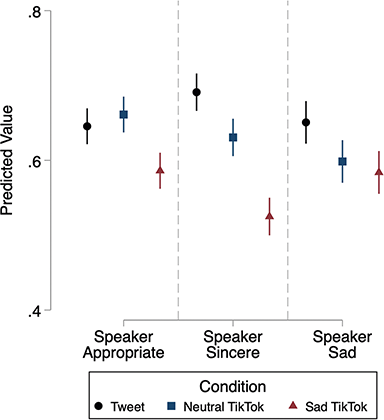
Figure 10 Predicted evaluations of speaker appropriateness, sincerity, and whether they are actually sad by treatment. Results are from linear regressions, regressing each dependent variable on indicators for the treatment condition. Error bars are 95% confidence intervals. Full model results and robustness checks are available in Online Appendix D.1.

Figure 11 Predicted evaluations of whether the speaker is engaging in a persuasion attempt and is trustworthy. Results are from linear regressions, regressing each dependent variable on indicators for the treatment condition. Error bars are 95% confidence intervals. Full model results and robustness checks are available in Online Appendix D.1.
Taken together, these results suggest that including a facial expression of emotion may not enhance the perceived appropriateness or authenticity of the expressed emotion – in fact, it seems to do the opposite. All our treatments included the same textual expression of emotion, but the facial expression of emotion alongside made the post seem less sincere and trustworthy.
6.2.2 Feelings about Feelings
At the end of Study 5, participants were asked whether they had any final comments. This question was open-ended and did not prompt our participants to write about anything in particular. This open-ended box was designed as a means of giving people an opportunity to comment on the study. Some participants left comments about the study itself – for example, noting that it was “fun.” Other participants left notes about how climate change is real, and we should all be worried (and the opposite, that climate change is a hoax, and they can’t believe people are posting about it on social media). Still other participants commented on the post they saw – and social media generally. It was not our a priori preregistered plan to consider these comments substantively,Footnote 29 but looking at them at the conclusion of our study proved instructive.
Across all conditions, participants were equally likely to leave substantive comments about the treatments.Footnote 30 What shifted by condition was the proportion of the substantive comments that focused on climate change versus the proportion focusing on the post in the treatment, or social media in general. In the Twitter/X conditions, among those who made comments, 82.8% focused on climate change. In the neutral TikTok condition, the majority still focused on climate change, but the proportion declined to 67.2%. Instead, nearly 30% of participants in this group focused on social media. We see the same pattern in the sad TikTok condition, where 31.1% of comments are about the post or social media.
In addressing the post itself, participants often turned to authenticity – and the authenticity of sharing emotions on social media generally. “I personally think that Patricia seemed very insincere and manipulative,” wrote one participant. Other participants agreed: “I believe that a person who posts things like this may only be trying to ‘present’ themselves as a vehemently concerned individual. I would also assume that she is hoping to get ‘sympathy’ from other people by stating that this ruining her days.”
Some of these comments, we note, focused on social media beyond the specific post in the treatment. One participant wrote that the “TikTok platform, robs the message of some of its sincerity to me.” Another noted: “I feel sometimes that people say things like that for social media clout. If they are sincere about climate change, they should not over exaggerate [sic].”
Some participants in the Twitter/X condition also raised doubts about social media; “I think most people put up a facade on social media, they won’t actually donate or contribute in any meaningful way,” wrote one participant. Still, these comments were more frequent when participants encountered TikTok.
To be clear, these comments are not about the quality of the treatment – that is, we see no pattern suggesting that the post seemed faked or generated by us as researchers.Footnote 31 Further, no one complained that the emotion expressed in the TikTok wasn’t sadness. As described above, the face images have been rigorously pre-evaluated to ensure they convey the target emotion (in this case, neutrality or sadness; van der Schalk et al. Reference van der Schalk, Hawk, Fischer and Doosje2011). Instead, people questioned the sincerity and appropriateness underlying the emotion. As we suggest in Section 2, people can identify the emotion as sadness but believe that it is “performance” rather than a sincere reaction.
6.3 Study 6 Design: Emotional Faces without Emotional Words
Study 5 offers evidence that being able to see someone’s emotional expression can undermine perceptions of authenticity and appropriateness – rather than bringing people closer together, being able to see someone’s emotional expression only exacerbates people’s skepticism of that expression. That said, our Study 5 treatment included emotional expression via text and via facial expression – and required a cross-platform comparison. What happens if only the poster’s facial expression is emotional while their statement is more neutral? It is possible that participants believed that the text and facial expression were simply too much. The combination of both may feel like too strong a response to the issue of climate change, making it seem especially inappropriate. On the other hand, emotional expression as conveyed by someone’s facial expression may seem out of place in the absence of an emotional statement, undermining perceptions of authenticity. Finally, its possible results are similar with or without the text. People may be skeptical that visual emotional expression through platforms like TikTok that offer additional bandwidth is being used only to gain clout.
To better understand how people evaluate emotional expression when only conveyed through facial expressions, we replicated Study 5 with some changes. Respondents (n = 1,160, CloudResearch) were randomly assigned to one of three conditions. Each condition was a TikTok post from Patricia Merrill, responding to the IPCC report. Like in the previous study, the conditions included a TikTok with a neutral facial expression or a TikTok with a sad facial expression. In the third condition, however, participants saw the same TikTok screenshot, but without any face. This change between studies also allows us to make comparisons within a single communication channel. Unlike in Study 5, in Study 6, the post contained no emotional expression via text. Across all treatments, the text read, “So many people are thinking about climate change. In case it helps, I just found this report and what it says is really important.”
Posttreatment, participants answered the same questions about appropriateness and authenticity.Footnote 32 Pretreatment, we measure the use of TikTok and preregister an analysis tracking the moderating effect of TikTok use.
6.3.1 Study 6 Results: Appropriateness and Authenticity
The patterns in Study 6 are similar to those in Study 5 (Figure 12). For ease of discussion, we term our treatments “no face,” “neutral face,” and “sad face.” Compared to both the no face and the neutral face condition, Merrill seems less appropriate in the sad face condition (no face:
 p < 0.001, neutral:
 p < 0.001). Moreover, she also seems less sincere (no face:
 p < 0.001, neutral:
 p < 0.001) and less trustworthy (no face:
 p < 0.001, neutral:
 p < 0.001). There are no differences in these measures between the no face and neutral face conditions. Like in Study 5, the inclusion of Merrill’s face increases perceptions that she is engaging in a persuasion attempt, regardless of whether her expression is neutral or sad (neutral:
 p < 0.001, sad:
 p = 0.007).

Figure 12 Predicted evaluations of the speaker. Results are from linear regressions, regressing each dependent variable on indicators for the treatment condition. Error bars are 95% confidence intervals. Full model results and robustness checks are available in Online Appendix D.2.
Merrill is seen as significantly more sad when the post includes a sad face compared to a neutral face (
 p < 0.001) or no face whatsoever (
 p < 0.001). Surprisingly, Merrill is also seen as sadder when the post includes a neutral face compared to no face (
 p < 0.001). In both conditions, she is seen as somewhere between “a little sad” and “moderately sad,” though closer to only “a little sad” without any face included. This was unexpected, given that the images included in this study were pretested to ensure the neutral face indeed seems neutral (van der Schalk et al. Reference van der Schalk, Hawk, Fischer and Doosje2011).
6.3.2 Familiarity with the Platform
One possibility is that our effects may be due to the fact that the treatment is unusual or jarring for people who are unfamiliar with TikTok. People who are frequent users, however, may be more responsive and perceive them as more authentic. While we did not measure platform familiarity in Study 5, we did ask respondents whether they were familiar with TikTok in Study 6. Relying on our pretreatment measure of TikTok use, we see that, if anything, treatment effects are stronger among those who are more familiar with the platform. Although those who use TikTok do evaluate the no face and neutral face posts much more positively than those who do not use TikTok, all participants are equally skeptical of the sad face TikTok. For example, people who use TikTok believe Merrill is more trustworthy than those who do not use TikTok, as long as her post does not include her face (No face
 p = 0.02; Neutral
 p < 0.001). Once the post has a sad face, platform use has no effect on perceptions that Merrill is trustworthy (
 p < 0.14). We observe a similar pattern in evaluations of Merrill’s appropriateness and sincerity. Platform familiarity does not moderate evaluations of whether Merrill is sad or engaging in a persuasion attempt (see Online Appendix D.2).
6.3.3 Even More Feelings about Feelings
After seeing their assigned social media post, everyone was asked: “Do you have any comments about the TikTok screenshot you just saw?” Like in Study 5, people left comments at similar rates across conditions (no face: 36%, neutral: 39%, sad: 41%). And, like in Study 5, people were more likely to leave comments about the post itself when it included a facial expression: (no face: 62%, neutral: 68%, sad: 73%). Unlike in Study 5, this was a preregistered open-ended question about our treatment (rather than an open-ended at the end of the study). We emphasize that this question was about the treatment, as this leads to substantively different types of responses from participants – for many, our question inspired comments on the structure/design of the TikTok screenshot (e.g., the font, background image, etc.).Footnote 33
That said, the sad facial expression evoked a substantial amount of skepticism. Commenters noted it seemed like “virtue signalling” or “click-baity”[sic]. One noted that “She’s probably as fake as climate change is.” Negative evaluations of the post also spurred negative comments about posting on social media in general. For example, one commenter said: “I think the fact that people pretend to be organically sad and film, when we all know that they’re faking an emotion on purpose for attention is absolutely ridiculous.”
What is notable, however, is that some 13% of the comments either requested additional information about the IPCC report or complained that Merrill (or we, the experimenters) did not include information about the report. One commenter said: “It would have been better if I could have read the report from the Intergovernmental Panel.” Another complained, “Wish I had more information with the post.” Among those who left comments, people were less likely to request additional information in response to either the sad or neutral conditions (no face: 19%, neutral: 13%, sad: 8%). This is an unexpected result emerging from the comments – we did not preregister this possibility. Still, it is suggestive of a change in willingness to engage with the information (even when that engagement was complaining about the lack of information).
6.4 Seeing Isn’t Always Believing
While we once primarily encountered the emotions of our close friends and family, new communication channels now bring us the emotional expression of distant strangers. On platforms like TikTok or Instagram, these encounters with the emotions of strangers are often visual – through images and videos. Across both Studies 5 and 6, we find people are skeptical of emotional expression via social media, especially so when they can see the expression. Rather than making emotional expression seem more authentic, facial expressions of emotions left participants more concerned about “clout” and “attention seeking.”
To be clear, across these two studies, we have only scratched the surface of evaluations of emotional expression on platforms where we can view others’ facial expressions. For example, maybe different emotions or degrees of emotionality would have been perceived differently. Perhaps moving images would be more compelling – in Study 6, one participant wondered if Merrill’s emotional expression would “look more real as a video.” And, maybe participants would have responded differently if the post included more information about climate change. These two studies are not the final word on how observers interpret facial expressions of emotion about climate change. Instead, they underscore that observers do not always take such expression at face value.
7 “This Post Is So Dramatic”
New communication channels have given people more opportunities to reach far-flung audiences.Footnote 34 Beyond sending messages, people can now share their emotions in ways that previously required being in the same room (Choi and Toma Reference Choi and Toma2022). In a 2018 national survey of people aged thirteen to seventeen, for example, Pew found that nearly 40% had posted about their feelings online; just over 70% reported that social media made them feel “more in touch with [their] friends’ feelings.”Footnote 35 The emotions of others are such a part of our informational environment that they have been given the “trend story” treatment in the news (e.g., Kaur Reference Kaur2025). Our goal has been to consider this “tremendous exposure to the emotions of others on digital media” (Goldenberg & Gross Reference Goldenberg and Gross2020). When the emotional expression of a stranger flickers across someone’s screen, what do they think about that stranger’s motivation?
Although people can and do express their emotions about a great many topics, we have focused on a key political issue: climate change. We are not alone in considering expression on this issue, nor are we alone in suggesting that this issue can inspire the expression of emotions. People are taking to platforms like Twitter/X (Smirnov & Hsieh Reference Smirnov and Hsieh2022) and TikTok (Basch et al. Reference Basch, Yalamanchili and Fera2022) to share those feelings. In turn, research suggests that posting about climate change and engaging with others who post about climate change can facilitate mutual support and reinforcement (Kligler-Vilenchik & Literat Reference Kligler-Vilenchik and Literat2024).
Our focus is not on why people express their feelings about climate change, nor is our interest in the instrumental power of emotional expression to shape public opinion or behavior on climate change. Rather, our goal is to understand what people think when they encounter someone else sharing their emotions. Indeed, if people dislike and mistrust emotional expression, it is unlikely to meet any instrumental goal. We track individual perceptions of emotional expression across two types of outcomes: people’s perception of the appropriateness of the expression and their perception of the authenticity of the expressed emotion. Varying the “what,” “why,” and “how” of this expression, we find that people perceive emotional expression in this context as less appropriate than a more neutral concern about climate change. And, people are often skeptical of the authenticity of emotional posts.
Yet these perceptions of emotional expression are nuanced, and their implications are not always straightforward. In this final section, our goal is to highlight some of these nuances in three steps. First, we turn to the (unexpected) patterns in our results. Second, we address key limitations. Third, we turn to the broad remaining questions highlighted by our work. It is these broad questions that may best speak to the implications of considering an information environment where people see more and more expressed emotions.
7.1 (Unexpected) Patterns
Generally, people do see emotional expression as less appropriate and less authentic relative to a neutral baseline. We see less clear evidence about the role of factors like the presence of a gatekeeper and the visibility of a communication channel. Across different communication channels, for example, there are unexpected similarities in the way people perceive emotional expression. In this section, we consider the results that do not follow from expectations.
7.1.1 A Challenge in Identifying Visibility Distinctions
We theorized that the visibility of the communication channel – the “why” of sharing the emotion – would matter for the way people perceived expressed emotions. In Study 4, where we test these ideas directly, we find no evidence to this point. Results are similar across treatments, regardless of whether the emotion is expressed through a low-visibility (text message) or high-visibility (Twitter/X post) channel. In an additional analysis, we used Rainey’s (Reference Rainey2014) test of a “negligible effect” to more closely consider these results; across all measures, we find platform effects are not just null, but they are also “negligible” when compared to the effects in Study 5 (see Online Appendix B.3).
Given these unexpected results, we conducted an additional check with a different sample. We find that, as we had anticipated, people do believe that social media has a larger audience than other channels.Footnote 36 Moreover, open-ended responses in Studies 5 and 6 suggest that people perceive social media to be more self-promotional than other channels – just as we argued in Section 2. The “medium, TikTok platform, robs the message of some of its sincerity to me,” wrote one participant in Study 5. The person in the screenshot in the treatments “seemed to really be trying to attract clicks,” wrote a different participant in Study 6.
We are left with the challenge of reconciling these results. One possibility is that visibility may not undermine perceptions of appropriateness or authenticity to the degree we expected. It is also possible that it is especially challenging to manipulate channel visibility in a study. A text message in an experiment may feel less personal and private than in real life, where someone knows their text is going to a closed set of people. And, a social media post in an experiment may, ironically, seem less public. A single social media post may also not have the same effect alone in an experiment, compared to outside the lab, where it would be nested in a richer information environment (e.g., Andersen & Ditonto Reference Andersen and Ditonto2018). Moreover, all treatments were read by strangers, given that the expressor is a hypothetical person. In the experimental context, the audience for a text message and the audience for a social media post may seem less starkly different.
It is also possible that, given the results in Section 6, modality matters more than we anticipated; evaluations of appropriateness and authenticity may be more sensitive to the inclusion of a visual depiction of the emotion. The inclusion of an image – especially an image that is, ostensibly, the poster themselves – could heighten considerations of authenticity (e.g., Lobinger & Brantner Reference 75Lobinger and Brantner2015). Emotions expressed through images may be perceived as more intense than those expressed through text. Indeed, research underscores people’s sensitivity to visual displays of emotion (e.g., Balsters et al. Reference Balsters, Krahmer, Swerts and Vingerhoets2013; Hendriks & Vingerhoets Reference Hendriks and Vingerhoets2006).
7.1.2 A Questionable Role for the Gatekeeper
We theorized that whether the emotion was shared by a gatekeeper (“how”) may also shape response. Yet we found that participants did not distinguish between channels requiring gatekeepers (newspapers) and those that do not (Twitter/X; Study 4). Including emotional quotes also did not seem to reflect on the gatekeeper (the journalist; Study 3).
Again, we turned to additional checks with a separate sample, finding that people do view journalists as gatekeepers. Attempting to reconcile these results, we again return to the same possibilities as in Section 7.1.1 – perhaps our delivery of the treatments “flattened” the types of differences that are so clear in people’s information environments. People may also have more general views toward “the media” and its credibility, making it difficult for them to distinguish individual actors – as they were asked to do in Study 3.
7.1.3 A Lack of Heterogeneous Effects
We preregistered tests of heterogeneous treatment effects. Given our focal issue, we measured people’s own positions on climate change. Other pretreatment measures captured ideas and suggestions that emerged as we worked on the project. We measured perspective-taking, for example, because research suggests that people vary in their ability to consider the emotional states of others (e.g., Davis Reference Davis1980; de Waal Reference de Waal2008). Early on in the project, people frequently asked about the role of age – would younger people respond differently, given their different relationship to social media? From the same perspective, we also considered whether a person’s social media use and familiarity matter.
Across our studies, we see little evidence that these individual differences shaped results. In some cases – like perspective-taking – we find no evidence that the measure played any role in the way participants viewed the treatments. In other cases, while these factors shaped the levels of the outcome variable, they did not shape the response to treatment. Put another way, people’s own positions on climate change (for example) correlated with whether they believed any comment on climate change was appropriate, but seeing emotional expression still shifted those perceptions in the same direction across the whole sample. In short, climate change positions mattered – but they mattered in people’s overall willingness to accept the general issue goal rather than in their response to emotional expression.Footnote 37
Of course, these tests focus on only a small set of the potential characteristics that may moderate evaluations of emotional expression across platforms – there may be other factors that exert greater effects. Vulnerability to climate change, for example, could lead people to be more sympathetic to emotional expression; in other domains, people believe emotional expression is more sincere and appropriate when done over events that are more severe (e.g., Vingerhoets Reference Vingerhoets2012). Moreover, perhaps more fine-grained measures of social media use may uncover differential responses to emotional expression.
7.2 Addressing Limitations
Our research focuses on just one of the “billions of conflicts” in politics (Schattschneider Reference Schattschneider1957): climate change. We chose this issue because it inspires a lot of emotion (Leiserowitz et al. Reference Leiserowitz, Maibach and Rosenthal2024) and public emotional expression (e.g., Basch et al. Reference Basch, Yalamanchili and Fera2022; Smirnov & Hsieh Reference Smirnov and Hsieh2022). There have long been arguments that appealing to people’s emotions, and more recently that expressing one’s emotions publicly, will mobilize climate action (e.g., Davidson & Kecinski Reference Davidson and Kecinski2022; Salama & Aboukoura Reference Salama, Aboukoura, Filho, Manolas, Azul, Azeiteiro and McGhie2018). Our study is, therefore, likely not the first time many of our participants encountered emotional expression about climate change. “I think [poster’s] post reflects a genuine emotional response to climate change, which many people can relate to,” wrote one participant in Study 5. Focusing on one issue has technical benefits as well: Holding the issue constant allows us to isolate the effects of different communication channels, gatekeepers, and modalities. Still, focusing on one issue – even one that is tremendously relevant in this very context – is limiting.
Within the broader issue of climate change, we also focus specifically on emotional reactions to climate change generally (or climate change-related policy in Study 2). This deliberate choice increases the generalizability of our results, as they are not tied to any one particular disaster. But, people may express emotions about climate change in different ways – for example, in response to their own personal experiences with climate change. In other cases, expressed emotions may be embedded in a narrative that connects specific events to climate change (e.g., Wong-Parodi & Feygina Reference Wong-Parodi and Feygina2021). People may respond differently when the emotional expression is more contextualized, or when it comes from an individual who was personally harmed by the event. Investigating the moderating effect of the expressor’s own experience on perceptions of appropriateness and authenticity is an important next step in this research agenda.
In Section 2, our expectations center on three questions: What is the content? How did it get on our screen? Why was it shared? Absent from these questions, but underlying these ideas is the question of “who”? Yet the “who” matters – people, for example, may be more likely to perceive emotional expression as appropriate and authentic when they have a general affinity for the person expressing the emotion; we are more sympathetic to friends and family’s emotional expression than that of strangers (e.g., Van Kleef Reference Van Kleef2016). Although in this Element we only tangentially address this component – in Study 1 we distinguish between a woman expressing an emotion and a man expressing the same emotion, finding no differences (as have others, e.g., Brooks Reference Brooks2011; Gregersen & Bye Reference Gregersen and Bye2023; Luebke & Steffan Reference Luebke and Steffan2025) – the who is an important idea.
Gender, of course, is only one aspect of the “who.” The race of the person expressing emotions may also shape people’s response (e.g., Phoenix Reference Phoenix2019). As can partisanship – people may be more responsive when the emotion comes from someone on their political “side.” People may also respond differently depending on whether it is an ordinary person (like in this particular case), a politician (e.g., Brooks Reference Brooks2011; Luebke & Steffan Reference Luebke and Steffan2025), a scientist (Gregersen & Bye Reference Gregersen and Bye2023), or an activist expressing emotions. Indeed, the extent to which a person is seen as attempting to capitalize on their presence on various communication channels could exacerbate the dynamics we describe in Section 2.
We also underscore the limitation of comparing communication channels that differ on a variety of dimensions (e.g., Literat & Kligler-Vilenchick Reference Literat and Kligler-Vilenchick2023; Thorson et al. Reference Thorson, Vraga, Kligler-Vilenchik, Hendricks and Schill2015). On the one hand, these types of differences make tracking patterns across channels worthwhile (Weeks et al. Reference 80Weeks, Kim, Hahn, Diehl and Kwak2019); on the other hand, these differences also complicate the interpretation of results, as these channels may vary in unconsidered, unmeasured ways. Considering the mechanisms by which platforms may be especially likely to shape perceptions of expressed emotions is an important next step in this agenda.
Finally, this work focuses on only a few specific expressed emotions: sadness and fear. These reflect the emotional landscape of news articles and social media posts about climate change, but both are negative emotions, signaling the expressor feels overwhelmed and needs help (e.g., Balsters et al. Reference Balsters, Krahmer, Swerts and Vingerhoets2013; Gračanin et al. Reference Gračanin, Bylsma and Vingerhoets2018). Our theoretical predictions are not limited to sadness and fear, extending to evaluations of more action-oriented emotions. It is possible, for example, that observers would have higher evaluations of people expressing enthusiasm or anger, because these emotions suggest the expressor is engaging in more action. But these evaluations may still be contingent on the platform – influencers, for example, have been criticized for engaging in “influencer opportunism” by posting videos while attending political protests (Alfonso III Reference Alfonso2020).
7.3 Remaining Questions
The limitations underscore a series of remaining questions about the expression of emotion. To return to a point we belabor in Section 2: Judgments of authenticity and appropriateness are inherently perceptual. A view that someone’s emotional post, for example, is self-promotional may be at odds with their actual motivation for expressing the emotion. This potential for tension between the perceived reason for posting and the actual reason for posting points to a series of remaining broader questions.
7.3.1 Whose Emotions Do We Expect on Our Screens?
At the start of 2025, The Atlantic published an article titled “Beware the Weepy Influencers,” written by Maytal Eyal, a practicing psychologist. The article focused on influencers, and contrasted the “vulnerability” of crying in a face-to-face setting with what Eyal termed “McVulnerability” – influencers “toggl[ing] between montages of sadness and sponsored videos that show them cozily sipping fancy tea” (Eyal Reference Eyal2025).
This focus on influencers is reasonable. Research, for example, has suggested that posting emotions can be a strategic signal of authenticity for influencers (Audrezet et al. Reference Audrezet, de Kerviler and Moulard2020). The realm of influencers and content creators has often addressed these questions of self-disclosure, emotion, and authenticity (Duffy and Hund Reference Duffy and Hund2019; Duffy, Ononye, & Sawey Reference Duffy, Ononye and Sawey2024). It is not a coincidence that our measures of authenticity are based on a scale developed to consider the perceived authenticity of influencers (Lee & Eastin Reference Lee and Eastin2021).
Does this connection between social media, influencers, and emotions pose a tension for understanding how people respond to the emotions they see on their screens? When The Atlantic shared Eyal’s article on its own Instagram account, the comments reflected research on the skepticism about the motives of others on social media (Luo et al. Reference Luo, Hancock and Markowitz2022). “If you choose to go on social and cry for the world we all know you’re just doing it for attention,” read one comment; “sharing emotions with friends and family used to be enough, now we live in an era where oversharing on social media is monetized for clicks and likes,” wrote another. If people have long been “pre-treated” (e.g., Druckman & Leeper Reference Druckman and Leeper2012) by the idea that influencers might strategically share emotions, that emotions are “for attention” and that social media is a realm of attempts to influence, is it possible for any emotion on our screen to seem authentic?
7.3.2 What Does This Mean for Climate Change Communication?
Climate change is an increasingly emotional issue for the American public. It’s perhaps unsurprising, then, that people are taking more time to express their feelings online. Doing so can help people find a community that also cares about the issue (e.g., Berryman & Kavka Reference Berryman and Kavka2018). Indeed, in writing about how young people express themselves on social media, Kligler-Vilenchik and Literat (Reference Kligler-Vilenchik and Literat2024) find that discussions of climate change are closer to “insider dialogue” than attempts to “convince others of the significance of climate change” (p. 117). Even without instrumental goals, expressing emotions makes people feel better. Whether telling a close friend, posting a comment on a newspaper article, or broadcasting across social media sites, sharing one’s emotional pain is cathartic (e.g., Vingerhoets Reference Vingerhoets2012).
But where instrumental goals do exist, our work offers a note of caution: Observers perceive expressions of emotions as less appropriate and authentic than more neutral calls to messages about climate change. Perhaps surprisingly, this pattern holds even among observers who themselves are very worried about the issue. To be clear, in most of our studies, people rate emotional posts as more appropriate than inappropriate, just less appropriate than more neutral posts. The takeaway then is not that people should keep their feelings to themselves, but instead that such expression won’t be universally well-received.
While we have considered perceptions of appropriateness and authenticity, we have left open the question of persuasion. If more emotional posts are received with more skepticism, does this mean they are also persuasive? Given that people operate in a media environment where they are inundated by information, but have limited attention and time to navigate this information, they are drawn to posts and messages with more emotional content (e.g., Hasell Reference Hasell2021). So, even if an emotional post is less persuasive than an unemotional post, if it better captures people’s attention, is there a cumulative persuasive effect that outweighs the less emotional content?
Within these expressions of emotion, there may also be gradations. Across contexts, people are much more sympathetic to negative emotional expression when the event that caused the expression was more severe (e.g., MacArthur & Shields Reference MacArthur, Shields, Hess and Hareli2019; Vingerhoets Reference Vingerhoets2012). For example, people are more sympathetic if someone cries after a divorce compared to after a relationship of only a few days’ ending. In some extreme instances, observers even think it’s inappropriate to not get emotional (e.g., Van Kleef Reference Van Kleef2016)! Our goal is not to argue that emotional expression is always seen as less appropriate and authentic, but instead to highlight that we can’t assume such expression will be taken at face value.
Stuart Soroka
University of California, Los Angeles
Stuart Soroka is a Professor in the Departments of Communication and Political Science at the University of California, Los Angeles. His research focuses on political communication, political psychology, and the relationships between public policy, public opinion and mass media. His books with Cambridge University Press include Information and Democracy (2022, with Christopher Wlezien), The Increasing Viability of Good News (2021, with Yanna Krupnikov), Negativity in Democratic Politics (2014), and Degrees of Democracy (2010, with Christopher Wlezien).
About the Series
Cambridge Elements in Politics and Communication publishes research focused on the intersection of media, technology, and politics. The series emphasizes forward-looking reviews of the field, path-breaking theoretical and methodological innovations, and the timely application of social-scientific theory and methods to current developments in politics and communication around the world.