Impaired Consciousness in Ancient Medical Texts
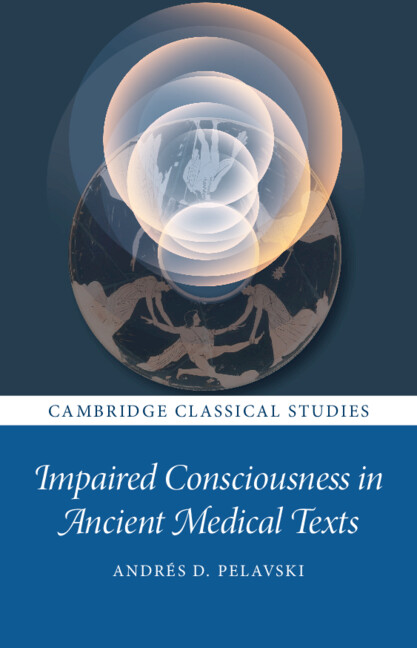

-
Select format
-
- Publisher:
- Cambridge University Press
- Publication date:
- 04 December 2025
- 04 December 2025
- ISBN:
- 9781009616577
- 9781009616591
- 9781009616607
- Creative Commons:
-
This content is Open Access and distributed under the terms of the Creative Commons Attribution licence CC-BY-NC-ND 4.0.


https://creativecommons.org/creativelicenses - Dimensions:
- (216 x 140 mm)
- Weight & Pages:
- 0.432kg, 240 Pages
- Dimensions:
- (216 x 140 mm)
- Weight & Pages:
- 0.303kg, 240 Pages
Open AccessYou have digital access to this book
Show more authors 
You have digital access to this book
Book description
Impaired consciousness is a topic lying at the intersection of science and philosophy. It encourages reflection on questions concerning human nature, the body, the soul, the mind and their relation, as well as the blurry limits between health, disease, life and death. This is the first study of impaired consciousness in the works of some highly influential Greek and Roman medical writers who lived in periods ranging from Classical Greece to the Roman Empire in the second century CE. Andrés Pelavski employs the notion and contrasts ancient and contemporary theoretical frameworks in order to challenge some established ideas about mental illness in antiquity. All the ancient texts are translated and the theoretical concepts clearly explained. This title is also available as open access on Cambridge Core.
Contents
Full book PDFContents
-
Impaired Consciousness in Ancient Medical Texts
pp i-i -
-
- You have access
- Open access
- HTML
- Export citation
-
-
Cambridge Classical Studies - Series page
pp ii-ii -
-
- You have access
- Open access
- HTML
- Export citation
-
-
Impaired Consciousness in Ancient Medical Texts - Title page
pp iii-iii -
-
- You have access
- Open access
- HTML
- Export citation
-
-
Copyright page
pp iv-iv -
-
- You have access
- Open access
- HTML
- Export citation
-
-
Contents
pp v-vi -
-
- You have access
- Open access
- HTML
- Export citation
-
-
Preface
pp vii-viii -
-
- You have access
- Open access
- HTML
- Export citation
-
-
Acknowledgements
pp ix-ix -
-
- You have access
- Open access
- HTML
- Export citation
-
-
Abbreviations
pp x-xii -
-
- You have access
- Open access
- HTML
- Export citation
-
-
Chapter 1 - Introduction: Many definitions of consciousness
pp 1-16 -
-
- You have access
- Open access
- HTML
- Export citation
-
-
Part I - Delirium
pp 17-82 -
-
- You have access
- Open access
- HTML
- Export citation
-
-
Chapter 3 - Delirium versus madness and the notion of disease in the Hippocratic corpus
pp 23-35 -
-
- You have access
- Open access
- HTML
- Export citation
-
-
Chapter 4 - Delirium, madness and disease among post-Hellenistic authors
pp 36-56 -
-
- You have access
- Open access
- HTML
- Export citation
-
-
Chapter 5 - Galen’s delirium: hot and dry dusKrasia of the hêgemonikon
pp 57-75 -
-
- You have access
- Open access
- HTML
- Export citation
-
-
Chapter 6 - Final remarks about delirium and the notion of disease: a diachronic look
pp 76-82 -
-
- You have access
- Open access
- HTML
- Export citation
-
-
Part II - Sleep
pp 83-148 -
-
- You have access
- Open access
- HTML
- Export citation
-
-
Chapter 7 - A general glance at sleep
pp 85-87 -
-
- You have access
- Open access
- HTML
- Export citation
-
-
Chapter 8 - Sleep in the Hippocratic corpus
pp 88-109 -
-
- You have access
- Open access
- HTML
- Export citation
-
-
Chapter 9 - Sleep in post-Hellenistic sources
pp 110-132 -
-
- You have access
- Open access
- HTML
- Export citation
-
-
Chapter 10 - Sleep in Galen
pp 133-145 -
-
- You have access
- Open access
- HTML
- Export citation
-
-
Chapter 11 - Sleep and the mind: an overview of ideas that did not change
pp 146-148 -
-
- You have access
- Open access
- HTML
- Export citation
-
-
Part III - Fainting
pp 149-196 -
-
- You have access
- Open access
- HTML
- Export citation
-
-
Chapter 12 - General overview of total loss of consciousness
pp 151-153 -
-
- You have access
- Open access
- HTML
- Export citation
-
-
Chapter 13 - The Hippocratic corpus and total loss of consciousness
pp 154-161 -
-
- You have access
- Open access
- HTML
- Export citation
-
-
Chapter 14 - Total loss of consciousness in post-Hellenistic authors
pp 162-182 -
-
- You have access
- Open access
- HTML
- Export citation
-
-
Chapter 15 - Galen’s two ways of losing consciousness
pp 183-192 -
-
- You have access
- Open access
- HTML
- Export citation
-
-
Conclusions
pp 197-204 -
-
- You have access
- Open access
- HTML
- Export citation
-
-
Bibliography
pp 205-223 -
-
- You have access
- Open access
- HTML
- Export citation
-
-
Index
pp 224-226 -
-
- You have access
- Open access
- HTML
- Export citation
-
References
Metrics
Altmetric attention score
Full text views
Full text views helpTotal number of HTML views: 0
Total number of PDF views: 0 *
 Loading metrics...
* Views captured on Cambridge Core between #date#. This data will be updated every 24 hours.
Usage data cannot currently be displayed.
Accessibility standard: WCAG 2.1 AA
Why this information is here
This section outlines the accessibility features of this content - including support for screen readers, full keyboard navigation and high-contrast display options. This may not be relevant for you.
Accessibility Information
The HTML of this book complies with version 2.1 of the Web Content Accessibility Guidelines (WCAG), covering newer accessibility requirements and improved user experiences and achieves the intermediate (AA) level of WCAG compliance, covering a wider range of accessibility requirements.
Content Navigation
Table of contents navigation
Allows you to navigate directly to chapters, sections, or non‐text items through a linked table of contents, reducing the need for extensive scrolling.
Index navigation
Provides an interactive index, letting you go straight to where a term or subject appears in the text without manual searching.
Reading Order and Textual Equivalents
Single logical reading order
You will encounter all content (including footnotes, captions, etc.) in a clear, sequential flow, making it easier to follow with assistive tools like screen readers.
Visual Accessibility
Use of colour is not sole means of conveying information
You will still understand key ideas or prompts without relying solely on colour, which is especially helpful if you have colour vision deficiencies.
Structural and Technical Features
ARIA roles provided
You gain clarity from ARIA (Accessible Rich Internet Applications) roles and attributes, as they help assistive technologies interpret how each part of the content functions.