
Skip to main content Accessibility help
×
  • Cited by 2
    • Show more authors
    • You may already have access via personal or institutional login
    • Select format
    • Publisher:
      Cambridge University Press
      Publication date:
      27 June 2025
      06 February 1997
      ISBN:
      9781009701839
      9780521574112
      9780521646529
      Dimensions:
      (228 x 152 mm)
      Weight & Pages:
      0.906kg, 552 Pages
      Dimensions:
      (228 x 152 mm)
      Weight & Pages:
      0.78kg, 552 Pages
    You may already have access via personal or institutional login
  • Selected: Digital
    Add to cart View cart Buy from Cambridge.org

    Book description

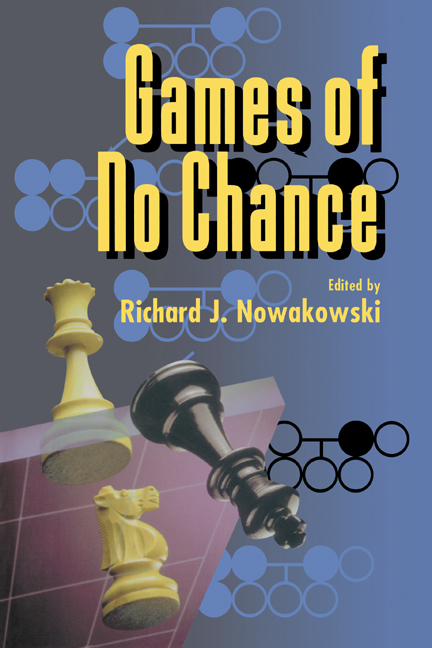
    Is Nine-Men Morris, in the hands of perfect players, a win for white or for black - or a draw? Can king, rook, and knight always defeat king and two knights in chess? What can Go players learn from economists? What are nimbers, tinies, switches and minies? This book deals with combinatorial games, that is, games not involving chance or hidden information. Their study is at once old and young: though some games, such as chess, have been analyzed for centuries, the first full analysis of a nontrivial combinatorial game (Nim) only appeared in 1902. The first part of this book will be accessible to anyone, regardless of background: it contains introductory expositions, reports of unusual tournaments, and a fascinating article by John H. Conway on the possibly everlasting contest between an angel and a devil. For those who want to delve more deeply, the book also contains combinatorial studies of chess and Go; reports on computer advances such as the solution of Nine-Men Morris and Pentominoes; and theoretical approaches to such problems as games with many players. If you have read and enjoyed Martin Gardner, or if you like to learn and analyze new games, this book is for you.

    Reviews

    ‘No one interested in two-person combinatorial games should hesitate before acquiring this splendid book. Leading experts report on the latest research involving such classic board games as checkers, chess, and go. Other familiar games are analyzed in depth, and many exciting new games are introduced. Did you know that go moku, nine-men morris, and Sol Golomb’s pentomino game are now solved? Did you know that computers are getting close to solving checkers? Fifty-two tantalizing unsolved problems are posed by Richard Guy, and Aviezri Fraenkel’s bibliography lists 666 references! Games of No Chance is a great collection of elegant, entertaining papers - a book to put on the shelf alongside the classic two-volume Winning Ways by Elwyn Berlekamp, John Conway, and Richard Guy.’

    Martin Gardner

    ‘A thoroughly edited volume, Combinatorial Game Theory at its best.’

    Source: European Mathematical Society

    Refine List

    Actions for selected content:

    Select all | Deselect all
    • View selected items
    • Export citations
    • Download PDF (zip)
    • Save to Kindle
    • Save to Dropbox
    • Save to Google Drive

    Save Search

    You can save your searches here and later view and run them again in "My saved searches".

    Please provide a title, maximum of 40 characters.
    ×

    Contents


    Page 1 of 2


    Page 1 of 2


    Metrics

    Full text views

    Total number of HTML views: 0
    Total number of PDF views: 0 *
    Loading metrics...

    Book summary page views

    Total views: 0 *
    Loading metrics...

    * Views captured on Cambridge Core between #date#. This data will be updated every 24 hours.

    Usage data cannot currently be displayed.

    Accessibility standard: Unknown

    Why this information is here

    This section outlines the accessibility features of this content - including support for screen readers, full keyboard navigation and high-contrast display options. This may not be relevant for you.

    Accessibility Information

    Accessibility compliance for the PDF of this book is currently unknown and may be updated in the future.
