
Skip to main content Accessibility help
×
  • Cited by 9
    • Show more authors
    • You may already have access via personal or institutional login
    • Select format
    • Publisher:
      Cambridge University Press
      Publication date:
      09 March 2018
      29 March 2018
      ISBN:
      9781107279100
      9781107049628
      9781107627918
      Dimensions:
      (228 x 152 mm)
      Weight & Pages:
      0.6kg, 328 Pages
      Dimensions:
      (229 x 152 mm)
      Weight & Pages:
      0.48kg, 330 Pages
    You may already have access via personal or institutional login
  • Selected: Digital
    Add to cart View cart Buy from Cambridge.org

    Book description

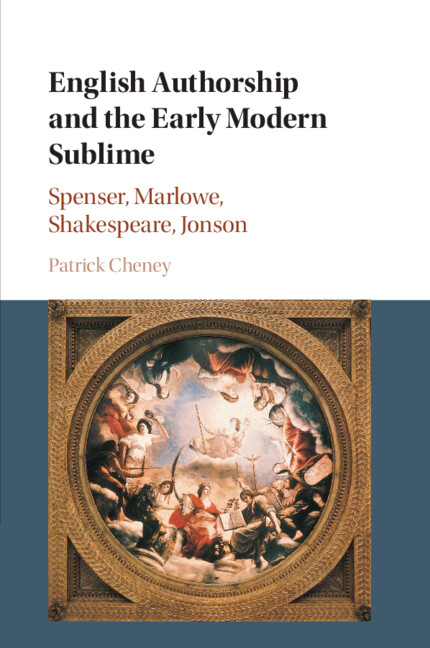
    Patrick Cheney's new book places the sublime at the heart of poems and plays in late sixteenth- and early seventeenth-century England. Specifically, Cheney argues for the importance of an 'early modern sublime' to the advent of modern authorship in Spenser, Marlowe, Shakespeare, and Jonson. Chapters feature a model of creative excellence and social liberty that helps explain the greatness of the English Renaissance. Cheney's argument revises the received wisdom, which locates the sublime in the eighteenth-century philosophical 'subject'. The book demonstrates that canonical works like The Faerie Queene and King Lear reinvent sublimity as a new standard of authorship. This standard emerges not only in rational, patriotic paradigms of classical and Christian goodness but also in the eternizing greatness of the author's work: free, heightened, ecstatic. Playing a centralizing role in the advent of modern authorship, the early modern sublime becomes a catalyst in the formation of an English canon.

    Reviews

    ‘A remarkable and important study that not only provides the missing link in the history of the sublime, but also redirects the reader towards what is truly great about the literature we read, study, and teach, and why. It is an extraordinarily ambitious project: the work maintains an intellectual focus, energy, and generosity throughout that explains and actually exemplifies the sublime.'

    Catherine Bates - University of Warwick

    'In English Authorship and the Early Modern Sublime, Cheney … asserts that the early modern era functions as a crucial link in understanding the sublime. Recommended.'

    K. K. Smith Source: Choice

    'Patrick Cheney, observing a resurgence of interest in the idea of the sublime, has contributed an original and persuasive book on this subject … The book meticulously catalogs and analyzes uses of the word sublime throughout the period.'

    Richard F. Hardin Source: Renaissance Quarterly

    Refine List

    Actions for selected content:

    Select all | Deselect all
    • View selected items
    • Export citations
    • Download PDF (zip)
    • Save to Kindle
    • Save to Dropbox
    • Save to Google Drive

    Save Search

    You can save your searches here and later view and run them again in "My saved searches".

    Please provide a title, maximum of 40 characters.
    ×

    Contents

    Metrics

    Altmetric attention score

    Full text views

    Total number of HTML views: 0
    Total number of PDF views: 0 *
    Loading metrics...

    Book summary page views

    Total views: 0 *
    Loading metrics...

    * Views captured on Cambridge Core between #date#. This data will be updated every 24 hours.

    Usage data cannot currently be displayed.

    Accessibility standard: Unknown

    Why this information is here

    This section outlines the accessibility features of this content - including support for screen readers, full keyboard navigation and high-contrast display options. This may not be relevant for you.

    Accessibility Information

    Accessibility compliance for the HTML of this book is currently unknown and may be updated in the future.
