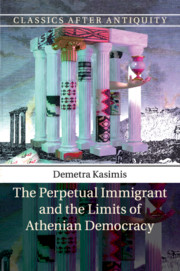


Among students and scholars of ancient Athenian political thought, it has long been a refrain that Athenian democracy did not produce a systematic theory of democracy. For that we have had to rely on its critics – notably Thucydides, Xenophon, Plato, and Aristotle. In The Perpetual Immigrant and the Limits of Athenian Democracy, Demetra Kasimis revolutionizes the terms of this discussion by showing how theories of democracy and citizenship were sustained through the invocation across multiple genres of certain key figures and concepts of exclusion. Athens practiced its political theory in multiple sites through religious rites, dramatic performance, assembly discussions, legal proceedings, and other civic rituals, and we misunderstand how Athenian political theory operated if we fail to recognize this. Within these civic conversations, one figure stands out in particular – the metic, the immigrant. Defining, regulating, and supervising metics became central to the project of Athenian citizenship.
Athens built up its notions of citizenship around a fantasy of blood descent and Athenian exceptionalism. Yet the metic constantly threatened to expose this fantasy and the implications of the possibility that a metic might successfully pass as a citizen were deeply troubling to its democracy. Metics’ insider-yet-always-outsider status made them crucial figures for mediating Athenian reflections on the conditions of citizenship. In a series of incisive readings of Euripides, Plato, and Demosthenes, Kasimis reveals the contours of an Athenian debate in which supposedly natural differences between Athenian citizens and noncitizens were fabricated through performance, resulting in the fatal condition that citizen status would always be vulnerable to the quality of that performance. In this civic drama, the metic plays a crucial role as an almost-citizen, a limit-case, who lacks the ultimate blood qualification to act the part of citizens but whose performance is otherwise perilously indistinguishable from that of Athenian citizens. And, as we know, sometimes their civic performance did enable metics to qualify for citizenship, a fact that only exacerbated concerns about the stability of a secure, pure conception of native Athenian citizenship.
In Kasimis’s argument, Plato, one of Athenian democracy’s arch critics, emerges as the theorist who, in holding up a “metic lens” to Athenian democracy, exposes the aporias of the civic drama of membership performance. Instead of Plato’s attack on democracy’s “open society,” as Karl Popper saw it, The Perpetual Immigrant finds Plato in Book VIII of the Republic critical of the fundamental hypocrisy of natural differences and the climate of political exclusion that they engender. This hypocrisy means that the equality between citizens is compromised by the suspicion that, while all may act like citizens, not all may qualify equally for citizenship, with the presence of the metic nibbling away at the fiction of the autochthonous Athenian, born not made.
Throughout this book, Kasimis explores multiple forms of reception. She lays bare the different ways in which interpretations of Athenian democratic theory are mediated by the disciplines and schools in which scholars have been trained. For its part, The Perpetual Immigrant weaves a rich interpretative web. In its deployment of the critical tools that characterize modernity and postmodernity, this is a work that could only emerge “after Antiquity”; this is a work that both informs and is informed by contemporary theory. In Chapter 2, Euripides’ drama of citizenship identity in the Ion, in which citizen descent is paradoxically suppressed, is paired with Eve Kosofsky Sedgwick’s theory of closeting. In the discussion of Plato in Chapter 5, another theoretical axis points to Homi Bhabha’s theorization of colonial mimesis, which exposes, through a regression of mimicry, the play-acting at the heart of the putative “original.” Similarly, in Kasimis’ wry summary of Plato’s critique, “remove a citizen’s mask and you will find a metic lurking underneath” (p. 106), we are reminded of Ralph Ellison’s exposition of the mask at the heart of American cultural identity, in the essay “Change the Joke and Slip the Yoke” (first published in Partisan Review in 1958). There Ellison dissected the constitutive work that masks do in shoring up the myth of Americanness in an elaborate cultural masquerade: “when American life is most American it is apt to be most theatrical.”Footnote 1 Metics stand in the wings of the polis, as understudies of citizen actors, showing up the stagecraft of Athenian, democratic citizen identity.
Demetra Kasimis leaves us with the question, “What if the metic is the critical figure of our time?” This is a timely suggestion as scholars of ancient Greek political theory attempt to find lessons for contemporary immigration debates in ancient Greek texts and vice versa. By exposing the deep entanglement of the metic in Athenian democratic identity, The Perpetual Immigrant delves deeper, offering a bold theoretical provocation for future studies. In Kasimis’s persuasive analysis, the metic presence leads to a “perpetual” aporia that defines not only Athenian thinking about citizenship but also our own.
1 Ralph Ellison, “Change the Joke and Slip the Yoke,” in The Collected Essays of Ralph Ellison, edited by John F. Callahan; preface by Saul Bellow. New York: Random House, 1995: 100–112 (quoting from p. 108).
