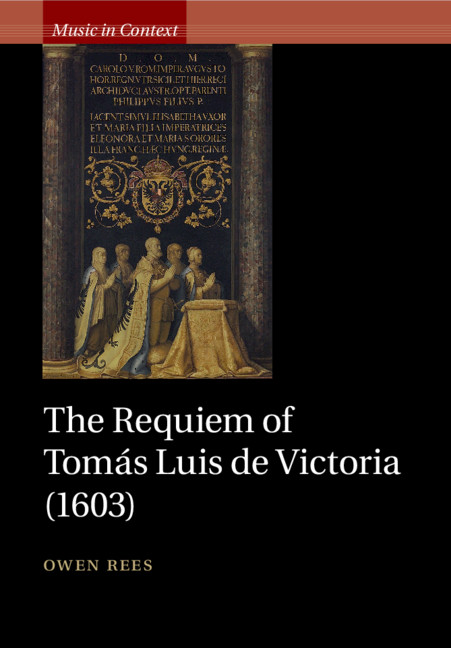

Victoria's Requiem is among the best-loved and most-performed musical works of the Renaissance, and is often held to be 'a Requiem for an age', representing the summation of golden-age Spanish polyphony. Yet it has been the focus of surprisingly little research. Owen Rees's multifaceted study brings together the historical and ritual contexts for the work's genesis, the first detailed musical analysis of the Requiem itself, and the long story of its circulation and reception. Victoria composed this music in 1603 for the exequies of María of Austria, and oversaw its publication two years later. A rich variety of contemporary documentation allows these events - and the nature of music in Habsburg exequies - to be reconstructed vividly. Rees then locates Victoria's music within the context of a vast international repertory of Requiems, much of it previously unstudied, and identifies the techniques which render this work so powerfully distinctive and coherent.
Winner, 2020 Robert M. Stevenson Award, American Musicological Society
‘In his wide-ranging and masterful study, Owen Rees examines Victoria’s Requiem as both text and icon. He does so with a scholar’s nose for forensic minutiae, an analyst’s eye for the telling detail, and a choral director’s ear for precision and rigour. His study is a model of its kind … Without a doubt, Rees’s study of Victoria’s Officium defunctorum will help bring us closer to an understanding of this astonishing work as a Requiem for a Habsburg empress and as a Requiem for us.’
Michael Noone Source: Early Music History
Loading metrics...
* Views captured on Cambridge Core between #date#. This data will be updated every 24 hours.
Usage data cannot currently be displayed.
This section outlines the accessibility features of this content - including support for screen readers, full keyboard navigation and high-contrast display options. This may not be relevant for you.
Accessibility compliance for the HTML of this book is currently unknown and may be updated in the future.
