

A scandal in Jodhpur
In the summer of 2007 a curious incident occurred in the city of Jodhpur in the north Indian state of Rajasthan.Footnote 1 The wife of a Member of the State Legislative Assembly lodged a complaint with the police, accusing a local temple priest of ‘hurting the religious sentiments of the people’. The cause of offence was a poster designed by the priest which depicted Rajasthan’s then Chief Minister, Vasundhara Raje, as the bread-giving goddess Annapurna. On the poster the crowned Miss Raje appeared mounted on a lotus throne, from which she showered an assembly of parliamentarians, legislators and ministers gathered below with golden coins and rays of light (see Figure 1). Either side of her were a pair of guardian lions and two cabinet ministers, portrayed as the ancient Hindu gods Kuber and Indra. Floating just above were the leaders of Raje’s Bharatiya Janata Party (BJP), depicted as Brahma, Vishnu and Shiva, the gods of the Hindu trinity. The incident sent ripples of amusement through the Anglophone press, but in the landscape of South Asian politics this was neither a singular occurrence nor a laughing matter. A host of leading politicians—including President of the Congress Party Sonia Gandhi, head of the People’s Party in Uttar Pradesh (UP) Mayawati, the Chief Minister of Bengal Mamata Banerjee and the former Tamil Chief Minister Jayalalitha—have all received colourful popular veneration.
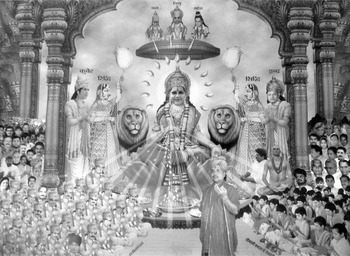
Figure 1 Vasundhara Raje depicted as goddess Annapurna. Courtesy of Pandit Hemant Bohra.
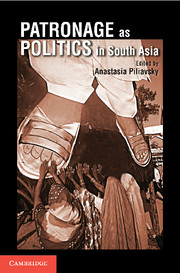
To most readers of this book, a picture of voters prostrated before a politician (like the one that appears on the cover of this book) will look not just ridiculous or bizarre, it will appear positively obscene: a perversion of every political virtue. This image projects inequality in place of equality, personal bonds where detached judgement should be and subjugation where the free will of individual citizens ought to reign. It makes a mockery of the very idea of representative democracy, a government by people elected to act on behalf of the citizens, not to rule over them as kings or gods. The shock of this vision reverberates far beyond politics. It shakes the foundations of what liberal cosmopolitans believe human beings to be and the society which they live in to be really made of—innately equal and independently judging individuals—the beliefs enshrined in the modern political theology of democracy and the universal ritual of each adult citizen casting a single vote in the isolation of a polling booth.Footnote 2
One look at South Asian popular politics topples all this. In cities and villages across the subcontinent voters adorn political leaders with crowns, garlands, turbans and swords, recite for them praise verses, and fall at their feet in adulation. Time and again, newspapers seem to confirm just how dissolute South Asian politics really is. Votes are cast not by autonomous citizens concerned with their countries’ long-term general good, but by interest groups, or ‘vote banks’, which elect one of their own to provide for them. Parties and politicians do not convince their electors with ideological platforms. They buy votes with short-term benefits. Endemic poverty and governmental dysfunction obliterate free, reasoned and responsible judgement and drive people to exchange their votes for bureaucratic favours, clutches of cash and bottles of hooch. Politicians run the show like royal sovereigns, often at the expense of law. Rates of corruption registered by Transparency International in the region hover at Sub-Saharan levels (www.transparency.org). Nepotism, political backwardness and decadence fill news reports, which often attribute this political bedlam on the subcontinent to the prevalence of ‘patronage’ or ‘clientelism’, the common glosses for ‘corruption’. It is seldom clear what exactly these words describe, but what they indicate is never obscure: a perverse and backward political practice, which prevails only where modern states fail.
Yet South Asia is not a site of state failure. Far from it. Since the retreat of colonial powers from the subcontinent, it has been one of political modernity’s busiest laboratories, and it has turned out some very striking results. While in many parts of Europe electoral participation has flagged, in most of South Asia it has been steadily on the rise.Footnote 3 The region is now home to the world’s most populous democracy and one of its most vigorous. The sheer scale of India’s general elections is mindboggling: a population of more than a billion, eager to cast their votes, makes this the single-largest social event in the world. India’s general elections regularly involve over 60% of voters, often substantially exceeding American presidential elections, and local elections often rise to 100% turnout. In 2008 the Hindu Kingdom of Nepal became a Democratic Republic, electing its first (Communist) government with more than 74% of its electors’ votes. In Pakistan, in the spring of 2013 voter participation rose from 40% (in 2008) to a spirited 60%, with people voting in face of great threat. Yet these political achievements have not stamped out patronage, which continues to thrive not despite democratic statehood, but alongside and indeed often through it. Clearly, we face not a feudal residue, but a current political form vital in its own right.
In this volume we do not treat ‘patronage’ as a term of art and we offer no definitions. Nor do we see it as an unchanging, timeless ‘phenomenon’, a transactional arrangement with a fixed and predetermined content. Rather, we see it as a living moral idiom that carries much of the life of South Asian politics, and society at large. Here ‘patronage’ is an imperfect gloss for a widespread moral formulation which helps us escape the gridlock of liberal political heuristics and see the local actors’ own normative imagination. Collectively, we try to think our way into the region’s own political sense and into the ways in which political communities and attachments, modes of leadership and ways of following shape the hopes and disappointments which political engagement necessarily brings. At the centre of our analysis are the relations which constitute South Asian politics. By working out the ways in which South Asian citizens relate, and think they ought to relate, to one another, we address some central conundrums of political modernity in the region: how people live and think about democracy and the state, what they make of ‘political representation’ and how to understand why the region appears at once so politically engaged and in many ways successful, and so drastically ‘corrupt’ and ‘criminalised’. We hope that those who do not know much about South Asia and those who know a great deal will find this book equally thought-provoking. We also hope that our readers find the accounts collected here, and their implications, helpful for thinking not only about South Asia, but also about politics in other places, including those which they call their home.
What happened to patronage?
In the social sciences patronage has had its day. Whilst debates on nationhood, sovereignty, governance, democracy and the state nowadays fill the journals, patronage barely figures. If three decades back academics as distinguished as Ernest Gellner, Shmuel Eisenstadt and James Scott published thick volumes on the subject,Footnote 4 today few dare to put the words ‘patron’ or ‘patronage’ on the cover of their books. This avoidance is in part a reaction to the concept’s career in earlier decades (mainly in the 1960s–1970s) when its analysis, even as the brightest minds applied themselves to it, generated a literature that was overwhelmingly dull. Endless case studies and descriptions of patronage observed around the world yielded little comparative framework or analytical continuity to sustain debate.Footnote 5 We agreed in 1960 that ‘patronage’ had something to do with asymmetry of status and power, that it involved reciprocity, and that it relied on particular, intimate, face-to-face relations (Powell 1960). More than five decades on we have not moved far beyond this basic picture, but we no longer care to explore it further.
The problem runs deeper than the concept’s dispiriting recent career. It issues from deep-seated prejudices and from two beliefs about patronage to which we hold fast, if often unwittingly. We believe that we already know what patronage is, and we believe that it must be a bad thing. At a bare minimum, we think of patronage as a relation between two unequal persons, one of whom holds the upper hand. Patrons are wealthier, politically more potent or otherwise privileged, and they control what others need or want, making their clients at best dependent and at worst oppressed. Call up some images which the phrase ‘political patronage’ brings to mind: a Sicilian peasant kissing the hand of a Mafioso, Vladimir Putin appointing governors to the Russian provinces, pharmaceutical lobbyists at work in DC. The slide show can go on with countless snapshots of political deformity, each capturing a disfigurement of what modern politics should be: equal, disinterested and impersonal. Over the decades, deeply ingrained moral aversion to patronage has frustrated the task of understanding it; description slips inadvertently into evaluation, which in turn poses as analysis. Time and again patronage appears as the cause or symptom of political infirmity. Time and again it is portrayed as a retrograde, oppressive or at best ancillary, institution destined to vanish the moment modern, democratic states take proper hold of the world.Footnote 6 Time and again analysts forecast its disappearance, time and again lamenting its refusal to go away.Footnote 7
Patronage first came to the fore of the social sciences in the 1960s and 1970s, mainly in Mediterranean and Latin American peasant studies. These writings had a broadly Marxist overtone and they dismissed patronage as a sentimentalisation of class inequality (e.g., Leeds Reference Leeds, Maier and Weatherhead1964; Galjart Reference Galjart1965; Alavi Reference Alavi1973). For them, patronage was a ‘myth’ or the ‘ideology’ of the elites, endorsed by those social analysts who dared to present it as anything but power struggle.Footnote 8 The language of kinship, friendship and sympathy, they claimed, concealed behind it the brutal mechanisms of dependence and exploitation.Footnote 9 Sociologist Anthony Hall, for example, wrote that however one may approach patronage, ‘the important fact is the inherently coercive nature of patron-clientage’ (1977, 511, emphasis in original). One could view this struggle from different angles and ask: How do the powerful access, create and misuse their subjects? What degree of control do they have? How do the powerless get access to resources, resist oppression or negotiate for themselves better deals? Yet whichever way analysts turned their viewfinders, the scene in focus remained a site of oppression, submission, resistance and domination.
A second academic camp developed a more forgiving view. They suggested that patronage was not everywhere plainly bad news. Patron-client relations, they insisted, did not necessarily propagate inequality or sent modern politics back into feudal darkness, but often achieved the obverse: social mobility and political participation.Footnote 10 Ties of patronage might assist the poor to wrest resources from the elites or help immigrants access state services. Some reported that patronage and electoral politics often went hand in hand; patronage promoted electoral participation, which in its turn generated fresh patronage bonds. Patron–client relations formed the backbone of ‘traditional’ politics and were the main political tool of tribals, peasants and the urban poor. As modern politics spread into far corners of society and the globe, patronage became a link between governments and ‘social peripheries’ culturally unfit for or otherwise excluded from direct engagement with the state.Footnote 11 Because patronage connected bureaucracies to traditional politics, cities to villages and governments to citizens through patron-politicians and broker-bureaucrats, it could paradoxically modernise ‘developing’ states (e.g., Schmidt Reference Schmidt1974). Between the late 1970s and the early 1990s, studies of political patronage focused almost exclusively on the ‘developing world’ and its political ‘systems in transition’ (Martz Reference Martz1997, 14). Insofar as patronage ‘at all interested political scientists, it did so principally as intermediary between the centre and the periphery’ (Dogan and Pleassy Reference Dogan and Pleassy1984, 76; also Eisenstadt Reference Eisenstadt1973, 60; Boissevain Reference Boissevain1974, 147–148).
If in anthropology patronage has lost its currency, in political science it is still ready money. Political scientists have long agreed the meaning of ‘clientelism’, as they usually term patronage. For them it is an exchange of goods and services for political support. This system of political barter, a ‘distributive’ politics of ‘take there, give here’ (Graham Reference Graham1990), turns elections into auctions and political choices into calculations of profit.Footnote 12 Politicians use goods and favours to buy their positions and their electors employ such means as they have at their disposal to wrest resources back from politicians and the state. ‘Machine politics’ could grease the wheels of electoral systems. It might boost political party membership and electoral participation, and even occasionally benefit the poor (e.g., Banfield Reference Banfield1969). But in doing so it depletes democracy of its point and meaning. This politics of purposeful mutual exploitation substitutes moral, responsible judgement and the concern for greater good with the pursuit of selfish, short-term advantage—what political scientist Edward Banfield once called The Moral Basis of a Backward Society (Reference Banfield1958). Clientelism is the politics of dire poverty, which turns democracy into a spectacle of desperation and greed.
In the past two decades political scientists have slowly recognised that patronage has not slunk away in the face of modernity and democratisation, as their predecessors had hoped, but instead carries on stridently in fully developed, rich countries like Austria, Japan and the United States.Footnote 13 These striking revelations make continued analytical resistance to patronage appear increasingly strange. And yet the resistance persists. Workshops and conference panels on clientelism organised around the world at the millennium’s turn, for instance, reached long-familiar conclusions: patronage was a regressive force inimical to democracy, civil society and the market’s free flow (Roniger Reference Roniger2004, 372). Most recent studies are still framed by old questions: Why doesn’t patronage disappear? When may it do so? What might bring about its demise (see Wilkinson, Chapter 11 in this volume)? Over the years, whatever role patronage has played in the literature—as a means of exploitation, a vestige of feudalism, a governmental pathology, a politics of the poor or an ancillary institution—it has never been a site of positive value in its own right. There is no better expression of this attitude than Ernest Gellner’s definition of patronage as ‘not bureaucracy’, ‘not kinship’, ‘not feudalism’, ‘not the market’, ‘not the state’ (1977). But what is it?
More than two decades earlier anthropologists had shown that relations between ‘patrons’ and ‘clients’ could be sympathetic and even intimate, based on mutual esteem and affection, like the bonds between kith and kin. In southern Spain Julian Pitt-Rivers (Reference Pitt-Rivers1954) wrote that patronage formed the backbone of politics and social relations, as they were lived and understood. Relations between patrons and clients were best seen as a kind of friendship. Other anthropologists showed that patronage was woven tightly into the fabric of many societies, where people did not see the institution itself as problematic, however dissatisfied they might feel with particular persons involved.Footnote 14 But this literature left little legacy.Footnote 15 Campbell’s (Reference Campbell1964) superb, intimate study of patron–client relations in rural Greece, for instance, is hardly ever cited today.
Resistance to patronage proved so strong that even as fine an anthropologist as Pitt-Rivers found it difficult to take his informants seriously. In his analysis he demurred: if patronage was a kind of friendship, he said, the friendship was necessarily ‘lop-sided’. He wrote that ‘while friendship is in the first place a free association between equals, it becomes in a relationship of economic inequality the foundation of the system of patronage … used to cloak a purely venal arrangement, a rich man using his money to attain his ends’ (1954, 140, emphasis mine). Patronage, in other words, was spoiled friendship. Where relations were unequal, they could not be right. Inequality was inherently oppressive. No one could sanely choose to be someone else’s client, and those who did must have acted under duress.
Patronage in South Asianist scholarship
South Asianists have been of a different mind, at least until recently. Once upon a time in South Asianist scholarship patronage was the hub of key debates on status and power, personhood, sociality, economic exchange and polity. Studies of kingship, the history of colonial relations, ethnographies of village exchange and ‘big-men’ in urban centres, and the more recent work on fixers have all focused centrally on patronage. For a long time for historians patronage was the centre of debates about kingship, which cast much light on lasting local conventions of ruler–subject bonds. Historians showed that for as far back as history stretched on the subcontinent, kingly rule relied on the distribution of gifts.Footnote 16 The king’s defining duty was to provide for (and protect) his subjects. The act of giving linked rulers to their subjects (and their subjects in turn to their subjects), creating chains of gift and receipt that defined kingly realms. Historians showed that giving and receiving were not just economic transactions, but socially and politically constitutive acts which authorised kingly rule and defined political communities. Giving was an expression of generosity, the cornerstone-value of South Asia’s political life. And as such it had to be performed. Whether or not the kings had the wealth to give, they staged their capacity to do so with extreme flamboyance. Royal courts were dazzling spectacles of munificence where kings often gave away much more than they could afford at extravagant feasts and gifting ceremonies. Kingly realms constantly stretched and shrunk with the subjects’ ever-fickle loyalties. As Sumit Guha shows (Chapter 4 in this volume), in 18th-century Maratha polities kingly rule was sustained by constant personal engagement, and collapsed when the regime of favours ossified into a regimented system of formal entitlements. This structure of loyalty was replicated on every level—from grand maharajas to ‘little kings’, vassals and vassals of vassals, all the way down to village landlords, producing the series of concentric and identically structured sovereignties which Stanley Tambiah termed ‘galactic polity’ (Reference Tambiah1977). In this tight structure of mutuality donor-kings depended on the gifts’ recipients no less than recipients depended on kings. Recipients of royal gifts provided not just tax money or manpower in times of war. They—paradigmatically the Brahmin donees—were the source of kingly authority.Footnote 17
Another camp of historians, the Cambridge School, produced meticulous accounts of local political economies and how these were embedded in networks of patron–client ties, mostly in British India.Footnote 18 By the middle of the 19th century, India’s ruling class were severely disenfranchised, and colonial administrators took over as the premier patrons. In this political ecology, Indian merchants and bankers emerged as the new class of indigenous patrons who, Chris Bayly argued, came to steer a great deal of politics and much else that happened in India at the time. Many merchants patronised political, and often progressive, activities: new religious movements (including the more ‘Protestant’ Hindu sects), Hindu revivalist campaigns (like the cow-protection movement), new cultural organisations, literary and political publications and the founding of the new Congress Party (Bayly Reference Bayly1973; Reference Bayly1983).
Bayly argued that in high colonial India patronage had two sides—a moral and an instrumental—and that these were perennially at odds. All patrons engaged in two types of relations: the essentially commercial vakil patronage meant to maximise profit, and the moral or dharmic patronage of religious and community institutions which enhanced patrons’ standing (1973, 367ff). He suggested that amidst vast shifts in political and economic infrastructures new figures of pre-eminence appealed to old ideals to legitimate their role as patrons, and not mere financial sponsors. To succeed socially, every bit as much as financially, bankers and dealers had to put on the old kingly shows of largesse. Conflict was built into the system. Generosity required wealth and acquiring wealth corrupted the image of an ideal patron, putting the two modes of patronage inexorably at odds. In this volume David Gilmartin (Chapter 5) shows that Bayly put his finger on something far bigger and more important than he himself may have realised—a clue to a fundamental aspect of patronage—to which I return below.
In the era of ‘classic’ ethnography (1930s–1980s) South Asia’s anthropologists took patronage perhaps even more seriously than the historians. At the time they focused chiefly on something known as the jajmani, a system of inter-caste village exchange.Footnote 19 In the ideal jajmani model each village revolved around a land owning patron-family (the jajman). Each service-caste (the kamin) performed a unique economic and ritual role—priests conducted rituals, sweepers swept floors, barbers shaved beards—and each caste, in return, received payments and gifts, along with a share of the village harvest.Footnote 20 This was what anthropologists termed ‘total exchange’ (after Mauss Reference Mauss2002 [1925])—at once economic, political, ritual, and moral— which constituted multi-dimensional social bonds. Over the decades, ethnographic descriptions of jajmani exchange solidified this general scheme into a closed, rigid and internally integrated village ‘system’. At the height of the village ethnography era, the subcontinent often seemed a universe of village-galaxies, each a microcosm of South Asia’s social life as a whole. Patronage was the heart of society, encompassing its hierarchical principles and the ways in which communities, political or otherwise, were composed and related to one another.
Like all theoretical perfections, the jajmani system eventually collapsed under the weight of observation. Anthropologists noticed, for instance, that in various south Indian types of village exchange (known by names like baluta, mirasi, paniwallu, padiyal or kaniaci), the identities of patrons and clients, the types of payments and quality of relations between them varied a great deal across time and space. There was, they maintained, no single ‘jajmani system’ (Orenstein Reference Orenstein1962; Reference Orenstein1965; Fukuzawa Reference Fukuzawa1972; Reiniche Reference Reiniche1977). By the late 1980s the jajmani system which seemed to bind villages into time capsule ‘village republics’ fell to pieces (Fuller Reference Fuller, Parry and Bloch1989). With it the era of village ethnography too came an end.Footnote 21 Since then anthropologists turned to other matters: urban anthropology, development, media studies, bureaucracy, middle classes and so on; and for today’s anthropologists the word ‘jajmani’ remains a relic of quaint, positivist ethnography. The time had certainly come to vacate the creaking jajmani edifice. But the baby was thrown out with the bathwater: along with the system anthropologists abandoned the many lessons about relational principles which jajmani studies contained and which still hold vital clues to some of the knottiest puzzles of political life on the subcontinent (Karanth Reference Karanth1987).
One thing the jajmani studies have taught us is that in South Asia patronage was never a purely economic or ‘top-down’ power relation. Crucially, it was a relation of status difference. Status asymmetry in this relation, they taught us, was expressed in the language of ‘services’ and ‘gifts’—terms which defined the normative principles organising the relationship and identities of those involved. The donor-servant relation was a profoundly mutual and socially constitutive bond in which all participants were defined relative one another. One was never simply a drummer, barber or priest, but a drummer, barber or priest for this or that patron. Servants, in turn, maintained their patrons’ ritual purity, authorising their pre-eminence and the authority through which they ruled. Both ritually and economically, servants turned landholders into patrons. In their turn, patrons passed down their identities to their servants together with the payments and gifts. Gifts were not just remuneration, they were receptacles of what South Asianists refer to as ‘bio-moral substance’, or a kind of total socio-physical identity.Footnote 22 This substance was carried most effectively in food and drink, the honoured and paradigmatic gifts in South Asia. As in the kingly realms, all exchanges were put on display, transforming transactions into statements of the relation’s moral content and the qualities of the parties involved. Gifts expressed patronal generosity and clients’ devotion.
Later studies of south Indian ‘big-men’ (periyars) put this wisdom in motion, showing how the old values and relational principles worked in contemporary urban life.Footnote 23 In his work on wealthy entrepreneurs in Chennai, Mattison Mines showed that the relational values present in jajmani exchange were not confined to the rural backwaters, but also shaped institutional development and political life in big, modern cities (see Chapter 1). The old values of munificence and the practices of their display provided a moral frame for urbane big-men’s pursuits and achievements, shaping their public selves and their contributions to public life. Big-men built their careers on grand feasts, ostentatious sponsorship of temples and schools, and other displays of munificence akin to the erstwhile rajas’ or the village jajmans’. Mines showed that the durable, widespread set of ideals and rhetorical tropes was as much the framework for individual action as for the vagaries of subcontinental politics in all its guises. Big-men created new institutions and organisations to benefit their constituents and expand their followings. They were the agents of history, and the identities of institutions (like temples, cooperatives or schools) and communities (like castes or caste associations) were, and were locally seen as, expressions of big-men’s aspirations and their ability to make things happen. Caste as such was not a stable ‘social structure’, but a mobile form of organisation constantly shaped and reshaped by the political and economic pursuits of big-men operating through old moral idioms (Mines Reference Mines1984; Reference Mines1994).
Yet just like jajmans, big-men dropped off the menu of ethnographers’ interests. With them patronage generally vanished too. Post-modern critiques of empirical inquiry and the ‘literary turn’ shook anthropology’s ethnographic nerve. Research shifted away from villages towards subjects without any determinate location: globalisation, neoliberalism, citizenship, civil society, development, post-colonialism, mass mediation, middle class shopping habits and so on.Footnote 24 Today, with South Asianist anthropologists devoting increasing energy to corruption and the state, continued apathy towards patronage appears increasingly ill-timed. While in international news patronage remains a hot item, in the indexes of books published by South Asianist anthropologists the words ‘patronage’, ‘patron’ and ‘client’ hardly figure.Footnote 25
The subject retains currency in political science, but most of this literature is more attuned to the established sense of clientelism in the discipline than to its South Asian practices and norms. Early studies of post-independence politics showed how patronage worked in electoral politics, political parties and factions. But they failed to explain what patronage meant for its participants and why it remained such a pervasive and central part of local political life.Footnote 26 Nowadays, just as before, when political scientists mention patronage in South Asia, one can be certain they are writing about political failure: vote banking, party corruption, inequality, ethnic party politics, the capture of governance by elites, failures of distribution and accountability or the overall ‘crisis of governability’.Footnote 27 Even if by now patronage has been accepted as a central practical feature of politics in the region, ‘the supposition of a tension between patronage and democratic values’, as Gilmartin notes,
persists in writings on ‘civil society’ in India, which often embody a normative emphasis on the tension between patronage (arising from ‘tradition’) and the more abstract, individual-oriented values, including openness, equity, and efficiency, commonly associated with democratic (and capitalist) forms of rule (Chapter 5, 128–129).
By binding people into particularistic top-down loyalties and ties of direct exchange, patronage appears to undercut the free choice which ought to guide electoral process; by making voter-clients dependent on politician-patrons, it seems to invert the very idea of democracy as the people’s rule.
Political scientists Kitschelt and Wilkinson, for instance, argue that clientelism replaces political accountability with a transaction: ‘the direct exchange of a citizen’s vote in return for direct payments or continuing access to employment, goods and services’ (Reference Kitschelt, Wilkinson, Kitschelt and Wilkinson2007, 2). This is a desperate system: voters require continuous proof that politicians will deliver on their promises, and politicians have to construct elaborate (and often unsustainably costly) structures of surveillance and enforcement to ensure that voters whom they had paid off honour the deal (Kitschelt and Wilkinson Reference Kitschelt and Wilkinson2007). Or consider Kanchan Chandra’s (Reference Chandra2004) picture of Indian ‘patronage democracy’ in what is now the most widely cited study of political patronage on the subcontinent. India’s citizens do not care for policies or ideologies, only for the goods and benefits they may personally receive. They know that politicians only give to their own—that ‘their’ politicians provide for them and that others provide for others. And they vote accordingly. Political choice is thus an ongoing calculation of loss and profit on both sides: ‘Faced with a choice between parties’, writes Chandra, ‘an individual voter in a patronage democracy should formulate preferences across parties by counting heads, preferring the party that represents elites from her “own” ethnic category to the greatest degree’ (ibid., 13).Footnote 28 Voters are so caught up in these calculations that they fashion their social identities with no other aim but to maximise gain: ‘Regardless of the good they seek’, contends Chandra, Indian voters are ‘instrumental actors who invest in an identity because it offers them the best available means by which to obtain desired benefits, and not because such identification is valuable in itself’ (ibid., 11). In their turn, politicians scramble to buy most votes and to secure for themselves positions from which they can earn even more (and gain ‘psychic goods’ like prestige) (ibid., 12). The poorer are the voters, the cheaper their votes. The electoral process is thus a mechanism of hand-to-mouth barter fuelled by the desperation of poverty and steered by self-serving choice. A billion profiteering voters wielding the abacus of rational choice is an arresting picture. But is it really like this? What happens when we move closer in?
Patronage close-up
Pamela Price (Chapter 9) takes us to a village in the former Indian state of Andhra Pradesh (now in Telangana), where villagers tell her how they make electoral decisions and why indeed they vote at all. Focusing on one of south India’s biggest political heroes, the state’s former (and now late) Chief Minister Y.S. Rajasekhara Reddy, better known as YSR, she reflects on the sources of his popularity. YSR’s widespread esteem did not come easy. In the hot summer of 2003 he trekked 1500 kilometres on foot across Andhra wearing simple farmer’s dress and speaking to villagers as he went along. ‘I am not bothered about my comfort’, he was quoted as saying, ‘I am ready to sacrifice my life for the wellbeing of the poor’ (Chapter 9, 221). YSR painted himself in moral hues and he appealed to what people looked for in a politician, and what they valued more generally when they cast their votes. In 2012, just months after being re-elected as Chief Minister, YSR’s helicopter crashed. Posthumous investigations into his and his young son’s vast fortunes revealed the extent of his nepotism and embezzlement of public funds. Little came of the irrigation schemes that he promised to farmers, while his son’s expansive range of businesses flourished. Many villagers, nevertheless, did not seem to mind: YSR could take whatever he wished for his family, as long as he was generous to ‘his people’ too. And that he was. Much of what he had done while in office may look like corruption, but he also did a great deal for his electors, who still remember him as a ‘good man’ (manchi manishi), swearing that they would have voted for him again, had he lived.
Villagers want politicians to provide (reliable supplies of water and electricity, sugar and kerosene at low prices, high pensions and interest-free loans) and they vote for those who they believe will ‘do their work’. Electors’ insistence that politicians ‘get things done’— what Ward Berenschot (Chapter 8) calls the ‘new pragmatism’ of South Asia’s post-independence politics—may look like the devolution of political life into the pursuit of purely instrumental gain. But, as Price shows, villagers in Andhra value effective politicians both as essentially useful persons and as good ones. That is, they assess them in moral rather than practical terms. The terms politicians appeal to and the terms in which they are judged by electorates are equally moral. This fact alone makes voting in participants’ eyes a choice, not a reflex of poverty or a function of greed.
Cross the subcontinent and join Lisa Björkman (Chapter 7) in the slums of Mumbai, where notoriously ‘corrupt’ politicians are said to ‘bank’ on the votes of the destitute. Here Mr Kamble, an effective municipal councillor gets water pipes laid and water pressure raised in the taps; Kamble solves family disputes and helps with college applications, he saves people’s sons from police and their homes from demolition. For more than two decades he has been what they call the area’s ‘social worker’, first as an informal ‘fixer’ and later as elected councillor. He earns his keep, but after 20 years in politics he is no magnate. Marching about the slum in plain trousers and shirt (see image on p. 181, Chapter 7), he needs no flashy jewellery (or flashy guns and body guards), like the gangster-politicians described by Lucia Michelutti in UP (Chapter 12), to show that he can provide. He gets things done and he gets people’s votes.
Leave the metropolis and travel north to rural Rajasthan during elections (Piliavsky, Chapter 6), where gifts and feasts remain the essence of electors’ choice. In electoral law such offerings constitute bribery, but villagers hold a much more nuanced view, distinguishing carefully between ‘gifts’ and ‘bribes’. In practice, gifts and bribes may look identical, but the contrast between them is pivotal to how electors assess candidates and in the end cast their votes. Bribes are things politicians give when they attempt shamefaced, oneoff transactions. Voters may accept ‘bribes’, but they maintain that these have no effect on their electoral choices. ‘Gifts’, conversely, are no cause for shame; in fact, voters expect politicians to give and complain when they fail to do so, calling this failure ‘corruption’. The line between gifts and bribes is not economic, but normative. Whereas ‘bribes’ are self-serving transactions meant solely for profit, ‘gifts’ create (or ought to create) mutually beholden relations which can become the basis for political ties. Despite a great deal of legal intimidation, politicians continue to throw lavish feasts, which often require increasingly ingenuous disguises like fake wedding parties or funerary feasts. Food remains the ultimate moral gift, which is as pivotal to elections in rural Rajasthan today as it was in former kingly courts and jajmani exchanges.
Leave South Asia’s shores and travel together with labour migrants from Kerala to the Gulf, where you will also find the familiar moral economy based on patron-client exchange (Osella, Chapter 16). Despite a great deal of effort by governmental and non-governmental organisations to liberate migrants from the yoke of ‘informal economy’, labourers seeking opportunities across the Arabian Sea prefer to sidestep bureaucracy and follow chains of relations, men whom they know from home, to the Gulf. The promise of patronage is perilous for new arrivals, as many old hands make it a lucrative, and often deeply dishonest, business. As many Malayalis on both sides of the Gulf see it, brokers ‘operate in the amoral, or altogether immoral, realm of calculated self-interest’ (Chapter 16, 366). Yet while promises of visas or good employment often come to nothing, migrants continue to prefer networks of kith and kin to NGOs. As Osella shows, despite widespread disappointment in their trade, ‘Gulf-based Malayali entrepreneurs mobilise their business skills to sustain community “upliftment” back in Kerala and many help by privileging the recruitment of migrant labour from among “their own people”’ (Chapter 16, 370; also Osella and Osella Reference Osella and Osella2009). Partha Chatterjee (Reference Chatterjee2004) has similarly shown that for many Indian slum dwellers it is patronage, and not the institutions of civil society and state law, that helps when the state fails to protect and provide (see also de Wit and Burner Reference de Wit and Berner2009; Witsoe Reference Witsoe2011). Here, as elsewhere, the practical goods needed and the services which provide them are sought and offered through a common normative frame in a continuous process of choice by everyone concerned, however irrational it may seem to those who cannot recognise, or accept, this frame.
A number of moral conventions persist across space and time in South Asian politics. The donor-patron ideal has endured for centuries (perhaps millennia) in a vastly diverse linguistic and cultural terrain, through maelstroms of political change, and across the many different, and constantly changing, styles of leadership.Footnote 29 Whether in medieval Tibet (Ruegg and Diemberger, Chapters 2 and 15), 18th-century Maratha polities (Guha, Chapter 4) or recent elections in Andhra Pradesh and Mumbai (Price and Björkman, Chapters 9 and 7), munificence is the mainstay of political rhetoric, action, judgement and choice. Political giving is never only a matter of redistributing resources, it is also necessarily a rhetorical act that conveys largesse as a politician’s virtue. As Price (Reference Price1989) argued more than two decades ago, this idea is heir to the persistent, historically embedded kingship model. To be a raja, one had to display one’s capacity to provide in grand spectacles of magnificence (see also M. Mines, Chapter 1, in this volume). Electoral feasts in Rajasthani villages, pilgrimages undertaken by south Indian politicians and the extravagant charities of Tamil big-men all dramatise self-denial and giving away. These dramas have discerning audiences, whose standards for judgement are often very strict. The range of presentational styles available to politicians is broad (e.g., Price and Ruud Reference Price, Ruud, Price and Ruud2010), yet crucially, giving must appear selfless: boundless, from the heart, done for the people one ‘loves’.
South Asian history is a parade of many different patrons, some of whom find a place on the pages of this book: Tibetan sovereigns, Maratha warlords, Tamil merchant-princes, Chief Ministers, tribal chiefs, gangsters and mafia bosses, MLAs and policemen, white-clad Gandhians and royalty, British colonial administrators, ‘every man’s’ politicians and modern India’s grandest patron of all—Jawaharlal Nehru. What makes all these characters into ‘patrons’ is the imputed obligation of selfless munificence and the duty to provide for those whose loyalties they hope to claim.
What patrons give away varies, depending on their circumstances and their followers’ demands. It can be land grants made by kings to vassals, printing presses constructed by Tibetan monarchs for their lama-clients, temples built by Tamil merchants for communities of devotees, welfare and subsidy schemes initiated by Chief Ministers, money, jobs, ‘development’, protection (as in Michelutti’s and Ruud’s accounts in Chapters 12 and 13) or the ubiquitous administrative and legal favours arranged by political fixers, policemen and MLAs. A patron’s generosity, crucially, must not be generalised; it must come from one person to another. When aimed at ‘one’s own’ people, generosity forms attachments that are much more substantial than financial debt. It generates loyalties.
If in the past kings gave land grants and temples, South Asia’s archetypal political ‘gifts’, the economics of patronage has grown more precarious now that most patrons are no longer sovereigns with royal coffers, but elected politicians and government employees, for whom the state itself has become the chief resource. In her study of negotiations surrounding the lodging of First Information Reports (FIRs) with the police, Beatrice Jauregui (Chapter 10) shows how policemen use legal and administrative restraints as ‘gifts’ or ‘favours’, which they can choose to grant (or withhold), thereby generating petitioners’ loyalties and styling themselves beneficent patrons with the power to give and protect. The legally pivotal and notoriously ‘corrupt’ process of lodging an FIR reveals that what is at stake in South Asia’s policing practice is not just bribery or extortion (however important bribes certainly are), but always also relations with the police who ‘serve the public not as “impersonal” bureaucrats in Weber’s mould (Weber Reference Weber1958 [1918]), but as patrons or providers of access to the state’s legal powers’ (Chapter 10, 257). The same logic structures the ways in which people relate to the state—via its intermediaries—in the slums of Ahmedabad (Berenschot, Chapter 8). Here, as elsewhere on the subcontinent, the state controls a great deal of what is crucial for daily survival—water, subsidies, jobs—creating legions of elected and informally acting politicians, whose work consists primarily of helping citizens access the state. In observable practice the primary job of these politicians is to help their constituents negotiate bureaucracy’s labyrinths and facilitate access to public services and goods. But in both popular imagination and politicians’ rhetoric these efforts appear as personal favours and gifts. Advocates of ‘good governance’ see this as the end of the state’s impartiality, as corruption’s reign. Yet in the slums it is precisely partiality—the exchanges, obligations and bonds among real people by no means indifferent to one another—which forces the torpid bureaucracy to do its citizens’ work.
New circumstances and exigencies require new types of provision and displays of largesse. In parts of the subcontinent there has been an increasing need for protection from both criminals and the state. Lucia Michelutti and Arild Engelsen Ruud (Chapters 12 and 13) tell us that in the increasingly ‘criminalised’ political ecologies of UP and Bangladesh voters increasingly look to politicians to provide them with security instead of cash, infrastructure and bureaucratic help. Growing concerns with security in these parts of the region are part of vicious cycles of political violence among increasingly ‘muscular’ politicians who promise to defend, by whatever means and at any cost, from the threat which they themselves often pose. If the economics of politics has changed, the normative structure of relations has remained in many ways remarkably stable. New leaders who hail from disadvantaged classes do not have the means of elite politicians who dominated politics in the decades following 1947. New leaders parade munificence in other ways: by showing off muscle and courage, ‘gangster-politicians’ can appear capable of providing almost anything at will. Or, as Björkman shows, even in more dire circumstances resourcefulness is never only an instrument of security or a provision operating in an ethical vacuum. Resourcefulness remains distinctly a virtue. The show of selfless munificence is as much a part of gangster politician’s work as it is of less violent policy makers. While current talk of ‘development’ and ‘programmes’ may seem to mark a shift away from paternalism to programmatic, policy-driven governance (Manor Reference Manor, Price and Ruud2010a; Reference Manor, Stokke and Törnquist2013), observations show that this appearance is largely misleading: today most ‘development’ does not target generalised bureaucratic reforms, but offers subsidies and poverty-relief programmes, jobs, electricity, schools, hand pumps, paved roads, and latrines (see M. Mines and Price, Chapters 1 and 9 in this volume).Footnote 30 In March 2013, for instance, UP’s young Chief Minister, Akhilesh Yadav, launched 71 development projects, which included 27 roads, a college, a hospital and seven marketing hubs. Not a single proposal was for programmatic or administrative change (Times of India, Kanpur edition, 4 March 2013, ‘Chief Minister Akhilesh Yadav Inaugurates 71 Projects’).
The moral logic and the conflict within
Social scientists have long imagined patronage as a domain of transactions.Footnote 31 When they use the word ‘patronage’, what they usually mean is something politicians dispense (favours, benefits, jobs) to their followers. A model of patronage as a set of transactions may show what people exchange. It may even show how resources end up being distributed. What it does not explain is why exchange takes the forms that it does, why people care about how well or badly it is enacted and why they are so concerned with morally appraising those who engage in it. None of this can be understood without a sense of the motivations and values behind the transactions. Because ‘patronage’ describes a particular moral idiom through which transactions are organised, we cannot understand it as a transactional network.
If patronage is a moral form, the question is: whose morals are these? The model of individual profit-seeking, which shapes the idea of ‘clientelism’ in political science, precludes this question, leaving no room for understanding how South Asian politicians lead, how their followers follow, how they all decide what to do, what not to do and how to go about it in the right way. To make sense of all this we need to grasp what they value in politicians, what they think political leaders should and should not do and what relations with them should be like: what we may call a moral logic of relatedness. The calculus of rational choice offers one very distinctive set of values, which pivot around the calculating, profit-seeking individual.
The actors themselves, however, insist on the opposite. They say that instrumental self-advancement is bad and that uncalculating altruism is good. As they swap gifts for services, they are not just trading, but also displaying, and hoping to be shown, the good. You can shove some cash into a voter’s pocket (as I show politicians in Rajasthan doing in Chapter 6), but this does not itself constitute an act of ‘patronage’ or guarantee electoral loyalty. Such ‘donations’ can only be thought of as patronal when the giving is perceived as generosity, and performed to this effect. The local logic of patronage is not about profiteering. On the contrary, it is a radical denial of individual self-advancement. Patronal munificence and the client’s service (seva)—both of which ought to be markedly selfless acts—affirm social relations, connectedness and society as ultimate values (see Osella’s Chapter 16 for more on that). Giving and serving as such are necessarily exertions for another’s sake. Shows of patronal munificence display the will to give away, something the picture of self-serving appropriation turns upside down, making it impossible to grasp the inner rationale of patron-client proceedings.
The idea of selflessness is captured by the language of kin, which is often used in patron-client relations. The idea of patron as parent is very old, and traditionally royalty and patron-deities have been referred to as ‘parents’, or maa-i-baap (literally, mother and father). Parental honorifics have persisted in popular use and in villages across northern India people still call policemen, bureaucrats and parliamentarians just that—maa-i-baap (Roy Reference Roy1965, 560; Saxena Reference Saxena1998, 494; Chapter 6 in this volume). Gandhi is still remembered as ‘Bapuji’, or honourable father. In some places the language of parenthood has given way to talk of dadas (‘elder brothers’ or ‘grandfathers’) (Hansen Reference Hansen2001, 72), but the moral significance of the new terms has remained—dadas are elder kinfolk and they ought to act as such: with selfless devotion and boundless love. Whether or not they in fact do this is a wholly different matter. The language of kinship as such, insofar as it expresses what Marshall Sahlins called the ‘mutuality of being’ (Reference Sahlins2011, 10), rejects the individual self in favour of relations in which individuals give themselves away, often quite literally via self-constituting ‘gifts’. As in Jean-François Bayart’s Africa (Reference Bayart2009), on the subcontinent ‘feeding-and-eating’ is the most pervasive cultural idiom (and act) of self-diffusion. At times of election, victuals are politically vital and their distribution forms the lifeline of voters’ identification with politians (Piliavsky, Chapter 6). ‘Feeding and eating’ is the central idiom in popular assessments of politicians: ‘feeding’ refers to the correct performance of patronly duty and ‘eating’ describes its betrayal, or ‘corruption’ (ibid.; also Chapter 9).
The moral logic of selflessness marks the line between two classes of South Asian political personages: political patrons proper and the vast class of political ‘fixers’. In practice, patrons and fixers ply the same trade: both extract money and political support in exchange for access to state resources (Berenschot and Osella Chapters 8 and 16). Yet in popular discourse patrons and fixers stand on opposite ends of the moral spectrum: patrons are held in esteem and fixers are scorned (often with derogatory terms like dalaal, ‘fixer’, or chamcha, ‘sycophant’). The contrast has nothing to do with differences in what both do in practice, but in the moral assessment of motives that people ascribe to their work. A patron does what he does—ought to do what he does—out of selfless devotion and a fixer does it for gain. As Berenschot’s account (Chapter 8) makes plain, ‘patrons’ and ‘fixers’ are not different persons, but different evaluative terms that can be used to describe the same person under different circumstances or be put to instrumental use. An MP who should protect and provide, but who instead extorts bribes, may be dismissed as a ‘fixer’. A petitioner may plead with a professional fixer with honorifics used for patrons in hope of receiving help at no cost; upwardly mobile fixers may offer services to clients at no cost to gain patronal status, and perhaps even get elected.Footnote 32
The patron–client relation is not a stable arrangement or a freestanding phenomenon, but a normative formula. While the roles remain constant, the practical content of such relations alters ceaselessly and the actors are ever changing, often switching back and forth between the two roles, as suits their purposes. A head of police station in UP may play the patron with petitioners, but he is also a client of his rank superiors and the local MLA. As Jauregui suggests (Chapter 10), when police officers move in and out of roles of patron and client, the moral basis for their actions also shifts. Patrons and clients may swap parts. In Seyfort Ruegg’s medieval Tibet (Chapter 2) princes and preceptor-monks were ‘patrons’ and ‘clients’ in turn; asymmetry of status seesawed as each gave to and accepted from the other the material means for life and the religious validation for rule. During electoral campaigns candidates play the patron. They host feasts and give away hundreds of thousands of rupees. If they hope for a re-election, they will carry on in the same mode: dole out cash, build roads, ‘rescue from the police’ (thana bacchana) and arrange jobs for their constituents. But when they appeal to constituents, they turn the donor–donee relationship upside down, promising ‘selfless service’ (seva) in return for the ‘gift of a vote’ (mat daan). Or, when pressed to deliver what they had promised, politicians hide behind the rhetoric of seva, styling themselves ‘servants of state’—not patrons but themselves clients with no duty or power to provide (Chapter 6). Yet however much patrons and clients may improvise, they return to the keynotes of service and gift.
This composition is not in symphonic harmony, as its lofty morals suggest, but in conflict that lies, as Gilmartin shows, at the very heart of patronage: ‘An effective patron is enmeshed in a world of perpetual calculation of costs and benefits, even as he projects an image of moral transcendence over the strategic connections and calculations on which his position relies’ (Chapter 5, 126). Generosity requires wherewithal, which patrons must accumulate, by whatever means, and so risk a clash of high morals and instrumentalism, which comprises its material base. To satisfy the patronal ideal, patrons must betray it.Footnote 33 The rhetoric of selfless love often hides brutal distortion and cynical profiteering: and the more brutal the politics, the more politicians speak of ‘love’ (see Ruud, Chapter 13). As Diane Mines (Chapter 3) shows, the threat that lurks behind the promise of patronage and the fear of losing patronal bonds often suffuses low-caste, or tribal, accounts of their past (see also Price 2006).
Patrons can never deliver as much as their clients expect them to. This is particularly so if they are not royal sovereigns, but politicians or government officers with limited legitimate means. They may use ostentation to compensate for their inability to provide, as Mattison Mines (Chapter 1) reports from Tamil Nadu. But such performances convince few, making electoral politics a desperate affair, full of hope and disenchantment, in which politicians are perennially suspected of hypocrisy, cynicism and sinister intent (Piliavsky, Chapter 6). In cities and villages across the subcontinent people say that politics is in essence degenerate—‘dirty’ (Ruud Reference Ruud, Fuller and Béneï2001; also Price, Chapter 9). This inner conflict is reflected voluminously in reports on electoral corruption and excessive campaign spending, which regularly agitate South Asia’s middle-class imagination and its projections in the international press.
In patron–client relations the balance of forces is always liable to tilt, till the scales collapse, and relations which should be mutual become coercive. Then patronage turns into slavery, indenture or other forms of inequality with no legitimate moral base. When that happens, it ceases to be ‘patronage’. As John Powell noted some time ago, ‘patron-client ties clearly are different from other ties which might bind parties unequal in status … such as relationships based on coercion, authority, manipulation and so forth. Such elements may be present in the patron-client pattern, but if they come to be dominant, the tie is no longer a patron-client relationship’ (1970, 412). When the moral form falls to pieces, what it leaves behind is a skeleton of transactions—the bare payments (or appropriations) and services (at times forced)—which analysts who view patronage as a set of transactions readily mistake for the real thing. The ugly practical consequences of patronage, when bonds of hierarchy become a struggle of unequals, are all too evident. As Nicolas Martin’s stark account of Pakistan illustrates (Chapter 14), a patronage which has become indenture can bring social catastrophe (see also Breman Reference Breman1974). In the Pakistani Punjab patronal masters trap client slaves in cycles of chronic debted and bondage, where clients languish for generations without the protection of morals or a state law (itself a plaything of their masters). These grim pictures have long led their interpreters to see patronage as a mere gloss for abuse. But the client slaves no longer perceive their masters as ‘patrons’ who provide and protect.
Fear that the normative frame is just a mask for the politics of greed and that patronage can at any moment disintegrate into coercion was there long before electoral politics reached the subcontinent. It has always been felt most acutely by the most marginal and vulnerable service-groups (often ‘tribal’). In her account of one such community, the Valaiyars of South India, Diane Mines (Chapter 3) relates how hopes for good patrons and fears of bad ones structure Valaiyars’ historical narratives and define their sense of self, present and past. Good patrons make life good and bad ones make it intolerable. Which particular circumstances precipitate momentary or longer-term collapses in patronage is a question for historians. But history shows that patronage, in its intrinsic moral ambivalence, is a highly unstable practical arrangement with material consequences which shade from the magnificent to the appalling, as people across South Asia readily recognise. Mattison Mines (Chapter 1) offers colourful snapshots of patronage’s brighter side: wealthy Tamil big-men using their fortunes to develop travellers’ lodgings, educational institutions, temples and medical services for the poor. No one demanded these from them. They were what a progressive patron did spontaneously for the common good. Another vivid example of ‘good patronage’ comes from medieval Tibet. There, Hildegard Diemberger (Chapter 15) shows, the great 15th-century efflorescence of religious and literary production emerged from relations between princely patrons who sponsored the ‘printing revolution’ and Buddhist monks who printed the books. The intense, if always unstable, patronage bonds she describes drove technological and aesthetic innovation, along with much cultural and economic advancement—as they did in Italy during the Renaissance. This account evokes the one context in Euro-American discourse in which patronage remains exempt from derision: artistic production, which still relies substantially, and without stigma, on the good will of patrons.
Patronage as politics
In mid-19th-century Britain political debates focused intensely on elections and the legal and procedural standards, which were still to be clearly established. By the 1870s, the government had adopted the secret ballot and a body of electoral law, both of which travelled to India in the early 20th century, as elections were introduced. The debate hinged on a crucial distinction—between good and bad ways for politicians to influence voters. This was no easy task, and the elusive difference between ‘due’ and ‘undue’ influence was disputed for four decades. At stake was the delicate balance between voters’ freedom to choose and politicians’ freedom to sway their decisions, on which democracy rests. The voters’ freedom to choose was required by the democratic mandate of ‘people’s sovereignty’ and the politicians’ freedom to sway voters’ choice was necessary for electoral politics to work at all. As Gilmartin explains (in Chapter 5), political thinkers of the time espoused the ideal of free choice as the basis for democratic governance, but also recognised that electoral politics could not take place without voters’ attachments to politicians, most of whom were no mere equals of their constituents, but ‘men of influence’. They recognised that patronage was unavoidable—and not necessarily undesirable—in democratic practice. It was not a question of whether politicians could patronise voters, but of how they should do so. Electoral law was not intended to eradicate patronage, but to separate good patronage from the bad. George Grote, historian, radical politician and advocate of the secret ballot, argued that while ‘pressure’ or the ‘purchase’ of votes threatened the people’s sovereignty, there was nothing wrong with the ‘influence of wealth and station’, which naturally—and legitimately—drew voters to follow it. ‘“Good” patronage thus provided a model for how democratic politics ought to operate’ (Chapter 5, 130).
The moral vision of liberal democrats today retains no trace of this picture. Since the 19th century, the freely choosing individual has been sheltered from ‘external influences’ in the isoloir of the voting booth, has triumphed over patrons and clients. We may no longer deny the practical co-presence of patronage and democracy, old and new, but we still find it difficult to believe that the two can be morally commensurate.Footnote 34 To grasp how peculiar this resistance really is, try running a simple thought experiment. Recall the liberal master principles of good democratic practice: equality and freedom of choice. Imagine a voter who decides to exchange her vote for a bicycle she wants or needs. Imagine both she and the candidate with whom she made a deal are both perfectly honest and each gives their due. Does this subvert the principles of choice by equal and free individuals? It does not. Yet does it strike us as morally acceptable? Probably not. Yet a purchase is as pure an exercise of individual free choice as there can be. What is upsetting us in this picture? Why should we think so poorly of swapping votes for bicycles? We do so because we believe both voter and politician are merely advancing their personal interests. Sound political choices should emerge from concern for the greater social good, and be driven by policies and ideologies whose benefits stretch beyond any individual’s interests or lifespan. Or so we think. Paradoxically, it is the very rational-choice theorists, and other hardened neoliberal champions of reasoned advancement of individual selves who, when it comes to democracy, believe ‘good’ political judgement must be completely selfless. What is it about democracy that makes egocentric and wholly ‘free’ choice appear so reprehensible, even to avowed egoists?
Whatever institutional arrangements people live under, or ideologies they espouse, from feudal to fiercely individualist, their politics is necessarily shaped by a relational morality: a set of ideas about how those who govern and those they govern should relate to each other, and conceptions of political community which issue from these ideas. When democracy meets individualism, it generates a contradiction: an explicit denial of sociality alongside a demand for the highest levels of selfless dedication from citizens. ‘Corruption’, as defined by Transparency International or decried by Anna Hazare, encapsulates this denial. In its official definition corruption is the ‘misuse of public office for private gain’, the capture of government by the ‘interests’ of family, friends, tribe or any other community, and indeed by relations between one particular person and any other. Corruption is the eruption of sociality into governance.
But how can representative democracy work without particular relations—relations of real human beings to other human beings? What are elections if not acts of preference in which politicians bid for voters’ exclusive loyalties and voters select the candidate of their choice? More broadly, what is democratic representation if not a social relation? Articulations of this relation vary from culture to culture (Spencer Reference Spencer1997), but however hard cosmopolitan political theory tries to purge politics of sociality—its own grounds for representative relations necessarily invoke society as a whole. The morals of relatedness carry special weight in representative democracies, which do not only require intense and regular involvement of the governors with the governed, but authorise such relations under the banner of ‘representation’. It is precisely because neoliberal theorists assign to political representation such great moral significance that they find patronage-based democracy so deeply offensive.
There is no ready single equivalent to the English word ‘patron’ in the Indian languages. The many appellations (raja, jajman, periyar) and common terms of address (bhaiya, anndata, maa-ibaap, dada) South Asians use for ‘patrons’ cannot be captured by a single term as in the languages of Europe. The very fact that the semantic field is too broad and important to essentialise in this way suggests that the term’s socio-political implications are much broader than words like ‘sponsor’, ‘master’ or ‘boss’, the meanings routinely attached to the Latinate ‘patron’ in the Romance and Germanic languages.Footnote 35 The studies collected here show that ‘patronage’ does not apply to a narrowly defined set of political relations. It encompasses the fundamental principles of social life far beyond ‘the political’, in printing in medieval Tibet (Diemberger, Chapter 15), relations between gods and humans (Michelutti, Chapter 12) or in the lives of Keralan migrants in the Gulf (Osella, Chapter 16).
Political patronage is an expression of the broad moral sense that shapes the ways in which people relate across social levels and contexts. The essence of this moral formulation is the idea that in South Asia differences of rank do not prevent relations, but promote intimacy between parties in distinct and complementary roles. The roles themselves and the people who play them are defined vis-à-vis others, and the values their occupants espouse are oriented towards relations and sociality. Louis Dumont called this social apperception ‘holism’, contrasting it with the anti-societal orientation of the modern West (1980; 1986), whose inhabitants imagine that human dignity and respectful relations can arise only from a basic condition of sameness: the state of being individual, or identically unique. From this angle, differences of rank and power look morally distorting in themselves.
Many have argued that the post-colonial democratisation of the subcontinent levelled social hierarchies in the region. South Asia’s masses, the argument goes, no longer heed traditional elites, but seek instead to topple them. Political mobilisation is no longer typically ‘vertical’, but increasingly ‘horizontal’ (intra-caste) (Breman Reference Breman1996, 262). The logic of caste has lost its legitimacy and whilst ‘castes’ have not vanished, the order of ranked and mutually dependent communities has given way to a collection of independent ‘societies’ (samaajs) or ‘ethnic groups’ (e.g., Chandra Reference Chandra2004; Michelutti Reference Michelutti2008).Footnote 36 This account captures much of what has happened in South Asia’s changing recent past. It frames the story of many new social formations, political players and parties. What it fails to reveal, and indeed obscures, is a central structuring principle at work behind the plotline. If the imagined totality of caste is no longer what it seemed to earlier lyricists of timeless ‘village India’, the relational principles of mutual dependence and intimacy across differences of rank have not lost their force. The persistence of patronage in shaping the politics of the region is the strongest possible testimony to this.
Analysts of South Asian politics often say that local politicians are less representatives and more rulers who covert citizens into subjects and take away their electors’ prerogative to authorise governance. The royal stage set of popular politics—the crowns, garlands and genuflections—appears to endorse this view. But are the citizens of South Asia utterly stripped of their sovereignty and the leaders they choose just sovereigns in new guise? Democratic representation is both a mode of political authorisation and a social relation through which governance is organised. In Europe and the United States that relation has been conceived, at least since the 17th century, as a contract, or explicit agreement between electors and those they elect to govern on their behalf. Representation is always an imperfect substitute for the citizens’ direct involvement in governance, a way to render most citizens who are in fact absent from government vicariously present with in it. Political representatives both stand in for and stand for those whom they represent. The substitution of one person for another is never a straightforward cognitive process, and does not explain how exactly any person can ‘stand for’—or represent—any other.Footnote 37 The answer lies in the ways that people conceptualise relations on which they can rely, and more specifically, in how they imagine identifying with one another.Footnote 38 Cosmopolitan political theory has privileged identification through contract, placing it above all others, which are now illegible, like the rival political systems which they uphold. In South Asia, no less than elsewhere, identification—and hence ‘representation’—forms the centre of politics, audible perhaps most loudly in the ubiquitous promise of politicians to work for their people and the voters’ stated desire to elect their men.
South Asian patronage-politics is no more grotesque than politics anywhere else. Its high normative code, however often and brutally betrayed in practice, prescribes distinctive ways of identifying with politicians and distinctive ways of asserting demands on them. Local forms of political identification, which we gloss as ‘patron–clientage’, are often bonds of intense intimacy: relations of common substance, shared divine origins and blood (e.g., Price Reference Price1989; Spencer Reference Spencer1997; Michelutti Reference Michelutti2004; Reference Michelutti2008; Chapter 12 in this volume). They are as substantial as contractual links (and arguably often more so) and they generate equally powerful political loyalties. It is not only that people may appeal to patronage to resist political pressures or demand resources from governments (à la Chatterjee Reference Chatterjee2004).Footnote 39 Patronage itself involves entitlements and obligations, which are politically constitutive in their own right, and which oblige politicians to understand, convey and respond to their constituents’ needs. Ideally, patrons are a perfect vessel for the people’s rightful capacity to govern themselves—for their sovereignty. (If rarely or never so in fact.)
In South Asia, as in Europe or the United States, the gulf between ideal and actual politicians is vast and expressed most starkly and ubiquitously in rumours of ‘corruption’—the global gloss for all that is wrong with the politics of our dreams. These dreams differ from place to place like the narratives of their betrayal. As several authors in this volume show, the meanings of ‘corruption’ on the subcontinent carry differing messages. If cosmopolitan followers of Anna Hazare in Bombay (Björkman, Chapter 7) equate patronage with ‘corruption’, for many others it is the distortion of good, proper patronage which is ‘corrupt’. Across the subcontinent, people hold few illusions about the goodness of politicians, but when leaders show loyalty to ‘their men’—by whatever means—they attract intense admiration. In Kerala, townsmen accuse politicians of corruption not when they ‘buy’ electoral loyalties, but when they fail to deliver on their promises (Osella, Chapter 16; also Osella and Osella Reference Osella and Osella2000a). For villagers in Andhra Pradesh ‘corruption’ is not the embezzlement of public funds, but the politicians’ failure to share its spoils properly (Price, Chapter 9). Or, in the words of an Oriya man cited by Wilkinson (Chapter 11), ‘all politicians eat, but the BJD [regional Party] eats less’. In all of these formulations ‘corruption’ is not the misuse of public office for private gain, but the collapse of ‘good patronage’—when patron-politicians prove instrumental, selfish and tight.
The idea that hierarchy may form the basis for democratic governance may look less incongruous if we turn back to the Euro-American origins of modern democratic rule. When representative governments were first established in Europe and the United States, few thought of democracy as an essentially egalitarian or individualist political form. Political thinkers of the time, either side of the Atlantic, understood that the relationship between governed and governors—whether elected, divinely ordained or otherwise—is necessarily ranked. Rousseau, for instance, (Reference Rousseau1984 [1754]) described representative democracy as ‘elective aristocracy’, a system that embraced social differences and put them to political ends. The Founding Fathers who drafted the American Constitution were not egalitarians, and neither were the citizens of Ancient Athens, the only state of any scale where democracy ever existed in its ideal, direct form (e.g., Dunn 2005, 24–44). Both were slave-owning societies and both comfortably excluded women from franchise. Democracy departed from other governmental forms not by levelling differences between electors and politicians, or between people more generally, but by allowing the ordinary citizen to place the extraordinary politician above himself (Manin Reference Manin1997, especially Chapters 3 and 4). The grounds for choice never included only merit (talent, charisma, experience), but also inherited status and wealth, both of which had great importance for electors in 18th-century Europe and the United States.
Idols in Westminster
In August 2013 the Daily Telegraph reported an embarrassment: British Members of Parliament in Westminster were found ‘worshipping at the feet of idols like Thatcher and Churchill’ (2 August 2013). Apparently, it is the parliamentarians’ custom to rub the feet of statues of their parties’ tutelary patrons—Thatcher for Tories, Clement Attlee for Labour and David George Lloyd for Lib Dems. But in 2013 the practice was formally banned, not just because it threatened the condition of the four statues outside the Commons chamber, but because it caused a scandal like the incident in Jodhpur. Politics was marred by ‘worship’. The ‘idols’ in Westminster were only statues, not living politicians, and one could see the MPs’ practice as a charming ‘superstition’, but it pressed an awkward question: if our own parties and politicians have patrons, may our own politics too be subject to the unreason of personal bonds? In the 1830s George Grote would not have opposed such a claim nor found it upsetting. But this was a long time ago. By now the idea of abstracted, impersonal, asocial governance has prevailed as the sole possible model for good governance. Bizarrely enough, it is an idea which deprives democracy of its demos and politics of its content: the ‘interests’ and ‘influences’, which we call ‘corruption’, yet without which electoral politics would simply cease.
In the Summer of 2013 I met the priest who had designed Vasundhara Raje’s poster. He turned out no lunatic, but astute, witty and conspicuously sane. He cast the Chief Minister in the image of the bread-giving goddess because, he explained, she developed the midday meal scheme in Rajasthan’s primary schools. ‘In India we respect seniors and people who have the power to bring good to their people. This is an old Indian tradition. Devotion is a way to show our respect’. A year earlier, one of Miss Raje’s cabinet ministers caused similar commotion by claiming he worshiped her icon every day. He shrugged off suggestions that there might be anything perverse about this by insisting the BJP was a family and that he deferred to Raje as he would to his own mother. Indeed, what the Anglophone press may deride as ‘idolatry’ is a widespread South Asian form of deference to authority, whether democratic or divine (e.g., Bate Reference Bate2009). The people cast their chiefs, patron-deities, ancestors, elders and MPs in the role of ‘patrons’, not only entitling them to special honours and privileges but making them responsible—obliging them to provide, protect and stand accountable for their actions. In practice, this logic may sometimes fare much better than other logics (see chapters by Mattison Mines, Osella and Diemberger), and sometimes much worse (see chapters by Martin and Michelutti). But however it manifests itself, and however we judge its many manifestations, we can ignore it only at the expense of comprehension.
To see a similar set of principles at work elsewhere, we need only look back a century in the history of Britain. 19th-century commentators on British politics recognised and accepted that persons who were superior (whether by achievement or birth) were obliged by their status to bear a greater load of responsibility, making them the electors’ natural, and indeed most appropriate, choice (Gilmartin, Chapter 5). As Tocqueville remarked in his own memoirs, the early days of the French Republic—before the French countryside was infested with talk of ‘degrading equality’ (already rampant in the United States)—peasants attached themselves to politicians-elect (including Tocqueville himself) with exceptional fervour (Reference Tocqueville1896, 127). For French peasants in the mid-19th century, inequality was not democracy’s foe. On the contrary, it provided political representation with a solid structure of responsibility: politicians were grandees who had to act in ways which were commensurate with their standing.
Liberal theorists and champions of democracy may choose to tell themselves that democracy proper raises politics above inequality and particular social bonds. But if to them the politics of South Asia—and much of the rest of the world—still appears unprincipled, it is because among them its principles remain so poorly understood.

