

Editors’ Introduction
The “general will” is a defining concept of modern political thought. For a time – in matters theological, philosophical, and political – it ranked alongside the concepts of liberty, sovereignty, and law, among others. Though defining, all were contested; and all were associated with paramount thinkers whom we still remember and debate today. Who can imagine discoursing about sovereignty or law in any sort of historical register without raising Bodin, Hobbes, or Bentham? And while liberty seems to be the legacy of alleged liberals such as Mill, there was liberty before liberalism1 – as Machiavelli, Locke, and the Levelers remind us. Even then, there were precursors and successors – some famous, some obscure – indicating long lines of genealogy, evolution, and change in the conceptual configurations of modern thought.
It would be impossible to imagine modern political thought without Rousseau, who ranks with these other paramount thinkers. And it would be impossible to imagine Rousseau without the general will. In Rousseau, the general will intimates and animates so much of the range of modern political conceptualization. Besides liberty, sovereignty, and law, it invokes order, equality, virtue, citizenship, individuality, and the social contract. “The general will is Rousseau’s most successful metaphor,” Judith Shklar once judged. “It conveys everything he most wanted to say.”2 Alas, what he most wanted to say was not entirely new or unprecedented. Neither was it perfectly clear or invariably well received. But the concept of the general will did succeed in becoming central to the contentious imagination of modernity after – and largely because of – Rousseau.
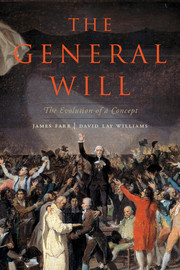
By turns celebrated and condemned, the general will in its history after Rousseau stirred passions as few ideas, concepts, words, or metaphors have. Some figures found great inspiration in the general will as they imagined Rousseau envisioned it. The most immediate inspiration came in the opening days of the French Revolution when the Abbé Sieyès appropriated the term to elevate the Third Estate from “nothing” to sovereign.3The same year, the Tennis Court Oath depicted on the cover of this volume would ultimately result in the Declaration of the Rights of Man, which proclaimed, “The law is an expression of the general will.”4Not only revolutionaries but the ill-fated Louis XVI gave testimony to the power of Rousseau’s central concept when, at the National Assembly, he promised to “defend and maintain constitutional liberty, whose principles the general will, in accord with my own, has sanctioned.”5 Robespierre – who would have none of Louis’s will but thought Rousseau “divine” – found the general will at work in the Committee of Public Safety as it doled out the Terror.6The most storied philosophers following Rousseau fell sway to the general will, as well. Kant celebrated Rousseau as the “Newton of the moral world” and appealed to the general will throughout his long career.7Fichte’s ambition for his philosophy of right was “to find a will that cannot possibly be other than the common will.”8 Hegel insisted that “the general will is supposed to supervise the supreme power in general.”9Admiration for Rousseau continued into the twentieth century. The liberal contractarian John Rawls identified himself as a Kantian insofar as Kant “sought to give a philosophical foundation to Rousseau’s idea of the general will.”10
Others have recoiled at what they thought were the dangers and darkness of the general will. In 1815, looking back on the results of the French Revolution, Benjamin Constant wrote of “this despotism of the so-called general will, in a word, this popular power without limits, dogmas which are the pretext for all our upheavals.”11In the aftermath of the First World War, John Dewey came to a similar conclusion. Rousseau had created “an overruling ‘general will’” which “under the influence of German metaphysics was erected into a dogma of a mystic and transcendent absolute will.”12In a world again at war, Bertrand Russell warned in 1945 that the “doctrine of the general will [has] made possible the mystic identification of a leader with his people, which has no need of confirmation by so mundane an apparatus as the ballot-box.”13Likewise, Karl Popper complained that, having unleashed the concept of the general will, Rousseau was “one of the most pernicious influences in the history of social philosophy.”14 “In marrying [the general will] with the concept of the principle of popular sovereignty, and popular self-expression,” J. L. Talmon added shortly thereafter, “Rousseau gave rise to totalitarian democracy.”15And, quite recently, Jeffrey Abramson has remarked that Rousseau’s general will projects a “spooky character.”16
The range of these historical judgments on Rousseau and the general will reflects, in part, the political, ideological, and philosophical options in the nineteenth and twentieth centuries. But it also reflects the “inherent indeterminacy” of Rousseau’s principles, as well as widely divergent conceptions of what, precisely, he meant by the volonté générale.17 Rousseau was himself aware of his ambiguity and notoriety. He warned: “Attentive readers, do not, I pray, be in a hurry to charge me with contradicting myself. The terminology made it unavoidable, considering the poverty of the language; but wait and see.”18 To judge by the subsequent history of the general will after Rousseau, it would be a long wait indeed.
But there is even more to the invention, reception, and contention of the general will in modernity than either Rousseau or the history after him. Indeed, one must consider the history of the general will before Rousseau, as well. Shklar brooked no doubts that “The phrase ‘general will’ is ineluctably the property of one man, Jean-Jacques Rousseau.” She added, however: “He did not invent it, but he made its history.”19No, he did not invent it. Immediately before his first discussion of the general will in an Encyclopédie contribution on political economy, Denis Diderot proclaimed, “the general will is always good” in his own 1755 contribution to the Encyclopédie on natural right.20Rousseau would also have been able to identify Montesquieu preceding Diderot in using the general will politically, given his close attention to Spirit of the Laws.21 However, he did not do so, though Diderot himself did.22Much later – and much after Rousseau – so would scholars like Shklar, C. E. Vaughn, and Charles Hendel. By that later time, it did rather appear that Montesquieu, briefly, and Diderot, passingly, exhausted what could be said about the history of the general will before Rousseau.
Our understanding of the provenance and intellectual dynamics of the concept of the general will and its post-Rousseauian reception – and thus Rousseau himself – advanced considerably with the publication in 1978 of Patrick Riley’s essay, “The General Will before Rousseau.” Evolving into his The General Will before Rousseau: The Transformation of the Divine into the Civic (Reference Riley1986), Riley discovered many others beyond Montesquieu and Diderot who, before Rousseau, had promoted their views or criticized others explicitly using the terminology of “the general will.” There was Antoine Arnauld who coined the term in 1644 in reaction to the theology of Nicolas Malebranche. There were also Pascal, Bayle, Bossuet, and Fénelon as well as – to a lesser degree – their contemporaries, Hobbes, Spinoza, Descartes, Leibniz, Locke, Barbeyrac, Fontenelle, Voltaire, and Hume, among others. In subtitling his book, The Transformation of the Divine into the Civic, moreover, Riley offered a sweeping sketch of conceptual change of the first order. The general will had originated as a theological notion – about nature, grace, and the extent of “God’s general will to save all men” – but was “politicized” or “civicized” over the course of its history, culminating in Rousseau. In regard to the prospects of “a more general theory of the genesis and metamorphosis of ideas,” Riley summarized his own preference “to say simply that between the seventeenth and eighteenth centuries there was a rising consciousness that ideas once imputed or ascribed to God, such as justice, goodness, wisdom, generality, and constancy, are merely moral ideas made yet more attractive by being transplanted to heaven.” At the peak of this rising consciousness, Rousseau wrote in such a way as to make possible Kant’s subsequent efforts to bring these moral ideas “back to earth” as the demands of reason. For it was “Rousseau who completed Montesquieu’s conversion of the general will of God into the general will of the citizen.”23
As a result, Rousseau was to be understood in a distinctly French discourse of political theology in which he inherited and transformed the terminology of the “general will.” Given its centrality in Rousseau’s political thought, this interpretation made greater sense than citing Rousseau in an English contractarian discourse or a German critical discourse. He could obviously be cited in these latter discourses, as well, indeed as he standardly had been. But Riley’s interpretation opened a new scene, one glimpsed but undeveloped by Shklar and Hendel. Moreover, Bayle, in particular, but the others, as well, became much more civicized and of greater note in the history of political thought. Moreover, the conceptual history of the general will – and genealogical inquiry, more generally – proved an essential historiographical method for understanding French, English, and German discourses, before and after Rousseau.
This volume – The General Will: The Evolution of a Concept – furthers the conceptual and interpretative work begun by Riley. An expanded version of the initial 1978 article – “The General Will before Rousseau: The Contributions of Arnauld, Pascal, Malebranche, Bayle and Bossuet” – serves as chapter 1 of this volume.24 The subsequent chapters take up the general will, not always in agreement, as well as endorsing, amending or criticizing Riley’s account. Not only Rousseau, then, but Arnauld, Pascal, Malebranche, Bayle, Montesquieu, and Kant appear at length in various chapters that follow. Some who were dealt with en passant by Riley – like Leibniz, Spinoza, and Locke – are treated at greater length, and new figures are represented here, too, like Benjamin Constant, Adam Smith, Alexis de Tocqueville, and John Rawls, with passing glances at Marx and Nietzsche, as well. Even Cicero and the Puritans emerge in this volume as having conceptual equivalents to the general will informing their religion and politics.
As broad as the coverage is here, however, the general will’s scope extends well beyond what could be found even in a volume such as this. While Andrew Murphy draws attention in this volume to a prototype of the general will in John Winthrop’s promotion of fraternal bonds among citizens, for example, this was merely the beginning of the general will in the American tradition. Alexander Hamilton in Federalist No. 32 acknowledges a domain for a sovereign national “general will,” while conceding to the Anti-Federalists that each state would retain a particular will and the associated rights of sovereignty for elements not “exclusively delegated to the United States.”25Two years later, James Wilson would offer his own formulation of the general will: “In order to constitute a state, it is indispensably necessary, that the wills and the power of all members be united in such a manner, that they shall never act nor desire but one and the same thing in whatever relates to the end for which the society is established.”26Thomas Paine commented that the best way to promote civic harmony in Britain is “that the general WILL should have the full and free opportunity of being publicly ascertained and known.”27In his fourth State of the Union address, President John Adams praised the early years of the American experiment for operating “under the protection of laws emanating only from the general will.”28 In the majority opinion of Cohen v. Commonwealth of Virginia, Chief Justice John Marshall insisted on the right of the federal government “to preserve itself against a section of the nation acting in opposition to the general will.”29Later in the same century Woodrow Wilson asserted in Rousseauean fashion that “the will of majorities is not the same as the general will.”30And in the twentieth century the general will lingered in American political discourse by working its way into the 1970 edition Robert’s Rules of Order, which insisted, “The application of parliamentary law is the best method yet devised … to arrive at the general will.”31
Meanwhile, Prussian interest in the general will begins with Immanuel Kant, who first acknowledges in 1766 the moral sway of a “general will” in his Dreams of a Spirit-Seer32 and goes on to develop it in his mature works. This tradition continues with Kant’s student, J. G. Fichte, who makes the general will central to his political philosophy, describing the fundamental problem of politics to “find a will that cannot be other than the common will [gemeinsame Wille].”33 Along these lines, Fichte is especially concerned to contain powerful particular wills. This requires that “Each person must be convinced that the oppression and unrightful treatment of one citizen will result with certainty in the same oppression and treatment of himself.”34In his Addresses to the German Nation, he describes the severe limitations of particularism – “selfishness has annihilated itself by its complete development”35 – where that particularism culminates in a thoroughly selfish and corrupt government that cannot rule for the general will.36 Indeed, this selfishness extends beyond governance and even infects individual citizens such that “the individual no longer retain[s] any interest in the whole.”37 To solve this problem, Fichte proposes replacing the “natural love” that is Hobbesian egoism with “another kind of love, one that aims directly at the good,”38 largely through an ambitious educational program emphasizing love of the fatherland.
Hegel would further develop the tradition of the general will by explaining its development in the course of human history. While Hegel occasionally employs Rousseau’s terminology of “general” and “particular” wills, these terms evolve into “objective” and “subjective” wills. He characterizes the “general” or “objective” will as “the will of all individuals as such,” and he distinguishes it from particular wills, “factions,” or “atomic point[s] of consciousness.”39 While the general will is morally superior to the subjective or particular will, it lacks the motivational force of particular, selfish wills. The aim, then, for Hegel is to channel the energies of particular wills into the cause of the objective will. As he writes in the Introduction to the Philosophy of History, “a state is well constituted and internally strong if the private interest of the citizens is united with the universal goal of the state, so that each finds its fulfillment and realization in the other.”40 This merger itself, however, is only attainable in its fullest form at the end of history, where individual private wills are not merely channeled into the cause of the objective or general will. Rather citizens will the general will because it is the general will, which for him represents highest manifestation of human freedom.
Hegel’s conception of the general will found sympathy among the late nineteenth-century British Idealists, particularly Bernard Bosanquet. In the context of an emerging triumph of liberalism and utilitarianism, the Idealists sought to develop a political philosophy less reliant on the individual rights and wills that they associated with Locke and more oriented to teleology and the common good. Bosanquet, in particular, refers to the theories of Bentham, Mill, and Spencer as “theories of the first look,” which are guided by an assumption of “the natural separation of the human unit.”41 Bosanquet rejects this approach as validating the “actual will,” which is egoistic, and advocates replacing it with a “real” or “general will,” which may not be manifested in every individual articulation of interest, but is coherent and determined by its fidelity to the “common good.”42
Although no idealist, another self-described “pupil” of Hegel who inherited and deepened consciousness of the general will was Karl Marx. He used the concept both as a detached theorist of history and as an impassioned conduit of communist ideals. On the one hand, that is, he could look down on the modern state and declare that “in civil law the existing property relations are declared to be the general will” while harboring “the illusion that private property is based solely on the private will.”43On the other hand, he could quote Rousseau admiringly on the “volonté générale”44 and be read as connecting it to the ideals of communal life.45 Later Marxists – like Louis Althusser – would follow Rousseau’s and Marx’s lead, keeping the general will alive as both explanation and ideal.46
The above-mentioned thinkers and byways of the conceptual history of the general will – not otherwise covered in this volume – suggest that more such thinkers and byways may yet be discovered or revived. And they suggest where they might be found. Discoveries or revivals are possible, for example, in the popular pamphlets in the wake of the French Revolution or in the constitutional commentaries of late eighteenth-century Americans or in the lesser writings of nineteenth-century British Idealists or in the precincts of French Marxism or in the neocolonial discourses of Francophone revolutionaries. They are also possible nearer to the known beginning of the conceptual history, as Patrick Riley dates it, that is, in seventeenth-century theological debates about “God’s will to save all men.” Indeed, we think we have made a few such discoveries in religious writings and sermons from that period. They invite deeper inquiry than we can provide here, but they are very suggestive without detailed commentary. One or another might suggest an older source, a different referent, or an alternative pathway in the evolution of the general will.
These early uses were often merely acknowledgments of the adjectivally “general” character of divine volition. A few brief examples suffice. When dealing with the medical dimensions of “enthusiasm,” for example, the classical scholar Meric Casaubon lectured in 1655: “When in matters of diseases, we oppose natural causes to supernatural, whether divine or diabolical; as we do not exclude the general will of God, without which nothing can be.”47Similarly, in The Divine Right of Church-government and Excommunication (Reference Rutherford1646), the Presbyterian pastor Samuel Rutherford gestured to “the general will and command of God” when distinguishing between “essential” and “arbitrary” worship.48And in a posthumous commentary on “the light of Christ” at the earlier date of 1623, Nicholas Byfield deemed “the instrument of receiving it, in respect of the general will of God, is the understanding.”49 These references did not introduce or occasion spirited debate about what, precisely, was “general” about God’s will. His will could be anything, of course, not least of all general. The references often vied for place alongside other adjectives: God’s will was absolute, eternal, pure, simple, rigorous, severe, commanding, forbidding, gentle, permissive, adorable, and on and on. Hobbes thought these adjectives told us about ourselves, not God. “The attributes we give him are not to tell one another what he is, nor to signify our opinion of his nature, but our desire to honour him with such names as we conceive most honourable amongst ourselves.”50
Other references in this early period carried greater theological import when divining the different ways in which God could will men’s salvation. In The True Catholicks Tenure (Reference Hyde1662), for example, Edward Hyde the clergyman referred to instances of God’s judgments that “derogate from his general will by his special will.”51In 1635, when commenting on Paul’s epistle to the Hebrews, William Jones proclaimed, “CHRIST came not only to doe the general will of God: but to do his particular will also as the Mediatour of mankinde.”52The nephew and namesake of Sir Walter Raleigh made the same distinction from the pulpit before the outbreak of civil war in 1642.53 In these cases, “special” or “particular” contrasted with “general” in ways that Riley found in the French debates between Arnauld, Malebranche, and others. Indeed, one English reference provides a striking and sustained parallel to the French debates. In the first article, “Of God’s Predestination” in his “Via Media: The Way of Peace” – collected later in The Shaking of the Olive Tree (Reference Hall1660) – Joseph Hall, the Calvinist-leaning Anglican bishop of Norwich and Exeter, theologized about God’s volitions regarding man’s salvation. Hall allowed both a “general” and a “special” will at work in God’s predestination.
Besides the general will of God, he hath eternally willed, and decreed to give a special, and effectuall grace to those, that are predestinate according to the good pleasure of his will, whereby they do actually believe, obey, and persevere, that they may be saved: so as the same God, that would have all Men to be saved, if they believe, and be not wanting to his Spirit, hath decreed to work powerfully in some, whom he hath particularly chosen, that they shall believe, and not be wanting to his Spirit in whatsoever shall be necessary for their salvation.54
This passage was posthumous, Hall having died in 1656. Who read or listened to the original? Could this be an independent development? Were their discursive connections between the bishop and the French authors? Are there perhaps yet earlier uses of the term – including those noted above by Byfield, Raleigh, or Jones that precede Arnauld’s reference in 1644 – that might throw new and different light on the origin and evolution of the general will?
The referent of these early uses was invariably the general will of God, as it had been in the French debates between Arnauld and Malebranche. However, at least one striking and suggestive usage points not to God, but to “our selves.” In A Spiritual Treasure containing our Obligations to God, and the Vertues Necessary to a Perfect Christian, as translated into English in 1660 and reissued in 1664, the Oratorian Jean-Hugues Quarré (1580–1656) wrote that “it is good for the soul to present her self often before God, exciting in her self an efficacious desire to do the pure will of God.” Then he continued:
Moreover it is very profitable to offer our selves to God, and to form a generall will to practice all sorts of good, though we have no light nor feeling, contenting our selves with a resignation to God, and taking care to follow him, and to co-operate faithfully with the graces and motions we receive from him.55
Well before Montesquieu, Diderot, and Rousseau, then, we seem to have a “general will” or “volonté générale” that is the will of humans, individually or collectively. Furthermore, the French original by Quarré – Thrésor spirituel contentant les obligations que nous avons d’estre à Dieu, et les vertus qui nous sont necessaires pour vivre en chrestien parfait – was first published in 1632, pushing back the known date of origin and inviting us to speculate on the lively discussions at the Oratory under Cardinal Pierre de Bérulle, even before Malebranche’s birth! This, too, raises further questions about origins and underscores the complexity – covered in this volume, otherwise known, or yet to-be-discovered – in the conceptual history of the general will.
Four sections divide up the volume: the general will before Rousseau, the general will in Rousseau, the general will after Rousseau, and pre-history of the general will tradition. As noted, Riley’s sweeping chapter covers much of what is now known of the general will before Rousseau. It emphasizes the dramatic change that the concept underwent – from a divine concept, as found in Arnauld, Leibniz, and Malebranche, to a civic one in Montesquieu and especially Rousseau. Of special interest is the central importance of Bayle in the unfolding of the general will. In particular, Riley underscores how and the ways in which Bayle civicized the general will. Before he was the editor of the monumental Dictionary, Bayle took up the themes of the debate that preceded him. Whereas Pascal had hinted at the general will of “bodies politic” like churches, Bayle secularized and rendered more evidently civic the ways in which human associations in their collective actions exhibit a “general will.” It remained for Montesquieu to follow this train of thought in anticipation of Rousseau.
Following this overview, Steven Nadler, then, returns to the early salvos of the French debate. His “Malebranche’s Shadow: General Will in the Leibniz-Arnauld Correspondence” explores theological dimensions of the general will in the important works of the Oratorian Nicolas Malebranche. Upon reading Malebranche’s Treatise on Nature and Grace – which introduced an account of God acting according to general laws that were expressions of His will and consistent with God’s constancy and perfection – Arnaud offered the first known assessment of the general will: he thought it completely undermined God’s capacity for miracles, which he understood to be central to the very meaning of God himself. That is, God must be allowed to exercise a particular will. Armed with a new dedication to God as an agent of particular wills, Arnauld read Leibniz’s Discourse on Metaphysics as being in league with Malebranche in its unacceptable insistence that God can only legislate generally, even if this is supposedly consistent with the best of all possible worlds. Nadler reveals how Leibniz, in turn, artfully responded to Arnauld’s objections in order to pacify Arnauld while still publicly maintaining a version of Malebranchian generality in divine will or providence.
The gap between the theological and political accounts of the general will was bridged indirectly by another figure of the greatest importance to early-modern political thought and Rousseau in particular – John Locke. Alas, this is not appreciated as much as it should be, so argues James Farr. As Farr notes, Rousseau not only respected Locke on matters of education and toleration, he credited him “in particular” as holding “the same principles” of politics and law. Upon inspection, these Lockean principles – which Rousseau glossed as matters of the “general will” – proclaimed the law to be “the Will of society” and necessary for liberty, for “where there is no Law, there is no Freedom.” These principles were adaptations of his theological views. So it is notable that Locke had read extensively those thinkers most responsible for debating the general will – Malebranche, Pascal, and Bayle – as well as speculating on the Pauline doctrine that most concerned them, namely, that “God wills all men to be saved.” Drawing yet closer to the “general will,” Locke found it necessary to refute the theory of ideas he found in Malebranche and his English followers. By His laws, God governed an orderly universe that He willed into existence, to be sure, Farr argues, but there was no coherent reason, Locke thought, to embrace Malebranche’s view that it was God’s “general will” that human beings have the ideas they do because they “see all things” in Him. For Locke, the (human) will – whether general or particular – has no role in the formation of ideas, which exist merely as a consequence of sense perception. At any rate, these competing accounts of ideas were “hypotheses” to which believers should submit humbly, not presupposing, as Malebranche, to “dictate” what God can do or how. In confronting Malebranche, Locke was among the first in English to quote (in translation) Malebranche’s use of “general will.” In light of this fact – and Rousseau’s later invocation of Locke as embracing “the same principles” – Locke deserves to be more fully incorporated into the conceptual history of the general will than has been the case hitherto.
The next two chapters take up the politicized general will implied in Locke, Bayle, and other early modern thinkers. In doing so, each challenges Riley’s narrative, though in different ways, that the general will takes this secular turn specifically with Montesquieu. David Lay Williams argues that the general will had been secularized generations before Montesquieu in the political writings of Benedict de Spinoza. Williams identifies Spinoza’s “common mind” as possessing many of the same qualities that later come to be associated with Rousseau’s secular general will. What is unique in Spinoza, he reasons, is that he offers three different ways to achieve that union of wills: fear, love, and reason. Further, Spinoza stands outside of the rest of the general will tradition insofar as he resists the dominant tendency of general will theorists to appeal to Platonic metaphysics, instead resting on a modern naturalism. The leaves Spinoza with a compatabilistic conception of the will significantly different from the autonomous will found in Rousseau and Kant.
In “Freedom, Sovereignty, and the General Will in Montesquieu,” Sharon Krause asks whether or not Montesquieu actually embraces a secular, politicized general will in his Spirit of the Laws, as Riley claims. With careful attention to the text, she reveals that Montesquieu infrequently employs the term; and, when he does, it is not as his own normative principle. He rather speaks of a legislature, yes, legislating for all – but not for the common interest, as has been frequently supposed. In Montesquieu, Krause finds a liberal political theorist who is more concerned to effectively channel particular wills than to privilege a general will. As such, she describes a Montesquieu who is less a predecessor to Rousseau’s general will than an alternative.
The essays in the second section of this volume explore how the concept of the general will inaugurated in early modern French theology and political thought might nonetheless be found to have analogues or conceptual equivalents beyond and before its nascent roots. We think of this as the prehistory of the general will. These essays, then, suggest ways we might conceptualize an extension of the general will tradition. Daniel J. Kapust explores how, centuries earlier, Cicero’s On Duties bears on matters that became relevant to the general will. He notes the dangers that Rousseau associated with rhetoric as a particularizing force, hence subversive to the general will. By contrast, he finds that Cicero comes down on the opposite side of this question, suggesting that rhetoric has the capacity for both generalizing and effecting consent. That Cicero might have differed from Rousseau on such matters may not be surprising, since Rousseau was quick to say of Cicero in the Social Contract that he “loved his glory more than his fatherland.”56 Yet Cicero’s defense of rhetoric suggests alternative means by which to achieve the common good and hence the general will.
Finally, Andrew R. Murphy explores the fraternal dimension of the general will by examining the colonial Puritan, John Winthrop. For Winthrop, fraternity was a religious and specifically Christian duty – but with important political implications. Murphy observes Winthrop insisting, “That every man might have need of others, and from hence they might all be knit more nearly together in the bond of brotherly affection.”57 Murphy’s attention to Winthrop’s Calvinism provides an opportunity to consider Rousseau’s own possible debts to Calvinism, as suggested in a footnote to the Social Contract, where Rousseau notes of his fellow Genevan,
Those who know Calvin only as a theologian much underestimate the extent of his genius. The codification of our wise edicts, in which he played a large part, does him no less honor than his Institutes. Whatever revolution time may bring in our religion, so long as the spirit of patriotism and liberty still lives among us, the memory of this great man will be forever blessed.
This offers a potentially fruitful source for reexamining the source material for Rousseau’s unique formulation of the general will.
The third section turns its attention to the most famed proponent of the general will: Jean-Jacques Rousseau. We offer four strikingly different accounts of Rousseau’s general will. David Lay Williams grounds Rousseau’s general will in Platonism, arguing that the general will involves consent on the part of the people to a pre-existing eternal idea of justice. As such, Rousseau represents a curious blend of an ancient commitment to immaterial substance and a modern commitment to consent for assuring legitimacy. In order to maintain this will, Williams emphasizes the importance of fraternal love in Rousseau’s republic. By contrast, Richard Boyd finds a more ambiguous Rousseau with greater liberal sympathies than are typically assumed. While there is an element in Rousseau emphasizing benevolent feelings or sentiment, there is another casting aside those very sentiments in favor of procedural justice. And even when Rousseau cultivates civic feeling, this is where he is potentially most dangerous – insofar as sentiments of nationalism emanating from fraternity work against all external communities. Implicit in this is a challenge to any sort of cosmopolitanism. So Rousseau’s general will is a kind of particular will in the end – the will of one particular society among many in the world.
Sankar Muthu acknowledges and develops the problem identified by Boyd, namely, the problem that Rousseau’s general will presents for cosmopolitanism of any sort. Despite some derisive remarks by Rousseau about the “cosmopolites,” Muthu shows that Rousseau was nonetheless open to the idea of a general society of humankind and thus a “general will of humanity.” He did not believe, however, that it could play any feasible role in the political affairs of the world of his day, or in the future. In a complex investigation, Muthu reveals that the citizen of Geneva expressed a longing for the fellowship that a universal society could provide, endorsing the conceptual validity of a general will that pertained to all humanity. Ultimately, though, what could be defended in theory was tragically inapplicable in practice in a world dominated by predatory states and commercial societies. Thus, a general society of all peoples was impossible. This followed because of features of the human condition itself; the curious mix of sovereign legal power and natural liberty that characterized that condition; the pathologies endemic to commercial relations; and the requirements necessary for the realization of the general will of particular societies. Ultimately, as Muthu concludes, Rousseau’s critical analysis of the general will of humanity illustrates – from an all-encompassing, global perspective – the profoundly tragic sensibility of his social and political thought.
Finally in this array of overlapping or competing readings, Tracy B. Strong offers a reading of Rousseau’s general will that emphasizes commonness. Even more cosmopolitanism than either Boyd or Muthu, Strong’s Rousseau sketches out in his general will “what it means to live as a human being … capable of living with other human beings as human beings and as a human being.” In order to achieve this, Strong emphasizes the role of law in Rousseau’s political theory. For it “requires a people to be able to see itself as a people, to stand outside itself and, as itself, constitute itself.” This conception of humanity and law, however, must not be confused with a simply moral concept. Rather, the general will embodies at least as much what is as what should be, if not more so. Rousseau’s general will is adamantly a will of and in the present. Strong concludes by suggestively tracing the evolution of the general will through the nineteenth and twentieth centuries in the very different figures of Marx, Nietzsche, Weber, and Rawls.
The general will after Rousseau – our fourth and final section – includes essays on Smith, Kant, Constant, Tocqueville, and Rawls. This set of thinkers is hardly of one mind about the value of Rousseau’s general will. Kant and Rawls view the general will as a valuable contribution, needing some (rather important) refinement in order to achieve its purposes, while Smith, Constant, and Tocqueville, by contrast, view the general will as inadequate or even a genuine threat to the public good.
Rousseau’s philosophical influence was immediately felt in Königsberg when Immanuel Kant turned his attention from the critiques of reason to politics and political theory. At least Kant felt this way when, shortly after the publication of the Social Contract, he spoke of “this compulsion we feel in us to harmonize our will with the General Will.”58 Yet the connection between Kant and Rousseau – so strong in many ways – is less strong than at first it might seem when it comes to the general will. So argues Patrick Riley. While he is quick to acknowledge the influence of Rousseau and the general will in Kant’s moral philosophy, he is less inclined to do so with regard to his political philosophy. Riley’s Kant is crucially grounded in the maxim that a good will is the only unqualified good. And while this good will is the proper standard for moral judgment, it is entirely impractical for establishing a republic, where “public legal justice” assumes the work that a good will cannot fulfill. As such, Riley argues, the “will” of the “general will” plays much less of a role in Kant’s political philosophy than it does for Rousseau.59 Riley pushes further to argue that Rousseau’s “general” is in its own way more “particular” than Kant’s “universal.” Specifically, Rousseau denies that the aspiration to “universal” norms, such as found in Kant – and Diderot – are unrealistic in their own respect. For this reason, whereas Kant is eager to consider questions of international right, Rousseau is pessimistic about the possibility. For Riley’s Rousseau, the “general” represents the outer limits of justice and is always somewhat provincial.
Other contemporaries of Rousseau – or those just after him – had similarly guarded reactions to the general will, however much else they shared with the “Citoyen de Genève.” Thus, Shannon C. Stimson notes that Adam Smith was by no means unfriendly to Rousseau. For example, Smith translated into English the Second Discourse and accepted as true many of Rousseau’s critiques of commercial society. Further, Smith embraced Rousseau’s demand for greater social unity. Yet he ultimately found an “invisible hand” to be a more effective tool for the purposes of social unification than the “general will.” For Smith, the problems of poverty and inequality in sowing disunity, in particular, do not require the radicalism of the general will so much as simply granting more space to the particular will than Rousseau and his closest followers would permit. Although the particular will has its warts, in Smith it has more virtues than the general will tradition – and Rousseau, in particular – allows.
Though influenced by and sympathetic to Smith, Bryan Garsten’s essay reveals that Benjamin Constant went much further than Smith in critiquing Rousseau’s general will, identifying what he considered its fatal flaw: the separation of government and sovereignty. Remember, it was this that Rousseau shared with Locke as one “the same principles” bonding them. For Constant – who was more forgiving of Locke as a forerunning liberal and associated, favorably, with the Glorious Revolution – the complete submission of subjects to the general will results not in equality, as Rousseau envisioned, but rather in an asymmetrical distribution of power. The people surrender their private wills to the government, which then holds all of the power. An all-powerful government, consequently, wields its power arbitrarily and despotically. Furthermore, its power is enhanced by the pretense of the general will’s sovereignty. By laying claim to “seemingly disinterested principles,” factious interests remove public opinion as an obstacle to their machinations.60 Garsten concludes, at some distance from Constant’s particular critique of Rousseau, by exploring how a government might genuinely arise from the sovereign general will.
Another major figure in the French liberal tradition, Alexis de Tocqueville, is often cited as embracing Rousseau’s political philosophy. Yet while Michael Locke McLendon demonstrates that Tocqueville had genuine affection for elements of Rousseau’s thought, this cannot be said of the general will. If anything, Tocqueville takes Rousseau’s dictum that we must “take men as they are” far more seriously than Rousseau himself did, which, in fact, renders him an entirely different thinker, more comfortable with giving free reign to the particular will than Rousseau possibly could. Departing quite dramatically from Rousseau, Tocqueville accepts selfishness as an accurate assessment of “men as they are” and builds a nineteenth-century American doux commerce, where this selfishness ultimately softens society and brings civic harmony. That is, Tocqueville finds the public good in private wills rather than in the quixotic attempt to forge a general one.
A later American liberal in our time, John Rawls, took a more sympathetic view of Rousseau’s and, then, Kant’s use of the “general will” for establishing social and political unity. As a historical matter and as a self-identified Kantian, Rawls remarked in A Theory of Justice that “Kant sought to give a philosophical foundation to Rousseau’s idea of the general will.”61 Furthermore, Rawls himself is said to have confessed that his “two principles of justice could be understood as an effort to spell out the content of the general will.”62 Christopher Brooke in the final chapter follows these clues to see just how Rousseau’s concept of the general will – along with its substantive commitments to liberty and equality – animated Rawls’s theory of justice. In examining Rawls’s Lectures on the History of Political Philosophy, he notes that not only are the lectures on Rousseau more polished than those on any other historical figure, but also that Rousseau is also the only canonical figure in his History to escape serious criticism. Brooke paints a portrait of Rawls deeply inspired by what he found in Rousseau, just as was the case in Kant. He also sketches the ways in which Rawls departs from Rousseau – especially with regard to the prospects for long-term success in politics. Whereas Rousseau laments in his Social Contract that every republic is ultimately doomed to decay, one finds a more optimistic – or, at least, less anxiety-ridden – assessment of our contemporary prospects in Rawls. In making these informed observations, Brooke not only appeals to Rawls’ published texts, but to some hand-written notes toward a future, unrealized project.
The “general will” has clearly had the most remarkable evolution. While there is no reason to expect a theory of conceptual change to explain it or any other conceptual evolution in political thought – as we might imagine in natural science63 – there are some dynamics and features of conceptual change evident in the general will’s evolution. Perhaps the most dramatic development happened within its first half-century when the referent to God’s will changed dramatically to be that of human will, either in individuals or a community or humankind, more generally.64 The change from Arnauld and Malebranche to Montesquieu and Rousseau, as Riley argued, was the change from “the divine to the civic.” Even when civic, the changes were notable, for example, from Robespierre’s revolution to Napoleon’s rule. For some witnesses, then and later, neither of these civic or political transformations were good – as the general will had been for Diderot and Rousseau – and so the general will earned its bad name, to date things at least from Constant. All along the changes were driven by contradiction within or contestation between different conceptions of the general will.65 Some changes were intentional, others unintentional or at least until noticed amid debate. Perhaps the most dramatic change of all has been the marked decline in the use of “general will” at all, at least among politicians and publicists, unlike historians and scholars as evident in this volume.
The most obvious reason for this decline has to do with the French Revolution itself. Even as Hegel refashioned the general will, for example, he condemned Rousseau’s formulation as the inspiration for “the most terrible and drastic event,” namely, the Terror.66 This assessment was, of course, widely shared, including by Benjamin Constant, who read Rousseau’s general will as “inspir[ing] our Revolution and those horrors for which liberty for all was at once the pretext and the victim.”67 The stain of this association of the general will with nightmarish political violence subsequently proved difficult to wash out. Indeed, amid another European crisis a century and a half later, Rousseau and the general will returned for another round of opprobrium. As intellectuals struggled to comprehend the rise and enormities of fascism, they found its inspiration in Rousseau and the general will. Toward the end of the war, Russell wrote, “At the present time, Hitler is an outcome of Rousseau; Roosevelt and Churchill, of Locke.”68Alexander Passerin d’Entrèves labeled Rousseau’s general will “the prototype of the modern tyrant.”69And Isaiah Berlin found Rousseau and his general will to be “one of the most formidable enemies of liberty in the whole history of political thought,” specifically linking the general will to the Jacobins, Robespierre, Hitler, Mussolini, and the Communists, all of whom “use this very same method of argument.”70 Thus, it became increasingly difficult to evoke its name in the service of more noble causes. Indeed, the association of the general will with modern tyranny lingers even in contemporary American legislative debate, such as when Senator Chuck Grassley recently cited the application of Rousseau’s philosophy resulting in “power centralized in a ruling elite that claims a unique ability to interpret the ‘general will.’”71
Another reason for the decline of the general will (especially in the circles of faith) stems from its very generality. In his account of William Bentley, the early nineteenth-century American theologian, J. Rixey Ruffin argues that generalist theologies “failed to provide what the faithful seek from their faith.”72 Among other things, the faithful desired that God take a special and personal interest in their wellbeing, and be responsive to their specific prayers. In arguing that God’s providence was general rather than particular, Bentley had placed his congregants in the position of confronting “the prospect of a universe governed by a god unable or unwilling to help them.”73 That Bentley’s theological views were doomed to failure is apparent in the absence of such theological views in the public sphere today. A general will, from a certain point of view, is cold and abstract – these traits being especially unsuited for dominant public philosophies.
Much the same logic applies to everyday (not just revolutionary) politics. Just as appeals to a divine general will began to fall on deaf ears, so too did appeals to a political or civil general will. The same subjects who wanted to believe that God took a special interest in their personal affairs wanted to believe that their own particular wills were worthy of some kind of priority over a general will. Rousseau’s general will shares the same failure to resonate with modern Western societies one finds in its theological predecessor. Its abstraction offers few, if any, assurances of individual salvation or preference. A new appeal to particularism in the nineteenth and twentieth centuries – whether through Smith, Constant, Tocqueville, Mill, or others – offered a philosophical alternative to the general will. It honored even celebrated personal preferences in contrast to Rousseau’s republican calls for personal sacrifice to a greater good. Or put slightly differently, whereas Rousseau regarded each individual or particular will with deep suspicion, the new tradition took each individual to be special. While it is difficult to measure the psychic consequences of such appeals, it is not difficult to imagine the obstacles confronting the defenders of the general will tradition – either theologically or politically.
As a consequence of this history, one rarely finds prominent contemporary political thinkers, much less actors, couching their arguments in the terms of the general will.74 Despite this, it would be mistaken to assume that a bad name is all that remains of the general will. As some recent scholars have suggested, the values associated with the general will retain a vibrant life, though perhaps detached from express use of the term itself. Jane Anna Gordon, for example, has sketched multiple links between Rousseau’s general will and Franz Fanon’s conception of national consciousness. For Gordon’s Fanon, the general will informs both critical and constructive elements of his political philosophy. Critically, in the same way that Rousseau warned against legislating in ignorance of local conditions, Fanon appropriates the general will to scrutinize the “arrogant ventures” of imperial powers into foreign territories with robust traditions of their own. Constructively, just as Rousseau insists that the general will must include all citizens for both derivation and substantive application, Fanon demands “radically democratic participation.”75Along similar lines, Kevin Inston has recently argued for the Rousseauean foundations of contemporary radical democratic theory, especially as found in Mouffe, Laclau, and Lefort. In this spirit, he emphasizes that Rousseau’s general will demands far more from citizens than mere obedience of the laws. It requires vigorous civic participation in “actively (re)producing” the general will.76 Mouffe, Laclau, and Lefort, Inston argues, learn from Rousseau’s conception of the general will that voting is perhaps the least of a citizen’s duties, in comparison with contributing to a vigorous democratic discourse.77As with Gordon’s Fanon, they all stress the importance of democratic inclusion emanating from Rousseau’s conception of the general will.
The essays in this volume, taken collectively, paint a complex portrait of Rousseau – as well as his forebears and descendants – who grappled with the very idea of a general will, whether of God, the citizen, a body politic, or humanity at large. From the theological anxieties of Malebranche and Arnauld to the political-theoretic complexities of John Rawls – entangling Leibniz, Spinoza, Locke, Bayle, Montesquieu, Diderot, Kant, Smith, Hume, Tocqueville, and Rousseau, not least – the general will has been a conceptual instrument to answer or attempt to answer some of the most pressing and timely questions of theology and politics. How does God will that all men be saved? Are ideas divine or sensate? What makes whole the members of a body? How much unity need a body politic have? What commonality do citizens share? How can individuals be both free and obey the law? What makes common the common interest or public the public good? How do governments threaten states or the sovereignty of their peoples? Can humanity be as one?
In the course of answering or attempting to answer questions like these – our essays also show – the “general will” invited or had brought down on it questions, in their turn, about the adequacy, coherence, or dangers of this concept. Can God act by anything but a particular will, in the end? Can a person, a citizen, a city, or a state? Are things as diverse as ideas, actions, and practices matters of will, much less a general will? Can particular volitions actually be aggregated into collective or universal ones? Are humans so selfless as to embrace a good others deem common? Are actual people capable of such public-minded deliberation? Doesn’t the “general will” express an unattainable ideal, noble perhaps but unrealistic? Isn’t it really propaganda for suppressing dissidents, a verbal prelude to tyranny and terror?
These are questions not only about a concept but about the realities of human politics or God’s universe which call forth or call out that which is named by the term “general will.” Besides the intellectual depth and diversity on display in the chapters to follow, they collectively remind us of the political and theological issues that have been at stake – sometimes persisting and sometimes changing – since the seventeenth century. They – or others rather like them – are certainly at stake still, in one form or another. It does not appear that human affairs or the prospects of salvation will anytime soon be stable enough or sufficiently understandable to render final judgment on the value of thinking about politics or religion – about citizens or God – in terms of a general will. The palpable lack of unity or commonality in almost every quarter one looks – in a person, a soul, a citizen, a congregation, a body politic – makes it virtually inconceivable to think that there is a general will somewhere at work in the world. At the same time – and for the very same reasons – it makes understandable the temptation to think or, rather, hope in such terms. We could do much worse, then, than to reconsider, as we have tried, the multifaceted debates over the general will that inform our history in order to try better to understand our own problems and predicaments.
Notes
1. , Liberty before Liberalism (Cambridge: Cambridge University Press, 1998).
2. , Men and Citizens: A Study of Rousseau’s Political Theory (Cambridge: Cambridge University Press, 1969), p. 184.
3. , What is the Third Estate? in Political Writings, ed. (Indianapolis, IN: Hackett Publishing, [1789] 2003), p. 111.
4. , Decree upon the National Assembly, in The Communist Manifesto and Other Revolutionary Writings, ed. (Mineola, NY: Dover Publications, [1789] 2003), p. 76.
5. Louis XVI, quoted in , Citizens: A Chronicle of the French Revolution (New York: Vintage Books, 1989), p. 323.
6. Maximilien Robespierre, “Dedication to Jean-Jacques Rousseau,” quoted in , Rousseau and the Republic of Virtue: The Language of Politics in the French Revolution (Ithaca, NY: Cornell University Press, 1986), p. 156.
7. Quoted in , The Question of Jean-Jacques Rousseau (Bloomington: Indiana University Press, 1963), p. 43.
8. , The Foundations of Natural Right according to the Principles of the Wissenschaftslehre, ed. (Cambridge: Cambridge University Press, [1795–1796] 2000), p. 134.
9. , On the Scientific Ways of Treating Natural Law, on its Place in Practical Philosophy, and its Relation to the Positive Sciences of Right, in Hegel: Political Writings, eds. and (Cambridge: Cambridge University Press, [1802–1803] 1999), p. 134.
10. , A Theory of Justice (Cambridge: Harvard University Press, 1971), pp. 252, 264.
11. , Principles of Politics Applicable to All Governments, ed. (Indianapolis, IN: Liberty Fund, [1815] 2003), p. 386.
12. , The Public and its Problems, in The Later Works, vol. 2 (Carbondale: Southern Illinois University Press, [1927] 1988), p. 269. Earlier, in “Austin’s Theory of Sovereignty,” declared: “The great weakness in Rousseau’s theory that the general will is sovereign, is that he makes its generality exclude all special modes of operation.” The Early Works, vol. 4 (Carbondale: Southern Illinois University Press, [1894] 1971), p. 90.
13. , A History of Western Philosophy (New York: Simon and Schuster, [1945] 1972), p. 700.
14. , The Open Society and Its Enemies, vol. 1: The Spell of Plato (Princeton: Princeton University Press, [1945] 1971), p. 257 n20.
15. , The Origins of Totalitarian Democracy (New York: W. W. Norton, 1970), p. 43.
16. , Minerva’s Owl: The Tradition of Western Political Thought (Cambridge: Harvard University Press, 2009), p. 256.
17. See , Rousseau’s Theodicy of Self-Love: Evil, Rationality, and the Drive for Recognition (Oxford: Oxford University Press, 2008), p. 211.
18. , Social Contract, in The Social Contract and Other Later Political Writings, ed. (Cambridge: Cambridge University Press, [1762] 1997), p. 61n.
19. , “General Will,” in The Dictionary of the History of Ideas, ed. (New York: Charles Scribner’s Sons, 1973), p. 275.
20. , “Droit Naturel,” in Diderot: Political Writings, eds. and (Cambridge: Cambridge University Press, [1780] 1992), p. 19. Diderot does mention the general will cursorily in subsequent essays, though without development of the concept. See his “Observations on the Instruction of the Empress of Russia to the Deputies for the Making of the Laws” and Histoire des Deux Indes, in Diderot: Political Writings, pp. 93, 208.
21. , Spirit of the Laws, eds. , , and (Cambridge: Cambridge University Press, [1748] 1989), 2.11.4, p. 157. provides an accounting of Rousseau’s study of Montesquieu’s texts in Jean-Jacques: The Early Life and Work of Jean-Jacques Rousseau, 1712–1754 (Chicago: University of Chicago Press, 1982), pp. 213–215.
22. “Had it not been for Montesquieu’s previous adoption of this doctrine of the general will … it might never have gained Diderot’s adherence.” See , Jean-Jacques Rousseau: Moralist (Indianapolis, IN: Bobbs-Merrill, 1934), vol. 1, p. 104.
23. Riley Reference Riley1986, pp. 250, 259.
24. , “The General Will before Rousseau: The Contributions of Arnauld, Pascal, Malebranche, Bayle and Bossuet,” in Studi Filosofici (1982–1983): 131–203.
25. , “Federalist No. 32,” in The Federalist with Letters of “Brutus,” ed. (Cambridge: Cambridge University Press, [1788] 2003), pp. 145–146. According to , Hamilton’s term “national interest” is the “Hamiltonian counterpart of the Rousseauean general will.” See “Alexander Hamilton: Rousseau of the Right,” Political Science Quarterly73 (1958): 166.
26. , Lectures on Law in Collected Works of James Wilson, vol. 1, eds. and (Indianapolis, IN: Liberty Fund, [1790] 2007), p. 635. For an argument outlining Wilson’s interest in Rousseau and fidelity to the general will as the proper foundation of public policy, see , “James Wilson’s New Meaning for Sovereignty,” in Conceptual Change and the Constitution, eds. and (Lawrence: University Press of Kansas, 1988), pp. 99–106. It is worth noting that once argued that Rousseau’s influence in American political thought has been negligible. See Rousseau in America, 1760–1809 (Tuscaloosa: University of Alabama Press, 1969).
27. , Letter Addressed to the Addressers on the Late Proclamation, in Rights of Man, Common Sense, and Other Political Writings, ed. (Oxford: Oxford University Press, [1792] 1995), p. 370; see also p. 376. In the same spirit in his Rights of Man, notes, “The Nation is the paymaster of every thing, and every thing must conform to its general will” (Rights of Man, in Paine 1995), p. 171.
28. , “Speech to Both Houses of Congress,” November 22, 1800, in The Works of John Adams, vol. 9, ed. (Boston: Little, Brown, and Company, 1854), p. 146.
29. 19 U.S. 264 (1821).
30. , “A Lecture on Democracy,” in The Papers of Woodrow Wilson, vol. 7, ed. (Princeton: Princeton University Press, [1891] 1969), p. 355.
31. , Robert’s Rules of Order, newly revised, ed. (Glenview, IL: Scott, Foresman, and Company, 1970), p. xlii. Oddly enough, the general will is absent in earlier editions, but since its inclusion in 1970, it has expanded modestly. The most recent edition now includes three references to the “general will” in its introductory passage, “Principles Underlying Parliamentary Law” (Henry M. Robert, Daniel H. Honemann, and Thomas J. Balch with the assistance of and , Robert’s Rules of Order, 11th ed. (Philadelphia: Da Capo Press, 2011), pp. li–lii).
32. For an account of Kant’s early formulation of the general will in Dreams, see , Kant’s Platonic Revolution in Moral and Political Philosophy (Baltimore: Johns Hopkins University Press, 1994), pp. 19–27.
33. Fichte [1795–1796] Reference Fichte and Neuhouser2000, p. 134.
34. Ibid., p. 138.
35. , Addresses to the German Nation, ed. (Cambridge: Cambridge University Press, [1807] 2008), p. 9.
36. Fichte [1807] Reference Fichte and Moore2008, p. 14.
37. Ibid., p. 16.
38. Ibid., pp. 24–25.
39. For example, , Phenomenology of Spirit, trans. (Oxford: Oxford University Press, [1807] 1977), p. 357; cf. p. 363. See also ’s On the Scientific Ways of Treating Natural Law, on Its Place in Practical Philosophy, and Its Relation to the Positive Sciences of Right, in Hegel: Political Writings, eds. and (Cambridge: Cambridge University Press, [1802–1803] 1999), pp. 132–135.
40. , Introduction to the Philosophy of History, trans. (Indianapolis, IN: Hackett Publishing [1840] 1988), p. 27.
41. , The Philosophical Theory of the State (London: MacMillan, 1923), p. 75.
42. Bosanquet 1923, p. 114. See , “The Word ‘Liberty’ on the Chains of Galley-Slaves: Bosanquet’s Theory of the General Will,” History of Political Thought15 (1994): 249–267; also see , General Will in Political Philosophy, trans. (Exeter, UK: Imprint Academic, 2013), pp. 77–80.
43. This is from a fragment in what became known as The German Ideology, in Marx Engels Collected Works (New York: International Publishers, [1847] 1976) vol. 5, p. 91. Even more sardonic was ’s observation in the Eighteenth Brumaire about Louis Bonaparte’s victory over parliament, “of force without phrases over the force of phrases.” “In parliament the nation made its general will the law; that is, it made the law of the ruling class its general will” (Marx Engels Collected Works [1852] 1979, vol. 11, p. 185).
44. Marx Engels Collected Works [1860] 1981, vol. 17, p. 400.
45. . The General Will: Rousseau, Marx, Communism (Cambridge: Cambridge University Press, 1993).
46. , Politics and History: Montesquieu, Rousseau, Marx, trans. (London: Verso, 2007).
47. , A Treatise concerning Enthusiasm (London, 1655), p. 61.
48. , The Divine Right of Church-Government and Excommunication (London, 1646), p. 121; cf. pp. 118, 123, 126. Rutherford also makes distinctions between “God’s general permissive will” and his “general allowing [or approving] will,” pp. 123, 126.
49. , A Commentary or Sermons upon the Second Chapter of the First Epistle of St. Peter (London, 1623), p. 355.
50. , Leviathan, ed. (Cambridge: Cambridge University Press, [1651] 1996), p. 271.
51. , The True Catholicks Tenure, or, a Good Christians Certainty which He Ought to have of his Religion, and may have of his Salvation (Cambridge, 1662), p. 270.
52. , A Commentary upon the Epistles of Saint Paul to Philemon, and to the Hebrews (London, 1635), p. 392.
53. “Why, if he [God through Christ] died for every one in particular, how could he chuse but die for all in general, and if he died not generally for all, with what truth may every one believe it in particular?” Cognizant of the difficulties here, Raleigh observed: “The end of the Chase, I am sure is an abrupt and dangerous precipice, for how doth it evatuate and frustrate the general Will and Testament of God, like a quirk or gull in Law, that all may fall to the particular Heir? It cuts the very strings and Sinews of our general hope.” , Reliquiae Raleighanae, being Discourses and Sermons on Several Subjects, ed. (London, [circa 1642] 1679), pp. 202–203.
54. , The Shaking of the Olive Tree, the Remaining Works of that Incomparable Prelate Joseph Hall (London, 1660), p. 356.
55. , A Spiritual Treasure containing our Obligations to God, and the Vertues Necessary to a Perfect Christian, trans. (London, [1632] 1664), p. 207.
56. Rousseau [1762] Reference Rousseau and Gourevitch1997, p. 140.
57. , “Model of Christian Charity,” in The American Intellectual Tradition, vol. I: 1630–1865, 2nd ed., eds. and (New York: Oxford University Press, 1993), p. 7.
58. , Dreams of a Spirit-Seer, in Kant on Swedenborg: Dreams of a Spirit-Seer and Other Writings, ed. (West Chester, PA: Swedenborg Foundation, [1766] 2002), p. 21.
59. For a different view that argues for a central role of the general will in Kant’s politics, see , “Ideas and Actuality in the Social Contract: Kant and Rousseau,” History of Political Thought28 (2007): 469–495; and , “Elusive Unity: The General Will in Hobbes and Kant,” Hobbes Studies25 (2012): 21–42.
60. Constant [1815] Reference Constant and Hofmann2003, p. 13.
61. Rawls Reference Rawls1971, p. 264.
62. , Rousseau: A Free Community of Equals (Oxford: Oxford University Press, 2010), p. 2.
63. , Human Understanding (Princeton: Princeton University Press, 1972).
64. Further inquiry into Jean-Hugues Quarré, mentioned above, might change this general picture.
65. See , “Understanding Conceptual Change Politically,” in Political Innovation and Conceptual Change, eds. , , and (Cambridge: Cambridge University Press, 1989): 24–49.
66. , Elements of the Philosophy of Right, ed. (Cambridge: Cambridge University Press [1821] 1991), p. 277.
67. Constant [1815] Reference Constant and Hofmann2003, p. 13.
68. Russell [1945] Reference Russell1972, p. 685.
69. , Natural Law: An Introduction to Legal Philosophy (New Brunswick, NJ: Transaction Publishers, [1951] 1994), p. 143.
70. , Freedom and Its Betrayal: Six Enemies of Human Liberty (Princeton: Princeton University Press, [1952] 2002), pp. 49, 47.
71. Chuck Grassley, “Unconstitutional Power Grabs,” prepared speech from January 26, Reference Grassley2012, http://www.grassley.senate.gov/news/news-releases/unconstitutional-power-grabs, accessed September 15, 2014.
72. , A Paradise of Reason: William Bentley and Enlightenment Christianity in the Early Republic (Oxford: Oxford University Press, 2007), p. 174.
73. Ruffin Reference Ruffin2007, p. 179.
74. We have quoted Rawls’s embrace of the general will. is also an exception here, in Strong Democracy: Participatory Politics for a New Age (Berkeley: University of California Press, 1984), esp. ch. 8. It is worth noting, however, that even as Barber appeals to Rousseau and the general will as his inspiration, he was critiqued for doing so. characterized Barber’s approach as “disturbing,” insofar as he “lets Rousseau do the talking: down to the very metaphors – social algebra and public vision – the quest for the elusive general will, hence for ‘citizens’ to feel and express it, is renewed.” See “Review of Strong Democracy,” Ethics95 (1985): 940.
75. , “Revolutionary in Counter-Revolutionary Times: Elaborating Fanonian National Consciousness into the Twenty-First Century,” Journal of French and Francophone Philosophy19 (2011): 41, 42.
76. , Rousseau and Radical Democracy (London: Continuum, 2010), p. 135.
77. argues similarly in (Un) Manly Citizens: J. J. Rousseau’s and Germaine de Staël’s Subversive Women (Baltimore: Johns Hopkins University Press, 1999).
