

Part III Responses and Resistance
10 Voice and Power in the Immigrant Rights Movement
On May 17, 2010 four undocumented students and one citizen ally occupied the Arizona office of Senator John McCain. This action was followed by a flurry of occupations, hunger strikes, demonstrations, and marches around the country. The undocumented student activists, or DREAMers as they were known, were seeking support for the Development, Relief and Education for Alien Minors Act (DREAM Act), which would provide undocumented college students the legal right to stay in the country. These events were the culmination of a ten-year struggle to pass this bill. While the DREAM Act failed to muster enough votes to overcome a filibuster in the Senate, this intensive period marked the emergence of undocumented students as an important component of the immigrant rights movement. The DREAMers captured the inherent injustice of the country’s immigration policy and made changing it a matter of serious public debate. Not only were the president of the United States and the Senate majority leader directly responding to the DREAMers’ arguments, but so too were their most important adversaries. Whereas undocumented students had very little public presence ten years earlier, they had now come to assume a dominant role in the country’s immigrant rights debate. The student activists had achieved an extraordinary voice in the public sphere.
How did this group of stigmatized immigrants gain the power to become an important voice in the public sphere? The chapter maintains that the abilities of undocumented youths to gain a powerful voice involved a number of representational processes, two of which will be the focus of this chapter. First, facing a hostile political and discursive environment, the early advocates of the DREAM Act (professional rights associations and DREAMers) needed to craft a discourse that resonated with core American values. They needed to transform themselves from a “threat” to America (Chavez Reference Chavez2008) into a figure that would contribute to the civic, economic, and moral foundations of the national community (Honig Reference Honig2006). Second, while a compelling message or discourse is a necessary condition to achieve a voice in the public sphere it is by no means sufficient. If the thousands of activists and advocates involved in the campaign “hadn’t ‘stayed on message,’” their entry into the public sphere would have been received as the “noise” of a disarticulate mob instead of the compelling “voice” of a sympathetic political subject (Dikec Reference Dikec2004). Staying on message has required key immigrant rights associations to create an infrastructure that would ensure message control by producing a common discourse, diffusing it across national networks, and training activists to become disciplined messengers. Thus, in the face of adversaries seeking to construct undocumented people as undeserving and “illegal,” DREAM Act advocates and activists were able to gain a powerful voice for their cause because they produced a compelling discourse and a disciplined body of activists to deliver the discourse into the public sphere.
This chapter addresses these issues in three parts. The first part summarizes the literature on immigrant rights activism and briefly outlines a theory to explain how undocumented immigrants can gain a voice in hostile environments. The second part uses news articles (New York Times 2000–10) and interviews1 to identify the main components of the DREAM discourse or “master frame” (Benford and Snow Reference Benford and Snow2000) that emerged in the mid-2000s. While many elements of this discourse were reformulated following the spring of 2010, it nevertheless continued to play an important role in shaping public expressions. The third section of the chapter outlines the major components of the infrastructure developed to ensure discursive control in the public sphere.
Making a Voice (Not a Noise) in Hostile Lands
Much of the recent literature on citizenship and immigrant rights movements suggests that exclusionary political and discursive regimes offer few opportunities for highly stigmatized immigrants. Some scholars have argued that national citizenship regimes employ discourses and institutions that make it “impossible” for immigrants to gain rights within national citizenship regimes (Ngai Reference Ngai2004; Raissiguier Reference Raissiguier2010; Rancière Reference Rancière1992, Reference Rancière2007). Portrayed as material and existential threats to the national community, antiimmigrant forces maintain that nationals have no choice but to exclude immigrants and deny them basic rights. Neoinstitutional scholars have refined the argument by suggesting that opportunities for expressing immigrant rights are limited but not entirely closed off. The political and discursive opportunities facing immigrants vary by immigrant groups and countries (Giugni and Passy Reference Giugni and Passy2004, Reference Giugni and Passy2006; Koopmans et al. Reference Koopmans, Statham, Giugni and Passy2005). Some immigrants have found opportunities to express their voice in some countries (second generation in France), while immigrants in other countries have encountered hostility that has compelled them to exit the political field (e.g., immigrants in Switzerland and Germany). These findings suggest that while political and discursive opportunities vary, the most hostile environments deny the openings needed for immigrants to express a “voice” and compel most to “exit” the public sphere of receiving countries.
Undocumented immigrants are some of the most stigmatized immigrants and face high levels of discursive, political, and institutional hostility. If the preceding proposition were valid, we would expect undocumented immigrants to avoid the public sphere and eke out an existence in the shadows of receiving countries. However, rather than “exit” the public sphere as theory would predict, undocumented immigrants in various countries have sought to bring their cases directly to the public and make powerful arguments for their legalization (Anderson Reference Anderson2010; Benjamin-Alvarado, De Sipio, and Montoya Reference Benjamin-Alvarado, De Sipio and Montoya2009; Cissé Reference Cissé1999; Cordero-Guzmán et al. Reference Cordero-Guzmán, Martin, Quiroz-Becerra and Theodore2008; Iskander Reference Iskander2007; Laubenthal Reference Laubenthal2007; Nicholls Reference Nicholls2013; Péchu Reference Péchu2004; Siméant Reference Siméant1998; Voss and Bloemraad Reference Voss and Bloemraad2011). In these various instances, the public sphere has become a singularly strategic space for making claims by undocumented groups. To draw on the language of the lesbian, gay, bisexual, and transgender movement, “coming out” has become strategically more advantageous than “staying in the closet.”
Hostility, Voice, Power
In spite of enormous barriers and risks, undocumented immigrants in the United States and Europe have struggled to gain a voice in the public spheres. While the literature demonstrates the capacities of undocumented immigrants to mobilize, it has failed to provide an adequate theory to explain how such stigmatized people gain the power to express their voices in the public sphere. While many factors are involved, this chapter stresses the unique importance of producing compelling representations of immigrants and their cause.
Xenophobic environments paint immigrants as a fundamental threat to the integrity of the national community (Berezin Reference Berezin2009; Chavez Reference Chavez2008; De Genova, Chapter 2; Raissiguier Reference Raissiguier2010; Rancière Reference Rancière1992, Reference Rancière2007). Immigrants may owe their allegiance to foreign governments, ideologies, and beliefs; possess economic values and work ethics that make them either free-riders of social welfare systems or make them drive down wages and working conditions for the native working class; hold on to their national cultures and traditions and resist cultural assimilation; and so on. Because of these attributes, they do not only weaken the economic and moral foundations of the country but they also transform Americans into foreigners in their own lands. The immigrant is not merely a stranger but a force that directly threatens the vitality of the national community (Isin 2000). Following this logic, if nationals want to preserve the community, they have no choice but to deny immigrants the right to reside in the country. They must not only seek to block immigrants from settling in the country but they must also roll back the most basic rights that have been granted to this population. Any right granted to the immigrant – no matter how fundamental the right or innocent the immigrant – provides an opportunity for the propagation of the population. For example, granting a seemingly innocent child (referred to as an “anchor baby”) citizenship provides an opportunity for millions to gain residency rights through family reunification (Chavez, Chapter 4). Each immigrant, no matter how innocent, is conceived as a virus that threatens to contaminate the national body. Aggressively rolling back all rights to immigrants (e.g., rights to citizenship, social services, enter contracts, and work) is a preemptive move to avert an immigrant contagion. While nationals may have compassion for the stories of some immigrants, they must remain strong and deny all immigrants the right to even the most basic rights in the country. Framed in this zero-sum way, denying immigrants the “right to have rights” (Arendt 1973; Benhabib 2004) is not only necessary for the survival of the national community but also is just and fair.
Facing such a hostile environment, undocumented immigrants and their advocates must craft clear, effective, and compelling public representations of themselves and their cause in order to gain public support. They must demonstrate, through public discourses and performances, that they possess the attributes needed to become full and productive members of the community. Through well-crafted public discourses, they identify the attributes (cultural, moral, legal, etc.) that make them deserving of rights within the country. These immigrants cleanse themselves of the polluting stigmas attributed to the immigrant population and assert that they are important contributors to the nation. Representations of conformity cleanse them of the stigmas that made them threats to the national community. Not only do they possess attributes that make them nonthreatening, but they also possess attributes that make them important contributors to the country. Their hard work ethic, love of family, and civic engagement build upon core national values and reinvigorate the moral and economic life of the nation (Honig Reference Honig2006). Demonstrating one’s fit in the country transforms immigrants from a foreign and threatening other into an acceptable and sympathetic newcomer. A good representation does not guarantee the extension of rights but it makes the extension of rights a legitimate issue for public debate.
Generating a powerful voice in a hostile environment depends on creating a compelling message but, equally, it depends on ensuring consistency in the ways in which thousands of diverse activists and advocates talk about immigrants and their cause. “Sticking to the talking points” is just as important as the talking points. Poorly disciplined activists produce statements and utterances that veer from the core message of the campaign, resulting in “noise” instead of a compelling and powerful “voice” (Dikec Reference Dikec2004). Producing a “voice” depends as much on producing a compelling message as much as it does on producing people who can deliver the message into the public sphere. This has required rights associations to build an infrastructure to control and discipline how thousands of activists have talked and represented the struggle. The infrastructure to achieve message control has required the use of centralized organizations and social networks. The infrastructure enables leaders to produce strategic discourses, diffuse these discourses downward to local activists across a national network, and train activists in different sites to deploy these discourses in public in a disciplined and controlled fashion (Mann Reference Mann1986; Ong Reference Ong1999). Through these trainings, individuals encounter discourses, internalize their meanings, and learn how to employ them in different publics (Cruikshank Reference Cruikshank1999; Ong Reference Ong1996). The trainings are pivotal spaces where the very public and formal discourses of organizations interact with the private worlds of undocumented youths, helping to transform youths into the political subject of the DREAMer, with its own identity, goals, and ways of knowing the world (Foucault Reference Foucault1982).
Producing a Compelling Message: Youths as the “Good Immigrant”
In 2001, prominent immigrant rights associations launched a campaign to pass the DREAM Act. Joshua Bernstein, the Director of Federal Policy of the National Immigration Law Center (NILC), helped draft the legislation that would provide a pathway to legalization for college students as well as youths involved in community service activities. The measure was supported by important House and Senate Democrats, with Richard Durbin becoming the lead supporter in the Senate and Luis Gutierrez in the House of Representatives. Professional rights associations like the NILC, Center for Community Change (CCC), and Coalition for Humane Immigrant Rights of Los Angeles (CHIRLA) assumed important roles in advocating for the measure and in mobilizing undocumented students to come out in its support. While the campaign was initiated in 2001, it picked up real momentum in 2006 and 2007 when the DREAM Act was presented as part of Comprehensive Immigration Reform. At this juncture, the professional rights associations invested important resources in representing the students and their cause in the public sphere.
Immigrant rights associations in the United States had learned from the mass immigrant rights demonstrations of 1994. During these demonstrations, immigrants and their supporters in California marched against the punitive Proposition 187 by displaying flags from Mexico, Central America, and other sending countries. While this display of flags helped empower demonstrators and reinforce feelings of camaraderie, it also sent a message that immigrants were defiantly foreign and unwilling to conform to American values (see Chavez Reference Chavez2008). Antiimmigrant forces used these images to bolster their arguments that immigrants represented an existential threat to the country. This was seen by most immigrant rights associations and sympathetic politicians as a messaging and communications debacle. Since then, immigrant rights advocates have stressed assimilation over distinction and national identification over disidentification. Leading immigrant rights associations now disseminate American flags widely in public demonstrations and push Mexican flags out of public sight. The move to embrace American symbols and to silence displays of foreignness and otherness has been a central plank of the movement’s representational strategy.
This strategy has strongly influenced how immigrant rights associations represented undocumented students and their cause during the 2000s. During the 2000s, the rights associations crafted a discourse of undocumented youths that rested on three themes. These themes formed the discursive scaffolding through which undocumented youths would be represented to the public for years to come (Benford and Snow Reference Benford and Snow2000).
It has been important to embrace American symbols and cultural assimilation. One activist stresses the strategic functions of such messaging, “Yeah, that whole spiel about being ‘good Americans’ is strategic messaging. The aim of it all is to gain support from people in ‘conservative places’” (Organizer 1, Immigrant Youth Coalition, personal interview). Performing American loyalty has required them to embrace key symbols (e.g., flags and the Statue of Liberty) and stress American values in their public discourse. Exhibiting one’s “Americanness” also requires DREAMers to show how they embody national values through their cultural dispositions and habitus. They engage in the same activities, eat the same foods, speak the same language, cheer the same sports teams, and embrace the same aspirations as any other American in their peer group. Stressing their conformity with national values allows them to present themselves not as breaking with or “threatening” the norms of the country but ensuring their continuity.
In addition to stressing the attributes that undocumented youths are “normal” Americans, immigrant rights advocates have drawn attention to their most exceptional attributes. They are “normal” students but they are also the “best and the brightest” who stand to make an important contribution to the country. The director of the California Dream Network put it in the following way:
This message comes from the facts because that is their experience. Many of these students are going to school and succeeding in spite of terrible barriers. The only strategic part is that we have focused on the crème de la crème, the top students, the 4.3, the valedictorian. We have always been intentional of choosing the best story, the most easily understood story, the most emotionally convincing story. So, we have always been intentional but that story also runs true: young person comes, realizes they are undocumented, faces terrible constraints but does good anyway because those are the things their parents taught them.
In addition to cleansing themselves from the stigma associated with immigrants and immigrant youth (e.g., delinquent, lazy, or gang members), the discourse of the best and brightest is used to stress their potential contribution to the country as highly skilled workers. Senate Majority Leader Harry Reid drew on this line of argument to justify his support of the DREAM Act: “The students who earn legal status through the DREAM Act will make our country more competitive economically, spurring job creation, contributing to our tax base, and strengthening communities” (New York Times, November 17, 2010). In this instance, their attributes as the “best and brightest” make them into forces of economic, moral, and civic regeneration in the country (Honig Reference Honig2006).
These discourses have sought to cleanse youths of the stigma of illegality. It was argued that because their border crossings occurred when they were unknowing minors, they could not be held accountable for being in the United States illegally. The phrase “no fault of their own …” became a standard talking point used when discussing this group of immigrants. By stressing that these youths did not have the capacity to choose crossing the border, they could not be held legally accountable for breaking the law and, by extension, could not be considered “illegal” residents of the country. A DREAM activist remarked, “I didn’t ask to come here; I was brought here. With kids like me, you’re truncating their future” (New York Times, December 12, 2007). This theme has resonated widely with the media and national politicians. Secretary of Homeland Security Janet Napolitano stated her support for the DREAM Act in the following way: “The students who would gain legal status under the bill have no fault for being here in the United States because they were brought here when they were children by their parents” (New York Times, December 2, 2010).
These themes (normal Americans, best and brightest, no fault of their own) have formed the discursive scaffolding through which undocumented students and their cause have been represented in the public sphere. Following this, DREAMers and the immigrant rights associations supporting them have argued that denying these exceptional youths, these de facto Americans, the right to live and thrive in the country is not only unjust but also reflects a moral lapse in the national character. This message resonates well with political supporters of the DREAM Act. For example, President Barack Obama drew upon this idea of justice and fairness to express his support of the DREAM Act: “It is heartbreaking. That can’t be who we are. To have kids, our kids, classmates of our children, who are suddenly under this shadow of fear, through no fault of their own” (New York Times, December 22, 2010). The statement is telling because Obama asserts the moral failings of the system on the basis that the youths are thoroughly assimilated (“our kids, classmates of our children”) and they are not culpable for their current legal status (“through no fault of their own”).
Not only has DREAM discourse achieved resonance among traditional supporters in the Democratic Party, but it has also won over the support of important adversaries. As a Republican presidential candidate, Mike Huckabee spoke sympathetically of the youths and their cause: “In all due respect, we’re a better country than to punish children for what their parents did” (New York Times, December 12, 2007). Even more telling, the director of a leading antiimmigrant association (Roy Beck, Numbers USA) was willing to cede ground when it came to the case of undocumented students, “I could support legal status for some young immigrant students. However, I would do so only if Congress eliminates the current immigration system based on family ties and imposed mandatory electronic verification of immigration status for all workers” (New York Times, December 10, 2009). DREAM Act advocates have therefore produced a representation of the youths and their cause that makes their continued status as “illegals” an issue of legitimate public debate. For allies and adversaries alike, their unique attributes (American, best and brightest, innocent) make them an exceptional group and because of this deserving an exemption to normal exclusionary rules.
Reflecting Erving Goffman’s (Reference Goffman1959) distinction between front and backstage performances, the DREAMer discourse has been crafted for the primary purpose of producing an exceptionally good front-stage persona of undocumented youth. The former director of the California Dream Network maintains that the discourse emerged at an early phase of the movement when associations were uncertain of what they were doing. In the face of uncertainty, associations were careful to craft a public persona that would generate the greatest resonance with the American public, “Much of this was a reflection of the early strategies. It was all very new to talk about these things. In this context it was important to cover all your bases, to show this top student, let them know that we’re not what they think” (former director, California Dream Network, personal interview). Making rights claims in hostile geographic territories of the country played an important role in shaping this discourse. The more the campaign sought to convince conservatives in hostile areas of the country, the greater the need to produce a clear, simple, and sympathetic representation of these youths and their cause. A former organizer of United We Dream notes:
Yeah, we need to stick to the DREAM Act talking points that have been in place for 10 years. You know, no fault of their own, best equipped, positive for the economy, and of course the pro-America thing. You have to say these things because we are trying to reach people in Iowa, Missouri, Utah, and North Carolina. If you want to reach these people, you have to stick close to these talking points because they work really well with people in these places.
To win over the public in hostile areas of the country, immigrant rights associations and DREAMers have been left with no choice but to represent the students and their cause in ways that resonate with core American values.
In addition to crafting a disciplined front-stage persona of the DREAMer, there has also been an effort to silence backstage realities that would complicate their message. They needed to reject discourses and symbols that would raise doubts about their innocence or loyalty to America. The complicated backstage realities and identities of these youths, their complicated national loyalties, sexualities, conduct, and so forth, could not be allowed to seep into public discourse because such complexities would risk complicating the message and put their cause at peril. For example, one DREAM activist commented on an idea to include symbols of different national flags into a demonstration:
That is something we all agree on. You can never have a Mexican flag waving at your rally. One time we said, “Hey, wouldn’t it be cool to have a rally showing our different flags, you know, flags from Mexico, Korea, Honduras, etc.” But then we said, “No, we have to be careful because we’re in Orange County [a very conservative area of southern California] and people are going to take it the wrong way.” We thought it would be nice to celebrate the fact that we are from all over the world but we didn’t want to risk it.
Carefully excising utterances, symbols, and performances that should be kept off the public transcript, that should be silenced, has been just as important as crafting messages that should be included in the public transcript (Scott Reference Scott1990).
The DREAMer discourse was effective in opening a debate over whether undocumented students deserved residency rights in a hostile country, but it also helped reinforce a dichotomy between the “good” and “bad” immigrant. This was the unintended consequence of stressing the exceptionally good attributes of the DREAMer. While “good” immigrants possessed certain attributes that made them particularly deserving of the legalization (well-integrated, best and brightest, etc.), the lack of these same attributes made other immigrants foreign, unassimilated, and guilty, leaving them open to state repression. According to the former director of the California Dream Network, the discourse that emerged from the early years of the campaign has been problematic because “[i]t perpetuates the good immigrants and the bad immigrants, and that the good immigrants are the ones who look like me and talk like me. And the bad immigrants are ones who don’t know the language and choose not to learn it” (former director, California Dream Network, personal interview). The critique in this instance is not directed at the exclusionary nature of citizenship but that those who possess all the attributes of “national belonging” continue to be left out. A radical argument calling for the immediate legalization of all immigrants irrespective of their cultural attributes or for the abolition of the national border would likely have been rejected by large parts of the American public as the noise of threatening and irrational foreigners. Radical utterances have no sense in the existing order of things.
Conformity and identification with national cultures, values, and norms have become the primary ways to gain legitimacy for rights claims in xenophobic environments because they reveal the other is a human being who merits basic rights. Demonstrating the humanness of the foreign other is achieved by peeling off the qualities that make them different (destigmatization) and highlighting the attributes that make them similar (national identification). This strategy is effective but it introduces a dilemma for rights and youth activists because opening the door for one group (youths) can come at the cost of closing the door for others (adults, newcomers, unassimilated, etc.). Stressing the attributes (American, best and brightest, innocent) that make this group deserving accentuates the qualities that make many others undeserving. This does not only place undocumented youths in a rather paradoxical role of accentuating the line between deserving (legalizable) and undeserving immigrants but it also reinforces the ideological and normative underpinnings of a nationally exclusive citizenship regime.
Producing a Disciplined Messenger: Sustaining “Voice,” Avoiding “Noise”
A tight and consistent public message is necessary for immigrants to gain a voice in the public sphere but it is not sufficient. Staying on message is equally important. If activists appearing in the media and public forums around the country would stray from the message and utter thousands of different feelings and positions on the issue, the core message would be diluted and the movement would fail to generate much resonance in the public sphere. The movement would again produce “noise” rather than a “voice” in the public sphere (Dikec Reference Dikec2004). It is for this reason that a “voice” requires producing a strong and compelling discourse but it also requires producing disciplined messengers who can deliver the discourse in a consistent and controlled way. This section analyzes the erection of the infrastructure and techniques employed to discipline undocumented students into becoming a disciplined messenger of the DREAMer discourse. Through this disciplining process, these students would internalize the discourse and employ its categories and norms to frame their views and feelings of themselves in the country. Real undocumented individuals would enter this discursive and disciplinary field and be transformed into the new political subject of the DREAMer.
The mid-2000s was a period that marked the development of a formal organizational infrastructure to support the federal DREAM Act. At a national level, prominent rights associations like the NILC helped form a network of DREAM-friendly associations called the “United We Dream Coalition” in 2007. Participants in this coalition connected through weekly conference calls to discuss the political and messaging strategies of the campaign. Rights associations and youth activists developed a permanent organization to sustain the youth component of the struggle. Youths have largely been recruited to staff the organization but NILC has continued to play strategic supporting roles. NILC provided United We DREAM (UWD) with fiscal sponsorship and its former director of federal policy (currently immigration director of the Service Employees International Union) and author of the original DREAM Act (Joshua Bernstein) continues to serve on the UWD executive board.
UWD has played an important role in achieving messaging control. First, UWD became a critical site where rights associations have worked together with youths to produce core messages. The highly professionalized staff of national rights associations have spent years crafting messages that resonate with the media. Through this experience, they knew how to destigmatize minority groups and create compelling stories that resonated with politicians, the public, and the media. They knew how to tap core values, convey values through convincing frames, identify strategic targets, and craft arguments for different audiences in different parts of the country. Moreover, through their good relations with important journalists and producers covering immigration issues, they also enjoyed important access to local and national print, radio, and television media. Second, UWD was not only an important center for producing messages but it also became a center for diffusing discourse outward through a national network of allies, supporters, and activists. It performed this function by providing and disseminating discursive templates through its website, associated blogs, Facebook and Twitter postings, and regular e-mail blasts. In addition to the diffusion of discourses through these online circuits, UWD also held national meetings and training workshops for DREAMers around the country. Through these sessions, undocumented youth activists have learned the core DREAMer discourse produced by the movement leaders and how to modify the general discourse to fit different contexts and audiences. Once youths have gained insights into the discourse, they have been encouraged to go back to their home organizations and diffuse the messages and messaging skills to local members (former organizer, United We Dream, personal interview). UWD has therefore become an important representational node for producing and diffusing discourses across the national activist network. This has played an important role in ensuring a certain degree of messaging control and consistency.
During the mid- to late 2000s, state-level DREAMers associations arose across the country, complementing the representational work of UWD. One of the most prominent and well developed of these associations was spearheaded by CHIRLA. CHIRLA was an important member of the national Reform Immigration for America (RIFA) and an ally of national organizations including the CCC and the NILC. In 2007, CHIRLA launched an effort to integrate AB 540 groups (i.e., college support groups for undocumented students in California) into a single statewide network.2 The California Dream Network played a similar role as UWD but its organizational structure was more formal, centralized, and vertically integrated. The organization was made up of three regions (Northern, Central, and Southern California), with each region assembling undocumented student organizations in their respective areas. A steering committee of three representatives was selected for each region and they coordinated activities and discussions with the Network director, a paid employee of CHIRLA. According to the first network director, the DREAMers were given full autonomy to devise their own strategies and campaigns. The network director’s role was not to impose the “CHIRLA-line” in a top-down fashion but to use information provided by CHIRLA to help steer actions, messages, and campaigns. Another founding member of the network (now estranged) provides a different interpretation and maintains that CHIRLA stood to gain from its ability to steer a network of undocumented youth in larger-scale campaigns:
Even though their [CHIRLA] intention was the right one, to create a space for all these groups to talk to each other, they were also smart. Providing that space for the youth to talk to one another would provide them with some control over it. So whenever a bigger campaign was initiated, they would be able to move a state-wide youth network to do the work.
The California Dream Network and CHIRLA worked with national organizations (CCC, NILC, and RIFA) and the UWD to produce messages and used the network’s infrastructure to diffuse these messages to local college campuses around the state. Message diffusion was performed through bimonthly meetings (telephone and in-person) between the network director and regional steering committees. Message diffusion was also achieved through trainings, workshops, regional summits, and retreats. National- and state-level organizations therefore worked together in the mid- to late 2000s to organize undocumented student activists and diffuse core messages to thousands of individual activists in localities throughout the country.
The infrastructure described in the preceding text functioned not only to produce and diffuse a common discourse but also to train new activists to become disciplined messengers of the DREAM discourse. UWD’s and the California Dream Network’s wide-reaching infrastructure helped train dispersed student activists across the country and state to make them into effective messengers of the DREAMer discourse. Biannual retreats and regular workshops were the principal means for achieving this. Training events of various kinds have been strategic because they assembled activists from dispersed communities and provided them with uniform training in producing and disseminating messages.
Training in “storytelling” has been a particularly important part of these events. DREAM advocates have long understood that a morally compelling story was the most effective method to deliver the message to the general public. “We tell them that storytelling is the most important way of getting our message across, in organizing, lobbying, in media outreach, in everything” (Organizer 2, California Dream Network, personal interview). The generic narrative stresses several key points: the hardship of the students, their exceptional efforts to excel in school and their communities, and the unjust barriers they face because of their immigration status. A good story has depended on a person’s abilities to blend their own compelling life histories with the generic narrative employed by the movement. Particularly important for a good story is to stress the connection between the personal and the larger implications of the DREAM Act for one’s self and the general society.
For newcomers entering the movement, telling an effective story has by no means been a natural process. Personal tangents and peculiarities tempt most new DREAMers to veer “off message” or to personalize their story too much. This requires intensive and ongoing training in “storytelling.” “We’ve gone through several trainings. Your story has to show how this legislation will benefit you personally, how it will benefit others in your community, and how it will benefit the country. Now, when people ask me how to write their story, I say to include something about themselves but also tie it to everybody. Don’t personalize it too much” (Organizer 3, California Dream Network, personal interview). Another DREAM activist confirms the importance of training students to tell a good story, “This is a training that we provide. We tell them how to tell their story in a compelling way. How to connect it to the national level, how to connect it not only to their own personal problems but also to society as a whole” (Organizer 2, California Dream Network, personal interview). Once students structure the stories of their own lives within the generic narrative of the movement, they perform their stories repeatedly to other DREAMers. These sessions allow them to share storytelling techniques, create disciplined performances, and internalize generic narrative structures into their own thinking about their lives as undocumented residents of the country. Following network workshops and retreats, participants are expected to return to their colleges to train the members of their local campus support groups in these discursive practices. Additionally, experienced and trained members of the network have visited and trained newer campus groups in their areas. For example, one DREAMer recounts:
Author: And learning storytelling has occurred through workshops?
DREAMer: Yeah. We had Herman come to one of our meetings to talk about how storytelling is done, and then after he explained what the story was, we then went ahead with one-on-one trainings.
Well-trained activists have therefore played the role of local leaders who transmit the discourses and trainings to new recruits throughout the region. These new recruits then employ the techniques to discipline themselves in restructuring their personal narratives according to the dominant discourse of the movement.
The infrastructure of the California Dream Network has therefore helped connect scattered campus-based groups to one another and bring dispersed individuals into the public sphere. As new student recruits have been brought into the public sphere, this infrastructure also provided them with the discourse and training to present their arguments for rights in a disciplined and consistent fashion:
Before we joined the Network, we thought about messaging but not strategically. We just focused at the campus-level, we were basically living in a bubble. When we became part of the California Dream Network, it just opened doors and helped us see the larger picture. So now when we talk about messaging, we see the California Dream Network, we get updates from the Network, we decide what we should be doing, what we should be saying.” (Organizer 1, California Dream Network, personal interview)
CHIRLA and the California Dream Network have therefore played instrumental roles in connecting youths and shaping the ways in which they expressed themselves in the public sphere. This permitted the supporters of the DREAM Act to maintain a high level of discursive consistency and discipline in their public encounters. The compelling message and disciplined messenger has allowed the movement to produce a powerful voice in the public sphere. It must also be noted that the control of immigrant rights associations over the strategic and representational directions of the DREAMer movement resulted in profound conflicts between the students and the leadership. This conflict would eventually result in the fragmentation of the movement.
Conclusion: Seeking Legality in Xenophobic Times
A number of scholars have argued that state categories and rules have largely been responsible for making immigrants into the subject of the “illegal” (Chavez Reference Chavez2008; De Genova 2005; Ngai Reference Ngai2004). Leo Chavez argues that “Policy makers … construct classifications to further bureaucratic control of populations, including and perhaps most especially, migrants. Being an unauthorized migrant, an ‘illegal,’ is a status conferred by the state, and it then becomes written upon the bodies of the migrants themselves because illegality is both produced and experienced” (Chavez Reference Chavez2008: 25). “Illegality” doesn’t only deny immigrants the “right to have rights” in the country but it also denies them the right to make basic rights claims in the public sphere (Arendt Reference Arendt1973; Benhabib Reference Benhabib2004). They have no legal or moral basis to make rights claims in a country that is not their own.
The case of the DREAMers reveals how people conferred with the status of illegality have responded to this status and struggled to insert themselves in public debates to fight for their legality. The struggle has aimed to shift them from a category of total illegality to legality, a process requiring them to make an argument for why they merit possible legality. This process has required DREAMers and their advocates to forge a new discourse that was a complete inversion of the discourses that rendered them “illegal.” Rather than being irreducibly foreign, parasitical threats, and criminals, they were hardworking Americans, contributors to the economic and moral revitalization of the country, and not culpable for their current immigration status. The counterdiscourse was a direct response to the classifications imposed by the state and the stigmas attributed to them by antiimmigrant forces in the United States. By demonstrating their fit in the country, they did not only gain access to the public sphere but also support from friends and adversaries alike. The process of shifting categories from “illegal” to “legal” required the leadership of the movement to craft a new political subject that was consistent with the norms and values of the nation. Demonstrating conformity with national norms, demonstrating Americanness, provided access to the public sphere and enabled them to make a legitimate claim to legality. A radical and universal discourse may have been ideologically satisfying for many activists but it would likely have been rejected by large parts of the American public. This would have made it impossible for the undocumented students to be considered legitimate voices and sealed their fates into the shadows of public life.
In these instances, it is not the state that directly compels new immigrant activists to conform to national norms and codes through the technologies of coercive citizenship. The leadership of the movement worked as an intermediary between state and activists to achieve such conformity. They play the active role of making immigrants accept and internalize established values and codes of the country through the disciplining techniques described previously. They construct and designate appropriate discourses, disseminate these discourses throughout the immigrant community, intensively train activists to internalize these discourses, and actively silence transgressions and deviations from the established line. These social movements place real immigrants in information flows, rituals, and disciplinary processes that assist in the internalization of national norms and codes. Rather than immigrant movements creating a new transnational consciousness, the rules of the game seem to compel them to do the opposite: through the disciplinary techniques described in the preceding text, they inscribe national norms and values into the political dispositions and instincts of real immigrant activists. Nationalizing the speech and conduct of immigrants has therefore been a crucial step in creating legitimacy for this group of immigrants and its rights claims.
Future Comparative Research: Resistance and Illegalities across Borders
The discursive strategy of the DREAMers is by no means unique. Immigrant rights struggles in Europe have employed a similar strategy to gain access to the public sphere and make basic rights claims. For example, during the 1990s, immigrant rights activists in France represented undocumented immigrants as well-established, hardworking, and family-loving individuals with sound legal rights to stay in the country. They argued that in spite of the merits of their case, an unjust citizenship regime refused to recognize their rights, denied them their papers, and drove them into a state of illegality (Nicholls Reference Nicholls2013). Similarly in the Netherlands, immigrant rights and refugee organizations have rallied in support of the cases of several youths slated for deportation. The advocates of these youths argued that the youths were raised in the Netherlands, well assimilated, extremely good students, and not culpable for their existing legal status. Many also argued that their assimilation into Dutch culture placed them at risk in countries that were hostile to “Western” values. This argument resonated with many in the Dutch public (left and right alike) because it confirmed general assumptions of the inherently inhospitable character of non-Western societies to the “emancipated” culture of the West. What is remarkable is that in spite of important differences between the United States, the Netherlands, and France, high levels of xenophobia within them required immigrant rights advocates to pursue nearly identical discursive strategies. They stressed that certain groups are exceptionally good immigrants because of their conformity to national moralities, values, and norms. Their exceptional attributes made them deserving of an exemption of the normal exclusionary rules of national citizenship regimes. These discourses provide an opening for some, but they also reinforce an exclusionary idea of citizenship that conformity with national values and cultures should be a precondition to membership.
While scholars in North America and Europe have written extensively about immigrant mobilizations, few have yet to perform systematic analyses between these cases. Ruud Koopmans and his colleagues (2005) performed a series of comparative studies of immigrant social movements but these studies compared cases in Europe. Moreover, these studies started from a theoretical presumption of difference. They assumed that different “models of citizenship” would generate different kinds of immigrant social movements. Their search for differences may have undermined their abilities to identify similarities across “models of citizenship.” By discovering and explaining similarities in countries with seemingly different citizenship regimes (e.g., United States, the Netherlands, and France), we would be in a stronger position to reveal the convergences and commonalities between these regimes (Bertossi and Duyvendak Reference Bertossi and Duyvendak2012; Joppke Reference Joppke2007). Transatlantic comparisons of undocumented immigrant struggles would therefore help to identify the general forces in the field of immigration politics that precipitate similarities and the context-specific factors that may be responsible for variations between cases.
References
Interviews
Former director, California Dream Network, personal interview
Organizer 1, California Dream Network, personal interview
Organizer 2, California Dream Network, personal interview
Organizer 3, California Dream Network, personal interview
Organizer 4, California Dream Network, personal interview
Organizer 1, Dream Team Los Angeles, personal interview
Organizer 2, Dream Team Los Angeles, personal interview
Organizer 1, Immigrant Youth Coalition, personal interview
Former organizer, United We Dream, personal interview
1 The study is based on a discourse analysis based on the New York Times (2000–10), and thirty-four semistructured interviews with immigrant rights associations, political officials, and religious and union leaders are used to provide insights into the strategies, discourses, alliances, and conflicts of the movement. Interview materials have been made anonymous. Only quoted interview materials are listed in the references.
2 AB 540 refers to the California law passed in 2001 that allowed undocumented residents to pay in-state tuition fees in public universities. While AB 540 made it easier for undocumented immigrants to access universities, the law did not give these students access to most forms of financial aid. The student support groups played an important role in providing emotional support for these students but also in providing information on grants and other sources of support.
11 “Illegality” and Spaces of Sanctuary Belonging and Homeland Making in Urban Community Gardens
Urban community gardens in poor areas of U.S. cities and in Latino urban neighborhoods have proliferated in recent years. These gardens address many community needs. They provide healthy foods in Latino neighborhoods where fresh produce may not be available in stores; host numerous social and cultural events, sometimes leading to community activism and resistance; and serve as sites of leisure where poor adults and children may interact with nature in dense urban neighborhoods that are typically devoid of parks and playgrounds (Mares and Peña Reference Mares, Peña and Hou2010; Peña Reference Peña2006; Saldivar-Tanaka and Krasny Reference Saldivar-Tanaka and Krasny2004; Schmelzkopf 1995). One benefit that has not been previously identified is this – these gardens serve as palliative sanctuaries for lives steeped in marginality and illegality. In this chapter we draw on ethnographic and interview research from urban community gardens in Los Angeles to show how these urban gardens provide sites where people alleviate the hardships and suffering of illegality. We shift the focus to the spatial and the palliative realms, and we frame this discussion by drawing from scholarly debates on illegality and Latino cultural citizenship.
Illegality is lived, experienced, and gains meaning in particular physical spaces. The spaces under consideration here are urban community gardens in the Pico Union, Westlake, and Koreatown neighborhoods of Los Angeles (also popularly known as MacArthur Park). These are among the most crowded immigrant neighborhoods in Los Angeles. The majority of people living here are young, foreign born, and predominantly Mexican and Central American, and the population density is among the highest not only in the city but also in the country. These are also among the poorest neighborhoods in Los Angeles, where the majority of households live below the poverty line.1 Most people here live in crowded, substandard apartments with code violations. At the gardens, Mexicans and Guatemalans, and a few Salvadorans, the majority of them “without papers,” build community ties, friendship, and homeland recreations, as they gather to grow vegetables, fruits, and medicinal herbs, including corn, chayote, pápalo, chipilín, epazote, and even tropical bananas, papaya, and mangos. We argue that these urban community gardens serve as palliative sanctuaries, as both consuelos and sites for the recreation of homeland and as new spaces of belonging. To be sure, we are not arguing that urban community gardens are the only spaces where these processes of homeland making and belonging occur (e.g., we might think of churches, homes, or other associations). Here we highlight the need to consider the spatial dimension of illegality, and the importance of connection with plant nature, especially productive medicinal and food plants familiar from Mesoamerica, and we show how processes of alternative forms of belonging, homeland making, and incipient mobilization unfold in these sanctuary spaces where nature and culture meet.
The Urgency and Contours of Illegality Today
The old idea that there are simple dichotomous categories of “citizens and aliens” or “legal and illegal” immigrants is now widely recognized as a fiction, as modern societies of immigrant and refugee destination are complex nation-state bureaucracies that produce a panoply of official state-sanctioned legal-status categories. Moreover, these categories shift over time. For this reason, historians, legal scholars, and social scientists emphasize that illegality is a social, historical, and political construction (Calavita Reference Calavita1998; Coutin Reference Coutin2000; De Genova Reference De Genova2002; Hing Reference Hing2003; Kanstroom Reference Kanstroom2007; Ngai Reference Ngai2004). Binary categories of legal and illegal no longer accurately describe, if they ever did, contemporary realities that include many “in-between” categories. There is no bright line separating illegal from legal (Goldring, Berinstein, and Bernhard Reference Goldring, Berinstein and Bernhard2009, citing Bosniak Reference Bosniak2000), and scholars have suggested terms such as “liminal legality” (Menjívar Reference Menjívar2006) and “permanent temporariness” (Bailey et al. Reference Bailey, Wright, Muntz and Miyares2002) to refer to Salvadorans with temporary protective status (TPS), and “legal non-existence” (Coutin Reference Coutin2000) and “precarious legal status” (Goldring et al. Reference Goldring, Berinstein and Bernhard2009) to include a plurality of in-between forms of illegality and irregularity.
Today illegality presents us with a new sense of urgency and relevance.2 It has now been more than twenty-five years since the United States enacted a broad amnesty-legalization program for undocumented immigrants to regularize their status. The Immigration Reform and Control Act (IRCA), signed into effect by then President Reagan in November 1986 was at heart an exclusionary act, but it included provisions that allowed approximately 3.1 million undocumented immigrants to become legal permanent residents, and many of those people went on to become U.S. citizens in the 1990s. Amnesty-legalization provisions were included in IRCA as a measure to gain support for the legislation, as it had been met with opposition from those who claimed that it would create a permanent underclass of long-term, settled undocumented immigrants and lead to intensified racial discrimination at the workplace. Yet since 1986, no comprehensive immigration reform has offered new pathways to legal residency and citizenship. The legislation that governs routes to legal permanent residency and citizenship is the same ossified system that has been on the books for nearly half a century, well before the current age of globalization and global migration.
The Immigration Act of 1965 still governs who may qualify for legal permanent residency, but many changes have shifted unprecedented resources to deportation and new forms of restrictionism. This includes a series of federal administrative decisions; border enforcement policies and the escalation of interior enforcement (such as workplace raids); the 1996 Illegal Immigration Reform and Immigrant Responsibility Act legislation, which introduced new expansionary definitions of “criminal aliens” and diminished the rights of legal permanent residents; and the post-9/11 reorganization of the Immigration and Naturalization Services into the Department of Homeland Security and Immigration and Customs Enforcement.
Immigrant illegality, as we have seen, is legally produced (Calavita Reference Calavita1998; De Genova Reference De Genova2002), and the production of illegality in everyday life is more intensified now than it was a few decades ago because of legal, administrative, and juridical changes. For example, surveillance is now expanded beyond the Border Patrol to police and sheriffs’ offices; social welfare agencies; private employers who must check legal documents and fill I-9 forms; and Department of Motor Vehicles offices administering driver’s licenses (Coutin 2000; Golash-Boza Reference Golash-Boza2011). Immigrant detention centers have proliferated during the Obama presidency, many of them built and operated by private contractors (Golash-Boza Reference Golash-Boza2011). Punitive immigration policies now punish undocumented immigrants as well as legal permanent residents and their U.S.-citizen family and community members. For example, when the undocumented parents of U.S.-citizen children are deported, this generally results in a de facto deportation for the U.S.-citizen children. Undocumented immigrant workers who once freely circulated between their homes in Mexico or Central America and the United States can no longer do so as the U.S.-Mexico border has become increasingly militarized and dangerous to cross, so they are essentially trapped in the United States for decades. In the United States, deportation has historically been used for social control purposes, but in recent decades this has intensified into a new form of Deportation Nation, as Daniel Kanstroom’s (Reference Kanstroom2007) book title suggests.
What are the social consequences of this increasingly punitive, carceral, and restrictionist immigration regime? We suggest that there are at least three. First, people are living with illegality for longer periods of time, as much as twenty or twenty-five years. The average length of residency of living with illegality in the United States has increased. Based on U.S. Census data from 2010, Passel and Cohn (Reference Passel and Cohn2011) finds that nearly two-thirds of the 10.2 million undocumented adult immigrants in the United States have lived in the United States for at least ten years, and nearly half are the parents of minor children. Thirty-five percent have lived in the United States for more than fifteen years. Living “without papers” was not uncommon in the mid- and late-twentieth centuries, but during those times, people circulated back to their countries of origin or they eventually regularized their legal status. Today, a complicated web of legal restrictions prevents millions of people from qualifying for legal permanent residency. Among those who do, the waiting period for getting a visa for legal status, especially for those from high backlog countries such as Mexico and the Philippines, can span twenty to twenty-five years. Second, living with illegality in the context of enhanced border and interior enforcement involves living with uncertainty, fear, anxiety, terror, and prolonged separation from family and community members. We concur with Susan Coutin (Reference Coutin2000), Tanya Golash-Boza (Reference Golash-Boza2011), and Cecilia Menjívar (Reference Menjívar2011) and others that this experience is qualitatively different than it was say, thirty years ago, when a less restrictionist climate prevailed, when immigrant enforcement was enacted at the border, not the interior. Third, as many commentators have noted, many people living with illegality or liminal legality are now trapped and isolated in the United States, prevented from returning to their homelands to visit family and community members (Massey, Durand, and Malone Reference Massey, Durand and Malone2001).
Our second point of departure for a study of illegality draws attention to intersectionalities, a perspective developed by feminist sociologists of color in the 1980s. The basic idea here is that gender oppression or privilege is always interrelated to class, race, and other forms of inequality. This is the basic insight of the intersectionalities framework, and it is relevant here. Illegality is relational with other dynamics of inequality, including race, gender, class, and nation, so that multiple marginalities are always associated with illegality (Hondagneu-Sotelo Reference Hondagneu-Sotelo, Romero and Higgenbotham1997). As we now know, even legal permanent residents may be deported and constructed as “illegal” (Golash-Boza, Chapter 9). Multiple marginalities may include gender subordination, unemployment, or subemployment or informal sector work; living in substandard housing and high crime neighborhoods; and experiences of racism and racial discrimination. “Illegality,” or being without full legal authorization, cannot be considered separate and apart from other axes of inequality.
Finally, our third point is that the spatial cannot be considered in the abstract, but only in relation to time and historical specificity. Many of the new concepts of illegality focus on the temporal dimension of uncertainty. This chapter is inspired by insights from cultural geography and builds on the work of Adrian Bailey and colleagues (Reference Bailey, Wright, Muntz and Miyares2002) who acknowledge that illegality is accompanied by spatial “acts of strategic visibility”; Clara Irazabal and Macarena Gomez-Barris (2008) who look at tourist and commercial enactments of Latino cultural citizenship; and Marie Price and Courtney Whitworth (Reference Price, Whitworth and Arreola2004) who, building on Edward Soja (Reference Soja1996), examine soccer fields in Washington, D.C., as a transnational third space that incorporates the remembered homeland. We add an emphasis on the spatial. As Teresa Mares and Devon Peña (2010: 241) underscore in their study of community gardens as contested urban spaces, “space is continuously re-invented as place over time through the formation of place-based resistance.” Illegality cannot be reduced to binaries of permanent and temporary, or between country of origin and country of destination. Thus we urge the examination of interstitial sites. Urban community gardens are interstitial places, locales that offer respite from the hardships of living with illegality, and they contain as well the seeds for resistance and social transformation.
Latino Cultural Citizenship
Cultural practice can serve as a form of belonging. In Latino Cultural Citizenship: Claiming Identity, Space and Rights (1998) William V. Flores, Rina Benmayor, Renato Rosaldo, and other scholars suggest that beyond the realm of citizenship, legal status, and deportation regimes, Latinos in the United States are constructing their own vision of society through cultural expression. In this view, Latino cultural resiliency, shared practice, and language are ways that Latino immigrants can claim rights and dignity. “Claiming space,” Flores (Reference Flores, Flores and Benmayor1998: 263) contends, is a vital aspect of this process, allowing groups to define themselves, claim rights, and create “a distinct Latino sensibility, a social and political discourse, and a Latino aesthetic.” Flores (1998) also reminds us that “[c]ommunity formation and claiming physical space in this country take place in the context of a capitalist society … ,” with resulting tensions.
In a study of Plaza Mexico, a commercial mall constructed, owned, and operated by Korean investors in South Los Angeles, recreations of Mexico using replicas of national architecture and symbols, such as plazas and the Angel of Independence statue, produce spatial practices that Irazabal and Gomez-Barris (2008) call diasporic bounded tourism. They suggest that this commercial homeland recreation is tied to new regimes of illegality. The commercial market created by restrictionist border policies now prevents most Mexican immigrants from returning to the communities of origin. Irazabal and Gomez-Barris (2008: 193) describe this public market as “forcefully bounded-in-place for individuals with a desire for ethnic consumption and leisure, great nostalgia for an idealized homeland they cannot easily return to, and some time and money to spare.”
The most famous urban community garden, thanks in part to the Oscar-winning documentary The Garden, is the South Central Farm of Los Angeles.3 Until 2006 when it was bulldozed, more than three hundred families, mainly Mexican and Central American immigrants, including indigenous people of Mixtec, Tojolobal, Triqui, Yaqui, and Zapotec descent, cultivated a fourteen-acre property in the impoverished neighborhood of what we now call South Los Angeles, near Watts and Compton (Peña Reference Peña2006). This large urban garden began in the 1990s, in that post–Rodney King moment when community activists and new coalitions were seeking to rebuild and fortify poor communities of color in Los Angeles. With funding from public and private parties, the organizers started with a 7.5-acre vacant lot controlled by the city, and deliberately used the word farm to connect agricultural production and to erase any connotation of suburban, ornamental gardening.4 The South Central Farm grew to include more than three hundred substantial-sized parcels, each averaging 1,500 square feet, big enough for families to build small shelters or casitas where they could gather for socializing and eating.5 Until it was bulldozed, the South Central Farm was reportedly the largest urban community garden ever documented in the United States. When geographer Devon Peña conducted a study of plant biodiversity there, he counted more than one hundred species of trees, shrubs, vines, cacti, and herbs, and proclaimed the replication of a veritable “Vavilov Center.” Vavilov Centers are world sites where the original domestication of wild plants occurred, and there are only eight in the world. Mesoamerica is one of them, having introduced corn, beans, squash, tomatoes, chiles, chocolate, and peanuts, foods now commonly ingested in our global diet. In this regard, Peña suggests that the South Central Farmers served not only as food producers but as “stewards of a significant cultural and natural resource.”6
The South Central Farmers were involved in not only sustaining their families and communities with food, but they were also involved in the project of community narration through place making, what Peña calls “autotopography.”7 In one of the poorest, neglected neighborhoods of Los Angeles, the South Central Farmers transformed abandoned urban wastelands to look like their homeland, often with nopales (cactus) and small casitas erected on the plots. This transformation was particularly salient for Latino immigrants denied formal legal status and U.S. citizenship. This process of community self-definition is also what is unfolding at the pocket-sized community gardens in the Westlake area of Los Angeles, where the gardens have come to serve as community sanctuaries during the current crisis of detentions and deportations.
The South Central Farm was violently razed in 2006. Why was it bulldozed? We contend that this happened because the cultivators and the land lacked legal permanent residency and full rights. This was essentially the struggle between the legitimacy of private property held by a multimillionaire (who has continued to leave this large property vacant) versus the illegitimacy of poor people’s collective claims to the productive use of land. Not even celebrity support from Daryl Hannah and Joan Baez could stop the bulldozers. The original farm was lost, but today, South Central Farmers are thriving, thanks in part to strong organizational leadership and community autonomy, and to their integration into local capitalist markets. Some of the farmers continue to cultivate vegetables in South Los Angeles at the Stanford Avalon Community Garden, a nine-acre space under power lines in Watts, where individual families cultivate nearly two hundred large plots (40′ × 60′) for personal consumption and sale to local restaurants and taco trucks. Restaurant owners and catering trucks arrive early in the morning to purchase fresh produce, and food writer Jonathan Gold has even profiled the garden in the upscale food magazine, Saveur.8 Some of the original South Central Farmers have taken this to another scale, and now lease agricultural land near Bakersfield in the Central Valley, allowing them to sell fresh organic produce at trendy farmers markets and at Whole Foods stores in Southern California. As a cooperative, they have also branched out, developing Community Supported Agriculture and selling kale chips and beet chips.9
In this chapter we show the ways in which concrete, physical space in urban community gardens is reshaped by illegality. Undocumented immigrants are not simply incorporated or inserted into a particular geographical space, but they transform it. In the urban gardens, they convert formerly dead urban spaces into oases of freedom, belonging, and homeland connection, and this occurs largely outside of the market, in a noncommodified way. In this context, public community gardens emerge as small sanctuary spaces in an otherwise hostile territory.
Latino immigrants caught in webs of illegalities and liminal legalities are able to create spaces of belonging in urban community gardens. In these gardens they create spontaneous community gatherings and convivios to combat solitude and social isolation; address añoramientos and longings for people, places, and collective practices by connecting with homeland plants, practices, and rituals; and ameliorate political marginality and gender powerlessness by participating in empowerment classes, social events, and meetings. Urban community gardens are neither repressive spaces of subordination, nor are they necessarily spaces of resistance or contestation to state-imposed illegality. Rather they are sanctuary spaces where creative practices and engagement with plant nature make the hardships of marginality and illegality bearable, and perhaps reveal pathways to social justice.
The empirical data for this chapter come from one year of ethnographic observations and in-depth interviews conducted at two urban gardens in the Pico Union and in between the Westlake and Koreatown neighborhoods. For more than one year, we conducted participant observation at different times of the day, during different days of the week, and with various gardeners as well as community members who are regulars but who do not tend plots. We attended community meetings, collective garden cleanups, informal garden meals, the women’s empowerment classes and celebrations for birthdays, and festivities such as Día de los Muertos and Las Posadas. We also spent many hours sitting on benches chatting with whoever was there, or helping in the individual garden plots, and afterward we typed copious field notes. During the winter of 2010 and spring of 2011, we conducted twenty-five in-depth interviews with core members at both gardens, and in this chapter, we focus on one of the gardens. The interviews were audiotaped and fully transcribed, and covered a range of semistructured questions on the respondent’s relationship with the garden and with other garden community members. We obtained Institutional Review Board authorization for all of the research. In the following text, we show how activities in the urban community gardens address three aspects of illegality and marginality: social isolation and stress; longings for people, places, tastes, and collective practices of the homeland; and social and political powerlessness.
From Social Isolation to Social Connection
During most weekday mornings, the Franklin Community Garden is quiet and receives only a few random visitors, but by late afternoon, the Franklin garden and the surrounding neighborhood come to life. Mothers are picking up children from the local elementary schools and pushing strollers; women and men are walking home from the bus stops on the busy corridors of Vermont and Wilshire Avenues, lugging groceries; and the paleteros (popsicle vendors) are out in full force with their pushcarts, ringing bells to promote sales of savory mango-chile and watermelon popsicles. At these moments, the streets pulsate with human energy and the garden is transformed into a plaza, a public square that you might see in a Latin America town. A built-in bench placed near the garden gate serves as a major lookout point, offering whoever is sitting there a bird’s-eye view of the street activity. On any given weekday between 4 and 7 pm, comadres gather to chat on that bench or on the benches below the casita, while children run around the garden chasing birds or chickens, and a few teens might cluster a few yards away, drinking soda and eating chips, or a young couple might be kissing.
On late afternoons and weekends, the garden becomes a place of social connection that is particularly important to women, especially women living with illegality. Men have other public spaces. In the late afternoons men gather on street corners, perhaps enjoying some beer after work while sitting on the front steps of an apartment or huddled around a car engine. Women do not enjoy access to these public spaces. Their interior apartment dwellings are crowded and small, so visiting is not common (in fact even after years of friendship, we learned that women here rarely visit one another’s apartments). Instead, women gather at the garden, seeking relief from solitude and social isolation in their small, cramped apartments, just as immigrant women with legal status might do, but it is more acute for these undocumented immigrant women, as they know they cannot travel to their home countries for visits. Tilling the soil, tending plants, enjoying the aesthetics of the garden with others, and chatting with other women brings them solace. For Bertila, a young mother from Michoacán who was raising two ten- and eleven-year-old boys while her husband was in jail, the garden became a space of relief and social connection. As she explained, “Yo no salía, yo no conocía a nadie. Yo era muy aislada en mi casa. No salía con mis dos niñitos pequeñitos. Este, no los sacaba al parque, porque no conocían a nadie.” (I didn’t go out, I didn’t know anyone. I was very isolated in my house. I didn’t go out with my two little boys. I didn’t take them to the park, because they didn’t know anyone.) In fact, there was no nearby public park. The closest parks were Lafayette and MacArthur Parks, and these were not only blocks away, but were widely perceived as dangerous and full of drug addicts. Chickens had roamed freely at the Franklin garden; the chickens were still there when we began our fieldwork, but community complaints led the land trust organization that oversees the garden to get rid of them. When Bertila’s sons had expressed interest in seeing the chickens, she entered the iron gates and met Monica and discovered a new social world of friendship, community, and understanding in a garden environment that reminded her of home.
Some of the women are active gardeners, but others are not. For several months Bertila joined two other women in cultivating a small plot, but later, the gardening work proved too onerous and the annual fee ($30) too expensive. She stopped tending the plot, but like other women, she remained a stalwart garden community member, a regular visitor and collaborator in shared meals, conversations, and activities. Victoria, a Guatemalan woman who lived with her four children and common-law partner in a small apartment, also found the garden to be a respite from isolation. She explained her connection this way:
Me empecé a incluir en los grupos, en las reuniones. Y ya este, empecé a como hacer una familia. Y ya se nos hizo aquí. Aunque esté lloviendo, aquí nos mira. Tenemos frío, ponemos la parrilla. Y, y ya nos sentamos en grupito. Pero siempre desde ese momento en que yo, en que yo conocí a Monica fue tanto, fue tanto la, la, lo, o sea, la, yo pienso que el estar aislada, que yo misma me dije que ya no quería estar … aquí es una unidad que tenemos.
I began to join the groups, at the meetings. And then, I began to make a family. And that’s what formed here. Even if it’s raining, this is where we see each other. When we’re cold, we light the grill. And then we sit in a little group. But ever since that moment when I met Monica it was so much, so much that, that is, I think having been so isolated that I myself I no longer wanted to be (that way) … here we have unity.
The garden provided Victoria and her children with a new physical space and a new “family.” When she began coming to the garden, her children were young and she didn’t work. As she explained, “Me gustó porque aquí nos quedábamos casi todo el día con mis hijos, porque como ya ve que los apartamentos son muy chiquitos, hace mucho calor, y los niños necesitan correr.” (I liked it because we could stay here almost all day with the kids, because as you can see, the apartments are really small, it’s really hot, and children need to run around.) When her youngest daughter started school, Victoria became one of the most actively employed women at the Franklin garden, developing an active house-cleaning route. Five days a week, she took the bus around the city, cleaning different houses on different days. But in late afternoons, and on Saturdays, she returned to the garden, taking along the youngest children. Unlike Bertila, Victoria became one of the most dedicated and celebrated gardeners at Franklin, tilling and fortifying the soil alone or with her children, sharing bountiful harvests of herbs, squash, lettuce, sunflower seeds, spinach, cabbage, tomatoes, corn, and medicinal herbs with her friends and neighbors.
While there are only eighteen official plots rented out to eighteen individuals or families, the garden community includes approximately forty or fifty people, and only some of them cultivate vegetables and herbs. Most of them are women, and like Bertila and Veronica, most of them have been living with illegality for many years. Among them, the domestic workers are among the most affluent, and other women piece together income from the sale of tamales, or doing child care for other women in the neighborhood. Economic life is precarious. Gustava, a Guatemalan woman who lived with her Mexican common-law husband and young son, had come to Los Angeles ten years prior, leaving behind four children back home in Guatemala, the youngest of whom was then only four years old. The community garden, she said, had allowed her to overcome the anxiety and depression of this situation:
Cuando vengo aquí yo, se me va todo. Sí le digo que cuando me pegó, como nervios, yo para acá buscaba, el jardín buscaba. El jardín buscaba. Y así rápido se me quitó gracias a dios. Era como un, era como, como se llama ese, depresión que me estaba pegando. Bien feo eso. Pero no, tardé como dos meses y ya, no tenía nada … y rápido salí de eso, pero eso me afectó, de muchos problemas allá. Como mire que dejé mis hijos allá. La tristeza.
When I come here, all my cares fade away. Yes, I’ll tell you that when it hit me, this nervousness, I would always seek this out, I looked for the garden. I looked for the garden. And then it quickly ended, thank god. It was like, something like, what is it called, depression that hit me. It was really ugly. But no, it lasted about two months, and then I didn’t have it … and I quickly got out of that, but yes, it affected me, as I have so many problems back there. As you see, I left my children back there. The sadness.
So what is it about the garden? For the Franklin garden members, the majority of whom are women living with illegality, the garden community offers a sense of belonging, social connection, and emotional support. They form new friendships with women who hail from different regions and different countries, but who face similar challenges, living as they do with illegality, long-term family separations, underemployment, and poverty. The garden also serves as an important social imaginary, a life line of social connections that women carry with them even when they are not physically at the garden. Ceci, a Salvadoran single parent of two, who was navigating the uncertainty of generating money to pay for the renewal of her TPS and the dilemma of finding appropriate, affordable therapy for her young daughter who had suffered a violent sexual assault while at her babysitter’s house, put it this way:
Aunque yo no este aquí estoy pensando en las personas que vienen acá al jardín. Y son imágenes de que me vienen como fotografías o video, recuerdos pues. De cualquier conversación que tenemos y hay conversaciones que, que uno se esta recordando en la casa y uno a veces se ríe, a veces se preocupa, a veces también nos preocupamos por los demás…. El hecho de que uno este en la casa no se puede uno desligar. Se puede desligar físicamente pero no emocionalmente.
Even when I’m not here I’m thinking about the people who come here to the garden. And these images come to me like photographs or videos, like memories. From whatever conversation we have, and there are conversations that you might recollect when you are home, and once in a while you laugh, sometimes you worry, and sometimes we worry about someone else…. Just the fact that you are in your home doesn’t mean you can separate. You can let go physically but not emotionally.
Recreating the Homeland: siento que fuera un pedacito de mi país
(I feel like it’s a little piece of my country)
Añoramientos, deep longings for people, places, and collective practices are part of the experience of illegality. Immigrants with legal status can generally travel back home to visit family members, activating transnational social circuits (Levitt Reference Levitt2001; Smith Reference Smith2006). For undocumented immigrants living in the era of the militarized and violent U.S.-Mexico border, the United States becomes a new carceral-like environment, with an iron wall separating them from everything and everyone they previously knew. A kind of permanent homesickness roots in them.
Some of the women at the garden are transnational mothers, with their children in Guatemala or Mexico. Others are raising their children in Los Angeles, but they have constant worries about them too, particularly with their older adolescent and young adult children who encounter problems with school failure, substance abuse, unemployment and underemployment, criminal arrests, and detentions and deportations. Although they have experienced significant ruptures, they remain very devoted to their family members in their countries of origin. As we got to know these women, we realized that they also palpably experienced stress not only as mothers, but also as transnational daughters.
One day, while clumsily trying to show affinity, Pierrette said, “Sorry, but I won’t be at the next garden limpieza [clean up] because I need to go visit my mother this weekend in the Bay Area.” In her ethnographic conceit, she had thought she was showing similarity, acting like a good attentive, dutiful Latina daughter. As the women stared at their feet in silence, she quickly realized that her statement had siphoned their spirits, underlining her own privilege. The sociologist can hop on a plane and go visit her elderly mother without any penalty of wondering if she will be able to return freely. These women cannot do that. That day, after a pause, the women shared with one another that they worry about what they will do when their elderly mothers become ill. Will they even be able to return for a funeral?
Coming to the garden does not magically reconnect them with family members “back home,” but it becomes a space where homeland is recreated and lived. Yearnings and anxieties imposed by the current system of detentions, deportations, and family separations, and by the hardship of being poor in this dense, urban neighborhood, were momentarily alleviated in the garden. The garden space was comfortingly familiar. Many of the garden members were first drawn to the garden when they saw physical markers that reminded them of their towns and villages in Mexico or Central America. Drawn by the sound of hens clucking, or the sight of hoja santa or sugar cane peaking over the chain link fence, they entered the garden and found a community of people who were growing the herbs and vegetables that they too had grown up with – pápalo, chipilín, nopales, chayotes, epazote, ruda, varieties of chile, and the Mesoamerican staples of maize, beans, and squash. In the middle of arid Los Angeles, they have even coaxed tropical papaya, mango, and banana trees to bear cherished fruit.
Plants and animals from “back home” become place markers of homeland oases. The chickens and rooster prompted particularly visceral memories and evocative emotional connections. “Just seeing the chickens was so nice, because you would look at them and think you were back where you grew up,” said one woman. Another woman from Chiapas who had spent her first six years living in a trailer park in Atlanta said she felt happier in Los Angeles because she heard the garden rooster crowing. When her son, the main breadwinner in her home, was arrested and incarcerated at an immigration detention center, she took a fall and suffered severe migraine headaches and paralyzing back spasms, but she hobbled to the garden to hear and see the chickens, insisting that this relieved her physical ailments. Others at the garden doubted that listening to the hens clucking could alleviate physical pain, but she insisted that it did. Elena, an undocumented single mother of four children, came to the garden four or five times a week. “Everything here reminds me of my country,” she said. “Like that corn, that reminds me, and also the nopales. My grandfather had a lot of those, even though we didn’t eat them. Even these benches remind me of home.” And Gustava, a transnational mother said:
Y me gusta mucho el ambiente. Vengo, me siento como que estuviera allá en mi país. En este pedacito. Porque veo, veo la tierra allá en la casita. Veo las flores, la entradita. Veo la basura, los palos. Digo, ay parece que estuviera ahí sentada allá, en un corredor de allá. Porque así es bien verde allá con nosotros. Y eso es lo que a mi me atrae aquí, a este lugar.
I really like this environment. I come here, and I feel like I’m back there in my country [Guatemala], here in this little patch. Because I see the dirt [floor] in that little casita. I see the flowers at the entrance. I see the trash, the sticks. And I think, it seems like I could just be sitting back there in a pathway. Because that’s how it is, really green back there. And that’s what attracts me here, to this place.
Homeland visuals became sights for sore, homesick eyes. In the middle of densely urban Los Angeles, where asphalt and apartment buildings prevail, one small physical space is transformed with plants, animals, benches, a tool shed/chicken coop, and a shade structure so that the Franklin garden looks like places in Mexico or Guatemala. Just as important, homeland social relations are also recreated and reenacted in the garden through meal preparations, spontaneous feasts and convivios (get-togethers), the celebration of festivities such as Día de los Muertos, and small gatherings for children’s birthday parties and first communions. On Friday evenings, the women might gather for atole and pan dulce, or they might just share store-bought chips with salsa and perhaps some pureed black beans that someone has prepared at home. On weekends, elaborate feasts occur.
A great deal of cooking happens outdoors in the garden. On Saturdays, especially after a community garden cleanup sessions, the women prepare meals that include vats of masa expertly shaped into handmade tortillas, pupusas, and quesadillas. Typically, a short discussion will take place, with Monica providing directives. One woman will run home for her comal, and another will go to her apartment for cooking oil or rice, while others gather pápalo, cilantro, tomatoes, and chile from the garden. Those that can afford to spend a little money will go to the corner store to buy some cream, mushrooms, or a bit of meat. Sometimes there are contributions brought from the local L.A. Regional Food Bank distribution, which occurs on Saturday mornings at the Unitarian church just around the block. There is no sink and no kitchen counter space, but tomatoes are rinsed off with bottled water in plastic bags, while onions, chiles, and vegetables are expertly minced and then sautéed over small propane grills (a few knives and pans are stored in the tool shed). These are spontaneous makeshift meals cooked under challenging conditions. One day, Jose Miguel complimented the women for their resiliency in cooking under these “casita” conditions. A Salvadoran woman responded, “Yo así cocinaba en mi pueblo. No teníamos luz ni gas.” (That’s how I cooked in my town. We didn’t have electricity or gas.) So here was yet another homeland comparison, cooking without basic infrastructure. The meals were always delectable and eaten with mucho gusto. On a warm Saturday afternoon in January 2011 the Santa Ana winds were blowing and we enjoyed delicious quesadillas made with handmade tortillas and store-bought mushrooms and zucchini squash.
Growing homeland foods and eating homeland meals are significant ways of connecting with Latino homelands and traditions (Mares Reference Mares2012; Peña Reference Peña2006). Meals here at Franklin garden, however, were not a pure authentic replication of homeland foods. Community members hail from different countries and regions, so they share their traditions and a kind of intraethnic Latinidad unfolds on the table. This is not about preserving homeland culture in some rarefied way, but it’s a living culture, and garden members are open to change, even with food. The mushroom quesadillas, for example, ignited a lively discussion. While people from Mexico and Guatemala had eaten hongos (mushrooms) in their countries of origin, a woman from El Salvador shared that she had first tried mushrooms here in Los Angeles, on a Domino’s pizza. Another person from Oaxaca mentioned the tradition of hallucinogenic mushrooms in Zapotec culture, eliciting a few raised eyebrows. Similar discussions center on medicinal herbs, with women from different regions of Mesoamerica sharing a variety of medicinal remedies. These are intraethnic exchanges, allowing people to share and relive different homeland memories, as they simultaneously adopt new foods and herbal remedies.
Finally, and most obviously perhaps, homeland identity is expressed through cultivation of particular plants. The gardeners who cultivate plots of vegetables and herbs take great pride in growing foods that taste just as good as those back home. And for many of these gardeners, this becomes a way of connecting the past of their ancestors, to their present reality, and to that of future generations. Armando, one of only a handful of men who regularly participated in the Franklin garden community, hailed from Puebla, Mexico. He was a relatively new gardener at Franklin and he said the garden was particularly important because it allowed him to teach his seven-year-old son, Oscar, about how to prepare the soil, plant seeds, tend plants, and harvest food. Armando’s grandfather had cultivated sugar cane in Puebla, and here was a homeland tradition he could pass on to his seven-year-old son in Los Angeles. This was the legacy that his father and grandfather left him: “Mi padre no me pudo haber dado una herencia de dinero, pero sí me heredó una fortuna muy grande, y esta es la de sembrar.” (My father couldn’t leave me an inheritance of money, but he did allow me to inherit a great fortune, that of cultivating.) Now, Armando was happy to pass this legacy on to his young son. “It’s really nice to see my son learning how to harvest fruit, vegetables, a tomato or radish … so that he can see what the earth can give us.” Growing and eating these foods became an experience not unlike religion, a practice that connected the tierra (soil) of the homeland past with the present lived geography in Los Angeles.
Lo sembraste con tus manos, si. Y como allá en nuestro país igual, lo que cortabas directo del campo era mucho más sabroso. Entonces, cuando yo cosecho algo de aquí, del, del, del jardín, me da la sensación que estoy allá en mi pueblo y que estoy cosechando algo de allá de mi pueblo [ríe] y que me sabe igual de sabroso que allá.
You cultivated it with your own hands, yes. And back in our countries, it’s the same – what you cut directly in the countryside was much tastier. So, when you harvest something from here, from the garden, it gives me the sensation that I’m back there in my pueblo, and that I’m harvesting something there in my town [laughs], and it tastes equally as delicious as it does back there.
Social Critique, Empowerment, and Incipient Mobilization
At the Franklin garden, community members are also developing social and political consciousness, and are launching collective projects for social change. Social critique unfolds in informal discussions and in formal meetings. One of the key formal meetings is a women’s empowerment class, funded by the land trust organization and staffed by Paty, a social worker from Guatemala with a very warm and welcoming manner. For more than two years, women – and a few men – have gathered on Saturday mornings at the casita to participate in discussions, lessons, and group exercises that feature self-esteem and communication skills. The sessions draw heavily from Western psychology and the human potential movement, and promote what used to be called “the power of positive thinking” and is sometimes now referred to as “the science of positive emotions.” But the discussions always went beyond individual emotions and decisions to include social and community issues that are relevant to illegality and marginality. For example, the first meeting we attended in August 2010 focused on managing money, and Paty wrote basic advice on a white board:
Evitar deudas. (Avoid debt.)
Ser persistente y disciplinada. (Be persistent and disciplined.)
Soñar en grande, y poner metas. (Dream big, and set goals.)
These dictums did not remain abstractions, and Paty actively drew out everyone to talk about concrete aspects of managing money. Women shared the daily problems of poverty, brainstormed solutions, and shared their dreams and aspirations, such as graduating kids from college, learning to drive, or starting a business. When a woman spoke off topic to complain about a husband who was so jealous that he did not want her to come to the garden or so much “look at a flower” without his permission, Paty responded with compassion and support, telling the woman that she had every right to attend these meetings. These were not lessons in institutional politics, but in personal politics, and the attendees were grateful for these classes. Later, when we interviewed some of the women who had been in the class they expressed deep appreciation and said they had learned new communication styles, skills, and self-confidence in these classes. “I learned that yes,” said one woman, “Yes, we must defend ourselves whenever we are accused of something that we didn’t do.” Another woman affirmed that the class had helped her become a public speaker at an event attended by the local city council representative. Commenting on her personal growth, she said:
Esa fue la primera vez que participé así como hablando, y pues, ya le digo que he cambiado mucho de mi forma de pensar. Soy mas positiva que negativa. Aquí me dieron esa iniciativa de que tu lo puedes, tu puedes, tu puedes hacer esto. Tu puedes hacer el otro.
That was the first time I had participated as a speaker, and well, I can tell you that I’ve really changed my way of thinking. I’m more positive than negative. Here [at the empowerment classes] they gave me the initiative [to think] you can do it, you can, you can do this. You can do that.
The empowerment class also became a launching point for social critique and more political discussions. After one leadership class, Pierrette wrote the following in her field notes:
C led us in a game with yarn, a game designed to highlight our individual strengths and our interconnectedness. We stood in a circle and took turns throwing a ball of red yarn. With the ball of yarn in hand, each person had to say one thing they admired about themselves, and then throw the yarn to someone else, making an intricate web across the patio, underneath which the kids ran and played. The women frequently said they liked these traits about themselves: friendly, hardworking, good mother…. The game subsided and Victoria brought up the topic of social conflict. She said they just opened the new Ambassador school (actually called The Robert F. Kennedy School, built on the site of the old Ambassador Hotel, where Bobby Kennedy was assassinated in the 1960s). Rich people, she said, motioning with her hands to the Westside, are used to be being the only ones who produce lawyers and doctors, and now this school is going to allow our kids to get ahead. Some rich people don’t like this, she said. They say, “Why should $50 million dollars be spent on this school here?” Then she went on to give a very sophisticated rendition of the ideas presented by scholars David Hayes-Bautista, and later Dowell Myers, saying, “What they don’t realize is that later these kids are then going to contribute to society and contribute to the social security retirement funds. Their advancement is good for everyone.” Paty affirmed her comment, and used the phrase “clase trabajadora.”
What unfolded on that day was a fairly typical discussion in the empowerment class, ranging from self-esteem–building exercises, to a critical discussion that connected the local neighborhood to broader politics of class, immigration, and public debate about who is worthy of receiving social investment (note: the cost of the Robert F. Kennedy School is actually more than $500 million). At the same meeting, the group discussed the Development, Relief and Education for Alien Minors (DREAM) Act, the environmental consequences of the Gulf oil spill, and the new xenophobic laws in Arizona.
The empowerment class and the informal discussions that occurred afterward, as we ate food in the casita, often prompted discussions that connected private problems with public issues of illegality. These also included shared experiences and consciousness raising about racism, police brutality in the neighborhood, unjust immigration laws, and class inequalities. One day, Jose Miguel shared his story of coming to the United States as a baby from Mexico, and not discovering his illegal status until he was in high school and ready to apply to college, when he was finally able to regularize his immigration status. This prompted the women to speak openly about their own bouts with illegality and emotional depression. One woman shared that sometimes she is able to forget about it and forge ahead, but she admitted that on other days, when she stops to think about all the limitations that come with being undocumented, she didn’t feel like getting out of bed. “Sin papeles, te sientes como que no eres nadie,” she said (Without papers, you feel like you are nothing).
At the empowerment classes, or sometimes just working together in their garden plots, the garden members also shared useful information with one another. What is a charter school? Where are the good ones? Which are the ones to avoid? How can you best help your kids in school? These were regular topics of conversation, and in the middle of weeding, watering, and making compost, the women were actively building their stores of social capital. One day after the empowerment class, about a dozen women were informally chatting, but two or three dominated the conversation. One woman held the floor, and said no one should be content just to be a classroom volunteer but rather parents like themselves need to get involved in school governance. This was essentially a didactic and politicizing conversation, more like an informal speech or political lesson. Didactic, socially useful information was freely shared in these informal garden settings.
The women’s empowerment class also helped generate social capital that fueled a number of other programs and activities. As they gathered to chat and talk about what was happening in their lives, the women decided they wanted a shared savings account, outlets for safe and affordable exercise, and new income-earning opportunities. With help from volunteers from the Unitarian church around the corner, who served as official liaisons, the women opened a small collective savings account at a bank, and they started a regular schedule of aerobics and zumba classes, also held at the church. Conversations and gatherings in the garden led them to launch collective and individual efforts to earn income by making and selling tamales and handmade soaps that featured fragrant herbs from the garden. The profits were disappointing, and the sales efforts sometimes prompted new tensions, but the women were together trying to find new sources of income.
Incipient political mobilization also occurred at the garden. The lack of affordable housing is one of the most pressing social issues in Los Angeles, and this is especially critical for undocumented immigrants living in Westlake and Koreatown neighborhoods, where gentrification looms with new high-rent apartment complexes. In 2011, Mercy Housing Corporation began construction on what was officially called “low-income housing” in the neighborhood. When the garden members learned that only families earning a minimum of $40,000 a year would qualify, local housing activists (some of them also living with illegality) began holding meetings in the Franklin garden. These meetings brought together activists with ties to community mobilization in other parts of the city and transnational ties with a social movement organization in Mexico. It is impossible to predict the outcome of these efforts, but a new political mobilization has taken root at the Franklin garden.
Conclusion
Urban community gardens are routinely celebrated for producing organic vegetables and fruits in poor urban neighbourhoods, but these sites also produce numerous social benefits, and in this chapter we have drawn attention to how these gardens alleviate the social costs and suffering caused by illegality. The social costs of illegality include isolation and stress; a precarious economic existence; a longing for people, places, and practices of the homeland; and an exacerbated sense of social and political powerlessness. While we have shown how the social practices and relations that unfold in the garden address these issues, we contend that urban community gardens such as Franklin are neither panaceas for illegality, nor “natural” or intrinsic sites of resistance. That is why we contend that urban community gardens, and similar social arenas, may be better conceptualized as palliative sanctuaries. Palliative is an adjective generally associated with physical illness, referring to treatments that relieve pain without treating the underlying cause of illness. The focus of palliative care is on the prevention of pain and suffering, but sometimes remedies to illness may emerge with palliative treatment. Similarly, we believe that urban community gardens hold the potential to become seed beds for social change. This social change might occur at different levels, individual, community, and broader transnational mobilizations as well.
That said, however, we remain adamant that palliative sanctuaries are no substitute for comprehensive legal immigration reform. Illegality is socially constructed through legislation, and it can only be dismantled through legislation. Social practices at the garden may provide feelings of belonging and community well-being, homeland familiarity, and political empowerment, but only access to legal authorization can address basic civil and employment rights. And even then, as we have seen in numerous cases, legal permanent residency and U.S. citizenship does not always ensure these.
At the beginning of this chapter, we noted that it has now been more than twenty-five years since the 1986 IRCA amnesty-legalization program. What are the consequences of living with long-term illegality? That is a question that remains beyond the scope of our research, but we remain convinced that this is a critical social issue that deserves attention of scholars and public advocates. Significant scholarly attention has focused not only on the unauthorized immigrants, but also on their U.S. citizen family members, especially their children, as some of the authors in this volume have done (Abrego, Chapter 6; Dreby, Chapter 8). But parents and spouses of the detained are also affected, and a sharp gendered dimension has emerged. The deportation crisis of the last decade and a half has been extraordinarily selective with respect to race, class, and gender, targeting primarily Latino working-class men (Golash-Boza and Hondagneu-Sotelo 2013). Our ethnographic research at the gardens in Los Angeles during this crisis sensitized us to the effects on the wives and mothers of detained and deported men. For many Latina immigrant women in this community, the detention and deportation of their sons, husbands, and fathers of their children created new economic hardships and emotional stress. How does this affect women’s opportunities for basic well-being and social mobility? Their mental and physical health? Our time spent with the mujeres and families at the gardens has underscored the urgency of these issues, but rather than leading us to conclude with a pathologizing framework emphasizing the despair of desperate immigrant women, we wish to emphasize the resilience, creativity, and resourcefulness generated in these urban garden communities, and particularly the women’s social ties. The urban community gardens serve as spaces of autonomy and community resilience. When one person is detained or deported, family and community members also experience a carceral-like environment. We know from history that even in prisons, gardens provide hope and a sense of freedom and autonomy. Here we are inspired by the words of one of the most famous political and moral leaders, Nelson Mandela, who tended a small kitchen garden in prison. In his memoir he wrote:
A garden was one of the few things in prison that one could control. To plant a seed, watch it grow, to tend it and then harvest it, offered a simple but enduring satisfaction. The sense of being the custodian of this small patch of earth offered a taste of freedom. (Mandela 1994: 489–90)
Urban community gardens such as Franklin serve as sanctuary spots for practices and social relations that make illegality and marginality bearable, and offer moments of freedom and collective sharing. There are ripple effects too, as the community-building practices that unfold at the garden also lead to general community enhancement and neighborhood improvement. In Los Angeles, small abandoned lots have been transformed into inviting green oases that serve as sites of belonging, community narration, homeland recreation, and mobilization. While the urban environment is reinvented in ways that are reminiscent of home, precarious legal and economic status remains. As our final quote from one of the women at the garden suggests, people are frustrated that they cannot challenge the terms that this system of illegality imposes on them. They cannot go home, but they seek consoling sanctuary by creatively building a new homeland and communal life in the garden.
Pero he podido sobrevivir a ello, y gracias a dios encontré el jardín. Y el jardín me ha, como que ha regresado de nuevo a lo que era mi pueblo. Yo se, no puedo traer mi pueblo acá. No puedo ir a mi pueblo. Pero si puedo … traer recuerdos, y ponerlos en práctica.
But I’ve been able to survive because of it, and thank god I found the garden. And the garden has allowed me to return to what was my pueblo. I know I can’t bring my pueblo here. I can’t go back to my pueblo. But yes I can … bring memories, and put them into practice.
Future Research
Gardens have been ignored in sociology and in other social science disciplines, yet the connection between people and plants is an ancient one, essential to all human societies. Gardens serve as sources of sustenance, beauty, enchantment, and sanctuary, but they also can be deployed as instruments of power, status, exploitation, and subjugation. Our experiences at the urban community gardens in Los Angeles convince us of the powerful, life-affirming potential of gardens and we believe that urban sociology, Latina/o studies, and immigration studies would be wise to turn attention to gardens and plant nature. This is not an altogether new topic. Sociology’s earliest puzzles involved understanding the transition from rural, preindustrial, feudal agricultural life to urban, industrial capitalism, and these transitions remain themes that are still relevant in the twenty-first century. For many Latino immigrants in the United States, strong connections with homeland tierra remain and find expression in gardening and farming. Even in the face of repressive immigration policies and systems of surveillance, detention, and deportation, and in some of the most urban and crowded metropolitan regions, Latino immigrant communities have pioneered new spaces of belonging in gardens and urban farms. From the Puerto Rican casitas on the Lower East Side, to the South Central Farm in Los Angeles, these efforts have been captured in film and literature.
In recent years, a good deal of scholarly attention in sociology and political science has focused on nation-state belonging, citizenship, and formal organizations. Looking at gardens, and people’s interactions with plant nature and plots of land, may offer an alternative view of belonging, one that emphasizes a smaller spatial scale of belonging and claims expressed through the collective creation of alternative homelands. We suggest that scaling down to smaller community garden sites where people interact with each other and la tierra reveals social worlds of creativity and resourcefulness, and highlights efforts that seek to resolve and moderate problems of ruptured transnational families and communities; crises of illegality and deportations; and urban marginality. Like the sedimentation found in soil, there are many layers of life in the urban community gardens.
References
1 See http://projects.latimes.com/mapping-la/neighborhoods/neighborhood/westlake/ (accessed December 5, 2012).
2 We wish to offer a note on the term illegality. In the context of deeply xenophobic times, many immigrant rights and human rights advocates have objected to the term illegal. “No person is illegal” has become a popular slogan, and in 2010 some organizers started a Facebook campaign to “Drop the I-word,” exhorting participants to “tell 5 friends to join you in dropping the I-Word.” We concur that “no person is illegal,” but we join with others in drawing analytic attention to the increased significance of illegality in contemporary social life. In this chapter, the terms undocumented and illegal will be used interchangeably, with recognition that these are socially and politically constructed concepts and categories.
3 The documentary, The Garden, by Scott Hamilton Kennedy, is available for purchase or rent on Netflix. See http://www.thegardenmovie.com/ (accessed May 18, 2013).
4 Initial funding for the South Central Farm came from the Los Angeles Regional Food Bank, the city of Los Angeles, the U.S. Department of Agriculture, and thirty private restaurants; site preparation was provided by the Los Angeles Conservation Corps and the city of Los Angeles (Lawson Reference Lawson2005: 271).
6 Peña Reference Peña2006: 2.
8 The community gardeners pay $15 a month here, and sell their produce in a vibrant on-site market to taco truck and restaurant owners. Personal communication with Al Renner, of the L.A. Community Garden Council, on-site at Stanford Avalon Community Garden on October 31, 2010.
9 See http://www.southcentralfarmers.com/ (accessed October 16, 2012).
12 Challenging Laws Faith-Based Engagement with Unauthorized Immigration
Another Letter from Birmingham
On June 13, 2011, Alabama’s Governor, Robert Bentley, and two state legislators received an open letter. The letter, signed by more than 150 United Methodist ministers, began with these words:
Forty eight years ago, while sitting in a Birmingham jail cell, Dr. Martin Luther King wrote that, just as Christians have a moral duty to obey just laws, they also have a moral duty to disobey unjust ones. We are a group of United Methodist ministers from all across the state of Alabama who believe that HB 56 is an unjust law.
These clergy wrote to condemn the Beason-Hammon Taxpayer and Citizen Protection Act (HB 56), which had been signed into law by an overwhelming majority of Alabama legislators four days earlier. The law was widely acknowledged as the harshest and most punitive among the five state immigration laws enacted in the first half of 2011, as copycats of Arizona’s controversial SB 1070. When it passed in the state of Alabama, religious leaders were forced to contend with the statewide climate of fear and prejudice and with the haunting reminder of Alabama’s own troubled history.
HB 56 brought Alabama into the center of a nationwide trend in which state and local governments, frustrated with the stalled immigration debate in Washington and the federal government’s inability to pass immigration-related legislation, have taken matters into their own hands. The Alabama law formed part of a record-breaking number and breadth of immigration bills introduced in state legislatures throughout the United States during the first half of 2011. According to the National Conference of State Legislatures, 1,592 immigration-related bills and resolutions were passed in the states (Open Letter 2011).
Explaining the intention of the law, Representative Mickey Hammond, who sponsored the bill in the State House of Representatives, explained, “This bill is designed to make it difficult for them to live here so that they will deport themselves” (Chandler Reference Chandler2011). Alabama expressly intended to join the growing trend of addressing unauthorized immigration through the strategy of attrition through enforcement. Alabama’s sweeping law would require local law enforcement agents to verify the immigration status of individuals that police have “reasonable suspicion” of being undocumented; require that Alabama public elementary and secondary schools determine and report the immigration status of children in their schools; deny the right to receive higher education to unauthorized immigrants; criminalize transporting or renting property to unauthorized immigrants; and prohibit any activities encouraging unauthorized immigrants to visit or reside in the state of Alabama.
As state laws related to immigration increased dramatically in the wake of Arizona’s SB 1070, they pointed toward the states as key battlegrounds, not only for the legal authority to control immigration, but also for the ability to shape moral and ethical frameworks within which unauthorized immigration would be understood. In Alabama, this framework inevitably brings the state’s history into focus. The Reverend Matt Lacey was one of two authors of the open letter from the United Methodist clergy. Explaining why they began with reference to King’s “Letter from a Birmingham Jail” he explained, “King was saying context doesn’t matter. If it’s unjust, it’s unjust, and you call it like you see it” (Robertson Reference Robertson2011). Reverend Lacey’s Birmingham church had, decades earlier, counted Sheriff Bull Connor among its members. This outspoken segregationist had directed the use of fire hoses and police attack dogs against Martin Luther King Jr. and other peaceful protesters in Birmingham in 1963, and was responsible for the jailing of Martin Luther King Jr. in that city, where King penned the famous 1963 letter.
Building on the legacy of the civil rights movement, on August 1, 2011, four bishops – Methodist, Episcopalian, and Catholic – sued the state of Alabama. Their complaint argued that
if enforced, Alabama’s anti-immigration law will make it a crime to follow God’s command to be Good Samaritans. Luke 10:25–37. Without relief from this court, the Law will prohibit the members of these mainstream congregations from being able to freely practice their faith to minister to all of God’s children without regard to immigration status. If enforced, the Law will place Alabama church members in the untenable position of verifying individuals’ immigration documents before being able to follow God’s Word to “love thy neighbor as thyself,” Matthew 22:39. Alabama’s anti-immigration law may brand Christians as criminals. (Parsley et al. Reference Parsley, Willimon, Rodi and Baker2011)
Directly challenging the attrition through enforcement model as inhibiting their free practice of religion, the bishops explained, “the intention [of HB 56] is to ensure Alabamians are inhospitable to strangers…. In contrast, the Bible is replete with directions on how to selflessly welcome all people without reservation.” Contrary to their typical approach, religious and political conservatives in Alabama argued that the legislation required a respect for clear separation of church and state and, on this basis, criticized the decision to write an open letter. The United Methodist clergy who penned the letter offered this defense:
Although the governor and virtually every legislator claim to be Christian, they have not been able to give a Christian argument for supporting HB 56. The only faith argument we have heard is based on a passage in Romans 13 where Paul writes, “Let every person be subject to the governing authorities; for there is no authority except from God, and those authorities that exist have been instituted by God. Therefore whoever resists authority resists what God has appointed, and those who resist will incur judgment.” Many have interpreted this statement to argue that we have no right to speak against a bill that has been signed into law by the governor. However, Paul (along with most of the first Christians) was himself a lawbreaker. Paul eventually was executed by the state as a lawbreaker. In fact, some of Paul’s letters were even written while he was in prison. Paul and the early Christians never advocated submitting to laws that directly contradicted their faith. (United Methodist Clergy 2011)
Faith-based responses in Alabama did not stop at letter writing and legal actions. On November 21, close to three thousand immigrants and their supporters gathered in the 16th Street Baptist Church, a place that is deeply linked to the struggle for social justice and racial equality. In the spring of 1963, the Ku Klux Klan planted a bomb there that killed four African American little girls, marking a turning point in the civil rights movement. Drawing from this powerful historical legacy and chanting “USA! USA! USA!,” those gathered nearly half a century later kicked off a national campaign against HB 56 (Ott Reference Ott2011).
A broad range of religious groups joined in condemning Alabama’s law. As Alabama’s religious leaders challenge laws they believe to directly contradict their faith, they drew upon a set of principles that faith-based organizations (FBOs) in the United States have been working to craft for more than a decade. These principles, which we explain in the following text, stimulated a range of other local, regional, and national responses in support of those vilified as “illegal” in the United States. Religiously inflected discourses emphasizing diversity, inclusion, and shared humanity represented an alternative to the dichotomous rhetoric of beleaguered law-abiding citizens versus criminal, dangerous, and opportunistic immigrants. This discourse is part and parcel of what Nicholas De Genova (Chapter 2) describes as the “legal production of migrant ‘illegality.’”
Supportive Statements by Faith-Based Organizations and Their Theo-Ethical Underpinnings
Christian Responses
Many people of faith recognize that the immigration system has not been working for years and some go as far as declare that it is now irretrievably “broken.”1 They challenge enforcement-only approaches, which both fail to address the root causes of unauthorized immigration and run counter to religious notions of solidarity, charity, and compassion. The General Board of Church and Society of the United Methodist Church, for example, has explicitly stated that such approaches “are limited in their scope and take into account only the ‘breaking of the law’ through illegal crossing of the border. The enforcement-only approach does not seek to understand the context of why so many have crossed the U.S. northern and southern border illegally” (United Methodist Church 2011). Seeking to respond to the needs of the estimated eleven million people living in this country without official immigration papers, religious groups offer pastoral support and engage in advocacy. They aim both to help immigrants settle – and remain settled – and to unsettle government policy (Snyder Reference Snyder2011).
In this and the following section, we throw a spotlight on some religious responses – those made by denominational structures and coalitions at a national level – and outline in more depth the theo-ethical principles that underpin them. Most Christian denominations have expressed opposition to increasingly draconian state bills and local ordinances directed against unauthorized immigrants, while advocating for meaningful immigration reform, even if they do not always agree on the matter of offering a path to citizenship. In doing so, they claim to be challenging the current laws of the land on the basis of an alternative set of laws – those of God. These statements and actions are, as the situation in Alabama demonstrated, sometimes able to bring about significant change in local, state, and national discourse and debate, largely because religious leaders – and particularly Christians – have a privileged voice that carries moral authority (see Smith Reference Smith1996: 20).2 As Walter Nicholls demonstrates in his chapter in this volume (Chapter 10), vigorous campaigning by young immigrants supported by FBOs and other coalitions around the Development Relief and Education of Alien Minors (DREAM) Act,3 contributed to President Obama signing Deferred Action for Childhood Arrivals (DACA) on June 15, 2012. DACA offers those who have been brought to the country as minors and who met certain other requirements a reprieve from deportation. According to Obama, this was “the right thing to do” as so-called DREAMers are “Americans in their hearts, in their minds, in every single way but one: on paper.”4 The success of the DREAMers was due in large part to the strategic use of practices of civil disobedience, including marches, sit-ins, and witnessing, that groups like United We Dream borrowed from the civil rights movement. In one case, United We Dream leaders even met with one of President Obama’s senior advisors to press their case in a church in Washington, D.C., because unauthorized immigrants could not enter the White House.5 Even more significantly, the reelection of President Obama can be seen as a referendum on both his campaign commitment to bring about comprehensive immigration reform, including a pathway to citizenship in his next term, and the preference of Mitt Romney for “self-deportation” as a solution to current immigration challenges. FBOs, working closely with DREAM activists, have played a noticeable explicit and implicit role in bringing about this shift in discourse and the pendulum of public opinion.
At the most general level, FBOs have been at the forefront of challenging the construction of the category of illegality, particularly its recent association in public discourse with criminality, civic insecurity, and terrorism. For example, the World Council of Churches (WCC), a worldwide fellowship of 349 Protestant and Orthodox denominations and churches based in 110 countries, observes with concern that
The marginalization and exclusion of migrants has become one of the most dangerous trends in the world today…. The now common usage of the term “illegal migrant” or “illegal alien” reinforces this. By definition, this term criminalizes and de-humanizes human beings; it by a word renders people legally non-existent. For Christians, no human being is illegal. (World Council of Churches 1998)
For the WCC, the critique and rejection of the category of illegality stems from “the sacredness of all human life and the sanctity of all creation.” It argues that “the Biblical values of love, justice and peace compel us to renew Christian responses to the marginalized and excluded,” and “the Biblical challenge to build inclusive community requires us to accompany the uprooted in service and witness’” (World Council of Churches 1998).
Nobel Peace Prize winner and Holocaust survivor Elie Wiesel, speaking in more general moral terms, wrote: “You who are so-called illegal aliens must know that no human being is illegal. That is a contradiction in terms. Human beings can be beautiful or more beautiful, they can be fat or skinny, they can be right or wrong, but illegal? How can a human being be illegal?”6 Wiesel here points to the contingent and fabricated nature of the category of illegality. It is not an essence or a fixed natural condition. Rather, it is a political and juridical category connected to the historical emergence of the nation-state (Ngai Reference Ngai2004).7
While FBOs are playing an important role in contesting the category of illegality, most their work has concentrated on accompanying, defending, and welcoming unauthorized immigrants as individual human beings who deserve understanding, respect, and love. In large part, this is a function of the fact that religious congregations are often at the frontlines of local tensions generated by immigration and increasing racial and religious diversity. As we shall see in our case studies, congregations are one of the few safe spaces where unauthorized immigrants and the native born can meet face to face, beyond the dehumanizing discourses of illegality that dominate the public sphere. This is the driving force behind the emergence of an interdenominational and interreligious New Sanctuary Movement, which seeks to move “immigrants from victim to witness.”8
Denominations humanize and serve immigrants in diverse but complementary ways. As a church that has historically experienced hostility from nativist groups like the Know-Nothing Party, and one that is currently witnessing dramatic changes in its internal composition due to the presence of large groups of immigrants from Latin America, Asia, and Africa, the Catholic Church has been among the clearest voices defending the dignity and rights of unauthorized immigrants. The Church’s stance is powerfully articulated in Strangers No Longer: Together on the Journey of Hope, a pastoral letter issued jointly by the bishops of the United States and Mexico in 2003. The document concludes by citing John Paul II’s message for World Migration Day in 1995:
In the Church no one is a stranger, and the Church is not foreign to anyone, anywhere. As a sacrament of unity and thus a sign and a binding force for the whole human race, the Church is the place where illegal immigrants are also recognized and accepted as brothers and sisters…. The Church must, therefore, welcome all persons regardless of race, culture, language, and nation with joy, charity, and hope. (U.S. Catholic Conference of Bishops and Conferencia del Episcopado Mexicano 2003: para. 103)
The U.S. and Mexican bishops also pledge directly to migrants to
stand in solidarity with you, our migrant brothers and sisters, and we will continue to advocate on your behalf for just and fair migration policies. We commit ourselves to animate communities of Christ’s disciples on both sides of the border to accompany you on your journey. (U.S. Catholic Conference of Bishops and Conferencia del Episcopado Mexicano 2003: para. 106)
Out of this call for solidarity, the U.S. Catholic Conference of Bishops (USCCB) launched in 2005 the national campaign Justice for Immigrants: A Journey of Hope. This campaign maintains an active website that offers “parish toolkits” explaining the Church’s position on immigration and providing resources to develop a welcoming parish. These resources may involve hosting international dinners or job fairs, offering English-language classes, planning multicultural liturgies, training immigrant lay members, providing legal services, and coordinating letter-writing campaigns and visits with local legislators to lobby for a comprehensive and humane reform (Justice for Immigrants Reference Immigrants2011).
In its most recent statement on the subject, Welcoming Christ in the Migrant (2011), the USCCB reiterates the message of dignity and solidarity in Strangers no Longer and also engages another key theme in Jewish and Christian responses to migrants: the recognition that key figures in their traditions were migrants. Welcoming Christ in the Migrant underscores the widespread reality of migration in the Bible, from Abraham and Sarah, who are called to migrate from Ur to Canaan, and Moses leading the Hebrews out of slavery in Egypt and wandering for forty years in the wilderness to Matthew’s account of Joseph and Mary fleeing to Egypt to escape the repressive hand of King Herod. It also points out that “Jesus is portrayed as a migrant,” who “had no place of his own and relied on the hospitality of others for his and his disciples’ needs” (U.S. Catholic Conference of Bishops 2011: 4).
These scriptural resources inform a long tradition of Catholic social teaching, which on the subject of immigration relies on three fundamental principles: (1) people have the right to migrate to sustain their lives and the lives of their families; (2) a country has the right to regulate its borders and control migration; and (3) a country must regulate its borders with justice and mercy (U.S. Catholic Conference of Bishops 2011: 5). The first principle – echoed in the secular language of human rights – includes the right of individuals not to migrate. This principle is rooted in the Christian conception of the fundamental dignity of all human persons. Created in God’s image (Gen. 1:26–27) and as “God’s children,” all human beings have value and dignity, regardless of class, race, gender, or immigration status, and all have an inherent right to pursue the flourishing of themselves and their families. The second and third principles rest on the twin notions of the “sovereignty” and “common good,” sovereignty understood as “the duty and responsibility of sovereign states to regulate their borders in furtherance of the common good.” It is exercised through determining who is allowed access to its territory and who can receive political membership (Kerwin Reference Kerwin, Kerwin and Gerschutz2009: 105–6). Prima face, the first and second principles appear to contradict each other: it is often argued that the “common good” of natives in terms of jobs and resources and their “sovereignty” are threatened by Mexicans and Central Americans exercising their “right” to migrate. However, the bishops argue that they are reconciled by the third principle, which calls nations to find the right balance between “valid security needs while at the same time striving to meet the basic human needs of others, including those who are foreign born.” In regulating their borders with justice and mercy, nations must seek “the common good above self-interest. Family reunification must be at the center of all government migration policies …” (U.S. Catholic Conference of Bishops 2011: 6). As they have pointed out, the principles are complementary as “the common good is not served when the basic human rights of the individual are violated” (U.S. Catholic Conference of Bishops and Conferencia del Episcopado Mexicano 2003: para. 39). “Common good” is here understood as “universal” or “borderless” and relates to the whole global human family. In the face of globalization and the increasing interdependence of nation states, “neighbors” can no longer be understood only or primarily as those who are physically proximate. Solidarity is the virtue through which “the common good is realized” (Kerwin Reference Kerwin, Kerwin and Gerschutz2009: 104–5).9
Protestant denominations tend to focus more exclusively on biblical texts. For instance, the General Board of Church and Society of the Methodist Church begins its statement on immigration with a citation from Leviticus 19:33–34: “The alien who resides with you shall be to you as the citizen among you: you shall love the alien as yourself, for you were aliens in the land of Egypt.” This citation frames the work of the United Methodist Task Force on Immigration, which created Immigration Rapid Response Teams in thirty-one of the church’s annual conferences. In September and October 2011, seven sites in these thirty-one conferences held Bible study sessions in support of DREAM Sabbath, a campaign coordinated by the Interfaith Immigrant Coalition.
The Evangelical Lutheran Church in America (ELCA) recalls “Paul’s admonition: ‘Welcome one another, just as Christ has welcomed you, to the glory of God’” (Rom. 15:7). Drawing on the Leviticus passage mentioned previously, ELCA’s statement on immigration further enjoins the faithful: “We should hear our own ethnic groups degraded when they first arrived. Recalling that our families were once the ‘stranger’ – and remembering our Lord’s call to love our neighbor as ourselves – can expand our moral imagination, enable us to see the new ‘stranger’ as our neighbor, and open us to welcome today’s newcomers.”
ELCA warns that “the existence of a permanent sub-group of people who live without recourse to effective legal protection opens the door for their massive abuse and exploitation and harms the common good” and calls for “flexible and humane ways for undocumented persons who have been in this country for a specified amount of time to be able to adjust their legal status” (Evangelical Lutheran Church in America 2011).
Embedded in the notion of having a duty to care for the “stranger” are two significant ethical assumptions. First, biblical calls to welcome outsiders are usually linked with an invitation to remember one’s own identity as a stranger, to recall the long tradition of the people of God of movement and exile. Significantly, the ELCA echoes this practice in asking their members to remember their own identities as “degraded” immigrants when they first arrived in the United States. The native born are to respond from a place of empathy, from memories of their own marginalization and need. Second, caring for the stranger always ends up benefiting the one who provides care as much as the cared for. Hebrews 13:2 – another oft-quoted passage in immigration activist circles – states, “Do not neglect to show hospitality to strangers, for by doing that some have entertained angels without knowing it.” Through encountering the immigrant or “guest,” the “host” is also enriched and transformed. Both parties are simultaneously “host” and “guest”– a reality that is particularly pertinent when thinking about unauthorized immigrants who have been firmly established in the United States for decades, with homes, jobs, and, in some cases, offering “care” to U.S. citizens through domestic or child care labor. Immigrants have also been responsible for the reinvigoration of churches in many places, numerically, culturally, economically, and theologically (Levitt Reference Levitt2007; Lorentzen et al. Reference Lorentzen, Gonzalez, Chun and Do2009).10 These two assumptions point toward an approach rooted in mutuality rather than one-way “do-gooding” or paternalism. They also point to the reality that motivations for supporting immigrants are frequently complex. While “transcendent motivation” plays a significant role – people of faith are inspired by an alternative theological vision that helps them to see how things could be more just, and that generates “considerable self-sacrifice and altruism” (Smith Reference Smith1996: 9–12) – other motivations can also be present. People sometimes recognize that they have something to gain, too. A desire for friends or a need to be needed can coexist with recognition of the importance of supporting people who are experiencing injustice.
Evangelical Protestant organizations are also walking in solidarity with unauthorized immigrants. Sojourners, an evangelical interdenominational coalition focused on justice, has taken a leading role in Christians for Comprehensive Immigration Reform. They argue that members “believe in the rule of law, but we also believe that we are to oppose unjust laws and systems that harm and oppress people made in God’s image, especially the vulnerable.” They advocate for federal legislation that includes humane enforcement, reduced times for family reunification, a path to citizenship, expanded legal avenues for immigration, and economic policies that address the root causes of migration, such as economic disparity between sending and receiving nations (Sojourners 2011).
Evangelical Latinos have also been very active, with the National Hispanic Christian Leadership Conference (NHCLC) spearheading vigorous lobbying efforts on Capitol Hill and putting out organizing kits for local congregations. In its letter to Congress and then President George Bush, the NHCLC observes with concern how
cities across America are beginning to pass ordinances that in essence legalize racial profiling and place the Latino community in an unnecessary defensive posture. We urge you to pass comprehensive immigration reform…. we as Americans have the intellectual wherewithal, the political acumen and the spiritual fortitude to reconcile the principles of law and order with a pathway to citizenship for those that seek to live the American Dream. (National Hispanic Christian Leadership Conference 2006)
The letter makes a strong appeal to the importance of the family in sustaining the moral fabric of American society, concluding that it is essential to keep immigrant families together and to recognize the “intellectual, spiritual and economic capital” brought by immigrants to “the American Experience…. Let us protect our borders, protect all our families and thus, protect the American dream” (National Hispanic Christian Leadership Conference 2006).
The role of the NHCLC highlights an essential aspect to the involvement of all of these churches: immigrants – authorized and unauthorized – have been at the forefront of advocacy and pastoral care. As agents who manage their experiences of hostility, hope, fear, and joy through a range of strategies, including the negotiation of religious identities and practices, migrants draw on church communities, theology, and prayer in different ways at different times.11 As Charles Hirschman has suggested, religion offers a space in which immigrants can pursue their search for three “Rs” – “refuge, respectability and resources” (2007: 413) – and can help people to become involved in their new communities, socially, economically and politically (Levitt, Reference Levitt2008; Ley Reference Levitt2008; Stepick, Rey, and Mahler Reference Stepick, Rey and Mahler2009). Sometimes, immigrants join an established church; sometimes, they create their own. Far from being passive beneficiaries, therefore, those who live in the United States without legal permission to do so are part of the churches and coalitions making these statements and taking these actions. Immigrants are often where the inspiration for such responses initially emerges.
Jewish and Muslim Responses
Most the work with and on behalf of unauthorized immigrants has been undertaken by Christian FBOs. However, some Jewish and Muslim organizations have also been involved. For instance, the Anti-Defamation League (ADL) has called for comprehensive immigration reform, including a path to legalization and citizenship (Anti-Defamation League 2006). Rabbi David Saperstein, Director of the Religious Action Center of Reform Judaism, echoed the ADL’s call, drawing parallels between the Jewish history of immigration and the situation of unauthorized immigrants today.
For over 350 years, our Jewish ancestors have immigrated to this country in search of a more hopeful life; a life free from religious persecution and economic hardship, a life where family members have a chance to be reunited and contribute to their adopted home. Today’s immigrants come here for the same reasons as our Jewish ancestors…. Who are we to say that now that we are here, now that the courage and the hopes of our parents and grandparents in this nation of immigrants have been so richly vindicated, now the door must be closed?12
Jewish FBOs, including ADL, the Hebrew Immigrant Aid Society, the American Jewish Committee, and the Simon Wiesenthal Center, have also been highly critical of SB 1070 in Arizona. In the words of Rabbi Hier, founder of the Simon Wiesenthal Center: “This isn’t about immigration, it’s about discrimination. We should not forget that we’re a nation of immigrants. This law makes no sense – it guarantees and stigmatizes people of color as second-class citizens and exposes them to intimidation and the use of racial profiling as a weapon of bias.”13 Gideon Aronoff, president and CEO of the Hebrew Immigrant Aid Society adds: “We are all Americans, we are all our brothers’ keepers. We have an obligation not to stand by when legislation so harmful is put through” (Apter Reference Apter2010). Along the same lines, Reform Rabbis of Arizona sent a letter to Governor Jan Brewer stating: “Over the centuries, Jews have known the predicament of being ‘strangers in strange lands’…. The mandates of both our Jewish moral and American civic traditions compel us to adamantly oppose this legislation and to call for its immediate repeal.”14 Meanwhile, the ADL has filed an amicus brief in the Justice Department lawsuit against SB 1070, characterizing the bill as “ill-conceived and misguided.”
Understandably, Muslim organizations have been focusing more on the fallout of the USA Patriot Act, which has made Muslim communities vulnerable to suspicion, intolerance, harassment, civil rights violations, and religious profiling. Thus the interventions of Muslim FBOs have concentrated on the link that some nativists make between “illegal” immigration and Muslim terrorists (Stokols 2011). Sociologist Pierrette Hondagneu-Sotelo (Reference Hondagneu-Sotelo2008) observes that, in contrast to Christian and Jewish FBOs working on immigration, Muslim organizations tend to shy away from using explicit religious language to address the issue. This has to do with the difficult place of Islam in post-9/11 America. Christians and Jews operate with the conviction that “their religions are acceptable in the public sphere. They do not encounter the fear, hatred, and suspicion of their religions as Muslims do. Not only are their religions acceptable, but they are respected, revered, can be used strategically to garner moral legitimacy and authority. They know this and use this knowledge” (Hondagneu-Sotelo Reference Hondagneu-Sotelo2008: 176).
However, despite the focus on the rise of xenophobia and religious intolerance and the hesitancy to voice their concerns in explicit religious language, Muslim groups such as the Islamic Society of North America (ISNA), the Islamic Circle of North America, and the Muslim Public Affairs Council have also addressed the issue of unauthorized immigration, actively supporting the passage of the DREAM Act. The rationale for this support has been couched in economic and cultural terms: “the DREAM Act will create opportunities for shared prosperity.” In addition, Imam Mohamed Magid, president of ISNA, stressed that immigrant children who were brought at a very young age to America by their parents without proper authorization have been raised as Americans: “They listen to the same music, play the same football.”15
More research needs to be undertaken into the advocacy and outreach of non-Christian FBOs around the issue of unauthorized immigration. This research will allow us to identify differences and similarities across religious traditions in the goals, strategies, religious symbols, and the kinds of alliances involved. More specifically, it will enable us to understand why Christians have been at the forefront of protests and pastoral action – particularly when compared to Muslims. Do Muslims mainly identify as Muslims rather than migrants because that is the primary way in which they are subjectivized as Others? Is it perhaps harder or riskier for Muslims to voice their concerns in the public sphere about any issue, including their legal immigrant status, when many are simply trying to avoid any attention, most of which tends to be negative?
Although research may be limited at this point, it is clear that Jewish and Muslim responses are important in the context of a growing interfaith coalition advocating for comprehensive and humane immigration reform.16
“Our Law Is God’s Law”: Christians Ambivalent about Immigration
By contrast to the evangelicals mentioned previously, the majority of “born-again” and, more generally, conservative Protestants have been less favorable toward comprehensive immigration reform and more supportive of the enforcement-only approach. As we see in Alabama, these Protestants point to Romans 13:1–7 in which Paul writes that Christians must obey laws and authorities because they come from God: “Let every person be subject to the governing authorities; for there is no authority except from God, and those authorities that exist have been instituted by God. Therefore whoever resists authority resists what God has appointed, and those who resist will incur judgment.” This call for Christians to respect the law and punish those who break it is also found in 1 Peter 2:13–16: “For the Lord’s sake accept the authority of every human institution, whether of the emperor as supreme, or of governors, as sent by him to punish those who do wrong and to praise those who do right.” These groups also highlight passages that suggest that national borders were created and ordained by God (Deut. 32:8; Acts 17:26), and that Christians have a particular duty or priority to those in their own “group,” be that nation, local community, or family (Edwards Reference Edwards and Swain2007; Russell Reference Russell2004).17
The emphasis on respect for the law is clear in statements by denominational bodies such as the Southern Baptist Convention (SBC) and the Church of Jesus Christ of Latter-Day Saints (CLDS). A SBC resolution entitled “On the Crisis of Illegal Immigration” acknowledges from the start a tension at the heart of Christianity: “Christians have responsibilities in two realms: as citizens of the nation and as citizens of the heavenly Kingdom…. As citizens of the nation, Christians are under biblical mandate to respect the divine institution of government and its just laws, but at the same time, Christians have a right to expect the government to fulfill its ordained mandate to enforce those laws.” Nevertheless, “as citizens of the heavenly Kingdom and members of local congregations of that Kingdom, we also have a biblical mandate to act compassionately toward those who are in need, love our neighbors as ourselves, and to do unto others as we would have them do unto us …” (Southern Baptist Convention 2006).
In light of this tension, the resolution concludes with support for a path to legalization, even while calling the federal government to enforce immigration law, “including the laws directed at employers who knowingly hire illegal immigrants or who are unjustly paying these immigrants substandard wages or subjecting them to conditions that are contrary to the labor laws of our country.” At the same time, the SBC urges Christians to care for their neighbor and the foreigner, “regardless of their racial or ethnic background, country of origin, or legal status” and “to act redemptively and reach out to meet the physical, emotional, and spiritual needs of all immigrants, to start English classes on a massive scale, and to encourage them toward the path of legal status and/or citizenship” (Southern Baptist Convention 2006).
A similar tension characterizes the position of the CLDS. In a brief statement, CLDS notes that “most Americans agree that the federal government of the United States should secure its borders and sharply reduce or eliminate the flow of undocumented immigrants. Unchecked and unregulated, such a flow may destabilize society and ultimately become unsustainable. As a matter of policy, CLDS discourages its members from entering any country without legal documentation and from deliberately overstaying legal travel visas” (Church of Jesus Christ of Latter-Day Saints 2011). Nevertheless, referring to the history of mass persecution and expulsion faced by Mormons,
The Church of Jesus Christ of Latter-Day Saints is concerned that any state legislation that only contains enforcement provisions is likely to fall short of the high moral standard of treating each other as children of God. The Church supports an approach where undocumented immigrants are allowed to square themselves with the law and continue to work without this necessarily leading to citizenship. (Church of Jesus Christ of Latter-Day Saints 2011)
CLDS’s position has been influential in the drafting and passage of HB 497 in Utah, a compromise bill that combines increased enforcement with a guest-worker program, which enables qualified unauthorized immigrants to regularize their status, without opening up a path to citizenship.18
The diversity of denominational responses demonstrates the complexity of the issue of unauthorized immigration. While most churches agree that the current immigration system is not working, there is an evident tension between two theological and scripturally based moral grammars, one that stresses the Christian obligation to love thy neighbor and welcome the stranger – contrasting earthly, nation-state laws with divine law – and another that emphasizes the Christian duty to respect and obey human law as God’s.19
Complexities on the Ground
Views from the Pews: Survey Data
Competing theological and moral languages are accompanied by divergent attitudes on the ground. The extent to which the normative position of leaders in the Catholic Church, Evangelical churches, and mainline Protestantism connects with, let alone influences, people in the pews is subject to debate. A 2009 Zogby poll of likely voters in religious communities found a “huge divide between rank-and-file Jews and Christians and many of their leaders.” According to Steven Camarota (Reference Camarota2009), “[t]he public statements of Christian and Jewish leaders make it plain that they believe that legalization is the only moral option. In contrast, their members seem to feel that enforcing the law and causing illegal immigrants to return home is the best option. Presumably community members see enforcement as moral in a way that leaders do not.”
For example, among Roman Catholics, 64 percent of those polled supported enforcement versus only 23 percent who supported legalization. These percentages were virtually the same for mainline Protestants. Only among Jews is the support for conditional legalization (40 percent) roughly equivalent with support for enforcement (43 percent). A great majority of “born-again” Protestants (73 percent) were in favor of enforcement, with only 12 percent indicating support for legalization.
The Zogby poll numbers stand in stark contrast with the findings of the Public Religion Research Institute (PRRI), which conducted a survey among Ohio and Arkansas residents. This survey found that “nearly 9-in-10 Arkansas and Ohio residents, like Americans overall, support an earned path to citizenship for illegal immigrants (85% Ohio, 87% Arkansas, and 86% America), which is one of the key provisions of comprehensive immigrant reform” (Public Religion Research Institute 2010).
The PRRI supplemented its survey with four focus groups among “politically moderate” white Protestant and Catholic voters in Columbus, Ohio, finding “significant differences in attitudes toward immigration between Catholics, whose initial impressions were mostly positive and grounded in their own families’ immigration stories, and Protestants, whose initial impressions were more likely to be negative and associated with images like day laborers looking for work at a Home Depot parking lot” (Public Religion Research Institute 2010).
Another survey by the Pew Research Center, while not showing the “huge divide” between the religious leaders and church members documented by the Zogby poll, indicated that “large segments of the public – including many Catholics, mainline Protestants and evangelicals – harbor serious concerns about immigrants and immigration” (Smith Reference Smith2006). While 52 percent of all Americans agreed with the statement that “immigrants are an economic burden because they take our jobs, housing, and health care,” significantly higher numbers of Christians did – 64 percent of white Evangelical Protestants, 52 percent of white mainline Protestants, and 56 of white non-Hispanic Catholics.20 The Pew Research Center survey also shows that despite the proimmigrant statements issued by religious leaders, attitudes of rank-and-file Christians toward legalization have tended to mirror those of the general public. Nevertheless, the survey did find that the high frequency of church attendance correlates with more favorable views of immigrants and immigration. Thus the study concludes that “the most religiously committed Americans tend to hold views that are more favorable toward immigrants. While church shepherds may not be getting through to all their flock, they may have better luck reaching their most attentive parishioners” (Public Religion Research Institute 2010).
Despite clear discrepancies in their findings, what these surveys show is that religious communities are just as divided on the issue of immigration reform as Americans at large. This persistent division suggests that much work remains to be done to bring about a convergence of views from the pulpit and the pews. In the PRRI focus groups, the majority of the participants readily agreed that the current immigration system is broken. However, “they had little concrete knowledge of how it was broken. When participants heard stories about the hardships of becoming a citizen, ideas shifted in a more supportive direction.” Moreover, “nearly all participants were wary of hearing about a political issue such as immigration reform from the pulpit, but they were open to clergy leadership in discussion or informational settings. Very few had heard anything about immigration reform at church, and nearly all were unaware of any official position of their denomination on the issue.” Finally, focus group participants were skeptical that if unauthorized immigrants were given a path to citizenship, they would “‘put their whole being’ into being here” (Public Religion Research Institute 2010).
It remains to be seen whether the November 2012 elections, in which Latinos and other immigrant minorities supported President Obama in record numbers, making a difference in key swing states such as Colorado, Nevada, Virginia, and Florida, will lead to a shift in public opinion toward immigration reform and, particularly, toward unauthorized immigrants. Certainly, many high-profile Republicans who were proponents of an enforcement-only policy have called for a new approach that does not automatically criminalize and demonize unauthorized immigrants and does not reduce the complex challenges of legalization to the emotionally charged word amnesty. Furthermore, exit polls from the November 2012 elections indicated a shift among U.S. voters toward greater support for comprehensive immigration reform, with 65 percent of American voters (and 51 percent of Republican voters) supporting a path to legal status, rather than deportation, for most unauthorized immigrants.21 Giving voice to the changing climate, former President George W. Bush, whose efforts at immigration reform in 2007 were scuttled by fierce resistance from rank-and-file Republicans, stated that “[a]s our nation debates the proper course of action relating to immigration … I hope we do so with a benevolent spirit and keep in mind the contributions of immigrants.” He continued, “not only do immigrants help build our economy, they invigorate our soul” (Preston Reference Preston2012b).
FBOs can seize the current movement of self-reflection, changing the perceptions of those in the pews not only by facilitating awareness of and engagement with the official statements of their respective denominations, but also by offering the opportunity for face-to-face encounter between immigrants and the native born.
Faith-Based Organizations and the Transformative Power of Encounter
Surveys and statements by national religious organizations do not always capture the crucial work that FBOs do on the ground. Particularly in regions of the country most hostile to unauthorized immigrants, religious congregations are emerging as safe and morally inflected spaces where immigrants and the native born can encounter each other, learning about each other’s histories, yearnings, and dreams and building deep, affective bonds (Marquardt et al. Reference Marquardt, Steigenga, Williams and Vasquez2011).22
St. Thomas the Apostle Catholic Church located in Cobb County, Georgia, one of the most notoriously antiimmigrant regions of the Southeast, is a case in point. Between 2000 and 2007, as the area surrounding the church experienced significant demographic shifts, St. Thomas transitioned from being a majority white American parish to being a parish in which 43 percent of members were Latino immigrants – largely of Mexican origin, and largely unauthorized. Initially, many longtime members of the parish and parish staff expressed frustration and disappointment with their church’s extraordinary growth and diversification. Expressing this frustration in a 2007 focus group interview with members of the parish staff, one asked: “How do you become one St. Thomas the Apostle Catholic Church when within the walls are two faith communities that don’t just not [sic] speak the same language, but we almost have a different understanding of our faith life?”
Shortly after this interview, a small group of volunteers at the church contacted the offices of the Catholic Archdiocese of Atlanta, seeking assistance to address the growing tensions between the church’s Spanish-speaking and English-speaking congregations, and to overcome the misunderstandings that many members of the English-speaking congregation had about unauthorized immigration. Archdiocesan representatives suggested, as a first step, a series of meetings in which information could be shared and in which immigrants and the native born could gather around tables and get to know one another.
As the pastor of the church explained, the goal of the events was “first, to help us to respond as a gospel people, to be who we call ourselves to be. But I think it’s also … introducing a venue or opportunity to … change some of their thinking.” Their strategy was simple. One member explained,
We decided the way to get people together is to get them to spend time together…. I think on the American side, education is very important because people have all this misinformation and all these reasons to hate the other, all this information that dehumanizes immigrants – that doesn’t consider the root causes of immigration, poverty, the effects that America has had on these other countries. So the education part is the first part. The other thing we need to do is…. we knew friendship is important and we wanted to work together. To get people in small groups to sit down and get the perspectives of the Americans on their piece of the truth, and get the perspectives of the immigrants on their piece of the truth…. So, you know, you have to widen your view by looking through other people’s eyes…. That was really, kind of the first seed that started. (Marquardt et al. Reference Marquardt, Steigenga, Williams and Vasquez2011: 195)
Using the materials provided by the Justice for Immigrants campaign, the parish held a series of informational meetings, and the Spanish-speaking and English-speaking members of the parish began to develop friendships and build common projects at the church.
Travelers Together, the program they initiated around tables in the social hall of the church, has developed a model for addressing tension and conflict, not only within the church, but also in the county and the nation, as participants are encouraged to become involved in political advocacy campaigns for comprehensive immigration reform. While some participants in the program have resisted the “conversion of heart” advocated by the church’s pastor, most have responded positively to the campaign, and the outcome has been several innovative initiatives, including an annual Holy Week Pilgrimage for Immigrants attended by several hundred members of the Church. The simple act of building friendships between unauthorized immigrants and citizens, across boundaries of class, ethnicity, and citizenship, tends to foster a deeper awareness of the theological and scriptural underpinnings of official statements by religious leaders; a willingness and desire to understand the U.S. immigration system; and the motivation to take public action and advocate for comprehensive immigration reform.
Conclusion
As the struggle to repeal HB 56 in Alabama demonstrates, FBOs often function as key spaces for sociopolitical mobilization around the issue of immigration. Particularly in the U.S. South, where many of the most draconian laws aimed at unauthorized immigrants have been passed, churches have the moral standing, social trust, and institutional memory of struggles for justice that enable them to bring together activists from all walks of life, including nonreligious actors. Religious leaders have also produced a series of eloquent and moving statements in favor of immigration reform and a path to citizenship for unauthorized immigrants. These statements are challenging the construction of the category of illegality as a sharp boundary that separates righteous citizens from law-breaking aliens. They do so by offering alternative visions of an inclusive, just, and compassionate community based on Christian, Jewish, and Muslim moral values, as well as on the shared values of a nation that has made immigration central to its identity.
There have been clear gaps and tensions between these high-profile statements and the concerns and hostility of the rank-and-file faithful. Undoubtedly, these tensions and gaps have limited the transformative role that FBOs can play. Yet, by introducing moral and spiritual grammars into the conversation about immigration reform and unauthorized migration in particular, FBOs are changing the tenor of the public debate, which has hitherto been characterized by dehumanizing stereotypes and harsh and polarizing rhetoric. They are challenging, and in the case of Alabama, helping to overturn laws that could have a detrimental effect on those living in the United States without papers.
On the ground, as the case of St. Thomas the Apostle in Georgia shows, some churches are also creating unique spaces within which face-to-face encounters can take place – encounters between immigrants and established communities that have the potential to transcend the polarizing discourses. By allowing immigrants and the native born to recognize each other as complex persons, with common desires, needs, and dreams, rather than as faceless stereotypes, congregations may gradually transform hostility and encourage understanding, empathy, and mutual respect.
Future Research
We should not overestimate the role of FBOs in the postelections prospects for a comprehensive immigration reform. That these prospects have improved dramatically is more the result of changes in the political landscape, themselves part and parcel of a more diverse America. Nevertheless, more sustained research has to be undertaken on the multiple roles that FBOs play in processes of migrant integration and legalization, from transforming public discourse and building grassroots local or national coalitions for political advocacy to challenging existing enforcement strategies and offering practical, psychological, and spiritual support to individual migrants at various stages of their journey. In which ways can FBOs most effectively support unauthorized immigrants as discussions of comprehensive immigration reform take place at federal and state levels in the coming presidential term? Can FBOs, rather than just reacting to existing laws and their consequences, translate their face-to-face encounters with immigrants into moral frameworks that can proactively shape legislation as it is being formed?
The adoption of DACA shows that activism that draws inspiration, tactics, and material resources from FBOs can make a significant difference. A coalition of clergy, law enforcement officials, and business leaders, self-described as “Bibles, badges and business,” has emerged as a bulwark against conservative forces that may seek to derail efforts to pursue immigration reform (Preston Reference Preston2012b). As spaces of civic engagement and intercultural encounter, FBOs will continue to play important roles in shaping the tenor of debate and in producing moral grammars and ethical frameworks. These can inform a new immigration system that responds not only to the challenges of America’s evolving place in the world but also to its historical values.
References
1 De Genova notes, however, that this system characterized as “broken” by almost all serves dominant business interests well (see De Genova, Chapter 2).
2 For a similar argument in relation to the role played by faith communities in refugee resettlement in the United States, see Eby et al. (Reference Eby, Iverson, Smyers and Kekic2011).
3 The DREAM Act is a piece of federal legislation that would legalize the immigration status of several million undocumented youth in the United States.
4 See http://www.whitehouse.gov/the-press-office/2012/06/15/remarks-president-immigration (accessed December 7, 2012).
5 See Preston (Reference Preston2012a). On faith-based immigration activism, see Slessarev-Jamir (Reference Slessarev-Jamir2011), Daniel (Reference Daniel2010), Carroll (2008), Groody and Campese (Reference Groody and Campese2008), and Zwick and Zwick (Reference Zwick and Zwick2010).
6 Quoted in Breslin (Reference Breslin2009: 215).
7 The affirmation that no human being is illegal served as a powerful rallying cry during the massive demonstrations in favor of immigration reform in the spring of 2006 (Voss and Bloemraad 2011).
8 The original Sanctuary Movement was an interfaith network in the 1980s that opposed the Reagan administration’s policies in Central America, particularly in El Salvador and Guatemala (Golden and McConnell Reference Golden and McConnell1986). Drawing inspiration from the original movement, the New Sanctuary Movement emerged out of a meeting on January 29, 2007, in Washington, DC, which brought together representatives from eighteen cities, twelve religious traditions, and seven denominational and interdenominational organizations. See http://www.newsanctuarymovement.org/the-convening.htm (accessed January 16, 2012).
9 For more on Catholic social teaching and human rights in relation to migration, see Battistella (Reference Battistella, Groody and Campese2008) and Tomasi (Reference Tomasi and Hollenbach2010).
10 According to “Faith on the Move,” a report by the Pew Research Center, “[a]n estimated 214 million people – about 3% of the world’s population – have migrated across international borders as of 2010.” Only 9 percent of these immigrants reported no religious affiliation. See http://www.pewforum.org/Geography/Religious-Migration-exec.aspx (accessed December 2, 2012).
11 For more on migrants as agents who draw on religion in a range of ways, see Fiddian-Qasmiyeh and Qasmiyeh (Reference Fiddian-Qasmiyeh and Qasmiyeh2010), Hagan (Reference Hagan2008), Marquardt (Reference Marquardt and Leonard2005), Levitt (Reference Levitt2008), and Bonifacio and Angeles (Reference Bonifacio and Angeles2010).
12 See http://rac.org/Articles/index.cfm?id=1848&pge_prg_id=15242&pge_id=2423 (accessed January 16, 2012).
13 See http://www.wiesenthal.com/site/apps/nlnet/content2.aspx?c=lsKWLbPJLnF&b=5711859&ct=8212211 (accessed January 16, 2012).
14 Arizona Rabbis to Governor: Repeal Anti-Immigrant Law. See http://rac.org/PrintItem/index.cfm?id=21399&type=Articles (accessed January 16, 2012).
15 See http://www.isna.net/articles/Press-Releases/ISNA-Joins-Interfaith-Partners-to-Support-DREAM-Act.aspx (accessed January 16, 2012).
16 For an article beginning to explore immigration through an interfaith perspective, see Snyder et al. (Reference Snyder, Kassam, Rowlands, Massoumi, Garnett and Harrisforthcoming).
17 For an argument contesting the idea that borders are divinely ordained, see Bretherton (Reference Bretherton2010).
18 See Utah’s New Immigration Law: A Model for America? Available at http://www.npr.org/2011/03/18/134626178/utahs-new-immigration-law-a-model-for-america (accessed November 4, 2011). The bill is currently tied up in court.
19 See Snyder (Reference Snyder2012) for a discussion of these two biblical and theological strands that emanate from differing ecologies of fear or faith.
20 The survey does not consider the impact of racial discrimination on these opinions. As Bill Ong Hing (Chapter 15) rightly argues, further examination is needed on the connection between racism and attitudes on immigration.
21 See Craighill (Reference Craighill2012).
22 On the role of FBOs in creating “bridging social capital,” see Furbey et al. (2006) and Sager (Reference Furbey2010).
13 Shades of Blue Local Policing, Legality, and Immigration Law
Local law enforcement has often been described as the “thin blue line” that protects the American public from criminality, a perspective that emphasizes the responsibility of police officers to balance the demands of public safety and individual rights. Local law enforcement can also be described as government at its most decentralized level, a perspective with significant implications for the study of immigration enforcement. Police and sheriffs enforce locally enacted laws at a local level and answer to local authorities. Localism in law enforcement is part of the constitutional design. From the perspective of the federal government, however, the traditional independence of local law enforcement from federal authority can impede the realization of important policy goals, such as the enforcement of federal immigration laws. In this view, local law enforcement has the potential to be a valuable “force multiplier” in the effort to detect and remove unauthorized immigrants from the nation’s interior.
Under the umbrella of cooperative federalism, what was once an informal and sporadic relationship between local law enforcement and federal immigration authorities is morphing into something much more intense and organized. The process began in 1996 when the federal agency charged with immigration enforcement, now called Immigration and Customs Enforcement (ICE), began to actively seek partnerships with local police departments and sheriffs (see Menjívar and Kanstroom, Chapter 1, regarding the expansion of deportations during this period). The idea was to increase the apprehension of undocumented immigrants by authorizing local police to make arrests and verify immigration status. This experiment in the devolution of enforcement authority, at first limited to a few interested jurisdictions, has now evolved into a national mandatory effort: Operation Secure Communities. The goal of this new program is to link local jails to federal immigration databases and require cooperation from jail officials in reporting and holding arrestees who appear to lack legal status.
Secure Communities is a bold move that will for the first time make the enforcement of federal immigration law depend in significant part on personnel who are largely outside of federal control. Secure Communities is not supposed to alter already existing policies regarding surveillance, stops, and arrests. Is it realistic, however, to assume that nothing will change? Secure Communities lacks effective barriers to pretextual stops and racial profiling, and popular sentiment favors aggressive enforcement. There is also the lure of working with “big time” federal law enforcement, which can be a route to advancement.
It is also possible that some officers will avoid arresting to avoid negative immigration consequences. Absent specific instructions, officers will have to make surveillance and arrest decisions according to their own rough calculus of justice in the particular case. Some signs are worrisome. There are already reports of arrests apparently initiated by the arrestee’s Latino appearance (see, e.g., Kennis Reference Kennis2011) and there is unequivocal statistical evidence that Secure Communities is not achieving its ostensible goal of targeting the worst criminal offenders (Kohli, Markowitz, and Chavez Reference Kohli, Markowitz and Chavez2011). This chapter suggests why these initial results should not be surprising.
As the federal government has pressed to more systematically incorporate local law enforcement into its work, basic contradictions within the federal government’s current attrition-through-enforcement plan have emerged. Some of these tensions have been highlighted in earlier chapters. The federal government’s failure to respect the basic spirit of the rule of law that Kerwin describes also threatens the work of local police and sheriffs, who are encouraged to report offending immigrants, but forbidden to engage in racial profiling or pretextual stops to detect illegal immigrants. At the same time, immigration enforcement at the federal level has racialized the unauthorized population as almost entirely Mexican and Central American, as described in detail in chapters in this volume by De Genova (Chapter 2), Heyman (Chapter 5), and Rodriguez and Parades (Chapter 3). Congressional deployment of the Border Patrol almost entirely on the nation’s southern border and fortification of that border have intensified long-held fears of a “Latino threat” to Anglo supremacy (Chavez 2008; Chavez, Chapter 4; see Provine and Doty Reference Provine and Doty2011).
The implicit and explicit criminalization of Latino residents lacking legal status, like the extraordinary security measures directed at Muslim residents after the 9/11 attack, tends to undermine a fundamental tenet of local policing: the cultivation of trust and confidence in law enforcement within all segments of the local population. As Abrego notes in Chapter 6, these developments have wide-ranging effects because of the network of family ties that places even citizens in fear of interacting with law enforcement. Acutely aware of the negative public mood about illegal immigration that Congress and federal agencies have cultivated and hyped, many immigrant residents tend to avoid any contact with police, even to complain of crimes perpetrated against them.
The social construction of the unauthorized immigrant as a quasicriminal has occurred in tandem with the idea that enforcing immigration law is morally unproblematic and of utmost importance. These ideas are deeply at variance with the basic realities of policing, which inevitably involve balancing legality against practicalities and norms that weigh against enforcement. In Chapter 2, Nicholas De Genova describes the prevailing “exuberant intolerance for illegality” and a fetishizing of law on the books that tends to separate police from the larger society and to create tensions within policing organizations. Local law enforcement is entering uncharted territory without much guidance from civil society.
We begin with a more detailed discussion of the policy shifts that have brought local police and sheriffs into new prominence in the enforcement of federal immigration law. We then offer a brief critique of this new relationship based on well-accepted standard works on policing, which assert that police work does not readily lend itself to externally imposed controls. The focus then shifts to empirical evidence of how local police currently operate in the context of immigration. We first draw from three coordinated national surveys of law enforcement leaders that we have conducted to describe relationships between law enforcement, the communities they police, and federal immigration authorities. We then test several hypotheses about the reactions of local law enforcement to external pressure to step up enforcement efforts. We conclude by drawing upon this analysis to suggest how law enforcement agencies are likely to interpret legality in the multilevel, multijurisdictional patchwork that is evolving to enforce immigration policy. We define legality to mean, at the street level, adherence to the requirements of lawful surveillance, investigation, and arrest – in short, no racial profiling or pretextual arrests. At the executive level, legality requires leadership dedicated to preventing abuses of discretion by arresting officers.
The Devolution of Power to Enforce Immigration Law
Power-sharing agreements between federal and local authorities are not new within the American system of government. The diffusion of authority across levels has provoked a substantial scholarly literature and a long-standing debate over whether U.S. federalism is best characterized as a marble cake of institutions cooperating at multiple levels, or something more contentious. Martin Grodzins and other scholars long ago emphasized the necessity for intergovernmental cooperation to achieve broader goals (Grodzins 1966: 32; and see Broughton Reference Broughton1943 and Elazar Reference Elazar1966). But as Michael Greve (Reference Greve2001) notes, power-sharing arrangements are often a political experiment undertaken because of the needs of the moment, and not all such experiments are successful.
Immigration enforcement came late to devolutionary power sharing (Spiro 2001: 73). For a long time the federal government appeared determined to maintain its plenary power to control all aspects of immigration enforcement, authority that it won with some difficulty in the latter decades of the nineteenth century (Kanstroom Reference Kanstroom2007). Throughout most of the twentieth century, relationships between levels were ad hoc and occasional, with local law enforcement operating as distinctly junior partners.
The political context began to change in the aftermath of California’s Proposition 187, a 1994 initiative that would have cut off most social and economic benefits to residents without legal status. The popularity of this new law was a wake-up call for Congress, which responded by stepping up its militarization of the southern land border (see, e.g., Nevins Reference Nevins2002) and by creating an explicit new role for courts, states, and localities in enforcing immigration law within the nation’s interior. The 1996 Anti-Terrorism and Effective Death Penalty Act gave local police authority to arrest previously deported noncitizen felons. The Illegal Immigration Reform and Immigrant Responsibility Act, also passed in 1996, authorized the training of local and state police to enforce federal immigration laws. Memoranda of understanding between federal immigration officials and local police agencies were authorized to set out specific duties for patrol officers and jail officials trained under the § 287(g) program (a moniker derived from its location in federal statutes).
These federal laws at first attracted little attention. No local law enforcement agencies signed up for immigration-enforcement training until after the September 11, 2001, terrorist attacks. Even after that event, only a handful of local law enforcement agencies opted for training. The number increased with time, reaching sixty-nine in October 2011, and involving 1,500 officers in twenty-four states, still a tiny proportion in a nation of more than three thousand counties and more than nineteen thousand municipalities (Elmi and McCabe Reference Elmi and McCabe2011). In 2012, criticism of the program caused ICE to phase out the part of the program allowing local police to make immigration arrests; the fate of the program for jail officers remains uncertain.
The § 287(g) program provided a kind of test case for a much more extensive program designed to include all jails and holding facilities in the nation: Operation Secure Communities. Under Secure Communities, fingerprints of all arrestees brought in for booking are run, not just through Federal Bureau of Investigation databases, which had long been customary, but also through immigration databases, which contain a wealth of information about outstanding immigration warrants, past violations, and other matters. Operation Secure Communities, which began operations in 2010, immediately proved controversial with police departments and some public officials concerned about endangering relationships with immigrant communities (see, e.g., Foley Reference Foley2011; Law Enforcement Engagement Initiative 2011). This controversy continues to simmer, particularly after a Department of Homeland Security (DHS)–initiated taskforce found a number of serious deficiencies with the program and several members resigned to protest the commission’s recommendation of continued operations (Taskforce on Secure Communities 2011).
Concerns about the potential for overreach by police and sheriffs appear to be well founded. More than half of those detained under this program have no prior arrests or only minor past infractions (American Immigration Lawyers Association 2011). Although there is no direct evidence as to why this is happening, research on the nearly moribund § 287(g) program suggests that part of the problem is a lack of internal controls to prevent baseless arrests. Amada Armenta examined the implementation of a § 287(g) agreement in a Nashville, Tennessee, jail and found that some desk officers assigned to processing defendants bound for deportation were aware of cases involving suspiciously minor offenses that normally do not result in arrest, but nevertheless felt constrained to move these cases forward (Armenta Reference Armenta2012). Mathew Coleman’s (Reference Coleman2012) study of a § 287(g) agreement in Raleigh, North Carolina, shows how everyone involved felt relieved of responsibility to avoid racial profiling by the arrangements adopted there. The county sheriff’s office ran the jail and booked arrestees, but did not make arrests, and so did not monitor their quality. The municipal, environmental, and other law enforcement agencies that did make arrests were not involved in booking cases, and so felt no obligation to consider possible deportation consequences (Coleman 2012).
The replacement of the voluntary § 287(g) program with the mandatory nationwide Secure Communities initiative, critics note, will vastly expand joint enforcement authority without addressing the problems of unjustified arrests and lack of accountability (Graber Reference Graber2011). The federal government’s commitment to this program, however, appears unshakeable, in part, perhaps, because of strong restrictionist sentiment emanating from states and localities. Dissatisfaction with federal efforts came to a head in April 2010 when Arizona passed an omnibus law, SB 1070. Among its features was a requirement that all local law enforcement agencies in the state enforce federal immigration law. Although the federal government successfully sued to temporarily block enforcement, this did not discourage at least sixteen other states from considering similar measures. In 2011 Alabama enacted an even more comprehensive law, defying federal assertions of plenary authority. Some municipalities are also urging their police forces to take more aggressive action against out-of-status residents, a development whose impact we explore later in this chapter.
The fate of state and local legislation requiring local police to enforce immigration law remains uncertain after the U.S. Supreme Court’s June 2012 decision in Arizona v. United States (567 U.S. 2012), which asserted federal primacy in immigration enforcement, but left standing a provision of Arizona’s law allowing law enforcement officers to question arrestees about immigration status based on the officer’s suspicion that the person stopped lacks legal status. Such laws have put the federal government in an awkward position. While federal officials are pursuing lawsuits to maintain the federal government’s plenary authority to control immigration enforcement, they are at the same time asserting authority through Secure Communities to require local assistance in this effort. Local law enforcement is in the middle of this volatile, highly politicized situation, its hard-won independence from partisan conflict at risk (see, e.g., Epp Reference Epp2009) and its commitment to community-oriented policing under threat (Taskforce on Secure Communities 2011).
Enforcing immigration laws against settled but unauthorized immigrants raises delicate, hard-to-answer questions for local law enforcement personnel. These community members can be valuable sources of information about criminal misbehavior. Police are also obliged to “protect and serve,” a commitment that extends to everyone within the jurisdiction, including people with problematic or nonexistent legal status. Police confront daily the reality of “liminal legality” (Menjívar Reference Menjívar2006), that is, a residency status defined by its precariousness and vulnerability (Menjívar Reference Menjívar2006; Menjívar and Kanstroom, Chapter 1).
The tensions inherent in enforcing immigration law come alive in the highly discretionary environment in which local law enforcement works. These issues were not addressed before the Secure Communities Program rollout, perhaps because local police agencies were not part of the planning effort. Nor did federal officials appear to have consulted the ample literature on police work. The section that follows takes up the neglected issue of discretion in local law enforcement.
Law, Legality, and Discretion in Police Work
Legal controls on the exercise of police authority are relatively recent. Samuel Walker described policing in the nineteenth century as “utterly lawless,” a situation that did not change fundamentally until the 1960s, when the U.S. Supreme Court began to impose more robust constitutional requirements on stops, interrogation, and other procedures (Walker 1993: 36–7). These decisions boldly challenged policing standards that had existed for decades and that have always been exercised through a highly decentralized system of governmental social control. Legislators had left the field almost untouched. As political scientist Charles Epp notes, “Unlike almost every other governing system in the world, the United States places police authority in tens of thousands of local police forces, and for a very long time neither the national government nor state governments made much effort to regulate these local forces” (Epp 2009: 33).
Ensuring that law enforcement will respect legality is not a simple matter, and not just because of the logistics of exerting regulatory control. The necessity of maintaining a significant discretionary element at the street level presents a conundrum that has no obvious solution. Herbert Packer addressed this issue in an influential article written just as the courts were beginning to turn their attention to police practices. Packer posited two competing models of criminal justice, one that emphasizes crime control and proactive, efficient enforcement as a precondition for a free society, and the other that focuses on fundamental fairness under the law and limitations on police powers in order to protect individual rights (Packer 1964). The inherent conflict between these two sets of norms plays out in the day-to-day work of officers of the law.
In another important work on policing written in this period, Jerome Skolnick critiques the frequent linking of “law and order,” as if the two inherently belong together. Law, he argues, is often opposed to order. The requirement that police maintain order while respecting legality – a basic precept in democratic society – puts law enforcement officers under a constant strain (Skolnick Reference Skolnick1967: 7). Skolnick cites the frequency of reports of barbaric conduct by police to stress the difficulty of maintaining respect for law while enforcing order. While law furnishes the essential grounds for maintaining social order, it is often an unwelcome constraint: “If the police could maintain order without regard to legality, their short-run difficulties would be considerably diminished” (Skolnick 1967: 6). Skolnick identifies various features of a police officer’s occupational environment that weaken the primacy of the rule of law in police conduct, including the pressure to produce results in a bureaucratic environment that focuses on arrests.
Skolnick’s observations about the subordination of law to order in police work sparked considerable research on the influences that shape the exercise of police discretion (see, e.g., Brown Reference Brown1988; Chambliss Reference Chambliss1994; Davis Reference Davis1975; Mastrofski Reference Mastrofski2004; Wilson Reference Wilson1976). Steve Herbert suggests, for example, that police are likely to find that the applicable law is vague, or even contradictory and difficult to apply, and so they resort to the more ambiguous legal standard of “peacekeeping” or “order maintenance” (Herbert 1998: 352).
Legal ambiguity looms large in immigration enforcement because lack of legal status is neither a criminal act nor a basis for arrest, despite popular rhetoric that insists otherwise. The temptation to invent a reason for arrest can be strong. But it can also be weak. Knowledge that an arrest can result in a life-changing disruption for an individual and family may seem to the officer a morally indefensible outcome. Our survey data suggest that officers do often consider immigration consequences when the violation is minor, a finding that will be discussed in the following text.
Decisions not to enforce the letter of the law are common. As James Wilson and others have observed: “With respect to routine police matters, the normal tendency of the police is to under enforce the law” (Wilson 1976: 49; and see Natapoff 2006). Kenneth Davis is similar in emphasizing nonenforcement based on prudence and an officer’s own sense of justice (Davis 1975). Situations involving mentally disturbed or disoriented individuals offer an obvious case in point (see, e.g., Bittner Reference Bittner1980). These decisions must often be made quickly and without consultation. In his interviews with police officers, Michael Brown found that they repeatedly cited instinct and judgment and “you can’t go by what the book says” in describing their decisions (Brown 1988: 62, 66–7).
Law enforcement officers have discretion to make on-the-spot decisions without much oversight because this serves important institutional ends, including the reputation of the police for justice: “Police discretion, then, is more than an operational necessity imposed by ambiguous laws and scarce resources, and more than a way of tempering the strictures of the law to mitigating circumstances. It is a necessary element in adapting to the social and political forces which impinge upon the police, and in sustaining the legitimacy of police authority” (Brown Reference Brown1988: 38). For individual officers, however, the calculus is a practical matter of weighing the seriousness of the incident, the views of the complainant, the relationships involved, and the deference shown the officer (Black Reference Black1980).
Immigration enforcement raises the issue of discretion in a special way because of the weighty consequences of an arrest. The federal government has issued mixed messages about the desirability of deporting residents who have lived in their communities without incident. The issue can be framed as a conflict between morality and law, at least in the case of minor offenses observed or investigated by a law enforcement officer. Such conflicts are not uncommon in police work or in other frontline public service occupations (Maynard-Moody and Musheno Reference Maynard-Moody and Musheno2003). As Herbert observes, “What an officer defines as ‘the right thing to do’ may in fact, violate legal rules. In these situations, officers must choose which order to use in defining the situation, and their decisions might differ from those of other officers. Organizational conflict is the inevitable result” (Herbert 1998: 349).
Operation Secure Communities is misleadingly simple in its requirements. The program requires only identifying information of persons arrested in the normal course of police work. It takes no account of the possibility of pretextual stops, racial profiling, or uneven enforcement, though these problems have been documented. A study of arrests in Irving, Texas, before and after ICE provided round-the-clock access to its records showed a tripling of referrals and arrests of Latinos (but not other racial/ethnic groups) for petty offenses (Gardner and Kohli Reference Gardner and Kohli2009). The American Immigration Lawyers Association gathered 127 cases from its members that fell outside the DHS’s stated prioritization of serious criminal violators in Secure Communities and the § 287(g) program (American Immigration Lawyers Association 2011).
Local law enforcement administrators are in an unenviable position as they consider how to implement Operation Secure Communities. They are familiar with public pressure to “do something” about crime (Brown Reference Brown1988: 63), but immigration enforcement cannot easily be cast in such straightforward terms. Differences of opinion within local government about the desirability of immigration enforcement are common, creating a difficult public-relations issue for sheriffs and police executives, who typically seek to maintain cordial relations with all major players in their local governments. A police chief or sheriff may also have to deal with officers disinclined to follow policy in this area, assuming that a policy can be formulated. In the current atmosphere, committing an immigration-enforcement policy to writing is a delicate, politically sensitive matter.
The understandable reluctance to commit to a written policy nevertheless opens the door to uneven enforcement. A consensus among public administrators and scholars in the field developed around the early 1970s that “while externally imposed legal rules are usually ineffective in regulating administrative action (and may be very counterproductive), internally developed rules are likely to be professionally accepted and influential” (Epp Reference Epp2009: 51). Nearly every law enforcement agency we surveyed, for example, has a written policy forbidding racial profiling. It remains to be seen, however, whether these policies, designed in the wake of complaints about unfairness toward American citizens, will be applied to the apprehension of unauthorized immigrants. In short, while the movement to require local police to become more involved in immigration enforcement is too recent to be part of the standard literature on policing, that body of research suggests certain areas of concern. The fundamental question is whether local law enforcement will prove willing and capable of abiding by the legal mandate justifying Secure Communities: that surveillance and arrest practices not be influenced by a desire to detect and deport unauthorized immigrants, but rather by standard procedures that forbid singling out any group for special treatment. It is unclear whether street-level personnel see the matter in these terms. The policing literature suggests that officers are committed to getting “bad guys” off the streets, a sign that decisions are often made according to a moral calculus, not a legal one (Herbert Reference Herbert1998; Muir Reference Muir1977). Wide variation in the standards applied can be anticipated, a supposition supported in the empirical evidence we describe in the following text.
The Internal Organization of Policing and Immigration Enforcement
To learn more about the context in which local police confront the prospect of enforcing federal immigration law, our research team conducted three nationwide surveys of U.S. police executives. We began with a survey of police chiefs in all large U.S. cities (those with a population of sixty-five thousand or more), which we conducted in 2007–8. Then in 2009–10, we surveyed a sample of county sheriffs, focusing on those whose counties had significant numbers of foreign-born residents. Our final survey, conducted in 2010, sampled police chiefs of small cities (those with populations under sixty-five thousand) in these same counties. To the data gathered through the surveys we added information gleaned from the U.S. Census, which provided statistics on each respondent jurisdiction’s ethnic makeup, percent foreign born, and other useful demographic information. The three surveys each achieved response rates between 52 percent and 57 percent and sample sizes of more than 235, with responding cities and counties reasonably representative of the full sample on such metrics as population size, percentage foreign born, and region of the country.1
Our surveys explore a number of themes that bear on the issue of how police envision legality in the context of immigration. We asked police chiefs and sheriffs, for example, in what ways their perceptions of immigration enforcement (its difficulty, its importance, etc.) were similar or different from those of the general public in the jurisdictions they served. Our goal was to learn as much as possible about the organizational and political constraints that face law enforcement executives as they respond to pressure to become more involved in enforcing federal immigration law.2
We conducted three separate surveys because of significant differences in the size of large and small municipal police departments, and because sheriff’s offices stand apart from municipal police departments organizationally and politically. Sheriffs typically are elected – 97 percent were in our sample. Election gives sheriffs a degree of independence that police chiefs, as appointed members of city government, do not enjoy. Sheriff’s offices also usually have responsibility for managing jails, a function that is rare for municipal police departments. Eighty-three percent of the sheriffs responding to our survey stated that they run or manage a jail, generally one of significant size (mean capacity of 940 beds, median of 369). About 90 percent of the responding sheriff agencies also engage in law enforcement outside the jail system, with most patrolling in unincorporated areas as well as in one or more municipalities. For the sake of comparability, the data for sheriffs that we report in the following text pertains only to the 197 “full-service” sheriff agencies – that is, those providing both jail and patrol services – that represent 78 percent of the total sheriff respondents.
Despite these significant differences in responsibilities and political independence, the three groups have much in common. Police chiefs and sheriffs are overwhelmingly male and white; Latino police chiefs and sheriffs are a relative rarity, comprising less than 8 percent of each group. Chiefs and sheriffs tend to be men in their fifties who have had a career in law enforcement. Both chiefs and sheriffs typically rise through the ranks, having had nearly thirty years of service on average. But turnover at the top is frequent – the mean tenure of a chief or sheriff is between five and a half and nine years. This leadership stratum tends to be fairly well educated, with most having at least a bachelor’s degree. Police chiefs in large and small cities are more likely to have attained this level of education (more than 80 percent in both cases), compared to sheriffs (57 percent).
The surveys asked the police chiefs and sheriffs about the differences they perceived between their officers and the communities they serve on a number of dimensions related to immigration enforcement. Although there is some variation between types of police organizations, for many questions, the largest differences are between law enforcement organizations and the communities they serve. For example, respondents in all three settings differentiated communities from their own organizations on the degree of controversy raised by unauthorized immigration, and on the question of how easily an unauthorized immigrant could be identified. Table 13.1 includes these and other questions of this type.
Table 13.1. Immigration-Related Perceptions, as Reported by Local Law Enforcement Executive
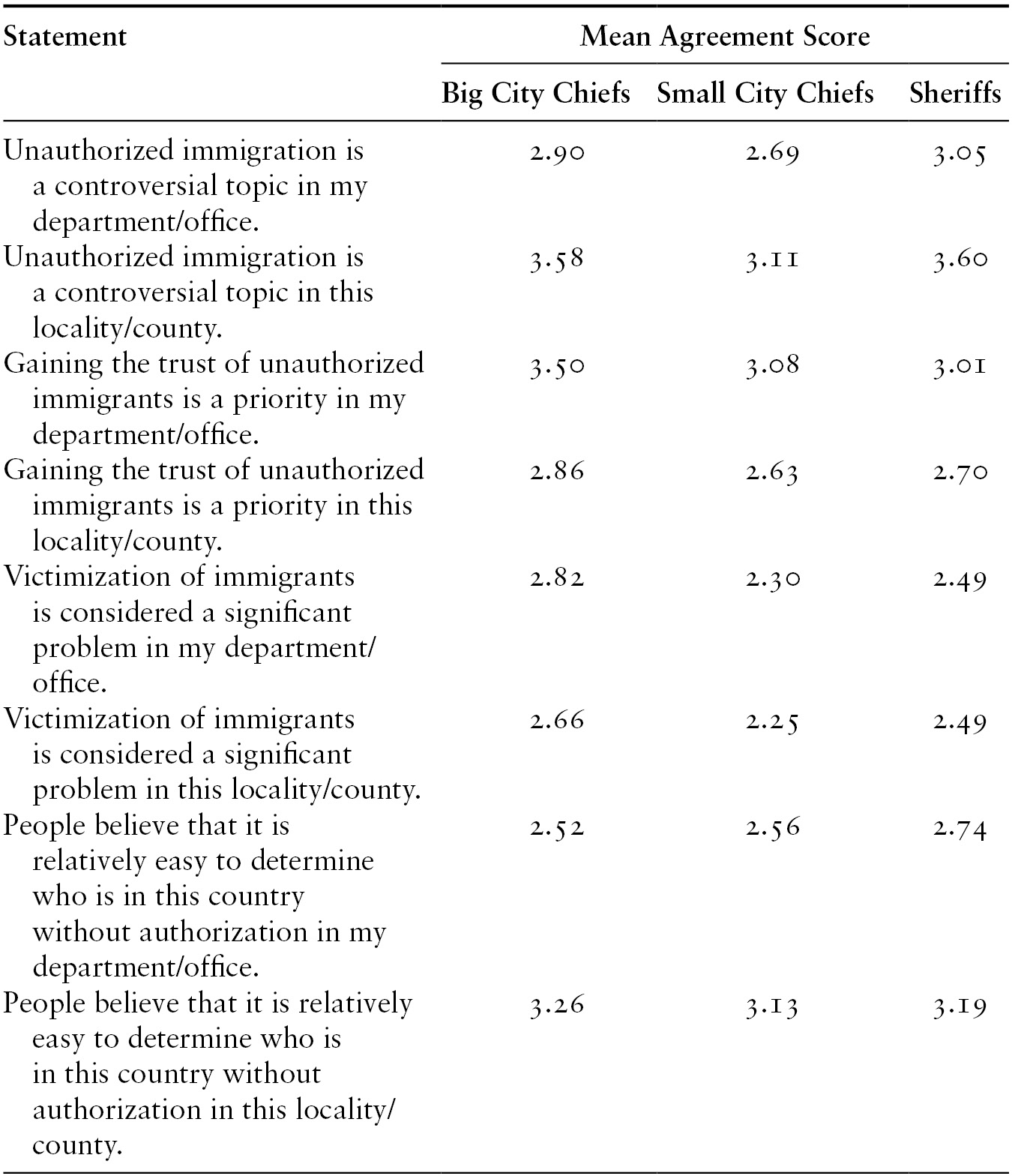
Notes: Cell entries are mean responses on a 1–5 scale, where 1 is “strongly disagree” and 5 is “strongly agree.” The sheriff sample is limited to full-service sheriff offices – those engaging both in patrol and in jailing.
Despite the differences suggested by the results in Table 13.1, most law enforcement executives report that local government is satisfied with their current position on enforcing immigration law. Only a small share of any of the three groups reported that their local officials want law enforcement to be more proactively engaged in immigration enforcement than it is now – 9 percent in large cities, 6 percent in small cities, 8 percent in counties. Three to 4 percent reported a desire on the part of local officials for less enforcement. Nor were most local governments deeply engaged with this issue, as Table 13.2 indicates.

Table 13.3 summarizes police chiefs’ and sheriffs’ responses to survey questions about their working relationships with the federal government related to immigration enforcement. The data indicate that law enforcement organizations of all types usually contact ICE when they are holding undocumented individuals suspected of criminal violations, and they do so at almost the same rate. Responsibilities connected with jails, however, set sheriffs apart. Many of them are in regular contact with federal officials to help them manage the arrestees whom they detain for federal immigration agents, and they are more likely to have ICE officers embedded in their units. A majority of sheriffs also receive partial or full federal reimbursement for the expense of detaining immigrants. What is most striking in terms of the rollout of Operation Secure Communities is that 39 percent of responding sheriffs with full-service responsibilities already had an agreement with ICE to help manage inmates who were presumed immigration violators.

Most of these data were gathered before Operation Secure Communities became operational, when federal immigration authorities played a relatively minor role in the day-to-day operation of most police departments. Even sheriff’s offices, which have been more closely aligned with federal immigration agencies because of their management of jails, had much less interaction with ICE than they will in the future.
Police executives, through their organizations, have complained that Secure Communities interferes with their commitment to community policing, that is, to activities designed to inspire trust among residents and to facilitate communication. We found a high level of commitment to community policing among survey respondents in all three groups. Nearly all report that officers attend neighborhood meetings and make visits to schools, churches, and other organizations. More than two-thirds have officers proficient in at least one foreign language. A large majority of municipal police departments have bike patrols and foot patrols and report that they cooperate with nongovernmental organizations. The lesser frequency in sheriff’s departments can probably be explained by their larger, often rural jurisdictions. At least half of all three groups share crime maps with interested citizens (often using the Internet). More than half of municipal departments responding hold public hearings and more than half of larger cities in the reporting group have community advisory boards. A significant percentage of all three groups also say they meet with immigrant advocacy organizations (big city chiefs: 49 percent, small city chiefs: 24 percent, sheriffs: 39 percent).
How do local law enforcement organizations balance immigration enforcement with these efforts to reach out to members of communities and inspire their trust? The survey provides no direct evidence of the balancing process that occurs, but it does suggest that the issue remains in flux. Table 13.4 contrasts policies against racial profiling, which are almost universally present, with written policies regarding enforcement of immigration laws, which are relatively rare in all three groups. This finding should be evaluated in terms of Charles Epp’s (Reference Epp2009) observation that law enforcement agencies have a distinct preference for bureaucratic responses, usually indicated by putting policies in writing. Our results thus suggest that, for the most part, a workable response to immigration enforcement has not yet been formulated at the local level. It appears that most law enforcement organizations are leaving the balancing of law and equities to individual officers. Training of officers regarding interactions with immigrants is available in less than half of the agencies in all three groups. Table 13.4 sets forth the responses to questions about immigration-enforcement policies internal to police agencies, the format of these policies, and the availability of training.
Table 13.4. Internal Policies of Police Departments and Sheriff Offices (in %)

Note: The sheriff sample is limited to full-service sheriff offices – those engaging both in patrol and in jailing.
These results indicate that law enforcement agencies already engage with federal immigration authorities in cases of serious criminal wrongdoing and incarcerated inmates. What remains unclear is how police officers handle minor infractions. The decision of whether to use discretion not to arrest remains mostly in the hands of individual officers, and they make these decisions usually without any written guidance from superiors or specialized training. Accountability for inappropriate arrests in the case of minor violations and hypersurveillance designed to produce arrests are problems that remain to be addressed. In the section that follows, we consider the role of external pressure and internal commitments in how law enforcement responds to low-level violations.
External Pressures, Internal Commitments, and Local Immigration Policing Strategies
Thus far we have described the situation that faces local law enforcement agencies as they consider how to respond to unauthorized immigrants in their communities. We have summarized broad patterns of activities and perceptions – including perceptions about legality – reported by our survey respondents. In this section we consider why responses vary. Using a series of bivariate analyses, we examine external pressures that might encourage agencies to enforce immigration law more aggressively, as well as internal characteristics that might tend to reduce these pressures. Although a comprehensive statistical treatment of the factors influencing local immigration policing is beyond the scope of this chapter, the bivariate relationships we present here suggest why immigration policing practices might vary across localities in systematic ways. As before, we look at all three sets of survey respondents – the large and small city police chiefs as well as county sheriffs in “full-service” sheriff offices.
We examine two measures of local immigration policing – one attitudinal and the other operational. The attitudinal measure is the respondent’s score on the statement (mentioned in Table 13.1) that “gaining the trust of unauthorized immigrants is a priority.” This variable is a Likert-type scale ranging from a score of 1 (strongly disagree) to 5 (strongly agree); thus, higher scores represent a stronger stated commitment to building trust with unauthorized residents. We label it the gaining trust score.
The operational measure attempts to determine how deeply local police are actually involved in detecting or apprehending unauthorized immigrants. We asked respondents, “Regardless of what officers [or deputies] are instructed to do or are supposed to do, what typically happens when officers in your department [or office] encounter individuals who might be unauthorized immigrants in each of the following situations?” The scenarios we offered represented a range of situations in which police might encounter unauthorized immigrants, ranging from almost incidental meetings to serious crimes. Our categories are, in order of declining severity, violent crime arrests, nonviolent crime arrests (assuming no prior criminal record), domestic violence arrests, detention for parole violations or failure to appear in court, traffic violation stops, interviews with possible victims of human trafficking, and – in a situation that creates a direct trade-off between immigration enforcement and the norms of community policing – interviews of crime victims or witnesses. For sheriffs we added an eighth scenario about jail bookings, reflecting their jailhouse responsibilities. The resulting variable, which we simply call the enforcement score, is a count of the number of situations in which the respondent indicated that officers would typically check the person’s immigration status, report the person to ICE, or both. The enforcement score can range from 0 to 7 for municipal police departments and from 0 to 8 for sheriff offices.
We hypothesized that when the external environment favored enforcement, the gaining trust score would tend to be lower, while the enforcement score would tend to be higher. We used three measures of the external political environment. The first was based on responses to a question about the position taken by the mayor and council or county governing board regarding unauthorized immigrants. See Table 13.2 for possible responses. Our bivariate relationships compare the law enforcement agencies in proenforcement localities (those desiring a “proactive role in deterring unauthorized immigration” and those that have developed or are developing “policies designed to encourage [law enforcement] to participate with federal authorities”) with those in which respondents gave an answer indicating that immigration enforcement was a lesser or nonpriority for local elected officials.3
The first two rows of Table 13.5 show average enforcement scores for localities whose governing authorities have embraced proenforcement policies in comparison to localities that have not. Among all three law enforcement groups, enforcement scores tend to be higher where the local governing body has a proenforcement policy. This result is statistically significant in all cases except sheriffs, where it is nearly so. We did not find the same strong pattern with respect to our gaining trust measure, as is evident from the top two rows of Table 13.6, which shows that the local government’s pro- or nonenforcement policy has no measurable impact on police department attitudes, and runs contrary to the expected direction in the case of sheriffs. In sum, the signals local politicians send on immigration enforcement appear to influence police operations regarding enforcement, but not attitudes toward gaining the trust of immigrants.
Table 13.5. Comparison of Mean Enforcement Scores in Various Types of City and County Police Agencies

a Mean score is significantly different from the mean score in the row below at p <.05.
Table 13.6. Comparison of Mean “Gaining Trust” Scores in Various Types of City and County Police Agencies

a Mean score is significantly different from the mean score in the row below at p <.05.
We continued this same approach at the level of state-level politics and legislation regarding immigrants. Only a few states have enacted omnibus legislation like that in Arizona and Alabama requiring local police to become engaged in enforcement of federal immigration laws. Quite a few, however, have enacted more narrowly crafted laws that place new restrictions on immigrants, especially those who are undocumented. Using information from the National Council of State Legislatures, which has reported annually on immigration-related legislation in the fifty states since 2005, we identified states that enacted (not merely considered) laws that clearly restrict or reduce the public benefits or privileges of all immigrants, or of broad categories of immigrants. Examples include laws that make unauthorized immigrants ineligible for in-state tuition at state colleges, require state judges to deny bail to certain immigrants in situations in which citizens would have been eligible for bail, or render unauthorized immigrants ineligible for state-funded employment training, health, or adult education programs. We measure state legislation using a slightly different time period in each case because of the varied timing of our surveys. For the large cities, for example, the “immigrant-restrictive state law” indicator variable covers the years 2005–7, because our survey began in late 2007.
Table 13.5 indicates that mean enforcement scores are higher in states with immigrant-restrictive policies. The differences are statistically significant for large cities and sheriff offices. Thus a “tough” state-level legislative climate for immigrants also seems to reverberate in enforcement operations at the local level. But once again, Table 13.6 tells a somewhat different story. There are no significant differences reflecting the level of state restrictiveness in the gaining trust score.
The final effort to measure the effect of political pressure on local law enforcement involves the local partisan atmosphere, specifically the degree of Republican identification in an area. We are aware that this is an imperfect measure, but public opinion surveys and journalistic coverage make it readily apparent that Republicans are considerably more oriented toward strict border security and tighter internal enforcement against immigration violations than Democrats or independents. Because city-level measures were not consistently available, we used county-level measures of partisan leanings for this analysis, specifically the percentage of the two-party (i.e., Republican plus Democratic) vote that was cast for Republican candidate George W. Bush in the hard-fought and relatively close 2004 presidential election.
Table 13.5 (rows 5 and 6) compares mean enforcement scores for cities and counties that were in the top quartile of Republican strength with those in the bottom quartile. We anticipate that the enforcement score will be higher in localities that are in heavily Republican areas, and this expectation is borne out by the data. The differences are particularly pronounced in large cities and in counties; in each of these sets of observations, there is a mean difference of approximately one full scenario in the frequency with which law enforcement agencies would check IDs or contact ICE. (Recall that there are seven possible scenarios for cities and eight for county sheriffs.) There is no similar pattern in the gaining trust variable, as Table 13.6 shows.
Turning now to the internal characteristics of local law enforcement agencies, do some configurations and commitments tend to insulate agencies from pressure to enforce? We hypothesized that police departments or sheriffs’ offices with a relatively insulated organizational culture or with leadership committed to the precepts of community policing might resist pressures to root out unauthorized immigrants. We used a battery of questions to assess commitment to community policing. The chiefs and sheriffs were asked how many of eleven community-policing techniques they used. In rows 7 and 8 of Tables 13.5 and 13.6, we compare responses from agencies in the top and bottom quartile in their use of community policing techniques. In this case, interestingly, the association is strong for the gaining trust score (Table 13.6), but not for the enforcement score (Table 13.5). That is, law enforcement agencies that place heavier emphasis on community policing tend to agree that gaining the trust of unauthorized immigrants is important; they appear to embrace not only specific techniques thought to promote public safety, but also a sense that unauthorized immigrants are members of the community among whom it is important to build trust. Yet this philosophy does not seem to inform their day-to-day enforcement approaches toward unauthorized immigrants.
We examined one final element that we thought might be associated with policing practices toward immigrants – the race or ethnicity of the police chief or sheriff. Chiefs or sheriffs who are minorities, particularly Latinos, might be more sensitized to the immigrant experience and more attuned to the risks of overaggressive enforcement. Because the nonwhite category was small, however, we combined Hispanic, Asian, black, or Native American into a single category.4 The last pair of rows in Tables 13.5 and 13.6 show the relevant comparisons. The gaining trust score, perhaps surprisingly, is unrelated to the race/ethnicity of the law enforcement executive; not so the enforcement score. Minority chiefs and sheriffs indicate considerably lower levels of immigration-enforcement activity in their agencies than their white counterparts do. The difference is more than 1.2 scenarios among both the large city chiefs and the sheriffs, with a somewhat more modest difference (about 0.8 scenarios) in the small city sample, where the very small share of minority chiefs (6 percent, compared to 13 percent of sheriffs and 17 percent of big city chiefs) renders this difference statistically insignificant. Thus, just as the immigration issue is often subtly, or not so subtly, racialized in the United States, the racial characteristics of local law enforcement leaders also appear to be linked to variations in immigration enforcement.5
The analysis of bivariate relationships in our three samples thus provides strong indications that the level of immigration enforcement undertaken by local police agencies varies systematically with external political pressures on these agencies. We also found that internal factors make a difference, particularly the race-ethnic identification of the police chief or sheriff. Yet these relationships contain some surprises. The tendency to prioritize gaining the trust of immigrants appears unrelated to external pressures and to the police executive’s ethnicity. Commitment to community policing, by contrast, is associated with prioritizing trust, but not with the level of enforcement.
Conclusion
American law enforcement agencies are geographically dispersed, and by tradition and structural design, they operate quite independently of each other. Our survey data suggests that law enforcement executives exercise a significant degree of independence even from local governing authorities. This is in part because they increasingly view policing as a distinct professional domain that must remain aloof from political oversight in order to operate fairly and efficiently and to maintain public confidence. The rapidly increasing engagement of federal immigration authorities with local agencies shows no sign of changing this pattern of independent operations.
Within each law enforcement agency, independence from direct supervision – that is, discretion at the street level – prevails and is considered a fundamental characteristic of police work. The individual officer must decide when enforcement is feasible and when it is desirable in light of the larger purposes of law, which include community welfare, social order, and public respect for the legitimacy of law. In the immigration context this means, at a minimum, refraining from pretextual arrests and racial profiling.
As things currently stand, the federal government has committed itself to a program that builds on local enforcement practice without safeguards to prevent end runs around standards of fairness and good police practice, and without clear policy guidance. Secure Communities, like its predecessor, the § 287(g) program, also ignores the long-standing commitment of most local police and sheriffs to community policing, which involves gaining the trust of local residents in order to get their assistance in creating safe neighborhoods. And yet the federal government shows no sign of taking responsibility for what happens as Operation Secure Communities gains traction throughout the land. The issue of legality in the enforcement of federal immigration law must be confronted, not just at the local level, where legality is known to play a role subordinate to other important (and perhaps not-so-important) values, but also at the federal level. Off the streets and in the administrative suites, the temptation must be avoided to subordinate legality to other enforcement priorities, such as achieving high numbers of deportations. Legality at this level involves creating and enforcing effective safeguards against abuses by newly empowered local agents. It is a form of regularity required by principles of democracy and its helpmate, the rule of law.
Future Research
Our research suggests that imposing federal immigration-enforcement responsibilities on local law enforcement officers complicates and compromises their role. Pressure to step beyond the bonds of legality is significant and gray areas in enforcement are inevitable. Nor can officers expect much policy guidance from their superiors, who are under conflicting pressures. It is therefore important to understand how frontline officers evaluate and prioritize among the various legal pressures and moral impulses they face when interacting with potentially unauthorized immigrants. This is a virtually unexplored area of research. Although the existing literature on police behavior contains important insights into how officers make decisions in law enforcement, the immigration-enforcement context is substantially different. Shifting federal policy initiatives, now including deferred action on removal of some younger immigrants, makes a particularly compelling case for research on how officers envision their role in immigration enforcement.
The interaction of immigrants with their local law enforcement agencies and the beliefs immigrants have about police and sheriffs are an equally important site for further research. While there is a growing body of interview evidence about the fears and experiences of unauthorized immigrants with local law enforcement, other systematic approaches are also needed. Focus groups and specialized surveys could help to fill this gap, providing insights in how immigrants construct notions of (il)legality, order, and community membership in the context of stepped up, but increasingly nuanced, federal enforcement policy.
A part of our research not presented here was a series of in-depth case studies of communities variously affected by immigration enforcement initiatives. They offer a tantalizing glimpse of the complexity of relationships between law enforcement and immigrants. We found that organizations and individuals representing unauthorized immigrants have developed strategies for survival that engage local law enforcement, suggesting a sort of ongoing negotiation at the street level between law enforcement and immigrant representatives. Local leadership, the history of a community’s relationship with immigrants, and the contribution of immigrants to the locality’s economic base appear relevant in explaining some of the differences we observed (Varsanyi et al. Reference Varsanyi, Lewis, Provine and Decker2012). Knowing more about these relationships and why they differ from place to place is another worthwhile area of investigation. This is a moving target for research as the winds of change in immigration policy blow at both the national and local level.
References
1 This study was funded with support from the National Science Foundation through grants SES-0819082 and SES-0921202, and an earlier seed grant from the North American Center for Transborder Studies at Arizona State University. Any opinions, findings, or recommendations expressed here are those of the authors and do not necessarily reflect the views of the National Science Foundation.
The large-city survey was sent to police chiefs (or the equivalent position) in all 452 U.S. communities that met the size threshold of sixty-five thousand in population and that have their own municipal police department; 237 usable responses were ultimately received (a 52 percent response rate). For the sheriff survey, we approached the 449 sheriffs working in counties that had at least twenty thousand residents and where at least 6 percent of the population was foreign born as of the 2000 U.S. Census. Of these, 254 (57 percent) completed the questionnaire. Given the huge number of small municipalities in the United States, for our small city survey we sampled 450 municipalities with populations under sixty-five thousand within these same counties. The sample was stratified to closely represent the percentage of the total small city population by U.S. Census region (e.g., Northeast, Midwest, South, and West) and by population-size categories. Ultimately, 237 of these completed the questionnaire (53 percent).
2 The survey format limited the source of perceptions – only police chiefs and sheriffs were surveyed. To broaden the research, the research team also conducted five in-depth case studies of jurisdictions selected on the basis of patterns of immigration enforcement that the survey data suggested are typical. Given space constraints, however, only findings from the survey data are included here. See also Varsanyi et al. (Reference Varsanyi, Lewis, Provine and Decker2012).
3 We group respondents who were “not sure” of whether their locality had any such policies with the localities that have nonenforcement policies or no policy.
4 Respondents indicating a bi- or multiracial/ethnic identity are grouped with the minority respondents, while those who identify only as “Other” are omitted from the comparison.
5 It is also possible that localities that have chosen a minority to fill the police chief or sheriff position might be more tolerant or open to diversity, which would militate against harsh policies toward unauthorized immigrants. Because our empirical ambitions in this chapter are rather modest and exploratory, we do not attempt to discern whether policing practices are “caused” by the race of the chief independent of community characteristics.


