

Part I Unity through law: inventing Europe's ‘integration programme’
In the realm of State structure, jurists are contained and dominated by political authorities, for at the present time there no longer exists any government, in any State, that is in the hands of specialists in law. In all modern countries power belongs to the representatives of public opinion, and it is they who enact laws and dominate jurists. In international organizations, we see jurists occupying a place that they have lost in the internal [national] order. States want to abandon the smallest possible number of sovereign prerogatives when they agree to be bound by the terms of treaties instituting international organizations. They therefore ask jurists to prepare complex magical formulas that will allow the organizations to function while preserving as many privileges as possible for the State structures … To implement these treaties, courts of justice, judicial committees and legal services are required, and they have characteristically flourished in international organizations … Their work is not finished, however, for they will subsequently incorporate themselves into the bodies of the monsters they have created.
The Rome Treaties were signed on 25 March 1957. At the time, nothing would have led one to think that a first transnational polity would grow up between the lines of this international agreement, attracting a multitude of political, administrative, economic, academic and other actors. The three Treaties (ECSC, EEC, Euratom) and the supplementary Convention regarding ‘certain institutions common to the European Communities’ represented a dense set of texts comprising respectively 100, 248, 225 and 8 articles. At the outset, this collection did not appear to offer a palette of immediately available opportunities, and even less a unique institutional system endowed with a specific rationale. The Treaties were the product of a heterogeneous set of diverse diplomatic forces and ideological influences, and were not immediately intelligible as an ‘institutional terrain’ creating relationships between and giving meaning to all the groups, institutions and policies that they brought into existence.2 Likewise, they did not in one fell swoop redraw the lines of the dominant beliefs and representations with regard to the spheres of political mediation, nor did they by themselves upset the organizational practices that determine the national echelon as the natural locus for the aggregation of interests.
There are several explanations for this. After decades of ritual commemoration of this ‘founding moment’, we have forgotten that the Rome Treaties were greeted with a certain degree of indifference. At the time, few professional groups, companies, labour and employer organizations, political parties or academic disciplines felt that the Treaties' provisions were relevant to them. It must be said that the road to the unification of Europe was already quite congested. The Europe embodied by the European Communities was just one of the forms of transnational political and economic cooperation that were springing up at the time, and that were debated in various forums simultaneously: the Greater Europe forged by the Organization for European Economic Co-operation, the proposed free-trade zones that would give birth to the European Free Trade Association, the Atlantic Europe of NATO and international institutions such as the GATT or the IMF. As noted by Laurent Warlouzet, ‘the principal organization of European economic cooperation in which the Six were engaged in 1955 was not the ECSC but the [Organization for European Economic Co-operation], and the latter handled the development of trade for all economic sectors in Western Europe with considerable success’.3 In other words, the EC institutional framework was just one of several European stages on which politicians and diplomats acted simultaneously. Of course, the importance of the Common Market is not to be under-estimated; but, although the dismantling of customs and tariff barriers was organized in detail by the Rome Treaties, the prospect of ‘market merger’ leading to harmonization of national economic and professional regulations was a distant and frankly improbable outcome. The signatories who gathered at the Capitoline Hill in March 1957 certainly had ambitions for the political unification of Europe. But, as the Rome Treaties were explicitly founded on the renunciation of the constitutional aims linked to the European Defence Community, from the start it was hard to mobilize the nebulous pan-European formation on this basis. Worse still, the adoption of the Treaties opened deep divisions within Europe, with a maximalist faction around the Italian socialist, Altiero Spinelli, who scathingly decried the ‘Common Market hoax’,4 and a pragmatic faction around Paul-Henri Spaak, who saw in the Treaties the seeds of a future political unity.5
It must be said that nothing in the Treaties hinted at the premises of a new political centre. As the Treaties pursued essentially economic goals, they ultimately left to one side the institutional system intended to organize the Common Market policies. Indeed, commentators pointed out that, in contrast to the Treaty of Paris, the EC institutions were relegated to the fifth and final section of the text. The low level of political content in the new Treaties is reflected in the expression ‘Common Market’ that was most often used to designate the Communities in ordinary parlance. The 1957 Rome Treaties contain far fewer declarations of values and statements of principles than the 1951 Paris Treaty. After the Coal and Steel Community – which the Paris Treaty pledged would create ‘the basis for a broader and deeper European Community among peoples long divided by bloody conflicts’ – came a European Economic Community with the ‘task’ first and foremost of ‘establishing a common market … and to promote throughout the European Community a harmonious development of economic activities’ (article 2). In practical terms, the ‘basis’ of this new European Community was merely a customs union (article 9). But there is something even worse. The singular form (the Rome Treaty) which is commonly used today notwithstanding, three international instruments were signed in Rome on 25 March 1957 – the EEC and Euratom Treaties, and a supplementary Convention. These documents mark the existence of three distinct entities on the institutional level, the ECSC, Euratom and the EEC. It was clear to all that the institutional characteristics of the two new Communities differed profoundly from those of the ECSC. This ensemble was held together by just one thread, the supplementary Convention to the Treaties, a spare document of eight articles that ensures no more than the coordination of the three Communities by setting up a couple of shared institutions, principally the Court of Justice and the Parliamentary Assembly, which as commentators pointed out would nevertheless have different competencies and act according to different procedures under the different Treaties. As it turned out, the absence of a unified institutional system in no way impeded the formation of several sector-specific networks that brought together business managers, emerging transnational interest groups, high-level civil servants and other experts representing the Member States.6 These nascent networks sought to flesh out the skeleton of the various chapters (transport, fisheries, agriculture, social policy, etc.) that made up the new Treaties. It remains, nonetheless, that at the outset no shared and cross-sectoral framework of understanding of ‘Europe’ was available. The Paris and Rome Treaties had created a set of cursorily defined institutions, an index of (possible) European public policies, and a list of objectives to attain, but hardly any ‘political system’.
The first part of this book explores the transformative process through which this rather inchoate set of Treaties, Communities, institutions and policies was turned into one ‘constitutional settlement’, thereby providing us with a unitary understanding of this emerging transnational polity. It traces the coalescence of a constellation of pan-European actors fostering a constitutional interpretation of the founding Treaties and building the Court's and the Commission's political capacity to defend this settlement, in a context in which the idea that EC law would be granted a constitutional function had little traction. It does so by tracking the conflicts that arose as ‘meaning’ and ‘scope’ were given to the Rome and Paris Treaties. The issue of the objective traits of these Treaties did not exist per se, but only insofar as it was brandished by a variety of advocates who seek to establish or consolidate a certain vision of Europe, in line with their personal trajectories and their social and professional positions. In other words, defining Europe's institutional platform was at one and the same time a debate over the relative legitimacy of different groups of actors (and their respective credentials, savoir-faire and techniques of government) in leading the emerging government of Europe. In this regard the Treaties are first of all a terrain for the confrontation between different definitions of ‘Europe’, its institutions, its operational dynamics and its modes of legitimization, and, in fine, between different types of competencies and credentials expected from the statesman of this emerging polity.7 On this stage are found, in addition to diplomats and political leaders, various sectoral communities and specialists wielding many sorts of expertise – economic, legal and others – all of whom have an interest in formalizing the ‘logic’ (intergovernmental or supranational) underlying the Treaties, and the political, economic and legal questions relevant to the functioning of the Treaties.8 As I track this competitive and collective process of definition of the authentic meaning of the Treaties, I am able to unearth the process whereby ‘Europe’ has emerged as a tangible political reality possessing its own rationale distinct from that of national and international political orders, and as a shared ‘institutional terrain’ for the variety of Treaties, institutions, and ultimately policies (competition, transport, free movement, the Common Agricultural Policy, etc.) that are implemented in its name. Chapter 1 follows EC institutions and policies as they start up in Luxembourg, Strasbourg and Brussels at the turn of the 1950s, tracing the institutional strategies of various Euro-implicated ‘entrepreneurs’ as they try to give life and meaning to the Rome Treaties. Chapter 2 analyzes the emergence, at the intersection of these European undertakings, of a transnational legal field whose ‘denizens’ act as ‘brokers’ for this transnational institutional sphere as it takes shape. This analysis of legal and judicial spaces as Europe's ‘weak field’ will enable readers to follow the arguments in Chapter 3 and see how a full-blown political metaphysics of Europe was built up, inscribing in one framework all the heterogeneous and sometimes conflicting groups, institutions and policies that make up the European entity.
1 ‘Techniciens et politiques dans l'organisation internationale’, in Politique et technique, Paris, PUF, 1958, p. 195. A renowned professor of international public law at the law faculty of the Sorbonne, Paul Reuter had been the legal adviser (jurisconsulte) of the French government in the drafting of the European Coal and Steel Community Treaty in 1951. Unless otherwise indicated, all quotations from non-English-language books and journals are translated by the author.
2 and , ‘The Institutional Terrain of the European Union’, in and (eds.), European Integration and Supranational Governance, Oxford, Oxford University Press, 1998, pp. 59–91.
3 , Le choix de la CEE par la France. Les débats économiques de Pierre Mendès-France à Charles de Gaulle (1955–1969), Paris, CHEFF, 2011.
4 , ‘La beffa del Mercato comune. 24 sett. 1957’, in L'Europa non cade dal cielo, Bologna, Il Mulino, 1960, pp. 282–7.
5 On the political rifts that divided the European Movement at the time the Rome Treaties were implemented, see , ‘The Movements for European Unity (1958–1972)’, in (ed.), Inside the European Community: Actors and Policies in the European Integration 1957–1972, Baden-Baden, Nomos, 2006, pp. 177–93.
6 and , ‘The Institutional Terrain of the European Union’, in and (eds.), European Integration and Supranational Governance, Oxford, Oxford University Press, 1998, pp. 59–91.
7 See the work of Antonin Cohen for a similar interpretation, in particular ‘Constitutionalism without Constitution: Transnational Elites between Political Mobilization and Legal Expertise (1940s–1960s)’, Law and Social Inquiry, 23(1), 2007, pp. 109–35.
8 The use of initial capital letters when referring to those treaties which set out EU primary rules (the Treaties of Paris and of Rome, the Single European Act, the Maastricht, Amsterdam and Nice Treaties, the Constitutional Treaty and the Lisbon Treaty) – a convention that we use throughout this text – is in itself indicative of the efforts made to mark the constitutional nature of Europe's fundamental rules.
1 Three Treaties, one Community: institution-building and legal strategies to unify Europe
The four institutions that were officially constituted on 1 January 1958 to carry out the creation of the Common Market – ‘an Assembly, a Council, a Commission, a Court of Justice’ as succinctly announced in article 4 of the EEC Treaty – were born in a somewhat hazy context. The precedent furnished by the ECSC provided a marker for exploring this terra incognita, but this parallel was not always adequate. The ‘supranationalism’ that was meant to be the specific hallmark of the institutional system created under the Paris Treaty was poorly regarded since the failure of the European Defence Community, so much so that it was close to being ‘subject to a ban’ at the turn of the 1950s.1 This notion did not seem readily transposable to the Rome Treaties under which the EEC Commission had no federal vocation, and not even the executive capacity held by the ECSC High Authority. In the absence of trail markers, the most seasoned constitutionalists and political scientists were disturbed by the institutions created under the Rome Treaties. The words used to describe them were certainly familiar, but the objects they referred to were only distantly related to the ‘things’ habitually designated by this same terminology in national spheres. The Court of Justice of the European Communities, for instance, appeared to be merely an ersatz of a supreme jurisdiction, and it was a far stretch from the European Parliamentary Assembly to the genuinely transnational parliamentary representation that some observers hoped to see emerge in Strasbourg. Even the Common Market, which this whole institutional apparatus was developed to serve, looked to be a figment of the imagination as long as the economies of the six Member States remained almost exclusively under national regulatory frameworks. The labels attributed to the new institutions that were set up in Brussels, Luxembourg and Strasbourg looked more like ‘pseudonyms’ than titles corresponding to established practice.2 The awkwardness was palpable: commentators felt obliged to have recourse to multiple rewordings (‘quasi-legislative’, ‘de facto Constitution’, etc.), quotation marks and neologisms in order to qualify the organs whose effective functions ‘are not to be found where the analogy with the State model would lead one to expect them’.3 For those accustomed to the classic architecture of national constitutional edifices, reading the Treaties caused a perpetual ‘mental refocusing’.4 Let us take a look: here the executive has two branches, the legislative function eludes the Parliament, no organ has an exclusive function, no function is exercised by just one organ, etc. The baroque features of these institutional arrangements could make the specialists almost dizzy. Could one really talk of ‘political control’ in the case of an essentially consultative European Parliamentary Assembly? Could an institution lacking any legislative function be called a parliament? Further still, how could the Commission truly be an ‘executive branch’ of the Communities when at the same time it shared a ‘legislative function’ with the Council of Ministers? What sort of court could have the attributions of an administrative court to oversee the legality of the acts of EC institutions, those of a constitutional court to ensure the balance of power between institutions, and those of an arbitral tribunal to resolve conflicts arising from the creation of the Common Market? The most sceptical critics denounced the optical illusion of political institutions that scarcely masked the forceful return of governments in the EC decision-making process; the most indulgent critics saw a confusion of roles characteristic of all international organizations. All, however, pointed out the dearth of traditional landmarks (separation of powers, specialized functions, parliamentarism, etc.) and the absence of criteria shared by the countries for making judgments, thus underscoring the many uncertainties that weighed on this phase of the implementation of EC institutions.5
Our subject here is this newborn Europe emerging from the Rome Treaties, this short historical sequence where these institutions can be seen as they take shape, trying out all sorts of pathways and identities. It is fair to say that at first not many political or social actors took an interest in the Rome Treaties, preferring the national echelon as the most suitable for achieving their objectives. Nonetheless, first microcosms of EC political, administrative, legal and market professionals began to form at the heart of the new institutions, or on their immediate periphery, with the intention of giving supranational flesh and bones to the words and fictions of the Treaties. These entrepreneurs of Europe, the first ‘tenants’ of these EC institutions, sought – for various reasons – to protect the institutions from the pressures of inter-State manoeuvres. Far from representing a single group or project (neo-liberal, federalist or otherwise), these enterprises took on features as varied as the national power structures from which they derived and the transnational networks (political, economic, legal, etc.) to which they were connected. They were members of parliament, businessmen, ambassadors, members of the college of European commissioners, high-level civil servants, often practitioners of legal professions, but also law professors, judges and auditors of the Court, or business lawyers. Their professional and institutional projects were relatively independent of each other, and sometimes even contradictory, reflecting the diversity of the social spaces in which they unfolded. From an administrative point of view, the aim was to cast the foundations of a genuinely supranational bureaucracy that would be a structure embodying Europe's ‘general interest’, rather than just an international secretariat charged with the technical aspects of setting up common markets. In a more political outlook, the objective was to establish the basis of an authentic European parliamentary system. From a judicial perspective, it was the truly ‘jurisdictional’ character of the ECJ that was at stake, a court that many saw as no more than an instance for international arbitration. Economically speaking, the issue was to breathe life into the ambitions for a common market, with Brussels' institutions as the guarantor and regulator of open trade and free competition.
As I follow the emergence of these institutional strategies as they try to live up to the expectations created by the fictions present in the Treaties, we see a generation of entrepreneurs of Europe; they did not have to imagine, as did the post-Second World War pan-European advocates, the possible outlines or ideals of a European project, embodied in a corresponding number of draft Constitutions, assembly resolutions and other declarations of intent, but henceforth had to bring institutions and policies into concrete existence. In this respect, everything remained to be invented: as set forth in the Rome Treaties, the roles, the scope and the rank of the various institutions were quite vague. Due to this lack of precision regarding the rules of conduct for ‘policies’ that were essentially stated in terms of objectives, and the relatively indeterminate operational boundaries of each of the ‘institutions’, the early years of existence of the European Communities had a strong agonistic dimension as each institutional group had to mark its status and define its missions.
In the absence of a unanimously recognized scope of action, and lacking leverage to act within the Member States themselves, the success of these various institution-building strategies would play out to a large extent on the only terrain that gave them legitimacy when confronting diplomats and ministers – the terrain of the Treaties themselves. The Rome Treaties thus became the central object of value for a group of judges, commissioners, members of parliament, entrepreneurs and European business lawyers for whom this shared paper foundation anchored and gave support to their claims of competency. Thus these initial entrepreneurs of Europe were led to produce a set of in-house legal and political doctrines (narratives, rationalizations, theories, etc.) that would interpret the European Treaties as providing them with a degree of autonomy, even if relative. In this context, these first legal and political discourses and theories on the European Treaties were not esoteric discourses produced by actors concerned exclusively with the legal stakes, but constituted a fundamental lever for a highly diverse set of institutional undertakings. This study follows the deployment of lay legal theories of Europe both within and at the margins of the Commission, the Parliamentary Assembly, the ECJ and the Common Market.
Claiming objectivity: the European Commission and the guardianship of the Treaties
If there is one opinion shared by the first commentators on the Rome Treaties, it is the view that these new texts sacrificed to a large extent the driving role of the EC Executives that was so cherished by Jean Monnet. Citing the failure of the ECSC, the French delegation to the negotiations for the Rome Treaties had been careful to avoid constructing two new Executives – the Commission of the EEC and the Commission of Euratom – according to the supranational model of a High Authority endowed with significant decision-making power. Accordingly, the EEC administrative services that took up their quarters at the intersection of the Avenue de la Joyeuse Entrée and the Rue de la Loi in Brussels on 1 January 1958 had a low profile. An ‘Executive’ without executive powers, an ‘administration’ without enforcement powers, the EEC Commission had very little splendour. Its first president, Walter Hallstein, had this laconic comment: ‘[I]t is not the power of decision that essentially characterizes the role of the Commission in the institutional system of the treaty…’.6 But this was not all. Not only was this emerging European bureaucracy weak, but it was fragmented into three separate entities. In practice, three ‘EC Executives’ – the High Authority, the EEC Commission and the Euratom Commission – now coexisted. Furthermore, they were geographically dispersed, the High Authority remaining in Luxembourg while the other two set up in Brussels, the provisional capital of the new Communities. Without shared administrative services (with a few exceptions) or a unified status for civil servants (the first dating from 1968), there were very few institutional ties that could ensure coordination across the three Communities in the decade that followed the adoption of the Rome Treaties (up to the merger of the three Executives on 1 July 1967). Adding to the confusion, a muted rivalry smouldered between the ECSC High Authority in Luxembourg and the emerging Brussels pole of the EEC Commission and Euratom, each seat claiming to embody the true EC ambition.7 While the formation of a transnational bureaucracy thus seemed greatly jeopardized, the political path towards a supranational political Europe did not appear to be any more practicable. Following a diplomatic line already taken during the negotiations for the Rome Treaties, the French government would repeatedly refuse to see these Executives as anything other than ‘international secretariats’ in charge simply of coordination and technical implementation. This was strikingly confirmed by the French Fouchet projects of 1961–2 that envisaged the creation of a fourth EC, which for the government led by Michel Debré would be a fully “inter-governmental” one.8
Impossible administration, improbable government, the EEC Commission needed to invent a new role for itself. In the following section, I track how a novel institutional pathway was invented. Instrumental to this invention was the encounter between an EEC Commission president who was an ardent advocate of a constitutional reading of the Rome Treaties, and a Legal Service that tasked itself with the mission of carrying on a ‘legal policing’ of their rightful implementation. Taking advantage of the then strong osmosis between the ‘administration’ level (the directors general) and the ‘political’ level (the commissioners),9 these European entrepreneurs founded the Commission's institutional identity on a claim of ‘supplement of objectivity’10vis-à-vis Member States enmeshed in the partisan politics and in diplomatic considerations. This mission of objectivity – watching over the European general interest – was rooted in the fictional grounds of a ‘Constitution-Treaty’, a unified and objective standard, independent of the Member States. Thereby, these first European entrepreneurs devised the equation of a Commission that affirmed its leadership on the playing field of law.
The constitutional doctrine of Professor Hallstein
This propensity to define the Commission's mission in terms of objectivity and law is undoubtedly in part related to the profile of the first commissioners and top civil servants of the three EC Executives (ECSC, Euratom, EEC). In both categories, the appointees were in most cases law graduates, and indeed often directly experienced in legal professions.11 Their preference for law was emblematically personified by the first president of the EEC Commission, Professor Walter Hallstein, a zealous legal theoretician. Indeed, the former law professor and vice-chancellor of the University of Frankfurt, who purportedly made a point of using the title of professor in all circumstances, saw the president's role as an intellectual magisterium, to the point that the German press often reproached him for his ‘professorial attitude’ and ‘juridical turn of mind’.12 In the course of his mandate, he continued to lecture and to attend conferences at American and European universities: he was present, among others, at the congress of the International Law Association in Hamburg in August 1960, at Harvard University in 1962, at Padua University in March 1962, at the Max-Planck Institute in July 1963, at the Académie des sciences morales et politiques in Paris in 1963, at the Royal Institute of International Affairs in London in December 1964, at the British Institute of International and Comparative Law in March 1965, at the Institut d'études juridiques européennes at the University of Liège in June 1965, etc. It is true that Walter Hallstein had a number of academic titles to his credit. Before his surprise nomination as head of the German delegation charged with negotiating the Treaty of Paris in 1950, he had followed an exclusively academic career, from the University of Berlin where he studied international private law, to the University of Frankfurt from 1941 onwards, with stints at the University of Rostock where he taught from 1931 to 1941 and at Georgetown University (Washington DC) in 1948–9.13 Far from severing his ties with German law faculties, Hallstein's entry into politics as the head of the Foreign Affairs Secretariat (the Auswärtiges Amt) of the Federal Republic of Germany (1952–7) led him to draw on law, and particularly on German legal doctrine, as the preferred terrain for his political undertakings. Hallstein's commitment to the Law as both an ideal and an instrument was well known: Ernst Steindorff, his former university assistant, would expound this in the following way: ‘[I]f the jurist Hallstein speaks of the EC as a creation of the law and of legality, it is because he sees the law not only as a means to realize the ideal of the Law, but also as a tool for harmonizing the law for all the people living in the European states’.14 Even more explicitly, over his years at the Auswärtiges Amt, Hallstein helped define the ‘legal doctrine’ of German diplomacy, exalting the constitutionality of the European commitments made by the Federal Republic of Germany that had been born a few months earlier under the sign of a limited sovereignty.
The Auswärtiges Amt and its Jurist-diplomats' constitutional doctrine
When it came to defining European Treaties as constitutional, Hallstein could call upon a handful of jurist-diplomats who were active both in the European talks that marked the 1950s and in the main German academic journals devoted to law. Among these were:
Carl Friedrich Ophüls, professor of international public law, who had been legal adviser to the German delegation to the ECSC negotiations, then to the European Defence Community, and who headed the ‘Europe’ department at the Foreign Affairs Secretariat throughout the 1950s before he became the first ambassador of the Federal Republic of Germany to the Communities in 1958, thus accompanying Walter Hallstein to Brussels;
Karl Carstens, who joined the Foreign Affairs Secretariat in 1954 before becoming a law professor in 1960, then Secretary of State for Foreign Affairs between 1960 and 1964, thereby pursuing a long political and academic career that led him to the presidency of the Federal Republic of Germany (1979–84);
Wilhelm Grewe, also a professor of international law, legal adviser to Konrad Adenauer, subsequently head of legal affairs, and later political affairs, at the Auswärtiges Amt during the 1950s, and finally the German ambassador to Washington in 1962, and then to NATO.
Other members of this group were former colleagues and assistants at the Frankfurt law school, including:
Ernst Steindorff, who had previously been Hallstein's assistant and his intern in 1950–1 during the Paris Treaty negotiations, and who was at the time a professor and also legal adviser to the European Commission and first president of the German chapter of the International Federation for European Law (Fédération internationale pour le droit européen, or FIDE; see below);
Hermann Mösler, international law professor, Steindorff's colleague at the University of Frankfurt, who headed the Legal Service of the Auswärtiges Amt from 1949 to 1954 before being appointed by the German government to the European Court of Human Rights in 1959, and then to the International Court of Justice in 1976.15
Collectively, they upheld the ‘constitutional’ character of the entire set of European commitments contracted during the 1950s by the Federal Republic of Germany, meaning by this that they ranked above federal law and that they were directly applicable. This was already the case at the signing of the European Convention on Human Rights in 1950 when the German delegation, led by Walter Hallstein, invoked the ‘constitutional’ nature of the Convention.16 It was again the case in the days following the signature of the ECSC Treaty, when these jurist-diplomats published articles in the German law journals in support of the idea that a ‘European structure of a constitutional nature’ had been born – running counter to dominant German legal scholarship.17 While they would disperse after the signing of the Rome Treaties, becoming professors, high-level civil servants, diplomats, judges or politicians, the group of jurist-diplomats formed at the Auswärtiges Amt maintained close ties with president Hallstein, as is attested by their contributions to the Festschrift that honoured Hallstein in 1966 on the occasion of his sixty-fifth birthday.18 In the various positions that they occupied at the start of the 1950s, they continued to espouse in chorus the constitutionalist interpretation, extending it to the Rome Treaties.
In his new functions at the head of the EEC Commission, Professor Dr Juri. Walter Hallstein reiterated the constitutional doctrine forged by German diplomats during the 1950s, extolling this time not the imperious nature of the international commitments of the Federal Republic of Germany that aspired to full membership in the ‘international community’, but rather the figure of a Commission invested with a mission of guardian of a new objective constitutional order created by European Treaties. The intention of Hallstein was certainly not exclusively legal: his speeches show a constant preoccupation with the political character of the Rome Treaties: ‘[T]he existing European Communities are called “economic”. But the work of the European Communities is not economic. It does not integrate the decisions of producers, employers and workers, farmers, bankers and shopkeepers. It is the economic policies, the social policies of the States that are integrated and merged … Our Communities are thus themselves already the beginnings of a real and full “political Union”’.19 But this ‘political union in the area of the economy’20 is grounded in an objective and incontrovertible source, namely, the constitutional character of the Rome Treaties: ‘[T]he Communities resemble a constitutional construction much more than a classic sort of international organization, because their objectives are to be fulfilled by institutions endowed with sovereign rights’.21 In that framework, the political authority of the European Commission would derive from its constitutional role as guardian of Europe's general interest. Similarly, the objective mission of the ‘German-style’ of bureaucracy – permanent, hierarchical and specialized22 – that Walter Hallstein and his entourage intended to build in Brussels was deeply grounded on the belief that Europe itself was now an objective constitutional order of its own.
A ministry of law
This ‘Hallstein doctrine’ was strongly relayed in the ambitions displayed by the Legal Service under the aegis of its director, Michel Gaudet, a department that was in a pivotal position in the heart of the newborn EC administration.23 Nothing predisposed Gaudet, a jurist steeped in State law, to embrace the supranational doctrine of the German law professor. Son of a lawyer working before the Conseil d'État, a graduate of the Paris Law school and the École libre des sciences politiques, appointed to the French Conseil d'État in 1942, Gaudet followed in the footsteps of his colleagues at the Conseil d'État, alternating positions in the Conseil as auditeur and the maître de requêtes, and positions in government service as legal adviser to the French protectorate in Morocco (1945) and as cabinet secretary to the Secretary of State for the Economy and Finances, Léon Tinguy du Pouët (1946–7). His appointment as head of the Legal Service of the High Authority, upon the recommendation of Maurice Lagrange, his colleague at the Conseil d'État and a collaborator of Jean Monnet, are therefore essentially a continuation of a rather classic career of serviteur d'État. However, Michel Gaudet progressively made a name for himself in Luxembourg as a guardian and promoter of the ‘supranational spirit’ of the Communities, in the course of a ‘conversion’ process that has been efficiently described by Julie Bailleux.24 As she explains, Michel Gaudet became, immediately upon his arrival in Luxembourg in 1952, part of a small circle of very close collaborators of Jean Monnet, thereby acquiring a role lawyers rarely play in international organizations. Undoubtedly helped by the initial organization of the High Authority as a ‘task administration’ (administration de mission) where the members of the ECSC Executive and high-level civil servants worked closely together in ‘working groups’,25 Michel Gaudet was directly and continuously associated with the decisions of the High Authority college.26 After the departure of Monnet (June 1955) and of many of his closest collaborators (François Duchêne, Max Kohnstamm and Pierre Uri), Michel Gaudet remained one of the last, if not the last, representative of Monnet's legacy within the ECSC institutions, all the more so as he had maintained a very strong relationship to Jean Monnet during these years. His designation by the new president of the High Authority, René Mayer, another former colleague of his from the Conseil d'État, as the institution's representative in the group assigned to draft the Rome Treaties, marked another step in his embracing the role of a staunch promoter of pan-European ideals.27
There is much evidence, however, that this central position of the High Authority's Legal Service was threatened as two new European Communities were created. At that time still director of that Legal Service, Michel Gaudet immediately saw the dangers inherent in the splitting up of the Communities. In a very enlightening epistolary exchange with a New York lawyer, Michel Gaudet expressed his fears. On 31 December 1957, he wrote:
I fear that the establishment of the two new Communities will in fact delay, if not stop, that progressive evolution of our Court towards a federal Court … Will the judges confirmed the invoked opposition between the Treaties, thus weakening the progress towards United Europe? … At present, I can think of only one way for the Court to avoid the danger described above. That is to ensure a coordination between the three Treaties by the three Commissions or Authority themselves before they fix their positions before the Court (and this is also true for their positions before the Assembly or the Council of Ministers). A few divisions, and at any rate, the legal one, must be put in common by the High Authority and the new Communities with a view to ensuring coherence in the interpretation of the three Treaties.28
In the weeks following the entry into force of the Rome Treaties on 1 January 1958, as the organizational charts of the new Euratom and EEC Commissions were being drawn up, hastily but sheltered from government influence,29 Gaudet addressed many notes to the colleges of the three Executives. He directed the colleges' attention to the risks of ‘sterile divergence’ and ‘useless and prejudicial opposition’ in the interpretation of the three Treaties as three separate legal units with distinct interests and potentially competing purposes.30 In his mind, there was no doubt that such a division would only weaken the Legal Service, whose authority ‘in-house’ rested precisely on their capacity to invoke the unequivocal and objective legal character of the Treaties. Gaudet's Note sur l'organisation d'un service juridique commun aux trois Communautés, submitted in late January 1958, constitutes a tightly formulated argument in favour of the creation of a ‘single corps of jurists’ endowed externally with the exclusive right to represent the three Executives before the ECJ, and internally with complete control over the interpretation of the law when queried by the directorates general.31 A few months later, in October 1958, in an in-house memo, Gaudet further insisted that ‘all documents’ submitted to one of the three colleges should first go through the Legal Service, in the name of the necessary consistency in interpreting the Treaties.32 This project was ambitious in scope, but it had three vital supporters among the EEC commissioners: Walter Hallstein, Hans von der Groeben and Jean Rey, respectively president of the Commission, commissioner in charge of talks with his counterparts at the EEC and at Euratom on the subject of setting up joint services across the three Communities, and commissioner in charge of the ‘Legal Group’. All three held PhDs in law and believed the Commission to be ‘by its very nature an état-major of economists and jurists’.33 In fact, the idea of a joint Legal Service shared between the three Communities was rapidly accepted by the Communities and the members of the High Authority.34 In lieu of the three Legal Services initially envisioned (or, worse still, myriad ‘mini legal services’ under each DG), a single body of jurists was thus constituted as a counterweight to the three-headed organization of the Communities. Pleading for the necessary ‘independence’ required for an objective analysis of the Treaties,35 the Legal Service was in addition placed in an ‘extra hierarchical’ position outside the administrative structure, answering directly to the commissioners, and not to the secretariat general, as is usually the case in international organizations. In this way, the Legal Service escaped the particularly rigid hierarchical organization that was coming into existence at the same time. What is more, the Legal Service used this cross-sector and generalist position to legitimize its role in framing and reining in the ambitions of the various directorates general. Thus the requisite ‘consistency of interpretation of the Treaties and in the defence of the Executives before the Court’ meant that the Legal Service would have to be ‘consulted on all issues of interpretation of the Treaties, on all drafts of legal instruments for the Executives, and in particular on proposals to be submitted to the EEC/EAEC’.36 This ambitious plan was not a dead letter, if we are to judge by the testimonials that describe Michel Gaudet as an ‘11th commissioner’.37 Gaudet reports: ‘In my experience of the sessions of the High Authority, and later of the EEC Commission in the 1960s, the Legal Service was present at all the meetings of the executive … We were constantly asked … “Does the Treaty allow this?”, “Can the Treaty be interpreted in this way?”’.38 The Legal Service was the only joint administrative service from 1958 until the merger of the EC Executives in 1967 (with the exception of the information department and of the statistics office),39 and established itself as one of the principal sources of research regarding the structure of the European Communities and the nature of the Rome Treaties. This was all the easier as the Service had few or no competitors, as the Council of Ministers and the European Parliamentary Assembly had at best just a handful of legal advisers. Only the secretariat general of the EEC Commission, under the lead of Guy Mollet's former cabinet secretary Émile Noël, appeared to be in a position to counter Michel Gaudet's ambitions. But, in addition to the fact that the two directors ‘were emperors who treated each other with circumspection … and who knew that they had to treat each other with circumspection’,40 up until the merger of the three Executives Émile Noël had only a partial vision of the Communities, that of the EEC Commission.
This non-standard and extra-structural department could also count upon a team of ‘State jurists’ who were well versed in administrative matters. In a context in which the recruiting process in the European Communities was in most cases still exempt from the rules of competitive entry examinations, thus giving the department heads broad freedom to choose their colleagues, in hiring their staff over the years Michel Gaudet and his deputy director Robert Krawielicki tended to prefer State jurists who had served in government administrations and/or international organizations. Both men had spent nearly all their previous careers in public service – the French Conseil d'État for Gaudet, and the Federal Republic of Germany's Justice Ministry for Krawielicki – and they left only meagre pickings for legal practitioners, fiscal advisers or business jurists, professions that were directly qualified to help set up the Common Market. Most of the young recruits in the Legal Service were men who had in common their background in public service, either national (academics, magistrates, legal advisers in ministries, etc.) or international (judges at the Saar International Tribunal, auditors at the ECJ, etc.).41 At the crossroads of the common markets and supported by jurists disposed to think of Europe as a matter of public law, from the outset the joint Legal Service built its doctrine on the promotion of the fundamental unity of European law spanning the three EC Treaties. Displaying the legal unity of the Treaties was in fact an obsession at the Legal Service. Indeed, Michel Gaudet had already invoked, as the basis of his call for a single Legal Service, the need for ‘a unity of spirit in the interpretation of the Treaties and in the effort to construct the European edifices’, a unity that he saw as ‘the most appropriate method when the task at hand is to create one body of law common to six countries whose traditions are quite different’.42 Accordingly, Gaudet sought to bridge the gaps between the ECSC and EEC Treaties even though they differed greatly. The ‘institutional relationships between the independent Executives on the one hand, and the Councils, the Assembly or the Court on the other hand’, ‘the determination of the international legal personality of the European Communities and of their rights and obligations on the international scene’, and ‘the legal issues related to their employees' status’ – all these are ‘fundamental legal questions common to the three Executives [which] must be addressed jointly from the outset’.43 Likewise, the Legal Service took it upon itself to promote ways to achieve the coordination, harmonization and, in fine, the unification of statutes, functions and Treaties. For instance, it called for the merger of the Communities in the early 1960s, and pleaded for adoption ‘by the three administrations … of a single corps of civil servants for the Communities’.44 Thus, even though they grappled with a set of sectoral issues (nuclear power, economics, agriculture, anti-competitive cartels and monopolies, etc.), the members of the Legal Service worked to build ‘Europe’ as a single institutional entity, whose intrinsic nature was legal even before it was economic. As jurists of the res publica faced with the construction of a common market, in the course of internal consultations, briefs to the Court and scholarly articles, they were keen on building a system of ‘Institutions’ with a capital ‘I’ that Michel Gaudet never failed to insert. When Gaudet asked the rhetorical question, ‘Can't the Communities just “do business” and leave out all institutional stuff? Perhaps a more matter-of-fact approach might spare all the talk – including my own – on organization, transfer of powers and democracy, which after all is not a necessary contribution to the success of the common market!’, he quickly added that ‘this learned audience [of legal scholars] knows better than that. To you a common market means much more than a mere trade agreement … This complex job cannot be accomplished without proper Institutions … indispensable for establishing, ruling and operating a common market’. And, if the institutional logic embraces more than just the day-to-day management of the common markets, it is because it is anchored in ‘the more noble and more essential task [of] completing and implementing EC law as it stands in the Treaties’.45 The mission of ‘overseeing the application of the provisions of the present Treaty and the dispositions taken by the institutions on the basis of this Treaty’ (EEC Treaty, article 155) became, in the notes compiled by the Legal Service, a veritable ‘policing’ of the Treaties in the name of Europe's general interest, thereby taking the EC Executives well beyond the task of organizing common markets.46 In this framework, the identification of ‘presumed breaches’ that the Legal Service could then refer to the ECJ became an essential lever of the Executives' authority, consolidating by law their role as guardians of the Treaties. The implantation of a Legal Service, placed at the intersection of the EC Executives and granting it the role of monitoring through law the implementation of the Treaties was therefore instrumental to affirming their political status as an objective spokesmen of Europe's ‘general interest’ – a notion incidentally mentioned in the European Treaties but one that had remained vague and undefined until then.47
Europe's political laboratory: the European Parliament and the building of a collective expertise in institutional reform
There is little outward splendour about the Strasbourg Assembly. It sits in a building borrowed from the Council of Europe; it is served by ushers borrowed from the parliaments of the six Member States still wearing their national uniforms; it even had to christen itself, having been born with the bland name of “Assembly”. Its administrative services located in Luxembourg migrate to Strasbourg at session time. Its standing committees are peripatetic – sitting in Strasbourg, Luxembourg or Brussels. Its legal powers are limited.48
This is how the European Parliament appeared to a visitor at its sessions in 1959. Endowed with essentially consultative powers, relegated to the margins of the Commission–Council duopoly where the bulk of the Communities' legislative power was concentrated, the European Parliamentary Assembly was a pale copy of national parliaments. It is true that the Parliamentary Assembly differed from other consultative European assemblies (the Council of Europe, the Western European Union, NATO) in that it possessed an embryonic parliamentary control of the Executives, via its power to adopt a vote of no-confidence in the college of commissioners. But, in the framework of the Rome Treaties, it was the Council of Ministers that was the principal seat of the ‘legislative power’, and the parliamentary censure was largely illusory. This ambiguity was reflected in the qualification of this entity, that the Treaties did not want to name as an authentic ‘Parliament’.49 One of the most attentive American observers at the European Communities saw this assembly as a cross between a national parliament and an international assembly like the General Assembly of the United Nations, adding that ‘its powers over the budget are inferior to those of the United Nations Assembly which determines the budget of the organization’.50 This initial uncertainty was compounded by a ‘fundamental difficulty’. In the words of Pierre-Henri Teitgen, one of the figureheads of this early Euro-parliamentarism, how can one ‘bring into existence and develop a political control regarding a specialized action such as that of the EC?’51 This equation was not fundamentally altered by the signing of the Rome Treaties: the new members of parliament were concerned about the impossible political future of an ‘Assembly dedicated to such technical, scientific and economic work’, and they exhorted each other to escape from this trap of technicity. ‘When we study our tables, when we draw up diagrams and pose financial problems, let us be careful not to neglect human feelings’, was the plea of an Italian Christian-Democrat member of parliament.52 How could a political institution be created when the subject-matter was technical and economic through and through?
A solution to this problem was proposed by a group of members of the European Parliament already quite seasoned in the workings of transnational political venues (pan-European congresses, European parliaments, diplomatic delegations, etc.) as well as closely tied to European law schools (Pierre-Henri Teitgen, Fernand Dehousse, Marinus van der Goes van Naters, among others). Although they would often differ in political affiliations, they all converged in turning institutional-legal expertise into one privileged pathway when it came to asserting Parliament's political utility. This subject was of prime importance, judging by the fact that reforming Europe's institutional architecture was a preoccupation of the chanceries throughout the decade following the signing of the Rome Treaties. From the controversies over the 1960 French proposal for a ‘Communauté politique’, better known as the ‘Fouchet plan’, and the negotiations for the merger of the three Communities (that would eventually end up with the 1965 Merger Treaty that essentially merged the three Executives into one European Commission) to the March 1965 Hallstein proposals, revision of the Treaties was a subject of nearly uninterrupted discussion up to the ‘empty chair’ crisis.53 Armed with the many recognized legal experts in its ranks, partly law academy and partly an international law commission, the European Parliamentary Assembly came into its own as a laboratory for institutional thinking.
The politicians of the law
The institutional pathway thus taken by the European Parliamentary Assembly leads us to evoke the premises of a first transnational politics, in which the politicians of the law are a key figure. With the creation of the Consultative Assembly of the Council of Europe in August 1949, parliamentary assemblies took their place alongside diplomatic conferences, technical secretariats and courts of justice in the basic institutional toolkit of European organizations: assemblies were created under the ECSC in 1952, the Nordic Council in 1953, the West European Union in 1954, NATO in 1955 and last but not least in the framework of the Benelux countries in 1957. From plenary sessions to the working groups of various commissions and committees, a full palette of transnational parliamentary activity began to take form. A British member of parliament reported that ‘a member of a large country will be a member of three committees, possibly chairman of one, and a member of his political group. Between September 1957 and the first three months of 1959, he attended a total of 69 meetings and spent 191 days outside his own country on European work’.54 The work load grew very quickly at the new European Parliamentary Assembly born of the Rome Treaties, occupying members' schedules to the extent that it became difficult to belong to more than one assembly simultaneously. This was all the more true now that this supranational politics not only took hold in the parliamentary setting, but was paralleled in the nebulous supranational politics of the European Movement. As noted by one observer, ‘it is not only the formal attendance at plenary or bureau meetings, or committee sessions which counts, but also the necessary informal meetings, the need to study documents, often acting as rapporteur to a committee and in some cases the wish to keep contacts with the European Movement, in order to prevent the growth of a rift between the “official” and the “non-official” forces working for Western European federation’.55
In academic colloquia and in European Conventions, in parliamentary committees and in general meetings, a small group of professionals of this emerging transnational politics came into existence. It is worth noting that the major political figures in Europe, from Winston Churchill to Edouard Herriot, who had initially shown a strong presence at the podium of the Council of Europe Consultative Assembly, gradually deserted these venues, either through absenteeism or by not seeking to renew their mandate. Their place was taken by parliamentarians who had less prominent political profiles, but who often possessed a technical expertise in European matters that came into its own in the sectoral commissions of the European parliamentary assemblies, to the point that Fernand Dehousse worried about ‘national representations that are less and less representative’.56 This disengagement fostered first and foremost the emergence of jurist-politicians of law at the front ranks of Euro-parlimentarism. By their presence in universities where they held chairs, at the numerous conferences in which they participated and by the doctrinal articles that they continued to write,57 as in the first party-political networks in Europe,58 they set the initial framework for this new transnational parliamentary activity. As has been noted by Julien Weisbein, the sociability that took root in the pan-European political nebula ‘is defined more by status and quality (top civil servant, expert, intellectual, politician, etc.) than by their numbers or by the population they represent’, so that ‘the action takes place in a discreet fashion similar to that found in the diplomatic paradigm (production of expert knowledge, more or less informal negotiations, etc.)’.59 Naturally, not all of the 142 parliamentarians who gathered for the inaugural session of the European Parliamentary Assembly on 19 March 1958 were equally capable of excelling in specific types of politics. The politicians of the law were particularly well equipped for this game involving expertise and political representation. A virtuous dynamic of accumulation existed between these two poles, as shown by Antonin Cohen when he indicates that political centrality, as measured by the number of European parliamentary mandates occupied, would increase with the amount of legal capital.60 This is particularly true for the French professor of public law and co-founder of the Mouvement républicain populaire, Pierre-Henri Teitgen, for the Dutch socialist lawyer and Doctor of Law Marinus van der Goes van Naters, and the Belgian professor of international law and senator Fernand Dehousse. These three each held multiple positions in the highest ranks of the European parliamentary assemblies during the 1950s and 1960s. Teitgen was a member of the Council of Europe Assembly (1948–58) and of the ECSC Assembly (1952–8). Van der Goes van Naters was vice-president of the Council of Europe Assembly (1949–59), a member of the ECSC Assembly, then of the Joint Assembly of the European Communities (1952–67), and vice-president of this Assembly's political commission in the mid-1960s. As for Dehousse, he was a member of the Council of Europe Assembly from 1952 to 1961 and served as its president from 1956 to 1959, and was a member of the ECSC Assembly and then of the European Parliament (1952–71). Their central role in the parliamentary assemblies can also be gauged by the fact that they were frequently chosen to be rapporteurs for various committees, ‘a position that carries great political importance and considerable prestige, and [for which] elections are hotly disputed’.61 Spanning these different transnational parliamentary venues in which they often held the post of president or vice-president, they were the actors of an early form of professionalization in the European political sphere.
Fernand Dehousse: political and legal craftsmanship in Europe's institutional engineering
The links that were formed between institutional expertise and political authority at the heart of Euro-parliamentarism can be seen, in a nutshell, in the activism of Fernand Dehousse (1906–76) in the course of the eighteen months of talks on the draft European Constitution that was to accompany the construction of the European Defence Community. Before engaging in that debate, Dehousse had pursued a multifaceted career, always moving across the political, diplomatic and academic boundaries: a member of the Belgian delegation to four of the first six sessions of the General Assembly of the United Nations, an associate member of the Institut de droit international since 1947, and a member of the Permanent Court of Arbitration, Fernand Dehousse had at the same time been an active member of the European Movement, a member of the Union européenne des fédéralistes and of the Mouvement socialiste pour les États-Unis d'Europe. A professor of international law at the University of Liège, he became the most renowned expert in engineering European institutions: he would be successively called upon to be secretary general to the Comité d'études pour la Constitution européenne (also called the ‘Jurists' committee’) constituted in May 1952 within the European Movement; chairman of the expert group on international law formed in July 1952 to study the different European constitution drafts;62rapporteur for Europe's Political Community project to the Constitutional Commission (Co-Co) created within the ad hoc assembly (charged with preparing a draft treaty); and special rapporteur on the reform of EC institutions to the second congress of the European Movement in The Hague in October 1953. This broad range of experiences gave him a veritable authority over the reform of European institutions. His contemporaries readily recognized that Dehousse occupied a ‘strategic position’63 acquired in the course of his work crossing back and forth between pan-European movements and European parliamentary institutions. In a portrait of Dehousse that can in many respects also be read as a self-portrait, Pierre-Henri Teitgen extolled the virtues of the Belgian senator, ‘the professor rich in practical experience, the politician faithful to his doctrine, the jurist who is concerned for the fate of Justice … and the combativeness of the militant’, all qualities that mark the facets of this first European political capital.64
This small group of parliamentarians helped elevate institutional engineering to the rank of high art serving this emerging transnational politics. Proof to that effect can be seen in the particular importance of ‘reports’ in the emerging repertoire of pan-European political activism. Whether they be elaborated by committees of specialists, parliamentary commissions or European Movement working groups, they would clearly mark the success of expert knowledge when it came to envisioning the nature and future of Europe. This was not new on the international scene, as the Geneva multilateralism of the 1920s had likewise fostered the deployment of an ‘a-political’ repertoire.65 The emerging Euro-parliamentarism provided a particularly propitious environment for this development, however. The absence or weakness of internal opposition at the Assembly was certainly a contributing factor; the communist parties were excluded up until 1969, as was the populist movement of French politician Pierre Poujade, and the Gaullist parties had only a handful of representatives prior to 1962. As a result, both European assemblies (the Consultative Assembly of the Council of Europe and the Parliamentary Assembly of the ECSC) formed a space with few deep divisions that was particularly favourable to the emergence of a depoliticized knowledge-based repertoire. With the development of parliamentary committees, and more particularly the political affairs and institutional committees, reports bloomed and flourished. Fernand Dehousse said as much when he rejoiced that, in a European Parliament that ‘has little political activity, certain reports point it in this direction’.66 Relying on analyses of different possible institutional scenarios for Europe that sought to be methodical, systematic and even scientific, these reports claimed an objectivity that would rise above the narrow viewpoints of States and political groups. The two Teitgen reports, the first on the European Convention on Human Rights presented on 9 September 1949 to the Legal Affairs Commission of the Consultative Assembly of the Council of Europe, and the second on strengthening the functions of the Parliament in the institutional system under the Treaty of Paris presented on 14 November 1954 to the Political Affairs Commission of the joint ECSC Assembly, and the Dehousse report on the project for a European Political Community drawn up in September 1952 for the Constitutional Commission of the 1952 ad hoc Assembly, are models of the genre. The Consultative Assembly of the Council of Europe soon gained a reputation for its ‘debates of an academic nature’, often ‘confused, but of a high calibre’, as one vice-president of the ECSC Assembly commented, not without irony.67 Indeed, the rapporteurs were obliged to defend themselves against the charge of ‘examining problems on an academic and abstract level’ and had to declare that ‘politicians [were guided] by a genuine concern for political effectiveness’.68 It remained nonetheless that their conclusions were based on ‘in-depth study’ in comparative legal and institutional engineering. By thus displaying their capacity to construct realistic institutional proposals for a future political Europe, the rapporteurs and their reports outlined an art of European politics in which rational knowledge of the Treaties and institutional mechanics played a central role.
Euro-parliamentarism and the institutional unity of Europe
The political and institutional unity of Europe was the first cause they would espouse. It must be said that the European Parliament itself had narrowly escaped the three-way partition that characterized the EC edifice born of the Rome Treaties. The negotiators at the intergovernmental conference held at Val Duchesse in June and July 1956 had initially pushed for the creation of a new parliamentary assembly that would be in charge of the two new common markets and Euratom Communities, in addition to the ECSC Assembly and that of the Council of Europe. Fernand Dehousse, at the time president of the Assembly of the Council of Europe, and the two other presidents, Hans Furler of the ECSC Assembly and René Pleven of the Western European Union, together led the riposte of the European assemblies that avoided such fragmentation of Euro-parliamentarism. Dehousse instigated a joint meeting of the bureaux of the three assemblies in February 1957, and obtained a meeting with the six foreign affairs ministers chaired by Paul-Henri Spaak. In the face of the ministers' opposition, the Assembly presidents had to give up their initial plan to merge the four Assemblies (ECSC, Council of Europe, the Western European Union and the Common Assembly of the two new Communities) which was postponed ‘until a later time’.69 The worst was avoided, however, because they obtained in extremis a single assembly for the three communities (EEC, ECSC, Euratom). Although functioning under three distinct legal regimes and three different types of powers, depending on which European Community was operating, the European Parliamentary Assembly was, like the ECJ, one of the few links between the three communities.
It comes as no surprise therefore that the European Parliamentary Assembly, arguably the weakest of the institutions that emerged from the Rome Treaties, found its first raison d'être in the promotion of the institutional unity of the Communities, deeming that ‘it falls within its purview as a parliamentary institution, common to the three Communities, to see that this unity is progressively achieved’.70 This enterprise was spearheaded by the Committee for Political Affairs and Institutional Issues which saw itself from the outset as ‘the prime locus of a discussion on the future of our institutions and on the development of our European politics’.71 This commission soon emerged as the most ‘political’ and generalist of the commissions, first in the order of protocol, guided by experienced parliamentarians (over half of the twenty-six members had belonged to the ECSC Common Assembly) and heavily endowed with legal expertise (half of the members had studied law). While the twelve other committees were assigned to the different domains of the Communities' sectoral competence (transport, energy policy, internal market, trade policy, agriculture, institutional rules, etc.), the Committee for Political Affairs and Institutional Issues would take up the challenge of providing Europe with unificatory institutional devices. Leaving aside the thorny issue of the ‘single seat’ of the Communities, and the touchstone proposal to institute universal direct suffrage (immediately taken up by Fernand Dehousse), the committee's first reports were devoted to the institutional unity of the Communities and the outcomes at stake. Pushed by two members of parliament, Charles Janssens and Marinus van der Goes van Naters, both doctors of law, the question was on the agenda as early as June 1958. The two pointed out the faulty coordination, redundancies and other malfunctions resulting from the three-way partition, all of which were unacceptable in light of the statements ‘that, I hope, that you all know [that] our Treaty is a “Constitution”; [and] I believe we are all in agreement on this point’.72 The focus on coordination soon led to work to prepare plans for the ‘merger of the Communities’, which was the topic of successive parliamentary reports under the impetus of members such as Marinus van der Goes van Naters, Maurice Faure and Fernand Dehousse, paving the way for the Merger Treaty, which would ultimately be signed in April 1965.73 Alas, the political aspirations of these politicians of the law were largely dashed, as these projects were rapidly quashed by the Member States. The six Member States did reach agreement on the merger of the three European Executives in February 1964, but this was à institutions constantes, meaning that the relance européenne envisioned by both the Parliament and the Commission, notably in budgetary matters, came to naught.74 What was worse, the January 1966 ‘Luxembourg compromise’ that put an end to the 1965 ‘empty chair’ crisis even condoned a marginalization of the Parliament–Commission duopoly, compared to the essential role acquired by the Council of Ministers and the Committee of Permanent Representatives (Coreper). Yet, even though this whole body of institutional expertise that had been produced in the framework of the European Parliament had dramatically failed to influence the treaty revision process that remained in the hands of diplomats, it did define the profile of Euro-parliamentarism, the authority of which was now linked to its expert capacity in designing Europe's institutional future.
A supreme court? The European Court and its constitutional doctrine
With the entry into force of the Rome Treaties, a new court, the Court of Justice of the European Communities, began work on 7 October 1958, replacing the ECSC Court of Justice. It was not born under favourable auspices, and the prognosis of observers was not particularly optimistic, judging by the opinion voiced by the American political scientist Stuart Scheingold when he visited Luxembourg in the early 1960s. ‘There is a great chance’, wrote Scheingold, ‘that the Court will function more as an arbitration tribunal than as a court’.75 Just as it was no simple matter to generate political debate out of the technical intricacies related to the implementation of the Common Market, it was likewise not easy to ferret out ‘the pure gold of constitutional issues under the heaps of scrap iron and coal’.76
The impossible Court of Justice
The preceding ECSC Court of Justice, flatly called the ‘coal and steel court’,77 had been for the most part restricted to the role of an economic court specialized in judging highly technical matters, and did not inspire optimism. This Court affirmed ‘as early as possible and with a certain ardour’ an economic doctrine that was marked by ‘enthusiasm for a competitive market’ and a belief in the ‘general efficacy of the rationalizing pressure of natural market forces’.78 By contrast, it had a reserved attitude in the repertoire that most suits supreme courts, that of broad legal principles. How could it act otherwise, knowing that it had to rule on the acts of the ECSC High Authority, an institution defined by one of its creators as a ‘manager’, an ‘expert’, a ‘banker’, a ‘referee’?79 All the evidence indicates that, apart from the presiding judge and the two advocates general who were meant to embody the ratio juris, the six other members of the Court were appointed – as is usually the case for arbitration courts – on the basis of their technical expertise, in this instance private international law, trade law and economics. As noted by Antonin Cohen, the composition of the ECSC Court of Justice gave pride of place to economists, labour-union representatives and high-level civil servants specialized in economic law. On the bench were Petrus Serrarens, a figurehead of the international Christian labour movement; Louis Delvaux, a lawyer and former member of parliament, who had worked in various positions in banking; Jacques Rueff, professor of economics and former member of the economic and financial secretariat of the League of Nations; and Adrianus van Kleffens, a Dutch jurist who had served before the war as head of the foreign trade department at the Dutch economic affairs ministry.80 In addition, member governments had agreed with the two major European labour confederations to reserve a seat for a trade unionist on the Court, as they had done in the case of the High Authority.81 With this roster, the Court rather resembled the High Authority,82 the EC judges drawing their legitimacy from their proximity to those who were to be judged, as is true for arbitrators, and not from their distance, as is the case for national judges.
Furthermore, the experience of the ECSC Court of Justice apparently did not convince the negotiators of the Rome Treaties that a European jurisdiction would be absolutely necessary. Citing the essentially technical and economic nature of the Common Market, the French delegation, in the person of Georges Vedel, the delegation's expert on institutional questions, initially pleaded for the constitution of a simple arbitration panel deemed to be better suited to the economic and technical scope of the Rome Treaties.83 Although a Court of Justice was, in fine, retained in the Treaties, its capacity to produce84 authentic jurisprudence was far from enacted, not only because the Court ruled on cases of little legal import, but also because it was not evident that the Court would be able to construct a single corpus of jurisprudence, valid for the three Communities, given the major institutional differences between the ECSC and the two other Communities. The risk of a three-way partition in EC jurisprudence was evoked in early commentary. In a letter written to an American lawyer on the eve of the entry into force of the Rome Treaties, Michel Gaudet expressed his fear ‘that the establishment of two new Communities could be of a nature to delay, if not halt, the progressive transformation of the Court of the Communities into a truly federal court … In the face of divergent and even opposing views coming from the two Communities, what will the judges do? Will they attempt to impose a conception for the three Communities, and if so to what extent will federalism prevail?’85 In a public query regarding the path that would be followed by the Court in this context, ECJ advocate general Maurice Lagrange worried about the possibility of maintaining a consistent jurisprudence across the three Communities: ‘Will the Court opt to maintain the interpretation of the Treaties in its original framework (three-way partition) or on the contrary will it seek to establish a rapprochement in order to propose identical solutions to similar problems?’86
This concern over the capacity to construct a single judicial point of view on the three EC Treaties was undoubtedly justified. The Court was not immune to the various political blockages that hamper the capacity of international courts to embody the judicial ideals of impartiality and independence to the same degree as national jurisdictions. Since the birth of the Permanent Court of International Justice, international jurisdictions have all complied with the same nearly diplomatic imperative that ties their legitimacy to a balance between the powers within the courts' make-up, or – in the euphemistic terms of the 1922 Statute of the Permanent Court of International Justice – ‘representation of the main forms of civilization and of the principal legal systems of the world’. The ECJ was no exception to this rule. The savvy ‘diplomatic equilibrium’ reached following the Treaty of Paris balancing ‘the principle of equality between countries (one judge per country) and the unwritten but fundamental principle of parity between France and Germany’87 was thus renewed, with a few minor adjustments, in the months after the signature of the Rome Treaties. As with other international courts, this geographical weighting was seen as an essential precondition ensuring the viability of the ECJ. Pierre Pescatore, who was then Head of the political affairs' department at Luxembourg's ministry of foreign affairs, remarked that it would be ‘impossible in the long term to maintain the community ties as tightly as stipulated by the Treaties … if the Member States are unable to have the conviction that the Court of Justice includes for each case, at the very least, one member with direct knowledge of the national law and of the particulars of the national interests involved’.88 Even more threatening for the judicial legitimacy of the ECJ, this dependence on the dynamics of international politics also manifested itself in an inequality between parties before the court. While the Member States are not required to justify their ‘interest in bringing an action’ in order to file suit with the Court, individual persons must be ‘directly and individually’ concerned in order to mount an attack on an EC decision (article 173 of the EEC Treaty), leading the former minister and Belgian lawyer Marcel Grégoire to speak of ‘the pathetic protection of individual rights in the Common Market’.89 Worse still, individual suits are simply ruled out when the contested decisions relate to the ‘legislative’ activity of the Council of Ministers. Appointed directly by the Member States, and well connected in national and transnational political and diplomatic circles, the ECJ judges showed restraint, securing a political sanctuary to the inter-State decision-making process. Without such a sanctuary, protected from judicial meddling by individuals, the political consensus upholding international treaties would have been jeopardized. Former member of the French Conseil d'État and a legal adviser to Jean Monnet during the negotiations of the Paris Treaty, ECJ advocate general Maurice Lagrange said as much when he underscored the ‘extremely grave consequences that would follow from even a partial annulment of texts that [have] “quasi-legislative character” and [have] been adopted with considerable difficulty, and sometimes after a compromise reached in the Council’.90 This eminently political prudence was the justification for the Court's self-limitation, as attested by remarks made by Andreas Donner, the president of the Court from 1958 to 1964, in the wake of the ‘empty chair’ crisis:
People have regretted that, in recent years differences between France and its partners, the legal implications of the French absence in the Council were never submitted to the Court. That is much too legal an approach; it would have been the definite end of the Communities as Communities if the opposing parties had gone to law and asked for a ruling of the Court on details that were no more than the juridical top of a political iceberg. Under the existing conditions, the capacity of the legal framework to support the weight of such controversies is yet only a limited one – just as political science teaches us that no constitution has the unlimited ability to withstand any social or political disintegration.91
Fully cognizant of the political imperatives that weighed on inter-State relationships, the ECJ judges allowed themselves only a limited scope of intervention in disputes concerning the Communities.
A contested interpreter
Thoroughly enmeshed in the politics of European integration and constrained by the essentially economic mission of the European Communities, the Court initially struggled to affirm a recognized authority for the interpretation of the Rome Treaties. Even without discussing here the disdain of some international jurists who continued to call for the transformation of the Court into a mere chamber of the International Court of Justice,92 it must nonetheless be observed that the ECJ was kept at a distance regarding the disputes of legal and political interpretation that grew up around the new Treaties. National jurisdictions were reluctant to recognize the Court as a genuine ‘interlocutor’ in this area.93 It would be nearly three years after the Rome Treaties took effect before the Court was notified of its first case related to the Treaties, and close to a decade before the national origins of the preliminary rulings began to diversify (until the end of the 1960s, almost all such preliminary rulings came from the Netherlands).94 Oral accounts report that the judges broke out the champagne each time a new appeal was notified.95 And, when the ‘dialogue’ was finally engaged, it was expressed in terms of rejection. National supreme courts, the guardians par excellence of the judicial ideal, regarded this new jurisdiction with suspicion. When the highest-ranking magistrates of the six Member States came to Luxembourg for the first time in June 1965, some did not hide their irritation, as manifested by the president of the French Cour de cassation who questioned his ECJ colleagues in highly undiplomatic language: ‘How does one explain that everyone – this seems to me to be a principle of democracy, if I may employ the term – is not placed on an equal footing when addressing the EC Court?’ This defiance is also found in the first judicial decisions concerning the new Treaties: ranging from the order handed down by the fiscal court of the Palatinate emphasizing that the Treaties did not conform to the Basic Law of Germany (November 1963) and the ruling of the Italian Constitutional Court in Costa v. ENEL that denied any primacy of EC law (March 1964), to the decision by the French Conseil d'État in Shell-Berre (June 1964) affirming its own competence to interpret the Rome Treaties when they were ‘self-explanatory’ (a doctrine known as the théorie de l'acte clair), the Member States' jurisdictions were loath to consider the ECJ as a full-fledged member of the ‘society of courts’.
Just as the national supreme courts openly displayed their scepticism regarding the ECJ, the political actors in the EC listened only distractedly to the Court and only occasionally deferred to its authority to decide the inter-institutional conflicts that emerged in the interpretation of the Rome Treaties. Indeed, it was not until December 1961, close to three years after the new Treaties took effect, that the Court pronounced its first verdict pertaining to the Rome Treaties.96 In practice, the inter-institutional conflicts that grew up were settled for the most part outside the Court's jurisdiction. This was the case in 1959 in the dispute that sought to resolve whether it was possible for the Euratom Commission to claim ‘implied powers’ in addition to those explicitly granted to it under the Treaties. Rather than referring the matter to the Court to resolve this legal dispute, a conciliation panel was ultimately set up between the Euratom Council and the Euratom Commission to find a political compromise between the institutions.97 And, when there was recourse to the Court, it was, apparently, in the framework of broader political negotiations, with the result that a significant proportion of cases initially submitted to the Court were withdrawn because the conflict had been resolved upstream of the Court (twelve cases out of forty-seven for the period 1952–60).98
Judicializing the Court
In this context, the judicialization of the Court, that is, its approximation to national standards of justice, was not a simple matter. Its long-standing advocates were for a long time in the minority in Luxembourg. The advocate general Maurice Lagrange, Jean Monnet's former legal adviser in the drafting of the Paris Treaty, was the main spokesperson for this cause in Luxembourg. Over a period of ten years in Luxembourg, Maurice Lagrange transformed his function of advocate general into a veritable chair of EC law, linking narrowly the debate over the nature of the Court (in part constitutional, he would claim) and that over the nature of the Rome Treaties (quasi-constitutional, he would argue).99 In one of the very first cases brought before the Court, Fédéchar v. High Authority, he faced some of the most eminent internationalists of the time, including Professor Henri Rolin, who was defending the Belgian coal federation. Lagrange clearly invoked the specificity of the Treaty of Paris to distinguish the ECSC Court of Justice from ordinary international jurisdictions. He regarded the latter to be ‘more timid when it came to departing from a literal interpretation [of the Treaties]’: ‘[O]ur Court is not an international jurisdiction, but the jurisdiction of a Community created by six States, along lines that are much closer to those of a federal organization than to those of an international organization’.100 At the time, however, the Court did not follow his opinion.
The first chair in European law: Maurice Lagrange as ECJ advocate general
Born in 1900, with a father who was a member of the Conseil d'État, himself appointed to the French administrative supreme court in 1924, Lagrange spent most of his career there, leaving the Conseil d'État only to assist – with a certain bureaucratic zeal – the wartime Vichy government in the administrative implementation of the status of Jews in public service.101 Reaching the rank of full-fledged conseiller d'État in 1945 (he had only received a minor administrative sanction – a ‘blame’ – the previous year for his role in Vichy), Maurice Lagrange was chosen to assist Jean Monnet in the drafting of the Paris Treaty in 1950. The only one of the nine members of the ECSC Court of Justice to have taken part in the Paris Treaty negotiations, Jean Monnet's former legal adviser was from the outset the herald of a ‘constitutional’ reading of the jurisdiction which was on all points opposed to the status of specialized economic jurisdiction to which many actors in Europe seemed to want to limit the court.102 As early as November 1953, in a discourse at the École nationale d'administration (ENA), he stated in clear terms ‘the supranational feature of ECSC powers’.103 In the course of the sixty Opinions that he delivered as advocate general, from the ruling in France v. High Authority in 1954 to the ruling in Costa v. ENEL in July 1964 (he left the Court in October of the same year),104 Lagrange paved the way for a ‘judicialization’ of the Court, elevated to the rank of supreme jurisdiction of a new constitutional order. This undertaking was not without its ambiguities. As seen above, the former member of the Conseil d'État fully recognized the political limits of the court's jurisdiction, maintaining a restrictive stance of individual access to the ECJ. Nor did he accept the constitutionalism of the jurist-diplomats of the Auswärtiges Amt, pointing out the many ambiguities of the constitutional rhetoric. In this regard, he warned that ‘one must be wary of analogies that go too far’, because ‘if in some respects our Court does in effect have the role of a constitutional judge in the Communities, the Treaties do not attribute to the Court the full attributes of such a judge’.105 But, embodying, by his function as advocate general and his experience in French administrative jurisprudence, the ‘general principles of law’ in a court long dominated by the preoccupations of sectoral law, Lagrange worked, in his Opinions and doctrinal articles, to prise the Court free of the constraining internationalist and economic framework in which it seemed condemned to remain. His strategy rested on an interpretation of the EC Treaties as a unique and specific ‘constitutional order’. He had already laid down markers with respect to the Paris Treaty. As early as his first findings delivered in the first France v. ECSC High Authority case in 1954, he promoted a teleological interpretation ‘in relation to the Treaty as a whole’ and in particular to its ‘philosophy’.106 He was not followed by the Court, which preferred a more textual method of interpretation. With this extensive reading of the Paris Treaty as a Treaty-Constitution, Lagrange was one of the spokespersons for the ‘dissidents’ of international law who were proponents of a supranational reading of the European Community in the 1950s and into the 1960s.
His position, long in the minority, would however find a new echo within the Court in the years following the adoption of the Rome Treaties. At this time, there was a notable change in the Court's membership with new recruits that were more concerned with ensuring a full-fledged judicial legitimacy for the institution. It must be said that the lawyers of the ‘groupe juridique’ tasked with drafting the Rome Treaties in the spring of 1957 had managed to obtain a higher standard of juridical requisites for the judges, they would henceforth be aligned with those of the judges of the International Court of Justice for which ‘a recognized juridical or judicial competence’ is required.107 The choice of candidates was still left, in fine, to the sovereign appreciation of each of the Member States, but there seemed to be an increasing sensitivity among Member States towards the legal credentials of the future judges. Just a few months after the entry into force of the Rome Treaties, Louis Joxe, secretary general to the French foreign ministry, wrote in a telegram to his chargé d'affaires in Bonn or the need to require ‘an improvement in the composition of the Court’:
I would be obliged if you could indicate to the federal government that we are highly preoccupied by the insufficient quality of the Court in its current composition … [T]here is no reason for a trade unionist to sit on a Court of Justice charged with interpreting the Treaties; training as a trade unionist gives no qualification to be a good judge of European Treaties. This principle must therefore be rejected and a seventh judge's seat attributed to someone who is truly competent, in replacement of the present trade unionist … It will be advisable to have the Italian government understand that it should designate only candidates of great personal value; for your information I point out that this is not the case at present.108
The practice of including a trade unionist among the judges came to an end in 1958 with the departure of the Dutch judge Petrus Serrarens, former secretary general to the International Confederation of Christian Trade Unions. This departure, and the progressive withdrawal of the economist judge Jacques Rueff who was retained for other functions in Paris, reflect this perspective that considerably reinforced the legal capital of the ECJ. With one exception, the five new judges appointed between 1958 and 1962 had pursued almost exclusively careers in law. In 1958, Andreas Donner, a young professor of administrative law and son of a very high-ranking Dutch magistrate, and Nicola Catalano, legal adviser to the Italian State and former member of the ECSC Legal Service, joined the Luxembourg court. In 1962, Riccardo Monaco, principal legal adviser to the Italian foreign affairs ministry and eminent professor of international law at La Sapienza in Rome, and Alberto Trabucchi, an undisputed authority on Italian civil-law scholarship, were appointed to the Court. Robert Lecourt, also appointed in 1962, stands out in this group. He came to the Court after a top-level political career in the Mouvement républicain populaire party throughout the Fourth Republic in France (he served notably as justice minister), but he held a doctoral degree in law and had practised as a lawyer for nearly fifteen years in Paris and Rouen before the war. All the appointees were confirmed jurists, and were also deeply attached to the EC project. Steeped in a jus naturalis juridical culture, judge Alberto Trabucchi, brother of a Christian-Democrat minister, extolled the European jus commune of which the EC Treaties would be an expression. Robert Lecourt, who today is sometimes elevated to the rank of a ‘second Robert Schuman’ for his role at the head of the Court (1967–76),109 was a former member of the Nouvelles equipes internationales network, the transnational network of Christian Democrats. Coming to the Court in the very same year in which the Mouvement républicain populaire ministers left the Gaullist government due to a profound disagreement over the government's orientation towards European integration, Lecourt put a missionary spirit into his new function. Nicola Catalano, formerly at the Legal Service of the High Authority, soon revealed himself to his colleagues at the Court as ‘possessed by the European idea and an idea that has shone like a flame through all his activity’.110
The ideas of a Maurice Lagrange, extolling the authentically judicial, and even constitutional, character of the ECJ, found new support in Luxembourg in the years following the implementation of the Rome Treaties. The new judges were equally attached to the causes of law and the European Community, and, in their turn, concerned themselves with the construction of an in-house doctrine. Indeed, in a setting in which litigation remained limited, the doctrinal path was seen as an additional component needed to affirm the Court's institutional identity. Exciting little interest in national legal and judicial circles, and therefore acting in a semi-public sphere, the Court's own staff (clerks and judges) were among the few who took the trouble to chronicle the Court's jurisprudence in law journals. Via the twin pathways of rulings and commentaries on those rulings, the judges and their clerks tended to monopolize discussion of the Court. They did not all necessarily follow Maurice Lagrange on the constitutional path, when he wrote, for instance, that ‘the Court appears as clearly invested with a mission of a constitutional nature, and, insofar as the Treaty system is likened to a federal system, it is permissible to state that the role of the Court is likewise assimilated to that of a federal judge’.111 But they joined with him in exalting a Court whose mission was henceforth to emphasize the legal and political unity of the three Communities. While he would concede prudently that even the more reluctant judges, such as advocate general Roemer, who indicated in a May 1960 Opinion that ‘it is not possible to speak of a legal unity of the three Communities’, would, however, concede that ‘their spiritual unity constitutes a reality that calls for a greater juridical unification’.112 And the Court would actually follow him wholeheartedly, affirming in its subsequent ruling the principle of ‘the operational unity of the [three] European Communities’, justified by the great common vision of European unification for which the Luxembourg Court wished to be the interpreter. The ECJ was no longer the arbitration court to which EC actors only occasionally had recourse. Instead, it was emerging as a supreme court willing to take charge of the variegated set of economic, administrative and constitutional conflicts inherent to the functioning of a quasi-federal regime.
A supranational market? Euro-lawyers and Europe's economic constitution
What exactly was this ‘Common Market’ in the name of which so many institutions were set into motion? Did the normative ideal inscribed in the Treaties suffice to give birth to an ‘institution’ within the meaning given to the term in economic sociology ever since Karl Polanyi, that is, a relatively unified set of rules and social conventions pertaining to the forms, goods and actors of economic exchange? There is room for reasonable doubt. Like any other social institution, the ‘market’ cannot be created by decree, no more than it emerges spontaneously from the development of economic exchanges.113 While the Rome Treaties are particularly precise about the ‘dismantling of customs and tariffs’ and the constitution of a free-trade zone for the circulation of people, capital, goods and services, for which the Treaties provide a detailed roadmap, they are by contrast singularly vague about the development of a form of EC economic regulation in Brussels. To use the terms consecrated in European studies, while ‘negative integration’ is well orchestrated in the texts, the concrete mechanisms of ‘positive integration’ (harmonization of legislation, competition policy rules, etc.) that would imply a full merger of market legislations and regulations remain a distant prospect. The ‘institutional market’, this new type of law-based market diametrically opposed to the Manchesterian laissez faire market, that Jacques Rueff had enthusiastically detected as incipient in the Rome Treaties, had only a sketchy existence.114Very few economic and political actors of the six Member States seemed to pay attention at first to the provisions of the EEC Treaty regarding the regulation of cartels and monopolies (articles 85–86). Either they preferred, like French employers' federations, to see nothing more than a loose coordination of national policies in this area, or they sought to minimize as much as possible this aspect of the Treaties, in the manner of the French government which at the time was hostile to any reinforcement of the competencies held by the European executives.115 All in all, the legal instruments for the organization of economic markets (patents, property rights, taxation, State subsidies, etc.) remained in the hands of the States whose sovereignty in matters of economic regulation was intact.
Far from creating a single market, the Common Market left the legal, professional and institutional structures of the national economies almost untouched. For proof, we have the example of the professions of business consultancy (legal, fiscal, patrimonial, etc.); these firms continued to be structured around national professional orders and deontological rules that differ greatly from one country to the next. To be sure, there were ‘modernizers’ in each of these national professions who saw early on the business opportunities that the Common Market was opening. This first impetus spurred various interest groups, employers in particular, to open offices in Brussels.116 But the hopes placed in the Common Market were soon dampened. The reform-minded members of the legal professions rapidly had to rein in their ambitions. Hopes for a speedy modernization of the legal structures in the economy via the EC were dashed by two failures. First, the plan to create the status of a ‘European commercial company’ initially backed by the Commission became quickly mired in disagreements between various Member States. Second, under the auspices of the Consultative Commission of European Bar Associations set up in Brussels in 1961, the members of the bar in the different countries exerted coordinated pressure to postpone sine die the adoption of a directive concerning the rights of lawyers to establish offices within the territories of the Member States. Thus it seemed that neither the regulation of the economy nor the market for business consultancy would be able to take on a European dimension.
In this context, it was only in Brussels that an embryonic and truly supranational market seemed to be emerging following the lead of two groups of actors equally inclined to take the Rome Treaties as the basis of a supranational regulation of the European economies. There were multinational corporations, in particular those based in the United States, who were ready to bet on the emergence of a new regulatory echelon in Brussels and who flocked to the Belgian capital. And there were the high-level civil servants of the competition DG who were laying the groundwork of an antitrust policy that was centralized in the hands of the Commission. Between these two poles, there emerged a generation of young lawyers who were American or who had trained in the United States, who had close ties to the new European administration, and who became the first practitioners and the zealous theoreticians of this embryonic market-based Europe. Thereby, they contributed to defining a boundary of action for the Euro-lawyer far wider than those of most of its national counterparts.
Brussels as a new marketplace
The first signs of a European economic regulation began to appear. In the temporary quarters of the new EEC Commission, a small group of high-level civil servants in the competition DG, most of whom shared an ordoliberal faith, devised a European regulatory system to oversee cartels and monopolies. The profile of the first commissioner in charge of competition policy had something to do with this orientation. Hans von der Groeben was a jurist of long-standing ordoliberal conviction, a former ‘Schuman Plan’ bureau chief in a German economic ministry dominated at the time by ordoliberal notions,117 a member of the pan-European Europa Union movement and deputy head of the German delegation charged with negotiating the Common Market (1956–7) to which he contributed to help give it a markedly liberal stamp.118 In Brussels, he formed a small team of civil servants and advisers, all of whom came from this movement which was then in its golden age in Germany. Hermann Schumacher, director of the cartels and monopolies office, Ernst Albrecht, his cabinet secretary, and Ernst-Joachim Mestmäcker, his special adviser, all had close ties to this milieu: the first was the son of an important ordoliberal economist, and the third had obtained his doctorate with one of the figureheads of German ordoliberalism, Franz Böhm, a former colleague of Ludwig Erhard when the latter worked for the Anglo-American occupation authority after the war.119 They had in common lengthy legal studies (in some cases including a doctorate), publishing in 1958 a joint commentary on the European Treaties, Kommentar zum EWG-Vertrag that was destined to become a reference work in German. They were also undoubtedly marked by the decade of debate over the German antitrust law that led to the creation of the Bundeskartellamt (BKA), an independent administrative authority with considerable power, and they shared a ‘constitutional’ view of competition policy.120 The ‘free-market interventionism’ that they advocated depended on a fully independent authority entrusted with the power to ensure, in law and under a quasi-jurisdictional procedure, the liberal economic order, by attacking practices that restricted competition. This was exactly the mission of the German BKA, a quasi-tribunal protected from political pressure that from 1958 undertook very close oversight of industrial cartels in Germany.
One essential way to promote this mandatory reading of EC competition policy actually consisted in interpreting the Treaty as containing an economic constitution. It seems that the German ambassador to the EC, the renowned international law professor Carl Friedrich Ophüls, whom we saw earlier promoting the constitutional nature of the Paris Treaty in the early 1950s, was the first to promote this constitutional reading in the domain of European economic integration, mentioning as early as 1962 the existence of a ‘European Economic Constitution’.121 He was followed in this particular way by Ernst-Joachim Mestmäcker, the legal adviser to the commissioner Hans von der Groeben, who would become one of the most active doctrinaires of this view.122 Thus, contrary to the dominant interpretation among top civil servants, law professors and employers in France who saw articles 85–86 of the Rome Treaties as no more than a simple roadmap that would have to bend to political winds and to particular national circumstances, the ordoliberals of the competition DG held these same articles to be truly constitutional, thereby laying the groundwork for a supranational regulation fully independent of the Member States. As Hans von der Groeben himself said in a speech before the European Parliament, in their eyes ‘the economic order is not established by itself, but only through an adjustment of the economic order of competition’.123 Therefore, only a constitutional predicament – whose respect would be monitored by a court, the ECJ – could free this essential policy from the tutelage of States viewed as excessively sensitive to their social and political clienteles. With the benefit of divisions among European employers' federations and the Member States, and singularly of the isolation of the French government in its refusal to endow the Commission with new powers,124 von der Groeben managed to impose his views in the course of 1961, by way of Regulation 17/62 that conferred upon the Commission quasi-jurisdictional powers to oversee cartels. This regulatory text, which remained in essence in effect until it was superseded by Regulation 1/2003, erected a centralized oversight system that left little room to national authorities when confronting cartels ‘affecting free circulation’ (article 85).125 An ambitious notification system obliged enterprises to directly inform the Commission of their cartels, in effect bypassing national authorities. The Commission alone had the authority to grant exemptions to the principle that banned cartels, as the French government had been able to obtain only a purely consultative committee of representatives of the Member States. Regulation 17/62 consecrated a major success for the ‘constitutional’ reading of the Treaties, conferring an effective juridical scope to articles 85 and 86, under the authority of an institution that was largely independent from the Member States. The specific identity of the competition DG was built on this paradigm to a point that it became for three decades the province of jurists who had worked with Hans von der Groeben. Personalities such as Ernst Albrecht, Manfred Caspari and Claus-Dieter Ehlermann, who succeeded each other at the head of this directorate almost without interruption from 1967 to 1995, had respectively been cabinet secretary, cabinet member and a colleague who incidentally took over the editorship of Kommentar zum EWG-Vertrag when von der Groeben retired.
During these same years, a multitude of multinational corporations took offices not far from the Commission's premises. The months following the enactment of the Rome Treaties saw a veritable rush to the Belgian capital by investors, in particular by American investors. Already enhanced by the success of the World's Fair in 1958, now the ‘provisional capital’ of the institutions of the Common Market, Brussels emerged as an essential pole for the internationalization strategies of major corporations. Driven by the spectacular economic growth of the United States during this period, a wave of investment swept across all of Europe in the 1950s and 1960s. This American foreign investment flowed primarily to the six Member States, rising from US$970 million in 1958 to US$2,063 million in 1962.126 Just as in Europe economic modernization meant tackling the ‘American challenge’, in the United States business internationalization meant engaging with the economies of the six: ‘going international’ entailed coming to grips with the many problems of doing business both with and within the Common Market.127 We may recall the best-selling book written by Jean-Jacques Servan-Schreiber, who warned of a ‘Common Market Europe that has become a new Far West for American business’.128 Indeed, American corporations concluded no fewer than 530 acquisitions and 582 joint ventures in the six Member States between 1958 and 1965.129 Responding to the extremely advantageous fiscal measures set up by the Belgian government, American investors were particularly drawn to Brussels.130
Brussels, a new capital for business law?
The most internationalist segments of the American legal and business elite – members of the international chapter of the American Bar Association, members of the International Law Association and members of the economic networks of the American Chamber of Commerce in Brussels131 – all were drawn to Brussels at the urging of the US State Department, which championed the EC cause132 and highlighted the considerable opportunities of the Common Market to both businessmen and lawyers. In the early 1960s, major business law congresses were held in Brussels, consecrating this city as a new international venue. The International Law Association held its bi-annual convention in Brussels in 1962, attended by many high-ranking EC civil servants and commissioners. Financed in part by the large multinational corporations that were then emerging (Shell, British Petroleum, Iran Petroleum, the US Steel Foundation, and Lever), the members of this association represented the segment of the Western legal professions most closely tied to international trade (Walter Hallstein was a member). In 1963, the Antitrust Law section of the American Bar Association also held a very large conference over four days, straddling Luxembourg and Brussels and attended by the full array of top EC personalities who came together to promote the potential of competition policy in the Common Market. Alongside the vice-presidents of the Commission (Robert Marjolin) and the High Authority (Albert Coppé) and the president of the ECJ (Andreas Donner) were the competition commissioner and his director general (Hans von der Groeben and Peter Verloren van Themaat), the directors of the European Commission's Legal Service, and numerous EC civil servants.133
Euro-lawyers as corporate brokers
Between these two microcosms, the competition DG on the one hand, and the multinational corporations established in Brussels on the other, burgeoned an entire generation of American and Belgian lawyers. They were all educated in East Coast law schools and were at the same time closely linked to the EC institutions, thus setting themselves up as natural intermediaries of the emerging EC market that was thus dominated by the ‘American way of law’.134 Indeed, American lawyers arrived in Brussels close on the heels of American corporations at the end of the 1950s. Between 1958 and 1965, all the major Wall Street firms opened offices in the Belgian capital: Baker & McKenzie (1958), Cleary Gottlieb (1960), Simons and Simons (1962), Archibald (1963), Couderts Brothers (1965), Dewey Ballantine, Dilley and Custer (1967), White and Case (1967), Clifford Chance (1968), etc. Until then, for the most part concentrated in Paris that in the interwar period had served as the European headquarters for many New York law firms (in part due to the presence of the International Chamber of Commerce in the French capital), these firms now saw the ‘new Eldorado’135 in Brussels and redeployed an internationalization strategy that was still in its infancy. ‘They saw the notification procedures (rule 17/62) before the Commission’, recalls a Belgian lawyer, ‘and they said to themselves that there would be an American-style market there’.136 They encountered many obstacles in their Brussels adventures, however. Fearing unfair competition from these American lawyers, the Council of the Brussels Bar Association considerably restricted their professional freedom of action in the European capital: they were not allowed to put up a professional nameplate, were banned from pleading before a Belgian court, and were required to apply for a professional activity card that was granted sparingly. This protectionist regime was coupled with a de facto ban on pleading before the ECJ, as only members of the bar of one of the six Member States were accepted in Luxembourg. In this context, the development strategy of the American law firms also involved co-opting local lawyers who could act as permanent representatives of American branches in Brussels. Many Belgians therefore tried their luck in these American law firms that set up in the European capital after 1958 and sought to bring in European recruits who, as indicated by the founder of Cleary Gottlieb himself, ‘had, without exception, the most distinguished record in the European law schools where they had earned their diplomas, and most of whom had also attended an American law school, and English university or the Inns of Court, where they excelled’.137 The future ‘great men’ of EU competition law, Jean Blondeel, Walter van Gerven, Jean-Pierre de Bandt, Ivo van Bael and Michel Waelbroeck trained in the Cleary Gottlieb firm for the first two, at Frank Boas for the third, and at Dewey Ballantine for the last. Their recruitment was not by chance: they had graduated from one or another of the five law faculties that existed in Belgium, and they also had finished their training in the crucible of American legal excellence, that is, at Harvard (Jacques Blondeel, Jean-Pierre de Bandt, Jean-Pierre Lagae, Luc Hinnekens, Pierre Osterweil), New York University (Michel Waelbroeck), the University of Chicago (Walter van Gerven) and the University of Michigan (Ivo van Bael). Belgium thus had a pool of lawyers trained on the other side of the Atlantic thanks to a major university exchange system set up by the Belgian–American Educational Foundation immediately after the First World War.
This Belgian–American microcosm could not have numbered more than a few dozen people, in a Brussels bar that registered more than 1,000 lawyers. But it appeared very much as a threat to the hierarchs of the Brussels Bar who were little inclined to accept this ‘extra-territorial enclave’ in the very heart of the Belgian capital. In taking up quarters in the Belgian capital, these lawyers – with their multiple facets and professional roles – transgressed ‘the extreme punctiliousness manifested by the national legislator in the organization of the legal professions (lawyers, barristers, solicitors, bailiffs, notaries, etc.)’.138
Cleary Gottlieb, the first Euro-law firm
Let us consider the American firm Cleary Gottlieb, one of the first firms to set up in Brussels and in which several generations of Belgian business lawyers would be trained. The example is undoubtedly a singular one due to the close relationship between Jean Monnet, the first president of the High Authority, and one of the partners in the firm, George Ball, an eminent member of the foreign policy establishment.139 Ball was a former general counsel to the post-war French Supply Agency when Jean Monnet was the director of this public entity tasked with negotiating the buying of war furniture in the name of the French government in Washington (1945–6). Subsequently, he took an active part in the launching of a new Wall Street law firm, Cleary Gottlieb Friendly & Cox. Through his close ties with Jean Monnet (who had returned to France as the head of the Commissariat général au Plan), this new firm became the representative of the French government's economic and financial interests in the United States in the framework of the Marshall Plan. Retained in 1953 by Jean Monnet (now head of the ECSC High Authority) to take charge of the interests of the High Authority, the American firm did not limit itself to giving legal advice, but had a much broader role as a broker between the European Communities and the American elite, one that was more akin to the role lawyers played at the time in the United States well beyond a strictly legal scope (legal advice, public relations, lobbying, etc.). The firm negotiated the loans that the EC contracted with American banks, founded and directly managed the EEC information office in Washington, drew up briefs for ‘key members of Congress and of the Executive Department’, ensured that ‘the itineraries of qualified representatives of the EC who visit the United States include meetings with small groups of key members of American financial institutions’,140 ‘organized the visits of American personalities to Luxembourg’, etc. It was ‘most ardently’ wished, within the Luxembourg institutions, that, ‘given the distance from Washington’, ‘Mr Ball, in whom we have the utmost confidence, should have there the global responsibility of our representation to the United States’.141 Trusted by Jean Monnet and his successors, to the point that he would take part directly in High Authority meetings when he visited Luxembourg,142 George Ball and his law firm were in the position of the ‘High Authority's authorized agent’,143 assigned ‘tasks of a political nature’,144 and acted throughout the 1950s as a veritable platform for EEC interests in the United States.145
This particularly broad spectrum of tasks taken on by the American-style lawyer in Brussels questioned the traditional and rather limited roles that the avocat, avvocato or rechtanwalt would be able to play. What probably made the emergence of this Euro-lawyer possible in the Brussels' enclave was that these young Belgian lawyers had all the characteristics of ‘young Turks’: if they could without too much risk disregard the structures of the Brussels bar, that saw in the law firms an unfair competition, and could do so without causing controversy, it was because they remained, through their families and/or university mentors, the ‘heirs’ of various Belgian political and/or legal dynasties. They were relatives and/or protégés of the Belgian ‘grand masters’ of European and international law at the time (Henri Rolin, de Visscher father and son, Walter Ganshof van der Meersch and George van Hecke), and they benefited from the indulgence often granted to unruly heirs, to the extent that, in the words of one of them, ‘one didn't dare consider me to be a traitor [to the Brussels Bar]’.146 This group included: Walter van Gerven at Cleary Gottlieb, son of a senator and former president of the bar in Dendermonde, who had studied under Jossé Mertens de Wilmars (himself a lawyer, senator, president of the European Movement in Belgium, and future judge and president of the ECJ of the European Community); Michel Waelbroeck at Dewey Ballantine, son of a high-level civil servant at the International Labour Board, first cousin once removed and protégé of the Socialist senator and top international law professor Henri Rolin, and also one of the students closest to Walter Ganshof van der Meersch, professor and attorney general at the Court of Cassation, who would join the European Court of Human rights in 1973; John Kirkpatrick, great-grandson of Gustave Rolin-Jaequemyns, minister of the interior and founder of the Institut de droit international, as well as cousin to Michel Waelbroeck; and, finally, Bavo Cool, also at Cleary Gottlieb in the 1960s, son of August Cool, a central figure in Belgian Christian trade unionism and at the time president of the European organization of Christian trade unions.
These first Euro-lawyers quickly imposed themselves as mandatory intermediaries between the multinational corporations and the competition DG. They were in fact the permanent staff of these first Brussels offices, if only because the ‘European tour of duty of the American lawyer’147 was a stint of only a few years (about three years) that was not long enough to build up real expertise in EC law, and even less so in the Belgian law that was nonetheless often required in the first cases that related to the establishment of distribution and export networks. At the end of the 1960s, with the ebb of American firms disappointed by the development of the Commission's economic powers that they found too modest, these Euro-lawyers became the true bridgeheads of multinational corporations in Brussels. Pooling both their expertise in European business law and their address books of American contacts and clients, these Belgian lawyers soon founded the first two law firms specializing in EC law. A first group of former students from the Catholic University of Louvain joined the firm of seasoned international lawyer George Van Hecke who had been their teacher, forming the firm Bandt-Van Hecke-Lagae & Van Bael, in 1969; some former students at the Free University of Brussels came together in 1965 to create the firm Liederkerke Waelbroeck & Kirkpatrick. Partly structured along the lines of American law firms, they became indispensable relays for clients outside the EC. As one of these lawyers recalls, ‘those who came to us were non-Europeans … [T]hey were in need of new lawyers for their business in Europe, and they tended to seek them in Brussels. French companies called exclusively upon French lawyers’.148 In addition, English firms ‘were slow to get involved in European law, and therefore they sent me their cases. They liked having someone in Brussels, we had a geographic advantage’.149 Henceforth, they appeared as the natural legal correspondents for multinational enterprises from outside the EC. ‘We had splendid cases’, recalls one lawyer, ‘lots of people went to see Waelbroeck, he was very well-known in the United States and in England’.150
Inevitable relays for multinational corporations in Brussels, they also had close relationships within the political and government spheres of the EC. Members of a prestigious lineage, an inseparable mesh of family and professional ties that linked them to the major internationalist figures in post-war Belgium, they were very early on familiar with the forums, actors and debates of European law matters, as they had been successively the students, university assistants and interns of these internationalist jurists. Even before coming to Dewey Ballantine, both Michel Waelbroeck and his cousin John Kirkpatrick had done internships at the firm of their former professor and ‘cousin’ Henri Rolin, while the latter was in charge of the defence of the influential Belgian steel mills federation, Fédéchar, before the ECJ, or the Belgian State before the International Court of Justice in the important Barcelona Traction case (1969). The young Michel Waelbroeck also assisted another former professor and mentor at the Free University of Brussels, Walter Ganshof van der Meersch, when as prosecutor general at the Court of Cassation he prepared his Opinion in the Fromageries Franco-Suisses Le Ski case (27 May 1971) that marked the beginnings of the shift of the Belgian Court of Cassation towards the doctrine of the supremacy of EC law. The young lawyer and professor, Walter van Gerven, for his part, clerked with George van Hecke, the highly reputed dean of the law faculty or the Catholic University of Louvain under whom he had studied, and then worked for as an assistant. Van Hecke had himself studied at Harvard in the 1920s, and was at the time one of the most renowned international antitrust lawyers, notably at the ECJ before which the Commission and corporations often made use of his services.
These Euro-lawyers provided this supranational milieu with an initial meeting place for developing a structure around the Common Market – the university. Often pursuing careers both in law schools and at the bar, they had solid connections in the academic world. ‘There were close contacts between the Université libre de Bruxelles and the Commission’, recalls one of the actors. ‘People were invited to give courses in the Evening Conferences and continuing education programmes. There were civil servants from the Commission there’.151 Placed between the multinational corporations and the Commission, the American and Belgian lawyers were in a position to jointly lay the groundwork for a market of European business law that was just in its beginnings.
It was no easy task, however; although Regulation 17/62 (and its supplement, Regulation 17/65), supported by Hans von der Groeben, had indeed laid down the basis of an EC regulatory system, very few decisions had been handed down, by either the Commission or the Court. To make matters worse, the notification system advocated by the competition DG very quickly revealed the limitations of the directorate, incapable of handling the flow of notifications, that numbered over 36,000 in less than one year.152 Against this backdrop, the Grundig–Consten case took on great importance for that little microcosm, and the various stages of this litigation constituted a full-blown judicial saga, from the ruling by the Commercial Court of the Seine in 1962 and the European Commission decision in 1964, up to the judgment pronounced by the ECJ in July 1966. This case, pertaining to the legality of an exclusive contract for the French market between the manufacturer, Grundig, and a distributor, Consten, was the vertical inauguration of articles 85 and 86 of the Rome Treaties.153 It was the occasion for the first sanctions handed down by the competition DG, more than two years after approval of Regulation 17/62. It was also the occasion for a first decision from the ECJ on the fundamental substance of the rules of EC competition policies; previously, the Court had only incidentally considered this part of the Rome Treaties. In this way, the Grundig–Consten case put to the test the ambitions of those – multinational corporations, law firms and the competition DG foremost among them – who had since 1958 bet on the emergence of regulatory authority in Brussels. In November 1966, just a few months after the Court's ruling, a colloquium organized by Michel Waelbroeck with an American business lawyer, Homer Angelo, gave an idea of the expectations placed in the Court. The 164 participants in the audience who were invited to discuss ‘Patents and brands under competition law in Europe and the United States’ included twenty-three professors and seventy-one multinational corporations (secretaries general, heads of patent departments, etc.). For the most part, these enterprises were American (Coca-Cola, Shell, General Motors, Phenix Works, Procter and Gamble, Pfizer Europe, ITT Europe and Philips) and large European companies (Pechiney, Unilever, Pétroles d'Aquitaine, Petrochim and Nestlé). Also in attendance were nineteen civil servants from the Commission, mostly from the competition DG (and, to a lesser extent, from the Legal Service), twelve American lawyers with offices in Brussels, seventeen lawyers at the Brussels Appellate Court and twelve lawyers from other European countries.154 All were there to discuss the outlook for the Commission and the Court. With its declaration that ‘the EC competition regime does not tolerate abusive use of rights proceeding from national rights for brands that would counter the EC law on cartels’, the Court did not disappoint this audience. The Court thus confirmed the full sovereignty and supremacy of the Commission to oversee ‘agreements likely to affect trade between Member States’, and attested its capacity to call into question national economic regulations (in this case, national patent laws) when these regulations impeded the proper functioning of free competition. The condemnation of the exclusive contract, in the name of its incompatibility with free circulation, had the quality of a first victory,155 and soon became the keystone of a legal and economic doctrine that made free competition a core definition of the Common Market.156 Immediately raised to the rank of a ‘landmark in the law of the European Communities’,157 this decision at the same time bolstered the competition DG that found a way to handle its work overload,158 and confirmed the Brussels Euro-lawyers who had anticipated the formation of a supranational regulatory system at the intersection of the Court and the Commission.
Conclusion
The Commission, the Parliament, the Court and the Common Market thus found in the construction of in-house legal doctrines an essential lever for their institutionalization strategies. These strategies comprised in particular the invention of a series of transcendancies – ‘Europe's Community of law’, ‘Europe's economic Constitution’, ‘general interest’ – and teleologies – ‘the economic union’, ‘integration’, ‘the ever-closer union of peoples’, etc. – concepts that helped found the various components of Europe's emerging polity. Pointing at the ‘general economy’, the ‘philosophy’ of the European Treaties, they outlined the existence of a single European reality that integrated the three Communities, the various treaties and the multiple policies that were enacted in its name. While this exemplifies the emerging entanglement between European law and Europe's polity-building, this is still not enough to account for the legal identity of the nascent EC polity. There was still far to go, from these multiple uses of the law to the genesis of a genuine ‘institutional programme’ under the Treaties. This study must therefore delve deeper to understand the social and political dynamics that turn the constitutional paradigm into Europe's core unificatory paradigm. This will be the subject of the next two chapters. Chapter 2 is devoted to the formation of a field of European law which we see functioning as a crossroads for a variegated set of EC-related political, economic, administrative and academic undertakings.
1 , ‘Le traité CECA. Origine et modèle de l'unification européenne’, in CECA (1952–2002), Luxembourg, Office des publications officielles des Communautés européennes, 2002, p. 184. For a general perspective, see , ‘How Europe Came to Law’, Revue française de science politique, 60(2), 2010, pp. 295–318.
2 , L'avenir institutionnel des Communautés européennes, Nancy, Conférences européennes, Centre européen universitaire de Nancy, 1967, p. 9.
3 , ‘Prolégomènes à une théorie constitutionnelle des Communautés européennes’, Rivista di diritto europeo, 1(1), 1961, p. 130.
4 , ‘Les objectifs de la Communauté européenne comme principes d'interprétation dans la jurisprudence de la Cour de justice’, in Miscellanea Ganshof van der Meersch, Brussels, Bruylant, 1979, p. 331.
5 , ‘Value, Flexibility and Openness: The Treaty of Rome's Success in Historical Perspective’, in and (eds.), European Integration in Historical Perspective from Rome to Berlin (1957–2007), Brussels, Peter Lang, 2009, pp. 17–39.
6 , Débats de l'Assemblée parlementaire commune du 23 juin 1958, Luxembourg, Official Journal of the European Communities, 1959, p. 159.
7 See , ‘Hallstein e l'amministrazione pubblica europea’, in Storia amministrazione costituzione, annale dell'Istituto per la scienza dell'amministrazione pubblica, 8(1), 2000, pp. 79–104.
8 On this topic see , ‘Les institutions communautaires face au projet d'union politique (1958–62)’, in La construction européenne. Enjeux politiques et choix institutionnels, Brussels, Peter Lang, 2007, p. 126.
9 and , ‘Where have all the lawyers gone? Structure and transformations of the top European Commission officials' legal training’, in and (eds.), Lawyering Europe: European Law as a Transnational Social Field, Oxford, Hart Publishing, 2013, pp. 137–52.
10 , Le droit de l'intégration. Emergence d'un phénomène nouveau dans les relations internationales selon l'expérience des Communautés européennes, Leiden, Sijthof, 1974, p. 80.
11 During the period 1952–67, 50 per cent of the commissioners held law degrees, and 22.5 per cent were in legal professions. See , ‘European Commissioners: National Routes to a European Elite’, in (ed.), At the Heart of the Union: Studies of the European Commission, Basingstoke, Palgrave Macmillan, 2000, pp. 28–50.
12 , ‘The Lawyer as Diplomat’, Society of International Law Proceedings, 54, 1960, pp. 232–6, p. 233.
13 On Walter Hallstein, see the contributions compiled in , and (eds.), Walter Hallstein: The Forgotten European?, Basingstoke, Macmillan Press, 1998. See also , ‘Tut etwas Tapferes’. Compi un atto di coraggio. L'Europa federale di Walter Hallstein (1948–1982), Bologna, Il Mulino, 2005.
14 , ‘Der Beitrag Walter Hallstein zur europäische integration’, in (ed.), Probleme des Europäische Recht. Festschrift für Walter Hallstein zu seinem 65 Geburstag, Frankfurt am Main, Klostermann, 1966, p. 3.
15 On this group and its academic activism, see , Resisting the European Court of Justice: West Germany's Confrontation with European Law (1949–1979), Cambridge, Cambridge University Press, 2012, pp. 44–88.
16 On this point, see , ‘Divided in Diversity: National Legal Scholarship(s) and the European Convention on Human Rights’, in and (eds.), Lawyering Europe: European Law as a Transnational Social Field, Oxford, Hart Publishing, 2013, pp. 117–36.
17 Carl Friedrich Ophüls, ‘Juristische Grundgedanken des Schumanplans’, Neue Juristische Wochenschrift, 15 April 1951, pp. 288–92; , ‘Der Vertrag über die Europäische Gemeinschaft für Kohle und Stahl’, Zeitschrift für Ausländisches Recht und Volkerrecht, 14, 1951, pp. 3–22; Ernst Steindorff, ‘Schuman-Plan und Europäischer Bundesstaat’, Politisches Archiv, 20 May 1951, pp. 3955–86.
18 (ed.), Probleme des Europäische Recht. Festschrift für Walter Hallstein zu seinem 65 Geburstag, Frankfurt am Main, Klostermann, 1966.
19 Walter Hallstein, ‘L'unité de l'action européenne (discours du 15 Octobre 1964 aux VIIème états généraux des communes d'Europe)’, Lausanne, Centre de recherches européennes, 1965, pp. 10–11.
20 , ‘The European Economic Community’, Political Science Quarterly, 78(2), 1963, p. 165.
21 , ‘Zu den Gründlanden und Verfassungsprinzipien der Europäischen Gemeinschaften’, in Zur Integration Europas, Festschrift für Carl Friedrich Ophüls, Karlsruhe, CF Müller, 1965, p. 5.
22 See Daniela Preda, ‘Hallstein e l'amministrazione pubblica europea’, in Storia amministrazione costituzione, annale dell'Istituto per la scienza dell'amministrazione pubblica, 8(1), 2000, pp. 79–104.
23 In the framework of my Habilitation à diriger des recherches defended at the Sorbonne (Political Science Department, March 2010), I started an exploration of the Legal Service of the EC Executive, whose role had until then been neglected in favour of studies on the ECJ. The study of this subject has now gained momentum and important new works have been produced recently that are only partly accounted for in this section: see in particular the recent PhD defended in June 2012 by , Penser l'Europe par le droit. L'invention du droit communautaire en France, Paris, Dalloz, 2014; for a summary of some of these findings in English, see , ‘Michel Gaudet as a Law Entrepreneur: The Role of the Legal Service of the European Executives in the Invention of EC Law’, Common Market Law Review, 50(2), 2013, pp. 359–67. See also , ‘Establishing a Constitutional Practice of European Law: The History of the Legal Service of the European Executive (1952–1965)’, Contemporary European History, 21`(3), 2012, pp. 375–97.
24 , ‘Michel Gaudet as a Law Entrepreneur: The Role of the Legal Service of the European Executives in the Invention of EC Law’, Common Market Law Review, 50(2), 2013, pp. 359–67.
25 On this initial structuring, see , ‘Studi, materiali e prospettive per una storia delle amministrazioni comunitarie’, in Storia amministrazione costituzione, annale dell'Istituto per la scienza dell'amministrazione pubblica, 8, 2000, pp. 57–67, p. 57.
26 and , Histoire de la Haute autorité de la CECA. Une expérience supranationale, Brussels, Bruylant, 1993.
27 Michel Gaudet, interview with Gérard Bossuat, INT 603 of 14th April 1988, Voices of Europe Collection, Archives historiques des Communautés européennes (available online).
28 ‘Correspondence between Michel Gaudet and Donald Swatland’ published and introduced by in ‘Michel Gaudet as a Law Entrepreneur: The Role of the Legal Service of the European Executives in the Invention of EC Law’, Common Market Law Review, 50(2), 2013, p. 374.
29 See , The Process of Politics in Europe: The Rise of European Elites and Supranational Institutions, Basingstoke, Palgrave Macmillan, 2010.
30 Service juridique de la Haute autorité, ‘Concours susceptible d'être apporté aux nouvelles Communautés européennes’, Texte No. 2, 4 February 1958, p. 3, in CEAB1/956 HAEU.
31 Michel Gaudet, Legal Service of the High Authority, ‘Note sur l'organisation d'un service juridique commun aux trois Communautés’, 26 January 1958, p. 1 in CEAB1/956 HAEU.
32 On this document dated October 1958, see , Le origini del diritto dell'Unione europea, Bologna, Il Mulino, 2010, pp. 215–20.
33 Jean Rey, ‘Les juristes et le Marché commun’, Journal des tribunaux, 1961, pp. 1–2.
34 Service juridique, Service juridique commun aux trois Communautés, letter dated 15 February 1958, 4 pages, Archives historiques des Communautés européennes, CEAB 1/956.
35 Michel Gaudet, Michel Gaudet, Legal Service of the High Authority, ‘Note sur l'organisation d'un service juridique commun aux trois Communautés’, 26 January 1958, p. 4 in CEAB1/956 HAEU.
36 Michel Gaudet, ‘Note relative aux tâches et à l'organisation du Service juridique’, 26 November 1958, CEAB1–956 HAEU.
37 Jean-Marc Sohier, quoted in et al. (eds.), La Commission européenne 1958–1972, Luxembourg, Office des publications officielles des Communautés européennes, 2007, p. 225.
38 Michel Gaudet, Interview with Gérard Bossuat, INT 603 of 14th April 1988, Voices of Europe Collection, Archives historiques des Communautés européennes (available online).
39 Treaty instituting a single Council and a single Commission of the European Communities, signed in Brussels on 8 April 1965 with effect on 10 July 1967.
40 Gérard Olivier (member of the Legal Service during this period), Interview with Gérard Bossuat and Myriam Rancon, INT 714 of 4 December 2003, Archives historiques des Communautés européennes, pp. 35–6.
41 Among the twenty-four members who worked in the Legal Service between 1952 and 1965, the academic profile of ‘pure jurist’ remained marginal (two out of twenty-four), and only three had worked as lawyers or legal advisers in companies. By contrast, seventeen came directly from State service or international organizations.
42 Michel Gaudet, Legal Service of the High Authority, ‘Note sur l'organisation d'un service juridique commun aux trois Communautés’, 26 January 1958, p. 1 in CEAB 1/956 HAEU.
43 Legal Service of the High Authority, ‘Concours susceptible d'être apporté aux nouvelles Communautés européennes’, Text No. 1, 4 February 1958, p. 2, in CEAB1/956 HAEU.
44 , ‘The Challenge of the Changing Institutions’, Common Market Law Review, 3(1), 1965–6, p. 150.
45 Reference GaudetIbid., p. 144.
46 Legal Service of the European Executives, Note to MM. Sassen and Rey, 19 October 1961, p. 2, BAC 118/1986-932.
47 Both the Paris and the Rome Treaties mentioned only in passing that ‘The members of the Commission [or High Authority] shall, in the general interest of the Communities, be completely independent in the performance of their duties’.
48 , ‘The European Parliamentary Assembly: Techniques of Emerging “Political Control”’, International Organization, 13(2), 1959, pp. 233–54, p. 233.
49 By a resolution dated 30 March 1962, a veritable ‘petit coup d'État’ in the words of Fernand Dehousse, the parliamentarians of the ‘European Parliamentary Assembly’ claimed the appellation of ‘European Parliament’ that had been denied to them in the French and Italian translations of the Treaties.
50 , ‘The New Institutions’, in American Enterprise in the European Common Market, Ann Arbor, MI, University of Michigan Law School, 1960, pp. 55–6.
51 Pierre-Henri Teitgen, Rapport fait au nom de la Commission des affaires politiques et des relations extérieures de la Communauté sur les pouvoirs de contrôle de l'Assemblée commune et leur exercice, ECSC Common Assembly Doc. No. 5, November 1954.
52 Enrico Roselli, Débats du mardi 24 juin 1958, Assemblée parlementaire commune, 1958, p. 172.
53 , and (eds.), Visions, Votes and Vetoes: The Empty Chair Crisis and the Luxembourg Compromise Forty Years On, Brussels, Peter Lang, 2006.
54 (ed.), European Assemblies: The Experimental Period 1949–1959, London, Stevens and Sons, 1960, p. 90.
55 , ‘The Netherlands’, in (ed.), European Assemblies: The Experimental Period 1949–1959, London, Stevens and Sons, 1960, p. 125.
56 , L'avenir institutionnel des Communautés européennes, Nancy, Conférences européennes, Centre européen universitaire de Nancy, 1967, p. 14.
57 Marinus Van der Goes van Naters, ‘Les fondements du droit parlementaire européen’, Nederlands tijdschrift voor international recht, 1956, pp. 324–41.
58 On the activity of these first transnational partisan networks, see the work of Wolfram Kaiser on the Christian Democrats, Christian Democracy and the Origins of European Union, Cambridge, Cambridge University Press, 2007.
59 , ‘Les mouvements fédéralistes ou les entrepreneurs déçus d'une Europe politique (années 1950–1990)’, in and (eds.), L'Europe telle qu'elle se fait. Européanisation et sociétés politiques nationales, Paris, CNRS Editions, 2007, pp. 35–54, p. 40.
60 , ‘L'autonomisation du “Parlement européen”. Interdépendance et différenciation des assemblées parlementaires supranationales (années 1950-années 1970)’, Cultures et conflits, 85–6, Spring 2012, pp. 13–33.
61 Ernst Haas, in Institut d'études juridiques européennes, Le Parlement européen. Pouvoirs, élections, rôle futur, Liège, colloquium at the University of Liège, p. 221.
62 , ‘Fernand Dehousse et le projet d'Union politique’, in The European Integration from the Schuman Plan to the Treaties of Rome, Baden Baden, Nomos Verlag, 1993, pp. 365–77.
63 and (eds.), Studi sul federalismo, Milan, Comunità, 1959, p. xxxix.
64 , ‘Préface’, in , L'Europe et le monde. Recueil d'études, de rapports et de discours 1945–1960, Paris, LGDJ, 1960, p. xv.
65 On this point, see and , ‘The Force of International Law: Lawyers' Diplomacy on the International Scene in the 1920s’, Law and Social Inquiry, 32(1), 2007, pp. 83–107.
66 , L'avenir institutionnel des Communautés européennes, Nancy, Conférences européennes, Centre européen universitaire de Nancy, 1967, p. 12.
67 Cited in , Vers un Parlement unique. L'influence de l'Assemblée commune de la CECA sur les Traités de Rome, Parlement européen, 2007, p. 206.
68 See , Rapport établi au nom de la Commission des affaires politiques et des questions institutionnelles sur l'élection de l'Assemblée parlementaire européenne au suffrage universel direct, European Parliamentary Assembly, session documents, 30 April 1960, doc. No. 22.
69 On this point, see the discussion in , Vers un Parlement unique. L'influence de l'Assemblée commune de la CECA sur les Traités de Rome, European Parliament, 2007, pp. 35–8.
70 ‘Résolution sur la coordination des trois Communautés du 27 juin 1958’, Annuaire de l'APE, 1958–9, pp. 538–9.
71 Battista, ‘Débats parlementaires’, 12 October 1960, p. 9.
72 , Débats du 24 juin 1958, European Parliamentary Assembly, 24 June 1958, p. 167.
73 , Note sur l'unicité des trois Communautés, Archives du Groupe socialiste au Parlement européen, Florence, 22 July 1959–16 October 1959.
74 , ‘De-Commissioning the Empty Chair Crisis: The EC Institutions and the Crisis of 1965–66’, in , and (eds.), Visions, Votes and Vetoes: The Empty Chair Crisis and the Luxembourg Compromise Forty Years On, Brussels, Peter Lang, 2006.
75 , Law and Politics in Western European Integration, University of California Berkeley, PhD dissertation, 1963, pp. 29–30.
76 , ‘La Cour en tant que juridiction fédérale et constitutionnelle’, in Institut für das Recht der Europäischen Gemeinschaften, Zehn Jahre Rechtsprechung des Gerichtshofs der Europäischen Gemeinschaften, Cologne, Carl Heymanns Verlag, 1965, pp. 520–58, p. 522.
77 Henri Rolin, ‘La Cour du charbon et de l'acier’, Journal des tribunaux, June 1951.
78 Stuart Scheingold, Law and Politics in Western European Integration, University of California Berkeley, PhD dissertation, 1963, pp. 362–3.
79 , La Communauté économique du Charbon et de l'Acier, Paris, LGDJ, 1957, p. 47.
80 , ‘Ten Majestic Figures in Long Amaranth Robes: The Formation of the Court of Justice of the European Communities’, Revue française de science politique, 60(2), 2010, pp. 227–46.
81 Cf. Letter from H. G. Buiter, Secretary General of the Secrétariat syndical européen, and J. Kulakowski, Secretary of the European organization of the Confédération internationale des syndicats chrétiens, to the members of the Council of the European Communities, 1 August 1958, CM2/1958/548.
82 Ibid.
83 In a note dated 11 September 1956 to prepare the French communication to the meeting of the delegation heads, Georges Vedel, foreign affairs legal adviser, challenged the very idea of a Court of Justice for a common market whose technicity ‘would more appropriately and more efficiently relate to arbitration’. On this point, see the many insights given by in ‘Negotiating the Foundations of European Law (1950–1957): The Legal History of the Treaties of Paris and Rome’, Contemporary European History, 21(3), 2012, pp. 339–56.
84 , ‘Ten Majestic Figures in Long Amaranth Robes: The Formation of the Court of Justice of the European Communities’, Revue française de science politique, 60(2), 2010, pp. 227–46.
85 Letter from Michel Gaudet to Donald Swatland, 31 December 1958, cited by , Penser l'Europe par le droit. L'invention du droit communautaire en France, Paris, Dalloz, 2014.
86 , ‘Le rôle de la Cour de justice des Communautés européennes tel qu'il se dégage de sa jurisprudence’, Revue du Marché commun, 4(32), 1961, p. 33.
87 , ‘La CJCE du Plan Schuman à l'Union européenne’, in Mélanges Fernand Dehousse, Paris, Nathan et Labor, 1979, pp. 127–37, p. 129.
88 , in Institut für das Recht der Europäischen Gemeinschaften, Zehn Jahre Rechtsprechung des Gerichtshofs der Europäischen Gemeinschaften, Cologne, Carl Heymanns Verlag1965, p. 614.
89 Le Soir (belgium), 3 October 1957.
90 Opinion of the Advocate General , ‘Confédérations nationales des producteurs contre Conseil des CEE, Affaire 16-62, 14 décembre 1962’, in , Reports of Cases before the Court, Luxembourg, Curia, 1962, p. 486.
91 , The Role of the Lawyer in the European Communities, Chicago, IL, Northwestern University Press, 1968, p. 63.
92 , ‘La juridiction européenne dans la communauté internationale’, in Mélanges offerts à Henri Rolin. Problèmes de droit des gens, Paris, Pedone, 1964, pp. 95–103.
93 On this point, see , Establishing the Supremacy of European Law: The Making of an International Rule of Law in Europe, Oxford, Oxford University Press, 2001.
94 The procedure initially foreseen in article 177 allowed a national court to rest its judgment on the interpretation of a point of EC law by the ECJ.
95 Anecdote reported in and , ‘The Changing Face of Article 177 References’, Common Market Law Review, 34, 1997, p. 1117.
96 ‘Commission de la CEE contre gouvernement de la République italienne, Affaire No. 7-61’, in Recueil de la jurisprudence de la Cour, Luxembourg, Curia, 7, 1961, p. 633.
97 On this episode, see , ‘The New Institutions’, in and (eds.), American Enterprise in the European Common Market, Ann Arbor, MI, University of Michigan Press, 1960, p. 75.
98 , Law and Politics in Western European Integration, University of California Berkeley, PhD dissertation, 1963.
99 On this point, see , La fonction de l'avocat général prés la Cour de justice des Communautés européennes, Brussels, Bruylant, 2011.
100 Conclusions of the Advocate General , ‘Fédération charbonnière de Belgique c. Haute autorité de la CECA, Affaire No. 8/55’, in Recueil de la jurisprudence de la Cour, Luxembourg, Curia, 1, 1955, p. 263.
101 On Maurice Lagrange in Vichy, see , Servir l'État français. L'administration en France de 1940 à 1944, Paris, Fayard, 1997, pp. 325–6; and , Vichy dans la ‘Solution finale’. Histoire du commissariat général aux questions juives (1941–1944), Paris, Grasset, 2006, pp. 89–92.
102 On this point, see , ‘Ten Majestic Figures in Long Amaranth Robes: The Formation of the Court of Justice of the European Communities’, Revue française de science politique, 60(2), 2010, pp. 227–46, who characterizes him as ‘the architect of a silent revolution’.
103 Cf. , Penser l'Europe par le droit. L'invention du droit communautaire en France, Paris, Dalloz, 2014.
104 , ‘The First Advocate General: Maurice Lagrange’, in and (eds.), The Advocate General and EC Law, Oxford, Oxford University Press, 2007, pp. 59–88.
105 Conclusions of the Advocate General , ‘NV Algemeine Transport Van Gend en Loos contre Administration fiscale néerlandaise, Affaire No. 26-62’, in Recueil de la jurisprudence de la Cour, Luxembourg, Curia, 9, 1963, pp. 85–6.
106 Conclusions of the Advocate General , ‘Gouvernement de la République française contre Haute autorité de la CECA, Affaire No. 1-54’, in Recueil de la jurisprudence de la Cour, Luxembourg, Curia, 1, 1955, pp. 53–5. On these first ten decisions and the role played by Maurice Lagrange, see the discussion by , ‘Ten Majestic Figures in Long Amaranth Robes: The Formation of the Court of Justice of the European Communities’, Revue française de science politique, 60(2), 2010, pp. 227–46.
107 This was not the case for the ECSC Treaty that required only that judges be recruited ‘among persons of recognized independence and competence’ (article 32). On this episode, see , ‘Les travaux du “groupe juridique” dans la négociation des Traités de Rome’, Studia diplomatica, 24(1–4) 1981, pp. 159–78, p. 167.
108 French Ministry of Foreign Affairs to Mr Leduc, French chargé d'affaires in Bonn, 20 June 1958, in Commission de publications des documents diplomatiques, Documents diplomatiques français: 1958, vol. 1, Paris, Imprimerie nationale, p. 810. I would like to thank Kiran Patel for indicating this document to me.
109 , ‘Robert Lecourt (1908–2004)’, Revue trimestrielle de droit européen, 3, July–September 2005, p. 990.
110 , Audience solennelle du 8 mars 1962 à l'occasion du départ de M. le juge Nicola Catalano et de la prise de fonctions de M. le juge Alberto Trabucchi, Luxembourg, Curia, 1962, p. 18.
111 Reference DonnerIbid., p. 36.
112 Aff. 27-59, 10 May 1960, Rec. 1960, vol. VI, p. 847.
113 Cf. Neil Fligstein and Iona Mara-Drita, ‘How to Make a Market: Reflections on the Attempt to Create a Single Market in the European Union’, American Journal of Sociology, 102(1), 1996, pp. 1–33.
114 Jacques Rueff, ‘Une mutation dans les structures politiques. Le marché institutionnel des Communautés européennes’, Le Monde, 9–10 February 1958, p. 5.
115 , Le choix de la CEE par la France. Les débats économiques de Pierre Mendès-France à Charles de Gaulle (1955–1969), Paris, CHEFF, 2011, p. 563.
116 and , ‘Interest Groups and Lobbyists in the European Political Space: The Permanent Eurocrats’, in (ed.), The Field of Eurocracy: Mapping EU Actors and Professionals, Basingstoke, Palgrave, 2013, pp. 166–87.
117 On the importance of ordoliberalism to the West German Economy Ministry under the direction of Ludwig Erhard (1949–1963), see , Soziale Marktwirtschaft und administrative praxis. Das Bundeswirtschaftsministerium unter Ludwig Erhard, Stuttgart, Steiner, 2002.
118 On his contribution to the neo-liberal orientation of the Treaties, see and , ‘L'économie (très) politique des Traités de Rome’, Politix, 23(89), 2010, pp. 35–56.
119 On this group, see , ‘DG IV and the Origins of a Supranational Competition Policy: Establishing an Economic Constitution for Europe’, in , and (eds.), The History of the European Union: Origins of a Trans- and Supranational Polity 1950–72, London, Routledge, 2008.
120 Readers are referred to the important work done by , ‘Constitutionalizing the Economy: German Neo-liberalism, Competition Law and the “New” Europe’, American Journal of Comparative Law, 42(1), 1994, pp. 25–84; and by , ‘The Market without the State? The “Economic Constitution” of the European Community and the Rebirth of Regulatory Politics’, European Integration Online Papers (EIoP), Vol. 1, 1997; and, more recently, the important edited volume at the crossing between law and history by and (eds.), Historical Foundations of EU Competition Law, Oxford, Oxford University Press, 2013.
121 , ‘Grundzlige Europäischer Wirtschaftsverfassung’, Zeitschrift für das gesamte Handelsrecht und Wirtschaftsrecht, 124, 1962, pp. 136–66.
122 See in particular his contribution to the Festschriften on honour of the most prominent ordoliberal legal scholar, Franz Böhm: , ‘Offene Märkte im System Unverfälschten Wettbewerbs in der Europäischen Gemeinschaft’, in and (eds.), Wirtschaftsordnung und Rechtsordnung. Festschrift zum 70 Geburstag von Franz Böhm, Karlsruhe, Verlag C. F. Müller, 1965, pp. 345–91.
123 Hans von der Groeben, ‘La politique de la concurrence, partie intégrante de la politique économique dans le Marché commun’, Speech delivered before the European Parliament, 16 June 1965, quoted in and , L'Europe sociale n'aura pas lieu, Paris, Raisons d'agir, 2009, p. 72.
124 See , Le choix de la CEE par la France. Les débats économiques de Pierre Mendès-France à Charles de Gaulle (1955–1969), Paris, CHEFF, 2011, pp. 507–644.
125 and , ‘Revisiting 50 Years of Market-Making: The Neoliberal Transformation of EC Competition Policy’, Review of International Political Economy, 16(4), 2009, pp. 20–44.
126 , The Maturing of Multinational Enterprise: American Business Abroad from 1914 to 1970, Cambridge, MA, Harvard University Press, 1974, p. 331.
127 , ‘Foreword’, in Doing Business in the Common Market, co-sponsored by George Washington University and Commerce Clearing House Inc., 1963, p. iii.
128 , Le défi américain, Paris, Denoël, 1967, p. 23.
129 , ‘Antitrust in the Common Market: Innovation and Surprise’, Law and Contemporary Problems, 37(2), 1972, pp. 329–40.
130 American investment in Belgium represents 1.9 per cent of GDP, compared to 1.1 per cent in France and in Germany; cf. , American Enterprise in the European Common Market, Ann Arbor, MI, University of Michigan Press, 1960, p. 29.
131 See , ‘The EU Committee of AmCham: The Powerful Voice of American Firms in Brussels’, Journal of European Public Policy, 3(3), 1996, pp. 339–58.
132 On the State Department networks and their diplomatic action regarding the construction of Europe, see the recent work by , The Atlantic Century: Four Generations of Extraordinary Diplomats Who Forged America's Vital Alliance with Europe, Cambridge, Da Capo Press, 2009.
133 Section on antitrust law, American Bar Association, ‘Conference on Antitrust and the European Communities. Brussels September 23–25, Luxembourg, September 25–26. Program’, CEAB 1, No. 24, 1963.
134 and , ‘Re-structuring States by Exporting Law: American Law Firms and the Genesis of a European Legal Market’, in et al. (eds.), Paradoxes of European Legal Integration, Aldershot, Ashgate, 2008, pp. 76–88.
135 Interview No. 3, Brussels, October 2008.
136 Ibid.
137 , Cleary, Gottlieb, Steen & Hamilton: The First Thirty Years, New York, Cleary Gottlieb, 1993, p. 243.
138 Conseil de l'ordre, ‘Installation des juristes étrangers à Bruxelles’, Ordre des avocats. Barreau de Bruxelles, March 1968, p. 47.
139 On the connections between Jean Monnet and George Ball, see 's Memoirs, London, Collins, 1978, pp. 227–8, and a recent publication by , The Dissent Papers: The Voices of Diplomats in Cold War and Beyond, New York, Columbia University Press, 2012, pp. 119–27.
140 Law Firm Cleary, Gottlieb, Friendly and Ball, Report to the President of the High Authority on the European Coal and Steel EC in American Opinion, 10 February 1955, p. 6. CEAB 05-316 HAEU.
141 Legal Service, Note to MM. Balladore Pallieri et al., 11 December 1957, in CEAB 05-316 HAEU.
142 Procès-verbal de la 282ème réunion de la Haute autorité, Luxembourg, 28 September 1955, CEAB 05-316.
143 Piero Malvestiti, Letter to George Ball, 27 October 1960, in CEAB5–922, HAEU.
144 Division des relations extérieures, Note pour Messieurs les membres de la Haute autorité, 3 November 1958, p. 1, in CEAB5-316, HAEU.
145 The appointment of George Ball in 1961 as Deputy Cabinet Secretary for economic affairs under President Kennedy marked the end of this special relationship between the EC and the law firm. After resigning from this position, George Ball became chairman of the board at Lehman Brothers International.
146 Interview No. 1, Florence, October 2008.
147 , Cleary, Gottlieb, Steen & Hamilton: The First Thirty Years, New York, Cleary Gottlieb, 1993, p. 200.
148 Interview No. 3, Brussels, October 2008.
149 Interview No. 2, Brussels, October 2008.
150 Interview No. 4, Brussels, October 2008.
151 Interview No. 2, Brussels, October 2008.
152 , The Rise of European Competition Policy, 1950–1991: A Cross-Disciplinary Survey of a Contested Policy Sphere, Florence, European University Institute/RSCAS, 2010.
153 Recently, historians have dug into the dynamics of the Grundig–Consten case, bringing detailed accounts of its underlying legal and political dynamics: see and , ‘The Evolution of the Law on Articles 85–86 EEC: Ordoliberalism and Its Keynesian Challenge’, in and (eds.), Historical Foundations of EU Competition Law, Oxford, Oxford University Press, 2013, pp. 19–54; and and , ‘American Influences on EEC Competition Law: A Belated Europeanization through Convergence?’, in and (eds.), Historical Foundations of EU Competition Law, Oxford, Oxford University Press, 2013, pp. 54–88.
154 and (eds.), Brevets et marques au regard du droit de la concurrence en Europe et aux États-Unis. Colloque organisé les 15 et 16 novembre 1966, Brussels, Presses universitaires de Bruxelles, 1968.
155 Competition litigation was very rare: only four decisions were handed down by the Commission between 1964 (the date of the Grundig–Consten ruling) and the end of the transition period for the industrial common market, in July 1968; cf. , The Rise of European Competition Policy, 1950–1991: A Cross-Disciplinary Survey of a Contested Policy Sphere, Florence, European University Institute/RSCAS, 2010.
156 , La notion de marché dans la jurisprudence de la Cour de justice des Communautés européennes, Paris, LGDJ, 2007.
157 , ‘The Grundig–Consten Case, a Landmark Decision of the European Court of Justice on Common Market Antitrust Law’, American Journal of Comparative Law, 15(4), 1966, pp. 811–22.
158 The principles established by the ECJ were explicitly used as the basis for a rule proposed by the competition DG a month later (26 August 1966) that enabled the DG to set aside a significant proportion of the 32,000 authorization applications it had received.
2 The force of a weak field: the transnational field of European law and the formation of Europe's polity
In the previous chapter, we saw that Brussels at the beginning of the 1960s was an impressive melting-pot of institutional experiments and legal constructs, political strategies and academic theories, and it is not always possible to discern which of these preceded the others. The capital of Europe was the locus of convergence for highly varied endeavours that granted equally a logic or a nature to the Rome Treaties in the service of, respectively, the judicialization of the Court, the parliamentarization of the Parliament, the authority of the Commission, or the formation of a supranational market. Observers were not indifferent to this teeming activity that bubbled through the EC enclave, as shown in this account by an American law professor and early promoter of EC law among American lawyers after one of his frequent stays in the EC capital:
[O]f all the cities hosting international organizations, Brussels is unique in having developed an explosively productive “critical mass” of legal talent. Neither New York, nor Geneva, the principal seats of UN administration, has managed to provide an atmosphere of sustained and organized interaction among the legal staff of the UN bodies, the local bar and law faculties. But in Brussels, the early leading figures of the European Communities – Hallstein, Rey, Von der Groeben, Gaudet, Verloren van Themaat – personally set a pattern of extensive scholarly writing, lecturing and teaching, and they frequently sought outside advice from legal scholars and practitioners'.1
In other words, in the crucible of the emerging EC institutions, a sub-field of debate and conflict over the legal interpretation of the Rome Treaties was progressively emerging. Born in the continuity of the undertakings to institutionalize Europe, this transnational legal field appeared as an interstitial space of the EC polity where, under the aegis of law, all sorts of agents coexisted, jurists by profession or training but nonetheless direct participants in one or another of the sectoral-specific policies that emerged from European Treaties. Thus, far from being exterior to the many struggles that made up European integration at the time, the field of European law was actually their prolongation; as such, it constituted a space for exchange and mobilization where many sorts of specific sectoral legitimacies and competencies were built up and nurtured. By virtue of this unique position at the crossroads of Europe, it is possible to look at this field not only for the law it produced but also for the work of brokering that it enabled which turned Euro-lawyers into authentic professionals of European interdependence.
The genesis of a transnational legal field
State knowledge and European heresies
What should be clear from the previous chapter is that an essential part of the institutional strategies of Europe's (political, administrative, economic) entrepreneurs relied on their capacity to convincingly provide new theories of the Paris and Rome Treaties. The stakes were high, considering that the in-house doctrines that they produced did not take effect in a theoretical vacuum, and that they constituted authentic heresies when compared to the more established definitions of what ‘judicial power’, ‘Constitution’, ‘separation of powers’ or ‘sovereignty’ traditionally meant in the various Member States. It is easy to see that things could hardly have been otherwise. Indeed, how could one justify the term ‘Parliament’ for an assembly that had no legislative capacity without subverting the very concept of parliamentarism? How could a ‘constitutional function’ be granted to an international court without at the same time undermining the very notion of State sovereignty? How could one call an international treaty a ‘Treaty-Constitution’ without having an effect on the idea of constitutionalism?
The making of the EC sui generis
The construction of Europe therefore required a veritable decoupling of concepts to allow a court, a bureaucracy, a political sphere and a market to exist at the European level without necessarily referring to the meanings that the national corpus of State knowledge attributes to these canonical terms of modern polities. Many lawyers had actually initiated such a decoupling with the Paris Treaty, promoting the intrinsically unique nature of this treaty. The report delivered on 8 December 1952 by the jurisconsults of the German, French and Italian ministries of foreign affairs (respectively, Carl Friedrich Ophüls, Paul Reuter and de Rossi) to the joint secretariat of the ECSC and Council of Europe parliamentary assemblies, argued that the specificity of the Paris Treaty lay in the transfer of sovereignty that had been accepted by the Member States. Similarly, the collaborative work undertaken by the Institut des relations internationales de l'Université de Bruxelles with leading international law scholars such as Fernand Dehousse, Heinrich von Bretano and Riccardo Monaco indicated that ‘the EC, while presenting some features of a federal State, can not be assimilated to any pre-existing legal category and therefore forms a sui generis Union of States’.2
However, these initial efforts to set the Paris Treaty apart from ‘ordinary’ international treaties would be somewhat suspended after the political rejection of this ‘supranational’ reading of the ECSC institutional system with the rejection by the French Assembly of the European Defence Community in 1953. In a context, that of the entry into force of the Rome Treaties, where the ‘supranational’ lexicon turned into a taboo, the scholarly debate over the nature of the European Treaties started all over again. It is therefore not surprising to see the president of the Court, constitutional law professor Andreas Donner, exhort the judges and the professors ‘to leave behind the too-narrow framework of the sacrosanct notions of traditional constitutional law’.3 Likewise, advocate general Maurice Lagrange addressed internationalist jurists just a few weeks after the Rome Treaties came into effect, asking that ‘they not hesitate, as the case may be, to revise [their doctrinal positions]’ because ‘the dynamic force of the treaty requires equally dynamic legal thinking’.4 The president of the Commission, Walter Hallstein, was no less of a proponent of this view, recalling that ‘legal concepts must keep pace with reality’.5 The constitutional traditions of the different Member States (parliamentarism, legislative power, political accountability, ‘separation of powers’, etc.) thus looked to be outdated doctrines, incapable of reflecting the new forms of regional integration for which the different functions – legislative, judicial and executive – were jointly exercised under a system of permanently interdependent organs. The Court, supported in this by a legal doctrine that was seeking to bring meaning to the terra incognita of the Treaties, was not long in coining a new notion, that of ‘institutional balance’, which was not written into the Treaties but would be steadily developed by the Court as a European substitute for the ‘separation of powers’, starting with the Meroni ruling of 13 June 1958. This manoeuvre to avoid the most classic constitutional categories went hand in hand with a process of voiding the very essence of these principles, a veritable effort of sabotage of nationally entrenched notions of public law. The continuous recourse to ‘quasi’ or de facto – ‘quasi-State’, ‘quasi-federation’, ‘de facto Constitution’, ‘quasi-legislative’ – exemplifies such a strategy, as it helped maintain an apparent continuity with State knowledge and national political lexicons, while in fact subverting the meaning of these terms by placing very different meanings behind the same words.
From this point of view, the many efforts to qualify the European Communities as an institutional system sui generis and thereby not subject to State knowledge, can be seen as a symbolic coup de force. Far from mirroring a sort of pre-existing nature inherent to the European Communities, the sui generis is actually first and foremost the historical product of strategies designed to break with the traditional categories of understanding of State-building processes. By organizing a conceptual void around EC institutions, it became imperative to erect a whole new set of intellectual constructs. French diplomacy's jurisconsult, Paul Reuter, had sensed this necessity to emancipate Europe from national traditions of political thought when he suggested to Jean Monnet and Robert Schuman to use the term ‘Community’ to label the future ECSC institutional system which, as he said at the time, ‘did not mean anything legally, except for wedding and churches’,6 and would therefore allow a concrete advancement along the path of integration without the tutelage of historically established notions of international public law. Walter Hallstein himself felt this necessity very vividly, positing in 1962 that ‘the European Community is sui generis, a new kind of political animal … Just as language precedes grammar, so politics precedes political theory’.7 This constitutional tabula rasa opened up all sorts of institutional possibilities. In effect, it authorized a decoupling of European polity-building from national constitutional traditions, and thereby opened up considerable room for manoeuvring for the different entrepreneurs working to build EC institutions. As early as July 1960, the judges of the ECJ added their stone to this edifice, by refusing to accord any legal value to national Constitutions or to the jurisprudence of supreme courts. ‘It is not the Court's responsibility to enforce the rules of internal law, even constitutional, in effect in one or another of the Member States’, stated the Nold ruling, and this was supported ten years later in 1970 in Internationale Handelsgesellschaft, in which the Court refused to consider itself bound ‘by the fundamental rights as they are formulated by the Constitution of a Member State (or by the) principles of a national constitutional structure’. By these efforts to set aside national constitutional constraints, by exhorting politicians ‘to recognize, purely and simply, that the traditional separation of powers is not capable of properly explaining the EC ensemble’,8 Euro-lawyers helped confound the historically stabilized definitions and roles of the relationship between law and politics.
As erudite and sophisticated as they may appear, however, the bold positions taken by Waelbroeck, von der Groeben, Lagrange, Dehousse, Gaudet and Hallstein could not initially rely upon an academic discipline or even a supreme court ready to fully embrace their representations of the emerging European polity. Constructed in the course of action, their doctrines were at first more avatars of science and jurisprudence, as understood by the American sociologist Andrew Abbott, i.e. scholarly formalizations constructed by and for practice itself.9 Above all, they existed as juridical or judicial ‘theories’ able to found ‘Europe’ on a firm ground only on the condition that they met with the two-fold approval, on the one hand, of the academics who alone could grant (or refuse) the label of scientific validity, and, on the other hand, of the judges who alone could give them substance in law. Yet, this academic and judicial homologation was far from assured. As they reinvented the legal categories that traditionally organized ‘political power’ at the national level, these in-house doctrines called into question much more than just ‘principles’ or ‘ideas’; they touched more broadly upon the vast array of isomorphic policy instruments, professional identities and the institutional functions that had grown out of State-building processes.
The academic and judicial guardians of the States
It is no surprise then that the high courts and law faculties, organized into professional disciplines and bodies, often zealous guardians of national and international State sovereignty, erected a solid social and intellectual barrier to the various in-house doctrines that were being constructed in Luxembourg, Strasbourg and Brussels.
The discipline of international law that had been primarily institutionalized around a Westphalian reading of international affairs was particularly reluctant to accept the European set of doctrinal innovations.10 It is true that the post-Second World War period was marked by much activity in the field of international protection of human rights, involving the notions of jus cogens and access by individual plaintiffs to international courts.11 But the so-called ‘contractualist’ approach – that recognizes only States as the subjects of international law and thus preserves their entire and exclusive sovereignty in the international sphere – continued very largely to predominate outside the small circle of the first practitioners of the European Court of Human Rights. Europe's high-level civil servants and members of the High Authority had the bitter experience of being confronted with this attitude. Julie Bailleux has clearly demonstrated this: as they were trying to ground ‘in legal rationality’ a notion, that of supranationality, that had been made politically fragile by the failure of the European Defence Community, it was quite natural that they (civil servants and members of the High Authority) turned to the most authoritative scholars of international affairs at the time, namely, the international law community.12 The impressive international congress devoted to the study of the ECSC held in Stresa from 31 May to 9 June 1957 was conceived by the High Authority as a scholarly high mass intended to anoint the High Authority with the academic unction of international law, in the presence of the different stakeholders of the ECSC (major steel industry companies, Member States' representatives, etc.). However, the organizers of the conference (the High Authority) were obliged to give top billing to the international law scholars in the scientific discussion, and thus they concretely felt their isolation: the supranationality that they claimed as the foundation of a new international law and of a new type of European integration was essentially defended by the EC institutions' lawyers themselves (the advocate general Maurice Lagrange, ECJ judge Louis Delvaux, and constitutional law professor and member of the European Parliament, Pierre Wigny, etc.) but was relegated to the status of a political option based on shaky academic reasoning by the most established international law scholars of the time. The observations of one of these proponents during the conference says it well: ‘[T]he old conceptions of the State and its absolute sovereignty’ erected ‘a theoretical barrier’.13 The congress exemplified that the scholarly field of international law was not propitious to the consecration of the new principles purported to found ‘Europe’.
National supreme courts and law faculties also firmly opposed the in-house doctrines that were being constructed in Brussels and Luxembourg. No doubt, the first promoters of a constitutional Europe were fully aware of how controversial their theories were at the national level. They compared the differences in the level of the ‘opening’ of national legal elites to their constructions: while former ECJ judge Nicola Catalano viewed the Netherlands as best, ‘where the difficulties seem to be solved’, France would come in second place;14Italy was considered by advocate general Maurice Lagrange to be ‘a victim of its professors’;15 and the German scholarship and jurisprudence was viewed by international law professor and German ambassador to the EC, Carl Friedrich Ophüls, ‘as influenced by the ruins of the mythology of sovereignty’.16 As a matter of fact, the constitutional reading of the European Treaties espoused in the 1950s by the German Auswärtiges Amt jurist-diplomats – around Walter Hallstein – was very clearly in the minority at the annual colloquium of the Vereinigung der Deutschen Staatsrechtslehrer, the influential association of public law professors whose members saw in this reading a threat to parliamentary sovereignty.17 In 1953, and then repeatedly up to the middle of the 1960s, the leading names in German public law would underscore that the transfer of sovereignty enacted under the Paris and Rome Treaties, to the benefit of a system without guarantees of fundamental rights without securing the oversight function of the Bundestag, was not in compliance with the German Basic Law. From the beginning of the 1960s, the German courts kept up a sceptical posture vis-à-vis the institutional system born of the Rome Treaties. Two decisions of a German tax court, dated 14 November 1963 and 25 March 1965, kicked off the debate in a spectacular fashion, listing the defects of constitutional form in the EC political system, starting with the dispossession of the German Parliament in favour of a regime, the European Communities, that had no separation of powers. The 1974 ruling of the German Constitutional Court, better known as the Solange I ruling, would follow the same line, declaring that, as long as the Communities had no democratically elected parliament and no protection of fundamental rights, the German Constitutional Court would claim the right to verify the constitutionality of EC rules.18 Acting as guardians of State's sovereignty, many high magistrates and professors of law were opposed to the new set of concepts on which the institutionalization of the Rome Treaties had been grounded.
If we cast off the intellectualist vision of science as simply sets of theories and ideas, we are obliged to see that this conceptual barricade was not just theoretical, but effectively worked as ‘a brake’.19 When academics contested the scientific or judicial reality of the in-house doctrines conceived by the entrepreneurs of a supranational Europe, the entire institutional edifice was menaced by this resistance. For, above and beyond their differences, the common feature of the EC enterprises was that they all rested upon a constitutional reading of the Rome Treaties. The exaltation of the ECJ as the ‘Supreme Court of the Communities’, the consecration of the Commission as ‘guardian of the general EC interest’, the elevation of the competition DG to the rank of chief regulator of the new Common Market, or the accession of the European Parliament Assembly to the family of Parliaments, are all inseparably linked to the reading of the Rome Treaties as Treaty-Constitutions. Without a formal endorsement of these theories by academic and jurisdictional authorities, these institutions were at risk, in the words of the president of the ECJ himself, of being no more than ‘a variation on the old story of Baron Münchhausen who dragged himself out of the mud by pulling on his own hair’.20
Academic and judicial endorsement
In this light, the development of an EC judicial scene and the flourishing of transnational academic arenas relatively sheltered from the scepticism of national legal elites were means of getting around this ‘theoretical barrier’. Born as a by-product of the strategies for the institutionalization of the Rome Treaties, and financially supported by the Communities, these venues opened up a durable space for scientific discussion and judicial debate that was relatively independent of the States and of national legal traditions, and thereby more favourable to the development of a genuinely European vision of law. These transnational academic and judicial spheres constituted ‘neutral places’ where different avatars could be discussed, revised and ultimately validated.
A courtroom for Europe
The formation of these transnational arenas was not an effortless process. As we saw above, the ECJ long turned a deaf ear to the pleas of its advocate general Maurice Lagrange, who urged the Court to mark its difference with classical international jurisdictions. In fact, the Court was initially the receptacle of an ‘internationalist’ judicial style, by which is meant types of actors, standard operating models, and methods of interpretation that distinctively characterized international courts. Proof of this is the fact that, in the same way as their counterparts at the International Court of Justice or the European Court of Human Rights, professors, and particularly professors of international law, initially played an important role at the ECJ: there were no fewer than nine professors among the fourteen lawyers who were the most active practitioners before the Coal and Steel Court (1954–8).21
Nonetheless, a process of autonomization of this EC judicial space got underway. Starting in 1958, the proportion of professors to lawyers began to shift in favour of the latter: by 1972, there were only three professors for twenty-one lawyers among ECJ most active ‘players’. This acquisition of autonomy was bolstered by the EC Executives, who played an essential part at the Luxembourg Court. The Executives were the only repeat players in this emerging judicial arena: alone, they commissioned 40 per cent of the 2,710 ‘interventions’ by jurists (legal advisers in the institutions or outside consultants) before the Court between 1952 and 1978. This predominance had no equivalent, as the 1,216 other interventions were instigated by close to 700 different clients (individuals, companies and Member States). With the rare exception of a few States and companies (Meroni & Co., Lemmerz-Werke, among others), no other actor was a recurring litigator before the Court. Table 1 lists the ten most frequent plaintiffs before the Court in the period 1954–78.
Table 1 The ten most frequent plaintiffs before the Court, 1954–1978 (by number of interventions commissioned over this period)

This is a significant fact. First and foremost, it signifies that the Legal Service alone was in a position to pursue a truly jurisprudential policy, concretely fulfilling the definition that Mark Galanter gives of the ‘repeat player’ in a celebrated article: ‘a unit which has had and anticipates repeated litigation, which has low stakes in the outcome of any one case, and which has resources to pursue its long-run interests’.22 To be sure, the pool of members of the Legal Service were experienced practitioners of the European Treaties, while the litigation departments of national ministries and major companies accorded it only sporadic attention. Having poached four out of nine legal clerks (référendaires) from the ECSC Court of Justice in 1958, Michel Gaudet and his team of legal advisers were the only ones with the capacity to develop judicial strategies that matched the specific opportunities and constraints of the jurisprudence developed by the Court since 1952. This state of play did not go unnoticed by the practitioners at the Court, who observed that ‘the plaintiffs only rarely obtained confirmation of their arguments … because the Court took care, and rightly so, to avoid unnecessarily attacking the brand-new institutions, on the contrary seeking to reinforce as much as possible their credibility’.23 Addressing the trade federations of the steel industry, another seasoned observer gave them warning in these terms: ‘Going to the Court of Justice is like going to Waterloo’.24
But this was not all. Not only was the European Commission in the best position when it came to shaping a body of jurisprudence tailored to its desires, it also contributed to the structuring of the corps of ECJ specialists by its frequent recourse to outside legal consultants called in to support the Commission in its litigation strategies. Here it must be remarked that, initially, the members of the Legal Service of the Executives, often surprisingly young and with little experience, could hardly hold their own against seasoned practitioners of international courtrooms such as the professors and legal advisers, Henri Rolin (Case No. 1-54), Riccardo Monaco (Case No. 2-54) and Wilhem Riphagen and J. H. M. Verzilj (Case No. 6-54) who came to Luxembourg to defend variously the coal federations, the Netherlands, Italy, etc. Consequently, the Commission sought from the start to reinforce its position at the Court by frequently calling upon external legal consultants chosen from the rosters of national faculties and bars. Nearly one-third of the 1,082 interventions by jurists before the Court commissioned by the Commission between 1952 and 1978 were made by outside lawyers. In this way, the EC Executives imposed themselves as the main suppliers of cases in an EC litigation market that was still small and did not allow for a high degree of specialization in law firms. Fewer than one-quarter of the 460 lawyers who pleaded before the Court between 1952 and 1978 appeared three times or more; for the most part, they were ‘one-shotters’, to use the expression coined by Mark Galanter. In these conditions the fact that the Commission employed many outside consultants can be seen as a co-optation. Statistical data show the same. Those who had worked at one time or another for the Commission were also those whose activities before the Court were most significant between 1952 and 1978: more than one-quarter of these seventy-five lawyers, twenty-one in all, who were most active in Luxembourg had the Commission as their main client. Even more significantly, those who pleaded for the Commission were also those whose clientele was the most diverse (States, companies, interest groups, individuals, etc.) and who had the most long-standing practice before the Court. Regularly consulted by the Commission, which had often given them a leg up by ‘offering’ them their first case in Luxembourg, lawyers including Jean Coutard (France), Wijckerheld Bisdom (Netherlands), Alex Bonn (Germany) and George van Hecke (Belgium) were rapidly ensconced as the uncontested masters of the European courtroom. The imprimatur of the Commission thus consecrated a reputation and expertise to which companies, interest groups and to a lesser extent States had recourse when they went to defend their causes in Luxembourg. In designating its ‘defenders’ throughout the 1950s and 1960s, the Commission therefore indirectly chose its future ‘opponents’.
This was not without consequences, considering that these lawyers, frequently co-opted on the basis of personal ties to members of the Legal Service, and acclimated to the legal reasoning of the ‘EC Institutions’, were inclined to inscribe their pleas within the space that the Court and the Commission had together delineated. In this way, they helped consolidate the foundations of a European courtroom that was in part protected from the scepticism of professors of international law and of high court judges. This is undoubtedly one of the most tangible effects of the institutionalization of the Court as a specific judicial arena, i.e. organized around its own distinctive rules and operational logic: it imposed upon those who sought to plead successfully a shared set of arguments, the terms of and alternatives to which were necessarily adopted by the State jurists, companies, individuals and Communities who appeared before the Court. As noted today by Loïc Azoulai, ‘the closer the plea or observation submitted to the Court was to the language and constraints adopted by the Court itself, the better its chances of being properly received and treated’.25
Co-opted academia?
European academia, taken to be the transnational academic space devoted to the study of Europe and the Communities, already existed in an embryonic form when the Rome Treaties were signed. In the wake of the mobilization for the Hague congress (May 1948) and singularly by the impetus of the cultural commission of the European Movement, myriad of local and transnational academic initiatives came to the fore. Spurred by figures in the federalist nebula such as Denis de Rougement and Alexandre Marc, these movements aimed to acculturate national elites to the ‘European spirit’.26 The creation of College of Bruges and the first generation of Institutes of European Studies in Nancy, Nice, Saarbrucken, Strasbourg, Tours and Turin that grew up in its wake (all of them were created between 1950 and 1954) were inscribed in the same perspective of a Europeanization ‘from below’ aiming at forging a new form of European patriotism via access to a ‘European culture’ freed from its nationalist roots. In most cases confined to the periphery of universities, populated by educators who owed their presence first to their pan-European commitment, and with an uncertain academic legitimacy, these multidisciplinary teachings were essentially focused on providing a ‘civilizational’ approach to Europe, thereby granting law as well as economics a secondary position in the required coursework. Moreover, this training was based on a broad understanding of ‘Europe’, thereby refusing to grant a specific status to the European Communities vis-à-vis other European integrations (the Western European Union, NATO or the Council of Europe). Most often dependent on local support from pan-European political leaders, mixing practitioners (politicians, journalists, writers, public intellectuals, etc.) and scholars in highly eclectic curricula, these institutes all claimed a commitment to the political unification of Europe. Thereby, their existence was continuously subjected to controversy from both Euro-sceptical national political parties as much as from established academic communities that hardly recognized their scientific legitimacy.
However, the period following the adoption of the Rome Treaties offered a new opportunity for ‘European studies’ to emerge from the limbo in which they had been since the European Movement had opted for universities as the prime vectors for the rise of a ‘European consciousness’. The interest taken by American foundations as well as the emergence of a sustained interest for academic research at the Commission, offered new sources of funding that allowed a transnational academic debate to exist, if not full-fledged core academic disciplines recognized in national curricula. By virtue of the close ties that Jean Monnet had with the Ford Foundation through the former Marshall Plan commissioner John McCloy, the foundation funded the creation of an Institut de la Communauté européenne pour les etudes universitaires (with Walter Hallstein as a member), and the creation of a first chair in European integration, in Lausanne in 1957.27 Above all, those who took an interest in the Communities could henceforth count on the support of the European Communities press and information DG headed by another figure close to Jean Monnet, Jacques-René Rabier, who had been the head of Monnet's cabinet at the French Commissariat général au Plan (Planning Commission) and then later at the High Authority. During his nearly eighteen years at the press and information DG (1955–73), Rabier put numerous measures into motion: the creation of European Documentation Centres in universities that would receive free of charge all EC publications and documents; research grants and awards; logistic and financial assistance in setting up national academic associations, etc.28 The press and information DG directly financed the emergence of university research centres that promoted education on European issues (European Studies Institutes) and national scholarly societies for the study of the European Communities, such as the Commission pour l'étude des Communautés européennes (Cedece, 1965) and the Arbeitskreise für Europäische Integration (1969).29 This continuous support was instrumental in the emergence of transnational spaces that were partly independent of the dynamics of national academic fields.
But let there be no mistake: the formation of an embryo of European academia could in no way be detached from the mobilization of the first political entrepreneurs of supranational Europe, more often than not themselves academics. By their presence within both EC institutions and European studies research centres, they were at once the initiators and the first beneficiaries of the various institutional resources distributed by the Communities (subsidies, internships and awards for their students, but also privileged access to information, etc.). Let us take a closer look. The Cedece was founded in 1965 by the former vice-president of the Assembly of the Council of Europe, Pierre-Henri Teitgen, who was also a professor at the University of Paris and a principal proponent of the institutionalization of EC law in French law schools. The Arbeitskreise für Europäische Integration came into being under Professor Walter Hallstein, president of the European Commission. Most European studies research centres were born in similar circumstances. The Europa-Instituut was founded in 1962 at the University of Leiden under the aegis of Ivo Samkalden, then the (socialist) minister of justice of the Netherlands, professor of international law and president of the Dutch chapter of the association of European jurists, the Fédération internationale pour le droit européen (FIDE). The Institut d'études juridiques européennes (IEJE) was launched in 1964 by the European member of parliament Fernand Dehousse, professor at the University of Liège, who did himself proud for having a few years earlier created the first Licence diploma in European law (1957). And there are other examples.
Likewise, a large part of the doctrinal production was actually a co-production bringing together scholars from within and without the EC institutions. The commentaries on the Rome Treaties that were published in the different Member States were a form of co-production between the EC institutions' lawyers (from the Court, the Council and the Commission) and legal scholars. Examples include the two legal commentaries that were then, and for a long time afterwards, authoritative in Germany. The first associated the names of the director of the Council of Ministers' Legal Service, Ernst Wohlfart, and law professor, Ulrich Everling, who was soon to be appointed judge at the ECJ.30 The second was the work of the European commissioner for competition, Hans von der Groeben, and his colleague with whom he shared responsibility for the ECSC Treaty at the economic ministry, Hans van Boeckh.31 Likewise, the sole Italian commentary on the Treaties associated (in 1965 and 1970) two judges of the ECJ, Alberto Trabucchi and Riccardo Monaco, with an international law professor, Rolando Quadri. But the most striking example is certainly the Mégret Commentary, the fruit of the cooperative efforts undertaken (from 1970 to the present) by professors at the Institut d'études européennes at the Université libre de Bruxelles and members of the Council's Legal Service under its then director Jacques Mégret. This commentary is known as the French-language ‘bible’ on the Rome Treaties.32
The first academic spaces were thus formed not at a distance, but in direct and continuous contact with political and administrative audiences.33 The first ‘theories’ of Europe were born ‘in a context of application’ and in a close relationship with their end users with whom these academic constructs were discussed, abandoned or reworked. They were conceived first and foremost as contributions destined to equip the emerging figures of the European governing personnel – judges, top civil servants, commissioners, members of Parliament, diplomats, corporate executives – with rationales for their own roles and techniques for the unification of Europe. More broadly, these first transnational academic venues were ‘kitchen cabinets’34 where European decision-makers could test out all sorts of trial balloons and garner all sorts of doctrinal suggestions. They also constituted a pool for the recruitment of ‘seconds’ who were already fervent proponents of the European project and who could be immediately mobilized to positions in the initial European teams – administrative, judicial, economic and political. Last but not least, there is no neglecting the fact that decision-makers and academics gave each other mutual support in maintaining an image that flattered their own role and importance. The academics profited from the presence at their side of European leaders who were very often invited to introduce, preside over, preface or conclude academic debates, and thereby confirmed the utility and credibility of their scholarly work in the historic process of the construction of Europe. The European decision-makers, for their part, found in these transnational venues their first ‘captive’ audiences that reassured them as to the pertinence of their pan-European strategies.
The Fédération internationale pour le droit européen: the ‘private army of the Communities’
The creation of the Fédération internationale pour le droit européen (International Federation for European Law, FIDE) in 1961, the main scholarly association in the domain of EC law, is wholly emblematic of the conditions subsisting in the emergence of this European academe. Doubtless scathed by its failures to enlist the big names of international law in support of its cause, the Legal Service of the Commission pushed for the creation of an association with unquestioned pan-European loyalties.35 FIDE inherited in part the pan-European legal networks of the Association of European Jurists created in 1952 merging them with the group of lawyers who were working for EC institutions (judges, auditors, legal advisers to the Commission), thereby creating an institution that, from its outset, was protected from the criticism of international law professors who were carefully kept out of range. As a result, FIDE could rely on the broad range of jurists that the European integration spawned, who were much more diverse than the traditional specialists of international legal affairs. These included jurists in multinational corporations with business in the Common Market, law professors in the various Institutes for European Studies, jurists in ministries, auditors and judges of the ECJ, as well as pan-European advocates, politicians, etc. A veritable consortium from all quarters of European integration, FIDE did not have the authority of a scholarly society like the Institut de droit international (indeed, academics were a minority in FIDE) but its loyalty to the twin causes of law and the political advancement of Europe was unshakeable. Prevailing for at least two decades as the true ‘Mecca of EC jurists’36 and bringing every two years around 200 practitioners and theoreticians of EC law together for its congresses, FIDE aimed to be ‘the private army of the European Communities’ in the words of its first president the Belgian high magistrate, Léon Hendrickx,37 furnishing, in colloquia and journals, the legal arsenal that would ensure the firepower needed for pan-European combat.
Thus, the field of EC law – and in particular here its judicial venues and academic arenas – was born in the continuity of a number of lay endeavours (political, administrative, economic, judicial, etc.) that supported and promoted an extensive and unified reading of the European Treaties. Consequently, these spaces were never beyond the pale of the ‘irréductible diplomatique’38 that ran through and through the functioning of the EC political and administrative spaces.
The ‘irréductible diplomatique’
Nothing could have been more foreign to this emerging ‘Europe of law’ than an a-national cosmopolitanism. Although not a hard and fast rule, the appointment of members to the High Authority and of commissioners respected a balance between the ‘large’ countries (France, Germany, Italy) who were entitled to two positions and the ‘small’ countries (Belgium, Luxembourg, the Netherlands) who had to settle for a single representative; this quasi-diplomatic logic had a tendency to cascade down through all the EC institutions (general secretariat, directorates general, etc.). This was the case in the joint Legal Service of the Executives, where the directors carefully tracked the national distribution of legal adviser positions. This notion of geographic weighting spread well beyond the political and administrative spheres. In a framework where the principles of transnational legitimacy, such as that of specialized expertise, were not sufficiently ensconced to override diplomatic considerations, the prime condition ensuring legitimacy to these first European arenas lay in a geopolitical equilibrium that secured national representativeness. The organizers of scientific meetings and the leaders of FIDE alike took care to ensure, if not equality, at least a form of balance between nationals of the different countries. FIDE organized the discussions at its congresses (Brussels 1960, The Hague 1963, Paris 1965, etc.) on the basis of six national reports drawn up by its six national sections.39
There can be no better sign of this quasi-diplomatic sensitivity among Euro-lawyers than the fact that the forms of discrepancies and inequalities never went unnoticed. At a law conference held at the College of Bruges in 1965, some participants voiced regret over ‘the henceforth traditional absence of qualified representatives of the French University at these colloquia’.40 On another occasion, in Lyon in May 1962, some participants would worry that it was important ‘not to give the impression that these international meetings are necessarily and exclusively dominated by Franco-Belgian and German law’.41 Only the pooling of the different national legal traditions of which each national citizen is an expression, willingly or not, could secure the Europeanness of these venues. In other terms, if the FIDE meetings or hearings before the ECJ could claim to constitute a European view of law, beyond national allegiances and dependencies, it was on the condition that these forums be composed in equal parts of representatives of different legal traditions.
Legal Europeanness was defined not as a space beyond nations, but through the glorification of the different legal cultures found in the Europe of the Six. This national representativeness condition was also reflected in the working methods and argumentational strategies used by EC lawyers. As one Luxembourg jurist-diplomat remarked, in the days following the signing of the Rome Treaties, interpreting the Treaties would mean ‘calling upon underlying notions that can be revealed by comparison of national bodies of legislation and the deepest legal convictions’, emphasizing that ‘the task of discovering – or rediscovering – this legal commonality is a role that falls to comparative law scholars, an avant-garde role that could usefully be performed by academia’.42 The Court did precisely this when it chose to interpret the Treaties, not so much on the basis of international doctrine, as by seeking the elements ‘brought forth by a comparative study of the law in all the Member States’, and notably the set of principles commonly shared across these bodies of national law. This was noted by advocate general Maurice Lagrange, when he underscored that, as from the very first litigation before the Court in 1954, ‘the Court adopts … a method of textual interpretation that is not literal, not based on exegesis of texts, but a global approach directly inspired by the rules in effect in the national jurisdictions for the application of domestic law and that is opposed to the misguided directions habitually followed by international jurisdictions’.43 Even though expressed euphemistically as the fair representation of different national legal traditions, it was indeed a quasi-diplomatic rationale that impregnated the European legal field, in its very ways of functioning (working methods, forms of reasoning, etc.).
A field at the crossroads of Europe
At first sight, this emerging field of EC law looks like any other national legal field. Functionally speaking, one can find a ‘court’, ‘legal professionals’, ‘scholarship’, ‘academic congresses’ and ‘learned societies’, etc. However, taking homonyms for synonyms would be seriously wrong and would cloud our understanding of what constitutes this field's specificity, namely, its particular degree of instability and heteronomy. Born of the endeavours of lawyers engaged in very different political, bureaucratic, economic or judicial sites, the field of EC law blurred the multiple professional boundaries that ordinarily give a ‘national’ structure to legal and judicial activity at the national level. The numerous caesurae and censorings that traditionally organize the space of possibilities of legal professionals lose some of their social effectiveness at this transnational level. It is as if there were a sort of ‘functional decoupling’ of jurists, bound by many customs and rules linked to their social and professional role in their national activity, but benefiting from an unaccustomed degree of liberty on the European stage. This emerging transnational field allowed for a set of proximities, circulations and exchanges that would otherwise have been unthinkable. This in turn positioned the field of EC law as the crossroads of European undertakings.
A functional decoupling
There is one founding paradox of the European Communities that is worth reflecting upon: while the Treaties and subsequent EC rules did set up a series of European legal institutions, they actually never managed to define the legal professionals that were supposed to populate and give life to these institutions. The treaty drafters managed to agree on the creation of a permanent jurisdictional institution, but they simultaneously renounced the tackling of the much more sensitive question of defining who the permanent members of this permanent court (judges, litigants) had to be and what sort of credentials they should be required to have. This was not the first such occasion: the advisory committee of jurists solicited in 1920 by the League of Nations to draft the statutes of the first international jurisdiction, the Permanent Court of International Justice, had also failed to codify the qualities and characteristics that were expected of these first professionals of international law.44 From the outset, deeply divergent definitions of what an ‘international judge’ had to be were in opposition, at the very least between the ‘international magistrate judge’ drawn from the bar or the courts, a notion defended by the common law countries, and the ‘international professor judge’ or ‘jurisconsult’ familiar to civil law countries. The stakes were not just symbolic. This conflict touched upon the different historically rooted systems of professions, potentially putting in question the respective scope of action and domains reserved to legal professions. The solution adopted by the European Treaties and the internal rules of the Court are strikingly similar to that found in 1920: absent an agreement on a single professional canon for the European ‘judge’ and ‘lawyer’, all definitions would be accepted, enabling any jurist, whether professor, magistrate, politician of the law or jurist-diplomat, to be appointed as a judge at the Luxembourg Court. It is as if the price to be paid for the creation of a European court was to forego the definition of the European judge and lawyer, and so it fell to each of the national governments to choose the profile – politician, civil servant, magistrate or professor – best suited to fulfilling the EC judicial functions. The result was a wide variety of recruitment pathways that, in fine, were a function of national administrative and political arrangements.45
This initial lack of definition of professional standards for Euro-lawyering can also be found in the relative imprecision that prevailed as to rules of incompatibility that are such sensitive issues at the national level when it comes to judges. The ‘Rueff case’ that marked the first months of operation of the new Court in 1958 is particularly emblematic in this regard.46
A European judge in Luxembourg, a government expert in Paris: the ‘Rueff case’ (1959–61)
Jacques Rueff, a top civil servant and renowned free-market economist, had initially been appointed to the ECJ in 1952. When Charles de Gaulle returned to power in 1957, Rueff was called on to take a prominent role in the creation and work of the committee of experts designated in late 1958 to draw up a financial and monetary stabilization plan for France (later adopted under the name of the ‘Rueff plan’), and then in the ‘Armand–Rueff’ committee tasked with analyzing ‘obstacles to economic expansion’.47 Jacques Rueff was therefore at the same time a European judge and a highly important government expert in Paris. While this double appointment triggered embarrassment at the Court, MEPs of strict pan-European obedience were quick to denounce this as a conflict of interest: politician of the law and MEP, Marinus Van der Goes van Naters, decided to draw the attention of public opinion in a written question submitted on 23 June 1959 to the EEC Council, in which he evoked the incompatibility between the functions of a judge at the ECJ and ‘the very active role as chairman of a commission of experts mandated to make proposals to the government of a Member State as to measures to be taken by said State in economic and financial matters’.48 Revising its first draft response which underscored the ‘purely occasional and therefore [sic] extra-professional character’, the Council ultimately gave a laconic response that recognized de facto the possibility of multiple mandates, as ‘the nature of Mr Rueff's activities does not fall under any of the bans or incompatibilities stipulated’ in the statutes of the Court.49 ‘The higher interest of the Communities’ – and, in this case, of its Member States – would appear to be sufficient to justify this departure from the rules of judicial deontology; a few years later, Andreas Donner who had been the ECJ president during the ‘Rueff case’, would endorse this view, stating that, in exercising his governmental functions in Paris, Mr Rueff ‘was realizing to Europe the greatest service he could, that of helping the heart of Europe [for which, read “the French economy”] to sustain the effort demanded of it by a new era. He was continuously recalled to Paris to undertake duties as honourable as they were difficult’.50
In a context in which many candidates who were approached declined appointments to Luxembourg (starting with Pierre-Henri Teitgen and Paul Reuter),51 this initial refusal to set strict rules was undoubtedly the price to pay to make the EC judicial function attractive. It allowed ECJ judges to ‘never lose sight of the public affairs of their country’.52
The same ambiguities prevailed for the European bar. The authors of the Court's internal rules adopted the same prudent attitude and did not risk a foray onto the terrain of a European-wide definition of the profession of lawyer, an attempt that would inevitably have appeared as a form of meddling in the delicate interplay and balances of national systems of professions (avoués/avocats/notaires in France, avvocato/procuratore legale in Italy, etc.). Declining to set supranational standards for the profession of lawyer, the ECJ's internal rules granted the right to plead before the Court to any person qualified to do so in one of the six Member States, thus remitting the control of access to the EC bar, as well as the deontological oversight of practices, to the national professional bodies, and to them alone. As early as 1960, the most internationalized segments of the European legal professions supported various projects to establish ‘a European bar distinct from national bar associations … grouping in a single order lawyers who plead before European jurisdictions … establishing between members of the bars a supranational confraternity where the conceptions of law and the defence of legal rights would be unified in the words of the former president of the Paris Bar’.53 But these ambitions were quickly stifled within the Conseil consultatif des barreaux européens which remained a mere confederative institution with no direct regulation over European lawyers. Similarly, the ambitious projects promoted by the EEC Commission as early as 1961 of a directive that would secure a freedom of establishment for lawyers throughout the Member States would soon be blocked by the impossibility of national bars' representatives to agree on a common definition of what being a ‘lawyer’ in Europe meant.
Without professional standards applicable throughout the European Community, or at the very least a European system of equivalencies between the different national titles, diplomas and professions, a certain degree of ambiguity reigned as to the meaning and value of these titles (chargé de cours, bâtonnier, docteur, avocat-notaire, etc.), diplomas and professions (notaire, avocat, jurisconsulte, professor, etc.). The methods of classification differing from one country to another, no one system could prevail without jeopardizing the equal dignity of the jurists of the six Member States that was a core element in the legitimacy of these transnational legal and judicial spaces. This confusion showed up in the rulings of the Court as they were transcribed by the Registrar, in which one may spot ambiguous wording, inconsistencies and errors in the titles and qualifications of lawyers (identified sometimes by their own name, sometimes with that of their partner(s), or even by the name of their firm). This reflects the early beginnings of a formalization of a European legal practice. More broadly, the faltering language also reflects the fact that, in the emerging field of EC law, there coexisted profoundly different definitions of legal professions, their scopes of action, and their roles and positions in political, economic and administrative spaces. All sorts of jurists were gathering under the common banner of European law. These first circles were a colourful array in which the German Rechtsanwalt crossed paths with the Italian Avvocato dello stato, the French conseiller d'État met with the Belgian lawyer-professor, the German law-professor diplomat encountered the American business lawyer, etc.
Caesurae and censorings at the national level
This was not a trivial circumstance, considering that the national legal fields offered little possibility for these types of encounters, and were, on the contrary, highly compartmentalized. National systems of legal professions (how legal work is divided up, professional pathways between occupations, the possibility of multiple mandates, incompatibilities, etc.) are the outcome of long series of fratricidal battles. As emphasized by Yves Dezalay, ‘the division of the world of clerks into rigorously defined subcategories that are for all intents and purposes impermeably sealed off from each other, as it has existed up until now in Europe, hardly facilitates circulation between the different professional positions’.54 This subdivision of legal and judicial tasks into an infinite number of orders and professional bodies is particularly acute in France and in Italy where legal advisers, solicitors (avoués), lawyers at the Court of Cassation, lawyers at commercial courts, notaries and other commercialisti constitute so many professions anxious to protect their domain of jurisdiction from the incursions of neighbouring professions.55 While in Germany the unity of the quasi-bureaucracy of Juristen had prevailed since the time of Prussia, a particularly strict geographical compartmentalization had taken hold, and lawyers could not plead outside of the judicial district in which they are registered.56 In addition to this occupational compartmentalization, the legal fields in the six Member States are traditionally organized along a caesura between public law and private law that is not a purely academic separation, but entails different legal regimes, specific judicial proceedings and distinct professional roles.57 Placed under tight surveillance, the relations (passages, points of contact, multiple positioning, etc.) between the different legal segments are highly codified in European countries (incompatibilities, bans on multiple occupations, etc.). This is all the more true in view of the fact that the professional boundaries are in most instances protected by the States themselves, which throughout the nineteenth century relayed the construction of national legal professions, granting numerus clausus, licences, authorizations and monopolies in exchange for the loyalty of the professional bodies thus created to the regime in place.58
To this must be added the fact that the multiple separations in the national legal fields of the six Member States are structured around a ‘double distancing’ from both the world of business and the political sphere. Many writers, from Mark Osiel and Lucien Karpik to Yves Dezalay, have shown in their work how the distance maintained from market actors and dynamics constituted a structural feature of the identity of European legal professions, that are quite different from their American counterparts in this respect.59 Heirs to an aristocratic conception of their role, informed by a vision of detachment and vocation, the high magistrates of the Court of Cassation, law professors and the elites of European bars thus kept at bay those most directly in contact with business matters (business lawyers, commercialisti, commercial agents and notaries) whom they relegated to the margins of the legal field. By glorifying a ‘pure’ law exempt from the scars and blemishes of practice, an ‘ethic of distanciation’ and an ‘ideology of detachment’, these notables of national legal fields preserved a strict hierarchical order.60In addition to this separation came that between the political sphere and the world of law. The genesis of the parliamentary State, in which law professionals had directly participated, nonetheless contributed to the structural subordination of these professions to the Parliament – the expression of national sovereignty – that had the monopoly on making laws that magistrates, professors and lawyers were to comment upon or apply.61 This break between ‘law’ and ‘politics’, between practitioners of law and producers of law, is one of the least noticed effects of the affirmation in Europe of parliamentarism. Of course, this boundary did not rule out movement and contact of all sorts. The new political profession that emerged from that parliamentary age of the late nineteenth century drew massively from the ranks of the legal elite, starting with the bar, to the point that one Italian political scientist referred to the legal profession as a ‘pre-profession for politics’.62 But the separation of the legal and the political repertoires remained strong: while the intervention of ‘jurists’ in public debate was of course still possible, it had to remain within the realm of expertise and pay, at least formally, due respect for the popular will as embodied by elected officials, that was meant to found and organize the political regime as a whole. This political censure, inscribed in the models of professional excellence, was manifested quite clearly in the multiple examples of resistance by high magistracies and legal academia of the six Member States to the development of a jurisdictional oversight of the constitutionality of laws. Alain Bancaud has shown how deeply entrenched in the habitus of French magistrates was their loyalty to the State and its legitimate government, not to mention of course the members of the Conseil d'État which would repeatedly state their légicentrisme: ‘[W]hat remains banned for courts of all sorts, is, in any circumstance whatsoever, a critical appreciation of the law’.63 Suffice it to mention here the resistance that the development of constitutional courts aroused in European countries, particularly within the legal and judicial professions themselves. The vicissitudes of the late French conversion to constitutional justice in the 1970s are well known today,64 but this is less the case for Germany and Italy, where the legal and judicial elites – mostly trained during the years of totalitarian regimes that glorified the unity and higher interest of the State – still had a hard time imagining a form of subordination of the politician to the judge – even a constitutional judge – and they initially worked to reduce the scope of these post-Second World War innovations.65 This was the case for the Italian Constitutional Court that was set up with great difficulty in 1956, nearly ten years after the Constitution took effect in 1948. The Court was long contested by the Court of Cassation, and was itself very prudent in affirming its own role, preferring to see itself, in the words of its first president, ‘not so much as an instrument of sanction, as one might think, but of collaboration with all the powers of the State’.66
This was one of the collateral effects of the formation of a relatively autonomous transnational field of EC law: to loosen in part the hold of these compartmentalizations between ‘law’ and ‘politics’, and between ‘the world of law’ and ‘the world of business’, or between that of ‘public’ and ‘private’ law. Under the aegis of promoting a European rule of law, figures and sectors whose relationships were frequently highly codified at the national level (State jurists, high magistrates, law professors, cause lawyers, business jurists, politicians of the law, jurist-diplomats, commissioners, etc.) were set side by side and would mingle in the name of law.
Proximities and exchanges under the aegis of European law
Absent a supranational definition of European legal professions, the field of EC law – the courtroom of the ECJ, scholarly societies and academic journals, the Legal Committee of the European Parliament, etc. – were home to the relatively undifferentiated figure of the jurist, that of the ‘Euro-lawyer’, available to take on all sorts of roles – scholarly, expert, political, judicial, business-related or non-profit, etc. – in the name of building Europe and its rule of law. This novelty did not escape the notice of the French members of FIDE, who were pleased to see ‘for once, all legal professions working together: jurists in public and private law, magistrates, lawyers, certified ministerial officers, experts recognized by the courts’, etc.67 In a country where the legal field was highly segmented, the French chapter of FIDE brought together ECJ advocate general Maurice Lagrange, the secretary of the European Commission for Human Rights at the Council of Europe, thirty-four lawyers, eleven magistrates in national courts, five members of the French Conseil d'État, eight law professors, the presiding judge of the Paris commercial court, two experts, one notaire, the president of the Compagnie des experts judiciaires, the president of the Conseil des fédérations commerciales d'Europe (trade federations), a director from the administration of the Ministry for Public infrastructure, the former minister and negotiator of the Rome Treaties Maurice Faure, and René Mayer, the second president of the ECSC High Authority.
The congresses of FIDE were particularly emblematic of this non-differentiation; in the name of a unified support for European integration and the rule of law, the proceedings ranged from debates over the constitutional nature of the Rome Treaties, to discussions about the economic organization of the Common Market. In the course of the same congress, members might discuss both ‘the problem of directly applicable provisions of the Treaties instituting the Communities’ (i.e. the direct effect) and ‘the statutes of the European commercial company’, or ‘the guarantees required of companies in the Member States to protect the interests of associated partners and third parties’, to mention just some of the topics addressed. Michel Waelbroeck, whom we left organizing, under the auspices of the Institut d'études européennes at the Université libre de Bruxelles, a conference on ‘Patents and marques in competition law’ with an American lawyer, could just as well be active in the birth of EC antitrust law, and participate fully in the ontological questions surrounding the constitutional (or otherwise) nature of the Rome Treaties.68 The committee on legal affairs of the European Parliament was another space that facilitated exchange and circulation across professional and sector-specific boundaries. Let us take as an example Arved Deringer, at once a CDU member of Parliament, president of the Parliament's Legal Committee, founder in Cologne in 1962 of a law firm, Deringer-Tessin, which would later become one of the first global law firms, and legal counsel to major American and German corporations. In the European Parliament, he could successively promote the ‘harmonization of the legislation of Member States regarding taxes on business income’ in a 1963 parliamentary report, and call for setting up full protection of individual rights at the EC level in another parliamentary report in 1968.69 A Treaty-Constitution as much as a trade treaty, the Rome Treaties allowed the proponents of the cause of EC law to cast off the historically consolidated separation of public law and private law.70
The separation between legal professions (judges, lawyers, law professors) and the careers to which law gave access (politics, government service, business responsibilities, etc.) seemed to have been considerably blurred. The profile of the most prominent figures of EC law congresses, such as Walter Hallstein, Fernand Dehousse, Hans von der Groeben and Michel Gaudet, provided concrete examples of such mingling. As a result, the scholarship produced between 1962 and 1995 was the work of practitioners, in non-negligible proportions (and much higher than in national spaces), whether civil servants at the Commission (17 per cent), judges (11 per cent) or lawyers (8 per cent);71 similarly, only eight of the thirty-two most prolific authors of doctrinal work during this period had never worked for EC institutions during their careers. Another indicator is the fact that FIDE meetings were always held when the ECJ was out of session, a way of reserving a special place for the Court in the production of the academic doctrine of EC law. A curious medley of genres thus took hold in the ranks of FIDE and in the columns of European law journals, in congresses and hearings before the European Parliament: a mixture of law practice and academic work, private and public law, and of legal professions from a wide variety of occupations (politics, diplomacy, corporate boards, etc.) As ambassadors met judges, politicians spoke with scholars, business lawyers encountered EC institutions' legal advisers, a ‘zone of non-distinction between usually distinct orders of practice’ was created, as discussed by Christian Topalov in relation to reform-minded elite circles in late-nineteenth-century France. Without supranational professional regulation, EC law gave its practitioners a chance to partially escape from the rather limited sets of activities lawyers could hope for at the national level.
The degrees of liberty acquired at the European level with respect to national professional orders allowed for career moves and multiple positioning that were improbable, and sometimes unthinkable, at the national level. Under the umbrella of this academic discussion on various aspects (institutional, economic, etc.) of treaty law, the distance between actors coming from different spaces (political, administrative, economic, judicial) of European integration was reduced, and sometimes abolished. The result was a partial non-differentiation of the repertoires of intervention. The boundaries between science and reform, between law and politics, became less distinct. The Euro-lawyer could be both the scholar constructing the rationale behind the emerging EC power and the practitioner testing it in different policy domains, both the politician envisioning new steps for the political unification of Europe and the lawyer providing theories and arguments for the constitutional nature of the Treaties, and so on. In this respect, FIDE resembled less today's national scholarly societies than the sort of broad coalitions that made up learned society in the second half of the nineteenth century, such as the National Association for the Promotion of Social Science in Britain (1857) and the American Social Science Association (1867) whose academic aims were equalled only by their ambition for reform.72
It comes as no surprise therefore that this intense exchange of ideas and projects fostered an intense exchange of opportunities and resources. The field of EC law acted de facto as a facilitator, encouraging forms of exchange and circulation that would otherwise have been unlikely or unthinkable. Colloquia and conferences became the occasion to establish bridgeheads between sectors that were habitually distinct, or, to use the terms of the sociology of networks employed by Ronald Burt, to fill the ‘structural hole’73 between different poles of European integration. As one professor-lawyer has pointed out, ‘the relationships with the Commission were made through the FIDE. We maintained friendships in this way’.74 Another lawyer-professor recounts how he found his way into the world of multinational corporate clients at a colloquium on … human rights! ‘One day’, as he tells it, ‘I gave a talk in Leiden at a conference on the European Court of Human Rights, there was someone from the legal department at Gulf Oil in the audience, and that's how I started working for them. Then later for other big corporations in the sector: Esso, Mobil, BP’.75 The itinerary of someone like Michel Gaudet, whom we previously encountered as he presided over the destiny of the Legal Service at the Commission (1952–69), is equally exemplary. After a whole career as a State lawyer (successively serving with equal zeal the French State and the European Commission), he left Brussels through the ‘revolving door’ for a job in the private sector where he joined the Fédération française des assurances (1970–81) before presiding over the arbitration court at the French Chamber of Commerce (1977–88) where he succeeded the former president of the Commission and lawyer from Liège, Jean Rey. In other words, practising in the field of EC law had a “booster” effect: it ensured a high convertibility of resources across social spaces that would often remain segmented at the national level, and allowed for a striking accumulation of concurrent activities and positions (editorial, administrative, academic, economic, judicial, as court expert, etc.).76 Legal professions thus resumed, at the European scale, the role of crossroads professions that they had long played in national arenas, offering those who followed them a vast palette of careers and possible conversions, in domains as varied as economics, politics, government service and academia.77 In the 1960s, a professional passage through these European legal positions was thus a powerful vector enabling those who took this path to flourish outside their original occupational universe and venture into other sectors (administrative, economic, judicial, academic, etc.) of the construction of Europe. Just as, in France, ‘State service’ at the highest level opens the door to all sorts of careers in politics, economics, courts, etc., in the European Union, it all occurred as if it was ‘service in the European law’ that would play that role.
Professionals of European interdependence
The resulting paradox is that, while jurists actively contributed to strengthen the autonomy of the EC polity, carving out the theories and categories that would found ‘Europe’ as a self-standing entity, the field of European law practice itself continued to have little autonomy. As it was indeed ‘submerged on all sides by more solidly constituted and marked out fields’78 such as the administrative, economic, political and judicial fields, national or European. the field of EC law constituted a ‘weak field’, as defined by Christian Topalov in his analysis of fields of social reformers in late-nineteenth-century France. The weak autonomy and internal differentiation of this transnational field meant, however, that it was at a crossroads in the overall emerging European field of European power.
To fully grasp this interstitial crossroads, it is necessary to consider in more detail the social profiles and professional trajectories of the first generation of lawyers who populated the field of EC law. If one considers how they have progressively accumulated a first European legal capital – hereinafter defined as the authority to speak in the name of the law of the European Treaties – one can identify two patterns. The first pathway, that of ‘legal cosmopolitanism’, accompanied the development of transnational venues, while the second pathway, that of ‘national brokers’, followed an intersectoral path within the ‘national communities of European law’. Beyond their differences in forms of capitalization, it is clear, however, that both types of Euro-lawyers accrued – and certainly did not undermine – their authority as they moved across the communities, institutions, policies and actors that made up ‘Europe’. In other words, the European legal capital was first an intersectoral capital acquired and amassed for the most part at the intersection of the different levels (national, transnational) and sectors (administrative, political, judicial, economic, academic) with a stake in the law of the Treaties. By contrast with their national counterparts, Euro-lawyers owed their success less to their independence and accumulation of the trophies in a single branch (judiciary, university, bar) than to their capacity to be professionals of interdependence, positioning themselves in and between each of the constitutive poles of the emerging European polity.
Legal cosmopolitans
‘The army of European jurists, the vanguard whose loyal feats of arms we follow with pleasure’,79 formed not only a new transnational arena in which the urgent concerns and stakes of EC law could be discussed and defined. It also contributed to portray a number of resources that were useful for navigating and for being noticed. Specific traits of excellence and virtuosity came to the fore, outlining the contour of a ‘European sensibility that breaks down borders … and escapes the bonds of narrowly national imperatives’.80 To put it another way, the pages of EC law journals, the aisles of the convention halls of FIDE, and the ECJ courtrooms were also the locus where a European (legal) civility was shaped, to shed all nationalist reflexes and all a priori political assumptions. A first type of distinction emerged at FIDE meetings between ‘national’ and even nationalist jurists who were shunted back to their unmovable and narrow legal particularisms, and Euro-lawyers who moved between national legal cultures and, thereby, were the only ones capable of rising above these cultures to judge their respective merits objectively and dispassionately. The display of a certain distance regarding one's own country, the capacity to smooth over differences between national legal categories and suggest possible compromises, were qualities that were expected and remarked. Conversely, a lack of familiarity with these usages and customs which proved a form of ‘methodological (legal) nationalism’ did not go unnoticed and was indeed seen as a handicap. The president of a chamber at the Court of Cassation, André Pépy, was obliged to confess the difficulties of a French jurist in general (who ‘does not have a federal mind’) and of a French magistrate in particular (who does not possess ‘the EC psychology’) in apprehending Europe and its law. For this, he attracted the ironic comments of his fellow countryman Michel Gaudet, the director of the Commission's Legal Service, who saluted the ‘memorable encounter of M. Pépy with the EC atmosphere’.81
The capacity to fully participate in the ‘EC atmosphere’ and to excel in this setting was most certainly tied to the possession of key resources that not only enabled one to understand the language of the law of other member countries, but also gave them the capacity to speak all these languages with equal fluency. Basic linguistic skills were a key element from this point of view, particularly for those who spoke more marginal languages (Flemish/Dutch, even Italian) and therefore could not easily act in these arenas without mastering one of the two dominant languages, German and (to an even greater extent) French. Cosmopolitans as much as legal practitioners from bilingual or multilingual countries (Belgium, Luxembourg) had an advantage as they could plead, argue and debate in several languages, and thus had access to several national arenas (and clienteles) in which EC law was produced, interpreted and discussed. Jossé Mertens de Wilmars (1912–2002) who, as a lawyer, would defend Belgian, French and Dutch companies before the ECJ, thus gained a reputation as a specialist in EC law (a reputation certainly reinforced by his being president of the Belgian council of the European Movement and former Christian-Social member of Parliament from 1951 to 1961), leading to his appointment a few years later as judge on the ECJ (1967), a jurisdiction that he eventually presided over (1980–4).
Being multilingual was not enough in itself, however, if it did not come with a mastery of the different legal cultures of the six Member States. Anyone who wanted to take part in the construction of a common law of Europe had to be able to debate with nearly equal facility on the major subjects of international law (self-execution, jus cogens, direct invocability of international treaties, etc.), on the appropriateness of adopting in EC law the ‘théorie de l'acte clair’ from the French Conseil d'État, and on the merits of the classical German constitutional debates over the Transformationslehre, thereby engaging in a comparative analysis of national legal bodies. In this respect, all ongoing contacts with the foreign legal cultures of the six Member States (academic training, previous working experience, etc.) were the trump cards.
Pierre Pescatore, the cosmopolitan Euro-lawyer par excellence
Pierre Pescatore (1919–2010) whom we saw earlier heading Luxembourg's diplomatic mission and participating in the writing of the Rome Treaties, embodies cosmopolitan legal excellence. Descended from an old and rich Luxembourg family of industrialists, he trained in the different European legal traditions at the universities of Tübingen and Louvain, and obtained his doctorate in international law in 1946. A polyglot (it is said that he spoke French, English, German and Spanish as well as Dutch), in 1946 he entered the diplomatic service as a legal adviser, and in this capacity he participated in negotiations of the charter to establish the OECD (1948), of the Rome Treaties (1956–7), the Benelux treaty (1958) and the Fouchet plan (1963). Head of the ‘Political affairs’ department at the Luxembourg ministry of foreign affairs at the age of 39 (1958), and then secretary general to that ministry at the age of 45 (1964), he became one of the principal voices of Luxembourg diplomacy, all the while undertaking very active transnational academic activities. Adjunct professor at the University of Liège in the years after the war, he became full professor of law at this same university in 1963, and at the same time teaching various courses in international law all across the six Member States at the Centre d'études européennes of Nancy, the Saar University, the Academy of International Law at The Hague and the International Institute of Comparative Law in Luxembourg, among others. His nomination to the ECJ in 1967 – a position he held until 1984, durably influencing EC jurisprudence – did not interrupt his multifarious activism – far from it. Doctor honoris causa of the universities of Nancy, Geneva, Tübingen and Leiden, member of the principal scholarly societies of international law (Institut de droit international, International Law Association), he elaborated an ample body of doctrine in service of a constitutional vision of the legal order born of the Rome Treaties.82 Continually crossing the national borders and linguistic boundaries, discussing with ease the respective merits of the different national legal categories and theories in existence, Pierre Pescatore incarnates better than anyone else the cosmopolitan figure of the Euro-lawyer.
It remains, however, that proximity with this ideal type of the ‘legal cosmopolitan’ was not equally necessary, in part depending on the country or institution of origin. Because, as shown by Anne-Catherine Wagner, ‘the balances of power between nations are not abstractions [but] produce concrete effects on the positions of agents, on trajectories and social relationships’,83 the exchange value of languages, diplomas and national professional experience is very unequal. In other words, jurists were not all required to be legal comparativists in the way of a Pierre Pescatore. The considerable weight of the French conseillers d'État (Maurice Lagrange, Michel Gaudet, Jacques Mégret, etc.), often considered as the ‘founding fathers’ of EC law, was only marginally the product of their ‘Europeanness’. Other important factors mattered: the central position occupied by France in EC institutions that gave these conseillers d'État a direct access to leading roles in European law (advocate general of the ECJ, director of one of the Legal Services at the Commission or at the Council); the preponderance of the French language that vaulted them from the start and almost effortlessly to the heart of the European legal debate that took place mostly in this language; and their membership in an institution, the Conseil d'État, which was prestigious well beyond its national borders (four of the five other Member States actually had themselves a Conseil d'État and an administrative law built – at least initially – on the ‘Napoleonic model’). This meant they did not need to engage in international strategies as much as say a Belgium law professor would need to. In addition to the fact that often they were endowed with fewer international resources, they rarely shaped their strategy in this direction, much less often in any event than their Belgian, Italian, Dutch and even more their Luxembourg counterparts, who on the contrary manifested a much more highly developed spirit of European goodwill (multilingualism, publications in foreign languages, participation in conferences abroad, etc.). This is particularly the case for Maurice Lagrange, who had no previous international or European experience before being asked to draft the Paris Treaty and who would later join the ECJ: this would not stop him from becoming (as we have seen) a figurehead of this first European legal milieu, a veritable ‘spiritual father of the function of advocate general’ that over 12 years he transformed into ‘one of the most eminent chairs of EC law’.84 This means that, ultimately, legal cosmopolitanism was just one of the ways – and still an infrequent one – to constitute one's authority to interpret European law.
National brokers of Europe
While transnational ties were indeed becoming more frequent, the field of EC law remained profoundly embedded in national fields of power. There were at least two reasons for this. The first reason is that access to positions in European law (as expert national détaché, member of the Legal Services, judge or clerks at the ECJ, etc.) was subject to various forms of national co-optation, notably affiliation to relatively stable and narrow professional and institutional orders. In other words, lawyers were not randomly ‘thrown’ into the European legal sites merely by virtue of their competence or pan-European motivation, but rather refracted the idiosyncracies and particular balance of professional powers in national legal fields. Most often, the proximity with the pole of State jurists, whether it be the Conseil d'État in France, the Avvocatura della Stato in Italy, or the ministries of justice and the economy in Germany proved to be particular critical for accessing positions in the Legal Service or at the ECJ.85 The second reason was the common situation that objectively linked the jurists of the same country when they were engaged in the same undertaking to enhance the value of their professional experience as a ‘Euro-lawyer’ at the national level, and when they had to highlight the value of their own ‘legal culture’ in debates over the definition of European legal categories. In practice, congresses and conferences help draw the symbolic outlines of national groups of EC law experts. The first Italian commentary on the Treaties, the Trattato istitutivo della CEE. Commentario published in 1962, was the work of forty-four contributors, all Italian, who in their diversity represented the different spaces in which EC law was produced (law professors, civil servants at the Commission, diplomats, legal experts in various ministries, business lawyers, etc.). The same was true for the different national chapters of FIDE and for the journals of EC law that sprang up in each of the Member States.86 Certainly, these national communities of jurists were not constituted in the same way from one country to the next, depending on the architecture of national legal fields. For instance, French law professors who had been progressively sidelined by the members of the Conseil d'État when it came to accessing international legal functions (in international organizations and courts) had certainly fewer professional opportunities than had their Italian, Belgian or German counterparts who could be found under many different guises. Although structured differently, the ties established through a variety of national venues (conferences sponsored by the government or the pan-European movement promoting European integration, editorial committees of EC-related book series or journals, FIDE national chapters, etc.) still turned these national communities of Euro-lawyers into a common breeding ground from which to recruit the many legal experts, clerks, legal advisers, lawyers and judges that the construction of Europe required.
National musical chairs in legal Europe: the first generation of Italian Euro-lawyers
These national legal communities enabled a circulation across institutions. Let us look at the astonishing game of musical chairs that occupied for nearly two decades the three Italian judges who served on the ECJ between 1958 and 1976. They took turns in each domain of European integration, handling diplomatic, economic, administrative and political matters, and successively filled all the available roles for Euro-lawyering.
Nicola Catalano (1910–84), doctor of law, joined the Avvocatura dello Stato in 1939, a body specialized in the legal defence of the State where he was in charge of international legal affairs serving as Legal agent of his government in the Conciliation Commissions established by the peace treaties (1948–50) and then as legal adviser in the Tangiers international zone (1951–3). He then entered service in the EC institutions as legal adviser at the High Authority of the ECSC in Luxembourg, a position he held from 1953 to 1956 and which led him to defend the interests of the Communities before the ECJ, on several occasions against his own national government. In 1956, the Italian government called him back to participate in the negotiation of the Rome Treaties as jurisconsult in the Italian delegation. Chosen by his government to become a judge at the ECJ in 1958, he became one of the most prolific and well-known advocate publicists of EC law, publishing one of very first manuals of EC law (in both French and Italian, the Manuel de droit des Communautés européennes, Dalloz-Sirey, 1962) and chairing the Italian chapter of FIDE. Upon reluctantly leaving the Court in 1962, he pursued an intense doctrinal activity, and at the same time created his own law firm specializing in EC law at the Rome bar, defending companies and EC civil servants before the ECJ and against EC institutions. Unfailing in his ‘missionary zeal’, he brought his legal expertise to the conception of the Spinelli draft treaty for the ‘European Constitution’ just a few months before his death in 1984.87
Riccardo Monaco (1909–2000), doctor of law at the University of Turin, magistrate from 1931 to 1939, occupied the position of professor of international law in various Italian universities from 1939 to 1948. Returning to Rome after his appointment at the Consiglio di Stato in 1948, he was named principal jurisconsult of the Italian foreign affairs ministry. In this capacity, he was a member of many Italian delegations to international conferences, starting with those that preceded the Rome Treaties. He also represented the Italian State in a number of cases before the ECJ between 1954 and 1964. Appointed professor at the La Sapienza university in Rome in 1956, he was also one of the most prolific authors on doctrinal questions, publishing a manual (Primi lineamenti du diritto pubblico europeo, Milan, 1962), two commentaries on the Treaties (Trattato istitutivo della Comunità economica europea, 1965 and Trattato CECA. Commentario, 1970) co-edited with Alberto Trabucchi, and various articles written with Nicola Catalano. In 1962, he founded the Italian journal of EC law, Rivista di diritto europeo, with the support of a Christian Democrat member of parliament. Already considered for the job in 1958, he was finally appointed judge at the ECJ in 1964, a position he held until 1976. The function of ECJ judge did not prevent him from continuing to ‘represent’ the Italian State from time to time, as in the arbitration proceedings of Italy v. United States Air Transport Cargo Services in which he participated in July 1965. As he himself has written, referring to his first years at the Court, ‘as the workload at the Court was light and alternated with weeks off, I was able to return to the ministry with some frequency’.88
Alberto Trabucchi (1907–98), lecturer (1929), associate professor (1935) and then full professor (1941) at the universities of Padua, Ferrara and Venice, Trabucchi was at the time of the Rome Treaties one of the foremost authorities on Italian civil law scholarship: the publication of his Manuale du diritto civile (now in its forty-second edition), the direction of the Institute of Private Law at the University of Padua from 1945, and the founding of the Rivista di diritto civile in 1955, all confirm his stature. Regularly called upon by his former colleague for the University of Padua, Giulio Pasetti, who had moved to the ECSC Legal Service, Trabucchi had brought his legal expertise to defend the EC Executives in various cases between 1952 and 1962, including some against the Italian State. In parallel, he also pleaded before the Constitutional Court, where he defended, for instance, the district of Bolzano against the Italian State. Linked to the political field by virtue of his brother, also a Christian Democrat politician and minister of finance between 1960 and 1963, Trabucchi was chosen by the Italian government to be judge at the Court in 1962, a post he would retain until 1976. He is the author of a Codice delle comunità europee and of two commentaries on the Treaties with Riccardo Monaco.
Mandated to defend causes as diverse as the definition of the interests and objectives of national diplomacy, the construction of the scholarly premises of EC law, the competencies of the Commission, the protection of business interests, the promotion of Court jurisprudence and the federal projects of pan-European groups, these three Italian Euro-lawyers would successively oppose and unite with each other, depending on the position they occupied at the time. Riccardo Monaco recalls with emotion ‘the friendly legal jousting before the Court of Justice’ with Nicola Catalano, with whom he wrote an important report on the ‘direct effect of EC law’ for the Italian chapter of FIDE in 1963,89 ‘me as jurisconsult for the Italian government and he as the counsel of the European Communities’.90 The situation was reversed a few years later when Nicola Catalano, now a practising lawyer, pleaded before the ECJ on which his friend Riccardo Monaco now held a seat – a network of close ties (scholarly collaborations, joint participation in FIDE, stints in the same institutions, etc.) linked these three jurists whose careers had led them to engage in the legal representation of nearly all the interests involved in the construction of Europe.
While the Italian example may seem to be an extreme case, it reveals a pattern that is less so: this continual circulation between the different poles of the European polity is an essential mechanism in the formation of European legal capital. A form of ‘cartelization’ of the emerging European legal market around a limited number of actors was at work in the accumulation of resources and titles resulting from this to-and-fro movement. This process was never clearer than in the case of those who, having participated in the negotiation and drafting of the Paris and Rome Treaties, felt ‘a bit responsible for the institutional system of the Rome Treaty’.91 They could legitimately claim to know the spirit and the philosophy of the founding Treaties, and this advantage made them the natural recipients of the first European legal appointments. This type of pathway is no doubt not limited to jurists,92 but it has particular importance in the field of law, in which it was connected to the essential issue of treaty interpretation. The role of the treaty drafters was all the more central because, as the ECJ did not recognize for legal purposes the ‘preparatory work’ (declaration of government intentions, records of working group discussions, etc.), the texts of the Treaties were open to exegesis. And six of the sixteen judges who sat on the ECJ between 1951 and 1969, and three of four directors of the Legal Services at the Council (Ernst Wohlfahrt) and the Executives (Michel Gaudet and Robert Krawielicki) had directly participated in the negotiations preceding either the Paris or Rome Treaties. Invested with the authority of their direct experience in the negotiations and by their practical experience of EC institutions, these ‘founding fathers’ in pectore had more than one title to act as interpreters par excellence of the meaning of the Treaties.
By highlighting these movements between jobs, I do not mean to denounce any presumed duplicity of these Euro-lawyers, or even to suggest that there is one set of interests (economic, political, bureaucratic or others) supposed to be more real or determinant. The aim is rather to emphasize that the first Euro-lawyers, contrary to a retrospective vision of the ‘founding fathers’, did not form an epistemic community of denationalized experts united in fervent pan-judicial and pan-European communion. Many of those who figure today in the pantheon of the precursors to Europe's ‘Union of law’ (Vedel, Monaco, etc.) were frequently also meticulous defenders of the interests of their diplomatic service in their role as jurisconsults, of the Commission as legal advisers, of companies as business lawyers, etc. Putting it another way, the idealism of the academic and the cynicism of the lawyer, the pan-Europeanism of the Commission's counsellor and the legal nationalism of the jurisconsult, the activism of the defender of human rights and the realism of the jurist-expert do not necessarily determine opposing figures, but rather constitute the different repertoires through which the Euro-lawyer would fulfil his or her public office.93 These movements back and forth across the boundaries between law and politics, between the national and the EC, or between the public and the private sectors are naturally also possible for other actors in Europe – starting with diplomats and high-level civil servants whose careers are often made of a circulation between national and European administrative positions. But, in the case of law, these movements have the traits of professional duty, if not honour, situating legal excellence precisely in this capacity to defend ‘in the name of the law’ all causes and all interests. This circulation was not without problems however. Take the embarrassing position of Riccardo Monaco in one of the most controversial cases heard by the ECJ, Costa v. ENEL in July 1964. Jurisconsult to a government (Italy) that refused to recognize the jurisprudence of the ECJ regarding the direct effect of EC law, and at the same time future judge on this same Court (his appointment was at the time already settled), Monaco had no choice but to leave the case so as not to compromise his ties with one and the other:
By reasons of my functions, it was my job to be the agent of the Italian government; but I did not at all want to assume this responsibility. I had the Avvocato generale [Italian government] designate one of my best colleagues; in addition, I also managed to have my illustrious colleague and friend Massimo Severo Gannini placed in the ranks of the Italian defence … To the surprise of the audience [at the hearing before the ECJ] I refused to take the floor. I had a good reason: it was already rumoured that I would be appointed judge at the Court of Justice in early October.94
It is clear, however, that, in managing these multiple or successive social and political loyalties that this circulation implied, Euro-lawyers were in a privileged position. This had previously been underscored by the American sociologist Wright Mills who saw lawyers as ‘professional go-betweens of economic, political and military affairs, and who thus act to unify the power elite’.95 By focusing narrowly on legal know-how exclusively in terms of strictly technical competence, the fact that this competence also and inseparably constituted a social skill is too often neglected. When Luc Boltanski observes that modern legal vocabulary has developed a particularly sophisticated casuistry for thinking, organizing and facilitating relationships between individual persons and the multiple social positions that they occupy (persons/institutions, physical persons/moral persons, boss/company, etc.), he omits to mention that the mastery of this difficult social art is possessed first of all by lawyers themselves.96 As professionals of these forms, their work is to constantly break down the subjects they treated into points of fact and points of law, social causes and legal causes, physical persons and moral persons, etc. This turns them into experts who were particularly well armed to play a multipositional game: they manage the positions of their clienteles certainly, to whom they gave a sort of omnipresence by ensuring their representation in various loci of the social space; but they manage also, and perhaps primarily, their own positions, i.e. their capacity to accumulate clients/mandates/employers with interests and objects both diverse and varied, without this accumulation ever appearing to be incongruous or contradictory. This is one of the specific characteristics of ‘legal representation’, as codified by the jurists over time in the framework of the trial process (judicial representation by lawyers) as well as in the broader set of legal relationships (notions of mandate, representation, delegation, etc.): it enables both the defence of the specific interests and causes of the groups who employ the jurists' services, and a distance from these groups operated by the work of re-presentation or re-translation in the terms of the law.
In sum, if there is indeed a ‘European legal identity’, it lies not only in a heritage of common principles but also in a form of legal habitus that leads these law professionals to practice a balance between proximity to the numerous lay interests in their charge, and distance (unequally maintained depending on the case) from these interests, in the name of the Law of which authority they are collectively the guardians. This hypothesis – the existence of a European legal habitus – is based on their common acculturation to the exigencies of a legal rationality espoused by all European law faculties from the time they adopted, at the turn of the nineteenth century, juridical models grounded in the increasingly formal science of legal exegesis.97 Constructed along a model that favours formal systematization (objective, and thereby calculable, legal order) and that in part sweeps aside the substantial issues of ends, values and other meta-justifications, modern legal rationality is naturally ‘welcoming’.98 Under its aegis and in its name, one can regulate and deregulate, politicize and depoliticize, Europeanize or nationalize, shift to the left or anchor on the right, build up an administration or take it to court.
It must be recognized that this specific habitus, rooted in European law faculties, was particularly at ease in the emerging EC polity. Unburdened (at least in part) of the numerous caesurae and censorings that circumscribe their professional practices at the national level, Euro-lawyers in serving law in Europe had an opportunity to serve a broad range of social and professional interests. Armed with technologies and social skills particularly well suited to a multilevel transnational ensemble, they have become the professionals of European independence. This position at the crossroads of European integrations is not only propitious to the accumulation of resources; it also reinforces the legitimacy of Euro-lawyers and, ultimately, that of the ECJ as arbitrator of all EC-related disputes. Henceforth, the ‘honest courtier’ of Europe is less – as Walter Hallstein had wished – the European Commission itself, than the corps of jurists, as mediators and unavoidable points of passage in this Europe in the making.99
‘Weak field’ of Europe's polity, the transnational field of European law cuts across all EC-implicated sectors, while being simultaneously bound to each one of them by a set of ‘weak links’. It is precisely this limited autonomy that makes this transnational legal field a terrain for political mediation that can reintegrate the diversity of private and public, national and European, economic and political interests, that take part in the construction of Europe. Henceforth, it is much more than law that is forged in the halls of law in Europe. Distanced from the diverse professional and social interests present in Europe, and at the same time closely tied to each of these interests, the European legal field forms an intermediate space where are brought together – under the auspices of a disinterested exchange in the service of the law of Europe – a set of sectoral and/or national arenas that are only loosely connected and largely exclusive of each other. In this sense, this field is a critical terrain for discussion of Europe, its nature and reform, among individuals drawn from a diverse range of professional backgrounds and institutions, but who are able to recognize each other, and agree, if not on reform measures, at least on the diagnosis and assessment of possible futures for Europe's polity. Thereby, the ‘field effect’ is not to be found in the judicial coup of an ‘invisible college’ of Euro-lawyers taking over power and designing this or that public policy, than in the field's specific contribution in the shaping of cross-sectoral and inter-institutional frames of understanding Europe's fragmented polity, thereby providing a privileged locus for the metamorphosis of the inchoate set of treaties, institutions, and groups into one new polity.
1 , ‘European Communities’, American Journal of Comparative Law, 22(3), 1974, p. 573.
2 On these two reports, see the developments by , Le origini del diritto dell'Unione europea, Bologna, Il Mulino, 2010, p. 83.
3 , ‘La Cour de justice des Communautés européennes’, Recueil des cours de l'Académie de droit international de La Haye, 118(2), 1965, p. 7.
4 , ‘L'ordre juridique de la CECA vu à travers la jurisprudence de sa Cour de justice’, Revue de droit public, 84, 1958, pp. 841–65, p. 865, quoted in , ‘How Europe Came to Law’, Revue française de science politique, 60(2), 2010, pp. 295–318.
5 , ‘Economic Integration: An Example of the Association of States’, International Law Association Conference Report. August 1960, 1960, pp. 13–32, p. 19.
6 Quoted in , Histoire d'un groupe dans l'institution d'une ‘communauté’ européenne (1940–1950), PhD in political science, Université Paris 1-Sorbonne, September 1999.
7 , United Europe: Challenge and Opportunity, Cambridge MA, Harvard University Press, 1962, p. 29.
8 , ‘L'Exécutif communautaire. Justification du quadripartisme institué par les traités de Paris et de Rome’, Cahiers du droit européen, 1978, p. 393.
9 , ‘Linked Ecologies: States and Universities as Environments for Professions’, Sociological Theory, 23(3), 2005, p. 266.
10 Generally, on the history of internationa law's paradigms, see , The Gentle Civilizer of Nations: The Rise and Fall of International Law, Cambridge, Cambridge University Press, 2001.
11 On this point, see , ‘L'Europe au service (du droit) des droits de l'homme’, Politix, 1, 2010, pp. 57–78.
12 On the Stresa congress, see , ‘How Europe Came to Law’, Revue française de science politique, 60(2), 2010, pp. 295–318.
13 , ‘Problèmes juridiques de la CECA’, in , Actes officiels du congrès international sur la CECA, Milan-Stresa, 31 mai–9 juin 1957, 7 vols., vol. 1, Milan, Giuffrè, 1959, p. 95.
14 , in Droit communautaire et droit national. Semaine de Bruges 1965, 1965, Bruges, De Tempel, p. 89.
15 , ‘Les obstacles constitutionnels à l'intégration européenne’, Revue trimestrielle de droit européen, 5(2), 1969, p. 242.
16 , in Droit communautaire et droit national. Semaine de Bruges 1965, Bruges, De Tempel, 1965, p. 89.
17 On this episode, see , Resisting the European Court of Justice: West Germany's Confrontation with European Law (1949–1979), Cambridge, Cambridge University Press, 2012, pp. 44–88, pp. 46–88.
18 See, in the vast literature, , ‘The Law–Regulation Distinction and European Integration. Reflections on the German Jurisprudence from the 1960s to the Present’, Jus Politicum, 2(4), 2009, www.juspoliticum.com/The-Law-Regulation-Distinction-and.html.
19 , ‘L'ordre juridique de la CECA vu à travers la jurisprudence de sa Cour de justice’, Revue de droit public, 84, 1958, pp. 841–65, p. 865.
20 , ‘Les rapports entre la compétence de la Cour de justice des Communautés européennes et les tribunaux internes’, Recueil des cours de l'Académie de droit international de La Haye, 115(2), 1965, pp. 1–61, p. 57.
21 The following quantitative data are published in and , ‘Lawyers as Europe's Middlemen? A Sociology of Litigants Pleading to the European Court of Justice (1954–1978)84’, in and (eds.), What Europe Constructs?, Manchester, Manchester University Press, 2010, pp. 68–87.
22 , ‘Why the Have's Come Out Ahead: Speculations on the Limits of Legal Change’, Law and Society Review, 9(1), 1974, p. 102.
23 , ‘Souvenirs externes sur les débuts de la Cour’, XXXV anni (1952–1987), Luxembourg, Curia, 1987, p. 49.
24 Paul Reuter, quoted in Reference de Wilmaribid.
25 , ‘La fabrication de la jurisprudence communautaire’, in and (eds.), Dans la fabrique du droit européen, Brussels, Bruylant, 2009, pp. 178–97.
26 On this point, and regarding this paragraph in general, we refer to the first chapter of the doctoral dissertation by , Penser l'Europe par le droit. L'invention du droit communautaire en France, Paris, Dalloz, 2014.
27 , ‘American Foundations and European Scientific Integration: Actors and Networks (1920s–1970s)’, in (ed.), Réseaux économiques et construction européenne, Brussels, Peter Lang, 2004, pp. 55–72.
28 Recent work by various authors has underscored the multifarious academic forms invested by the Information and Communication Department of the Commission: see in particular the articles by Morgane Le Boulay and Philippe Aldrin in the Symposium entitled ‘L'Académie européenne’, 89, Politix, 2010; and a recent book by , Negotiating Europe: EU Promotion of Europeanness since the 1950s, Basingstoke, Macmillan, 2013.
29 On this point, see an account by one of the main protagonists involved in the Commission's policies to support European studies: , ‘La Commission européenne et les études universitaires’, Temas de Integracao, 15–16, 2003, pp. 13–36.
30 and , Die Europäische-Wirschaftsgemeinschaft: Kommentar zum Vertrag, Berlin, Vahlen, 1960.
31 and (eds.), Kommentar zum EWG-Vertrag, Baden-Baden, Nomos, 1958.
32 , , and , Le droit de la Communauté économique européenne. Commentaire du traité et des textes pris pour son application, vol. 1, Brussels, Presses universitaires de Bruxelles, 1970. The Mégret Commentary consists of fifteen volumes and has been reprinted several times.
33 and , ‘L'Académie européenne. Savoirs, experts et savants dans le gouvernement de l'Europe’, Politix, 89, 2010, pp. 9–34.
34 , ‘Jurist Advocacy Movements in Europe: The Role of Euro-Law Associations in European Integration (1953–1975)’, in , The European Court's Political Power: Essays on the Influence of the European Court of Justice on European Politics, Oxford, Oxford University Press, 2009, pp. 63–91.
35 On the creation of the FIDE and the role of Michel Gaudet, see , Penser l'Europe par le droit. L'invention du droit communautaire en France, Paris, Dalloz, 2014.
36 , On Law and Policy in the European Court of Justice, Dordrecht, Nijhoff, 1987, p. 266.
37 Léon Hendrickx, quoted in ‘Le colloque international de droit européen de Bruxelles’, Journal des tribunaux, 1962, p. 614.
38 , ‘L'irréductible diplomatique’, Études de droits des Communautés européennes. Mélanges offerts à Pierre-Henri Teitgen, Paris, Pedone, 1984.
39 On the role of ‘national traditions’ in the formation of transnational academic spaces, see also , ‘Qu'est-ce qu'une “tradition nationale” en sciences sociales?’, Revue d'histoire des sciences humaines, 18, 2008, pp. 3–13.
40 , ‘Compte-rendu’, Cahiers du droit européen, 1, 1965, p. 80.
41 , ‘Introduction à un colloque de juristes européens’, Problèmes juridiques et pratiques du Marché commun, Lyon, Imprimerie des petites affiches lyonnaises, 1962.
42 , ‘Les aspects fonctionnels de la Communauté économique européenne, notamment les sources du droit’, in , Les aspects juridiques du Marché commun, Collection scientifique de la Faculté de Droit de Liège, 1958, p. 74.
43 , ‘La CJCE du Plan Schuman à l'Union européenne’, in Mélanges Fernand Dehousse, Paris, Nathan et Labor, 1979, p. 131 (emphasis added).
44 , Transnational Expert Fields as Weak Fields: The Drafting of the First World Court and the Genesis of the International Way of Expertise, Working Paper EUI, RSCAS, 2014, forthcoming.
45 On the diversity of recruitment pathways, see , ‘Ten Majestic Figures in Long Amaranth Robes: The Formation of the Court of Justice of the European Communities’, Revue française de science politique, 60(2), 2010, pp. 227–46.
46 The ‘Rueff case’ has been recently explored in more detail by Antonin Cohen, ‘Juge et expert. L’Affaire Rueff ou la production des frontières institutionnelles’, Critique internationale, No. 59, 2013, pp. 69–88.
47 Cf. , ‘Le plan de stabilisation Pinay–Rueff 1958’, Revue d'histoire moderne et contemporaine, 48(4), 2001, pp. 102–23.
48 Written Question No. 27 submitted to the Council by Marinus Van der Goes van Naters of the European Parliamentary Assembly, in AHCE, CM2/1959/442.
49 Reply of 25 July 1959 to Question No. 27 submitted to the Council by Marinus Van der Goes van Naters of the European Parliamentary Assembly, in AHCE, CM2/1959/442.
50 ‘Funeral Oration in Honour of Mr Jacques Rueff Given by on 11 May 1978’, in Formal Sittings of the Court of Justice. 1978 and 1979, Luxembourg, Curia, 1979.
51 See , Commissaires et juges dans les Communautés européennes, Paris, LGDJ, 1972.
52 ‘Address Delivered by the President of the Court of Justice, H. Kutscher, at the Formal Sitting of the Court on 29 March 1979 on the Occasion of the Retirement of Judge Andreas M. Donner’, Formal Sittings of the Court of Justice. 1978 and 1979, Luxembourg, Curia, 19791979, p. 18. In 1971, Andreas Donner presided over the consultative committee tasked with reforming the constitution of the Netherlands.
53 (former head of Paris Bar), Vues sur la justice, Paris, René Julliard, 1962, p. 257.
54 , Marchands de droit. La restructuration de l'ordre juridique international par les multinationales du droit, Paris, Fayard, 1992, p. 259.
55 On this point, see , ‘Vendre du droit en (ré)inventant de l'État. Stratégies constitutionnelles et promotion de l'expertise juridique dans le champ du pouvoir d'État’, in and (eds.), La Constitution européenne. Élites, mobilisations, votes, Brussels, Presses de l'Université libre de Bruxelles, 2007.
56 For a comparative study of legal professions in Europe, see , Avocats et notaires en Europe. Les professions judiciaires et juridiques dans l'histoire contemporaine, Paris, LGDJ, 1996.
57 , ‘La summa divisio en droit communautaire’, in (ed.), L'identité en droit public, Paris, LGDJ, 2010.
58 On this point, see the comparative approach proposed by , Professionisti e gentiluomini. Storia delle professioni nell'Europa contemporana, Turin, Einaudi, 2006.
59 , ‘Lawyers as Monopolists, Aristocrats, and Entrepreneurs’, Harvard Law Review, 103(8), 1990, pp. 2009–66.
60 Cf. , La haute magistrature judiciaire entre politique et sacerdoce, Paris, LGDJ, 1993; , Les avocats entre l'État, le public et le marché: XIIIe-XXe siècle, Paris, Gallimard, 1995.
61 See , La république des constitutionnalistes (1870–1914), Paris, Presses de Sciences Po, 2011.
62 , Politica e società, Florence, La nuova Italia, 1979, p. 242.
63 ‘Comments by Achille Mestre under Arrighi, Conseil d'État, 3 November 1936’, Recueil Sirey, 1937, p. 3.
64 , ‘Le Conseil constitutionnel et la Ve République. Réflexions sur l'émergence et les effets du contrôle de constitutionnalité en France’, Revue française de science politique, 47(3–4), 1997, pp. 377–404.
65 See , Denken vom Staat her. Die bundesdeutsche Staatsrechtslehre zwischen dezision und integration (1949–1970), Munich, Oldenbourg2004.
66 Cf. , L'institution judiciaire remotivée. Le processus d'institutionnalisation d'une ‘nouvelle justice’ en Italie (1960–2000), Paris, LGDJ, coll. Droit et société, 2004.
67 , ‘Maurice Rolland, européen’, Bulletin de l'Association des juristes européens, 38, 1978, p. 16.
68 , Peut-on parler d'un droit constitutionnel européen?, Travaux et conférences de l'Université de Bruxelles, 1964.
69 , ‘L'Europe est-elle un État comme les autres? Retour sur la distinction public/privé au sein de la commission juridique du Parlement européen des années 1960’, Cultures et conflits, 85–6, 2012, pp. 33–60.
70 On this point, see , ‘La summa divisio en droit communautaire’, in (ed.), L'identité en droit public, Paris, LGDJ, 2010.
71 and , ‘The Legal Community: Judges, Lawyers, Officials and Clerks in the Writing of Europe’, European Law Journal, 3(2), 1997, p. 174.
72 , and , ‘Towards a Transnational History of the Social Sciences’, Journal of the History of Behavioral Sciences, 44(2), 2008, pp. 146–60.
73 , Structural Holes: The Social Structure of Competition, Cambridge, MA, Harvard University Press, 1992.
74 Interview No. 1, October 2008.
75 Interview No. 2, October 2008.
76 This highly ‘fungible’ nature of international capital has already been pointed out by , ‘Les courtiers de l'international. Héritiers cosmopolites, mercenaires de l'impérialisme et missionnaires de l'universel’, Actes de la recherche en sciences sociales, 151–2, 2004, pp. 5–35; see also , Les classes sociales dans la mondialisation, coll. Repères, Paris, La découverte, 2008.
77 On this point, see Christophe Charle, ‘Pour une histoire sociale des professions juridiques à l'époque contemporaine. Note pour une recherche', Actes de la recherche en sciences sociales, 76–7, pp. 117–19; and , ‘The Education of an Elite: Law Faculties and the German Upper Class’, Transactions of the Fifth World Congress of Sociology, Vol. 3, Louvain, 1964, pp. 259–74.
78 Reference DarendorfIbid., p. 464.
79 , in Symposium ‘Droit communautaire et droit national’, Cahiers de Bruges, 14, 1965, pp. 399–400.
80 , ‘Propos européens’, Cahiers du droit européen, 1(1), 1965, p. 95.
81 , in , Droit communautaire et droit national. Semaine de Bruges 1965, Bruges, De Tempel, 1965, p. 291.
82 A selection of his doctrinal work has recently been published: , Études du droit communautaires (1962–2007), Brussels, Bruylant, 2008.
83 Anne-Catherine Wagner, ‘Les stratégies transnationales en France’, Skeptronhäften Working Papers, No. 13, 1997, p. 6.
84 ‘Éloge funèbre de Maurice Lagrange prononcé par le président Lord Mackenzie Stuart’, in , Aperçu des travaux de la Cour en 1986 et 1987 et audiences solennelles, Luxembourg, Curia, 1988, p. 206.
85 On French administrative pathways acceding to EC institutions see , Une Europe improbable. Les hauts fonctionnaires français dans la construction européenne 1948–1992, PhD in political science, IEP Strasbourg, December 2000.
86 In Italy, the Rivista di diritto europeo (starting in 1961); in the United Kingdom and the Netherlands, the Common Market Law Review (1963); in Belgium, Les cahiers du droit européen (1965); in France, the Revue trimestrielle de droit européen (1965); and, in Germany, Europarecht (1966).
87 Nicola Catalano, ‘Le Traité d'Union européenne. Légitimité juridique et institutionnelle’, in Crocodile. Lettre aux membres du Parlement européen, 11, June 1983.
88 , Memorie di una vita, memorie per l'Europa, Rome, Ledip, 1996, p. 161.
89 The two jurists co-authored the Italian report to the second FIDE congress held in October 1963 on the direct effect of the Rome Treaties: and , ‘Rapport italien’, in , Deuxième colloque international de droit européen. La Haye, 1963, The Hague, W. E. J. Tjeenk Willink, 1966, pp. 115–35.
90 , ‘Nicola Catalano (1910–1984)’, Rivista di diritto europeo, 23(1), 1984, pp. 104–5.
91 , in , Zehn Jahre Rechtsprechung des Gerichtshofs der Europäischen Gemeinschaften, Cologne, Carl Heymanns Verlag, 1965, p. 42.
92 See , The Process of Politics in Europe: The Rise of European Elites and Supranational Institutions, Basingstoke, Macmillan, 2010.
93 See also , ‘Entre engagement et cynisme. Aperçu d'une théorie du droit international en tant que pratique’, in La politique du droit international, Paris, Pedone, 2007, pp. 359–90.
94 , Memorie di una vita, memorie per l'Europa, Rome, Ledip, 1996, p. 158.
95 , The Power Elite, Oxford, Oxford University Press, 2000 (first edition printed in 1956), pp. 288–9.
96 , ‘L'espace multipositionnel. Multiplicité des positions institutionnelles et habitus de classe’, Revue française de sociologie, 1, 1973, pp. 3–26.
97 and (eds.), La science juridique française et la science juridique allemande de 1870 à 1918, Strasbourg, Presses universitaires de Strasbourg, 1997.
98 and (eds.), Sociologie du droit de Max Weber, Economica, 2006.
99 , United Europe: Challenge and Opportunity, Cambridge, MA, Harvard University Press, 1962, p. 21.
3 The ‘Van Gend en Loos moment’
The transformation of Europe has its particular ‘moment’, one in which a constitutional integration programme coalesced and brought into a coherent whole the so far dispersed constitutional doctrines of Europe's nature and future. This foundational moment is quite easy to identify. Suffice it to read the established narrative of European law that dates its creation back to one particular case, Van Gend en Loos (6 February 1963) whose fiftieth anniversary was celebrated in 2013.1 However, just like the Marbury v. Madison case in the United States, Europe's foundational case is primarily remembered for what it is purported to have inaugurated, rather than for what it actually was.2 It stands as a unique moment of revelation of Europe's nature (a unified legal order where EC norms have direct effect and prevail over national norms) and future (an incremental process of Europeanization through case law). As with any foundational myth, the principles ‘uncovered’ in 1963–4 have been ‘vindicated and validated again and again’3 at each of the critical steps of the story of Europe, from the 1973 enlargement to the various projects of a Constitution for Europe from 1984 onwards, and from the Maastricht Treaty to the Lisbon Reform Treaty. The decision appears as the constitutional platform of Europe encapsulating all the successive developments of the EU polity to which they are purported to have paved the way, if not directly to have called for. The consequences of this judicial ‘discovery’ seem so far-reaching that it has become almost impossible to imagine ‘what EU law would have been without the decisions of 1963 and 1964’4 and, consequently, ‘what Europe would be without the European Court of Justice’.5 As a consequence of this dense set of interrelated narratives where Van Gend en Loos stands as the cornerstones, it is virtually impossible to reflect upon it without referring to its ‘logical’ outcomes, be they legal (the formation of a highly integrated legal order), economic (the intense development of intra-EC exchanges) or political (the succession of Treaties reinforcing European integration).6 Until very recently, this teleological reading has impeded one from engaging in a fine-grained historical analysis of its genesis. Contrary to the ex post vision of the Court's decision as a judicial fiat, it is not just a thunderstorm in a quiet sky but rather takes place in a very specific moment of European integration, that between 1962 and 1966, during which the legal interpretation of the Rome Treaties became a focal point for a variety of academic, political, economic and bureaucratic controversies. While it was becoming clearer and clearer that the prospects for further political integration were less and less plausible, the fate of EC institutions became even more dependent upon the recognition of a constitutional status to the EC Treaties as a whole. While they were not aiming directly at creating a new body of law, the institutional strategies of the European Commission, the European Parliament and the main proponents of the Common Market had a direct stake in securing that an extensive interpretation of the legal reach and scope of the Rome Treaties prevailed as it directly impinged upon their own competences and powers. In other words, the ‘Van Gend en Loos moment’, is not just important for the legal principles it contributed to establish: it relates more broadly to the various controversies around the parliamentarization of the European Parliament, the judicialization of the European Court of Justice, the ‘governmentalization’ of the European Commission and, last but not least, the emergence of the Common Market as a credible level of governance for national and international economic actors. This chapter shows how the ‘Van Gend en Loos moment’ has been the temporal locus for the transformation of the EC Treaties from a diverse and heterogeneous set of communities, institutions and policies into one common institutional terrain endowed with specific properties and qualities. In other words, it is through the law and, more specifically, through the shaping of a constitutional reading of European Treaties that Europe has built its relative autonomy and its political capacity.
Between predictions and hindsight: the making of a landmark decision
If one wishes to study this moment for what it is, and not for what it is supposed to have produced, there is no other way than suspending temporarily taken-for-granted exegesis of Van Gend en Loos. More often than not, the decision is indeed considered as a self-explanatory and self-evident decision taken by a compact and solitary Court bringing a full-fledged theory to the external world. Yet, just like any other legal text, Van Gend en Loos does not mean anything in itself, unless we consider the lengthy, continuous and multilayered process of interpretation that takes place on both sides of the ‘event’. In other words, jurisprudence is not just a natural and ahistorical outcome: it is rather the product of collective and concurrent attempts to define their true meaning and extent.7 This chapter therefore charts the whole ‘hermeneutic space’8 of this decision, that is, the various social arenas – national as well as European, legal but also bureaucratic, economic and political, etc. – in which its meaning, scope and implications have been commented before, during and after its occurrence. In particular, it shows how the decision has been inserted into a dense web of pre-dictions (structuring the expectations and strategies of the actors vis-à-vis the ECJ) and of retro-dictions (granting it with specific meaning and implications). Through this complex interpretative process, Van Gend en Loos has been prophesied, associated, contested, stylized and eventually polished and codified into one judicial theory of Europe, solidly grounded on a group of stable legal and political principles – the ‘Van Gend en Loos–Costa theory of EC law’.9
Mobilizing for judicial fiat
Far from being a thunderbolt in a calm judicial sky, Van Gend en Loos had been awaited for a couple of years within the then still-restricted circles of Euro-lawyers. As a matter of fact, the Court's interpretation of the juridical value and effect of the new European Treaties remained uncertain. As early as 1961, the Rome Treaties had started being implemented in national – including judicial – settings. This opened the way for a flow of judicial decisions dealing with the interpretation of the new Treaties.10 While evidence shows that the issue raised little interest within the national bureaucracies,11 two groups of actors felt particularly concerned: the Legal Service of the three Executives of the European Communities (hereinafter the ‘Legal Service’) and the pan-European association of lawyers' association, the Fédération internationale pour le droit européen (FIDE). Both groups were closely intertwined: the Legal Service had actually called for, subsidized and co-defined the agenda of FIDE's foundational congress of 1961. On that occasion, 300 legal professionals of all kinds (ECJ and national judges, clerks, professors, jurisconsults, corporate lawyers, etc.) coming from different political, administrative, academic, judicial and – to a lesser extent – economic segments of the EC polity had gathered in Brussels. After carefully scrutinizing the first decisions of national courts on the legal effects of EC Treaties,12 the Legal Service asked the FIDE Board to devote part of its next congress (October 1963) to that specific issue. One of its roundtables accordingly was devoted to ‘Le problème des provisions directement applicables (self-executing) des traités internationaux, et son application aux traités instituant les Communautés’.13
The initiative concurred with that of the Dutch section of FIDE. Possibly because there was already a tradition of international lawyering in the Dutch bar, possibly because the 1956 constitutional reform had rendered its legal system compatible with the direct effect of international treaties, the Dutch section of FIDE launched a working group tasked with identifying ‘which provisions of the Treaty establishing the EC are self-executing’ as early as November 1961. While other national sections of FIDE were more keen on drafting proposals for a European statute for companies, the Dutch section of FIDE was putting together legal practitioners from various backgrounds (legal advisers of public and private bodies, lawyers and law professors) to consider the juridical potentialities of the EEC Treaty article by article in terms of litigation.
These multifaceted doctrinal efforts were soon offered a chance to get tested in real judicial life. It must be said that the Rome Treaties famously provide a new ‘judicial gadget’,14 that of the preliminary ruling, which allowed for national courts, and in particular lower courts, to solicit directly the ECJ's opinion on matters of treaty interpretation thereby circumventing the traditional diplomatic channels. As a matter of fact, the Dutch FIDE's working group had barely started when the ECJ received its first preliminary ruling and gave a wide interpretation to the range of national jurisdictions allowed to refer cases to it under this procedure (Bosch, 6 April 1962). This new legal venue did not go unnoticed by the members of the working group; in fact, the recourse to this new procedure soon became a distinctively Dutch phenomenon, spearheaded by FIDE members.15 Amongst them was L. F. D. Ter Kuile, an international lawyer of the Rotterdam bar since 1955 and legal adviser to an important international bank (the Bank voor Handel en Scheepvaart, the Bank of Commerce and Navigation). Ter Kuile managed to engage in two test-cases on the legal effect (direct or indirect) of article 12 of the EEC Treaty. On 21 May 1962, together with another well-established international lawyer and former head of Amsterdam's bar, Hans Stibbe,16 he defended two firms before the Dutch tax court (Tariefcommissie) – the transport company Algemenende Van Gend en Loos and the electro-technical equipment company Da Costa en Schaake NV. He obtained a preliminary ruling before the ECJ in August 1962.
Michel Gaudet, the head of the Legal Service of the Commission, immediately seized the opportunity opened by his fellow members of FIDE. The brief he submitted in the case was arguably the most far-reaching and ambitious account of the relationship between Law and Europe at the time. A very influential figure in the early years of the EEC, as we saw in Chapter 1, Michel Gaudet was able to have the Collège des commissaires fully endorse his daring legal theory of European integration in its 204th meeting on 31 October 1962 on the matter.17 Described as a ‘vast’ and ‘very impressive analysis of the structure of the EC’ by ECJ advocate general in the case, Karl Roemer, the twenty-one-page memo presented by Michel Gaudet before the Court on 29 November 1962 proposed in fact a unique legal doctrine for the three European Treaties, only mentioning the specific facts of the Van Gend en Loos case at the very end. Trying to make the case for the irreducible specificity of the ‘legal structures established by these Treaties’ with regard to international law, he indicated very explicitly that EC law ‘ha[d] to be’ of direct effect and ‘ha[d] to prevail over contrary national law, and even over subsequent rules’.18
The fact that many actors of the Court itself caught this multifaceted call for a ‘judicial fiat’ coming from both the FIDE lawyers and the Commission's Legal Service is confirmed by the comment of Roger-Michel Chevallier, Robert Lecourt's young référendaire and active FIDE member, made a few days before the actual decision: ‘When you know that a preliminary reference has recently been made to the Court (the case is under deliberation) concerning a possible direct “applicability” of article 12 … you understand the huge interest … not only for the Member States but for any individual if the Court is to give a positive answer to this question’.19 A landmark judgment was predicted; and expectations were great.
A polysemous decision
However, when the Van Gend en Loos decision was eventually delivered, it disappointed many of these expectations of a legal clarification of the EC Treaties' scope. Evidence now shows that the case actually gave way to an open conflict of interpretation within the Court itself between the more classical thesis heralded by the advocate general Otto Riese and the juge-rapporteur Charles-Léon Hammes on the one hand and the more ambitious position of Alberto Trabucchi on the other.20 Testimonies indicate that the majority that eventually ruled on direct effect was very narrow (four to three).21 As a result, the final decision lay somewhere between Gaudet's grand design and the more circumspect analysis of the German advocate general Karl Roemer. Of course, the Court clearly rejected the allegations of the three Member States (Belgium, the Netherlands and Germany) who had presented memos rejecting on principle any direct applicability of the Treaties.22 Nonetheless, the judgment only recognized direct effect on the restrictive ground that article 12 entailed a ‘negative’ obligation for Member States (namely, an obligation not to act). In other words, large parts of the Treaties according to which States had ‘positive’ obligations were potentially excluded from the scope of ‘direct application’ as defined in Van Gend en Loos. Furthermore, the decision did not consecrate the intrinsic specificity of the European legal order, merely described as a ‘new legal order in international law’.23 If read together with the former Confédération nationale des producteurs de fruits et légumes v. Council of the EEC, the decision that had just restricted individual legal standing before the ECJ (December 1962), the judgment could well have been taken to be yet another version of the well-established rules laid out in 1928 by the Permanent Court of International Justice in its Opinion on the access of [certain] individuals to the Danzig courts.24 Last and not least, Van Gend en Loos did not express any opinion on the question of the supremacy of EC law over national laws – contrary to what the Legal Service of the Commission had hoped for.
Thereby, in itself, Van Gend en Loos cannot be said to have called for what nowadays is said to be its ‘logical’ consequence: the affirmation of the principle of supremacy of European law as a whole. Quite to the contrary, and because of its thorough nature and its argumentative richness that have been pointed out by many authors, the judgment actually left open a wide margin of interpretation. The very wavering of the decision's terminology is quite telling in this regard: while the English-language version referred to the ‘direct effects’, the French version used the words ‘effets immédiats’,25 while the unofficial translation made by the Common Market Law Reports mentioned the ‘direct effect’ (with no plural).26 To these not irrelevant variations, one may add the wide range of expressions that legal scholars used in their commentaries (‘self-executing articles’, ‘direct applicability’, ‘direct insertion’, etc.). This ambiguity of the decision as well as the fluidity in the lexicon not only indicate that no legal commonsense had yet imposed itself erga omnes, it also confirms that a range of possible legal futures were still open for Europe. Only this sense of uncertainty that prevailed among Euro-lawyers can actually explain how an acute and alert lawyer such as Pierre Pescatore could neglect to even quote the case in a long paper on ECJ case law presented at a conference held in April 1963. Commenting on his text forty-five years after, he acknowledged that ‘it is quite obvious that I had not at the time grasped the fundamental importance of this decision’.27
Judicial ventriloquism: Van Gend en Loos and its legal entrepreneurs
These uncertainties may actually be the reason why Van Gend en Loos was immediately taken up in an interpretative tide sparked by some of those who had been directly implicated in the case: within two months, a number of members or former members of the Court, joined by their référendaires, the Commission's Legal Service as well as the lawyer in the case, Ter Kuile. Their activism profoundly transformed the case. Their efforts converged in drawing the attention of a variety of audiences and publics (lawyers, academics, public opinion, etc.) on the historical importance of the decision for European integration, a matter of weeks after the judgment was delivered.
The transnational fabric of a landmark case
The interpretative tide started the very day after the decision had been delivered. On 6 February 1963, at a ceremony held at the Court for his departure, Otto Riese (ECJ judge) indicated that, ‘in these days, the Court has delivered an important decision’.28 On 21 February 1963, Michel Gaudet, head of the Commission's Legal Service, notified the Conférence du libre barreau de Liège that ‘a decision of the Court of the highest interest’ had just been taken.29 Two days later, Maurice Lagrange, ECJ advocate general, speaking before the French section of FIDE, ‘called immediately [their] attention to a recent Court decision, 26/62 of 5 February 1963 … of the highest importance’.30 The very same day, in a column in the most authoritative French newspaper, Le Monde, Robert Lecourt stressed that, ‘in the core of the Brussels crisis, the judicial world has just brought an important stone to the building of the European entity’.31 A month later, on 6 April 1963, ECJ judge Alberto Trabucchi, in a lecture at the University of Ferrara, evoked a ‘decision [that] will have a great echo’.32 In issues published just after Van Gend en Loos, various legal journals included comments on the case. Nicola Catalano, a former ECJ judge, referred to ‘a rightful, well-founded and cautious decision’ in one of the major Italian legal journals, Foro padano.33 He was followed by judge Trabucchi's référendaire, Paolo Gori, who considered the decision as ‘one of the most important contributions [which] will be remembered as a landmark in the affirmation of EC law’.34 In the first issue of the Dutch–British EC law journal, the Common Market Law Review, the president of the Court, Andreas Donner, referred to the decision as one of ‘cardinal importance for the entire operation of the EEC Treaty’.35 Two months later, in October 1963, the lawyer who had brought the Van Gend en Loos case before the Court, L. F. D. Ter Kuile, commented on the decision's extreme relevance in a report to the 1963 FIDE congress on direct effect.36
Even though there are no signs of a premeditated collective strategy, four judges and one advocate general, together with their référendaires, former judge Nicola Catalano, as well as the director of the Commission's Legal Service Michel Gaudet and the lawyer in the case L. F. D. Ter Kuile swiftly converged in giving Van Gend en Loos legal and political salience. Through this process of drawing the attention of various audiences to the case, there came into being a sort of judicial ventriloquism (‘the Court said that …’) through which the judgment was put into common parlance in legal circles, by which the actors in the case managed to turn the ambiguous Van Gend en Loos judgment into a clear-cut and far-reaching judicial fiat. On the whole, it all occurred as if a kind of second judicial deliberation had been initiated – one that would fabricate the overall reach of Van Gend en Loos by extending in manifold ways the sense and the validity of its message well above and beyond the relatively prudent and balanced considerations of the decision itself.
Various elements were crucial in such a pre-empting of the Van Gend en Loos hermeneutic space. The first relates to the very position of these Euro-lawyers. As each of them had taken part in the case (as judge, law clerk or litigant in the case of Michel Gaudet and Ter Kuile), they could claim direct access to the ‘authentic’ sense of the decision. As (almost37) no dissenting opinion was expressed publicly in the following weeks,38 their authority with regard to asserting what Van Gend en Loos ‘really’ meant remained virtually unchallenged. Protected by the secrecy of the judicial deliberations, they were in a privileged position when it came to persuasively stating what ‘the decision recognized implicitly’.39 A second element is the sort of activism by proxy, in which judges could engage with the help and participation of their référendaires. The latter were indeed in a very favourable position since not only had they been associated (albeit indirectly) with the judicial deliberations, but they had also more statutory freedom to openly speak about the case. This is particularly important as they played a crucial role at the time in the legal commentary of ECJ case law,40 thereby assuming a position both in the drafting and in the commenting of the Court's decisions. The third element of explanation lies in the position these Euro-lawyers had in the nascent transnational academic circles of EC law. Most of them were key members of that emerging community of scholars, if only because of the critical role both the Court and the Legal Service had played in framing (and subsidizing) the nascent milieu through FIDE. It is quite natural then that référendaires and judges engaged in a sort of academic tour, spreading the Van Gend en Loos word. Two months after the decision, in late April 1963, no fewer than thirteen members of the Court (five judges out of nine, and eight référendaires out of nine) took part in the important conference held at the Institut fur das Recht der Europäische Gemeinschaften in Cologne on ‘Ten Years of ECJ Jurisprudence’. And, at the second FIDE congress in October 1963, three judges and five référendaires participated, together with Michel Gaudet and L. F. D. Ter Kuile,41 all of them actively promoting the relevance of the Van Gend en Loos case for interpreting the whole architecture of the Treaties. Last but not least, judges could rely on the variegated sets of national social networks in which they participated. Quite characteristically, these activists of the pan-European legal cause primarily took action in their own national political, legal and academic circles. It comes as no surprise that former minister and member of parliament Robert Lecourt published an enthusiastic Op-Ed in Le Monde, and did the same several times during his years in Luxembourg. Similarly, judges Antonio Trabucchi and Andreas Donner, who were both academics, commented the Van Gend en Loos judgment in various law journals and conferences in their respective countries. The diversity in the channels of mobilization mirrors the various sorts of social capital that the first ECJ judges could rely on.42 The range of national but also transnational resources they could collectively count on allowed for a quick enlargement of the social fora implicated in the debate over the relationship between Europe and law.
Manufacturing content: Van Gend en Loos and its ‘implications’
Through this interpretative activism, Van Gend en Loos was soon divested of its litigation identity and turned into a constitutive principle of an overall doctrine. It ceased to be the mere resolution of a dispute between the transport company NV Algemene-Van Gend en Loos and the Dutch tax authorities, or just an interpretation of article 12 of the EEC Treaty on customs duties. Rather, it came to represent a trail-blazing judgment founding EC law's social and political functions with European integration. Two elements were particularly crucial in such a multi-faceted exegesis.
First of all, Van Gend en Loos became considered as the cornerstone of an altogether new body of law. Because it related to the judicial capacity for ‘individuals’, Euro-lawyers viewed the decision as paving the way for ‘un nuovo diritto’ (in the words of judge Trabucchi). The decision was read as ‘the first arch of a bridge meant to entirely overcome the barrier between the sovereignties of the different Member States’.43 For this transnational group of exegetes, this was just the first step. As they commented on the ground-breaking importance of the decision, they simultaneously set the Court's future challenges, namely, the ‘supremacy of EC law’. As indicated by former judge Catalano, ‘a decision of the ECJ [in this matter] could well be necessary’44 to solve the next obstacle – ‘the serious problem concerning the coexistence of national and EC law’.45 Their analysis was at one and the same time descriptive (what Van Gend en Loos was or said), prescriptive (what European case law should be now) and performative (making Costa happen before it actually did). While Trabucchi's référendaire stated that ‘the rule will be that of general prevalence of EC law and jurisdiction over the law and jurisdiction’ of the Member States,46 the president of the Court himself boldly explained that the issue was almost solved already since the Court ‘would presumably have ruled that the EEC Treaty has precedence [supremacy] over national law’47 in Van Gend en Loos had it been questioned on the matter. Caught up in this net of descriptions, predictions, and anticipations, Van Gend en Loos thus became not only a foretaste of EC law's future but also a far-reaching manifesto calling for a number of further steps.
A second cognitive salience made its way through this thick pile of interpretative strata: the political relevance of the decision in the context of the crisis in the EC institutions. While there is no direct evidence that this heated political context – the French government had adjourned the British membership negotiations only a couple of days earlier on 28 January 1963 – had influenced the Court in its decision, it clearly weighed on its interpretation. Actually, the day immediately after the Van Gend en Loos decision was delivered, first references were made to the intergovernmental crisis in the presidential address welcoming a newly elected ECJ judge: ‘[S]ince the political impetus [for European integration] will possibly slacken for some time to come, it is incumbent upon the organs [of the Communities] to be all the more conscious of their role as the institutionalized carriers of the European idea’.48 Such transgressions of the separation of political and judicial branches would then repeatedly occur, to the obvious advantage of the judicial realm: ‘[W]hile the statesmen discuss the political future of Europe, without sparing the weight of their authority and the passion of their convictions, the lawyers of our six countries dedicate themselves to the birth of a European law which is discreet, yet full of promises’49 – said Michel Gaudet, the director of the Commission's Legal Service, a couple of weeks after Van Gend en Loos. ECJ judge and former political leader Robert Lecourt went even further when indicating that the ECJ's case law was one of the possible fuels for a lasting European integration: ‘[I]n times where the establishment of a political construction is at a standstill, the field is clear to accomplish other, certainly more modest, progresses but … which might be determinant … The practical Europe, which evolves under the influence of mere facts, could soon make political Europe inevitable’.50 On the whole, therefore, Van Gend en Loos was given very extensive legal and political potentialities that made it a salient point in the nascent EC polity.
Debating the ‘logic’ of the European Treaties
Had it not been heralded within the various social fields that made up the European Communities at the time, the emerging legal doctrine of Europe drawn from Van Gend en Loos exegeses would have stayed in the realm of abstraction. In a context where the perspectives for political integration appeared less and less plausible, the salience of this emerging doctrine of Van Gend en Loos gave a variety of (political, bureaucratic, corporate, etc.) entrepreneurs of Europe an opportunity to ground their pan-European ambitions in new legal terms. In this progressive rallying of differently situated actors, a new common sense of the European Communities was consolidated as each of these mobilizations enriched this nascent paradigm with new dimensions and scopes at the core of the EC polity.
Dramatizing the stakes
While extensive interpretations of the Van Gend en Loos scope and consequences were emerging and consolidating, a dramatic turn of events suddenly put in question the very possibility of such daring pan-European jurisprudence. In a decision of 7 March 1964, the Italian Constitutional Court explicitly denied the supremacy of EC law over posterior national legislation, thereby putting in doubt the then emerging Van Gend en Loos doctrine. Interestingly, the case had emerged from the very hopes and expectations that Van Gend en Loos had triggered within specific Euro-lawyers. The very vagueness of the decision left open a variety of possible future paths. Brussels' first business lawyers saw Van Gend en Loos as a form of ex post confirmation of their correctness in choosing the EC institutions as a new centre for economic regulation; as early as May 1963, a former chairman of the international section of the American Bar Association who had set up his legal office in Brussels two years earlier, Homer Angelo, welcomed Van Gend en Loos: ‘on February 5, 1963, the Court of Justice handed down an interlocutory ruling which may prove for the European communities to be a landmark equivalent to Marbury v. Madison or McCulloch v. Maryland in American constitutional history’.51 The paragraph in Van Gend en Loos on the contribution of ‘individuals’ to the implementation of the Treaties52 had been read by others as setting the stage for legal actions against all sorts of violations of the spirit or letter of the Treaties by the Member States or the Commission (including the more political aspects concerning the functioning of the EC institutions and their internal politics). Both lawyers who had initiated the Costa v. ENEL case that led to the decision of the Constitutional Court were part of the first rank of national lawyers who read Van Gend en Loos as a new starting point.
European cause-lawyers and the Costa v. ENEL case
Far from being a rather irrational dispute over a contested 1,925 Italian lire bill issued by the Italian electricity company, ENEL, led by a litigious, if not foolish, individual, Flaminio Costa (as many of the accounts seem to indicate nowadays), the Costa v. ENEL case originated in a consistently activist conception of a European rule of law. Giangaleazzo Stendardi, a forty-three-year-old constitutional law professor, and Flaminio Costa, a sixty-two-year-old criminal lawyer53 were both committed liberals (in the European sense of criticism of State intrusion in the area of both individual freedoms and economic markets). On previous occasions, they had argued that individual standing before the two European courts was a critical element for bringing about a Stato di diritto in Italy. Costa was among those calling for his government to accept ‘with no more delays the individual petition right before the European Court of Human Rights’.54 Stendardi had theorized the role of individual legal activism before courts as a quasi-substitute for political accountability, particularly at the European level. In various writings before and after the Costa case, he indicated that ‘it is not necessary to have a Parliament directly elected by the people for the citizen to be protected; it only requires the existence of a procedure capable of protecting the individual vis-à-vis the [European] organization’.55 The test-case was a familiar strategy to him. An early analyst of the Italian Constitutional Court (he published one of the very first books on the newly founded Court), he had immediately seized (however unsuccessfully) the opportunity opened by its creation in 1956 to defend freedom of speech through a preliminary ruling, thus resulting in the court's third decision (23 June 1956). Similarly, when claiming as early as 1958 that ignorance of EC law supremacy was ‘a substantial violation of the Treaties’, he prophetically stated that ‘it will be necessary to plead judicially such an issue, in order to provoke a decision, for example of the European Court of Justice’.56
This strong belief in Law as the paramount tool for citizens (more important even than the vote)57 was then naturally mobilized in this context against the December 1962 Italian nationalization law. As a matter of fact, Stendardi, who had been adjunct professor at the private Milanese business school, La Bocconi, in the 1950s and was at the time an active member of the Italian liberal party in Milan,58 was highly critical of the ongoing process of nationalization of a number of private companies in Italy. In an article published in late 1962, Stendardi argued that nationalization was both unconstitutional and contrary to the EC Treaties and that the most likely ‘legal consequences of these violations [would be] a preliminary ruling before the European Court of Justice’.59 It was therefore as a natural continuation of both their professional litigation know-how and their political commitments that the two of them tried a test case (Costa was both the plaintiff and his own lawyer in this case) asking a Milanese lower court for a preliminary ruling before the ECJ (and the Constitutional Court) on the legality of ENEL's nationalization. In a nutshell, the two cause lawyers argued two issues: first, the prevalence of EC law over the posterior Italian nationalization bill; second, the fact that individuals could solicit the Court on the grounds that the obligation of consulting the European Commission before engaging in the nationalization process (articles 93 and 102 of the EEC Treaty), an obligation breached by the Italian government, was not just ‘politically’ but also ‘legally’ binding and justiciable. Hence, they tested an extensive interpretation of the scope of direct effect that would have enabled individuals to ask for the legal implementation of the most ‘political’ part of the Treaties (the inter-institutional dynamics).
In this context, where Van Gend en Loos had given rise to high expectations and many prophecies regarding the future of EC law, the decision of the Italian Constitutional Court in Costa v. ENEL came as a blow. All the more so as other supreme courts had at the same time delivered judgments which refused to acknowledge the specific nature of the Rome Treaties vis-à-vis other international treaties. In France, three judicial decisions from the Cour de cassation (19 February and 22 October 1964) and the Conseil d'État (19 June 1964) defined the EC Treaties as ordinary international public law instruments. The annual meeting of the German law professors' association, where the proponents of a ‘constitutional reading’ of European Treaties turned out to be a minority,60 confirmed that the emerging legal doctrine was hardly capable of convincing national judicial and academic elites. The case had not come to a close, however. Both Milanese lawyers had lodged simultaneously a preliminary ruling before the ECJ and therefore the perspective of a new decision of the same case before the summer triggered an unprecedented transnational legal mobilization. A memo presented by the Legal Service of the Commission in the Costa v. ENEL case indicated its ‘vivid apprehensions’ after the Italian and German adverse judicial decisions.61 The Opinion presented a couple of days later, on 24 June 1964, by ECJ advocate general Maurice Lagrange – the very last Opinion of his more than twelve years at the Court – pointed at the ‘disastrous – the word is not too strong – consequences of such a jurisprudence [would have] on the functioning of the institutional system established by the treaty and therefore, on the very future of the Common Market’.62 Last but not least, only three days before the decision of the Court, the German section of FIDE met in Bensheim for a small seminar with ECJ judges and référendaires to talk about the options open to the Court in matters of supremacy of EC law, Hans-Peter Ipsen, at the time one of the leading German academic authorities in the field, presented possible pathways for the relationship between EC law and domestic laws.63
Politicizing the issue of the legal logic of the European Treaties
This dramatization of the stakes of ECJ decision could not leave the many EC law-implicated political and bureaucratic entrepreneurs unconcerned, all the more so that pan-European leaders were simultaneously facing a closing down of the perspectives of European political integration. The many disagreements and crises that developed between Member States ever since 1962 prevented the rapid development of EC supranational institutions in which federalist political entrepreneurs had put many of their hopes. The failure of the various initiatives to revive European integration (for example, the Fouchet plan of 1961–2 and, most of all, the Hallstein proposals of March 1965), as well as the rejection of the British application for membership (January 1963) illustrated the hardening of the Member States' diplomatic positions and marked a sudden inflexion in the rise of the Commission within the EC institutional system.64 Similarly, the central cause of the European Parliament, namely, the institution of direct election, was quickly put aside. The Parliamentary Assembly criticized such evolution in a resolution to the Council on 27 June 1963, without, however, any effect. In the meantime, the agreement on the merging of the European Communities (February 1964) was carried out à institutions constantes.65 This progressive closure of the political horizon of European integration, which would progressively become more and more clear, came over the months leading up to the 1965 ‘empty chair’ crisis, and came along with a serious crisis of the pan-European movement itself. While, in the immediate aftermath of the Second World War, the European Movement had been the crossroads for all European (political, economic and academic) undertakings, it was now weakened by a series of internal conflicts regarding the best ways to achieve unity of the polity. Ever since the failure of the European Defence Community in August 1954, at least two different streams emerged, one led by Altiero Spinelli which heavily criticized the Rome Treaties and pushed for the establishment of a Constituant Assembly of the European people, and the other promoted by leaders such as Paul-Henri Spaak who defended a more pragmatic point of view on the political potential of the Common Market.66 As a consequence of these divisions, the pan-European nebula lost much of the political momentum that had marked its early congresses in the immediate post-Second World War period.
This progressive dismantling of both the transnational pan-European milieu and the concrete institutional opportunities for further political integration would not be of direct interest for our present research if many of the pan-European political leaders had not also been jurists often maintaining close relationships with legal academia. Fernand Dehousse, Arved Deringer, Walter Hallstein, Carl Friedrich Ophüls, Jean Rey, Marinus van der Goes van Naters, Ivo Samkalden, Paul-Henri Spaak and Pierre-Henri Teitgen whom we have met earlier in this book as they were engaged in institution-building at the Council, the Commission, the Court or the European Parliament, were at the same time law professors, judges or corporate lawyers related to the legal realm through a number of professional associations, teaching positions, learned societies and law journals. This blurriness of the borders between law and politics in early EC settings is essential to understand how these ‘politicians of the law’ were able to redirect their own pan-European investments towards the promotion of a new project of Europeanization where the ECJ would play a central political role. In a context where the blockage of the political pathway was becoming more and more flagrant, the judicial terrain appeared like a new land of opportunities.
Thus, the signal coming from Italy in February and the perspective of a decision by the ECJ in July did not remain unnoticed. Walter Hallstein was first among our lawyers to engage publicly with the debate in a speech before the European Parliament in June 1964. That he was critical in converting the judicial issue of supremacy of EC law into a political stake of European integration as a whole is probably not surprising. As indicated in Chapter 1, Hallstein had retained strong links with German legal academia. Evidence shows that he was closely following the ongoing heated debates over EC law principles.67 In a context where the political development of EC institutions was experiencing its first blockages, the decision of the Italian Constitutional Court indicated that the fate of European integration was also at stake on the judicial scene. Taking advantage of the debate before the European Parliament over the EEC Commission's annual report on 18 June 1964 (that is to say one month before the Costa decision by the ECJ), Walter Hallstein presented no less than his own legal doctrine of Europe. His ‘theses’ were all grounded on the fact that ‘the regulation of EC law prevails, regardless of the level of the two orders where the conflict appears’, thus including prevalence of all EC regulation over national constitutions.68
In this context, it comes as no surprise that the Costa v. ENEL decision delivered by the ECJ was immediately seen as a landmark raising interest and concern beyond the restricted circles of EC law specialists. Even if it is still impossible to speculate on the internal balance within the Court itself,69 its decision taken on 15 July 1964 resolutely sided with pan-European advocates. Admittedly, Costa was assertive and defended most of the arguments that had been expressed by the Commission in its Van Gend en Loos brief. Not only did it set out the prevalence of EC law, but this time it did so in a particularly clear, almost provocative manner, with EC law being defined as an ‘integral part of the legal systems of the Member States’ enshrining a ‘permanent limitation [by the latter] of their sovereign rights’.70 Since the post-Van Gend en Loos prophecies had determined anticipations and strategies vis-à-vis the Court, the recognition of the principle of supremacy confirmed that Costa was read as ‘undoubtedly a continuation and development of the [Van Gend en Loos dccision]’.71 One decision being seen as the mere endorsement of the other's ‘logical consequences’, the commentators of the Costa case, fulfilling the predictions they themselves had made in the wake of Van Gend en Loos, the two cases became firmly linked together into one unique and coherent doctrine.
However, given the still fragile authority of the ECJ, it is not surprising that its decision in Costa was far from being the last word on the now widely debated issue of the legal nature of the Rome Treaties. At the European Parliament, a number of politicians of the law started drawing attention to the political relevance of the subject-matter. The first of them was Marinus van der Goes van Naters, a Belgian Socialist member of parliament, lawyer and former vice-president of the Consultative Assembly of the Council of Europe between 1949 and 1959. On 11 August 1964, he expressed his deep concerns about the Italian Constitutional Court's Costa decision in a question addressed to the Commission. The question initiated an exchange between the Parliament and the Commission that ended with Fernand Dehousse writing a report on the matter in the name of the Legal Committee of the Parliament he was presiding over at the time. Dehousse's report on the ‘supremacy of EC law’ (15 March 1965) was largely based on Van Gend en Loos and Costa v. ENEL of which he quoted and paraphrased many extracts. Prepared in close collaboration with the Legal Service of the Commission,72 the report was meant to be ‘a cry of alarm’. Forging close links between the highly doctrinal questions (for example, dualist v. monist reading of the relationship between national and international law) and the very survival of European integration, it foresaw that ‘legal chaos’73 would ensue if the dualist perspective heralded by the Italian Constitutional Court prevailed.
A couple of weeks later, on 8–10 April 1965, the locus of mobilization moved to an academic setting. The conference on the relationship between EC law and national law organized by the College of Europe in Bruges in April 1965 brought together a very diverse set of people. Among the two hundred participants, one can find a member of the European Commission (Jean Rey), two directors of the Legal Service (Michel Gaudet and Theodor Vogelaar), four members or former members of the ECJ (Nicola Catalano, Maurice Lagrange, Riccardo Monaco and Joseph Gand), a number of jurisconsults of national diplomacies (Ulrich Everling and Pierre Pescatore), young professor-lawyers (Walter van Gerven and Michel Waelbroeck), etc. To put it in the terms of a participant, there was a diverse ‘group of EC law specialists, some being actual “Founding fathers” of the EC, others being former or current members of the Court of Justice, high civil servants of the EC or university professors … [embodying] the wheeling flank of the army of European jurists’.74 However, beyond the diversity of the professional positions of the participants, one could see a striking convergence that another observer, the young Jean-Victor Louis, described in the following terms: ‘[W]hereas the Court of Justice's decision of 5 February 1963 in the case Van Gend & Loos has been at the heart of the debates in The Hague in October 1963, this time the decision of 15 July 1964 in the case Costa v. ENEL, where the Court clearly affirmed the primacy of EC law in a well-founded manner, served as a background to the debates [in Bruges]. Nobody in The Hague challenged the liberal orientation of the decision Van Gend & Loos, everybody in Bruges recognized the necessary primacy of EC law’.75
Two months later, the debate was brought to the European Parliament through the discussion over the Dehousse report. In the meantime, however, the political context had changed dramatically. The disagreements over the reform of EC institutions had now turned into an overt intergovernmental crisis that would lead to the begining of the ‘empty chair’ period starting with the 28–30 June 1965 Council of Ministers. In this context, the fact that the parliamentary discussion displayed a large consensus between MEPs and the presidents of the three Executives, all of them ‘fully agreeing with the 15 July 1964 ECJ decision’76 and stressing the importance of judicial integration, is of importance. Walter Hallstein had made things even clearer in a booklet published in 1964 by the Office for Official Publications of the European Communities as a follow-up to his June speech to the European Parliament on this subject. The president of the EEC Commission defined Europe as a ‘European Community of law’77 – an expression he had already used in 1962 but in rather vague terms.78 By that, he meant to describe (on the basis of the two judicial decisions) the quasi-constitutional structure of the European Communities in which individuals and EC institutions have a direct relationship through law and beyond State control. Quite strikingly, in packaging altogether the direct effect (‘the individual is a legal subject … [who] as a citizen and a subject of the EC is subjected to legal orders in the same way as in the constitutional system of states of federal nature’) and the supremacy (if there were no supremacy, the very ‘functioning of the EC would be put into question’), he connected them to article 177 as ‘the preliminary rulings of the Court of Justice guarantees a uniform interpretation of EC law which is faithful to the finality of the Treaty’.79 Quoting Van Gend en Loos and Costa v. ENEL no less than six times (he actually only referred to these two decisions), literally paraphrasing some of their formulae in several occasions,80 he turned this ‘direct effect/supremacy’ into the very bedrock of the European Communities. What emerges here is a sort of ‘magic triangle’ connecting direct effect, supremacy and preliminary ruling: taken individually, any of these notions is merely a legal principle or procedure utterly incapable of founding a political order on its own. Taken together, their effects now appear to bring into being a dynamic of circular reinforcement: no effective European Treaties without the supremacy of EC law over the law of Member States; no direct effect without preliminary ruling ensuring the uniform implementation of EC law throughout the Community; and, to the loop, no preliminary references to the ECJ without the recognition of the possibility for individuals to claim justiciability in EC law through the direct effect/supremacy doctrine. It seems now that the whole Community would fall apart, were one of these pillars to be compromised or put in question. Structured as a unique legal matrix, this ‘magic triangle’ provides a unique cognitive framework for all European Treaties regardless of their different institutional and political setups, elevating law as the unifying glue of Europe.
In turn, probably comforted by the strong endorsement it had received on a variety of academic and political fronts, the ECJ itself became more and more assertive in promoting and diffusing the emerging ‘Van Gend en Loos doctrine’. Among these far-reaching and bold affirmations of the former is the report of ECJ president Andreas Donner in the Poudres de lait decision on 13 November 1964 that Pierre Pescatore considers to have ‘sealed the finally established unanimity’81 among ECJ judges, less than three years after the Court had split four against three on Van Gend en Loos.82 The accession of Robert Lecourt, one of the strongest advocates of an extensive reading of Van Gend en Loos, appointed to the Court's presidency in 1967 further consolidated the ‘holistic’ reading of the European Treaties, Communities, institutions and policies as constitutive of one coherent, unified, and hierarchized legal order.
Europe's integration programme
It is probably not necessary to push further this fine-grained analysis of the debates over the legal interpretation of the EC Treaties. Within three years, and in a context of great political turmoil in Brussels, a genuine corpus of legal–political doctrine had emerged and become consolidated that was now considered as the very foundation of the European Communities themselves. As the Brussels' crisis affected many of the initial political hopes that had been put in the EC, this doctrine offered an opportunity for jurists of various sorts (politicians of the law, legal advisers to EC institutions, business lawyers, ECJ judges, law professors, etc.) to reformulate their variegated pan-European ambitions into one integration programme, thereby defining a common institutional terrain for EC institutions.
A new common sense
What is most striking in this progressive coalescence of Europe's integration programme is indeed how convergent it has been across fields and institutions. This is not to say there were no dissenting opinions in Europe. It is well known that, at the national level, many Courts, academics, politicians and other groups did not support a ‘Van Gend en Loos doctrine’.83 However, at the EC level, a consensus quickly emerged. From Lecourt to Hallstein and Gaudet to Dehousse, from legal academia to political institutions, from the Court to the Commission or the Parliament, the frames of understanding EC Treaties aligned swiftly. Such a redefinition of Europe as a ‘Community of law’ was so consensual that there was confusion as to which institution was to be recognized as the actual ‘author’ of such a doctrine. Those who had a more predominantly political role, such as the European commissioner Emmanuel Sassen, started referring to ‘the Court's support [in the Costa decision of July 1964] to the Commission's position [expressed in June 1964 by Hallstein before the European Parliament]’. Others, mostly legal academics, would rather draw attention to the creative role of the Court's jurisprudence and the successive rallying of political institutions to it. The similarity of the arguments of the three European institutions was actually striking enough for the president of the EEC Commission to feel the need to underline that ‘there is no conspiracy, but common agreement of freely convinced institutions which are conscious of their responsibility in European affairs’.84 Equally, commissioner Sassen had to emphasize that ‘this concordance is absolutely no conspiracy whatever’.85
The synchronization of timelines around the judicial saga of Costa and the alignment of the EC institutions' agenda hints again at the position of the transnational field of European law as an interstitial field standing at the crossroads of Europe's many integration paths. Key figures of the EC polity such as Fernand Dehousse (head of the Parliament's Legal Committee and EC law professor), Robert Lecourt (president of the ECJ and a member of the Nouvelles equipes internationales, the Christian-democrats' European association), Walter Hallstein (head of the Commission and former international law professor) or Michel Gaudet (conseiller d'État and director of the Commission's legal service) were all multi-positioned actors moving across the various social universes that made up Europe at the time. Their multifaceted activities in the various legal, academic, political or administrative sites of the EC polity were integral in producing common cognitive and normative frameworks of European legal integration. As a matter of fact, in managing their personal ‘holdings’ of memberships and networks, they generated diffuse and almost unnoticed forms of coordination of their various points of view. While one would call for academics to take political imperatives into account, another would simultaneously call for political leaders to draw on the lessons of academic work. As they moved from one position to another, they acted as the ‘special functionaries coordinating the game’86 Norbert Elias referred to in his sociology of complex social settings. Progressively, this convergence of the timing and agendas of EC-implicated actors was authenticated and codified under various forms, such as the jurisprudence of the Court, FIDE proceedings, the Commission's policies or the Parliament's resolutions, etc. On the whole then, this doctrine had no specific author but can be said to have been designed concurrently and collectively through the interplay of reciprocal references and quotations in judicial decisions, hearings and memos as well as in academic conferences and parliamentary debates. Although there was no particular conductor, each of these actors contributed in its own way to further this new definition of Europe and the law.
The emerging theory of Europe took account of the fact that, in the context of intergovernmental rivalries in Brussels, ECJ case law was the most tangible and lasting form of European integration, for it departed from the shaky foundations provided by inter-State agreements. Notably, because it relied on a legal procedure (preliminary rulings) that depended neither on the goodwill of the Member States, nor on that of the Commission, the ECJ appeared to be available to all Euro-concerned interests (be they expressed by individuals, interest groups, companies, etc.). Everyone could take part in the construction of European law through recourse to the ECJ. The fact that the ‘empty chair’ crisis had not altered the dynamics of intra-European exchanges, which continued to expand swiftly, was considered as a confirmation that the really relevant avenue for integration needed to be a-political.87 Rapporteur of the Costa case within the ECJ, the judge and former prominent French political leader Robert Lecourt, who would be president of the Court from 1967 to 1976, was one of the most committed choirmasters of this renewed understanding of the Court's social and political functions in the integration process. Although there are no accounts of his encounters with the functionalist literature,88 his 1964 conference before the French section of FIDE, entitled ‘The Role of Law in Unifying Europe’, is arguably the first systematic conceptualization of the Court's contribution to the dynamics of what would today be referred to as ‘integration-through-law’. In this sense, the ‘Van Gend en Loos doctrine’ is not just a legal doctrine of Europe. More widely, it is the key to the process of social and economic integration between six countries – a process that, eventually, political leaders will have to endorse:
The legal method to unify Europe lies in the fact that EC law has the effect of multiplying relations, associations, transactions beyond borders, as well as of triggering narrow interrelations of activities, interests, and human relationships. The resulting interpenetration of populations cements in concreto a lively Europe thereby irreversible. Thereby, this process will necessarily call for a political coronation required by the very needs of the population ruled by this unique body of law’.89
Potentially mobilized by Europe's civil society, the ECJ was soon pictured as the new cornerstone of economic, social and eventually political integration. As the natural receptacle of this ‘real’ Europe, the ECJ therefore appeared to be in a privileged position when it came to engaging in the highly political task of regulating interests and groups. In this vein, functionalism was no longer related to economics but to law – essentially private law that was endowed with a particular ability to build Europe. Judicial functionalism therefore emerged as a new way of conceiving the articulation between Europe and the law,90 thereby marginalizing two other possible paths for legal integration that would be left off, or at least played down in the course of history: the ‘international harmonization’ one for which the Member States–Commission duet would monitor an overall programme of harmonization of national legislations through political decision-making, and the ‘European citizenship’, heralded by Stendardi and Costa, which gave individuals (and civil society in general) the lead through extensive direct petitioning before the ECJ. Instead, it is the ECJ which is elevated to the role of mediator and moderator between the claims of individuals (considered to be potentially ‘excessive’ and thereby disruptive of the fragile diplomatic agreement) and inter-States politics (deemed incapable of providing Europe with a lasting integrative momentum). As a result, the ECJ and ‘its interlocutors’ have the role of a channel, if not the engine, of Europeanization itself. Table 2 sets out these contending doctrines in Europe and law in the early 1960s.
Table 2 Contending doctrines in Europe and law in the early 1960s
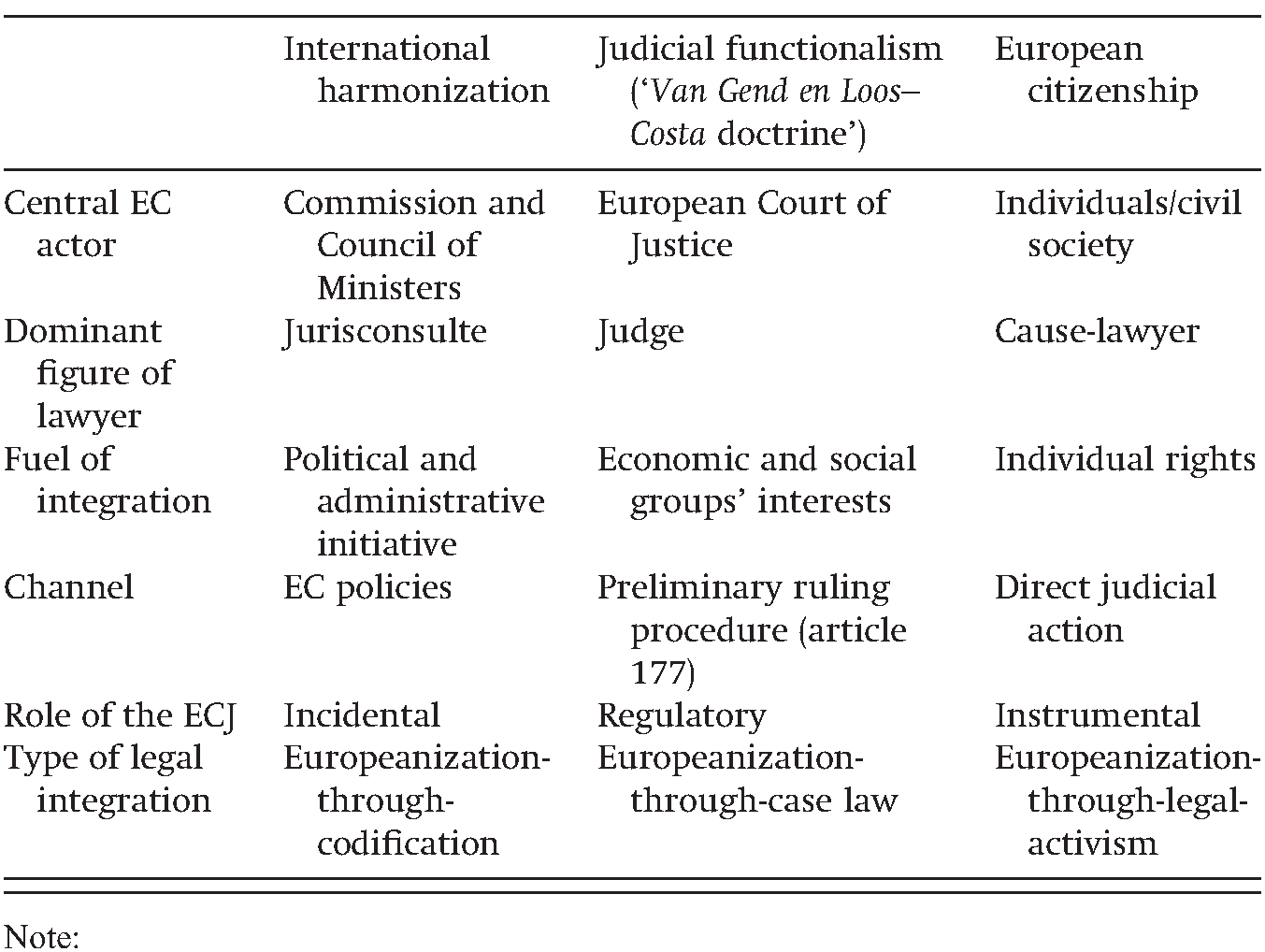
Note: These models are ideal-types. Thereby, they do not intend to mirror reality and they cannot be observed as such in social life. Rather, this table aims at providing a stylization of specific cleavages over the possible political functions given to law and lawyers in the integration process in the early years of European integration. The relevance and respective weight of these three models then have to be measured empirically.
A Community of law
In that it ties together law and politics, the ECJ and European integration, this judicial theory of European integration is more than just an abstract reflection on the future of Europe. The variegated set of its promoters intended it to be performative, thus to effectively redesign the allocation of authority and legitimacy within the EC polity. More particularly, they contributed to elevate legal competence as a necessary precondition for anyone to fully and persuasively participate in EC debates. The fact that Europeanization became seen as a matter of law implied that anyone willing to hold a position of responsibility within the European Communities (be it political, economic, bureaucratic and of course judicial) had to be able to engage in legal discussions. By acknowledging each other as crucial interlocutors beyond the ordinary divisions that still structured the emerging EC polity (national/European; public/private; legal/political), as well as by quoting each other regardless of their different responsibilities, Euro-lawyers of the different breeds (politicians of the law, corporate lawyers, law professors, ECJ judges, the Commission's legal advisers) jointly redefined what it meant and what it required to access and hold various institutional roles within European Communities (commissioners, members of parliament, ECJ Judges, high-ranking officials, but also consultants, etc.), thereby redefining a new ‘integration programme’ for Europe.
In that respect, it might not be coincidental that it is precisely when the ‘Van Gend en Loos–Costa doctrine’ was first discussed in the Parliament (15–16 June 1965) that the requirement for EC elites to possess strong legal credentials became most explicit. Although the Parliament at the time was still weakly institutionalized, the debates generated by the above-mentioned Dehousse report on the issue of supremacy quietly grew into academic exchanges – and accordingly, the Parliament itself turned into an academy of law. The national and political diversity of the thirteen participants in the discussion could not hide the fact that all of them (except one) were, or had been, legal professionals. Written by a renowned academic, the report itself had set the stage for such a ‘legal-only’ debate. It outlined that ‘the science of law and, in particular legal scholarship, play[ed] a decisive role in this framework because it contributes to define and clarify a political situation’.91 Speaking ‘as a lawyer and in the name of the Commission’, Hallstein did not go off message either – quite to the contrary. Right from the start, he praised the report for being a ‘document of scientific quality’. He also insisted that this ‘big political issue’ could only ‘be answered along legal criteria with the help of a legal methodology and only a solution validated by this method can be the right one’.92
Certainly, such a legalistic formulation of the parliamentary debate raised some criticisms. Emmanuel Sassen, a member of the Euratom Commission and himself a doctor of law, expressed some irony about ‘the professor's [Hallstein] real law course’, and more seriously then remarked that ‘neither the Euratom Commission, nor its sister institutions are academies of law’. Similarly, Italian MEP Edoardo Battaglia, himself a former judge and trial lawyer, tried to restore a political order by recalling that ‘this Assembly is not a scientific academy of public law specialists. We are in a Parliamentary assembly and we are politicians’.93 However, he also ended up referring to the various law professors and legal doctrines at stake. And, in fact, the metamorphosis of the Parliament into an academy of law seemed to have been conspicuous enough during that particular session that the chairman felt obliged to adjourn it when it occurred to him that there were not enough lawyers present in order to keep a good debate going: ‘[L]ook around you, it will convince you that, in order to be able to discuss a matter of such importance, there should be more lawyers present’.94 In other words, while stressing the political stakes of the judicial branch, the theory of European integration was at once promoting a specific representation of the EC polity in which legal competence was deemed essential to anyone wishing to exert leadership within that nascent political system.
Simultaneously, but equally importantly, this integration programme was offering the dispersed and variegated set of Euro-jurists that promoted it (judges of the Court, law professors, lawyers, but also many of the MEPs, commissioners, EC civil servants coming from the legal professions) a common place through which they could think and conceive of themselves as one group – that of ‘Euro-lawyers’ – endowed with specific functions (social, economic and, in fine, political integration). Thereby, reframing the role of the ECJ in Europeanization processes also meant for lawyers reframing their own role within the EC polity. While building a legal theory of Europe, the otherwise segmented and often antagonistic ensemble of Euro-lawyers was therefore constituting itself as a specific EC elite. To quote Lecourt, addressing members of FIDE:
If Law possesses such an ability to approximate – to the point of integrating in one unique body – separate and sometimes adversary nations, if it has the power to mould and fuse them, to animate them with one unique soul, if it is endowed with a unificatory power, then let's rejoice, Gentlemen, that this power has been in great part delegated to you.95
In a very characteristic effet de théorie, the emergence of the integration-through-law narrative therefore offered Euro-lawyers a unitary understanding of their variegated, and often conflicting, set of experiences and practices as one unique contribution to the grand project of leading European integration. This does not imply that from then onwards Euro-lawyers would tend to agree on issues and would form one collective profession acting in a rational and unitary way. Rather, it means that, as policy instruments, professional identities and institutional functionalities were now defined in line with and on the basis of that ‘Van Gend en Loos–Costa theory of EC law’, the latter served as a blueprint for action, orienting actors' perceptions, anticipations and (competing) strategies vis-à-vis the European Communities.
From this perspective, Europe's new integration programme is far from being just an abstract set of principles strategically mobilized by self-interested actors (companies, States, EU institutions, interest groups, associations, etc.), as it is too often conceived of in political science. It is the bearer of specific representations of the European Union, of its specific professional canons and political models. In other words, what is usually considered as the mere surface of the social processes that shape EU government is in fact one of the very terrains on which it is built.
1 , 50th Anniversary of the Judgment in Van Gend en Loos (1963–2013). Conference Proceedings, Luxembourg, Office des publications officielles de l'Union européenne, 2013.
2 On this, see also a stimulating paper by Damian Chalmers and Luis Barroso, What Van Gend en Loos Stands For, Jean Monnet Working Paper 03/14.
3 , ‘Rewriting Van Gend en Loos: Towards a Normative Theory of ECJ Hermeneutics’, in (ed.), Judicial Discretion in European Perspective, Kluwer Law International, 2003, p. 151.
4 , ‘Qu'eut été le droit des Communautés sans les arrêts de 1963 et 1964?’, in L'Europe et le droit, Mélanges Boulouis, Paris, Dalloz, 1991, p. 350.
5 , ‘Retour du mythe du gouvernement des juges?’, JurisClasseur-Europe, February 2006, p. 1. Quotes from this article have been translated by the present author.
6 As with any foundational myth, the ex post exegesis of Van Gend en Loos and Costa offers a selective reading of history. Quite emblematically, the ECJ's selection of its most important decisions presented in the languages of the new Member States that joined the EU in 2004 starts with Van Gend en Loos. See http://curia.europa.eu/cs/content/juris/data57/liste.htm (accessed 4 April 2014). Highlighting those decisions that establish the purported emancipation of the ECJ from classic intergovernmental politics, it neglects other ECJ decisions that could well be considered as equally important in defining the Court's jurisprudence. For example, Confédération nationale des producteurs de fruits et légumes v. Council of the EEC, 14 December 1962 could also qualify as a ‘landmark decision’, as it gave a very restrictive reading of individual standing, therefore granting Member States with specific privileges and rights within this new legal order.
7 In this, I disagree with Alec Stone's reading of Van Gend en Loos as a juridical coup not so much for the objective he is aiming at – questioning transformations of law's legitimacy of a given political system (my general goal too) – but rather for the conception of social change the idea of ‘coup’ conveys. It is hardly possible to conceive of Courts – and of international Courts in particular – as unified and rational actors endowed with one clear and common idea of their objectives. A product of heterogeneous if not opposed conceptions of Law and particularly of EC law, Van Gend en Loos is less the sort of inaugural and far-reaching judgment than a still ambiguous text which leaves open a variety of possible interpretations and futures (particularly as far as supremacy is concerned). We argue here that the decision's far-reaching ‘content’ has been produced throughout the history of the European integration. See , ‘The Juridical Coup d'État and the Problem of Authority’, German Law Review, 8, 2007, pp. 935–40.
8 , Glory of Van Gogh: An Anthropology of Admiration, Princeton, NJ, Princeton University Press, 1996.
9 , ‘The Making of a Transnational Constitution’, American Journal of International Law, 75(1), 1981, p. 12.
10 See , Establishing the Supremacy of European Law: The Making of an International Rule of Law in Europe, Oxford, Oxford University Press, 2001.
11 , ‘Meek Acceptance? The West German Ministries’ Reaction to the Van Gend en Loos and Costa Decisions', Journal of European Integration History, 2, 2008, pp. 57–76.
12 As of 1961, the Legal Service had a Centre de Documentation scrutinizing the evolution of national jurisprudence on EC law: ‘Document de travail interne. Analyse des décisions nationales rendues par les juridictions et les autorités administratives sur le droit des Communautés européennes’, 1962, HAEU/COM/BAC.
13 , ‘Nouvelles diverses sur les travaux de l'Association’, Bulletin de l'Association des juristes européens, 10, 1962, p. 29.
14 , ‘Les travaux du groupe juridique dans la négociation du Traité de Rome’, Studia diplomatica, 34(1–4), 1981, pp. 159–78.
15 Out of the first eighteen preliminary rulings notified to the Court during the first six years of the Rome Treaties, fifteen came from Dutch tribunals, one from Luxembourg, one from Germany and one from Italy.
16 Hans Stibbe's Amsterdam law firm, which he inherited from his father, would become, after several mergers, one of Europe's largest law firms in the field.
17 On this, see , ‘The Origins of a Legal Revolution: The Early History of the European Court of Justice’, Journal of European Integration History, 4, 2008, pp. 77–99.
18 Michel Gaudet, ‘Note à MM. les membres de la Commission. Objets. Observations de la Commission devant la Cour de justice au sujet des demandes préjudicielles de la “Tariefcommissie” néerlandaise’, ronéo, 1963, 21p. I would like to thank Bruno de Witte who was so kind as to lend me his own copy of this precious albeit still unpublished document.
19 , ‘Commentaire d'arrêt 2 et 3/62 de la CJCE’, Gazette du palais, 19–22 January 1963, p. 1.
20 The position of Alberto Trabucchi is known thanks to the recent publication of the internal memo he circulated among the judges which went against the position taken by the juge-rapporteur in the case: G. Perini, ‘Note à MM. les juges. Affaire 26/62 Tariefcommissie’, in , ‘Alberto Trabucchi, giurista europeo. Alle radici del diritto in Europa: una testimonianza inedita’, Quaderni della rivista di diritto civile, 2008, pp. 174–6.
21 Interview (conducted together with Morten Rasmussen) with Paolo Gori, former référendaire of Alberto Trabucchi, Prato, Italy, 20 March 2008. See also , ‘The Origins of a Legal Revolution: The Early History of the European Court of Justice’, Journal of European Integration History, 4, 2008, pp. 77–99.
22 See , ‘The Making of a Transnational Constitution’, American Journal of International Law, 75(1), 1981, p. 12.
23 The citations herein all come from the judgment as published in Common Market Law Reports, 1963, pp. 127–32.
24 See , ‘Rewriting Van Gend en Loos: Towards a Normative Theory of ECJ Hermeneutics’, in (ed.), Judicial Discretion in European Perspective, The Hague, Kluwer Law International, 2003, pp. 151–63.
25 Cour de justice des Communautés européennes, Recueil de la jurisprudence de la Cour, Luxembourg, Publications officielles des CE, 1963, p. 21.
26 Common Market Law Reports, 1963, p. 13.
27 , ‘Note’, in Études de droit communautaire européen (1962–2007), Brussels, Bruylant, 2008, p. 61.
28 Otto Riese, ‘Ansprache von Herrn Professor O. Riese anlasslich seiner Verabschiedung am 6 February 1963’ in /CEAB 2/1137 HAEU.
29 , ‘Incidences des Communautés européennes sur le droit interne des États membres’, Annales de la Faculté de droit de Liège, 1963, p. 24.
30 , ‘L'organisation, le fonctionnement et le rôle de la Cour de justice des Communautés européennes’, Bulletin de l'Association des juristes européens, 1963, p. 13.
31 , ‘L'Europe dans le prétoire’, Le Monde, 23 February 1963, p. 1.
32 , ‘Un nuovo diritto’, Rivista di diritto civile, 9, 1963, p. 259.
33 , ‘L'inserimento diretto delle disposizioni contenute nel Trattato istitutivo della Comunità economica europea negli ordinamenti giuridici degli Stati membri’, Foro padano, 1963, p. 32.
34 , ‘Una pietra miliare nell'affermazione del diritto europeo’, Foro italiano, 1963, p. 10.
35 , ‘National Law and the Case-Law of the Court of Justice of the European Community’, Common Market Law Review, 1(1), 1963, p. 13.
36 , ‘Le problème des dispositions directement applicables des traités internationaux et son application aux traités instituant les communautés’, in Deuxième colloque international de droit européen: La Haye 1963, The Hague, NV Uitgeversmij, 1966.
37 I have identified only one differing opinion to this interpretative activism, namely, that of ECJ référendaire Sergio Neri, presumably echoing the viewpoint of his judge, Rino Rossi, who denied the view, held by many Euro-lawyers, that there is any element in the decision enabling to see supremacy of EC law as a logical consequence of Van Gend en Loos: ‘While the Court has endorsed the Dutch theory of self-executing of specific international norms, it is not possible to affirm that it has accepted supremacy’: see , ‘Sulla natura giuridica delle Comunità europee’, Rivista di diritto internazionale, 1964, p. 235.
38 To our knowledge, three out of the seven ECJ judges (Louis Delvaux, Rino Rossi and Charles Léon Hammes) and one of the two Advocates General (Karl Roemer) did not take part in this ex post interpretative activism and remained silent.
39 , ‘Un nuovo diritto’, Rivista di diritto civile, 9, 1963, p. 259.
40 While finishing a PhD at the University of Paris, precisely on ECJ preliminary rulings, Roger-Michel Chevallier, Robert Lecourt's référendaire, was writing a regular legal commentary on EC law in the French Gazette du palais, and, together with the Belgian Gérard Rasquin (Hammes's référendaire), they wrote numerous doctrinal articles on the Court's procedures and case law. Paolo Gori, Alberto Trabucchi's référendaire, a PhD in international law from the University of Florence and Harvard Law School, and Sergio Neri, another Italian référendaire who also held a PhD in international law, were respectively commenting ECJ decisions for the Foro italiano and the Foro padano. One could add former ECJ judge Nicola Catalano to this group, for he had just left the Court and had become one of the most active commentators of the Court's decisions in major Italian, French and Belgium law journals.
41 Presumably as a tribute to his achievement in his Van Gend en Loos test-case, L. F. D. Ter Kuile was representing the Dutch section of FIDE in that debate.
42 Antonin Cohen, Scarlet Robes, Dark Suits: The Social Recruitment of the European Court of Justice, European University Institute, Working Paper RSCAS 2008/35.
43 , ‘Una pietra miliare nell'affermazione del diritto europeo’, Foro italiano, 1963, p. 10, p. 17.
44 , ‘L'inserimento diretto delle disposizioni contenute nel Trattato istitutivo della Comunità economica europea negli ordinamenti giuridici degli Stati membri’, Foro padano, 1963, p. 32, p. 36.
45 , ‘Un nuovo diritto’, Rivista di diritto civile, 9, 1963, p. 259.
46 , ‘Una pietra miliare nell'affermazione del diritto europeo’, Foro italiano, 1963, p. 10, p. 18 (emphasis added).
47 , ‘National Law and the Case-Law of the Court of Justice of the European Community’, Common Market Law Review, 1(1), 1963, p. 13.
48 Speech by Andreas Donner on 6 February 1963, quoted in , The Court of the European Communities: New Dimensions in International Adjudication, Dordrecht, Martinus Nijhoff, 1964, p. 116.
49 , ‘Incidences des Communautés européennes sur le droit interne des États membres’, Annales de la Faculté de droit de Liège, 1963, p. 24 (emphasis in the original).
50 , ‘L'unification du droit européen est aussi un moyen de construire l'Europe’, France-Forum, 1963, p. 31.
51 , ‘Developments in the European Common Market’, International and Comparative Law Bulletin, 7(2), 1963, p. 12.
52 As stated in the Van Gend en Loos decision: ‘The vigilance of individuals concerned to protect their rights amounts to an effective supervision in addition to the supervision entrusted by articles 169 and 170 to the diligence of the Commission and Member States’.
53 Giangaleazzo Stendardi took part in the case only when it was before the Italian Constitutional Court, but suggested the recourse to the ECJ. See , ‘Problemi in materia di legittimità di espropriazione d'impresa’, Foro padano, 5, 1962, pp. 52–60.
54 , ‘Riforme legislative urgenti per una più efficace tutela giurisdizionale del cittadino nella procedura penale’ in Congresso nazionale giuridico forense: Milan 13–18 settembre 1965, Milan, Giuffrè, 1966, p. 735.
55 , I rapporti tra gli ordinamenti giuridici italiani e le Comunità europee, Milan, Giuffrè, 1958, p. 18.
57 He urged each European citizen to ‘ask himself: what have I done, what am I doing for the European norms to be implemented?’ Reference StendardiIbid., p. 17.
58 The Partito liberale italiano, a small right-wing party closed to corporate interests, had gained an unprecedented momentum at the time in Milan (around 20 per cent in 1963–4 elections), actively campaigning against the politics of the centre-left government and, particularly, its nationalization policies. Giangaleazzo Stendardi was on the party's list at the municipal elections in Milan in 1963 and eventually entered the municipal council in 1969. See , Accade a Milano 1945–2002, Milan, Greco e Greco, 2002.
59 , ‘Problemi in materia di legittimità di espropriazione d'impresa’, Foro padano, 5, 1962, p. 60.
60 , Resisting the European Court of Justice: West Germany's Confrontation with European Law (1949–1979), Cambridge, Cambridge University Press, 2012, pp. 44–88.
61 Opinion of the Advocate General Maurice Lagrange on Costa v. ENEL, 25 June 1964, in Recueil de la jurisprudence de la Cour, Luxembourg, Curia, 1964, p. 1179.
62 Ibid.
63 Wissenschaftliche Gesellschaft für Europarecht, Aktuelle fragen des europäische gemeinschaftsrechts, Bensheim, 10–14 Juli 1964, Stuttgart, Enke Verlag, 1965. On the importance of this meeting and the influential role of German law professor Hans Peter Ipsen in shaping the set of possible alternatives for the ECJ judges, see , ‘Europe a Großraum? Shifting Legal Conceptualisations of the Integration Project’, in and (eds.), Darker Legacies of Law in Europe: The Shadow of National Socialism and Fascism over Europe and Its Legal Traditions, Oxford, Hart Publishing, 2003, pp. 167–91, p. 183, n. 92.
64 Cf. et al. (eds.), Visions, Votes and Vetoes: The Empty Chair Crisis and the Luxembourg Compromise Forty Years On, Brussels, Peter Lang, 2006.
65 See , ‘A Supranational Icarus: The Early Commission and the Search for an Independent Role’, in (ed.), Inside the European Community: Actors and Policies in the European Integration 1957–1972, Baden-Baden, Nomos, 2006.
66 On these divisions, see , ‘The Movements for European Unity (1958–1972)’, in (ed.), Inside the European Community: Actors and Policies in the European Integration 1957–1972, Baden-Baden, Nomos, 2006, pp. 177–93; and (ed.), Crises and Compromises: The European Project 1963–1969, Baden-Baden, Nomos, 2001.
67 See , Resisting the European Court of Justice: West Germany's Confrontation with European Law (1949–1979), Cambridge, Cambridge University Press, 2012, pp. 44–88.
68 , ‘La Communauté européenne, nouvel ordre juridique’, in Les documents de la Communauté européenne, 27, 1964, p. 5.
69 In between the two decisions, the composition of the Court had undergone only one change with the – to our knowledge, still unexplained – resignation of the German judge Otto Riese, Adenauer's nephew, only one day after the publication of the decision in Van Gend en Loos (but after he had taken part in the judicial deliberations). He was replaced by Walter Strauss, former minister of Justice in Adenauer's government.
70 Decision Costa v. ENEL, Recueil de la Cour de justice des Communautés européennes, Luxembourg, Curia, 1964, p. 1141.
71 , ‘La preminenza del diritto delle Comunità europee sul diritto interno degli Stati membri’, Giurisprudenza italiana, 1964, pp. 1071–86.
72 Its director Michel Gaudet was heard on 18 February 1965 by the Legal Committee, and a member of its staff was ‘lent’ for the purpose of the report to the European Parliament.
73 Fernand Dehousse, Rapport fait au nom de la commission juridique sur la primauté du droit communautaire, Parlement européen, documents de séances, 1965, p. 14.
74 , in Symposium ‘Droit communautaire et droit national’, Cahiers de Bruges, 14, 1965, pp. 399–400.
75 , ‘Compte-rendu’, Cahiers du droit européen, 1, 1965, pp. 74–5.
76 Débats du Parlement européen, Séance des 16–17 juin 1965, 1965, pp. 221–3. See also the resolution: ‘Résolution du 22 octobre 1965’, Assemblée parlementaire commune, 1966.
77 , ‘La Communauté européenne, nouvel ordre juridique’, in Les documents de la Communauté européenne, 27, 1964, p. 5.
78 , ‘Walter Hallstein et les institutions des Communautés européennes’, in (ed.), Le couple franco-allemand et les institutions européennes, Brussels, Bruylant, 2001, pp. 151–68.
79 , ‘La Communauté européenne, nouvel ordre juridique’, in Les documents de la Communauté européenne, 27, 1964, pp. 8–10.
80 Reference HallsteinIbid., pp. 10–11.
81 , ‘Robert Lecourt (1908–2004)’, Revue trimestrielle de droit européen, 3, July September 2005, p. 990, p. 995.
82 William Phelan, ‘Supremacy, Direct Effect and Dairy Products in the Early History of European Law’, EUI Working Paper, 2014/11.
83 Some cases are thoroughly documented in , Establishing the Supremacy of European Law: The Making of an International Rule of Law in Europe, Oxford, Oxford University Press, 2001.
84 Walter Hallstein, in ‘Débats. Compte rendu in extenso des séances’, Session 1964–5, 17 June 1965, European Parliament, 1965, p. 218.
85 Walter Sassen, in ibid., p. 223.
86 , What Is Sociology?, London, Hutchinson, 1978, p. 86.
87 , ‘Das Europarecht in der Krise der Gemeinschaften’, Europarecht, 1, 1966, pp. 4–24.
88 It must be noted that the first book engaging in a reflection on the role of the European Court in a functionalist perspective came later: , The Rule of Law in European Integration, New Haven, CT, Yale University Press, 1965.
89 , ‘Le rôle du droit dans l'unification européenne’, Bulletin de l'Association des juristes européens, 17–18, 1964, pp. 5–23, p. 22.
90 On this, see also the interesting developments by , Power and Legitimacy: Reconciling Europe and the Nation-State, Oxford, Oxford University Press, 2011.
91 , Rapport fait au nom de la commission juridique sur la primauté du droit communautaire, Parlement européen, documents de séances, 1965, p. 2.
92 Walter Hallstein, in Reference Dehousseibid., pp. 218 and 220.
93 Reference DehousseIbid., p. 231.
94 Reference DehousseIbid., p. 243.
95 , ‘Le rôle du droit dans l'unification européenne’, Bulletin de l'Association des juristes européens, 17–18, 1964, pp. 5–23, p. 22.


