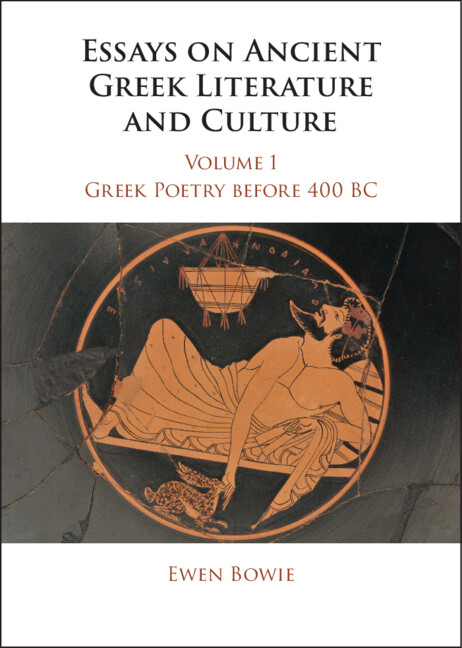
Essays on Ancient Greek Literature and Culture

-
Select format
-
- Publisher:
- Cambridge University Press
- Publication date:
- 11 December 2021
- 25 November 2021
- ISBN:
- 9781107415423
- 9781107058088
- 9781107692091
- Dimensions:
- (228 x 152 mm)
- Weight & Pages:
- 1.7kg, 886 Pages
- Dimensions:
- (244 x 170 mm)
- Weight & Pages:
- 1.5kg, 884 Pages
- Subjects:
- Classical Studies, Classical Literature
You may already have access via personal or institutional login- Subjects:
- Classical Studies, Classical Literature
Show more authors 
You may already have access via personal or institutional login
Book description
In this book one of the world's leading Hellenists brings together his many contributions over four decades to our understanding of early Greek literature, above all of elegiac poetry and its relation to fifth-century prose historiography, but also of early Greek epic, iambic, melic and epigrammatic poetry. Many chapters have become seminal, e.g. that which first proposed the importance of now-lost long narrative elegies, and others exploring their performance contexts when papyri published in 1992 and 2005 yielded fragments of such long poems by Simonides and Archilochus. Another chapter argues against the widespread view that Sappho composed and performed chiefly for audiences of young girls, suggesting instead that she was a virtuoso singer and lyre-player, entertaining men in the elite symposia whose verbal and musical components are explored in several other chapters of the book. Two more volumes of collected papers will follow devoted to later Greek literature and culture.
Reviews
‘Bowie's work has played a crucial role in keeping classics in Britain a flourishing enterprise by showing what significant new work can be done by looking at evidence others pass over … Any reader will be dazzled by Bowie's technical mastery.’
Ben Cartlidge Source: Times Literary Supplement
Contents
Contents
Metrics
Altmetric attention score
Full text views
Full text views helpTotal number of HTML views: 0
Total number of PDF views: 0 *
 Loading metrics...
* Views captured on Cambridge Core between #date#. This data will be updated every 24 hours.
Usage data cannot currently be displayed.
Accessibility standard: Unknown
Why this information is here
This section outlines the accessibility features of this content - including support for screen readers, full keyboard navigation and high-contrast display options. This may not be relevant for you.
Accessibility Information
Accessibility compliance for the HTML of this book is currently unknown and may be updated in the future.