

Part I The political and institutional determinants of education policy
1 Theoretical framework Partisan politics in context
This chapter develops a theoretical framework that forms the basis for the qualitative case studies of Chapter 2 and the quantitative analyses of Chapter 3. I start with a short depiction of the core dimensions of variation in contemporary education and training regimes in Western democracies, which will be discussed in detail in the quantitative chapter (Chapter 3). I distinguish between the dimensions of public involvement in education on the one hand and educational stratification on the other, which roughly correspond to Esping-Andersen's (Reference Esping-Andersen1990) well-known concepts of de-commodification and stratification. This description is followed by a short review of how existing approaches – especially the VoC paradigm, historical institutionalism, and power resources theory – try to explain the observed variation, and where they fall short. The core of the chapter is a theoretical framework, which is essentially a proposal to extend the standard model of partisan theory in three important ways: first, by taking into account that political parties have preferences not only about the content of policy but also about how the political process should be organized; second, by reflecting on the interaction between partisan politics and institutional context; and third, by focusing more on the long-term balance of power between political party families than on the partisan composition of governments in the short term. The chapter closes with some remarks on the empirical strategy of the subsequent chapters.
De-commodification and stratification in education systems
As is well known, Esping-Andersen (Reference Esping-Andersen1990) has identified two dimensions along which contemporary welfare state regimes vary: de-commodification and stratification. These concepts are also useful for understanding education and training regimes. The concept of de-commodification is related to the Marxian notion of the commodification of labor. For Esping-Andersen (Reference Esping-Andersen1990: 21–2), “de-commodification occurs when a service is rendered as a matter of right, and when a person can maintain a livelihood without reliance on the market.” In other words, welfare states achieve a high degree of de-commodification when citizens who are entitled to receive generous welfare state benefits become less dependent on selling their labor on the market. Education differs somewhat from other social policies because the connection to the labor market is different. Whereas the traditional types of social insurance target people who are already on the labor market and are meant to compensate for income loss related to life risks such as illness, unemployment, and old age, individuals receive education before they enter the labor market. The purpose of education is not to compensate ex post for income loss, but to invest in human capital in order to insure individuals against the prospect of income loss.
Even so, the concept of de-commodification can be meaningfully applied to education. In this case, the decisive question is whether education itself is considered a tradable commodity and capital investment or a social right and entitlement. T.H. Marshall considered education to be an important part of his catalogue of social rights:
The education of children has a direct bearing on citizenship, and, when the State guarantees that all children shall be educated, it has the requirements and the nature of citizenship definitely in mind. It is trying to stimulate the growth of citizens in the making. The right to education is a genuine social right of citizenship, because the aim of education during childhood is to shape the future adult. Fundamentally it should be regarded, not as the right of the child to go to school, but as the right of the adult citizen to have been educated.
Human-capital theory (Becker Reference Becker1993) takes the opposite perspective: that the amount of individual investment in education is determined by individual costs and benefits in terms of higher wages. Education is not regarded as a social right as such, but as the outcome of an individual choice under constraints such as innate academic abilities and credit market constraints.
On the level of cross-country comparison, differences in the division of labor between public and private sources of funding are likely to reflect cross-national variations in how much the provision of education has been commodified. When a large share of education funding comes from private sources (mostly in the form of tuition fees paid by households and individuals), individual educational choices are more likely to resemble the cost–benefit calculus depicted in human-capital theory. Conversely, when the involvement of the state in financing and providing education is high, the provision of education may be regarded as a social right and entitlement, and as part and parcel of a comprehensive welfare state model.
Esping-Andersen's second dimension of stratification captures the degree to which welfare state institutions themselves contribute to the formation of distinct welfare state clientele groups or classes (Esping-Andersen Reference Esping-Andersen1990: 23). This specific approach to stratification does not pick up on the effect of welfare state institutions at the level of outcomes in terms of socioeconomic inequality. Instead, it focuses on the question of how the welfare state itself creates group identities by defining the beneficiaries of social benefits in particular ways. This concept applies very well to education and training systems, since it is possible to draw on a large literature in educational sociology concerned with educational stratification (see Chapter 4). Education systems vary widely in the strength of class-related inequalities of access to higher levels of education and the degree of educational mobility between different tracks (academic and vocational) within the system. Countries where the secondary school system is segmented and students are put onto different tracks early in their educational careers are generally identified as having high levels of educational inequality (Breen et al.Reference Breen, Luijkx, Müller and Pollak2009; Pfeffer Reference Pfeffer2008). Comprehensive education at the secondary level and open access to tertiary education lower educational stratification.
Figure 1.1 shows the association between de-commodification and educational stratification in education and training systems. The two measures used in this figure are by no means perfect indicators of the underlying complex concepts but serve as decent proxies. The x axis is a measure of educational stratification, provided by the OECD (2007: 87). For this measure, students were asked whether they expected to complete higher education (at ISCED level 5A or 6) at some point in their educational careers. The measure thus captures the difference in the odds ratio of expectations between students from strong socio-economic backgrounds and students from weak socioeconomic backgrounds. Unlike other measures of educational inequality (see Chapter 4), therefore, this measure does not capture the direct relationship between socioeconomic background and educational attainment; the institutional setup of the education system is more important, especially the relative openness of access to higher academic education as reflected in student expectations. The y axis is the share of education spending that comes from private sources for all levels of education. Most such private sources are households, but in this case they include contributions from foundations and businesses.1 Commodification can take different forms depending on the educational sector. In VET, commodification may refer to the role of employers and other private entities in the provision of training. In higher education, it captures the extensiveness of the private sector in the university system, as well as the level of household spending in the form of tuition fees.2
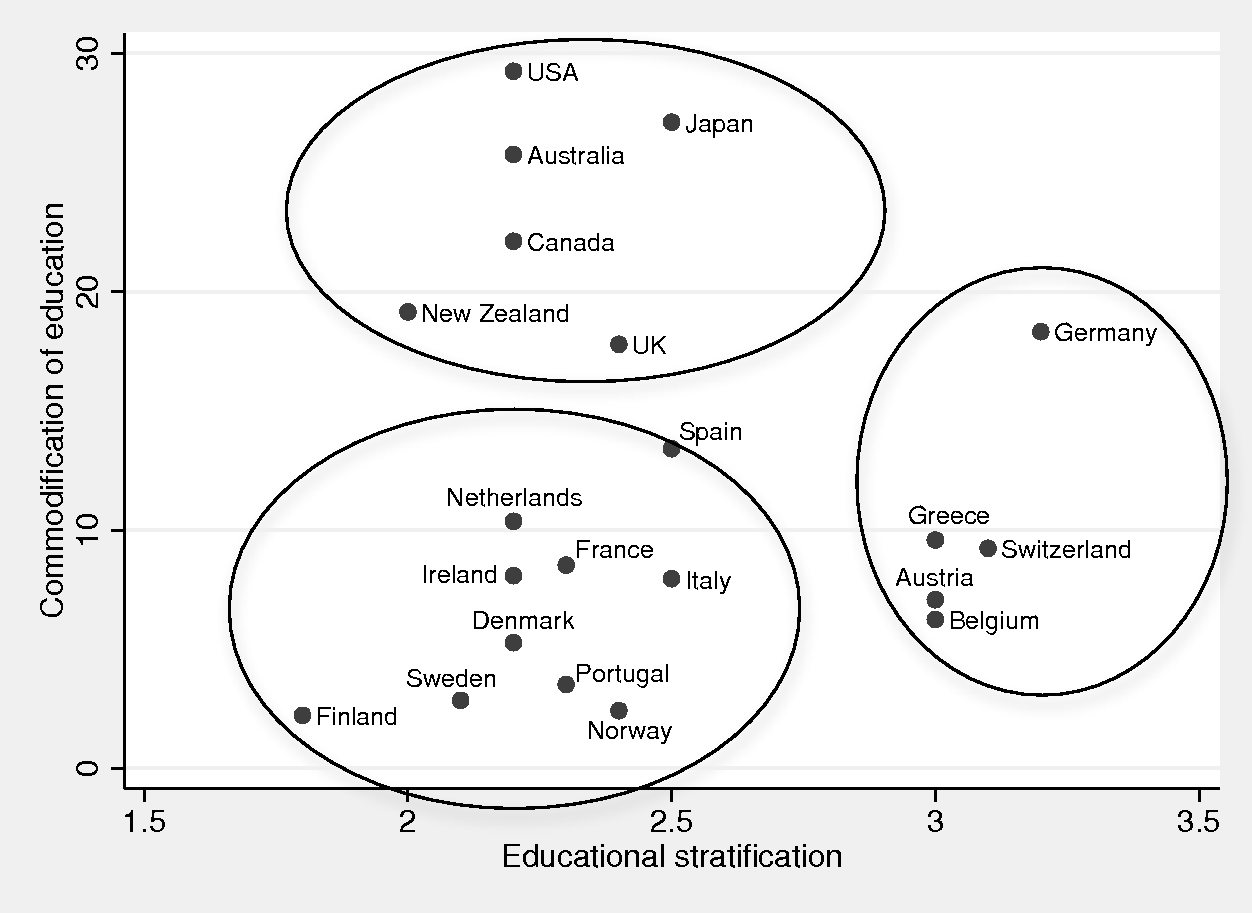
Figure 1.1 De-commodification and stratification in education systems
As can be seen in Figure 1.1, there is no apparent association between these two dimensions (the bivariate correlation in the cross-sectional sample of OECD countries is −0.04). As in the case of welfare state regimes more generally, these are two distinct and different dimensions of variation. Nevertheless, it is possible to identify three country groupings or clusters of countries that are reminiscent of the well-known worlds of welfare capitalism (see also Busemeyer & Nikolai Reference Busemeyer, Nikolai, Obinger, Pierson, Castles, Leibfried and Lewis2010). Countries in the liberal cluster combine low levels of de-commodification (expressed as high shares of private education spending) with low levels of stratification. This cluster includes the United States, Canada, Australia, New Zealand, the United Kingdom, and Japan. The second cluster of statist skill regimes, combining low levels of educational stratification with high levels of de-commodification, covers all Scandinavian countries but also includes the Netherlands, France, Ireland, and some southern European countries.3 Finally, there is a cluster of continental European countries (Germany, Austria, Switzerland, Belgium), as well as Greece, that is characterized by a combination of high levels of educational stratification and medium levels of de-commodification.4
It is important to point out that differences in total levels of investment in education are not taken into account in Figure 1.1, since the two dimensions only capture differences in the public/private division of labor in education financing and educational stratification. There are of course many other differences in the institutional setup of education and training systems in advanced democracies besides these two variables, including overall levels of public and private investment in educational institutions; the division of labor between the state, employers, and individuals with regard to the financing and governance of skill formation; the extent of stratification between academic and vocational tracks; and performance in terms of average levels of educational attainment (Allmendinger & Leibfried Reference Allmendinger and Leibfried2003; Busemeyer & Nikolai Reference Busemeyer, Nikolai, Obinger, Pierson, Castles, Leibfried and Lewis2010; Crouch et al.Reference Crouch, Finegold and Sako1999; Hega & Hokenmaier Reference Hega and Hokenmaier2002; Iversen & Stephens Reference Iversen and Stephens2008; Lynch Reference Lynch and Freeman1994). These other measures will be discussed in greater detail inChapter 3.
Explaining variation: the varieties-of-capitalism perspective
How did different countries end up on different development paths constituting different worlds of human capital formation? And which mechanisms explain the sustainability of institutional variation across time? Although there is very little scholarship that deals explicitly with the analysis of the connections between education and the welfare state as it develops over time, we can distinguish two broad perspectives. One is rooted in the VoC debate (Hall & Soskice Reference Hall, Soskice, Hall and Soskice2001), which played a crucial role in making mainstream comparative political scientists and welfare state researchers more interested in the study of education (Busemeyer & Trampusch Reference Busemeyer and Trampusch2011: 424–9). Education and training systems were regarded as one of five institutional spheres of political economies in the original framework developed by Hall & Soskice (Reference Hall, Soskice, Hall and Soskice2001: 25–6). Inspired by the earlier work of Streeck (Reference Streeck1989, Reference Streeck1992), their core argument was that the institutional setup of the education and training system has implications for the availability of different kinds of skills in the political economy, which in turn influences firms’ choices of production strategies and patterns of competitiveness. Specific or occupational skills dominate in CMEs such as Germany, which impels firms to specialize in the production of high-end manufacturing products for as long as institutional complementarities between the systems of skill formation and adjacent institutional spheres, such as industrial relations and finance, allow them to adopt a long-term perspective in human-capital management and skill formation (Hall & Soskice Reference Hall, Soskice, Hall and Soskice2001: 28). The institutions of LMEs such as the United States encourage investment in more generalized academic skills that can be easily transferred from one job to another. Firms in LMEs hence excel in product markets that value fast-paced innovation and high-level academic skills (IT, biotech, consulting, etc.) (Hall & Soskice Reference Hall, Soskice, Hall and Soskice2001: 32).
In the original framework of Hall & Soskice (Reference Hall, Soskice, Hall and Soskice2001), the welfare state as such was not mentioned as one of the five institutional spheres. The link between skills and the welfare state featured more prominently in related work by Torben Iversen, David Soskice and others (Cusack et al.Reference Cusack, Iversen and Rehm2006; Estévez-Abe et al.Reference Estevez-Abe, Iversen, Soskice, Hall and Soskice2001; Iversen Reference Iversen2005; Iversen & Soskice Reference Iversen and Soskice2001). In particular, Iversen & Soskice (Reference Iversen and Soskice2001) developed an “asset theory of social policy preferences,” which argues that the individual skill portfolios of workers have an impact on their demand for social insurance (see also Moene & Wallerstein Reference Moene and Wallerstein2001, Reference Moene and Wallerstein2003 for a related argument). Controlling for other factors such as income or level of education, workers with more specific skills exhibit a higher demand for social insurance, because the risk of their skills becoming obsolete is higher than in the case of general, transferable skills. Estévez-Abe et al. (Reference Estevez-Abe, Iversen, Soskice, Hall and Soskice2001) have argued that employers are willing to accommodate this demand for insurance in CMEs because they have an interest in maintaining their competitive advantage in product markets that require specific skills. The counterintuitive prediction that comes out of this line of reasoning is that employers, at least in CMEs, are willing to support the expansion of the welfare state because they would like to maintain workers’ willingness to invest in specific skills. Historical work by Mares (Reference Mares, Hall and Soskice2001, Reference Mares2003) and Swenson (Reference Swenson2002) provides additional evidence for employer support of welfare state expansion under certain conditions.
The VoC approach has triggered a huge debate that cannot be adequately summarized here (but see Becker Reference Becker2007; Hancké Reference Hancké2009; Deeg & Jackson Reference Deeg and Jackson2006; and Streeck Reference Streeck2009 for critical overviews, as well as Busemeyer Reference Busemeyer2009a; Emmenegger Reference Emmenegger2009; and Streeck Reference Streeck, Busemeyer and Trampusch2012 for skill formation more specifically). The crucial takeaway for the purpose of this chapter is the stipulation of a functional complementarity between skill formation and welfare state policies. The VoC perspective argues that employers in CMEs support welfare state institutions because they serve an important function: securing an adequate supply of a particular kind of skill. This may help to explain why institutional arrangements that constrain business in the short term still receive considerable support from the business community and thus contribute to the long-term political sustainability of development paths (Hassel Reference Hassel, Hancké, Rhodes and Thatcher2007; Iversen & Stephens Reference Iversen and Stephens2008). The original version of the VoC framework is less able to explain the emergence of different varieties of capitalism, however. To be fair, Estévez-Abe et al. (Reference Estevez-Abe, Iversen, Soskice, Hall and Soskice2001: 147) have explicitly stated that “our model is not intended to explain the origin of specific social policies.” Nevertheless, a comprehensive theoretical framework should be able to explain both institutional change and stability.
Recent work in the field has therefore gone back to the late nineteenth and early twentieth centuries with the aim of explaining contemporary varieties of capitalism through the outcomes of political struggles during the critical juncture of industrialization (Iversen & Soskice Reference Iversen and Soskice2009; Korpi Reference Korpi2006; Mares Reference Mares2003; Martin & Swank Reference Martin and Swank2011, 2012; Swenson Reference Swenson2002; Thelen Reference Thelen2004). This is very much in line with the theory of path dependency (Pierson Reference Pierson2000, Reference Pierson2004), which argues that events that happen in the early phase of path formation have a stronger impact on the eventual shape of the development paths than events that happen later. But we must be careful here not to throw the baby out with the bathwater: not everything was preordained by developments during the Industrial Revolution. Political struggles and conflicts in the mid-twentieth century had enormous consequences for the shape of contemporary education and training regimes. The simple reason for this is that education and training systems entered a new phase of development after access to primary education became more or less universal during the first half of the twentieth century. The expansion of post-secondary education, however, took very different forms. Essentially, the force of educational expansion led to the establishment of new educational pathways at the post-secondary level, or at least to a significant transformation of existing institutions (such as the opening up of access to universities). In order to explain this variety of development paths, I now turn to the second broad perspective in the literature: historical institutionalism and partisan theory.
Historical institutionalism, partisan politics, and power resources
How can we explain the different development paths of education and training regimes? Theories in comparative public policy proffer different explanations. One perspective rooted in modernization theory emphasizes the importance of socioeconomic forces over political and institutional determinants (Wilensky Reference Wilensky2002). The continued expansion of educational opportunities, particularly at the higher post-secondary level, is regarded as a corollary to societal and economic development. Cross-country differences in policy output are thus attributed to differences in the level of development. A different, but related, perspective is put forward in the theory of the world society (Meyer et al.Reference Meyer, Ramirez and Soysal1992). Here, the massive expansion of educational opportunities during the twentieth century is attributed to the institutionalization of a legitimate model of the nation-state, in which the universal provision of primary and later secondary education is an important element (Meyer et al.Reference Meyer, Ramirez and Soysal1992: 129). In contrast to modernization theory, therefore, the spread of education is not primarily attributed to its functional complementarity to the developing industrial society, but to its appeal as an instrument of legitimation used by societies eager to become part of the fledgling “world society,” built upon Western notions of democracy and development. Socioeconomic explanations and world-society approaches are undoubtedly well suited to explain the massive expansion of educational opportunities across the duration of the twentieth century and beyond. Because they are approaching the subject from a global perspective, however, they are less able to account for the more fine-grained differences in the institutional setup of education and training systems in the Western world.
In this respect, historical institutionalism – or neoinstitutionalism more generally – may be superior (Hall & Taylor Reference Hall and Taylor1996; Pierson Reference Pierson2000, Reference Pierson2004; Steinmo et al.Reference Steinmo, Thelen and Longstreth1992; Thelen Reference Thelen1999). Theories of path dependency can explain why countries follow distinct development paths. Once a path is chosen, actors tend to stick with it, because changing the path would result in significant transaction costs (Pierson Reference Pierson2000, Reference Pierson2004). Institutions have feedback effects on the political process as well: actors whose political power is bolstered by existing institutions have an interest in the continued survival of these institutions (Pierson Reference Pierson2004: 36–7). Because of path dependency and the associated institutional “lock-in” effects, work in this tradition needs to “go back and look” (Pierson Reference Pierson2004: 47) at the historical origins of contemporary institutional arrangements, paying close attention to the fact that actors (or coalitions of actors) who supported the establishment of a particular institution at one point in time might not be the same ones that benefit from its continued existence in later periods. A well-known example of this is Thelen's historical account of the formation of training regimes, where she finds that unions initially opposed the establishment of workplace-based training regimes, only to become strong supporters in later years (Thelen Reference Thelen2004).
Historical institutionalism has been criticized on a number of fronts. One common criticism is that the claim of path dependency is overstated and does not fit empirical reality. In Pierson's analysis of Western welfare states, the conservative-corporatist type to be found in continental European countries is singled out as being particularly resistant to change and reform because of its many established veto points and powerful clientele groups (Pierson Reference Pierson2001: 446). Empirical studies of institutional change in “Bismarckian” welfare states, however, convincingly show that these welfare states do change in significant ways, although their changes proceed in various stages of reform and not in one single “big bang” (HäusermannReference Häusermann2010; Palier Reference Palier2010).
Related to this empirical type of criticism, recent work on institutional change has drawn attention to theoretical inconsistencies in the first generation of theories in historical institutionalism (Hall & Thelen Reference Hall and Gingerich2009; Mahoney & Thelen Reference Mahoney, Thelen, Mahoney and Thelen2010; Streeck & Thelen Reference Streeck, Thelen, Streeck and Thelen2005; Thelen Reference Thelen, Mahoney and Rueschemeyer2003, Reference Thelen2004). The central problem is that theories of path dependency draw a stark distinction between periods of stasis, when the forces of path dependencies are at work, and periods of institutional breakdown (Streeck & Thelen Reference Streeck, Thelen, Streeck and Thelen2005: 1). Path dependency is an excellent explanation for the forces that keep institutions in place once they have been set up, but it cannot explain why these institutions were established in the first place, nor why or how they might be transformed in incremental ways. In short: because they emphasize the impact of institutions on actors’ choices, the early versions of historical institutionalism have no theory of action. This is why historical institutionalism should and can be combined with well-established actor-centered theories, such as power resources or partisan theory.
Classical power resources theory highlights the role of coalitions between trade unions and leftist parties in government as driving forces of welfare state development (Korpi Reference Korpi1983; Esping-Andersen Reference Esping-Andersen1990; Stephens Reference Stephens1979; more recently, but in a similar vein: Bradley et al.Reference Bradley, Huber, Moller, Nielsen and Stephens2003; Korpi Reference Korpi2006). This perspective associates left-wing partisanship (powerful unions and social democratic parties) with the expansion of the welfare state in both the historical and the contemporary period. In its depiction of political conflict as a struggle between partisan coalitions of the left and right, however, power resources theory fails to explain the emergence and sustainability of cross-class coalitions. Such coalitions have been found to be the crucial supporting pillars of collective vocational training regimes, because the joint investment in vocational skills creates a form of mutual dependency between workers and employers (Busemeyer Reference Busemeyer2012a; Busemeyer & Trampusch Reference Busemeyer2012; Cusack et al.Reference Cusack, Iversen and Soskice2007; Thelen Reference Thelen2004).
The work of Kathleen Thelen is related to power resources theory in many ways, since Thelen has posited that the long-term survival of socioeconomic institutions depends fundamentally on the presence of supporting coalitions of actors (Thelen Reference Thelen2004: 290–1; Hall & Thelen Reference Hall and Gingerich2009: 12). Actors make use of the “gaps” that necessarily emerge between institutions as abstract rules and the concrete implementation of those rules on the ground; as part of this process they are continuously engaging in institutional “re-creation” and inadvertently in institutional change as well, since changes in the balance of power between actors or their preferences can drive incremental changes in institutional frameworks that may lead to large-scale change in the long run (Streeck & Thelen Reference Streeck, Thelen, Streeck and Thelen2005; Mahoney & Thelen Reference Mahoney, Thelen, Mahoney and Thelen2010).
Thelen's coalitional approach is a significant advancement over previous work on theories of institutional change and classical power resources theory, because instead of conceptualizing political struggles over policy reforms in terms of epic battles between the left and right, Thelen advocates a fundamentally empirical approach. She pays close attention to the reconstruction of politico-economic coalitions in policy-making, arguing that the composition of these coalitions may sometimes run counter to a priori expectations. In this respect, Thelen's approach is quite similar to “actor-centered institutionalism,” as put forward by Mayntz and Scharpf (Mayntz & Scharpf Reference Mayntz, Scharpf, Mayntz and Scharpf1995; Scharpf Reference Scharpf1997). The difference is that in actor-centered institutionalism, politics is conceived as a process of bargaining or mutual adjustment between individual or collective actors, whereas Thelen emphasizes the formation of coalitions of actors.
However, what has been missing in Thelen's argument is an appreciation of the role of partisan actors in general and government parties in particular as agents of institutional change. In her work on training regimes, Thelen argues that the state plays a crucial role in supporting the formation of different kinds of alliance between economic actors (Thelen Reference Thelen2004: 32), but that the interests of state actors do not seem to be determined by partisan politics as such. In later work, Martin & Thelen (Reference Martin and Thelen2007) have noted that state actors in countries with a large public sector develop an interest in maintaining cross-class solidarity, because government bureaucrats have an incentive to cater to the interests of the low-skilled and the long-term unemployed: they too form part of the large sector of public employment (Martin & Thelen Reference Martin and Thelen2007: 16–17). Employers and unions in these countries also have an incentive to cooperate with each other in order to fend off the intrusion of the state (Martin & Thelen Reference Martin and Thelen2007: 17). Again, state actors feature as bureaucrats, not partisan actors. This may be helpful in explaining why cross-class solidarity and a large public sector develop a mutually reinforcing relationship over time, but it does not explain why countries have ended up with different degrees of state involvement in the political economy more generally and in systems of skill formation in particular.
In order to understand this, it is necessary to bring in partisan theory. Starting with Hibbs (Reference Hibbs1977), this theoretical perspective posits that differences in policy output occur when government parties cater to different electoral constituencies (Schmidt Reference Schmidt1996). For example, left-wing parties will want to increase public spending to promote the interests of lower-income citizens, whereas rightist parties will prefer to lower taxes. Whereas power resources theory tends to regard government parties as the extensions of labor-market interest groups into the policy-making sphere, partisan theory gives government parties a certain degree of political independence from their electoral bases. Partisan actors are both office- and policy-seeking (Müller & Strøm Reference Müller and Strom1999), in that they aim to implement certain kinds of policy even as they attempt to win electoral majorities by mobilizing their core electoral constituencies and appealing to the median voter.
In a certain sense, the blind spots of partisan theory are the mirror image of the coalitional approach. Whereas the coalitional approach focuses on the interaction between coalitions of economic actors and nonpartisan state actors, partisan theory glosses over the impact of organized interests on government policy choices. Power resources theory does take into account organized interests, but assumes coalitional patterns that reflect the underlying class cleavage, such as one of the unions and the left against the employers and the right.
A recent example of the application of partisan theory to the study of education policy is the influential work of Ansell (Reference Ansell2008, Reference Ansell2010) and Boix (Reference Boix1997, Reference Boix1998).5 Both Ansell and Boix start out by deriving the expected interests of individual voters in different income classes with regard to institutional choices in education policy. For example, Ansell (Reference Ansell2008: 200) argues that poor voters will prefer a privately funded elite system of higher education if access to universities is income-dependent, as they have no interest in subsidizing the education of the rich. The preferences of political parties are then derived from the preferences of the voter groups that the parties represent (Ansell Reference Ansell2010: 125); the choices of government parties thus reflect the (economic) interests of their core electoral constituencies. One theoretical weakness of this type of model is that it does not take into account the impact that organized interests have on the choices made by government parties in defining a range of feasible policy options.
In sum, existing theories have various blind spots that prevent us from developing a deeper understanding of the dynamics of institutional development in education and training systems and in contemporary political economies more generally. The VoC school of thought initially concentrated on identifying functional complementarities between education systems and adjacent institutional spheres and refrained from studying the origins of politico-economic institutions. Scholars have moved in this direction more recently, but I note a tendency to overestimate the importance of the long “shadow of the 19th century” (Iversen & Soskice Reference Iversen and Soskice2009). Empirically, as Ansell (Reference Ansell2010) has shown for the case of higher education, education systems start to diverge most clearly in the second half of the twentieth century. Partisan politics play an important role here, but in contrast to Ansell (Reference Ansell2008, Reference Ansell2010) and Boix (Reference Boix1997, Reference Boix1998), partisan conflict should not be depicted as a struggle between left and right. Instead, it is important to highlight the differences between Christian democracy and secular conservatism, especially in the field of education policy (Busemeyer & Nikolai Reference Busemeyer, Nikolai, Obinger, Pierson, Castles, Leibfried and Lewis2010; Iversen & Stephens Reference Iversen and Stephens2008). However, partisan politics alone is not a sufficient explanation. Ansell (Reference Ansell2010) and Boix (Reference Boix1998) have focused on electoral politics and voters’ preferences, but have not considered the role of organized interests, such as labor unions and employers’ associations, in influencing education and training policies. Thelen's (Reference Thelen2004) coalitional approach, in turn, focuses on the interaction between organized interests and state actors, but does not take into account the electoral arena and the role of partisan ideologies in shaping policy output. In order to fully understand the historical evolution of education and training systems, it is necessary to think more extensively about the interplay between partisan politics on the one hand and socioeconomic institutions and organized labor-market interests on the other.
Theoretical framework: partisan politics in context
The previous sections sketched out the contributions that existing theories can make towards explaining the institutional diversity of education and training systems. These discussions reveal comparative strengths and weaknesses. The VoC school draws a broad distinction between liberal economies and CMEs and is particularly well placed to elucidate the functional complementarities between education and training and adjacent institutional spheres. It fails to comprehensively explain the variety of skill regimes within the large group of CMEs, however: why has the Scandinavian development path been so different from the German one? The power resources approach and partisan theory emphasize the role of political struggles over the institutional design of educational institutions. These struggles and political conflicts occur because educational institutions, like welfare state institutions, affect the distribution and redistribution of economic resources. A significant shortcoming of these approaches, however, is their neglect of the institutional context in terms of economic coordination. Partisan theory, at least the classical version of it, essentially assumes that government parties will pursue the same policies in different countries. Taken to its logical extreme, this approach fails to account for how, and by how much, British Conservatives and German Christian Democrats have differed in their education policy. Partisan theory tends to dichotomize between left- and right-wing parties, treating Christian democrats as a middle category between the two.
The rest of this chapter develops a theoretical framework that emphasizes the role of partisan politics and power resources as explanatory factors while at the same time extending and modifying existing theory in three important ways. The first modification, to standard partisan theory, is to argue that political parties not only have preferences with regard to the content of policies, but also with regard to how the political process should be organized; that is, which interests should legitimately get access to policy-making. This extension captures a crucial difference between secular conservatives and Christian democrats and helps to explain their different approaches to education policy. The second modification is to give more credence to the institutional context and how it modifies the menu of options available to government parties when they pursue reform strategies. While government parties of the same family may have similar policy preferences initially, institutional contexts can change the relative costs and benefits of policy alternatives so as to make some policies feasible and others not. In the third and final modification, I posit that the long-term balance of power between partisan forces is more important than the short-term partisan composition of governments, simply because reforming social systems as complex as education systems takes a lot of time and political stamina.
The standard partisan model
I start my argument with a simple and by now fairly common model of how and why political parties differ with regard to their policy preferences. Going back to Hibbs (Reference Hibbs1977), the expectation is that political parties of the left and the right represent different electoral constituencies with different economic interests. In comparative welfare state research, this leads to the simple hypothesis that parties of the left, representing the economic interests of the lower income classes, will support more redistribution and a larger welfare state, whereas parties of the right will oppose these policies because they would require their constituencies in the upper income classes to pay higher taxes in order to finance the expansion of social policy.
Partisan theory can be and has been applied to the study of education policy (Ansell Reference Ansell2008, Reference Ansell2010; Boix Reference Boix1997, Reference Boix1998; Busemeyer Reference Busemeyer2007, Reference Busemeyer2009b; Rauh et al.Reference Rauh, Kirchner and Kappe2011; Schmidt Reference Schmidt and Castles2007; Wolf Reference Wolf2009). In general, and simplifying greatly, the findings that have emerged from this literature support the core claims of the theory (Schmidt Reference Schmidt1996): that there are significant differences in policy output between left- and right-wing governments, and that left-wing governments are more likely to increase public spending on and expand access to education. Some of this literature (in particular Ansell Reference Ansell2008, Reference Ansell2010 and Boix Reference Boix1997, Reference Boix1998) has focused on the dichotomy between left- and right-wing parties, since these two party families are clearly the political representatives of voters in the lower and upper income strata, respectively.
Rather than formulating hypotheses about specific policies, such as spending, I would like to start with the more general claim that in education policy, political parties differ in how much they support or oppose educational expansion. Parties on the left are expected to promote educational expansion by creating opportunities to participate in education and obtain certificates, especially for those previously excluded from the higher levels of the education system. In contrast, parties on the right, if not outright opposed to educational expansion, are certainly more reluctant to promote it, instead attempting to slow down the general trend of expansion that set in after the Second World War. I focus here on educational expansion instead of spending as such, and not just because Esping-Andersen (Reference Esping-Andersen1990: 23) famously argued that political actors do not care about “spending per se.” More importantly, fostering educational opportunities for those previously excluded from participation in education can be achieved by various means; increasing education spending is just one way to do this, and not necessarily the most effective.
In principle, there are two different strategies by which to expand educational opportunities to previously excluded groups: the first is to expand access to higher levels of education for a wider share of the population, the second to expand the kinds of education more suited to the educational needs of those formerly excluded. The first strategy is associated with conflicts about expanding access to university education, whereas the second centers on the role of VET in the education system as a whole.
This is not simply a matter of choosing between the expansion of VET and higher university education, however. Because of the inherent complexity of the redistributive implications of educational investments, partisan preferences are prima facie ambiguous as well. For example, right-wing parties may support the expansion of VET as an educational alternative in order to “divert” the excess demand for educational participation away from higher education and towards other types of education. Furthermore, right-wing parties should have an interest in limiting access to higher education, in order to ensure their educational privileges, but they might be in favor of increasing spending on higher education anyway – as long as access continues to be limited – since such investment will benefit their electoral constituencies (Ansell Reference Ansell2010). The ambiguities are even more pronounced for left-wing parties. It could be expected that these parties will support general and vocational education, the types of education that will directly benefit the educational and labor-market needs of their constituencies (Ansell Reference Ansell2010; Boix Reference Boix1998). On the other hand, left-wing parties may oppose the creation of separate and potentially dead-end educational tracks for their clientele and instead promote the opening up of access to academic higher education (Busemeyer Reference Busemeyer2009b). In short, and given these ambiguities, the specific policies supported or opposed by partisan actors will likely depend on the particular institutional context, delimiting the menu of feasible policy options, as I will argue in detail below.
The first obvious problem with the standard partisan approach is that it predicts the existence of two worlds of education regimes. Depending on how power is distributed between the left and right, one ideal-typical end of the underlying dimension will be a system with a high level of stratification and little educational mobility, while the opposite end will be a system with high levels of educational and social mobility and little stratification. However, the empirical evidence sketched out above and discussed in greater detail in Chapter 3 clearly confirms the existence of (at least) three different and distinct worlds. To understand the underlying reasons why this is the case is to step beyond simply observing the existence of “three worlds of human capital formation” (Iversen & Stephens Reference Iversen and Stephens2008; see also Hega & Hokenmaier Reference Hega and Hokenmaier2002; Willemse & de Beer Reference Willemse and de Beer2012) and highlighting the obvious connections to the relative power of Christian democracy and social democracy.
First extension: preferences regarding the political process
The standard model of partisan theory focuses on the preferences of political parties in terms of policy content (which policies they promote or oppose). Because this approach disregards whether parties promote policies in order to get elected or to implement particular policy programs (cf. Müller & Strom Reference Müller and Strom1999), the extension I propose is to think of parties as having not only specific policy preferences but also preferences with regard to how the political process should be organized. In particular, political parties and their ideologies may differ on two questions: Which interests should be granted access to decision-making (unions, employers, both, or neither)? And: Which forms of interest mediation between political and economic interests should prevail (pluralist, corporatist, or statist/hierarchical forms of interest mediation)? What is more, government parties can try to use policies as instruments to alter the balance of power between organized interests in the labor-market arena (“policies shape politics”). This expansion of perspective reveals stark differences in the ideological orientation of secular conservatives and Christian democrats.
The prevailing view in comparative welfare state research is that Christian democrats in government do increase levels of social spending and hence are not opposed to the welfare state on principle, as conservatives and liberals might be (Bradley et al.Reference Bradley, Huber, Moller, Nielsen and Stephens2003; Esping-Andersen Reference Esping-Andersen1990; Van Kersbergen Reference Van Kersbergen1995; Wilensky Reference Wilensky, Flora and Heidenheimer1981). Compared to social democrats, however, Christian democrats promote social policies that are less redistributive and are more transfer- than service-oriented. Thus, Christian democratic party ideology can easily be misunderstood as a middle class-oriented blend of conservatism and social democracy. Kees Van Kersbergen (Van Kersbergen Reference Van Kersbergen1995, Reference Van Kersbergen, Kitschelt, Lange, Marks and Stephens1999; Kalyvas & Van Kersbergen Reference Kalyvas and Van Kersbergen2010) has convincingly argued that Christian democracy should be regarded as an ideology distinct from both social democracy and conservatism; he holds that the crucial difference between Christian democrats and other parties is their particular approach to the political process, which he calls the “politics of mediation” (Van Kersbergen Reference Van Kersbergen, Kitschelt, Lange, Marks and Stephens1999: 356). Historically, Christian democratic parties mobilized using the religious rather than the economic cleavage, so they had to establish procedures of interest mediation between different economic and social interests within their party organizations. This is why they ended up promoting interest mediation and “[c]ross-class coalitions” (Van Kersbergen Reference Van Kersbergen, Kitschelt, Lange, Marks and Stephens1999: 356) as a general principle of policy-making. A second important principle of Christian democratic ideology is that of “subsidiarity”: delegating decision-making powers to autonomous civil-society associations to the greatest extent possible (Van Kersbergen Reference Van Kersbergen, Kitschelt, Lange, Marks and Stephens1999: 353).
In terms of the categories mentioned above, then, Christian democratic parties are expected to grant access to both employers’ and union representatives and to support corporatist forms of interest mediation (Wilensky Reference Wilensky, Flora and Heidenheimer1981) for the sake of maintaining cross-class compromise and cooperation. To a certain extent, Christian democratic government parties may pursue policies that seek to stabilize or create cooperation between unions and employers (e.g., passing laws that establish corporatist committees in charge of vocational training). But Christian democratic parties remain fundamentally on the “right” side of the partisan spectrum, meaning that despite their willingness to support cross-class cooperation they can be expected to grant business interests a certain privilege compared to unions. The influence of business interests and the connections between organized business and policy-makers in Christian democratic governments are likely to be very different from those in secular conservative governments, however. Christian democrats may be willing to delegate significant competences to corporatist bodies run by employers’ associations and unions, but they expect employers to take over certain public responsibilities as well (Streeck & Schmitter Reference Streeck, Schmitter, Streeck and Schmitter1985): in Christian democratic ideology, employers are given privileged access in return for their willingness to participate in the production of collective goods, such as vocational training.
Secular conservative parties are thought to differ significantly from Christian democrats in many respects. First of all, they do not subscribe to the principle of cross-class cooperation. Born out of the class conflict between capital and labor, secular conservative parties strive to minimize the influence of the left in general and unions in particular. Their preferred model of interest mediation tends to be pluralistic, based on the free competition of interests, but business interests can still expect a certain level of privileged access. Compared to Christian democrats, secular conservatives put less emphasis on the reciprocity between rights and obligations, perceiving themselves more as representatives of business interests in the policy-making arena than as a political force demanding that business contribute to collective goods. Secular conservatives may also design public policies with the goal of limiting and weakening the influence of unions, whom they consider their political enemy.
Finally, social democratic or socialist parties on the left can be expected to have different preferences with regard to the political process than do right-wing parties. Generalized expectations concerning leftist parties should be formulated in a very careful manner, since there is considerable variation in terms of ideologies across countries within the political family of social democracy (Merkel et al.Reference Merkel, Petring, Henkes and Egle2006), and since partisan preferences with regard to process also depend on the institutional context (see below); in particular, whether the institutional context offers the opportunity for cross-class compromise. At one extreme, parties on the left are the representatives of the working class in the overarching battle between capital and labor: they give unions privileged access to policy-making, reject cross-class compromise, and are willing to use public policies to limit the influence of business (the pre-Blair Labour Party in the United Kingdom might serve as a rough real-typical example). At the other end, left-wing parties can become active supporters of cross-class compromise, understanding that the political sustainability of the universal welfare state model depends on broad supporting coalitions between different economic classes (Esping-Andersen Reference Esping-Andersen1990; Rothstein Reference Rothstein1987). I would therefore argue that institutional context matters more in the case of social democratic parties, as a determinant of procedural preferences. The difference between Christian democrats and secular conservatives, by contrast, reflects inherent differences in terms of ideology.
Second extension: the role of institutional context
A look at the impact of institutional context will lead us to the second extension of the standard model in partisan theory. First, however, we must clarify what is meant by “institutional context.” Here the concentration is on context in terms of socioeconomic institutions; that is, the prevailing level of economic coordination (Hall & Soskice Reference Hall, Soskice, Hall and Soskice2001). As is well known from the VoC literature, high levels of coordination essentially entail a higher degree of cross-class and nonmarket-based cooperation between the organized labor-market interests. On the one hand, this implies differences in the patterns of interest mediation between LMEs and CMEs, as argued above, and shapes partisan preferences and strategies with regard to how the political process should be organized. On the other hand, institutional context also affects the menu of feasible policy options. In other words, economic coordination entails two aspects: one that is concerned with the collective organization – and ultimately also the power resources – of labor-market actors, such as unions and employers; and one that emphasizes the institutional constraints and complementarities.
In general, I posit that high levels of coordination contribute to making VET a sustainable educational choice and a worthwhile alternative to academic higher education for those making their way up the educational ladder. The conventional argument for why this is the case is that coordination allows labor-market actors to make credible long-term commitments to each other (Cusack et al.Reference Cusack, Iversen and Rehm2006; Finegold & Soskice Reference Finegold and Soskice1988; Iversen & Soskice Reference Iversen and Soskice2001). Employees, so the argument goes, demand some kind of insurance before they are willing to invest in occupation- or firm-specific skills, through either a generous welfare state or an employer's credible commitment to lifetime employment (Estévez-Abe et al.Reference Estevez-Abe, Iversen, Soskice, Hall and Soskice2001; Iversen & Soskice Reference Iversen and Soskice2001). Conversely, employers who invest in skill formation need assurance that employees will stay with the firm beyond the training period, so that the company can recoup its investment (Acemoglu & Pischke Reference Acemoglu and Pischke1998).
A slightly different argument I would like to put forward here is that high levels of coordination also have an impact on the content of VET. The participation of employers’ associations and labor unions in the design of VET curricula, both in the firm-based part and in the school-based component, ensures that the skills that are produced in the VET sector fit the needs of the employment system. When there is a high match between the skills taught in VET and the skills demanded on the labor market, choosing VET over general academic education becomes attractive, especially for those in the middle strata of the skills distribution. This is because a tight linkage between VET and the employment system enables smooth transitions from education to employment (i.e., low levels of youth unemployment) and increases the payoff on educational investment for those in the lower half of the skills distribution (Breen Reference Breen2005; Gangl Reference Gangl, Müller and Gangl2003; Wolbers Reference Wolbers2007). When VET is not regarded as an educational dead end, but rather as a gateway to relatively attractive positions at the intermediate skill level, it increases the viability and sustainability of VET as a credible alternative to higher education. The existence of a well-developed VET system also changes labor-market structures: instead of the polarization between high-skilled services and low-skilled jobs that is often found in LMEs, CMEs have seen a strong segment of employment at the intermediate skill level (Marsden & Ryan Reference Marsden and Ryan1990).
The cooperation between unions and employers’ associations is a crucial point in the design of VET curricula. At a very general level, employers are expected to demand more specific skills (or at least a broad foundation of vocational skills with a strong specific component), whereas unions tend to favor broad skills. The simple reason for these differences in interest is that unions (and employees) have an interest in maintaining or increasing the labor-market mobility of employees, since labor-market mobility is related to bargaining power (Streeck Reference Streeck and Regini1994), whereas employers have an interest in minimizing the mobility of skilled employees (while maintaining the ability to fire the less-skilled ones), since this depresses employees’ power to demand higher wages. The compromise that is likely to emerge from these interest-driven bargaining processes over the content of VET is one of occupational profiles that combine broad vocational skills with a firm-specific component. Incidentally, these types of “polyvalent” (Streeck Reference Streeck, Dore and Berger1996: 141) and yet specific skills have given a competitive advantage to firms engaging in “diversified quality production” (Streeck Reference Streeck1992), meaning high-end manufacturing and similar activities. Coalitions between unions and employers are also important in terms of political influence. Together, unions and employers can lobby policy-makers to continue supporting VET, since this type of education has traditionally been closer to the economic and organizational interests of labor-market actors than has higher education.
In the absence of cross-class coordination, by contrast, the linkage between VET and the employment system is weaker, decreasing the attractiveness of VET as an educational choice because of the less favorable labor-market outcomes. When the content of VET is mostly designed by employers, without the involvement of unions, there is a danger that training content becomes too specific. This decreases the attractiveness of VET from the perspective of employees/young people, because it does not increase labor-market mobility and the potential to invest in transferable skills. Conversely, when the state or the unions are the only ones in charge of designing the skills content, it may become too general and broad, decreasing the attractiveness of VET from the perspective of employers, who demand a certain degree of skill specificity. When unions are in charge of regulating access to training, moreover, they may abuse this position in order to limit the supply of skilled labor, so as to drive up wages (Thelen Reference Thelen2004).
It is important to remember that high levels of coordination as such are not a sufficient explanation for the variety of education and training systems in Western Europe. Although cross-class coalitions between unions, employers, and state actors are common in CMEs, the long-term balance of power between partisan actors remains an important factor. In other words, government parties can and do influence the politics of institutional change by selectively and carefully privileging certain organized interests, even when the general institutional framework may remain corporatist. This consideration of partisan power in corporatist settings implies a crucial change in perspective that distinguishes my approach from the classical power resources and VoC perspectives by building on and extending Thelen's coalitional approach (Thelen Reference Thelen2004; see also Hall & Thelen Reference Hall and Gingerich2009). Unlike power resources theory, I acknowledge the importance of cross-class coalitions. Unlike the VoC school, I posit that cross-class coalitions may still be partisan in nature.
Third extension: long-term balance of power
Finally, I would like to draw attention to the role of time and timing. A common research design in quantitative studies of the effect of partisan politics on policy output is to include the current partisan composition of governments as an independent variable in regression models of some kind of policy output (cf. Schmidt Reference Schmidt1996). Whereas early contributions to the literature were able to identify systematic partisan effects (e.g., Castles Reference Castles and Castles1982, Reference Castles1989; Schmidt Reference Schmidt1982), more recent work has observed a weakening of these effects (Kittel & Obinger Reference Kittel and Obinger2003; Kwon & Pontusson Reference Kwon and Pontusson2010), which might be explained by the constraining impact of globalization, a general convergence of party positions to the median, or other factors. A further explanation for the disappearance of partisan effects in the short term is the buildup of policy legacies and path dependency over time (Pierson Reference Pierson1994, Reference Pierson1996; Rose & Davies Reference Rose and Davies1994). Thus, even in cases where parties come to government with a clear mandate to change policies, they often find it hard to do so because they need to deal with a large and ever-increasing set of entrenched interests and policy legacies.
In short, timing matters: the intensity of the impact of partisan forces on policy and institutional change is likely to vary across time. In the early phases of path formation, when institutional arrangements are still being established and are not yet fully developed, there is greater room for political agency (Pierson Reference Pierson2000). This means that partisan politics (or the balance of power between political interests) is likely to matter more during critical junctures of historical development.
How can we distinguish periods of path formation from periods of path consolidation, when large-scale change becomes increasingly unlikely? In broad terms, societal and economic development have proceeded alongside and in interaction with welfare state development. During the Industrial Revolution, the welfare state provided insurance against basic risks of health and safety and expanded to cover more and more life risks, such as unemployment and old age. The development of economies went along with a greater demand for education and skills (Goldin & Katz Reference Goldin and Katz2008), which led to the expansion of educational opportunities at the higher levels of the education system. The postwar decades in Western Europe were a critical period of path formation, in the sense that access to formerly elitist and closed post-secondary education systems was opened up to meet the increasing demand for education, both from business and from households. We can see from this that path formation occurs when the welfare state expands to address the new social needs and demands that arise from societal and economic development. The specific response of policy-makers to these new demands then depends on the balance of power between partisan interests.
A second point relates to the role of time, but not timing as such. Modern societies are extremely complex social systems. They are not mechanistic but organic in nature, which limits the leeway for policy-makers to influence societal developments or institutional change. Like “institutional gardeners,” policy-makers can use their hedge trimmers by changing formal regulations such as laws and decrees. Formal legal change, however, does not directly translate into actual institutional change, because economic or other social actors can react to policy change in a manner that is very different from the policy-maker's original intentions (cf. Streeck & Thelen Reference Streeck, Thelen, Streeck and Thelen2005). To provide a concrete example from the study of education systems: policy-makers can change the formal structure of education systems by creating a new educational pathway, for instance an apprenticeship-training track, but whether this educational pathway is actually accepted by employers and households is an entirely different matter. In open and democratic societies, educational choices are the privilege of individuals and their families. Policy-makers can only indirectly influence these choices, by manipulating the formal structure of educational institutions. Given this state of affairs, educational reform is a long-term project. Education is a central concern to many families. Structural changes in the education system usually need to be implemented over a period of several years, and large-scale change can only be implemented in a stepwise and incremental manner, in order to give individual households time to adjust. To put it another way: attempting to effect large-scale reforms in a short span of time is akin to political suicide and will most likely not succeed.
The upshot of this discussion of time and timing is that my empirical analysis will focus on the role of partisan politics and politico-economic coalitions in the formative years of the postwar decades, when critical decisions about the future development of education and training systems were being made. Futher, instead of paying too much attention to the short-term effects of the current partisan composition of governments, I will concentrate on differences in the long-term balance of power between different countries/regimes, which are expected to be more important for the development of education regimes. Of course, political parties may adopt their policy goals to changing circumstances in the long term. Parties’ electoral constituencies can also change, reflecting changes in the social structures of societies. These problems are mediated by the fact that I focus on partisan conflict in the postwar period, which was characterized by tighter linkages between electoral constituencies and their representative parties. Partisan politics in the postindustrial age is more complex, because of the increased importance of value conflicts (Häusermann et al.Reference Häusermann, Picot and Geering2013). Still, I would argue that basic differences between leftist and rightist parties that are related to fundamental issues such as inequality and redistribution are also discernible in the contemporary period and are rooted in the material interests and normative considerations of different electoral constituencies, even though these may have changed compared to the industrial age.
Putting the pieces together: hypotheses
The core argument for the following analysis is that different types of politico-economic coalition were responsible for shaping education and training policies during the critical juncture of the postwar decades. As a reminder, the core dimensions of variation are public involvement in education and training on the one hand and institutional stratification on the other (see Figure 1.1). The long-term dominance of one particular party family had an impact on the extensiveness and partisan nature of politico-economic coalitions, since parties have preferences with regard not only to policy content but also to how the political process should be organized. The prevailing institutional context in terms of economic coordination shaped the menu of feasible policy options. These propositions lead us to the following hypotheses/expectations:
Partisan politics in LMEs
In LMEs, cross-class coordination is expected to be largely absent. This also implies little coordination between government and labor-market actors in terms of corporatist forms of interest mediation. The scope of politico-economic coalitions is therefore quite limited, in line with the model of a majoritarian democracy (Lijphart Reference Lijphart1999), with governing parties expected to occasionally reach out to friendly organized labor-market interests (unions in the case of left-wing parties and business groups in the case of conservatives), but otherwise governing by majority decision. Government parties from both sides may sometimes aim to expand VET instead of higher education, but they will do so for different reasons: conservatives are hypothesized to promote institutional stratification (i.e., diversion to VET) in order to lower the political pressure to open up access to higher education, while left-wing parties want to promote VET because it serves the educational needs of their core electoral constituency and helps unions to consolidate their membership base. When cross-class cooperation in VET is largely absent (or abolished for political reasons), however, VET will not become a viable and credible alternative to higher education, because it lacks the necessary institutional and political support. Partisan conflict is therefore hypothesized to center largely on the question of access to and financing of higher education in LMEs. Conservative parties are expected to be proponents of an expansion of private financing in order to slow down the expansion of access, and left-wing parties to promote public financing.
Partisan politics and cross-class coalitions in CMEs
Cross-class coalitions and corporatist forms of interest mediation are common in CMEs. Just because actors strive for consensual solutions, however, does not mean that partisan conflict is completely neutralized. Instead, the expectation is that different education regimes will be associated with different partisan cross-class coalitions, depending on the long-term balance of power between partisan forces.
A crucial distinction between conservative and Christian democratic ideology is that the latter actively promotes the formation of cross-class compromise (a “politics of mediation”; cf. Van Kersbergen Reference Van Kersbergen, Kitschelt, Lange, Marks and Stephens1999: 356) and the delegation of public obligations to corporatist decision-making bodies. Despite this, Christian democrats are still expected to favor the interests of organized business and upper-income strata over the interests of unions and workers, such that Christian democratic education policies will promote educational stratification by limiting access to higher education, diverting students from general academics to VET, and supporting segmented secondary school systems. These policies are very similar to conservative policies as far as their content is concerned; the crucial difference between them is related to procedural preferences. The cross-class compromise that Christian democrats encourage converts VET into a viable and credible alternative to academic education, because the institutional and political support for VET ensures that vocational degrees will have a high labor-market value in terms of employment security and wages. The close ties between organized business and Christian democrats mean that preference is given to those kinds of VET that are closer to the needs of employers, privileging firm-based apprenticeship training over school-based alternatives. Christian democrats are also expected to be less eager than conservatives to expand the private financing of education, because the diversion to VET lowers the pressure on the higher-education sector, and public spending on higher education then actually serves the interests of the wealthier sectors of the electorate, who already enjoy privileged access to that sector.
A different constellation is usually seen in CMEs where social democrats have long dominated in government. Unlike conservatives or Christian democrats, social democrats are expected to use any means available to promote educational expansion and mobility. This is primarily expressed by their strong public involvement in the financing and administration of education. Compared to left-wing parties in LMEs, social democratic government parties in CMEs actively support and promote cross-class coordination in the form of macro-corporatism (Rothstein Reference Rothstein1987), which is often associated with the formation of formal or informal coalitions between parties in the political arena. The existence of cross-class alliances is hypothesized to contribute to the sustainability of VET as a credible educational alternative. In contrast to countries where Christian democrats dominate, however, countries where social democrats dominate are expected to promote school-based VET that provides broad qualifications and thereby increases the labor-market mobility of VET graduates.
Empirical strategy
The hypotheses and theoretical expectations outlined above will be tested against empirical evidence in the two chapters that follow, using a multi-method approach. One fundamental limitation and challenge in quantitative analyses of education policies is the general lack of good data (see Chapter 3 for a more detailed discussion). For this reason, it seems advisable to follow the advice of Rohlfing (Reference Rohlfing2008) instead of Lieberman (Reference Lieberman2005): in other words, to start with small-N within-case studies before engaging in large-N statistical analysis. The purpose of the case studies (Chapter 2) is to explore in a relatively open and inductive manner the processes and causal mechanisms that led to the formation of different and distinct historical development paths in Western European education and training systems. At the end of Chapter 2, I restate and refine the theoretical expectations, which will then be analyzed in a broader sample of OECD countries using quantitative methods in Chapter 3.
For the case studies, I have selected the United Kingdom (England), Sweden, and Germany. These are selected as representative or typical cases (Seawright & Gerring Reference Seawright and Gerring2008: 299) for the different welfare state regimes (Esping-Andersen Reference Esping-Andersen1990): liberal, social democratic, and conservative. All three cases had a relatively similar starting point in the years immediately following the Second World War (see Ansell Reference Ansell2010; Baldi Reference Baldi2012; Iversen & Stephens Reference Iversen and Stephens2008 for a similar argument). They all had segmented and stratified secondary school systems, an elitist higher-education sector, and an existing tradition (even in Sweden) of firm-based apprenticeship and vocational training.
A further argument in selecting cases is that they should each have been dominated by a particular politico-economic coalition for a significant period of time. I therefore have sought a particular combination of outcomes on the dependent variable (education policy) of partisan politics (the independent variable). The primary goal is thus not hypothesis testing in the strict sense, but the illustration of a causal mechanism that links partisan politics to institutional choices, based on a deliberate selection of representative cases. The case selection is straightforward in Sweden and Germany, where social and Christian democrats each dominated governments for long periods of time. The situation is less clear-cut in the case of England, where the balance of power was more evenly distributed between the left and the right until the advent of Margaret Thatcher. There were various reasons, however, for looking at England instead of alternatives such as the United States. During the postwar years, the United States was expanding educational opportunities at the post-secondary level at a much faster clip than European countries. Furthermore, the United States never had anything approaching the UK tradition of apprenticeship training. This restricts the scope of the argument of this and the chapter that follows to Western Europe, as I have argued in the introduction, but Chapter 3 will show that the core theses hold in a wider set of cases, covering the group of advanced democracies in the OECD world.
The case-selection strategy that I pursue here is somewhat problematic, in that it makes it hard to distinguish between the effects of partisan government in a narrow sense and more general country-specific effects that stem from a particular set of institutions or socioeconomic conditions. In simple words: did Sweden pursue an egalitarian education policy because it was governed by Social Democrats, or did the Social Democrats come to power there because of particular institutional and structural conditions? One way to gain traction in answering this question is to study within-case variation. While it is true that part of the reason these cases were selected is because they are all characterized by the long-term dominance of a particular party family, they do exhibit some changes in government, such as the advent of the social–liberal coalition in Germany in 1969 and that of the bourgeois coalition in Sweden in 1976. Analyzing differences in partisan government within cases helps to disentangle partisan effects from more general institutional effects. If institutional effects dominated, I would not observe any significant differences between governments of different partisan stripes within countries. If there were significant differences, as well as similarities in partisan ideologies across countries, this would support partisan theory. The empirical reality will most likely be a mix of both. Parties who are in the minority position in the long term (such as Swedish conservatives or German social democrats) will pursue policies different from their dominant predecessors once in government. The policies of these erstwhile minority parties will be similar to those promoted by their partisan brethren in other countries, but they will also reflect the prevailing institutional context. Jensen (Reference Jensen2010), for instance, shows that right-wing parties are more cautious in engaging in welfare state retrenchment in the Scandinavian countries, because the welfare state is so popular. If the newly dominant party manages to stay in power for longer periods of time, however, it will become more assertive in implementing its policy program. This is another reason our focus should be on long-term partisan government instead of short-term effects.
1 Private spending by households is far more important than the other sources. I use the broader measure in the present case because it is available for a larger set of countries. See Appendix for details on sources and definitions. This measure is the average for the time period 1997–2008 (see Chapter 3).
2 Private household spending that is related to education, but not directed to educational institutions (e.g., parents giving money to their college-bound offspring for food or clothing), is not included here.
3 The latter may constitute a fourth world of education regimes, as is sometimes argued with regard to their welfare state models (see Chapter 3 for a more extensive discussion of this topic).
4 The outlier position of Germany is explained by the fact that firms’ contributions to the financing of the apprenticeship system are counted as private education spending, which was a more or less arbitrary and politically motivated decision made when the OECD's system of educational statistics was revamped in the 1990s (Heidenheimer Reference Heidenheimer, Imbeau and McKinlay1996).
5 Other studies on the partisan politics of education include Busemeyer (Reference Busemeyer2007, Reference Busemeyer2009b), Jensen (Reference Jensen2011), Schmidt (Reference Schmidt and Castles2007), and Wolf and Zohlnhöfer (Reference Wolf2009). The work of Ansell and Boix, however, is more rigorous in the application of classical partisan theory than these.
2 The politics of education and training reform Case studies
In Chapter 1, I developed an analytical framework to explain the variety of education and training systems observed in Western European countries, with implications for the politics of education reform for the larger set of advanced industrial democracies. In brief, my argument emphasizes the importance of partisan power politics as a driving force of policy and institutional change, but adds three extensions to the standard model of partisan theory: the first paying attention to partisan preferences about how the political process should be organized, in addition to preferences related to policy content; the second taking into account the institutional and historical context in which partisan politics play out; and the third focusing on the long-term balance of power between parties rather than on short-term transitory effects.
Based on this framework, I expect to see major differences in the historical development of education and training policies in the United Kingdom, Sweden, and Germany. These cases have been selected as representative or typical (Seawright & Gerring Reference Seawright and Gerring2008: 299) of the different welfare state regimes (Esping-Andersen Reference Esping-Andersen1990), in order to explore the causal mechanisms at work. My study of them recounts the most important policy developments in the three cases since the mid-twentieth century. This is followed by an analytical section in which I compare the takeaways from the case studies to my theoretical expectations.
The United Kingdom
The United Kingdom poses a number of problems compared to the other two cases. For one thing, the partisan balance of power is not as clearly in favor of one particular party family as it is in Germany or Sweden. Labour governed from 1945 until 1951, and then there was a long period of Conservative rule (1951–64). Labour governed again from 1964 until 1970 and from 1974 until 1979, but in both cases had to rely on small majorities or even minorities in Parliament. Conservative dominance was finally asserted during the premiership of Margaret Thatcher after 1979. Overall, then, the partisan balance of power in the postwar decades remained slightly tilted in favor of the Conservatives. Analytically, we must distinguish between effects that are due to the dominance of a particular party family in government (the Social Democrats in Sweden and the Christian Democrats in Germany) and those that result from some unspecified country-specific effect. The case of the United Kingdom is not as clear-cut in that respect as the other two, but it offers the opportunity to distinguish more clearly between partisan and country-specific effects through analysis of the within-case variation: changes in government policy after a change in that government's partisan composition.
A second complication (one that is probably causally related to the first) is that until Thatcher, the institutional character of the British economy was more that of a mixed economy than a pure LME (Hall Reference Hall, Steinmo, Thelen and Longstreth1992). Repeated but largely unsuccessful attempts to stimulate the economy with Keynesian demand-side policies and manpower planning (Perry Reference Perry1976) conflicted with the tenacious legacy of a voluntarist and decentralized education system (King Reference King1997). The Thatcher government then finally stripped away the institutional remnants of coordinated capitalism and turned Britain into a role model for neoliberal economic (and education) policies (Graham Reference Graham, Crouch and Streeck1997). Britain's commitment to the path of a liberal skill-formation regime thus happened later than Sweden and Germany's, coming in the 1980s (Fuller & Unwin Reference Fuller and Unwin2009) rather than the 1970s as in the other two cases.
A third hurdle is that because of its peculiar form of decentralization and devolution, the British polity is moving away from its historical status as a unitary state. Devolution is even more relevant in the case of education than in other policy fields, and the Scottish education system differs from the English one in certain nontrivial aspects. It follows that our case study is mainly concerned with policy development in England and Wales, although I will occasionally speak of the United Kingdom and/or Britain. In any case, the differences between England, Wales, and Scotland seem minor when compared to the other two international cases in the study.
For the purposes of this chapter, policy development in British education and training can be divided into three subperiods: first, the period of postwar consensus on educational expansion and institutional consolidation (1945–64); second, the period of increasing partisan conflict and crisis over the direction of post-secondary educational expansion (1965–79); and third, the period of neoliberal transformation of education and training policy (after 1979).
Postwar consensus and institutional consolidation (1945–1964)
The immediate postwar era in Britain was characterized by a widespread consensus between parties in matters of education policy. The legislative foundation of this consensus was the 1944 Butler Education Act, passed by the wartime coalition government after several years of consultation with societal stakeholders (Chitty Reference Chitty2004: 18). The progressive thrust of the Act was meant to achieve “secondary education for all” by, among other things, abolishing tuition fees for secondary schools. Both Labourites and Conservatives agreed on the desirability of expanding educational opportunities at the secondary level in the 1950s (Gordon et al. 1991: 62–4). This consensus was in part based on the fact that the Butler Act remained very vague with regard to the specific institutional design of secondary schools (Chitty Reference Chitty2004: 19). Although the postwar Labour government had instigated large-scale radical change in the British welfare state by establishing the National Health Service, it had remained rather timid with regard to reforming education. The implementation of the Act was largely left in the hands of the Local Education Authorities (LEAs), and Prime Minister Attlee himself did not support the comprehensive schools and favored maintaining public schools (which are, in fact, private schools in British parlance) (Lawton Reference Lawton2005: 49).
Since the Conservative government was even less eager to intervene in local affairs, the education systems had the character of a “national system, locally administered,” based on “a benign partnership between central government, local government, and individual schools and colleges” (Chitty Reference Chitty2004: 21). The decentralized and essentially voluntarist character of the education system encouraged great variety in secondary schools, which effectively constituted a tripartite system: the elitist grammar and public schools, the new modern secondary schools, and the technical and trade schools. Access to the more prestigious types of state school was based on a competitive examination at age 11 (called 11-plus) (Cheung & Egerton Reference Cheung, Egerton, Shavit, Arum, Gamoran and Menahem2007: 201).
The Labour Party in opposition was initially divided on the issue. Assigning pupils to different schools on the basis of academic merit was regarded as an advancement over the previous system, where school choice depended on the discretion of teachers and parents (Baldi Reference Baldi2012: 1006). Over the course of the 1950s, however, critics of the tripartite system asserted a growing influence within the Labour Party, particularly after the Crowther Report (1959) and similar sociological research produced evidence that, controlling for academic ability, family background determined access to grammar schools (Baldi Reference Baldi2012: 1006–7; Gordon et al.Reference Gordon, Aldrich and Dean1991: 72; Lawton Reference Lawton2005: 57).
The climate of educational expansion penetrated both secondary and higher education. As in other countries, access to higher education was limited to a small minority of about 5 percent of a typical age cohort (Ansell Reference Ansell2010: 197), but public pressure to allow more young people to enter higher education mounted over the course of the 1950s, especially within the traditionally Conservative electoral constituencies in the upper middle class (Ansell Reference Ansell2010: 197). In 1963, a committee led by Lord Robbins recommended that access to higher education be opened to all who could benefit from it (Cheung & Egerton Reference Cheung, Egerton, Shavit, Arum, Gamoran and Menahem2007: 196). The Conservative government implemented most of the recommendations from the Robbins Report and continued to support higher education institutions with public grants. According to Ansell (Reference Ansell2010: 198), this seemingly progressive policy in fact benefited the Conservatives’ electoral constituencies in the upper income classes (see also Gordon et al.Reference Gordon, Aldrich and Dean1991: 79), because even after the expansion, only a small minority of the relevant age cohort (about 15 percent) would enroll in higher education and therefore benefit from the public subsidization of universities.
VET remained disconnected from the general education system. The curricula of most secondary schools were still committed to a liberal arts education in preparation for university studies. The technical schools catered to those with low academic abilities and were oriented towards vocational skills. Unlike the German Hauptschule, however, they covered only a small share of the student population (about 4 percent of the secondary age group in 1958; see Chitty Reference Chitty2004: 25), so that there was effectively little to no vocational education in the general education system.
This made the matter of training primarily the responsibility of the economic actors themselves. As in other European countries, Britain had a tradition of apprenticeship training going back to medieval times (Perry Reference Perry1976). The institutional setup of apprenticeship in the United Kingdom remained quite traditional until well into the postwar period: advancing from an apprentice to a journeyman was based not on the passing of externally administered exams, but simply on time served (Gospel Reference Gospel1994: 508–9). British unions are organized as crafts unions; that is, as unions of skilled workers in a particular craft or occupation. This differs from the industry-based organization of unions in Germany (Thelen Reference Thelen2004: 98–100). The nature of the UK system led unions there to develop an interest in limiting the supply of skilled workers so as to drive up wages: they used apprenticeship training as a gateway to skilled labor markets and enforced a strict separation between skilled and unskilled workers (Thelen Reference Thelen2004: 105–6). This is why the traditional system of apprenticeship training came under pressure in the postwar period, as demographic developments increased the need for more training opportunities. Critics also lamented the narrow nature of training, which was tied to a particular occupation and lacked reference to common standards (Gospel Reference Gospel1994: 508–9). The unions’ hold on apprenticeship training also led employers to look for new ways to limit the role of skilled labor in production processes and effectively prevented the emergence of a lasting cross-class compromise on matters of training during the period of industrialization in the late nineteenth century (Thelen Reference Thelen2004: 107).
Despite the more contentious nature of training policies in Britain, unions and employers actually managed to come to a consensus immediately after the Second World War, when a joint report by the British Employers’ Confederation and the Trades Union Congress (TUC) recommended that National Joint Apprenticeship Councils be established (Perry Reference Perry1976: 49). Unions supported the establishment of collective institutions, but at the same time were careful to preserve their strong bargaining position in controlling access to skilled labor markets (Perry Reference Perry1976: 60). British employers (as well as policy-makers) were increasingly worried about deficiencies in competitiveness compared to continental European countries such as France and Germany, and the issue of training and “manpower” policy was believed to be crucial in dealing with these problems (Corina Reference Corina, Hayward and Watson1975: 194). Nonmarket forms of coordination among employers were never as strongly developed in the United Kingdom as in Germany, since British employers’ associations remained voluntary in nature, in contrast to the statutory character of German Chambers of Industry and Commerce. But multi-employer bargaining in matters of wage policy was nevertheless common during the postwar decades, and it is believed to have been a crucial supporting factor for apprenticeship training (Gospel Reference Gospel1995: 41).
Demographic factors and the threat of youth unemployment continued to exert pressure on economic actors and policy-makers to reform the training system in the 1950s and early 1960s. The government refrained from intervening in industrial training at first; its position had been supported and confirmed by the report of the Carr Committee in 1958, and training was believed to fall under the purview of unions and employers (Perry Reference Perry1976: 66). The ensuing debate, however, led to a transformation of the general political climate and government policy within just a couple of years.
In 1964, the Conservative government passed the Industrial Training Act, based on broad support from unions and employers, as well as the Labour Party in opposition (Perry Reference Perry1976: 108, 125), reflecting a “general economic, social and ideological climate” (Evans Reference Evans1992: 191) more favorable to expanding the role of the central state in manpower planning. The Act was considered “one of the largest-scale attempts at structural change in Britain” (Corina Reference Corina, Hayward and Watson1975: 195). It led to the establishment of a number of Industrial Training Boards (ITBs; 27 in total by 1969; see Perry Reference Perry1976: 175), which were in charge of administering and financing firm-based training. To this end, ITBs were empowered to impose a training levy on firms in their own economic sector, the revenues of which would be used to subsidize out-of-firm training courses and the Boards’ activities in devising training standards and supplying training materials. As bureaucratic organizations with a significant degree of autonomy from the government, ITBs developed their own practices over time, such that levy practices “became extremely variable across Boards, growing up in a haphazard way” (Corina Reference Corina, Hayward and Watson1975: 197).
If we disregard the implementation of the 1964 Act and look only at the formal set of institutions it created, we can see that the British training system after 1964 exhibits many characteristics of collective skill-formation systems (Busemeyer & Trampusch Reference Busemeyer2012), and in fact surpasses what Germany achieved a couple of years later with the enactment of the Federal Law on Vocational Education and Training (the BBiG). Employers in Germany successfully fought against the introduction of a training levy in the 1970s, for example, because they feared that it would bring too much state intrusion (Busemeyer Reference Busemeyer2009c: 79–106). Nevertheless, the British ITB system retained a certain voluntaristic character in the sense that the Boards could not force firms to provide training, but were restricted to supporting the training efforts of individual firms through subsidies, the provision of training material, or the organization of out-of-firm training courses. The reform also did not establish a binding national framework of qualifications or occupational profiles, as happened in Germany – or much later, at the end of the 1980s, in the United Kingdom.
The case of the 1964 Training Act remains highly interesting, because it shows that policy-makers and economic actors in the United Kingdom did attempt to build up collective institutions in skill formation (as was the case in the United States at an earlier moment in its history; see Martin Reference Martin2006). The British efforts to establish a collective skill-formation system were based on cross-class compromise between unions and employers, as well as between the Conservative government and Labour opposition. The partisan consensus proved to be short-lived, however, as will become clear in the next section. Furthermore, the pluralistic and fragmented character of industrial relations (their low degree of nonmarket coordination) prevented the short-term consensus between unions and employers from becoming sustainable in the long run. This shows the importance of the institutional context in terms of economic coordination as a constricting factor of partisan politics: as the ideological orientations of political parties rooted in class conflict became more influential in the years that followed, the partisan consensus in education policy proved to be transitory.
Increasing partisan conflict and crisis (1964–1979)
Starting in the mid-1960s, the postwar consensus on education policy, economic policy, and social policy came under increasing pressure, which was further aggravated by the massive economic crises of the 1970s and their high levels of unemployment and inflation. When Labour returned to power in 1964, one of the first actions of the new education minister, Anthony Crosland, was to issue Circular 10/65, which put more pressure on LEAs to establish comprehensive schools. Despite his reputation as a “pace-setter” (Gordon et al.Reference Gordon, Aldrich and Dean1991: 82), Crosland granted LEAs considerable leeway in implementing the governmental directive. By this time, a bottom-up movement that favored comprehensivization based on “a coalition of parents, local politicians, and grassroots opinion” (Gordon et al.Reference Gordon, Aldrich and Dean1991: 189) was gaining momentum. As comprehensive schools spread more widely, especially in Labour-controlled LEAs, teachers at comprehensive schools became more influential within the Labour Party and contributed to transforming the party's formerly ambiguous stance on the issue into a more assertive position of support (Fenwick Reference Fenwick1976: 114–15).
The issue of whether to promote comprehensive schools was now splitting the Conservatives (Knight Reference Knight1990: 72). Centrist moderates such as Edward Boyle were supportive, because of comprehensive schools’ general popularity. Margaret Thatcher, however, was radically opposed to comprehensivization. When she came into power as minister of education with the change of government in 1970, one of her first actions was to rescind Circular 10/65, but this did not stop the expansion of comprehensive schools (Fenwick Reference Fenwick1976: 147; Gordon et al.Reference Gordon, Aldrich and Dean1991: 193). One obvious indication of the breaking up of the partisan consensus on education reform was the so-called “Black Papers,” published beginning in the late 1960s by a group of Conservative educationalists representing the “Establishment Tories” (Ansell Reference Ansell2010: 199). The Black Papers criticized certain aspects of comprehensive education and the general expansion of access to higher education (Lawton Reference Lawton2005: 85).
Perhaps this is one of the reasons why Labour acted more cautiously and refrained from enacting more large-scale reforms once it was back in government in 1974. According to Lawton (Reference Lawton2005: 96), the period of Labour government between 1974 and 1979 must be regarded as an “education failure”: “[Prime Minister] Wilson seemed to be uninterested in the details of school education; [Prime Minister] Callaghan was interested, but adopted a technicist, unsocialist stance, neglecting to consider the importance of education for society as a whole rather than simply concentrating on the needs of industry.” In 1976, Prime Minister James Callaghan gave a famous speech at Ruskin College at Oxford University that is widely regarded as a “turning point” in British education policy (Lawton Reference Lawton2005: 91), because it marked “the end of the period of educational expansion” (Chitty Reference Chitty2004: 44) and contained a challenge for schools to provide more skills that were directly relevant to industry. In reality, however, the ensuing “Great Debate” on education reforms produced a large number of reports and White Papers, but little concrete policy output until the advent of the Thatcher government (Gordon et al.Reference Gordon, Aldrich and Dean1991: 95–6).
The Labour government of the 1960s also introduced a binary system of higher education institutions: “an ‘autonomous’ sector consisting mainly of old and new universities and colleges of advanced technology (which acquired university status in 1966–7); and a ‘public’ sector under local authority control and represented by the leading technical colleges and the teacher-training colleges, to be known in future as colleges of education” (Chitty Reference Chitty2004: 164). The Labour government set up “30 polytechnics intended to provide advanced vocational education and respond to local labor market and industrial research needs” (Cheung & Egerton Reference Cheung, Egerton, Shavit, Arum, Gamoran and Menahem2007: 196). Lord Robbins, who a couple of years earlier had forcefully advocated the expansion of access to higher education, expressed concern about this new Labour policy at a conference in 1965:
I just can't understand what has happened. Here you have a Labour government which is attempting, for good or bad, to introduce the comprehensive principle into the schools, which I think is the right thing to try to do provided that it is done with good sense and prudence. At the same time they are deepening the existence of lines of division in higher education and actually announcing as a matter of policy, which has never been announced before, that these divisions are to be permanent. They are making the system more hierarchical than ever before.
From a redistributive perspective, however, the Labour policy of promoting vocational education at the tertiary level made sense. Instead of expanding academic universities, which catered to children of the upper income classes, the new type of higher education institution could potentially attract new groups of students from more disadvantaged backgrounds. What is more, the new polytechnics would be placed under the direct control of LEAs, whereas the traditional universities remained largely autonomous, giving state actors less control over their admissions policies. The price for this differentiation was, of course, that polytechnics were regarded as “subordinate institutions” compared to the traditional universities (Gordon et al.Reference Gordon, Aldrich and Dean1991: 241).
The Labour government of the 1960s was also responsible for establishing and developing further the ITB system (Evans Reference Evans1992: 208). Critics of the system grew louder towards the end of the 1960s, after ITBs had been set up for most economic sectors (with the notable exception of banking and finance). Small firms in particular chafed under the levy-grant system (Perry Reference Perry1976: 273). Once the Conservatives took over, they commissioned a review of the ITBs, which together with the related Green Paper actually recommended the wholesale abolishment of the levy-grant system (Perry Reference Perry1976: 285), as could be expected from a business-friendly Conservative government. The Confederation of British Industry (CBI), on the other hand, preferred to keep the ITB structure as the “lesser of two evils,” since unions had been pressing for a more centralized approach to training policy for a long time, and with increasing success (Perry Reference Perry1976: 292). As a consequence, the 1973 Employment and Training Act retained the levy-grant system in principle but made it much easier for firms to opt out. More specifically, “the criterion for exemption [from the levy-grant scheme] was a firm's training activity measured in terms of its own needs; and only if these were deemed not to have been met would a liability for a levy arise” (Perry Reference Perry1976: 301). Given this ability to define their own needs, individual firms could more or less decide by themselves whether to participate in the scheme or not, causing the levy-grant system to be “effectively abandoned” in 1973 (Lee Reference Lee and Wood1989: 158). The Act also established the Manpower Services Commission (MSC), fulfilling long-held demands by unions for a more centralized approach to training policy (Evans Reference Evans1992: 18) and resulting from the CBI finally coming around to lending its support (Perry Reference Perry1976: 301).
Another major change in the British training system was the decline of traditional apprenticeship training. This change, at least in the beginning, happened not as a consequence of policy-making, but due to structural changes in the economy. The decline of traditional manufacturing and the rise of the service economy led to a severe downfall in the number of apprenticeship places, from 218,000 in 1970 to 73,000 in 1985 (Lee Reference Lee and Wood1989: 159). Union attempts to limit access to the skilled labor market and drive up wages triggered adversarial reactions by employers and the government (Lee Reference Lee and Wood1989: 159). As wage-bargaining institutions became increasingly fragmented in character, moreover, the wages of apprentices began to approach those of unskilled employees, making employers less willing to invest in the training of young workers (Marsden & Ryan Reference Marsden and Ryan1990, Reference Marsden, Ryan and Ryan1991). Confronted with high levels of youth unemployment, the newly founded MSC started sponsoring specific labor-market programs such as the Youth Opportunities Programme (YOP). These would be massively expanded in the 1980s.
In hindsight, the 1970s can be regarded as the onset of a critical juncture. This had less to do with Callaghan's Ruskin speech, however, than with the changes that happened in the field of training policy: the effective abandonment of the short-lived collectivist levy-grant scheme in 1973, the decline of traditional apprenticeship training, and the setup of publicly sponsored labor-market programs to deal with youth unemployment in a voluntarist framework. All of these trends would become much more pronounced in the 1980s.
Neoliberal transformation of education and training policy (1979–1997)
As far as general schooling goes, the 1988 Education Reform Act (ERA) is widely regarded as a “historically significant” milestone, “because it represents the culmination of a break with the consensus politics of education which had prevailed from 1944 to 1979” (Lawton Reference Lawton1992: 59–60). The ERA fundamentally changed the role of LEAs by shifting “power away from LEAs to the central authority, contrary to the established tradition of avoiding too much centralized control” (Lawton Reference Lawton1992: 47). In the old system, “[c]ontrol over the content of education was left, instead, in schools in the hands of head teachers, who in turn tended to leave what went on in the classroom to individual teachers” (Ainley Reference Ainley2001: 458). Based on the general mistrust of public administrators and officials common in neoliberal ideology, the ERA was aimed at centralizing control over the provision of education on the one hand and maximizing opportunities for choice by strengthening the role of consumers (in this case, parents and students) on the other (Gingrich Reference Gingrich2011). The result was the emergence of a more complex governance structure (Ainley Reference Ainley2001). The Act also created a new, privileged class of “grant-maintained” schools, which were funded directly from the central government and operated independently of the local control of LEAs. Grammar schools (and former grammar schools) were overrepresented in the group of schools that applied for this new status (Gingrich Reference Gingrich2011: 138–9).
The Conservative government also committed to deeply transforming the higher education system. Williams considers the period between the end of the Second World War and the advent of the Thatcher government the “golden age” of British universities, because they then enjoyed a considerable degree of autonomy and were generously financed by public funds (Williams Reference Williams, Teixeira, Jongbloed, Dill and Amaral2004: 243). The early years of the Thatcher government saw massive cuts in spending on higher education, and the government used the purse strings to effect changes in the universities (Williams Reference Williams, Teixeira, Jongbloed, Dill and Amaral2004: 244). As the share of core funding via maintenance grants from the central government fell from 70 percent in the 1960s to just over 30 percent in the mid-1990s (Cheung & Egerton Reference Cheung, Egerton, Shavit, Arum, Gamoran and Menahem2007: 200), the universities turned to new sources of revenue, such as research contracts, short courses, and conferences, as well as student fees. These fees, however, were initially still paid by the central government and administered through the local authorities (Cheung & Egerton Reference Cheung, Egerton, Shavit, Arum, Gamoran and Menahem2007: 200).
Changes in the funding mechanism fueled competition between universities for students and research funding. As student fees became a more important source of revenue, universities could effectively increase their funding by admitting more students, which led to “an explosive expansion of student numbers” (Williams Reference Williams, Teixeira, Jongbloed, Dill and Amaral2004: 247) in the late 1980s and early 1990s (Mayhew et al.Reference Mayhew, Deer and Dua2004: 66). After the ERA of 1988 upgraded the status of polytechnics, the 1992 Further and Higher Education Act finally abolished the binary structure of the system by putting the former polytechnics and universities under the same funding scheme, taking control over the former polytechnics away from local authorities (Cheung & Egerton Reference Cheung, Egerton, Shavit, Arum, Gamoran and Menahem2007: 198). Although the system was now less stratified in formal and legal terms, a de facto hierarchy of higher education institutions quickly developed, which was much more pronounced than before and was determined by the relative successes of institutions in attracting good students and research funding (Cheung & Egerton Reference Cheung, Egerton, Shavit, Arum, Gamoran and Menahem2007: 199). Responding to the large increase in student numbers in the early 1990s, the government introduced a cap on the maximum number of students to be admitted in 1994/95 (which was removed again in 2001/02; Mayhew et al.Reference Mayhew, Deer and Dua2004: 69). This is a nice example of partisan differences in the promotion of educational expansion: the Conservative government initially expanded access to higher education, but then restricted it once a critical threshold had been reached. The (New) Labour government, in turn, abolished that restriction.
The Conservative government fundamentally transformed vocational training policies as well, although some changes had begun in the 1970s. The Thatcher government, however, decisively and deliberately cleared away the institutional remnants of coordinated capitalism and collective approaches to skill formation in particular, and thus firmly consolidated the British development path as a liberal skill regime. Youth unemployment remained persistently high in the early 1980s, which persuaded the government to keep the MSC alive for the moment (Evans Reference Evans1992: 45). But instead of reviving the collective ITB scheme, the Thatcher government sought to abolish the training boards (Finn Reference Finn1987: 135) and expand training measures, with a strong focus on fighting youth unemployment. The general aim of Conservative training policy was to minimize the role of unions by undercutting the traditional apprenticeship system in particular, as well as by getting rid of the institutional legacy of collective skill-formation institutions in order to give individual employers more flexibility to make their own decisions about training (Dingeldey Reference Dingeldey1996; Evans Reference Evans1992: 152, 209; King Reference King1993: 215).
The MSC, which was established in 1973 as a genuinely tripartite institution, with equal participation of unions, employers, and state actors, was increasingly used by the Conservatives as a labor-market agency to sponsor programs for unemployed youth (Evans Reference Evans1992). With its New Training Initiative (NTI), the MSC initially proposed a collective approach to solving the problem of youth unemployment. The government's version of the NTI, published as a White Paper in 1981, strengthened the workfare component by threatening to withdraw benefits to youths who did not accept the training opportunities offered by the MSC's programs (Finn Reference Finn1987: 154–5). The YOP, mentioned above, had by this time become quite unpopular with youths, because it suffered from problems in the quality of training. Nevertheless, a tripartite task force at the MSC proposed to introduce a new version of the YOP in 1982 – the Youth Training Scheme (YTS) – which was accepted and supported by the government as a concession to unions and employers (Finn Reference Finn1987: 158). The YTS provided employers with funds to train people under the age of 18 for one year (this was extended to two years in 1986), guaranteeing a period of thirteen weeks of off-the-job training (seven weeks in the second year). Area Manpower Boards (AMBs) under the auspices of the MSC were responsible for administering and monitoring in-firm training, but the actual provision of training was outsourced to a number of training providers. These could be individual employers, but were more often groups of employers, further colleges of education, or commercial training companies. The number of youths participating in the YTS in the 1980s and the sum of public funds devoted to it were significant, although not as high as in the German apprenticeship system (Ryan & Unwin Reference Ryan and Unwin2001). At the peak of its power, in 1986, the MSC had a budget of more than £2 billion, of which about £850 million was spent on the YTS (Evans Reference Evans1992: 83). Indeed, by some measures it proved a successful short-term remedy for youth unemployment: an estimated 60 percent of trainees either stayed with their initial training sponsor or found employment elsewhere (Lee Reference Lee and Wood1989: 161).
But the scheme was heavily criticized by unions and the youths themselves. In 1985, about 200,000 pupils in over sixty towns protested against the YTS and the proposal to make it compulsory (Finn Reference Finn1987: 182). One widely uttered criticism of the scheme was its focus on quantity of training, instead of quality. While the MSC and its AMBs were formally in charge of monitoring, these organizations did not in fact have the necessary administrative capacities to effectively monitor the implementation of the scheme on the ground (Finn Reference Finn1987: 175). Neither were there any clearly defined standards on the content of training to be provided, because the original MSC task force had pursued a strategy tantamount to “black boxing”: “Black boxing meant that what trainees do on work placements is not directly vetted but placed largely at the discretion of the trainee's employer. It is constrained only by agreed ‘end-product’ criteria which the MSC has found difficult to enforce” (Lee Reference Lee and Wood1989: 166).
The lack of standards resulted in a huge variation in the quality of training provided. At the top of the hierarchy were manufacturing firms, which used the opportunity to replace traditional apprenticeship training schemes with new YTS-sponsored training (Lee Reference Lee and Wood1989: 164). Firms in the service economy were at the low end of the hierarchy, effectively using YTS trainees as a source of cheap labor without formally investing in skill formation (“bogus training”) (Lee Reference Lee and Wood1989: 165). All in all, the YTS marked a “watershed in the transition from the employer-led style of apprenticeship to a State-led approach” (Fuller & Unwin Reference Fuller and Unwin2009: 413; see also Unwin Reference Unwin1996) in the financing and provision of training as labor-market policy, even though the stated policy goal had been to promote employer involvement and leadership.
The government's strategy to undermine traditional apprenticeship training and replace it with employer-led, but government-sponsored, training schemes started with the YTS scheme and was carried to the next level by the reforms of the late 1980s. The continued electoral success of the Conservatives, coupled with union criticism of the YTS scheme, “ended any government willingness to maintain tripartite links with unions and employers” (King Reference King1993: 226–7) and effectively dissolved the tripartite MSC; it was transformed into a Training Agency within the Department of Employment. In fact, this step was long overdue, because “the MSC had enjoyed a quite anomalous existence during the first decade of the Thatcher government, explicable mainly because it solved problems during a difficult era of transition which other agencies were unable to address” (Evans Reference Evans1992: 127).
In 1988, the government established Training and Enterprise Councils (TECs, called Local Enterprise Councils in Scotland) as the successors to ITBs. Unlike ITBs, TECs were private companies in charge of both local economic development and vocational training, with the latter often confined to a secondary role (King Reference King1997: 398). TECs were dominated by representatives from industry; neither unions nor other stakeholders such as local authorities had a statutory right to be included. TECs received funding from the central government for training programs and then acted as managing agencies in outsourcing the provision of actual training (King Reference King1993: 232–3). They lacked the power to intervene in firms’ training practices, however. Since the voice of organized labor had already been marginalized, firms could “continue with their own training in traditional voluntarist style (advantaged by the weakening of trade unions)” (King Reference King1997: 401). Thus, even though TECs were supposed to be employer-led organizations of self-governance, they very much depended on continued government support (Keep Reference Keep2006: 51) and represented a less dirigiste and more voluntarist approach to training policy (Coffield Reference Coffield1992; Evans Reference Evans1992: 127, 138).
The government began developing a system of National Vocational Qualifications (NVQs) to make training quality and standards more uniform. Industrial training organizations (ITOs) were created by the state; these were supposed to develop NVQs, but their relationship with the TECs remained unclear, leading to conflicts and competition (Evans Reference Evans1992: 181). NVQs were awarded by a central body, the National Council for Vocational Qualifications (NCVQ), and later the Qualifications and Curriculum Authority (QCA). The new system reflected an output-oriented and modular approach to training, in the sense that trainees and training firms were free to combine training modules as they pleased and to accumulate qualifications by demonstrating the ability to perform skills as stipulated in the NVQs. This stands in contrast to the occupational principle (Berufsprinzip) at the core of the German training system, which values broad training in occupational skills (Pilz Reference Pilz2009: 59–60). The British NVQ system instead allowed employers to pursue a “cafeteria approach” to skill formation (Ryan & Unwin Reference Ryan and Unwin2001: 110), selecting only those training modules required for the immediate task at hand.
In addition to setting up labor-market programs, the Conservatives also promoted vocational education in the general schooling system, in the spirit of “new vocationalism” (Skilbeck et al.Reference Skilbeck, Connell, Lowe and Tait1994; cf. Knight Reference Knight1990: 151). Without consulting the MSC, the government announced the Technical and Vocational Education Initiative (TVEI) in November 1982, an attempt to increase funding for vocational education in schools for students between the ages of fourteen and eighteen (Finn Reference Finn1987: 166–7). Vocational skills acquired in a school-based setting were to be certified in the form of General National Vocational Qualifications (GNVQs), which were meant to prepare students to acquire a broader set of vocational skills in an occupational field than were available from the narrower NVQs. Critics interpreted the TVEI as an attempt by the Conservative government to reestablish a quasi-tripartite system: “The independent sector has been strengthened and subsidised through the Assisted Places Scheme, which by 1985 was supporting 20,000 pupils. Within the state sector, an academic elite will be separated from a middle tier doing something like TVEI; and the bottom 40 per cent will be suitably differentiated and offered a curriculum which no doubt will more adequately prepare them for employment, or more realistically for places in the two-year YTS” (Finn Reference Finn1987: 171).
In 1994, the John Major government engaged in yet another attempt to reform the training system by introducing the successor to YTS (which had briefly been renamed Youth Training, YT), known as Modern Apprenticeship (MA). MA signaled a certain change in the government's perception of the value of apprenticeship training. The goal was to increase the supply of intermediate level skills at the third level of the NVQ framework, which was supposed to correspond to the level of German apprenticeship training (Steedman Reference Steedman2011: 1) and promote employer involvement in the financing and provision of training (Gospel & Fuller Reference Gospel and Fuller1998: 5–6). Although MA was deemed to perform better than YTS in terms of completion rates and quality (Gospel & Fuller Reference Gospel and Fuller1998), the number of young people in high-quality apprenticeships remained low compared to Germany: Ryan & Unwin (Reference Ryan and Unwin2001) have estimated that 13.6 percent of a typical age cohort entered apprenticeship in the United Kingdom in 1998, compared to 62.9 percent in Germany. This means that 0.50–0.67 percent of employees were apprentices in the United Kingdom, compared to 4.42 percent in Germany (Ryan & Unwin Reference Ryan and Unwin2001: 101).
Consolidation of the liberal skill regime (after 1997)
Despite the consistently high levels of reform, rebranding, and relaunching of training schemes in the 1990s and beyond, the politico-economic and institutional logic behind them remained essentially unchanged after the critical juncture in the mid-1980s (Finegold & Soskice Reference Finegold and Soskice1988; Gospel & Fuller Reference Gospel and Fuller1998; Keep Reference Keep1999; King Reference King1997; Ryan & Unwin Reference Ryan and Unwin2001: 111). Even the New Labour government did not fundamentally change the basic logic of the system, neither in the general education system nor in training policy (Gleeson & Keep Reference Gleeson and Keep2004: 58; Keep Reference Keep2006: 60). The key assumption underlying New Labour's social investment strategy was the idea that public investment in the supply of skills would boost international competitiveness and at the same time help low-skilled individuals to gain access to education and training, lowering social inequality (Keep & Mayhew Reference Keep and Mayhew2010; Payne & Keep Reference Payne and Keep2011: 1) and redefining the purpose of education in economic terms (Wolf Reference Wolf1998).
As for training policies, the Labour Party had abandoned its commitment to the collective levy-grant scheme shortly before coming into office and instead supported the creation of Individual Learning Accounts (ILAs) (King & Wickham-Jones Reference King and Wickham-Jones1998). Hence, the Labour Party had turned away from collective approaches to skill formation based on cooperation between the organized labor-market interests towards supporting more individualistic and voluntarist instruments such as individual learning subsidies. Although the New Labour government envisaged a somewhat stronger role for unions, it remained committed to “voluntary partnerships,” instead of genuine social partnership (Keep Reference Keep1999: 324), and kept the basic employer-dominated infrastructure of the training market in place. The TECs were replaced with the Learning and Skills Council (LSC) and Local Learning and Skills Councils (LLSCs) in 2001, but employers remained the interest group with the “highest level of representation” in these (Gleeson & Keep Reference Gleeson and Keep2004: 44).
The focus of training policy continued to be on combating youth unemployment. Shortly after coming to office, Tony Blair initiated a series of initiatives intended to integrate more young people into the labor market. Prominent examples of these were the “New Deal for Young People” program and Foundation Apprenticeships below the level of MAs, which in fact represented a recurrence of the labor-market programs of the 1980s (Ryan & Unwin Reference Ryan and Unwin2001: 111). Public subsidies were used to sponsor low-quality and lightly regulated training programs for youths; once again, increasing the quantity of training opportunities was more important than addressing quality concerns (Fuller & Unwin Reference Fuller and Unwin2011: 191). The fundamental structures of the British “training market” (Ryan & Unwin Reference Ryan and Unwin2001: 107) were left in place, since a multitude of public, private, and semi-private training providers had to compete for public subsidies. It should be mentioned, however, that in 2009 the outgoing Labour government passed the Apprenticeships, Skills, Children and Learning Act, which established the National Apprenticeship Service, an entity designed to convince employers to participate in training, and created an entitlement to apprenticeships for young school-leavers (Steedman Reference Steedman2011: 3).
With regard to general schooling policies, the Labour government continued along the lines set out by the Conservatives, fostering more competition and choice in the education marketplace (Lawton Reference Lawton2005: 134). Political parties are generally expected to differ in their motivations for privatization and decentralization: whereas parties of the right are more inclined to promote market-based reforms for ideological reasons, the left may support decentralization and privatization of education in order to maintain middle-class support and legitimacy for the continued provision of social services in the public or quasi-public domain (Gingrich Reference Gingrich2011: 38, 136). Whatever the reason, New Labour largely accepted the principles of market-based reforms, renaming the grant-maintained schools created by the Conservatives in the 1980s “foundation schools.” The new administration expanded the powers of central government to enforce the national curriculum and school inspections (Bache Reference Bache2003: 303, 305), making the role of LEAs even more circumscribed. It also established “academies,” a new type of school that was still publicly funded but could attract additional private sponsors and was free from the governance and regulation of LEAs. Academies were initially set up in poor neighborhoods to provide educational opportunities for disadvantaged children (Gingrich Reference Gingrich2011: 142). Once the coalition of Conservatives and Liberal Democrats came to power, however, a new Academies Act was passed in 2010 that significantly expanded the number of academies in order to promote the more general process of decentralization and privatization (Taylor-Gooby & Stoker Reference Taylor-Gooby and Stoker2011: 9, 11), even though public opinion, and that of teachers’ unions in particular, was generally critical of these reforms (Hatcher Reference Hatcher2011).
Significant changes also occurred in the financing of higher education, but these were entirely path-dependent; that is, they reinforced the character of the English system as a liberal skill regime. In 1998, the Blair government decided to allow universities to charge tuition fees of up to £1000 per year (in 2004, this was increased to £3000). This increase in the private share of financing was accompanied by an expansion of subsidies (grants and loans) to low-income families (Harrison Reference Harrison2011: 452), softening the blow. Most importantly, the Blair government adopted the goal of increasing the enrollment rate in higher education to 50 percent of an age cohort (Ansell Reference Ansell2010: 200–1). This indicates that VET as an educational alternative was officially written off by a Labour government that was instead eager to expand access to academic higher education for children with disadvantaged backgrounds. This dynamic continued even more forcefully after the change in government; the coalition government of Conservatives and Liberal Democrats passed a motion in 2010 allowing universities to charge tuition fees of up to £9000 per year. This brought the share of private spending on education in the United Kingdom to the same level as found in the United States (OECD 2012: 257).
The coalition government tried to resuscitate apprenticeship training. Appealing to the “beauty of craft skills” (Fuller & Unwin Reference Fuller and Unwin2011: 196), the new education minister Michael Gove set out to secure a central place in the government's agenda for the promotion of apprenticeship training (Payne & Keep Reference Payne and Keep2011: 10). As has been argued by Fuller & Unwin Reference Fuller and Unwin2011: 200), “apprenticeship training as a pathway for young people is astonishingly under-utilised in the UK despite the policy rhetoric and investment afforded to it over the past few years.” In 2008/09, about 5 percent of 16- to 18-year-olds were in apprenticeships (and most of them in less ambitious level-2 qualifications; cf. Fuller & Unwin Reference Fuller and Unwin2011: 200; Payne & Keep Reference Payne and Keep2011: 13), compared to close to 50 percent in countries such as Denmark, Germany, and Switzerland. In line with Conservative policies of the 1980s, the new coalition government has continued the “employer-led” approach to training (Fuller & Unwin Reference Fuller and Unwin2011: 202), meaning that there is no strong push to organize a cross-class compromise on training that would include a strong voice for unions. The new government allocated public funds to promote apprenticeship training, but according to Payne & Keep (Reference Payne and Keep2011: 10), the sums are “relatively small beer” compared to the investments in YTS in the 1980s. Because of this, the government has appealed to employers “mainly through exhortation and voluntary pledges” (Payne & Keep Reference Payne and Keep2011: 27) to promote investment in skills, maintaining the British voluntarist tradition in training policies. The much-debated Richard Review of Apprenticeships has adopted a similar tactic, by arguing that “[t]he solution lies in shifting the power over designing and developing apprenticeship qualifications to employers” (Richard Reference Richard2012: 7). The 2011 Education Act by the coalition government rescinded the entitlement of young people to an apprenticeship or other qualification that had been introduced in the 2009 Act (Steedman Reference Steedman2011: 3).
All of this is further evidence that after the critical juncture of the mid-1980s, the British system became firmly committed to the path of a liberal skill regime, largely because “the vast bulk of employers have to date been unwilling to support the development of a vibrant, high-quality workbased route for new entrants to the workforce” (Payne & Keep Reference Payne and Keep2011: 13; see also Steedman Reference Steedman2011). The distinguishing feature of this regime is a market-based approach to the provision of education and training, allowing individual employers a large degree of flexibility to define the content and standards of training. The system also promotes competition for public funding among a variety of training providers (Steedman Reference Steedman2011: 4). In contrast to Germany, where firms have integrated training into their regular work processes, the large majority of British training providers are companies or colleges specialized in supplying out-of-firm training. The role of unions in the governing bodies of the British training system is marginal. One consequence of this is that NVQs are narrow in scope, since each employer or group of employers can have its individual training programs certified as an NVQ (Keep Reference Keep1999: 334–5). Even though the dominant policy approach of the last thirty years in the United Kingdom has been to promote employer leadership in training policy, employers there are confined to “a subordinate, supportive role as recipients of public subsidy and delivery agents for an ever-growing list of schemes the government has designed for them with little or no real employer input” (Keep Reference Keep2006: 56). British employers take on less responsibility for the training of young people than do German employers, but they continue to have influence over government policies and the design of vocational qualifications – a regime that Gleeson & Keep (Reference Gleeson and Keep2004: 50) call “voice without responsibility.”
Sweden
In many ways, Sweden and its universal welfare state represent a counter-model to the liberal British system. Comparative welfare state research puts the social democratic welfare state at the opposite end of the spectrum from the liberal model (Esping-Andersen Reference Esping-Andersen1990). When it comes to education policy, however, there are some interesting parallels between the two cases, which also distinguish them from the German development path. As above, I divide the reconstruction of the process of policy development in the Swedish education system into three subperiods: first, the period of the construction of the comprehensive education system (1945–75); second, the period of consolidation (1975–90); and third, the period of reform in general schooling (after 1990). This attempt at periodization would seem to imply a significant degree of reform and transformation, but the Swedish system was actually much less prone to constant attempts at reform and transformation than the British case. The basic institutional features of the system were established by the early 1970s and have since remained remarkably stable (Arnesen & Lundahl Reference Arnesen and Lundahl2006).
The construction of the comprehensive education system (1945–1975)
Immediately after the Second World War, the Swedish education system was still as elitist and segregated as most other European education systems at the time: “Most children only received a six- or seven-year education, which provided them with basic skills in counting, reading and writing. Secondary and higher education were reserved for a minority, which typically came from the wealthier classes and aimed at forming an elite” (Hudson & Lidström Reference Hudson, Lidström, Hudson and Lidström2002: 34; see also Hickox & Lyon Reference Hickox and Lyon1998: 32). Only 5 percent of a typical age cohort passed the Studentexamen required for university admission (Härnqvist Reference Härnqvist, Ball and Larsson1989: 18). Over the ensuing decades, the old elitist system was transformed into a comprehensive education system with the goal of eliminating educational inequalities and opening up access to higher levels of education. This “Nordic model of education” was considered an integral component of the “Nordic welfare state” (Antikainen Reference Antikainen2006: 240) and was very much tied to the political dominance of social democracy (Antikainen Reference Antikainen2006: 240, cf. also Aasen Reference Aasen and Apple2003; Wiborg Reference Wiborg2010).
Even though the balance of power favored the left, the educational reforms of the postwar period were based on a broad consensus between the major political stakeholders. Crucial coalitions had been formed in the 1930s in both the political and the labor-market arenas, following a long period of industrial conflict: in 1933, the Swedish Social Democrats (SAP) and the Agrarian Party formed a “red–green” coalition, which became a crucial driving force behind the universal welfare state model (Manow & Van Kersbergen Reference Manow, Van Kersbergen, Van Kersbergen and Manow2009: 27; Wiborg Reference Wiborg2010). In 1938, the leading organizations of trade unions (Landsorganisationen i Sverige, LO) and employers’ associations (Svenska Arbetsgivareföreningen, SAF) passed the historic Saltsjöbaden or Basic Agreement, which led to the institutionalization of class compromise and is considered to be a historical turning point in labor-market relations (Ball & Larsson Reference Ball, Larsson, Ball and Larsson1989: 3–4). These far-reaching agreements between the major political stakeholders set the tone for the predominant style of policy-making in the postwar period – one that was consensus-oriented, and in fact “positivist-rationalist”: “Parliamentary commissions were established to undertake a careful collection of views, evidence and research, to initiate investigations and experiments and canvass opinions. Commission reports were then subject to widespread consultation with interested groups” (Ball & Larsson Reference Ball, Larsson, Ball and Larsson1989: 10). The consensual and rationalist character of policy-making was accompanied by the emergence of a broad cross-class coalition in support of reform, under the ideological and political leadership of the Social Democrats (Aasen Reference Aasen and Apple2003: 110; Hickox & Lyon Reference Hickox and Lyon1998: 27). The coalition included the major labor-market actors (LO, SAF, and the white-collar union Tjänstemännens Centralorganisation, TCO) and most of the major political parties (Ball & Larsson Reference Ball, Larsson, Ball and Larsson1989: 7).
When the Social Democrats came to power in the 1930s, educational reform was not particularly high on their agenda; other economic and social problems were considered to be more pressing (Paulston Reference Paulston1968: 10, 60). Members of the working class did not care much about secondary schools at the time, since these were regarded as the domain of the upper and middle classes (Paulston Reference Paulston1968: 62). After the Second World War, however, education rose to the top of the reformers’ agenda. The process of rational policy-making had already started during the war, with the establishment of the Expert School Committee in 1940, whose majority recommendation was to maintain the segregated and differentiated school system (Paulston Reference Paulston1968: 95). In the ensuing political debate, the SAP came out as the strongest supporter of comprehensive schooling; the Liberals were less supportive and the Conservatives were openly opposed (Paulston Reference Paulston1968: 95). The Agrarian Party had sided with the Conservatives in this question before 1932, but now changed its position to become the SAP's main ally: “Because of the plight of rural education at the war's end and its many fundamental problems caused by the very nature of a dual system of education, the farmers in general warmly concurred with the sentiment for longer common schooling but, as usual, balked at the thought of increased costs” (Paulston Reference Paulston1968: 96).
Another committee was established in 1946: the Political School Commission. In contrast to the Expert School Committee, the membership of this group came from the major political parties (Paulston Reference Paulston1968: 109) and was thus well placed to come up with a viable political solution to the school reform debate. The Commission submitted its report in 1948, recommending that compulsory schooling be extended to nine years and that comprehensive schools be introduced at the secondary level (Paulston Reference Paulston1968: 113). This was the starting point for the decades-long process of constructing the comprehensive education system, setting in motion a period of cautious and local experimentation with the new comprehensive schools (Härnqvist Reference Härnqvist, Ball and Larsson1989: 20). Following these experiments, legislation in 1962 introduced the nine-year comprehensive basic school (grundskola) as the standard. By this time, comprehensive schools had already spread significantly, to cover about a third of the compulsory school population (Härnqvist Reference Härnqvist, Ball and Larsson1989: 20). There was isolated but sometimes vocal opposition against the introduction of comprehensives from grammar-school teachers and the Conservative Party in the 1950s, but it remained ineffective (Husén Reference Husén1965: 182, 186–7; Lundahl Reference Lundahl1990: 163; Paulston Reference Paulston1968: 128; Rothstein 1996: 160). The move towards comprehensivization was supported by a number of popular movements, such as the Workers’ Educational Association (ABF) and trade unions. Their goal was to eliminate educational inequalities both between economic classes and between urban and rural areas (Hudson & Lidström Reference Hudson, Lidström, Hudson and Lidström2002: 35). The popular support for the comprehensive education system – also expressed in surveys of public opinion (Husén Reference Husén1965: 187) – was so widespread that it is now regarded as a “self-evident consequence of society's democratization and the development of the welfare society” (Hudson & Lidström Reference Hudson, Lidström, Hudson and Lidström2002: 35).
The introduction of the nine-year grundskola was only the first step towards the full comprehensivization of the system, however. The next was to overcome the traditional tracking of students into different types of school at the upper-secondary level. Until the reform of upper-secondary education in 1969, the traditional grammar school (Gymnasium) existed alongside a number of technical, commercial, and trade schools with a more vocational orientation (Härnqvist Reference Härnqvist, Ball and Larsson1989: 25). The 1969 reform integrated the various parts of upper-secondary education into one comprehensive school, the Gymnasieskola (Härnqvist Reference Härnqvist, Ball and Larsson1989: 26). The obvious purpose of this reform was to reduce the distinction between academic and vocational education in order to promote educational mobility. But the institutional legacy of the old system can be recognized in the structure of the new one, in which three- to four-year academic programs, the “vestiges of the traditional university entrance studies formerly provided by the gymnasium” (Opper Reference Opper1989: 140), were run in parallel with a number of two-year academic and vocational programs. The upper-secondary education system conferred about 80 to 100 final qualifications in different occupational fields (Busemeyer Reference Busemeyer2009a: 392; Opper Reference Opper1989: 140–1), signaling a relatively high degree of vocational specificity. One crucial difference from the German system was that all upper-secondary programs in Sweden, in principle, allowed students to continue studying at the tertiary level (Opper Reference Opper1989: 141), a clear expression of the social democratic goal of promoting educational mobility.
The 1969 reform, which came into force in 1972, was a critical point in the history of VET in Sweden. It firmly established the priority of school-based training over other forms. But the path towards school-based VET was by no means the only one the country could have taken, even if apprenticeship training in Sweden may never have had the same relevance as it did in Germany (or the United Kingdom, for that matter). In the critical period of the 1930s, when the foundations of the welfare state were laid, the governing coalition of Social Democrats and farmers also delved into the field of VET policy; the ruling coalition wanted to expand state financial support for apprenticeship training in order to prevent youth unemployment (Nilsson Reference Nilsson1983: 33). Both employers and unions in this era were against increased state involvement in matters of apprenticeship training, albeit for different reasons. Because of their opposition, the state itself set up and financed a number of vocational schools, particularly in areas of the country where unemployment was high (Nilsson Reference Nilsson1983: 33). The government decided to expand the number of regional workshop schools following recommendations from a parliamentary commission in 1937; these “remained the backbone of the vocational school system for 30 years, especially during the 1950s” (Nilsson Reference Nilsson1983: 34), until they were replaced by integrated upper-secondary schools. By the early 1960s, 6,700 students were enrolled in 38 vocational schools (Nilsson Reference Nilsson1983: 34). According to Lundahl (Reference Lundahl1997: 93), the total number of students in state-sponsored vocational schools was actually as high as the number of apprentices in 1945 (about 10,000). As in Germany, employers and unions had successfully lobbied for the establishment of a national board for apprenticeship training and were strongly involved in the administration of the training system between 1944 and 1970, although the system was on a smaller scale than that in Germany (Crouch Reference Crouch1992: 38; Nilsson Reference Nilsson2011; Rothstein Reference Rothstein1996: 103). The number of apprentices declined significantly after 1945, however, so that by twenty years later they totalled about 2,000, while enrollment in vocational schools had by then expanded to 75,000 (Lundahl Reference Lundahl1997: 93). The strong increase in enrollment in vocational schools can be explained by the government's attempt to promote vocational education, a response to the realization that VET had become too important to be left in the hands of employers alone (Nilsson Reference Nilsson1983: 36). State subsidies for full-time courses in vocational schools were significantly increased in 1955, and paved the way for the later integration of VET into secondary education, although dual apprenticeships remained important and popular until the end of the 1960s (Nilsson Reference Nilsson2011). Social Democrats and unions, fearing that apprentices could be exploited as cheap labor by employers, advocated integrating VET into the secondary school system instead (Crouch Reference Crouch1992: 38).
Before the big reform of the late 1960s, both unions and employers were wary of too much state intrusion into the field of vocational training: “SAF and the LO argued that preparatory vocational training in the compulsory school should be the responsibility of the State, whereas substantial parts of VET proper should be planned by and take place within industry, which could provide advanced machinery, modern methods and real working conditions” (Lundahl Reference Lundahl1997: 94). A drop in enrollment in vocational education in the 1960s, however, was “pivotal” in securing the backing of labor-market actors for the 1969 reform (Opper Reference Opper1989: 153). Unions were generally more willing to support the integration of VET into upper-secondary education, because they valued the contribution of the reform towards the goal of promoting educational mobility (Lundahl Reference Lundahl1997: 95; Nilsson Reference Nilsson2011: 28). SAF was “the more reluctant party and argued that VET had become too broad and general at the expense of a focused goal” (Lundahl Reference Lundahl1997: 95). Employers supported the reform because they wanted to make sure that the general education system produced a sufficient number of graduates with a vocational education, even if it was less specific than they would have liked. The dominance of large export-oriented firms and the absence of small and medium-sized enterprises (compared to Denmark) also helped to stabilize school-based VET in Sweden. Large firms were more willing to hire school leavers with broad occupational skills, which could be complemented with on-the-job training in firm-specific contexts (Crouch Reference Crouch1992: 38). Compared to a purely statist system (e.g., France), employers retained some influence over the design of vocational curricula in schools (Crouch Reference Crouch1992: 39).
The 1969 reform was considered a success, “both as a combination of adjustment to the second phase of industrialisation and as a response to social demand for greater equality between different types of vocational education and between the vocational school system and the corresponding system for academic education” (Nilsson Reference Nilsson1983: 38). Enrollment in upper-secondary education expanded significantly between 1971 and 1981, from 75,000 to 106,000. The vocational tracks proved a very popular choice with students: enrollment increased from 24,000 to 49,000, compared to an increase from 30,000 to 41,000 in three- to four-year academic programs (Nilsson Reference Nilsson1983: 40).
Consolidation and conflict (1975–1990)
Bureaucratic obstacles hampered the implementation of the comprehensive school model for a long time. Conflicts and administrative dualism in the National School Board between proponents of the grammar schools and those of the elementary schools continued to slow the realization of the comprehensive model, for example by preventing the formulation of common teacher training standards (Rothstein Reference Rothstein1996: 97, 157). At the same time, the introduction of comprehensive education moved from upper-secondary to tertiary under the social democratic government of Olof Palme. As was the case in VET, higher education was increasingly regarded as the building block of a nationally unified, centrally administered, and rationally planned political economy and welfare state (Elzinga Reference Elzinga, Rothblatt and Wittrock1993: 197). The Social Democrats lost power to a bourgeois coalition that governed from 1976 to 1982, but many of the reforms begun in the early 1970s were taken up again later on, in part because the nonsocialist coalition did not have strong parliamentary support. The university reform of 1977, in particular, eliminated distinctions between academic and vocational tertiary education by abolishing the binary system and forming a new unified Högskola, as well as by upgrading the professional status of welfare professions (Elzinga Reference Elzinga, Rothblatt and Wittrock1993: 217). The 1977 reform was also an attempt to promote applied instead of basic research, so as to maximize the contribution of higher education to the development of the political economy (Elzinga Reference Elzinga, Rothblatt and Wittrock1993: 207–8). In spite of these structural reforms, however, participation in higher education did not expand significantly during the 1980s (Jonsson & Erikson Reference Jonsson, Erikson, Shavit, Arum, Gamoran and Menahem2007: 116).
Regarding the general schooling system, the nonsocialist government did not transform “education in a neo-liberal direction to any large extent” (Lundahl Reference Lundahl2002: 690), but it did start a process of decentralization from the central to the local level that would continue on a small scale throughout the 1980s. Examples of decentralization included granting more responsibility to local authorities in matters of financing, transforming governance modes from hierarchical steering to goal- or output-oriented governance, and increasing choice options for parents (Lindblad & Wallin Reference Lindblad and Wallin1993: 79). This early wave of decentralization was a reaction to popular criticism of the overly bureaucratic and centralized system of the 1970s, which, amplified by the Conservative party, focused on topics such as the lack of discipline and academic standards in comprehensive schools (Lundahl Reference Lundahl1990: 156). This is an interesting parallel to the debate in the United Kingdom triggered by the Black Papers. At the same time, the Swedish Conservatives display similarities to Christian democratic ideology on matters of education policy. For instance, they supported early streaming of pupils onto different tracks, a stronger separation between academic and vocational education at the secondary level, and a closer connection between VET and the labor market (Lundahl Reference Lundahl1990: 160–1). Like British Conservatives, however, Swedish Conservatives lack a strong commitment to the corporatist “politics of mediation” (Van Kersbergen Reference Van Kersbergen, Kitschelt, Lange, Marks and Stephens1999: 356).
In contrast to the radical decentralization reforms of the British Conservative government in the 1980s, which emphasized choice and competition, the driving force behind the early Swedish efforts at decentralization was an attempt to increase the participation and influence of local stakeholders, such as local policy-makers, teachers, and parents, in the governance of education. When the Social Democrats regained power in 1982, the government engaged in a process of careful decentralization in reaction to mounting evidence that citizens felt a lack of influence in public schooling (Björklund et al.Reference Björklund, Clark, Edin, Fredriksson and Krueger2005: 2; Bunar Reference Bunar2010a: 6; Klitgaard Reference Klitgaard2008: 490). Significant political momentum for the decentralization of education policy came from the political left demanding more local flexibility in the implementation of new pedagogical concepts (Aasen Reference Aasen and Apple2003: 114). As a consequence, the government delegated responsibilities for primary schools to municipalities and increased local stakeholders’ ability to influence the content of teaching. A significant reform occurred in 1989, when municipalities were put in charge of personnel matters and a new funding scheme was introduced: in the new regime, the central government would give subsidies in the form of lump-sum payments to the municipal governments, greatly increasing the autonomy of local decision-makers (Björklund et al.Reference Björklund, Clark, Edin, Fredriksson and Krueger2005: 2; Hudson & Lidström Reference Hudson, Lidström, Hudson and Lidström2002: 45; Klitgaard Reference Klitgaard2008: 490; Lundahl Reference Lundahl2002: 691). The extent of decentralization was limited overall, in part because of the intense conflict within the Social Democrat party between the reformers who supported decentralization and the “true believers” who preferred the old, centralized model (Klitgaard Reference Klitgaard2008: 489). The result was a “cooperative model” of decentralization (Mons Reference Mons2004), in which the local level gained more autonomy but the central state remained committed to, and strongly involved in, certain matters, such as national-curriculum standards and school inspections (Bunar Reference Bunar2010a: 7; Hudson & Lidström Reference Hudson, Lidström, Hudson and Lidström2002: 46).
VET in Sweden went through a period of consolidation and simmering conflict in the 1980s. In 1976, shortly before leaving office, and confronted with the rising problem of youth unemployment (as in the United Kingdom and Germany), the social democratic government had set up a parliamentary commission to reform upper-secondary education. The goal of this reform was to further erode the differentiation between the academic and vocational tracks in the newly integrated upper-secondary school system. The incoming nonsocialist government weakened this aspect of the reform, but the parliamentary commission's report in 1981 effectively remained committed to the goal, proposing a common structure for educational programs so that they would all contain both academic and practical components (Lundahl Reference Lundahl1997: 97). Not surprisingly, the SAF strongly opposed this reform, especially the proposed extension of the role of basic vocational education, because employers wanted VET to more closely reflect the needs of industry (Crouch Reference Crouch1992: 39–40). The unions opposed the reform, too; in their view, the proposal did not go far enough towards abolishing the differences between academic and vocational education (Lundahl Reference Lundahl1997: 97). Such widespread opposition to the reform led the government to abandon it. This example shows that in CMEs, such as Sweden, government attempts to promote policy change against the joint opposition of employers and unions will likely fail.
For the remainder of the 1980s, the institutional structure of upper-secondary education followed the stipulations of the 1972 reform, but the political debate on reforming the system continued. Employers and unions began criticizing the system's strong orientation towards school-based forms of VET and its lack of linkages to the labor market. They also feared that vocational education would be neglected, as an increasing number of young people opted for academic education (Lundahl Reference Lundahl, Lundahl and Sander1998: 43). The next push for reform was a joint effort by the social partners: they set up yet another commission in 1984 (working via the Joint Industrial Training Council set up in 1944), which in 1986 recommended extending the length of VET from two to three years and expanding workplace-based components of training (Lundahl Reference Lundahl1997: 98). The social democratic government implemented some of these proposals, but on a small scale (Lundahl Reference Lundahl, Lundahl and Sander1998: 43). For example, a new agreement in 1984 between the government, educational authorities, and social partners introduced apprenticeships as a potential VET route in upper-secondary education. The number of apprentices in 1984 and thereafter remained very low, however, amounting to about 10 percent of total enrollment in vocational tracks at upper-secondary level (Opper Reference Opper1989: 147); that is, roughly 4 percent of a typical age cohort at the time.
The Conservative party was a strong supporter of apprenticeships and wanted apprenticeships to become the dominant form of VET at the upper-secondary level (Lundahl Reference Lundahl1997: 98). The employers were less enthusiastic, wondering whether firms could provide the kind of broad occupational skills that would be required (Lundahl Reference Lundahl1997: 98). Unions, in turn, wanted to keep apprenticeship training in a marginal position, because they feared education would become subordinated to the needs of employers (Lundahl Reference Lundahl, Lundahl and Sander1998: 47). In sum, despite increased support among the important stakeholders for increasing workplace-based components of VET in principle, the system essentially remained stuck on its development path of a statist skill regime.
Decentralization and reform (after 1991)
The bourgeois government coalition that was in charge from 1991 until 1994 followed a more market-oriented ideology and accelerated the decentralization of the governance of education (Aasen Reference Aasen and Apple2003: 129). The nonsocialist government attempted to increase the role of private, independent schools in particular, which traditionally had a very marginal position (accounting for 0.2 percent of enrollment in the early 1980s; cf. Klitgaard Reference Klitgaard2008: 489–90). The Social Democrats, despite strong internal conflicts, had already taken the first steps in this direction in the late 1980s: the new financing mechanism mentioned above distributed public funds to both public and private schools, according to local needs (Klitgaard Reference Klitgaard2008: 490–1). The nonsocialist government, however, went beyond that by giving private schools the legal right to receive public funds amounting to 85 percent of the average costs of a public school student and allowing schools to charge tuition fees for the remaining 15 percent (Klitgaard Reference Klitgaard2008: 492). This new regime was effectively a voucher scheme for independent schools because it was complemented by the introduction of school choice, meaning that parents could now freely choose among public (and independent) schools within their municipality, although students were sill allocated to schools on the basis of residence (Björklund et al.Reference Björklund, Clark, Edin, Fredriksson and Krueger2005: 6). Other policy changes included transferring employer responsibility for teachers (eventually including wages) from the central to the municipal level, introducing a new curriculum, and establishing more flexibility to adapt the curriculum to local needs (Arreman & Holm Reference Arreman and Holm2011: 227). Interestingly, the social democratic government after 1994 by and large did not reverse these policy reforms, although it did enact some form of recentralization in terms of regulation and oversight (Gingrich Reference Gingrich2011: 154). First, it lowered the level of subsidies to private schools to 75 percent of average per-student costs in public schools. Then, it increased subsidies to 100 percent of the average, but prohibited private schools from levying additional fees (Klitgaard Reference Klitgaard2008: 492). This policy was passed against the wishes of organized interests (especially teacher unions) and can best be understood as an attempt by reformist Social Democrats to cater to the interests of the middle class, which demanded more opportunities for choice in education (Klitgaard Reference Klitgaard2008: 492).
Can the decentralization and privatization reforms of the 1990s be considered as path-changing reforms? First of all, empirical research on the reforms indicates that their effects have been rather small. “Surprisingly or not, just 17 years after the reform was enacted, it seems that it has not managed to bring decisive changes (either positive or negative) into the educational system. […M]ost researchers and evaluators still claim that the outcomes in terms of segregation, costs, and achievement at the national level are ambiguous or at best visible but small” (Bunar Reference Bunar2010a: 13, see Björklund et al.Reference Björklund, Clark, Edin, Fredriksson and Krueger2005 for a similar conclusion). Even so, the share of post-16-year-old students in independent schools has increased to 20 percent (as of 2008), and the share of upper-secondary schools that are independent has increased to 40 percent of total (2007/08; cf. Arreman & Holms Reference Arreman and Holm2011: 235). Many of these new independent schools have a vocational orientation. While they may be run by commercial companies, they are still entirely publicly financed and are not allowed to charge tuition fees (Arreman & Holms Reference Arreman and Holm2011: 226; Bunar Reference Bunar2010b: 49). Furthermore, “free” schools have to comply with the national curriculum and are subject to public inspections and regulations (Bunar Reference Bunar2010b: 49, 53–4). Most importantly, free schools can decide whether to accept students from other districts, but “no one's application can be turned down based on his or her ability, level of achievement, gender, ethnicity, religion, or social background” (Bunar Reference Bunar2010b: 53). The prohibition on selecting students based on academic ability prevents private schools from becoming overly selective organizations catering to the academically gifted. In sum, as Bunar (Reference Bunar2010b) argues, the Swedish school system has become more competitive and decentralized, but competition plays out in a highly “controlled school market” (Bunar Reference Bunar2010b: 49), pervaded by an “ideological legacy” (Bunar Reference Bunar2010b: 56) that emphasizes equity and equality in education. In a similar manner, Aasen (Reference Aasen and Apple2003: 145) argues that the reforms of the 1990s can be interpreted as a “renewal of social-democratic progressive education to meet new challenges” and “an effort to defend the Scandinavian social democratic political model.”
With regard to VET, the outgoing social democratic government passed a large reform of upper-secondary education in 1991. This was further spelled out in the 1994 reform of the national curriculum, which took up a number of proposals developed by the social partners in the reform debate of the 1980s. More specifically, the new system consolidated the number of courses or tracks at upper-secondary level into seventeen national programs, thirteen of which had a vocational orientation. All of them conferred a basic eligibility for studying at a higher education institution and all had a common core of general subjects. The length of VET courses was also increased, to three years (cf. Arreman & Holm Reference Arreman and Holm2011: 228; Lundahl Reference Lundahl1997: 98–9; Lundahl et al.Reference Lundahl, Erixon Arreman, Lundström and Rönnberg2010: 49–50). The reform further blurred the line between academic and vocational education. It also greatly expanded access to higher education: nowadays, almost all students from lower-secondary education proceed to secondary education (Lundahl Reference Lundahl2002: 692). The Conservative government fueled the expansion of higher education with the passage of the Higher Education Act in 1993, which also increased the autonomy of individual universities with regard to admissions (Ansell Reference Ansell2010: 203).
There is also evidence of a “new vocationalism” at work: the reform was intended to increase the share of instruction in the workplace to 15 percent of scheduled time in vocational courses (Lundahl Reference Lundahl1997: 98–9). The coalitional dynamic behind the 1991 reform is interesting: The reform was largely supported by LO and SAF, because its purpose was to increase the relevance and attractiveness of VET (Lundahl Reference Lundahl1997: 100). The Conservative and Liberal parties were opposed, however, because the reform further blurred the distinction between academic and vocational education, as mentioned above (Lundahl Reference Lundahl, Lundahl and Sander1998: 49; Reference Lundahl, Erixon Arreman, Lundström and Rönnberg2010: 50). More recent reforms by the current bourgeois government coalition have gone in the direction of reinstating the distinction between academic and vocational education (Lundahl et al.Reference Lundahl, Erixon Arreman, Lundström and Rönnberg2010: 56).
The Swedish case shows that the transformation of education systems from the elitist and class-based models of the past to the comprehensive and universalist social democratic variant has taken a long time, despite the long-term dominance of Social Democrats and their allies in government. The early 1970s can be regarded as a critical juncture, in which VET was fully integrated into the secondary school system, setting Sweden on the path towards a statist model of skill formation. Significant reforms happened after this period as well, in particular the decentralization reforms of the 1980s and 1990s, but the fundamental institutional structure of the Swedish system has remained largely stable since the integration of VET.
Germany
One important difference between the German case and both Sweden and the United Kingdom lies in German political institutions, which have implications for the politics of education and training reform. Sweden and the United Kingdom are both unitary states, whereas Germany has a long tradition of federalism. In contrast to other federalist countries such as the United States, Canada, and Switzerland, however, German-style federalism has a strong unitary tendency, which Erk (Reference Erk2003) sees as a consequence of the “nonfederal” character of German society. The different levels of government in Germany often share responsibilities and competencies in policy-making: there is no clear separation of powers. Members of the second chamber of parliament, the Bundesrat, are delegates of the Länder governments, not elected senators as in the United States. This institutional setup causes regular friction between two different kinds of cleavage: first, conflicts between the federal level and the Länder, and second, partisan conflicts between the two large partisan blocks (the Christian Democrats and the Social Democrats, with the Liberal Party aligning with one or the other until the rise of the Green party in the 1980s). Thus, party competition interacts with distributional conflicts across levels of government (Lehmbruch Reference Lehmbruch2000), contributing to joint-decision traps (Scharpf Reference Scharpf1988) and incremental policy change. If policy change is to occur, it requires the support of informal or even formal grand coalitions (Schmidt Reference Schmidt and Colomer2008) between the two large partisan blocks, particularly when the Bundesrat is captured by the party in opposition in the Bundestag. In many policy fields, moreover, the government has delegated important powers to corporatist bodies, or “private interest governments” (Streeck & Schmitter Reference Streeck, Schmitter, Streeck and Schmitter1985). In order to achieve significant policy change, therefore, the formal or informal grand coalitions in the partisan arena have usually been complemented by cross-class coalitions in the labor-market arena. In recent years, however, there have been indications that coalitional patterns are becoming more varied. The erosion in membership of intermediate associations such as trade unions and employers’ associations, as well as the increasing distance between corporatist actors and professional politicians, has led to a more contentious, less consensus-oriented style of policy-making (Busemeyer Reference Busemeyer2012a; Häusermann Reference Häusermann2010; Trampusch Reference Trampusch2009; Vail Reference Vail2007).
This institutional setup has an important consequence for the politics of education and training reform: policy-making powers in the field of education policy are largely in the hands of the state (Länder) governments. Therefore, the study of Germany requires that more attention be paid to the multilevel nature of the policy-making structure than in the other cases. Nevertheless, there are several arguments in favor of studying Germany as a whole instead of as individual Länder. First, as Erk (Reference Erk2003) points out, and as will become clear below, there is significant horizontal and vertical coordination between the Länder and the federal government in matters of education policy. Although nontrivial differences across the Länder remain, there is a high level of horizontal coordination, resulting in a much more unitary education system than would be expected of a federal country. Second, the relative power of the federal government varies across educational sectors. With regard to general schooling, the Länder are clearly the dominant players, but the federal government has more policy-making powers in the fields of VET and higher education. The political context on the federal level is thus much more important in these sectors, where the federal government has often acted as the agenda-setter and pace-maker for large-scale reform attempts.
The following discussion identifies three periods of policy development: first, a period of reconstruction and restoration (1945–65); second, a period of expansion and only partially successful reforms (1965–82); and third, a period of consolidation and incremental adaptation (after 1982). It needs to be emphasized that this attempt at defining periods is mostly motivated by pragmatic concerns. Compared to the United Kingdom and Sweden, in Germany there is less evidence of a clear separation between periods as a consequence of changes in government, because policy developments across subsystems of the education system developed on different timescales (especially in the field of VET; see Greinert Reference Greinert1998: 58). The incrementalism of policy change in general also implies less stark differences in terms of policy across time periods. Unless noted otherwise, “Germany” refers to West Germany from 1949 until 1990, and thereafter to reunified Germany.
Reconstruction and restoration (1945–1965)
Without a doubt, the end of the Second World War marked a significant watershed in the political and historical development of Germany. The large-scale destruction of cities and property, millions of refugees from the East, the redesign of political institutions, and the denazification of the public sector were immediate and pressing problems. In these times of extreme uncertainty, policy-makers often turned to established institutions and policies of the prewar era, or, in some cases, left the existing institutions in place. Instead of a large-scale break with the past, there was a great deal of institutional continuity, particularly in the field of VET (Greinert Reference Greinert1998; Thelen Reference Thelen, Mahoney and Rueschemeyer2003, Reference Thelen2004).
The policy legacies that policy-makers were confronted with go back to the roots of the German education and training system in the nineteenth and early twentieth centuries. Prussia was among the first countries to enact compulsory schooling, in 1763, although this regulation was difficult to implement and enforce at the time (Herrlitz et al.Reference Herrlitz, Hopf and Titze1998: 52). Access to prestigious positions in the Prussian bureaucracy was tied to school certificates, in particular the Abitur – the school-leaving certificate of the academic track of secondary education, the Gymnasium (Herrlitz et al.Reference Herrlitz, Hopf and Titze1998: 34; Thränhardt Reference Thränhardt, Von Beyme and Schmidt1990: 178). As a consequence, access to higher levels of education became an important factor in class politics. One element in Bismarck's attempts to fight off the rising power of the working and middle classes was the limiting of access to universities and Gymnasien through increased tuition fees (Herrlitz et al.Reference Herrlitz, Hopf and Titze1998: 76). These efforts were complemented by efforts to channel the educational aspirations of the rising classes into new alternative tracks. A new middle school below the level of Gymnasien but above the common school (Volksschule) was established (the predecessor of the modern-day Realschule), preparing the children of the bourgeoisie for intermediate-level clerk positions in the public and private sectors (Herrlitz et al.Reference Herrlitz, Hopf and Titze1998: 76, 132). In 1897, the government passed the “Handwerkerschutzgesetz,” which is widely regarded as an important cornerstone of the apprenticeship system because it protected the privileged position of craft chambers to regulate, monitor, and administer apprenticeship training in firms in the crafts sector; this was entrenched by further legislation in 1908 (Greinert Reference Greinert, Arnold and Lipsmeier2006: 500; Thelen Reference Thelen2004: 43). As Thelen (Reference Thelen2004: 44–53) has pointed out, this was aimed at convincing the craft sector (the petite bourgeoisie) to align themselves with the authoritarian regime instead of the rising labor movement. Because of this legislation, German unions could not effectively use apprenticeship to control access to skilled labor markets, as British unions had. The unintended consequence of this constellation was that it triggered the rise of industrial unions, instead of craft unions, which in later periods facilitated the formation of cross-class consensus in matters of skill formation.
The Weimar period was significant in two respects. First, the enactment of the 1920 school law (Reichsgrundschulgesetz) symbolized a preliminary school compromise between Conservatives and the supporters of educational reforms promoting a more comprehensive education system (Mitter Reference Mitter1991: 156). It introduced a four-year basic school for all children, whereas before the Gymnasien and other higher schools had their own basic schools. This progressive element was counterbalanced by the more conservative three-tiered structure of the education system at post-primary level, consisting of the Volksschule, the Realschule, and the Gymnasium.
The second legacy of the Weimar period was the establishment of a collective and essentially voluntarist approach to VET, based on coordination between firms in the crafts and industry sector (cf. Greinert Reference Greinert1998: 62–86; Thelen Reference Thelen2004: 53–89). Because previous legislation had essentially given the crafts sector a monopoly over apprenticeship training, industry interests now aimed to expand their own control over the content of training and the certification of vocational skills. The Deutscher Ausschuß für Technisches Schulwesen (DATSCH), founded in 1908 by the associations of the engineering and machine-making industries, developed training curricula and exams and thus contributed to standardizing training content across the economy. In 1925, the DATSCH teamed up with the peak employers’ associations to establish the Arbeitsausschuß für Berufsbildung (Working Committee for Vocational Education). Once trade unions had been officially recognized as partners in collective wage bargaining, they too tried to expand their influence over vocational training. Employers were initially in favor of cross-class compromise, supporting the establishment of the Zentralarbeitsgemeinschaft der industriellen und gewerblichen Arbeitgeber und Arbeitnehmer Deutschlands in 1921, a committee of employer and trade union representatives concerned with enacting comprehensive legislation. This effort at cross-class coordination fell apart at the end of the 1920s, however, when the industry and crafts sectors joined forces to fend off state legislation of this domain of employer-led self-governance (Greinert Reference Greinert1998: 86).
Both of these legacies became important during the immediate postwar period. As Ellwein puts it: “When the educational establishments were reopened in the postwar period, immediate concerns and needs were foremost; getting things off the ground was the order of the day. There was little time for reflection on the problems of established institutions and future needs. People turned to existing institutions and continued along these lines” (Ellwein Reference Ellwein, Führ and Furck1998: 89, author's translation). One new actor in the education policy arena was, of course, the American military government. The US occupying power promoted educational reform in the name of democratic reeducation, because it was believed that Germany's elitist education system had contributed to the rise of the Nazis (Herrlitz et al.Reference Herrlitz, Hopf and Titze1998: 160, 163). The United States was successful in promoting a new set of educational institutions in Japan that were modeled on the US system of comprehensive secondary education (Heidenheimer Reference Heidenheimer1997: 55). In Germany, however, these attempts mostly failed. A progressive, reform-oriented coalition of Social Democrats, trade unions, associations of teachers from the Volksschulen, and the US military government was pitted against a conservative coalition of Christian Democrats, universities, teachers from the Gymnasien, and churches (Herrlitz et al.Reference Herrlitz, Hopf and Titze1998: 164; Thränhardt Reference Thränhardt, Von Beyme and Schmidt1990: 188). The conservative coalition gained considerable legitimacy from the support of the Catholic Church, which was less tainted by the Nazi legacy and which derided the proposed educational reforms as “unchristian” (Herrlitz et al.Reference Herrlitz, Hopf and Titze1998: 164).
Some Länder governments made use of the head start gained by virtue of their constitutions having been enacted before the Federal Basic Law was passed in 1949. In particular, Länder governed by the SPD, such as Berlin, Hamburg, Bremen, and Schleswig-Holstein, passed a series of educational reforms in the years following 1945. By 1953, most of these reform attempts had been rolled back, and the three-tiered structure of the secondary school system was fully reinstated across all of West Germany (Thränhardt Reference Thränhardt, Von Beyme and Schmidt1990: 189). One reason for the rollbacks was the losses suffered by the SPD in Länder elections of the early 1950s, perceived as being a consequence of the school reforms (Schmidt Reference Schmidt1980: 93; Wiborg Reference Wiborg2010: 552–3). A more indirect, but probably more lasting reason for the unpopularity of the comprehensive school model is that it was introduced in East Germany as the “fundamental school type of the unified socialist educational system” (Mitter Reference Mitter1991: 157). The exploitation of the comprehensive school by the socialist regime in the East contributed to its delegitimization as a reform model in the West. A further factor may have been “national policy discourses” (Baldi Reference Baldi2012: 1000); that is, the dominance of conservative thinkers in educational research who emphasized the validity of the “fixed-ability approach” tied to the segmented school system.
The peculiar character of German educational federalism is evidenced by the fact that the central coordinating organization was actually established before the founding of the Federal Republic in 1949. The Ständige Konferenz der Kultusminister der Länder in der Bundesrepublik Deutschland (Kultusministerkonferenz, or KMK, for short) was established in 1948 as a voluntary association of the education ministers of the German Länder. Because the KMK is a forum for voluntary horizontal coordination between the Länder, decisions must be unanimous, which often results in gridlock and lowest-common-denominator policies (Thränhardt Reference Thränhardt, Von Beyme and Schmidt1990: 182–3). Nevertheless, the KMK has issued hundreds of decisions and recommendations over the decades, which although formally voluntary are regularly implemented by the Länder. The KMK is thus crucial in creating and sustaining a unitary framework in the federalist education system. The agreements of Düsseldorf (1955) and Hamburg (1964), for example, defined the core features of the German three-tiered education system and remain in force today.
Once the central features and institutions of the education system had been restored and consolidated, no further large-scale structural reform attempts were made for the rest of the 1950s or much of the 1960s. The Christlich Demokratische Union Deutschlands (CDU) staunchly defended the three-tiered structure of secondary education and justified it with religious references to the divine order of an organic society, based on the principle of differences between individuals (Faulstich Reference Faulstich1977: 94), which contrasted sharply with the secular and egalitarian comprehensive school model promoted by left-wing partisans. The 1950s also saw conflicts over the survival of confessional (religious) schools, which cumulated in a popular referendum in Bavaria in which the Christian Democrats (organized into the party of the CSU in Bavaria) faced a coalition of liberals and Social Democrats who advocated ending confessional schools (Thränhardt Reference Thränhardt, Von Beyme and Schmidt1990: 194–5). After this struggle, purely confessional schools were abandoned, but private schools with ties to church authorities and largely financed by the state survived.
The SPD increasingly became a supporter of the comprehensive school model, albeit probably a less enthusiastic one than its Nordic neighbors (Faulstich Reference Faulstich1977: 98–102; Schmidt Reference Schmidt1980: 92). Comparing the effects of partisan government at the Länder level, Schmidt (Reference Schmidt1980: 59, 63) found that SPD participation in government was associated with higher levels of education spending and participation, as well as more concern for primary, lower-secondary, and vocational schools. Education policy was not a particularly important topic for trade unions in the 1950s, when economic and social policy issues were more pressing (Schmidt Reference Schmidt1980: 128, 135).
In 1953, the Deutscher Ausschuß für das Erziehungs- und Bildungswesen (German Committee for the Education System) was established as an advisory committee. Half of its members were educators, the other half academics and business experts. The committee produced a significant number of reports and recommendations, but these did not have any sustainable impact (Hepp Reference Hepp2011: 96). Compared to similar committees and commissions in the United Kingdom and Sweden at the time, its recommendations were rather cautious and conservative. In its Rahmenplan zur Umgestaltung und Vereinheitlichung des allgemeinbildenden Schulwesens (Framework for the Reform and Unification of the General School System), the committee expressed continued support for the three-tiered structure of secondary schooling (Herrlitz et al.Reference Herrlitz, Hopf and Titze1998: 168). Its proposals were minor: to extend the four-year primary school by two years and to ease transitions between the different tracks of the secondary school system (Herrlitz et al.Reference Herrlitz, Hopf and Titze1998: 169–70).
In VET, the overarching topic was again the restoration of prewar institutions, meaning the quasi-voluntarist and employer-dominated system of apprenticeship training (Thelen Reference Thelen2004: 240–58). Immediately after the end of the war, various Chambers of Industry and Commerce coordinated to reinstate the prewar training curricula and to accept only training in recognized training occupations (Greinert Reference Greinert1998: 68). The successor to the DATSCH, the Arbeitsstelle für Betriebliche Berufsausbildung (ABB) was established in 1953 under the aegis of the Bundesverband der Deutschen Industrie (BDI), one of the two main employers’ associations. The CDU-led government passed two smaller pieces of legislation that supported the system of employer-led self-government: the 1953 Handwerksordnung (Crafts Ordinance) and the 1956 Gesetz zur vorläufigen Regelung des Rechts der Industrie- und Handelskammern (Law on the Preliminary Regulation of Chambers of Industry and Commerce). These pieces of legislation reinstated and reinforced the Chambers’ powers to monitor, implement, and design training, without expanding the participation rights of trade unions in these semi-public and employer-dominated institutions (Lemke Reference Lemke1969: 1305). They also reaffirmed the distinction between training in the crafts and in the industry sectors, which continued to be subject to different regulatory regimes. As Bismarck had done before him, Adenauer saw the continued protection of the privileges of the crafts sector as an effective instrument by which to support small and medium-sized businesses (Mittelstandspolitik; Stratmann Reference Stratmann, Stratmann and Schlösser1990b: 80–1), which were needed to carry out postwar reconstruction and fight surging youth unemployment.
Employers’ associations were closely aligned with the Christian democratic government. Deliberately taking up a popular campaign slogan of the CDU in the 1957 campaign (“Keine Experimente!” – “No experiments!”), the German Association of the Industry and Commerce Chambers (Deutscher Industrie- und Handelstag, DIHT) staunchly defended the principle of self-governance of employer associations in matters of training policy, pointing to the high level of training standards (DIHT 1958: 1). The ideology of German employers’ associations was also deeply influenced by religious concerns, which differentiates them from secular conservative or liberal business associations in other countries. The peak employers’ association published two pamphlets in the early 1950s that highlighted the importance of the religious underpinnings of the German variety of democratic capitalism in the form of the social market economy (Baethge Reference Baethge1970: 61–2). In an echo of Catholic social doctrine, the education of young people was considered to be an important obligation for employers (Baethge Reference Baethge1970: 63).
The trade unions were less satisfied with the quality of training than were employers. They renewed their prewar demand for the establishment of a comprehensive legislative framework of firm-based training. In 1950, there were about 900 recognized training occupations (Ausbildungsberufe), which was taken by trade unions as an indication of the narrow and overly firm-specific nature of apprenticeship training (Stratmann Reference Stratmann, Stratmann and Schlösser1990b: 85). The unions called for broader vocational education with stronger theoretical foundations, more involvement in training decisions in the workplace, and a training levy to address the disparity of investment in skill formation between training and nontraining firms (Greinert Reference Greinert1998: 84).
Towards the end of the 1950s, unions prodded the SPD to become more active in the field of VET. The Deutscher Gewerkschaftsbund (DGB, the German Federation of Trade Unions) presented its own proposal for a law on VET in 1959 (Greinert Reference Greinert1998: 87). Following the initiative of the SPD, the Bundestag unanimously passed a motion (Entschließungsantrag) in 1962 to push the CDU-led government to begin work on a proper law proposal (Stratmann Reference Stratmann, Stratmann and Schlösser1990c: 148). Ludwig Erhard, the new chancellor, stated his opposition to state intervention in the field of VET and his support for the principle of self-government by associations (Stratmann Reference Stratmann, Stratmann and Schlösser1990c: 148–149). The federal government officially responded to the motion in 1964 (one year after the deadline), stating that it was not yet able to present a proposal because of the “extreme complexity of the matter” (cited in Greinert Reference Greinert1998: 87, author's translation). Serious reform of the VET institutional framework would have to wait until the first CDU-SPD grand coalition came into power in 1966.
Expansion and reform (1965–1982)
Like other European countries, Germany went through a phase of massive educational expansion in the 1960s and 1970s. Before the 1960s, higher education policy was fully in the hands of the Länder governments, without the intervention of the federal government. Universities went through a phase of denazification and turmoil immediately after the end of the war, but by and large, their governance model remained that of the prewar years and became a textbook case of academic oligarchy (Clark Reference Clark1983). Like the governance model in VET, the principle of self-government (in this case: of university professors and their faculties) is today still deeply entrenched, although the ministerial bureaucracies of the Länder have intervened quite heavily in the recruitment of professors, as well as in management and financing issues.
The involvement of the federal government was very limited in the beginning, but expanded significantly during the 1960s and 1970s, in response to the massive increase in student numbers. In 1950–55, only 3.4 percent of a typical age cohort was students. This share increased to 5.4 percent in 1960–65 and to 11.7 percent in 1970–75 (figures from Heidenheimer Reference Heidenheimer1997: 236). The Länder governments were unable to deal with this surge alone, because many of them lacked the resources to establish new universities on their own. The grand coalition therefore passed a reform of the Basic Law in 1969, which enumerated new “Joint Tasks” (Gemeinschaftsaufgaben) to the Bund and the Länder, in particular the building of new universities, educational planning, research funding, and educational subsidies, and provided a general competence for the federal government to enact a legal framework for higher education (Hepp Reference Hepp2011: 112–13).
This constitutional reform opened the door to a massive expansion of the federal government's involvement. After the grand coalition collapsed in 1969, a new government coalition between the SPD and the liberal FDP attempted to push forward an agenda of significant reforms in many policy fields and to do away with the conservative legacy of the Adenauer era (Schmidt Reference Schmidt1980). Facilitating educational opportunities for previously excluded segments of the population was a central element of this progressive, social–liberal reform agenda. By holding the purse strings, the federal government could influence the speed and specific guise of the expansion of higher education. In 1971, the SPD-FDP government passed legislation granting educational subsidies to low-income students for the first time (Bundesausbildungsförderungsgesetz, BAFöG). In 1973, 46 percent of students received at least some subsidies for their living expenses under this law (Hepp Reference Hepp2011: 164). In 1976, the government passed framework legislation for the higher education sector (Hochschulrahmengesetz) that upgraded the status of universities of applied sciences (Fachhochschulen) to the level of universities proper; this included detailed regulations that prompted resistance on the part of the Länder and universities.
In line with the prevailing zeitgeist, the government initiated a large-scale venture into educational planning. The Deutsche Bildungsrat (German Education Council) was founded in 1965 as the successor to the ineffective Deutscher Ausschuß. This time, the group consisted of both academics and government representatives, in order to achieve a tighter connection to policy-making. The Bund-Länder Kommission für Bildungsplanung und Forschungsförderung (BLK) was established in 1970, following the constitutional reform of 1969. Its institutional setup was different from that of the KMK: in the BLK, the federal government had the same number of votes as the Länder taken together. Decisions were made by qualified majority rule. This meant that on the one hand, no decision could be made against the will of the federal government, while on the other, if a majority of Länder governments supported the position of the federal government, qualified majority decisions could be passed. Until 1976, the SPD (alone or in coalition with the FDP) ruled in a majority of the Länder, in addition to being in charge of the federal government. The social–liberal coalition was able to use qualified majority decisions to move forward with its reform agenda, even with the opposition of those Länder governments in which the CDU dominated.
There were bitter ideological conflicts in the BLK from the beginning (Hepp Reference Hepp2011: 138). The SPD had by then become a strong supporter of integrated comprehensive schools, whereas the CDU continued to oppose them. The main task of the BLK and the Bildungsrat was to develop a comprehensive educational plan for the whole system (Bildungsgesamtplan), which they managed to do in 1973 despite the bitter conflicts. A central feature of this plan was the integration of VET into the general school system (more on this point below). The Bildungsrat also recommended that forty integrated comprehensive schools be established as part of a pilot program (the social–liberal coalition had a majority on this committee, just as in the BLK), about fifteen to twenty years after the United Kingdom and Sweden had started similar projects. This recommendation was supported by the KMK in 1969, and the BLK was put in charge of monitoring and evaluating these experiments. In the years that followed, the Länder governed by the SPD established comprehensive schools on a much larger scale than the Länder governed by the CDU or the CSU, where comprehensive schools remained isolated experiments. Even in those places where a significant percentage of students attended comprehensive schools, however, the old three-tiered structure, in particular the Gymnasium, was not abolished, effectively resulting in a four-tiered structure (Heidenheimer Reference Heidenheimer1997: 98–100; Hepp Reference Hepp2011: 214; Mitter Reference Mitter1991: 157). The BLK published its report on the comprehensive schools in 1982. By then, the tide had turned: the CDU Länder fully reverted to the three-tiered system and successfully pushed to dismantle the Bildungsrat in 1975 (Heidenheimer Reference Heidenheimer1997: 98–9). The FDP had become a less ardent and reliable supporter of comprehensive schools than it had been in the early 1970s (Schmidt Reference Schmidt1980: 105). The project of comprehensive educational planning was mostly abandoned after the change in the federal government in 1982 (from the social–liberal coalition to a coalition of the Christian Democrats and the FDP) and the change in the majority of the Bundesrat in 1976 (Mäding Reference Mäding and Brinkmann1985).
Unlike the other educational sectors, the field of VET experienced a critical phase of path formation in the 1960s and 1970s. Shortly before the grand coalition came to power at the end of 1966, the SPD formally submitted a proposal for a VET law to the Bundestag. The CDU/CSU/FDP government coalition followed up with its own proposal shortly thereafter. The two different proposals strongly reflected the divergent interests of trade unions and employers’ and crafts associations (Offe Reference Offe1975: 57). The various organizations clashed during the public hearing of the proposals in 1967, and the grand coalition then decided to speed up the process by merging the two proposals and passing the Law on Vocational Education and Training (Berufsbildungsgesetz, BBiG) in 1969 (Greinert Reference Greinert1998: 87).
The reactions to the adoption of the BBiG were mixed. While trade unions had lobbied for the establishment of a comprehensive legal framework for firm-based VET, the law fell short of their expectations (“Restoration instead of reform,” Lemke Reference Lemke1969: 1303, author's translation; see also Faulstich Reference Faulstich1977; Kuda & Mignon Reference Kuda and Mignon1982). The law fundamentally did not question the autonomy of training firms in their decision to participate in apprenticeship training and to influence its content. Unions had also lobbied for the establishment of publicly controlled training funds (financed by a training levy) in order to create a redistribution of funds from nontraining to training firms, none of which became law. The extensiveness of the remit of the BBiG was limited as well, because the crafts sector was allowed to keep its own regulatory scheme for apprenticeship training (Offe Reference Offe1975: 59). Finally, the law only regulated the firm-based part of apprenticeship training, over which the federal government had exclusive law-making powers; the school-based part of training fell into the domain of the Länder. Employer representatives were largely satisfied with the law, but the unions were not (Offe Reference Offe1975: 71). As Thelen (Reference Thelen2004: 262) has argued, the law “brought greater unity to the previously disparate legal framework” but did not fundamentally change the existing system of self-governance (see also Lipsmeier Reference Lipsmeier, Koch and Reuling1992 for a similar assessment).
The impetus for a “reform of the reform” started to grow after the change in the political makeup of the federal government in 1969 (Stratmann Reference Stratmann, Stratmann and Schlösser1990a: 179). That same year, the Bildungsrat published an evaluation of the existing apprenticeship system that was critical of the lack of systematic and theoretical training and cited the danger of apprentices being misused as cheap labor (Deutscher Bildungsrat Reference Pätzold1991). The SPD-FDP coalition in the federal government paid particular attention to promoting VET in its agenda for educational reform, demanding that training no longer be treated as the “stepchild of education policy” (Bundesregierung Reference Pulte and Vorbrücken1974a: 24, author's translation). In its initial ambitious proposals for reform (Bundesregierung Reference Pulte and Vorbrücken1974b), the government wanted to expand public oversight of firm-based training and strengthen the quality and theoretical underpinnings of training curricula by establishing foundational training courses. It also proposed to establish a training levy system and fully integrate VET into the new comprehensive secondary school system. Unions were generally very supportive of these proposals, but, unsurprisingly, employer representatives of all stripes and the Christian Democrats were hostile to them (Busemeyer Reference Busemeyer2009c: 80–8). The government backed down from its initial proposals when employers threatened to boycott apprenticeship training (Baethge Reference Baethge and Lipsmeier1983: 148). Faced with increasing youth unemployment after the oil crisis, changing demographics, and a shift in administration (from Brandt to Schmidt in the chancellorship and Dohnanyi to Rhode in the education ministry), the government passed a much watered-down reform in 1976. This legislation still allowed the government to impose a training levy (which it never did), but only under exceptional circumstances, such as in the case of a severe lack of apprenticeship places. More ambitious proposals to expand public oversight in training were effectively abandoned. In 1980, the Federal Constitutional Court declared even this watered-down reform unconstitutional, and therefore void – not because of the substantive policies it contained (the training levy was not the problem), but because the federal government had failed to consult with the Länder in the Bundesrat with regard to some administrative issues (Busemeyer Reference Busemeyer2009c: 92–5). The government then passed yet another diluted version of the law in 1981 (the Berufsbildungsförderungsgesetz, BerBiFG), which did not contain any provisions concerning the training levy and mostly served to establish the Federal Institute for Vocational Education and Training (Bundesinstitut für Berufsbildung, BIBB). Despite its initially ambitious plans, therefore, the social–liberal government largely failed to implement large-scale reform in VET (Baethge Reference Baethge and Lipsmeier1983).
At the same time, the institutions of the VET system continued to develop and evolve “below the radar of national legislative politics” (Culpepper Reference Culpepper2007: 183). Once unions realized that large-scale policy reforms would be impossible, they turned their attention to promoting their interests via corporatist bodies and at the firm level (Greinert Reference Greinert1998: 99; Kuda & Mignon Reference Kuda and Mignon1982: 66). A complex framework for the regular upgrade and reform of training occupations was established in the 1970s. The BIBB came to occupy a central place in this framework, managing the coordination between employers and unions on the one hand and between the federal and Länder levels on the other (Busemeyer Reference Busemeyer2009c: 97). Unions were on more equal footing with employers in this framework than in their partially subordinated position in the local Chambers, and they used their newfound power to press for broader and more theory-oriented training occupations. Common demands for a solid foundational education led to the enactment of the school-based Vocational Foundation Year (Berufsgrundbildungsjahr, BGJ). The KMK decided to implement the BGJ in 1972, and the federal government passed legislation to ensure that apprentices would get credit for it during their regular apprenticeship. Towards the end of the 1970s, it became clear that employers had found effective ways of getting around this regulation, for example by only taking apprentices who promised not to demand recognition for their prior study (Busemeyer Reference Busemeyer2009c: 102–3; Stratmann Reference Stratmann, Stratmann and Schlösser1990a: 192). It was for this reason that the BGJ (and similar instruments set up in the following years) never posed a fundamental challenge to the principle of employer autonomy in training decisions.
Consolidation and incremental adaptation (after 1982)
The 1980s and 1990s were a period of consolidation and, at best, incremental adaptation of the education system. This is most clearly the case in VET, the education sector in which the influence of the federal government is the greatest. When coming to power in 1982, the head of the new government coalition of Christian democrats and liberals, Chancellor Kohl, proclaimed a “spiritual and moral turnaround” (“geistig-moralische Wende”), signaling a break with the reform-oriented and progressive spirit of the previous government. The new federal education minister, Dorothee Wilms (CDU), blamed the SPD for having turned education policy into a “political battlefield” (Wilms Reference Wilms and Lipsmeier1983: 59, author's translation) and neglecting VET in favor of a focus on the expansion of higher education. According to Wilms, employers did not need that many university graduates and would have preferred more skilled workers instead (Wilms Reference Wilms and Lipsmeier1983: 65). There were too many unemployed academics already, she said, and the “educational illusions” (Wilms Reference Wilms and Demuth1986: 12) from the 1970s surmising that these academics would create their own demand on the labor market were wrong. Wilms insisted that the dual system of apprenticeship training and the differentiated three-tiered system of secondary schooling should be preserved as they were (Wilms Reference Wilms and Lipsmeier1983: 86; Reference Wilms and Demuth1986).
Demographics in Germany contributed to a high demand for apprenticeship places in the late 1970s and early 1980s, as also happened in the United Kingdom. Rather than threatening employers with the imposition of a training levy, however, as the previous government had done, the Kohl government refrained from direct intervention, instead asking employers’ associations and the Chambers to lean on firms to expand the number of available training slots (Busemeyer Reference Busemeyer2009c: 106–7). This appeal to the spirit of corporatism was effective in significantly increasing the number of training slots, especially in the crafts sector, during the first half of the 1980s. The government's thank-you for this engagement on the part of employers was to refrain from pushing any structural reforms in VET:
Vocational education and training has developed in an organic and successful regulatory framework, which must be preserved. The broad distribution of responsibility on the Bund, the Länder, and the social partners, the privilege of individual educational and vocational choices, the autonomy of firms and other suppliers of training, the dismissal of statist-bureaucratic demand steering, as well as the orientation on the principles of subsidiarity, plurality, and competition are likely to meet the challenges that vocational education and training is facing in the coming years.
In this new political constellation, the repeated demands from unions and the SPD to introduce a training levy and other more far-reaching structural reforms fell on deaf ears (Busemeyer Reference Busemeyer2009c: 111–15). Trade unions largely continued their strategy of pushing for incremental reforms within the confines of the corporatist framework that had been established to update and reform training occupations (Hilbert et al.Reference Hilbert, Südmersen and Weber1990; Streeck et al.Reference Streeck, Hilbert, Van Kevelaer, Maier and Weber1987). Of crucial importance in this respect was the reform of training occupations in the metal and electrical industry; the bargaining between unions and employers on this lasted more than ten years and did not finish until 1988. The final agreement on reform was a great success for the unions. It reduced the total number of occupational profiles in the metal/electrical field, which guaranteed broader training instead of narrow, firm-specific skills acquisition. The reform also largely phased out so-called “staged apprenticeships,” which initially were meant to promote foundational training but in fact allowed employers to lay off apprentices after the first stage, resulting in reduced training and lower pay. The Christian democratic government was highly committed to the principles of corporatism and self-government through “private interest governments” (Streeck & Schmitter Reference Streeck, Schmitter, Streeck and Schmitter1985). It did not intervene strongly in the process of training reform and instead assumed the position of a neutral arbiter in the background (Hilbert et al.Reference Hilbert, Südmersen and Weber1990: 55), mediating conflict between the social partners.
The 1980s were a tranquil period of consolidation in general schooling and higher education as well. Individual Länder progressed on their own specific paths with regard to the expansion of comprehensive schooling. The government did pass higher education legislation in 1985 that allowed for greater differentiation in the system and granted more autonomy to individual universities, but it was not until much later, at the end of the 1990s, that significant steps were taken to move away from the oligarchic model of governance in higher education and towards a more deregulated and market-oriented one (Hepp Reference Hepp2011: 155).
The dominant topic of the 1990s is obvious: educational institutions in the new eastern Länder had to be reformed and integrated into a unified framework. As in other spheres of the welfare state, this was largely a story of institutional transfer from the West to the East; reunification was certainly not used as an opportunity to implement large-scale reforms of existing institutions. Because the comprehensive school (polytechnische Oberschule, POS) had been the central form of secondary schooling in the GDR, it suffered a steep drop in legitimacy after reunification. The new Länder all opted for a more differentiated system, but significant differences emerged between them according to the political constellations at the beginning of the 1990s (Hepp Reference Hepp2011: 214; Overesch Reference Overesch2007; Stern Reference Stern2000; Von Below Reference Von Below2002). Brandenburg (governed by the SPD) favored the establishment of comprehensive schools, but also kept the popular Gymnasien alive. Mecklenburg-Vorpommern (where the CDU was in charge for most of the 1990s) was the only Land that maintained the classical West German three-tiered system. Saxony established a two-tiered system, with the traditional Gymnasium as one pillar and a merged Realschule and Hauptschule (called Mittelschule or “middle school”) as the other (Edelstein & Nikolai Reference Edelstein and Nikolai2013).
Institutional transfer in the field of VET was not as easy as in other parts of the welfare state. The formal legal and institutional framework was transferred quite quickly and easily through such actions as establishing Chambers and creating regulations on the recognition of vocational qualifications awarded in the GDR. The dual system of apprenticeship training had evolved and developed within an institutional ecology of intermediate associations in the West, however, which could not be easily transplanted or created from scratch in the eastern Länder (Culpepper Reference Culpepper2003; Johnson Reference Johnson and Wiesenthal1995). Large state-owned firms had been the central pillars of the vocational training system in the GDR. When these firms went bankrupt after reunification, there was no viable crafts sector that could take over apprenticeship training: the federal government and Länder governments had to step in by heavily subsidizing firm-based, school-based, and out-of-firm training (Busemeyer Reference Busemeyer2009c: 132–3). Initially regarded as a short-term measure, public subsidization of training at a much higher level than in the West has become an important and lasting feature of VET in the new Länder.
The 2000s were a period of more heightened reform activity than the 1980s and 1990s, due in part to the more activist stance of the red–green government coalition (SPD and Greens) that came into power in 1998, but also to important international developments such as the Bologna Process and the PISA debate, as well as the 2006 institutional reforms of the federalist structure. According to Hepp (Reference Hepp2011: 69–70), partisan politics in education policy-making has now become less ideological and more oriented towards problem-solving, especially compared to the 1970s (although Overesch (Reference Overesch2007) reached the opposite conclusion when comparing Germany to Finland). The PISA shock in the early 2000s resurrected the debate about structural reforms of the three-tiered system. Regardless of ideological debates, increasingly practical concerns have provoked a number of Länder to merge the two lower tiers (Hauptschule and Realschule), essentially following the example of Saxony in the early 1990s (Edelstein & Nikolai Reference Edelstein and Nikolai2013). As expansion of access to higher levels of education has continued, the lowest tier (Hauptschule) has become an increasingly unpopular choice. Demographic changes (a decrease in the number of pupils) and general fiscal pressures have made the costs of maintaining three different school types oppressive, especially in rural areas. Merging the two lower tiers into semi-comprehensive schools (labeled differently in different Länder) and maintaining continued independence of the academic Gymnasien has become a general trend, and a potential solution to the decades-long conflict over school structure. Although this trend represents a cautious movement towards the comprehensive model, a full-scale comprehensivization of the system seems very unlikely – especially the abolishment of the Gymnasien – because it would face significant political opposition from middle-class voters.
The Bologna Process triggered a surprisingly far-reaching process of internationalization and deregulation of the higher education sector (Voegtle et al.Reference Voegtle, Knill and Dobbins2011). For example, the structure of a large majority of study programs was changed from the traditional four- or five-year diplomas to the internationally more common two-cycle structure of bachelor's and master's degrees. By contrast, the attempts by the red–green government to prohibit tuition fees and establish junior professorships as an additional career pathway to full professorship (instead of the traditional Habilitation) were ruled unconstitutional by the Federal Constitutional Court because they infringed on the autonomy of the Länder (Hepp Reference Hepp2011: 157). There is nevertheless a general trend towards introducing market-oriented governance mechanisms in higher education (Kamm & Köller Reference Kamm and Köller2010). Such mechanisms include strengthening the autonomy of universities, introducing cost–benefit budgeting, and establishing new university boards that feature representatives from industry and other stakeholders. For a rather brief period in the 2000s, various Länder governments introduced tuition fees at the comparatively low level of €500 per semester. Because tuition fees were always introduced by Christian democratic governments and then revoked once the Social Democrats regained power (Kauder & Potrafke Reference Kauder and Potrafke2013), by 2014 no Land will require the payment of fees.
As for VET, German governments of different stripes have promoted the flexibilization and differentiation of the training system by doing such things as allowing firms more leeway in implementing training profiles and waiving or abolishing regulatory policies (Busemeyer Reference Busemeyer2009c, Reference Busemeyer2012; Deissinger & Hellwig Reference Deissinger and Hellwig2005). These reforms have proceeded in an incremental manner, but may end up producing a significant change in the character and institutional logic of the system, making it more attuned to the needs of training firms than of unions or young people (Thelen & Busemeyer Reference Thelen2012). For the moment, however, the reforms have also helped to maintain the popularity of the system with employers (Bosch Reference Bosch, Bosch, Krone and Langer2010; Hassel Reference Hassel, Hancké, Rhodes and Thatcher2007), and the core of the training system in the export-oriented parts of the economy remains very stable. One negative side effect of this stability is the rise of the so-called “transition system,” which is a complex and uncoordinated arrangement of school- and workplace-based training measures, reminiscent of UK-style “make-work” schemes. Similar to developments in social and labor-market policy (Palier & Thelen Reference Palier2010), this differentiation between a stable core and increasingly precarious transition paths for low-skilled youths at the periphery amounts to a form of dualization (Busemeyer Reference Busemeyer2012a,Reference Busemeyerb).
Analysis: partisan coalitions, economic coordination, and the politics of education reform
The previous sections sketched out the historical development of education policy in three cases: the United Kingdom (England and Wales), Sweden, and (West) Germany. These case studies are typical or representative of the three worlds of welfare capitalism (Esping-Andersen Reference Esping-Andersen1990), but they can also be regarded as diverse cases in the sense of Seawright & Gerring (Reference Seawright and Gerring2008: 300). The purpose of this section is to reflect on the extent to which the analytical framework developed in Chapter 1 is applicable to these case studies before it is applied within the broader context of a comparison of OECD countries in Chapter 3. I will pull together the crucial elements of the three case studies under two headings. I will first discuss the extent and continuity of institutional change, as well the importance of critical junctures in the postwar period for the development of upper and post-secondary education. I will then examine the role of partisan conflict and apply the extended model of partisan theory sketched out above to the cases at hand.
Critical junctures in the postwar development of upper and post-secondary education
The notions of critical junctures and punctuated equilibria were prominent features in the early generation of scholarship in historical institutionalism (Steinmo et al.Reference Steinmo, Thelen and Longstreth1992; Thelen Reference Thelen1999). But as Streeck and & Thelen (Reference Streeck, Thelen, Streeck and Thelen2005: 1) have pointed out, drawing a “sharp distinction between long periods of institutional stasis periodically interrupted by some sort of exogenous shock that opens things up” is too simplistic a picture of the complex process of institutional change in advanced political economies. To a significant extent, both the distinction between institutional change and stability and the definition of a “critical juncture” depend on how much the observer “zooms in” on the process of institutional development. If one studies large-scale change in polities (e.g., constitutional reforms or revolutions; Skocpol Reference Skocpol1979), as the early work in historical institutionalism did, the punctuated-equilibrium model might be the appropriate one, and critical junctures are critical in the sense of being relatively short episodes of radical change. In advanced political economies, however, the institutional density and complexity is much higher than in preindustrial societies. In such a setting, large-scale policy change is always less likely than incremental change (Streeck & Thelen Reference Streeck, Thelen, Streeck and Thelen2005).
This does not necessarily imply, however, that the notion of critical junctures cannot be applied in a meaningful way in these cases. By “zooming out” of the cases studied above, it is possible to identify certain time periods in which the potential for reform was higher than in others. These windows of opportunity open up when policy-makers face different options for the institutional development of a previously underdeveloped policy field. Indeed, compared to primary and lower-secondary education, as well as other social policies, upper-secondary and post-secondary education was an underdeveloped policy field that had not yet been fully institutionalized in European countries in the postwar period. Over time, the institutional density of policy fields increases and the window of opportunity for reform closes, because, as Pierson (Reference Pierson2000: 253) has written, events that happen earlier in a chain of path-forming events have more significant implications than events that occur later.
We can thus distinguish different stages in the process of path formation, which can be called path initialization, path formation, and path consolidation. The concept of critical junctures is most meaningful in the second stage, when switching to alternative paths is still a politically feasible option.
Path initialization refers to the idea that policy legacies matter even in the relatively early stages of path formation. But policy legacies do not fully determine future events, and path switching could and did occur in the three cases studied above. While the cases had relatively similar policy legacies in the immediate postwar period (in comparison to countries like the United States and Japan), it is obvious that there were some significant differences. Even early on, the status and importance of apprenticeship was probably higher in Germany than in Sweden, although Sweden still had an apprenticeship system, whereas the ideological appeal of the universal welfare state model was stronger in Sweden. These facts can of course be taken as foreshadowing later events, but there is room for political action and conflict. The “shadow of the 19th century” (Iversen & Soskice Reference Iversen and Soskice2009) may be long, but it is not endless. The case studies in this chapter have shown that there were significant political struggles over the institutional design of education systems in the 1950s, 1960s, and 1970s, and that these had strong implications for the future development of education systems.
The second stage, path formation, occurs when decisive choices are made about the design of institutions, choices that with hindsight can be identified as critical junctures. It is important to emphasize, however, that path formation during critical junctures is still a process, which may happen over an extended period of time. Rarely does one single instance of reform change development paths completely. Large-scale reforms, by contrast, proceed through various stages before they result in significant institutional change (see, for instance, the long process of comprehensivization in the Swedish system). It follows that the long-term balance of power between partisan actors matters more than the short-term partisan composition of governments. But it is not only partisan politics that matters: the long-term political sustainability of a chosen path depends on the congruence between the policy reforms and the socioeconomic context; that is, the institutional setup of the political economy and the interests of labor-market actors. When there is a hegemonic partisan coalition and the congruence between policies and socioeconomic institutions is high, path consolidation happens earlier and development paths are more sustainable over time. Critical junctures should thus not be conceptualized as brief periods of large-scale change, but rather as windows of opportunity that can be open for a longer stretch of time. Policy-makers may need to enact several steps of policy reform during such a stretch, each of which might look incremental at first sight, but which taken together will add up to a significant degree of institutional change over time (Streeck & Thelen Reference Streeck, Thelen, Streeck and Thelen2005: 8).
Each of this chapter's cases went through a critical juncture, but the specific timing varied. In the case of Sweden, the construction of the Nordic model of education started under social democratic hegemony in the 1950s and lasted roughly until the 1970s. The crucial reform of upper-secondary education in 1972 had a lasting, path-shaping impact. The integration of VET into the general secondary school system contributed to the phasing out of workplace-based forms of apprenticeship training, leading large companies to make changes to their personnel strategies. The promotion of educational mobility within the egalitarian education system exacerbated academic drift towards higher education to a greater extent in Sweden than in Germany.
The critical juncture in Germany happened in the 1960s and 1970s. The 1969 law on VET stabilized and institutionalized the dual system of apprenticeship training and its core features, especially the dominance of firm-based training over school-based forms. The prewar three-tiered secondary education system had been restored by the 1950s, but the real window of opportunity for reforms opened up after the social–liberal coalition came into government. This coalition started out with an ambitious reform agenda that prioritized education. The prevailing zeitgeist greatly favored the creation of a comprehensive education system similar to the Swedish one; important components of the government's plans included integrating VET into the secondary school system and strengthening school-based forms of VET. The failure of most of these policy reforms indicated a consolidation of the specific path of institutional development, characterized by a strong and deeply institutionalized separation between academic and vocational education at the secondary and post-secondary levels.
The UK is a less clear-cut case, and not only because the Conservatives had a less hegemonic position than the Christian Democrats in Germany or the Social Democrats in Sweden. That being said, the Conservatives in Britain were certainly more influential than Labour during the postwar decades, particularly after 1979. The system could be considered a hybrid case until 1979, since it combined certain features of the Scandinavian and German models and added these into a more conservative and elitist model. As in Sweden, comprehensive schools spread throughout the 1960s and 1970s, but independent private schools survived as well. Like in Germany, apprenticeship training continued to be important in the manufacturing industry, and it was actually a Conservative government that passed the collectivist 1964 Industrial Training Act and expanded access to higher education in the early 1960s. The Thatcher government was crucial in setting the United Kingdom on a liberal-conservative development path, both in education and in welfare state policies more generally, making the 1980s the critical juncture for the British case. The 1988 Education Act introduced the principles of competition and choice into the general school system. The collectivist and corporatist institutional framework of the training system was dismantled; vocational training came to be regarded by both the government and employers as a social policy program for unemployed youths, instead of an investment in skilled labor. Once VET had ceased to be a viable route to secure and well-paid employment, academic drift came to be even more pronounced in the United Kingdom than in countries such as Sweden.
The third stage, path consolidation, is reached when the dominant political and economic actors adapt their preferences and strategies to reflect the institutional status quo. This does not preclude any kind of institutional change, but the fundamental structure of institutions will rarely be challenged, and change is bound to reflect existing policy legacies to a stronger extent than in the previous phase of path formation. As a consequence, partisan conflict matters less in this later stage, especially short-term changes in the partisan composition of governments. While it is true that studies comparing the policies of different governments over time within individual countries will always find differences that are related to the different electoral constituencies of political parties, the range of feasible policy options decreases because of path dependencies.
The case studies include numerous examples of path consolidation. In the United Kingdom, for example, the New Labour government of the mid-1990s and early 2000s largely continued along the lines of its Conservative predecessor. New Labour did not go back to the collective, corporatist approach to training policy of the 1960s and 1970s, but kept the voluntarist, employer-led framework in place instead. It also continued to promote choice and decentralization in the area of school policy. The coalition government likewise continued along the path set out by New Labour, particularly in higher education policy and with respect to establishing new kinds of schools independent of local authorities. Despite its newfound enthusiasm for apprenticeships, the coalition government did not return to the collective approach of the 1960s either, but stuck with the liberal voluntarist system.
The most significant educational reforms in Sweden were the decentralization and privatization reforms of the 1990s. These reforms did introduce more competition into the Swedish education system, but the case study shows that this change did not yet pose a fundamental challenge to the political and normative logic of the Nordic model of education. Most tellingly, the political conflict was about the division of power between localities and the central government in governing the education system, not about the place of VET in the education system, the reintroduction of apprenticeship training, access to higher education, or other aspects that would have represented far-reaching changes. The fundamental characteristic of the Swedish education system today remains in place: a statist and integrationist model of skill formation in which VET is fully integrated into the upper-secondary school system.
A similar conclusion can be drawn for the case of Germany. This country has gone through a period of intensified reform activity in the last decade, but its fundamental characteristics have been maintained. The red–green coalition initiated a number of significant reforms in the welfare state, and the education system – particularly higher education – went through a phase of internationalization. The privileged status and importance of dual VET (apprenticeship) has remained unchallenged, however, and is supported by most influential political actors, including unions. This is why the red–green coalition did not take up the more ambitious plans of the social–liberal coalition of the 1970s to fully integrate VET into secondary schooling. Although there is a trend towards slowly changing the structure of schools from a three-tiered to a two-tiered structure, a full-scale comprehensivization along Swedish lines is politically unfeasible for the foreseeable future.
Partisan politics in context
As documented in Chapter 1, there now exists a large and growing literature on the partisan politics of education (Ansell Reference Ansell2008, Reference Ansell2010; Boix Reference Boix1997, Reference Boix1998; Busemeyer Reference Busemeyer2007, Reference Busemeyer2008, Reference Busemeyer2009b, Reference Busemeyer2012a; Castles Reference Castles1989, Reference Castles1998; Jensen Reference Jensen2011; Nikolai Reference Nikolai2007; Rauh et al.Reference Rauh, Kirchner and Kappe2011; Schmidt Reference Schmidt1980, Reference Schmidt2002, Reference Schmidt and Castles2007; Wolf Reference Wolf2009; Wolf & Zohlnhöfer Reference Wolf2009). Partisan preferences can vary across a number of policy dimensions, such as the preferred level of public or private investment in education, the distribution of resources across educational sectors (early childhood, compulsory, academic, and vocational education), the relative importance of education vis-à-vis other kinds of social policy, and the preferred governance model, including preferences concerning which kinds of organized interest should be involved. In this chapter I have concentrated on two aspects: the division of labor in financing education (commodification) and the stratification of education in terms of institutions.
I will now apply the theoretical framework – essentially an extended partisan model – developed in Chapter 1. I will first comment briefly on similarities and differences in partisan preferences across country cases, and then discuss the extensions to the standard partisan model proposed above. I have already discussed the third extension (i.e., the focus on long-term balance of power instead of the short-term partisan composition of governments, covered in the previous section). In this section, I concentrate on the two remaining extensions: the discussion of partisan preferences about the political process in addition to policy content, and the role of the institutional context, particularly in terms of economic coordination.
The case studies reveal some similarities in partisan preferences across countries. Finding these similarities (independent of context in terms of institutions and idiosyncratic party-specific ideological and organizational legacies) can be taken as support for the general model of partisan theory. At a very general level, left-wing parties are in favor of expanding access to higher levels of education for their core electoral constituencies in the lower half of the income and skills distribution. This also implies a preference for strong state involvement in the financing and administration of education, such as increases in public spending and individual subsidies for students, and a determination to limit educational stratification. For example, in all three countries the social democratic parties have become strong supporters of the model of comprehensive schooling, although the German Social Democrats have been less effective in implementing this preference because of the disadvantageous balance of power. Right-wing parties, by contrast, care less about educational expansion and are more supportive of private involvement in the financing and administration of education; they have strong preferences for a differentiated education system with extensive tracking. In this regard, the ideology of Christian democrats is not all that different from that of the secular conservatives. In all three countries, bourgeois parties have been the defenders of the traditional segmented school system, which also implies restricted access to higher education and a strict separation between VET and general schooling. Again, the bourgeois parties have been more or less successful in defending this model, depending on the balance of power (the Swedish conservatives’ opposition to the comprehensive secondary school was ineffective, for instance).
In sum, the standard model of partisan theory assumes that different political parties of the left and of the right have similar policy preferences regardless of the context, and that differences between country cases emerge solely because of differences in the balance of power between partisan families. The standard model should work best in the early stages of path formation, before institutional legacies and contexts begin to shape the range of feasible policy options. One extension to this standard model is to argue that political parties have preferences with regard not only to policy content but also to how the political process should be organized. Whereas secular conservatives aim to minimize the influence of labor (Wolf Reference Wolf1998), Christian Democrats pursue a “politics of mediation” (Van Kersbergen Reference Van Kersbergen, Kitschelt, Lange, Marks and Stephens1999: 356). This has implications for the range of feasible policy options. As mentioned above, there are some similarities between conservative and Christian democratic ideology with regard to policy content, such as a preference for a segmented secondary school system and elite universities that is justified by the organic division of labor in society. The most important difference, however, may be the approach to apprenticeship training. British Conservatives, especially after 1979, regarded collective institutions such as the levy-grant system and the training boards as infringing on the autonomy of individual firms, and they did not hesitate to use the policy reforms of the wage-bargaining and training system in the 1980s to weaken the influence of trade unions. The German CDU, by contrast, pursued a corporatist policy approach that encouraged cross-class compromise and, to a certain extent, deliberately granted influence to union voices. The Christian democratic approach to training respected employers’ autonomy to train as they wished, but at the same time demanded that they carry out their duty to train young people. Following the principle of subsidiarity, intermediate associations have been given a central role in the management and operation of the training system, even as the state remains a neutral moderator in the background, ready to intervene if necessary.
As expected, the case studies revealed some diversity within the social democratic family with regard to procedural preferences. In Britain, political parties are inclined to coalesce with and grant privileged access to those economic interests that belong to their electoral constituencies (business in the case of the Conservatives and unions in the case of Labour). In principle, parties are less keen on engineering cross-class consensus, which may be related to the majoritarian nature of the United Kingdom's political institutions and the liberal character of the economy. However, we also saw that there was a time when Labour and the Conservatives were able to form a broad coalition supporting education reforms in the immediate postwar period, for example in the case of comprehensive secondary schools and in the establishment of the levy-grant system in training. The consensual period ended decisively when Thatcher brought back the “class warfare” spirit. New Labour then tried to appeal to business interests while still maintaining ties to the unions, which could be interpreted as a cautious attempt to create some sort of cross-class compromise. In both Sweden and Germany, social democratic parties have historically been more open to the notion of corporatist bargaining.
The comparison between Germany and Sweden on the one hand and the United Kingdom on the other leads to the next issue: even though political parties may be willing to promote cross-class compromise, their ability to do so depends on the organizational foundations of labor-market actors and the institutional setup of the economy. Partisan politics does not happen in a societal vacuum, but is embedded in and interacts with institutional contexts. The linkage between political parties and organized labor-market actors varies across countries. This goes back to the old distinction between pluralist and corporatist systems of interest mediation (e.g., Lehmbruch Reference Lehmbruch, Schmitter and Lehmbruch1979; Schmitter Reference Schmitter, Schmitter and Lehmbruch1979), which is reflected in the recent differentiation between LMEs and CMEs (Hall & Soskice Reference Hall, Soskice, Hall and Soskice2001). In LMEs, the coordination among economic interests follows the market logic; this implies a pluralistic conception of interest mediation. It is less likely that unions and employers’ associations will engage in the formation of sustainable cross-class coalitions, nor is it likely that organized economic interests will enter into close alliances with state actors or partisan policy-makers, institutionalized in corporatist bodies. In contrast, corporatism is strong in CMEs. This includes both the monopolization of functional representation via peak associations and tight linkages between these associations and the policy-making system. In sum, the concept of economic coordination entails two aspects: coordination among organized economic interests in the labor-market arena and coordination between these interests and policy-makers in the political arena.
Socioeconomic institutions are also associated with particular patterns of democratic decision-making (Lijphart Reference Lijphart1999). Where coordination is low, as is the case in majoritarian Westminster democracies, policy-makers may be able to effect more significant policy change, but given the lack of coordination, it is an open question ex ante whether this policy change will actually lead to real change. If there is no congruency between the policies and the institutional context, they will remain ineffective in triggering real institutional change. Where coordination is high, policy-makers can hardly pass policies against the joint opposition of organized interests; instead, they must engage in the formation of politico-economic alliances that span the gap between the policy-making and labor-market arenas. Once agreement on policy reform is reached, however, it is more likely to lead to real institutional change that is sustainable in the long run.
In the United Kingdom, an LME, the formation of a sustainable cross-class coalition was not feasible in the long run. The low level of coordination in both the business and labor camps led to pluralist forms of interest mediation and relatively weak peak associations, with little influence. It thus prevented the establishment of representative monopolies, which would have been necessary for the establishment of a viable system of private-interest government via associations (Streeck & Schmitter Reference Streeck, Schmitter, Streeck and Schmitter1985). The tumultuous 1970s, with their high levels of strike activity, delegitimized and put an end to earlier attempts to establish corporatist institutions in training and manpower policy more generally. The wildcat strikes during the Winter of Discontent (1978–79) are a good example of policy-makers’ failure to coordinate with organized economic interests: although Labour was in government at the time, it could not prevent unions from striking. The lack of coordination between labor-market interests and policy-makers may also explain the government's repeatedly unsuccessful attempts to promote apprenticeship training (Finegold & Soskice Reference Finegold and Soskice1988; King Reference King1997; Ryan & Unwin Reference Ryan and Unwin2001). Because policy-makers cannot credibly commit labor-market actors to long-term strategies of skill formation, employers will refrain from investing in skills beyond short-term needs and unions will be unwilling to accept lower wages for apprentices, which would be a necessary condition for skill investments by firms (Marsden & Ryan Reference Marsden, Ryan and Ryan1991).
On the other hand, cross-class coalitions are a hallmark of CMEs. A well-known argument in the literature is that coalitions between employers and unions in matters of skill formation and social policy are important historical foundations of the institutional framework of CMEs (Cusack et al.Reference Cusack, Iversen and Soskice2007; Mares Reference Mares2003; Martin & Swank Reference Martin and Swank2008, Reference Martin, Busemeyer and Trampusch2012; Swenson Reference Swenson2002; Thelen Reference Thelen2004). What is less appreciated in the literature, however, is that there can be different types of cross-class coalitions, depending on which partisan actor is the formateur during the critical juncture (Busemeyer Reference Busemeyer2012a). Cross-class coalitions can be more or less encompassing, and policy-makers as political and partisan actors can selectively grant privileged access to certain kinds of organized interest.
In Sweden, the hegemony of social democracy was a consequence not only of the strong position of the SAP in parliament and government, but also of the extraordinary power of the trade-union movement. As is well known, employers responded to the threat of organized labor by establishing extensive coordination mechanisms on their own (Martin & Swank Reference Martin, Busemeyer and Trampusch2012; Swenson Reference Swenson2002), and the 1938 Saltsjöbaden agreement laid the foundation for sustainable cross-class compromise and macro-corporatist wage bargaining. Nevertheless, employers’ associations were the weaker partners in this cross-class coalition. In the 1950s and 1960s, the Social Democrats’ preference for statist solutions and the unions’ worries about apprentices being misused as a cheap source of labor led to the dismantling of the institutional legacies of firm-based apprenticeship training from the postwar era. The 1972 reform of upper-secondary education was supported by both unions and employers, but the SAF would have preferred a much stronger linkage of VET to the workplace (Lundahl Reference Lundahl1997: 95). Once the path was selected, however, labor-market interests adopted their strategies in the same way as the political parties had done. When Swedish conservatives promoted the resuscitation of apprenticeship training in the 1980s, the SAF was initially supportive, but it then became quite reluctant, because employers had already adjusted their recruitment strategies and were not willing or able to invest in broad occupational skill formation (Lundahl Reference Lundahl1997: 98). Unlike the unions in Germany, Swedish unions have strongly supported the integrated secondary system and school-based VET.
The German case is different from the Swedish one. Here, the formateur of the cross-class coalition was the Christian Democratic Party, not the Social Democrats. In this case, business interests had a privileged position compared to unions. The passing of the BBiG in 1969 provides a good example of the specific bias of this variety of cross-class coalition. The law did not fundamentally challenge the privileged position of training firms in training matters, even though the SPD was a formal member of the government coalition. Unions were very much part of the social–liberal reform coalition of the 1970s, but this coalition eventually failed because of effective opposition from employers, who were threatening to withdraw from apprenticeship training in a time of rising youth unemployment. After this critical juncture passed, unions changed their strategies, working through corporatist institutions at the firm and industry level, as well as the complex institutions set up to reform training occupations. Unions have since become strong defenders of firm-based training over school-based alternatives (Busemeyer Reference Busemeyer2012a), even more so than the SPD.
These cases are excellent examples of how actors adopt their strategies and preferences once a critical juncture has passed. They also demonstrate how “policies shape politics” (Pierson Reference Pierson2005: 37–9). German trade unions supported the establishment of a more statist skill-formation regime in the 1970s because they hoped this would increase their political influence in the administration of the system. The prevailing dominance of firm-based apprenticeship and the continued central role of Chambers of Industry and Commerce in the governance structure of this system crushed the unions’ aspirations. In the United Kingdom, the Thatcher government's use of training policies to break the influence of trade unions was even more blatant.
Preliminary conclusions and outlook
Chapter 1 laid out a theoretical framework meant to explain the observed variety of education regimes in Western European countries. The case studies in this chapter have applied this theory to the three cases of the United Kingom (England), Sweden, and Germany. The main findings can be summarized as follows: partisan conflicts do matter, and reflect the distributive power struggles over the institutional design of education systems, but the standard model of partisan theory needs to be extended. First of all, the case studies revealed that each case went through the three stages of path initialization, path formation, and path consolidation. Critical choices about the design of educational institutions happened during the second stage, when policy alternatives remained politically feasible, but the ultimate defeat of such alternatives set in motion a process of path consolidation, locking in the development path and defining the fundamental characteristics of education regimes. Because large-scale change takes time, the notion of critical junctures needs to be broadened to take into account that critical junctures are more akin to windows of opportunity for reform, which may remain open for a significant amount of time. It is less the short-time frame that defines the “criticalness” of critical junctures, then, but the fact that choices undertaken during this period have long-term implications for future development paths. A first extension to the standard model of partisan theory is thus to pay more attention to the long-term balance of power between partisan forces and how this varies across countries, rather than focus too much on the short-term effects of changes in the partisan composition of governments.
A second extension is to take into account that political parties have preferences not only about the content of policies but also about how the political process should be organized and which interests should gain access to policy-making. I have argued that this extension reveals a clear distinction between secular conservatives of the British kind and Christian democrats, which is reminiscent of the debate in welfare state research about the distinctiveness of Christian democratic social policy (Van Kersbergen Reference Van Kersbergen1995). Conservative parties are strongly opposed to the notion of cooperating with unions, and in the British case have even used training and labor-market policies to marginalize union influence. In contrast, Christian democratic parties promote corporatist forms of interest mediation, including giving a voice to unions.
The extent to which cross-class compromise is achieved depends not only on the willingness of political parties to foster compromise but also on the institutional structure and the organizational foundations of labor-market actors. In LMEs, class conflict dominates, whereas in CMEs, cross-class compromises between unions and employers are more common. Political parties can and do try to influence the partisan logic of cross-class coalitions, however, tilting the balance slightly more in favor of those economic interests that are closer to their electoral constituencies.
What is the upshot of these discussions, and how are they related to the topics discussed in the remainder of the book? The key to understanding the linkage between education, employment, and the welfare state more generally is to recognize the importance of the survival of VET as an educational alternative to academic higher education. Where VET has declined as a viable alternative for middle-class children, as in the United Kingdom, the focus has shifted to higher education, contributing to skills polarization and higher levels of inequality. Where VET has survived as a popular and politically viable alternative, a stronger compression of skills and income has resulted, creating lower levels of inequality, as will be shown in detail in Chapter 4. This effect is particularly strong for school-based forms of VET that are fully integrated into the secondary school system (e.g., in Sweden), because this opens up routes to social and educational advancement for children from the lower classes. The dominance of workplace-based types of VET (apprenticeships) in countries such as Germany has contributed to keeping segregated secondary school and elitist higher education systems alive and politically viable, as long as school leavers from the lower tiers have access to good apprenticeships and decent jobs afterwards. The high degree of institutional stratification in this system also helps maintain willingness among employers to invest in apprenticeship training, since they do not have to fear that apprentices will abscond to universities after their training has finished. In short, the survival of VET has had deep implications for the expansion of higher education and the institutional structure of secondary school systems.
3 Worlds of skill formation Cross-national quantitative analysis
In this chapter, I continue along the lines of the previous one by expanding the comparative lens from the three selected case studies to a broader set of advanced industrial democracies in the OECD world. Chapter 3 consists of three distinct parts. In the first, I present descriptive statistics on the variety of educational institutions in Western welfare states. In the second, I present a number of simple scatterplots and cross-sectional regressions on the institutional and political determinants of the various characteristics of education regimes. In the third I look at multivariate regression analyses.
Descriptive statistics
This section starts with a broad overview of the institutional characteristics of education regimes in the OECD world. First, I would like to go back to Figure 1.1 (reprinted as Figure 3.1), which represents the distribution of cases along the two broad dimensions of commodification (i.e., the division of labor between public and private in the financing of education) and educational stratification. This graph provides initial support for the notion of three distinct worlds of education: we can observe the expected clustering of countries. Table 3.1 presents a more qualitative summary of the core characteristics of the different regimes, building on the insights from the case studies in Chapter 2 and the pertinent literature on worlds of education (Allmendinger & Leibfried Reference Allmendinger and Leibfried2003; Busemeyer & Nikolai Reference Busemeyer, Nikolai, Obinger, Pierson, Castles, Leibfried and Lewis2010; Crouch et al.Reference Crouch, Finegold and Sako1999; Hega & Hokenmaier Reference Hega and Hokenmaier2002; Iversen & Stephens Reference Iversen and Stephens2008; Lynch Reference Lynch and Freeman1994; West & Nikolai 2013; Willemse & de Beer Reference Willemse and de Beer2012). Table 3.2 provides more detailed statistical data to back up the qualitative statements. The grouping of countries into different clusters (liberal, collective, statist, mixed) is mainly done for presentational purposes at this point. Since I am interested in broad cross-national comparisons, Table 3.2 presents average values for the recent period (1997–2008), for which high-quality and standardized comparative data are available in the OECD Education Statistics Database (Columns 2 through 5). For some countries, the OECD provides data for earlier years, which will be used in the quantitative multivariate analyses later in this chapter. I refrain from extending the period of analysis beyond 2008 because the global economic and financial crisis had significant effects on policy and economic output in some of the countries under observation and less severe effects in others. This might potentially bias the average values, particularly for short time series such as these. Therefore, the main purpose of this data presentation is to capture cross-national differences in the 2000s before the onset of the crisis.

Figure 3.1 De-commodification and stratification in education systems
Table 3.1 The diversity of education and training systems in OECD countries

Table 3.2 Selected quantitative indicators, cross-national averages, 1997–2008


One continuing problem in the OECD data is the lack of convincing quantitative measures of the variety of VET systems, particularly with regard to the distinction between school-based and workplace-based systems. The OECD does publish data on enrollment patterns in upper-secondary education (Indicator C1.2 in the Education at a Glance series), which distinguishes between enrollment in general (or academic) tracks on the one hand and enrollment in vocational tracks on the other. Additional data are given on the share of upper-secondary students in vocational programs that combine school- and workplace-based training; that is, dual apprenticeships. Unfortunately, these data have a number of problems. There are a lot of missing values, particularly with regard to the share of apprenticeship training. This is largely a consequence of the inherent complexity of some VET systems, such as the British one, where training is offered by a multiplicity of training providers, ranging from vocational schools via private training providers to regular employers. Because the OECD data are based on enrollment shares, they also miss important qualitative differences between education and training systems. To pick an extreme example, the share of students in vocational education in Australia (47.5 percent) is similar to that in Denmark (46.5 percent; all values for the year 2010; OECD 2012: 332). While it is well known that VET in Australia plays a larger role than in other Anglo-Saxon countries (Toner Reference Toner2008), the similarity in enrollment shares glosses over important qualitative differences in the institutional setup between the Danish and Australian skill regimes.
To mitigate the problem of missing data, we conducted a survey among VET experts in a large number of OECD countries in order to come up with better measures. Additional information on the survey can be found in Busemeyer & Schlicht-Schmälzle (Reference Busemeyer2014). Initially, we approached 193 experts in 23 OECD countries, and we ended up with 99 completed questionnaires, which we used to construct measures of two core dimensions of variation in VET systems (see also Busemeyer Reference Busemeyer2009a; Busemeyer & Iversen Reference Busemeyer2012; Busemeyer & Trampusch Reference Busemeyer2012; Martin Reference Martin, Busemeyer and Trampusch2012): the involvement of employers in skill formation and the degree of public commitment to the provision of VET. The first measure captures the extent to which employers are involved in the provision of training – mostly in the form of dual apprenticeships – and in the governance of these schemes. The second measure relates to various characteristics of the education system, such as the extent to which vocational qualifications are certified and the amount of public subsidization of VET. These two dimensions are not as strongly correlated as could be expected (the bivariate correlation is 0.23). They capture essential differences between the statist and the collective skill regime. The two measures in Table 3.2 are standardized; they have a mean of 0 and a standard deviation of 1.
What are the core characteristics of the different worlds of skill formation? The liberal regime combines medium levels of public expenditure with above-average levels of private education spending. A large share of private education spending is made up of tuition fees for higher education. In sum, the overall levels of educational investment are clearly above the OECD average. This pattern is particularly pronounced in the United States, Canada, New Zealand, and Australia. The United Kingdom and Ireland are somewhat different. Higher education institutions in the United Kingdom are mostly public, and thus strongly dependent on public subsidies, but the governance of higher education is market-oriented because these institutions are highly autonomous. The significant increase in tuition fees in recent years has made the UK system more similar to the North American countries with regard to financing mechanisms (Ansell Reference Ansell2010). Ireland is different again from the other countries because it is still in the process of catching up. The share of the working-age population (15- to 64-year-olds) with at least an upper-secondary education is significantly lower in Ireland than in other countries, hinting at the legacy of a low-skill economy struggling with brain drain. A common characteristic of the liberal Anglo-Saxon countries is that levels of both public commitment to and employer involvement in VET are below average. Australia is a partial exception because apprenticeship training there survived in particular economic sectors, such as construction, longer than it did in the United Kingdom. This also speaks to the peculiar character and generally more robust system of Australian industrial relations (Gospel Reference Gospel1994; Toner Reference Toner2008). Compared to continental European countries, the education systems of liberal skill regimes are much less institutionally stratified. In all of these countries except Ireland, secondary education is mostly provided in comprehensive high schools. Post-secondary education centers on academic education in colleges and universities. Some of these may have a vocational orientation (such as the American community colleges), but the systems are generally geared towards providing general and transferable skills (Busemeyer Reference Busemeyer2009a; Estévez-Abe et al.Reference Estevez-Abe, Iversen, Soskice, Hall and Soskice2001).
Japan shares many characteristics with liberal skill regimes (see also Busemeyer & Nikolai Reference Busemeyer, Nikolai, Obinger, Pierson, Castles, Leibfried and Lewis2010), including low levels of public expenditure combined with above-average levels of private education spending, the dominance of general education at the secondary level in comprehensive high schools, and the central position of academic education at the post-secondary level (Dore & Sako Reference Dore and Sako1998). Some of these similarities can be traced back to the influence of the United States as an occupying power in the immediate postwar years. A crucial difference between Japan and the liberal countries, however, is that Japanese employers are much more involved in skill formation (Thelen Reference Thelen2004). Skill formation is provided in a more firm-specific context than in collective skill systems, and the mechanisms for the authoritative certification of vocational skills that would ensure job mobility between firms are less developed (Estévez-Abe et al.Reference Estevez-Abe, Iversen, Soskice, Hall and Soskice2001). Japan is therefore usually classified as a segmentalist skill regime (Busemeyer Reference Busemeyer2009a; Busemeyer & Trampusch Reference Busemeyer2012; Thelen Reference Thelen2004).
In many ways, statist skill regimes are the opposite of liberal regimes: they are characterized by above-average levels of public spending on education, but below-average levels of private spending. But beyond these apparent differences, there are a number of interesting commonalities. Looking at total levels of education spending, for example, the liberal and statist regimes are roughly even: where liberal regimes draw on private sources for additional funding, statist systems inject more public funds (Wolf Reference Wolf2009; Wolf & Zohlnhöfer Reference Wolf2009). As in most liberal countries, the percentage of the population with at least an upper-secondary education is strongly above average (with the exception of Iceland, as a catch-up country). Another similarity is the spread of comprehensive education as the dominant form of secondary education, which implies a desire to overcome the segmentation between academic and vocational education and to promote educational mobility. A crucial difference between the statist and the liberal regime, however, lies in the treatment of VET. Compared to its low status in the liberal world, VET remains an important and viable educational alternative to general academic education in the Scandinavian countries. This is evidenced by the large difference between the statist and the liberal regime type that we found in our measure of public commitment to VET. Employers are much less involved in the provision of skill formation than in collective skill regimes, because VET is largely provided in vocational schools or in the form of dedicated tracks in the integrated comprehensive school system.
Finally, the collective skill regimes exhibit medium to below-average levels of public spending on education. Levels of private education spending are higher than in the Scandinavian countries, for reasons which include that in some cases, such as Germany, employer contributions to apprenticeship training also count as private education spending (Heidenheimer Reference Heidenheimer, Imbeau and McKinlay1996; Wolf Reference Wolf2009). The population share with at least an upper-secondary education is above average too, indicating a broad distribution of educational credentials. Whereas liberal skill regimes such as the United States and Canada achieve high scores on this indicator as a result of high levels of college enrollment, the collective skill regimes have a competitive advantage in the provision of intermediate-level skills related to well-established VET systems. Compared to the other worlds of skill formation, employers are much more involved in the provision of skill formation. The level of public commitment to VET is only middling, however. These two aspects are related because collective skill-formation systems are based on the principle of corporatist self-governance, which implies a certain self-restriction on the part of state actors against getting involved (Busemeyer & Trampusch Reference Busemeyer2012). Levels of public commitment to VET are higher in Austria than in the other countries because school-based VET is more important there (Graf et al.Reference Graf, Lassnigg, Powell, Busemeyer and Trampusch2012).
Denmark and the Netherlands are interesting cases that combine elements of different skill regimes. Denmark displays much higher levels of public spending on education than do other countries in the collective skill-formation regime, and its secondary education system is less stratified and more integrated. Compared to other Scandinavian countries, the degree of employer involvement in skill formation is much higher in Denmark, since dual training is the dominant form of VET at the secondary level (Nelson Reference Nelson, Busemeyer and Trampusch2012). The Dutch system, by contrast, privileges school-based VET (indicated by its high level of public commitment to VET), but apprenticeship training has become an important part of the secondary education system since its resuscitation in the early 1980s (Anderson & Oude Nijhuis Reference Anderson and Beramendi2012). As in other continental European countries, the secondary system remains more stratified institutionally and the level of public spending on education is merely average.
The Belgian and French education systems are in many ways similar to the Dutch system: VET remains important, but it is largely provided without strong firm involvement, although French policy-makers have been trying to use various means to get employers to commit (Culpepper Reference Culpepper2003). The governance mechanisms in these education systems are very much state-centered. The French education system remains highly centralized, the Belgian system less so after the transition towards a federalist system in the 1990s. Nevertheless, both countries exhibit significantly higher levels of public spending on education than their German-speaking neighbors, in part because of their extensive systems of early childhood education.
Finally, a case can be made to group the southern European countries into a cluster of their own (see, e.g., Allmendinger & Leibfried Reference Allmendinger and Leibfried2003). The discussion over whether there should be a “fourth world of welfare state capitalism” for southern European countries is a repeating topic in comparative welfare state research (Esping-Andersen Reference Esping-Andersen1999; Ferrera Reference Ferrera1996). The data in Table 3.2 show that these countries have a number of things in common: below-average levels of public and private spending on education and, as a corollary, below-average shares of the working-age population with at least an upper-secondary education. Employer involvement in VET and public commitment to VET are likewise low in those cases for which we have data (Greece and Italy), potentially accounting for the exceptionally high levels of youth unemployment in these countries.
The grouping of countries in Table 3.2 is deliberate and therefore to a certain extent arbitrary. As an alternative, Figure 3.2 presents the results of a hierarchical cluster analysis. Cluster analysis is a simple but highly illustrative tool of descriptive statistics that calculates the relative distances between cases in the multidimensional space defined by the variables entered into the analysis (in this case, I used the Ward method for calculating differences). The downside of hierarchical cluster analysis is that the clustering can be very sensitive to the inclusion or exclusion of additional cases and/or variables. The findings should be treated with caution and used merely as a descriptive illustration of what has been said so far. In order to determine the relative robustness of the clusters identified in the analysis, I ran two different specifications. In the first, I included a large set of variables, namely all variables contained in Table 3.1 (except the public spending share; this does not provide any new information because I included both public and private education spending as individual variables). In the second, I used a reduced set of variables: the public share of education spending, public commitment to VET, and employer involvement in VET. These variables, in my view, capture the essential dimensions of variation in the institutional setup of education and training systems (commodification and stratification). Because two of the variables included in the analysis are the same, the results of the cluster analysis are not that different from one another. Figure 3.2 presents the findings from the analysis using the larger set of variables.

Figure 3.2 Results of a hierarchical cluster analysis of countries
Importantly, the cluster analyses confirm the existence of three broad clusters of countries. The statist skill regime is made up of Finland, Norway, and Sweden, joined by France. Belgium and the Netherlands are related to this cluster on a higher level, confirming their intermediate position between the statist and the collective world; not only are they close to one another, but they are also not that far from the statist group. The collective skill regime consists of Austria, Denmark, Germany, and Switzerland. Their cluster is connected to the statist group at a higher level, which makes sense, since this is the large group of CMEs. The liberal countries in the sample, Australia, the United Kingdom, and Canada, also form a cluster of their own. Somewhat surprisingly, they are quite close to the southern European countries (Ireland is actually grouped together with Greece and Italy). The explanation for this group of strange bedfellows may be that the educational pathways in VET in all of these countries are either underdeveloped or nonexistent compared to the other country clusters.
It can be argued that at a general level, the different worlds of skill formation relate to the different conceptions of how education and the welfare state are connected (Allmendinger & Leibfried Reference Allmendinger and Leibfried2003; Allmendinger & Nikolai Reference Allmendinger and Nikolai2010). In the liberal world, the promotion of education might be considered a functional equivalent to social policy in securing against the vagaries of the labor market. As Heidenheimer (Reference Heidenheimer, Flora and Heidenheimer1981: 269) has argued, the differences in the relative emphasis on education versus social insurance policies in Europe and the United States could simply be “the cores of alternative strategies pursued by emerging welfare states”: essentially different means to achieving the same end. In a liberal political culture that values individual freedom and choice over collective forms of social insurance, education may even be regarded as the morally superior solution to the problem of labor-market uncertainty, because it rewards individual effort and limits collectively enforced redistribution.
The liberal world shares with the Scandinavian statist world the notion that education should be considered part of the welfare state. Whereas in liberal countries education may be regarded as the functional equivalent of redistributive social policies or a substitute for these, in Scandinavian countries it is conceived as an essential element of the universal model of the welfare state: in other words, as a complementary addition to social policy. Another important difference is that in the more liberal regimes, the placing of academic (often even liberal arts) education at the top of the hierarchy of educational alternatives has prevented and delegitimized the establishment of more practical or applied types of secondary and post-secondary education, which could have benefited those in the lower half of the academic skills distribution. Whether due to the lingering legacies of elitist and stratified education systems or the explicit influence of unions and employers, VET has remained a viable educational alternative in Scandinavian countries. In contrast to continental Europe, however, and in line with the notion of a comprehensive model of education, VET in Scandinavia is also supposed to facilitate educational mobility for low-skilled youths and enable them to ascend the educational ladder.
In the collective skill systems of continental Europe, the spheres of education and welfare state policies are politically and institutionally separated. The conservative welfare state model implies a delegation of responsibilities to corporatist, self-governed, semi-public institutions that are eager to defend their autonomy against intrusion by the central government. In a number of federalist countries in this cluster (Germany, Austria, Switzerland), the asymmetrical distribution of policy-making competencies for education and social policy may have exaggerated this separation.
Figure 3.3 is a simple way of demonstrating the relative emphasis put on education in the different worlds of skill formation. The x axis shows the level of public social spending, broadly defined (but excluding education, of course) as a percentage of GDP. The y axis displays the level of public education spending, also as a percentage of GDP. The positive slope of the fitted regression line indicates that the public provision of education can generally be regarded as a complement to, rather than a substitute for, a well-developed welfare state. Residual welfare states do not compensate for their low levels of social spending with above-average levels of public education spending. Conversely, generous welfare states are also more likely to funnel a significant amount of public investment into the education system. More interesting than this general trend are the departures from it. The liberal cluster (the United States, Canada, New Zealand, the United Kingdom, and Australia) is exactly where we would expect it to be: these countries combine low levels of public social spending with medium levels of education spending. If we add private education spending to public spending, of course, some of the countries move up to the level of the Scandinavian countries. This indicates a strong emphasis on education. The Scandinavian cluster exhibits high levels of both social and education spending. These countries’ position above the regression line indicates that they have a strong relative emphasis on education (i.e., levels of education spending are even higher than would be expected given the respective levels of social spending). Finally, a number of continental European countries (southern European countries in particular, but also Germany and the Netherlands) exhibit a certain bias that favors social policy provision to the detriment of public investment in education, as indicated by their position below the regression line. In this picture, the southern European states cluster together with the typical representatives of the conservative welfare state model, although there are other continental European countries such as Belgium and France that are between the Scandinavian and the Continental cluster. In any case, the borderlines of these clusters should not be drawn too sharply; they are sensitive to the inclusion of different cases and variables.

Figure 3.3 Public spending on educational institutions and social policies as percentage of GDP, average values 1997–2008
Political and institutional determinants of educational institutions: bivariate analyses and scatterplots
I now present a series of bivariate analyses and scatterplots that provide a first test of the theoretical expectations developed in Chapters 1 and 2. I will concentrate on the main independent variables of interest: partisan politics and economic coordination. Alternative explanations and additional control variables will be discussed in the third part of this chapter. In this section, I am interested in broad cross-national comparisons, as well as in how partisan legacies of the postwar decades are related to the contemporary institutional setup of education and training systems. The underlying assumption that I have to make is that changes over time within countries will be less pronounced than cross-national differences. All dependent variables analyzed in the following section are defined as average values for the contemporary period (1997–2008) for which the OECD has provided high-quality comparative data.
As is common in the literature, I use the cabinet share of different party families to measure their influence on policy output. This indicator is more problematic in the case of education than in other social policies because it measures the partisan composition of national governments, despite the fact that the provision and administration of education, especially in federalist countries, is usually delegated to lower levels of government, such as state governments in the United States or Länder governments in Germany. In the present case, therefore, the indicator should be regarded as a more general measure of the balance of power between party families over longer time periods. For the bivariate analyses, I use the dataset provided by Schmidt (Reference Schmidt2003), because this covers the entire postwar period and differentiates clearly between the party family of Christian democrats and others (social democrats, conservatives, and liberals). I calculate long-term averages of the cabinet shares of different party families (1945–2000). To measure differences in economic coordination, I use the encompassing index of economic coordination in labor relations developed by Hall & Gingerich (Reference Hall and Gingerich2009: 456–8). This indicator combines information about the prevailing level and degree of wage coordination (both of which are related to the centralization of wage bargaining), as well as labor turnover (a measure of labor mobility). Higher values indicate a stronger degree of coordination.
I start out by analyzing the political and institutional determinants of the first of the two dimensions depicted in Figure 3.1: (de-)commodification in terms of the public/private division of labor in education financing. Differences in the private share of education financing are strongly related to the size of the welfare state (Figure 3.4). Higher levels of social spending are associated with a higher public share in the financing of education, and vice versa. Without necessarily implying a causal relationship in one direction or the other, this negative association clearly indicates an empirical correlation between the differences in the institutional setup of the education system and the welfare state.

Figure 3.4 Private share of education funding and public social spending, 1997–2008
Partisan legacies are another important determinant of the public/private division of labor in education financing (Figure 3.5; see also Wolf Reference Wolf2009; Wolf & Zohlnhöfer Reference Wolf2009). The private share of education spending is considerably higher in countries where conservative parties have occupied a larger share of cabinet seats in the postwar period. The participation of social democratic parties in government, by contrast, is strongly associated with lower levels of private spending. The influence of Christian democratic parties is not as clear-cut as in the other two cases; the association between the Christian democratic cabinet share and the private spending variable is negative, as in the case of social democrats, but it is relatively weak.

Figure 3.5 Partisan politics (1945–2000) and private share of education spending (1997–2008)
These results can be confirmed in simple cross-sectional regression analyses using long-term averages (Table 3.3). Even when we control for levels of social spending (and are aware that government partisanship and social spending are themselves correlated), the historical partisan composition of governments matters. Models 1 to 4 in Table 3.3 look at the share of private education spending, whereas Models 5 to 8 analyze the spending share for tertiary higher education only. Private spending on higher education amounts to roughly two-thirds of total private education spending (Wolf & Zohlnhöfer Reference Wolf2009: 231), making it more significant than private spending on primary and secondary education. In any case, the effect of partisan government on the division of labor between public and private sources is very similar regardless of whether we look at all levels of education or at higher education only. On the other hand, there is no apparent association between the private share of education spending and the degree of economic coordination. This is not surprising, since the latter is hypothesized to be more relevant with regard to VET in terms of the distribution of students across different tracks.
Table 3.3 Partisan politics, social spending, and private share of education spending, cross-sectional regression analyses

Robust standard errors in parentheses
*** p < 0.01, ** p < 0.05, * p < 0.1
As well as affecting the division of labor in education spending between public and private sources, partisan politics matters with regard to the level of public investment in education. The simple cross-sectional regressions in Table 3.4 look at the statistical association between the long-term averages of the cabinet share of conservatives, Christian democrats, and social democrats on the one hand, and public spending on educational institutions for all levels of education, for higher education, and for VET (which needs to be estimated with a proxy variable) on the other.1 I include levels of social spending as a control variable because a larger welfare state is likely to imply higher levels of public spending on education.
Table 3.4 Partisan politics and the determinants of different types of education spending, cross-sectional regression analyses
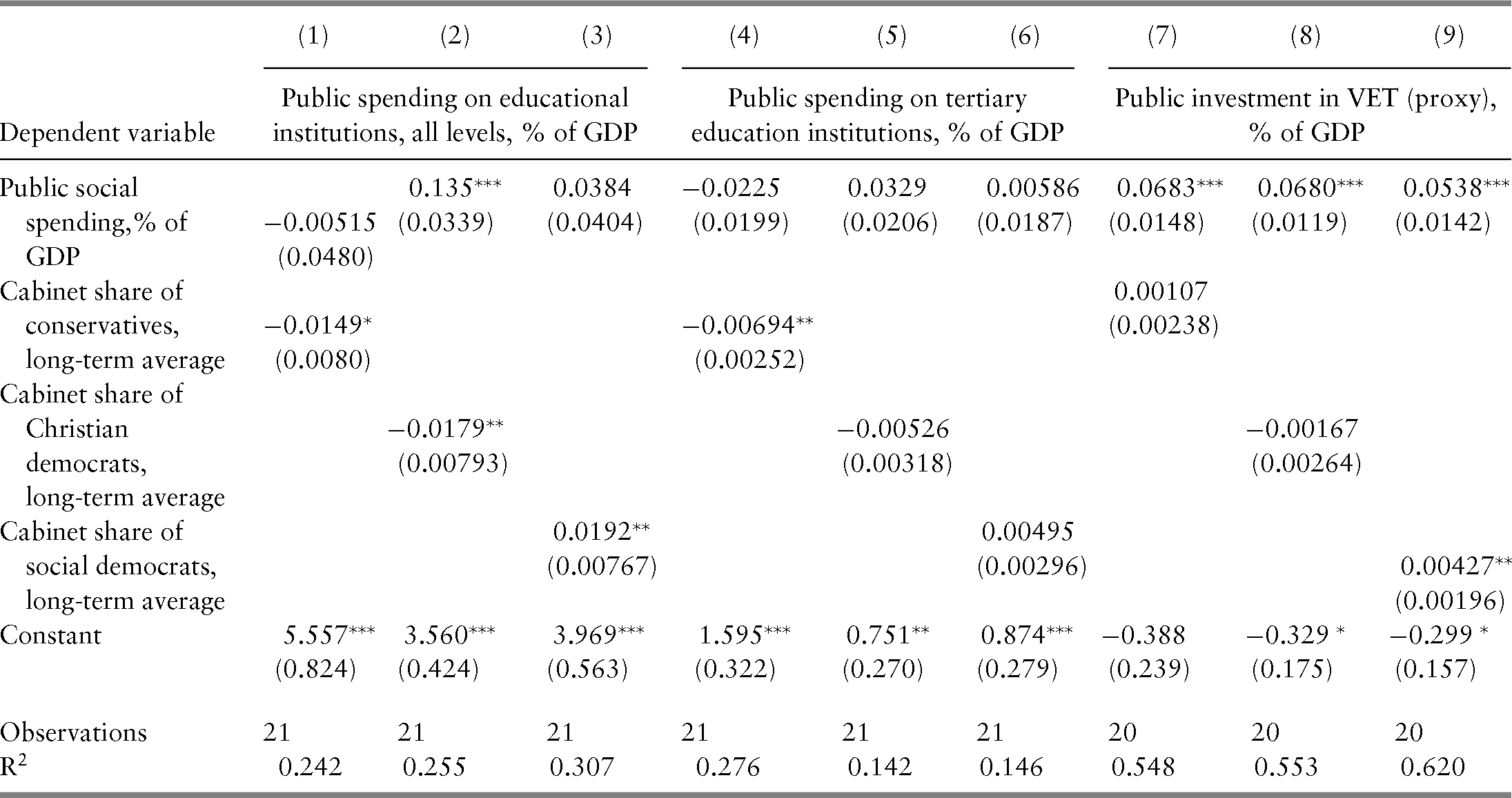
Robust standard errors in parentheses
*** p < 0.01, ** p < 0.05, * p < 0.1
Mirroring previous findings in the literature (Ansell Reference Ansell2010; Boix Reference Boix1997, Reference Boix1998; Busemeyer Reference Busemeyer2007, Reference Busemeyer2009b; Schmidt Reference Schmidt and Castles2007), I find a positive association between the cabinet share of social democrats and public spending on education (as percentage of GDP; Model 3). The positive association also holds in the case of public spending on VET (Model 9), but is less pronounced in the case of higher education (but see Busemeyer Reference Busemeyer2009b). In contrast to social democrats, the extensive government participation of conservative parties is associated with lower levels of public spending on education (Model 1), as well as lower public spending on higher education (Model 4). Christian democratic incumbency is also negatively associated with public spending for all levels of education (Model 2), but there is no statistically significant effect for public spending on higher education or VET (Models 5 and 8).
The strong left–right difference confirms the notion that partisan power is important not only for the division of labor between public and private financing (see above) but also with regard to the overall levels of public resources devoted to education (Busemeyer Reference Busemeyer2007; Castles Reference Castles1989; Schmidt Reference Schmidt and Castles2007). The absence of a significant association between Christian democracy and spending on VET and the presence of such an effect for social democracy should be interpreted with caution. First of all, the dependent variable is a proxy that is strongly influenced by overall levels of public spending on secondary education, which in turn is likely to reflect social democratic priorities on increasing spending. Second, Christian democrats are not necessarily in favor of increasing spending on VET as such, because any overreaching involvement by the state will risk marginalizing employers. Instead, the Christian democratic approach to VET is to promote employer involvement, which involves employers taking over a significant share of the costs (see the case study of Germany in Chapter 2).
I will now turn from the analysis of (de-)commodification and spending to an analysis of educational stratification, the second dimension identified in Figure 3.1.2Educational stratification is strongly related to differences in enrollment patterns at the upper-secondary and post-secondary level. Not surprisingly (since the OECD measure of educational stratification is based on students’ expectations of completing higher education), there is a strong negative association between the OECD measure and the share of an age cohort that enters academic higher education (the entry rate, see Model 1 in Table 3.5). There is also a positive association between the share of upper-secondary students in VET and educational stratification (Model 2) in a cross-sectional regression, but the association is weaker than in the previous case (see the negative and significant coefficient estimate of entry rate into tertiary type A in Models 1, 2, and 3). Furthermore, there is no statistical association between the share of upper-secondary students in VET and the entry rate into higher education (the bivariate correlation between the two is merely 0.06). The simple reason for this surprising nonassociation is that in some countries, notably the Scandinavian countries, vocational tracks at the upper-secondary level do not preclude students from moving on to academic higher education at the post-secondary level. In these countries, both the share of students in VET and entry rates into higher education are high. In continental European countries, by contrast, the possibilities that students on the vocational track have of moving into higher education are very restricted, because of the limitations of segmented secondary school systems (Ebner & Nikolai Reference Ebner and Nikolai2010; Nikolai & Ebner Reference Nikolai, Ebner, Busemeyer and Trampusch2012). It follows that we could expect a high share of students in apprenticeship-type schemes to be associated with high levels of educational stratification. Model 4 in Table 3.5 confirms this negative bivariate association, but the coefficient is not statistically significant once the entry rate into higher education is included as an additional control (Model 3). This might be because of the reduced number of country cases as a consequence of missing data. The positive effect of the share of upper-secondary education in VET remains significant, however, even when controlling for the entry rate into higher education.
Table 3.5 Educational stratification and enrollment patterns in upper- and post-secondary education, average values 1997–2008

Robust standard errors in parentheses
*** p < 0.01, ** p < 0.05, * p < 0.1
A simple summary measure for cross-country differences in enrollment patterns is the ratio of upper-secondary students in VET to the entry rate into tertiary type-A education (or tertiary enrollment rates). This variable indicates the importance of VET as a final stage in educational careers relative to higher education, taking into account the ease of transition from the vocational tracks at the upper-secondary level into higher education. As expected, this variable is a very strong predictor of differences in educational stratification (the t value is 5.96 and the share of explained variance (R2) is 0.5; see Model 5 in Table 3.5). As can be seen in Figure 3.6, educational stratification is particularly high in countries where transitions from vocational to higher education face high institutional barriers (e.g., in Germany or Switzerland). In contrast, levels of educational stratification are lower when access to higher education is very open (the liberal skill regime) or when transitions from vocational to academic higher education do not face institutional barriers or are even actively encouraged (the Scandinavian countries).

Figure 3.6 Educational stratification and the ratio of VET enrollment to the entry rate into higher education
Table 3.6 confirms the importance of partisan legacies for enrollment patterns at the upper- and post-secondary level. In Models 1 through 3, I include only partisan variables; in Models 3 through 6, I add economic coordination as a control variable. The importance of VET relative to academic higher education is lower in countries with a strong legacy of conservative partisan government (Models 1 and 4). Above-average government participation by Christian democrats, by contrast, is associated with VET playing a larger role in the education system relative to higher education (Models 2 and 5). These findings resonate well with the case studies by confirming a critical difference between Christian democrats and conservatives in their support for expanding VET as an alternative to academic higher education. Social democratic legacies do not have any significant effect (Models 3 and 6), because social democrats attempt to expand both educational opportunities in VET and higher education. When looking at the association between the combined cabinet share of Christian and social democrats on the one hand and the ratio measure on the other (Figure 3.7), we find a significant positive association. The privilege of VET over other forms of upper- and post-secondary education thus seems to depend not only on the presence of Christian democrats in government, but also on their ability to form formal or informal coalitions with social democrats in order to build sustainable cross-class coalitions.

Figure 3.7 Importance of VET relative to higher education and combined cabinet share of Christian and social democrats
Table 3.6 Partisan politics and enrollment patterns in upper- and post-secondary education (I)

Robust standard errors in parentheses
*** p < 0.01, ** p < 0.05, * p < 0.1
Table 3.7 presents the results from cross-sectional regression analyses of enrollment levels in various types of upper- and post-secondary education. Differences in enrollment are, of course, important determinants of public spending on education, since education is a personnel-intensive social service (Ansell Reference Ansell2010; Busemeyer Reference Busemeyer2007; Castles Reference Castles1989, Reference Castles1998; Nikolai Reference Nikolai2007; Wolf Reference Wolf2006; Schmidt Reference Schmidt and Castles2007). Conversely, it can be argued that when increasing education spending, policy-makers will eventually aim to expand access to higher levels of education, here referring to enrollment. As in the case of spending, there is a positive association between the long-term average cabinet share of social democrats and tertiary enrollment (Model 3 in Table 3.6; see Ansell Reference Ansell2010: 184; Busemeyer Reference Busemeyer2009b: 119, 121 for similar findings).
Table 3.7 Partisan politics and enrollment patterns in upper- and post-secondary education (II)

Robust standard errors in parentheses
*** p < 0.01, ** p < 0.05, * p < 0.1
Perhaps more interesting than the impact of social democracy are the effects of the various types of right-wing parties. As Ansell (Reference Ansell2008, Reference Ansell2010) has argued, the redistributive politics of public investments in higher education are complex. When access to higher levels of education is limited and class bias is prevalent, conservative right-wing parties may actually have an interest in increasing public spending on higher education, since in such a case this type of spending will have a regressive impact, favoring children from the upper-income strata (Ansell Reference Ansell2010: 194). Moving beyond the simple left–right dichotomy reveals important differences between Christian democratic and conservative education policy. First of all, there is no apparent relationship between the cabinet share of secular conservatives and tertiary enrollment (Model 1 in Table 3.7). This indicates that, unlike social democrats, conservative parties have not been actively promoting the opening up of access to higher education. Neither have they been uniformly opposing it, however, especially when a large share of the funding for higher education comes from private sources (the United States, Australia, New Zealand). Model 3 in Table 3.7, in contrast, documents a clearly negative association between tertiary enrollment and the cabinet share of Christian democrats. This association may admittedly be driven by the particular group of countries in which Christian democrats have been notably influential: Belgium, the Netherlands, Italy, Germany, Austria, and – to a certain extent – Switzerland. Even so, the Christian democratic opposition to the expansion of tertiary enrollment is obviously greater than that of the secular conservatives.
The simple reason for these differences between right-wing parties is that Christian democrats have chosen to channel the rising educational aspirations of the middle classes by expanding VET instead of privately funded higher education (see also Figure 3.8). The notion of a segregated and stratified secondary education system fits very well with the partisan ideology of an “organic society” (Van Kersbergen Reference Van Kersbergen1995: 186), in which various strata and societal groups contribute differently to the common good. Christian democrats are a less openly upper-class party than secular conservatives, because they strive to mediate and promote cross-class consensus. Instead of deliberately excluding children of the lower strata from education on principle (e.g., by expanding the private share of education financing), Christian democratic education policy strives to provide the “right” kind of education for future workers at the intermediate skill level. Nevertheless, the Christian democrats are a business-friendly party, especially in countries where they are the dominant right-wing political force, and thus expect VET to be designed in such a way that it meets the skill demands of business most effectively. This differentiates them from social democrats, who may be equally willing to promote VET as the more fitting type of education for their core electoral constituencies, but whose goal remains the promotion of educational opportunities, whereas Christian democrats are more interested in maintaining the supporting role of training for business interests.

Figure 3.8 Share of upper-secondary students in VET (average 1997–2008) and cabinet share of Christian democrats (1945–2000)
Figure 3.8 depicts the association between Christian democracy and the share of upper-secondary students in VET (both school- and workplace-based schemes). As in the case of tertiary enrollment, there is a particular group of countries that is driving this association: Germany, Austria, the Netherlands, Belgium, and Switzerland. Italy is an outlier, because even though Christian democrats were the dominant force there in the postwar decades, its VET share remains very low (as a reminder, tertiary enrollment is also exceptionally low in this country).
The differences within this group of countries can in part be explained by differences in the socioeconomic context with regard to labor-market institutions. Germany, Austria, and Switzerland are characterized by both strong Christian democratic parties and medium-to-high levels of economic coordination, particularly on the side of employers. The case study on Germany revealed that the Christian democrats pushed strongly for the establishment of a collective skill-formation system with dual apprenticeship training at its core.
The case of Denmark is a bit more ambiguous. On the one hand, it too is characterized by high levels of economic coordination, but on the other, the Christian democrats there are politically weak, as in other Scandinavian countries. There are several possible reasons for this. First, as Jensen (Reference Jensen2010) has argued, right-wing parties in countries with a strong or even dominant left respond by moving towards the political center and becoming more supportive of the welfare state. Historically, the Danish liberals were a strong driving force behind progressive education reforms (Wiborg Reference Wiborg2010). Compared to other countries, the liberals in Denmark were more open to cross-class compromises, primarily with the social democrats; they might in effect have played a role somewhat similar to that of the Christian democrats in other continental European countries. Second, the Danish social democrats were never as strong as their brethren in Sweden. Various attempts by Danish social democrats to introduce comprehensive education of the kind that came into being in Sweden failed because of the opposition of employers’ associations (Nelson Reference Nelson, Busemeyer and Trampusch2012: 194–5). Third, Denmark's economic structure, rooted in small and medium-sized enterprises, encouraged and enabled collective approaches to the problem of skill formation (Estévez-Abe et al.Reference Estevez-Abe, Iversen, Soskice, Hall and Soskice2001; Martin & Knudsen Reference Martin and Knudsen2010; Nelson Reference Nelson, Busemeyer and Trampusch2012). Cross-class alliances between employers and strong unions against statist and partisan interventions ensured the stability and survival of the apprenticeship system. Compared to the German system, however, the Danish system is more solidaristic and collective (Busemeyer Reference Busemeyer2012a,c; Martin & Knudsen Reference Martin and Knudsen2010; Nelson Reference Nelson, Busemeyer and Trampusch2012), because the institutional separation between vocational education and the general schooling and higher education systems is not as pronounced, and the link between initial VET on the one hand and continuing education and active labor-market policies on the other is much more institutionalized.
With regard to the Netherlands and Belgium, policy legacies of apprenticeship training were less entrenched there during the postwar years than in the German-speaking countries. In the case of Belgium, a French-inspired statist approach to education policy likely played a role in expanding school-based forms of VET. VET is still much more entrenched in Belgium than in France, however. In the Netherlands, workplace-based forms of apprenticeship were significantly expanded beginning in the early 1980s under the aegis of governments led by Christian democrats (Anderson & Oude Nijhuis Reference Anderson and Beramendi2012).
The outlier case of Italy can be explained by its complex territorial politics, as well as its conflict-ridden system of industrial relations. If this were about partisan politics in the narrow sense (i.e., without taking into account the institutional context), the long-term dominance of Christian democracy would lead us to expect a strong apprenticeship system and an underdeveloped higher education system. The latter expectation fits empirical reality, since Italy lags behind other European countries with regard to tertiary enrollment. But apprenticeship training and VET in general remain equally underdeveloped in Italy, as can be seen from the data in Figure 3.8. One important explanation for this is the massive differences between northern and southern Italy with regard to economic development and the associated conflicts over cross-regional redistribution (Glassmann 2014). It is telling that in the north, where levels of economic coordination and the potential for cross-class cooperation are generally higher and the business structure is rooted in small and medium-sized enterprises, dual-type apprenticeships are far more widespread than in the south (Crouch et al.Reference Crouch, Finegold and Sako1999: 165). A further factor is the relative strength of the Communist Party in the postwar era, which split the left in the areas of politics and the labor market. Conflicts between employers’ associations and communist trade unions prevented the formation of the sustainable cross-class coalitions at the national level (although some were feasible at the regional level) that would have been needed in order to establish a comprehensive framework for VET. Interestingly, and in line with theoretical expectations, the Christian democrats passed a law on apprenticeship training in 1955, with provisions for on-the-job training and lower salaries for trainees. The law did not increase employer involvement in VET, however, because the union-dominated labor exchanges meant that employers were severely restricted in their choice of apprentices (Bonoli Reference Bonoli2013: 99, 111). Hence, Italian Christian democrats did try to expand apprenticeship training, but failed because the socioeconomic context prevented the formation of lasting cross-class coalitions above the regional level.
I will move next from partisan politics to the socioeconomic context. Labor-market institutions are a particularly important context factor with regard to VET. The VoC literature argues that there are important institutional complementarities between collective wage bargaining and skill formation (Hall & Soskice Reference Hall, Soskice, Hall and Soskice2001). Labor-market economists such as Acemoglu & Pischke (Reference Acemoglu and Pischke1998, Reference Acemoglu and Pischke1999) have seconded this claim. Their argument is that because the centralization of wage bargaining leads to lower levels of wage inequality (Wallerstein Reference Wallerstein1999), firms are more likely to invest in skill formation, since they can later recoup part of what they have invested in training from the skilled workers with firm-specific skills who are willing to remain with them. Collective wage bargaining also forces firms to invest in the skills of the low-skilled in order to increase their productivity (Streeck Reference Streeck1989). As expected, there is a strong and clear positive association between the level of economic coordination and the share of apprenticeship training (Models 7, 8, and 9 in Table 3.7 and Figure 3.9).3 As levels of coordination increase, employers are more likely to get involved in skill formation, in the form of apprenticeship training. Denmark and Switzerland are outliers because their level of employer involvement is higher than would be expected given their level of coordination. This is most likely due to the structure of their business interests (i.e., a large share of small and medium-sized firms) and policy legacies. What is more, there is a positive association between economic coordination and the general share of students in VET at the upper-secondary education level (Models 4, 5, and 6 in Table 3.7), but this effect is not statistically significant (even when the partisan variables are dropped from the regression). This indicates that coordination is particularly relevant for those types of VET that depend on a high degree of employer involvement. Finally, there is a negative association between economic coordination and levels of enrollment in tertiary education, as could be expected given the demand for vocational skills relative to academic education is higher in CMEs. Again, however, this effect is not statistically significant.

Figure 3.9 Economic coordination and the apprenticeship training share
Multivariate regression analyses
The following time-series cross-sectional analyses provide a further robustness test of the central claims developed in this and the previous chapter. The methodological literature has featured much discussion on the benefits and downsides of using this method (Beck & Katz Reference Beck and Katz1995, Reference Beck and Katz1996; Kittel Reference Kittel2006; Kittel & Winner Reference Kittel and Winner2005; Plümper et al.Reference Plümper, Troeger and Manow2005; Plümper & Troeger Reference Plümper and Troeger2007). The method gained popularity so quickly because it seemed to show a potential way out of the typical problem in comparative public policy research of having too few cases and too many variables. But there are problems with using panel data that consist of country-year observations. The most common ones are the serial correlation of error terms within countries (what happens in country X at time t strongly depends on what happened at t − 1), contemporaneous correlation of country cases, and panel heteroskedasticity (differences in over-time variation within countries). Beck & Katz (Reference Beck and Katz1995, Reference Beck and Katz1996) proposed calculating “panel-corrected standard errors” to deal with cross-country correlation and panel heteroskedasticity. They also advised including a lagged dependent variable to take care of the problem of serial correlation. This “Beck–Katz standard” was later criticized on various fronts (Plümper et al.Reference Plümper, Troeger and Manow2005). The inclusion of a lagged dependent variable typically depresses the explanatory power of the other independent variables (Achen Reference Achen2000). The inclusion of variables that are largely time-invariant also poses problems (Plümper & Troeger Reference Plümper and Troeger2007), particularly when they are combined with country dummies (fixed effects) that are supposed to control for country-specific characteristics that are not picked up by the other independent variables (such as “culture” in a very general sense). Finally, some important variables studied by welfare-state scholars, such as social spending, are nonstationary: they trend upwards (or downwards, for that matter) over time, which leads to wrong coefficient estimates (Kittel & Winner Reference Kittel and Winner2005). Given these problems, I will use different model specifications in the following section according to which characteristics of the data are to be analyzed. The standard model specification is to calculate panel-corrected standard errors and to model serial correlation in the error term with an AR(1) process. In cases where longer time-series data are available, I run an error-correction model and/or include a lagged dependent variable. The time period in this section can be slightly extended in comparison to the cross-sectional regressions. The OECD does provide data on the public/private division of labor in education financing for a number of countries (e.g., Australia, Canada, Denmark, Japan, the Netherlands, Spain, Sweden, and the United States) for some years before 1997. The same holds for enrollment shares in VET (for which some data for the first half of the 1990s are available for Australia, Austria, Belgium, Denmark, Finland, France, Germany, Italy, Japan, the Netherlands, Norway, Spain, Sweden, and the United Kingdom). I perform linear interpolation for these cases in order to increase the number of observations, but given the limited coverage, it is not advisable to extend the time period to the early 1990s in order to calculate averages. The panel is therefore unbalanced.
The determinants of different types of education spending have by now been analyzed extensively in the literature (Ansell Reference Ansell2008, Reference Ansell2010; Boix Reference Boix1997, Reference Boix1998; Busemeyer Reference Busemeyer2006, Reference Busemeyer2007, Reference Busemeyer2008, Reference Busemeyer2009b; Castles Reference Castles1989, Reference Castles1998; Jensen Reference Jensen2011; Nikolai Reference Nikolai2007; Rauh et al.Reference Rauh, Kirchner and Kappe2011; Schmidt Reference Schmidt2002, Reference Schmidt and Castles2007; Wolf Reference Wolf2006, Reference Wolf2009; Wolf & Zohlnhöfer Reference Wolf2009). For the purpose of the present chapter, the most important finding from this literature is that partisan politics matters – but only to a certain extent. Left partisanship has a positive impact on public education spending, but this effect is most obvious when long-term averages and large cross-national differences are studied (as in the previous section). The short-term effects of left partisanship are less clear-cut, except in the case of higher education, where social democratic government participation does have a positive impact in both the long- and the short-term (Busemeyer Reference Busemeyer2009b). Ansell (Reference Ansell2010) explains this pattern by a shift in partisan preferences once a critical threshold in enrollment has been reached. When higher education systems are elitist, the left does not increase spending on higher education, but this effect reverses when access to higher education opens up.
Because of the focus on spending in the existing literature, in the present chapter I look at the division of labor between public and private sources of funding and at enrollment patterns, since these two elements are most closely related to the two central dimensions of variation identified above. There is, of course, a positive association between spending and enrollment, but it is not as strong as one would expect (see above). There are also other reasons for the focus on enrollment instead of spending; spending data are not available, or, in the case of VET, can only be estimated via proxy. In order to keep the analyses consistent with each other, I therefore focus on enrollment in higher education as well. In the case of higher education, high-quality data on spending are available back to the early 1990s. UNESCO provides data on gross tertiary enrollment extending back to the early 1970s. In this case, then, it is possible to study a longer time period.
Before I present the findings, some brief remarks on the operationalization of partisan effects are in order. For the multivariate regressions, I rely on data on the partisan composition of governments provided by Armingeon et al. (Reference Armingeon, Engler, Potolidis, Gerber and Leimgruber2011). Their Comparative Political Data Set includes data on the cabinet share of left, center, and right parties. Center parties are mostly Christian democratic parties, especially in European countries. I nevertheless decided to recode the dataset in a few cases: Armingeon et al. (Reference Armingeon, Engler, Potolidis, Gerber and Leimgruber2011) consider the left-wing parties of Canada and the United States to be centrist parties rather than left parties. I recoded these as left parties. Conversely, the center-right coalition that governed Spain in the late 1970s and then again in the late 1990s was recoded as a right-wing government party. The recoded variable on the cabinet share of centrist parties thus captures the effects of Christian democrats in government more precisely.
I again start with an analysis of the private share in education funding as an indicator of (de-)commodification in education policy (Table 3.8). As was shown in Figure 3.4, I find a robust and statistically significant negative association between levels of public social spending and the private share in education spending. This relationship should be interpreted as an empirical correlation rather than a causal relationship, since the underlying causal mechanisms are not yet clear (but note that Chapter 5 will probe the association between education and the welfare state at the micro-level of attitudes and preferences). Interestingly, there is no such association between the total level of public spending on education and the private share, although it could have been expected that the degree of public investment in the education system would be more important than the size of the welfare state. I also find a negative and significant association between the private share in education spending and the entry rate into tertiary type-A education. Here it is important to remember that the regression analyses also pick up cross-national differences, since in order to be able to include time-invariant variables, such as the degree of coordination, I do not use country fixed effects. Furthermore, the causal relationship between these two variables is more likely to run from private financing to the openness of tertiary education than the other way around. This finding should be interpreted with caution, especially as it vanishes in the case of tertiary education (Models 5 to 8), where it should have been stronger. This could indicate the existence of a tradeoff between the openness of access in higher education and the extensiveness of private financing, at least for the contemporary period. Following Wolf (Reference Wolf2009), I include union density as an additional predictor of the private share of spending. As expected, there is a negative association between union density and the private spending share. A more powerful union movement would be likely to push the government to promote public instead of private investment in education, in order to promote educational mobility and maintain the openness of access to education.
Table 3.8 Determinants of private share of education spending, 1993–2008, panel-corrected standard errors and panel-specific AR(1) error correction


Standard errors in parentheses
*** p < 0.01, ** p < 0.05, * p < 0.1
With regard to our main variables of interest, I find a positive association between the government participation of conservatives and the private share in education spending, with regard to both spending on all levels of education (Model 1) and spending on tertiary education only (Model 5). The predicted effect of a change in government from one without conservative participation to a completely conservative one amounts to 2.96 percentage points for spending on all levels of education and 8.36 percentage points for spending on higher education (the average in the sample is 11.1 percent in the former case and 23.9 percent in the latter). Comparatively speaking (as a share of a standard deviation), the effect is larger in the case of spending on higher education. Conversely, the government participation of social democrats has a significant and negative effect on the private spending share. In terms of magnitude, the size of the effect is only about half that of the conservative effect in the case of spending on higher education (Model 7), but it remains statistically significant. There is no statistical association between the government participation of Christian democrats and private spending for all levels of education (Model 2). There is a significant negative effect for the case of spending on higher education, however, which in terms of magnitude is much larger than the effect of social democratic participation in government (a decrease of 9.6 percentage points in the case of a complete change in government, as above).
I also find a strong negative association between the degree of economic coordination and the private share of education spending (Models 4 and 8), which was not apparent in the simple cross-sectional regression analyses. But this finding should not be overinterpreted: because the degree of economic coordination does not vary over time, its significance is overestimated in cross-sectional time-series analyses such as these. Most likely the variable has picked up intrinsic differences between countries that are correlated to, but not necessarily conceptually the same as, economic coordination (similar to country fixed effects).
Table 3.9 presents an analysis of enrollment in tertiary education. The dependent variable is the gross level of enrollment in tertiary education, as defined by UNESCO. The definition of this variable covers the number of pupils or students enrolled in a given level of education, without taking into account the age of these students. This figure is then divided by the number of individuals (population) in a typical age cohort (five years following the official secondary graduation age). Enrollment levels can therefore be particularly high when a large share of the adult population attends higher education institutions. The measure also does not consider migration flows. Compared to the entry rate into tertiary education used above, this variable is thus less precise, but it has the advantage of being available for a longer period of time.
Table 3.9 Determinants of gross level of enrollment, 1971–2008, error-correction model with country fixed effects


Standard errors in parentheses
*** p < 0.01, ** p < 0.05, * p < 0.1
Because enrollment levels in tertiary education have been going up consistently in recent decades, there is a problem of non-stationarity: an upward trend in the dependent variable that biases the coefficient estimates. I employ an error-correction model (Beck Reference Beck1991) in order to deal with this problem. In this model specification, the dependent variable is not given in levels, but in first differences (annual change in enrollment from one year to the next). Independent variables are included in two ways: first, as lagged levels whose coefficient estimates capture the long-term trend in the association between this variable and the dependent variable; and second, as first differences (annual changes), which indicate the short-term effects of the particular variable. Error-correction models have become quite popular in comparative welfare state research and political economy (e.g. Busemeyer Reference Busemeyer2009b; Iversen & Cusack Reference Iversen and Cusack2000; Kaufman & Segura-Ubiergo Reference Kaufman and Segura-Ubiergo2001) because they are effective in dealing with the problem of nonstationarity and they allow us to differentiate between long- and short-term effects. Their applicability depends on the availability of sufficiently long time series, however, as well as sufficient over-time variation in the dependent variable (otherwise the independent variables would have no variation to explain). I present the findings below, first using an error-correction model with country fixed effects and then with a more conventional model specification.
I include a number of control variables in addition to partisan variables. More specifically, I include public spending as percentage of GDP. This variable captures the overall size of the public sector, given that the size of the welfare state has been identified as an important positive determinant of levels of public education spending (Busemeyer Reference Busemeyer2007). The share of the population aged 65 and above captures demographic characteristics. I expect these to have a negative impact on levels of enrollment because older societies tend to invest less in education (Cattaneo & Wolter Reference Cattaneo and Wolter2007). I also include the share of employment in services relative to other employment sectors. Structural changes of the economy (deindustrialization) have been identified as major driving forces of welfare state expansion (Iversen & Cusack Reference Iversen and Cusack2000), and it is likely that they are also driving participation levels in higher education. The causality in this particular case could range from the expansion of higher education to the growth of services, but at this point I am less interested in causality than in correlation. From a theoretical perspective, the most important independent variable is the partisan composition of governments. Since there are good reasons to assume that policy-makers’ influence on levels of enrollment is less direct than in the case of spending, I use moving averages of the cabinet shares. More specifically, for each country-year, I calculate the five-year average cabinet share of social democrats, applying weights such that the more recent period has a larger influence on the calculation of the average.4
Considering the findings in Table 3.9, it is first interesting to note that none of the control variables seems to have a strong impact. This is most likely due to the limited degree of over-time variation in the dependent variable. The preliminary findings of the bivariate analyses with regard to the impact of right-wing government parties are largely confirmed, however: there is no statistical association between the cabinet share of conservative parties and changes in the level of enrollment (Model 1), but there is a significant negative effect from the government participation of Christian democrats. The predicted long-term effect of a change in government from one without any Christian democrats to one made up purely of Christian democrats is a decrease in tertiary enrollment by 22 percentage points.5 The average in the sample is 42 percent with a standard deviation of 21, meaning that the magnitude of the effect is roughly one standard deviation.
Somewhat surprisingly, there is no statistical association between left-wing government and tertiary enrollment (Model 3), which is at odds with the findings in the literature. As it turns out, however, this non-finding hinges entirely on the classification of North American left-wing parties as either centrist or left. When I use a more narrow definition of left partisanship that excludes North American parties (Model 4), I find a significant positive long-term effect, whose statistical significance actually increases when the sample is restricted to the more recent period (results not shown here). Based on Model 4, the predicted long-term effect of a change in government from one without social democrats to one made up purely of social democrats is an increase in tertiary enrollment of 15 percentage points, keeping in mind that these are gross levels of enrollment.
Table 3.10 presents the results of an additional analysis employing a different and perhaps more common model specification (panel-corrected standard errors in combination with a lagged dependent variable; see Beck & Katz Reference Beck and Katz1995, Reference Beck and Katz1996). I also restrict the sample to the more recent period (1993–2008), since both Ansell (Reference Ansell2010) and Busemeyer (Reference Busemeyer2009b) have argued that leftist partisan effects on enrollment are more relevant then. Model 1 of Table 3.10 seemingly confirms the non-association between left-wing governments, but when I use the more restrictive definition of left partisanship (Model 2), I find a positive and significant effect of left partisanship on enrollment. Instead of cabinet shares, Model 3 uses a single measure of government partisanship, which goes from 1 for a strong right-wing dominance to 5 for a strong left-wing dominance. The positive (and significant) effect of this variable indicates that government partisanship is indeed an important determinant of levels of tertiary enrollment. Correcting for the depressing impact of the lagged dependent variable, as suggested by Kittel & Winner (2002: 18), the predicted long-term increase in enrollment resulting from a move from a right-wing to a left-wing government is 23 percentage points, which is similar to the estimates from the previous models. We can see from this that above and beyond the association between long-term averages of partisan control of the government and education policy indicators documented in the cross-sectional regressions, it also possible to identify a short-term effect of partisanship, at least in the case of enrollment.
Table 3.10 Regression analysis: left-wing government and gross enrollment levels in tertiary education, 1993–2008, panel-corrected standard errors with lagged dependent variable

Standard errors in parentheses
*** p < 0.01, ** p < 0.05, * p < 0.1
Data on enrollment in different types of VET are much less readily available than enrollment data for tertiary education. UNESCO provides data on upper-secondary students in technical and vocational education that are widely used in the literature (Ansell Reference Ansell2010; Cusack et al.Reference Cusack, Iversen and Rehm2006; Estévez-Abe et al.Reference Estevez-Abe, Iversen, Soskice, Hall and Soskice2001; Iversen & Soskice Reference Iversen and Soskice2001). The problem with these data is that they do not distinguish between the different types of VET: school-based and workplace-based (apprenticeship). This distinction is crucial for our argument. The OECD data, albeit not perfect, are superior to the UNESCO data in this respect. Unfortunately, these are only available for a relatively short time period. Coverage in the early and mid-1990s is spotty, improving only for the late 1990s. Thus, for the case of VET, it will not be possible to use sophisticated model specifications such as the error-correction model. Also, there is very little variation over time; most of the variance is cross-sectional, such that when we include a lagged dependent variable and/or country fixed effects, all other independent variables lose any explanatory power. The following models therefore use levels for both the dependent and the independent variables. Serial autocorrelation in the error term is corrected by employing an AR(1) process. As before, I calculate panel-corrected standard errors and use a similar set of control variables. The only difference is that I pay more attention to measures of economic coordination. I include both the more encompassing measure of economic coordination of labor relations, provided by Hall & Gingerich (Reference Hall and Gingerich2009), and a more narrowly defined measure of the centralization of collective wage bargaining (Visser Reference Visser2011). The expectation is that high levels of coordination/centralization will be associated with high levels of enrollment in VET, particularly apprenticeship training. I first analyze the determinants of the share of upper-secondary students in VET (both school- and workplace-based; Table 3.11), then look at the share in apprenticeship training (Table 3.12).
Table 3.11 Determinants of levels of enrollment in VET, 1993–2008, panel-corrected standard errors and panel-specific AR(1) error correction


Standard errors in parentheses
*** p < 0.01, ** p < 0.05, * p < 0.1
Table 3.12 Determinants of levels of enrollment in apprenticeship training, 1993–2008, panel-corrected standard errors and panel-specific AR(1) error correction


Standard errors in parentheses
*** p < 0.01,** p < 0.05,* p < 0.1
Table 3.11 confirms the positive association between economic coordination, centralized collective wage bargaining, and general levels of enrollment in VET. The predictive power of the VoC indicator is much stronger than the narrowly defined measure of wage-bargaining centralization (Models 1, 3, and 5 versus models 2, 4, and 6). Based on these estimates, the predicted difference in the share of upper-secondary students in VET between a pure LME (the United States or the United Kingdom) and a strong CME (Germany, Austria) lies somewhere between 25 and 30 percentage points. Models 1 and 2 also document the positive association between Christian democratic participation in government and levels of enrollment in VET. The government participation of social democrats or conservatives, by contrast, does not seem to have any effect. The predicted change in enrollment resulting from a change of government to Christian democrat is between 6.2 (Model 1) and 9.7 percentage points (Model 2). Compared to the bivariate analyses above, then, the multivariate regressions reveal in a much clearer way the particularly important role of Christian democratic parties as driving forces of the expansion of VET relative to other types of education.
In Table 3.12, I look at the determinants of the share of upper-secondary students in apprenticeships. The size of the sample is unfortunately reduced significantly because this variable is only available for a smaller set of countries, and it is even further reduced compared to the cross-sectional analyses above because of missing data for some control variables (e.g., the VoC indicator). The findings should thus be interpreted very carefully. Somewhat surprisingly, the control variables perform better than in the case of total enrollment in VET. Given that school-based VET is an integral part of the universal Nordic model of education, I would have expected a much stronger relationship between the size of the public sector and general levels of enrollment in VET. This positive association is somewhat stronger (and in some cases statistically significant) in the case of apprenticeship training. The fact that GDP growth has a stronger effect on apprenticeship training than on general levels of enrollment in VET is more easily explained, because workplace-based training schemes are more dependent on general economic conditions. The negative effect is again surprising, however, since we could expect enrollment in apprenticeship to increase when economic conditions are favorable.
With regard to partisan politics, the most important thing to note is the difference of effects between rightist and centrist (Christian democratic) government. Whereas conservative government participation has a negative and statistically significant effect on the share of students in apprenticeship training, Christian democratic government participation is positively associated with the share of apprenticeship training (Models 2 and 4). When we simulate changes in government similar to those above, the predicted decrease in the share of apprenticeship training resulting from a change to a conservative government is 2.25 percentage points, whereas Christian democratic government is associated with an increase of 7.5 percentage points.
Economic coordination again has a positive effect on the share of apprenticeship training, but there is no statistical effect for wage-bargaining centralization. When the VoC indicator is included, partisan effects turn insignificant because they are dominated by this variable (the bivariate correlation between the VoC index and Christian democratic government share is 0.38). The predicted difference in the share of apprenticeship training between a pure LME and a pure CME is roughly 40 percentage points, which comes close to the real-world difference between Denmark (47.5 percent) and Ireland (5 percent).
Summary and conclusion
This chapter has continued to explore the variation of education and training systems. Like welfare state regimes, education and training systems can be grouped roughly into three clusters: the liberal, the statist, and the collective skill regime. Southern European countries might form a distinct fourth cluster of their own, but the evidence is not conclusive in that respect. Partisan politics and economic coordination have been identified as important determinants of the variation of education systems, both in cross-sectional regressions using long-term averages and in cross-sectional time-series analyses. Conservative government parties are more likely to increase the private share of education financing and decrease the share of apprenticeship training in upper-secondary education. Christian democrats in government, by contrast, are more likely to expand apprenticeship training and to lower enrollment in tertiary education. Finally, social democratic governments are associated with a lower share of private spending in education and a higher share of enrollment in tertiary education. Economic coordination matters most in determining the relative importance of VET – and especially apprenticeship training – as an alternative educational pathway to academic higher education.
1 Unfortunately, the OECD does not provide direct data on public spending on VET. I had to construct a proxy variable instead, which is the share of upper-secondary students in VET multiplied by public spending on all forms of upper-secondary education (as percentage of GDP). In order for the proxy to work, I had to assume that per capita spending for VET and general upper-secondary education is the same (or at least that asymmetries between the two are similar across countries). This measure is far from perfect, but the country values are largely those one would expect given the evidence from the case studies. For the case of the United States, I have inserted a value of zero manually, since the secondary education system does not have a dedicated vocational track. This is done to avoid losing a case. Excluding the case of the United States does not fundamentally affect the results, although the effect of social democracy is somewhat weaker, as could be expected. There is still missing data for New Zealand, such that the number of cases is reduced from 21 to 20 in Models 6 to 9 in Table 3.4.
2 The number of cases is reduced due to missing data on the entry rate into tertiary type-A education (missing for Canada, France) and the share of upper-secondary students in apprenticeships (missing for Australia, Italy, Japan, New Zealand, Portugal, and the United Kingdom). Data are also missing on the share of upper-secondary students in VET (for both school-based VET and apprenticeship) in New Zealand and the United States. Given the well-known properties of the secondary education systems in these countries, I have manually inserted a value of 0 for some of the quantitative analyses below, but not for the cross-sectional regressions. The Hall–Gingerich indicator of economic coordination is not available for Greece, which leads to a further reduction of cases in some analyses.
3 Unfortunately, the number of cases is reduced significantly in these models because the OECD only provides data on the share of apprenticeship training for a limited number of countries, in part because of the complexity of VET schemes compared to other sectors of the education system (see above for details).
4 The most recent year receives a weight of 1, which is reduced by 0.2 for each successive year up until year five.
5 The long-term effect is calculated by dividing the coefficient of the lagged level variable by the absolute value of the coefficient of the lagged dependent variable; see Iversen & Cusack (Reference Iversen and Cusack2000: 330).


