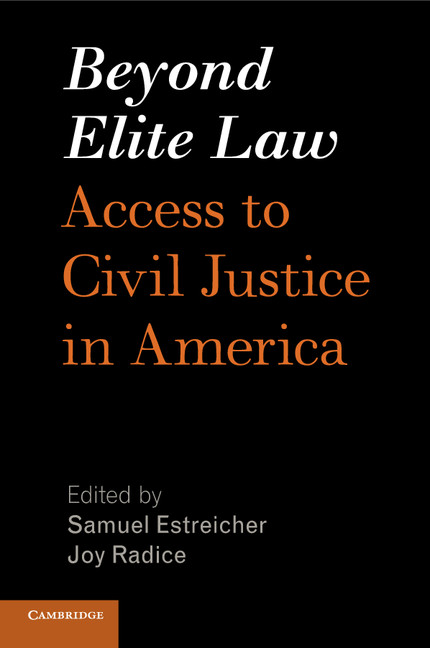
Beyond Elite Law

-
Select format
-
- Publisher:
- Cambridge University Press
- Publication date:
- 05 May 2016
- 26 April 2016
- ISBN:
- 9781107707191
- 9781107070103
- 9781107668621
- Dimensions:
- (228 x 152 mm)
- Weight & Pages:
- 1.14kg, 752 Pages
- Dimensions:
- (229 x 152 mm)
- Weight & Pages:
- 1.08kg, 758 Pages
- Subjects:
- US Law, Law, Legal Skills and Practice
You may already have access via personal or institutional login- Subjects:
- US Law, Law, Legal Skills and Practice
Show more authors 
You may already have access via personal or institutional login
Book description
Are Americans making under $50,000 a year compelled to navigate the legal system on their own, or do they simply give up because they cannot afford lawyers? We know anecdotally that Americans of median or lower income generally do without legal representation or resort to a sector of the legal profession that - because of the sheer volume of claims, inadequate training, and other causes - provides deficient representation and advice. This book poses the question: can we - at the current level of resources, both public and private - better address the legal needs of all Americans? Leading judges, researchers, and activists discuss the role of technology, pro bono services, bar association resources, affordable solo and small firm fees, public service internships, and law student and nonlawyer representation.
Reviews
‘This book significantly advances our understanding of the failure to provide most Americans the legal services needed to vindicate important rights and provides an attractive blueprint for addressing this serious social problem.’
Richard L. Revesz - Lawrence King Professor of Law and Dean Emeritus, New York University School of Law
‘The authors of this volume show powerfully how access to justice is essential. Justice for only those who can afford it is neither justice for all nor justice at all.’
Nathan L. Hecht - Chief Justice, Supreme Court of Texas
‘This volume is a moving and remarkable tribute to the hopes for American justice, even as many chapters detail current failings. Beyond Elite Law documents when and why millions of individuals lack the resources to pursue their claims of right and their needs for representation. Yet, instead of leaving readers disheartened, the editors include a panoply of reforms, enabling debate about which routes create fair and publicly accountable responses.’
Judith Resnik - Arthur Liman Professor of Law, Yale Law School
Contents
Contents
Metrics
Altmetric attention score
Full text views
Full text views helpTotal number of HTML views: 0
Total number of PDF views: 0 *
 Loading metrics...
* Views captured on Cambridge Core between #date#. This data will be updated every 24 hours.
Usage data cannot currently be displayed.
Accessibility standard: Unknown
Why this information is here
This section outlines the accessibility features of this content - including support for screen readers, full keyboard navigation and high-contrast display options. This may not be relevant for you.
Accessibility Information
Accessibility compliance for the PDF of this book is currently unknown and may be updated in the future.