

In the first scene of John Marston's comedy The Dutch Courtesan (1605), Freevill, a free-thinking law student, announces to his Puritan friend Malheureux that he is planning to visit a brothel. Malheureux is shocked and tries to talk him out of it:
freevill. […] not to disguise with my friend, I am now going the way of all flesh.
malheureux. Not to a courtesan.
freevill. A courteous one.
malheureux. What, to a sinner?
freevill. A very publican.
malheureux. Dear my loved friend, let me be full with you.
Freevill speaks in prose, Malheureux in verse. Unconstrained prose seems right for Freevill and formal verse right for Malheureux. But things get more complicated. At the end of his next long irreverent prose speech – a mock peroration in defence of prostitutes, punning on laying up and laying down, falling and rising – Freevill changes to rhymed verse:
freevill. […] Why do men scrape, why heap to full heaps join?
Malheureux responds in verse, before both return to speaking in prose. Malheureux sounds very different in prose – more like the slangy, if still indignant, law student that he is:
malheureux. Of ill you merit well. My heart's good friend,
freevill. Beauty is woman's virtue, love the life's music, and woman the dainties or second course of heaven's curious workmanship. Since, then, beauty, love, and woman are good, how can the love of woman's beauty be bad? And bonum, quo communius, eo melius. Wilt, then, go with me?
malheureux. Whither?
freevill. To a house of salvation.
malheureux. Salvation?
freevill. Yes, ’twill make thee repent. Wilt go to the Family of Love? I will show thee my creature: a pretty, nimble-eyed Dutch Tanakin; an honest, soft-hearted impropriation; a soft, plump, round-cheeked frow, that has beauty enough for her virtue, virtue enough for a woman, and woman enough for any reasonable man in my knowledge. Wilt pass along with me?
malheureux. What, to a brothel? to behold an impudent prostitution? Fie on't! I shall hate the whole sex to see her. The most odious spectacle the earth can present is an immodest, vulgar woman.
Marston is alternating prose and verse in a very flexible and skilful way, seemingly well aware of the expressive possibilities of the different forms and confident that an audience will recognise the change from one mode to another and make the appropriate inferences, even if subliminally.
Scholars have proposed a number of motivating factors in the choice of prose or verse in early modern English drama. Verse is ‘high’ style, prose is ‘low’.Footnote 3 Comedy and comedic scenes are suited to prose.Footnote 4 Kings, dukes, and nobles tend to speak in verse, while the middling sort (city merchants and tradesmen) and the lower orders speak in prose.Footnote 5 Matters of romantic love are dealt with in verse – characters otherwise speaking in prose often switch to verse within a speech when talking of love – while clowns and fools generally speak in prose.Footnote 6 Both patterns are evident in the exchanges between Bottom and Titania in A Midsummer Night's Dream, for example, where the infatuated fairy speaks verse and her ‘rude mechanical’ lover answers in prose.Footnote 7 Children, madmen, and characters for whom English is a second language typically speak in prose.Footnote 8 In King Lear Gloucester ‘as a nervous and rather ludicrous old man is given prose’, but when ‘blind’ or ‘tending Lear’ is given verse; Lear in his madness responds in prose.Footnote 9 Even in otherwise purely verse plays, proclamations and letters read aloud are in prose.Footnote 10 Choruses are always in verse; soliloquies often so, though not invariably – George Chapman has soliloquies in both mediums.Footnote 11 Reasoned argument is often in prose.Footnote 12 Jonas Barish singled out ‘rank, realism, and…risibility’ – lower rank, greater realism, and increased risibility – as the key factors in the choice to move to prose within a verse play in the period.Footnote 13 Douglas Bruster suggests that Marlowe develops a practice of using prose in mainly verse plays for passages of ‘resentment’, ‘reckoning’, and ‘ritual’.Footnote 14
In characterising the styles of prose as against verse, commentators then as now offer a range of epithets and general features. George Puttenham in The Art of English Poesy (1589) contrasts the musicality and intensity of verse with the plainness and prolixity of prose. In the hierarchy of modes, verse was clearly the higher. Puttenham writes that verse ‘is a manner of utterance more eloquent and rhetorical’ than ‘ordinary prose’.Footnote 15 Modern commentators note the ‘ordinariness’, ‘simplicity’, and ‘flat[ness]’ of prose.Footnote 16
The indications are that audiences in early modern English theatres could easily distinguish prose from verse in spoken dialogue. Some scholars argue that actors emphasised the difference by declaiming verse passages.Footnote 17 Characters sometimes remark on the change from prose to verse in another's dialogue. After a prose exchange in As You Like It between Rosalind and Jacques, Orlando enters and speaks a single iambic pentameter, ‘Good day and happiness, dear Rosalind’ to which Jacques retorts, ‘Nay, then, God b'wi'you, an you talk in blank verse’ before he exits (4.1.28–30). Just before the previously cited passage in The Dutch Courtesan, Freevill is asked what happened in a tavern brawl that evening, and starts his reply: ‘In most sincere prose, thus’ (1.1.11). In Chapman's comedy The Widow's Tears, Tharsalio brings the loquacious Lycus down to earth after the latter has offered a long-winded verse account of his own sorrow with the rejoinder: ‘In prose, thou wept'st’ (4.1.48).
Printed texts retained the familiar manuscript conventions of lineation and capitalisation for verse, although modern editors sometimes feel the need to vary from a particular compositor's arrangement. For instance, Mercutio's ‘Queen Mab’ speech in Romeo and Juliet is set as prose in the 1623 Folio text (TLN 510–44),Footnote 18 evidently to save space, but modern editors invariably render the passage as verse. Hal's speech at the end of Act 2, Scene 2 in 1 Henry the Fourth – beginning ‘Got with much ease’ – is set out as prose in the 1598 Quartos and in the Folio (TLN 841–6).Footnote 19 Alexander Pope, who remarks in the preface to his 1725 Shakespeare edition that ‘Prose from verse [the Folio editors] did not know, and they accordingly printed one for the other throughout the volume’, prints the speech as verse.Footnote 20 This is followed in many, but not all, modern editions.Footnote 21
Shakespeare's practice in prose and verse dialogue has been studied intensively. Books on Shakespeare's language usually have a section on verse and prose, and there are numerous specialised studies.Footnote 22 Work on other dramatists is less developed, with the exception of Barish's magisterial book on Jonson's prose, but a number of intriguing instances of the alternation between prose and verse have been noted, such as the case from The Dutch Courtesan discussed above. For example, Akihiro Yamada discusses Chapman's practice in The Widow's Tears, in which the playwright reserves verse for sections drawing directly on his classical source, and prose for passages composed independently. Douglas Bruster considers the case of an early anonymous play, (The Rare Triumphs of) Love and Fortune (1582), which uses prose exclusively and consistently for the more dignified of the gods, with doggerel for the more comical Vulcan, the lame god of fire married to the unfaithful Aphrodite.Footnote 23
Bruster identifies four phases in the use of verse and prose in English plays through to c.1600. According to Bruster, medieval plays were composed exclusively in verse, but humanist playwrights in the mid sixteenth century began to write prose plays as well, reserving this mode mostly for comedies. In the late 1570s and 1580s, individual plays began to include a ‘sporadic mingling’ of the two modes, often by including proclamations and letters in prose in a play otherwise in verse. Finally, alternating prose and verse emerged as an important part of the ‘world-picturing system’ of the plays. This development is ‘inaugurate[d]’ by Christopher Marlowe's Tamburlaine plays and taken to new heights of expressivity in Shakespeare's plays.Footnote 24
The full system as Bruster describes it goes beyond the association of ‘low’ comic scenes with prose and ‘high’ aristocratic scenes with verse, and allows some characters the capacity to move between the modes, ‘depending upon context and situation’. Characters such as Hal and Hamlet cross between prose and verse as part of a display of the ‘flexibility of the self’ which seems to be characteristic of early modern writing.Footnote 25 Bruster suggests this may reflect the convergence of playwright and the planning, arranging main character, both of whom need to make skilful transitions from one mode to the other.Footnote 26 The alternation of prose and verse is thus one of the key elements in creating the three-dimensionality of the Shakespearean stage world: meaning along a number of different axes is created by the powerful short-hand of prose contrasted with verse, and vice versa.
Bruster ends his account with the close of the sixteenth century and Shakespeare's accomplished handling of alternating prose and verse within a play, but in the next century playwrights such as Ben Jonson abandoned the mixture and reverted to all-prose and all-verse drama.Footnote 27 After 1614 Thomas Middleton abandoned prose comedy, and the next generation of comedy writers – among them Philip Massinger, John Fletcher, and James Shirley – avoid prose almost entirely.Footnote 28 Barish argues that ‘the triumph of prose as the language of comedy, and its convergence with realism, seem by hindsight an almost inevitable outcome of the history of the genre’,Footnote 29 but this broader historical trend is not necessarily apparent everywhere in early modern English drama. A tally of early modern comedies suggests that the association of comedy and prose does not mean that prose is the normal medium for a comedy. There are at least as many all-verse comedies in the period as all-prose ones. There are more comedies with a mixture of the two modes than either. Prose and verse are obviously different, on stage and on the page, but it is hard to generalise about them and get a sense of how much they matter and how they are used in any systematic way.
Seven Shakespearean Characters
As already noted, it is common for individual characters to move between verse and prose in the drama. Shakespeare in particular exploited this possibility in his plays of the late 1590s and early 1600s. Bruster names Hal in the two Henry the Fourth plays, Hamlet, Iago, King Lear, Duke Vincentio in Measure for Measure, and Portia in The Merchant of Venice as the most important examples.Footnote 30 How different is the prose part from the verse one in each case, and is there a consistent difference? We begin by assembling texts of their speeches, sorted into prose and verse parts. Table 2.1 gives the total words spoken in prose and verse for each character.
Table 2.1 Prose and verse parts for seven Shakespearean characters
| Character | Play | Total words (prose) | Total words (verse) |
|---|---|---|---|
| Prince Henry | 1 Henry the Fourth | 2,776 | 1,672 |
| Prince Henry | 2 Henry the Fourth | 877 | 1,463 |
| Hamlet | Hamlet | 5,165 | 6,367 |
| King Lear | King Lear | 2,082 | 3,399 |
| Duke Vincentio | Measure for Measure | 1,761 | 4,831 |
| Portia | The Merchant of Venice | 762 | 3,869 |
| Iago | Othello | 2,335 | 6,007 |
We generate word-frequency counts for the top 100 most frequent function words across all of the dialogue samples.Footnote 31 To account for the difference in sample size, proportions for each word in every sample are derived from the word-frequency counts. We then project these proportions for each sample into a two-dimensional space using Principal Components Analysis (PCA), treating the scores on the first and second principal components as Cartesian coordinates defining each segment as a point on a scatterplot (Figure 2.1).

Figure 2.1 PCA scatterplot of prose and verse parts for 7 Shakespearean characters using the 100 most frequent function words.
Evidently, Portia's prose part is very different in word use from all the other dialogue samples, and the first principal component (PC1) singles out this difference as the most important factor in the data: the prose marker for Portia is plotted far to the lower end of PC1. PCA provides a figure for the fraction of the total variance accounted for by each of the components: PC1 in this case accounts for approximately 32 per cent, and the second principal component (PC2) roughly 21 per cent, together accounting for ∼53 per cent. The strong PC1 effect can be explained by the fact that Portia has only a small portion of dialogue in prose (at 762 words; see Table 2.1), confined to her exchanges with Nerissa discussing the merits or otherwise of her suitors in ‘light-hearted banter’.Footnote 32 This small and specialised sample stands out among the fourteen verse and prose parts, and if we examine the biplot of the PCA data to visualise the word-variable loadings (Figure 2.2), we see that he, his, him, and them are among the heavily weighted words to the lower end of PC1. This is where the prose part of Portia's dialogue is plotted, reflecting the unusually high incidence of these words in Portia's prose speeches to Nerissa as she contemplates the series of eligible males who visit Belmont to try their hand at the casket test devised by her father. For example, Portia dismisses the Neapolitan prince as ‘a colt indeed, for he doth nothing but talk of his horse, and he makes it a great appropriation to his own good parts that he can shoe him himself’ (1.3.39–41, emphasis added).

Figure 2.2 PCA biplot of prose and verse samples from 7 Shakespearean characters, using the 100 most frequent function words, highlighting the 48 most weighted word-variables.
Plural forms dominate the highly weighted word-variables on PC2 in Figure 2.2, the y-axis – words such as are, we as a true plural (as opposed to a royal plural), them, these, and their. The dialogue samples plotted to the high end of PC2 are distinguished by considering groups rather than individuals. In these passages, characters generalise and make observations on behaviour – often satirical ones. T. S. Eliot's term ‘sardonic comment’ for Hamlet's prose speeches is apt.Footnote 33 Plotted highest of all is Lear's prose part, which includes his speeches deploring human frailty and corruption: ‘When we are born, we cry that we are come to this stage of fools’ (4.5.171–2, emphasis added).
To the low end of PC2 are two old-fashioned words: that as a conjunction, which is often used in earlier texts and omitted in later ones, and hath. The lowest-weighted of all is shall, used in orders and discussion of the future. There are also three prepositions – by, on, and to – associated with specificity and detail. In these dialogue samples, characters give orders and concern themselves with detailed reports and actions. The dialogue sample with the lowest PC2 score is Hal's verse part in 2 Henry the Fourth, in which he meditates (in verse) on his father's crown, and then rehearses the soliloquy to his father once the latter wakes – all passages of serious meditation, well-articulated, and logical. He addresses the Lord Chief Justice and others in the court, and Falstaff, once King, in archaic verse, poised and formal:
Along the y-axis, from Lear's prose part at the top and the verse part of Hal from 2 Henry the Fourth at the bottom, the prose and verse parts of individual characters generally have very different scores. In these cases, the differences between prose and verse prove stronger than the similarities of the same character in the same play. The prose parts of six of the seven characters – Portia, Hamlet, Iago, Lear, and Hal in the two parts of Henry the Fourth – are plotted higher on PC2 than their corresponding verse parts. Nevertheless, overall the prose parts are not plotted higher than the verse parts. For example, Lear's verse part is on much the same level as the prose parts for Hamlet, Iago, and Hal from 1 Henry the Fourth, even though Lear's verse part is plotted lower than his prose on the PC2 axis.
The stylistic profiles of these characters do vary as between the parts of their dialogue in verse and those in prose. In the prose parts, they adopt the stance of commentators and observers; in verse, they are involved in the action, and they offer detailed descriptions and instructions. One exception to this generalisation is the Duke in Measure for Measure, who is a direct participant in the action in his prose dialogue and is more like a commentator in his verse, reversing the pattern for the other characters. His prose is spoken when he is in disguise as the Friar, and acting to direct the course of events; in his role as Duke, out of disguise, he dispenses observations on the actions of his subjects, and his dialogue conforms better to the commentator pattern. He is an exception to the rule that prose for these characters is the medium for commentary, for ‘criticism’, to use Frank Kermode's term.Footnote 34 For prose to be adopted when a noble character is in disguise,Footnote 35 a contradictory pressure has reversed the usual polarity.
Generally, though, when one of the seven characters in this experiment moves to prose, his or her dialogue will be generalising and observing, a step away from close involvement in the action and from direct engagement with others on stage. In the terminology of Robert Weimann, he or she will take up a platea Figurenposition rather than a locus one and will, metaphorically at least, move to the edge of the stage, relate more directly to the audience, and leave the urgently forward-moving time scheme of the action for a speaking position sharing the audience's separate – more Olympian – temporality.Footnote 36
Fourteen All-Verse and Fourteen All-Prose Comedies
Some patterns in the PCA scatterplot (Figure 2.1) relate readily to the familiar understanding of how verse and prose are used in plays, but nevertheless the difference between the two is not overwhelming. There are a number of cross-cutting factors. For instance, it is Portia's particular dramaturgic orientation in her prose speeches, rather than any general prose–verse distinction, that emerges as the most powerful factor overall. Among the dialogues of seven Shakespearean characters, there is no consistent and marked style that goes with verse as opposed to prose.
In order to explore the possibility of a ‘verse’ style distinct from a ‘prose’ one, we consider the helpfully clear-cut case of all-verse and all-prose plays belonging to the same genre. If the medium does impose a constraint, this should appear with regularity in the patterns of word use in one group as against the other. We begin by assembling two text sets for comparison: one with fourteen ‘all-verse’ comedies, and another with fourteen ‘all-prose’ comedies. A number of plays from the period are entirely verse or prose, but the majority contain a mixture of both forms in varying proportions. To account for this, we removed demonstrably prose passages (e.g. letters and brief exchanges involving servants) from predominantly verse comedies included in the ‘all-verse’ set, and demonstrably verse passages (e.g. choruses and songs) from the ‘all-prose’ set.Footnote 37 Table 2.2 lists the plays in the resulting ‘more or less’ all-prose and all-verse sets, indicating those requiring prose or verse passages to be excised.Footnote 38
Table 2.2 Fourteen more or less ‘all-prose’ and fourteen more or less ‘all-verse’ comedies. An obelisk indicates plays from which verse or prose passages were excised
| ‘All-prose’ comedies | ‘All-verse’ comedies |
|---|---|
| Chapman, An Humorous Day's Mirth | Fletcher, Monsieur Thomas |
| Chapman, May Day | Fletcher, The Pilgrim |
| Fletcher & Shirley (?), Wit Without Money | Fletcher, The Wild-Goose Chase |
| Greene & Lodge, A Looking Glass for London | Greene, Orlando Furioso† |
| Jonson, Bartholomew Fair† | Jonson, The Alchemist |
| Jonson, Epicene | Jonson, The Devil is an Ass |
| Lyly, Campaspe | Jonson, The Tale of a Tub |
| Lyly, Midas | Lyly, The Woman in the Moon† |
| Lyly, Mother Bombie | Middleton & Fletcher (?), The Nice Valour |
| Middleton, The Puritan† | Middleton, The Widow† |
| Middleton, A Trick to Catch the Old One† | Middleton, The Witch† |
| Shakespeare, The Merry Wives of Windsor† | Rowley, A New Wonder, a Woman Never Vexed |
| Sharpham, Cupid's Whirligig | Uncertain, George-a-Greene† |
| Sharpham, The Fleer | Uncertain, A Knack to Know a Knave† |
We compare the frequencies of the top 100 most frequent function words in both sets, using Welch's t-test as a measure of difference. To recall, the t-test is a simple metric – the difference in means in the two sets divided by a combination of the standard deviations of the two sets. A high t-test score means that the average use in one set is much higher or lower than the use in a second set, and the word overall does not fluctuate much. The t–test generates a p-value estimating how often this level of difference in this trial would come about if the two sets belonged to the same parent population. The usual thresholds for this probability are p < 0.05, or one in twenty, taken to be a ‘significant’ difference, and p < 0.01, or one in a hundred, taken to be ‘highly significant’. We use this second threshold here. The understanding is that in random data this degree of difference between two groups of samples for a given variable would appear around once in a hundred similar trials.
To provide a further calibration, we assemble several additional sets of twenty-eight plays: fourteen comedies and fourteen tragedies, all with mixed prose and verse dialogue; fourteen plays by Jonson and fourteen by Shakespeare; fourteen plays from 1600–4 and fourteen from 1610–14; and five randomly assembled comparison sets, each containing two groups of fourteen plays (Tables 2.3 and 2.4). Our question is, how does the prose–verse difference compare with those three other kinds of difference?
Table 2.3 Paired sets of fourteen mixed prose–verse plays: comedies and tragedies, plays by Jonson and Shakespeare, and plays dated 1600–4 and 1610–14
| Comedies | Tragedies | Jonson | Shakespeare | 1600–4 | 1610–14 |
|---|---|---|---|---|---|
| Brome, A Jovial Crew | Chapman, Bussy D'Ambois | The Alchemist | 2 Henry the Fourth | Chapman, Bussy D'Ambois | Beaumont & Fletcher, A King and No King |
| Cooke (?), Greene's Tu Quoque | Chapman, Byron's Conspiracy | Bartholomew Fair | All's Well That Ends Well | Chapman, May Day | Cooke (?), Greene's Tu Quoque |
| Day, The Isle of Gulls | Chettle, Hoffman | The Case is Altered | As You Like It | Heywood, 1 If You Know Not Me | Daborne, A Christian Turned Turk |
| Dekker, The Shoemaker's Holiday | Ford, ’Tis Pity She's a Whore | Catiline His Conspiracy | The Comedy of Errors | Heywood, The Wise Woman of Hoxton | Dekker, If It Be Not Good |
| Greene, Friar Bacon and Friar Bungay | Kyd, The Spanish Tragedy | Cynthia's Revels | Hamlet | Heywood, A Woman Killed with Kindness | Field, Fletcher & Massinger, The Honest Man's Fortune |
| Heywood, The Wise Woman of Hoxton | Marlowe & others, Doctor Faustus | Epicene | Henry the Fifth | Jonson, Cynthia's Revels | Fletcher, Bonduca |
| Marston, Jack Drum's Entertainment | Marston, Antonio's Revenge | Every Man Out of His Humour | Julius Caesar | Jonson, Poetaster | Fletcher & Beaumont (?), The Captain |
| Marston, Parasitaster | Marston, Sophonisba | The Magnetic Lady | King John | Marston, Antonio's Revenge | Fletcher & Shakespeare, Henry the Eighth |
| Marston, What You Will | Middleton, The Revenger's Tragedy | The New Inn | Love's Labour's Lost | Marston, Jack Drum's Entertainment | Jonson, The Alchemist |
| Middleton, A Mad World, My Masters | Middleton, The Second Maiden's Tragedy | Poetaster | The Merry Wives of Windsor | Marston, Parasitaster | Jonson, Bartholomew Fair |
| Middleton, Michaelmas Term | Shakespeare & others (?), Arden of Faversham | The Sad Shepherd | Richard the Second | Marston, What You Will | Middleton, More Dissemblers Besides Women |
| Middleton, Your Five Gallants | Suckling, Aglaura | Sejanus His Fall | Romeo and Juliet | Shakespeare, Othello | Middleton, The Second Maiden's Tragedy |
| Uncertain, The Taming of a Shrew | Webster, The Duchess of Malfi | The Staple of News | The Taming of the Shrew | Shakespeare, Troilus and Cressida | Shakespeare, The Tempest |
| Wilson, The Cobbler's Prophecy | Webster, The White Devil | The Tale of a Tub | The Winter's Tale | Uncertain, 1 Hieronimo | Webster, The White Devil |
Table 2.4 Five randomly paired comparison sets of fourteen mixed prose–verse plays
| Set A1 | Set A2 | Set B1 | Set B2 | Set C1 |
|---|---|---|---|---|
| Dekker & Webster, Sir Thomas Wyatt | Beaumont & Fletcher, A King and No King | Fletcher, The Island Princess | Fletcher, The Faithful Shepherdess | Barkstead, Machin & Marston, The Insatiate Countess |
| Fletcher, The Chances | Dekker, If It Be Not Good | Jonson, Catiline His Conspiracy | Ford, The Lover's Melancholy | Chapman, Bussy D'Ambois |
| Fletcher, A Wife for a Month | Dekker, The Shoemaker's Holiday | Jonson, Poetaster | Lyly, Galatea | Dekker, The Whore of Babylon |
| Heywood, 2 The Fair Maid of the West | Fletcher & Shakespeare, The Two Noble Kinsmen | Kyd, The Spanish Tragedy | Marston, Antonio and Mellida | Fletcher, The Wild-Goose Chase |
| Lyly, Midas | Greville, Mustapha | Markham & Sampson, Herod and Antipater | Shakespeare, 1 Henry the Fourth | Greene & Lodge, A Looking Glass for London |
| Marlowe, 1 Tamburlaine the Great | Greene, James the Fourth | Marlowe & Nashe (?), Dido, Queen of Carthage | Shakespeare & others, 2 Henry the Sixth | Jonson, The Case is Altered |
| Massinger, The Roman Actor | Marston, Sophonisba | Marmion, The Antiquary | Shakespeare & Middleton, Measure for Measure | Lyly, Mother Bombie |
| Middleton, A Mad World, My Masters | Middleton, No Wit, No Help Like a Woman's | Marston, The Dutch Courtesan | Shakespeare & Middleton, Timon of Athens | Marlowe, The Massacre at Paris |
| Nashe, Summer's Last Will and Testament | Shakespeare, Julius Caesar | Middleton, The Widow | Sharpham, Cupid's Whirligig | Marlowe & others (?), The Jew of Malta |
| Shakespeare, 2 Henry the Fourth | Shakespeare, King Lear | Phillip, Patient and Meek Grissel | Shirley, Love's Cruelty | Middleton, A Chaste Maid in Cheapside |
| Shirley, The Cardinal | Shakespeare, Love's Labour's Lost | Shakespeare & others (?), Arden of Faversham | Uncertain, Appius and Virginia | Middleton, The Second Maiden's Tragedy |
| Uncertain, Edmond Ironside | Shakespeare, Romeo and Juliet | Shakespeare & Wilkins, Pericles, Prince of Tyre | Uncertain, The True Tragedy of Richard the Third | Middleton, The Witch |
| Uncertain, Fair Em | Uncertain, John of Bordeaux | Shirley, The Traitor | Uncertain, The Valiant Welshman | Wilmot & others, Tancred and Gismund |
| Uncertain, The Famous Victories of Henry the Fifth | Uncertain, The Wars of Cyrus | Uncertain, George-a-Greene | Webster, The Devil's Law-Case | Wilson, The Three Lords and Three Ladies of London |
| Cooke (?), Greene's Tu Quoque | Chapman, 1 The Blind Beggar of Alexandria | Chapman, Caesar and Pompey | Brandon, The Virtuous Octavia | Beaumont & Fletcher, The Maid's Tragedy |
| Ford, The Broken Heart | Chettle, Hoffman | Chapman, An Humorous Day's Mirth | Chapman, Byron's Conspiracy | Cary, The Tragedy of Mariam |
| Heywood, The Wise Woman of Hoxton | Fletcher, Women Pleased | Chapman, Monsieur D'Olive | Dekker, 1 Old Fortunatus | Davenant, The Unfortunate Lovers |
| Jonson, Cynthia's Revels | Ford, ’Tis Pity She's a Whore | Chapman, Sir Giles Goosecap | Fletcher, The Loyal Subject | Fletcher, Valentinian |
| Marston, Jack Drum's Entertainment | Jonson, Bartholomew Fair | Daniel, Cleopatra | Fletcher & Beaumont (?), The Captain | Haughton, The Devil and His Dame |
| Marston, The Malcontent | Jonson, Every Man Out of His Humour | Fletcher & Massinger, The Double Marriage | Goffe, The Courageous Turk | Jonson, The Devil is an Ass |
| Middleton, A Game at Chess | Jonson, The Sad Shepherd | Ford, Love's Sacrifice | Heywood, The Four Prentices of London | Jonson, Epicene |
| Middleton, The Phoenix | Lodge, The Wounds of Civil War | Jonson, Every Man in His Humour | Heywood, A Woman Killed with Kindness | Jonson, The New Inn |
| Munday & others, Sir Thomas More | Middleton, Hengist, King of Kent | Lyly, Endymion | Jonson, The Staple of News | Lyly, The Woman in the Moon |
| Peele, Edward the First | Porter, 1 The Two Angry Women of Abingdon | Marston, What You Will | Lyly, Campaspe | Shakespeare, Henry the Fifth |
| Peele, The Old Wife's Tale | Shakespeare, Othello | Middleton, The Puritan | Marlowe, 1 Tamburlaine the Great | Shakespeare, King John |
| Shakespeare & others, 1 Henry the Sixth | Suckling, Aglaura | Shakespeare, Cymbeline | Marston, Antonio's Revenge | Shakespeare, A Midsummer Night's Dream |
| Uncertain, 1 Hieronimo | Uncertain, 1 Selimus | Shakespeare & others, 3 Henry the Sixth | Rowley, A New Wonder, a Woman Never Vexed | Shakespeare, Twelfth Night |
| Uncertain, John a Kent and John a Cumber | Uncertain, A Warning for Fair Women | Uncertain, The Hector of Germany | Shakespeare, Much Ado About Nothing | Shakespeare, The Two Gentlemen of Verona |
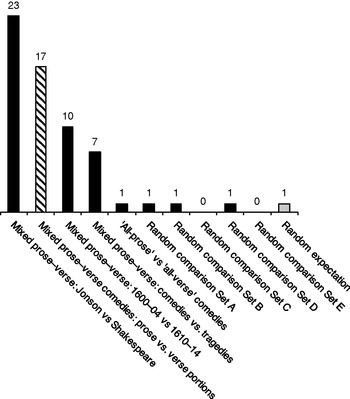
We take the top 100 most frequent function words, apply the t-test to each in the comparisons, and then count how many of the results exceeded a probability of 1 in a 100 of occurring by chance. In 100 such applications of the test – 100 different words – we expect one word-variable to exceed this probability threshold merely by chance. Figure 2.3 gives the results as a column chart.

Figure 2.3 Column chart of word-variables exceeding the 0.01 probability threshold in the groups plays detailed in Tables 2.2–2.4
The theoretical expectation for random data is that there would be 1 variable in a 100 over the 0.01 threshold, as represented by the grey column. The randomly assembled sets do indeed fit this expectation pretty well. One word-variable was below the threshold – that is, significantly different – in three of the tests, and in two tests there were none. There were seven word-variables with significant differences between the comedies and the tragedies,Footnote 39 ten between the two half-decades,Footnote 40 and twenty-three between the Shakespeare and Jonson plays.Footnote 41 It is unexpected that comedies are less different stylistically from tragedies than plays from two different half-decades with just a half-decade between them, but not surprising that Shakespeare is more different from Jonson than either, since that is the sort of result that is very common in studies of overall likenesses between plays and is the basis for authorship attribution.Footnote 42 The ‘all-verse’ and ‘all-prose’ comedies show only the sort of difference we expect in any assemblage of plays (the grey column). There was only one word-variable with a significant difference – an, with a p-value of 0.004.
In early modern English drama, it would seem that comedies in prose are not immediately distinguishable stylistically from comedies in verse. There is evidently nothing about writing in verse as against prose that requires a particular profile of use of very common words – nothing so powerful, at least, that it emerges whenever verse plays are compared directly with prose plays. When tackling a comedy with dialogue entirely in prose, it seems that playwrights were able to vary their style even within that mode to achieve effects of rich elaboration and conscious artificiality. Equally, if writing a verse comedy, playwrights were seemingly able to present domestic business and exchanges on everyday topics within the constraints of metre and within the language conventions that come with verse, in a way that is not distinguishable from prose drama.
There may, of course, be other ways in which the styles of ‘all-prose’ and ‘all-verse’ comedies differ. We have only taken function words into account, and then only the summary whole-play incidence of these words, with no regard, for instance, for the placement of the words in the order of sentences. On the other hand, whatever its limitations, the common-words data does evidently bear traces of difference in contrasts by genre, author, and date, so any inherent prose–verse stylistic distinction is fainter than these, or different in kind from them.
In another study, Ulrich Busse examined word use in prose and verse comedies – this time confined to Shakespeare. Busse finds a correlation between prose passages and you pronoun forms, and between verse passages and thou forms in Shakespeare.Footnote 43 In fifteen out of eighteen Shakespeare comedies, where there is a significant difference, thou forms are over-represented in verse sections.Footnote 44 Yet these correlations do not appear in the all-prose and all-verse plays. None of the thou and you forms – thou, thy, thine, thee, ye, you, your, and yours – are higher or lower in the prose plays compared with the verse plays, at least not markedly and consistently higher.
It seems we have to rethink the prose–verse contrast on every level. If there is indeed little difference between the style of ‘all-prose’ and ‘all-verse’ comedies, then why would readers and writers – then and now – have paid such heed to the distinction? Why did John Lyly feel the need to forsake his career-long practice of writing comedies in prose to write The Woman in the Moon in verse? The most obvious explanation is the enduring prestige of verse, and one small benefit of casting doubt on the idea of a necessary stylistic difference with prose is to throw attitudes towards verse into a new light.
Mixed Prose–Verse Comedies
The ‘all-verse’ and ‘all-prose’ comedies do not show any marked and consistent differences in their use of very common words. But, as we saw earlier, there were some significant differences in characters within one play who mix verse and prose. What about comedies which contain mixtures, looked at overall? To explore this, we selected fourteen comedies with prose-to-verse ratios somewhere between 1:1 (or 50% to 50%) and 3:17 (or 15% to 85%). Table 2.5 lists these plays.Footnote 45
Table 2.5 Set of fourteen comedies with prose-to-verse ratios between 1:1 and 3:17
| Play | Percentage prose | Words (prose) | Percentage verse | Words (verse) |
|---|---|---|---|---|
| Brome, A Jovial Crew | 31.9 | 7,725 | 68.1 | 16,465 |
| Chapman, Sir Giles Goosecap | 26.1 | 5,337 | 73.9 | 15,096 |
| Cooke (?), Greene's Tu Quoque | 38.4 | 8,986 | 61.6 | 14,393 |
| Day, The Isle of Gulls | 14.7 | 3,129 | 85.3 | 18,219 |
| Dekker, The Shoemaker's Holiday | 42.7 | 8,189 | 57.3 | 10,981 |
| Field, Amends for Ladies | 53.4 | 9,503 | 46.6 | 8,278 |
| Jonson, Every Man in His Humour | 79.7 | 20,520 | 20.3 | 5,228 |
| Jonson, Poetaster | 35.8 | 9,011 | 64.2 | 16,150 |
| Marston, The Dutch Courtesan | 25.5 | 4,623 | 74.5 | 13,471 |
| Middleton, A Mad World, My Masters | 24.2 | 4,449 | 75.8 | 13,915 |
| Middleton, The Phoenix | 34.4 | 6,910 | 65.6 | 13,181 |
| Shakespeare, As You Like It | 42.6 | 9,146 | 57.4 | 12,311 |
| Shakespeare, Twelfth Night | 42 | 8,283 | 58 | 11,437 |
| Wilson, The Cobbler's Prophecy | 71.8 | 9,074 | 28.2 | 3,572 |
We repeat the procedure as before, only this time pitting the fourteen verse and prose portions listed in Table 2.5 against each other. How many of the 100 very common words are significantly more or less common between the two groups, prose versus verse? Figure 2.4 introduces the results from the new test (in the striped column) to those from the previous test.

Figure 2.4 Column chart of word-variables exceeding the 0.01 probability threshold in the groups plays detailed in Tables 2.2–2.5.
There are seventeen word-variables with significant scores, much more than we expect in a pairing of randomly chosen plays, and somewhere between the chronology and author comparisons. Evidently, playwrights do pursue consistently different styles in verse and prose when they are deployed within a play. This time, also, some of the words Busse discussed are significantly different – thy is much higher in the verse portions and you is much higher in the prose portions.Footnote 46
Another aspect which may well differ between mixed prose–verse and ‘all-verse’ plays is the amount of rhymed verse included. While our texts were not marked up to identify rhymed lines, which meant we could not pursue this systematically, examination of the plays suggested that the mixed-form plays had more rhymed verse. We did not find any rhymed verse in Monsieur Thomas, The Wild-Goose Chase, or The Woman in the Moon, for example, and while other plays listed in Table 2.2 certainly include songs and interior masque speeches in verse, and numerous couplets to end speeches, as well as rhyming prologues and epilogues, the overall proportion seems low. By contrast, all the mixed-form plays listed in Table 2.5 have significant amounts of rhymed verse, going beyond isolated couplets and the familiar specialised forms. The Isle of Gulls, for example, is almost entirely in rhyme, whereas just under 20 per cent of the verse lines are rhymed in the two mixed-form Shakespeare plays examined, As You Like It and Twelfth Night.Footnote 47
This relatively high proportion of rhymed to blank verse could be regarded as part of the specialisation of forms in the mixed-mode plays: perhaps playwrights are more inclined to draw attention to the fact that lines are in verse by using rhyme? It may also help explain the differentiation between prose and verse if we posit that rhymed verse brings with it more constraints on sentence construction than blank verse. This is mere speculation, however, until a suitable corpus is marked up to separate rhymed verse from the rest.
We were able to test prose–verse differentiation in the plays as already marked up with a longer list of word-types and some other kinds of variable. Figure 2.5 gives the test results as a column graph, indicating the number of significant differences among the 1,000 most frequent words (or ‘1-grams’), rather than the 100 most frequent function words as before, the 1,000 most frequent word-pairs (or ‘2-grams’), the 1,000 most frequent word-triplets (or ‘3-grams’), and the 1,000 most frequent function-word ‘skip’ word-pairs.Footnote 48 The ‘all-prose’ and ‘all-verse’ comparison groups in Table 2.2 are represented by black columns and the mixed-plays comparison group in Table 2.5 by unfilled columns.

Figure 2.5 Column chart of word-variables exceeding the 0.01 probability threshold in the groups of plays detailed in Tables 2.2 and 2.5.
While the ‘all-prose’ versus ‘all-verse’ comparison picks up some more significant word-variables, above random expectation (represented by the grey column), the comparison between the prose and verse portions in mixed-mode plays picks up even more.
Finally, we examined the Shannon entropies of the various texts. To recall, Shannon entropy is a measure of the repetitiveness of a set of data; when applied to linguistic data, it scores each text along a spectrum of word use from the highly repetitive (with a correspondingly low entropy score) to the constantly varied (with a high entropy score). For this test, all the vocabulary – from the most common function word to the rarest exotic term – was included.Footnote 49 The texts were segmented into non-overlapping 3,000 word blocks, with the smaller blocks at the ends of the segments discarded. Table 2.6 gives the t-test p-value scores for the two comparisons, as an estimate of how different they are on this measure, as well as the mean Shannon entropies for verse and prose respectively in the two pairings.
Table 2.6 Shannon entropies of ‘all-prose’ versus ‘all-verse’ comedies and prose portions versus verse portions of mixed-mode comedies
| Comparison | t-test p-value | Mean Shannon entropy | |
|---|---|---|---|
| Prose | Verse | ||
| ‘All-prose’ versus ‘all-verse’ comedies | 0.63 | 5.62 | 5.63 |
| Prose portions versus verse portions of mixed-mode comedies | 0. 00000000002 | 5.60 | 5.80 |
The ‘all-prose’ and ‘all-verse’ comedies score much the same on this measure, with their mean Shannon entropies suggesting that verse drama is not necessarily richer in vocabulary than prose drama. This confirms an intuition that poetic diction does not of itself bring a greater diversity in vocabulary, and neither does the informality or unboundedness of prose. By contrast, the prose and verse portions of mixed-mode plays produce significantly different entropy scores, with the verse portions incorporating a more varied vocabulary.
Conclusion
There is, it seems, no necessary stylistic adaptation for prose comedy as against verse comedy. However, the contrast between prose and verse was laden with meaning in the theatrical and literary world of early modern England, and authors exploited these associations in their work. If we move from plays exclusively in prose or verse to plays employing a mixture of both, systematic contrasts appear in terms of character groups, register, and tone. Prose and verse drama do not necessarily have to be different, but they often are. If they set out to write a play entirely in one mode, playwrights were perfectly capable of representing the same kaleidoscope of styles using prose or verse alone. Often, though, they mixed the two modes within the same play, as Shakespeare does in many cases. In these instances, we observe a sharp divergence in styles.
T. S. Eliot's lectures on Poetry and Drama offer a helpful framework for this odd-seeming situation. ‘Whether we use prose or verse on the stage,’ he remarks, ‘they are both but means to an end.’ ‘The difference’, for Eliot, ‘is not as great as one might think’: prose, like verse, ‘has been written, and rewritten’, such that ‘prose, on the stage, is as artificial as verse’ and ‘verse can be as natural as prose’.Footnote 50 In the same vein, Frank Kermode notes that Hamlet's prose speech on human nobility – beginning ‘What a piece of work is man’ (2.2.305–12) – is so well crafted that it ‘might have been designed to show that prose can double poetry’.Footnote 51 On the opposite side of the question, the capacity of verse to approach prose, Eliot demonstrates that Shakespeare for one was capable of a wide range of styles within verse, evident in the first scene of Hamlet, all in verse, where we find lines of simple speech which might be either prose or verse. Lines 1–22 of the opening scene of Hamlet are ‘built of the simplest words in the most homely idiom’, such that ‘we are unconscious of the medium of its expression’. Eliot characterises Horatio's comment, ‘So have I heard and do in part believe it’ (1.1.146), as ‘a line of the simplest speech which might be either prose or verse’. Here, as elsewhere in the scene, the verse is ‘transparent’, and the audience is not likely to be aware that the medium is verse.Footnote 52 Nevertheless, there are lines in the same scene that demand a different sort of attention: Eliot offers Horatio's ‘the morn in russet mantle clad’ (1.1.147), which follows hard on the line quoted before, in which we can see ‘a deliberate brief emergence of the poetic into consciousness’.Footnote 53
Other scholars have made similar points about the potential of dramatic verse and dramatic prose to converge and even overlap in the characteristics for which each is noted. N. F. Blake comments that although it is sometimes claimed that the language of Shakespeare's prose is ‘more colloquial and less artificial than that found in the verse’, many prose passages, such as the speech of Shylock's servant Lancelot Gobbo Blake analyses, are in fact ‘literary in [their] affiliation[s]’ – in them, ‘little or nothing’ is ‘inserted as a marker of informal language’.Footnote 54 Shakespeare is capable of writing a highly decorative prose, as with Osric and Falstaff.Footnote 55 On the ‘absence of cant, slang and dialect in Shakespearian plays’, Blake offers the example of 1 Henry the Fourth, which, despite having ‘low-life’ characters, contains no ‘low-life language’.Footnote 56 All this suggests for the purposes of the present study that Shakespeare's prose – and, by extension, early modern dramatic prose generally – might not be as far apart from verse stylistically as the numerous contrasts of the two would suggest. On similar lines, Brian Vickers urges modern readers to ‘read Renaissance prose as if it were poetry’, not to treat it as an ‘antithetical’ medium to verse.Footnote 57
The Hamlet scene Eliot singles out is entirely in verse, and that is what he recommends for the modern playwright – to remain in a single medium. However, Eliot acknowledges that it was common for early modern playwrights to mix verse and prose. The transparency of verse which he has identified as an ideal disappears abruptly when prose and verse are mixed: ‘each transition makes the auditor aware, with a jolt, of the medium’. Such transitions, however risky for the modern playwright, were ‘easily acceptable to an Elizabethan audience, to whose ears both prose and verse came naturally; who liked highfalutin and low comedy in the same play’.Footnote 58 Here Eliot anticipates the contrast between verse and prose used as the entire mode for a play as against verse or prose used side by side within the same play which emerges from the quantitative results we have been discussing.
Eliot's main interest in his lectures is in establishing the requirements for an ideal modern verse drama. His advice to the playwrights of his own time is that they should avoid including prose in these plays. He also regards prose drama as foregoing a ‘peculiar range of sensibility [which] can be expressed by dramatic poetry, at its moments of greatest intensity’.Footnote 59 These concerns take him in a different direction from the present focus on the actual performance of early modern playwrights. Yet the ideas in the Eliot lectures of a possible ‘transparency’ for verse, and of the opposite, the ‘jolt’ when the two modes are juxtaposed, forcing the audience to an awareness of the medium, help to conceptualise a system where prose or verse could be neutral, and brought with them no automatic consequences in style at the level of common word use frequency, and yet could also be polarised for local expressive purposes.
We can conclude that verse in these comedies does not require any variation in the overall use of words compared with prose, despite the obvious and often remarked-on differences between these two mediums for drama.Footnote 60 The interchangeability of prose and verse puts another clear fact about these two mediums – that the availability of a contrast is a powerful expressive means in plays, with no simple rules for local effects, but all the more effective for that – into the spotlight. Verse and prose can be transparent, but in juxtaposition they can become suddenly visible and bring audiences to an intense awareness of different orders of being, from sanity and madness to close engagement and sharp disaffection. The prose–verse contrast does not, apparently, bring with it stylistic constraints. That may free us to see it more clearly as a carrier of dramatic meaning, as when Freevill switches to verse, or Malheureux abruptly reverts to prose.