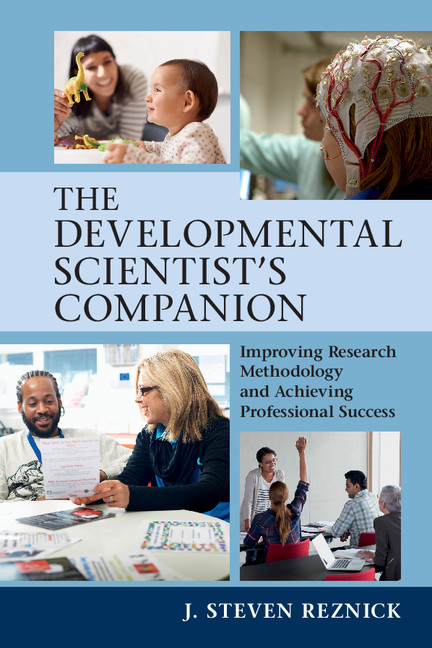
The Developmental Scientist's Companion

-
Select format
-
- Publisher:
- Cambridge University Press
- Publication date:
- 04 May 2017
- 03 April 2017
- ISBN:
- 9781108155359
- 9781107194281
- 9781316645604
- Dimensions:
- (228 x 152 mm)
- Weight & Pages:
- 0.44kg, 218 Pages
- Dimensions:
- (228 x 152 mm)
- Weight & Pages:
- 0.32kg, 218 Pages
You may already have access via personal or institutional login
Show more authors 
You may already have access via personal or institutional login
Book description
Written by one of developmental science's foremost methodologists, The Developmental Scientist's Companion provides an engaging and accessible guide to the scientific techniques that have been devised to investigate human development. Adopting an original approach to what can be a dry yet essential topic, Reznick enlivens his coverage of key issues in developmental methodology - measuring psychological phenomena, assessing reliability and validity, experimental design, interviews and surveys, data collection and analysis and interpreting research results - with discussion of his own experiences of those various techniques, gained over a substantial research career. The Companion concludes with practical tips for improving the field and navigating a path to professional success. Reznick's 'behind-the-scenes' view of empirical research and career progression, told with wit, wisdom and insight, is essential reading for students and young researchers launching their careers in developmental science.
Awards
Winner, 2017 Choice Outstanding Academic Title
Reviews
‘In this extraordinary book, Reznick provides an engaging and insightful perspective on the practice of research in developmental science – one that is rooted in deep reflections on the philosophy of science and filled with valuable practical advice about research design, methodology, and data analysis. It should be required reading for anyone interested in the science of human development.'
Philip David Zelazo - University of Minnesota
‘As the author practiced in over thirty years of mentoring/advising trainees, this companion/guide informs, challenges, and scaffolds the reader to new levels of understanding and engagement with developmental science. This book should be required reading for aspiring developmentalists and those in training.'
Jed T. Elison - University of Minnesota
Contents
Contents
References
Bibliography
Achenbach, T. M., & Rescorla, L. A. (2000). Manual for the ASEBA preschool forms and profiles. Burlington, VT: University of Vermont Department of Psychiatry.
Achor, S. (2012). Positive intelligence. Harvard Business Review, January–February, 100–102.
Adolph, K. E., & Robinson, S. R. (2011). Sampling development. Journal of Cognition and Development, 12(4), 411–423.
Ainsworth, M. D., & Bell, S. M. (1970). Attachment, exploration, and separation: Illustrated by the behavior of one-year-olds in a strange situation. Child Development, 41, 49–67.10.2307/1127388
American Psychiatric Association. (2013). Diagnostic and statistical manual of mental disorders (5th ed.). Washington, DC: Author.
American Psychological Association, American Educational Research Association, & National Council on Measurements Used in Education. (1954). Technical recommendations for psychological tests and diagnostic techniques. Psychological Bulletin, 51(2, pt. 2), 1–38. doi: 10.1037/h0053479.
Anderson, C., Colombo, J., & Shaddy, D. (2006). Visual scanning and pupillary responses in young children with Autism Spectrum Disorder. Journal of Clinical and Experimental Neuropsychology, 28, 1238–1256.10.1080/13803390500376790
Aslin, R. N. (2007). What’s in a look? Developmental Science, 10, 48–53.10.1111/j.1467-7687.2007.00563.x
Babineau, B. A., Yang, M., & Crawley, J. N. (2012). Mainstreaming mice. Neuropsychopharmacology, 37(1), 300–301. doi:10.1038/npp.2011.168.
Barlow, D. H. (2010). Negative effects from psychological treatments: A perspective. American Psychologist, 65(1), 13–20.10.1037/a0015643
Barrett, L. F. (2009). The future of psychology: Connecting mind to brain. Perspectives on Psychological Science, 4, 326–339.
Bauer, D. J. (2007). Observations on the use of growth mixture models in psychological research. Multivariate Behavioral Research, 42, 757–786.10.1080/00273170701710338
Bauer, D. J. (2011). Evaluating individual differences in psychological processes. Current Directions in Psychological Science, 20(2), 115–118.10.1177/0963721411402670
Bauer, D. J., Gottfredson, N. C., Dean, D., & Zucker, R. A. (2013). Analyzing repeated measures data on individuals nested within groups: Accounting for dynamic group effects. Psychological Methods, 18(1), 1–14.10.1037/a0030639
Bauer, D. J., & Reyes, H. L. M. (2010). Modeling variability in individual development: Differences of degree or kind? Child Development Perspectives, 4, 114–122.10.1111/j.1750-8606.2010.00129.x
Bauer, D. J., Sterba, S. K., & Hallfors, D. D. (2008). Evaluating group-based interventions when control participants are ungrouped. Multivariate Behavioral Research, 43(2), 210–236. doi: 10.1080/00273170802034810.
Bauer, P. J., & Zelazo, P. D. (2014). The National Institutes of Health Toolbox for the Assessment of Neurological and Behavioral Function: A tool for developmental science. Child Development Perspectives, 8(3), 119–124.10.1111/cdep.12080
Baumeister, R. F., Vohs, K. D., & Funder, D. C. (2007). Psychology as the science of self-reports and finger movements: Whatever happened to actual behavior? Perspectives on Psychological Science, 4, 396–403.
Baumrind, D. (1968). Authoritarian vs. authoritative parental control. Adolescence, 3(11), 255–272.
Bechtel, W. (1988). Philosophy of science: An overview for cognitive science. Hillsdale, NJ: Erlbaum.
Beck, D. M. (2010). The appeal of the brain in the popular press. Perspectives on Psychological Science, 5(6), 762–766.10.1177/1745691610388779
Behrens, J. T. (1997). Principles and procedures of exploratory data analysis. Psychological Methods, 2, 131–160.10.1037/1082-989X.2.2.131
Berlin, L. J., Dodge, K. A., & Reznick, J. S. (2013). Examining pregnant women’s hostile attributions about infants predict offspring maltreatment. JAMA Pediatrics, 167, 549–553.10.1001/jamapediatrics.2013.1212
Blair, C., Granger, D., Kivlighan, K., Mills-Koonce, R., Willoughby, M., Greenberg, M., et al. (2008). Maternal and child contributions to cortisol response to emotional arousal in young children from low-income, rural communities. Developmental Psychology, 44, 1095–1109.10.1037/0012-1649.44.4.1095
Bollen, K. A., & Ting, K. (2000). A tetrad test for causal indicators. Psychological Methods, 5(1), 3–22. doi:10.1037/1082-989X.5.1.3.
Borsboom, D., Romeijn, J., & Wicherts, J. (2008). Measurement invariance versus selection invariance: Is fair selection possible? Psychological Methods, 13, 75–98.
Bradburn, N. M., Sudman, S., & Wansink, B. (2004). Asking questions: The definitive guide to questionnaire design – for market research, political polls, and social and health questionnaires. San Francisco: Jossey-Bass.
Buhrmester, M., Kwang, T., & Gosling, S. D. (2011). Amazon’s Mechanical Turk: A new source of inexpensive, yet high-quality, data? Perspectives on Psychological Science, 6, 3–5. doi: 10.1177/1745691610393980.
Burchinal, M., Skinner, D., & Reznick, J. (2010). European American and African American mothers’ beliefs about parenting and disciplining infants: A mixed-method analysis. Parenting: Science And Practice, 10(2), 79–96.10.1080/15295190903212604
Cacioppo, J. T., Berntson, G. G., & Decety, J. (2012). A history of social neuroscience. In Kruglanski, A. W., Stroebe, W., Kruglanski, A. W., & Stroebe, W. (Eds.), Handbook of the history of social psychology (pp. 123–136). New York, NY: Psychology Press.
Cacioppo, J. T., & Decety, J. (2009). What are the brain mechanisms on which psychological processes are based? Perspectives on Psychological Science, 4, 10–18.10.1111/j.1745-6924.2009.01094.x
Cacioppo, J. T., Semin, G. R., & Berntson, G. G. (2004). Realism, instrumentalism, and scientific symbiosis: Psychological theory as a search for truth and the discovery of solutions. American Psychologist, 59, 214–223.10.1037/0003-066X.59.4.214
Caelli, K., Ray, L., & Mill, J. (2003). “Clear as mud”: Toward greater clarity in generic qualitative research. International Journal of Qualitative Methods, 2, 1–13.10.1177/160940690300200201
Cairns, R. B., Elder, G. H., Jr., & Costello, E. J. (1996). Developmental science. Cambridge: Cambridge University Press.10.1017/CBO9780511571114
Campbell, D. T. (Ed.). (1974). Philosophy of Karl Popper (Vol. 1). LaSalle: Open Court Publishing Co.
Campbell, D. T., & Fiske, D. W. (1959). Convergent and discriminate validation by the multitrait-multimethod matrix. Psychological Bulletin, 56, 81–105.10.1037/h0046016
Cantlon, J. F., Brannon, E. M., Carter, E. J., & Pelphrey, K. A. (2006). Functional imaging of numerical processing in adults and 4-y-old children. PLoS Biology, 4, 0844–0854.10.1371/journal.pbio.0040125
Carnegie, D. (1936). How to win friends and influence people. New York, NY: Simon & Schuster.
Carroll, J. B. (1993). Human cognitive abilities: Survey of factor-analytic studies. New York, NY: Cambridge University Press.10.1017/CBO9780511571312
Chan, M. E., & Arvey, R. D. (2012). Meta-analysis and the development of knowledge. Perspectives on Psychological Science, 7, 79–92.10.1177/1745691611429355
Chandra, A., Martino, S. C., Collins, R. L., Elliott, M. N., Berry, S. H., Kanouse, D. E., & Miu, A. (2008). Does watching sex on television predict teen pregnancy? Findings from a national longitudinal survey of youth. Pediatrics, 122, 1047–1054.
Churchland, P. M., & Churchland, P. S. (1998). On the contrary: Critical essays 1987–1997. Cambridge, MA: The MIT Press.10.7551/mitpress/5123.001.0001
Cizek, G. J. (2012). Defining and distinguishing validity: Interpretations of score meaning and justifications of test use. Psychological Methods, 17, 31–43.
Cohen, A. B. (2010). Just how many different forms of culture are there? American Psychologist, 65(1), 59–61. doi:10.1037/a0017793.
Cohen, J. (1962). The statistical power of abnormal-social psychological research: A review. Journal of Abnormal and Social Psychology, 65, 145–153.10.1037/h0045186
Cohen, J. (1977). Statistical power analysis for the behavioral sciences. New York, NY: Academic Press.
Cook, T. D. (1985). Postpositivist critical multiplism. In Shotland, R. L. & Mark, M. M. (Eds.), Social science and social policy (pp. 21–62). Beverly Hills, CA: Sage Publications.
Cooper, H., & Koenka, C. (2012). The overview of reviews: Unique challenges and opportunities when research syntheses are the principal elements of new integrative scholarship. American Psychologist, 67(6), 446–462.10.1037/a0027119
Costa, P. T., Jr., & McCrae, R. R. (1992). Revised NEO Personality Inventory (NEO-PI-R) and NEO Five-Factor Inventory (NEO-FFI) manual. Odessa, FL: Psychological Assessment Resources.
Curran, P., Hussong, A., Cai, L., Huang, W., Chassin, L., Sher, K., et al. (2008). Pooling data from multiple longitudinal studies: The role of item response theory in integrative data analysis. Developmental Psychology, 44(2), 365–380.10.1037/0012-1649.44.2.365
Decety, J., & Cacioppo, J. (2010). Frontiers in human neuroscience: The golden triangle and beyond. Perspectives on Psychological Science, 5(6), 767–771.10.1177/1745691610388780
DeFries, J. C., & Fulker, D. W. (1988). Multiple regression analysis of twin data: Etiology of deviant score versus individual differences. Acta Geneticae Medicae et Gemeologiae, 37, 205–216.10.1017/S0001566000003810
De Los Reyes, A., & Wang, M. (2012). Applying psychometric theory and research to developing a continuously distributed approach to making research funding decisions. Review of General Psychology, 16(3), 298–304. doi:10.1037/a0027250.
Diamond, A., Cruttenden, L., & Neiderman, D. (1994). AB with multiple wells: I. Why are multiple wells sometimes easier than two wells? II. Memory or memory + inhibition? Developmental Psychology, 30, 192–205.
Edwards, J. R. (2008). To prosper, organizational psychology should … overcome methodological barriers to progress. Journal of Organizational Behavior, 29, 469–491.10.1002/job.529
Edwards, J. R., & Bagozzi, R. P. (2000). On the nature and direction of relationships between constructs and measures. Psychological Methods, 5, 155–174.10.1037/1082-989X.5.2.155
Elder, G. J., Shanahan, M. J., & Jennings, J. A. (2015). Human development in time and place. In Bornstein, M. H., Leventhal, T., Lerner, R. M., Bornstein, M. H., Leventhal, T., & Lerner, R. M. (Eds.), Handbook of child psychology and developmental science, Vol. 4: Ecological settings and processes (7th ed.) (pp. 6–54). Hoboken, NJ: John Wiley & Sons Inc.
Enders, C. K. (2013). Dealing with missing data in developmental research. Child Development Perpectives, 7, 27–31. doi: 10.1111/cdep/12008.
Erceg-Hurn, D. M., & Mirosevich, V. M. (2008). Modern robust statistical methods. American Psychologist, 63, 591–601.10.1037/0003-066X.63.7.591
Erkut, S. (2010). Developing multiple language versions of instruments for intercultural research. Child Development Perspectives, 4(1), 19–24. doi:10.1111/j.1750-8606.2009.00111.x.
Fantz, R. L. (1958). Pattern vision in young infants. Psychological Review, 8, 43–47.
Feldman, R., & Reznick, J. S. (1996). Maternal perception of infant intentionality at 4 and 8 months. Infant Behavior and Development, 19, 483–496.
Fenson, L., Marchman, V. A., Thal, D., Dale, P., Reznick, J. S., & Bates, E. (2007). The MacArthur-Bates Communicative Development Inventories: User’s guide and technical manual. Baltimore, MD: Paul H. Brookes Publishing Company.
Ferguson, C. F., & Brannick, M. T. (2012). Publication bias in psychological science: Prevalence, methods for identifying and controlling, and implications for the use of meta-analyses. Psychological Methods, 17(1), 120–128.
Fiedler, K., Kutzner, F., & Krueger, J. I. (2012). The long way from α-error control to validity proper: Problems with a short-sighted false-positive debate. Perspectives on Psychological Science, 7(6), 661–669. doi:10.1177/1745691612462587.
Firick, R. W. (1996). The appropriate use of null hypothesis testing. Psychological Methods, 1, 379–390.10.1037/1082-989X.1.4.379
Fisher, Sir Ronald A. (1935) Mathematics of a lady tasting tea. In J. R. Newman (1956, Ed.), The world of mathematics (Vol. 3, Part 8): Statistics and the design of experiments (pp. 1514–1521). New York, NY: Simon & Schuster.
Fiske, D. W., & Campbell, D. T. (1992). Citations do not solve problems. Psychological Bulletin, 112, 393–395.10.1037/0033-2909.112.3.393
Fox, E., Russo, R., Bowles, R., & Dutton, K. (2001). Do threatening stimuli draw or hold visual attention in subclinical anxiety? Journal of Experimental Psychology: General, 130, 681–700.10.1037/0096-3445.130.4.681
Gehlbach, H., & Brinkworth, M. E. (2011). Measure twice, cut down error: A process for enhancing the validity of survey scales. Review of General Psychology, 15(4), 380–387. doi:10.1037/a0025704.
Gilmore, J., Lin, W., Gerig, G., & Tamminga, C. (2006). Fetal and neonatal brain development. American Journal of Psychiatry, 163, 2046–2046.10.1176/ajp.2006.163.12.2046
Giner-Sorolla, R. (2012). Will we march to utopia, or be dragged there? Past failures and future hopes for publishing our science. Psychological Inquiry, 23(3), 263–266. doi:10.1080/1047840X.2012.706506.
Gopnik, A., & Wellman, H. M. (2012). Reconstructing constructivism: Causal models, Bayesian learning mechanisms, and the theory theory. Psychological Bulletin, 138(6), 1085–1108. doi:10.1037/a0028044.
Gottlieb, G. (2007). Probabilistic epigenesis. Developmental Science, 10, 1–11.
Gough, B., & Madill, A. (2012). Subjectivity in psychological science: From problem to prospect. Psychological Methods, 17(3), 374–384. doi:10.1037/a0029313.
Greenwald, A. G. (2012). There is nothing so theoretical as a good method. Perspectives on Psychological Science, 7(2), 99–108. doi:10.1177/1745691611434210 1.
Grothe, I., & Plöchl, M. (2008). Amplitude asymmetry: A direct link between ongoing oscillatory activity and event-related potentials? The Journal of Neuroscience, 28(49), 13025–13027. doi:10.1523/JNEUROSCI.4670-08.2008.
Gullo, M. J., & O’Gorman, J. G. (2012). DSM-5 Task Force proposes controversial diagnosis for dishonest scientists. Perspectives on Psychological Science, 7(6), 689. doi:10.1177/1745691612460689.
Gunnar, M., Sebanc, A., Tout, K., Donzella, B., & van Dulmen, M. (2003). Peer rejection, temperament, and cortisol activity in preschoolers. Developmental Psychobiology, 43, 346–358.10.1002/dev.10144
Haith, M. M. (1980). Rules that babies look by: The organization of newborn visual activity. Potomac, MD: Erlbaum.
Handy, T. C. (2004). Event-related potentials: A methods handbook. Cambridge, MA: The MIT Press (B&T).
Harmon, A. G., Hibel, L. C., Rumyantseva, O., & Granger, D. A. (2007). Measuring salivary cortisol in studies of child development: Watch out – what goes in may not come out of saliva collection devices. Developmental Psychobiology, 49(5), 495–500.10.1002/dev.20231
Hart, B., & Risley, T. R. (1995). Meaningful differences in the everyday experience of young American children. Baltimore, MD: Brooks.
Hartmann, W. E., Kim, E. S., Kim, J. H. J., Nguyen, T. U., Wendt, D. C., Nagata, D. K., & Gone, J. P. (2013). In search of cultural diversity, revisited: Recent publication trends in cross-cultural and ethnic minority psychology. Review of General Psychology, 17, 243–254.10.1037/a0032260
Hedges, L. V. (2008). What are effect sizes and why do we need them? Child Development Perspectives, 2, 167–171.10.1111/j.1750-8606.2008.00060.x
Helms, J. E., Jernigan, M., & Mascher, J. (2005). The meaning of race in psychology and how to change it: A methodological perspective. American Psychologist, 60, 27–36.10.1037/0003-066X.60.1.27
Henrich, J., Heine, S. J., & Norenzayan, A. (2010). The weirdest people in the world? Behavioural and Brain Sciences, 33, 61–135.10.1017/S0140525X0999152X
Howell, R. D., Breivik, E., & Wilcox, J. B. (2007). Reconsidering formative measurement. Psychological Methods, 12, 205–218.
Hull, C. L. (1943). Principles of behavior: An introduction to behavior theory. Oxford, England: Appleton-Century.
Hume, D. (2003). A treatise of human nature. New York, NY: Dover.
Hyde, J. S. (2005). The gender similarities hypothesis. American Psychologist, 60(6), 581–592. doi:10.1037/0003-066X.60.6.581.
James, W. J. (1890/1981). The principles of psychology (Vol. 1). Cambridge, MA: Harvard University Press.
Jarde, A., Losilla, J., Vives, J., & Rodrigo, M. F. (2013). Q-Coh: A tool to screen the methodological quality of cohort studies in systematic reviews and meta-analysis. International Journal of Clinical and Health Psychology, 13(2), 138–146.10.1016/S1697-2600(13)70017-6
Johnson, V. E. (2013). Revised standards for statistical evidence. Proceedings of the National Academy of Sciences, 110, 19313–19317.10.1073/pnas.1313476110
Jones, J. M. (2010). I am white and you’re not: The value of unraveling ethnocentric science. Perspectives on Psychological Science, 5, 700–707.
Kagan, J. (2009a). Categories of novelty and states of uncertainty. Review of General Psychology, 13, 290–301.10.1037/a0017142
Kagan, J. (2009b). Two is better than one. Perspectives on Psychological Science, 4, 22–23.10.1111/j.1745-6924.2009.01092.x
Kagan, J., Reznick, J. S., & Snidman, N. (1988). Biological bases of childhood shyness. Science, 240, 167–171.10.1126/science.3353713
Kagan, J. & Snidman, N. (2004). The long shadow of temperament. Cambridge, MA: Harvard University Press.
Klein, O., Doyen, S., Leys, C., de Saldanha da Gama, P. M., Miller, S., Questienne, L., & Cleeremans, A. (2012). Low hopes, high expectations: Expectancy effects and the replicability of behavioral experiments. Perspectives on Psychological Science, 7(6), 572–584. doi:10.1177/1745691612463704.
Kosslyn, S. M. (1999). If neuroimaging is the answer, what is the question? Philosophical Transactions of the Royal Society of London, B, 354, 1283–1294.10.1098/rstb.1999.0479
Kraemer, H. C., Yesavage, J. A., Taylor, J. L., & Kupfer, D. (2000). How can we learn about developmental processes from cross-sectional studies, or can we? The American Journal of Psychiatry, 157, 163–171. PMID: 10671382.
Krause, M. S. (2012). Measurement validity is fundamentally a matter of definition, not correlation. Review of General Psychology, 16, 391–400.
Krause, M. S. (2013). The data analytic implications of human psychology’s dimensions being ordinally scaled. Review of General Psychology, 17(3), 318–325.
Kruschke, J. K. (2011). Doing Bayesian data analysis. Oxford, England: Elsevier.
Kuhn, T. (1962/1970). The structure of scientific revolutions. Chicago: University of Chicago Press.
Laborda, M. A., Miguez, G., Polack, C. W., & Miller, R. R. (2012). Animal models of psychopathology: Historical models and the Pavlovian contribution. Terapia Psicológica, 30, 45–59.
Lane, D., & Sándor, A. (2009). Designing better graphs by including distributional information and integrating words, numbers, and images. Psychological Methods, 14, 239–257.10.1037/a0016620
LeBel, E. P., Borsboom, D., Giner-Sorolla, R., Hasselman, F., Peters, K. R., Ratliff, K. A., & Smith, C. T. (2013). PsychDisclosure.org: Grassroots support for reforming reporting standards in psychology. Perspectives on Psychological Science, 8(4), 424–432.10.1177/1745691613491437
Leevers, H., & Harris, P. (2000). Counterfactual syllogostic reasoning in normal 4-year-olds, children with learning disabilities, and children with autism. Journal of Experimental Child Psychology, 76(1), 64–87.
Logothetis, N. K. (2007). The ins and outs of fMRI signals. Nature Neuroscience, 10(10), 1230–1232. doi:10.1038/nn1007-1230.
LoLordo, V. M. (1971). Facilitation of food-reinforced responding by a signal for response-independent food. Journal of the Experimental Analysis of Behavior, 15(1), 49–55.10.1901/jeab.1971.15-49
Luck, S. J. (2005). An introduction to the event-relates potential technique. Cambridge, MA: The MIT Press.
Maccoby, E. E., & Martin, J. A. (1983). Socialization in the context of the family: Parent–child interaction. In Mussen, P. (Ed.), Handbook of child psychology (Vol. 4). New York, NY: Wiley.
MacCorquodale, K., & Meehl, P. E. (1948). On a distinction between hypothetical constructs and intervening variables. Psychology Review, 55, 95–107.
MacKinnon, D. P. (2008). Introduction to statistical mediation analysis. Boca Raton, FL: CRC Press.
Madill, A., & Gough, B. (2008). Qualitative research and its place in psychological science. Psychological Methods, 13(3), 254–271. doi:10.1037/a0013220.
Magnusson, D. (1998). The logic and implications of a person-oriented approach. In Cairns, R. B., Bergman, L. R., & Kagan, J. (Eds.), Methods and models for studying the individual (pp. 33–62). Beverly Hills, CA: Sage Publications.
Marcovitch, S., & Zelazo, P. (1999). The A-not-B error: Results from a logistic meta-analysis. Child Development, 70, 1297–1313.10.1111/1467-8624.00095
Marshall, P. J. (2009). Relating psychology and neuroscience: Taking up the challenges. Perspectives on Psychological Science, 4, 113–125.
Maxwell, S. E. (2004). The persistence of underpowered studies in psychological research: Causes, consequences, and remedies. Psychological Methods, 9, 147–163.
McKnight, P. E., McKnight, K. M., Sidani, S., & Figueredo, A. J. (2007). Preventing missing data by design. In D. A. Kenny (Ed.), Missing data: A gentle introduction (pp. 65–87). New York, NY: Guilford Press.
Meade, A. W., & Craig, S. (2012). Identifying careless responses in survey data. Psychological Methods, 17(3), 437–455.
Medin, D., Bennis, W., & Chandler, M. (2010). Culture and the home-field disadvantage. Perspectives on Psychological Science, 5(6), 708–713. doi:10.1177/1745691610388772.
Meehl, P. E. (1978). Theoretical risk and tabular asterisks: Sir Karl, Sir Ronald, and the slow progress of soft psychology. Journal of Consulting and Clinical Psychology, 46, 806–834.10.1037/0022-006X.46.4.806
Mitchell, G. (2012). Revisiting truth or triviality: The external validity of research in the psychological laboratory. Perspectives on Psychological Science, 7(2), 109–117. doi:10.1177/1745691611432343.
Mook, D. G. (1983). In defense of external invalidity. American Psychologist, 38, 379–387.10.1037/0003-066X.38.4.379
Moore, D. S. (2015). The developing genome: An introduction to behavioral epigenetics. New York, NY: Oxford University Press.
Mussen, P. M. E. (1960). Handbook of research methods in child development. New York, NY: John Wiley and Sons.
Muthén, B. O. (2001). Second-generation structural equation modeling with a combination of categorical and continuous latent variables: New opportunities for latent class – latent growth modeling. In Sayer, A. & Collins, L. (Eds.), New methods for the analysis of change (pp. 289–322). Washington, DC: American Psychological Association.
Neuenschwander, E. (2013). Qualitas and quantitas: Two ways of thinking in science. Quality & Quantity: International Journal Of Methodology, 47(5), 2597–2615. doi:10.1007/s11135-012-9674-7.
Neuroskeptic (2012). The nine circles of scientific hell. Perspectives on Psychological Science, 7(6), 643–644.10.1177/1745691612459519
Newton, P. E., & Shaw, S. D. (2013). Standards for talking and thinking about validity. Psychological Methods, 18, 301–319.
Nickerson, R. S. (2000). Null hypothesis significance testing: A review of an old and continuing controversy. Psychological Methods, 5, 241–301.10.1037/1082-989X.5.2.241
Palida, S. F., Butko, M. T., Ngo, J. T., Mackey, M. R., Gross, L. A., Ellisman, M. H., & Tsien, R. Y. (2015). PKMζ, but not PKCλ, is rapidly synthesized and degraded at the neuronal synapse. The Journal of Neuroscience, 35(20), 7736–7749. doi:10.1523/JNEUROSCI.0004-15.2015.
Pan, B., Rowe, M., Singer, J., & Snow, C. (2005). Maternal correlates of growth in toddler vocabulary production in low-income families. Child Development, 76, 763–782.10.1111/1467-8624.00498-i1
Pelphrey, K., & Morris, J. (2006). Brain mechanisms for interpreting the actions of others from biological-motion cues. Current Directions in Psychological Science, 15, 136–140.
Pelphrey, K. A., Reznick, J. S., Goldman, B. D., Sasson, N., Morrow, J., Donahoe, A., & Hodgson, K. (2004). Development of visuospatial short-term memory in the second half of the first year. Developmental Psychology, 40, 836–851.
Piaget, J. (1952/1936). The origins of intelligence in children. New York, NY: International University Press.
Piaget, J. (1954/1937). The construction of reality in the child. New York, NY: Basic Books.10.1037/11168-000
Pinkham, A., Hopfinger, J., Pelphrey, K., Piven, J., & Penn, D. (2008). Neural bases for impaired social cognition in schizophrenia and autism spectrum disorders. Schizophrenia Research, 99, 164–175.10.1016/j.schres.2007.10.024
Popper, K. (1934/2002). The logic of scientific discovery. London: Routledge.
Popper, K. R. (1959). The logic of scientific discovery. New York, NY: Basic Books.
Porges, S., Doussard-Roosevelt, J., Portales, L., & Suess, P. (1994). Cardiac vagal tone: Stability and relation to difficultness in infants and 3-year-olds. Developmental Psychobiology, 27, 289–300.10.1002/dev.420270504
Poulin, F., Dishion, T., & Burraston, B. (2001). 3-year iatrogenic effects associated with aggregating high-risk adolescents in cognitive-behavioral preventive interventions. Applied Developmental Science, 5(4), 214–224.10.1207/S1532480XADS0504_03
Pungello, E. P., Iruka, I. U., Dotterer, A. M., Mills-Koonce, R., & Reznick, J. S. (2009). The effects of income, race, sensitive parenting and harsh parenting on receptive and expressive language development in early childhood. Developmental Psychology, 45, 544–557.10.1037/a0013917
Quine, W. V. O. (1951). Two dogmas of empiricism. The Philosophical Review, 60, 20–43.
Ratto, A. B. (2013). The impact of cultural factors on the diagnostic process in autism: A comparison of Latina and European American mothers (Doctoral dissertation). Retrieved from ProQuest Dissertations Publishing database. (Dissertation number: 3593268.)
Reichenbach, H. (1951). The rise of scientific philosophy. Berkeley and Los Angeles: University of California Press.10.1525/9780520341760
Reichenbach, H. (2006). Experience and prediction: An analysis of the foundations and the structure of knowledge. Notre Dame, IN: University of Notre Dame.
Reinhart, A. (2015). Statistics done wrong: The woefully complete guide. San Francisco: No Starch Press.
Rennie, D. L. (2012). Qualitative research as methodical hermeneutics. Psychological Methods, 17(3), 385–398. doi:10.1037/a0029250.
Reznick, J. S. (2007). Working memory in infants and toddlers. In Oakes, L. M. & Bauer, P. J. (Eds.), Short- and long-term memory in infancy and early childhood: Taking the first steps toward remembering (pp. 3–26). Oxford: Oxford University Press.
Reznick, J. S. (2008). Inferring infant intentionality. Berlin: VDM Dr. Müller.
Reznick, J. S., Baranek, G. T., Reavis, S., Watson, L. R., & Crais, E. R. (2007). A parent-report instrument for identifying one-year olds at risk for an eventual diagnosis of autism: The first year inventory. Journal of Autism and Developmental Disorders, 37, 1691–1710.
Reznick, J. S., Corley, R., & Robinson, J. (1997). A longitudinal twin study of intelligence in the second year. Monographs of the Society for Research in Child Development, 61(1, Serial No. 249).
Reznick, J. S., Morrow, J. D., Goldman, B. D., & Snyder, J. (2004). The onset of working memory in infants. Infancy, 6, 145–154.10.1207/s15327078in0601_7
Reznick, J. S., & Richman, C. L. (1976). Effects of class complexity, class frequency, and preexperimental bias on rule learning. Journal of Experimental Psychology: Human Learning and Memory, 2(6), 774–782. doi:10.1037/0278-7393.2.6.774.
Reznick, J. S., & Schwartz, B. B. (2001). When is an assessment an intervention? Parent perception of infant intentionality and language. Journal of the American Academy of Child & Adolescent Psychiatry, 40, 11–17.
Richards, J., & Gibson, T. (1997). Extended visual fixation in young infants: Look distributions, heart rate changes, and attention. Child Development, 68, 1041–1056.10.2307/1132290
Richman, C. L., Mitchell, D. B., & Reznick, J. S. (1979). Mental travel: Some reservations. Journal of Experimental Psychology: Human Perception and Performance, 5(1), 13–18. doi:10.1037/0096-1523.5.1.13.
Richters, J. E. (1997). The Hubble hypothesis and the developmentalist’s dilemma. Development and Psychopathology, 9, 193–229.10.1017/S0954579497002022
Robinson, J. P., & Martin, S. (2008). What do happy people do? Social Indicators Research, 89, 565–571.
Rodgers, J. L. (2010). The epistemology of mathematical and statistical modeling: A quiet methodological revolution. American Psychologist, 65, 1–12.
Rosenberg, A. (2005). Philosophy of science: A contemporary introduction (2nd ed.). New York, NY: Routledge.
Rosenthal, R. (1979). “File drawer problem” and tolerance for null results. Psychological Bulletin, 86, 638–641.10.1037/0033-2909.86.3.638
Rosenthal, R., & Jacobson, L. (1968). Pygmalion in the classroom. New York, NY: Holt, Rinehart & Winston.10.1007/BF02322211
Salapatek, P., & Kessen, W. (1966). Visual scanning of triangles by the human newborn. Journal of Experimental Child Psychology, 3, 155–167.10.1016/0022-0965(66)90090-7
Salmon, P. (2003). How do we recognize good research? The Psychologist, 16(1), 24–27.
Sanders, L. (2009). Trawling the brain. Science News, 176, 16–20.
Sanders, L. (2011). Residents of the brain: Scientists turn up startling diversity among nerve cells. Science News, July 30.10.1002/scin.5591800326
Schmidt, F. (2010). Detecting and correcting the lies that data tell. Perspectives on Psychological Science, 5(3), 233–242. doi:10.1177/1745691610369339.
Schmidt, F. L. (1996). Statistical significance testing and cumulative knowledge in psychology: Implications for training of researchers. Psychological Methods, 1, 115–129.10.1037/1082-989X.1.2.115
Schwartzer, J. J., Koenig, C. M., & Berman, R. F. (2013). Using mouse models of autism spectrum disorders to study the neurotoxicology of gene–environment interactions. Neurotoxicology and Teratology, 3617–3635. doi:10.1016/j.ntt.2012.08.007.
Scott-Phillips, T. C., Dickins, T. E., & West, S. A. (2011). Evolutionary theory and the ultimate-proximate distinction in the human behavioral sciences. Perspectives on Psychological Science, 6 (1), 38–47.
Shonkoff, J. P., & Bales, S. N. (2011). Science does not speak for itself: Translating child development research for the public and its policymakers. Child Development, 82(1), 17–32. doi:10.1111/j.1467-8624.2010.01538.x.
Simmering, V. R., Triesch, J., Deák, G. O., & Spencer, J. P. (2010). A dialogue on the role of computational modeling in developmental science. Child Development Perspectives, 4(2), 152–158. doi:10.1111/j.1750-8606.2010.00134.x.
Simpson, E. H. (1951). The interpretation of interaction in contingency tables. Journal of the Royal Statistical Society, B, 13, 238–241.10.1111/j.2517-6161.1951.tb00088.x
Skinner, B. F. (1972). Beyond freedom and dignity. New York, NY: Vintage Books.
Smedley, A., & Smedley, B. D. (2005). Race as biology is fiction, racism as a social problem is real: Anthropological and historical perspectives on the social construction of race. American Psychologist, 60, 16–26.
Staats, A. W. (1999). Unifying psychology requires new infrastructure, theory, method, and a research agenda. Review of General Psychology, 3, 3–13.
Steinberg, L., & Fletcher, A. C. (1998). Data analytic strategies in research on ethnic minority youth. In McLoyd, V. C. & Steinberg, L. (Eds.), Studying minority adolescents: Conceptual, methodological, and theoretical issues (pp. 279–294). Mahwah, NJ: Erlbaum Associates.
Sternberg, R. J., & Grigorenko, E. L. (2001). Unified psychology. American Psychologist, 56, 1069–1079.10.1037/0003-066X.56.12.1069
Sulloway, F. J. (1997). Born to rebel: Birth order, family dynamics, and creative lives. New York, NY: Vintage Books.
Thompson, R. A. (2006). The development of the person: Social understanding, relationships, conscience, self. In Eisenberg, N. (Ed.), Handbook of child psychology (6th ed., pp. 24–98). Hoboken, NJ: John Wiley & Sons.
Tudge, J., Putnam, S., & Valsiner, J. (1996). Culture and cognition in developmental perspective. In Cairns, R. B., Elder, G. H., Jr., & Costello, E. J. (Eds.), Developmental science (pp. 190–222). Cambridge, England: Cambridge University Press.
Tukey, J. W. (1977). Exploratory data analysis. London: Pearson.
van der Worp, H. B., Howells, D. W., Sena, E. S., Porritt, M. J., Rewell, S., O’Collins, V., & Macleod, M. R. (2010). Can animal models of disease reliably inform human studies? PLoS Medicine, 7(3), 1–8.10.1371/journal.pmed.1000245
Vaughn, B., Taraldson, B., Crichton, L., & Egeland, B. (1981). The assessment of infant temperament: A critique of the Carey Infant Temperament Questionnaire. Infant Behavior and Development, 4, 1–17.10.1016/S0163-6383(81)80003-3
Vul, E., Harris, C., Winkielman, P., & Pashler, H. (2009). Puzzlingly high correlations in fMRI studies of emotion, personality, and social cognition. Perspectives on Psychological Science, 4(3), 274–290. doi:10.1111/j.1745-6924.2009.01125.x.
Vul, E., & Pashler, H. (2012). Voodoo and circularity errors. Neuroimage, 62(2), 945–948. doi:10.1016/j.neuroimage.2012.01.027.
Wagenmakers, E., Wetzels, R., Borsboom, D., van der Maas, H. J., & Kievit, R. A. (2012). An agenda for purely confirmatory research. Perspectives on Psychological Science, 7(6), 632–638. doi:10.1177/1745691612463078.
Wainer, H. (2000). Computerized adaptive testing: A primer. Mahwah, NJ: Erlbaum Associates.10.4324/9781410605931
Weigold, A., Weigold, I. K., & Russell, E. J. (2013). Examination of the equivalence of self-report survey-based paper-and-pencil and internet data collection methods. Psychological Methods, 18(1), 53–70.
Wellman, H. M., Cross, D., & Bartsch, K. (1987). A meta-analysis of research on Stage 4 object permanence: The A-not-B error. Monographs of the Society for Research in Child Development, 51(3), 1–62.
Wellman, H., Cross, D., & Watson, J. (2001). Meta-analysis of theory-of-mind development: The truth about false belief. Child Development, 72(May), 655–684.
Wilkinson, L., & the Task Force on Statistical Inference. (1999). Statistical methods in psychology journals: Guidelines and explanations. American Psychologist, 54, 594–604.10.1037/0003-066X.54.8.594
Wilson, E. O. (1998). Consilience: The unity of knowledge. New York, NY: Vintage Books.
Wöhr, M., & Scattoni, M. L. (2013). Behavioural methods used in rodent models of autism spectrum disorders: Current standards and new developments. Behavioural Brain Research, 251, 5–17. doi:10.1016/j.bbr.2013.05.047.
Xiaolong, J., Shan, S., Cadwell, C. R., Berens, P., Sinz, F., Ecker, A. S., … Tolias, A. S. (2015). Principles of connectivity among morphologically defined cell types in adult neocortex. Science, 350(6264), 1–10. doi:10.1126/science.aac9462.
Yarnold, P., & Soltysik, R. (2005). Multiple sample analysis. Optimal data analysis: A guidebook with software for windows. Washington, DC: American Psychological Association.
Yoshikawa, H., Weisner, T. S., Kalil, A., & Way, N. (2013). Mixing qualitative and quantitative research in developmental science: Uses and methodological choices. Qualitative Psychology, 1(S), 3–18.10.1037/2326-3598.1.S.3
Yuste, R. (2013). Electrical compartmentalization in dendritic spines. Annual Review of Neuroscience, 36, 429–444.10.1146/annurev-neuro-062111-150455
Zelazo, P. D., Carter, A., Reznick, J. S., & Frye, D. (1997). Early development of executive function: A problem-solving framework. Review of General Psychology, 1(2), 198–226. doi:10.1037/1089-2680.1.2.198.
Metrics
Altmetric attention score
Full text views
Full text views helpTotal number of HTML views: 0
Total number of PDF views: 0 *
 Loading metrics...
* Views captured on Cambridge Core between #date#. This data will be updated every 24 hours.
Usage data cannot currently be displayed.
Accessibility standard: Unknown
Why this information is here
This section outlines the accessibility features of this content - including support for screen readers, full keyboard navigation and high-contrast display options. This may not be relevant for you.
Accessibility Information
Accessibility compliance for the HTML of this book is currently unknown and may be updated in the future.