

Giorgio A. Ascoli received a Ph.D. in Biochemistry and Neuroscience from the Scuola Normale Superiore of Pisa, Italy, and continued his research at the National Institutes of Health in Bethesda, MD, to investigate protein structure and binding in the nervous system. He moved to George Mason University in 1997, where he is University Professor in the Bioengineering Department and Neuroscience Program. He is also founder and director of the Center for Neural Informatics at the Krasnow Institute for Advanced Study and founding editor-in-chief of the journal Neuroinformatics.
Daniel Casasanto is Professor of Psychology at the Department of Psychology and director of the Experience & Cognition Laboratory of the University of Chicago. He has worked and published extensively on metaphor in thought. He acts as a general editor of the journal Language and Cognition and is the scientific director and co-founder of THE THINK TANK (thinktank.uchicago.edu).
Valentina Cuccio received a Ph.D. in Philosophy of Language and of Mind from the University of Palermo. She has done postdoctoral research at the University of Parma (Dept. of Neuroscience), John Hopkins University (Dept. of Cognitive Science), the University of Amsterdam, Humboldt University (Berlin School of Mind and Brain), as well as the University of Palermo (Dept. of Humanities). Her research interests range from philosophy to neuroscience, psychology, and cognitive linguistics. Cuccio has published on language and embodied cognition, especially embodied simulation (also with Vittorio Gallese), and is currently working on the embodiment of metaphor (with Gerard Steen).
Alice Deignan is Professor of Applied Linguistics in the School of Education, University of Leeds. She works with corpora to investigate lexical meaning, focusing on metaphor and metonymy. She is interested in cross-register variation and its implications for non-expert language users such as young people and language learners. She is the author of Metaphor and Corpus Linguistics (2005) and co-author of Figurative Language, Genre and Register (Cambridge University Press, 2013). Deignan serves as an associate editor of the journal Metaphor and the Social World and is on the editorial boards of Metaphor and Symbol, the Review of Cognitive Linguistics, and Empirical Language Research.
Zsófia Demjén is Senior Lecturer in Applied Linguistics at University College London, Institute of Education, specializing in health communication, metaphor, and the intersections of language, mind, and health(care). She is author of Sylvia Plath and the Language of Affective States: Written Discourse and the Experience of Depression (2015) and co-editor of The Routledge Handbook of Metaphor and Language (2017). She has published in the journals Journal of Pragmatics, Applied Linguistics, Metaphor and the Social World, and the BMJ’s Medical Humanities, among others.
Charles J. Forceville is Associate Professor in the Media Studies Department at the University of Amsterdam. He has pioneered the study of visual and multimodal metaphor in various genres and media (advertising, documentary, feature film, animation, comics, cartoons). More recently, he has worked on multimodality in argumentation and narrative discourse as well as on the application of relevance theory to mass-communicative visuals. He co-edited Multimodal Metaphor (2009) and The Agile Mind (2013) and serves on the advisory boards of several journals, including Metaphor and Symbol, Journal of Pragmatics, Public Journal of Semiotics, and the Review of Cognitive Linguistics.
Raymond W. Gibbs, Jr. is Distinguished Professor of Psychology at the Department of Psychology, University of California at Santa Cruz. His extensive and widely influential research on embodied cognition, especially image schemas and metaphor, has been published in major journals of the cognitive and language sciences. Among others, Gibbs is the author of The Poetics of Mind (Cambridge University Press, 1994) and Embodiment and Cognitive Science (Cambridge University Press, 2006), as well as the editor of the journal Metaphor and Symbol and of The Cambridge Handbook of Metaphor in Language and Thought (Cambridge University Press, 2008). His most recent work is Metaphor Wars: Conceptual Metaphor in Human Life (Cambridge University Press, 2017).
Joseph E. Grady received his Ph.D. in linguistics from the University of California at Berkeley and taught linguistics at the University of Maryland and Georgetown University. He has explored fundamental cognitive and linguistic aspects of metaphor, emphasizing “primary metaphor,” an idea proposed in early publications. Grady is the co-founder of Cultural Logic and more recently the Topos Partnership, firms that use cognitive and social science approaches to develop effective ways of communicating about public interest topics.
Beate Hampe was appointed Professor of Language and its Structure at the University of Erfurt (Germany) in 2009, where she currently teaches English linguistics, cognitive linguistics, and corpus linguistics. Hampe has published on various topics in cognitive linguistics, especially image schema theory, conceptual metaphor theory, and cognitive usage-based construction grammar. She is the author of Superlative Verbs (2002) and the editor of From Perception to Meaning: Image Schemas in Cognitive Linguistics (2005).
Thomas W. Jensen is Associate Professor at the Department of Language and Communication, Centre for Human Interactivity at the University of Southern Denmark. His research centers on multimodality and metaphor(icity) in social interaction, emphasizing an ecological approach to cognition, emotion, and theory of science. He is the author of Kognition og Konstruktion (2011) as well as the editor of the journal Nydanske Sprogstudier (NyS) and has published in journals such as Metaphor and Symbol, Frontiers in Psychology, and Cognitive Semiotics.
Gina Joue is a member of the Department of Neurosciences, Biomedicine and Movement Sciences at the University of Verona. She studied cognitive science with an emphasis on language and mind at the University of California at Berkeley and Ben-Gurion University (Israel), and with a computational twist at the University of Edinburgh and University College Dublin. Joue’s research is strongly interdisciplinary, her recent work in cognitive neuroscience focused on abstract cognition in multimodal communication (RWTH Aachen, Germany) and the visual, attentional, and memory processes that have an impact on it.
Jeannette Littlemore is Professor of Applied Linguistics in the Department of English Language and Applied Linguistics at the University of Birmingham. Her research focuses on metaphor and metonymy in cross-cultural communication and language learning. Her main publications include: Figurative Thinking and Foreign Language Learning (with Graham Low, 2006); Applying Cognitive Linguistics to Second Language Learning and Teaching (2009); Figurative Language, Genre and Register (with Alice Deignan and Elena Semino, Cambridge University Press, 2013); and Metonymy: Hidden Shortcuts in Language, Thought and Communication (Cambridge University Press, 2015).
Teenie Matlock is Professor of Cognitive Science and McClatchy Chair in Communications at the University of California, Merced, where she does research at the intersection of cognitive linguistics and psycholinguistics. Her research examines how people interpret and use everyday language, especially non-literal language, and its relation to everyday thought and reasoning. She is associate editor for the journal Cognitive Linguistics and serves on the editorial boards of Metaphor and Thought and Environmental Communication. She also serves on the Governing Board for the Cognitive Science Society.
Irene Mittelberg is Professor of Linguistics and Cognitive Semiotics at the Institute of English, American and Romance Studies at RWTH Aachen University, where she directs the Natural Media Lab and the Center for Sign Language and Gesture (SignGes). Mittelberg received a Ph.D. in Linguistics and Cognitive Studies from Cornell University; her interdisciplinary research on embodied cognition, language, visual art, and gesture has emphasized the role of metonymy and image schemas in multimodal communication. Mittelberg is co-editor of Empirical Methods in Cognitive Linguistics (2006) and serves on the advisory board of the journal Cognitive Semiotics.
Cornelia Müller is Professor of Language Use and Multimodal Communication at the European University Viadrina, Frankfurt/Oder, Germany. She has published on multimodal forms of language use, focusing on embodied processes of meaning emergence in co-speech gestures as well as on the experiential dynamics of metaphoric meaning in speech, gestures, and audio-visual media. Müller is the author of Redebegleitende Gesten (1998) and of Metaphors Dead and Alive, Sleeping and Waking (2008). She is also the editor-in-chief of Body–Language–Communication: An International Handbook on Multimodality in Human Interaction (2014).
Roy Porat works as a researcher and teaching fellow at the School of Cultural Studies as well as the School of Philosophy at Tel Aviv University. He is a Ph.D. candidate in psycholinguistics, his main areas of research being the relation between language and thought, metaphor and conceptual structure, and synesthesia. He is simultaneously a Ph.D. candidate and a teaching fellow at the Department of East Asian Studies in Tel Aviv University, specializing in Early Chinese (Daoist) philosophy. Porat has published on the psycholinguistics of metaphor (with Yeshayahu Shen) and on Chinese philosophy of language.
L. David Ritchie is Professor of Communication at Portland State University in Portland, Oregon (USA). His primary research focus is metaphor use, storytelling, and humor in naturally occurring discourse including conversation, political speeches, and environmental communication. He is the author of three books on metaphor, Context and Connection in Metaphor (2006), Metaphor (Cambridge University Press, 2013), and Metaphorical Stories in Discourse (Cambridge University Press, 2017).
Francisco J. Ruiz de Mendoza Ibáñez is Professor of Linguistics at the University of La Rioja. He works on cognitive linguistics and pragmatics. He has developed the Lexical Constructional Model and is the co-founder of the international research group Lexicom (www.lexicom.es). Ruiz de Mendoza is also the founding editor of the Review of Cognitive Linguistics as well as founding co-editor of the series Applications of Cognitive Linguistics.
Elena Semino is Professor of Linguistics and Verbal Art in the Department of Linguistics and English Language at Lancaster University, UK. She holds a Visiting Professorship at the University of Fuzhou in China. She has (co-)authored four monographs, including Metaphor in Discourse (Cambridge University Press, 2008) and Figurative Language, Genre and Register (with Alice Deignan and Jeannette Littlemore, Cambridge University Press, 2013). She is co-editor of the Routledge Handbook of Metaphor and Language (with Zsófia Demjén, 2017).
Yeshayahu Shen is a full professor teaching at the Program of Cognitive Studies of Language and its Uses and in the Literature Department at Tel Aviv University. His main areas of research are narrative comprehension, discourse analysis, cognition and figurative language, cognitive poetics, metaphor and conceptual structure, and the relation of language and thought.
Gerard J. Steen is Professor of Language and Communication at the University of Amsterdam. He previously held chairs in Language and Communication as well as Language Use and Cognition at Vrije Universiteit Amsterdam. He is the director of the Metaphor Lab Amsterdam and has published twenty monographs, edited books and special issues as well as over 120 articles and book chapters on metaphor and discourse analysis.
Bodo Winter is Lecturer in Cognitive Linguistics at the University of Birmingham, UK, where he researches metaphor, gesture, and sensory language. He has received an MA in linguistics from the University of Hawaiʻi at Mānoa and a Ph.D. in Cognitive and Information Sciences from the University of California, Merced. His work combines experimental approaches and corpora with data science and computational modeling.
Book contents
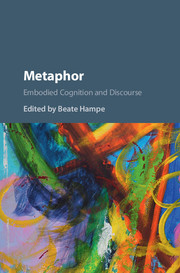
- MetaphorEmbodied Cognition and Discourse
- Metaphor
- Copyright page
- Contents
- Figures
- Tables
- Contributors
- Editor’s Preface and Acknowledgments
- Introduction
- Part I Metaphor in Cognition
- Part II More than Metaphor
- Part III Metaphor in Discourse
- Part IV Salient Metaphor
- Epilogue (A Personal View)
- References
- Person Index
- Subject Index
Contributors
Published online by Cambridge University Press: 05 July 2017
Edited by
Book contents
- MetaphorEmbodied Cognition and Discourse
- Metaphor
- Copyright page
- Contents
- Figures
- Tables
- Contributors
- Editor’s Preface and Acknowledgments
- Introduction
- Part I Metaphor in Cognition
- Part II More than Metaphor
- Part III Metaphor in Discourse
- Part IV Salient Metaphor
- Epilogue (A Personal View)
- References
- Person Index
- Subject Index
Summary
A summary is not available for this content. As you have access to this content, full HTML content is provided on this page. A PDF of this content is also available in through the ‘Save PDF’ action button.
Information
- Type
- Chapter
- Information
- MetaphorEmbodied Cognition and Discourse, pp. xi - xviPublisher: Cambridge University PressPrint publication year: 2017
Accessibility standard: Unknown
Why this information is here
This section outlines the accessibility features of this content - including support for screen readers, full keyboard navigation and high-contrast display options. This may not be relevant for you.Accessibility Information
Accessibility compliance for the HTML of this chapter is currently unknown
and may be updated in the future.
 You have
Access
You have
Access