
Skip to main content Accessibility help
×
  • Cited by 6
    • Show more authors
    • You may already have access via personal or institutional login
    • Select format
    • Publisher:
      Cambridge University Press
      Publication date:
      13 December 2018
      22 November 2018
      ISBN:
      9781108261166
      9781108417044
      9781108404273
      Dimensions:
      (228 x 152 mm)
      Weight & Pages:
      0.8kg, 412 Pages
      Dimensions:
      (228 x 152 mm)
      Weight & Pages:
      0.7kg, 412 Pages
    You may already have access via personal or institutional login
  • Selected: Digital
    Add to cart View cart Buy from Cambridge.org

    Book description

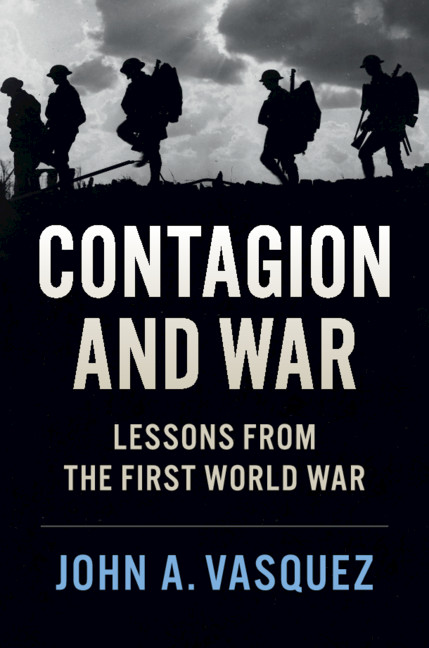
    John A. Vasquez explains the processes that cause the spread of interstate war by looking at how contagion worked to bring countries into the First World War. Analysing all the key states that declared war, the book is comprised of three parts. Part I lays out six models of contagion: alliances, contiguity, territorial rivalry, opportunity, 'brute force' and economic dependence. Part II then analyses in detail the decision making of every state that entered the war from Austria-Hungary in 1914 to the United States and Greece in 1917. Part III has two chapters - the first considers the neutral countries, and the second concludes the book with an overarching theoretical analysis, including major lessons of the war and new hypotheses about contagion. This book will be of great interest to students and scholars of international relations, conflict studies and international history, especially those interested in the spread of conflict, or the First World War.

    Reviews

    ‘Some scholars like to look at forests from the outside-in and never get too close to the trees. Others like to plunge into the forest and tag every tree. Despite the old adage of not seeing the forest for the trees, both approaches can prove profitable. John A. Vasquez's latest book is a tree-tagging exercise that pays off in generating an inside-out look at why war participation spreads. There is still more to learn about these contagious processes but tackling first one of the toughest nuts to crack in the war inventory, World War I, should make it easier to figure out why wars spread in general. And just when you thought everything had been said about World War I that could be said, Vasquez comes up with some new twists on how things worked between 1914 and 1918.'

    William R. Thompson - Distinguished and Rogers Professor Emeritus, Indiana University

    ‘Contagion and War is a nuanced and systematic exploration of the multiple causal processes through which war might spread, illustrated by a detailed examination of the First World War. Vasquez makes a significant contribution to both the theory of international conflict and to our historical understanding of one of the world's most catastrophic and consequential wars.'

    Jack S. Levy - Rutgers University, New Jersey

    ‘Contagion and War adds to our knowledge of World War I and multiparty conflicts … by recognizing that temporal sequences are involved in both the start and spread of belligerency, and teasing out and exploring the mechanisms associated with them.’

    Richard Ned Lebow Source: War in History

    Refine List

    Actions for selected content:

    Select all | Deselect all
    • View selected items
    • Export citations
    • Download PDF (zip)
    • Save to Kindle
    • Save to Dropbox
    • Save to Google Drive

    Save Search

    You can save your searches here and later view and run them again in "My saved searches".

    Please provide a title, maximum of 40 characters.
    ×

    Contents

    Metrics

    Altmetric attention score

    Full text views

    Total number of HTML views: 0
    Total number of PDF views: 0 *
    Loading metrics...

    Book summary page views

    Total views: 0 *
    Loading metrics...

    * Views captured on Cambridge Core between #date#. This data will be updated every 24 hours.

    Usage data cannot currently be displayed.

    Accessibility standard: Unknown

    Why this information is here

    This section outlines the accessibility features of this content - including support for screen readers, full keyboard navigation and high-contrast display options. This may not be relevant for you.

    Accessibility Information

    Accessibility compliance for the HTML of this book is currently unknown and may be updated in the future.
