
Skip to main content Accessibility help
×
  • Cited by 4
    • Show more authors
    • You may already have access via personal or institutional login
    • Select format
    • Publisher:
      Cambridge University Press
      Publication date:
      29 March 2018
      29 March 2018
      ISBN:
      9781108278058
      9781108417648
      9781108405546
      Dimensions:
      (228 x 152 mm)
      Weight & Pages:
      0.68kg, 338 Pages
      Dimensions:
      (229 x 152 mm)
      Weight & Pages:
      0.5kg, 340 Pages
    You may already have access via personal or institutional login
  • Selected: Digital
    Add to cart View cart Buy from Cambridge.org

    Book description

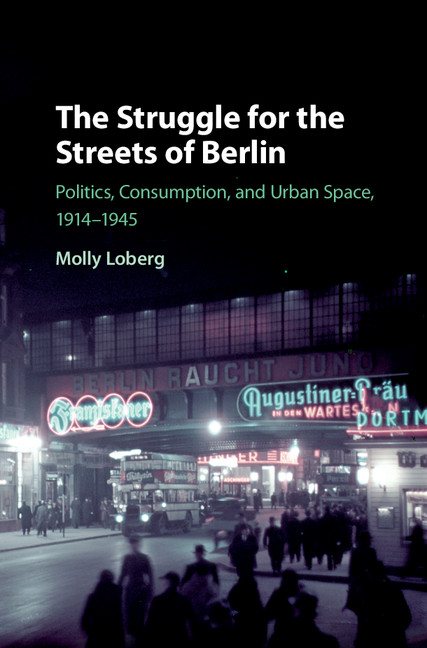
    Who owns the street? Interwar Berliners faced this question with great hope yet devastating consequences. In Germany, the First World War and 1918 Revolution transformed the city streets into the most important media for politics and commerce. There, partisans and entrepreneurs fought for the attention of crowds with posters, illuminated advertisements, parades, traffic jams, and violence. The Nazi Party relied on how people already experienced the city to stage aggressive political theater, including the April Boycott and Kristallnacht. Observers in Germany and abroad looked to Berlin's streets to predict the future. They saw dazzling window displays that radiated optimism. They also witnessed crime waves, antisemitic rioting, and failed policing that pointed toward societal collapse. Recognizing the power of urban space, officials pursued increasingly radical policies to 'revitalize' the city, culminating in Albert Speer's plan to eradicate the heart of Berlin and build Germania.

    Awards

    Finalist, 2018 Waterloo Centre for German Studies Book Prize

    Winner, 2018 Hans Rosenberg Prize, Central European History Society

    Reviews

    'Molly Loberg illuminates the sequential phases of the commercial and political ‘scramble for space’ and struggle for access to and control of the streets of post-World War I Berlin. Alongside the less well known contestations - the stories of rogue placard pasters, hawkers, beggars, unruly drivers, and gangs of thieves - is the assault on Jewish space in Berlin. The extinction of Jewish space preceded the extinction of Jewish life. This is a deeply-researched, highly original, and creative venture in spatial history.'

    Christopher R. Browning - University of North Carolina, Chapel Hill

    'It is a rare book that allows today’s readers to mingle with yesterday’s crowds, to touch the textures of streets, the noise of hype, but also to feel the suspicious glances of policemen, Nazis, and ordinary strangers. Loberg’s superb book explores how possibility and apprehension intertwined to make and remake the face of twentieth-century Berlin.'

    Peter Fritzsche - author of An Iron Wind: Europe under Hitler

    'Brimming with fresh empirical findings and intellectual insights, The Struggle for the Streets of Berlin makes a significant contribution to the historiography of the German metropolis in the Weimar and Nazi periods. The book should also be of interest to scholars of consumption, commerce and social control in European cities.'

    Moritz Föllmer - University of Amsterdam

    'Placing the familiar story of the rise of National Socialism in the context of the changing texture of urban life, Molly Loberg offers a fresh perspective on Germany during the 1920s and 1930s. In an extremely well-researched book, she shows how people (and police) interacted in public space - through commerce, consumption, crime and the often chaotic patchwork of daily life - in the ‘struggle for the streets of Berlin.'

    Richard Bessel - University of York

    'How do the big political events and large-scale social transformations make their way into the ground-level experience of everyday lives? In this fascinating social topography of popular politics in early twentieth-century Berlin. Molly Loberg challenges many familiar assumptions about how political changes can occur.'

    Geoff Eley - University of Michigan, Ann Arbor

    'Loberg offers much that challenges readers to rethink historical assumptions … Advancing an innovative approach to Berlin’s history, The Struggle for the Streets is essential reading for historians of Berlin. Students of Weimar and Nazi Germany will also find the work engaging, as Loberg’s analysis from the streets convincingly questions the standard periodization of German history.'

    Sara Ann Sewell Source: European History Quarterly

    Refine List

    Actions for selected content:

    Select all | Deselect all
    • View selected items
    • Export citations
    • Download PDF (zip)
    • Save to Kindle
    • Save to Dropbox
    • Save to Google Drive

    Save Search

    You can save your searches here and later view and run them again in "My saved searches".

    Please provide a title, maximum of 40 characters.
    ×

    Contents

    Metrics

    Altmetric attention score

    Full text views

    Total number of HTML views: 0
    Total number of PDF views: 0 *
    Loading metrics...

    Book summary page views

    Total views: 0 *
    Loading metrics...

    * Views captured on Cambridge Core between #date#. This data will be updated every 24 hours.

    Usage data cannot currently be displayed.

    Accessibility standard: Unknown

    Why this information is here

    This section outlines the accessibility features of this content - including support for screen readers, full keyboard navigation and high-contrast display options. This may not be relevant for you.

    Accessibility Information

    Accessibility compliance for the HTML of this book is currently unknown and may be updated in the future.
