

Aslı Bâli is Professor of Law at UCLA School of Law, and Director of the UCLA Center for Near Eastern Studies. She is the co-editor of Constitution Writing, Religion and Democracy (Cambridge University Press, 2017) and author of numerous peer-reviewed and law review articles, including “The Perils of Judicial Independence: Constitutional Transition and the Turkish Example,” in The Virginia Journal of International Law (2012); “Courts and Constitutional Transitions: Lessons from the Turkish case,” in the International Journal of Constitutional Law (2013), and “Shifting into reverse: Turkish constitutionalism under the AKP,” Theory and Event (2016).
Philip Gorski is Professor of Sociology, International Studies, and Religious Studies at Yale University. He received an AA from Deep Springs College, a BA from Harvard College, and a PhD from the University of California at Berkeley. His most recent book is American Covenant: A History of Civil Religion from the Puritans to the Present (2017).
Helen Hardacre is the Reischauer Institute Professor of Japanese Religions and Society at Harvard University. She earned her doctorate from the University of Chicago in 1980. She has done extended field study of contemporary Shinto, Buddhist religious organizations, and the religious life of Japan’s Korean minority. She has also researched State Shinto and contemporary ritualizations of abortion in Japan. Before moving to Harvard in 1992, she taught at Princeton University (1980–1989) and Griffith University (Australia) (1990–1991). Her publications include The Religion of Japan’s Korean Minority (1984), Lay Buddhism in Contemporary Japan: Reiyukai Kyodan (1984), Kurozumikyo and the New Religions of Japan (1986), Shinto and the State, 1868–1988 (1989), Marketing the Menacing Fetus in Japan (1997), and Religion and Society in Nineteenth-Century Japan: A Study of the Southern Kanto Region, Using Late Edo and Early Meiji Gazetteers (2002) and Shinto: A History (2016). Her ongoing research includes work concerning the issue of constitutional revision in Japan and its effect on religious groups.
Nader Hashemi is the Director of the Center for Middle East Studies and an Associate Professor of Middle East and Islamic Politics at the Josef Korbel School of International Studies at the University of Denver. He obtained his doctorate from the Department of Political Science at the University of Toronto and previously was an Andrew W. Mellon Postdoctoral Fellow at Northwestern University and a Visiting Assistant Professor at the UCLA Global Institute. He is the author of Islam, Secularism and Liberal Democracy: Toward a Democratic Theory for Muslim Societies (Oxford University Press, 2009) and co-editor of The People Reloaded: The Green Movement and the Struggle for Iran’s Future (Melville House, 2011), The Syria Dilemma (MIT Press, 2013), and Sectarianization: Mapping the New Politics of the Middle East (Oxford University Press, 2017).
Christophe Jaffrelot is Senior Research Fellow at CERI-Sciences Po/CNRS in Paris. He teaches South Asian politics at Sciences Po and King’s College. Among his most recent publications are Religion, Caste and Politics in India (2010) and The Pakistan Paradox – Instability and Resilience (2015) and as editor, Pakistan: Nationalism Without a Nation? (2002); A History of Pakistan and its origins (2004); Hindu Nationalism. A Reader (2007); with L. Gayer (eds), Muslims of India’s Cities. Trajectories of marginalization (2012); and Pakistan at the Crossroads – Domestic Dynamics and External Pressures (2016).
Zhe Ji is Associate Professor of Chinese Studies at the Institut National des Langues et Civilisations Orientales in Paris. His main study areas are Buddhism and the relationship between state and religion. He has published numerous articles regarding Buddhism in contemporary China and co-founded the Centre d’Etudes Interdisciplinaires sur le Bouddhisme. His books include Religion, Modernité et Temporalité: une sociologie du bouddhisme chan contemporain (CNRS Editions, 2016) and Making Saints in Modern China (co-edited with David Ownby and Vincent Goossaert, Oxford University Press, 2017). In 2014, he was nominated as Junior Member of the Institut Universitaire de France.
Gudrun Krämer is Professor of Islamic Studies at Freie Universität Berlin and director of the Berlin Graduate School Muslim Cultures and Societies. She has worked and published on modern Middle Eastern history and on Islam, democracy, and modernity. Her books include Der Vordere Orient und Nordafrika ab 1500 (2016), Hasan al-Banna (2010), A History of Palestine: From the Ottoman Conquest to the Founding of the State Israel (2008), The Jews in Modern Egypt (1989), Responsabilité, égalité, pluralism: Réflexions sur quelques notions-clés d’un ordre islamique moderne (2000), and the edited volume (with Sabine Schmidtke) Speaking for Islam: Religious Authorities in Muslim Societies (2006). She is a member of the Berlin-Brandenburg Academy of Sciences and Humanities, the Tunisian Academy of Sciences (Bayt al-Hikma), and an Executive Editor of the Encyclopaedia of Islam Three. In 2010 she received the Gerda Henkel Prize.
Mirjam Künkler is a senior research fellow at the Swedish Collegium for Advanced Study (SCAS). Before joining SCAS, she taught Near Eastern Studies at Princeton University, where she also directed the Oxford-Princeton research cluster on “Traditional authority and transnational religious networks in contemporary Shi’i Islam” and co-directed the Luce Program on “Religion and International Affairs” for several years. Her books include Democracy and Islam in Indonesia (co-edited with Alfred Stepan, 2013; published in Arabic as Al-Dimokratia va al-Islam fi Indonisia, 2015); Women’s Juristic Authority in Shi‘ite Islam (with Devin Stewart, Edinburgh University Press, forthcoming 2018); as well as two volumes co-edited with Tine Stein: Selected Writings by Ernst-Wolfgang Böckenförde, 2017 (Vol. I) and 2018 (Vol. II). Künkler has guest-edited special issues and symposia for the journals Party Politics (March 2013), Cambridge Journal of Law and Religion (January 2013), the American Behavioral Scientist (July 2016), Asian Studies Review (December 2016), the British Journal of Middle Eastern Studies (January 2018), Constellations (June 2018) and the German Law Journal (May 2018).
Hanna Lerner is a senior lecturer of Political Science at Tel Aviv University. She is the author of Making Constitutions in Deeply Divided Societies (Cambridge University Press, 2011), co-editor of Global Justice and International Labour Rights (Cambridge University Press, 2016), and co-editor of Constitution Writing, Religion and Democracy (Cambridge University Press, 2017). Her research focuses on comparative constitution-making, Israeli constitutional politics, religion and democracy, global justice, and international labor.
John Madeley retired as Senior Lecturer in Government at the London School of Economics and Political Science in 2009, where he also served as the Dean of the Graduate School for three years. Starting as a specialist in the government and politics of the Nordic countries, during the second half of his career he concentrated on researching and teaching the linkages between and contrasting patterns of religion and politics, especially across Europe’s 50-plus countries. In addition to many journal articles and book chapters, he edited Church and State in Contemporary Europe: The Chimera of Neutrality (with Zsolt Enyedi, 2003), Religion and Politics (2003), and Religion, Law and Politics in the European Union (with Lucian Leustean, 2010). Recent publications include “Constitutional Models and the protection of religious freedom” in S. Ferrari (ed.) Routledge Handbook of Law and Religion (2015) and “The curious case of religion in the Norwegian Constitution” in A. Bâli and H. Lerner (eds.) Constitution Writing Religion and Democracy (2017).
Shylashri Shankar is a senior fellow at the Centre for Policy Research in New Delhi. She has held academic positions at the University of Texas at Austin and the Center on Religion and Democracy, University of Virginia. In June 2011, she was a Bellagio Fellow at the Rockefeller Centre in Bellagio (Italy). She has a PhD in Political Science from Columbia University, an MSc from the London School of Economics and Political Science, an MA (Cantab) from the University of Cambridge, and a BA (Hons) from Delhi University. She is the author of Scaling Justice: India’s Supreme Court, Anti-Terror Laws and Social Rights (2009) and co-author of Battling Corruption (2013). In the past she has been a Fellow at the Rockefeller Foundation’s Bellagio Center in Italy and a co-convenor of a research group at the Center for Interdisciplinary Research (ZiF) in Bielefeld, Germany. She is currently working on a food biography of India (Speaking Tiger, 2017).
Charles Taylor is Professor em. of Philosophy at McGill University, Montreal. His most influential books are Explanation of Behaviour (1967), Sources of the Self (1989), and A Secular Age (2007). His newest book is The Language Animal (2016). He has been a recipient of numerous prizes and awards, among them the 2007 Templeton Prize, the 2008 Kyoto Prize in Arts and Philosophy, the 2015 John W. Kluge Prize for Achievement in the Study of Humanity, and the 2016 Berggruen Prize for philosophy.
Jonathan Wyrtzen is an associate professor of Sociology, International Affairs, and History at Yale University. He received a BA and MA from the University of Texas at Austin and a PhD from Georgetown University. His research interests center on empire and colonialism, state formation and non-state forms of political organization, ethnicity and nationalism, and religion and socio-political activism in North Africa and the Middle East. His first book, Making Morocco: Colonial Intervention and the Politics of Identity (2015), examines the relationships among European imperial expansion, colonial policies of modernization and state formation, and the rise of Arabo-Islamic nationalism in Morocco. His current book project focuses on the making of the modern Middle East during the Long Great War (1911–31), examining the clash between colonial and local political projects set in motion during this period to replace the Ottoman Empire. His recent publications include “Colonial Legitimization-Legibility Linkages and the Politics of Identity in Algeria and Morocco” in the European Journal of Sociology (2017) and “Colonial War and the Production of Territorialized Space in North Africa” in Political Power and Social Theory (2017).
Book contents
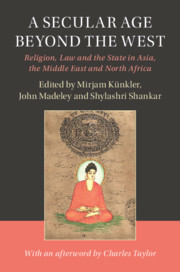
- A Secular Age beyond the West
- Cambridge Studies in Social Theory, Religion and Politics
- A Secular Age beyond the West: Religion, Law and the State in Asia, the Middle East and North Africa
- Copyright page
- Dedication
- Contents
- Tables and Figures
- Contributors
- Preface
- 1 Introduction
- 2 Secularity I: Varieties and Dilemmas
- 3 The Origins of Secular Public Space: Religion, Education, and Politics in Modern China
- 4 The Formation of Secularism in Japan
- 5 Law, Legitimacy, and Equality: The Bureaucratization of Religion and Conditions of Belief in Indonesia
- 6 Secularity and Hinduism’s Imaginaries in India
- 7 Secularity without Secularism in Pakistan: The Politics of Islam from Sir Syed to Zia
- 8 Charles Taylor’s A Secular Age and Secularization from Below in Iran
- 9 The Politics of Jewish Secularization in Israel
- 10 A Kemalist Secular Age? Cultural Politics and Radical Republicanism in Turkey
- 11 Enigmatic Variations: Russia and the Three Secularities
- 12 Piety, Politics, and Identity: Configurations of Secularity in Egypt
- 13 The Commander of the Faithful and Moroccan Secularity
- 14 Conclusions: The Continued Prevalence of the “Marker State”
- 15 Afterword and Corrections
- Appendix A Quantitative Take on the Incidence of Taylor’s Three Secularities in the Eleven Country Studies
- Index
Contributors
Published online by Cambridge University Press: 15 June 2018
Book contents
- A Secular Age beyond the West
- Cambridge Studies in Social Theory, Religion and Politics
- A Secular Age beyond the West: Religion, Law and the State in Asia, the Middle East and North Africa
- Copyright page
- Dedication
- Contents
- Tables and Figures
- Contributors
- Preface
- 1 Introduction
- 2 Secularity I: Varieties and Dilemmas
- 3 The Origins of Secular Public Space: Religion, Education, and Politics in Modern China
- 4 The Formation of Secularism in Japan
- 5 Law, Legitimacy, and Equality: The Bureaucratization of Religion and Conditions of Belief in Indonesia
- 6 Secularity and Hinduism’s Imaginaries in India
- 7 Secularity without Secularism in Pakistan: The Politics of Islam from Sir Syed to Zia
- 8 Charles Taylor’s A Secular Age and Secularization from Below in Iran
- 9 The Politics of Jewish Secularization in Israel
- 10 A Kemalist Secular Age? Cultural Politics and Radical Republicanism in Turkey
- 11 Enigmatic Variations: Russia and the Three Secularities
- 12 Piety, Politics, and Identity: Configurations of Secularity in Egypt
- 13 The Commander of the Faithful and Moroccan Secularity
- 14 Conclusions: The Continued Prevalence of the “Marker State”
- 15 Afterword and Corrections
- Appendix A Quantitative Take on the Incidence of Taylor’s Three Secularities in the Eleven Country Studies
- Index
Summary
A summary is not available for this content. As you have access to this content, full HTML content is provided on this page. A PDF of this content is also available in through the ‘Save PDF’ action button.
Information
- Type
- Chapter
- Information
- A Secular Age beyond the WestReligion, Law and the State in Asia, the Middle East and North Africa, pp. xii - xviPublisher: Cambridge University PressPrint publication year: 2018
Accessibility standard: Unknown
Why this information is here
This section outlines the accessibility features of this content - including support for screen readers, full keyboard navigation and high-contrast display options. This may not be relevant for you.Accessibility Information
Accessibility compliance for the HTML of this chapter is currently unknown
and may be updated in the future.
 You have
Access
You have
Access