
Skip to main content Accessibility help
×
  • Cited by 3
    • Show more authors
    • You may already have access via personal or institutional login
    • Select format
    • Publisher:
      Cambridge University Press
      Publication date:
      25 May 2018
      03 May 2018
      ISBN:
      9781108292191
      9781108418843
      Dimensions:
      (228 x 152 mm)
      Weight & Pages:
      0.55kg, 290 Pages
      Dimensions:
      Weight & Pages:
    You may already have access via personal or institutional login
  • Selected: Digital
    Add to cart View cart Buy from Cambridge.org

    Book description

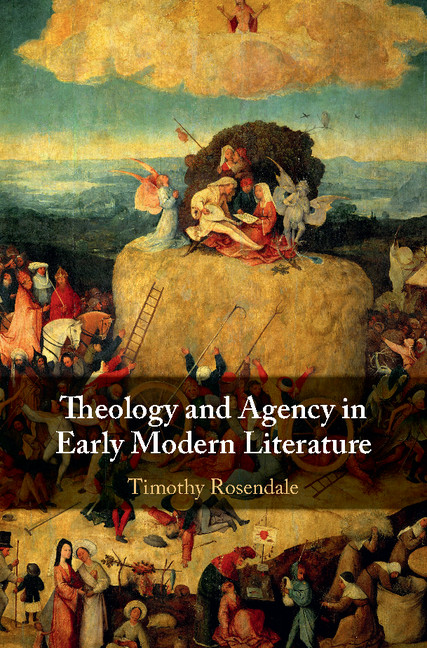
    What can I do? To what degree do we control our own desires, actions, and fate - or not? These questions haunt us, and have done so, in various forms, for thousands of years. Timothy Rosendale explores the problem of human will and action relative to the Divine - which Luther himself identified as the central issue of the Reformation - and its manifestations in English literary texts from 1580–1670. After an introduction which outlines the broader issues from Sophocles and the Stoics to twentieth-century philosophy, the opening chapter traces the theological history of the agency problem from the New Testament to the seventeenth century. The following chapters address particular aspects of volition and salvation (will, action, struggle, and blame) in the writings of Marlowe, Kyd, Shakespeare, Ford, Herbert, Donne, and Milton, who tackle these problems with an urgency and depth that resonate with parallel concerns today.

    Reviews

    ‘Rereading Marlowe, Donne, Milton and writers of revenge tragedy in the light of classical and Christian thought , Timothy Rosendale’s study delivers a panoramic perspective on [theological] quandaries … Rosendale’s own writing, sinuous and alert to paradox, does justice to the nuances he identifies.'

    Source: The Times Literary Supplement

    ‘… tightly argued and thorough … [Rosendale’s] book is admirable for several reasons: comprehension of the soteriological tradition; skilled and sustained close readings of major texts; and, perhaps most importantly, a thoroughgoing effort to understand the early modern preoccupation with this issue on early moderns’ own terms.’

    David K. Anderson Source: Renaissance Quarterly

    ‘There is an unintended timeliness, during a pandemic that defies humanity’s sense of control, in Timothy Rosendale’s meditation on the literary and theological problems of human agency … exceptionally sensitive to the contours of theological history …’

    Thomas Fulton Source: Modern Philology

    Refine List

    Actions for selected content:

    Select all | Deselect all
    • View selected items
    • Export citations
    • Download PDF (zip)
    • Save to Kindle
    • Save to Dropbox
    • Save to Google Drive

    Save Search

    You can save your searches here and later view and run them again in "My saved searches".

    Please provide a title, maximum of 40 characters.
    ×

    Contents

    Metrics

    Full text views

    Total number of HTML views: 0
    Total number of PDF views: 0 *
    Loading metrics...

    Book summary page views

    Total views: 0 *
    Loading metrics...

    * Views captured on Cambridge Core between #date#. This data will be updated every 24 hours.

    Usage data cannot currently be displayed.

    Accessibility standard: Unknown

    Why this information is here

    This section outlines the accessibility features of this content - including support for screen readers, full keyboard navigation and high-contrast display options. This may not be relevant for you.

    Accessibility Information

    Accessibility compliance for the HTML of this book is currently unknown and may be updated in the future.
