
Skip to main content Accessibility help
×
  • Cited by 10
    • Show more authors
    • You may already have access via personal or institutional login
    • Select format
    • Publisher:
      Cambridge University Press
      Publication date:
      12 July 2019
      01 August 2019
      ISBN:
      9781108348461
      9781108425506
      9781108442428
      Dimensions:
      (228 x 152 mm)
      Weight & Pages:
      0.5kg, 262 Pages
      Dimensions:
      (229 x 152 mm)
      Weight & Pages:
      0.39kg, 266 Pages
    You may already have access via personal or institutional login
  • Selected: Digital
    Add to cart View cart Buy from Cambridge.org

    Book description

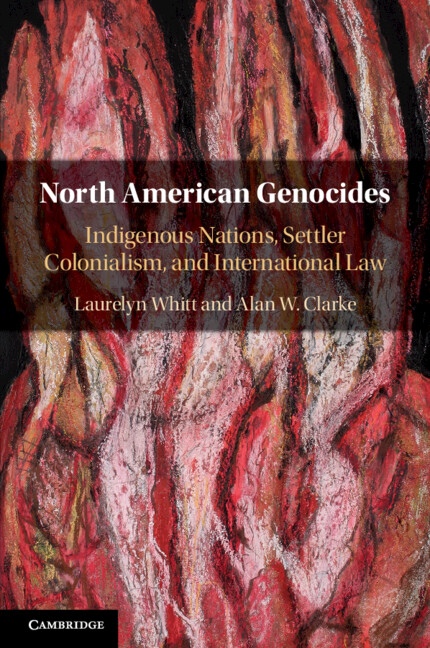
    When and how might the term genocide appropriately be ascribed to the experience of North American Indigenous nations under settler colonialism? Laurelyn Whitt and Alan W. Clarke contend that, if certain events which occurred during the colonization of North America were to take place today, they could be prosecuted as genocide. The legal methodology that the authors develop to establish this draws upon the definition of genocide as presented in the United Nations Genocide Convention and enhanced by subsequent decisions in international legal fora. Focusing on early British colonization, the authors apply this methodology to two historical cases: that of the Beothuk Nation from 1500–1830, and of the Powhatan Tsenacommacah from 1607–77. North American Genocides concludes with a critique of the Conventional account of genocide, suggesting how it might evolve beyond its limitations to embrace the role of cultural destruction in undermining the viability of human groups.

    Reviews

    'For too long, the historical experience and lasting impact of settler colonialism on the indigenous peoples of the Americas has been neglected in international law scholarship. This thoughtful and provocative work helps bring this reality to the surface, particularly in respect of the controversial use of the term 'genocide' to describe colonial policies of physical and cultural destruction.'

    Payam Akhavan - McGill University, Montreal and former UN prosecutor

    'This indispensable, remarkable and necessary book will change the way one comprehends the meaning of the crime of genocide in United Nations law. It is a brilliant and groundbreaking exposition that illuminates the predicament of the contested understanding of the crime of genocide and challenges the refusal to apply it to the destruction of North American Indigenous nations.'

    Sakej Henderson - Native Law Centre of Canada

    'In 1946, two years before the UN Genocide Convention was adopted, the General Assembly recognized that 'many instances' of the crime of genocide had already taken place. This thoughtful and compelling account makes the case for one of them, the intentional destruction of indigenous peoples in North America.'

    William A. Schabas - Middlesex University

    Refine List

    Actions for selected content:

    Select all | Deselect all
    • View selected items
    • Export citations
    • Download PDF (zip)
    • Save to Kindle
    • Save to Dropbox
    • Save to Google Drive

    Save Search

    You can save your searches here and later view and run them again in "My saved searches".

    Please provide a title, maximum of 40 characters.
    ×

    Contents

    Metrics

    Altmetric attention score

    Full text views

    Total number of HTML views: 0
    Total number of PDF views: 0 *
    Loading metrics...

    Book summary page views

    Total views: 0 *
    Loading metrics...

    * Views captured on Cambridge Core between #date#. This data will be updated every 24 hours.

    Usage data cannot currently be displayed.

    Accessibility standard: Unknown

    Why this information is here

    This section outlines the accessibility features of this content - including support for screen readers, full keyboard navigation and high-contrast display options. This may not be relevant for you.

    Accessibility Information

    Accessibility compliance for the HTML of this book is currently unknown and may be updated in the future.
