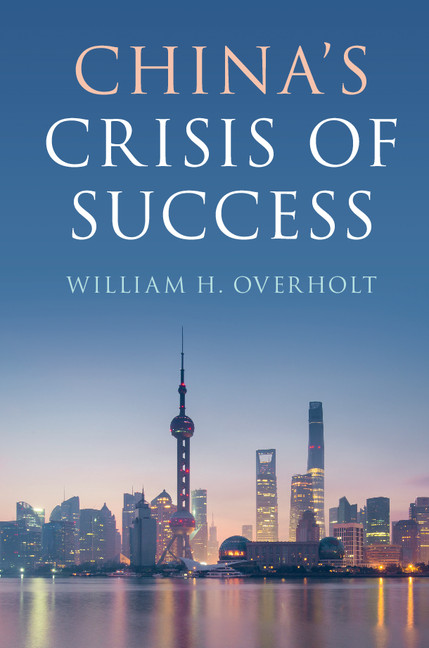

China's Crisis of Success provides new perspectives on China's rise to superpower status, showing that China has reached a threshold where success has eliminated the conditions that enabled miraculous growth. Continued success requires re-invention of its economy and politics. The old economic strategy based on exports and infrastructure now piles up debt without producing sustainable economic growth, and Chinese society now resists the disruptive change that enabled earlier reforms. While China's leadership has produced a strategy for successful economic transition, it is struggling to manage the politics of implementing that strategy. After analysing the economics of growth, William H. Overholt explores critical social issues of the transition, notably inequality, corruption, environmental degradation, and globalisation. He argues that Xi Jinping is pursuing the riskiest political strategy of any important national leader. Alternative outcomes include continued impressive growth and political stability, Japanese-style stagnation, and a major political-economic crisis.
‘This book is an excellent read. It debunks many common misunderstandings about China and explains why a political system of electoral democracy tends to be inimical to economic development in poor countries with much social inequality.'
Pieter Bottelier - The Johns Hopkins University
'William H. Overholt has been watching Asia for half a century, mostly making observations that run against the tide. His 1993 The Rise of China was heavily criticized at the time, but proved correct. Now, Overholt sees a real need for a change in the model that has brought China so much success economically; it must become more consumption oriented, less reliant on investment, it must move from manufacturing to services, and it must upgrade its manufacturing. These are all complex challenges that carry substantial risks. Overholt lays out these challenges with his usual clear sightedness.'
Joseph Fewsmith - Boston University
'William Overholt, who may have been the first to identify the ‘rise of China’ in his 1993 book of that name, goes straight to the heart of the puzzles presented by contemporary China. … This is an eye-opening book that debunks many established notions held by disciplinary academics, as well as by policymakers both in China and the West.'
Gilles Andréani Source: Survival: Global Politics and Strategy
Loading metrics...
* Views captured on Cambridge Core between #date#. This data will be updated every 24 hours.
Usage data cannot currently be displayed.
This section outlines the accessibility features of this content - including support for screen readers, full keyboard navigation and high-contrast display options. This may not be relevant for you.
Accessibility compliance for the HTML of this book is currently unknown and may be updated in the future.
