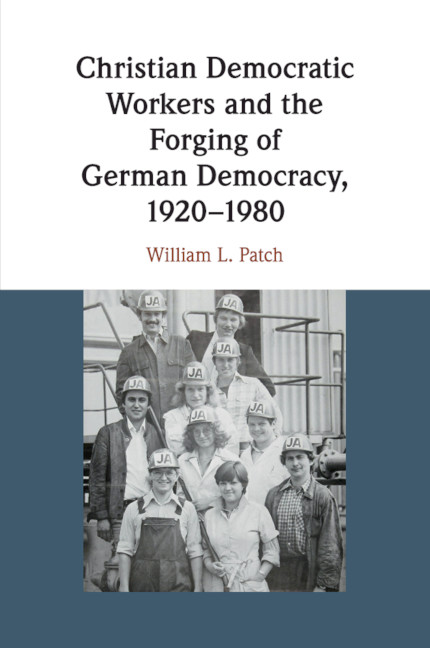

Why has democracy flourished in the Federal Republic of Germany despite that country's troubled past? Exhaustive research in German historical archives illuminates the pivotal role played by the veterans of the Christian trade unions of the Weimar Republic, the only group to participate in both of Germany's most successful political experiments after 1945, a 'Christian Democratic' party to unite Catholics and Protestants, and unified labor unions for workers of all political outlooks. They perceived that feuds between the religious confessions and competition among three rival labor federations had greatly facilitated Hitler's rise, and they resolved to bridge both chasms. Playing an influential role on the left wing of the CDU from the 1950s to the 1970s, Christian laborites alleviated class conflict through new welfare programs and laws to grant workers a powerful voice in management decisions. They took the lead in forging the distinctive 'German Model' for labor relations.
‘From co-determination between employees and employers to the welfare state, from debates about democracy to the gradual rise of Social Democracy, the Catholic labor movement played a critical role in constructing postwar West Germany. Patch tells the story of these ‘bridge-builders' beautifully, with an unsurpassed knowledge of the sources.'
Peter C. Caldwell - Rice University, Texas
‘William Patch's Christian Democratic Workers and the Forging of German Democracy, 1920–1980 offers a compelling argument that Christian labor leaders in the early Federal Republic – Catholic as well as Protestant – set aside the confessional divisions that had so severely damaged their prospects in the Weimar Republic to unite behind the newly founded Christian Democratic Union, from where they went on to play a decisive role in the creation of a stable German democracy.'
Larry Eugene Jones - Canisius College, New York
‘Overturning the dominant view of the conservatism of the German Christian Democratic Party, William L. Patch shows how fundamental the impact of Christian labor on German society really was. A bold argument, based on extensive research, presented in a rich and nuanced way. Highly relevant also for our present neo-liberal and populist times. Impressive.'
Patrick Pasture - Katholieke Universiteit Leuven, Belgium
‘The book acknowledges the contribution of the Christian Social Labor Movement to the German model of labor relations and Social Market Economy. Furthermore it impressively highlights the brave resistance against Hitler by the Christian Trade Unions of the 20s and 30s. It also shows their often overlooked influence on the CDU in West Germany. All in all an important book about a Germany which is little known.'
Tilman Mayer - Rheinische Friedrich-Wilhelms-Universität Bonn
‘… the book is a massive achievement, and one that extends the analysis of Patch’s previous, and rightly influential, scholarship. It is recommended reading for anyone interested in postwar German history, labor history, or the history of religion and politics.’
James Chappel Source: ,H-Net: Humanities and Social Science Reviews Online
Loading metrics...
* Views captured on Cambridge Core between #date#. This data will be updated every 24 hours.
Usage data cannot currently be displayed.
This section outlines the accessibility features of this content - including support for screen readers, full keyboard navigation and high-contrast display options. This may not be relevant for you.
Accessibility compliance for the HTML of this book is currently unknown and may be updated in the future.
