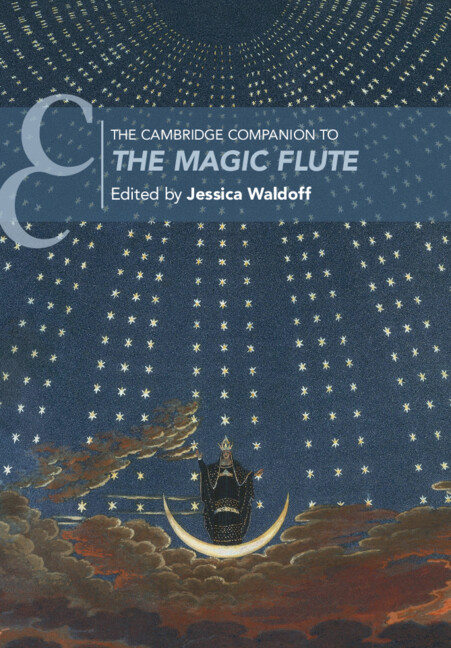
The Cambridge Companion to The Magic Flute

-
Select format
-
- Publisher:
- Cambridge University Press
- Publication date:
- 24 November 2023
- 02 November 2023
- ISBN:
- 9781108551328
- 9781108426893
- 9781108446846
- Dimensions:
- (244 x 170 mm)
- Weight & Pages:
- 0.84kg, 388 Pages
- Dimensions:
- (244 x 170 mm)
- Weight & Pages:
- 0.67kg, 388 Pages
- Subjects:
- Music, Opera, Eighteenth-Century Music, Music: General Interest
- Series:
- Cambridge Companions to Music
You may already have access via personal or institutional login- Subjects:
- Music, Opera, Eighteenth-Century Music, Music: General Interest
- Series:
- Cambridge Companions to Music
Show more authors 
You may already have access via personal or institutional login
Book description
Since its premiere in 1791, The Magic Flute has been staged continuously and remains, to this day, Mozart's most-performed opera worldwide. This comprehensive, user-friendly, up-to-date critical guide considers the opera in a variety of contexts to provide a fresh look at a work that has continued to fascinate audiences from Mozart's time to ours. It serves both as an introduction for those encountering the opera for the first time and as a treasury of recent scholarship for those who know it very well. Containing twenty-one essays by leading scholars, and drawing on recent research and commentary, this Companion presents original insights on music, dialogue, and spectacle, and offers a range of new perspectives on key issues, including the opera's representation of exoticism, race, and gender. Organized in four sections – historical context, musical analysis, critical approaches, and reception – it provides an essential framework for understanding The Magic Flute and its extraordinary afterlife.
Reviews
‘This volume will surely spark these conversations in the scholarly community, another link in the chain of exploring this intriguing work.’
Lily Kass Source: Notes: the Quarterly Journal of the Music Library Association.
Contents
Contents
Metrics
Altmetric attention score
Full text views
Full text views helpTotal number of HTML views: 0
Total number of PDF views: 0 *
 Loading metrics...
* Views captured on Cambridge Core between #date#. This data will be updated every 24 hours.
Usage data cannot currently be displayed.
Accessibility standard: Unknown
Why this information is here
This section outlines the accessibility features of this content - including support for screen readers, full keyboard navigation and high-contrast display options. This may not be relevant for you.
Accessibility Information
Accessibility compliance for the HTML of this book is currently unknown and may be updated in the future.