

The lexicography of Canadian English is a niche field today. Once looming large, the field was abandoned by academic linguistics in the early 1980s. Since around 2000, Canadian dictionary publishing has been considered no longer economically viable, which successively forced the retreat of dictionary publishers Funk & Wagnalls (F&W), followed by Nelson, then Gage, and at last the latest entry into that market, Oxford University Press. These publishers had been carrying on the tradition to a degree.
Consequently, the lexicography of Canadian English is currently not adequately institutionalised. There is a strong history with many impressive dictionaries and some landmark works, including three regional scholarly historical dictionaries (the Dictionary of Newfoundland English, online at http://heritage.nf.ca/dictionary, as well as the Dictionary of Prince Edward Island English and the Dictionary of Cape Breton English). There is also a recently updated open-access historical dictionary of Canadianisms (http://dchp.ca/dchp2) and at least three carefully-crafted desk dictionaries from around 2000 (the Gage Canadian Dictionary, fifth edition, 1997; the ITP Nelson Dictionary of the English Language, 1997; and the Canadian Oxford Dictionary, second edition, 2004). It needs to be added that a good number of dictionaries geared towards the Canadian market have been of questionable quality, such as the popular wordbooks by Bill Casselman. These will not be discussed for reasons of space.
Periodisation: The First Century
Canadian English lexicography has completed its first century, which may be divided into four periods. First, a foundation period beginning in 1912, when the first monolingual stand-alone wordbook of Canadian English was published (Sandilands 1912 [1977]). Prior to that, French glossaries had existed as early as 1534, and the first known English wordlist dates from 1792 (Considine 2003, 251). The foundation period also includes what has commonly been termed the first Canadian general desk dictionary (Brown and Alexander 1937).
Preceded by the national war effort around World War II, a growth period began in earnest at the 1958 Canadian Congress of the Social Sciences and Humanities, held in Edmonton. This period produced the landmark dictionaries, these being The Senior Dictionary and the Dictionary of Canadianisms on Historical Principles, first edition (DCHP-1, online at http://dchp.ca/dchp1). The start of the Dictionary of Newfoundland English under George Story also falls in this period.
The book market period was next, beginning in the early 1970s, and characterised by a search for quick(er) returns on investment. It culminated, ultimately, in what I call the Great Canadian Dictionary War of the late 1990s. This war had no long-term winners and many losers, the biggest one belonging to the 1960s, high-quality tradition of Canadian lexicography. Terry Pratt’s interview-based and sociolinguistically inspired Dictionary of Prince Edward Island English appeared in this period as perhaps the last scholarly dictionary of Canadian English of the twentieth century.
Since 2008, Canada has experienced a post-sales period in which, apart from a historical dictionary (DCHP-2), no up-to-date dictionary of Canadian English has been available. The Dictionary of Cape Breton English, published in 2016, is traditional in approach and does not generally include current terms. The ‘post-sales period’ is named based on user expectations that reference tools ought to be digital and free, a development that the commercial publishers had missed.
Drawn-Out Canadian Birthing Processes: The Winston Simplified (1937)
National developments have been known to take their time in Canada, with identity formation processes appearing as excessively drawn-out cases. To make the point, we can say that Canadian independence only began in 1867 with the Canadian Confederation, although today Canadians celebrate that year as the country’s birthday; it might be more adequate to call it the country’s ‘conception’, however, as 1867 is hardly the equivalent to the 1776 American Declaration of Independence. After 1867, Canada was still a British colony, though with powers of its own, however limited. For example, Canadian passports were not issued before 1947 (just British ones), and it was as late as 1982 that the Canadian parliament finally acquired the right to alter its founding document, the 1867 British North America Act (before then, Westminster was in charge).
In this light, it may not be surprising that Canadian English lexicography began with baby steps and long idle periods. John Sandilands’ pioneering book of about 850 (first edition, 1912) and subsequently 1500 terms (second edition, 1913) made a beginning with a guide for the cheechako (newcomer) to the Canadian West. Not geared towards sourdoughs (those who had survived at least one Canadian winter), it introduces, among other things, B.S. for bullshit, kale (‘money’), and to make the grade (‘succeed’) (Considine 2003, 253). In a way, Sandilands was Western Canada’s ‘hard word’ dictionary, but with a tongue-in-cheek sprinkle, presumably to increase sales in both the New and Old Country. Sandilands was in a way Act 1–Scene 1 in the history of English lexicography in Canada (Considine 2003, 252).
It was one world war later and on the brink of another one that Act 2 would begin with a general language dictionary, The Winston Simplified Dictionary: For Home, School and Office (WSD). Considine identifies the WSD as ‘the first general dictionary aimed at the Canadian market’ (2003, 254). Printed in Toronto in 1937, the WSD was a very subtle yet principled adaptation of the 1937 edition printed in Philadelphia, PA, though the Winston Simplified Dictionary: Primary Edition, about the same length, is another possible source. The Canadianisation was carried out by the expert of Canadian English at the time, Queen’s University English professor Henry Alexander. The unsuccessful search for some Canadianisms in use by the 1930s gives an idea of the limited scope of Canadianisation: not entered are to acclaim (‘to elect without opposition’), chesterfield (‘sofa’, in DCHP-2), toque (or tuque, ‘winter hat’), and washroom (‘bathroom’). Likewise, the foreign ice hockey is entered (but not hockey, as used in Canada), as is beaver; they are entered without any Canadian reference, as is tap, the majority Canadian form for ‘faucet’.
While a comparison of the American 1937 and the Canadianised 1937 edition is pending, it seems that the print plates of the US edition could only marginally be altered. Alexander wisely chose Canadian spelling for that purpose, which he consequently de facto codified. He listed, for instance, only honour (not honor), but ‘theatre or theater’, while centre and metre were the main entries, as was colour, with color being labelled, remarkably at the time, as ‘an American spelling of colour’ (Brown and Alexander 1937, s.v. color). Alexander lists with ‘American’ apologize, systematize (no –ise endings), and fufilment [one l], and ‘British’ levelling [two l’s] – the mix that to this day characterises Canadian English (Pratt 1993, 47–9). The limitations Alexander may have faced within WSD’s 629 pages are largely unclear, however. The Winston Simplifieds were innovative, aiming to document the ‘actual use’ with ‘verbal illustrations’ of a given word in example sentences (Brown and Alexander 1937, iv); WSD’s scope was, with ‘upwards of 32,550’ entries, small and on a par with a primary dictionary.
English and the Canadian Nation: From the Western Canadian Dictionary and Phrasebook (1912) to DCHP-2 (2017)
For language standards, the status quo has considerable weight and is usually presented as an ahistorical, unquestionable construct. This is true in Western languages that have been implicated by the confounding of nationalism with linguistic ‘purity’, a late eighteenth-century idea; German Gottfried Herder (1744–1803) is considered its key philosopher. What seemed like an enlightened idea then (‘one nation, one language’) has since contributed to two world wars and yet more harm. Recently, in light of unprecedented migrant movements in Europe, these ideas have received renewed uptake; historical sociolinguists would do well to comment.
Linguistic diversification, codification, and resistance to it are still quite universal processes. The charge of nationalism always looms large, yet what is often not seen is that speakers have a legitimate need to express their identities linguistically. It is also clear that the idea of an ‘older’ standard and its ‘universal claim’ is itself an ideological construct that dismisses speakers’ needs and linguistic rights to choose and create a variety of their own, as Einar Haugen first explored in the 1960s with the example of Norwegian. The codification of a national variety of Canadian English can be dated to the 1950s through 1960s, with local Toronto publisher Gage playing the major role in the process with the Dictionary of Canadian English series, comprised of three school dictionaries; The Senior was the most comprehensive, while DCHP-1 was the most scholarly (Gregg 1993, 35–6). Recent years, since about 2007, have seen the acceptance of a Canadian standard by wider parts of the Canadian population. This is the standard defined mostly by Gage from the 1960s on, followed by the Canadian Oxford Dictionary, while the real change is a change in attitudes that seems to have, quietly and behind the scenes (which is itself very Canadian), taken place.
The table below lists the – nationally – most important dictionaries, while excluding for reasons of focus the (impressive) regional dictionaries, which are mentioned above. Responsible for The Beginning Dictionary, The Intermediate Dictionary, and The Senior Dictionary (as of 1983 renamed The Gage Canadian Dictionary), Gage put Canadian English on the map. Canadian adaptations of (usually) American dictionaries came forth in increased numbers in the 1970s. Funk & Wagnalls Canadian College Dictionary (1986) is nearly identical to the Funk & Wagnalls Standard College Dictionary (1978), which featured on the inner pages only the words ‘Canadian edition’. With the 1986 edition, the wording was moved onto the title page and the Funk & Wagnalls Canadian College Dictionary was born. Chief editor of these dictionaries was Albert H. Marckwardt, a Michigan-based dialectologist who was sympathetic to Canadian English. While Walter S. Avis, the pioneer researcher of Canadian English, is listed as the Canadian consultant and wrote the foreword, the F&W dictionaries are qualitatively not as thorough as the Gage dictionaries in terms of Canadian English.
The last edition, F&W 1989, claims to include ‘[m]ore than 200,000 definitions’ (paperback edition cover). It lists and marks as Canadian, for example, beaver (5) (‘coin’), chesterfield (2) (‘sofa’) as ‘chiefly Canadian’, or hydro (‘electricity’), yet the definition of ‘hydroelectric’ is too narrow; not listed are, among others, e.g., garburator (‘in-sink organic waste disposal’), ghost car (‘unmarked police car’), and parkade (‘parking garage’); while washroom (‘public toilet’) is not marked Canadian, and toque is mistranscribed with [ou] instead of [u] (this mistake is still found in the Canadian Collins Dictionary from 2011), though tuque is labelled Canadian; eh is listed with only one meaning without a Canadian dimension. F&W 1989 shows room for improvement.
There is little doubt that the Gage Canadian Dictionary (1997), the ITP Nelson Dictionary (1997), and the Canadian Oxford Dictionary (1998, 2004) are still the best present-day dictionaries of Canadian English. Not without their problems, these dictionaries are largely available in paper only, which is one reason for their demise. Apart from these and the F&W introduced above, the Penguin Canadian Dictionary (PCD) deserves mention. The PCD is a 1990 dictionary featuring a ‘fully Canadian database, developed and produced in Canada’.
PCD is the product of a single person and as such, was remarkable in the increasingly tough market of the early 1990s. Thomas M. Paikeday, PCD’s editor, claims to have used ‘computerised databases of well-edited current English’ for the first time (PCD, ix), a claim that is, for Canada, likely correct. With 75,000 entries, the PCD was bigger than the Winston series on which Paikeday used to work. The PCD is remarkable as a one-man project undertaken as a labour of love. It lists (like F&W 1989) teeter-totter (a Canadian term) as ‘see saw’, without labels. It does not list garburator or ghost car; it does not mark washroom as Canadian; Cheque is (correctly) listed as the first form (and check second), but no information on its use is given (almost categorically cheque in Canada). Parkade is correctly defined as ‘an automobile parking facility that is one or more storeys high’, but not marked Canadian. These few examples illustrate the general problem and paucity of comparative data when establishing Canadian dimensions, meanings, and usages that, especially for small operations, are nearly impossible to obtain. Marked as Canadian is, however, hydro (‘electricity’) with the correct definition and good examples (e.g. ‘electricity as a utility, or an agency that distributes it: Our hydro was cut off by a storm; […] a cheque made out to Ontario Hydro’).
The Collins Canadian Dictionary, published in hardback in 2010, is a recent attempt to sell to the Canadian market a dictionary from elsewhere. Haphazardly Canadianised, this new Collins is, contrary to what the title, cover design, and marketing suggest, a problematic example. This dictionary should not be confused with a paperback dictionary of the same title published in 2011, as the latter is of high quality but only covers 40 per cent of the scope of the former.
Most recently, the open access second edition of the Dictionary of Canadianisms on Historical Principles focuses on twentieth and twenty-first century terms and offers, for 1,248 meanings, a clear rationale, typology, and ‘word stories’ on whether a given meaning is Canadian, as well as, for the first time, why a given meaning may not be (such as ASA or sunset clause).
The Great Canadian Dictionary War
The 1990s saw a business mindset take over Canadian English lexicography, as the various players on the market – market leader Gage and newcomers Nelson and Oxford University Press – were competing for market shares. In a compact market such as that in Canada, where 100,000 sold copies are rare for any book, it might have been foreseeable that, as the market was starting to switch to free, digital reference sources, non-collaborative competition would not be good for anyone. As none of the publishers embraced digital delivery modes, sooner or later all of them went down. This point is made graphically below, based on mentions of American, British, and Canadian dictionary titles in 300+ Canadian newspapers.
The Frequency Index is a normalised measure that allows comparisons across periods. The figure shows that American dictionaries were the most frequently referenced dictionaries in the Canadian press in the first period, 1977–84, followed by British dictionaries, with Canadian titles in the third and last position. It was thanks to the achievement of the third edition of the Gage Canadian that Canadian works became the most popular in 1985–9, and this was a position they would not surrender. We can see in the next image the five major titles; as of 1985–9, that the Gage Canadian was the most often cited dictionary, until the pre-publication PR surrounding the Canadian Oxford Dictionary, set in around 1995/6. The steep drop of Canadian dictionary names in 2005–9 is the result of Canadian Oxford’s shutdown in October 2008. Katherine Barber, chief editor of the Canadian Oxford, played the role of public advocate for a decade, bringing at least the Canadian Oxford regularly into the news; the lack of that advocacy after 2008 was palpable.
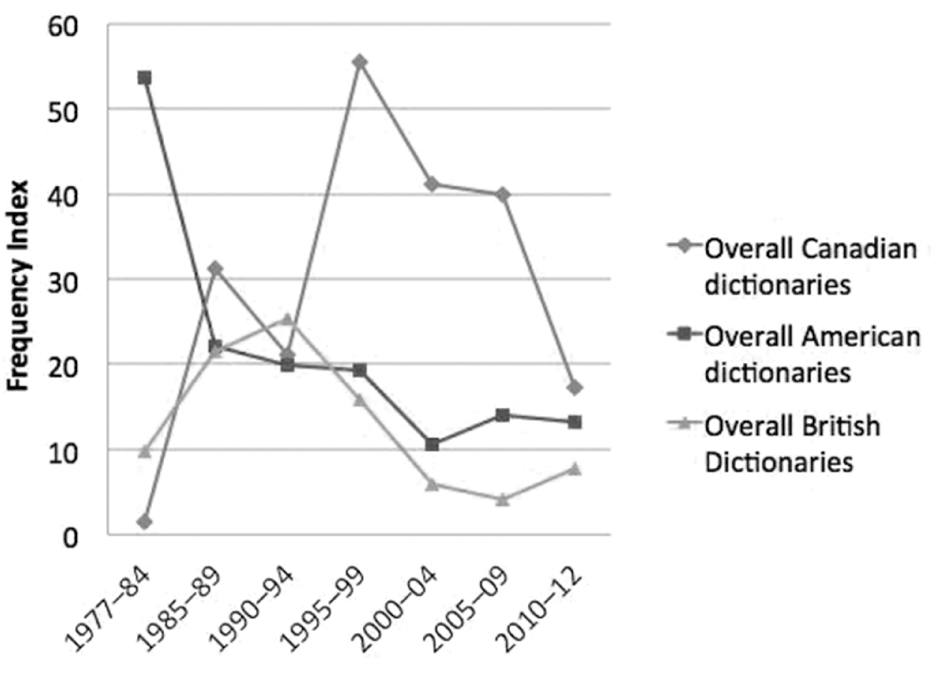
Figure 20.1 Overall mentions in the Canadian press of US, CDN, and UK titles
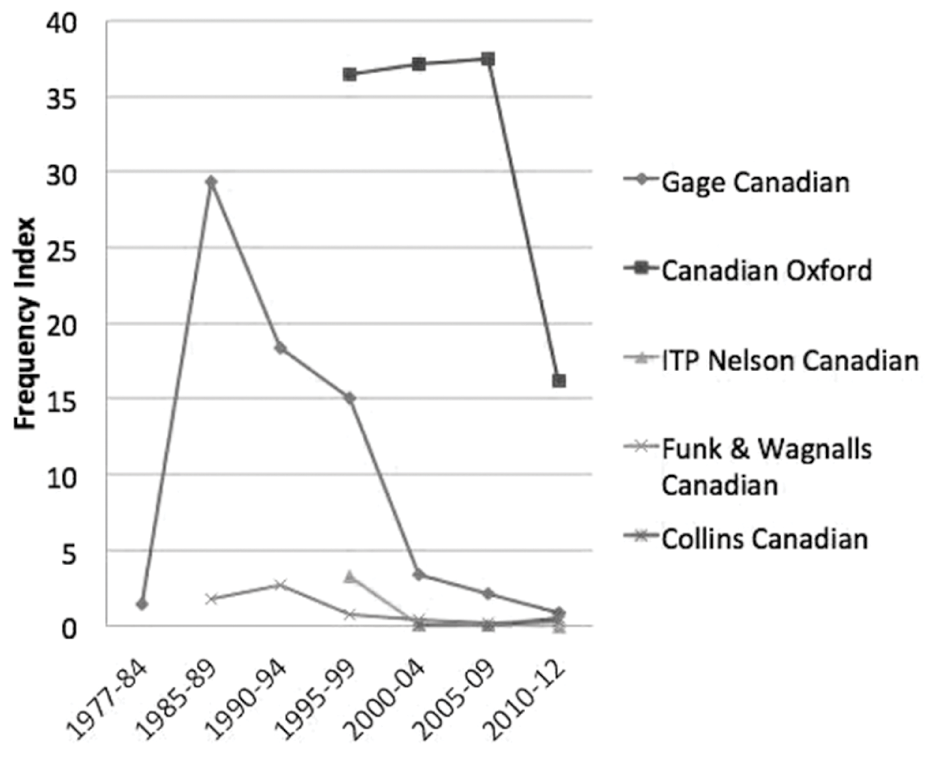
Figure 20.2 Mentions of major dictionaries in the Canadian press, 1977–2012
Table 20.1 Dictionaries of Canadian English of a national dimension (1912–2017)
| Publ. | Base dictionary | Key names | |
|---|---|---|---|
| Western Canadian Phrasebook and Dictionary | 11912, 21913 | – | John Sandilands |
| Winston Simplified Dictionary for Home, School and Office (Canadian edition) | 1937 | Winston Simplified, 1927 or 1936 (American) editions | Thomas Kite Brown and Henry Alexander |
| Gage’s The Beginning Dictionary | 1962 | Thorndike -Barnhardt school dictionaries | Walter S. Avis |
| Gage’s The Intermediate Dictionary | 1963 | Thorndike-Barnhardt school dictionaries | Matthew H. Scargill |
| Gage’s The Senior Dictionary | 1967 | Thorndike-Barnhardt High School Dictionary (see Barnhardt 1962) | Robert J. Gregg |
| Dictionary of Canadianisms on Historical Principles, first edition (DCHP-1) | 1967 | – | Charles J. Lovell (founding editor), Avis (chief editor), Douglas Leechman, Charles Crate, Patrick Drysdale, Scargill |
| Winston Dictionary of Canadian English, Intermediate Edition | 1969 | a 1966 US dictionary, likely a Winston dictionary | Thomas M. Paikeday |
| The Compact Dictionary of Canadian English | 1976 | Paperback edition of the Winston Intermediate of 1969 (first publ. 1970, reprinted 1976) |
|
| Gage Canadian Dictionary (rev. Senior Dictionary, third edition) | 1983 | Gage Senior Dictionary (1979, second edition) | Gregg, Avis; later Gaelan Dodds de Wolf |
| Funk & Wagnalls Canadian College Dictionary | 1986 | Funk & Wagnalls Standard College Dictionary (1978); | Albert H. Marckwardt |
| (publ. by Fitzhenry & Whiteside, Toronto; first edition 1986; second, revised and updated edition 1989) | first F&W marked as Cdn edition. | Note that in both editions Walter S. Avis, who died in 1979, is listed as ‘editor of this Canadian edition’, with Sidney I. Landau as ‘editor in chief’ | |
| The Penguin Canadian Dictionary | 1990 | Thomas M. Paikeday | |
| ITP Nelson Dictionary | 1996 | American Heritage Dictionary | David Friend |
| Gage Canadian Dictionary, fifth edition | 1996 | Gage Canadian Dictionary (1990), fourth edition, going back to The Senior Dictionary (first edition) | Gaelan Dodds de Wolf, Gregg, Barbara P. Harris, Scargill |
| Canadian Oxford Dictionary | 1998 second edition 2004 | Oxford Concise Dictionary (British), eighth edition (1992) | Katherine Barber |
| Collins Canadian Dictionary (2010 hardback, not to be confused with the 2011 paperback) | 2010 | Duncan Black et al. | |
| Dictionary of Canadianisms on Historical Principles, second edition (DCHP-2) | 2017 | DCHP-1 | Stefan Dollinger and Margery Fee |
This second graph shows a clear pattern: once Oxford entered the market in 1995–9, the Gage Canadian (1997) was gradually abandoned, while the ITP Nelson (1997) was never popular with the press, and neither was Funk & Wagnalls. When the Canadian Oxford was shut down, a void was created. The public relations success of the Oxford dictionary, which de facto monopolised the Canadian English reference market in the media as of 2000, had in hindsight effectively if inadvertently destroyed the reputations of the Gage Canadian and the ITP Nelson.
That the Gage dictionaries had a good reputation is beyond doubt. Edmonton professor John Considine, for instance, rightly calls them ‘the work of good scholars’ (Considine 2003, 257). Paradoxically, Considine’s assessment was rare among the large choir of voices that, for non-linguistic reasons, preferred the Canadian Oxford Dictionary of 1998. Since 2004, Canadian English has, for the first time since 1967, been left without an up-to-date general dictionary entirely (DCHP-2 is a specialised dictionary).
The Future
The November of 1967 has so far been the high point of Canadian lexicography, with The Senior Dictionary published that year and DCHP-1 hot off the printing press. October 2008 was its low point. To my knowledge, the Canadian English Lab at the University of British Columbia is today the sole place in Canada concerned with Canadian English lexicography. It will remain to be seen when a new, updated general dictionary of Canadian English can be edited, now that new material and, above all, a new, comparative methodology is available. While there is considerable demand from editors and language professionals today, negotiations over the licensing of a base dictionary, held in Canada’s Sesquicentennial year in 2017, stalled. As sales alone would not support such a project, a monetising model and updating cycle would need to be devised. It is to be hoped that such a project can be swiftly executed, one way or another.
Varieties of English, the Dictionary, and the Nation
The relationship between dictionaries and national identity is at its strongest when the regional variety of English they codify has become the speakers’ dictionary of reference. This phenomenon comes with the fourth of five phases in the establishment of new regional varieties of English according to Edgar Schneider’s (2007) evolutionary model, which he calls endonormative stabilization. By phase four, a stable regional variety has crystallised out of the diverse input elements of English (nativization being phase three), and its speakers no longer refer to an external standard for their language norms, as in phase two (exonormative stabilization) and phase three.
These sociolinguistic processes take place over approximately two centuries, as demonstrated in the evolution of American and Australian English. In both, the foundational mix of dialectal English that came with successive waves of British settlers was distilled into a consistent regional variety with which its speakers identified. This they could regard as their own standard language with the publication of a comprehensive national dictionary, such as Noah Webster’s Dictionary of the American Language (1828) in the United States and the Macquarie Dictionary (1981) in Australia. Other dictionaries and glossaries were published in Australia before that, with limited or specialised coverage of the regional lexicon. They nevertheless shed light on facets of regional culture which were or are part of the national matrix.
Australia’s Early Dictionaries
What might be called Australia’s first dictionary was written in the second decade of the nineteenth century, while the practice of transporting English criminals to Australia was in full swing. The convicts’ occupational slang was recorded by James Hardy Vaux in New and Comprehensive Vocabulary of the Flash Language in 1819, a set of more than 700 words and phrases from the ‘cant language used by the family’, the latter defined as ‘thieves, sharpers and all others who get their living upon the cross’. Vaux’s Flash Language vocabulary, compiled to assist the commandant of the penal settlement with the in-language used by the convicts, was arguably the nation’s first specialised dictionary, an account of the occupational jargon of those who still made up a significant proportion of the Australian population after thirty years of settlement. Its focus on convict business makes it a monument to the foundations of Australia as the penal colony Britain needed after the American War of Independence (1775–83) closed those which it had previously maintained in North America. Some of Vaux’s flash terms, like kid (originally ‘a boy thief’) and swag (‘bundle of booty’) have remained as general colloquialisms without pejorative connotations in current Australian English.
During the nineteenth century, the English used in Australia was steadily adapting itself to the local context, applying transported English to a steadily evolving society with increasing numbers of free settlers after 1830, bringing new elements of British English dialects from north to south. It created a melting pot of variable elements which gradually stabilised into a common accent and lexicogrammar. Two late nineteenth-century dictionaries document the growing social and cultural distinctions of the nation, as observed by short- and longer-term visitors. German commentator Karl Lentzer’s Colonial English (1891), subtitled A Glossary of Australian, Anglo-Indian, Pidgin English, West Indian and South African Words, reflects the then-typical view that regional words were marginal elements of common English. His fifty pages of words from Australian and bush slang are documented with relish, and he provides early citations for urban bywords such as brickfielder (‘a dust storm’), rural terms such as rouseabout (‘odd-job man’), and Aboriginal loan words such as bong > bung, meaning ‘dead […]’. Lentzner’s eclectic mix of terms sketches many facets of nineteenth-century life, with individual citations from literary writers as well as contemporary Australian newspapers, of which he writes enthusiastically: ‘if there is one institution of which Australians have reason to be proud, it is their newspapers’. He notes also that ‘the style is purely English, without a touch of Americanism’, in keeping with the view that the wide range of Australian ‘slang’ did not constitute Australian English.
The better-known late nineteenth-century Australian dictionary is that of Edward Morris: Austral English: A Dictionary of Australasian Phrases and Usages (1898). Morris included both Aboriginal–Australian and Maori words, and the ‘commoner scientific words that have had their origin in Australasia’. His dictionary was designed according to the historical principles exemplified in the New English Dictionary (which became known as the Oxford English Dictionary), with numerous citations for many words, including seventeen for brickfielder. His definitional style was much more formal than Lentzner’s, and he provided taxonomic names for many of the Australian species of flora and fauna which he was documenting for the first time, such as xanthorrhoea, also known as ‘black boys and grass trees’, and yabby, ‘the Aboriginal names for a small crayfish found in waterholes in many parts of Australia’. From the 500-plus pages of Morris’s dictionary, with its wealth of citations from every decade of the nineteenth century, the distinctly Australian environment and its natural inhabitants come to life, as settlements extended further and further into the ‘bush’ from each capital city.
Although a significant work of lexicography, Morris’s dictionary was not a comprehensive dictionary of English as used in late nineteenth-century Australia. The Australian colloquial idioms that were celebrated as forms of national expression in contemporary publications like The Bulletin magazine are almost entirely absent from the dictionary. A characteristic term of address like mate had been in use for decades to express Australian egalitarianism, but Morris’s eye for scientific details was not apparently matched by an ear for contemporary spoken idiom. His dictionary contains very few informal words, such as those formed with the –ie/-y suffix: bluey, bullocky, swaggie (‘a swagman’), but established idioms like poor/miserable as a bandicoot are buried deep in citations designed to exemplify the ‘insect-eating marsupial animal’. Morris’s ‘Austral English’ is remarkable in its coverage of words for flora and fauna, but does not reflect the democratisation of English in Australia, which was already emerging to become its hallmark in the twentieth century. His dictionary may nevertheless be seen as helping to ‘nativise’ the language, to borrow Schneider’s term for the third phase of its evolution. His full documentation of words relating to the Australian environment articulated what was new and different about it.
The first half of the twentieth century was marked by a dearth of Australian dictionaries; the nation was caught up in major political and social changes, ushered in by the process of Federation (1901), and the integration of individual state systems and currencies into a single national structure. The so-called ‘White Australia policy’ embedded in it erected new barriers to foreign immigration, and tended to underscore Australia’s British heritage, and the importance of maintaining the ties with ‘home’ there. This identification intensified with thousands of Australian soldiers participating alongside British troops in European and Middle-Eastern warfronts in World War I and World War II. Imperial rhetoric underpinned the role of British English as Australia’s external language standard, as well as the so-called ‘cultural cringe’ in mid-century, by which Australians were inclined to devalue their own cultural norms in favour of English or European culture. Reservations about hearing Australian accents on the radio meant that the Australian Broadcasting Commission recruited its radio announcers from England until the 1960s. Likewise, British dictionaries continued to serve as general language references for Australians, partly because of the lack of lexicographic publishing resources in Australia until well into the second half of the twentieth century. The first dictionary to carry Australia’s name in its title was Grahame Johnstone’s Australian Pocket Oxford Dictionary (1976), but it was based on the 1924 edition of the Pocket Oxford Dictionary of Current English, edited by the Fowler brothers.
The drought in Australian lexicography was finally broken by Gerald Wilkes’s Dictionary of Australian Colloquialisms (1978), published by Sydney University Press. Again, this dictionary documented a particular segment of Australian English, but it captured an ample range of rural and urban colloquial words and idioms, mostly documented from Australian literary fiction. They conjure up Australian social types: the barracker and the boss cocky, the ratbag and the rorter; and notable behaviours – mad as a cut snake/a meat axe, rough as bags/guts/buggery – where the comparison can be varied to suit the context. Both kinds of neologism contribute to the vitality of oral discourse, and at the same time to establishing solidarity among fellow Australians. Thus, Wilkes’s dictionary was the first to represent the distinctive elements of Australian oral culture, and to affirm their place in the nation’s vocabulary. It demonstrated the importance of regional phraseologies in the nativisation of Australian English, providing documentation of its ‘cultural scripts’ (Wierzbicka 1997).
National Dictionaries: The Reference Dictionary and the Dictionary of Record
Australian national sentiment was raised during the 1980s in anticipation of the bicentenary of Australia’s foundation. It stimulated a sense of national identity among the population at large, and coincided with the publication of two national dictionaries. They complement each other in codifying Australian English for its users, and benchmark its endonormative phase.
A specially formed company called Macquarie Library, backed by a consortium of Australian newspapers, published the Macquarie Dictionary (1981), a comprehensive dictionary of Australian English of 80,000 words. It was compiled by lexicographers at Macquarie University in Sydney to document the full range of ‘mainstream’ Australian usage (Leitner 2004), both distinctively Australian words and senses and the numerous elements of contemporary English shared with other varieties worldwide. The Macquarie Dictionary contrasts with the Australia National Dictionary (1988), constructed on historical principles like the Oxford English Dictionary (OED) and headquartered at the Australian National Dictionary Centre (Ramson 2002), which focuses strictly on ‘Australianisms’ – words and senses that originated in Australia. Its stock of c. 7,500 words, systematically illustrated with a wealth of citations from different kinds of Australian texts, made it a resource for scholarly inquiry rather than everyday use. Both are indigenous dictionaries in the sense of being compiled by Australians and published in Australia. They contrast with other ‘desk’ dictionaries published since, whose content consists largely of material compiled by British-based dictionary publishers, such as Oxford or Collins, with an admixture of Australian entries to localise them to a greater or lesser extent. Both national dictionaries have since been updated to maintain their coverage of the Australian lexicon; the Macquarie Dictionary is now in its seventh edition (2017) in two volumes, and the Australian National Dictionary in its second edition (2016), also in two volumes.
The two national dictionaries of the 1980s served to valorise Australian English for Australians with reflections of their history (Moore 2008). Verbal images are drawn from the steadily expanding range of Australian across the major literary genres, as discussed by Webby (2000) – a phenomenon commonly associated with the establishment of a new variety of English. Thus grounded, the national dictionaries reflect and define countless details of Australian society and culture.
Standardisation and the Dictionary
The Australian dictionaries noted above have all contributed to articulating aspects of the language used in the southern continent over more than two centuries. Yet those with limited size or restricted scope could hardly serve as a reference dictionary or provide full codification of Australian English. Only a comprehensive national dictionary could do this: to establish the regional variety as a whole for its users, and represent it among the other major varieties of English in the world. The Macquarie Dictionary, published amid the build-up to bicentenary celebrations, became a focal point for national identity, and a manifestation of the mature status of the Australian variety of English. It was affordable through discounts provided by the supporting newspapers, and was thus accessible to the general Australian public.
All these factors helped to embed the local dictionary in Australian society at large, to make it the reference dictionary for details of Australian usage and an instrument of standardisation. It has been adopted in the Australian education sector, and is widely referred to in editorial circles and in commercial and government publishing. The Macquarie Dictionary adopted –ise spellings rather than the traditional Oxford –ize for all words and neologisms that contain the suffix, in tandem with the preferred spelling of the Australian Government Style Manual (1966 on), thus affirming the local preference. It also indicates the Australian preference on other variable spellings, and foregrounds local senses of shared words.
The Macquarie Dictionary’s role in standardising Australian English spelling is probably a factor in preserving its mostly British tradition in orthography, as noted in a recent worldwide study of American influence on world English (Gonçalves et al. 2017). Their research on variable British-American points of spelling and lexical selections showed that Australia was among the most conservative countries of the world – including both English-speaking and non-English-speaking countries – in maintaining the British elements. The fact that Australians have a fully codified version of their own variety to refer to, including both conservative and innovative aspects of the lexicon, suggests that the dictionary does have a standardising effect on Australian usage.
The Contribution of Australian Dictionaries to World English
Australian dictionaries have undoubtedly contributed to dictionaries of world English, and to world English itself. Morris’s scholarly entries on the flora and fauna of Australia, enshrined in his Austral English Dictionary, were taken over into the first edition of the OED. His successors working on the Australian National Dictionary have likewise contributed to the OED’s second edition, with further additions to the ongoing third edition online. The engagement between the parent publishing company and the satellite operation in the Australian National Dictionary Centre has been effective in ensuring that Australian lexical innovations are included in the record of world English.
The codification of Australian English in Australian publications has supported its recognition in other kinds of world English dictionaries, such as learner’s dictionaries. Notable among them is the Cambridge International Dictionary of English (1995), which indicated Australian English selections alongside British and American variants, for the benefit of second language learners in the antipodes.
The take-up of Australian words and phrases overseas did not of course depend on access to Australian print dictionaries. Rather, the increasingly global reach of English-language media (print, broadcast, and online) has helped to circulate them in entertainments and informative discourse of many kinds. Early travel publications and newspaper reports took indigenous Australian words like boomerang and kangaroo to the northern hemisphere, and subsequent trade in the exotic carried the budgerigar to the northern hemisphere as a domestic bird. While these early borrowings were specifically associated with Australia, the geographical association becomes attenuated, as when boomerang is applied to a similar wooden instrument used by African peoples, and budgerigar becomes the byname for other exotic cage birds. Compounds such as kangaroo court and boomerang baby/child, which originated in the US, show how words for physical objects originating in Australia can be taken up in figurative ways in other varieties of English, with fresh social denotations and connotations.
The Australian penchant for coining informal words with –ie (originating in British usage for speaking with children), has returned to the home country as informal adult usage in TV serials such as the long-running Neighbours. Since -ie words are usually interpretable in context, they go across varieties quite easily, and prompt similar ad hoc formations in the British context, as may be observed. The impact of this type of Australian neologism can be seen in the more frequent use of –ie in adult conversation elsewhere in the world. Rapid communication via the Internet ensures that new words may be taken up overseas very quickly, and so their point of origin in world English is less obvious in shared technology. The fact that selfie was first recorded in an Australian newspaper in 2006 aligns with it being an Australian coining as an –ie abbreviation. While this underscores its likely origin in the southern hemisphere, it is less obvious given the increased use of –ie forms in both British and American English.
One final factor to consider is the stylistic contribution of Australian colloquial language to world English – since its take-up in the northern hemisphere can be seen as contributing to the now well recognised colloquialisation of world English (Mair 2006). In informal contexts anywhere, informal Australian words and phrases slip into common usage, and their shared English elements belie their place of origin. Their regional neutrality becomes a sign of their successful assimilation into world English – no longer to be claimed as Australian. But the question remains as to how much Australian English has contributed to the colloquialisation and democratisation of world English.
Table 21.1 Dictionaries of Australian English (1819–2017) mentioned in the chapter
| Dictionary title | Date | Base dictionary | Editor |
|---|---|---|---|
| A New and Comprehensive Dictionary of the Flash Language | 1819 | A Classical Dictionary of the Vulgar Tongue (1788) compiled by Francis Grose | James Hardy Vaux |
| Colonial English: A Glossary of Australian, Anglo-Indian, Pidgin English, West Indian and South African Words | 1891 | Karl Lentzner | |
| Austral English: A Dictionary of Australasian Phrases and Usages | 1898 | Edward Morris | |
| Australian Pocket Oxford Dictionary | 1976 | Pocket Oxford Dictionary of Current English (Oxford, 1924), based on earlier version edited by F. G. and H. W. Fowler | Grahame Johnstone |
| Dictionary of Australian Colloquialisms | 1978 | Gerald Wilkes | |
| Macquarie Dictionary |
| Encylopedic World Dictionary (Paul Hamlyn 1971) edited by Patrick Hanks | Arthur Delbridge |
| Australian National Dictionary on Historical Principles |
| William S. Ramson |
This chapter is structured around the publication, in 1997, of The Dictionary of New Zealand English (DNZE) by Oxford University Press. There had been New Zealand (NZ) dictionaries before, and there have been dictionaries since, but this publication could arguably be described as the pinnacle of NZ lexicographic history. It was a dictionary compiled on historical principles, which had begun life on index cards and in files, but transitioned to the computer age early; indeed, the affordances offered by large-scale computing no doubt contributed to the creation of this major work. It contained some 6,000 headwords of New Zealandisms (a glossary of those used here concludes this chapter), and was the culmination of over forty years’ labour – or hard yakker1 – by Harry Orsman and many assistants; not including the numerous volunteer contributors, forty-four people were employed at various times on the dictionary since the early 1980s. On publication, it was quickly recognised as ‘a national taonga’2 and went on to win the 1998 Montana medal for non-fiction. Not only did a ‘dip into this dictionary [bring you] face to face with the culture and history of New Zealand’, as one critic put it, but the dictionary could be read as a declaration of lexical independence. New Zealand English had arrived.
The Decades Before 1997
Today, New Zealand English is generally accepted as being a standard variety of English, and its existence has long been recognised even if the variety has not always been well-regarded. The earliest recorded use of the term New Zealand English – according to DNZE – was in 1910, but a late nineteenth century date for the emergence of a distinctively New Zealand variety of English accords with the dates of published commentary on the fact that the English used in New Zealand was different from that used in Britain. McBurney (1887), for instance, commented on features of pronunciation that made New Zealand and Australian English distinctive at that time, and T. A. P. (1887) discussed vocabulary. Bauer (1994, 386) takes 1890 ‘as a point after which the development of the English language in New Zealand reflected New Zealand rather than British or Australian trends’, for it was at that time that New Zealand–born Europeans began to outnumber immigrants. The tendency in early commentary, however, was not to identify national varieties of English but to lump them together under the tag ‘colonial’. This was the case with vocabulary that may have been peculiar to New Zealand, as well as with pronunciation.
In some quarters New Zealand English remained, for many decades, regarded as a colonial variety. Not only was it viewed as being non-standard, it was regarded in some sense as being sub-standard. Arnold Wall, for instance, saw himself as ‘fighting a battle’ against an enemy ‘represented by slovenly and careless habits in speech, by vulgarisms and solecisms … and by mispronunciations’ (Wall 1939, 5) and addressed himself to ‘those who desire, as many persons passionately do, to keep their speech as closely as possible in conformity with that of the “best” speakers at Home’ (Wall 1939, 7). The publication of a fourth edition of this particular book in 1961 suggests that he was not without support.
As well as being labelled ‘colonial’, New Zealand English was also coupled with Australian English. Indeed, the emergence of New Zealand English lexicography was in a dictionary titled Austral English by Edward E. Morris in 1898. This dictionary on historical principles was an early landmark in the study of New Zealand (and Australian) English, and showed the extent to which the distinctive vocabulary of the varieties of English in New Zealand and Australia had begun to emerge by the end of the nineteenth century. It was a response to the wealth of data Morris had gathered following a request from Oxford English Dictionary (OED) editor James Murray for information on regional usage – only a portion of which would find its way to the OED.
The importance of Morris’s dictionary should not be underestimated, for, as Deverson (2001, 33) notes, ‘Morris’s work was the last word on the subject for a long time’. Although twentieth-century dictionaries from international publishing houses included New Zealand words and/or supplements, often drawing from Morris, it was not until 1979 that the first New Zealand dictionary was produced by Harry Orsman. More were to follow, however, and ‘at century’s end the number of wide-coverage New Zealand dictionary titles had already reached 17 (including three second editions and some school works)’ (Deverson 2001, 23). The most important of these was DNZE, which, along with its other achievements, clearly decoupled New Zealand English from Australian English. The relationship between New Zealand and Australian Englishes had on occasion struck a nationalist chord among speakers of New Zealand English, for, as Joshua Fishman (1970, 25–6) points out ‘where languages seem to be quite similar to each other … it may be of great concern to establish their autonomy from each other, or at least that of the weaker from the stronger’, for without the establishment of autonomy, it ‘might become part of a rationale for political subservience as well’. New Zealanders do not like to be confused with Australians.
The Spectre of Slang
While the first truly New Zealand dictionary may not have appeared until the last quarter of the twentieth century, comment on and discussion of the New Zealand English lexicon continued throughout the century, with Sidney Baker’s wide-ranging account of the New Zealand lexicon, too modestly titled New Zealand Slang (1941), being of particular note. That dictionary’s title may possibly reflect ‘a certain amount of reluctance in New Zealand, even today, to believe that New Zealand words are not either Māori words or slang’ (Bauer 1994, 410), and certainly slang has been a popular area of investigation. There have been a number of dictionaries of slang both before and after DNZE by Cryer, McGill, Orsman, and Hurley to name just a few. Although often entertaining and sometimes instructive, such dictionaries do a disservice to New Zealand English in that they draw attention to non-standard aspects of the variety and mask the distinctive features of standard New Zealand English.
The Māori Language and Lexicography
While the focus of this volume is on English monolingual dictionaries, any chapter on NZ lexicographic achievements would be incomplete without some reference to dictionaries of Māori and their importance to issues of NZ identity, as evidenced through the presence of Māori words in New Zealand English and their representation in NZ dictionaries.
It was in 1769 that Māori and English speakers first came into contact, with the arrival of Captain James Cook and the crew of the HMS Endeavour. Words of Māori origin began to make their way into written English soon after the first of Cook’s voyages to New Zealand, but the small wordlists and glossaries included in these publications were surpassed by Kendall and Lee’s A Grammar and Vocabulary of the Language of New Zealand (1820), which established an orthography for Māori and included a 100-page lexicon of Māori. This early contribution to New Zealand lexicography was in its turn eclipsed by a major lexicographical project undertaken shortly after the signing of the Treaty of Waitangi in 1840, when the Reverend William Williams of the Church Missionary Society published his authoritative Dictionary of the New Zealand Language (1844). This dictionary went through seven editions, with the last appearing in 1971. Williams’s dictionary was notable for being Māori–English only, and for excluding transliterations and other borrowings from English. Important subsequent works have included an English–Māori dictionary by Bruce Biggs in 1981 which was based on Williams’s sixth edition; a comprehensive learners’ English–Māori dictionary reflecting Māori idiom from the East Coast of the North Island by Hori Mahue Ngata in 1993; and a substantial Māori–English and English–Māori glossary of over 20,000 words from each language created by Peter Ryan in 1995. Reflecting new lexical developments, an English–Māori and Māori–English dictionary of over 5,000 Māori neologisms was developed by the Māori Language Commission in 1996.
The Māori influence on the New Zealand English lexicon has been obvious to commentators from a comparatively early date. The most significant nineteenth century critique was by Morris, who noted in the introduction to his dictionary of Australasian English that:
Care has been taken … to exclude [Māori] words that have not passed into the speech of the settlers. But in New Zealand Maori is much more widely used in the matter of vocabulary than the speech of the aborigines is in Australia, or at any rate in the more settled parts of Australia; and the Maori is in a purer form. Though some words and names have been ridiculously corrupted, the language of those who dwell in the bush in New Zealand can hardly be called Pigeon English.
Sidney Baker also provided rich testament to the influence of Māori on New Zealand English when he noted, ‘[t]he Maori language has been of considerable service to us in colloquial speech and our borrowings from it will probably increase in the future’ (Baker 1941, 55). In a similar vein, a few years later Johannes Andersen claimed that ‘[m]any Maori words are now in such common use that they may be regarded as incorporated in the English language’ (Andersen 1946, 141); he produced a list of 246 Māori word types that he felt qualified.
Over the next five decades, however, views on the importance of the Māori contribution to New Zealand English fluctuated. Up until the 1970s, the view was that the contribution had been minor and, indeed, lacked contemporary relevance, but in the 1970s a new vitality was seen in the relationship between the two languages, with the result that Deverson could identify lexical borrowing from the indigenous Māori language as being ‘in reality the most unmistakably New Zealand part of New Zealand English’, and speak of a ‘current renaissance of Māori language and culture’ with the result that ‘Māori is making its presence in English more strongly felt than ever before’; as such, he identified a consequent ‘strengthening of the Māori component’ in New Zealand English (Deverson 1991, 18–19; 21).
The publication of DNZE was the first attempt since Andersen to capture the Māori influence on the New Zealand English lexicon in a comprehensive way. With 746 words of Māori origin, accounting for over 10 per cent of the dictionary’s headwords, it contained three times as many as Andersen’s earlier list. It captured not just the historical, but also the contemporary. As well as words relating to the flora and fauna of New Zealand and the material culture of Māori, which were words that had entered English early after contact, words drawn from Māori social culture were well represented. Many of these words had entered New Zealand English from the 1970s and reflected, among other factors, demographic shifts that had seen the Māori population change from being predominantly rural to predominantly urban (Macalister 2006).
The Decades Since 1997
The DNZE drew on but did not exhaust the database that Harry Orsman created. At the dictionary’s launch at Government House in Wellington on 17 July 1997, Victoria University of Wellington and Oxford University Press announced a joint venture: a centre for lexicographical research and dictionary production named the New Zealand Dictionary Centre (NZDC). Professor Graeme Kennedy accepted the role of director, and Tony Deverson from the University of Canterbury became associate director.
The NZDC was established at a time of significant advances in the technology designed to support lexicography, and over the next fifteen or so years, it fulfilled its intended aims admirably. A major production was The New Zealand Oxford Dictionary (Deverson and Kennedy 2004), but this was just one of over twenty dictionaries produced by the Centre, many aimed at the education market. Dianne Bardsley, the second and final NZDC director, edited many of these.
The Centre also produced original research, primarily through the funding of five PhD fellowships that explored the presence of te reo Māori in New Zealand English, the rural lexicon, the language of public sector reform, the contribution of the marine industry to New Zealand English, and the nature of un-parliamentary language. Two of these studies have resulted in dictionaries (Bardsley 2009; Macalister 2005).
Rapid changes in dictionary consumption, however, spelled the end of the NZDC. Without the income derived from dictionary sales, funding was threatened and, eventually, the effective operations of the NZDC ceased – though not before its resources contributed to the production of the beautifully designed and award-winning Book of New Zealand Words (Bardsley 2013).
Yet, for all the achievements of the NZDC, one task remains for some future lexicographer – a revised edition of Orsman’s DNZE.
Table 22.1 Prominent New Zealand dictionaries
| Dictionary | Date | Editor | Notes |
|---|---|---|---|
| A Grammar and Vocabulary of the Language of New Zealand | 1820 | Thomas Kendall & Samuel Lee | – |
| A Dictionary of the New Zealand Language and a Concise Grammar: To Which is Added a Selection of Colloquial Sentences | 1844 | William Williams | Seventh edition 1971 |
| Austral English | 1898 | Edward Morris | – |
| New Zealand Slang: A Dictionary of Colloquialisms | 1941 | Sidney J. Baker | – |
| Heinemann New Zealand Dictionary | 1979 | Harry Orsman | – |
| The Complete English–Maori Dictionary | 1981 | Bruce Biggs | Remains in print |
| A Dictionary of Kiwi Slang | 1988 | David McGill | McGill published two further dictionaries of slang (1989, 1998) |
| English–Maori Dictionary | 1993 | Hori M. Ngata | Pocket edition 1995 |
| The Reed Dictionary of Modern Māori | 1995 | Peter M. Ryan | Based on 1974 publication; pocket edition published 1996; second edition 1997; fourth edition 2012 as The Raupō dictionary of modern Māori |
| Te matatiki: Contemporary Māori Words | 1996 | Māori Language Commission – Te Taura Whiri i te Reo Māori | Update of 1992 list |
| The Dictionary of New Zealand English: A Dictionary of New Zealandisms on Historical Principles | 1997 | Harry Orsman | – |
| A Dictionary of New Zealand Sign Language | 1997 | Graeme Kennedy | Concise edition 2002 |
| A Dictionary of Modern New Zealand Slang | 1999 | Harry Orsman | Orsman published two earlier slang dictionaries with Desmond Hurley (1994) |
| The New Zealand Oxford Dictionary | 2004 | Tony Deverson and Graeme Kennedy | – |
| A Dictionary of Māori Words in New Zealand English | 2005 | John Macalister | – |
| In the Paddock and On the Run: The Language of Rural New Zealand | 2009 | Dianne Bardsley | – |
| Online Dictionary of New Zealand Sign Language | 2011 | David McKee, Rachel McKee, Sara Pivac Alexander, Lynette Pivac, and Mireille Vale | – |
| Book of New Zealand Words | 2013 | Dianne Bardsley | – |
Key Figures in New Zealand Lexicography
A number of key figures in NZ lexicography have already been mentioned in this chapter. The substantial contributions in recent decades of Harry Orsman, Tony Deverson, Dianne Bardsley, and Graeme Kennedy have been noted. Kennedy, it is worth recording, was also instrumental in dictionary-making for New Zealand Sign Language, NZ’s second official language, with the publication in 1997 of A Dictionary of New Zealand Sign Language by Graeme Kennedy, followed by a concise edition in 2002. The launch in 2011 of an online dictionary, https://nzsl.vuw.ac.nz/, that currently has over 4,500 entries built on this work.
A key figure from an earlier era was Ian Gordon, Professor of English Language and Literature at Victoria University for thirty-seven years, who served for many years as a NZ consulting editor for Collins dictionaries, and several of whose students established important scholarly careers in lexicography. One of these was Harry Orsman, but others included Bob Burchfield, who from 1957 to 1986 became editor of the OED; Bill Ramson, who edited the Australian National Dictionary; and Grahame Johnston, editor of the Australian Pocket Oxford Dictionary.
But in the end, it is Orsman and his dictionary that command the New Zealand lexicographic landscape. For those with a love of words and an interest in New Zealand English, DNZE remains, as one reviewer described it, ‘a grouse read, a real rubydazzler’.3 Beyond the slang terms that still attract attention for their ability to amuse, the headwords and citations reveal a world that in many aspects has passed, but that can still be glimpsed today. That is the lexicographer’s legacy.
The English language in India has a long history, starting in 1600 with the chartering of the British East India Company (EIC) by Queen Elizabeth I. By the late 1700s, the Company’s operations in India had expanded to include military operations and tax collection, and by the mid-1800s, the British government was directly ruling vast portions of the subcontinent. By then, English not only had become the language of trade and government administration, but was also the primary vehicle for the education of those Indians who were fortunate enough to receive formal education. Once India gained its independence from the British in 1947, the role of English changed from that of a language imposed by colonisers to one of two official national languages and the chosen lingua franca for many who resisted the linguistic hegemony of the other national language, Hindi. English thrives in India today – as a second or third language for most of its speakers, but as a first language for around 260,000 people, according to the 2011 Indian Census. However, despite the continuing role of English as an official language, as the language of choice in higher education, and as a lingua franca between speakers of different mother tongues, the lexicography of Indian English remains underdeveloped, with no current comprehensive dictionary of this variety.
Anglo-Indian Dictionaries
The earliest examples of the lexicography of Indian English appeared as glossaries in works written for an audience outside of India, such as the 1698 travelogue of Persia and India written by the East India Company physician John Fryer or various reports to the British government. These glossaries were limited in their scope to the vocabulary and topics in the works to which they were appended. In the mid-1800s, several free-standing dictionaries appeared, focused not on terms from a specific book or report, but on terms from a specific realm of British activity in India – at that time, these were trade, taxation, law, and the military. Among these works, which would be most useful for the East India Company and government officers joining the British Indian service and heading to India for the first time, were H. H. Wilson’s hefty Glossary of Judicial and Revenue Terms, C. P. Brown’s Zillah Dictionary, and Patrick Carnegy’s Kachahri Technicalities. The authors of these independent glossaries were typically officials from the British Indian service or scholars with detailed knowledge of the languages of India, and they documented not the Indian English spoken by Indians who had learned English as a second language, but the terminology particular to the ‘Anglo-Indian’ spoken and written by British transplants to India. The entries in these works usually reported a language of origin, orthography of the word in Persian, and a brief definition. Spelling of these terms in English was idiosyncratic, however.
In 1886, the lexicography of Anglo-Indian was transformed when the retired military engineer Henry Yule published a landmark Anglo-Indian dictionary, which he had compiled with Arthur Coke Burnell, a linguist and jurist from the British Indian service. Their dictionary departed from its predecessors in its coverage of terms from all aspects of life and work in India, including many geographical terms; its presentation of generally sound etymologies; its documentation in many lexical entries using historical examples of the term’s use in print; and its chatty, entertaining style. A typical entry in Hobson-Jobson offered cultural context and a sense of the changing use of a word over centuries of European presence in India. Although Yule and Burnell benefited from and relied on the work of prior Anglo-Indian lexicographers, their Hobson-Jobson modernised the entire genre, bringing it up to date not only with the wide range of the British experience in India but also with the most modern practices of lexicography (except for pronunciation, about which Hobson-Jobson gave no guidance). Indeed, Hobson-Jobson was so ground-breaking and set such a high bar for readability, reliability, and comprehensiveness that it eclipsed its contemporary competition, such as G. C. Whitworth’s Anglo-Indian Dictionary, issued just six months earlier. Hobson-Jobson’s authoritative information made it the most important source for the Oxford English Dictionary’s documentation of words imported from South Asia. No other dictionary of English in India gave it serious competition for more than a century. A lightly edited second edition of Hobson-Jobson was issued in 1903, and reprints of that edition have been produced from the 1960s onward.
Yet Hobson-Jobson was only ever half a dictionary. It documented the English spoken by the British in India but, like its predecessors, included almost no examples of the English spoken by Indians. For instance, terms that represent native Indian uses of English, such as ledikeni or Lady Kenny (a Bengali dessert reportedly invented for presentation to Lady Canning, the wife of the first viceroy of India in the late 1850s – the word is an accented pronunciation of her name), were not included in Hobson-Jobson, despite being current at the time of its publication. In fact, the authors of Hobson-Jobson were contemptuous of the English spoken by Indians, which they called ‘butler English’ and ‘baboo English’. The British civil servants and military officers who departed when India gained its independence took their variety of English with them but left behind the sense that Indian English was inferior to the British variety.
Dictionaries of Indian English
Indian English today is distinguished lexically by two categories of words: those from Indian languages that have eased their way into English (the same types of words documented by Hobson-Jobson and its predecessors), and existing or innovated English words and phrases that have unique meanings in the Indian context. In the first category, we find very common words such as lakh (n., ‘a hundred thousand’), crore (n., ‘ten million’), or desi (n. or adj., ‘native South Asian’). The second category includes words such as military hotel (n., ‘a restaurant that serves meat’), batch-mate (n., ‘classmate of the same graduation year’), and prepone (v., ‘to move to an earlier time than planned’).
A century after Hobson-Jobson was first published, a few small dictionaries of Indian English began to appear that addressed one or the other of these segments of the lexicon. The first category includes the anachronistic Sahibs, Nabobs, and Boxwallahs by Ivor Lewis, which covers much of the same Anglo-Indian lexicon found in Hobson-Jobson, although in a less discursive style. In the second category, Indian and British English by Paroo Nihalani et al. includes a comprehensive lexicon of English words and phrases whose meaning in Indian English differs from that in British English – but none of the lexical items imported from Indian languages. Nigel Hankin’s Hanklyn-Janklin, a popular volume of amateur lexicography with a discursive tone similar to Hobson-Jobson’s, does include terms from both segments of the Indian English lexicon, but it is not comprehensive and lacks some structural elements of a dictionary, such as pronunciations.
So where are the comprehensive dictionaries of Indian English? To which dictionaries does the speaker or writer of English in India today turn for guidance on spelling, meaning, and usage? A request in 2018 to a prominent New Delhi bookstore for a selection of dictionaries that educated Indians might purchase produced the eleventh edition of the Pocket Oxford English Dictionary, the twelfth edition of the Concise Oxford English Dictionary, the ninth edition of the Oxford Advanced Learner’s Dictionary, and the fifth edition of the Collins COBUILD Advanced Learner’s Dictionary. Each of these was printed exclusively for the South Asian market, but only the Oxford Advanced Learner’s Dictionary appears to have been adapted in its content to the South Asian user. For example, Indian terms such as lakh, crore, prepone, and desi do not appear in the Pocket Oxford or the Collins, which draws its wordlist only from British, American, Australian, and New Zealand English. These terms do appear in the Concise Oxford, but with usage notes indicating that they are specifically Indian English. These usage notes, which also identify terms and meanings that are specifically British, Australian, or North American, suggest that this dictionary is written for users in many parts of the English-speaking world, not just India. The Oxford Advanced Learner’s includes these terms without India-specific usage notes. None of these dictionaries, however, includes words such as the regional Bengali ledikeni or Lady Kenny or sarod, an Indian stringed musical instrument.
Table 23.1 Selected dictionaries of English in India, and selected current dictionaries marketed in India
| Year | Title | Author/Editor | Notes |
|---|---|---|---|
| 1698 | A New Account of East India and Persia | J. Fryer | 12 pp.; travel narrative, includes an ‘Index Explanatory’ |
| 1788 | The Indian Vocabulary, to which is Prefixed the Forms of Impeachment | J. Stockdale | 133 pp.; glossary for those attending the impeachment trial of East India Company official Warren Hastings |
| 1800 | An Indian Glossary, consisting of some Thousand Words and Forms Commonly Used in the East Indies … | T. T. Robarts | designed to assist travellers in learning Indian languages (page count unknown) |
| 1802 | A Dictionary of Mohammedan Law, Bengal Revenue Terms, Shanscrit, Hindoo, and other Words used in the East Indies … | S. Rousseau | 177 pp. |
| 1813 | Glossary appended to the Fifth Report of the Select Committee | C. Wilkins | 46 pp. |
| 1845 | Supplemental Glossary of Terms Used in the North Western Provinces, A–J | H. M. Elliot | 447 pp.; second volume never completed |
| 1848 | The Oriental Interpreter … A Companion to the ‘Handbook of British India’ | J. H. Stocqueler | 243 pp; designed for travellers and East India Company officers posted to India for the first time |
| 1852 | The Zillah Dictionary … Explaining the Various Words used in Business in India | C. P. Brown | 132 pp. |
| 1855 | Glossary of Judicial and Revenue Terms … | H. H. Wilson | 595 pp. |
| 1877 | Kachahri Technicalities, or a Glossary of Terms, Rural, Official, and General, in Daily use in the Courts of Law | P. Carnegy | 361 pp. |
| 1885 | Anglo-Indian Dictionary. A Glossary of such Indian Terms used in English, and such English or other non-Indian Terms as have obtained special meaning in India | G. C. Whitworth | 350 pp. |
| 1886 | Hobson-Jobson: A Glossary of Colloquial Anglo-Indian Words and Phrases … | H. Yule and A. C. Burnell | 870 pp.; second edition 1903 (986 pp.) |
| 1979 | Indian and British English: A Handbook of Usage and Pronunciation | P. Nihalani et al. | new edition 2004 (186 pp.) |
| 1991 | Sahibs, Nabobs, and Boxwallahs: A Dictionary of the Words of Anglo-India | I. Lewis | 210 pp.; mostly pre-1947 usage |
| 1992 | Hanklyn-Janklin: A Rumble-Tumble Guide to Some Words, Customs and Quiddities Indian and Indo-British | N. Hankin | new editions 1994, 1997, 2003, 2008 (532 pp.) |
| – – – – | |||
| 2006 | Collins COBUILD Advanced Learner’s Dictionary, fifth edition | J. Sinclair | does not include common Indian English terms |
| 2011 | Concise Oxford English Dictionary, twelfth edition | A. Stevenson and M. Waite | Indian English words and meanings marked with usage notes |
| 2013 | Pocket Oxford English Dictionary, eleventh edition | M. Waite | very few Indian English words |
| 2015 | Oxford Advanced Learner’s Dictionary, ninth edition | A. S. Hornby | Indian English incorporated throughout |
English Dictionaries and Standardising Indian English
The variety of English spoken in India is not yet recognised, even by its own educated speakers, as an aspirational standard. As might be surmised from the lack of an Indian-edited and -published dictionary on the shelves of a New Delhi bookstore, ‘the standard accepted in India by tradition and convention is British English’ (Yadurajan 2001, xi). Yet British English is not what is spoken in India, nor is it what appears in English-language newspapers. Although the bulk of Indian speakers of English have learned it as a second language (from non-native-English-speaking teachers), the speech of the several hundred thousand native speakers can serve as a basis for the documentation of a standard Indian English. A dictionary by Indians for Indians would encourage speakers of English in India to consider their variety as legitimate and not defective.
English in South Africa
English occupies a paradoxical position in multilingual South Africa. It is the language of government, the judiciary, business, and academia, and is often portrayed as a lingua franca that enables communication across South Africa’s varied cultures. However, precisely because of this ‘prestige’ position, it is also considered by many to be an obstacle in the path of the development of those indigenous languages that were discriminated against under colonial and apartheid rule. In an effort to overcome this perceived hegemony, English – along with Afrikaans, South Africa’s only other official language until 1994 – was relegated to being one of eleven official languages under the newly democratic country’s constitution.
In the founding provisions of the Constitution of the Republic of South Africa Act of 1997, all the official languages were to ‘enjoy parity of esteem and must be treated equitably’, and the state was enjoined to elevate the status and advance the use of those languages that had previously been disadvantaged. Furthermore, in the same year the Department of Basic Education promulgated its ‘Language in Education’ policy, advocating additive bilingualism – or even additive multilingualism – as a practical means of ‘maintaining home language(s) while providing access to and the effective acquisition of additional language(s)’. However, despite this statutory commitment to equity between all South Africa’s languages, in practice the global reach of English has to some extent hindered the effective introduction of indigenous languages across prestige domains. Proficiency in English is still regarded by many as the key to success, with one’s mother tongue language being reserved largely for social and cultural communication.
Early South African Dictionaries
Within this scenario, the role of dictionaries has largely been to assist in the acquisition or understanding of English. Historically, though, this was not always the case. For Christian missionaries arriving in South Africa from Europe in the nineteenth century, the compilation of dictionaries served various purposes. The first was for missionaries to develop their own understanding of the languages of the communities around their mission stations while recording these languages in writing, usually for the first time. This in turn led to translations of the Bible, prayers, and hymns, as part of their proselytising work and as tools for developing literacy amongst their parishioners. However, the intellectual skills that underpin some of these early dictionaries is a testament to their authors’ commitment to much more than simply advancing the cause of Christianity. Their works often included, for example, ethnographic information, botanical names, and place names and their origins. So although the viewpoint of these nineteenth- and early twentieth-century documents may have been Eurocentric and colonialist, the breadth of vocabulary and concepts that was recorded provided the foundations for later lexicographical development in South Africa’s indigenous languages.
Early in the twentieth century, Afrikaans speakers too sought to consolidate their language and culture by embarking on the production of a descriptive dictionary in order to establish Afrikaans as a language in its own right, rather than ‘Cape Dutch’, South African Dutch, or even ‘kitchen Dutch’, as it was sometimes pejoratively known. It was only in 1925 that the South African government formally recognised this distinction, and not until the 1950s, under the government of the predominantly Afrikaner National Party, that compilation of the Woordeboek van die Afrikaanse Taal (WAT) began to gain momentum; some seventy years later, the dictionary has reached the letter ‘S’ in Volume XIV, and is available both in print and online.
Meanwhile, the English component of language learning was, until relatively recently, ‘British’ English, with general English dictionaries being imported for the purpose. In the late twentieth century, however, realisation began to dawn that in a nation embarking on a transition from a colonial past, if English was still to be taught, there was much to be said for ‘acclimatising’ the language to its surrounding social and cultural realities. With this in mind, publishers in South Africa began to ‘South Africanise’ their dictionaries at all levels, with special emphasis on those for use in schools. But the roots of this linguistic adaptation lie in work begun long before South Africa moved towards becoming an inclusive society.
The Reverend Charles Pettman, a Methodist minister from England who arrived in Cape Town in 1876, is generally recognised as the first person to record, in lexicographic form, the idiosyncrasies of the English that he encountered in nearly four decades of ‘acquaintance, more or less intimate, with every Province and with most of the different peoples of the Union’. Subtitled A Glossary of South African Colloquial Words and Phrases and of Place and Other Names, Pettman’s Afrikanderisms was published in 1913, three years after the British and Afrikaner provinces came together as the Union of South Africa. Although the book’s title seems to indicate the prevalence in the English of South Africa of loanwords from the British colonists’ Dutch-speaking neighbours, Pettman also notes words imported from South Africa’s indigenous peoples, as well as from descendants of those brought to the country as slaves. Neither does he restrict himself to documenting loanwords; the impact of the discovery of gold and diamonds that brought people of many nations flocking to the country is reflected in his inclusion of vocabulary, both formal and informal, from the mineral industries and the communities that grew up around them. Describing the book as ‘a glossary’, therefore, understates the meticulous detail with which Pettman compiled his work, as it includes not only etymologies, but also quotations with bibliographic details and cross-references; he even adds the occasional indication of register, identifying those expressions regarded as ‘slang’. As with the dictionaries of his missionary colleagues who documented the indigenous languages they encountered, Afrikanderisms reveals much about the culture and environment of the peoples and the land to which the author devoted so much of his life. It seems appropriate, then, that Charles Pettman should be considered the father of South African English dictionaries.
The Magnum Opus: A Dictionary of South African English on Historical Principles
Bill Branford was Rhodes University’s first professor of English Language and Linguistics. In this capacity, in 1968, he started to investigate the possibilities of recording and codifying the distinctive English spoken in South Africa. In 1969, under the auspices of the university’s Institute for the Study of English in Africa, Branford set up the Dictionary Unit for South African English (DSAE) with a single editorial assistant. In the 1970s the team grew to three, with occasional part-time research assistants and editors; and so began almost thirty years of intensive research that led not only to the publication of what is still the only comprehensive dictionary of South African English, but also a database of the language that consists of some 300,000 index cards. As Branford somewhat ruefully reminds his readers in the introduction to Voorloper: An Interim Presentation of Materials for a Dictionary of South African English on Historical Principles: ‘there is apt to be a very substantial interval of time between the inception of a major dictionary project and the publication of its first findings. Work on what is now the Oxford English Dictionary (OED) began in earnest in 1857 but the first volume appeared only in 1888’. He also made reference to the lengthy ongoing production of the WAT, the comprehensive synchronic, explanatory dictionary of the Afrikaans language – the only other major dictionary project in South Africa at that time.
As well as being an exemplar of the time-consuming nature of lexicography, the Oxford English Dictionary also served as a model for the methodology applied to collecting and recording examples of usage – hence the 300,000 index cards containing citations. In addition, as the project progressed, editors of the OED were to provide invaluable expertise, as well as sharing their records of South African English.
Identifying ‘South Africanisms’
What is it, though, that identifies a word as South African, rather than general English? Branford described in some detail the criteria used to apportion South African status to elements of the English vocabulary. With the caveat that ‘it is unlikely that we shall ever establish completely objective tests for the status of a given item as “South African English”’, he summarised the criteria for inclusion as follows:
1. Frequency and duration in English contexts;
2. Use with English prefixes or suffixes as in anti-apartheid, mooily, and werfs;
3. Assimilation to English sound-patterns and/or orthography (as in fowl-hock);
4. Change of meaning as between the parent language and English;
5. Italics, underlinings, or inverted commas, versus their absence (the most superficial test of the five).
Source Materials
Continuing with James Murray’s approach, the DSAE team sought to obtain examples of both ‘the common words of the particular language or variant … together with a sampling of the specialised vocabularies sufficient to meet the general needs of the general reader’. By specialised vocabularies, Branford was referring to, for instance, items of flora and fauna, terminology related to cultural practices, as well as terms taken from agriculture and industry; but these were carefully curated to avoid over-burdening the dictionary with the minutiae of specialist domains.
With all of the above criteria in mind, DSAE researchers trawled early texts of travellers and visitors to the Cape, as well as both printed and manuscript versions of the diaries and memoirs of settlers and missionaries. To ensure that the dictionary should as nearly as possible reflect the English of all South Africans, both historical and contemporary, items were collected from distinguished black South African writers of the late nineteenth and early twentieth century, such as the Reverend Tiyo Soga and Solomon (Sol) Plaatje. English vocabulary influenced by the Indians originally brought to South Africa as indentured labourers was also recorded. Fortunately, in those pre-Internet days, many of these resources were easily accessible in Rhodes University’s holdings of historical documents. Being one of South Africa’s oldest universities and located in Grahamstown, where the bulk of the first wave of British settlers established themselves, Rhodes was (and still is) the custodian of much important early documentation of the colonial era. More contemporary material was obtained from typical lexicographical sources: newspapers, magazines, literature, non-fiction materials across a wide spectrum of disciplines, and ephemera such as advertising slogans and even food-packaging. A useful source of popular idiom was a competition in a national magazine which invited readers to submit their own favourite South African English expressions, and this was supplemented by what Branford described as ‘generous and unstinting help from a small number of faithful correspondents’. A wider reading programme, such as that which contributed so effectively to the OED, was rejected as being too burdensome for the small team’s capacity to administer.
In considering the contemporary contributions to the dictionary, perhaps it is useful to recall the period in South Africa’s history during which the dictionary was being compiled. In the Dictionary Unit’s early years, apartheid was at its height, having first been imposed in 1948. It was a time when all young white men were being conscripted into the army to defend the separatist policies of the nationalist government. Meanwhile, in the townships, resistance to these policies was increasing, generating violent repercussions. Both the harsh language and the dark-humoured slang that emerged from these events were added to the dictionary. Meanwhile, from the earlier days of apartheid, in the 1950s, the magazine Drum depicted the lifestyle of a new generation of urban black South Africans. Produced by a team of dynamic young (and later famous) black writers, the magazine provided the DSAE with valuable examples of how English was being influenced by another, wider sector of South African society. Similarly, in the 1980s, the Sowetan newspaper – named after the largest black township in Johannesburg – provided insights into the language of activism against apartheid: ‘the struggle’, as it is still referred to in South African English.
As a historical (diachronic) dictionary, the Dictionary of South African English on Historical Principles (DSAEHist) was, in effect, mapping the development of a society, at first through the language of the outsider looking in, but latterly through the adopted language of a much wider sector of that society – the additional language speaker of English.
Financial Constraints
As with most lexicographic projects of this type, the DSAEHist was – and continues to be – run on a shoestring. For the first sixteen years of its work, the DSAE was supported by small ad hoc grants from South Africa’s Human Sciences Research Council, and later, the Department of Education. Although supplemented by support from Rhodes University, this financing was insufficient to allow for the appointment of more than a minimal permanent staff. However, with the typical persistence of all dedicated project leaders, Professor Branford was able to leverage additional funding for the dictionary, as well as to permit DSAE staff not only to visit national libraries for their research, but also to attend conferences to share their work and broaden their experience. By 1985, however, the Department of National Education was persuaded to recognise the DSAE as a permanent institute, and more realistic funding was made available. Nonetheless, in order for the DSAEHist to be published commercially, a subvention of £15,000 (around R75,000 at the time; at current exchange rates, equivalent to R270,000) was required, and no royalties were to be paid on sales of the first edition. In the end, corporate donors – some of them alumni of the university – provided the necessary financing, and the dictionary was published in 1996. At a price of around R400 (£80, at the time), DSAEHist was, of course, destined for a niche market, and not as a general-purpose dictionary. In 2004, it went out of print, and with the rapid changes in the dictionary market after the advent of corpus lexicography, a reprint or new edition was not considered feasible.
In the meantime, the unit had moved on to work on other dictionaries designed for the South African market: the first of these, published in 1997, was a primary school dictionary, the Francolin Illustrated School Dictionary for Southern Africa, and then in 2002, the first general English dictionary to be customised for South Africa appeared: the South African Concise Oxford Dictionary, with a second edition being published in 2010. All of these publications generated royalties for the DSAE, but this income could only be considered a small supplement to government funding, which allowed for – at its height – the employment of only four permanent staff and one part-time editor.
From 2001, funding for the DSAE became the responsibility of the Pan South African Language Board (PanSALB). Created by statute in 1995, PanSALB is a constitutional entity whose mandate is, broadly, to oversee language development in South Africa. Along with existing dictionary projects and new projects for the remaining official languages, the DSAE became one of eleven National Lexicography Units (NLUs) to fall under PanSALB’s aegis. Although adequate in the early years of this relationship, funding in real terms for the NLUs diminished increasingly from 2007 onwards, for reasons related mainly to organisational upheavals in PanSALB that continue to this day.
Even for a dictionary project with roots as strong as those of the DSAE, this raises real questions of long-term sustainability; it is axiomatic that projects of this nature are not profit-making enterprises, and that their value lies rather in their cultural and intellectual capital. In South Africa’s current economic climate, it would be unrealistic to expect a substantial upward shift in state support or private sector support for any project that has no obvious societal impact. The DSAE has, therefore, begun to seek other ways of sustaining its continuing investigation of South African English.
Future Directions
The future of the project is digital and collaborative. With a research grant from its host, Rhodes University, the first online version of DSAEHist was launched in 2014. A pilot edition, it still retained the appearance of the printed publication, but with some of the electronic features that permit more flexible access to dictionary content. Importantly, the groundwork for preparation of the electronic version served as the foundation for the project’s new direction, and has led to invaluable collaboration with the Department of Information Science and Natural Language Processing at the University of Hildesheim in Germany.
Since 2015, the DSAE has been working to enable the exploitation of the unique data resources that historical material contains across a broad spectrum of domains. The project’s current director, Tim van Niekerk, sums up the DSAE’s innovative first steps towards revitalising this unique South African English dictionary project:
As a historical variety dictionary, the DSAE[Hist.] represents a unique source of information for knowledge-based enquiries by ethnologists, historians, literary scholars and those interested in South African history and culture … In this dictionary, which supports cognitive uses to an unusual degree, visual devices provide alternate views of lexical data and expanded possibilities for navigation via multiple browsing pathways … While the introduction of visual devices opens new possibilities for viewing, browsing and navigating the lexicographical content of the DSAE, it also begins to demonstrate how a historical variety dictionary can be transformed from an ‘extended wordlist’ into an accessible linguistic, cultural and encyclopaedic inventory.
When the new DSAEHist is published, it will open up the results of over fifty years of scholarly research to a wider readership than the dictionary’s progenitors could possibly have imagined.
Table 24.1 Dictionaries of South(ern) African English (1913–2017)
| Dictionary title | Date | Base dictionary | Editor/compiler |
|---|---|---|---|
| Afrikanderisms | 1913 | –- | Charles Pettman |
| A Dictionary of English Usage in South Africa | 1975 | –- | D. R. Beeton and Helen Dorner |
| A Compact Dictionary of South African English (two volumes) | 1975 | –- | Jean Branford (published by Institute for the Study of English in Africa, Rhodes University & the South African Human Sciences Research Council) |
| Voorloper: An Interim Presentation of Materials for A Dictionary of South African English on Historical Principles | 1976 | –- | William Branford et al. (published by the Institute for the Study of English in Africa, Rhodes University) |
| A Dictionary of South African English, first edition | 1978 | A Compact Dictionary of South African English (two volumes) | Jean Branford |
| A Dictionary of South African English, new enlarged edition | 1980 | A Dictionary of South African English | Jean Branford |
| A Dictionary of Africanisms: Contributions of Sub-Saharan Africa to the English Language | 1982 | –- | Gerard M. Dalgish |
| Agterryer: An Interim Presentation of Materials for A Dictionary of South African English on Historical Principles (companion volume to Voorloper) | 1984 | –- | Jean Branford et al. (published by the Institute for the Study of English in Africa, Rhodes University) |
| A Dictionary of South African English, third edition | 1987 | – | Jean Branford |
| South African Pocket Oxford Dictionary, first edition | 1987 | Pocket Oxford Dictionary | William Branford |
| A Dictionary of South African English, fourth edition | 1991 (second impression 1993) | –- | Jean Branford with William Branford |
| South African Pocket Oxford Dictionary, second edition | 1994 | Pocket Oxford Dictionary | William Branford |
| A Dictionary of South African English on Historical Principles | 1996 | –- | Penny Silva et al.Dictionary Unit for South African English |
| Francolin Illustrated School Dictionary for Southern Africa | 1997 | –- | Dorothea Mantzel and Bernd Shulz Dictionary Unit for South African English |
| Longman Francolin Illustrated School Dictionary for Southern Africa | 2001 | –- | Dorothea Mantzel and Bernd Shulz |
| South African Pocket Oxford Dictionary, third edition | 2002 | Pocket Oxford Dictionary | William Branford |
| South African Concise Oxford Dictionary | 2002 | Concise Oxford English Dictionary, tenth edition 1999 | Kathryn Kavanagh et al. Dictionary Unit for South African English |
| South African Oxford Secondary School Dictionary | 2006 | Oxford Student’s Dictionary 2002 | Oxford University Press Southern Africa |
| Longman South African School Dictionary | 2007 | –- | n/a |
| Oxford South African School Dictionary | 2010 | n/a | |
| Oxford South African Concise Dictionary, second edition | 2010 | Concise Oxford Dictionary, eleventh edition 2006 | Tim van Niekerk and Jill Wolvaardt Dictionary Unit for South African English |
| A Dictionary of South African Indian English | 2010 | –- | Rajend Mesthrie University of Cape Town Press |
| Oxford South African Illustrated School Dictionary | 2011 | –- | n/a |
| Online Dictionary of South African English on Historical Principles (pilot edition) dsae.co.za | 2014 | A Dictionary of South African English on Historical Principles | Dictionary Unit for South African English |
| Oxford South African Pocket Dictionary, fourth edition | 2015 | Paperback Oxford English Dictionary 2012 | Oxford University Press Southern Africa |
Among all the agents of language standardisation, dictionaries have remained at the forefront of this process, especially once a particular language variety in a particular speech community has been identified and accepted as the supra-dialectal norm. Because of the major role played by dictionaries in the process of standardisation, they have become one of the most important instruments whereby the status of particular languages or language varieties has been determined. This fact is no less important for examining the role of dictionaries of Caribbean English (CE) as it is for dictionaries of any other member of the family of World Englishes, or for dictionaries of other languages.
Consequently, in order to discuss any dictionary as an instrument of standardisation in language, we have to be very clear about what is meant by ‘standard language’ or the ‘standard variety’. This chapter will therefore seek to focus on the theories associated with the process of standardisation generally, and how they relate to the standardisation of CE specifically.
Standardisation in language is a sociolinguistic process which involves several facets or sub-processes. First is the acceptance of a particular variety as the ‘best’ form of the language, chosen above regional and social varieties (Ferguson 1968). The second sub-process involves the codification, as well as acceptance within the speech community, of a formal set of norms defining ‘correct’ usage (Stewart 1968), and also providing a model for the wider speech community (Garvin and Mathiot 1968). The next crucial sub-process is that the accepted variety should be considered a prestige variety, bypassing and cutting across regional differences, thereby providing a uniform means of communication, an institutionalised norm that can be taught to foreigners and used beyond geographical boundaries (Crystal 1985).
However, in order to understand the standardisation process more fully, it can be broken down into the following characteristics: commonality, whereby the language variant in question is regarded as a lingua franca across different dialects; prestige, according to which it is considered as the best or most fitting and correct variety, is distinguished from other regional and social dialects, and is used as the written form of the language; prescriptivism, whereby it is the version preserved in grammar books, dictionaries, and guides to writing (therefore codified), and is the variety of language that is taught; and finally, that it is the yardstick against which other dialects are measured and compared.
What is Caribbean Standard English?
Any term with the word ‘standard’ in it presupposes measurement of some kind and to some degree, as stated above, and Caribbean Standard English is also subject to these criteria. Given the way in which a standard variety of English in the Caribbean evolved, some mention of the historical factors that promoted, influenced, and shaped it need to be highlighted.
First of all, when we use the term ‘Caribbean English’, it must be understood that we mean something very specific. This is so particularly because the Caribbean is not one homogeneous landmass, but a series of islands and mainland territories, stretching from Guyana in the northern part of South America to the mainland territory of Belize in Central America, and also including the archipelago of the Windward and Leeward Islands together with Spanish, French, and Dutch islands (such as Saba, to name a case in point). CE, as well as English-based creoles and dialects emerging out of contact between British English and hundreds of West African languages, are spoken throughout the territories of the Caribbean where English is the official language.
As a result, there is no variety among those identified above that does not have regionalisms that are territory-specific and hence have to be accounted for. The formation of a Caribbean Standard English was the result of the British colonisation and settlement of many of the Caribbean territories, whereby not one British English variety, but those brought by British colonisers who came largely out of England, but also from Scotland and Ireland, and to a lesser extent from Wales, contributed to the end product.
What became the accepted norm of British English that was transmitted to the colonies was the dialect emerging largely out of the South of England. This dialect had been accepted and institutionalised there because the South of England was, and is, the administrative centre of the United Kingdom. That area contains the seat of the monarchy in the form of the English court, the British Parliament, and several prestigious universities, including the Universities of London, Oxford, and Cambridge, all of which created the politically and socially powerful elite group that imposed their language variety on the rest of country. This was the major variety that was exported to the outer world through colonisation and settlement, although the other countries of the United Kingdom, referred to above, also brought with them some of their own regional varieties.
The British norm that is the basis of Caribbean Standard English became the accepted norm that was largely written, especially after the advent of printing in the Caribbean territories of Barbados and Antigua, where, according to Peter Roberts’s From Oral to Literate Culture, the earliest printing presses were established (140). Caribbean Standard English also followed the example of its British ancestor – and later, the family of World Englishes springing therefrom – by being adopted as the variety used in all formal contexts, in parliament, in church, in the education system, in the law courts, and in the media – although in the last mentioned context, non-standard usage was also permitted in advertisements and local programming, to give local flavour to the language used.
The Role of Major Caribbean Dictionaries in the Standardisation Process
In general, the English-speaking Caribbean has been fortunate to have the benefit of both territory-specific dictionaries – such as the Dictionary of Jamaican English (DJE), the Dictionary of Bahamian English (DBE), and the Dictionary of the English/Creole of Trinidad and Tobago (DECTT) – as well as the overarching Dictionary of Caribbean English Usage (DCEU), which covers all the territories of the Commonwealth Caribbean. The fact that the lexicons of other English-speaking territories within the region have not been included in the DCEU – the Dutch island of Saba being a case in point – will be discussed further on in this chapter.
The DJE, compiled by Frederic Cassidy and Robert Le Page and published in two hard-cover editions (1967 and 1980) by Cambridge University Press, is acknowledged to be the first major territorial scholarly dictionary and the first attempt at organised, professional Caribbean English lexicography.
Based on historical principles, the DJE seeks to inventory Jamaican Creole (JC) in its entirety as well as to include within its scope the body of more educated Jamaican English. It was therefore intended to be a major contribution to the process of the standardisation of Jamaican English.
Its main contribution is that it bequeathed to CE a system of phonemic spelling using the sound system of Received Pronunciation (RP) as a point of comparison with the sounds of JC. While not complete – in that it does not constructively reflect the West African element in Jamaican English, but merges the reflex vowel and consonant phonemes of JC from educated varieties of seventeenth and eighteenth-century British RP with corresponding sounds of Twi and Ewe – the Cassidy spelling system, as it is called, represents a new development in Jamaican English and, by extension, CE.
Consequently, we can see that phonemic representations of vowels and diphthongs in the dialect are presented in the way in which they are articulated: for instance, the British English long, high, front, tense, and unrounded vowel [i] is phonemically represented as /ii/ in words like /sliip/ sleep in Jamaican English. Similarly, in JC, the diphthong /ie/ is shown as the reflex of RP /eɪ/ in words like /kiek/ cake.
In the case of consonants, such as JC palatal and velar stops /ky/ and /gy/, such palatalisation before front vowels occurred in England in the seventeenth, eighteenth, and nineteenth centuries, and its retention in JC, before /a/ and /aa/ in particular, is also found in Twi. Examples such as /gyaadn/ garden and /kyaar/ car are quite common in JC and in other Caribbean Creoles as well, such as Guyanese Creole (GC).
A good example of Cassidy’s phonemic spelling is seen in the following entry:
DOCK /dak/ vb and sb dial; <dock (OED v1, sb2 7 obs).
A. vb: trans. To cut the hair, give a haircut; intr. To have the hair cut; (of the hair) to be cut.
1956 Mc Man /a waan tu dak mi hed/ I want to have my hair cut; StE (Accom) /a kliin héd kyáan dák/ A bald head can’t be trimmed.
B. sb: A haircut. BL
1943 GL Kgn, Dack, haircut. 1956 Mc Man /roun dak/ a man’s haircut cut low round sides with brush in front.
In the DBE, Holm and Shilling added their contribution to the standardisation process of CE by chronicling lexical items that they identified as Bahamian regionalisms. For example, they recorded such terms as glove sponge, which appeared first in the Journal of the Bahamian Society for the Diffusion of Knowledge (1835–6); words or idioms occurring in the Bahamas that have become obsolete elsewhere, such as colly for SE ‘soot’; and words or expressions apparently coined in the Bahamas, such as gritsy, meaning ‘not clean’ (relating to the teeth), among others that are typically Bahamian in usage.
Here are two examples from the DBE which fall under the second type of item cited by Holm and Shilling. The word gilly is treated as follows:
gilly [cf. Scots gilly-gaukie to spend time idly and foolishly; gillie-gascon an empty, talkative vapourer CSD] v. to pick up information for gossip, cf. GAP SEED <Inagua>
The second example cited is the following entry:
Hitian roach n. the small, inch-long cockroach (Blatella germanica), as opposed to the DRUMMER ROACH. = AMERICAN ROCH, CHINEE ROACH, NASSAU ROACH <Andros>
Similarly, Richard Allsopp in the DCEU sought, more ambitiously, to chronicle the lexicon of the Englishes of the twenty-two Commonwealth Caribbean territories in one volume. The volume remains incomplete, given the dynamic nature of language, and also given the fact that he was forced to cut down on the amount of material collected in the interests of time. An example, egg-plant, which is a well-known fruit usually served as a vegetable across the Caribbean, is entered as follows:
egg.plant (egg-plant) n (CarA) ║antrover (Antg, Brbu) ║aubergine (Antg, Gren, StVn, Trin) ║baigan (Guyn, Trin) ║balagé, banja (Mrat) ║balangene (Dmca, Gren) ║balanjay (Bdos, Guyn, StVn) ║bélanjenn, bélanjin (Dmca, Gren, StLu) ║bo(u)langer (Bdos, Guyn, Mrat, StVn, USVI) ║bringal (Trin) ║brown-jolly (Jmca) ║chuber (Antg, StKt) ║egg-fruit (CarA) ║garden-egg (CayI, Jmca, TkCa) ║melongene (Dmca, StLu, Trin) ║melonger (BrVi, StKt) ║truba (Nevs, StKt) ║volomjay (Bdos) A smooth-skinned, usu ovoid and also usu purple-skinned fruit with soft, corky flesh, about 4 ins long; it grows on a low, bushy shrub (also called the egg-plant), and is widely used as a vegetable, boiled, stuffed, etc; Solanum melongena (Solanaceae) … .There are many varieties of egg-plant some with paler skins turning yellow, some big and round and weighing up to two pounds, but the best eating ones are dark purple. –Guyn (Ms) [Egg (from the usu ovoid shape of the fruit) + plant, though this name is more commonly applied to the fruit than to the plant] □ The spelling as one word (or a hyphenated alternative) recommends itself to distinguish the fruit from the plant and to facilitate usage ex ‘slice two large eggplants’. Note cit(s).
An entry such as the one above serves to give the reader a good idea of the range of lexical variation in CE – first of all of the variant spellings of the item, as well as its numerous cross-references.
Furthermore, the short supplement of 700 words, the New Register of Caribbean English Usage (NRCEU) by Richard Allsopp, published posthumously in 2010 by the University of the West Indies Press in collaboration with the Centre for Caribbean Lexicography, was a final attempt on his part to update as much as possible the CE lexicon, as seen in the following example:
ab.or.ig.in.e [aborɪǰini] n (Guyn) // aboriginal n. [<Angligicized usage of Latin ab origine ‘fr the beginning’]
The two other features of particular note in the DCEU are the territorial labels and the status labels, showing descending levels of formalness: [F] designates educated or belonging to Internationally Accepted English (IAE); [IF], accepted as familiar, well-structured, casual speech; [AF], anti-formal, deliberately familiar and intimate, and including creole form or structure with different levels, namely Creole [AF-Cr], Jocular [AF-Joc], and through to [X], meaning erroneous or disapproved and not permissible in IAE. These status labels reflect specifically the standardising and prescriptive aspect of the DCEU in terms of what is acceptable and are ‘based upon the author’s own judgment as a native Caribbean, but also backed up as much as possible by citations’ (DCEU, lvii).
The last major territory-specific dictionary which will be discussed in this chapter is Lise Winer’s Dictionary of the Creole/English of Trinidad and Tobago (DECTT), published in 2009. It assumed the mammoth task of chronicling as completely as possible the range of Creole and English used in Trinidad and Tobago (TT).
Like the OED and the DJE, this dictionary was also based on historical principles. Although it has about 25 per cent overlap with the local lexicon contained in the DJE and the DBE, this dictionary, when compared with the DCEU, contains many more words found in TT – particularly historical, archaic, and obsolete words, Indic words, and words contained in the domains of flora and fauna, games, and the steelband (DECTT, xix). One interesting feature of the DECTT is that pronunciation is indicated phonemically, using International Phonetic Alphabet symbols, as can be seen in the following entry:
jira, geera, jeera n (E cumin), the aromatic seeds of Cuminum cyminum used in cooking. /dʒira/ (H-Bh jīrɑ ‘cumin’) ◊ Season with salt, black pepper, hot pepper and ground geera (roasted and ground cumin).
The next example shows an item that is obsolete:
milk cake n obs A round flat cake. ◊ The Milk cake. A round fat flat sweet cake. White in colour with sugar sprinkled on top. When it was put under a tap, it swelled up and just oozed down your throat.
In their microstructure, all the dictionary entries contain similar elements: headword, variant spellings, part of speech, phonetic/phonemic spelling of the items where considered necessary, and etymologies; these are indicated by simply putting an angular bracket (<) before the information, as in the DJE, square brackets in the DBE and DCEU, or round brackets in the DECTT. Citations and usage notes are also provided, and in the DBE a stress pattern is added in the phonemic spelling, while in the DCEU, a separate pitch pattern, with stress between forward slashes (/1’2/), is also added.
Table 25.1 Caribbean English Dictionaries
| Dictionary title | Date | Base dictionary | Editor |
|---|---|---|---|
| Dictionary of Jamaican English |
| – | |
| The Belizean Lingo | 1974 | – | George McKesey |
| What a Pistarckle | 1981 | – | Lou Valls |
| Dictionary of Bahamian English | 1982 | – | John Holm and Alison Watt Shilling |
| Cote-ce Cote la | 1985 | John Mendes | |
| Dictionary of Caribbean English Usage | 1996 | Oxford English Dictionary | Richard Allsopp with Jeannette Allsopp |
| Dictionary of the English/Creole of Trinidad and Tobago | 2009 | – | Lise Winer |
| A Lee Chip | 2016 | Dictionary of Caribbean English Usage | Theodore R. Johnson |
Saban English
At this point, it is pertinent to refer to the earlier statement in this chapter: that the DCEU sought only to cover the territories of the Commonwealth Caribbean, rather than other English-speaking territories outside of that grouping. The reference here is to the English of an island like Saba, Dutch since 1816, but English-speaking since the late seventeenth century because of its peculiar settlement history – among its largely European settlers, most were British. Very few African slaves came to Saba during the transatlantic slave trade between Europe and the Caribbean.
With reference to the possible standardisation of Saban English, a dictionary of that language, entitled A Lee Chip, was published in 2016 by Theodore Johnson, who has claimed that Saban English and the English spoken by other Dutch Windward Islands has often been overlooked in serious studies on English spoken in the Caribbean (as discussed earlier in the chapter). Johnson has stated further that his main objective in the dictionary was ‘to preserve the language as a written source of reference for Saban English’(iv). Undoubtedly, Saban English and those of other Dutch Caribbean territories merits scholarly attention and should be the focus of new and ongoing research.
Conclusion
In conclusion, it must be noted that the four major CE dictionaries studied here, as well as the Saban English dictionary, are definitely agents of standardisation in terms of their major objectives, as well as the material they present. However, they need to be the objects of ongoing study and to be much more meaningfully incorporated into the education systems of the Caribbean in general so that they can perform their standardising role more effectively in the Caribbean region.
The Dictionary of American Regional English (DARE), edited by Frederic G. Cassidy (volumes I–III and Joan Houston Hall (volumes II–VI), is an historical dictionary of the regional and folk language of the United States. It is based on a wide range of sources, including a special project of nationwide fieldwork carried out from 1965–70. The Dictionary was published by Harvard University Press in five volumes from 1985–2012, followed by a sixth volume of supplementary materials in 2013. Since the beginning of 2014 it has also been available in an enhanced online version (also published by Harvard), which is updated at intervals to incorporate new and revised entries.
The Scope of DARE
DARE documents words and meanings, expressions, pronunciations, and grammatical forms and usages that are limited to particular geographical areas or social/ethnic groups, or otherwise do not belong to the generally accepted standard. It is concerned with the language as it is learned and used in the family and the local community, rather than that derived from schooling, reading, or the media, and so is naturally especially concerned with the language of daily life and local experience. It is often said that mass communication and the media are leading to a ‘homogenisation’ of language, but what people hear and understand does not necessarily change what they actually say, and furthermore, there remain large areas of experience which one is more likely to discuss with family and friends than to hear about in the national news, and in which a rich variety continues to flourish.
DARE is not concerned with language which, deliberately or not, excludes the general community, such as occupational jargon, criminal argot, and much of what is usually called ‘slang’. But the language of widespread occupations, especially those which often involve entire communities or regions, such as farming, lumbering, and mining, are treated. It does not treat non-English languages used in the United States per se, but it treats in full the many words borrowed into English from the languages of indigenous peoples and immigrants, and the (English) language of communities with strong foreign language roots, such as the Pennsylvania Germans and the Cajuns of Louisiana.
The primary time period covered is from the late nineteenth century to the present, but, in keeping with DARE’s status as an historical dictionary, all items that are entered are traced as far back as they can be on US soil, and, of course, as far towards the present as well. Inevitably, many words and meanings that were common at the beginning of this period have since become obsolete, but many have not and continue to be used, and yet others have also arisen.
A few examples will give some idea of the wide range of material included. (The dates are those of the earliest and latest evidence quoted. The full entries can be seen at www.daredictionary.com/page/100sampleentries.)
jugarum n. = bullfrog 1. chiefly Northeast. 1928–1970.
mango n 2. A pepper, especially a green pepper. chiefly west Midland. 1948–1972.
schafskopf n. = sheepshead 5. chiefly Wisconsin. 1913–2001.
tag sale n. A sale of used household items. chiefly Nth, especially southern New England, New York City. 1919–2011.
toad-strangler n. A very heavy rain. chiefly Gulf States, South Midland. 1906–2001.
whang v. To sew up quickly or roughly; to make or mend in a makeshift way. chiefly Midland. 1855–2008. [This originally meant ‘to sew with a whang [a leather thong]’. In the latest quotation someone says ‘I just whanged up a couple of elisp modules to support fontified editing of Java source code’; striking evidence that this is not a dying word.]
History and Background
The ultimate origin of DARE can be traced to the foundation of the American Dialect Society (ADS) in 1889 with the express purpose of collecting material toward an eventual dictionary. The founders were inspired by the model of the English Dialect Society, founded ten years earlier, and the projected English Dialect Dictionary, on which Joseph Wright was just beginning editorial work. A great deal of material was collected over the years and published in the society’s journal Dialect Notes, but little was done towards the dictionary itself. In the 1940s Harold Wentworth, with the blessing of Louise Pound, then president of the ADS, began work on his American Dialect Dictionary, based on ADS material, extensive reading, and personal observation. While a remarkable accomplishment for one person working mostly alone, it was limited in scale, and was never considered to be the ADS dictionary.
The same period saw the creation of two other historical dictionaries of American English with a somewhat different focus: the Dictionary of American English on Historical Principles (DAE) and the Dictionary of Americanisms on Historical Principles (DA). The DAE treated words and senses that originated or were especially frequent in America, or were otherwise associated with American history and culture, but limited slang and dialect words ‘to those which are of early date or special prominence, as those sections of the vocabulary can be treated with proper fulness only in separate dictionaries after special collections of materials have been made for that purpose’ (DAE vol. 1, v). The DA focused exclusively on words and meanings that originated in the United States, expanding on that part of the DAE and bringing it up to date.
In the late 1940s there was renewed discussion in the ADS about the projected dictionary in which Frederic Cassidy, English professor at the University of Wisconsin–Madison, began to play an important role. He had already done linguistic fieldwork for the Linguistic Atlas Project in Wisconsin, and in 1949–50 he carried out a state-wide survey using an extensive questionnaire mailed to selected ‘informants’ to be filled in, with the explicit idea that this was a pilot project for the nationwide survey he believed was a prerequisite to the ADS dictionary. The result was that in 1962 he was appointed editor of the ADS dictionary, and, as he puts it, ‘encouraged to get on with the work’ (DARE vol. 1, xii).
Cassidy’s plan was to conduct a nationwide survey using trained fieldworkers armed with a questionnaire similar to the one used in the Wisconsin survey. In its final form the questionnaire consisted of over 1,600 questions divided into forty-one subject categories, such as ‘weather’, ‘furniture’, ‘children’s games’, and ‘farm animals’. Most of the questions were framed to elicit the informants’ natural vocabulary for a particular concept, like ‘What do you call a sudden, very heavy rain?’, or a list of words in a semantic category, like ‘What kinds of wild ducks do you have around here?’ There were also questions intended to elicit the pronunciation of particular words and the grammatical forms of verbs. (The full text of the questionnaire appears in volumes I and VI.) 1,002 communities were chosen, distributed roughly evenly in respect to population. In each community, it was the job of the fieldworker to find representative informants who were willing to be interviewed. Usually no one person was willing or able to respond to the whole questionnaire, so in all about 2,780 informants were involved in completing the 1,002 questionnaires. (Each was assigned an ‘informant code’ consisting of state abbreviation and number; a list of all informants by code, with basic demographic information about them, appears in volume I.)
Fieldworkers also made tape recordings of the informants if possible, both in free conversation and reading a set passage, the story of ‘Arthur the Rat’. (Quotations from the ‘DARE Tapes’ are used throughout DARE, and in the online version users can listen to audio clips linked to these quotations. The complete audio collection, with extensive searchable metadata, is publicly available as part of the Digital Collections of the University of Wisconsin–Madison at uwdc.library.wisc.edu/collections/amerlangs/.)
Early on, the decision was made to use computer methods to digest the immense mass of data that was being collected by the fieldwork – which was not self-evident at the time – and programs were developed to map responses and to tabulate basic demographic data about the informants who gave them. Nearly 3,000 of these schematic DARE maps are included in the final text of the Dictionary, and more than 1,600 are collected as an appendix in volume VI.
At the same time that the fieldwork was being done and the results being collected and analysed, other materials were being read and quotations excerpted. By 1975, it was felt that there was enough material at hand to begin editorial work. Cassidy began to assemble an editorial team that included Joan Houston Hall, who soon became associate editor, and, at its largest, nine assistant editors. The first volume was published ten years later, and the subsequent volumes followed slowly but steadily. Sadly, Cassidy did not live to see his project reach the letter Z, but by the time of his death in 2000, Hall was well prepared to take over as chief editor, and work went on smoothly, with the final volume appearing in 2013.
Other Sources
In all, DARE contains over 230,000 quotations from some 13,000 sources, all of them listed in the bibliography in volume V.
DARE naturally makes full use of the scholarly literature on American dialects. This includes other language surveys, such as those of the Linguistic Atlas Project; when the relevant results have not been published in a form suitable for quotation, the ‘quotation’ may consist of a summary of data that is available only in the form of maps, tables, or indexes. Wordlists and glossaries are also primary sources; in addition to those which have been published as articles or monographs, a number of important unpublished collections based on long-term observation of the language of particular regions has been generously shared with the project. More casual observations of regional usage play an important role as well, and may be found in the most diverse contexts.
The ideal material to illustrate the use of words in natural context is based on recorded speech, such as oral history interviews. For the most part, of course, such evidence is available only from recent times (and is often difficult to access), but even for earlier times such things as transcripts of trials and government hearings give similar evidence. Next come texts not originally written for publication, like letters and diaries. Memoirs, local histories, travel accounts, and newspapers – especially small-town newspapers – are also rich sources of regional language.
Fictional representations of informal and local speech form a special category; the material is very extensive, but also very uneven in authenticity, as authors differ widely in both their concern for, and ability in, representing language varieties accurately. This can be hard to evaluate in individual cases, but as much as possible DARE cites authors who came from or had spent significant time in the regions whose speech they represent, and who present this speech in a consistent and convincing way.
The collection of new material did not end as editorial work began, but has been an ongoing project throughout the history of the project; as a result, in each succeeding volume the entries are more thoroughly documented. In addition, the advent of the Web has had a profound effect on the documentation of entries, both as a rich source of recent material from such things as personal pages, blogs, and forums, and also as a powerful tool for finding earlier material in the many searchable text libraries of books, magazines, and newspapers. Though volume IV shows some effect, it is only with volume V and the updates that full use has been made of this resource.
DARE Entries
For the most part, DARE entries follow the familiar model of the Oxford English Dictionary and other historical dictionaries; if there are multiple senses, they are arranged as much as possible according to the assumed order of development, and each defined sense is illustrated with dated quotations arranged in chronological order.
As one would expect, the main differences are connected with DARE’s special concerns, and the following paragraphs describe them briefly. (All the examples are taken from the entry bid whist, which is defined as ‘A variation of the card game whist in which players bid to name trump’; the full entry can be seen on the DARE project web site at http://dare.wisc.edu/words/quarterly-updates/QU4/bid-whist.)
Since quotations in DARE must not only show the chronological spread and illustrate the forms and meanings of words, but also document their geographical distribution and social context, they are usually provided with a (bold-faced) regional label (unless the geographical context is obvious from the title of the source), and social context is provided where appropriate in bracketed ‘social labels’. Another type of contextualising information is the ‘as of’ date, added when the period represented or reported on differs greatly from the publication date of the quotation. Here is an example of a quotation exhibiting all three kinds of labels:
1982 Walker Color Purple 213 GA (as of c1930s) [Black], Us sit by the fire with Harpo and Sofia and play a hand or two of bid whist, while Suzie Q and Henrietta listen to the radio.
All of these add information that is not necessarily obvious from the quotation, but which is of primary importance for understanding the history and distribution of this word.
‘Quoting’ the results of a dialect survey is rather different from quoting a printed text. Here, for instance, is how the DARE Survey evidence for this word is presented:
1965–70 DARE (Qu. DD35, … Card games) 29 Infs, chiefly Sth, S Midl, Bid whist.
When only a few informants are involved, they may be listed individually by their codes; when, as here, a generalisation is made, the map on which it is based is often included in the entry as well. DARE maps are schematic. The areas of the individual states are distorted to be roughly proportional to their populations, so that if all 1,002 communities investigated were mapped, they would appear evenly spread out, and any variation from this even distribution is immediately obvious.
Labels are also used at the entry or sense level to summarise the evidence of the individual quotations, when the quantity and quality of the evidence is enough to justify generalisation. As much as possible, regional labels use a predefined set of regional designations that correspond to major cultural and geographical areas; while some of them, like ‘North’ or ‘South’, may sound familiar, it is important to note that in this context these terms have precise meanings that may differ considerably from what the reader expects. They are all defined in the front matter to volume I and presented in graphic form on the main page of the online version. Where justified, they may be combined, or more precise ad hoc descriptions used. The evidence at bid whist, for instance, is rather complex, and justifies the following regional label:
formerly chiefly NEast, now esp Sth, S Midl
Italicised social labels may, as in the same entry, indicate who (especially) uses the word in question:
formerly widespread, now chiefly among Black speakers
Italicised labels may also comment on currency – common ones are ‘old-fash(ioned),’ ‘obs(olete),’ and ‘hist(orical)’ – or tone – as ‘joc(ular)’ or ‘derog(atory)’.

Figure 26.1 A DARE map showing the distribution of the term bid whist
The Online Version
Adapting DARE for the online version did not involve major changes in content or format, but the opportunity was taken to make many corrections and minor improvements to the text. One significant addition is that all the quotations taken from audio recordings made during the DARE fieldwork are now linked to audio clips.
Table 26.1 Comparison of DARE with other English dialect dictionaries
| Dictionary Title | Editor | Published | Volumes | Pages |
|---|---|---|---|---|
| English Dialect Dictionary | Joseph Wright | 1896–1905 | 6 | 4,684 |
| Dictionary of American English | William A. Craigie and James R. Hulbert | 1936–1943 | 4 | 2,528 |
| American Dialect Dictionary | Harold Wentworth | 1944 | 1 | 734 |
| Dictionary of Americanisms | Mitford M. Mathews | 1951 | 2 | 1,911 |
| Dictionary of American Regional English | Frederic J. Cassidy and Joan Houston Hall | 1985–2012 | 5 | 5,164 |
The ‘Survey’ module gives the user access to the data from the DARE questionnaire in an interactive format. For each question, all the responses are listed; as one or more are selected, the locations of the informants who gave them are displayed on a map, and a table shows how the basic demographic data for those informants compares with that of all informants who responded to that question. From the same page, one can download a file that lists the individual informants (by informant code) for each response to the question.
The online version offers multiple ways to find entries. On the main page, headwords, variants, and phrases can be browsed in alphabetical order using the ‘word wheel’ or searched using the basic search function, and a graphic ‘Browse by Region’ feature facilitates searching entries by regional labels. The ‘advanced search’ page allows for searching words or phrases in full text or within selected fields, such as quotations, definitions, or etymologies, and multiple searches can be joined with Boolean operators (‘and’, ‘or’, ‘not’). Finally, from the survey module one can access all entries that quote responses to a particular question.
Access to the online dictionary text (except for a selection of 100 sample entries) and to the survey module is restricted to subscribers or members of subscribing institutions, but material under the ‘About DARE’ and ‘Resources’ tabs – which includes front matter from the original volumes, the text of the questionnaire, the informant list, the bibliography, and much of the material originally published in volume VI – is free.
Updating DARE
Since work on preparing the initial online version was finished, the present writer, who became chief editor upon Hall’s retirement in 2015, has continued to collect material, to write new entries, and to revise existing entries that can be significantly improved with new evidence. These entries are published in the first instance as ‘Quarterly Updates’ on the publicly available DARE project website (http://dare.wisc.edu), and they are incorporated (along with other corrections and minor updates) into the online version of the full text periodically. It proved impossible to find funding to continue any full-time positions past the end of 2017; fortunately, the present writer was in a position to retire, and continues to work on updating DARE.
There is no such thing as a Scottish Dictionary. Or, to put it another way, no dictionary functions for Scotland in the same fashion as a Canadian Dictionary or an Australian Dictionary, by covering lexis shared with other varieties of English together with lexis deemed specific to that country. Many factors have resulted in this situation, from the practical to the ideological. Large-scale projects are difficult to fund, and mixed attitudes toward Scots have militated in favour of its representation as a robust, independent language, that status itself being, for many, metaphorically conferred by the very existence of dictionaries specifically devoted to Scots. Nevertheless, the Scottish contribution to lexicography, both within and outside of Scotland, is seminal and extensive. In the early nineteenth century, two major publishing houses were established in Scotland. Chambers Publishing (now Chambers Harrap) was founded in Edinburgh by two brothers from Peebles, in the Scottish Borders, and William Collins and Sons (now HarperCollins) was founded in Glasgow. Both took a keen interest in dictionaries. The Oxford English Dictionary (OED) is a Scottish product in the sense that it was pioneered by its most prominent editor, Sir James Murray (1837–1915). Other notable historical Scottish lexicographers include Sir William Craigie (1867–1957), third editor of the OED, who went on to develop A Dictionary of American English on Historical Principles and A Dictionary of the Older Scottish Tongue. Indeed, Craigie’s vision for a network of major historical dictionaries, addressing specific periods of time and regional usage, paved the way for many other important projects, including the Middle English Dictionary and the Dictionary of Old English.
Scotland’s Languages
For the first time in its history, the Scottish Census (2011) asked respondents whether they could read, write, speak, and/or understand Scots, and nearly two million people said yes. Over 1,700 languages were recorded in use across the country, the other key ‘heritage’ language being Scottish Gaelic, with approximately 60,000 speakers. Scottish Gaelic is recognised under Part II (Article 7) and Part III (Articles 8–14) of the Council of Europe’s European Charter for Regional or Minority Languages, with support underpinned by Bòrd na Gàighlig, the Gaelic Language (Scotland) Act 2005, and local and national Gaelic Language Plans. Recognition under Part III of the European Charter is particularly significant because this section of the legislation covers activities which actively ‘promote’ the language. Scots has been recognised only under the somewhat weaker Part II (Article 7) of the Charter, which puts more emphasis on ‘respect’ than (financial) support, but the implementation of these protections has so far been limited.
Gaelic has its own rich tradition of lexicography too, although Gaelic is beyond the remit of this essay – which, with some irony, finds itself included amongst a set of discussions of ‘monolingual’ dictionaries. Here is the dilemma. If Scots is a separate language, and thereby excluded from discussion, that has a silencing effect which sits very uneasily with anyone concerned by linguistic and cultural representation. Scots and English have a long history and a shared parentage, and although they have often been rivals in this dysfunctional and unequal linguistic family, etymology runs thicker than water, and any dictionary of English would be sorely diminished if it sought to purge any lexis claimed as Scots. Word usage is also very fluid, and many terms have passed into English from Scots over time, underlining the rationale if not the necessity to study both together.
A further note of clarification is required concerning Scots and Scottish English. This terminology has proven divisive, and the most elegant solution proposed to date positions these varieties along a sliding scale known as the ‘Scots continuum’. Viewing Scots as a continuum effectively mirrors actual usage; people typically code-switch between lexical, grammatical, and phonological options, depending on the context. Broader Scots is associated with greater informality and with spoken rather than written discourse, although Scots is widely represented in creative works, including novels and poetry. Unhelpfully, however, Literary Scots is sometimes ghettoised as ‘middle-class’, almost as if it were a different language from the spoken Scots of everyday life. Such fragmentary approaches may dissipate as Scots gains linguistic status. Scottish newspapers, although primarily written in Scottish English, also make liberal use of Scots words to emphasise their cultural identity. A further issue is that Scottish English, the dominant formal language variety in Scotland, is sometimes referred to as Scottish Standard English (SSE), elevating its status to a ‘standard’ national variety. This elevation remains aspirational. The SSE dictionary does not yet exist, although SSE has been extensively discussed and documented in academic publications.
Debates over language status are only resolved when a sufficient number of people advocate for a given position, and it takes time and confidence for a ‘minority’ language to break away from its dominant relatives. There are many examples of this, such as Luxembourgish, which was viewed historically as a variety of German, much as Scots has been viewed as a variety of English. Legal and academic positions, currently, tend to support the cultural and linguistic rights of minority languages and their speakers, but in everyday practice, opinions vary widely, and even speakers of Scots may not identify themselves by that label, sometimes for personal or political reasons. Like gender, nationality, and other matters of identity, language status is also socially constructed.
From Ruddiman to Jamieson
The earliest lexicographical work generally claimed as a Scots ‘dictionary’, rather than a simple wordlist, is the complex glossary Thomas Ruddiman (1674–1757) appended to his edition of sixteenth-century poet Gavin Douglas’s Eneados (1710), a translation of Virgil’s Aeneid. Prior to that time, Douglas’s original work of 1513 had been circulated in an edition of 1553, but was criticised for inaccuracies, so Ruddiman wished to improve on it. He therefore appended to his edition ‘A Large Glossary, Explaining the Difficult Words: Which may serve for a Dictionary to the Old Scottish Language’, containing around 3,000 increasingly detailed entries, often with notes on usage, phonology, and etymology. For example, the entry for catcluke reads:
Catcluke, 401, 11. S. the name of an Herb, Trifolium siliquosum minus Gerardi, Birds-foot, Trefoil: named from some fancied similitude it has to a cat or a bird’s foot; different from what in the North of England they call Cats-foot, which Ray calls Ground-ivy.
The first Scots writer to provide an extensive glossary to his own works was poet Allan Ramsay (1686–1758), who included a detailed wordlist with the anthology The Ever Green (1724). Ramsay and other poets of the eighteenth-century Vernacular Revival, including Alexander Ross (1699–1784) and Robert Burns (1759–96), who sought to rehabilitate the status and perception of Scots as a literary language, included these didactic guides to further their linguistic cause.
The eighteenth century also saw the rise of style guides intended to help writers and speakers of the rapidly standardising English language expunge any ‘provincial’ impurities from their lexica. Capitalising on the linguistic insecurities of the age, notable examples included James Beattie’s Scoticisms [sic.], Arranged in Alphabetical Order, Designed to Correct Improprieties of Speech and Writing (1779) and James Mitchell’s Scotticisms, Vulgar Anglicisms and Grammatical Improprieties Corrected (1799). By this time, therefore, the language that successfully displaced Latin as the formal instrument of the Acts of the Scottish Parliament in 1424, and had been the creative instrument of court poets Robert Henryson and William Dunbar – indeed of the poet-king, James VI, before he acceded to the crown of England in 1603 – was fighting for survival, no longer being accepted in all genres and contexts. This process began during the sixteenth century as several social and political factors saw English move towards successful standardisation while Scots was relegated to a lower status. Printed works were first produced in England in 1476, but their equivalents did not appear in Scotland until 1508, and their English counterparts were more prolific. Furthermore, as the Reformation drew momentum from an increasingly literate public, readers engaged in its discourse through the language of the Bible; with no widely available Scots version, this discourse was inevitably dominated by English, further elevating its power and status.
In recognition of the loss of status of Scots, and with the expressed wish to do something about it, the Reverend Dr John Jamieson (1759–1838) published his Etymological Dictionary of the Scottish Language in two volumes in 1808. He describes Scots as follows: ‘No longer written in public deeds or spoken in those assemblies which fix the standard of national taste, its influence has gradually declined, notwithstanding the occasional efforts of the Muse to rescue it from total oblivion’ (preface, ii). The entry for sprattle, below, provides an indication of the attention to detail he employed, and it is noteworthy that the framework of his entry can clearly be discerned in the comparable entry in The Scottish National Dictionary, which uses his two illustrative quotations and a very similar etymology:
To sprattle, v. n. To scramble, to scrawl, S.
There ye may creep, and sprawl, and sprattle,
Wi’ ither kindred, jumpin cattle.
Burns, iii. 229.
–––– Why soud they then attempt to sprattle,
In doggrel rhyme ?
Rev. J. Nicol’s Poems, i. 190.
Sprackle is used in the same sense.
Sae far I sprackled up the brae,
I dinner’d wi’ a lord.
Burns, i. 138.
Perhaps from Teut. spertel-en, Belg. spartel-en,
to shake one’s legs to and fro; in reference to the
exertion of the limbs in scrambling.
So extensive was Jamieson’s research that he later published an extensive two-volume Supplement (1825), with subsequent editions of the dictionary combining these four volumes together (1840–1). Several single-volume dictionaries were to follow, some liberally copying Jamieson, such as A Dictionary of the Scottish Language (1845) by Thomas Brown. Others, however, including A Dictionary of Lowland Scotch (1888) by Charles Mackay, and A Scots Dialect Dictionary (1911) by Alexander Warrack, were editorially distinctive, while acknowledging their debt to Jamieson; they employed elements of his work as scaffolding for their endeavours (as is evident from a comparison of the dictionaries’ headwords), and noted their thanks to him openly. If Ruddiman paved the way for Scots lexicography, Jamieson demonstrated the breadth and depth of coverage that could be achieved, thus setting the stage for the two major twentieth-century dictionaries.
A Dictionary of the Older Scottish Tongue and The Scottish National Dictionary
1931 was a momentous year for Scots Dictionaries, as it saw the publication of the first fascicles of A Dictionary of the Older Scottish Tongue (DOST) and The Scottish National Dictionary (SND), which remain the definitive standard reference works. Roughly speaking, DOST documents Scots from its beginnings until the year 1700, while SND covers Scots from 1700 to the present day. Both include illustrative quotations, variant spellings, and etymological data on word histories. The dictionaries differ in their scope, however, with DOST including terms that are also shared with English, while SND excludes such words unless they had some particular meaning, spelling, or usage particular to Scotland or Scottish culture. Being a dictionary of the living language, SND also made use of both written and oral sources, with Scots speakers contributing as volunteer linguistic ‘informants’, sourced through local newspapers and organisations.
The twelfth and final volume of DOST provides several detailed additional texts addressing the ‘History of DOST’, its ‘Editorial Philosophy’, and ‘A History of Scots to 1700’, the last of these written by eminent Scots scholar Caroline Macafee and including unpublished work by A. J. Aitken. While Craigie was the instigator of DOST and a key driver of the project, A. J. Aitken joined the team as an assistant in 1948, becoming editor in 1955 and retiring in 1986. In 1964, Aitken introduced several key improvements to the development of DOST, more than doubling the historical sources read for the project by the volunteer team, and creating the Older Scottish Textual Archive, in collaboration with Paul Bratley. By setting up this corpus he brought the project in line with key developments in digital humanities technology and increased the extraction speed and quality of illustrative quotations for the dictionary.
When Craigie started his editorial work for DOST in 1925, he focused so extensively on linguistic details that his methodology advocated the splitting of entries based on spelling and phonology to the point where anyone wishing to follow the history of a term through its variant forms had to first locate all relevant entries. For example, the Scots equivalent of the English battle is covered under two entries, Batalie, Batale, Batell, n. and Batailʒe, Batalʒe, n., splitting the materials based on forms with or without <lʒ>. Aitken moved away from this principle, taking criticism of Craigie’s approach on board, and variant spellings continued to be grouped under single headwords under the editorial direction of Marace Dareau, who guided the project through to completion from the mid-1980s onwards. Under Dareau’s stewardship, the former exclusion of terms found only after 1600 was reversed, and the content of the dictionary was refocused to provide greater coverage of the social as well as the linguistic history of Older Scots terms.
It was of course inevitable that some elements of editorial policies and practices would evolve as the staff teams and their respective leaders changed over the decades. Projects of this scope cannot retain full continuity, and may need to alter as technologies, personnel, and social and linguistic attitudes change. Innovative urban Scots and Scots slang were largely ignored by SND, which paid significantly more attention to rural Scots vocabulary, despite seeking to include ‘Scottish words gathered from the mouth of dialect speakers’ (introduction, xlv). The 1931 introduction has continued to meet with criticism based on the unfortunately judgemental assertion that, ‘[o]wing to the influx of Irish and foreign immigrants in the industrial area near Glasgow the dialect has become hopelessly corrupt’ (xxvii). So notorious has this example become that it even featured in a poem by Tom Leonard in his collection, Intimate Voices (1984, 120): ‘right inuff / ma language is disgraceful […] even the introduction tay thi Scottish National Dictionary tellt mi’. As recently as 1980, even Aitken himself was writing academic commentaries that separated ‘Urban Scots’ from ‘Good Scots’, and even questioned whether Urban Scots should be regarded as a variety of Scots at all. Such attitudes are linguistically untenable relics of a former, more prescriptive age. The key legacy of SND and DOST was their totemic platforming of Scots through twenty-two dictionary volumes.
Scottish Language Dictionaries
The future of Scotland’s dictionaries also deserves some mention here, and further work on Scots and Scottish English currently continues under the stewardship of Rhona Alcorn, Chief Executive Officer of Scottish Language Dictionaries (SLD). This new organisation was formed in 2002, combining the editorial teams from SND and DOST. Continuity was therefore maintained by this new staff team, which included Iseabail Macleod, Pauline Cairns Speitel, Marace Dareau, and Eileen Finlayson. A separate project based at the University of Dundee under the direction of Viktor Skretcowicz produced digitised editions of SND and DOST, which became available online under the banner of the Dictionary of the Scots Language (DSL) in 2004. SLD added a second SND Supplement to DSL in 2005, and further updates and improvements to the search facilities and digital structure of DSL are ongoing at the time of writing. The SND and DOST teams had notably collaborated before on the creation of the one-volume Concise Scots Dictionary, derived from the parent dictionaries and first published in 1985. This work has also been taken forward by SLD, with the second edition of the Concise Scots Dictionary being released in 2017, providing an important update reflecting research facilitated by the advances in available digital humanities resources such as online newspaper corpora, as well as ongoing reading programmes. Further projects are currently in the works, notably a dictionary of the language of Scottish Travellers, which has been a long-term project led by Cairns Speitel. It may also fall to SLD to answer the call for a dictionary that covers both Scots and Scottish English – their inclusion together, perhaps on the more modest scale of a single-volume dictionary, would realise the ambition of former SND editor David Murison, who envisioned this as a ‘Dictionary for Scotland’. In my own five years as an SLD editor (2003–8), I had the good fortune to discuss such ideas with the late Iseabail Macleod, who told me of Murison’s vision. May it come to pass, drawing lexicography across the full spectrum of the Scots continuum, for a more complete linguistic story.
Conclusion
The primary purpose of a dictionary may be to teach a language to new learners, or to help advanced users of that language decode and further appreciate its literature. Perhaps the dictionaries of the future will be partly crowdsourced as they attempt to improve their coverage of living, evolving languages. In that regard, they would not be so different from the major historical dictionaries that came before them, including DOST and SND, which are also the work of many hands, with armies of silent lexicographers, quotation excerpters, and volunteer readers standing in the shadow of the named editors who took centre stage. As an increasing range of diverse Scots literature continues to be published, with creative work such as Matthew Fitt’s science-fiction novel But-n-Ben A Go Go (2000) demonstrating the ludic and imaginative potential of the language, lexicographers will have to decide how to respond, and which terms to include to assist their users. Simultaneously, as an increasingly socio-linguistically informed approach to Scottish slang and to multicultural and urban varieties of Scots establishes itself within academia, resources for studying the Scots language will continue to evolve. Since the development of the Scottish ‘Curriculum for Excellence’ early in the current millennium, Scots has been openly recognised by the Scottish Government as one of the nation’s languages, marking a sea-change in official attitudes. SLD has already produced a version of the Essential Scots Dictionary (2005) as a mobile phone app to help students engage with Scottish materials in the classroom, and as these inventions and experiences become normalised in the educational life of Scottish schoolchildren, future generations may be encouraged to understand, celebrate, and curate their Scots language.
Table 27.1 Scots Dictionaries (1710–2017)
| Dictionary title | Date | Base dictionary | Editor |
|---|---|---|---|
| A Large Glossary, Explaining the Difficult Words: Which May Serve for a Dictionary to the Old Scottish Language | 1710 | – | Thomas Ruddiman (appended to his edition of Gavin Douglas’s Eneados (1513), a translation of Virgil’s Aeneid) |
| An Etymological Dictionary of the Scottish Language | 1808 | – | John Jamieson (2 volumes) |
| A Dictionary of the Scottish Language | 1818 | – | Ebenezer Picken (published anonymously, posthumously, by James Sawers, Edinburgh) |
| Supplement to An Etymological Dictionary of the Scottish Language | 1825 | – | John Jamieson (2 volumes) |
| A Dictionary of the Scottish Language; Founded Upon That of John Jamieson | 1827 repr. | Picken (1818) | Ebenezer Picken (published anonymously, posthumously, by Archibald Allardice, Edinburgh) |
| An Etymological Dictionary of the Scottish Language | 1840–1 second edition | Jamieson (1808 & 1825) | John Jamieson (4 volumes) |
| A Dictionary of the Scottish Language | 1845 | Jamieson (1840–41) | Thomas Brown |
| The Handbook of the Scottish Language | 1858 | Jamieson (1840–41) | ‘Cleishbotham the Younger’ |
| A Dictionary of Lowland Scotch | 1888 | – | Charles Mackay |
| A Scots Dialect Dictionary | 1911 | – | Alexander Warrack |
| The Scottish National Dictionary | 1931–76 | – | William Grant et al. (10 volumes) |
| A Dictionary of the Older Scottish Tongue | 1931–2002 | – | William Craigie etal. (12 volumes) |
| The Concise Scots Dictionary | 1985 | SND / DOST | Mairi Robinson et al. |
| Collins Gem Scots Dictionary | 1995 | – | Harper Collins |
| Scots School Dictionary | 1996 | SND / DOST | Scottish Language Dictionaries |
| Concise English-Scots Dictionary | 1999 | SND / DOST | Scottish Language Dictionaries |
| Pocket Scots Dictionary | 1999 | SND / DOST | Scottish Language Dictionaries |
| Dictionary of the Scots Language www.dsl.ac.uk | 2004 | SND / DOST | Scottish Language Dictionaries |
| The Essential Scots Dictionary | 2005 | Scots School Dictionary | Scottish Language Dictionaries |
| The Scottish National Dictionary (Supplement) www.dsl.ac.uk | 2005 | – | Scottish Language Dictionaries |
| Concise Scots Dictionary | 2017 second edition | Dictionary of the Scots Language www.dsl.ac.uk | Scottish Language Dictionaries |