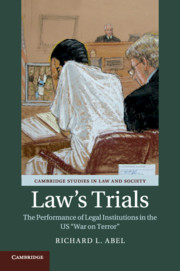


Do courts in fact preserve the rule of law? We all assume they do, but we rarely study precisely how they do it, and when and why they fail. The real test comes not in ordinary times, but when judges are under the most intense stress and political pressure to trade off the rights of those brought before them for unquantifiable, yet not easily dismissed, claims of national security. Nearly two decades after September 11, 2001, a broad and confusing landscape of legal actions has unfolded – courts-martial, criminal prosecutions, military commissions, habeas corpus petitions, and civil actions for grave civil liberties and human rights violations – that finally give us the kind of ecosystem-shocking episode that is ripe for serious scholarly examination. But how do we know which legal institutions in fact best protected the rule of law, and which have abjectly failed?
Understanding how and why trials mattered during this bracing historical era is one of the central challenges facing those who want to understand better the interaction between law and society. For while this is ground overtilled by many, it has been notably underexamined by serious scholars who conscientiously research where, when, and how challenges to the rule of law arise; how legal institutions weather those challenges; and how those responses compare with other responses by parallel institutions in other societies or during other historical eras. Over his long and most distinguished academic career, Richard L. Abel has consistently proven himself to be one of our most discerning law and society scholars. In the 1990s he instructed us on how law and lawyers mattered in winning another searing social justice challenge: the decades-long struggle against apartheid. In this prodigious volume, and its equally ambitious companion Law’s Wars, Abel offers a nuanced, deeply thoughtful, and overarching vision of how law can preserve its essential core under intense political pressure, and what long-term overall impact the so-called “war on terror” has had on our nation’s bedrock values.
These volumes should be read and remembered by historians, political scientists, sociologists, anthropologists, as well as lawyers willing to draw the fundamental lessons of this era. Those of us who have lived through these decades as observers and participants have often anguished when we have sought deeper understanding, only to find transient commentary. We both need and should learn from Abel’s essential and painstaking research, which provides the kind of detailed quantitative and qualitative analysis that has been too sadly missing from the daily blogosphere’s spontaneous reactions. Abel’s moving final chapter – which after surveying more than one hundred other social justice campaigns, suggests that most remedial rule-of-law projects take a generation or more to reach fruition – offers comfort and insight at the same time as it demands patience. Abel’s greatest achievement may be in reminding us that the vigilance that preserves liberty is sadly unceasing, and demands the kind of dogged persistence and perseverance we wish we could be spared from, but will always be both destined and obliged to provide.
+ Sterling Professor of International Law and former Dean (2004–09), Yale Law School, Legal Adviser (2009–13), and Assistant Secretary of State for Democracy, Human Rights and Labor (1998–2001), US Department of State.
