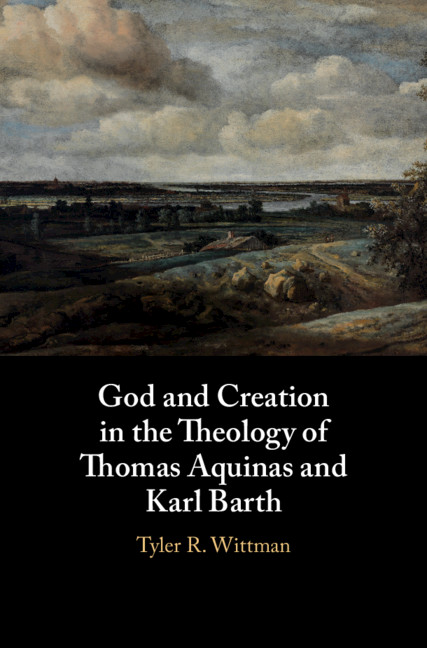

The legacies of Thomas Aquinas and Karl Barth remain influential for contemporary theologians, who have increasingly put them into conversation on debated questions over analogy and the knowledge of God. However, little explicit dialogue has occurred between their theologies of God. This book offers one of the first extended analyzes of this fundamental issue, asking how each theologian seeks to confess in fact and in thought God's qualitative distinctiveness in relation to creation. Wittman first examines how they understand the correspondence and distinction between God's being and external acts within an overarching concern to avoid idolatry. Second, he analyzes the kind of relation God bears to creation that follows from these respective understandings. Despite many common goals, Aquinas and Barth ultimately differ on the subject matter of theological reason with consequences for their ability to uphold God's distinctiveness consistently. These mutually informative issues offer some important lessons for contemporary theology.
‘The volume is an ambitious and demanding read that is full of rich insights into the theological method of its interlocutors. Wittman demonstrates a sensitivity to, and awareness of, the issues in the landscape of Aquinas and Barth scholarship, yet charts his own course by avoiding the temptation to become unduly entangled in them.’
Charles C. Helmer Source: International Journal of Systematic Theology
‘a learned and charitable study of both Thomas and Barth on a very selective theological topic. In this sense, Wittman’s work will prove insightful for those looking to think with the men from Aquino and Basel on the relation between theologia and economy, especially in moving beyond the somewhat restrictive categories of immanent and economic Trinity.’
Phillip Hussey Source: Journal of Reformed Theology
Loading metrics...
* Views captured on Cambridge Core between #date#. This data will be updated every 24 hours.
Usage data cannot currently be displayed.
This section outlines the accessibility features of this content - including support for screen readers, full keyboard navigation and high-contrast display options. This may not be relevant for you.
Accessibility compliance for the HTML of this book is currently unknown and may be updated in the future.
