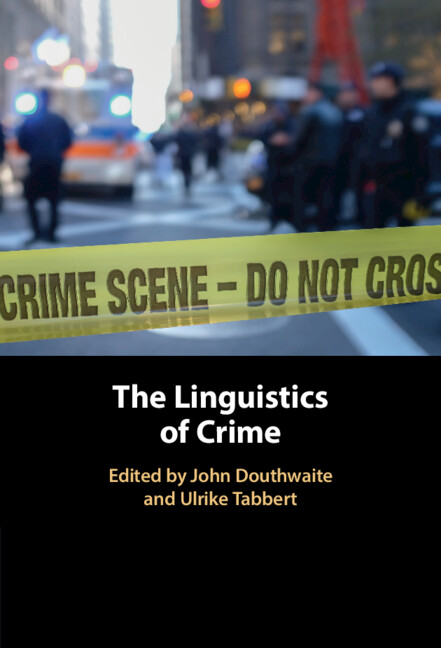
The Linguistics of Crime

-
Select format
-
- Publisher:
- Cambridge University Press
- Publication date:
- 05 January 2023
- 05 January 2023
- ISBN:
- 9781108581332
- 9781108471008
- 9781108456951
- Dimensions:
- (229 x 152 mm)
- Weight & Pages:
- 0.66kg, 350 Pages
- Dimensions:
- (229 x 152 mm)
- Weight & Pages:
- 0.507kg, 349 Pages
- Subjects:
- Stylistics, Language and Linguistics, Discourse Analysis
You may already have access via personal or institutional login- Subjects:
- Stylistics, Language and Linguistics, Discourse Analysis
Show more authors 
You may already have access via personal or institutional login
Book description
Bringing together scholars from a range of disciplines, this book explores the analysis of crime-related language. Drawing on ideas from stylistics, pragmatics, cognitive linguistics, metaphor theory, critical discourse analysis, multimodality, corpus linguistics, and intertextuality, it compares and contrasts the linguistic representation of crime across a range of genres, both fictitious (crime novels, and crime in TV, film and music), and in real life (crime reporting, prison discourse, and statements used in courts). It touches on current political topics like #BlackLivesMatter, human (child) trafficking, and the genocide of the Kurds among others, making it essential reading for linguists, criminologists and those with a general interest in crime-related topics alike. Covering a variety of text genres and methodological approaches, and united by the aim of deciphering how crime is portrayed ideologically, this book is the next step in developing research at the intersection of linguistics, criminology, literature and media studies.
Reviews
‘A wide range of potential readers, from non-experts to researchers seeking current insights, will find this volume appealing due to its formal features and engaging content. The multi disciplinarity of the chapters enhances the pedagogical potential of the book, making it equally appropriate for the consultation of specific chapters.’
Enrique Munoz-MantazLanguage in Society
Contents
Contents
Metrics
Altmetric attention score
Full text views
Full text views helpTotal number of HTML views: 0
Total number of PDF views: 0 *
 Loading metrics...
* Views captured on Cambridge Core between #date#. This data will be updated every 24 hours.
Usage data cannot currently be displayed.
Accessibility standard: Unknown
Why this information is here
This section outlines the accessibility features of this content - including support for screen readers, full keyboard navigation and high-contrast display options. This may not be relevant for you.
Accessibility Information
Accessibility compliance for the HTML of this book is currently unknown and may be updated in the future.