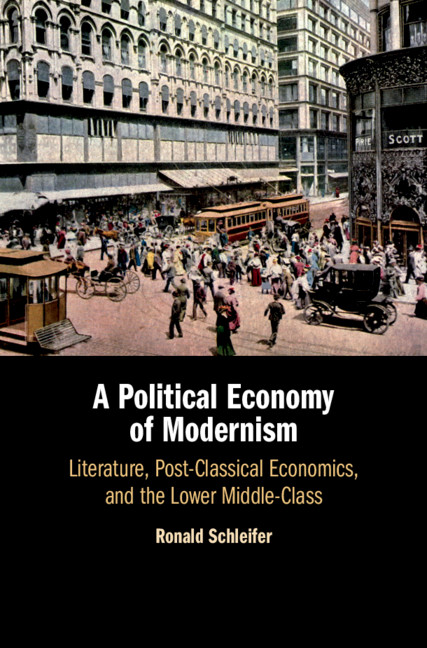

In A Political Economy of Modernism, Ronald Schleifer examines the political economy of what he calls 'the culture of modernism' by focusing on literature and the arts; intellectual disciplines of post-classical economics; and institutional structures of corporate capitalism and the lower middle-class. In its wide ranging study focused on modernist writers (Dreiser, Hardy, Joyce, Stevens, Woolf, Wells, Wharton, Yeats), modernist artists (Cézanne, Picasso, Stravinsky, Schoenberg), economists (Jevons, Marshall, Veblen), and philosophers (Benjamin, Jakobson, Russell), this book presents an institutional history of cultural modernism in relation to the intellectual history of Enlightenment ethos and the social history of the second Industrial Revolution. It articulates a new method of analysis of the early twentieth century - configuration and modeling - that reveals close connections among its arts, understandings, and social organizations.
‘Schleifer’s account of modernism is a fascinating and challenging attempt to realize a novel form of immanent cultural history.’
Benjamin Pickford Source: Genre
Loading metrics...
* Views captured on Cambridge Core between #date#. This data will be updated every 24 hours.
Usage data cannot currently be displayed.
This section outlines the accessibility features of this content - including support for screen readers, full keyboard navigation and high-contrast display options. This may not be relevant for you.
Accessibility compliance for the HTML of this book is currently unknown and may be updated in the future.
