

More than six decades after the launch of Sputnik, most rocket bodies used to send payloads into Space are still abandoned in orbit. So far, only SpaceX has the capacity to bring the ‘core stage’ of its rockets back to Earth and land it on four legs. When Space X uses a Falcon 9 rocket to launch Starlink satellites to low Earth orbit (LEO), the core stage usually returns to a landing pad or a barge in the ocean and is often reused. However, launch sequences vary between rocket models, and even SpaceX abandons rocket bodies in orbit sometimes.
The term ‘rocket body’ is shorthand for more specific terminology. ‘Boosters’, ‘core stage’ or ‘first stage’, and ‘upper stage’ might seem like familiar terms, but there can still be some confusion in their use. Boosters are parts of rockets that support the launch sequence but never themselves achieve orbit. Instead, they are dropped suborbitally, albeit with some precision, into designated areas, usually in the ocean. The core stage is typically the most substantial section of a rocket. In some designs, it achieves orbit during launch and is either brought back to Earth in a controlled manner or abandoned in orbit. Many rockets also have one or more upper stages, which provide additional boosts to the ‘payload’, usually made up of one or more satellites. Although upper stages are sometimes brought back to Earth in a controlled manner, most are abandoned in orbit as operators choose to maximise the lifting potential of the rocket by not reserving fuel for a potentially large de-orbit burn. In what follows we use ‘rocket body’ as a general term that is not specific to a stage. In 2021, over 60 per cent of launches to LEO resulted in at least one rocket body being abandoned in orbit.
There are two main categories of atmospheric re-entry: ‘controlled’ and ‘uncontrolled’. Controlled re-entries are achieved by using thrust to place the rocket body onto an orbit with a low perigee, timed in such a way that the re-entering object is directed towards a landing pad or recovery zone in the case of reusable systems, or to a remote area of ocean for expendable systems. By contrast, when a rocket body is simply abandoned on an orbit with a sufficiently low perigee, gas drag gradually reduces its altitude and eventually causes it to re-enter the atmosphere in an uncontrolled manner,Footnote 1 which can occur at any point under its flight path. This means that the location of the ‘debris field’ will not generally be known in advance.
While it may be self-evident, it is critical to recognise that, both collectively and individually, rocket bodies contain substantial mass and surface area. This has implications for debris generation, light pollution and re-entry casualty risks. Because we have already discussed space debris and light pollution in previous chapters, we will only touch on those first two issues briefly here, before moving on to a more substantial discussion of the third issue: casualty risks associated with uncontrolled rocket body re-entries.
4.1 Space Debris Generation
Abandoned rocket bodies are large tumbling objects that remain in orbit for days, months or years – and cannot be manoeuvred to avoid collisions. Their cross-sections provide ample surface area for impacts with other rocket bodies, derelict satellites, tracked and untracked space debris, and meteoroids. Worse yet, rocket bodies are not necessarily inert, with certain designs prone to explosions and fragmentation due to residual fuel, overpressure or other processes.Footnote 2
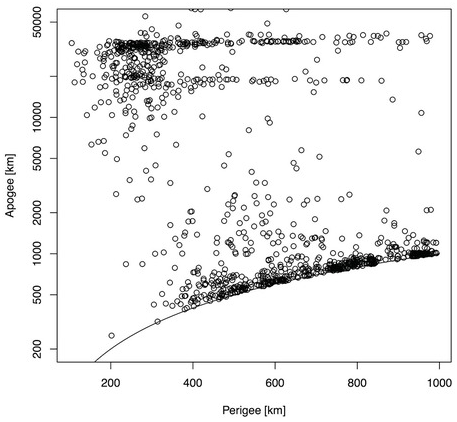
Figure 4.1 shows the apogee–perigee distribution of those rocket bodies currently in orbit with perigees below 1,000 kilometres. Many of the orbits are eccentric, traversing large swathes of Earth’s orbital regions, from LEO to GEO (geosynchronous Earth orbit). Any fragmentation event thus has the potential to spread debris throughout the entire orbital environment. Moreover, because they are among the most massive objects in orbit, a single major collision has the potential to cause large changes in the total amount of debris. Many rocket bodies also form ‘orbital clusters’. To put it another way, ‘families’ of rocket bodies, along with derelict satellites, share certain orbital characteristics and therefore have frequent close approaches with each other. This increases the risk of collisions and poses a major threat to the orbital environment.Footnote 3 The dangers of Space debris have been covered extensively in Chapter 2, and we will not repeat that discussion here. The point, simply, is to highlight that it is not just mega-constellations of satellites that put the safe and sustainable development of Space at risk.
Apogee and perigee of abandoned rocket bodies in orbit. Recall that perigee is an object’s closest approach to Earth and apogee is the most distant part of its orbit. Only rocket bodies with perigees below 1,000 kilometres are shown. The y axis has logarithmic spacing on account of the apogees extending from LEO to GEO. The curve delineates the physical parameter space; an object exactly on the curve would have an apogee that is equal to its perigee, and thus have a circular orbit. Many rocket bodies, some the size of a school bus, relentlessly pass through the entire satellite field about Earth and cannot be controlled.
4.2 Light Pollution
In Chapters 2 and 3, we discussed light pollution from satellites. However, light pollution from rocket bodies is also a concern, particularly given their large numbers and sizes. As illustrated in Figure 4.2, even rocket bodies at great distances from an observatory can be bright. And since many are on elliptical orbits that largely keep them out of Earth’s shadow, they are illuminated for greater periods of time than satellites in LEO, making many of them visible to telescopes throughout the night. Moreover, rocket bodies that are tumbling present challenges to astronomers additional to the unwanted presence of bright streaks. Their tumbling causes variability of light that can interfere with automated image processing and cause confusion in ‘processing pipelines’, such as those designed to look for variability in astronomical objects. Rocket bodies may also be a source of very small, non-lethal debris brought about through meteoroid impacts, Space debris impacts, fragmentation events and surface degradation. Although such debris may not be a major concern for satellites and other spacecraft, it is a growing one for astronomers. For while such pieces have very little mass, they could have a large cumulative surface area and thus scatter a non-negligible amount of sunlight. The net effect could be that such small debris becomes a source of diffuse scattered light at night, increasing the sky brightness.Footnote 4 This type of brightening would not be noticeable to the human eye, but could still affect sensitive astronomical observations.
An image of an SL-6 R/B(2) streaking across the sky (NORAD ID: 16911), an abandoned upper stage of a Soviet Molniya rocket with a perigee of 4,753 kilometres and apogee of 34,964 kilometres. Despite being at a range of about 7,400 kilometres from the observatory at the time of observation, the rocket body is very bright. Its brightness also varies due to rapid tumbling, creating additional challenges for astronomers. The image was taken by the DAO 1.8-metre Plaskett Telescope as part of a rocket body characterisation study. The dark horizontal streaks are known defects in the detector.

4.3 Uncontrolled Rocket Body Re-entries
Not only do abandoned rocket bodies create problems when they are in orbit, but also any uncontrolled re-entries into Earth’s atmosphere create dangers for people on the surface.
As a striking example, in May 2020, the 20-tonne main body of a Long March 5B rocket re-entered the atmosphere in an uncontrolled manner after being used to launch an unmanned experimental crew capsule. Debris from the rocket body, including a 12-metre-long pipe, struck two villages in Ivory Coast, causing damage to several buildings.Footnote 5 Then, one year later, the 20-tonne main body of another Long March 5B rocket made an uncontrolled re-entry after being used to launch part of China’s new Tiangong Space station into LEO.Footnote 6 This time, the debris crashed into the Indian Ocean. These two rocket stages were the heaviest objects to re-enter in an uncontrolled manner since the Soviet Union’s Salyut-7 Space station in 1991.Footnote 7
In April 2022, a metal ring with a diameter of three metres landed in a village in India, along with a cylinder-like object about 50 centimetres in diameter.Footnote 8 Fortunately, there were no injuries or property damage. According to Jonathan McDowell, who posted a picture of the metal ring on Twitter, the objects were likely from the third stage of a Chinese Chang Zheng 3B rocket that had been launched in February 2021.Footnote 9
Part of a re-entered rocket body. According to Jonathan McDowell of the Harvard & Smithsonian Center for Astrophysics, who posted this photograph on Twitter on 3 April 2022, ‘This 3-meter-diameter ring is consistent with being part of the CZ-3B third stage tankage. It was found in Sindewahi (79.6E 20.3N) in eastern Maharashtra.’ See twitter.com/planet4589/status/1510658292640534534.

China has been criticised, including by US government officials, for imposing the re-entry risks of its rockets on the world.Footnote 10 However, in the absence of any international consensus on the acceptable level of risk, other spacefaring states – including the United States – make similar choices concerning uncontrolled re-entries. In 2016, the second stage of a SpaceX rocket was abandoned in orbit and re-entered one month later over Indonesia, with two intact refrigerator-sized fuel tanks reaching the ground.Footnote 11 In June 2022, SpaceX abandoned another second stage after lifting an Egyptian communications satellite into a geosynchronous transfer orbit.Footnote 12
The added technological complexity and cost involved in achieving controlled re-entries help to explain the shortage of international rules on this matter. Moreover, casualty risks are usually assessed on a launch-by-launch basis, which keeps them low and makes it easier for governments to justify uncontrolled re-entries. However, as humanity’s use of Space expands, cumulative risks should also be considered. Launch providers have access to technologies and mission designs today that could eliminate the need for most uncontrolled re-entries. The challenge, in an increasingly diverse and competitive Space launch market, is not only to raise safety standards but also to ensure that everyone is subject to them, and all this needs to be done without creating unreasonable barriers to new entrants.
4.3.1 Assessing Casualty Risk
As indicated above, over 60 per cent of launches to LEO in 2021 resulted in a rocket body being abandoned in orbit. If these rocket bodies are not involved in either a catastrophic collision or an explosion in orbit but in due course return to Earth intact, a substantial fraction of their mass will survive the heat of atmospheric re-entry as debris.Footnote 13 Many of the surviving pieces are potentially lethal, posing serious risks on land, at sea and to people in aeroplanes.
In the United States, the Orbital Debris Mitigation Standard Practices (ODMSP) apply to all launches and include a requirement that the risk of casualty from a re-entering rocket body be below a threshold of one in 10,000.Footnote 14 However, in practice these requirements can be waived. The US Air Force waived the ODMSP requirements for 37 of the 66 launches conducted for them between 2011 and 2018, on the ground that it would be too expensive to replace non-compliant rockets with compliant ones.Footnote 15 NASA also waived the requirements seven times between 2008 and 2018, including for an Atlas V launch in 2015 where the casualty risk was estimated at one in 600.Footnote 16
The threshold of one in 10,000 for casualty risk is arbitrary,Footnote 17 and makes even less sense in an era when new technologies and mission profiles enable controlled re-entries. It also fails to address low-risk, high-consequence outcomes, such as a piece of a rocket stage crashing into a high-density city or a large passenger aircraft. In the latter case, even a small piece could cause hundreds of casualties.Footnote 18
Internationally, there is no clear and widely agreed casualty risk threshold. The 2010 UN Space Debris Mitigation Guidelines recommend that re-entering spacecraft not pose ‘an undue risk to people or property’, but do not define what this means.Footnote 19 The 2018 UN Guidelines for the Long-Term Sustainability of Outer Space Activities call on national governments to address risks associated with the uncontrolled re-entry of Space objects, but do not specify how.Footnote 20 There is no binding treaty that addresses rocket body re-entries, apart from the 1972 Liability Convention which stipulates that a ‘launching State shall be absolutely liable to pay compensation for damage caused by its Space object on the surface of the earth or to aircraft in flight’.Footnote 21
In Chapter 3, we discussed the issue of liability in the context of mega-constellations, collisions and Space debris. In that context, and others, the possibility of liability might help to induce good behaviour. However, on the issue of re-entering rocket bodies, governments have apparently chosen to bear the slight risk of having to compensate for one or more casualties, rather than require launch providers to make expensive technological or mission design changes. As in some other areas of government and commercial activity, ‘liability risk’ is treated as just another cost of doing business.Footnote 22 This approach may be made easier by the fact that the casualty risk is disproportionately borne by the populations of some of the poorest states in the world.
As Figure 4.4 demonstrates, most of the rocket bodies in orbit, and therefore most of the contributions to casualty risk, come from the powerful spacefaring states. And yet most of these rocket bodies are concentrated in orbital inclinations that correspond, more or less, with heavily populated regions of the Global South.Footnote 23
Casualty expectations. A Number of rocket bodies with perigee < 600 kilometres and associated global casualty expectation (CE) for spacefaring states with large contributions (Europe treated as a single unit). B Pie chart of the proportion of the total global CE contributed by each state. C Standard CE as a function of orbital inclination for a re-entry and the 2020 global population (as distributed under those inclinations). D CE of rocket bodies currently in orbit by latitude and population density. CE is the number of casualties per square metre of casualty area as described by R. Patera (2008) 45:15 Journal of Spacecraft and Rockets 1031–41. Casualty area, which is the total area over which debris could cause a casualty for a given re-entry, is not modelled. In all panels, only rocket bodies with perigees at or below 600 kilometres are included, based on the US Space Force Satellite Catalogue as of 5 May 2022. This approximates the population of long-lived abandoned rocket bodies that might reasonably be expected to de-orbit.


During the past 30 years, over 1,500 rocket bodies have de-orbited.Footnote 24 We estimate that approximately 70 per cent de-orbited in an uncontrolled manner, corresponding to a casualty expectation of 0.015 events per square metre. This means that, on the face of it, if the average rocket body were to cause a casualty area of ten square metres, there was roughly a 14 per cent chance of one or more casualties over this time. Fortunately, there has been no such event reported, but the estimate emphasises that the incurred risk has been far from negligible.
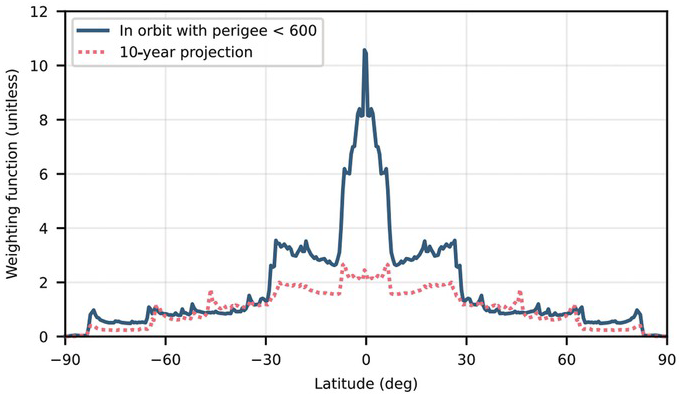
The future risk can be modelled in several ways; we explore two and illustrate them in Figure 4.5. Both these models (and Figure 4.6) use the ‘weighting function’, which is the distribution of ‘weights’ for each latitude, with each weight set by the fraction of time that an object with a given inclination spends over that latitude.Footnote 25 Assuming again that each re-entry spreads lethal debris over an area of ten square metres, we conclude that current practices have on the order of a 10 per cent chance of one or more casualties over a decade.
Rocket body weighting functions. Each curve is the sum of the rocket bodies’ normalised time spent over each latitude. Two models are shown: the sum of all rocket bodies currently in orbit with perigee under 600 kilometres and a ten-year projection based on the rocket bodies that re-entered uncontrolled from 4 May 1992 to 5 May 2022.
Population density by latitude (orange plot) and rocket body weighting function (blue logarithmic heatmap) overlaid on a world map. Some major and high-risk cities are labelled: 1 Moscow, 2 Washington, DC, 3 Beijing, 4 Dhaka, 5 Mexico City, 6 Lagos, 7 Bogota, 8 Jakarta.

First, the long-term risk resulting from the build-up of rocket bodies in orbit can be estimated by looking at rocket body orbits that have a perigee lower than 600 kilometres, with this perigee representing an imperfect but plausible division between rocket bodies that will de-orbit in the coming decades and those that require much longer timescales. For this cut-off, there are 651 rocket bodies, with a corresponding casualty expectation of 0.001 per square metre. As a second alternative, we can take the trend of rocket body re-entries from the past 30 years and apply it to the next ten years, in which case there is a corresponding casualty risk of 0.006 per square metre. Both these estimates are conservative as the number of rocket launches is increasing quickly.Footnote 26
Each rocket body is abandoned at a specific orbital inclination, and these are not evenly distributed. On-orbit rocket bodies are concentrated at inclinations where they spend most of their time above the lower latitudes. This is because many of the rocket bodies that lead to uncontrolled re-entries are associated with launches to geosynchronous orbits, located near the equator.Footnote 27 As we illustrate in Figure 4.6, the cumulative risk from rocket body re-entries is significantly higher in the states of the Global South, as compared to the major spacefaring states. The latitudes of Jakarta, Dhaka, Mexico City, Bogotá and Lagos are at least three times as likely as those of Washington, DC, New York, Beijing and Moscow to have a rocket body re-enter over them, under one estimate, based on the current rocket body population in orbit.
This situation, of risks from activities in the developed world being borne disproportionately by populations in the developing world, is hardly unprecedented. Powerful states often externalise costs and impose them on others, with greenhouse gas emissions being just one example.Footnote 28 The disproportionate risk from rocket bodies is further exacerbated by poverty, with buildings in the Global South typically providing a lower degree of protection; according to NASA, approximately 80 per cent of the world’s population lives ‘unprotected or in lightly sheltered structures providing limited protection against falling debris’.Footnote 29
4.3.2 Switching to Controlled Re-entries
Due to technological advances, allowing rocket bodies to re-enter in an uncontrolled manner is increasingly becoming a choice rather than a necessity. Controlled re-entries require engines that can reignite, enabling the launch provider to direct the rocket body away from populated areas, usually into a remote area of ocean.Footnote 30 Some older rocket models that lack reignitable engines are still used by some launch providers; these will need to be upgraded or replaced to achieve a safe, controlled re-entry regime.
Performing a controlled re-entry also requires having extra fuel on board, above and beyond that required for launching the payload. Some launch providers operating modern rockets with reignitable engines deplete the fuel on board to boost the payload as high as possible, thus saving customers time – since otherwise the payload will have to use its own thrusters to slowly raise its orbit. But in doing so, the providers deny themselves the opportunity for a controlled re-entry. Such an approach to mission design will have to be changed to achieve a safe, controlled re-entry regime.
Most of these measures cost money. In the case of the Delta IV rocket, the US government reportedly granted waivers because of the costs of upgrades,Footnote 31 even though, as the entity procuring these launches, it was well positioned to absorb the increased cost of safer missions. In the case of commercial missions, the costs associated with a move to controlled re-entries could affect the ability of a launch provider to compete. Yet this challenge, of increased costs arising when safety, environmental and other negative externalities are internalised, is one that has been faced by many industrial sectors in the past. This is where rules and regulations come in: when done well, they ensure a level playing field so that no single company, even a new entrant, loses out from improved practices.
4.3.3 Solving the Collective-Action Problem
National governments could raise the standards applicable to launches from their territory or by companies incorporated there. But individual governments might have competing incentives, such as reducing their own costs or growing a globally competitive domestic Space industry. Uncontrolled rocket body re-entries constitute a collective-action problem; solutions exist, but every launching state must adopt them.
There are numerous examples of national governments co-operating to ensure the adoption of technological ‘fixes’ to environmental problems. In the 1970s, scientists warned that chlorofluorocarbons (CFCs) used in refrigeration systems were converting and thus reducing ozone molecules in the atmosphere, which in turn allowed more cancer-causing ultraviolet radiation to reach the surface.Footnote 32 Fortunately, alternative technologies were available and, in 1985, the Vienna Convention for the Protection of the Ozone Layer was adopted.Footnote 33 This provided a framework for phasing out the use of CFCs, with the specific chemicals and timelines set out in the 1987 Montreal Protocol on Substances That Deplete the Ozone Layer.Footnote 34 These two treaties, which have been ratified by every single UN member state, have solved the collective-action problem. They have reduced the global use of CFCs by 98 per cent, prevented further damage to the ozone layer, and thus prevented an estimated 2 million deaths from skin cancer every year.Footnote 35
The 1970s also saw a growing risk to oceans and coastlines from oil spills, and, as a result, led to efforts, nationally and internationally, to adopt a requirement for double hulls on tankers. The shipping industry, however, concerned about increased costs, was able to stymie these efforts until 1989, when the Exxon Valdez spilled roughly 11 million gallons of oil into Alaska’s Prince William Sound. Media coverage of the accident made the issue of oil spills a matter of public concern. The US National Transportation Safety Board concluded that a double hull would have significantly reduced, if not eliminated, the spill,Footnote 36 leading the US government to require all tankers calling at US ports to have double hulls.Footnote 37 This unilateral move then prompted the International Maritime Organization to amend the International Convention for the Prevention of Pollution from Ships (MARPOL Convention) in 1992 to require double hulls on new tankers and,Footnote 38 through further amendments in 2001 and 2003, to accelerate the retirement of single-hulled tankers.Footnote 39 The 1992 amendments to the MARPOL Convention have since been ratified by 150 states (including the United States, Liberia and Panama) which represent 98.33 per cent of the world’s shipping tonnage.Footnote 40 This precedent, of oil spills and the double-hull requirement, is especially significant for uncontrolled rocket body re-entries because it concerns transport safety in an area beyond national jurisdiction. Oil spills pose risks for all coastal states in the same way that uncontrolled rocket body re-entries do for the entire planet. It is our hope, however, that national governments will respond to the risks posed by uncontrolled rocket bodies now, rather than wait for the equivalent of an Exxon Valdez accident to occur.
Those national governments whose populations are being put at disproportionate risk from uncontrolled rocket bodies should demand that major spacefaring states mandate controlled rocket re-entries and create meaningful consequences for non-compliance, thus eliminating the risks for everyone. If necessary, they could initiate negotiations towards a non-binding resolution or even a treaty – because they have a majority at the United Nations General Assembly. Even if a multilateral treaty is not ratified by the major spacefaring states, it would still draw widespread attention to the issue and set new expectations for behaviour. This is what happened with the 1997 Anti-personnel Landmines Convention:Footnote 41 although not ratified by the United States, Russia or China, it led to a marked reduction in the global use of anti-personnel mines, with non-ratifiers also changing their behaviour.Footnote 42
In any case, on the issue of uncontrolled rocket body re-entries, the states of the Global South hold the moral high ground: their citizens bear most of the risks, unnecessarily, since the technologies and mission designs needed to prevent casualties exist already.


 Open access