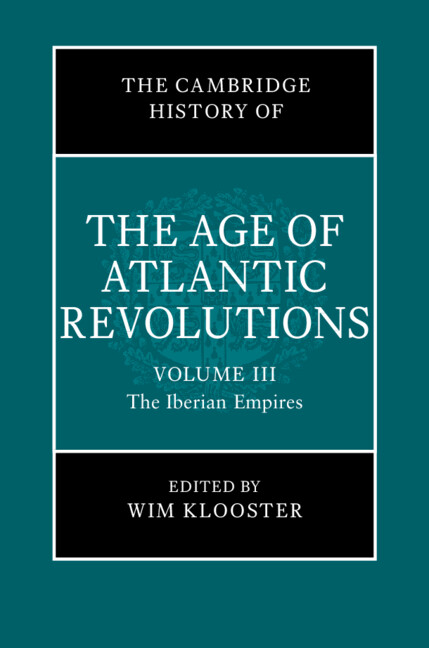
The Cambridge History of the Age of Atlantic Revolutions

-
Select format
-
- Publisher:
- Cambridge University Press
- Publication date:
- 20 October 2023
- 09 November 2023
- ISBN:
- 9781108598248
- 9781108475969
- Dimensions:
- (229 x 152 mm)
- Weight & Pages:
- 1.13kg, 800 Pages
- Dimensions:
- Weight & Pages:
You may already have access via personal or institutional login
Volume 3: The Iberian Empires
Show more authors 
You may already have access via personal or institutional login
Book description
Volume III covers the Iberian Empires and the important ethnic dimension of the Ibero-American independence movements, revealing the contrasting dynamics created by the Spanish imperial crisis at home and in the colonies. It bears out the experimental nature of political changes, the shared experiences and contrasts across different areas, and the connections to the revolutionary French Caribbean. The special nature of the emancipatory processes launched in the European metropoles of Spain and Portugal is explored, as are the connections between Spanish America and Brazil, as well as between Brazil and Portuguese Africa. It ends with an assessment of Brazil and how the survival of slavery is shown to have been essential to the new monarchy, although simultaneously, enslaved people began pressing their own demands, just like the indigenous population.
Reviews
‘Klooster has collected seventy-one essays, managing to give an idea of the ongoing debate: solid reconstructions … attempt to bring together historiography and history from different schools and perspectives. One can only appreciate the desire to reconstruct the historiographical debate because it opens the doors to the lives of scholars and their motivations and determinations in electing a theme and a research direction … The necessary nuances and chiaroscuro make the picture more authentic and point to other possible studies.’
Michaela Valente Source: Archivio Storico Italiano
‘The volume consistently describes revolutionary processes and provides the reader with a sense of time and place … The volume’s significance lies in its contribution to ongoing historiographical discussions on violence, gender, race, migration, circulation, and integration. Fortunately, the majority of the chapters reference publications in Spanish or Portuguese. It is commendable that a work aimed at English-speaking audiences embraces and disseminates high-quality historiography originating from outside the English-speaking academic world.… A valuable and significant book.’
Rodrigo Moreno Gutiérrez Source: Hispanic American Historical Review
‘The volume reveals the tension within the normative narrative of revolution as transition from top-down-declining-empire to participatory-bottom-up-new sovereign-nation, for nearly half of the twenty-two contributors deeply contradict this narrative. … Many of the essays reveal the deep contradictions of the liberal model of Atlantic Revolutions.’
Jorge Cañizares-Esguerra Source: Ler Historia
Contents
Contents
Metrics
Altmetric attention score
Full text views
Full text views helpTotal number of HTML views: 0
Total number of PDF views: 0 *
 Loading metrics...
* Views captured on Cambridge Core between #date#. This data will be updated every 24 hours.
Usage data cannot currently be displayed.
Accessibility standard: Unknown
Why this information is here
This section outlines the accessibility features of this content - including support for screen readers, full keyboard navigation and high-contrast display options. This may not be relevant for you.
Accessibility Information
Accessibility compliance for the HTML of this book is currently unknown and may be updated in the future.