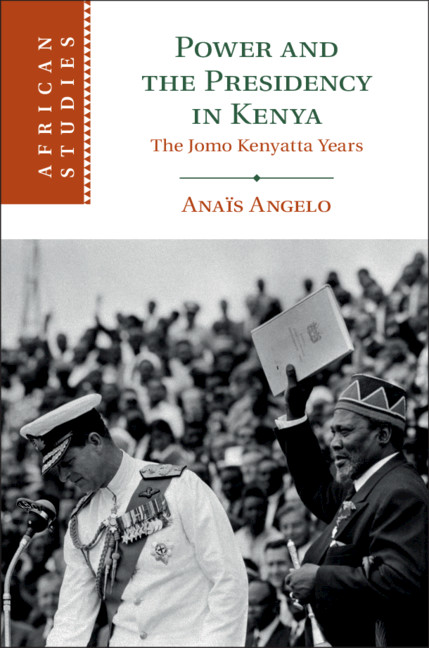

In December 1963, Kenya formally declared its independence yet it would take a year of intense negotiations for it to transform into a presidential republic, with Jomo Kenyatta as its first president. Archival records of the independence negotiations, however, reveal that neither the British colonial authorities nor the Kenyan political elite foresaw the formation of a presidential regime that granted one man almost limitless executive powers. Even fewer expected Jomo Kenyatta to remain president until his death in 1978. Power and the Presidency in Kenya reconstructs Kenyatta's political biography, exploring the links between his ability to emerge as an uncontested leader and the deeper colonial and postcolonial history of the country. In describing Kenyatta's presidential style as discreet and distant, Angelo shows how the burning issues of land decolonisation, the increasing centralisation of executive powers and the repression of political oppositions shaped Kenyatta's politics. Telling the story of state building through political biography, Angelo reveals how historical contingency and structural developments shaped both a man and an institution - the president and the presidency.
‘Power and Presidency in Kenya is an important contribution to the historiography of decolonization and of Kenya's post-colonial political landscape. But it also helps us better understand how presidential systems amass and enact power. Anaïs Angelo has written a lucid, engaging book of great interest to historians and political scientists alike.'
Daniel Branch - University of Warwick
‘Anaïs Angelo combines an insightful analysis of the political imagination and political style of Jomo Kenyatta with a vivid portrayal of infighting among the elite around him. Her study provides a rare glimpse into politics at the summit of an African regime.'
Frederick Cooper - New York University and author of Africa Since 1940: The Past of the Present
‘In this newly researched book Dr Angelo persuasively enters into the controversies surrounding the first Kenyatta's presidency, to portray it as a power created by a political elite who had no authority other than his peculiarly enigmatic charisma and who then exploited it in their own self-interest, with an eye to insuring their privileges against the uncertain future that lay ahead without him.'
John Lonsdale - University of Cambridge
‘… Angelo’s work is succinct and focused. It offers insight into the modern formation of executive power that extends beyond Kenya and the African continent.’
Riley Linebaugh Source: KULT online
‘This impressive work will have a reach beyond Africanists. It demonstrates how scholars can respond to methodological challenges with creativity.’
Kara Moskowitz Source: The Journal of Interdisciplinary History
Loading metrics...
* Views captured on Cambridge Core between #date#. This data will be updated every 24 hours.
Usage data cannot currently be displayed.
This section outlines the accessibility features of this content - including support for screen readers, full keyboard navigation and high-contrast display options. This may not be relevant for you.
Accessibility compliance for the HTML of this book is currently unknown and may be updated in the future.
