

Onlookers described the social world of the metropolitan elite as a glittering and at times poisoned menagerie, inhabited by peacocks, swans, chameleons, and monkeys. Young, ‘new-fangled’ gentlemen flitted ‘[i]n silken sutes like gawdy Butterflies’ along the Thames, travelling from Whitehall to Southwark to frequent plays or to woo lovers.Footnote 1 Satires derided the mix of pleasure-seeking and political pretensions found among urban gentlemen who lived around the four Inns of Court. Impetuous, beautifully attired, status-driven: these men were ruthlessly ‘in contempt of poorer fates’ and ‘[p]uft up by conquest’.Footnote 2 The political aspirants who navigated the ‘sinewes of a cities mistique body’, as John Donne’s narrator complained in ‘Satire I’, were status-obsessed officeholders and young members of the gentry, who ‘did excell/Th’Indians, in drinking [their] Tobacco well’ and who sought the goods that ‘schemes’ and global intervention produced.Footnote 3
While scholarship remains attuned to the way manners created modes of urbanity through which politics was discussed and accessed, little has been made of the influence of colonization on metropolitan civility, particularly among a demographic of young men intent on establishing state careers.Footnote 4 At the Inns of Court, gentlemen were encouraged to respond creatively to debates about the political realm and civil society through plays, masques, and the circulation of verse. In 1572, the MP John Hooker compared the House of Commons to a theatre, where, like civility, politics was performed and put on display.Footnote 5 What happened to these performances when American objects and representations of Native peoples came into them? As Noah Millstone argues, attention to political culture should include language and ideas as well as material culture and the social meaning of objects that emphasize ‘use, purpose, and strategy’ – in other words, that demonstrate how beliefs functioned in practice.Footnote 6 This final chapter examines how the Inns as institutions fostered spaces of masculine sociability where gentlemen came to behave and view themselves as colonizers. Understanding how gentlemen incorporated America into their social habits and performances challenges the idea that civility was ‘essentially rhetorical’, or that sociability and taste were disconnected from political decision-making and a detailed knowledge of colonial conditions.Footnote 7
As Donne himself exemplified, moving beyond the sumptuous imagery of America in his wit poetry composed at Lincoln’s Inn in the 1590s to sitting on the Virginia Company council and preaching a sermon in support of colonization in 1622, here was a generation who came of age with America. This demographic complicates the scholarly tendency to see the language of civic duty and common good as overwhelmingly driving Jacobean expansion.Footnote 8 In the realm of political thought, such rhetoric did dominate, but the making of an imperial polity also involved concerted efforts to make colonization a fashionable element of English political culture for the first time. By negotiating the bounds of excess and control, gentlemen praised plantation through carefully calibrated expressions of wit that simultaneously served to exclude those who failed to meet accepted standards of behaviour and taste. By promoting their civilizing project through colonial intervention, gentlemen developed and modified their own ideas of civility, one that was increasingly contingent on endorsing empire.
The Taste for Expansion
The seventeenth century saw the development of a London ‘season’ caused by two major factors: first, the development of London-based political, legal, and administrative institutions; and second, the city’s rise in trade and a global economy that made London the centre of commercialized leisure.Footnote 9 The Inns of Court were affected by both. Admissions rose steeply in this period, with the sons of gentry increasingly seeking to polish their education through an immersion into London society. The Inns partly served as a ‘finishing school’ while offering a place to establish political connections essential to establishing a career in government.Footnote 10 The training in law, whether or not members of the Inns were ever called to the bar – many were not – endowed members with the rudimentary basics that statesmen like Thomas Elyot had advocated since the sixteenth century for those who sought government positions.Footnote 11 The impact of metropolitan life on large numbers of the gentry who had previously spent much of their time in the provinces was substantial, and manifested itself partly through changing codes of behaviour and sociability among the elite.Footnote 12
As early as the fifteenth century, chief justice John Fortescue stressed that the education that young men received at the Inns went beyond the study of law, providing ‘nurseries’ where the courtly arts and government patronage might be obtained.Footnote 13 Inventories show that the most valuable goods gentlemen brought with them from Oxford or Cambridge to London were apparel and books, including cosmographies.Footnote 14 In their pursuit of refined civility, Inns members in the early Stuart period disparaged the lower branches at the Inns of Chancery, not because these students lacked learning but because their education often served as a form of apprenticeship.Footnote 15 Members of the lesser gentry or country merchant families made up the ‘lower branch’ of the legal profession, usually trained at one of the eight Inns of Chancery that prepared them to become justices of peace, sheriffs, and clerks.Footnote 16
Scholars have examined the unique dramatic and literary environment of the Inns, where gentlemen were encouraged to think about the law and government through creative refraction.Footnote 17 Entertainments, spectacles, and literary output at the Inns were a mandatory feature of formal education, often intersecting with ‘devices’ and performances at court.Footnote 18 While Paul Raffield emphasizes, perhaps overly so, the Inns’ constitutionalism and critique of the monarchy, Jessica Winston demonstrates that the Inns provided contested spaces where gentlemen passionately defended ‘the necessity of political dialogue’ and where they ‘broadened participation in that dialogue, making themselves figuratively and perhaps even literally, in terms of the performance space, central to conversations’.Footnote 19 As Winston points out, the influence of the Inns as institutions operating within the political nation did not lie just in members’ interest in the law or literature, but in their political connections and their strong sense of duty.Footnote 20 The Inns were places where Members of Parliament, justices of the peace, lawyers, poets, magistrates, and courtiers all mingled, exchanged ideas, and, as Michelle O’Callaghan demonstrates, drank, ate, and discoursed together.Footnote 21 Sociability involved the meeting between friends but also the networks of associations, both professional and informal, that perpetuated specific codes of behaviour and led to charged moments of social interaction and political debate.Footnote 22 The terms ‘company’, ‘society’, or ‘fraternity’ suggested an associational politics of participation that involved constructing boundaries to include and exclude, and concerns over civil behaviour propagated at this time should be understood partly as a response to this competitive atmosphere.Footnote 23
Jacobean satirists frequently lampooned Inns gentlemen for caring more about social status than their studies. At times, critiques of ostentation hardly seem exaggerated. Looking back on his time at the Middle Temple in the 1620s, Edward Hyde, later Earl of Clarendon, admitted that ‘the License of those Times … was very exorbitant’.Footnote 24 Writers mocked the Inns man who ‘takes Tobacco, and doth weare a locke,/And wastes more time in dressing then [sic] a Wench’.Footnote 25 ‘Initiated in a Taverne’, members soon learned what was truly important in university and then the city: velvets, tennis, books about honour tied with silk strings, and wit ‘which may doe him Knights service in the Country hereafter’.Footnote 26 Matthew Carew, a civil lawyer trained on the Continent, complained to Dudley Carleton in 1613 that one of his sons cared only for ‘houndes and hawkes’ while the other ‘is of the Midle [sic] Temple, where he hath a chamber and studye, but I heare studieth the law very litle’.Footnote 27 This was the poet Thomas Carew, eighteen at the time and seemingly inclined to use his education for somewhat less principled reasons than serving the commonwealth.
On the other hand, the sometimes unruly behaviour at the Inns was often less a rejection of discipline than an attempt to preserve and define it in other spheres. The term ‘civil’ brought together ‘the political and the social, the personal and the public within a common framework of order’.Footnote 28 Members styled themselves as active proponents of a ‘“civilizing” agency’ and promoted an ethos of responsibility towards government and the law, all in a cosmopolitan environment through which good manners were cultivated.Footnote 29 What was law, the Gray’s Inn lawyer Henry Finch wrote, but the ‘[a]rt of wel ordering a Civil Societie’?Footnote 30 Portraits commissioned by students portrayed them with formal demeanours that appear to reflect their attempts to separate themselves from those enrolled at the Inns of Chancery. Nicholas Hilliard’s portrait miniature of Francis Bacon is one example, painted in 1578 when Bacon resumed his studies at Gray’s Inn following his tour of Europe. Clad in simple black attire, his head held high and framed by a large ruff, Bacon cast an elegant but haughty gaze towards the viewer, while a Latin inscription declared the mind to be worthier of illustration than the face.Footnote 31
Given members’ self-referential commitment to civility, their deep enthusiasm for colonization strongly suggests that expansion increasingly served as a manifestation of their own civil interests. While it is not the intention to downplay the importance of the law in the education of gentlemen at the Inns, little extant evidence suggests that gentlemen used the law to pursue colonization in particularly innovative ways. If anything, the law is strangely absent in benchers’ fascination with the Atlantic. Bacon, in his essay ‘On Plantations’, made no mention of the lawfulness of expansion. Commonplace books belonging to law students were filled with poetry, diary entries, and litigation terms and cases, but interests in Native Americans and America appear in the first two forms rather than the latter. The Virginia Company had repeatedly stated that territorial expansion in the Atlantic was lawful because it involved converting ‘infidels’; because the English were not coming to conquer, but to trade; and due to the concept of res nullius, that ‘there is roome sufficient in the land … for them, and us’.Footnote 32 Further, the company claimed, the Powhatans had already violated the ‘law of nations’ by using English ‘ambassadors’ poorly, and ‘Powhatan, their chiefe King, received voluntarilie a crowne and a scepter, with a full acknowledgement of dutie and submission’.Footnote 33 Rather than drawing on the law to justify expansion, gentlemen seemed to accept the justifications laid out in the charters of joint-stock companies, and used America and its peoples to construct their social and political identities in other ways.
Scholarly discussions of English civility remain curiously void of the influence of imperial aspirations and discourses about ‘civilizing’ others on its development. Anna Bryson remarks on the significance of John Dickenson’s translation of Aristotle’s Politics (1598), which included mention of the uncivil ‘savages’ of America, but her study only allows for a fleeting acknowledgement that colonization must have influenced ideas of civility and savagery.Footnote 34 Nonetheless, from the later Elizabethan era gentlemen at the Inns advanced a civility that related to imperial intervention. In ‘The Prince of Love’, the elaborate Christmas revels at the Middle Temple in 1597/8, gentlemen channelled their devotion to Queen Elizabeth by proclaiming her power to soften and refine men: ‘She, by uniting mens hearts unto her, hath made herself a mind-subduing Conqueror … civilizing her subjects, whom in the past accounted barbarous’.Footnote 35 The author, likely Bacon, espoused the classical ideas of honour with imperial might, specifically relating successful expansion to the civilizing power of the monarch. ‘[B]y your Exploits and Victories … you shall find a sweet Respect into the Adventures of your youth … you shall eternize your Name, and leave deep Foot-steps of your Power in the World’.Footnote 36
The networks of patronage at the Inns helped to turn such spectacles into reality. Fuelled by the travel reports they acquired at nearby printers’ shops and privy to colonial intelligence through their connections to court and Parliament, gentlemen were well placed to apply their political aspirations to expansionist projects. The physical spaces of the Inns – gardens, private chambers, libraries, halls, chapels – provided places of study, deliberation, and performance. Bacon’s close affiliation with Gray’s Inn, where he lived and built expansive gardens, involved meeting with projectors and other colonial enthusiasts. He likely met with Ralegh in the Gray’s Inn gardens to discuss Ralegh’s Guiana ventures, and William Strachey, who went to Virginia as secretary, dedicated his ‘Historie of the Travaile into Virginia Britannia’ to Bacon in 1612. Strachey offered himself to Bacon’s service because he was ‘bound to your observance, by being one of the Graies-Inne Societe’, where ‘[y]our Lordship ever approving yourself … of the Virginia Plantation, being from the beginning (with other lords and earles) of the principal counsell applyed to propagate and guide yt’.Footnote 37
In his dedicatory epistle to Francis Walsingham in the first edition of The principal navigations (1589), Richard Hakluyt credited the Middle Temple as the place where his interests in colonization were first ignited. Writing in the mystical language of revelation, Hakluyt recalled the moment, as a boy in his cousin’s chambers in the Middle Temple, when he first gazed upon a cosmography and heard of the opportunities that lay in the uncharted realms beyond England. This left a deep impression on Hakluyt, for his cousin’s discourse was ‘of high and rare delight to my yong nature’.Footnote 38 Sermons that endorsed colonization were entrenched in this world of reading and exploration. The churchmen enlisted to support the Virginia Company in its 1609 campaign had Inns connections. William Crashaw, for example, was preacher at the Middle Temple, where he helped to collect and publish news from North America and Bermuda. Crashaw retained close links to fellow Middle Templar Henry Wriothesley, third Earl of Southampton, who acquired much of Crashaw’s vast library before becoming treasurer of the Virginia Company.
The literary scholar Michelle O’Callaghan finds that wit coteries in Jacobean England were closely related to members’ associations with the Virginia Company, especially at the Middle Temple and Lincoln’s Inn.Footnote 39 Men who spent much of the year in the localities came to London on business and to sit in Parliament, meeting in taverns and public houses to discuss current events in a convivial atmosphere in which literature and politics easily and often converged. The ‘sireniacal gentlemen’ who met at the Mermaid tavern on Bread Street in the early 1600s included lawyers, courtiers, and business associates who encouraged colonization. Robert Phelips, John Hoskyns, John Donne, Francis Bacon, Christopher Brooke, and Richard Martin were among those who served the London company in various legal capacities and had clear vested interests in Virginia. They were encouraged by patrons including Southampton, Robert Cecil, and the financier and MP Lionel Cranfield, first Earl of Middlesex, who had connections with City merchants and offered major financial support for Atlantic expeditions.Footnote 40 The playwrights Ben Jonson, Francis Beaumont, and John Fletcher also met at the Mermaid, and brought America, Native Americans, and tobacco to the popular stage.Footnote 41 These men also collaborated on court masques and City pageants, suggesting a cross-over between ideas of America and its peoples as they were depicted in various spaces, and to different audiences.
Viewing themselves as the arbiters of taste, gentlemen helped to set the foundations for what a well-ordered ‘Civill Societie’ might entail in an imperial context. Their role was especially important after Cecil and James’ eldest son, Henry, both died in 1612. Cecil and Henry were two of the most influential colonial patrons of the time, and, until James’ renewed interest in the Virginia colony in the late 1610s, members of the Inns helped to keep colonial interest alive. George Chapman’s The memorable masque (1613), featuring members of the Inns dressed as ‘Virginians’, allowed Richard Martin and other investors to employ the politically charged symbolism of the performance to present a utopian colony at an uncertain moment in its future, enabling affiliates of the company to make pointed political comments to an aristocratic audience.
Inns members sought intelligence on overseas voyages and copied travel reports into their commonplace books. Individuals kept themselves informed on Ralegh’s attempts at colonizing South America by transcribing Ralegh’s accounts ‘selected out of S[i]r Walter Raleighes first booke of his discoverie of Guyana’.Footnote 42 One anonymous transcriber chose to note the customs of the indigenous inhabitants who fiercely resisted foreign powers: they were ‘wont to make war upon all Nations, and especially w[i]th the Caniballs’.Footnote 43 These groups separated the skin from the bones of their dead, taking the former to ‘hang it in the Casiq[ue]s howse that died, and deck his scull w[i]th feathers of all colours, & hang all his goldeplates about the boanes of his armes, thighs, and legges’.Footnote 44 These reports seem to describe what anthropologists now acknowledge was a practice of memorializing the dead among certain groups.Footnote 45
Inns gentlemen also expressed interest in the short-lived Amazon Company in 1619. Of the thirteen original adventurers, roughly a third were trained at Gray’s Inn, Lincoln’s Inn, or the Inner Temple. James knighted three members at some point in their careers, and they contributed 500l. to the original 2,500l. collected for the company’s first voyage.Footnote 46 Investment in the Amazon Company brought together the interests of Inns members and court patrons. These South American projects were ‘an adventure and a chaunce at hazarde’, wrote the lawyer John Hayward to his friend Nicholas Carew in an enthusiastic note written at Inner Temple in 1617.Footnote 47 Disenchanted courtiers, aggravated by the Spanish ambassador Gondomar’s proximity to James and the Duke of Buckingham’s pro-Spanish policies, supported intervention in Guiana partly to challenge Catholic interests. Related to this, the support of the Amazon Company may reflect attempts on the part of Ralegh’s supporters to sustain his imperial projects after his trial and execution in 1618. While merchants had largely steered clear of Ralegh’s final Guiana voyage, backing for his ventures at the Inns had remained strong. ‘I praye let us heare from you to morrowe, and let mee receave my dyrections from you for w[i]thout yt I shall doe nothinge more,’ Hayward had written to Carew, urging him to invest in Ralegh’s undertaking. ‘I coulde wishe you were in towne, for I feare mee you will gette no monye, but you must adventure’.Footnote 48
Gentlemen also directly involved themselves first-hand in voyages of discovery. In 1582, Richard Madox, an Oxford fellow at All Souls, embarked on a voyage overseen by Martin Frobisher and Francis Drake to establish spice trades, in a route that eventually took Madox to Sierra Leone and Brazil.Footnote 49 Madox’s diary seemed to have been intended for readership, probably by the courtiers who invested in the voyage. These included Francis Walsingham, William Cecil, and the Earl of Warwick, all of whom were members of Gray’s Inn. With its Latin and Greek references, veiled allusions and pseudonyms, and recordings of seditious behaviour, Madox’s diary was both private record and government report, and offers one example of the way university-educated gentlemen participated in projects for expansion in America beyond collecting second-hand information.Footnote 50 Better known for his later travel to India, the Middle Templar Thomas Roe commanded an expedition to Guiana in 1611, encouraged by Ralegh, Cecil, and Prince Henry. Accounts written into the 1630s, including Henry Colt’s from Barbados in 1631, are in many ways the results of the vogue for planting apparent at the Inns in the 1580s and 1590s. Colt had been admitted to Lincoln’s Inn in 1596 and, before the systems of slavery irrevocably changed plantation systems, colonization remained in the hands of those Colt considered ‘gentlemen of note’ – ‘younge men, & [of] good desert’ who must find ways to rein in the ‘quarrelsome conditions of your fiery spiritts’ by serving the commonwealth abroad.Footnote 51
Sociability and table talk brought colonization into networks of literary production. The poems and epigrams about America by Chapman, Donne, and Michael Drayton, some of them likely shared over dinners in City taverns, were informed by an awareness of their associates’ experience abroad. Around 1610, a W. S., perhaps William Strachey, wrote a letter asking to borrow money, desperate not to miss the opportunity to ‘meete w[i]th some Frendes at dinner [who are] returned from Virginia’.Footnote 52 Chapman’s poem ‘De Guiana’ (1596), Drayton’s ‘To the Virginian Voyage’ (1606), and tobacco poems like John Beaumont’s The metamorphosis of tabacco (1602) or Raphael Thorius’ Hymnus tabaci (1626) must be situated within this milieu of gentlemanly sociability, where verses were privately circulated, read aloud, and discussed over wine and tobacco. ‘De Guiana’ was Chapman’s contribution to Lawrence Kemys’ A relation of the second voyage to Guiana (1596), a voyage ‘perfourmed’ under the direction of Ralegh.Footnote 53 Under the rhetoric of easy imperialism, Chapman and his readers were aware of the more complex process of colonization that included interactions with Arawaks and Caribs. While the land itself offered itself willingly to the English, Chapman extolled, the English must actively bring ‘what heretofore savage corruption held/in barbarous Chaos’.Footnote 54 ‘America, A merry K, Peru’, wrote the water poet John Taylor to his friend, the fellow ‘sireniacal’ Thomas Coryate, ‘Virginia of thy worth doth onely heare,/And longs the weight of thy foot-steps to beare:/Returne thee, O returne thee quickly than,/And see the mighty Court of Powhatan’, a reference to Pocahontas’ father.Footnote 55
A later poem by Drayton, ‘To Master George Sandys Treasurer for the English Colony in Virginia’ (1626), concluded by asking after ‘noble Wyats health’, referring to the governor Francis Wyatt, who was just finishing his term as first royal governor.Footnote 56 In asking about ‘descriptions of the place’ and ‘our people there’, Drayton exhibited an awareness of actual happenings on the ground. John Donne, in privately circulated manuscripts in the 1590s, may have eroticized the American landscape in ‘Elegy XIX – To His Mistress Going to Bed’, but he also sought the position of treasurer for the Virginia Company in 1609. This post demanded conformity to the dominant Protestant attitude that sought to convert Algonquians, but also to ‘civilize’ them according to English customs, a stance Donne publicly promoted as dean of St Paul’s in his sermon to the Virginia Company in 1622. Colonization, Crashaw had insisted in 1610, ‘is not only a lawfull, but a most excellent and holie action, and, as the case now stands, so necessarie, that I hold every man bound to assist’, an appeal gentlemen responded favourably to.Footnote 57
The Material Atlantic
In August 1586, Francis Drake returned from his raids on the Spanish West Indies and ‘came into the Middle Temple Hall at dinner time’, where benchers filled the hall with applause and greeted him ‘with great joy’.Footnote 58 Drake enjoyed a privileged status at the Inns despite having begun his career as a seafaring apprentice. Fragments of the ‘Drake lantern’, ostensibly from Drake’s ship The Golden Hind, continue to hang in Middle Temple Hall, where an oak desk said to contain part of the ship’s deck also survives. When Drake made his dramatic entrance at Middle Temple Hall that late summer evening, he had been to South America but also to Roanoke, bringing back its struggling colonists.
The excitement of Drake’s return was undoubtedly linked to Drake’s flamboyant opposition of the Spanish and, related to this, to the acquisition of goods. The commodities that circulated in Drake’s own ships, and those he intercepted in the West Indies and South America, connected the Americas to England in a tangible way. These ships were conduits to the circulation of precious commodities that the English sought as demonstrations of their own prestige, from pearls to precious metals.Footnote 59 Objects were intended to carry out the civilizing project of empire on multiple levels, from the material wealth they brought into England to the ‘civilizing’ effect English objects were believed to have on Native Americans. The baskets and red featherwork presented by the coastal Miwok to Drake in California were contrasted against the wrought silver items that the English brought with them overseas. Drake’s ships were equipped with provisions ‘for ornament and delight’, such as silver table utensils and ‘all sorts of curious workmanship’ so that ‘the civilitie and magnificence of his native country’ might be ‘more admired’.Footnote 60 To the English, showcasing metal-wrought objects to Native Americans expressed a covetable English civility while establishing trade links that would benefit the ‘kingdome here at home’ and build indigenous Americans’ dependence on European goods.Footnote 61
Objects brought back by captains and merchants helped to establish the relationship between American landscapes and the metropolis. Recounting Drake’s trip to western North America, one report described that ‘[t]his country our General [Drake] named Albion, and that for two causes; the one in respect of the white bancks and cliffes, which lie towards the sea; the other, that it might have some affinity, even in name also, with our own country’.Footnote 62 The particular things that Drake brought with him into the Middle Temple from his Atlantic voyages are unknown. Whether he carried Native American artefacts with him or not, other Atlantic things played a role in gentlemanly self-presentation. Thomas Hariot, who returned to England from Roanoke with Drake, was credited with helping to make tobacco a popular pastime among the elite, but his drawings and notes about Algonquians, at least those that survived the voyage back, may also have been shared or circulated prior to him publishing versions of his Briefe and true report. John White’s watercolours, still acclaimed for their elegant naturalism, paid remarkable attention to Algonquian facial expressions and details (see Figure 3). These were also, however, presentation items. Copies were made and were likely intended for display, visible to select members of the pro-imperial coteries of which Ralegh and his friend Henry Percy, ninth Earl of Northumberland, were patrons.
Objects and visual displays of colonial knowledge shaped gentlemanly responses to colonization. The spaces of the Inns, like some portraits, may be seen as amassing and exhibiting ‘consumption constellations’ that served to endorse the visual appeal of colonial intervention through a series of interconnected objects.Footnote 63 Gentlemen used these environments to promote colonization through specific assemblages of material culture, including globes, cosmographies, travel compendia, pearl jewellery, drawings and engravings, and tobacco pipes and boxes. The Middle Temple Library’s terrestrial and celestial ‘Molyneux globes’ raise attention to how such objects connected gentlemen to their imperial aspirations in a physical way. These globes, created in 1592, were subsequently modified to contain updated information that reflected Ralegh and Drake’s voyages in the Atlantic. As on maps, gentlemen updated the coastlines of their globes based on changing cartographic knowledge, where subtle over-layers of paint display ongoing attempts at cartographical precision.Footnote 64 The commissioner of the globe is unknown, but the globe maker, Emery Molyneux, was affiliated with John Dee and Ralegh’s circle in London and accompanied Drake on his circumnavigation.Footnote 65
Gentlemen quickly began to use and display the objects that came to them from America, drawing on iconographies and representations of Native peoples in their writings and performances. The Middle Temple lawyer Edward Phelips was not amused when benchers complained in 1613 that one gentleman refused to return his costume from the Virginian masque.Footnote 66 ‘Lett m[aste]r peters presently come unto me’, Phelips scrawled underneath the complaint, ‘for I hold his deniall very strange’.Footnote 67 The surviving petition does not specify which costume Peters seemed so intent on retaining, but it very well may have been one of the fifty ‘Virginian’ habits worn by the ‘civillest’ gentlemen of the Inns and ‘imitating Indian worke’ and motifs, including embroidered suns and feathers ‘compast in Coronets, like the Virginia Princes’.Footnote 68
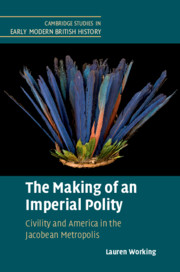
‘Coronets’ or feather headdresses were a recurring symbol of indigeneity, appearing in emblems, cosmographies, and fashion books derived from earlier Continental works and from more recent accounts of English travel. Henry Peacham, a writer and illustrator at Prince Henry’s court, used a South American headdress to invite a reflection on personal honour in his 1612 emblem book (Figure 6). Peacham’s engravings were of his own invention, and he depicted an ‘Indian Diadem’ suspended over water, framed by Italianate grotesques that were given an American bent with the inclusion of a turkey. To gain acclaim, the verses went, ‘[w]e pick from others praises here and there,/So patch herewith an Indian Diadem/Of Parrats feather’.Footnote 69
Henry Peacham, Minerva Britanna, or A garden of heroical devises (1612), featuring a head ornament from South America.

Intriguingly, Peacham’s verses seemed to demonstrate some knowledge of the function of feathers in bestowing honour upon the wearer who earned them. To accumulate undeserving accolades was akin to wearing ‘Plumes indeed, whereto we have no right’.Footnote 70 Peacham perhaps gleaned his information from accounts of English travel to Greater Amazonia. The shading of the feathers in the emblem suggests a multi-coloured headdress, such as were prized by indigenous leaders, and the woven basketry plaiting at the base is strikingly similar to that of surviving featherwork from Guiana (compare to Figure 4). Despite the English awareness of the value of such objects, the appearance of featherwork in cabinets of curiosity or in performances also indicates a willingness to disregard their supernatural force.
At the Middle Temple, perhaps as a result of Pocahontas and other Algonquians coming to London in 1616, English ‘Virginians’ were accused of wearing their hair in imitation of Powhatan religious men.Footnote 71 ‘I have heard Sir Thomas Dale and Master Rolph say’, Samuel Purchas recounted, that this fashion ‘was first by our men [worn] in the first plantation … borrowed from these savages – a fair unlovely generation of the lovelock, Christians imitating savages, and they the devil!’Footnote 72 In 1628, William Prynne also attributed lovelocks to Algonquians. Prynne had entered Lincoln’s Inn in 1621, at a time when authorities were clamping down on the more gaudy sartorial displays of wayward students insistent on wearing long boots and growing their hair. Prynne’s attempt to promote civil deportment seems directly informed by the Algonquian Tomocomo’s earlier presence in London. ‘A Virginian comming into England’, Prynne recounted, had ‘blamed our English men for not wearing a long locke as they did: affirming the God which wee worship to bee no true God, because hee had no Love-locke’.Footnote 73 ‘Our sinister, and unlovely Love-lockes, had their generation, birth, and pedigree from the Heathenish, and Idolatrous Virginians’, Prynne alleged.Footnote 74 They, in turn, ‘tooke their patterne from their Devill Ockeus: who visually appeared to them in forme of a man, with a long black Locke on the left side of their head … so that if wee will resolve the generation of our Love-lockes … the Virginian Devill Ockeus will proove to be the natural Father’.Footnote 75 Whether a connection actually existed between Native American hairstyles and the English adoption of the fashion, Purchas and Prynne’s criticisms were remarkably detailed, condemning metropolitan styles by drawing on Algonquians’ socio-cosmic beliefs and their physical presence in England.
The way that gentlemen expressed their identities by appropriating Native styles and commodities carried important implications for the relationship between empire and polity. Their urbanity included an element of the subversive or playfully reckless that did not actually oppose civility but rather seemed to sharpen its complexity. Such civility was differentiated from English interactions with other territories because it involved appropriating goods and styles from colonial environments that the English sought to control. While late Elizabethan satires critiqued opulence as eroding masculine strength – the courtier with ‘golden bracelets wantonly … tied’ and ‘[t]wo Indian pearles … pendant at his eares’ was ‘himselfe in nothing but in name’ – gentlemen in London related such luxuries to the successes of geopolitical exploitation.Footnote 76 Praising the precious minerals he sourced in Guiana in 1595, Ralegh reported a gemstone containing the ‘strange blush of a carnation’, ‘which being cut is very rare’.Footnote 77 Ralegh’s promise that ‘there are not more diamonds in the East Indies than are to be found in Guiana’ specifically related to his aspirations to ‘govern that country which I have discovered and hope to conquer for the queen’.Footnote 78
This link between consumption and subordination also meant effeminizing highly skilled warriors in metropolitan discourse, despite their undergoing the intensely challenging huskanaw coming-of-age ritual. The Virginia Company investor Walter Cope praised the pearls in Virginia but disdained Wahunsenacah/Powhatan for ‘stately marchinge w[i]th a great payre of buckes hornes fastened to his forhead, not knowinge what esteeme we make of men so marked’.Footnote 79 By comparing him to a cuckold, Cope reduced Wahunsenacah’s display of power into a symbol of bawdy humour. Meanwhile, the painted bearskins the Powhatans offered to John Smith, the product of much labour and technical refinement, were deemed ‘toyes’.Footnote 80
Pearls are so pervasive in Elizabethan and Jacobean portraits that they can become almost invisible, but these also served as ‘imperial blueprints’.Footnote 81 As luminous gems with potent mythological associations with the sea and carnality, they were increasingly viewed as the currencies of maritime power and global trade.Footnote 82 Colonists in the Chesapeake and Bermuda frequently commented on the abundance of oyster beds. Ralegh’s 1588 portrait, like Elizabeth’s ‘Armada’ portrait of the same year, was rife with pearls that played into the duality of their appeal as emblems of purity and sensuality while directly associating the display of these goods to a burgeoning English Atlantic.Footnote 83 One of the largest pearls in Elizabeth’s portrait pended from a weighty gem, tied with a pink ribbon and hanging suggestively below her waist. Lest anyone remain unsure of the statement of Atlantic intent, Elizabeth’s hand lay on a globe, specifically on the Americas.
The large, double-pearl earring in Ralegh’s portrait may draw the eye first, but nearly all his attire contained clusters and waves of pearls. From the double-stringed bracelet to his breeches and belt, rows of pearls were set on black cloth that heightened their brilliance while pandering to Elizabeth’s favoured colour combination, white and black. Portraits of Drake and Hawkins also featured globes and a multitude of pearls, Hawkins’ in the form of a bracelet, his hand wrapped around a captain’s sash with silver spangles similar to the one excavated in the grave of Captain William West in Jamestown. The objects gentlemen possessed and conspicuously displayed were not neutral expressions, but promoted a masculine Protestant civility that related imperial participation to expressions of status and authority of rule.
Political historians have traced the rise of the ‘information state’ in the late Elizabethan and early Stuart eras, where the practice of politics involved ‘the collecting, interpreting, manipulating, and disseminating of information as a primary mode of exercising and maintaining power’.Footnote 84 This involved ‘the material conditions of governance’ through attempts to physically collect and manage news and record-keeping.Footnote 85 The material politics of the state also involved the access to and display of global goods. When Nicholas Saunders, a country gentleman, noticed a pedlar wearing what seemed to be ‘an Indian hatt’ with a ‘Jewell fittar for a greater parsonage then that party of now hath it’, he wrote to Cecil to explain what he had seen, believing this ‘rare and riche thing’ to have belonged to a West Indian ruler and brought back on Drake’s ship.Footnote 86 Saunders described the hat with intricate detail, relating its ‘beaten plates of gould’ intermingled with pearls, which he believed unfit for a man who ‘caryed a pack at his back about the countrey’.Footnote 87 This curious story raises intriguing questions about the acquisition and distribution of American or indigenous-inspired objects in rural areas of England. Saunders’ observations also show how assumptions about social status and access to goods were rooted in the political.
The Sociability of Smoking
The stereotypes of the Inns man in the early seventeenth century depicted him as enamoured with the ‘Indian weed’. ‘His Recreations … are his only studies (as Plaies, Dancing, Fencing, Taverns, and Tobacco)’.Footnote 88 Epigrams described preened, ruffled, and velvet-clad creatures who expressed themselves through oaths and rituals of intoxication. Moralists complained that gentlemen were at times so uncivil that it seemed ‘their Progenitors had beene some Cumanian [Cumaná] Indians’, and they were encouraged to ‘resume spirits truly English’ to avoid becoming a ‘degenerating posteritie’.Footnote 89 Visitors to London noticed that ‘the English are constantly smoaking tobacco’, and their descriptions specifically related this practice to the physical spaces in and around the Inns of Court.Footnote 90 From there, it was only a short walk to the Thames, where gentlemen were daily reminded of their imperial aspirations: ‘Upon taking the air down the river, the first thing that struck us, was the ship of that most noble pirate, Sir Francis Drake, in which he is said to have surrounded this globe of earth’.Footnote 91
Chapter 4 ended with an analysis of how the tobacco debates in parliament created new clusters of consumption and assemblages of goods involving questions of taste and access.Footnote 92 This section explores how tobacco informed the colonially inflected civility of those gentlemen through their social performances and literary production in and around the Inns of Court. While wine ‘doth the wits refine’, intoxication had found a new contender now that ‘this our age an other worlde hath founde’.Footnote 93 Satires conjured changing modes of sociability through smoking, evoking friends who crossed each other in the streets and carried their conversations ‘unto his Chamber [for] the best Tobacco that he ever dranke’.Footnote 94 American-sourced tobacco was preferred over tobacco from other territories: ‘All that which others fetcht, he doth abhor/His grew upon an Iland never found’.Footnote 95 As Jessica Winston argues, a ‘vital relationship’ existed between civil affairs and leisure at the Inns, where states of play informed attitudes towards governance and served to extend the legitimate spaces where political discourse could operate.Footnote 96 The introduction of tobacco within these spaces of literary production helped to bring America in conversation with the political nation.
Their own superior civility, gentlemen claimed, allowed them to smoke without degenerating into the savagery they condemned in others. Still in his teens, the budding poet John Beaumont, a member of the Inner Temple alongside his young brother the playwright Francis, published a mock encomium that spun an elaborate, heroic tale of ‘this precious herbe, Tabacoo’ whose heavenly properties transformed and inspired its partakers.Footnote 97 Beaumont introduced this sweet ‘nymph’ with a history of her own, one ancient, pastoral, and divine. The Nymph was a civilizer of men: had gods and philosophers known her, the fluency of good rhetoric would have been rendered obsolete, with tobacco compelling the ‘rule uncivill throng’ to ‘[a]n order’d Politike societie’.Footnote 98 In Beaumont’s verses, tobacco contained civilizing properties that propelled civil society. The poem distinguished between refined, discerning gentlemen and London gulls who imbibed inferior strains of tobacco merely for fashion’s sake. In praising ‘thou great God of Indian melodie’, Beaumont conjured the heady, golden-hued plant of the Americas as a fitting intoxicant for urbane gentlemen, a sentiment underscored by the ten commendatory verses written by friends in Beaumont’s Inns network.Footnote 99 These poems celebrated the ‘Americk Ile’, but they did so in expressions of wit directed ‘To the white Reader’.Footnote 100
Though Beaumont’s poem contained a streak of youthful resistance to authoritarian control, his description of the ‘circles of a savage round’, and of Virginian religious men and ‘the valleyes of Wingandekoe … in the North part of America’, appears to directly reference the engravings of Algonquians by Theodore de Bry that appeared in Hariot’s influential and oft-cited 1590 edition of his Briefe and true report.Footnote 101 The closing stanzas framed the commodity within current events. Native Americans, with ‘savage rites, and manners fear’d’, possessed a plant whose glories they did not fully comprehend, and must yield to ‘the walles of Albions cliffie towers’.Footnote 102 ‘In the farre countries, where Tabacco growes’, the Nymph’s guiding hand would lead the English to assert their presence ‘over Virginia and the New-found-land’ and ‘[tame] the savage nations of the West’.Footnote 103 To Beaumont, the glorification of an indigenous commodity nevertheless justified the subjugation of America through the subordination of nature and an interference in Spanish affairs.
Such sentiments reached their most outrageous extremes in the London-based physician and poet Raphael Thorius’ Hymnus tabaci, published in Latin in 1626, but written as early as the 1610s. In Thorius’ poem, Bacchus led a legion of merrymakers to conquer Native Americans by teaching them to smoke. Submerged in the dark bower of a cannibal cave, mirroring a canto from The Odyssey, Bacchus encouraged its denizens to learn to drink and smoke in good company, for only through sociability with others could they assume ‘a civil garb smooth’d by urbanity’.Footnote 104 The element of transformation, of turning nature into what was artificial and civil, was a crucial marker between Thorius’ ‘savage’ inhabitants and ‘enlightened’ civilizers. ‘Eat not the Leaf’, Bacchus warned the cannibal, ‘there’s danger in it raw’.Footnote 105
Like the gentlemen who wrote, shared, and read these poems, Bacchus articulated that ‘to live the life of men’ involved discoursing with friends and partaking in social pleasures, luring cannibal creatures into grace. It was Idmon, famed for his wit, who braved the fiercest cannibal king and told him, ‘our manners are not steep’d in blood, but wine’.Footnote 106 This fraternity of civilizers would come to ‘[s]ophisticate by Art, but naturall’.Footnote 107 Here, the taste for colonial-sourced tobacco may have reinforced or encouraged gentlemen to act out their imperial pursuits through social performance. Verses commanding readers to ‘[t]ake up these lines Tabacco-like unto thy braine,/And that divinely toucht, puffe out the smoke againe’ brought poetry to the service of action, encouraging consumption while bringing attention to the content of the verses themselves.Footnote 108
Richard Brathwaite, a member of Gray’s Inn since 1609, also entrenched the appeal of expansion within the rituals of masculine conviviality in A solemne joviall disputation (1617), a small octavo conducive to easy sharing and circulation. Brathwaite’s text was divided into two parts. The first was a translation of a Continental drinking treatise, the second half an addition devoted entirely to tobacco. This latter part, ‘The Smoaking Age’, framed the metropolitan gentleman as one informed by the world of expansion and discovery beyond him (Figure 7). Decades before the arrival of the first coffeehouses in England, Brathwaite conjured the microcosm of the tobacco shop as a political space, where men could meet to smoke, speak to travellers, and discuss state affairs. Much of the humour in Brathwaite’s discourse relied on probing the tensions between the pleasures of smoking and the duties of state, between expected conduct and long-standing concerns over the perils of degeneration through the exposure of ‘savage’ influences. The author’s invented acquaintance, the ‘Bermudan’ Boraccio Fumiganto, discussed his resolve to ‘worke wonders among the wilde Irish’ by reducing ‘all those bogs, and marishes [sic] to plots of Tobacco’, a ludicrous project that jabbed at Jacobean schemes that purported to benefit both state and private purse.Footnote 109

Brathwaite included a lengthy lament by a cantankerous Father Time who echoed prevalent anti-tobacco polemic by asking why men now preferred ‘an herbes vapour’ over ‘their countries renowne; Commonweales success; or publike managements of state’.Footnote 110 This seems to have been an extension of the comic rhetoric around tobacco apparent at the Inns from the 1590s. The Christmas revels at the Middle Temple in 1597/8 included a speech where the orator instructed his audience to ‘examine the Complots of Politicians from the beginning of the world to this day … It is apparent it was not Tabacco [that caused them] … to conclude, Tabacco is not guilty of so many faults as it is charged withal’.Footnote 111 The inclusion of tobacco in the speech may have been a response to Ralegh’s own links to the Middle Temple and his recent voyage to Guiana, but it also brought tobacco into the folds of humanist discourse. Woven within discussions about the ‘Ramus Method’ and Roman eloquence, even mock celebrations of misrule could not disentangle tobacco from its inherent performativity or the world of ‘states’, ‘politicians’, and ‘poets’.Footnote 112
Beyond the comic effect achieved by mimicking the dominant rhetoric against smoking, the exaggerated capacity for tobacco to undermine civil society allowed Brathwaite to bring his readers into complicity, set against other Englishmen as well as other peoples. The pleasures of smoking would not corrupt cities or deprave youth, the text implied, because its readers were, through their own virtuosity, reconciling pleasure with virtue by transforming tobacco into an acceptable component of civil society. The frontispiece to A solemne joviall disputation depicted smoking as a suitable pastime for the elite. Gentlemen sat around a tavern table, their pipes serving as conduits to poetic inspiration and civil discourse while revellers of humbler status performed jigs in an alehouse below. Historians and literary scholars often discuss this image, ‘The Lawes of Drinking’, in relation to sociability, but the accompanying engraving for ‘The Smoaking Age’ in the second half of the volume deserves equal attention. It is one of the only known depictions of what appears to be an English tobacco shop, or of a designated space, set behind curtains, where men went to smoke. Food is noticeably absent, the table filled instead with pipes, leaf tobacco, and what appears to be a tobacco box. While this is no certain indication of what London tobacco shops actually resembled, and mirrors popular Dutch engravings and paintings of the time, the advice in the text placed the practice within physical spaces of sociability. Putting a ‘[b]lackamoore’ fishing for Caribbean pearls, or ‘a Virginia-man … upon the Frontespice [sic] of thy doore’ would beguile students to enter the shop, relating tobacco directly to its colonial source.Footnote 113
Brathwaite’s text was printed in 1617, a year after the second Earl of Warwick deliberately began sending skilled Angolan labourers to Bermuda to cultivate tobacco and dive for pearls.Footnote 114 A fertile landscape inhabited by dark-skinned figures adorned the wall behind the three smoking gentlemen in ‘The Smoaking Age’ engraving, over which appeared the word ‘Necotiana’. In the microcosm of the shop, gentlemen positioned themselves quite literally against Native Americans and Africans, and against the Spanish-style pudding tobacco smoked by the classicized African figure. Framed by columns and adorned with quotes from Ovid’s Metamorphoses, the image turned ancient verses about the harvest of the earth into a praise for a new global pastoral, a life of leisure and political participation related to the world beyond and to social relations in urban spaces. Literary licence and a knowledge of colonial affairs worked together to imagine a sociability underpinned by imperial intervention and plantation industry. As in Beaumont’s Metamorphosis of tabacco, Brathwaite’s civility quelled savagery through linguistic sophistication and a moderate worldview, even as he seemed to celebrate the fanciful disorder intoxicants might provide.
Performing Masculinity in an Age of Colonization
Though he had addressed his Counterblaste to tobacco to all his subjects, James’ special emphasis on ‘able, yong, strong, healthful men’ put new forms of consumption at the heart of questions over political behaviour.Footnote 115 One’s identity was ‘the product of social interaction’, and although manhood and patriarchy were not always aligned, the hierarchical structure of Protestant England heavily influenced articulations of honour, shame, and social status.Footnote 116 Beyond the bravado of masculine conviviality and the friendships that were often defined in relation to, or against, men’s relationships with women, gentlemen also thought about themselves in relation to those they sought to colonize. Questions over identity and belonging were not always as explicitly professed as they were by Anthony Knivet when he lived among the Tupi in 1590s Brazil (‘I sat downe remembring my selfe in what state I was, and thinking what I had beene’), but the jewellery, books, doublets, beds, and other personal items that gentlemen brought with them to the colonies, often impractically and at great expense, offer some clues as to their fears of losing what made them who they were when separated from home.Footnote 117
The confluence between personal conduct and colonial engagement is evident in Jacobean conduct manuals and commonplace books that interspersed poems about tobacco or reports of New England sachems alongside libels or reflections on friendship.Footnote 118 Edward Hoby, a member of the Middle Temple and later a courtier at James’ court, kept a commonplace book that exhibited an active interest in affairs in America. He included numerous transcriptions of news from North and South America, including a tract by George Popham, future leader of the short-lived Sagadahoc colony in Maine. Hoby’s commonplace book also held his correspondence with his good friend George Carew, who advanced colonization in Ireland and eventually Virginia, and copies of specific instructions for discovering and cataloguing areas of North America.Footnote 119 This would partly be achieved through discovering the ‘statutes conditions apparell and manners of foode, w[hi]ch of them be men eaters … what manner they arme and order them selves in warres and who oure friendes or enemies [are] to each other of them’.Footnote 120
The letters Hoby copied were attentive not just to acquiring new territories, but also to the customs of indigenous peoples, their political systems, and how best to govern them. Hoby collected this information between adages on civility, interspersing travel reports with reflections on sociability and conduct. ‘There be fowre thinges in the world most needfull’, Hoby wrote, ‘and the same ofte most hurtfull. witt, and wordes; drinck, and Company’.Footnote 121 Commonplace books compiled seemingly disparate material and encouraged comparison or contrast by nature of those inclusions in one bound entity, so that Hoby’s interest in America and his reflections on sociability operated together to frame his thinking about himself in relation to the world. As in the colonies themselves, gentlemen in England constructed their masculine selves partly in relation to their imperial ambitions.
Could collections of printed works have achieved a similar effect? James’ Counterblaste, for example, re-appeared in the 1616 edition of the king’s Workes. The tract sat chronologically between The Trew Law of Free Monarchies (1598) and A Discourse of the Maner of the Discoverie of the Powder-Treason (1605). However incidentally, this may have reinforced associations between tobacco-smoking, gunpowder, and treason that appeared in multiple texts in the 1610s. An extant copy of Josuah Sylvester’s poems, printed in London around the same time, bound his Tobacco battered; & the pipes shattered with other verses, including translations of the poems of the Huguenot Guillaume de Salluste, sieur du Bartas, and musings on mortality dedicated to the Earl of Southampton.Footnote 122 Readers contemplated the corrupting dangers of tobacco alongside such works as Auto-Machia: or, The Self-Conflict of a Christian, a translation of the Latin verses by the anti-Catholic poet George Goodwin that reflected on the inconsistencies of the human heart. Auto-Machia opened with a powerful commitment to coming to terms with oneself: ‘I Sing not PRIMA, nor the Siege of TROY … I sing my Self: my Civil-Warrs within:/The Victories I howrely lose and win’.Footnote 123 Here, secret temptations and desires vied to demean virtue: ‘my Minde divine, My Bodie brute by Birth/O! what a Monster am I, to depaint … halfe-Savage, halfe a Saint’.Footnote 124
Reading Tobacco battered alongside these other poems shifts Sylvester’s tract from mere polemic or hyperbole to a more sensitive portrayal of the tensions between personal desire and public duty, between the lure of sin and the importance of virtue. Sylvester’s poem is rarely considered beyond its strong anti-tobacco stance, likely written to pander to James’ sensitivities, but his work also criticized the devastations that colonization unleashed. It is perhaps commonplace to encounter concerns that ‘[d]ebaucht behaviour’ and ‘[d]amn’d Libertinism’ through smoking turned Christians into ‘heathens’, for ‘the Conscience … /This Indian Weed doth most molest’.Footnote 125 But Sylvester also insisted that it should be ‘question’d … Whether Discoverie of AMERICA,/That New-found World, have yeelded to our Ould/More Hurt or Good’.Footnote 126 In doing so, Sylvester lamented the misfortunes that befell Native Americans and Englishmen through disease, violence, and greed. Although more concerned with using indigenous peoples to critique the policies of Spain than to argue for Native American rights, Sylvester’s verses were nevertheless some of the few that explicitly lamented that ‘for Christians/It had been better, and for Indians … that the Evill had still staid at home’.Footnote 127 His concerns over tobacco were wrapped up in ‘conscience’, ‘behaviour’, and displays of masculinity. ‘We shoot Manners’, Sylvester wrote in his dedication to the Duke of Buckingham, to ‘save the Men’.Footnote 128
Alongside Sylvester’s other poems, notably his translation of du Bartas’ The colonies, the critique of disordered conquest becomes a particular anxiety related to personal honour. In Parliament or the Inns’ ‘smirking wit of all-male society’, gentlemen fiercely prized their intellect, but they were also aware of its dangers.Footnote 129 This might present a physical danger, as when James sought to assert his royal prerogative by imprisoning outspoken MPs in the Parliaments of 1614 and 1621, but it was also linked to individual conscience. We write satires, Donne wrote, ‘and we look that the world shall call that wit; when God knowes that that is in great part, self-guiltinesse, and we do but reprehend those things which we our selves have done, we cry out upon the illness of the times, and we make the times ill’.Footnote 130 In the troubled world of failed responsibility, literature contained hints of an unease about colonization rarely seen elsewhere. ‘Ambition which affords thee Wings,/To seek new Seas beyond Our Ocean’s Arms,/For Mounts of Gold’, wrote Sylvester, ‘Shal not preserve thy Carcass from the Wormes’.Footnote 131 The ‘pleasure’ of tobacco that ‘[b]esots thy Soule, intoxicates thy Sense’ would tear laurels from ‘mighty Conquerors’.Footnote 132 What was at stake was the individual and an entire country, for the ‘Worlde it Selfe is dying and decaying … The Sphears are distun’d’, and ‘the choicest … British Gallants’ go forth in ‘brave Deseignes to do their Country honor’ only to perish in the process.Footnote 133
The disenchantment of later Jacobean politics and James’ inflation of titles led to vehement critiques of those who sought honour through corrupt means. Beyond the ‘infinite sweet sinnes’ that moralists denounced as ‘Libertine Feasts, worse then Pagan Adulteries’, gentlemen sought to find ways to imbue worldly pleasures with the language of virtue.Footnote 134 As Bryson finds in her study on civility, although ‘libertine’ entered English usage at the end of the sixteenth century, Jacobean gentlemen never reached the levels of anarchic excess found in the libertinism of the later seventeenth century.Footnote 135 Nonetheless, civility was undergoing a point of change. By invoking Native Americans to present the glories of conquest to the king, or deriding their peers for behaving like ‘savages’, gentlemen were not renouncing colonization but expressing the necessity of rule and promoting themselves as ideal colonizers. They were turning the Atlantic into a recognized component of gentlemanly urbanity, related to their conception of what civil society was and how it might be advanced.
In their verses and political writings, gentlemen drew on America to celebrate the civilizing power of urban sociability in a performative way. The two masques featuring American motifs staged by members of the Inns brought their odes to cultivated refinement to Whitehall, offering different but complementary approaches to the colonial support demonstrated within the Inns themselves. The imperial designs expressed in masques allowed gentlemen to perform their ideals of improvement in full view of the king and the nobility. George Chapman’s The memorable masque (1613) and The maske of flowers (1614), of unknown authorship but commissioned at great personal expense by Francis Bacon, were institutional and collective statements of support for colonization, allowing gentlemen to articulate their own status by advancing a graceful masculinity that defined itself partly against the savagery it purported to subdue.
Scholars have recognized that Chapman’s masque, performed for the marriage of James’ daughter Elizabeth to Frederick V, Elector Palatine, exhibited the interests of those who had been associated with Prince Henry’s court.Footnote 136 On the night of 15 February 1613, an ensemble of fifty ‘Virginians’ paraded along the Strand and spilled into James’ tiltyard, moving through the galleries and circling an extra lap around the tilting yard. Their faces, wavering through the illuminated spaces made by rows of fiery torchbearers, were ‘of olive collour’, their hair ‘blacke & lardge, waving downe to their shoulders’, and they moved in an incandescent swirl of sun-embroidered cloth and ‘high sprig’d feathers’.Footnote 137 These performers were not Native Americans but members of the Middle Temple and Lincoln’s Inn, where they presented a lavish and triumphant civility while bringing imperial agendas to the court.Footnote 138 The king commended Edward Phelips and Richard Martin, both shareholders of the Virginia Company, for their role in organizing the spectacle.
Paul Raffield describes masques and revels at the Inns as enactments of ‘a traditional code of manners or honour as the basis of ideal governance’, concerned primarily with questions of kingly authority and its tensions with the law and its constitution.Footnote 139 The memorable masque, however, might be seen less as exhibiting a ‘traditional code of manners’, than a willingness on the part of gentlemen to advance a vision of governance that did not eschew, but subordinated, the exoticism of America to English political life. Bringing emblems of indigeneity like feather headdresses into metropolitan political spaces in modified forms, using costumes and sets made by local craftsmen, placed colonization in the hands of those who professed to know the difference between savagery and mimesis. A speech from St George’s, Bermuda, urged colonists not to ‘shame themselves’ by disgracing the colony, for this would be ‘after that fashion as if one of you should walke through Cheapeside at noone day, all to be bepainted and stuck with feathers like an Americane, wher he may be sure [not just] to be looked at, but laught at’.Footnote 140 While the unthinking imitation of indigeneity invited ridicule, gentlemen used performances to play out the civilizing narrative they advocated in their colonial projects. American motifs and commodities, in the right contexts, had a place in the imperial polity.
The printed account of Chapman’s masque included detailed descriptions of the gentlemen’s appearance and ‘Indian habits’. The chief masquers wore apparel embroidered with suns, covered in gold and ‘[r]uffes of feathers, spangled with pearle and silver … like the Virginian Princes they presented’.Footnote 141 These gentlemen were differentiated within their own ranks from the torchbearers, who assumed a ‘humble variety’ of the costumes to exhibit ‘the more amplie, the Maskers high beauties … and reflected in their kinde, a new and delightfully-varied radiance on the beholders’.Footnote 142 Through the masque, students demonstrated their ability to transform the perceived savagery of America through superior artifice. This ‘art’, visible in the costumes themselves as in the behaviour of the wearers, presented a symbiotic relationship between appearance and cultivation. The masquers’ apparel demonstrated the dual nature of the elite’s civilizing project, where ‘civilizing’ Native Americans would serve to radiate and enhance the civility of gentlemen at home. The ‘[b]ody expresseth the secret fantasies of the minde’, Brathwaite wrote.Footnote 143
Chapman’s careful attention to the performers’ physical appearance suggests that gentlemen at the Inns fashioned themselves both in relation to aristocratic courtliness and against the presumed brutishness of unrestrained nature. Arriving on an island ‘in command of the Virginia continent’, the masque featured Capriccio, a self-styled man of wit who embodied the archetypal foolish Jacobean gallant or the ‘Italianate’ Englishman.Footnote 144 Not unlike Beaumont’s differentiation between fops and urbane gentlemen who tastefully flirted with licence but remained committed to moral uprightness, members poked fun at the stereotypes of their own wit culture while ultimately disassociating themselves from those who sought riches without honour. In their dedication to honour and the law, the ‘Knights of the Virgine Land’ adhered to the neo-chivalric ideas of expansionist valour that had characterized Prince Henry’s court, where Chapman had served the prince and written him a funeral elegy that explicitly related Henry’s virtue to his colonial interests.Footnote 145 Capriccio and his band of foolhardy global travellers, dressed as ruff-clad baboons, had crudely ‘cut out the skirts of the whole world’ in search of riches but remained overshadowed by the grace of Eunomia, ‘the sacred power of Lawe’.Footnote 146 The costumes, together with the American motifs, separated the principal masquers from the uncivil adventurers in the anti-masque who proved unfit to bear the responsibilities of colonization.
The masque of flowers, performed at Whitehall on 6 January 1614, featured Kawasha, the ‘chiefe’ god recounted by contemporary histories of Virginia and depicted pictorially in the 1590 edition of Hariot’s A briefe and true report.Footnote 147 Presented by the gentlemen of Gray’s Inn, the performance celebrated the wedding of the king’s favourite, Robert Carr, first Earl of Somerset, to Lady Frances Howard. Bacon filled the hall with flowers that metamorphosed into ‘beautiful youths’ with the onset of spring.Footnote 148 On either side of Banqueting House stood the temples of Silenus (Wine), and Kawasha (Tobacco), where the two contended for superiority in the anti-masque. Kawasha appeared ‘borne upon two Indians shoulders’, ‘his body and legges of Olive colour stuffe, made close like the skinne, bases of Tobacco-colour stuffe cut like Tobacco leaves’ and holding a pipe the ludicrous size of a harquebus.Footnote 149
The masque contained an elaborate garden setting featuring a globe, where cultivation and industry were celebrated in both a colonial and a domestic context, and where the transformation of wild nature represented an essential component of English civility. Through the flower boys, nature was transformed into the human – ‘your verdure to fresh bloud’ – and the restoration celebrated in terms of James’ civilizing power.Footnote 150 ‘Britain’ became ‘fit to be,/A seate for a fitt Monarchie’.Footnote 151 Like The memorable masque, the performance undoubtedly revealed prejudices against indigenous peoples, as Raffield notes, but it also enabled gentlemen to propound a complex civility that praised the cultivation of artifice over raw nature while also envisioning a refinement found on the other side of empire.Footnote 152 The good-humoured battle for sovereignty between Silenus and Kawasha, ultimately, was hardly a battle at all. The two figures operated on the same stage, inviting less a polarity than a reconciliation: a world in which the ‘old’ successfully incorporated and accommodated the ‘new’.
The Passions of Empire
Gentlemen operated in a society with deeply entrenched ideas of youth as prone to folly. The Jacobean writer Owen Felltham wrote that his ‘passions and affections are the chief disturbers of my civil state’, a belief that harked back to the writings of Augustine.Footnote 153 ‘Yong men’, wrote the soldier Barnabe Barnes, are ‘much subject to vicious affectations and pleasures of nature; to passions and perturbations of the minde, so distracted with heat of youth’.Footnote 154 This final section explores how literature and sociability invoked the senses to urge imperial participation, allowing colonial promoters to turn the desire for knowledge and possession into a political good.
As Kevin Sharpe observes, political theorists often denounced the passions while acknowledging that all individuals, including the monarch, were subject to them.Footnote 155 Frequent denunciations of the passions only highlighted their ubiquity. ‘Some yeares ago … I was requested by divers worthy gentlemen’, wrote Thomas Wright, in The passions of the minde in generall (1604), ‘to write briefly some pithie discourse about the passions of the minde: because (as they said) they were things ever in use … yet never well taught’.Footnote 156 Wright described the passions as fundamentally related to civility and political conduct. To engage with the passions was to learn control, but also to channel the senses for good so that gentlemen might know ‘how to behave our selves when such affections possess us … and the fittest means to attain religious, civil, and gentlemanlike conversation’.Footnote 157
Rather than the temperance advocated in prescriptive literature, the verses gentlemen penned in the 1610s and 1620s used the senses to draw readers into the pleasures of conquest. The poetry and travel writing that compared America to a naked woman might be understood in this light. Beaumont and the colonist Luke Gernon described America as a ‘nymph’, as did Hakluyt in his translation of Peter Martyr’s Decades (1587): ‘no terrors … would ever tear you from the sweet embraces of your own Virginia, that fairest of nymphs’.Footnote 158 ‘Nymph’ conformed to gentlemanly fantasies of the sensuous personifications of desire, but the word also invoked Greco-Roman mythologies that bound these creatures to geographical places, further relating them to nature and territorial bounty. Ralegh famously praised Guiana for having ‘yet her Maydenhead, never sackt, turned, nor wrought’.Footnote 159 The fantasies of penetration were clear, climaxing with the triumph of imperial possession. Guiana’s earth had ‘not beene torne, nor the virtue … of the soyle spent’, ‘the mines not broken’, ‘never entred by any armie of strength, and never conquered or possessed’.Footnote 160 Ralegh’s description seduced readers towards imagining a greater intimacy with the ‘new’ world. This world might not yet be possessed by the English, but metaphor enabled an aspiration to be imagined as physically present and attainable. In ‘To the Virginian Voyage’ (1606), Drayton drew on sumptuous imagery to allure the reader into endorsing the first settlement in Virginia, using language that built up the notion of a country ripe for picking – ‘kiss’, ‘entice’, ‘enflame’, ‘delicious’, ‘luscious’, and ‘subdued’.Footnote 161
Conditioned by stylistic conventions and crafted to flatter the wit of authors and audience alike, verses entwined desire, even lust, with calls to political action. Aristotle’s own discussions of the passions appeared most prominently in his Art of Rhetoric, where he frequently considered emotions and desires in how people were inclined to behave.Footnote 162 Aristotle did not consider impetuousness to be wholly destructive. Youth made men brave, and the young ‘are ready to desire and to carry out what they desire … they are fond of their friends and companions, because they take pleasure in living in company’.Footnote 163 Though heavily gendered and eroticized, the colonial in wit poetry referenced friendship and pleasure while maintaining a political and geographical edge. The lawyer Gernon’s description of Ireland specifically utilized the imagination as a tool for visualizing colonial settlement. ‘Your imagination transports yourself into Ireland … I will depaynt her more lively and more sensible to your intelligence’.Footnote 164 Gernon followed this with his explicit and lengthy description of the soil as a teenage girl, a ‘nymph’ ‘that hath the green sickness for want of occupying … Her flesh is a soft and delicate mould of earth … Betwixt her legs, she hath an open harbour … she wants a husband. She is not embraced, she is not hedged and ditched’.Footnote 165 ‘Soil’, ‘hedge’, ‘ditch’ – even in its most exalted crescendos, Jacobean literature conveyed the physical reality of landscapes and the desire for cultivated order. When Samuel Purchas called upon readers to ‘survay’ the bounties of the Chesapeake while playing on virgin/Virginia, he referenced the technologies of seeing: those economies of mapping, anatomizing, enclosing, and gazing that fundamentally involved dynamics of power.Footnote 166
Rituals of sociability were acts of persuasion that implicated participants within a budding imperial system. Imagining the intoxicating splendour of a lush and yet-unravished America was often facilitated by the literal intoxication of tobacco on the senses. The powers of intoxication, in Beaumont’s words, ‘set’st forth with truth, fictions, Philosophie’, envisioning a transformation of America before it had happened, and drawing little distinction between ‘truth’ and ‘fiction’.Footnote 167 Wits explicitly connected smoking and conviviality to both the glories of the imagination – the ‘[c]rown’d Bowls to add quick Spirits unto men’ – and to the colonial context, a world populated by cannibals, heady tobacco, and ‘affrighted Indians’.Footnote 168 In this way, imagining and valorizing colonization became an integral means of beginning to achieve it. Inviting tobacco to enter the body enabled gentlemen to see the possibilities of empire spread before them, where the ‘inventing Power shines forth, & now descries/The worlds large Fabrick to the mentall eyes./The eternall Species now do naked stand/In comely order’.Footnote 169 To sing the pastoral ‘Georgicks of Tabaco’ was to acknowledge the necessity of plantation, one that hinged on an English model of civil conviviality.Footnote 170
Moralists and colonial promoters exhibited an awareness that the senses were important tools in advancing plantation. Poetry written in the first person encouraged readers to participate in the glories of expansion: ‘While through the worlds … wilderness/I, th’olde, first Pilots wandring House address:/While (Famous DRAKE-like), coasting every strand,/I doe discover many a New-found-Land’.Footnote 171 Virginia Company propaganda repeatedly appealed to the youthful desire for honour and distinction. Advancing the glory of God in Virginia, Robert Gray preached in 1609, would perpetuate ‘the immortalitie of your names and memory, which, for the advancement of Gods glorie, the renowne of his Majestie, and the good of your Countrie, have undertaken so honorable a project’.Footnote 172 To bring glory to God and to the realm, wrote the colonial promoter George Peckham, ‘noble youthes couragiously this enterprise discharge’.Footnote 173 The value of emotion is evident in Samuel Purchas’ ‘Virginias Verger’ (1625). As the church historian Alec Ryrie argues, Protestantism was a religion that involved reason and feeling. If properly disciplined, the passions need not always be restrained.Footnote 174 To Purchas, virtue and godliness were not necessarily at odds with personal advancement or even sexual fulfilment. Though he heavily criticized the profiteering nature of earlier colonial projects, he drew his readers’ interest by appealing to the ‘Twinnes of … Profit and Pleasure’.Footnote 175 Look upon Virginia, Purchas urged, and
view her lovely lookes (howsoever like a modest Virgin she is now vailed with wild Coverts and shadie Woods, expecting rather ravishment then Mariage from her Native Savages) survay her Heavens, Elements, Situation; her divisions by armes of Bayes and Rivers into so goodly and well proportioned limmes and members; her Virgin portion nothing empaired … and in all these you shall see, that she is worth the wooing and loves of the best Husband.Footnote 176
Though re-directing the wits’ celebration of illicit amorous encounters towards marriage, Purchas used the language of carnal sensuality to legitimize possession. ‘Luxuriant wantonnesse’ served to inspire good, while ‘Virginia was violently ravished by her owne ruder Natives, yea her Virgin cheekes dyed with the bloud’ of murdered English colonists.Footnote 177 Sustained English interference would engender prosperity. God had ‘enriched the Savage Countries, that those riches might be attractives to Christian suters, which there may sowe spirituals and reape temporals’.Footnote 178 Purchas stressed that hopes for America should involve spiritual fruition, not just gold and silver; but gardening and husbandry did not mean frugality.Footnote 179 Rather, God had given Virginia abundance ‘to allure and assure our loves’ by providing woods and rivers, wine, silk, ‘the bodies of Natives servile and serviceable’, ‘[t]obacco, and other present improvements as earnest of future better hopes’.Footnote 180 These goods were precisely those James and his courtiers recommended when they backed George Yeardley’s governorship at the end of 1618.
Purchas’ critique of the ‘partialities to friends and dependants, wilfull obstinacies, and other furious passions [that] have transported men from Virginias good and their owne’ may well have targeted overenthusiastic gentlemen in London.Footnote 181 But his text also reveals commonalities between the promises of godly reformers and the hopes of colonists themselves. In 1614, the planter John Rolfe wrote a letter to the governor of Jamestown, Thomas Dale, asking permission to marry Pocahontas. It is ‘not for transitory and worldly vanities, but to labour in the Lords vineyard, there to sow and plant’, Rolfe maintained, that he sought to promote the word of God through whatever means necessary.Footnote 182 When writing to colonial authorities, Rolfe framed his desire as one of selfless devotion. His pure motivations should ‘clean [me] from the filth of impurity … [I do so] not from hungry appetite’.Footnote 183 This was not quite the euphoric celebration of abandon seen in the discourses of urbane wits, but neither does it seem that Rolfe was shunning his desires. Rather, Protestant duty, his desire to ‘civilize’, and his confessed ‘agitations’, ‘passions of my troubled soule’, and even transcultural ‘love’ had become part of how he articulated ‘the honour of mine country’.Footnote 184 Pocahontas had sparked in him ‘perturbations and godly motions, which have striven within me … many passions’, bringing about ‘fervent praiers’ that allowed him to ‘performe the dutie of a good Christian’.Footnote 185 A civil society based on cultivation and husbandry both indulged and channelled certain passions, echoing Francis Bacon’s belief that ‘to set affection against affection and to master one by another’ was ‘of special use in moral and civil matters’.Footnote 186 As Albert Hirschman argues, statesmen like Bacon offered radical revisions to sixteenth-century moral philosophy by suggesting that the passions had a place in spurring virtue.Footnote 187 Colonial promoters’ discussion of luxury in the context of expansion and godly plantation – where ‘Profit and Pleasure’ were ‘twinnes’ – helped stimulate political discourses about the place of public good and private gain in civil society.
Inns members drew on the passions to urge revisions to colonial policy. Escalating anti-Algonquian sentiment in the 1620s were conveyed through a sense of personal grief and loss. In the months following the 1622 attack, Christopher Brooke, an established lawyer at Lincoln’s Inn and heavily involved with the Virginia Company, wrote a poem advocating the eradication of Native American ways of life. Brooke’s appeal to apply unmitigated force against the Powhatans was startlingly genocidal compared to the extant writings of many of his peers. Rather than emerging from prejudice alone, Brooke’s views were informed, indeed intensified, by his access to letters and news from Virginia. He wrote his poem, Brooke acknowledged, because he felt devastated by the loss of several close friends, especially the MP and Middle Templar George Thorpe, who had gone to Virginia in 1620 to build an Algonquian school.
Brooke sensationalized the attack in order to condemn political instability, viewing excessive violence towards the Algonquians as the essential outpour that would create a temperate polity. The Algonquians were ‘[s]oules drown’d in flesh and blood’ and ‘[e]rrors of Nature’, but he also reserved blame for the English themselves:
This ‘[e]xample’, written in the blood of their friends and fellow countrymen, should be ‘printed in your hearts, and understood’.Footnote 189 Invoking his friends by name and drawing parallels between broken physical bodies and threats to the body politic, Brooke urged ‘gentle’ Francis Wyatt and George Sandys to respond more powerfully to their grief. Violence, and the emotions that compelled acts of forceful subjection, would help sustain the imperial polity at a critical moment.
Finally, the language that often passionately urged colonization in the 1620s was likely influenced by subjects’ dissatisfaction with James’ policies and personal behaviour. Gentlemen at the Inns conveyed a sense that the king’s own appetites were too subversive to guarantee the safety and prosperity of the realm. ‘It cannot be denied but that he had his vices and deviations’, the Middle Templar Simonds d’Ewes wrote in his diary following James’ death in March 1625.Footnote 190 Libels denounced political disorders as manifestations of James’ ‘deviations’, where his lust for male favourites, his Hispanicized and Catholic court, and the corruption of offices and titles came under attack. ‘The Five Senses’, an audacious political libel based on verses in Ben Jonson’s 1621 masque, ‘The Gypsies Metamorphosed’, criticized the king’s political weaknesses through his social and sexual behaviour. ‘Seeing’ involved the captivation of youthful beauty, while the king’s ‘false frends’ and ‘after supper suits’ to privy councillors equated hearing with flattery and deceit.Footnote 191 ‘Tasting’ evoked the forbidden fruits of ‘the Cand[i]ed poyson’d baites/Of Jesuites’, excess ‘wyne that can destroye the braine’, and ‘the daingerous figg of Spaine’.Footnote 192 Smooth-skinned youths embodied ‘Feeling’, where the ‘moyst palme’ of a favourite’s hand led the king to ‘things polluted’.Footnote 193 ‘Smelling’ conjured the smoky altars of Catholic idolatry and the ‘whoreish breath’ of the king’s ‘Ganimede’, a daring reference to the king’s love for boys.Footnote 194
Partly in response to the climate of court corruption, many gentlemen framed the pleasures of America as a God-given consequence of virtuous behaviour, a world that could be subordinated in a way that would enrich their own civil mores and reinforce their authority. Though they flirted with subverting established norms in their poetry, gentlemen remained aware of the precariousness of colonial conditions and agreed with moral authorities who associated the rejection of Christian, usually Protestant, values with degeneration. Without godly order, polities would become ‘a Chaos, every Monarchie an Anarchy’, preached Matthew Stoneham in 1608.Footnote 195 ‘Let Theologie die, and no policie can live … at this day [this] is proved among the rude & naked Indians in the Westerne parts of the world’.Footnote 196 James’ belief in a monarch’s absolute prerogative had never been popular with members of the Inns, and the king came under increasing attack in the Parliaments of 1621 and 1624.Footnote 197 Despite accusations of social climbing or effeminacy, wits projected their colonial support as acting on traditionally masculine and more acceptable pursuits: honour, land, martial ability, and, through the personification of the American landscape, sex with women. The imperial polity was to be a well-governed world effectively kept in good order through cultivation, but one elevated by fraternal sociability and friends with whom to enjoy the bounties such a world brought forth.
*
Though moral literature, Continental treatises, and classical translations all served to prescribe civil behaviour, colonization generated new fashions and codes of conduct. As Anna Bryson finds, the humanist emphasis on civility re-structured the principles of elite behaviour and mapped concepts of socio-political order onto standards of conduct and the body itself.Footnote 198 In her conclusion, she observes that bodies ‘controlled and refined’ involved a self-valuation against savagery that partly ‘developed in response to the challenge presented by the discovery of the New World’.Footnote 199 Bryson’s conclusions deserve more than an afterthought, but they also require some modification. By relating expansion to their aspirations for political participation and civil refinement, gentlemen specifically framed the civil body as one that benefitted from an interaction with and the subordination of indigenous America. By the early seventeenth century, the ‘challenge’ of defining civility in relation to America emerged from intent and entanglement, not the ‘discovery’ of something unexpected or intellectually problematic.
This chapter took a relational approach to political culture, emphasizing the importance of networks in and around the Inns of Court and examining the interplay between texts, performances, and objects that shaped individual self-presentation. Poems and masques, portraits, and commonplace books that reflected interests in colonial projects did not just provide a backdrop to a wider context of global expansion, but became active components in effecting the civilizing project of a burgeoning imperial polity. Brought into the context of social gatherings and masculine performance, from masques to dinners in private chambers, artefacts from America influenced sociability and involved judgements about the places from where they came. Dressing up like Native Americans to enact colonization at court, writing verses that glorified the pacification of ‘savages’ through refined conviviality, and modifying practices around tobacco created a complicated politics of appropriation that sought to destroy or devalue some artefacts, such as indigenous-worked animals skins or terracotta pipes, while taking and re-contextualizing others. Even as high-ranking London councillors berated merchants in New England for ‘robbing natives of their furs’, American commodities appeared with increasing frequency in the expenditures of gentlemen seeking ‘a new black beaver hatte for mie self’ and ‘tobacco’.Footnote 200 The demand for Atlantic things reinforced a need for sustained intervention.
Encouraged to respond creatively and provocatively to questions about governance and civility, Inns gentlemen grappled with the moral responsibilities of colonization. They used their writings and performances to test the bounds of accepted behaviour, to imagine interactions with indigenous groups, to find acceptance among peers, and to shame or exclude others. ‘Society is of such power’, Brathwaite warned, that the pressure to belong turned saints into serpents.Footnote 201 Despite the mood of disenchantment or uncertainty expressed in wit poetry, gentlemen ultimately found ways to reconcile their vision of civil society to their expansionist agendas. As the king came under increasing attack for his pacifist policies, they pursued a more aggressive vein of colonization than James had called for when he directed ‘all the planters to deale gently & favourably w[i]th the Indians … by faire means and good example of life’.Footnote 202 The stated intent of ‘civilizing’ Native Americans that appeared in state discourses and charters did not operate beyond, but within, changing codes of behaviour in London, where political decision-making and sociability fuelled each other.


 Open access