
Skip to main content Accessibility help
×
  • Cited by 15
    • Show more authors
    • You may already have access via personal or institutional login
    • Select format
    • Publisher:
      Cambridge University Press
      Publication date:
      04 June 2019
      13 June 2019
      ISBN:
      9781108634274
      9781108496605
      9781108721745
      Dimensions:
      (228 x 152 mm)
      Weight & Pages:
      0.65kg, 378 Pages
      Dimensions:
      (229 x 152 mm)
      Weight & Pages:
      0.56kg, 380 Pages
    You may already have access via personal or institutional login
  • Selected: Digital
    Add to cart View cart Buy from Cambridge.org

    Book description

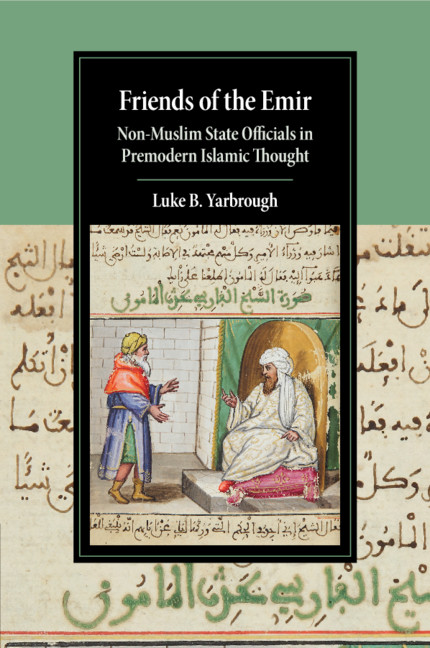
    The caliphs and sultans who once ruled the Muslim world were often assisted by powerful Jewish, Christian, Zoroastrian, and other non-Muslim state officials, whose employment occasioned energetic discussions among Muslim scholars and rulers. This book reveals those discussions for the first time in all their diversity, drawing on unexplored medieval sources in the realms of law, history, poetry, entertaining literature, administration, and polemic. It follows the discourse on non-Muslim officials from its beginnings in the Umayyad empire (661–750), through medieval Iraq, Egypt, Syria, and Spain, to its apex in the Mamluk period (1250–1517). Far from being an intrinsic part of Islam, views about non-Muslim state officials were devised, transmitted, and elaborated at moments of intense competition between Muslim and non-Muslim learned elites. At other times, Muslim rulers employed non-Muslims without eliciting opposition. The particular shape of the Islamic discourse on this issue is comparable to analogous discourses in medieval Europe and China.

    Awards

    Runner-up, 2020 Book Prize, British-Kuwait Friendship Society

    Reviews

    ‘A breakthrough for Middle East history … Few in the field are equipped to perform the meticulous research and incisive analysis on which this book rests. A must-read for anyone interested in Islamic law, the history of the Middle East, and Muslims' relationships to non-Muslims.'

    Marina Rustow - Princeton University, New Jersey

    ‘This book reveals a spectacular mastery of very diverse medieval Arabic primary sources. It explores how and why Muslim rulers for centuries regularly employed non-Muslims in important government positions, despite the frequent disapproval of this practice by many Muslim scholars and men of letters. This is a first-class work of original scholarship.'

    Carole Hillenbrand - University of St Andrews, Scotland

    ‘This richly detailed study illuminates the cultural wars of Islam's past, offering a vivid picture of Islam's value as a symbol of rule in the competition for state offices among Muslims and non-Muslims. It provides indispensable perspective for reflection on the nature of both interreligious relations and state-society relations in Islam.'

    Paul L. Heck - Georgetown University

    ‘Luke B. Yarbrough has written a brilliant, revisionist, diachronic history of the often discussed opposition to the employment of non-Muslims in the pre-modern Islamic state. Upending the assumption that this antagonism was born, in the first instance, of juristic prescription and religious prejudice, Yarbrough effectively demonstrates, that it was not doctrinal discrimination, let alone religious hatred that gave rise to and perpetuated such a discourse. Rather, it was rivalry over the ‘ubiquitous pursuit of resources' that lay behind the cry, expressed in multiple genres of Arabic literature, to oust non-Muslims from their often prominent positions in Islamic government.'

    Mark R. Cohen - Princeton University

    ‘Friends of the Emir is a lucidly written history of pre-modern Muslim attitudes towards the employment of non-Muslims by Muslim rulers. Learned, broad, and nuanced in its approach, Yarbrough's study sees beyond the clichéd dichotomies between ‘historical realities' and ‘legal norms' to provide a historical account as definitive as it is original.'

    Sean Anthony - Ohio State University

    ‘… this is an excellent and long-overdue study of an important aspect of interfaith relations and the evolution of Muslim government and identity, and a book which is comple Nabulusi’s Tajrid mented by Yarborough’s recent edition and translation of Ibn al-Nābulusī’s Tajrīd...Friends of the Emir’s fluid prose and clear argumentation will render it accessible and useful to graduate students and scholars in a variety of fields.'

    Brian A. Catlos Source: Al-Masāq

    ‘This book is … a most important read for anyone interested in Islamic political culture in general, and in the inter faith relationships in premodern Muslim societies in particular.’

    Valerie Gonzalez Source: Journal of the Medieval Mediterranean

    ‘The monograph will be a welcome and important addition to seminars on the intellectual and social history of the Middle East.’

    Kyle Longworth Source: Journal of Near Eastern Studies

    ‘The book’s detailed analysis of individual texts and how they contribute to a larger discourse is exemplary. Yarbrough provides insights into more familiar texts and introduces unfamiliar texts in a way that is helpful for future research. Readers interested in a particular period, place, or genre covered in the book’s scope will likely find additional rewards in specific moments of illumination.’

    Janina Safran Source: Journal of the American Oriental Society

    Refine List

    Actions for selected content:

    Select all | Deselect all
    • View selected items
    • Export citations
    • Download PDF (zip)
    • Save to Kindle
    • Save to Dropbox
    • Save to Google Drive

    Save Search

    You can save your searches here and later view and run them again in "My saved searches".

    Please provide a title, maximum of 40 characters.
    ×

    Contents

    Metrics

    Altmetric attention score

    Full text views

    Total number of HTML views: 0
    Total number of PDF views: 0 *
    Loading metrics...

    Book summary page views

    Total views: 0 *
    Loading metrics...

    * Views captured on Cambridge Core between #date#. This data will be updated every 24 hours.

    Usage data cannot currently be displayed.

    Accessibility standard: Unknown

    Why this information is here

    This section outlines the accessibility features of this content - including support for screen readers, full keyboard navigation and high-contrast display options. This may not be relevant for you.

    Accessibility Information

    Accessibility compliance for the HTML of this book is currently unknown and may be updated in the future.
