
Skip to main content Accessibility help
×

Maintenance update

Due to planned maintenance, between 07:00 - 16:00 (UTC) purchasing will not be available. We apologise for any inconvenience.

  • Cited by 8
    • Show more authors
    • You may already have access via personal or institutional login
    • Select format
    • Publisher:
      Cambridge University Press
      Publication date:
      02 October 2018
      11 October 2018
      ISBN:
      9781108650465
      9781316519585
      9781108460538
      Dimensions:
      (228 x 152 mm)
      Weight & Pages:
      0.58kg, 318 Pages
      Dimensions:
      (229 x 152 mm)
      Weight & Pages:
      0.5kg, 320 Pages
    You may already have access via personal or institutional login
  • Selected: Digital
    Add to cart View cart Buy from Cambridge.org

    Book description

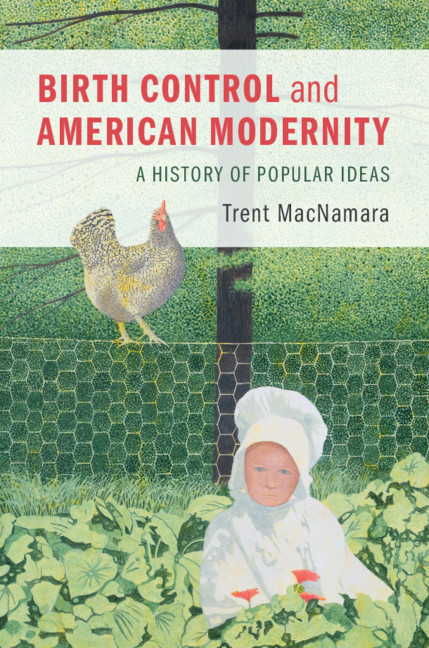
    How did birth control become legitimate in the United States? One kitchen table at a time, contends Trent MacNamara, who charts how Americans reexamined old ideas about money, time, transcendence, nature, and risk when considering approaches to family planning. By the time Margaret Sanger and other activists began campaigning for legal contraception in the 1910s, Americans had been effectively controlling fertility for a century, combining old techniques with explosive new ideas. Birth Control and American Modernity charts those ideas, capturing a movement that relied less on traditional public advocacy than dispersed action of the kind that nullified Prohibition. Acting in bedrooms and gossip corners where formal power was weak and moral feeling strong, Americans of both sexes gradually normalized birth control in private, then in public, as part of a wider prioritization of present material worlds over imagined eternal continuums. The moral edifice they constructed, and similar citizen movements around the world, remains tenuously intact.

    Reviews

    'MacNamara engages meaningfully with scholarship about birth control and demography outside of the United States, and animates this intellectual history with people, stories, and places that we don’t normally associate with the history of ideas or with the history of birth control.'

    Karissa Haugeberg - Tulane University, New Orleans

    'MacNamara has tackled a difficult topic - unpacking public opinion on a topic that wasn’t much discussed in public, and he has skillfully found evidence in a wide variety of sources.'

    Cathy Moran Hajo - Ramapo College, New Jersey

    ‘MacNamara's book goes against the grain of the usual scholarship on the history of birth control: it de-privileges the surface noise - of women’s rights activists, vocal eugenicists or Darwinists, of intellectuals in general - to plumb the half-conscious thoughts of ordinary citizens … MacNamara could hardly have tackled a more contentious subject, but he does so with detached aplomb … Ever so politely, he is attacking several sacred cows of the traditional feminist scholarship.’

    Michele Pridmore-Brown Source: The Times Literary Supplement

    ‘In his novel approach to examining birth control, MacNamara is quite successful in his attempts to bridge the gap between demographic and narrative histories of the topic. He focuses on why Americans chose to adopt methods to control fertility during the first half of the 20th century but also includes considerable information regarding the history of humans’ attempts to prevent pregnancy, dating from antiquity to the present … The book also contains an appendix with detailed information and a bibliography that should be useful to scholars … Recommended.’

    J. M. Benowitz Source: Choice

    Refine List

    Actions for selected content:

    Select all | Deselect all
    • View selected items
    • Export citations
    • Download PDF (zip)
    • Save to Kindle
    • Save to Dropbox
    • Save to Google Drive

    Save Search

    You can save your searches here and later view and run them again in "My saved searches".

    Please provide a title, maximum of 40 characters.
    ×

    Contents

    Metrics

    Altmetric attention score

    Full text views

    Total number of HTML views: 0
    Total number of PDF views: 0 *
    Loading metrics...

    Book summary page views

    Total views: 0 *
    Loading metrics...

    * Views captured on Cambridge Core between #date#. This data will be updated every 24 hours.

    Usage data cannot currently be displayed.

    Accessibility standard: Unknown

    Why this information is here

    This section outlines the accessibility features of this content - including support for screen readers, full keyboard navigation and high-contrast display options. This may not be relevant for you.

    Accessibility Information

    Accessibility compliance for the HTML of this book is currently unknown and may be updated in the future.
