
Skip to main content Accessibility help
×
  • Cited by 5
    • Show more authors
    • You may already have access via personal or institutional login
    • Select format
    • Publisher:
      Cambridge University Press
      Publication date:
      07 March 2020
      12 March 2020
      ISBN:
      9781108654418
      9781108473712
      9781108462488
      Dimensions:
      (247 x 174 mm)
      Weight & Pages:
      0.66kg, 248 Pages
      Dimensions:
      (247 x 174 mm)
      Weight & Pages:
      0.53kg, 248 Pages
    You may already have access via personal or institutional login
  • Selected: Digital
    Add to cart View cart Buy from Cambridge.org

    Book description

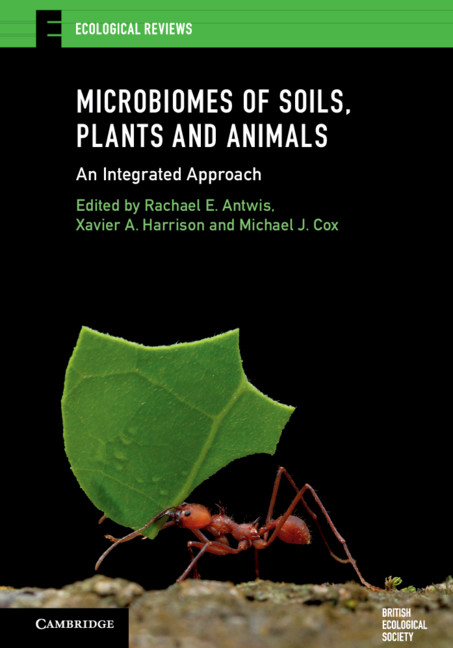
    Through a long history of co-evolution, multicellular organisms form a complex of host cells plus many associated microorganism species. Consisting of algae, bacteria, archaea, fungi, protists and viruses, and collectively referred to as the microbiome, these microorganisms contribute to a range of important functions in their hosts, from nutrition, to behaviour and disease susceptibility. In this book, a diverse and international group of active researchers outline how multicellular organisms have become reliant on their microbiomes to function, and explore this vital interdependence across the breadth of soil, plant, animal and human hosts. They draw parallels and contrasts across hosts in different environments, and discuss how this invisible microbial ecosystem influences everything from the food we eat, to our health, to the correct functioning of ecosystems we depend on. This insightful read also pertinently encourages students and researchers in microbial ecology, ecology, and microbiology to consider how this interdependence may be key to mitigating environmental changes and developing microbial biotechnology to improve life on Earth.

    Reviews

    ‘This book focuses on current research investigations of the microbiomes found in animals, plants, and soils. The authors propose an emerging theoretical framework for investigating the complex interactions between microbiomes and their habitats. They promote advancements for studying microbiomes and microorganisms in situ, or in the natural environment, rather than focusing on classical methods using in vitro studies as conducted in labs. Each chapter reveals the significant roles that microbiomes play in biogeochemical cycling and in homeostatic mechanisms of host organisms and natural environments. Also discussed are the impacts of anthropogenic changes on microbiome interactions. Topics in the book include background information on microbiomes, analytical methods for studying them, a review of microbiome research investigations, and biotechnology applications of microbiome research. Each chapter provides a wealth of primary references. As an added plus, the readability level is appropriate for those lacking an extensive background in science.’

    B. R. Shmaefsky Source: Choice

    ‘It is a solid, approachable introduction to the role of microbiomes in ecology and could serve as a primary reading for a graduate seminar course or for a researcher just entering the field.’

    Jonathan Newman and Newman Lab Group Source: The Quarterly Review of Biology

    Refine List

    Actions for selected content:

    Select all | Deselect all
    • View selected items
    • Export citations
    • Download PDF (zip)
    • Save to Kindle
    • Save to Dropbox
    • Save to Google Drive

    Save Search

    You can save your searches here and later view and run them again in "My saved searches".

    Please provide a title, maximum of 40 characters.
    ×

    Contents

    Metrics

    Altmetric attention score

    Full text views

    Total number of HTML views: 0
    Total number of PDF views: 0 *
    Loading metrics...

    Book summary page views

    Total views: 0 *
    Loading metrics...

    * Views captured on Cambridge Core between #date#. This data will be updated every 24 hours.

    Usage data cannot currently be displayed.

    Accessibility standard: Unknown

    Why this information is here

    This section outlines the accessibility features of this content - including support for screen readers, full keyboard navigation and high-contrast display options. This may not be relevant for you.

    Accessibility Information

    Accessibility compliance for the HTML of this book is currently unknown and may be updated in the future.
