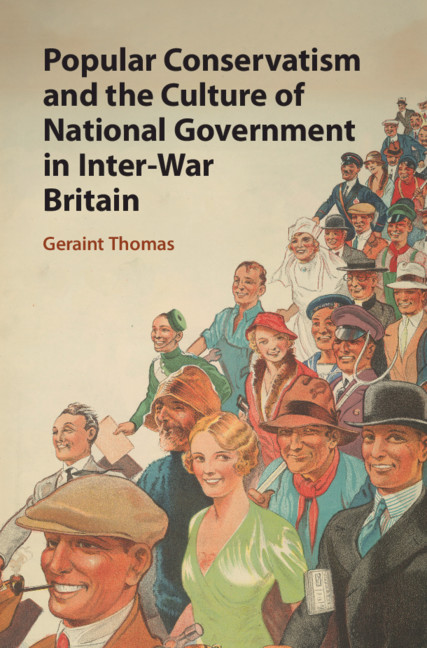

This radical new reading of British Conservatives' fortunes between the wars explores how the party adapted to the challenges of mass democracy after 1918. Geraint Thomas offers a fresh perspective on the relationship between local and national Conservatives' political strategies for electoral survival, which ensured that Conservative activists, despite their suspicion of coalitions, emerged as champions of the cross-party National Government from 1931 to 1940. By analysing the role of local campaigning in the age of mass broadcasting, Thomas re-casts inter-war Conservatism. Popular Conservatism thus emerges less as the didactic product of Stanley Baldwin's consensual public image, and more concerned with the everyday material interests of the electorate. Exploring the contributions of key Conservative figures in the National Government, including Neville Chamberlain, Walter Elliot, Oliver Stanley, and Kingsley Wood, this study reveals how their pursuit of the 'politics of recovery' enabled the Conservatives to foster a culture of programmatic, activist government that would become prevalent in Britain after the Second World War.
‘This deeply-researched study provides important new perspectives on the Conservative Party and the National Governments during the critical decade of the 1930s. It will be essential reading for anyone interested in British history between the two world wars.’
Stuart Ball - University of Leicester
‘Geraint Thomas’s book is a very significant addition to the political history of interwar Britain. Its discussion of the National Government, and particularly the relationship to it of the Conservative Party’s membership, as well as its leaders, convincingly undermines, or substantially modifies, much of the existing historiography of the period.’
Ross McKibbin - University of Oxford
‘… well written, fully referenced and extensively researched … it is a scholarly and valuable contribution to the study of inter-war electoral politics.’
Roland Quinault Source: Cercles
‘Thomas has produced one of the finest and most illuminating books on popular party politics in Britain-not just in England and not just about the Conservative Party-about any period in modern British history …. The book also offers a subtle but powerful wider critique of the tendency among ‘new political historians’ to explore the construction of electoral appeals over their consequences for the state.’
Kit Kowol Source: The American Historical Review
Loading metrics...
* Views captured on Cambridge Core between #date#. This data will be updated every 24 hours.
Usage data cannot currently be displayed.
This section outlines the accessibility features of this content - including support for screen readers, full keyboard navigation and high-contrast display options. This may not be relevant for you.
Accessibility compliance for the HTML of this book is currently unknown and may be updated in the future.
