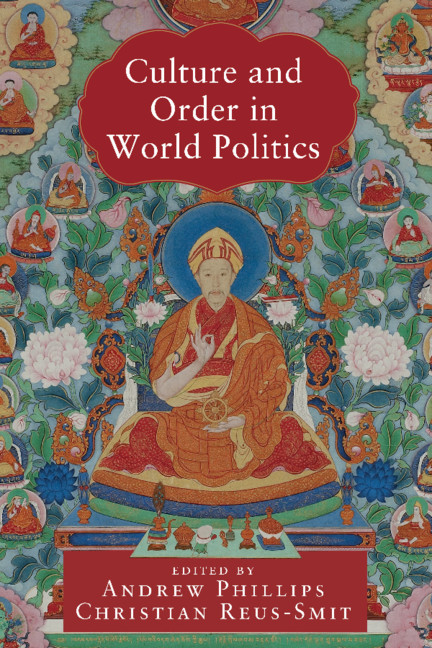

Understanding how cultural diversity relates to international order is an urgent contemporary challenge. Building on ideas first advanced in Reus-Smit's On Cultural Diversity (2018), this groundbreaking book advances a new framework for understanding the nexus between culture and order in world politics. Through a pioneering interdisciplinary collaboration between leading historians, international lawyers, sociologists and international relations scholars, it argues that cultural diversity in social life is ubiquitous rather than exceptional, and demonstrates that the organization of cultural diversity has been inextricably tied to the constitution and legitimation of political authority in diverse international orders, from Warring States China, through early modern Europe and the Ottoman and Qing Empires, to today's global liberal order. It highlights the successive 'diversity regimes' that have been constructed to govern cultural difference since the nineteenth century, traces the exclusions and resistances these projects have engendered and considers contemporary global vulnerabilities and axes of contestation.
Winner, 2020 ISA Theory Section Prize for the Best Edited Book, International Studies Association
Honorable Mention, 2020 ISA History Section Joseph Fletcher Prize for an Edited Volume, International Studies Association
Winner, 2020 Choice Outstanding Academic Title
‘The second volume of a trilogy, this brilliantly conceived and executed book draws on multiple disciplines (sociology, law, history, and political theory) to develop its central argument. Cultural diversity is patterned by diversity regimes (Ottoman, Chinese, Westphalian) and traceable in a large number of variegated domains (such as religion, gender, law, and global cultural heritage). The compelling results are a wake-up call for much IR scholarship. Culture nap time is over.'
Peter J. Katzenstein - Walter S. Carpenter, Jr. Professor of International Studies, Cornell University, New York
‘This volume pulls off a seemingly impossible task: to illuminate the role of culture in international orders without treating ‘culture' as static, homogenous and bounded. Once and for all we can see beyond the clash of civilizations to better apprehend how cultural diversity matters for world politics.'
Julian Go - Boston University, and author of Patterns of Empire
'Culture and Order in World Politics is a path-breaking collection that sets out a novel and interdisciplinary approach for systematically studying culture, and its impact, in global politics. Challenging the past tendency in IR to subscribe to either simplistic or outdated conceptions of culture, the contributors draw on insights from anthropology, sociology, history and cultural studies to demonstrate how different international orders over time have been shaped by cultural difference. The book's historical breadth, which places the much discussed 'liberal international order' in perspective, along with its theoretically-rich treatment of cultural diversity, will make it essential reading for those seeking to grapple with the enduring reality of cultural diversity and its relationship to international order.'
Jennifer Welsh - European University Institute, Italy
‘… Phillips and Reus-Smit (both, international relations, Univ. of Queensland, Australia) offer a pathbreaking collection on international relations. Written by outstanding international relations scholars … This is an absolutely required addition to the literature on international relations.’
S. R. Silverburg Source: Choice
Loading metrics...
* Views captured on Cambridge Core between #date#. This data will be updated every 24 hours.
Usage data cannot currently be displayed.
This section outlines the accessibility features of this content - including support for screen readers, full keyboard navigation and high-contrast display options. This may not be relevant for you.
Accessibility compliance for the HTML of this book is currently unknown and may be updated in the future.
