


15.0 Questions and Answers
(1) Why do you think both linguists and philosophers find implicatures interesting?
We owe the term ‘implicature’ to Paul Grice. He introduced a two-way division within what he called the ‘total signification of an utterance’ between ‘what is said by the sentence’ and ‘what is implied by the speaker’. So, a speaker who says ‘It is a lovely day” produces a sentence which says simply that it is a lovely day but they may thereby imply a further content, such as it is a horrible day (if the speaker is heard as being ironic) due to features of the context in which the sentence is produced. This distinction between the contents of linguistic items per se versus pragmatic, communicated contents is intuitively compelling, and it provides a way in which the project of semantics might seem feasible (as semantics no longer need account for everything a speaker might convey by her utterance), thus it is no surprise that it has been foundational in a vast sweep of theorizing in philosophy and linguistics following Grice.
(2) What recent developments in linguistics and philosophy do you think are most exciting in thinking about implicatures?
Recent work in philosophy of language and linguistics has seriously muddied the waters around implicatures. Whereas once (in Grice’s heyday) it seemed reasonable to think that maybe we could limit the input of contextual features to the content of ‘what is said by a sentence’ to a handful of (fairly well-behaved) processes, like disambiguation and reference assignment, now the situation looks much more murky. I will survey the problems (such as the relativization apparently necessary for taste predicates, the hidden standards for comparative adjectives, and the completion of apparently incomplete expressions like ‘enough’ and ‘ready’) which have so exercised recent theorists.
Moves to introduce kinds of richly pragmatically enhanced but nevertheless semantically relevant contents (Sperber and Wilson’s ‘explicatures’, Bach’s ‘implicitures’, Recanati’s ‘what is said’) provide an exciting recent lens through which to ask what force Grice’s original machinery can still wield in the contemporary debate. I will also consider (and argue against) Lepore and Stone’s recent rejection of the category of ‘implicatures’ and their claim that all pragmatically enhanced content is a question of unruly imagination, suggesting instead that there remains a well-defined place for implicatures (contrasting with explicatures) in our account of communicated content.
(3) What do you consider to be the key ingredients in adequately analyzing implicatures?
Grice gave us a range of now classic examples of the phenomenon he thought of as implicatures – the reference-writer who states just ‘Jones has nice handwriting’ but thereby conveys that Jones lacks philosophical talent, the speaker who tells a stuck driver ‘There is a garage around the corner’ and succeeds in conveying that the garage is open and sells petrol, and so on and so forth. These examples are intuitively compelling and are crucial for understanding what implicatures are supposed to be. However, the intuitive pull of the examples has, I will suggest, served to obscure a problem at the heart of the Gricean account. For it seems that within the account are two features which are able to pull in different directions: Grice’s notion of ‘what is said by a sentence’ (the content which lies in opposition to implicatures) is defined both in terms of the kinds of contextual inputs it allows (limited to disambiguation and reference-fixing) and in terms of its role in the communicative forum (as the content which the speaker directly asserts or conveys). Implicatures, on the other hand then, can be understood either in terms of the amount/kind of pragmatic processing that goes in to their recovery or in terms of the role that content plays (i.e. as indirectly conveyed or communicated). Yet again these two conditions seem able to come apart. It is thus key to correctly analyzing the phenomenon of implicatures that we get clearer on the criterion that we are using to identify or individuate them.
(4) What do you consider to be the outstanding questions pertaining to implicatures?
The most serious question pertaining to the phenomenon of implicatures is whether they should be understood in terms of the sorts of processes involved in generating or recovering a given content or in terms of the role that content plays in a communicative setting. I’ll suggest that improving our grip on these two (potentially conflicting) elements allows us to deliver a much clearer understanding of what implicatures are and what role they should play in theorizing. A further outstanding question (gestured at but left open in the chapter) concerns the role of speaker intentions in determining utterance meaning (see Borg et al 2022).
15.1 Introduction
The term ‘implicature’ is owed to Paul Grice. In a seminal contribution to the philosophy of language and linguistics, Grice took what he called the ‘total signification of an utterance’ (i.e. the complete content someone communicates by producing a linguistic signal) and divided it in two, distinguishing between ‘what the speaker says’, on one hand, and ‘what the speaker implies’, on the other. For instance, imagine a speaker, Hashim, who says “It is a lovely day”: Hashim says simply that it is a lovely day but he may thereby imply a further content, such as it is a horrible day (if he’s being ironic). Or again, take the person who writes just “Smith has lovely handwriting” as a letter of reference for Smith’s application for a philosophy job (Grice Reference Grice1989: 33). The writer produces a sentence which says that Smith has lovely handwriting but they may thereby convey or implicate some further proposition such as Smith is not a very good philosopher.Footnote 1 I will look more closely at how Grice defines ‘implicature’ and the opposing notion of ‘what is said’ below (Section 15.2), but intuitively the distinction between the contents expressed by linguistic items per se (what the speaker says, in Grice’s “favoured sense”) versus pragmatic, communicated contents (what the speaker implies) seems intuitively both clear and compelling. Furthermore, as I’ll argue in Section 15.1, drawing the distinction seems to really matter, as it holds out the promise of rescuing a project we might term ‘formal semantics’ from a plethora of utterly obvious counterexamples. Thus it is no surprise that Grice’s notion of implicature has become foundational in a vast sweep of theorizing in philosophy of language and linguistics.
However, recent developments have served to throw doubt on Grice’s taxonomy for the total signification of an utterance, with both sides of his divide coming under fire. So some have questioned the existence of implicatures (Lepore & Stone Reference Lepore and Stone2014), while others have questioned how he individuated his category of ‘what is said’ (e.g. Sperber & Wilson Reference Sperber and Wilson1986, Recanati Reference Recanati2004, amongst many others). These challenges to Grice’s framework will be examined in Section 15.3. However, I will argue that, on closer inspection, the recent developments canvassed do not serve to show that Grice’s notion of implicature is ill-founded, nor that his “favoured sense” of what is said is unnecessary. What they do serve to highlight is a peculiar tension in Grice’s original account. For it seems that Grice merged two distinct features when defining what the speaker says versus what the speaker implicates: the idea of a content dictated by word meaning and structure alone, on the one hand, versus the idea of an asserted or directly expressed proposition on the other. What the challenges to Grice’s framework reveal is that these features can and often do come apart. Yet once we resolve this tension, I’ll suggest, it is possible to deliver an account of the total signification of an utterance which is both (fairly) faithful to Grice’s original account and which is able to do a great deal of explanatory work.
15.2 The Role of Grice’s Theory of Implicatures
One of the reasons Grice’s notion of implicatures has seemed so important to philosophers and linguists, I suggest, is because it holds out the promise of rescuing an attractive but prima facie doomed project in theorizing about linguistic meaning. According to this project, which we might label ‘formal semantics’, a core explanatory datum for a theory of meaning is the fact that ordinary speakers can produce an apparently indefinite number of novel sentences. Furthermore, hearers are commonly able to grasp the meaning of novel sentences – i.e. those they have never heard before – with ease (provided they know the meaning of the words and are familiar with the grammatical structure involved). And speakers and hearers can do these things even though the cognitive resources they are able to dedicate to linguistic understanding are constrained. From this perspective, then, a key explanatory task for a theory of meaning is to show how an indefinitely productive capacity can rest on a finite knowledge base.Footnote 2 The answer formal semantics gives is that sentence meaning is strictly compositional, i.e. that the meaning of a complex linguistic whole is a product just of the meanings of the parts of the whole (e.g. the words it contains) and the way those parts are put together. If language is compositional then the indefinite nature of linguistic understanding is explained because our productive capacity is based on knowing only a limited set of lexical items and a limited set of rules for putting those items together. For instance, someone who knows the meanings of “horse,” “cow,” “brown,” “white,” and the relational term “_is bigger than_” will (normally) be able to generate all the following sentences with ease:
(1) The horse is bigger than the cow.
(2) The cow is bigger than the horse.
(3) The white horse is bigger than the cow.
(4) The brown horse is bigger than the cow.
(5) The horse is bigger than the white cow.
(6) The horse is bigger than the brown cow.
(7) The white horse is bigger than the brown cow.
(8) The brown horse is bigger than the white cow.
(9) The white cow is bigger than the brown horse.
(10) The brown cow is bigger than the white horse.
From a limited knowledge base of just five lexical items, then, the subject’s linguistic understanding projects out to a much larger number of sentences. Compositionality thus explains what is sometimes called the ‘productivity’ and ‘systematicity’ of natural language understanding.
However, the obvious challenge to any such formal semantics programme is that we cannot predict linguistically communicated content just on the basis of words and structure alone – linguistically communicated content is not compositional in the required way. To see this, take the classic case from Grice (Reference Grice1989: 32), where a driver (A) says to a passerby (B) “I am out of petrol” and B replies “There is a garage around the corner.” As Grice suggests, what B communicates in this context is that the garage is open, sells petrol, etc. Yet this isn’t content that we can get just by paying attention to the words B says and the way those words are put together. Or again, consider an utterance of “Someone ate the last cookie” (which in the right context can communicate that Hardeep ate the last oatmeal cookie from the jar) or “Students can take logic or maths” (which in some contexts might convey that they can take one or the other or both, but in other contexts that they can take one or the other but not both). In each case communicated content seems to outstrip compositional, lexico-syntactic content. This recognition – that what we communicate by what we say is often much more than our words strictly and literally mean – seems to throw the entire project of formal semantics into chaos, undermining the very idea of predicting the meaning of complex wholes simply in terms of the meaning and structure of parts.
It is at this point, then, that Grice’s model of communication comes to the rescue by showing that a semantic theory need not provide a treatment of all the content communicated by a speaker. Instead we could maintain that there is a difference between what a sentence itself says (the sort of content that a semantic theory might be able to capture) and what a speaker implies by uttering the sentence, where the latter is a pragmatically conveyed, indirectly communicated bit of content. This noncompositional implied content is nevertheless, according to Grice, something we can theorize about, recognizing the underlying principles which give rise to it.
15.3 Grice’s Theory of Implicatures
Grice divides up the ‘total signification of an utterance’ (what I’ll label ‘utterance meaning’) as shown in Figure 15.1.Footnote 3
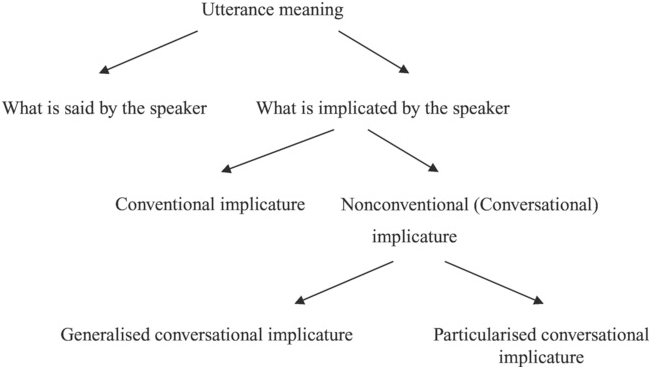
Figure 15.1 Grice’s account of the elements of utterance meaning
Focusing first on the notion of ‘what is said by the speaker’, Grice states that he is using the term in a “special, favoured sense” (Reference Grice1989: 25), whereby this kind of content is fixed by the conventional meaning of the words a sentence contains together with certain, limited pragmatic processes (namely disambiguation and reference assignment). So, for instance, to get at what is said by the speaker who utters “He was in the grip of a vice” we need to know both the meaning of the words and sentence structure, and certain facts from the context of utterance, namely the referent of “he” and the disambiguation of “vice” (meaning moral failing or piece of machinery). Grice gives us, then, what I’ll sometimes term below a ‘structural’ or ‘process-based’ definition of ‘what is said’, in terms of the degree of isomorphism between the formal elements of the sentence (e.g. the words) and the elements of the proposition delivered, or in terms of the kinds of processes required for getting at the content (lexico-syntactic interpretation plus disambiguation and reference assignment). Although Grice himself didn’t use the terms ‘semantics’ and ‘pragmatics’ it has become extremely common to identify ‘what is said by the speaker’ with semantic content, and ‘what is implied’ with pragmatic content.
The second element of utterance meaning – implicatures – give us the content that a speaker contributes to the conversation in a more indirect fashion, implying rather than stating. As we can see from the above diagram, Gricean implicatures come in a variety of different kinds, individuated by the degree to which they depend on particular features of the context of utterance. ‘Conventional implicatures’ are carried by conventional features relating to the meaning of the expressions the speaker chooses to use. For instance, an utterance of “She was poor but honest” implies that the speaker thinks there is some kind of contrast or tension between being poor and being honest, but it does so simply via the choice of the expression – ‘but’ rather than ‘and’ – instead of via more fine-grained contextual features.Footnote 4 ‘Nonconventional’ or ‘conversational implicatures’, on the other hand, depend more closely on the context in which an utterance is made. Generalized conversational implicatures are ones that would typically or normally arise given the utterance of a certain form of words in the given context. For instance, consider the so-called ‘scalar implicature’ from “Some of Year 8 ate cookies” to Not all of Year 8 ate cookies. It seems there is a scale of strength of expression which runs [one – some – all] and, in this context, selection by the speaker of a weaker item on the scale allows the hearer to infer the negation of the stronger item – not (all) – as implied by the speaker (see Horn Reference Horn1972). Finally, particularized conversational implicatures, like the move from “Someone ate the cookies” to Hardeep ate the cookies, depend intrinsically on quite specific features of the one-off utterance situation.
In addition to distinguishing these different categories of implicature, Grice also provided a mechanism for the recovery of conversational implicatures, in terms of what he called ‘calculability’ (Grice Reference Grice1989: 30–31). A conversational implicature should be capable of being worked out by a hearer using the following kind of schema:Footnote 5
A speaker S conversationally implicates that q by saying that p only if:
(i) S is presumed to be following the general principles of good communication (what Grice termed the ‘conversational maxims’, the most general of which is the assumption that speakers are being cooperative);
(ii) the supposition that S is aware that (or thinks that) q is required to make S’s saying or making as if to say p consistent with this presumption;
(iii) the speaker thinks (and would expect the hearer to think that the speaker thinks) that it is within the competence of the hearer to work out, or grasp intuitively, that the supposition mentioned in (ii) is required.
So, returning to the Gricean garage example above, if we just take B’s utterance ‘on face value’ (i.e. as communicating only the content that there is a garage around the corner) then their utterance seems to be irrelevant to A’s prior statement. That is to say, taking B as communicating only this piece of content would entail viewing B as flouting one of Grice’s general conversational maxims (in this case: Be Relevant). However, there is a further bit of content naturally available – that the petrol station is open (call this content ‘q’) – which would make B’s contribution conversationally cooperative. The content given in q thus counts as an implicature because: the supposition that B thinks that q is required if B is to be seen as abiding by the conversational maxims; furthermore B hasn’t stopped A thinking that q; so B has implicated that q.Footnote 6 This chain of reasoning shows that the implicature is calculable.Footnote 7
As well as the requirement for calculability, Grice provided two further tests for deciding whether a given bit of communicated content counts as a conversational implicature, as follows:
(i) Nondetachability: if we keep the context and the content fixed, we must get the implicature, as Grice says (Reference Grice1989: 58), “it is not possible to find another way of saying the same thing, which simply lacks the implicature in question.” So, in our above example, if, in response to A’s utterance, B had said “There’s a gas station around the corner” or “There’s a petrol station just past the bend,” the implicature that the station is open would remain.
(ii) Cancellability: conversational implicatures can be retracted without contradiction. Grice (Reference Grice1989: 58) notes two different types of cancellation: explicit vs. contextual. Explicit cancellation involves “the addition of a clause that states or implies that the speaker has opted out,” whereas contextual cancellation occurs where the “context…makes it clear that the speaker is opting out”. So, for instance, a speaker can add “but not p” or “I don’t mean to imply p” (explicitly retracting a content that might otherwise be implied). Or we can find contexts in which the utterance of this form of words does not carry the implicature; for instance if B says “There is a garage around the corner” in response to the question “What facilities does this village have?”, B’s utterance may fail to imply that the garage is open.
While these three tests (calculability, nondetachability, cancellability) certainly serve to flesh out our intuitive grip on what counts as a conversational implicature, it seems they do not provide necessary and sufficient conditions for identifying where a given bit of communicated content sits within Grice’s overall taxonomy (i.e. whether some bit of communicated content counts as what is said, versus what is conventionally implied, versus what is conversationally implied).Footnote 8 I will look briefly at failures of necessity in this section, before focusing on failures of sufficiency in the next section (Section 15.3).
First, we should be clear that Grice did not expect his tests to draw the divide between ‘what is said’ and ‘what is implicated’ in general because he explicitly notes that the tests are not passed by conventional implicatures. For instance, the move from “She was poor but honest” to the implicature that the speaker thinks there is some contrast between being poor and being honest is neither calculable nor nondetachable. I don’t need to see the speaker as flouting some principle of good communication to know that I’m entitled to derive the implicature that there is a contrast between being poor and being honest (that is to say, the implicature is not calculable) and if the speaker uses a different way of saying the same thing (such as uttering “She was poor and honest”) the implicature disappears (conventional implicatures are thus detachable). At most, then, Grice’s tests might serve to hold apart ‘what is said by the speaker’ from ‘what is conversationally implicated’. However, it might turn out that this worry is in fact somewhat moot since some theorists have argued that the category of conventional implicature itself is problematic. So, Bach Reference Bach1999 argues that conventional implicatures simply don’t exist, while Potts Reference Potts2005 argues that they exist but require a very different treatment to the one Grice envisaged. Thus it may turn out that concentrating our attention just on the divide between ‘what is said’ and ‘what is conversationally implied’ is warranted.
Yet, even if we do narrow our focus in this way, questions about the necessity of the tests remain. For a start, as Grice himself acknowledged, manner implicatures (which depend on the way in which a given content is expressed) clearly fail the test of nondetachability. The speaker who says “Miss X produced a series of sounds that corresponded closely with the score of ‘Home Sweet Home’” implicates something they would not have done if they had instead uttered “Miss X sang ‘Home Sweet Home,’” despite the fact that the latter sentence appears to be just ‘another way of saying the same thing’ (Grice Reference Grice1989: 37). Thus Grice himself explicitly excludes manner cases from the detachability test (Reference Grice1989: 58, emphasis added): “[I]nsofar as the manner of expression plays no role in the calculation, it will not be possible to find another way of saying the same thing, which simply lacks the implicature in question.”
So, something can be a conversational implicature but fail the nondetachability test.Footnote 9 Questions have also been raised about Grice’s cancellability test. For instance, it has been argued that some conversational implicatures based on Grice’s maxim of Quantity (which commands speakers to be as informative as required) cannot be easily cancelled. As noted above, many Quantity implicatures rely on the existence of a background scale (like the implicature from “some children ate cookies” to not all children ate cookies) and these cases standardly seem easy to cancel – saying “Some of the children ate cookies, in fact all of them did” is potentially conversationally odd, but the speaker doesn’t directly contradict themselves. However, things seem less clear with nonscalar Quantity implicatures (see Rett Reference Rett2020 for discussion). For instance, consider:
John met a woman at the bar last night.
War is war.
Example (11) implicates, via a flouting of the Quantity maxim, that the woman John met was not one he had a pre-existing relationship with. The tautology in (12) implicates that war has a number of canonical properties that cannot be avoided. In these cases (as Hirschberg Reference Hirschberg1991 and Rett Reference Rett2020 point out) cancellation seems less acceptable than in the scalar case:
John met a woman at the bar last night…#although actually he met a woman he knows well.
War is war…#in fact, there is nothing stereotypical about war.
Rett Reference Rett2020 goes on to argue that whether a conversational implicature is cancellable or not depends on further features of the conversational context, with implicature content which is crucial to the conversation (roughly, what is known as ‘at-issue content’) failing cancellation tests, while not-at-issue implicature content is cancelleable.Footnote 10 Yet this is to recognize that, at least as it stands, cancellability alone is not a good candidate for a necessary feature of all conversational implicatures.
Finally, a further challenge to the claim that all conversational implicatures are cancellable comes from content which is also entailed by the semantic content of the sentence produced. For instance, take the following exchange:
A: Does John drink slivovitz?
B: He doesn’t drink any alcohol.
B’s utterance seems to both entail and imply that John does not drink slivovitz (Sperber & Wilson Reference Sperber and Wilson1986: 61; Carston Reference Carston2002: 139), yet as an entailment this is content which is not cancellable (see Haugh Reference Haugh, Capone, Lo Piparo and Carapezza2013 for further discussion). Although these kinds of cases are not universally accepted, they do once again raise a question about whether cancellation without contradiction marks a universal feature of all conversational implicatures. Of course, the brief discussion of this section doesn’t suffice to show that there are no necessary features had by all conversational implicatures, for it may be that Grice’s original three tests could be refined or reinforced in some way to yield necessary tests.Footnote 11 However, I want to leave this question to one side now and turn instead to the question of whether Grice’s tests are sufficient – that is to say, if some piece of communicated content passes the three tests is that sufficient for us to conclude that the content in question is a conversational implicature? For recent work appears to show that (whether they are necessary or not) Grice’s tests are far from sufficient for identifying implicatures. To see this, let’s turn to examine recent developments at the semantics/pragmatics border and see what these can tell us about how we should characterize implicatures.
15.4 Explicatures vs. Implicatures
Recent work in philosophy of language and linguistics has seriously muddied the waters around implicatures. Whereas once (in Grice’s heyday) it might have seemed reasonable to think that we could limit the input of contextual features to the content of ‘what is said by a speaker’ to a small handful of (fairly well-behaved) processes (i.e. disambiguation and reference assignment), now the situation looks decidedly more murky. To see this, consider the following kinds of cases (where the material after the arrow indicates what a speaker might communicate in a given context, while the underlined part indicates content that does not appear to be contributed by any element contained in the uttered sentence):
“Jill is tall” ➔ Jill is tall for a jockey.
“Everyone came to the party” ➔ everyone in Year 4 came to Samira’s birthday party on Saturday.
“Steel is strong enough” ➔ steel is strong enough to support cars on the bridge.
“Bill got married and had children” ➔ Bill got married and then had children.Footnote 12
“It’s three o’clock” ➔ it’s roughly three o’clock.
“I’ve got money” ➔ I’ve got enough money to pay for the contextually relevant thing.
These kinds of cases (respectively: (15) comparative adjectives, (16) quantifier restriction and incomplete definite descriptions, (17) incomplete expressions, (18) bridging inferences, and (19), (20) loose talk), amongst others, have recently been at the center of discussions in philosophy about how and where to draw the boundary between semantics and pragmatics. What makes all these kinds of cases so interesting is that they appear to be examples of a speaker directly communicating something by their utterance (so content which ought to line up with ‘what is said by the speaker’ in Grice’s framework) which outstrips the content that can be recovered just by appeal to the constituents of the sentence, together with disambiguation and reference assignment (so which ought to count as implicature content given Grice’s structural definition of what is said by the speaker).Footnote 13 In the right context of utterance, the first content hearers’ will recover from an utterance of “Jill is tall” or “Bill got married and had children” seems to be Jill is tall for a jockey or Bill got married and then had children. The explicitness of these further contents – the fact that they seem to capture what the speaker is directly committed to – seems to be in marked contrast to the indirectness of paradigm implicatures, such as the handwriting case with which this chapter opened. What we have in cases like (15)–(20), it has been argued, are thus examples of semantic underdetermination: the semantic content of the sentence (i.e. what is said by the speaker) cannot be compositionally determined on the basis of the meanings of the parts of the sentence and their mode of composition, but this runs counter to Grice’s original way of dividing up the total signification of an utterance.
Roughly speaking, there are three main arguments given for the existence of semantic underdetermination (see Borg Reference Borg, Preyer and Peter2007):Footnote 14
‘Context-shifting cases’ (stressed in Travis Reference Travis1996, Reference Travis, Hale and Wright1997) where utterances of the very same (apparently nonindexical) sentence type intuitively shift in truth value across contexts, even though the relevant feature of the context remains unchanged. So, for instance, in Travis’s famous example (Travis Reference Travis, Hale and Wright1997: 89), we are asked to consider an utterance by Pia of “These leaves are green,” said of some naturally red leaves which have been painted green. If Pia’s utterance is made in response to an artist who is looking for something green to add to her composition, it seems Pia intuitively says something true, but if her utterance is made to a scientist who is looking for leaves for an experiment on photosynthesis, what Pia says seems intuitively false. Yet this apparent change in truth value occurs even though nothing alters with the leaves themselves. This is taken to show that, contrary to initial appearances, something about the meaning of “these leaves are green” must be context-sensitive (and as for this sentence, so for many/most/all other sentences).
‘Inappropriateness cases’: in very many contexts, the compositionally derived content will not be appropriate and the speaker should thus be taken to be asserting some contextually enriched content; e.g. the speaker who says “I’ve eaten” standardly conveys something like I’ve eaten recently, instead of the much weaker compositionally derived content which simply requires that the speaker has eaten at some point in the past.
‘Incompleteness cases’ seem to demonstrate that some well-formed sentences fail to express complete propositions without contextual enrichment. So “Jill is ready” or “Steel is strong enough,” although grammatically well-formed, seem to require contextual completion before they can be evaluated for truth or falsity, but (at least arguably) nothing in the lexico-syntactic elements of these sentences marks this context-sensitivity.
The pragmatically enriched contents (i.e. the contents on the right-hand side of (15)–(20)) are often labeled explicature contents (following the terminology of Sperber & Wilson Reference Sperber and Wilson1986). Explicature content is directly conveyed but pragmatically enriched content; that is to say, content which captures what is said or asserted but which is enriched by features contributed by robust contextual reasoning, rather than being dictated by compositional linguistic content alone. Importantly, explicature contents seem to pass Grice’s three tests above. The content seems generally nondetachable (saying “Steel is sufficiently strong” or “Bill got married and had kids” would convey the same richer explicature content as conveyed by (17) and (18)), and the content is also cancellable – the speaker can retract apparently without contradiction (e.g. continuing (18) with “although not in that order”). Furthermore, at least in Sperber and Wilson’s Reference Sperber and Wilson1986 ‘Relevance Theory’ model, explicatures are clearly calculable. According to this model, explicature content is recovered through the operation of the Maxim of Relevance, with the content on the right-hand side of (15)–(20) being (in the right context) the most relevant content the hearer can recover (for reasonable processing costs). It is this which gives the contents their status (in the right context) as ‘what the speaker says’.Footnote 15
Yet despite passing these tests, explicatures seem to be directly expressed content, rather than being indirectly conveyed implicatures. The speaker who utters “Bill got married and had children” will, in most contexts, be heard as asserting, not merely implying, that Bill got married and then had children. If this is right, it shows that Grice’s tests for conversational implicatures are not sufficient – there are contents which pass the tests yet which we do not want to count as indirectly conveyed implicatures. The framework of utterance meaning inherited from Grice then – of a binary divide between, on the one hand, ‘what is said’ content which is recoverable on the basis of words and structure alone and, on the other, implicated content which is the result of rich contextual processing – seems fatally flawed in light of cases like (15)–(20), for many contents which intuitively constitute ‘what is said by the speaker’ turn out to require rich contextual reasoning to recover.
Once we recognize this problem, there seem to be two possible options. On the one hand, we might take cases like (15)–(20) as simply fatal for Grice’s framework, showing that his way of carving up the total significance of an utterance cannot be maintained. As part of this kind of move we might decide to simply reject his category of implicature as itself ill-formed and explanatorily/theoretically empty. This move – what we might term ‘implicature eliminativism’ – has been suggested by Lepore and Stone Reference Lepore and Stone2014. As they write (Reference Lepore and Stone2014: 6) “Put most starkly: we have no use for a category of conversational implicatures, as traditionally and currently understood.” They deny the theoretical value of positing a distinct category of ‘implicatures’ since (they argue) any such label fails to pick out a unified, homogenous category. For Lepore and Stone the fundamental divide in a linguistic communicative act comes between ‘convention-based contributions to the conversational record’ and ‘imaginative, open-ended invitations to explore content’, which do not contribute to the conversational record (Lepore & Stone Reference Lepore and Stone2014: 242). The former kinds of contribution qualify as genuinely semantic content, while the latter kind of personal explorations qualify as individualistic imaginative endeavors, yielding at best indirectly conveyed contents. Lepore and Stone’s objection to implicatures then is that the kinds of cases Grice used to motivate his category cross-cut this divide. So, some ‘implicatures’ (such as scalar cases, indirect requests, and bridging inferences) qualify as convention-based contributions to the conversational record and hence qualify as genuinely semantic content. While others (e.g. metaphor, irony, sarcasm) qualify as open-ended invitations to engage with what the speaker says (with no determinate proposition to be added to the conversational record). Thus, for Lepore and Stone, ‘implicatures’ as Grice conceived them span across the semantic/pragmatic divide. Since no unified treatment could accommodate such a disparate set of cases, they conclude that Grice’s category of ‘conversational implicatures’ should be eliminated as theoretically unhelpful.
While Lepore and Stone’s approach is clearly radical and worth fuller consideration than I can give here, we might note that there are some prima facie worries with the model they provide. First (as other theorists have noted, e.g. Szabó Reference Szabó2016; Stainton & Viger Reference Stainton, Viger and Preyer2018), Lepore and Stone don’t provide a particularly robust account of ‘convention’ or what has to be in place for content to be ‘fixed by convention’. Yet this lacuna apparently leaves them open to the challenge that there are plenty of linguistic expressions that have a conventional usage but which fail to express a semantic content that hearers should add to the conversational record. For instance, as Stainton and Viger Reference Stainton, Viger and Preyer2018 note, the rule attaching to the term “gesundheit” is something like “used as a conventional response when someone sneezes,” but the fact that the term has a clear conventional use does not entail that it contributes a determinate semantic content. Being a linguistic expression associated with a clear linguistic convention is not sufficient, it seems, to guarantee a semantic contribution.
Second, and more problematic, is the fact that there are also nonconventional, imagination-based expressions which it seems must be allowed to make a contribution to the conversational record. The conversational record is supposed to keep track of linguistically relevant moves, in order to help a speaker to decide on an appropriate conversational contribution at any given point. Yet it is clear that, in order to decide what to say at any point in a conversation, one needs to know about pragmatic content just as much as (perhaps even more than) semantic content. I won’t be able to contribute appropriately to a conversation where I’ve heard you say “Moeen is a fine friend” if I fail to realize you’ve spoken ironically, or if I don’t realize when you say “Jill is ready” that you’ve said she is ready for her exam. Planning one’s next conversational move depends fundamentally, it seems, on a grasp of metaphorical content, irony, loose talk, and so on (Green Reference Green and Preyer2018). If all of these kinds of contents are placed ‘off record’, as Lepore and Stone seem to envisage, then hearers will need to run a second, more liberal kind of conversational record, one which tracks both kinds of linguistically conveyed content, alongside the one that tracks only conventional, semantic contributions. Yet this seems to multiply conversational records (and cognitive load) unnecessarily.Footnote 16
So, instead of eliminating the category of implicatures and entirely scrapping Grice’s framework for dividing up utterance meaning, let’s turn to a second, very widely endorsed response to cases like (15)–(20). On this approach the lesson to be drawn from the problematic cases is that we should refine Grice’s bipartite model, replacing it with a tripartite divide which recognizes:
(i) standing sentence meaning (exhausted by lexico-syntactic features but often/always subpropositional content).
(ii) directly asserted, pragmatically enhanced propositional content – what the speaker says (what I’ll term, following Sperber & Wilson Reference Sperber and Wilson1986, ‘explicature content’).
(iii) indirectly conveyed content – what the speaker implies.
This three-way divide gives us the general shape of what have come to be known as ‘Contextualist’ models.Footnote 17 According to this school of thought, what a speaker says (i.e. the content which captures what the speaker directly expresses or asserts) is shot through with rich pragmatic effects. Grice’s notion of what is said by a speaker, if this is to be propositional/truth-evaluable, asserted content, cannot, Contextualists argue, be content that is recovered on the basis of just a small subset of well-behaved contextual processes (like disambiguation and reference assignment), rather the full panoply of pragmatics (as partially illustrated by (15)–(20)) must be allowed to enter.
Cases like (15)–(20) provide a valuable lens through which to ask what (if any) force Grice’s original machinery can still wield in the contemporary debate. However, I want to suggest that, in answering this question, we need to be careful about exactly what lessons we draw from them. For what these kinds of cases show, I contend, is not that the Gricean assumption about what is said – namely, that there is a useful and important notion of linguistic content which cleaves very tightly to lexico-syntactic content – is wrong. Rather what they show is that the move (somewhat tacitly made in Grice and more explicitly made post-Grice) to identify semantic content with what is said by a speaker is a mistake. To see this, however, we need to take something of a detour through the Contextualist picture of a semantic theory infiltrated throughout by rich pragmatic processing, asking how this approach distinguishes explicatures from implicatures. The question we need to ask, for any contextually given piece of content, is whether it contributes to what is said or asserted (explicature content) or to what is indirectly conveyed (implicature content)? This has proved a notoriously difficult question for Contextualists to answer and I will argue that the only plausible answer to be given serves to reveal the need for propositions determined on the basis of lexico-syntactic properties (together with disambiguation and reference assignment) alone (that is to say, it shows that we do need contents which answer to Grice’s structural definition of ‘what is said by a speaker’).
Testing for Implicatures vs. Explicatures
The question we face is how to individuate explicature content from implicature content – if someone says “Naoki took out his key and opened the door” what makes the content Naoki took out his key and opened the door with his key the proposition expressed or asserted, as opposed to being a content merely implied? Or again, in our above example, should we treat the content that there is an open garage around the corner as part of the explicature – what the speaker directly conveys – or as part of an implicature (as Grice himself thought)? A range of tests have been proposed to answer this crucial question, including formal constraints and what I would term ‘processing accounts’, however as I’ve argued elsewhere (Borg Reference Borg2016), none of these tests seem able to draw the explicature/implicature divide at the place where we intuitively want it. To see this, let’s turn now to look very briefly at some of these proposals.
According to Sperber and Wilson’s canonical account (Reference Sperber and Wilson1986: 182), an explicature is a “pragmatic development of the logical form” of the sentence produced. Thus, we might think to define implicatures negatively, simply as contextually derived contents that are not mere developments of extant logical form. So, for instance, we might think that (21a) counts as an explicature of (21), while (21b) could only be an implicature:
Every bottle is empty.
Every bottle in the fridge is empty.
You should go to the liquor store before the party starts.
While this proposal has intuitive force and prima facie seems to deliver the results we want (e.g. making the right ruling for (21)), it does face difficulties. For instance, consider (21c):
Every bottle is empty and so you should go to the store.
Here it seems we have ‘developed’ the original logical form, via conjunction introduction; so should we count (21c) as potential explicature content or only a potential implicature? To decide how to answer this question it seems that we either need a fuller account of ‘development’ or we need some additional test we can apply to developed logical forms to decide if they constitute explicatures or implicatures. Proposals have been made along both these lines. For instance, Carston and Hall (Reference Carston, Hall and Schmid2012) have suggested that any ‘nonlocal’ development, where this means allowing pragmatic processes to modulate a whole proposition rather than a part, must count as implicature content. This kind of ‘locality constraint’ seems to do the work required in ruling (21c) as an implicature rather than an explicature, but it too runs into difficult cases. For instance, consider (21d):
Every bottle in the fridge is empty to a degree that is going to require you to go to the store before the party starts.
This is arguably a local development, yet it captures content that above we thought intuitively would only constitute an implicature not an explicature of (21).
Alternatively, then, we might turn to other features to mark the difference here. For instance, both Carston Reference Carston2002 and Recanati Reference Recanati2004 have appealed to the ‘scope test’, requiring explicature content to fall within the scope of operators such as conditionals and negation, while implicature content can fall outside. However, as Carston herself notes, such a test seems problematic. First, because it seems to draw the line in intuitively the wrong place, for instance counting the content generated by sarcastic utterances as explicature content. Thus, as Camp Reference Camp2006 has stressed, if I say “If you have one more great idea like that you’ll be sacked” the sarcastic content – that your ideas are not great – seems to be part of the overall truth conditions of what I say (falling within the scope of operators).Footnote 18 Yet intuitively such sarcastic content is not something I assert directly but instead has a much more indirect, implicature-like feel. Furthermore, scope tests (and others like it) seem to operate at the wrong level for individuating explicatures from implicatures. For scope tests operate at the sentence level, targeting type sentences, while at least particularized conversational implicatures are most certainly properties of token utterances.
Finally, then, we might think to look to the realm of psychological processing to do the work required instead. So Sperber and Wilson Reference Sperber and Wilson1986 suggested that the only way to individuate explicatures from implicatures is to use their general relevance framework, whereby propositions that are highly relevant for a hearer (which they define as having high cognitive effects for low processing costs) will constitute explicature content, while less relevant content will count as implicatures. Recanati Reference Recanati2004 also defined explicature content (what he calls ‘what is said’) in psychological terms, as the first full proposition available to a hearer on processing a given utterance, with all implicatures requiring further inferential work from this first available content (see Footnote n. 14 above). However, it is not at all clear that turning to psychological criteria will draw the division in the place we want either. For, on the one hand, content classed as classic Gricean implicatures and which definitely seems to be in some way indirectly conveyed (e.g. communicating Jones is not a good philosopher by saying “Jones has nice handwriting”) might nevertheless constitute the most relevant content for the hearer. While, on the other hand, as Grice himself stressed it seems that sometimes an implicature can be ‘intuitively grasped’, that is grasped without entering into a complex psychological derivational procedure. As Grice writes (Reference Grice1989: 31, my emphasis):
The presence of a conversational implicature must be capable of being worked out; for even if it can in fact be intuitively grasped, unless the intuition is replaceable by an argument, the implicature (if present at all) will not count as a conversational implicature; it will be a conventional implicature.
This seems to suggest that Grice himself allowed that sometimes an implicature may be the first recovered content a hearer entertains (which would, contra intuition, make it count as an explicature according to the current suggested definition). For reasons of space, I won’t explore the apparent problems with each of the extant criteria for holding apart explicatures and implicatures any further (see Borg Reference Borg2016 for further discussion), for instead I want to turn at this juncture to what I take to be the only plausible candidate for individuating explicatures from implicatures, namely socio-linguistic features.
15.5 Using Socio-Linguistic Notions to Distinguish Elements of Utterance Content
As I’ve argued elsewhere (Borg Reference Borg2017), I think we should move towards an understanding of the explicature/implicature divide which locates the difference in the socio-linguistic realm, arising from the relation of language to social norms and cultural expectations. On this approach, a socio-linguistic implicature is an element of communicated content that a speaker is not held strongly conversationally liable for, whereas explicature content is communicated content that a speaker is judged strongly conversationally liable for. Conversational liability I take to be a matter of degree, where a speaker can be held more or less responsible for communicating a given piece of content and where it is commensurably more difficult or more easy for the speaker to retract or reject the content in question as forming part of what she is committed to by her utterance. As with the Contextualist model above then, I want to agree that some richly pragmatically enhanced contents count as directly asserted (so constitute part of Grice’s notion of ‘what is said by the speaker’ when this notion is defined in terms of directly asserted, rather than indirectly conveyed, content), while other such contents count only as indirectly conveyed implicatures. A speaker who says (in the right context) “Bill got married and had children” may well succeed in asserting that Bill got married and then had children, or someone who says “Jill is ready” may assert that Jill is ready to bowl, even though these asserted contents outstrip what we can recover on the basis of lexico-syntactic constituents alone. These contents will count as asserted, I suggest, just in case the speaker is held strongly conversationally liable for them by ordinary interlocutors, i.e. if speakers cannot, or find it extremely hard, to retract or reject them as forming part of what they said.Footnote 19 It is notions of responsibility and liability then that give us the divide Contextualists want between explicature and implicature content.
However, I suggest that once we turn to the socio-linguistic realm to distinguish these kinds of contents, what we also find is that there is an ineliminable role for propositional contents which are fixed just by word meaning, sentence structure, disambiguation and reference determination (i.e. contents which map to Grice’s notion of ‘what is said by the speaker’ when this is defined in structural terms). That is to say, if we allow that socio-linguistic factors (to do with the degree of responsibility a speaker is held to have for a given communicated content) provide the most plausible ground for distinguishing between explicature and implicature content, then we cannot avoid also positing a notion of minimal content that tracks Grice’s structural version of ‘what is said by the speaker’. If this is right, it yields a slight tweak on the three-way divide within the total signification of an utterance provided by the Contextualist: if a speaker U utters a sentence s and thereby conveys p, p will fall into one of the three categories shown in Table 15.1.
Table 15.1. Three categories of utterance content
| (a) | p is determined by lexico-syntactic content and involves no pragmatic modulation beyond disambiguation and reference determination. | p is minimal content |
| (b) | p involves pragmatic modulation beyond (i) and is a content typical hearers would treat the speaker as being strongly conversationally liable for. | p is explicature content |
| (c) | p involves pragmatic modulation beyond that in (i) and is a content typical hearers would treat the speaker as being weakly conversationally liable for. | p is implicature content |
Here (a) captures Grice’s structural definition of ‘what is said by the speaker’. Elsewhere, I’ve labeled this kind of content ‘minimal content’ (see Borg Reference Borg2004, Reference Borg2012 for further discussion of this terminology). Minimal content differs from ‘standing sentence meaning’ in the Contextualist model above as it is held always to be genuine propositional or truth-evaluable content, rather than some subpropositional fragment of meaning. So why might we think that this level of content must be propositional in nature? The answer to this question is: because there are socio-linguistic practices which are clearly grounded in this kind of content. So, for instance, consider the important socio-linguistic category of lying. It seems that paradigm cases of lying involve a speaker producing a sentence with a literal meaning p where they know or believe p to be false (perhaps with the additional clause that they intend to get their audience to believe p). As many authors (e.g. Camp Reference Camp2006; Goldberg Reference Goldberg2015; Saul Reference Saul2013; Michaelson Reference Michaelson2016) have suggested, paradigm judgments of lying seem to track something very like minimal content. So, take an utterance of:
Maya took out her key and opened the door.
Imagine that the speaker knows that Maya took out her key but did not use it to open the door (perhaps the door was already unlocked and she had taken out her key to unlock something in the room). Here the utterance is clearly misleading, and it may well be intended to be misleading, but intuitively it seems it does not count as a lie. Although the speaker might well be conversationally committed to the bridging inference that Maya opened the door with her key, since this is something most ordinary interlocutors would assume (and after all it is this which grounds our judgment that the speaker in this case is being misleading), intuitively the speaker is not judged to have the kind of responsibility for the bridging content that would underpin an accusation of lying.Footnote 20 To lie using an utterance of (22) it seems that the speaker must know or believe either that Maya didn’t take out her key or didn’t open the door (i.e. she must know or believe that the minimal content of (22) is false).
Or again, take the well-entrenched distinction between following the rules of a game and abiding by the spirit of the game. The rules of a game are written down or orally preserved and they state the conditions players must observe if they are to play the game. Yet the rules will often allow for a range of actions which, if a player were to undertake them, would ruin the game for others. These activities – not strictly prohibited by the rules but nevertheless not acceptable – constitute breaches of the spirit of the game and players can be criticized when they perform them, even though there are no explicit penalties or sanctions that can be imposed (as there would be with breaches of a rule). Playing in line with the spirit of the game constitutes what we recognize as fair play. So, for instance, nothing in the rules of soccer say that (if the game hasn’t been stopped by the referee) a striker can’t shoot when the opposing goalkeeper is incapacitated. Yet most people recognize that shooting at an open goal when the keeper is lying on the floor injured is unsporting – it is failing to play within the spirit of the game. When a player abides by this sense of what the spirit of the game demands they are commended as examples of good sportsmanship (as in a match in 2000 when West Ham striker Paolo di Canio caught the ball, rather than taking a shot, because goalkeeper Paul Gerrard was lying injured).Footnote 21 This kind of commendation is not generally forthcoming when someone merely abides by the rules of the game. This well-established, socio-linguistic distinction again depends, I want to argue, on recognizing a minimal propositional content that is strictly bound by the lexico-syntactic content of the sentence (i.e. a kind of content which is defined by Grice’s structural sense of ‘what is said by the speaker’) and which gives us the rules of the game. This differs from the explicature content that all reasonable interlocutors may take the rule-setter to have committed herself to by her statement of the rules (the pragmatically delivered spirit of the game). Furthermore, this kind of distinction matters in other areas as well, such as in legal discourse and similar contexts where interpretation of a text, perhaps as opposed to a speaker, matters (e.g. academic dissertations and textualist interpretations of religious scripture); see Borg Reference Borg2017; Borg and Connolly Reference Borg, Connolly, Lepore and Sosa2022 for further discussion.
What cases like (15)–(20) demonstrate then, I want to suggest, is not that Grice’s category of implicatures cross-cuts the semantics/pragmatics divide and so must be eliminated (Lepore and Stone’s proposal), nor do they show that the only important distinction within the total signification of the utterance comes between content the speaker directly asserts and content she merely implies. Rather what they show is that Grice’s original category of ‘what is said by the speaker’ merged two different individuating features, features which can and often do come apart.
On the one hand, Grice gave us a formal, structural definition of ‘what is said’, in terms of content delivered by the words and structure of the sentence together with the limited pragmatic processes of disambiguation and reference assignment. On the other hand, however, by labeling this notion ‘what is said by the speaker’ he seems to have intended to capture our intuitions about the content a speaker asserts or directly communicates. But as cases like (15)–(20) show (given our working assumption that Indexicalist approaches won’t work, see Footnote note 13), what is asserted/directly expressed cannot be captured by lexico-syntactic elements, plus disambiguation and reference determination, alone. Instead rich pragmatically derived content must be allowed to figure. Yet none of this is tantamount to showing that the content which lines up with Grice’s structural definition is otiose.
Contextualist accounts claim that:
(i) Sentences [often/always/only] express propositions given rich pragmatic inference.
(ii) It is explicatures alone (not sentence-level contents) that have contextual effects (in terms of affecting agent’s belief sets, etc.) and are therefore worthy of conscious attention (Sperber & Wilson Reference Sperber and Wilson1986: 193).
Yet as I’ve tried to suggest, once we turn to look at socio-linguistic practices we see that both these claims are problematic, as we cannot make sense of the practices surrounding things like lying, perjury, misleading, deceiving, defamation, rules vs. spirit of games, and textualist interpretations in the law and religion, without positing a propositional content delivered by words and structure (together with disambiguation and reference determination) alone.
When subsequent writers took Grice’s notion of what is said by the speaker as capturing semantic content, and combined this with the idea that ‘what is said’ must capture what the speaker intuitively asserts, this led to the view that semantics must be treated as ineliminably shot through with rich pragmatic processes. As Soames (Reference Soames2009: 320) notes (when discussing cases like (15)–(20)):
In all these cases, meaning, or semantic content, is incomplete, with conversational maxims playing an important role in selecting contextual completions. In this way, the maxims contribute to what is asserted, and, thereby, to the truth-conditions of utterances. [T]hese cases contrast with classical conversational implicatures, in which one says or asserts one thing, and, as a consequence, implicates something else that is not asserted.
Yet once we recognize the tension in Grice’s original account and see that the two elements of his definition pull apart, we can also recognize, I contend, that the most explanatorily robust move is to retain both elements of his account of ‘what is said by the speaker’, positing both a structurally constrained minimal content and a socio-linguistic, pragmatically enhanced notion of explicature content.
Thus I want to recommend the kind of neo-Gricean framework for the total signification of an utterance displayed in Table 15.2.
Table 15.2. A neo-Gricean framework for utterance content
| Type of content | Type of speech act | Kind of liability generated | Phenomena explained |
|---|---|---|---|
| (i) Semantic content | (a) Assertion | Strict linguistic liability | Systematicity, productivity, learnability Paradigm lies/perjury Textualist interpretations (e.g. in law/religion) (Also, the developmental trajectory for language acquisition; see Borg Reference Borg2017) |
| (ii) Pragmatic content | (a) Assertion | Strong conversational liability | Misleading Defamation |
| (b) Implicature | Weak conversational liability | Deception Innuendo |
The divide between (i) and (ii) – semantic versus pragmatic content – should be construed (as it was by Grice’s structural notion of ‘what is said by the speaker’) as grounded in the kinds of processes licensed in production/recovery of the given content-type: limited, lexico-syntactically based processes for semantic content; rich, abductive, potentially all-things-considered processes for pragmatic content.Footnote 22 This process-based account yields a binary distinction between propositions which capture the literal, standing meaning of linguistic expressions on the one side (allowing that semantic content is suitable for a potentially modular account of the cognitive capacities which underpin it, see Borg Reference Borg2004, chapter 2), and propositions which capture pragmatically conveyed utterance content, a content which is not strictly compositional and which involves processes capable of considering anything a speaker or hearer knows. The divide between (a) and (b) on the other hand – asserted versus implied content – is not a division in kind but is rather a vague, hazy boundary drawn in terms of socio-linguistic notions like praise/censure of the speaker, judgments of conversational responsibility and conditions of retraction. Sometimes (but very far from always) speakers assert the literal, minimal semantic content of the sentences they produce, while at other times they assert pragmatically enhanced contents (explicatures).Footnote 23
This model differs from the Gricean picture with which we began, in that it allows that contextually determined content (where the processes involved go beyond the ones Grice countenanced as part of what is said by the sentence, i.e. beyond mere disambiguation and reference determination, to include such things as pragmatic broadening and narrowing) can count as asserted content. However it follows the original Gricean framework in maintaining that there is an important kind of propositional content (what I would term ‘minimal semantic content’) which depends only on the elements of the sentence produced (broadly speaking, the words it contains) and the way they are put together. And it contrasts this kind of content with all and any content deriving from rich, all-things-considered contextual processing. It then recognizes Grice’s crucial division between asserted and merely implied content but holds that this is a socio-linguistic distinction, to do with degrees of liability and conditions for retraction, which are orthogonal to the question of literal, semantic content versus nonliteral, pragmatically determined content. By clarifying the core relationship between the semantics/pragmatics divide and socio-linguistic notions like assertion and implicature, then, I suggest that we can arrive at a truly satisfying account of the intuitive category of implicature content that Grice did so much to bring to our attention.
15.6 Conclusion
I have suggested in this chapter that Grice’s technical notion of ‘implicature’ is both intuitively appealing and does important explanatory work, capturing content that we take speakers to have indirectly communicated. However, the framework within which implicatures were originally introduced – which holds apart content delivered via lexico-syntactic processing and content delivered via rich pragmatic processing, and claims that the latter is always indirectly conveyed implicature content – is problematic. For, as Contextualists have stressed and contra to Grice’s original model, not all rich pragmatic content is implied, some is directly asserted explicature content. Grice’s three tests, then, turn out to be good tests for richly inferential pragmatic content, but they are not good tests of indirectly conveyed implicature content. In light of this recognition, Contextualists have proposed a refinement of Grice’s original framework, which recognizes three kinds of content: incomplete sentence meanings, explicatures and implicatures. However, this revision leaves Contextualists with a fundamental question to answer concerning how to individuate explicature content from implicatures.
I suggested that the only plausible answer to this individuation question is to look to the socio-linguistic realm, asking what content a speaker is held most strongly conversationally liable for. However, once we turn our attention to the socio-linguistic realm, I argued that we find that the content individuated in terms of Grice’s structural definition of ‘what is said by the speaker’ (content individuated by word meaning, compositional structure, disambiguation and reference assignment alone, which I above termed ‘minimal semantic content’) must, contra the Contextualist suggestion, be treated as genuinely propositional content. We need propositional contents which answer Grice’s structural definition of ‘what is said by the speaker’ in order to capture things like the lying/misleading and the rules/spirit of the game distinctions. It seems then that we need both (i) the distinction between content Grice identified via his structural definition of ‘what is said by the speaker’ and content which is arrived at via richer pragmatic processing, and (ii) the distinction between directly conveyed and indirectly conveyed content (the explicature/implicature divide). Although terminology is somewhat vexed in this area, I suggested that we might think of the first distinction as the distinction between semantics and pragmatics, and the second as the distinction between assertion and implication. The moral of this re-visiting of Grice’s notion of implicature, and his framework in general, then, is that if we want to understand the terrain here properly, we need to appreciate that the semantic/pragmatic and asserted/implied distinctions cross-cut one another. The divide between semantics and pragmatics should, I suggest, be understood as a type-level processing distinction, where semantic content is delivered by processes that look no further than to what is given at the lexico-syntactic level, while pragmatic content is delivered by rich, abductive, all-things-considered reasoning. On the other hand, the asserted/implied distinction is a token-level socio-linguistic distinction, which cleaves content apart in terms of the role that that content plays in our communicative exchanges. Contra Lepore and Stone, I would argue that Grice’s category of implicature remains an extremely useful category in contemporary theorizing about linguistic meaning, but as a speech act category, rather than as the opposite of semantics.
‘The collapsing of Strawson’s sleeping children into Stalnaker and Saddock’s lunch-obviating sister, who herself metamorphoses into Grice’s aunt’s philharmonic cousin who in turn mutates into Burton-Roberts’ lunch-going sister should remind us that in the evolution of presupposition theory, all progress is relative.’
16.0 Questions and Answers
We do not live in a void. External information from the world is constantly perceived and processed by the senses. In order to facilitate this process, our cognition relies on a number of background assumptions and predictions based on previous experience. One of the most interesting linguistic aspects of this fact is the phenomenon of presupposition. Almost anything we say presupposes a number of things; this is why presuppositions have been of interest to linguists for the last 50 years. However, the issue of presuppositions also goes to the heart of analytic philosophy: key topics such as the analysis of assertion (Schlöder, this volume), attitude ascriptions (Kratzer, this volume), argumentation (Pavese, this volume), definite descriptions (Coppock’s and Kamp’s contributions to this volume), indexicality (Bary, this volume), implicatures (Borg, this volume), modals (Mandelkern, this volume), perspective sensitivity (Anand and Toosarvandani, this volume) and vagueness (Carter, this volume), among others, rely crucially on an understanding of presuppositions.
(2) What recent developments in linguistics and philosophy do you think are most exciting in thinking about presuppositions?
Traditional linguistic approaches to presupposition were mostly concerned with the interaction of presuppositions with various logical connectives and other embedding contexts, the so-called projection problem. Recent developments in linguistics have started to link the analysis of presuppositions to general processes of cognition and reasoning, such as attention, probabilistic reasoning and information structure. The bulk of the paper reviews these recent developments.
(3) What do you consider to be the key ingredients in adequately analyzing presuppositions?
One key ingredient for adequately analyzing presuppositions is to understand its interaction with the discourse context. In order to be able to do this, we need more good quality data. This calls for more large-scale corpus studies as well as verification of data in an experimental setting.
(4) What do you consider to be the outstanding questions pertaining to presuppositions?
Some outstanding questions concern the acquisition of presuppositions, perspective-taking (see Anand & Toosarvandani, this volume), the interaction of presuppositions and discourse structure (see Hunter & Thompson, this volume). Another question is whether presuppositions form one coherent group or they should be thought of as different types of presuppositional phenomena, and if yes, along what dividing lines. Finally, the answer to the ultimate questions, why do we have presuppositions at all, and why exactly we see the presuppositions that we see, looms still in the distance.
16.1 Introduction
What would it be like to speak a language without presuppositions? Is it even possible to have such a language, and if yes, would we want to speak it? Here is a game to try: let’s transcribe the fist sentence of the novel Wuthering Heights by Emily Brontë (1) into a text that does not contain expressions that are typically assumed to trigger presuppositions, cf. (2):
I have just returned from a visit to my landlord—the solitary neighbour that I shall be troubled with.
A first attempt at a presuppositionless transcription:
I have a unique landlord that I went to visit recently. He is a (solitary)Footnote 1 neighbour that I shall be troubled with and there is no other neighbour that I shall be troubled with. I am now at a location which is identical to where I was before I went to visit him.
An immediately visible result of this little exercise is that spelling out the presuppositions of various expressions creates a rather tedious text. I have assumed that the presuppositional expressions above are the verb return from x (which presupposes that its subject went to x at a previous time), the definite descriptions my landlord, the neighbour (which presuppose that there is a unique individual that the description refers to) and solitary (=sole) (which presupposes the clause that it modifies, and asserts an exhaustification of it). Just trying to spell out all these presuppositions creates a text that almost certainly no one would want to read any further. One reason for this tediousness is repetitions. There is something about presuppositions that helps package information in an efficient way.
In fact, the above paraphrase was based on a limited understanding of presuppositions that assigns them to a relatively small subset of the lexicon, also called conventional presupposition triggers (see an example list in Section 3.1). If we think of presuppositions as a broader category that encompasses sortal and compositional restrictions of lexical items (cf. Magidor Reference Magidor2013; Asher Reference Asher2011) as well as bits of world knowledge and assumptions of conversational partners (a.k.a. conversational presuppositions), a presupposition-free paraphrase becomes impossible. This is because the paraphrase has a problem of regression: any word that we use to explicate the sortal restriction of another word has sortal presuppositions itself and understanding our paraphrases require a significant amount of world knowledge and assumptions about our conversational partners as well. Here is thus a second (failed) attempt at paraphrasing (1):
I am an adult who has enough money to be able to rent a habitation from a landlord, of which I have exactly one. I am able to displace myself and I went to visit him recently. Having neighbours requires at least a certain amount of human interaction which I don’t like. He is a (solitary) neighbour that I shall be dealing with and there is no other neighbour that I shall be dealing with. I am now at a location which is identical to where I was before I went to visit him.
Another irreducible and arguably presuppositional aspect of the above example is the interpretation of anaphors. One reason is the gender restriction on pronouns is commonly thought of as a presupposition on their use. But more importantly, the requirement that an anaphoric pronoun needs to be resolved to a suitable referent in the discourse is usually thought about as a presupposition on using the pronoun. However, spelling out the anaphoric component of pronouns results in metalinguistic statements (“a unique discourse referent of he can be found in some preceding discourse”):
I am an adult who (a unique referent of who can be found in some preceding discourse) has enough money to rent…
Thus it seems all but impossible to transform English into a language that does not use conversational and sortal presuppositions, or anaphoric pronouns. Eliminating certain conventional triggers such as change of state verbs, definite descriptions or focus particles from our language is perhaps manageable (though one might wonder about the possibility of eliminating some other conventional triggers, for example the factive verb know or discourse connectives; see Pavese Reference Pavese2020 for discussion of the latter) but at the cost of creating a highly tedious and cumbersome text. If we add the content of presuppositions to our sentences explicitly – to the extent that it is possible – we end up endlessly repeating bits of information.
Another aspect of the original example (1) that is lost in the paraphrases is the illusion of familiarity that Brontë creates between the reader and the protagonist. This illusion might be due to the requirement according to which the content of presuppositions should be already present in the common ground of the interlocutors at the time of uttering a presuppositional sentence (see discussion in the next section). When this is not the case, and there is no information that contradicts them in the common ground, presuppositions are thought to be accommodated, i.e. silently added to the common ground. Since (1) is the first sentence of a novel, there is no common ground between the reader and the narrator other than general world knowledge. But the use of presuppositions and the resulting accommodation process forces the reader to create one, which in turn produces an illusion of familiarity between the reader and the protagonist.Footnote 2
Presuppositions are an irreducible property of natural language use. They have a crucial role for creating coherent discourse, managing new and old information. They have a crucial role in keeping track of discourse referents, whether concrete or abstract. They have a crucial role in efficient information packaging at the lexical level: they way we fold concepts into words interacts fundamentally with presuppositions. They even have a crucial role in managing social interaction and bonding between conversational partners in dialogue.
This is why it is hard to find a topic in semantics and analytical philosophy that does not interact with presuppositions. The study of assertion (Schlöder, this volume), attitude ascriptions (Kratzer, this volume), argumentation (Pavese, this volume), definite descriptions (Coppock, Kamp, this volume), discourse structure (Hunter, this volume), indexicality, implicatures (Borg, this volume), modals (Mandelkern, this volume), perspective sensitivity (Anand and Toosarvandani, this volume), vagueness (Carter, this volume) and more … all interact crucially with presuppositions.
And yet, there is little agreement about what presuppositions are as a theoretical phenomenon, what are examples of it, whether it is one phenomenon or many different phenomena, how presuppositions arise, what the content of particular presuppositions is, and many other issues. Perhaps the only thing that everyone agrees about is that presuppositions project: the presuppositional inference can survive in contexts that are normally entailment-cancelling: the so-called family of sentences test:
(5)
a. I doubt that Mr. Lockwood has returned from his visit. b. Has Mr. Lockwood returned from his visit? c. If Mr. Lockwood has returned from his visit, the lights should be on. all imply: Mr. Lockwood went for a visit.
The agreement ends there: why projection happens, why it shows the particular properties it does and what the fine-grained structure of the data is like is a matter of heated debates in both linguistics and philosophy. Indeed, the problem of explaining presupposition projection dominated the presupposition literature in the last 50 years leading to an abundance of projection theories that propose to explain the purported basic facts of projection.
Recently though, scholars have started addressing various questions in presupposition theory that are complementary to those asked by classical theories of projection: whether the presuppositions of various triggers show the same properties, why presuppositions arise to begin with (a.k.a. the triggering problem) and whether contextual and linguistic factors can influence presupposition projection and interpretation. After a discussion of major theories of what presuppositions are, this chapter overviews some of these recent developments. Unconventionally, I will not present in detail how the classic theories of presupposition predict the (alleged) projection facts (see Soames Reference Soames, Gabbay and Guenther1989; Heim Reference Heim1990; Geurts Reference Geurts1999; Beaver Reference Beaver2001; Kadmon Reference Kadmon2001; Potts Reference Potts, Lappin and Fox2015; Beaver & Geurts Reference Beaver, Geurts and Zalta2014, among others, for excellent overviews). Still, the conclusion I reach about presuppositions is valid for projection as well: it is complicated. Facts of presuppositions are the result of a dauntingly complex interplay of a number of lexical, contextual and extralinguistic factors and cannot be described by a simple beautiful formula one can print on a T-shirt.
16.2 What Is Presupposition?
16.2.1 One Possibility: A Precondition to Meaning
The dominant school of thought treats the word ‘presupposition’ as a speaking name: Just as the name Holly Golightly betrays the nature of the character that bears it, the word ‘presupposition’ tells us that it has to do with pre-existing suppositions, i.e. information that speakers in a conversation take for granted. This information can be of many different types: it ranges from specific conditions attached to lexical items to aspects of general world knowledge and language use. The linguistic literature focuses mainly on the first type.
Understood as a precondition, presuppositions can be conceptualized as being a precondition for an expression to have a meaning in a given context (a.k.a. semantic presupposition, Frege Reference Frege and McGuinness1892; Strawson Reference Strawson1950) or as a precondition for using an expression (or a sentence) felicitously in a context (a.k.a. pragmatic presupposition, Stalnaker Reference Stalnaker and Davidson1972, Reference Stalnaker1973, Reference Stalnaker, Munitz and Unger1974). Before I review these theories, let me add a few general observations. Although there is a debate in the literature about the true nature of presuppositions, often a mixed (or at least noncommitted, agnostic) position is assumed by researchers. One reason is that the two notions do not exclude each other, and in fact some have argued that both kinds of presuppositions are real (cf. Keenan Reference Keenan, Fillmore and Langendoen1971; Shanon Reference Shanon1976). Second, there is no such thing as a purely semantic presupposition because even semantic presuppositions have a built in pragmatic component: they place a requirement on the discourse participants’ common ground and must be evaluated with respect to these.Footnote 3 This dual nature of semantic presuppositions is most explicit in the dynamic theories of Heim (Reference Heim1992) and van der Sandt (Reference van der Sandt1992).Footnote 4 A purely pragmatic theory is possible, in principle,Footnote 5 although even proponents of Stalnaker’s pragmatic view sometimes assume that semantic and pragmatic presuppositions can co-exist.Footnote 6 In the latter case the relationship between the two types of presuppositions is mediated by what came to be known as Stalnaker’s Bridge Principle which states that the presuppositions of a sentence expressing a partial proposition must be commonly accepted before the proposition expressed is evaluated and added to the common ground. Finally, depending on the particular presupposition at hand, one or the other approach might seem more appropriate, at least to some researchers. The clearest examples of pragmatic presuppositions are those that cannot be traced back to particular words or expressions but seem to result from the expectations of discourse participants; in contrast, conditions tied to particular lexical items are more often viewed as semantic.
Semantic Presuppositions
Let us zoom in on semantic theories of presuppositions, which come in many flavors. The basic idea is that presuppositions are part of the lexical meaning of certain words and constructions, called presupposition triggers. One of the most widespread version of this idea, to be traced back to Frege (Reference Frege and McGuinness1892) and Strawson (Reference Strawson1950), assumes that presupposition triggers denote partial functions. For example, on a Strawsonian analysis of definite descriptions, the latter presuppose that there is a unique individual picked out by the description. A partial-function analysis captures this by stating that the domain of the function denoted by the is restricted to properties with a single member (in a given context). When this condition is not met, the function cannot be applied and the result is undefinedness, a catastrophic breakdown of semantic composition. As was noted by Potts (Reference Potts, Lappin and Fox2015), presuppositions are ‘meta-properties of denotations’ on this view, which also captures why presuppositions are felt to be a precondition to word or sentence meaning.
Many important variants of the semantic view have been developed in the last 50 years or so. One well-known version uses trivalent logics, cf. Keenan (Reference Keenan1972) Karttunen (Reference Karttunen1973), and Seuren (Reference Seuren1988) for early examples. Partial functions associated with triggers are undefined when their presuppositions are not entailed by the context. This undefinedness is, implicitly, a third truth value associated with presupposition failure. Trivalent accounts make this third truth value explicit, cf. Beaver (Reference Beaver2001), Beaver and Krahmer (Reference Beaver and Krahmer2001), George (Reference George, Friedman and Ito2008) for relatively recent discussions. Other important variants include supervaluationist theories of presuppositions (cf. van Fraassen Reference van Fraassen and Lambert1969), and the dynamic semantic approach of Heim (Reference Heim1992), to which I come back below.
Pragmatic Presuppositions
Stalnaker (Reference Stalnaker and Davidson1972, Reference Stalnaker1973, Reference Stalnaker, Munitz and Unger1974) worked out a theory of pragmatic (or speaker–) presuppositions. (cf. also Stalnaker Reference Stalnaker and Kasher1998 for a more recent exposition). On this view, speakers presuppose things, not sentences. Presuppositions are information that the speaker believes to be part of the accepted common ground among the interlocutors. If a speaker presupposes that p, she believes that p is true and also that her interlocutors believe it to be true as well. Saying that a sentence has a presupposition p, on this view, is only a shorthand for saying that the sentence can be felicitously used only if the speaker presupposes the truth of p. Thus on this view presuppositions are constraints imposed by sentences on the context in which they are uttered, the relevant notion of context being the beliefs of the speaker and what they believe to be compatible with the common ground.
An important aspect of this proposal is that presupposition failure is not predicted to lead to a catastrophic breakdown of communication. Second, this view allows for the possibility that certain (if not all) presuppositions arise due to general conversational principles or other pragmatic factors, instead of being hard-wired into the meanings of particular words or expressions.
Note that Stalnaker’s theory was part of a flourishing pragmatic trend in the 1970s, inspired by Grice’s pioneering work on pragmatics.Footnote 7 Much of this thinking did not assume that presuppositions are preconditions; I discuss these thories in Section 16.2.3.
Heim (Reference Heim1983, Reference Heim1992) introduced a dynamic version of the partial-function approach: In this theory, sentences denote functions from contexts to contexts, but are defined only for contexts that entail their presuppositions. The idea that utterances can be viewed as functions that update the context is directly inspired by Stalnaker’s theory of assertion and presupposition, and so is the assumption that presuppositions impose constraints on the context that is being updated by the assertion. But while in Stalnaker’s theory assertions update the global context, Heim, following Karttunen’s (Reference Karttunen1974) seminal work, proposes that the context is updated locally, i.e. the meanings of the subparts of a complex expression are added to the context step by step. Despite its conceptual closeness to pragmatic theories, Heim’s theory is semantic in the sense that it relies on the idea that presuppositions are part of the lexical content of particular items, and as a result, become part of the conventional content of the clauses that contain these items.
Another major dynamic approach to presupposition is van der Sandt’s (Reference van der Sandt1992) anaphoric theory. Van der Sandt’s idea is based on the observation that pronouns and presuppositions behave in a parallel fashion: syntactic configurations in which pronouns can be interpreted anaphorically are also configurations in which presuppositions are felicitous and conversely, configurations in which pronouns are infelicitous are infelicitous for presuppositions as well. In order to capture this connection, he proposes that all presuppositions are anaphoric in the sense that they need to establish an anaphoric link to an element in the previous discourse that entails the content of the presupposition. However, when a presupposition is bound by some element in its local context, it does not need to find a discourse antecedent in the (global) context, in other words, it does not project. Note that although the anaphoric theory is conceptually similar to Heim’s common ground theory, the empirical predictions of the two approaches are not the same, see Geurts (Reference Geurts1999) for discussion.
Projection
The idea that presuppositions are preconditions that the context needs to meet proved to be very fruitful for predicting projection facts; indeed most theories of presupposition projection on the market are based on this idea. Trivalent theories model projection via the trivalent truth tables for connectives, cf. Karttunen (Reference Karttunen1973), Beaver (Reference Beaver2001), Beaver and Krahmer (Reference Beaver and Krahmer2001), George (Reference George, Friedman and Ito2008). The dynamic approach of Heim (Reference Heim1992) encodes projection properties in the lexical semantics (the context change potential) of the connectives. The anaphoric theory of van der Sandt (Reference van der Sandt1992) derives projection facts from general rules of discourse for finding a suitable antecedent. Schlenker (Reference Schlenker2008, Reference Schlenker2009) offer theories that attempt to derive the projection potential of connectives from pragmatic principles. See Beaver and Geurts (Reference Beaver, Geurts and Zalta2014) for an overview.
16.2.2 Accommodation
A thorn in the side of the theory that views presuppositions as preconditions to meaning is the apparent ease with which we can utter sentences whose presuppositions are not entailed by the common ground of the speakers. For example the reader and the narrator clearly do not share the presuppositions of (1) at the time of uttering (or reading) the sentence. Yet (1) does not lead to a communicative breakdown, as would be predicted by the idea of presuppositions as preconditions to meaning. In fact, the sentence is easier to understand than its attempted presuppositionless variants.
There are two types of replies to this problem in the literature, skeptical and accommodating. Skeptics argue that the problem shows that the idea of treating presuppositions as preconditions is misguided cf. Burton-Roberts (Reference Burton-Roberts1989), Gauker (Reference Gauker1998), Abbott (Reference Abbott2000). Others argue that the theory can be saved by assuming a repair mechanism, called presupposition accommodation. Below I briefly discuss the accommodating position, before coming back to the skeptical position in the next subsection.
An often quoted passage from Lewis (Reference Lewis1979) suggests that presupposition accommodation is a magical process (see Abbott Reference Abbott2000), like some fairy in a tale that shows up to help just before a catastrophe is about to strike:
If at time t something is said that requires presupposition P to be acceptable, and if P is not presupposed just before t, then – ceteris paribus and within certain limits – presupposition P comes into existence at t.
Defenders of accommodation argued that the process is not so mysterious once we think more carefully about what really happens when we use a sentence with a presupposition in context. Let us look at Stalnaker’s theory of presuppositions as speaker’s presuppositions. According to this theory, when a speaker A uses a sentence with a presupposition p, she needs to believe that p is true and that p is entailed by the common ground. Now suppose that A is wrong about p being in the common ground and B in fact does not believe that p is true. Then B, a competent speaker himself, will recognize the mistake and update his beliefs with ‘A believes that p and that p is in the common ground’, and if A can be taken to be an authority on p or the content of p is uncontroversial he might even strengthen this to the belief that p. Moreover, if the speaker knows that the hearer will behave this way, she can knowingly use sentences whose presuppositions are not met in the common ground, as long as these presuppositions are uncontroversial. Stalnaker (Reference Stalnaker2002) says: “if it is common belief that the addressee can come to know from the manifest utterance event both that the speaker is presupposing that  , and that
  is true, that will suffice to make
  common belief, and so a presupposition of the addressee as well as the speaker.” (p. 710)Footnote 8 See also von Fintel (Reference von Fintel2008) and Thomason (Reference Thomason, Cohen, Morgan and Pollack1990) for discussion (among others).
If we accept that accommodation is a real pragmatic process, the question arises what and where to accommodate. As van der Sandt (Reference van der Sandt1992), Beaver (Reference Beaver2001), and Beaver and Zeevat (2004) show, the global context is not necessarily the right place to accommodate, sometimes accommodation can happen into embedded positions. Once we spell out all the constraints on accommodation, it turns out that a full theory of accommodation is a projection theory in disguise. Finally, as was stressed by Kamp and Rossdeutscher (Reference Kamp and Rossdeutscher1994), when we look at real-life examples we often find that even in the case of a single presupposition the context entails some but not all of the presupposed information and in practice a mixture of presupposition verification and accommodation is needed to justify the use of a presuppositional expression.
16.2.3 Another Possibility: A Side Effect of Information Packaging
Grice’s writings were a major inspiration behind Stalnaker’s theory, but they also gave rise to a different strand of pragmatic-minded thinking on presuppositions. In a paper on definite descriptions, written in 1970 but published only in 1981, Grice argued that the implication of unique existence associated with ‘The F is not G’ should be seen as a conversational implicature because, just like other implicatures, it is nondetachable, cancellable and calculable. This idea gave rise to a number of neo-Gricean pragmatic accounts that tried to fully reduce the phenomenon of presupposition to conversational implicatures, using the maxims of relevance and quantity, e.g. Kempson et al. (Reference Kempson1975), Wilson (Reference Wilson1975), Atlas (Reference Atlas1977, Reference Atlas, Oh and Dineen1979), Atlas and Levinson (Reference Atlas, Levinson and Cole1981), Boër and Lycan (Reference Boër, Lycan and Zwicky1976). More recent accounts close in spirit include Simons (Reference Simons, Hastings, Jackson and Zvolenszky2001, Reference Simons and Gendler Szabó2004, Reference Simons2006, Reference Simons2007), who argues for a conversational basis for presuppositions, as well as Chemla (Reference Chemla2010) and Romoli (Reference Romoli2015), who argue that certain presuppositions (namely of so-called soft triggers) are scalar implicatures.
In his 1981 paper, Grice also makes the following comment:
For instance, it is quite natural to say to somebody, when we are discussing some concert, My aunt’s cousin went to that concert, when one knows perfectly well that the person one is talking to is very likely not even to know that one had an aunt, let alone know that one’s aunt had a cousin. So the supposition must be not that it is common knowledge but rather that [it] is noncontroversial, in the sense that it is something that you would expect the hearer to take from you (if he does not already know).
The idea that presuppositions should present noncontroversial information, rather than something that is in the common ground, was directly imported into Atlas and Levinson’s (Reference Atlas, Levinson and Cole1981) theory of presuppositions as implicatures. Noncontroversiality also finds an echo in Abbott’s (Reference Abbott2000) view of presuppositions as nonassertions: if asserted information is up for discussion, then nonasserted information should be uncontroversial (see also Bezuidenhout Reference Bezuidenhout and Petrus2010). In contrast to Grice and the neo-Griceans, Abbott (Reference Abbott2000) does not attempt to reduce presuppositions to conversational implicatures, but assumes that presuppositions are a class of their own. Another approach that is related to the idea of presuppositions being noncontroversial and nonasserted is found in Wilson and Sperber’s (Reference Wilson, Sperber, Oh and Dineen1979) paper. They argue that the interpretation of an utterance involves a method of picking out and bringing to the forefront of attention the pragmatically most important entailments, on which the general relevance of the utterance depends. To achieve this, they propose that the semantic entailments of a sentence are ordered, based on syntactic form and relevance, into foregrounded and backgroundedFootnote 9 entailments, the latter acting as presuppositions. Both Abbott (Reference Abbott2000) and Wilson and Sperber (Reference Wilson, Sperber, Oh and Dineen1979) thus assume that presuppositions arise as a result of constraints on information packaging: only a subset of the total information conveyed by the sentence can be its asserted/foregrounded content (aka its pragmatic main point), the rest (or at least a subset of the rest) is presupposed. Interestingly, this idea relates again to suggestions already made in Grice (Reference Grice1981) and Stalnaker (Reference Stalnaker, Munitz and Unger1974), who propose that using one short construction to assert two independent meanings should be pragmatically prohibited.Footnote 10
For the accounts above, there is no infelicity in asserting informative presuppositions: For conversational implicatures, accommodation is the norm rather than the exception; and backgrounded/nonasserted information can (though does not have to) convey new information. Nevertheless, these theories were eclipsed by common ground theories because no precise projection theory with a wide empirical coverage was developed within these frameworks. Given the great number of highly successful common ground theories of projection, these came to dominate the field.
Nevertheless, recently there is a renewed interest in the idea of presuppositions as noncontroversial/backgrounded/nonasserted or – with more recent terminology – not at-issue material. One reason for this is the progress made in the understanding of different types of presupposition triggers (see the discussion in the next section). In particular, it has been shown that the presuppositions of some presupposition triggers can be accommodated more easily than the presuppositions of other triggers (cf. Spenader Reference Spenader2002; Beaver & Zeevat Reference Beaver, Zeevat, Ramchand and Reiss2007). This fact is surprising if accommodation is a run-of-the-mill pragmatic process: it should be easily available for the interpretation of any presuppositional content. These empirical differences have lead some researchers to suggest that at least some presuppositions are genuinely informative (cf. e.g. Tonhauser Reference Tonhauser2015).
Second, although most detailed projection theories are formulated in the common ground framework, some recent theories attempt to predict projection facts without the assumption that presuppositions need to be entailed by the common ground. For example, Simons et al. (Reference Simons, Tonhauser, Beaver, Roberts, Li and Lutz2010) propose that not at-issue meanings project, where not at-issueness is understood as content that does not address the question under discussion in a given context. A very different projection theory is proposed by Mandelkern (Reference Mandelkern, Moroney, Little, Collard and Burgdorf2016), who explicitly argues that presuppositions should not be thought of as constraints on input contexts, but rather as contents that are felt to be backgrounded.
A third reason is the growing interest in the problem of predicting why certain expressions trigger presuppositions, aka the triggering problem (cf. Simons Reference Simons, Hastings, Jackson and Zvolenszky2001; Abusch Reference Abusch and Jackson2002, Reference Abusch2010; Simons et al. Reference Simons, Tonhauser, Beaver, Roberts, Li and Lutz2010; Abrusán Reference Abrusán2011, and the discussion in the next section). Some of these accounts were inspired by an idea of Stalnaker (Reference Stalnaker, Munitz and Unger1974) who suggested that at least some presuppositions could be pragmatically derived based on considerations of efficient information packaging.Footnote 11 Inspired by this, and also by Wilson and Sperber (Reference Wilson, Sperber, Oh and Dineen1979) discussed above, some of the above-cited authors assume that there is a principled way to split the total meaning of a sentence into backgrounded/foregrounded (at-issue/not at-issue, etc.) meaning, thus predicting what part of the meaning gets presupposed. Though this not need not mean that presuppositions are not also subject to the common ground requirement (just as it did not mean this for Stalnaker, indeed some of the above-mentioned authors are agnostic on this issue), it gives a boost to the idea that they are (also) definable on information-packaging grounds.
The view that presuppositions can be defined solely as a side effect of information packaging faces a challenge though: If the characteristic property of presuppositions is that they are not at-issue (or backgrounded, noncontroversial, etc.), then what distinguishes conventional implicatures, e.g. the nominal appositive a confirmed psychopath in (6), the from presuppositions?
The agency interviewed Chuck, a confirmed psychopath, just after his release from prison.
Some of the above-cited authors bite the bullet, and argue that there is no fundamental difference between presuppositions and conventional implicatures see e.g. Simons et al. (Reference Simons, Tonhauser, Beaver, Roberts, Li and Lutz2010); Mandelkern (Reference Mandelkern, Moroney, Little, Collard and Burgdorf2016).Footnote 12 Nevertheless, the question still remains what explains the empirical differences between presuppositions and conventional implicatures: for example presuppositions can be filtered out if their content appears in the antecedent of an if-clause, this is however not the case with conventional implicatures, cf. Potts (Reference Potts2005), Tonhauser et al. (Reference Tonhauser, Beaver, Roberts and Simons2013) for discussion:
(7)
a. If Eddie has a dog, then his dog is a ferocious man-eater. (Potts Reference Potts2005: 112) b. #If Chuck is a confirmed psychopath, then Chuck, a confirmed psychopath, has just been interviewed by the agency.
Another issue faced by these accounts is terminological: although properties such as backgrounded, nonasserted, not at-issue, and noncontroversial are intuitive, they are also highly ambiguous and not all authors use them in the same sense, which creates a certain amount of confusion in the literature.
16.2.4 Connection between the Two Views
The precondition and the information-packaging views of presupposition are not incompatible with each other: it is possible that both are at play for defining some or all properties of presuppositions. There is also no necessary implication between backgrounded and given information: Backgrounded (not at-issue) information will often be contextually given (in the sense that it is satisfied in the (local) context or has a suitable antecedent that it can link to in the context), but it can also be new (as it is the case with Grice’s aunt’s cousin); and foregrounded information is typically new, but does not have to be (as in the case when my aunt’s cousin repeats what she just said). As Abbott (Reference Abbott2000) and Geurts (Reference Geurts and Huang2017) remark: there might be a nonessential connection, in that backgrounding is most naturally construed as givenness.Footnote 13
16.3 Some Recent Developments and Outstanding Questions
There are many thorny issues in presupposition theory; this section presents a personal selection. I discuss whether all presuppositions are the same and if not, whether we can establish different classes of them. Second, I present some recent attempts at explaining why we have presuppositions in the first place, aka the triggering problem. Third, I give an overview of various linguistic and pragmatic factors that influence projection and the interpretation of presuppositions, and discuss the challenges these facts pose for projection theories. Finally, I briefly comment on the problem of presupposition projection from the scope of attitude verbs.
16.3.1 Types of Triggers
Linguists and philosophers have studied diverse examples of presupposition triggers since Frege, often not making the connection between the observed facts. An ‘official’ list of 13 classes of presupposition triggers, based on unpublished work by Karttunen, was popularized in Levinson (Reference Levinson1983). Updated versions of this list can be found in most overviews of presupposition. Here is a list from Beaver (Reference Beaver, van Benthem and ter Meulen1997):
(8)
a. Definite NPs (presuppose the existence of their referent, and perhaps also uniqueness; includes proper names, possessives, ‘this’- and ‘that’-clauses, and wh-phrases) b. Quantificational NPs (presuppose the existence of a nontrivial domain) c. Factive verbs and NPs (presuppose the truth of the propositional complement) d. Clefts (an it-cleft ‘it was x that y-ed’ presupposes that something ‘y-ed’) e. Wh-questions (presuppose the existence of an entity answering the question, or speakers expectation of such an entity) f. Counterfactual conditionals (presuppose the falsity of the antecedent) g. Intonational Stress (‘X y-ed’ with stressed ‘X’ might presuppose that somebody ‘y-ed’) h. Sortally restricted predicates (presuppose that their arguments are of the appropriate sort) i. Signifiers of actions and temporal/aspectual modifiers (presuppose that the preconditions for the action are met) j. Iterative Adverbs, e.g. too and again, (presuppose some sort of repetition). k. Others (e.g. implicatives such as manage, verbs of judging such as criticize, the focus-sensitive particles even and only)
What has been noted over the years, however, is that the items on this list differ with respect to various properties associated with presuppositions: accommodation, cancellability in embedded environments, the type of discourse antecedent (if any) they require, etc. As Karttunen (Reference Karttunen, Moroney, Little, Collard and Burgdorf2016) notes, “The zoo of presupposition triggers should have been constructed with separate cages for different species.” Over the years, researchers proposed various types of separate cages, but the taxonomization into different (sub)species has turned out to be problematic as well.
One question is whether the items on the list are all examples of presupposition, or if some are rather examples of a different phenomenon, e.g. conventional implicature (cf. e.g. Karttunen Reference Karttunen, Moroney, Little, Collard and Burgdorf2016). The trouble is that the difference between presuppositions and conventional implicatures is itself a contested matter: while Potts (Reference Potts2005) argued forcefully that there is a real distinction between the two phenomena, Simons et al. (Reference Simons, Tonhauser, Beaver, Roberts, Li and Lutz2010) lump them together, and yet others proposed that certain cases of conventional implicatures should be thought of as presuppositions (cf. Schlenker Reference Schlenker2007).
Another question is whether we should distinguish separate subspecies of presuppositions. The problem here is that different subspecies emerge depending on the particular diagnostic used, e.g. cancellability, anaphoricity, ease of accommodation, and behavior in case of presupposition failure. Differences in cancellability in embedded environments have lead Abusch (Reference Abusch and Jackson2002, Reference Abusch2010) to propose two classes: soft vs. hard presuppositions (see also Simons Reference Simons, Hastings, Jackson and Zvolenszky2001; Abbott Reference Abbott, Birner and Ward2006; Romoli Reference Romoli2015). ‘Soft presuppositions’ (e.g. factive verbs, change of state verbs, the existential presupposition of focus) were argued to arise pragmatically, which would explain why they appear more easily cancellable, while hard presuppositions (e.g. focus particles, clefts, definite descriptions, too, again), by assumption, are lexically triggered, hence hard to cancel.Footnote 14
Differences in anaphoric properties were the basis of Zeevat’s (Reference Zeevat1992) classification of triggers into resolution vs. lexical triggers. The first class contains items that are primarily anaphoric such as definite descriptions, factive when and after-clauses and clefts. The second class contains items that denote concepts which can only be applied if certain conditions are met. Examples include predicates with an associated sortal restriction or predicates of actions and states with associated preconditions. (Zeevat (Reference Zeevat1992) also distinguishes a third class, though without giving it a name, the class of iterative presuppositions associated with items such as too, again.)
Triggers also show differences with respect to how easily they can be accommodated. Spenader (Reference Spenader2002) examined the behavior of various presupposition triggers in spoken discourse (the London–Lund Corpus), such as factive verbs and adjectives, aspectual verbs, it-clefts, definite descriptions, and too. She observed that the tendency to convey new information for the hearer in the discourse (i.e. to accommodate) differed greatly by trigger type: The most likely items to force accommodation were aspectual verbs and factives, while the presuppositions triggered by too were almost never used in a way that required accommodation.Footnote 15 Spenader’s findings are corroborated by observations made in Beaver and Zeevat (Reference Beaver, Zeevat, Ramchand and Reiss2007). These authors identify demonstratives, pronouns, short definite descriptions, names, iteratives too, politeness markers (French tu, vous), intonational marking of focus as having presuppositions that are hard to accommodate. The remaining class of items with more easily accommodating presuppositions includes factives, implicatives, aspectual verbs, sortally restricted predicates, clefts, long definite descriptions, and long names.
Glanzberg (Reference Glanzberg, Preyer and Peter2005) was concerned with presupposition failure, i.e. what happens when a presuppositional item is uttered in a context that is incompatible with the presupposition of that item. He observed that presuppositions fall into two categories with respect to their behavior in this situation: some presupposition failure leads to failure to express a proposition (e.g. in the case of clefts, demonstratives and factives), but this does not happen with all triggers, e.g. even, too. He proposes that the observed differences follow not so much from the basic nature of presuppositions, but rather from the relationship between the asserted content with the presupposition: when the asserted content can update the context even when the presupposition fails we do not observe failure to express a proposition.
Tonhauser et al. (Reference Tonhauser, Beaver, Roberts and Simons2013) examined various types of projective content, presuppositions as well as conventional implicatures. They argue that projective content should be divided into three subclasses, depending on whether they are subject to what they call the “Contextual Felicity” constraint (roughly whether the trigger imposes an anaphoric requirement on the context), and whether they give rise to a so-called “Local Effect,” roughly the ability to accommodate locally under certain operators (e.g. attitude verbs). Class A triggers (pronouns, demonstratives, too) are subject to both constraints, Class B triggers (conventional implicatures) are subject to neither, and Class C triggers (e.g. change of state verbs, almost, only, possessive NP’s) show the “Local Effect” but are not subject to “Contextual Felicity” constraint. Remarkably, they do not find significant differences between the two languages they examine, English and Guaraní.
What is the cause of the observed empirical differences among triggers? One type of reply holds that presuppositional inferences can be classified into fundamentally different types. This approach is taken when researchers classify presuppositions into soft vs. hard triggers (cf. Abusch Reference Abusch and Jackson2002, Reference Abusch2010; Simons Reference Simons, Hastings, Jackson and Zvolenszky2001, and others): soft triggers have presuppositions that arise from pragmatics while hard triggers have hard-wired semantic presuppositions. A taxonomy of presuppositional inferences was also proposed in Tonhauser et al. (Reference Tonhauser, Beaver, Roberts and Simons2013): “The evidence presented above minimally suggests that the classes of projective content A, B and C form a subtaxonomy in a better-developed taxonomy of meaning and are distinct on some dimension from e.g. ordinary entailments.”
Another type of explanation of the empirical differences does not assume a fundamental difference in the nature of presuppositional inferences. Instead, the differences are assumed to follow from the complex interplay of the meaning of the presuppositional item with its context as well as semantic and pragmatic principles. Glanzberg’s (Reference Glanzberg, Preyer and Peter2005) proposal is in this spirit and so is Spenader’s (Reference Spenader2002) reasoning about accommodation as well as Abrusán’s (Reference Abrusán2016) explanation of cancellation facts. Some facts clearly favor this view, e.g. the observation that longer definite descriptions and clefts accommodate more easily than short ones (cf. Prince Reference Prince1978; Delin Reference Delin1990, Reference Delin1992; Beaver & Zeevat Reference Beaver, Zeevat, Ramchand and Reiss2007), but on other facts the jury is still out.
A major recent contribution to this area was made by a wealth of experimental research. Since the empirical criteria described above can be easily investigated with experimental tools, the differentiation among various triggers have played an important role in this literature. Unfortunately, due to limitations of space, I cannot enter into the details of this extremely rich literature here. Overall, the findings seem to point towards real but gradient differences among triggers. As Schwarz (Reference Schwarz, Cummins and Katsos2019) notes in his recent article,
Many results have lent further support to the notion that (classes of) triggers differ from one another in various ways, but these difference are neither absolute or categorical, nor do they straightforwardly support any current conceptual approach to differentiating triggers. While all aspects of the study of presupposition will benefit from further experimental work, the behavior of embedded triggers and the relation of triggers to more intricate aspects of discourse and discourse structure seem like an especially important area that deserves further scrutiny.
It thus seems that in the zoo of presuppositions we should not construct cages for subspecies after all; rather, the richness of presuppositional phenomena should be studied in the jungle of their interactions with other factors.
16.3.2 Triggering
If presuppositions are lexical properties of words and linguistic constructions, one would expect that the class of presupposition triggers should differ from language to language. Strikingly, this does not seem to be the case. For example, Levinson and Annamalai (Reference Levinson, Annamalai and Srivastava1992) argued that presupposition triggers in English and Tamil overlap and also have the same projection properties in complex sentences. Similarly, Tonhauser et al. (Reference Tonhauser, Beaver, Roberts and Simons2013) showed that Paraguayan Guaraní and English expressions consistently convey the same projective contentsFootnote 16 and also show the same projection pattern (see also Tonhauser Reference Tonhauser2020 for an even more fine-grained study).Footnote 17 Both studies point out that the finding that the same truth-conditional meaning comes with the same presuppositions suggests that presuppositions arise nonconventionally (see also Simons Reference Simons, Hastings, Jackson and Zvolenszky2001).Footnote 18 A more recent argument in favor of presuppositions being pragmatically triggered comes from the observation that presuppositions are not strictly linguistic: co-speech gestures and various other signs seem to have a presuppositional structure as well (cf. Schlenker Reference Schlenker2021).
At the same time, as we have seen in the previous subsection, presupposition triggers differ from each other along various dimensions: cancellability, accommodation, anaphoricity, behavior in case of presupposition failure, referentiality, etc. These observations have prompted researchers to argue that at least some presuppositions arise in a pragmatic way, and to propose a triggering mechanism dedicated to certain classes of triggers (Abusch Reference Abusch and Jackson2002, Reference Abusch2010; Simons Reference Simons, Hastings, Jackson and Zvolenszky2001; Abrusán Reference Abrusán2011, Reference Abrusán2016). Others aimed to find the “holy grail” of presupposition theory: a uniform process of presupposition triggering, see Simons et al. (Reference Simons, Tonhauser, Beaver, Roberts, Li and Lutz2010) and Schlenker (Reference Schlenker2021). Let me review below the main types of ideas that have been proposed:
(a) Triggering from alternatives. An influential take on the problem was offered by Abusch (Reference Abusch and Jackson2002, Reference Abusch2005). She proposed that some presuppositions that are easily cancellable (namely, ‘soft’ presuppositions, for example the existential presupposition of factives, questions and the presuppositions of factives and change of state verbs) can be derived from the pragmatic alternatives that they associate with, by assuming that expressions presuppose that the disjunction of their alternatives is true. In the case of focus the alternatives are given by the semantics of these expressions cf. Rooth (Reference Rooth1992) and subsequent work. In the case of factives and change of state verbs the alternatives need to be stipulated: For example the lexical alternative of know is to be unaware, while the lexical alternative of stop is continue. Abusch’s idea is widely accepted as an account of the (volatile) existential presuppositions of focus and questions. However, the proposal concerning verbs relied on a stipulation about lexical alternatives; indeed Abusch (Reference Abusch2010) does not apply the idea to factive and change of state verbs any more. On the other hand, Abrusán (Reference Abrusán2016) proposed that the alternative-based method could be extended to the presuppositions of clefts as well, assuming we can explain the non-cancelability of the latter via other factors. Szabolcsi (Reference Szabolcsi, Alexandre Cremers and Roelofsen2017) applied the idea to derive the presupposition of too, another notorious hard trigger. The idea of triggering from alternatives does not coincide any more with the cancelability of the presupposition (or, the class of ‘soft triggers’). Instead, it seems to be at play for triggers whose presuppositions arise from focus alternatives.
(b) Triggering from the structure of semantic information (Aboutness). Another approach to presupposition triggering starts from the idea that the complex information conveyed by a proposition has internal structure.Footnote 19 Once we understand the nature of this internal structure, it might give us a clue about what part of the conveyed total information is backgrounded (presupposed) and why. Informal remarks by Stalnaker (Reference Stalnaker, Munitz and Unger1974) and Abbott (Reference Abbott2000) point in this direction, with Stalnaker suggesting that presuppositions arise in order to avoid uncertainty about what a complex sentence’s main contribution to the context is. Wilson and Sperber (Reference Wilson, Sperber, Oh and Dineen1979) order semantic entailments of the proposition expressed by a sentence based on the sentence’s syntactic form (including focus-marking). Entailments with a certain degree of semantic independence from the rest of the entailments are predicted to be presupposed. Abrusán (Reference Abrusán2011) focuses on the presuppositions of verbs. I proposed that there is default triggering rule according to which what is not the main point of a sentence is presupposed. Entailments that are about the main event described by the sentence constitute the sentence’s main point; what is not about the main event is presupposed. For example, in John knows that it is raining the main event is described by the matrix verb know. The entailment that ‘it is raining’ is not about this event (in a technical sense of aboutness given in Demolombe and Fariñas del Cerro Reference Demolombe and Fariñas del Cerro2010) and is therefore presupposed.Footnote 20 Abrusán (Reference Abrusán2016) extends the idea to certain other triggers as well, e.g. too, again.
(c) Triggering based on discourse status. Simons et al. (Reference Simons, Tonhauser, Beaver, Roberts, Li and Lutz2010) proposed that information that does not answer the current question under discussion (QUD) projects. QUD is to be understood as defined in Roberts (Reference Roberts2012). This theory was proposed for all projective meaning, presuppositions and conventional implicatures alike. Note that it is radically context-sensitive: changing the QUD might completely change what ends up being presupposed (projected). Abrusán (Reference Abrusán2011) argued that context-sensitivity of presuppositions, though real, is much more limited in scope than what is predicted by Simons et al. (Reference Simons, Tonhauser, Beaver, Roberts, Li and Lutz2010). Simons et al. (Reference Simons, Roberts, Beaver and Tonhauser2016) offer a refined version of their original proposal, concentrating on factive verbs.
(d) Triggering via probabilistic reasoning. Schlenker (Reference Schlenker2021) assumes that presuppositions are epistemic preconditions of the global meaning of a sentence. He employs probabilistic reasoning to attempt to predict which of the entailments of the global meaning become presupposed.
It is interesting to note that most of the above theories relate presupposition triggering to information structure, in one sense or another: be it (a) focus structure, (b) aboutness or (c) discourse structure. These are different – though related – ways of foregrounding/backgrounding information. The ideas do not exclude one another, either. For example, Abrusán (Reference Abrusán2011) complements her basic, aboutness-based account with a discourse-sensitive aspect as well. It is also possible that different types of triggers require different mechanisms, as was suggested in Abrusán (Reference Abrusán2016). The triggering problem(s), though far from being solved, has at least come within sight.
16.3.3 Factors That Influence Presupposition Projection and Interpretation
As was discussed in Section 16.1 of this chapter, a defining characteristic of presuppositions is that they project. Most of the research on presupposition in the last 50 years concentrated on explaining a small set of projection ‘facts’, more or less as they were established in the 1970s in Karttunen’s pioneering works. The aim was to provide precise rules that explain how compositional calculation of meaning interacts with presuppositions. Gradually though it came to be noticed that projection is influenced by various semantic, pragmatic, and contextual factors that are difficult to incorporate into a rule-based view of presupposition projection, be it semantic or pragmatic. Instead, it seems that actual projection facts result from a complex interaction of these factors, perhaps in conjunction with a basic projection mechanism (cf. also Degen & Tonhauser Reference Degen and Tonhauser2020). Below I provide a (nonexhaustive) list of various factors that seem to interact with projection in nontrivial ways: the first three relate to information structure of the sentence and the discourse, the remaining ones are more disparate.
Complex Interaction with the Previous Discourse Context
It has been long noted that the treatment of presuppositions should be integrated with a richer notion of discourse structure and update than is available in standard dynamic semantics. Ideas that point in this direction were put forth both in rhetorical structure based and question-based theories of discourse. In the context of SDRT, Asher and Lascarides (Reference Asher and Lascarides1998) argued that in order to capture projection facts we need to reason about how the presupposition is rhetorically connected to the previous discourse context: projection depends (among other things) on the plausibility and strength of the available coherent rhetorical connections. Question-based theories of discourse organization are the background for Simons et al.’s (Reference Simons, Tonhauser, Beaver, Roberts, Li and Lutz2010) proposal: they argue that all projection facts can be derived from association with the question under discussion (QUD): simplifying somewhat, semantic material that does not answer the QUD projects. Whether or not this bold claim is empirically correct is a matter of debate (cf. Abrusán Reference Abrusán2011; Karttunen Reference Karttunen, Moroney, Little, Collard and Burgdorf2016), but the idea that the QUD at least influences presupposition projection is likely true, see also earlier discussions in Chierchia and McConnell-Ginet (Reference Chierchia and McConnell-Ginet2000), Kadmon (Reference Kadmon2001), Beaver (Reference Beaver, Bäuerle, Reyle and Zimmerman2010). For example, a QUD that is explicitly about the content of a presupposition tends to block the presupposition from projecting. In the following example the context makes clear that the author is wondering whether method works with wombats as well: the presupposition addresses this question and is not felt to project.
I haven’t tried this with wombats though, and if anyone discovers that the method is also wombat-proof, I’d really like to know.
For further discussion of the effects of the QUD on presupposition projection, see Abrusán (Reference Abrusán2011), Simons et al. (Reference Simons, Roberts, Beaver and Tonhauser2016), Beaver et al. (Reference Beaver, Roberts, Simons and Tonhauser2017), Tonhauser et al. (Reference Tonhauser, Beaver and Degen2018), Xue and Onea (Reference Xue and Onea2011).Footnote 21
Prosodic Prominence/Focus Marking
Related to the previous is the issue of prosodic prominence/focus marking. I list it separately from QUD, because although focus marking some constituent can signal that it is an answer to some QUD, prosodical prominence (/focus marking) can also be motivated by other reasons. The importance of prosodic prominence for presupposition projection was already recognized in Delin (Reference Delin1992), Spenader (Reference Spenader2002), Beaver (Reference Beaver, Bäuerle, Reyle and Zimmerman2010). More recently, numerous studies have tested the effect of prosodic prominence on projection (cf. e.g. Tonhauser Reference Tonhauser, Moroney, Little, Collard and Burgdorf2016; Tonhauser et al. Reference Tonhauser, de Marneffe, Speer and Stevens2019; Cummins & Rohde Reference Cummins and Rohde2015; Djärv & Bacovcin Reference Djärv and Bacovcin2020), and though results vary, overall it is fair to say that prosodic prominence does seem to have an effect on projection.Footnote 22, Footnote 23
Topicality
Another information structural notion that seems to play a role in projection is topicality. The role of topicality was mostly discussed in connection with the interpretation of definite descriptions: Strawson (Reference Strawson1950, Reference Strawson1964) observed that nontopical NP’s can more easily get a nonpresuppositional interpretation than topical ones (cf. also Atlas Reference Atlas, Reimer and Bezuidenhout2004; Atlas & Levinson Reference Atlas, Levinson and Cole1981; Reinhart Reference Reinhart1981; Schoubye Reference Schoubye2009, among others.) For example, the NP in (10b) is nontopical, and therefore more easily understood as nonpresuppositional, in contrast to (10a):
(10)
a. The King of France is bald. b. The exhibition was visited yesterday by the King of France.
The effect of topics on the interpretation and projection of definite descriptions was confirmed experimentally in Abrusán and Szendröi (Reference Abrusán and Szendröi2013). In a different context, Beaver (Reference Beaver1994) was concerned with predicting the right level at which presuppositions should be accommodated in sentences with quantificational determiners and conditionals. He shows that intermediate accommodation should be explained by taking into account the topic structure of the sentence and discourse.
Types of Triggers
As was mentioned above, all presuppositions are not equal, and recent empirical research has discovered significant differences among presuppositions with respect to projectivity, cf. e.g. Smith and Hall (Reference Smith and Hall2014), Tonhauser et al. (Reference Tonhauser, Beaver and Degen2018). Interestingly, differences exist not only when we compare types of triggers but even within a type, e.g. the presuppositions of individual factive verbs might differ in their projection properties. Moreover, the difference between ‘classical’ factives and verbs that presuppose their complement only optionally (also called part-time triggers, cf. Schlenker Reference Schlenker2010) is not categorical but a matter of degree.
The Content of the Sentence: Probability, Possibility of Verification
The content of the sentence and of (what might become) the presupposition seems also to have an effect on whether it ends up being projected. I single out two aspects that have been noted in the literature: the prior probability of the content of the presupposition and whether the truth of the sentence can be easily verified by the hearer.Footnote 24 With respect to probability, Beaver (Reference Beaver1999) already noted that presupposition accommodation depends on the plausibility of its content in a given context. More recently, Yalcin (Reference Yalcin2007) argued that epistemic modals rely on probabilistic information states. Based on this idea, Lassiter (Reference Lassiter2012) proposed that the information states relevant to the theory of presupposition are also probabilistic: presuppositions are information that is judged highly probable. He argued that this idea can explain some recalcitrant problems for presupposition projection theories, e.g. the proviso problem.Footnote 25 Schlenker (Reference Schlenker2010) argued that the probability of the content of the sentence in a given contextFootnote 26 influences whether or not it is felt to be veridical and presupposed: the implication that Mary is pregnant is true and projects in contexts in which Mary is a responsible adult, but not in contexts in which Mary is a playful 7-year old:
Mary hasn’t announced to her parents that she is pregnant.
Relatedly, Jayez (Reference Jayez, Roberts and Tonhauser2011) and Tonhauser et al. (Reference Tonhauser, Beaver and Degen2018) hypothesized that probabilistic reasoning should influence what projects, while Degen and Tonhauser (Reference Degen and Tonhauser2021) provide empirical data for the claim that contents that are judged as more likely true (have a higher prior probability) project more easily than content that is less probable.
Another factor is whether the truth of a sentence can be verified, whether or not its presupposition is true in the context. Sentences such as (12a) are felt to be true, in contrast to (12b):
(12)
a. The King of France is not sitting in this chair. b. The King of France has not heard about the accident on the turnpike last night.
Lasersohn (Reference Lasersohn1993) proposed that (12a) is felt to be true because we can evaluate it independently from the King of France: the chair is either empty or someone other than the King of France is sitting in it. But a similar reasoning is not possible for (12b); see von Fintel (Reference von Fintel, Reimer and Bezuidenhout2004), Yablo (Reference Yablo, Thomson and Byrne2006), and Abrusán and Szendröi (Reference Abrusán and Szendröi2013) for more discussion.
Perspectival Reasoning
Presuppositions are inherently connected to perspective-taking, a connection that has been much emphasized in the French pragmatic tradition (cf. Ducrot Reference Ducrot1984). In the Anglo-Saxon approach to presuppositions the issue of perspective has been less prominent. Nevertheless, scholars have observed that in certain cases the apparent lack of presuppositions might be due to perspectival reasoning: the presupposition is satisfied not in the global conversational context but in the beliefs of some contextually relevant protagonist. This was argued to be the case in connection with some examples of factives in Gazdar (Reference Gazdar1979), Holton (Reference Holton1997) and Abrusán (Reference Abrusán2022):
She knew that he would never let her down, but, like all the others, he did.
In the above example, the attitude report is interpreted from the perspective of the subject of the attitude: this is why the content of the complement only needs to be true in the beliefs of the attitude holder. Abrusán (forthcoming) argues that perspectival reasoning can also explain other examples in which presuppositions fail to project, i.e. in the case of temporal adjuncts or preposed because-clauses.
Morale
It is becoming increasingly clear that presupposition projection is the result of a complex interaction of a number of factors (and the above is by no means an exhaustive list). Theories of projection cannot succeed unless they make room for taking into account all these diverse factors. One way to proceed might be to start with a baseline projection theory, but let its predictions be influenced by diverse pragmatic and semantic effects. An (incomplete) example of this way of thinking is Asher and Lascarides (Reference Asher and Lascarides1998), who extend van der Sandt’s (Reference van der Sandt1992) anaphoric theory in ways that can make room for rhetorical effects and effects of sentential contents. Another way to proceed might be a constraint-based projection theory along the lines advocated by Degen and Tonhauser (Reference Degen and Tonhauser2020) according to which projection theory is nothing else than a set of interacting constraints. This second option implies a more radical departure from conventional thinking about projection.
16.3.4 Presuppositions in Attitude Contexts
The behavior of presuppositions in the scope of attitude verbs is a notoriously difficult problem. Depending on the context, (14a) can imply (14b) or (14c) or both (14b,c).
(14)
a. John wants to sell his cello. b. John has a cello. c. John believes that he has a cello.
For a long time, scholars debated which of the two inferences should be seen as primary, and how to derive the other inference, if present, from the primary presupposition (cf. Karttunen Reference Karttunen1973, Reference Karttunen1974; Heim Reference Heim1992; Geurts Reference Geurts1999). Recently, Karttunen (Reference Karttunen, Moroney, Little, Collard and Burgdorf2016) suggested that the problem should not be thought of a simple question of projection, but should be examined in the broader context of what licenses descriptions in the scope of attitudes. Recent work on the fine-grained representation of mental states e.g. mental files of Recanati (Reference Recanati2012) and MSDRT by Kamp (Reference Kamp2015), Kamp and Bende-Farkas (Reference Kamp and Bende-Farkas2018) and Kamp (this volume) as well as ADT of Maier (Reference Maier2016) paves the way for an in-depth analysis of this issue; see Maier (Reference Maier2015) for a first step.
16.4 Conclusion
By way of conclusion, let me quote a paragraph from Kamp and Rossdeutscher (Reference Kamp and Rossdeutscher1994) which suits presuppositions perfectly:
There is a sense, therefore, in which this work confirms the widespread opinion that textual interpretation and inference are based on a complicated – in fact, for all we can see at present, a desperately complicated – web of linguistic and extralinguistic knowledge. We admit that we ourselves, as linguists of an essentially rule based persuasion, would have preferred if at least the inferences with which we deal here, and which seemed to us innocuous enough when we started, had proved amenable to a more strictly linguistic analysis than the one to which we have been led in the end. We do not think, however, that all that has been achieved is a long and convoluted proof of a general point that was plain to begin with. For analyses of the kind we attempt here do reveal something of how linguistic and extralinguistic knowledge interact. True, the interaction is extremely complicated, and we are only beginning to understand some of its intricacies. But this is a road along which there is a definite possibility of progress. The complexity of the web is daunting, and often it may drive us to despair. But it is not, we think, ultimately inextricable.
17.0 Questions and Answers
The difficulty of simultaneously accounting for logical and semantic properties which seem to jointly obtain is one thing that makes modals and conditionals endlessly interesting to linguists and philosophers.Footnote * This, in turn, has important ramifications for the foundations of semantics and pragmatics. And modals and conditionals play a central role in rational decision-making and practical reasoning, making their proper treatment of broad interest across cognitive science.
(2) What recent developments in linguistics and philosophy do you think are most exciting in thinking about modals and conditionals?
Especially of interest to me is work that has explored surprising connections and interactions, for instance, between modality, presupposition, and anaphora; between modality and attitude predicates; and between modality and moral psychology.
(3) What do you consider to be the key ingredients in adequately analyzing modals and conditionals?
A successful account of modals and conditionals will compositionally account for the interaction of ‘if’-clauses with overt modals, while also accounting for the meaning and logic of conditionals that do not contain overt modals. It will give a systematic account of the interaction of modals and conditionals with other logical connectives and attitude predicates. It will situate the theory of modals and conditionals within a psychological theory of our modal representations, and in the context of other semantic/pragmatic systems, like anaphora and presupposition.
(4) What do you consider to be the outstanding questions pertaining to modals and conditionals?
What is the logic of the conditional? And, relatedly, what is the underlying structure of the conditional and the nature of the interaction of ‘if’-clauses with overt modals? What is the precise connection of modality to anaphora and presupposition? How unified is the semantics and psychology of different kinds of modality (epistemic, deontic, agentive, circumstantial) with each other, and with conditionals? How do modals and conditionals interact with attitude predicates?
17.1 Introduction
Modals (‘It might rain’; ‘You must eat a cookie’; ‘I can fly’) and conditionals (‘If it rains, the picnic will be cancelled’; ‘If you want a cookie, let me know’; ‘If I had wings, I would have been able to fly’) play a starring role in philosophical and linguistic research. The ability to think modally distal thoughts is central to the human capacity to plan and choose; and the ability to express such thoughts is central to the human capacity for collective action.
Modals and conditionals have yielded a rich bounty of puzzles about logic, semantics, and pragmatics. In light of the obvious futility of giving an overview of these puzzles, I will organize this chapter around just three topics, focusing further in each case on just a few questions that particularly fascinate me. The result is partly autobiographical; but that seems inevitable for the task set out for this volume, and I hope to thus give a taste of some of the many interesting issues raised, together with pointers to further resources.
The first topic I explore is epistemic modals: words like ‘might’ and ‘must’, on a broadly epistemic reading. I survey a handful of puzzles about epistemic modals, puzzles which also touch on questions about attitude predicates, propositions, anaphora, and presupposition (for more on which, see Angelika Kratzer’s, Yael Sharvit and Matt Moss’s, Elizabeth Coppock’s, and Márta Abrusán’s contributions to this volume).
The second topic is conditionals. One reason the conditional has played a central role in logic, semantics, and pragmatics is because it does not seem amenable to a bivalent truth-functional analysis. For this reason, the conditional constitutes a major challenge for the Gricean research program which aims to treat the logical connectives and operators of natural language – ‘and’, ‘or’, ‘not’, ‘if … then …’ – as the truth functions of classical logic, and explain their communicative complexity via the interaction of simple truth conditions with complex pragmatic reasoning (see Emma Borg’s chapter). If conditionals are not truth functions, what are they? A prominent view in philosophy says that  If p, then q
 is true just in case the closest p-world(s) are q-world(s).Footnote 1 A prominent view in linguistics says that
  If p, then q
 is a restricted epistemic modal claim, which says that q must be true, on the assumption that p is true. In my discussion I will focus on points of convergence and divergence between these approaches.
The final topic I will explore is practical modality: modal claims about what one should do (deontic modals: ‘You should give me a cookie’), and about what one can or cannot do (agentive modals: ‘You can pass this test’). This topic has obvious ramifications for philosophical questions about morality, ability, and their connections. I will focus on recent work which suggests that these modals build on a representation of a set of available actions, and explore a puzzle about how we represent that set of actions when we give orders.
17.2 Epistemic Modals
Epistemic modals are words like ‘might’ and ‘must’ on a broadly epistemic interpretation, as in (1):
(1)
a. Susie might bring her new girlfriend to the party. b. Latif must be furious.
The standard analysis of modals in natural language, growing out of work in modal logic (Kripke Reference Kripke1963; Kratzer Reference Kratzer1977, Reference Gibbard, Harper, Stalnaker and Pearce1981; Lewis Reference Lewis1979), treats them as quantifiers over accessible worlds.Footnote 2 The idea is that modals are evaluated relative to a binary accessibility relation between worlds. An existential modal sentence ( Might p
 ,
,  May p
May p , etc.) is true at a world w just in case some world accessible from w makes p true; a universal modal sentence (
 Must p
 ,
,  Have to p
 , etc.) is true at w just in case every world accessible from w makes p true. Different kinds of modality are associated with different kinds of accessibility relations. Epistemic modals are associated with a broadly epistemic one, on which a world w can access a world
  just in case
  is compatible with the relevant evidence or knowledge in w.
17.2.1 Embedding
On the standard approach,  Might p
 thus means roughly the same thing as
  For all we know, p
 . There is some flexibility here, given the context-sensitivity of the accessibility relation for ‘might’, but not too much.
On the face it, this seems reasonable enough. But introspection about meanings is a limited technology. To evaluate a proposed synonymy claim, we must, among other things, explore whether the expressions in question embed in similar ways. Wittgenstein (Reference Wittgenstein1953: II.x.109) called attention to sentences with the form  Might p and not p
 , as in:
# It might be raining, but it isn’t.
Sentences like this, and in the reverse order,Footnote 3 have formed the basis for much recent work on the semantics of epistemic modals.Footnote 4 Specifically, it has been revealing to compare the behavior of Wittgenstein sentences like (2) to Moorean sentences (Moore: Reference Moore and Schilpp1942) like (3):
# For all we know, it’s raining, but it’s not raining.
If the standard theory is right, (2) and (3) should mean roughly the same thing. Again, on the face of it, this looks like a reasonable prediction. But a little investigation shows that it is wrong: (2) and (3) embed in very different ways. Yalcin (Reference Yalcin2007) made this point by embedding sentences like these under ‘Suppose’, as in the pair in (4):
(4)
a. # Suppose it might be raining but it isn’t raining. b. Suppose for all we know it’s raining, but it isn’t raining.
Yalcin observed that there is a striking difference between (4a) and (4b): the modal variant in (4a) is infelicitous, while the nonmodal variant in (4b) is felicitous. But if the embedded sentences meant the same thing, then (4a) and (4b) should mean the same thing, too.
One response would be to posit something special about the meaning of ‘Suppose’, or perhaps about attitude operators in general, to account for these data. But this is too narrow, because the divergence in (4) reappears in many different environments. For instance, similar phenomena arise when sentences like this are embedded in conditionals (Yalcin Reference Yalcin2007), under quantifiers (Groenendijk et al. Reference Groenendijk, Stokhof, Veltman and Lappin1996; Aloni Reference Aloni, Cavedon, Blackburn, Braisby and Shimojima2000; Yalcin Reference Yalcin2015; Ninan Reference Ninan2018; Mandelkern Reference Mandelkern2019a), epistemic modals (Gillies Reference Gillies2018; Mandelkern Reference Mandelkern2019a), and disjunctions (Mandelkern Reference Mandelkern2019a). The latter provides a particularly simple, and thus revealing, case:
(5)
a. # Either it’s raining but it might not be, or it’s snowing but it might not be. b. Either it’s raining but we don’t know it, or it’s snowing but we don’t know it.
Example (5b) is a coherent, if periphrastic, way of saying that it’s either raining or snowing, but I don’t know which; (5a), by contrast, sounds incoherent. These are, however, just disjunctions of Wittgenstein and Moore sentences, respectively.Footnote 5
The most obvious response to minimal pairs like these is to hold that, while Moore sentences are consistent (i.e. true at some points of evaluation), Wittgenstein sentences are not. But this is a hard line to maintain. Suppose  Might p and not p
 were a contradiction. If ‘and’ and ‘not’ have classical Boolean semantics (something we might deny, on which more presently), then for any sentences p and q, if
  p and q
 is a contradiction, then p entails
  Not q
Not q . So
. So  Might p
 would entail p if
  Might p and not p
 were a contradiction. But clearly it doesn’t (‘It might rain and it might not’ does not entail ‘It will rain and it won’t’). How, then, can we account for the robust infelicity of Wittgenstein sentences across embedding environments, without predicting that
  Might p
 entails p?
17.2.2 Some Possible Solutions
I will give a brief, and opinionated, overview of four solutions that have been posed to this puzzle.
The informational response comes from Yalcin Reference Yalcin2007, and says that, while Wittgenstein sentences are logically consistent, they are inconsistent in a different, informational sense.Footnote 6 On the informational conception of logic, roughly speaking, p entails q just in case, whenever you rationally accept p, you rationally must also accept q. Yalcin gives a theory of epistemic modals on which  Might not p and p
 and
and  p and might not p
 are informationally inconsistent – that is, they can never be rationally accepted.Footnote 7 Such sentences remain classically consistent, however, and so Yalcin avoids the unacceptable conclusion that
  Might p
 entails p (I’ll henceforth just call this the bad conclusion).
This approach has sparked much interesting research and debate, for instance on the nature of informational logic and the relation between informational and classical logics (e.g. Bledin Reference Bledin2015, Reference Bacon, Faroldi and van de Putte2020; Santorio Reference Goldstein and Santorio2021; Mandelkern Reference Mandelkern2020a). And this approach nicely accounts for the infelicity of Wittgenstein sentences when embedded under operators like ‘Suppose’ and ‘If’. The basic idea is that both of these can naturally be given semantics characterized in terms of acceptance: for instance,  A supposes p
 is true iff the set of worlds representing A’s suppositions accepts p.
The problem with this approach is that operators like quantifiers and disjunction are not naturally characterized in terms of acceptance, and so this approach does not naturally account for the infelicity of Wittgenstein sentences embedded in these environments. This suggests that this approach may be too limited to account for the range of the phenomenon.
A different approach is given by dynamic semantics. The dynamic approach is much more revisionary. In dynamic semantics, particularly in the framework growing out of Heim Reference Heim1982, Reference Heim, Barlow, Flickinger and Wescoat1983, sentence meanings are not sets of points of evaluation, but are rather functions which take one context (a set of variable-assignment/world-pairs) to another. Connectives are treated nonclassically: in particular, conjunction is treated as successive application of the functions denoted, first, by the left conjunct, then by the right conjunct. Finally,  Might p
 is a “test” function which checks its input context (its argument) for compatibility with p (Veltman Reference Groenendijk, Stokhof, Veltman and Lappin1996; Groenendijk et al. Reference Groenendijk, Stokhof, Veltman and Lappin1996; Beaver Reference Beaver2001; Aloni Reference Aloni, Cavedon, Blackburn, Braisby and Shimojima2000, Reference Aloni2001; Gillies Reference Gillies2004; Yalcin Reference Yalcin2015; Gillies Reference Gillies2018; Goldstein Reference Goldstein2019; Ninan Reference Ninan2019). The dynamic framework was developed to capture patterns involving anaphora and presupposition (in Karttunen Reference Karttunen1973, Reference Dale1974, Reference Karttunen1976; Stalnaker Reference Stalnaker, Munitz and Unger1974; Kamp Reference Kamp and Groenendijk1981; Heim Reference Heim1982, Reference Heim, Barlow, Flickinger and Wescoat1983), suggesting the intriguing possibility of a connection between the three phenomena of anaphora, presupposition, and modality.
Since conjunction is successive update, in a sentence like  p and might not p
 , the input context for
  Might not p
 will entail p; and
  Might not p
 tests this context for compatibility with
  Not p
Not p . But this test will never be passed (at least, provided that p itself does not contain modals).Footnote 8 Thus
  p and might not p
 will (for nonmodal p) be a contradiction. Finally, the bad conclusion is avoided thanks to the nonclassicality of the dynamic conjunction.
This approach is obviously well-suited to make sense of a wide range of the embedding data above, and it has been deeply influential. But it has an obvious problem with order. This approach predicts that, while  p and might not p
 is a contradiction (when p is nonmodal), sentences with the reverse order,
  Might not p and p
 , are not. On this approach, the input context for a left conjunct is just the global context; so this approach predicts that
  Might not p and p
 should pattern much like the corresponding Moore sentence.Footnote 9 But this is wrong: both orders are much worse than the corresponding Moore sentences. For instance, (6b) is substantially worse than (6a), and seems as bad as its right-modal variant in (6c).
(6)
a. Either for all we know it is raining, but it isn’t; or, for all we know, it is snowing, but it isn’t. b. # Either it might be raining but it isn’t, or it might be snowing but it isn’t. c. # Either it’s raining but it might not be, or it’s snowing but it might not be.
A variety of proposals have been made to essentially bleach the order sensitivity out of dynamic systems (Klinedinst & Rothschild Reference Klinedinst and Rothschild2014; Yalcin Reference Yalcin2015; Rothschild & Klinedinst Reference Rothschild and Klinedinst2015). These are interesting and deserve detailed consideration beyond our scope, though one might worry that there is something circuitous about building a system on top of an asymmetric conjunction and then finding ways to eliminate that order dependence.
A third, salience-based approach, due to Dorr and Hawthorne Reference Dorr and Hawthorne2013, says that the standard semantics for modals is correct; the infelicity of Wittgenstein sentences has to do instead with broad considerations about salience.Footnote 10 The idea is that these considerations lead us to generally interpret modals in such a way that we take into account locally salient information in determining what accessibility relation is salient. The result is in some ways like a pragmatic version of dynamic semantics: in  p and might not p
 , p is salient and thus will generally be incorporated into the accessibility relation associated with ‘might’, rendering such sentences inconsistent on most interpretations (but not logically contradictory, thus, once more, avoiding the bad conclusion).
Can a broadly pragmatic approach account for the systematic infelicity of Wittgenstein sentences? This raises general questions about how to think about pragmatic defaults, as well as about just how systematic this infelicity is. But however this question is answered, this approach faces the same obstacle as dynamic approaches, namely order. These approaches, like dynamic approaches, are fundamentally asymmetric, since salience is very much an order-sensitive matter. To see this point, compare the following:
(7)
a. John is here, but he isn’t. b. He isn’t here, but John is.
Example (7a) sounds a bit weird out of the blue, intuitively because there is some pressure to interpret ‘he’ as referring to John, leading to incoherence (of course (7a) can be rescued if we make salient a different referent for ‘he’). By contrast, there seems to be no pressure whatsoever in (7b) to interpret ‘he’ as referring to John. In general, it seems that any salience-based approach will predict – simply because of the temporal asymmetries inherent in processing sentences – that Wittgenstein sentences display marked order contrasts. In particular, in a sentence with the form ‘It might not be raining and it is’, the proposition that it is raining is not yet salient when we process the modal, and so on the most prominent reading of such sentences, they should be interpreted just like Moore sentences – and thus should be felicitous in embeddings like (6b). But, again, this does not seem to be the case. While there certainly are asymmetries in the interpretation of modals (for instance, in phenomena like modal subordination; Roberts Reference Roberts1989), the data under discussion here do not seem to be clearly asymmetric in the way predicted by the dynamic or pragmatic accounts.
A fourth approach – the one I am inclined towards – is the bounded theory which I develop in Mandelkern Reference Mandelkern2019a. That theory builds on the dynamic approach by tying the interpretation of epistemic modals to their local informational environment. In particular, the bounded theory builds on the theory of local contexts developed in work on presupposition by Karttunen (Reference Karttunen1974); Schlenker (Reference Schlenker2008, Reference Kaufmann2009). A local context is a quantity of information in some sense locally accessible in a given part of a sentence in a given context. In dynamic semantics, a local context for a given function is, in essence, just the argument of that function. But Schlenker shows how to systematically staticize the notion of a local context and recursively assign them to the parts of sentences, in a way which, crucially, is symmetric.
Given this account of local contexts, the bounded theory proposes that epistemic modals come with a locality presupposition which requires that, under the modal’s accessibility relation, local context worlds can access only local context worlds. In other words, the information in the local context must be incorporated into the modal’s accessibility relation throughout the local context. So epistemic modal claims have their classical, relational truth conditions; on top of that, they have a presupposition which ensures that they take into account their local information – and crucially, that they do so in a symmetric manner.
This theory predicts that Wittgenstein sentences can never be true and have their presuppositions satisfied at any context world. By recruiting local contexts in a symmetric way, this approach avoids the order-based objection to dynamic and pragmatic approaches. And, since the notion of a local context is as applicable in extensional as in intensional contexts, this approach avoids the objection to Yalcin’s informational approach, accounting for the infelicity of disjoined or quantified Wittgenstein sentences. Finally, Wittgenstein sentences, though never true at any context world when their presuppositions are satisfied, are not invariably false – so we avoid the bad conclusion.
In Mandelkern Reference Mandelkern2019a I spell out and argue for this system at much greater length. Since I am obviously sympathetic to this approach, I want to highlight some questions that the system raises. One concerns the logic of conjunction. Although the system builds on a classical system, the final result is not exactly classical (depending what one means by this). For instance, conjunction introduction will not always preserve satisfaction of presuppositions. So p and q can each be true and have their presuppositions satisfied at a given context, while  p and q
 does not have its presuppositions satisfied (whether we want to say that conjunction introduction is thus not valid depends on our understanding of logical consequence, and our formal treatment of presuppositions; see Sharvit Reference Sharvit2017; Chemla et al. Reference Chemla, Egré and Spector2017 for related discussion). This is central to the system’s ability to predict that
  Might p and not p
 is inconsistent, without also predicting that
  Might p
 entails p. And this provides a nice illustration of the long shadow modality casts in the study of the logic of natural language. Like dynamic semantics and like some versions of the pragmatic approach above, the bounded theory uses tools developed to account for anaphora and presupposition. This raises many questions. Why are epistemic modals bounded by their local context in this way? And why is the relevant notion of local contexts symmetric? The latter question is especially pressing in light of evidence that other systems that involve local contexts, like anaphora, redundancy, and presupposition, at least in some cases appear to require asymmetric local contexts.Footnote 11 Divergences aside, why do these different systems pattern together in the first place?
Finally, let me note some of the many other theories of epistemic modals which I pass over merely for reasons of space: for instance, the various probability-based theories given in Swanson Reference Swanson2015; Lassiter Reference Lassiter2011; Rothschild Reference Rothschild2011; Moss Reference Moss2015; Charlow Reference Charlow2019; the bilateral, state-based, and possibility-based theories of Hawke and Steinert-Threlkeld Reference Hawke and Steinert-Threlkeld2018, Reference Bacon, Faroldi and van de Putte2020; Aloni Reference Aloni2016; Flocke Reference Flocke2020; Incurvati and Schlöder Reference Incurvati and Schlöder2020; the situation-based theory of Kratzer Reference Kratzer2020b; and the relativist theories which I discuss in the next section. There are also many other important facets of the issues we have explored in this section, for instance about crosslinguistic facts about embeddability (Močnik Reference Mandelkern2019a, Reference Mandelkern2019b) and the syntax/semantics interface (Hacquard Reference Hacquard2006; Kratzer Reference Kratzer2020b).
17.2.3 Attitudes and (Dis)agreement
I will turn now to some further puzzles that arise from the behavior of epistemic modals when embedded under attitude operators. The first starts with the observation that sentences with the form  I believe p, but I know might not p
 can be felicitous:
I believe I’ll win but I know I might not.
By contrast,  I believe p, but I believe might not p
 seems much worse:
# I believe I’ll win but I believe I might not.
This is puzzling, since  I know p
 is standardly taken to entail
  I believe p
 , and so (8) should entail (9) (see Hawthorne et al. Reference Hawthorne, Rothschild and Spectre2016; Beddor & Goldstein Reference Beddor and Goldstein2018; Bledin & Lando Reference Bledin and Lando2018).
In response to this puzzle, one could hold that the inference from knowledge to belief is not valid when p itself is modal. This is, in fact, a consequence of a number of contemporary theories, including the domain semantics and standard implementations of the dynamic approach. But this is not satisfying, since the inference from ‘knows might’ to ‘believes might’ does feel valid. If you know that it might rain, it’s hard to see how you could fail to believe that it might rain; sentences like ‘I know it might rain, but it’s not that I believe it might rain’ feel incoherent.
The bounded theory suggests the beginnings of a solution to this puzzle. That theory predicts that the inference from  S knows p
 to
to  S believes p
 preserves truth whenever both sentences have their presuppositions satisfied: but, whenever a sentence with the form of (8) is true, the corresponding sentence in (9) will not have its presuppositions satisfied (assuming it is assessed relative to the same accessibility relation as (8)).Footnote 12 More generally, the bounded theory predicts that (9), but not (8), must ascribe inconsistent beliefs to the speaker whenever its presuppositions are satisfied. From a technical point of view this solution looks satisfying, but, again, more needs to be said to explain why the interpretation of epistemic modals is constrained in this way.
A potentially related topic concerns epistemic modals under factive operators, as in ‘Susie knows it might be raining’ (Lasersohn Reference Lasersohn2009; Moss Reference Moss2013a, Reference Beddor and Egan2018). Lasersohn (Reference Lasersohn2009) brings out an interesting puzzle. Intuitively, what ‘Susie believes it might be raining’ says is that Susie believes her evidence is compatible with rain.Footnote 13 Generalizing from that intuition, we would predict that ‘Susie knows it might be raining’ would mean that Susie knows that her evidence is compatible with rain. But this does not seem to be what it means. Consider a context where we know that it’s not raining, but Susie doesn’t know this, and in fact knows that she has evidence compatible with rain. In this context, ‘Susie knows that her evidence is compatible with rain’ is true, but ‘Susie knows that it might be raining’ does not seem true, or at least does not seem assertible.
This is a fascinating puzzle. As Lasersohn discusses, this is a pattern that fits naturally with a relativist approach to epistemic modality, on which modal propositions are not sets of possible worlds but rather something like sets of judge–world pairs (see also Stephenson Reference Stephenson2007b, Reference Stephenson2007a; Coppock Reference Coppock2018). To know such a proposition is for it to be true in every world compatible with your knowledge, relative to your own accessibility relation; but what projects due to the factivity presupposition of ‘knows’ is not a set of possible worlds, but rather the set of judge–world pairs. (Lasersohn observes that the puzzle extends to predicates of personal taste like ‘tasty’, and proposes a parallel relativist treatment of those predicates.)
Further complicating matters is the existence of cases with epistemic modals which parallel Gibbard (Reference Gibbard, Harper, Stalnaker and Pearce1981)’s Sly Pete case. Suppose you are sure that the murderer is either the gardener, the plumber, or the butler. Your two sleuths are out looking for clues about who it might have been. You know that the gardener and the plumber are not canny operators, and that, if either of them committed the crime, your sleuths will be able to figure it out. By contrast, if it was the butler, she will have set out misleading evidence to throw them off her path. The first sleuth comes to report, and says ‘I know that the culprit might be the gardener’. The second sleuth arrives and says ‘I know that the culprit might be the plumber’. You thereby conclude that it was the butler. It seems that you reached this conclusion via two true and felicitous knowledge ascriptions, and you can subsequently explain your course of reasoning this way. But on a relativist approach, this would be impossible, since the complements of both knowledge ascriptions are false, relative to the information you now have. There is a real tension here, then, which needs to be sorted out.Footnote 14
Relativist approaches have also been defended on other grounds, having to do with cross-contextual judgments (e.g. Egan et al. Reference Egan, Hawthorne, Weatherson, Preyer and Peter2005; MacFarlane Reference MacFarlane, Egan and Weatherson2011; Egan Reference Egan2007; Beddor & Egan Reference Beddor and Egan2018). This defense has recently been challenged by Phillips and Mandelkern (Reference Khoo and Mandelkern2019) in a way that raises interesting methodological issues. The key motivations for relativism from cross-contextual judgments come from cases like the following:
You overhear George and Sally talking in the coffee line. Sally says, ‘Joe might be in Boston right now.’ You think to yourself: Joe can’t be in Boston; I just saw him an hour ago here in Berkeley.
The relevant intuition is that it is reasonable, in this case, to say that Sally is wrong, or spoke falsely, or that she should retract what she said – even though it may have been compatible with her evidence that Joe was in Boston. But if that is reasonable, the thought goes, then speakers must evaluate Sally’s ‘might’, not relative to her evidence, but rather relative to their evidence.
But, as Fintel and Gillies (Reference von Fintel and Gillies2008) and others have noted, while this intuition seems reasonably robust, it seems like we find similar intuitions with attitude predicates. In particular, consider a close variant of this case which replaces ‘Joe might be in Boston right now’ with ‘I think Joe is in Boston right now’:
You overhear George and Sally talking in the coffee line. Sally says, ‘I think Joe is in Boston right now.’ You think to yourself: Joe can’t be in Boston; I just saw him an hour ago here in Berkeley.
In this variant, there is a similar intuition that we can reasonably say that what Sally said was wrong; that she spoke falsely; and that she should retract what she said – even though she thinks that Joe is in Boston. Phillips and Mandelkern (Reference Khoo and Mandelkern2019) argue for this by replicating experiments from Knobe and Yalcin Reference Knobe and Yalcin2014; Khoo and Phillips Reference Khoo and Phillips2019; Beddor and Egan Reference Beddor and Egan2018 and showing that speaker intuitions for ‘I think …’ pattern in the same way as for modals. Insofar as we take the first set of intuitions to speak in favor of relativism about ‘might’, we would then have to take the second set of intuitions to speak in favor of relativism about ‘thinks’. But the latter view seems untenable: clearly, whether Sally thinks Joe is in Boston doesn’t depend on what we think about where Joe is. So we need some theory other than relativism (or its close cousin, expressivism; Yalcin Reference Yalcin2007; Swanson Reference Swanson2015; Moss Reference Moss2015) to account for these latter judgments.
If this is right, then it raises important questions about how to account for these judgments in a unified way (one might, for instance, look to the account of modal disagreement in Khoo Reference Khoo2015a). But, if we reject relativism, that leaves us with the puzzle of how do we account for Lasersohn’s striking observations about epistemic modals in the complements of factive attitude verbs. It seems to me an open question about how to best account for the range of phenomena here.
17.3 Conditionals
I will turn now from modals to conditionals, which have been a topic of lively philosophical debate since antiquity. The literature on conditionals is thus extraordinarily large. For some helpful overviews, see e.g. Edgington Reference Edgington1995; Bennett Reference Bennett2003; von Fintel Reference von Fintel, von Heusinger, Maienborn and Portner2011; Kaufmann and Kaufmann Reference Kaufmann, Kaufmann, Lappin and Fox2015; Gillies Reference Gillies, Hale, Miller and Wright2017; for some of the earlier history of the debate, see Mates Reference Mates1953 and Algra et al. Reference Algra, Barnes, Mansfeld and Schofield1999: part II. Let me emphasize again that I make no pretense of giving an overview here. (Conditionals have also played a central role in philosophical work well beyond philosophy of language, for instance in the theory of rational decision [Stalnaker Reference Stalnaker, Harper, Stalnaker and Pearce1980b; Gibbard & Harper Reference Gibbard, Harper, Stalnaker and Pearce1981] and (relatedly) causation [Lewis Reference Lewis1973a].) In my brief space here, I will start by explaining why the traditional identity of the conditional with the material conditional is not viable. Then I will introduce two influential theories of the conditional: one, from the philosophical literature, which regards ‘if’ as a two-place operator; and one, from the linguistics literature, which regards ‘if’ as simply providing a restriction on modals in the conditional’s consequent. I will argue that there is more disagreement between these approaches than first appearances suggest.
17.3.1 Not Grice’s ‘If’
Let me start by highlighting one of the most obviously interesting things about the conditional: it is a point where a part of the Gricean research program breaks down. That project aimed to vindicate the classical Boolean analyses of natural language connectives, and to explain apparent divergences in usage by way of broadly pragmatic considerations. This program is alive (if controversial) for disjunction, conjunction, and negation. By contrast, it is no longer taken seriously by students of the conditional: identifying ‘if … then …’ with the material conditional (the connective true iff the antecedent is false or consequent true), and trying to explain deviations in usage by way of broadly pragmatic considerations, is largely considered a dead end.Footnote 15
A simple way to see why is to reflect on negated conditionals. If the conditional were material, then the negated conditional would be equivalent to the conjunction of its antecedent and its negated consequent; so, e.g. (10a) and (10b) would be equivalent to (11):
(10)
a. It’s not the case that, if Patch is a rabbit, she is a rodent. b. It’s not the case that, if Patch had been a rabbit, she would have been a rodent.
(11)
Patch is a rabbit and not a rodent.
But these are plainly inequivalent: the conditionals in (11) are true simply in virtue of facts about taxonomy, irrespective of whether Patch is a rabbit. Gricean pragmatic tools are generally most effective in explaining how inferences are amplified – how we draw inferences which are not logically entailed by what was asserted; it is not at all clear how they could explain our failure to draw a logically valid inference from (10) to (11).
For another example, note that, assuming a classical semantics for ‘every’,  Every p is q
 entails the material conditional
  , for any ‘a’ which names an individual in the domain. Suppose, then, that I tell you:
Every coin in John’s pocket is a dime.
You are not sure if I’m speaking truly. You have a penny which you are particularly fond of, called Pen. You don’t know where Pen is, but you certainly know that (13) is false:
If Pen is in John’s pocket, then Pen is a dime.
John’s pocket is not magic, after all. But the fact that (13) is false obviously doesn’t tell us that (12) is false. And so, again, ‘if’ cannot be material.
This is not to say that ‘if’ is never material on any use: on most theories of the conditional, the material interpretation is a limiting case (in which the world of evaluation is accessible and no other world is); some, like Kratzer Reference Kratzer, Hawthorne and Walters2020a, have argued that we sometimes find this special case in natural language. And this is not to say that ‘if’ is not truth-functional: intriguing recent discussion in Egré et al. Reference Egré, Rossi and Sprenger2020a, Reference Egré, Rossi and Sprenger2020b, Reference Egré, Rossi, Sprenger, Kaufmann, Over and Sharma2020c has tried to revive the trivalent truth-functional approaches of Finetti Reference de Finetti1936; Reichenbach Reference Reichenbach1944 (cf. Cooper Reference Cooper1968; Cantwell Reference Cantwell2008). The basic idea is that  If p, then q
 is true provided that p and q are both true, false when p is true and q is false, and otherwise undefined. Extending this with different treatments of the connectives, notions of logical consequence, and pragmatic theories leads to a variety of intriguing theories of the conditional.
17.3.2 Two Approaches to ‘If’
I will, however, focus on two different analyses of the conditional here. The first is arguably the most prominent approach in the philosophical literature. That approach says that ‘if’ is a two-place operator which evaluates the consequent at the closest world(s) where the antecedent is true: so  If p, then q
 says, roughly, that the closest accessible p-world(s) are q-world(s) (if there are any accessible p-worlds, true otherwise) (Stalnaker Reference Stalnaker and Rescher1968; Stalnaker & Thomason Reference Stalnaker and Thomason1970; Stalnaker Reference Stalnaker1975; Lewis Reference Lewis1973b). The idea is that context provides some kind of ordering over worlds. In the Stalnakerian picture this is a well-order, so there is a unique closest p-world; in the Lewisian picture, it is a total pre-order, so there can be more than one equally close p-world.Footnote 16
The most prominent line in the linguistics literature says that it is a mistake to treat ‘if’ as itself a modal operator. Instead, on this line, ‘if’-clauses simply restrict the domain of a modal operator in the consequent of the conditional. When there is no overt operator, there is an unpronounced one. This is Kratzer’s restrictor theory (Kratzer Reference Kratzer, Eikmeyer and Rieser1981, Reference Kratzer1986).Footnote 17 The idea is that, just as a sentence like ‘The picnic must be cancelled’ says that the picnic is cancelled in all the closest epistemically possible worlds, a sentence like ‘The picnic must be cancelled if it’s raining’ is still an epistemic necessity claim – just one where the universal quantification is restricted to the closest worlds where it’s raining. A sentence like ‘The picnic was cancelled if it was raining’, which has no overt modal, is assumed to contain an unpronounced modal – typically, an epistemic ‘must’ – so that the ‘if’-clause again simply restricts the domain of quantification for the modal. So  If p, [must] q
 says that the closest p-worlds are q-worlds (relative to a background partial pre-order on worlds), where ‘[must]’ is a possibly covert modal.
One thing that you might think from this exposition – something that has been argued for – is that there is no need to choose between these views: the Kratzer restrictor theory is essentially a view about the syntax/semantics interface of the conditional, and so is fully consistent with the Stalnaker/Lewis operator approach as far as semantic questions go. Indeed, in a famous passage, Kratzer wrote:
The history of the conditional is the history of syntactic mistake. There is no two-place ‘if then’ connective in the logical forms for natural languages. ‘If’-clauses are devices for restricting the domains of various operators.
And indeed, a conciliatory line is taken by Rothschild (Reference Rothschild, Hawthorne and Walters2020), as well as by Stalnaker (Reference Stalnaker2014: 180), who writes:
There is no conflict between the Kratzer-style analyses and the kind of formal semantic analysis that I and David Lewis proposed for conditionals. Those analyses are not guilty of a “syntactic mistake” since they make no claim about the syntax of any natural language … I don’t want to suggest that Kratzer would disagree with the distinction I am making here, or that she intended a serious criticism of the kind of semantic account that Lewis and I gave.
I think this conciliatory line is wrong: there is more of a conflict between the Stalnaker/Lewis approach and the Kratzer restrictor approach than there first appears, even when we focus solely on semantic questions. In arguing for this, I will draw attention to an overlooked point of disagreement, and thus an exciting area for future work.
17.3.3 Kratzer’s Restrictor Theory
To develop this point, I will first say more about what Kratzer’s restrictor theory amounts to, remaining fairly informal throughout. There are different versions of the restrictor view in the literature; here I will follow Kratzer Reference Kratzer, Eikmeyer and Rieser1981, Reference Kratzer, von Stechow and Wunderlich1991 in particular.Footnote 18 On this view (simplifying slightly in ways irrelevant to present purposes), the role of ‘if’-clauses is to add their prejacent to the modal base (the parameter which provides the background domain of quantification for modals). Let f be a modal base: a function which takes any world to a set of worlds. Then we have:

fp is the restriction of f to p: the smallest function such that for all worlds  . We then assume that q contains a modal; if any part of q lies outside the scope of an overt modal, we assume a covert modal takes scope over the relevant part of q. Crucially, then, fp will serve as the modal base for modals in q. Finally, a modal sentence like
  is true iff p is true in all the closest worlds to w in f(w), according to a background function
  which takes any world to an ordering on worlds. So
  If p, [must] q
 is true at
  iff all the closest worlds to w in
  are q-worlds – in other words, iff all the closest relevant p-worlds to w are q-worlds.
A direct motivation for Kratzer’s restrictor view comes from conditionals with overt modals, like ‘If you are going to England, you must bring an umbrella’ or ‘If it rained, the picnic might have been cancelled’. Since ‘if’-clauses, on the restrictor view, just restrict modal domains, the intuitive meanings of sentences like this fall out naturally.
17.3.4 Conditional Excluded Middle
So far, you might think that, as Stalnaker suggests, there really is nothing to choose between, from a semantic perspective, between the operator and restrictor theories. Before coming to my main point, let me start by giving you even more reason to believe this, by briefly considering the inference pattern known as Conditional Excluded Middle (CEM), which says that disjunctions with the form  (If p, q) or (if p, not q)
 are logical truths. There is substantial intuitive evidence for CEM (see e.g. Stalnaker Reference Stalnaker, Harper, Stalnaker and Pearce1980a; Higginbotham Reference Higginbotham, Hawthorne and Zimmerman2003; Williams Reference Williams2010; Klinedinst Reference Klinedinst2011; Cariani and Goldstein Reference Cariani and Goldstein2020; Cariani Reference Cariani, Schlöder, McHugh and Roelofsen2019; Mandelkern Reference Mandelkern2018; Santorio Reference Santorio, Cremers, van Gessel and Roelofsen2017; Dorr & Hawthorne Reference Dorr and Hawthorne2018), but it famously conflicts with a different pattern which is also intuitive, namely Duality, which says that
  If p, q
 and
and  If p, might not q
 are contradictory (Lewis Reference Lewis1973b). If both CEM and Duality were true, then
  If p, might q
 would entail
  If p, q
 , contrary to fact. (There are interesting parallels here, brought out by Santorio (Reference Santorio, Cremers, van Gessel and Roelofsen2017), to the situation with epistemic modals that we explored above.)
The Stalnaker/Lewis theories cross-cut CEM: it is validated by Stalnaker’s theory but not Lewis’s. For Stalnaker assumes that, for any p, there is a unique closest p-world if there is any accessible p-world. Since the closest p-world will either be a q or  -world, at least one of
  If p, q
 or
or  If p, not q
 will always be true. By contrast, Lewis does not assume that, for any p, there is a unique closest p-world if there are any accessible p-worlds; instead, conditionals quantify universally over a set of closest p-worlds. That set could include both q- and
  -worlds, in which case neither
  If p, q
 nor
nor  If p, not q
 is true.
Where does the restrictor view fall on this question? Apparently on the side of Duality. For the standard assumption is that the covert modal in ‘bare’ conditionals is a ‘must’; since ‘might’ is the dual of ‘must’, Duality falls out immediately, and CEM is invalid, since ‘must’ obviously quantifies over a set of worlds, rather than talking about a single world. But this assumption is not forced on us. As Cariani and Santorio (Reference Cariani and Santorio2018); Kratzer (Reference Kratzer, Hawthorne and Walters2020a); Mandelkern (Reference Mandelkern2018); Cariani (Reference Cariani, Schlöder, McHugh and Roelofsen2019) explore, we could instead say that bare conditionals have a covert “selection” modal that selects the closest world in the modal base to the starting world. If we do that, then we validate CEM after all.Footnote 19
This brings out the flexibility of the restrictor view, and illustrates why one might think that, indeed, it represents a semantically noncommittal assumption about the syntax–semantics interface.
17.3.5 Logical Divergences
And indeed, as long as p and q themselves do not contains modals or conditionals, the predictions of Kratzer’s theory about a sentence with the form  If p, [must] q
 closely match the predictions of Lewis’s theory about sentences of the form
  If p, q
 ;Footnote 20 assuming a covert selection modal instead of ‘[must]’, the predictions match Stalnaker’s theory.
But when we turn to complex conditionals – conditionals whose antecedents or consequents themselves contain conditionals – Kratzer’s restrictor theory diverges in deep ways from the Stalnaker/Lewis theory. To see this, consider a sentence like (15):
If John had come, then if Mary had come, then it would have been a real mess.
Example (15) has the superficial form  If p, then if q, then r
 . On the restrictor theory, this will naturally get the logical form
  If p, then if q, then modal(r)
 ; and that, in turn, will be equivalent to
  If p and q, then modal(r)
 , since the successive conditional antecedents each restrict the same modal.Footnote 21
By contrast, the Stalnaker/Lewis theories do not validate this Import-Export equivalence: if the closest q-world from the closest p-world is an r-world, it does not follow that the closest pq-world is an r-world. So (15) could be true while ‘If John had come and Mary had come, it would have been a real mess’ is false, and vice versa. On the other hand, Stalnaker/Lewis theories validate Modus Ponens, while restrictor theories do not. Modus Ponens says that  If p, q
 , together with p, entails q. On the Stalnaker/Lewis theory, if the closest p-worlds to w are all q-worlds and p is true at w, then q must be true there as well. But Modus Ponens is not validated by the restrictor theory, as Khoo (Reference Khoo2013) discusses. For instance,
  If p, then if not p, then q
 will be trivially true on the restrictor theory, when p is not modal or conditional: assuming it has the logical form
  If p, then if not p, then modal(q)
 , both of the antecedents will restrict the same modal, and so the modal base will be empty. But it is easy to see that
  If not p, then modal(q)
 can be false even if p is true.
So the restrictor theory and the Stalnaker/Lewis theory come down on different sides of Import-Export and Modus Ponens. And this divergence does not depend on the choice of covert modal in the restrictor theory: it is an architectural difference, and it shows that the restrictor theory is semantically committal after all.
There is a case to be made for the validity of each. While philosophers have tended to assume that Modus Ponens is valid, McGee (Reference McGee1985) makes a fascinating case against it, and in favor of Import-Export. I will not explore or assess those arguments; my aim is merely to highlight a fundamental logical difference between the two approaches.
In fact, the differences run even deeper than this: not only do the Kratzer and Stalnaker/Lewis views diverge on Import-Export vs. Modus Ponens, they also disagree about the Identity principle, which says that conditionals of the form  If p, then p
 are logically true. Arló-Costa and Egré (Reference Arló-Costa, Egré and Zalta2016) call this principle ‘constitutive of the very notion of conditional’, and it has come in for very little explicit criticism.Footnote 22 But, while Identity is validated by the Stalnaker/Lewis theory, it is, intriguingly, not validated by the restrictor theory. The reason for this brings out a central contrast between the two approaches. On the restrictor theory, the interpretation of conditionals depends on the modal base; and the modal base can change, within a sentence, depending on the presence or absence of conditional antecedents. Now suppose that p itself contains a conditional. Then in the sentence
  If p, then p
 , the second occurrence of p will be evaluated relative to a different modal base than the first, meaning that it can express a different proposition than the first.
More concretely, consider a sentence with the form  If (a, and not(if b, then a)), then (a, and not(if b, then a))
 . This sentence has the form
  If p, then p
 . Identity thus predicts that it will always be true. On the restrictor theory, this will have a form along the lines
  If (a, and not(if b, then [modal](a)), then [modal](a, and not(if b, then [modal](a)))
 . The modal base of the third modal will be restricted by the whole conditional’s antecedent, which entails a; and so the embedded conditional
  not(if b, then [modal](a))
 will never be (nontrivially) true relative to this updated modal base; meaning the whole conditional can never be nontrivially true. (See Mandelkern Reference Mandelkern2021a for further discussion: there, extending results of Dale Reference Dale1974, Reference Dale1979; Gibbard Reference Gibbard, Harper, Stalnaker and Pearce1981, I show that the failure of Identity will follow almost immediately for any theory that validates Import-Export.)
So the two approaches under discussion diverge, not just with respect to Import-Export versus Modus Ponens, but also with respect to the arguably more fundamental Identity principle. Again, I will not try to take sides here; my goal is rather to argue that the restrictor theory is semantically committal. There are real choices to be made here.
Given the extent of existing work on the conditional, it would be natural to think that all the interesting work has already been done. I hope this discussion brings out the degree to which many interesting issues remain open. And I have, of course, just brushed the surface of one active debate. To give just a few more examples (with, in turn, just a few references), recent work has brought out intriguing facts about the interaction of conditionals and attitude predicates (Drucker Reference Drucker2017; Pasternak Reference Pasternak2018; Blumberg & Holguín 2019; von Fintel & Pasternak Reference von Fintel and Pasternak2020); the alternative-sensitivity of conditionals, and their interactions with infinities (Fine Reference Fine2012a, Reference Fine2012b; Santorio Reference Cariani and Santorio2018; Ciardelli et al. Reference Ciardelli, Zhang and Champollion2018; Bacon Reference Bacon, Faroldi and van de Putte2020); the relation between the semantics of conditionals, knowledge, and the evolution of conversations (von Fintel Reference von Fintel and Kenstowicz2001; Gillies Reference Gillies2007; Williams Reference Williams2008; Moss Reference Moss2012; Lewis Reference Lewis2018; Holguín Reference Egré, Rossi and Sprenger2020b); the relation between conditionals and iteration principles in the logic of knowledge (Dorst Reference Dorst2020; Holguín Reference Egré, Rossi and Sprenger2020a; Boylan & Schultheis forthcoming); conditionals and semantic paradoxes (Field Reference Field2014, Reference Aloni2016), the probability of conditionals (McGee Reference McGee2000; Kaufmann Reference Kaufmann2004, Reference Kaufmann2009; Williams Reference Williams2012; Bradley Reference Bradley2012; Rothschild 2013; Moss Reference Moss2013b; Bacon Reference Bacon2015; Charlow Reference Charlow2015; Khoo Reference Khoo2016; Schultz Reference Schultz2017; Schwarz Reference Schwarz2018; Khoo Reference Khoo2019; Schultheis Reference Schultheis2020; Goldstein & Santorio Reference Goldstein and Santorio2021); decision theory and conditionals (Stefánsson Reference Stefánsson2015; Fusco Reference Fusco, Cremers, van Gessel and Roelofsen2017; Bradley & Stefánsson Reference Bradley and Stefánsson2017); and tense, mood, aspect, and conditionals (Iatridou Reference Iatridou2000; Ippolito Reference Ippolito2003; Schulz Reference Schulz2014; Biezma et al. Reference Biezma, Carnie, Siddiqi, Huang, Poole and Rysling2013; Karawani Reference Karawani2014; Romero Reference Romero, Crnič and Sauerland2014; Martin Reference Martin, Brochhagen, Roelofsen and Theiler2015; Khoo Reference Khoo2015b; von Fintel & Iatridou Reference von Fintel and Iatridou2020).
17.4 Practical Modality
In this final section, I will turn to a class of modals which I’ll call practical modals. This class comprises, first, deontic modals – modals that communicate permissions, obligations, and requirements, as in (16):
(16)
a. You may have a cookie. b. You should visit your grandmother. c. John must stop cheating on his husband.
And, second, agentive modals: modals which ascribe abilities and compulsions, as in (17):
(17)
a. Dumbo can fly. b. I have to sneeze.
Anankastic modals, which represent something like conditional practical necessity, as in (18), are plausibly also in this class:
If you want to have a meeting, you have to give two weeks’ notice.
Categorization here is controversial: one might think, for instance, that anankastic modals are just restricted compulsion modals. One might also think that agentive modals are just circumstantial modals: modals which say how things could or must go given local circumstances. There seems to be a difference, however, between the agentive (19a) and the circumstantial (19b):
(19)
a. Susie can hit the bullseye. b. It could be that Susie hit the bullseye.
If Susie is an untalented dart player, we may be disinclined to accept (19a), whereas (19b) still seems true, since of course she could hit a bullseye. In other words, (19b) seems to say something about mere compatibility with local circumstances, while (19a) says something stronger – something, intuitively, about Susie’s abilities.
There is a related point in the neighborhood concerning deontic modals. While there are perfectly well-formed “impersonal” deontic modal claims, like ‘There have to be 50 chairs in the living room by 5 p.m.’ (Bhatt Reference Bhatt and Harley1998), it doesn’t look like we can generally use deontic modals to simply describe preferable states of affairs which don’t involve agents. For instance, suppose that your doctor tells you that you need to go running in the sun more. The best states of affairs, then, are ones where you run in the sun. However, while (20a) seems true in this situation, (20b) seems weird (on the intended deontic reading):
(20)
a. You should run more. b. It should be sunny more.
This raises an interesting possibility: perhaps practical modals always concern actions. This hypothesis would have both linguistic and philosophical significance. It would suggest there is a distinction between modals which take propositions and those which take actions as complements, a distinction which maps onto a contrast between theoretical modality – claims about possibility, necessity, and conditionality – versus practical modality – claims involving ability, permission, and so on.
In Mandelkern et al. (Reference Mandelkern, Schultheis and Boylan2017), we develop this idea by arguing that ability ascriptions depend on an underlying representation of a set of actions which we treat as practically available to the relevant agent. Our aim there is to rehabilitate (in improved form) the classical conditional analysis of ability, which says that  S can q
 is true just in case S would do q if she tried to. This kind of theory has obvious appeal: for instance, our judgments about whether Susie can hit the bullseye seem to map neatly onto our judgments about whether she would, if she tried. In fact, it’s natural to think the latter is rather unlikely, though not certainly false; and this seems true of the former, too. But, as is well known, this account faces some rather dramatic counterexamples; for instance, if you’re going to a movie, you may be inclined to say you can’t go to dinner with your friend – but of course, if you tried to go to dinner, you would have no trouble doing so (see Thomason Reference Thomason2005). These problems can be circumvented by relativizing the conditional analysis to a set of actions: we say that
  S can q
 is true just in case there is an action A among the actions practically available to S, such that if S tried to do A, S would do q (see Boylan Reference Boylan2021 for more recent developments).
Whether this strategy is successful depends on whether a principled account of practical availability can be given. We make some preliminary remarks about the notion in those papers, but there is much more work to be done here. Here I would like to draw out a connection to the high-level hypothesis that there is a distinctly practical kind of modality. The picture that results here is structurally reminiscent of theories of deontic modals put forward by Cariani et al. (Reference Cariani2013); Cariani (Reference Cariani2013), which make the evaluation of deontic modals depend on a partition of logical space – a partition that we can think of as a set of actions. Likewise, in Mandelkern and Phillips Reference Mandelkern, Phillips, Maspong, Stefánsdóttir, Blake and Davis2018, we use experimental results concerning order effects to argue that ascriptions of freedom and force similarly are built on domains of actions, not just possibilities. And all this, in turn, goes naturally with standard approaches in decision theory, which take for granted a background set of actions available to the agents. It seems plausible to me that there is a potential for unification across these domains: namely, all these models of practical reasoning draw on the same core representation of practically available actions.
While I have emphasized here the distinctness of the class of practical modals, it is worth also noting here that, if our theory of agentive modality is correct, then at least that particular species of practical modality is intimately connected to our judgments about conditional facts. Along the same lines, Mandelkern and Phillips (Reference Mandelkern, Phillips, Maspong, Stefánsdóttir, Blake and Davis2018) argue that the set of practically available actions is constrained by a theoretical representation of the causal structure of a given scenario (cf. Phillips & Cushman Reference Phillips and Cushman2017; Phillips & Knobe Reference Phillips and Knobe2018 for related work on the psychological representation of modality). Causal decision theory (Stalnaker Reference Stalnaker, Harper, Stalnaker and Pearce1980b; Gibbard & Harper Reference Gibbard, Harper, Stalnaker and Pearce1981) likewise ties together practical modality – what one ought to do – with theoretical modality – what would happen if one did such-and-such.
Let me conclude this discussion by highlighting a puzzle about practical modality from Silk Reference Silk and Timmons2015, Reference Beddor and Egan2018; Mandelkern Reference Mandelkern2021b concerning orders.Footnote 23 We can use deontic modals to give orders; we can also use other constructions, like imperatives or performatives, which are presumably closely related:
(21)
a. You have to give me your cookie. b. Give me your cookie! c. I order you to give me your cookie!
An important fact about giving orders is that there is nothing wrong with giving an order when you aren’t sure you will be obeyed. Susie could say any of (21a)–(21c) to John, knowing that John is very unlikely to part with his cookie. She might communicate this to an onlooker with a construction like one of the following:
(22)
a. He might not do it. b. I’m not sure if he will give me his cookie.
The puzzle is that, in spite of this, there is something very weird about Susie telling John that he might not obey her at the same time that she is ordering him to give her the cookie:
(23)
a. # You have to give me your last cookie, but you might not. b. # Give me your last cookie! I’m not sure if you will. c. # I order you to give me your last cookie, but you might not.
The weirdness can be brought out if we contrast variants which are not used to give orders, like weak deontic modals or verbs of desire:
(24)
a. You should give me your last cookie, but you might not. b. I want you to give me your last cookie, but I don’t know if you will.
Sentences which both give an order and express uncertainty about whether it will be carried out (which I call practical Moore sentences) are generally infelicitous. But this is puzzling: if there’s nothing wrong with giving an order while being unsure whether it will be carried out, what is wrong with giving an order and simultaneously saying that it might not be carried out? One thing that I want to point out here is that it’s not clear what kind of puzzle this is. Is it a puzzle about the semantics of deontic modals, imperatives, and performative sentences? About the speech act of ordering? Or about the moral psychology of ordering? Or all of these, or something else? In Mandelkern Reference Mandelkern2021b, I argue that these sentences reveal a surprising norm on ordering: namely, in giving an order, you must act towards your orderee as though they will obey you. If this is correct, it might be revealing about the structure of conversational norms more generally; whether or not this is correct, this is an area where further exploration is clearly needed.
17.5 Conclusion
I have focused on a handful of puzzles concerning epistemic modals, conditionals, and practical modals, respectively. I have just brushed the surface of a rich and enormous literature, and I have done so in a necessarily idiosyncratic and autobiographical way. By delving into the details of these few topics, I hope to have said enough to show how much interesting work has been and remains to be done here by both philosophers and linguists.


