

“In history, as in cinema, every close-up implies an off-screen scene.”Footnote 1 Carlo Ginzburg, a leading figure in the Italian microhistorical tradition, recently employed this cinematographic metaphor to capture the potential insights gained when we alter and reduce the scale of our historical observation. In many ways, this book is the product of my own accidental close-up on a little-known and largely overlooked story, which led me to veer off the historical “screen” I had primarily focused on throughout my scholarly career.
Zooming in often compels us to abandon the narrative boundaries we are accustomed to and to step outside the conventional perimeter of our field of study – in my case, the history of the Cold War and of US foreign relations. This is one of the many paradoxes of a microhistorical approach and methodology: By deploying a figurative microscope, historians aim to gain a closer, more precise view. Yet instead of uncovering new certainties or validating old ones, they often find themselves in uncharted territory, grappling with additional doubts and qualms.Footnote 2
And yet, this reduction in the scale of observation offers new heuristic and narrative opportunities, beginning with the chance to reposition human agency – often of subaltern or ignored actors – at the center of a historical narrative that tends to subordinate it to the deep, structural, and impersonal forces of history. The unknown or overlooked fragment that microhistorians seek and study compels us to connect these broader forces to individual experiences, examining the complex interplay between overarching structures – whether political, social, or geopolitical – and subjective actions and choices. Microscale analyses and approaches not only help foster a more nuanced and complete understanding on a macro scale but also highlight the intricate, indeed inextricable, connections and intertwining between the two.Footnote 3 They anchor broader forces to concrete human experiences, thereby enriching the narrative pleasure derived from uncovering and recounting a previously unknown yet illustrative story. They also play a crucial role in preserving the fundamental craft and ethics of historical research by grounding it in the rigorous philological examination of primary sources.Footnote 4
There are, of course, no strict rules to follow when adopting a microhistorical approach. One of its defining characteristics is its methodological pliability. However, certain elements – let’s refer to them as analytical and narrative principles – can undeniably be beneficial. One such principle is the interdependence between structure and agency, context and the individual: the micro and the macro. The context imposes constraints, that’s obvious. But individual and collective agency affords a certain degree of freedom within the constraints of the context, allowing for the shaping and defining of their nature and form.Footnote 5 Additionally, a fundamental principle is the interest inherent in the story being retrieved and narrated. The narrative pleasure derived from composing this story is inextricably linked to its intrinsic significance. Like potent and elegant grand narratives, microhistories also contribute to the poetics of history through their capacity to evoke a sense of intimacy, belonging, and connectedness with the past that they reconstruct and convey.
The third principle is the anomalousness of the story and its participants, which serves as the primary catalyst for scholarly curiosity and drives researchers to investigate “minor” or lesser-known topics, individuals, and events. This phenomenon is what another microhistorian Edoardo Grendi famously termed the eccezionale normale, or the “exceptional normal.” The term “exceptional” denotes its status as neglected or unnoticed, situated outside the established contents and canon of a particular historiographical tradition, which it challenges and, at times, contests. “Normal” because, documents at hand, it is inherently logical and even commonsensical. “The testimony/document is exceptional in that it reflects a normality, so normal that more often than not it goes unnoticed,” Grendi wrote in 1994, elaborating on a concept (and a slogan) he had first put forward in 1977.Footnote 6 Finally, this exceptional normality is not only of interest and documentable but also significant insofar as it contributes to a deeper understanding of the past. Employing microhistorical approaches should not be viewed, nor intended, as merely an antiquarian pursuit – pleasurable and gratifying in itself but lacking broader historiographical significance. Even when stripped of its original political motivations, which played a clear role in the emergence of the Italian school of microhistory in the 1970s, such approaches remain valuable for enhancing our scholarly and intellectual discourse and understanding. Microhistory constitutes a history of the small, of course, and yet it should not be regarded as a “small history.” On the contrary, as noted by another Italian microhistorian of a much more recent generation, Francesca Trivellato, it represents an ambitious form of “big history,” not because it attempts “to embrace 13 billion years of human life on earth,” but because it aspires “to say something big about history.”Footnote 7
This book originates from my personal, unanticipated encounter with an eccezionale normale and the rediscovery of a historiographical tradition, microhistory, that I had quickly forgotten after my more or less compulsory (and perfunctory) readings in college. Writing history is inherently a gradual and fortuitous process, as Mary Lindemann eloquently emphasized in her sharp and elegant address as President of the American Historical Association a few years ago.Footnote 8 Indeed, this book has been both serendipitous and slow in its genesis and development. “Things never go as planned, and often what first appears a disaster or a dreadful mistake proves to be a windfall … there is nothing transparent about an archive or a document; the archive masks as much as it reveals,” Lindeman correctly explained. Over a quarter of a century ago, I was at the US National Archives (NARA) in College Park, Maryland, conducting research for my PhD and what would eventually be my first book.Footnote 9 Mine was a fairly conventional doctoral thesis, focused on the political and diplomatic history of the intricate relationship between the Truman and Eisenhower administrations and the Italian Christian Democratic Party (Democrazia Cristiana, DC). While diligently collecting documents from State Department records, I repeatedly encountered materials discussing the strange, obscure story of a group of Texan evangelicals who had established a mission in Italy, engaged in a fiery as much as quixotic anti-Catholic campaign, and were giving headaches to US diplomats in the field and in Washington: memoranda of conversations between Italian and American officials; letters to the State Department of enraged constituents from the missionaries’ home area (northwest Texas); protests of members of Congress, including Texan senators Lyndon Johnson and Tom Connally; indignant rebuttals from the Italian government and the Holy See; and much, much else.
Initially, I paid only limited attention to this peculiar, indeed “exceptional” yet ultimately very “normal” story. However, these documents kept resurfacing in the archives, eventually prompting me to begin systematically collecting and photocopying them (this was during the late twentieth century, when research trips still involved amassing photocopies from archives and having to manage the additional burden of extra luggage for the return journey).
The documents filled two substantial boxes, which remained long untouched, and accompanied me for many years after. Meanwhile, while an insightful article on the subject was published,Footnote 10 there remained much more to explore. Slowly, very slowly (and serendipitously), I eventually opened these boxes and meticulously examined their contents. This led me to extend my research to other archives in Italy, the United States, and eventually France, the United Kingdom, and Switzerland. The initial plan to write a single article was swiftly abandoned when the preliminary draft exceeded the word limit of even the most lenient academic journals, and still did not adequately address the core of the story (it eventually evolved into the first chapter of this book.)
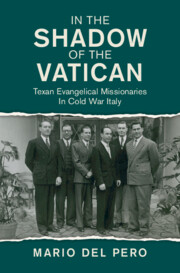
The “exceptionalities” of the story are many, making it challenging to decide where to begin. We have a group of radical evangelicals led by a young, energetic preacher – Cline Rex Paden, only 28 at the time – from a relatively small, nondenominational church (the Churches of Christ) mostly based in the American South and Southwest. In the aftermath of World War II, they chose to leave the flat, dry, and peaceful South Plains of Texas to establish a mission in the hilly region of the Castelli Romani in central Italy.
They spoke little to no Italian and had only a limited understanding of the country, aside from Cline’s brother, Harold, who had served as an Army ski trooper during the Italian campaign of 1944–1945. Arriving in Italy in late 1948 on short-term tourist visas, they quickly overstayed their permitted stay, thereby facing the severe retaliation of Italian authorities. Undeterred and propelled by an ardent zeal and a fervent optimism that bordered on naivety, they embarked on a bold and risky venture: To challenge the religious near monopoly of the Catholic Church in Italy and promote what they viewed as the true evangelization of the country. From their base in Frascati, the main town of the Castelli Romani (situated just a few miles from the Pope’s summer residence, the Papal Palace in Castel Gandolfo), they sought to propagate their primitive form of Christianity through a grassroots, horizontal, and cell-like expansion of the original community. Their doctrinal commitment to nondenominationalism was to be mirrored in their Italian mission as well. Frascati was intended to serve as the springboard for a much broader regional and national campaign. Soon after, other small missions emerged, spanning from northern cities such as Milan and Padua to southern locations like Palermo and Catanzaro, reflecting their ambition for a nationwide evangelical outreach.
Anti-Catholic sentiment was undeniably the primary, though not the sole, motivation behind the missionary endeavor. Cline Paden and his fellow missionaries were candid about this, openly expressing their desire to free Italians from alleged Catholic oppression and introduce them to what they believed to be true Christianity. The missionaries viewed the Catholic Church as the root cause of most, if not all, of Italy’s problems and overall underdevelopment. In their perspective, other deficiencies could be minimized or explained as unavoidable corollaries of the Vatican’s pervasive influence. They considered Communism as one of the inevitable and direct outcomes of Italy’s social, cultural, and religious backwardness – often arguing that it represented the last hope for millions of desperate Italians. Italian Communists were thus accepted, and even welcomed, into the Church of Christ. For the missionaries, they were lost but sincere souls who needed guidance back to the true faith. When Pope Pius XII excommunicated members of the Italian Communist Party in July 1949, Paden and the other missionaries viewed this as an opportunity. They believed they could attract a significant number of Christian Italians whom the Holy See had just labeled as apostates. When considering the extensive scholarly reflections on the role of US evangelicals in the Cold War anti-Communist crusade – what historian Jonathan Herzog has aptly termed the post-World War II American “spiritual-industrial complex” – the stance of the Church of Christ missionaries toward Italy’s Communism appears particularly “exceptional.”Footnote 11
The Vatican and its many allies within the Italian government seized upon this situation as a pretext to denounce an alleged, objective collusion between the Church of Christ and pro-Soviet forces. The inflammatory and radical rhetoric often used by the American missionaries against the Catholic Church and Catholic politicians added weight to these accusations. While it was true that a few Communists had joined the mission – some even forming close ties with Cline Paden – their numbers were extremely small. In fact, Italian converts to the Church of Christ across the entire country never exceeded a few hundred, rendering its influence – religious or political – largely marginal.
Despite the stark disparity between the missionaries’ lofty ambitions and their limited successes, and despite appeals from US diplomats on the ground as well as the Department of State, Italy’s Ministry of the Interior initiated a harsh crackdown on the American evangelicals. Utilizing Fascist-era laws, the Italian police repeatedly intervened to suspend Church of Christ gatherings and block access to their prayer halls, which were often located in the missionaries’ own homes. In some instances, mobs – frequently incited by local priests – resorted to violence against the Americans. One notable case, the alleged stoning of the evangelicals in late 1949, garnered attention in the United States and became a cause célèbre, eventually prompting the mobilization of the Texan congressional delegation. From 1949 until Cline Paden’s de facto expulsion in 1955, the Church of Christ evangelicals remained a contentious issue at the center of US–Italian relations, as well as those between Italy and the Holy See.
Which is all indeed quite “exceptional,” as demonstrated by the surprising lack of scholarly attention the story has received. Many of the aforementioned elements stand out as unique and incongruent with standard narratives: a group of Texan evangelicals accused of crypto-Communism, welcoming members of the Italian Communist Party (PCI) into their ranks, downplaying the Soviet threat, and even justifying anti-Catholic repression in the countries of the Soviet bloc; a steadfast and democratic Cold War ally of the United States, Italy, resorting to using Fascist-era laws against US citizens; the Vatican, reacting almost hysterically, pressuring the Italian government to adopt drastic measures against the seemingly insignificant missionary efforts of a lilliputian North American Church, and even justifying the use of violence against its members; the US and the Italian diplomatic sides forced to manage a politically and diplomatically complex issue over what they correctly assessed as a minor affair; the Truman and Eisenhower administrations being compelled to address the protests from numerous members of Congress, prompted by the flood of letters from their outraged constituents.
And yet, this “exceptional” reveals itself to be rather “normal” once we finally zoom in and are taken off-screen, to return to Ginzburg’s metaphor. Anti-Catholic sentiment has a deep-rooted history among US Protestants – both liberal and conservative – and continued to wield considerable influence in the immediate post-World War II period. Published in 1949, Paul Blanshard’s scathing portrayal of the Catholic Church as a foreign and alien institution that posed a threat to the core values of American democracy quickly became a bestseller. The book received widespread acclaim from prominent intellectuals and public figures, including John Dewey and Bertrand Russell.Footnote 12 Anti-Catholicism permeated the pamphlets, magazines, and journals of evangelical congregations, including those of the Church of Christ. The missionaries’ perspectives on Italy were inevitably informed by this anti-Catholic theological, political, and, in some respects, nativist bias.
If aversion to Catholicism trumped concerns about Communism, the theological radicalism of the Texan evangelicals further legitimized the Vatican’s assertion that they were either fellow travelers of Communism or unwittingly serving as useful idiots for pro-Soviet forces in Italy. A simple, cursory examination of Il Seme del Regno, the journal the Church of Christ attempted to publish in Italy for several years, reveals the extreme radicalism of its theological message and of its social and political implications. Which was, again, absolutely “normal,” given the Church’s history, tradition, and religious beliefs. While it is true that the Churches of Christ had gradually distanced themselves from their antiestablishment and anti-institutional origins, eventually becoming one among many religious actors within the US conservative movement, in the immediate post-World War II period they still espoused and embodied a radical form of theological primitivism.Footnote 13 Rooted in the belief that they were the vanguard of a movement to restore the Christian church to its original form, their message resonated with some of the poorer and more marginalized segments of society. In sum, while it seems quite “exceptional” that some Texas evangelical pastors could minimize the Communist danger and be accused of being pro-Soviet crypto-Marxists, it is, in the end, rather “normal” that their mission paid initially scant or no attention to the emerging dynamics of the Cold War and might have held some appeal for Christian Communists in Italy.
As it is logical and, once more, “normal” that US evangelical missions would focus on Italy in the aftermath of World War II. The de facto imperial US presence in the peninsula appeared to offer these missions considerable privileges and latitude – or so Paden and his group believed. Religious freedom was viewed as the essential complement to the other liberties the United States had introduced to Italy by freeing it from Fascism. Indeed, the missionaries frequently referred to Roosevelt’s Four Freedoms to justify their objectives and rights in the Italian context. Furthermore, the Church of Christ’s engagement in international missionary activities was the natural extension of a broader bandwagon: the awakening of US Protestant evangelicalism to global missionary outreach. This period witnessed the initiation of numerous missionary initiatives worldwide and a significant transformation in American Protestant foreign missions. During this time, evangelical churches began to eclipse mainstream liberal churches, which were increasingly distancing themselves from their historical commitment to missionary work.Footnote 14 Finally, Italy appeared to naturally align with the two primary groups toward which the Churches of Christ initially directed their missionary efforts: the least developed countries – to which several war-torn Italian regions, particularly in the south and the center of the country, seemed to belong – and the former World War enemies of the United States. The material reconstruction of these nations was seen as requiring a corresponding spiritual and religious renewal. Not by accident, the Churches of Christ chose to establish their first post-1945 foreign missions in Italy, Germany, and Japan.
The Vatican State, along with its political allies in the Italian government and parliament, clearly overreacted by perceiving – and presenting – these limited and largely unsuccessful missionary activities as a significant menace. They viewed it as a full-scale Protestant invasion of the country and an unacceptable challenge to Italy’s sovereignty and Catholic religious hegemony. This reaction might again appear “exceptional,” but was consistent with the long-standing Catholic opposition to Protestant missions in Italy, which were often perceived as alien imports or fifth columns of foreign forces threatening the spiritual cohesion and unity of the Italian people.Footnote 15 The receptive attitude of Italy’s politicians and members of parliament toward the Holy See’s requests to suppress these Protestant missionary initiatives stemmed from both ideological convictions – particularly within a government dominated by the Christian Democratic Catholic party – and a pragmatic recognition that resisting Vatican demands was often neither politically expedient nor feasible.Footnote 16
This exceptionally normal story took place within a specific context: the Cold War, which rapidly transitioned from its putative stage in 1947 and 1948 into a rigid and inescapable system. This was particularly evident in Italy, a Cold War frontline that fell within the US sphere of influence and the emerging Atlantic community, yet also home to the largest pro-Soviet parties and trade unions in Western Europe. The Cold War – an overarching geopolitical and ideological structure – shaped the environment where all actors operated, providing the broader context within which the microhistory of the Church of Christ’s mission in Italy unfolded. In Italy, as in the rest of Europe and the world, the Cold War became the global condition that compelled political and social actors to align with one of the two superpowers and their respective blocs. This process of integration left little room for maneuver within postwar ideological and geopolitical bipolarism. All the protagonists of this story had to navigate this reality, adjusting their actions, strategies, and discourses accordingly.
The missionaries soon realized that it was unrealistic to proclaim their neutrality in the Cold War struggle. While continuing to denounce Catholicism as an evil equal to, if not worse than, Communism, they quickly embraced a Cold War rationale for their activities. They argued that the version of true Christianity they offered was a more effective tool against atheist Marxism, and that the modernization efforts promoted by the US government in Italy also required the introduction of religious liberties still absent in the country.
For their part, the Catholic Church and its political allies accused the Texan evangelicals of being either covert Communists or unwitting accomplices to Soviet schemes. In doing so, they combined long-standing Catholic condemnations of Protestant activities in Italy – viewed as foreign imports of a mostly Anglo-American religious culture – with the new narratives of the Cold War. However, otherizing “a-Catholic denominations” (culti acattolici), as the Italian State had defined them, was insufficient on its own. Another Cold War justification was thus introduced to legitimize the radical hostility toward foreign missions like that of the Church of Christ: that they undermined the spiritual unity of Italy and its people, thereby weakening the nation’s resolve and making it more vulnerable to Communist influence and penetration.
For their part, in the efforts to defuse the crisis and find a lasting solution, the State Department, American diplomats on the ground, and Italy’s Ministry of Foreign Affairs also all invoked Cold War logic and objectives. They repeatedly argued that a marginal issue, such as the fate of the Church of Christ’s mission, risked causing unnecessary harm to US–Italian relations and prompting many members of Congress to reconsider the continuation of much needed American aid to Italy. The Italian embassy in Washington shared this view, as did the Foreign Ministry, leading to an internal rift with the pro-Vatican Ministry of the Interior.
The story of the Church of Christ’s mission in Italy thus intersected with the larger dynamics of the Cold War, with the latter’s macro-constraints shaping the strategies, actions, and discourses of all the actors involved. The micro and macro levels – the specific “small” history of this mission and the big, global context of Cold War geopolitical and ideological integration – operated in constant interaction. To fully understand this interplay, they must be examined together, as the Cold War not only defined the possibilities available to the actors, starting with the missionaries, but also influenced the strategies they devised to maintain agency or even leverage the international system and the US–Soviet competition to their own advantage.
Finally, this book seeks to engage with multiple historiographies and scholarly domains. In its own way, it strives to offer a microhistory of the global Cold War. It is a study rooted in American foreign policy and US–Italian relations – my primary fields of expertise – by addressing a key issue: the role of religion not only in shaping the foreign policy discourse and ideology of the United States, but also in illustrating how various groups and lobbies, both large and small (such as the Church of Christ), could influence Washington’s policies and decisions.Footnote 17 It also engages with a central scholarly question – national sovereignty, in this case Italy’s – in the post-World War II international context, which often challenged and constrained such sovereignty.Footnote 18 Last, it examines Italy’s transition from Fascism to democracy, focusing on how religious freedom and the liberties ostensibly guaranteed by the new republican constitution were actually promoted and implemented.
To achieve this, it was necessary to consider a plurality of actors – both governmental and nongovernmental – and to navigate across various scales of analysis, Jacques Revel’s famous jeux d’échelles. These included the missionaries, the various factions within the two governments, the Catholic Church and its diplomacy, national and international religious organizations (such as Italy’s long-established liberal Protestant Church, the Waldensians, the US National Association of Evangelicals – NAE, and the Geneva-based World Council of Churches – WCC), and numerous individuals – politicians, legal scholars, activists. An effort that has required a long and often slow journey, much longer than initially anticipated, through multiple archives spread across several countries.
This represents one of the main differences with the original microhistorical scholarly and intellectual project, which often relied on isolated documentary fragments, seeking to uncover their hidden meanings and broader implications. As modern historians of the post-World War II international system, we face both the privilege and the curse of working with an overwhelming availability of primary sources. Rather than scarcity, we are saturated with abundance. To the original two boxes from the 1990s’ NARA, countless other collections have since been added. Technology has at the same time facilitated access to these sources, reducing the need for physical storage, and further damaged an already weak eyesight with endless hours spent in front of screens, trying to make sense of poorly photographed or scanned documents. What has resulted is this book – my personal attempt at weaving together the macro and the micro, the local and the global, the domestic and the international, the drop of water and the sea. It is an effort to write a history of the seemingly small, very small indeed, which I hope will ultimately prove to be anything but a small history.
