

2.1 Introduction
In any attempt to “rethink” biodiversity governance, we need to consider that defining nature (and related concepts such as biodiversity, ecosystems, landscapes or green infrastructure) is not merely an objective scientific exercise. In reality, context-specific, subjective, normative and dynamic worldviews and values are at play in any definition of nature, whether explicitly or implicitly. Being aware of this pluralism is essential for avoiding “objective” definitional attitudes that risk disregarding and marginalizing the plurality of values and worldviews connected to different definitions of nature. In fact, paternalistic positions can create breeding grounds for fruitless dialogues between stakeholders, and thus pluralistic approaches help open up spaces for discussion.
In the modern era, Western worldviews have emphasized the separation between culture, humans and nature, dating back to at least the era of the Old Testament. This distinction has come to be known as the nature/culture divide, a dichotomy that posits nature as a separate and discrete object that can be known, conquered and used at will for humankind’s benefit, with consequences beyond theoretical and philosophical discussions (Reference CastreeCastree, 2013). Different interpretations exist on when and how this divide came to be (Reference PattbergPattberg, 2007; Reference UgglaUggla, 2010). In her classic book The Death of Nature: Women, Ecology and the Scientific Revolution, Carolyn Reference MerchantMerchant (1980) pointed out how the image of nature as a nurturing mother was gradually transformed during the sixteenth and seventeenth centuries into an image of nature as being wild, chaotic and uncontrollable, a position directly related to the dominant view on women at the time and a view that justified the domination of nature and the exploitation of its resources.
The environmental historian Donald Worster has proposed that since the Industrial Revolution, two key threads can be discerned in the way Western societies relate to nature. First, the “imperial” or Linnean tradition emerging from the development of biological classification of species and scientific exploration had the ambition to “establish, through the exercise of reason and by hard work, man’s dominion over nature” (Reference WorsterWorster, 1977: 2). At the same time, the Industrial Revolution led to a second strand that emerged as a countermovement to the idea of human domination, which Worster terms “Arcadian,” and that “advocated a simple, humble life for man with the aim of restoring him to a peaceful coexistence with other organisms,” given the depredations of industrial life (Reference WorsterWorster, 1977: 2). This second strand has taken many different forms over time; for example, in the later nineteenth century, Romanticism, despite being a heterogeneous movement, challenged the idea of human domination over nature and modernity by idealizing wild nature for its beauty and purity (Reference UgglaUggla, 2010).
The nature/culture divide has come under criticism as a cultural construction not universally applicable to the whole of human societies (Reference DescolaDescola, 2013), and as an invalid dichotomy for the West as well (Reference LatourLatour, 1991). These criticisms are not solely theoretical, as they raise the fundamental question “what is nature?” and reject a single objective answer. Thus, nature is a plural concept, and in this chapter we argue that this plurality reflecting the different values of nature will play a fundamental role in transformative biodiversity governance. Yet this does not come easily, as a plurality of values means a plurality of ontologies, epistemologies, interests and needs.
The authors do not pretend to present an exhaustive nature-definition overview in this chapter, nor to be without bias: The content of this chapter largely builds on the expertise and experience of the collaboration between them. And of course, explicitly or implicitly, certain accents or interpretations may come across more strongly than others. Nevertheless, we mainly hope to share with the reader a rich display of definition examples and elements, illustrating the core intention of this chapter: to show that nature is defined, and cannot be taken for granted as one objectifiable concept. After a brief introduction of the concept of biodiversity (Section 2.2) as a root scientific concept for conservation, we provide an overview of some of the ways nature has been defined over time and what this means for biodiversity conservation. Section 2.3 deals with wilderness, intrinsic value and how these are interlinked with protected areas. Section 2.4 addresses the concept of landscape via two lenses: ecosystem services and biocultural diversity. Instrumental and relational values of nature are also discussed. Section 2.5 takes the increasingly popular tool of conferring nature with legal rights (Rights of Nature) as demonstrating hybrid forms of biodiversity governance that attempt to merge Western and non-Western ontologies and definitions of nature. Section 2.6 discusses the importance of scenarios for nature in order to develop alternative pathways grounded on value pluralism. Section 2.7 concludes the chapter by drawing general conclusions for transformative biodiversity governance.
2.2 Nature Defined in the History of “Biodiversity”
Attention to the conservation of nature often manifests as a response to the widespread unsustainable and unethical use of nature (however defined) that stems from a view of nature from an instrumental value perspective, resulting in overlogging, overfishing, large-scale land-use change, etc. The concept of biodiversity emerged from the scientific community and, despite criticisms, represents one of the most common and recognized concepts for scientists and the general public. The term dates back to 1968, when Dasmann used it for the first time in his book A Different Kind of Country (Reference DasmannDasmann, 1968). While concepts of nature and wilderness had been commonly used previously, with this new term, global diversity that had evolved over more than 3.6 billion years was emphasized, as well as the fact that human impact extended beyond just endangered species. As the term began to circulate and become widely used, one of the first uses of the term was “biological diversity” in the United States. The United States historically played an important role in the design of conservation, where it was mentioned in the Global 2000 Report to the president, written by biologist Tom Lovejoy for President Jimmy Carter in 1980 (Reference Lovejoy and BarneyLovejoy, 1980). The popularity enjoyed by the term partly lies in the increasing concern about an accelerating “extinction crisis” (Reference Ehrlich and EhrlichEhrlich and Ehrlich, 1981; Reference MyersMyers, 1979), as well as the fact that it was a useful catch-all representing the need for increased conservation for the underpinnings of life (Heywood, 1995), and the National Forum on BioDiversity in 1985 cemented the idea that the concept was fundamental for shaping conservation policy (Reference WilsonWilson, 1988). In other words, as biologist E. O. Wilson put it, “Biological diversity – ‘biodiversity’ in the new parlance – is the key to the maintenance of the world as we know it” (Reference WilsonWilson, 1992: 15).
Although the last decades saw a surge in the use of the concept of biodiversity in the scientific community and beyond, the term itself is not uncontested. One “formal” definition of biodiversity, adopted by the Convention on Biological Diversity (CBD) in 1992, defines it as “variability among living organisms from all sources including, inter alia, terrestrial, marine and other aquatic ecosystems and the ecological complexes of which they are part; this includes diversity within species, between species and of ecosystems” (Article 2) (CBD, 1992). Many have argued, since the emergence of the term, that it still remains vague and imprecise: “the term biodiversity is beginning to fail as a useful catch-all term for the current planetary environmental crisis … ambiguity of meaning has, in my opinion, rendered the concept of biodiversity increasingly useless as a rallying-point by which to focus attention on the current and on-going dramatic changes to the biosphere” (Reference BowmanBowman, 1998: 239).
Further uncertainty emerges from the task of measuring biodiversity (Reference Walpole, Almond and BesançonWalpole et al., 2009). Early discussions about how different dimensions of biodiversity might best be measured included basic species/area ratios, which, as species diversity generally increases from the poles to the equator, led to biodiversity protection efforts centered in the tropics (Reference Harper and HawksworthHarper and Hawksworth, 1994); a focus on rarity and endemism, such as in “biodiversity hotspots” where such endemic species are under particular threat (Reference Myers, Mittermeier, Mittermeier, Da Fonseca and KentMyers et al., 2000); or on taxonomic character differences within populations, indicating genetic richness to be conserved for the sake of future evolution (Reference Humphries, Williams and Vane-WrightHumphries et al., 1995). In practical terms, the idea of sheer species numbers as equivalent to biodiversity has largely predominated (Reference TakacsTakacs, 1996), although it has led some to question “whether it is adequate – or correct – to base the priorities for global biodiversity conservation simply on the quantity of biological diversity, as is often done” (Reference Fjeldsaa and LovettFjeldsa and Lovett, 1997: 319). More recent discussions have focused on questions of “biodiversity intactness,” “biodiversity health,” “species viability,” and, as we note in the next section, ecological functions and services provided by biodiversity (Reference Dinerstein, Joshi and VynneDinerstein et al., 2020; Reference Mace, Barrett and BurgessMace et al., 2018; Reference Schneiders and MüllerSchneiders and Müller, 2017).
As concerns over the ambiguity of the term and how to measure it allude to, there remained no clear consensus on a single standard interpretation of biodiversity for many years. The difficulty of reconciling alternative interpretations has made critical engagement with definitions of biodiversity difficult and contested when the conceptual roots of the term are questioned (see also Reference Sarkar, Garson, Plutynski and SarkarSarkar, 2016). At the same time, biodiversity has entered the public discourse and is commonly used by newspapers and mass media; as a term, it is gaining in popularity (Reference Levé, Colléony and ConversyLevé et al., 2019), although not (yet) as much as climate change (Reference Legagneux, Casajus and CazellesLegagneux et al., 2018).
Despite these debates, the concept of biodiversity has, more than any other concept in the last decades in Western ecological thinking, been a key contribution in shaping the governance of nature conservation. For example, defining the boundaries of what biodiversity is and where it can be found is required for the creation of targets to “halt biodiversity loss” and, more recently, to “bend the curve of biodiversity loss” (Reference Mace, Barrett and BurgessMace et al., 2018). Yet, as we have noted, these targets do not “naturally” and “neutrally” emerge from agreements within the scientific community. On the contrary, they are negotiated and contested, and they lend themselves to alternative conservation strategies and practices (Reference Bhola, Klimmek and KingstonBhola et al., 2021; Reference Immovilli and KokImmovilli and Kok, 2020; Reference Keune, Dendoncker, Jacobs, Dendoncker and KeuneKeune and Dendoncker, 2013). In the next two sections, we discuss possible ways to look at biodiversity governance and further reflect on how these approaches are grounded in different definitions of nature.
2.3 Nature Defined as Wilderness
The concept of wilderness emerged from the US context in the nineteenth century and soon gained momentum in the wider international conservation debate. As European settlers arrived in the Americas, wild nature was considered the enemy, to be replaced with traces of “modern civilization” (Reference NashNash, 1967). Later, this attitude shifted, and wild nature started to be praised as sacred havens that would spare humanity from the unstoppable expansion of modernity; for example, the well-known American writer Henry David Thoreau advocated for wild nature as a space where modern humans’ excesses could be purified and limited. The cerebral and aesthetic values being praised in this context were advocated by upper-middle class and white American men, whose communing with nature conferred intellectual life, arts and letters (Reference McDonaldMcDonald, 2001; Reference NashNash, 1967). In other words, wilderness, particularly in Thoreau’s work, resembled an ontological claim to a different life, one not completely devoted to modernity and urbanism (Reference McDonaldMcDonald, 2001; Reference NashNash, 1967).
Yellowstone National Park was established in 1872 in the United States, marking a historical moment in the movement for the protection of the wild, although as historians have subsequently pointed out, the protection of this wilderness required the eviction of Indigenous Native Americans (Reference SpenceSpence, 1999). Yet these divisions between man and wilderness continued, eventually culminating in the passage of the Wilderness Act in 1964, where wilderness was defined as “an area where the earth and its community of life are untrammelled by man, where man himself is a visitor who does not remain.”
Yet the establishment of protected areas (PAs) and the concept of wilderness itself have been harshly criticized. Many pointed out that so-called wild areas were in fact recreated and strictly administered and managed (Reference DenevanDenevan, 1992). Furthermore, social justice concerns were raised, pointing at the violent displacement of people and the enclosing of land that followed the establishment of many parks (Reference CrononCronon, 1996). Despite these criticisms, protecting the wild still drives the expansion of PAs and other area-based measures, which remain among the most common practices for conservation governance as fears over land degradation and the extinction crisis have grown (Reference GroveGrove, 1992). Proposals to expand protected areas continue to play a fundamental role in biodiversity governance (Reference Locke, Coates and BilewitchLocke et al., 2013).
Additionally, a strong ecocentric rhetoric has grown in academic and public discourse, underlining the intrinsic value of nature (including humans) and its inherent right to exist, live and flourish despite human pressures. Such powerful discursive material serves as conceptual – if not philosophical – ground for many political and ecological efforts (see, for instance, the recent proposal to protect half of the Earth and how it is backed by ecocentric thinking [Reference KopninaKopnina, 2016]). This is well captured by Reference Wolke, Wuerthner and CristWolke (2014: 204), who states that “wilderness is about setting our egos aside and doing what is best for the land.”
While this definition retains the ontological claim that wilderness is a limit to human expansion – and that indirectly we can learn from it – it shifts the value of wilderness toward intrinsic (moral, spiritual and ecological) value. This should not come as a surprise when we consider the evolution of environmental concern over the last decades and the rise of biodiversity as a concept. Indeed, the concept of biodiversity itself has often been used to reinforce the narrative of wilderness (Reference NashNash, 1967; Reference UgglaUggla, 2010). As such, the expansion of protected areas and other area-based conservation measures is often grounded in an ecocentric rhetoric, which claims these measures to be a vital solution to achieving global biodiversity targets.
Since 1988, there has been a 400 percent increase in the number of PAs and they now cover 15 percent of the Earth’s surface land. Critics point at this data and argue that, despite this surge in protection, biodiversity has neither been conserved nor restored (Reference ButchartButchart, 2010). This remains a point of debate, as others have argued that the achievements of PAs, despite being insufficient, are relatively positive in terms of biodiversity conservation (Butler, 2015 in Reference Wuerthner, Crist and ButlerWuerthner et al., 2015), while the evidence on PAs mitigating human impacts is more mixed. Many nongovernmental organizations (NGOs) and some scientists have advocated that current levels of protection are not enough and more is needed, arguing that protection should be expanded to cover half of the Earth (Reference Dinerstein, Olson and JoshiDinerstein et al., 2017; Reference Dinerstein, Vynne and Sala2019; Reference Locke, Wuerthner, Crist and ButlerLocke, 2015; Reference WilsonWilson, 2016), while for others lower percentages could be enough (Reference Visconti, Butchart and BrooksVisconti et al., 2019) (see also Chapters 11 and 12 for different perspectives on this conservation).
2.4 Nature Defined through Cultural and Ecosystem Services Lenses in Landscapes
In the previous section, we saw that nature has been defined as the counterpart of culture: the physical and biological world dominated by “natural” processes, not manufactured or developed by people. This resulted in the creation of wilderness and to the deployment of PAs. However, some claim that most of what we designate as “natural” areas (e.g. what are designated as Natura 2000 habitats in Europe) are in fact historical cultural landscapes with a high biodiversity value (Reference Hermoso, Mora´n-Ordo´n˜ez and BrotonsHermoso et al., 2018; Reference Pechanec, Machar and PohankaPechanec et al., 2018). Following this logic, “natural” ecosystems are the outcome of a coevolutionary process in which they shape, and are shaped by, new forms of social organization, knowledge, technology and value systems (Reference Howarth and NorgaardHowarth and Norgaard, 1992). With this, the conceptualization of nature has shifted for some from wilderness to that of landscape, in 2000 defined by the European Landscape Convention (European Landscape Convention of the Council of Europe) as “an area, as perceived by people, whose character is the result of the action and interaction of natural and/or human factors.” This definition emphasizes the dialectic and productive relationship between humans and nature and encourages a move beyond dichotomies.
Other value perspectives correspond to a definition of nature that includes culture. In 2012, the publication of what became known as the “New Conservation Manifesto” (Reference Marvier, Kareiva and LalaszMarvier et al., 2012) added a new set of values of nature to the discussion: instrumental value. In their article, Reference Marvier, Kareiva and LalaszMarvier et al. (2012) argue that conservation in the Anthropocene must move past the idea of wilderness because humans and natural systems are profoundly intertwined. Despite the increasing number of PAs, biodiversity is still in decline due to the fact that conservation cannot succeed if it does not address social issues, they claimed, such as poverty and inequality. Thus, conservation (and conservationists) must “embrace human development and the ‘exploitation of nature’ for human uses, like agriculture, even while they seek to ‘protect’ nature inside of parks” (Reference Marvier, Kareiva and LalaszMarvier et al., 2012). From such a perspective, nature is no longer valued (and conserved) for its intrinsic value, but because it provides humans with services and benefits (Reference PearsonPearson, 2016). In this, the ethical horizon of conservation has changed toward ideas of the sustainable use of nature, and in this context, the establishment of the Millennium Ecosystem Assessment and the Ecosystem Services (ES) framework are clear milestones.
2.4.1 The Ecosystem Services Lens
One of the core conclusions of the Millennium Ecosystem Assessment (MA, 2001–2005) was the fundamental dependence of human wellbeing on ecosystems through a variety of ecosystem services. Ecosystem services have been defined as the “direct or indirect contribution to sustainable human well-being” (Reference Costanza, de Groot and BraatCostanza et al., 2017), highlighting an anthropocentric and instrumental perspective on nature while acknowledging the intrinsic value of species and ecosystems. Outside of the scientific community, ES gained momentum as well, capturing the attention of the general public and private companies, and becoming firmly settled in the international policy arena (Reference Costanza, de Groot and BraatCostanza et al., 2017). The main merit of the ES framework is that it widened the policy discussion to aspects of nature that were traditionally neglected in decision-making (Reference Schröter, van der Zanden and van OudenhovenSchröter et al., 2014). Ecosystem services approaches have successfully shifted conservationist attention to indirect drivers of environmental change, such as socioeconomic dynamics, and attempted to reconcile ecological knowledge with economic thinking. This marked a clear difference from previous conservation efforts grounded in the idea of “conservation against development” (Reference Gómez-Baggethun and Ruiz-PérezGómez-Baggethun and Ruiz-Pérez, 2011). According to critics, this specific economic turn was instrumental in winning the hearts and minds of policymakers and stakeholders (Ring et al., 2010), but it narrowed down ES to a purely economic discourse, paving the way for the commodification of nature (Reference Díaz, Pascual and StensekeDíaz et al., 2018; Reference Gómez-Baggethun and Ruiz-PérezGómez-Baggethun and Ruiz-Pérez, 2011; see also Chapter 6 of this book for a reflection on market-based approaches and their role in transformative biodiversity governance).
This shift is captured by the creation of “The Economics of Ecosystems and Biodiversity” (TEEB, 2007–2011) research program. Another example of the domination of economic approaches to ES is the increasing attention devoted to terms such as “natural capital,” which aims to embed ecosystem services within the human economy in the form of stocks and assets to be accounted for (Reference CostanzaCostanza, 1991; Reference Costanza, de Groot and BraatCostanza et al., 2017). While the MA and TEEB did not introduce new definitions of nature or biodiversity, their framing and discourse have had an influence on which components of biodiversity were selected as being more or less relevant and fit for analysis (e.g. Reference NorgaardNorgaard, 2010; see also Chapter 5). Responding to these criticisms, some argued that acknowledging ES can be the basis of different types of assessment and need not lead to commodification. While monetary valuations are common, the ES framework still directs attention to the multiple benefits of nature that would otherwise be marginalized in decision-making, including ethical and sociocultural valuations, and ES can be used for nonmonetary assessment of human wellbeing (Reference Costanza, Hart, Posner and TalberthCostanza et al., 2009, Reference Costanza, de Groot and Braat2017; Reference de Groot, Brander and van der PloegDe Groot et al., 2012; Reference Schröter, van der Zanden and van OudenhovenSchröter et al., 2014).
The ES framework, however, is changing. Partly out of concern for a narrow economic framing of the concept, and critiques of the domination of a Western world view embodied in ES, the Intergovernmental Science-Policy Platform on Biodiversity and Ecosystem Services (IPBES) has developed a more holistic perspective, known as Nature’s Contributions to People (NCP), in which noneconomic values and non-Western worldviews receive more attention. This is an evolution of the ES concept as it considers different types of contributions, from material to nonmaterial, as a spectrum indicating the nonmutually exclusive nature of different contributions. Thus, for instance, food can be seen as not just material (provisioning), but also linked to nonmaterial values (culture and identity), in addition to other values such as options for the future (e.g. to facilitate climate adaptation). Thus, NCP concepts purport to bring in more real-life nuances to the values held by different peoples to nature (Reference Díaz, Pascual and StensekeDíaz et al., 2018), as all of these values coexist, and are not equally prioritized, which could result in potential conflicts between different stakeholders (IPBES, 2017; Reference Pascual, Balvanera and DíazPascual, 2017).
2.4.2 Biocultural Diversity Lens
One reason for the development of the NCP concept was the lack of attention to nonmaterial aspects of nature. Despite the inclusion of “cultural ecosystem services” in the original ES framework, cultural services were underrepresented, lacked suitable indicators, and encountered difficulty (and reluctance) to quantify them (Reference Satz, Gould and ChanSatz et al., 2013). Notwithstanding these problems, studies on nature–culture relations evolved in parallel to the ES framework and gained prominence on the international agendas of organizations like the Food and Agriculture Organization (FAO) and UN Educational, Scientific and Cultural Organization (UNESCO) (Reference Bridgewater and RotherhamBridgewater and Rotherham, 2019), culminating in the 1988 Declaration of Belém, which found “an inextricable link between cultural and biological diversity” (Reference Schlebusch, Malmström and GüntherSchlebusch et al., 2017: 652).
From this, the concept of biocultural diversity was coined. Reference Agnoletti and EmanueliAgnoletti and Emanueli (2016) consider the concept of biocultural diversity to be a useful term to represent the dialectic relation between the biological and cultural diversity of a (cultural) landscape. As such, two complementary and reciprocally dependent dimensions exist within biocultural diversity: the human shaping of biodiversity and the evolution of cultural practices related to biodiversity.
Modern humans (Homo sapiens) developed in southern Africa some 260,000 to 350,000 years ago (Reference Schlebusch, Malmström and GüntherSchlebusch et al., 2017), emerging from local dryland ecosystems and later found, through dispersal over the globe, in a multitude of different ecosystems. Through foraging, ancient humans shaped and impacted local ecosystems in a similar way to other animal species. Along with the development of human culture, the use of tools and implements for hunting, and later crop cultivation and the raising and maintaining of domesticated livestock, shaped distinct ecosystem patterns (Reference KüsterKüster, 2003). The continuous harvesting of food, the hunting of animals, and the collection of medicinal and other plants influenced the composition of biological communities over time, making it impossible to distinguish “untouched” nature from human-altered ecosystems. According to Reference MoranMoran (2006), hardly any ecosystem on Earth has not been shaped by human action. Long before the Neolithic, our ancestors modified their environment to facilitate their quest for food. Reference Olsson, Zeunert and WatermanOlsson (2018) shows how the myth of untouched wilderness as a treasure for biodiversity was contested. Joint work by ecologists and anthropologists showed – through observations of tropical forests presumably untouched by humans, like large parts of the Amazon – that the habitat had in fact been used through different forms of shifting cultivation for long periods of time, thereby influencing biological diversity. This should therefore more accurately be called biocultural diversity (Reference Gómez-Pompa and KausGómez-Pompa and Kaus, 1992). Similar results and interpretations have been confirmed by other researchers (Reference Padoch and Pinedo-VasquezPadoch and Pinedo-Vasquez, 2010), such as the use of fires for hunting in shaping biodiversity (Reference Sevink, van Geel, Jansen and WallingaSevink et al., 2018).
Cultural practices can also view biodiversity as a resource (Reference Bridgewater and RotherhamBridgewater and Rotherham, 2019). An important aspect to highlight here concerns the meaning of culture, for which Reference CocksCocks’ (2006) work is central in arguing that biocultural diversity has so far been linked to the cultural activities of local and Indigenous groups. In his view, this is too limited and should be extended to include non-Indigenous groups, based on observations of the variety of cultural practices regarding the use of wild plants by non-Indigenous peoples (Reference CocksCocks, 2006).
This dialectic relation between nature and culture remains at the core of biocultural diversity and characterizes both rural and urban landscapes (Reference Elands, Vierikko and AnderssonElands et al., 2019). Examples include seminatural vegetation, like grasslands and West-European heathlands. In seminatural grasslands in Europe, biological communities (plant species and their associated insects and other organisms) depend on continuous interference by humans, such as through fire, mowing or grazing by large herbivores like domesticated livestock. Without such activities, the seminatural grassland will return to forest and lose species richness (Reference Babai and MolnárBabai and Molnár, 2014). Some of these grasslands existed in prehuman times and were shaped and maintained by wildfires and large wild herbivores, but the extent of seminatural vegetation from the Neolithic onward is due mainly to human interference (Reference Olsson, Zeunert and WatermanOlsson, 2018; Reference Oteros-Rozas, Ontillera-Sánchez and SanosaOteros-Rozas et al., 2013). Another example relevant for agricultural systems is that of biocultural refugia (Reference Barthel, Crumbley and SvedinBarthel et al., 2013). This concept directly relates to human food provisioning, as embracing (biocultural) diversity can be seen as an agricultural strategy, and involves ensuring crop and habitat diversity as important tools for resilience in facing different disturbances and uncertainties, as well as the effects of climate change.
In Europe, traditional agricultural landscapes are often abandoned or transformed into urban or more intensively managed agricultural areas (Reference AgnolettiAgnoletti, 2014; EEA, 2010; 2015; 2020). When abandoned, native shrubs, trees and invasive alien species may spread. Local farmers often perceive these changes negatively: from a landscape-in-order where “each corner had a role,” reverting into a landscape-in-disorder that is “getting wild” (Reference Babai and MolnárBabai and Molnár, 2014; Reference Ujházy, Molnár, Bede-Fazekas, Szabó and BiróUjházy et al., 2020). This “getting wild” causes loss of cultural practices and associated biocultural diversity (Reference Agnoletti and RotherhamAgnoletti and Rotherham, 2015), offering an interesting comparison with the interpretation of wilderness in the context of PAs given earlier. What is seen as the loss of biocultural diversity from the perspective of cultural landscapes from a traditional ecological point of view is often framed as a positive gain for biodiversity because land abandonment offers possibilities for “rewilding” (Reference Agnoletti and RotherhamAgnoletti and Rotherham, 2015). Reference AgnolettiAgnoletti (2014) acknowledges this tension and complains that many conservation approaches are too guided by the concept of wilderness when dealing with cultural landscapes, thereby neglecting biocultural diversity.
Frameworks are emerging for the conservation of landscapes that are coproduced by humans and nature, such as in the International Union for Conservation of Nature (IUCN) Category V (Protected Landscapes/Seascapes) (Reference Schneiders and MüllerSchneiders and Müller, 2017; IUCN, n.d.). Furthermore, cultural aspects are included in discussions of the CBD regarding the establishment of “sustainable use” as one of the three main goals of the convention, which hints in the direction of valuing cultural landscapes (Reference Bridgewater and RotherhamBridgewater and Rotherham, 2019). Another noteworthy development is that of the “Other effective area-based conservation measures” (OECMs) introduced by Aichi Target 11, which allow other sustainability-related goals along with conservation objectives in management and governance (Reference Laffoley, Dudley and JonasLaffoley et al., 2017).
An important step toward the protection of cultural landscapes and biocultural diversity is the increasing attention in the conservation debate to so-called relational values. Reference Chan, Balvanera and BenessaiahChan et al. (2016: 1462) argue that “[f]ew people make personal choices based only on how things possess inherent worth or satisfy their preferences (intrinsic and instrumental values, respectively). People also consider the appropriateness of how they relate with nature and with others, including the actions and habits conducive to a good life, both meaningful and satisfying. In philosophical terms, these are relational values.” The introduction of relational values aims to capture another dimension that can support the concept of biocultural diversity by enriching understandings of human–nature interactions within the landscape.
In conclusion, the introduction of concepts like ecosystem services and biocultural diversity have broadened the horizons of biodiversity conservation in the past decades, shifting the attention from wilderness protection to also include sustainable use and cultural landscapes, from intrinsic values of nature to a plurality of other values, including instrumental and relational. These concepts have been important influences on how biodiversity governance is conceptualized and practiced, as seen in the development of numerous international policy agendas and new forms of protection. The two frameworks discussed in this section emphasize different elements and can complement each other (Reference Bridgewater and RotherhamBridgewater and Rotherham, 2019; Reference Buizer, Elands and VierikkoBuizer et al., 2016). However, tensions exist, particularly on issues of quantification and monetization at the center of discussion within the ES framework that run the risk of objectifying and separating nature from humans.
2.5 Nature Defined as Rights of Nature
In the previous sections, we described the processes that led to the inclusion and engagement with a plurality of values and knowledge systems within mainstream conservation. This is all the more needed when one considers the importance of Indigenous Peoples and local communities (IPLC) in managing and meeting global biodiversity targets. These groups use, manage, own or occupy a quarter of the globe, including 35 percent of the formally protected land area (Reference Garnett, Burgess and FaGarnett et al., 2018, Reference Díaz, Settele and BrondízioIPBES, 2019). Despite globally-declining biodiversity trends, nature is declining less rapidly in these IPLC-managed lands (Reference Garnett, Burgess and FaGarnett et al. 2018, Reference Díaz, Settele and BrondízioIPBES, 2019).
Indigenous and local knowledge systems are mobilized by IPLC, who live within natural and rural settings and make a living through an intimate relationship with nature (UNESCO, n.d.). Examples of different conceptualizations of nature from Indigenous communities include Pachamama (Mother Earth) or Country (Australia) (Reference McElwee, Fernández‐Llamazares and Aumeeruddy‐ThomasMcElwee et al., 2020). Across many communities, nature is considered to be reciprocal kin, such as a mother or a deity, signifying a harmonious relationship between nature and humans (Reference Cano PecharromanCano Pecharroman, 2018). For instance, the concept of Pachamama, despite differences across populations using the term, translates into an actual philosophy of life (“buen vivir” in Spanish) that permeates the daily life and practices of these communities. The formulation of buen vivir as an alternative to modern Western ideas of development has been embraced by numerous social mobilizations (Reference GudynasGudynas, 2011; Reference Kothari, Demaria and AcostaKothari, Demaria and Acosta, 2014). Once again, multiple definitions of nature and the worldviews articulated around it play a role in shaping proposals for conservation governance and, more broadly, sustainability.
Rights of Nature (RoN) is an emerging legal framework that aims at integrating IPLC knowledge with Western legal systems (also see Chapter 9). It has gained vast momentum over the last decade and confers legal rights to individual ecosystems (or the whole of nature) that are then represented in court by one or more legal representatives or guardians (Reference Cano PecharromanCano Pecharroman, 2018). These changes in the legal system around nature represent a fracture with previous approaches (Reference Chapron, Epstein and López-BaoChapron et al., 2019), as proponents argue that the mainstream Western legal system is anthropocentric and legalizes environmental exploitation for the fulfillment of human needs (Reference BurdonBurdon, 2011). Nature, in an ecocentric legal system, would thus be recognized a legal entity and be conferred with the status of legal subject (Reference O’Donnell and Talbot-JonesO’Donnell and Talbot-Jones, 2018). Starting from local ordinances in the United States, RoN have been included in the Ecuadorian Constitution in 2008, and in 2011 Bolivia passed its own Law on the Rights of Mother Earth. More recently, in 2016, the Atrato river in Colombia was given legal personhood, quickly followed by the Whanganui river in New Zealand (2017) and the Ganga and Yamuna rivers in India (2017). In 2019, Lake Erie in Ohio, United States, was granted the rights “to exist, flourish and naturally evolve” (Lake Erie Bill of Rights Charter Amendment 2018), and a proposal to confer legal rights to the Dutch Wadden Sea has recently been discussed (Reference Lambooy, van de Venis and StokkermansLambooy et al., 2019).
The RoN framework poses an ontological quandary because it introduces nature as a subject, rather than object, not only in legal but also in moral terms (Reference de Sousa Santosde Sousa Santos, 2015). Yet, as detailed in the previous sections, such a conceptualization of nature may perhaps be less obvious in the context of the traditional Western ontological divide between nature and culture. The challenge lies in the fact that Western national legislations and worldviews, traditionally anthropocentric, are now confronted with IPLC conceptualizations of nature and of life. Rights of Nature thus is more than a mere legal tool, as it can create encounters between different epistemologies and ontologies, as Western concepts such as “rights” and “ecosystem” meet with Indigenous worldviews and concepts such as ”Pachamama” and “buen vivir” in what has been defined an “epistemic pact” (Reference Valladares and BoelensValladares and Boelens, 2017).
The establishment of RoN presents fundamental questions concerning the way we relate to and see nature. From a conservation point of view, the narrative around nature as a subject and nature’s intrinsic rights, as defined within “ecocentrism” (Reference Washington, Taylor, Kopnina, Cryer and PiccoloWashington et al., 2017), has been widely deployed for the conceptual backing of PAs expansion (Reference KopninaKopnina, 2016). However, ecocentric approaches are contested by critics for their lack of attention for the human dimension (Reference Büscher, Fletcher and BrockingtonBüscher et al., 2017; see also Chapter 12 on Convivial Conservation). Similarly, RoN is criticized for the risk of pitting humans against nature and neglecting human needs that are embedded in nature (Reference Kothari and BajpaiKothari and Bajpai, 2017). As such, ongoing discussions on who will represent nature and how legal representatives or guardians will play a role in trying to address these issues might offer useful examples for broader conservation debates on whether and how to integrate ecological and social concerns.
In 2016, the Colombian Constitutional Court recognized the Atrato as subject and assigned “biocultural rights” to recognize the inextricable connection between the river and local practices and culture. These biocultural rights formed a framework wherein conservation objectives relating to the river were reconciled with the sociocultural needs of local communities (Reference Kauffman and MartinKauffman and Martin, 2018; Reference RoncucciRoncucci, 2019). While promising, the Atrato case is relatively recent and more time is needed to draw any conclusion regarding the success (or not) of integrating environmental and sociocultural needs.
Ultimately, the integration of the Rights of Nature with the rights of people is contested, as it brings us back to the nature/culture divide and to the risk of seeing humans (or rather, some humans) as separated from and opposite to nature. Nonetheless, the inclusion of Indigenous knowledges and worldviews as exemplified by RoN frameworks is contributing to transformative biodiversity governance by proposing novel hybrid legal arrangements and by challenging dominant Western ontologies and epistemologies.
2.6 Scenarios of Nature
In this section, we deal with scenarios of nature as a way to develop future pathways that are inclusive of the plurality of definitions and values of nature encountered thus far. Scenarios of nature are qualitative and quantitative descriptions of a desirable nature future and are widely employed in environmental policymaking. Reference Díaz, Pascual and StensekeDíaz et al. (2018) note that most scenarios do not take into account the complexity of human–nature relations, but in fact only consider human impacts on nature, neglecting the importance of nature in supporting human wellbeing. To remedy this and to include a plurality of values of nature into scenario exercises, a new framework is being developed by IPBES, known as the Nature Futures Framework (Reference Pereira, Davies and den BelderPereira et al., 2020), where the three value perspectives discussed in this chapter (intrinsic, instrumental and relational) would be used to develop future visions for society and nature.
Similarly, the Nature Outlook study by PBL Netherlands Environmental Assessment Agency elaborated four perspectives based on different values of nature and explored alternative futures at the EU level (Reference Van, Prins, Dammers and VonketVan Zeijst et al., 2017). The result was the development of four perspectives underpinned by different value assumptions: strengthening cultural identity, allowing nature to find its way, going with the economic flow and working with nature. This exercise did not aim to identify one optimal way forward but rather to facilitate imagining alternative futures. These types of exercises are fundamental for thinking about transformative change because they allow scope for alternatives and create space for confrontation and decision-making with transparent values and inclusive practices.
A key element that is relevant for transformative biodiversity governance is that every perspective of nature comes with different sociocultural, political and economic implications for the future. At a policy level, prioritizing the intrinsic value of nature will result in adopting conservation strategies, envisioning human–nature relations or recalibrating the economic system in a very different way than if relational or instrumental values were prioritized. Moving across perspectives of nature, prioritizing one over another and referring to biodiversity instead of Mother Nature (or vice versa) imply different future worlds. This makes biodiversity governance a contested field, characterized by continual negotiation between different ontologies and epistemologies. The key to transformative biodiversity governance lies in the capacity to embrace and handle this contestation and negotiation without denying the radical value-based differences between perspectives but rather finding ways for them to coexist.
2.7 Discussion and Conclusion
This chapter introduced how different conceptions of nature have developed over time and in different geographies, as well as how different normative value perspectives shape and are reproduced by these definitions of nature. Ultimately, these conceptions and values influence strategies and targets for conserving and using nature. At the core, the nature/culture divide has been a foundational dichotomy in the way nature comes to be defined. While this divide has been criticized both within and outside the Western context in which it was created, nonetheless, it remains essential to much of the debate around conservation.
We argue that defining nature is far from an objective and conflict-free exercise. On the contrary, defining nature is a value-laden task with theoretical and material repercussions. Choosing one definition and value of nature over another implies imagining and advocating for different worlds and nature futures. It means legitimizing one worldview over another. While this is inevitable, we must be aware of the implications for transformative biodiversity governance. Defining nature as wilderness generates conservation strategies that are not only different but possibly at odds with conservation strategies deriving from other conceptualizations of nature.
In this regard landscapes, ecosystem services and biocultural diversity are concepts that, despite differences, aim at integrating human and natural systems. Conservation strategies stemming from these concepts require a different approach to that of traditional protected areas, and much work remains to be done to understand how to integrate different strategies. It is important for transformative biodiversity governance to avoid reductionist approaches that smooth over important ontological or epistemological differences and to embrace pluralistic approaches, as well as to envision governance tools and mechanisms to navigate the political space offered by these multiple perspectives, such as legal Rights of Nature. Additionally, it will also be important to understand what pluralism materially means in terms of biodiversity governance. Does pluralism mean developing hybrid conservation strategies and targets that include multiple perspectives of nature? If so, it would be necessary to first reflect on the extent to which current strategies and targets (at both local and international levels) are receptive of this or, if not, how they favor – more or less implicitly – some perspectives over others.
Another crucial point for transformative biodiversity governance is that of transparency and clarification of choices. Many concepts and approaches are presented as “black boxes,” without a clear view of the premises, rationales, norms and values included. This treats concepts and governance approaches as “truths,” which is problematic for multiple reasons. Firstly, it hides (or at best marginalizes) any uncertainties, unknowns, discordant voices and ambiguity that may exist behind a concept. For example, in our discussion of the concept of “biodiversity,” we noted that it did not emerge from a general consensus within the scientific community, and from the outset its usefulness was criticized.
The second problem that stems from treating concepts and approaches as truth-claims is that it makes them less open to influence by other perspectives. This is at odds with the new attention to inclusivity, plurality and justice that is emerging in biodiversity governance, and that is seen in recent multiperspective scenario exercises. In these, the objective was not to identify one single optimal vision for the future but, on the contrary, to create a space where multiple visions could come together and be realized. Truth-claims that do not acknowledge disagreement and diversity become markedly less tenable given calls for inclusivity and plurality. This requires a serious rethinking of the concepts and the practices that are employed in the name of biodiversity conservation, in order for those who deploy these concepts to become more self-reflective and aware of their own limits and of the values they hold.
3.1 Introduction
The Post-2020 Global Biodiversity Framework (GBF) of the Convention on Biological Diversity (CBD) (the Post-2020 Framework) is expected to embody transformative change through the adoption of the framework’s “Theory of Change” (CBD, 2020). Its implementation must recognize that the global biodiversity governance architecture needs to transform to lead the required personal and social transformations, including shifts in values, beliefs and patterns of social behaviors (Reference Chaffin, Garmestani and GundersonChaffin et al., 2016), necessary to successfully tackle biodiversity loss. Against this backdrop, the overarching goal of this chapter is to analyze what needs to be transformed in global biodiversity governance, including institutional structures that shape values, beliefs and behavioral change. The chapter examines obstacles and opportunities for transformation, with the indirect objective of informing implementation of the Post-2020 Framework; at the time of writing, the CBD is expected to adopt the Post-2020 GBF in 2022.
The chapter firstly introduces the key global biodiversity treaty, the 1992 UN Convention on Biological Diversity, and its principal institutional body, the Conference of the Parties (COP) (Section 3.2). The evolution of the CBD is analyzed along with its procedural mechanisms, including its decision-making and review mechanisms. Secondly, the chapter presents the other relevant international institutions in what constitutes the “regime complex” for global biodiversity governance (Section 3.3). Within this complex, biodiversity governance takes place at multiple levels, from global to local, and in different sectors, including some of those most responsible for biodiversity loss such as agriculture, trade and development. The evolution of biodiversity governance beyond the CBD is also explored by analyzing the role of private actors, including business and civil society, in global biodiversity governance. Thirdly, the implementation of global biodiversity laws and policies is examined through global and national governance processes (Section 3.4). The final section draws upon the analyses to propose ways to transform and strengthen global biodiversity governance (Section 3.5), before concluding. The chapter is mainly based on legal analyses, while also drawing on more generic biodiversity governance literature.
3.2 The Convention on Biological Diversity
3.2.1 The CBD, from Seed to Sapling
The CBD opened for signatures at the United Nations Conference on Environment and Development, known as the Earth Summit, in Rio in 1992, marking the start of the “postmodern era” of environmental regulation (Reference Sands, Bodansky, Brunnée and HeySands, 2007). The Convention, having now near universal ratification (with the major exception of the United States), marked a paradigm shift, from earlier species-specific and ecosystem-based nature conservation conventions to a holistic and development-oriented approach to biodiversity. The CBD is a framework convention that sets out basic principles, general objectives, and rather broad and qualified provisions. The three objectives are biodiversity conservation, sustainable use, and the fair and equitable sharing of benefits. Legal polycentricity, intergenerational responsibilities, and the need for inclusive and participatory processes were new concepts recognized by the treaty (Reference Sands, Bodansky, Brunnée and HeySands, 2007).
In addition, three legally binding protocols have been agreed to date under the CBD Art 28 mechanism: the 2000 Cartagena Protocol on Biosafety, the 2010 Nagoya Protocol on Access to Genetic Resources and the 2010 Kuala Lumpur Supplementary Protocol on Liability and Redress (Supplementary to the Cartagena Protocol). While these protocols cover the second and third objective of the CBD respectively, it is remarkable that no protocol has been agreed relating to the first objective of the CBD, biodiversity conservation. Thus, the first objective has been addressed by the COP only through its non-legally binding instruments like strategic plans, visions, goals and targets, decisions, guidelines and recommendations.
The design of CBD targets has improved since the first broad “2010” biodiversity target, which called state parties “to achieve a significant reduction of the current rate of biodiversity loss at the global, regional and national level by 2010 as a contribution to poverty alleviation and to the benefit of all life on earth” (CBD COP6, 2002). This target was unmet and superseded by the 2020 strategic plan and the twenty Aichi Targets (ATs), agreed at CBD COP10 in 2010 (see Chapter 1). The ATs were designed to be SMART (specific, measurable, ambitious, realistic and time-bound) and to improve the initial 2010 target (Reference Harrop and PritchardHarrop and Pritchard, 2011). However, well before the 2020 deadline it was clear that most of the ATs would not be achieved (IPBES, 2019; SCBD, 2020).
3.2.2 An Active Body: The CBD COP
The CBD COP is the governing body of the CBD, where state parties make decisions by consensus to advance implementation of the Convention. It is in a unique position to strengthen global biodiversity governance to steer change. The COP can advance the evolution and implementation of the CBD by (i) agreeing and furthering ambitions through decisions that are soft law but guide parties, and (ii) creating a space to positively encourage and promote implementation of obligations. It creates a space for the development of shared understandings of the legal regulation of biodiversity, and norms through the elaboration of guidelines on various topics. The thematic priorities of COPs (see Table 3.1) have changed from predominantly ecosystem-based themes (COP1–COP9) to addressing the main drivers of biodiversity loss (COP10–COP14). Themes of earlier COPs do not necessarily tally with their focus or substantial outcomes. For example, COP7’s theme was “Mountain Ecosystems” and, while a work program on this theme was adopted, more notably a work program on protected areas and the Addis Ababa principles on sustainable use were also adopted, which received more attention and subsequently are seen as more important. Changing narratives indicate the broadening of agendas of the CBD and the themes of more recent COPs better match their outcomes.Footnote 1 COP15 follows this trend and hooks onto an important concept: “Ecological Civilization: Building a Shared Future for All Life on Earth.”
Table 3.1 CBD COP themes
Due to the broad scope and comprehensive character of the CBD COP, it is essential that there is buy-in from a very wide range of actors. The Open-Ended Working Group (OEWG) responsible for developing the Post-2020 Framework utilizes a theory of change approach to guide the development of a nature framework for all, not just for signatories from the Ministry of Environment, but for the whole of government, multilateral institutions, Indigenous People and local communities (IPLC), nongovernmental organizations (NGOs) and business. This could be challenging. A study of the 2016 CBD COP13 in Cancun, Mexico, found a poor representation of government ministers from the economic sectors from both the global north and south, indicating the limited buy-in of biodiversity negotiations nationally, and that disadvantaged actors from the global south were unable to participate as effectively in negotiations due to the limited size of their delegations and lack of expertise to cover all agenda items (Reference SmallwoodSmallwood, 2019). This unbalanced dimension creates power dynamics that are problematic in consensus decision-making and in creating obligations that rest on genuine shared understandings: not all relevant actors are present and exposed to the processes of influence and persuasion at COP meetings (Reference BrunnéeBrunnée, 2002; Reference SmallwoodSmallwood, 2019).
The CBD COP has a long history of engagement with stakeholders such as women, children and youth, NGOs, local authorities, trade unions, business and industry, science and technology, and farmers as observers to its meetings. IPLC have a well-established engagement and influence that is unique for the CBD compared to other intergovernmental processes (Reference ParksParks, 2018). Such nongovernmental actors are central actors in international environmental regimes including the CBD (Reference Spiro, Bodansky, Brunnée and HeySpiro, 2007), exerting influence through: domestic political processes such as rallying voters, lobbying law makers, disseminating information, bringing legal actions and working with media and academia (Reference Chayes and ChayesChayes and Chayes, 1995); advancement of domestic NGO agendas in the international sphere (Reference Spiro, Bodansky, Brunnée and HeySpiro, 2007); and agenda-setting (Reference Arts, Mack and FalknerArts and Mack, 2006). Nongovernmental actors also take on certain key functions within international negotiations, including supplying policy research and development to states (for instance, the 5th Global Biodiversity Outlook is a product of “collected efforts” including individuals from nongovernmental organizations and scientific networks), supplying information on compliance,Footnote 2 facilitating negotiationsFootnote 3 and participating in national delegations (Reference SmallwoodSmallwood, 2019).
A specificity of the CBD COP has also been its ambition to include businesses in its activities. A 2006 COP decision on business participation defines a “business and biodiversity” agenda.Footnote 4 Subsequent COP decisions aim to facilitate private sector engagement and encourage businesses to “adopt practices and strategies that contribute to achieving the goals and objectives of the Convention and the Aichi Targets” (COP12 Decision XII/10). A Global Partnership for Business and Biodiversity and a Business and Biodiversity Forum have been established, and the 2017 Business and Biodiversity Pledge has 141 signatories, including some large corporations such as Monsanto, L’Oréal and DeBeers; however, most relevant multinational corporations to biodiversity loss are not signatories. Despite these decisions and initiatives on business, to date the level of business involvement has been less than aimed for by the CBD COP (Reference van Oorschot, van Tulder and Kokvan Oorschot et al., 2020).
The CBD stresses the importance of “mainstreaming,” that is, the inclusion of biodiversity considerations into nonenvironmental policy areas that impact or rely on biodiversity (Reference YoungYoung, 2011). Art 6(b) of the CBD requires Parties to integrate the conservation and sustainable use of biodiversity into sectoral and cross-sectoral activities. Subsequently, means of furthering mainstreaming have been an endeavor of the CBD COP. The first goal of the 2011–2020 CBD strategic plan, agreed at COP10, was to address the underlying causes of biodiversity loss by mainstreaming biodiversity across production sectors and society (GEF, 2016; GEF et al., 2007; SCBD, 2020).Footnote 5 In addition, COP decisions on mainstreaming have been agreed, and mainstreaming was adopted as the key theme at COP13 and COP14. So far, mainstreaming is mostly considered an issue of policy coherence that is yet to be realized at global and national levels, let alone making significant links with communities such as business to realize the whole of society approach advocated by the CBD.
The CBD has two permanent subsidiary bodies: First, Art 25 of the Convention established an open-ended intergovernmental scientific advisory board, the Subsidiary Body on Scientific, Technical and Technological Advice (SBSTTA). The SBSTTA provides advice and makes recommendations to the COP and has met twenty-four times from 1995 to 2020. Second, COP12 established a Subsidiary Body for Implementation (SBI) in 2014, whose mandate includes strengthening mechanisms to support implementation of the Convention and any strategic plans adopted under it, and identifying and developing recommendations to overcome obstacles encountered. Due to the soft law nature of most CBD decisions, the CBD has adopted a facilitative approach toward implementation by monitoring national implementation through national reporting (Art 26). Besides, a system of voluntary peer review of National Biodiversity Strategies and Action Plans (NBSAPs) and their implementation is under development. The methodology was tested in two countries (Ethiopia and India), and later three countries have been reviewed in a pilot phase (Montenegro, Sri Lanka, Uganda) (CBD, 2020).
3.3 The Biodiversity Regime Complex
3.3.1 The Intergovernmental Components of the Regime Complex
Intergovernmental biodiversity governance has also evolved beyond the CBD. Indeed, due to its comprehensive scope, the CBD has gradually become the central element of a biodiversity regime complex, consisting of five pre-existing international regimes that progressively became regime complexes as well (see Figure 3.1, based on Reference Morin and OrsiniMorin and Orsini, 2014).
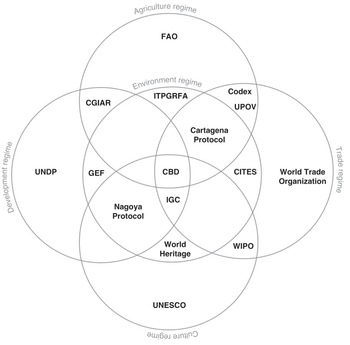
Figure 3.1 The regime complex on biodiversity (with a selection of international institutions provided as illustrations of the constituent elements)
CBD: Convention on Biological Diversity
CGIAR: Consultative Group on International Agricultural Research
CITES: Convention on International Trade in Endangered Species of Wild Fauna and Flora
FAO: Food and Agriculture Organization of the United Nations
GEF: Global Environment Facility
IGC: WIPO Intergovernmental Committee on Intellectual Property and Genetic Resources, Traditional Knowledge and Folklore
ITPGRFA: International Treaty on Plant Genetic Resources for Food and Agriculture
UNDP: United Nations Development Programme
UNESCO: United Nations Educational, Scientific and Cultural Organization
UPOV: International Union for the Protection of New Varieties of Plants
WIPO: Word Intellectual Property Organization
The first is the environmental regime. The first objective of the CBD, biodiversity conservation, facilitated interactions between the CBD and a pre-existing cluster of multilateral agreements within the environmental regime. Some of these agreements are biodiversity-related conventions such as the Ramsar Convention on Wetlands, the Convention on Migratory species (CMS) and the Convention on International Trade in Endangered Species of Wild Fauna and Flora (CITES). In 2007, these conventions started to collaborate in the framework of a broader Liaison Group of the Biodiversity-Related Conventions. The environmental conservation regime also consists of treaties that are not exclusively biodiversity-related, such as the United Nations Framework Convention on Climate Change (UNFCCC) and the UN Convention to Combat Desertification (UNCCD) (also adopted at the Rio Summit). A Joint Liaison Group of the Rio conventions has been established to enhance coordination and explore options for cooperation and synergistic action.Footnote 6
The second is the agricultural regime. The interactions here are established on a dual basis: agriculture practices are one of the main drivers for biodiversity loss, but agricultural biodiversity is also under threat, and constitutes the basis of food security (IPBES, 2019, see also Chapter 13). How best to manage agricultural biodiversity raises several questions, as agricultural genetic resources are not only important components of biodiversity but also constitute essential food resources (Reference SpannSpann, 2017). In addition, the Cartagena Protocol on Biosafety to the CBD also interacts with the agricultural regime by developing rules concerning the use, especially in agriculture, of genetically modified organisms. The CBD has always considered the agricultural sector to be a priority for mainstreaming.
The third is that of trade. Natural resources, like any other type of good, are traded; and biodiversity is subject to innovation protection, through instruments of intellectual property rights such as patents under the Agreement on Trade-Related Aspects of Intellectual Property Rights (TRIPS) of the World Trade Organization (Reference Raustiala and VictorRaustiala and Victor, 2004). To counter TRIPS, the CBD stated the principle of state sovereignty over natural resources, which allows states to regulate access to biodiversity within their borders.
The fourth regime is the international development regime. Sustainable development was at the heart of the priorities of the 1992 Rio Summit, which adopted the CBD (Reference Ademola, Casey and BridgewaterAdemola et al., 2015). The development regime includes, among others, financial provisions through, for instance, the Global Environment Facility, to assist developing countries to achieve the objectives of the CBD.
The fifth is that of culture. Originally, the main focus of this regime was on cultural heritage through the United Nations Educational, Scientific and Cultural Organization (UNESCO) World Heritage Convention (WHC). The WHC is part of the Liaison Group of the Biodiversity-Related Conventions and is increasingly connected with biocultural diversity, alongside other international policies such as the Nagoya Protocol to the CBD, which recognizes the importance of the traditional knowledge associated with genetic resources (Reference Morgera, Tsioumani and BuckMorgera et al., 2014), and the positive role of IPLC in conservation and the biocultural values that they represent (IPBES, 2019).
The existence of a regime complex is both a strength and a weakness for the CBD (“be at the table or be on the menu”). On the one hand, it ensures biodiversity is “at the table” and the various elements of the regime complex give resonance and amplify the biodiversity issue with its multiple dimensions and values (see Chapter 2). On the other hand, it is a weakness and can be seen to be “on the menu” with more powerful components of the regime deciding the fate of biodiversity. Lack of integrative governance between the different intergovernmental components of the complex, and tensions between biodiversity and the trade, agriculture and development dimensions has led to insufficient attention to biodiversity, as evidenced by poor progress on mainstreaming, and missed biodiversity targets. Policy coherence for biodiversity at the global level is an important precondition for “whole of government” approaches for biodiversity, as is being discussed in the Post-2020 Framework.
3.3.2 Governance beyond the Intergovernmental Realm
Since the 1980s, the institutional landscape of global biodiversity governance has shifted from predominantly public to more private and hybrid (public–private) forms of governance involving private actors (Reference Kok, Widerberg, Negacz, Bliss and PattbergKok et al., 2019; Reference Negacz, Widerberg, Kok and PattbergNegacz et al., 2020). The regime complex has expanded and includes new nonstate dimensions that work across state borders; this is referred to as transnational environmental governance (Reference Bulkeley and JordanBulkeley and Jordan, 2012). Neoliberalism has steered the privatization of state functions and promoted the commodification of biodiversity within global markets, thus shifting power relations (Reference Büscher, Sian, Neves, Igoe and BrockingtonBϋscher et al., 2012). For example, in agricultural commodity chains, public, private and, to a lesser extent, not-for-profit organizations play roles in global environmental governance, extending governance beyond legal and policy regimes.
The broader trend toward increased transnational governance can be seen in biodiversity policy as well as other areas, such as climate change and sustainable development (Reference Bansard, Pattberg and WiderbergBansard et al., 2017; Reference Bulkeley and NewellBulkeley & Newell, 2015; Reference Jordan, Huitema and HildénJordan et al., 2015; Reference PattbergPattberg, 2010; Reference Pattberg, Widerberg and KokPattberg et al., 2019; Reference van Oorschot, van Tulder and Kokvan Oorschot et al., 2020; Reference Visseren‐HamakersVisseren-Hamakers, 2013). An increasing number of nonstate and subnational actors (e.g., cities, regions, business and finance) participate in a plethora of national and international cooperative initiatives with the aim of addressing biodiversity loss (Reference Pattberg, Widerberg and KokPattberg et al., 2019; Reference Visseren‐HamakersVisseren‐Hamakers, 2013).
The increasing importance of nonstate and subnational actors, as well as their formal involvement, poses challenges to a state-based UN process like the CBD and the Post-2020 Framework and its further implementation. Collaboration with transnational actors entered a new stage in 2018 when, at COP14, COP presidencies Egypt and China, with the CBD Secretariat, launched the “Sharm El-Sheikh to Kunming Action Agenda for Nature and People” (Reference Kok, Widerberg, Negacz, Bliss and PattbergKok et al., 2019; Reference Pattberg, Widerberg and KokPattberg et al., 2019). The action agenda’s aim is to raise public awareness about the urgent need to stem biodiversity loss and restore biodiversity for both nature and people; to inspire and implement nature-based solutions to meet key global challenges; and to catalyze nonstate and subnational initiatives in support of global biodiversity goals. The action agenda is hosted on an online platform that has received and showcased commitments and contributions to biodiversity from stakeholders across all sectors in advance of COP15. This platform enables the mapping of global biodiversity efforts and helps to identify key gaps and estimate impact. With such a platform, the CBD follows current governance trends “towards transnational environmental governance and the inclusion of non-state action in multilateral agreements” (Reference Pattberg, Widerberg and KokPattberg et al., 2019: 385). Increasing inclusivity is considered an important element of transformative biodiversity governance (see Chapter 1); this is an important development in contributing to the mainstreaming of biodiversity where it matters as part of integrative governance (Reference Bulkeley, Kok and van DijkBulkeley et al., 2020; Reference Karlsson-Vinkhuyzena, Kok, Visseren-Hamakers and TermeeraKarlsson-Vinkhuyzena et al., 2017), and is being framed as a “whole of society approach” in the Post-2020 Framework.
Within the category of nonstate actors, the important role of subnational actors, cities, regions and local authorities has been recognized in the CBD since 2010. The “Edinburgh process” allows the active participation of subnational actors in consultations, therefore shaping the Post-2020 Framework and targets. With the global growth of urban populations, Reference Puppim de Oliveira, Balaban and DollPuppim de Oliveira et al. (2011) argue that, even though cities are not directly involved in negotiating environmental agreements, they can play a major role in implementation and influence biodiversity conservation (Reference Bulkeley, Andonova and BäckstrandBulkeley et al., 2012). Increasingly, large urban and regional initiatives, such as the International Council for Local Environmental Initiatives, or Covenant of Mayors, actively engage in diverse biodiversity activities and policies (see Chapter 14).
The involvement of business and the financial sector in the CBD is more contested. The first COP decision to encourage stronger business involvement was made in 1996 at COP3, but it took until 2010 for a CBD Business and Biodiversity platform to be established. Businesses within primary sectors, which exert direct pressure on biodiversity but also highly depend on it, have started to develop more biodiversity-friendly production methods, see opportunities in developing nature-based solutions and contribute to various sustainability and corporate social responsibility (CSR) goals, although pressure on biodiversity continues to grow (SCBD, 2020). Furthermore, international networks for business and biodiversity are starting to emerge: In 2019, the Business for Nature network was created with the aim of encouraging the adoption of a post-2020 biodiversity transformative agenda.
This diverse and polycentric institutional landscape of global biodiversity governance, described by Reference Pattberg, Kristensen and WiderbergPattberg et al. (2017; Reference Pattberg, Widerberg and Kok2019), is rapidly expanding. Reference Negacz, Widerberg, Kok and PattbergNegacz et al. (2020) and Reference Curet and PuydarrieuxCuret and Puydarrieux (2020) identified 331 international collaborative initiatives forming a crowded and diverse governance landscape, with international collaborative initiatives transitioning from predominantly public to more hybrid forms, including state, market and civil society actors, performing a broad array of governance functions. Most initiatives focus on information sharing and networking, followed by on-the-ground activities, setting standards and certification. Their activities mostly focus on sustainable use and conservation efforts for sectors such as agriculture, forestry and fisheries, rather than solely conservation. The geographical coverage of the initiatives suggests a wide but uneven distribution of activities. The efforts of the initiatives focus on Europe and Africa, leaving areas of high biodiversity in Asia and Latin America with much less attention (Reference Negacz, Widerberg, Kok and PattbergNegacz et al., 2020). Most initiatives monitor their performance, and more than half report their progress annually. Yet, only one-fourth of them has a verification mechanism in place, making review of progress more challenging (Reference Negacz, Widerberg, Kok and PattbergNegacz et al., 2020).
These more inclusive forms of biodiversity governance that commit to action for biodiversity, by a broad coalition of nonstate and subnational actors, could facilitate transformative change for biodiversity by breaking gridlocks in current negotiations through: fostering a nature-inclusive agricultural transition; pushing governments to increase their ambition levels to create a level playing field for front runners; building new multistakeholder coalitions and finding innovative solutions to existing problems (Reference Hale, Held and YoungHale et al., 2013; Reference Pattberg, Widerberg and KokPattberg et al., 2019). Yet, business engagement also raises serious concerns with business taking a powerful role in reshaping the biodiversity regime to its own profit-making agendas (Reference Büscher, Sian, Neves, Igoe and BrockingtonBüscher et al., 2012; Reference Corson and MacDonaldCorson and MacDonald, 2012; Reference MacDonaldMacDonald, 2010; Reference SpannSpann, 2017). Therefore, to avoid greenwashing, it is important to monitor and review progress. However, tracking the impact of international cooperative initiatives on the ground remains a challenge (Reference Arts, Buijs and GeversArts et al., 2017), and the impact, accountability, legitimacy and transparency of transnational biodiversity initiatives require more research (Reference GuptaGupta, 2008; Reference Jones and SolomonJones and Solomon, 2013).
3.4 Implementing Biodiversity Law and Policy
3.4.1 NBSAPs: Strengths and Limitations
National Biodiversity Strategies and Action Plans provide the foundation for national implementation of the CBD. In fact, their provision in the CBD, Article 6(a), is one of only two provisions that are unqualified and binding on Parties to the CBD whatever the circumstances; the other is Article 26 on national reporting. Its twin provision, Article 6(b), requires state parties to integrate the conservation and sustainable use of biodiversity into sectoral and cross-sectoral activities, signaling that such mainstreaming should be a key element of NBSAPs.
An upgrade of the role of NBSAPs was made in 2010 by the inclusion of AT 17, stating that “By 2015, each Party has developed, adopted as a policy instrument, and has commenced implementing, an effective, participatory and updated national biodiversity strategy and action plan.”
In early 2021, 191 out of 196 CBD state parties (97%) have developed at least one NBSAP, among which 169 have been developed after the adoption of the ATs. NBSAP processes have led to a better understanding of biodiversity, its value and what is required to address its threats. However, for many first-generation NBSAPs (developed before the ATs), development processes were more technical than political and did not manage to sufficiently influence policy beyond the remit of the Ministry of Environment (or whichever ministry is directly responsible for biodiversity) (Reference Prip, Gross, Johnston and VierrosPrip et al., 2010).
Second-generation NBSAPs were therefore proposed for the post-2010 period. These include national targets to a larger extent and offer an opportunity for a diversity of actors to engage with biodiversity policies and connect relevant decision-makers within a country (Reference Ademola, Casey and BridgewaterAdemola et al., 2015). However, the potential to “make NBSAPs matter” (Reference Ademola, Casey and BridgewaterAdemola et al, 2015: 105) is challenged using national targets more oriented toward classic nature conservation than systemically oriented to address the underlying causes of biodiversity loss through mainstreaming. Such goals and targets are often expressed in general, aspirational terms, without specifications as to how they could be operationalized. Many countries seem to be at a preliminary stage in terms of mainstreaming because a necessary first step is a basic review of all policies and legislation relevant to biodiversity (Reference Prip and PisupatiPrip and Pisupati, 2018). Moreover, many first-generation NBSAPs have not been endorsed beyond the ministry directly responsible for the CBD, indicating that mainstreaming goals and targets has not always been fully coordinated at the political level. Some NBSAPs specify that this remains to be done (Reference Prip and PisupatiPrip and Pisupati, 2018).
While the post-2010 NBSAPs reveal that biodiversity mainstreaming is gaining recognition, the process is at a very early stage and a considerable amount of political and legal work still needs to be done before tangible results can be achieved on the ground. Considering the missed Aichi Targets, this work needs to be prioritized to address the biodiversity crisis in time.
3.4.2 The Implementation Gap
Effective implementation has long been a challenge for the CBD (Reference Butchart, Di Marco and WatsonButchart et al., 2016). Theorists offer different explanations for poor implementation and lack of compliance, and these can be explored in the context of the CBD. International relations rationalists see power dynamics and self-interest as motivations for states to act (Reference Goldsmith and PosnerGoldsmith and Posner, 2005). Enforcement theorists indicate that compliance may require considerable resources in time, political engagement and financing; therefore, sanctions and other enforcement mechanisms are required to incentivize states to comply (Reference KoskenniemiKoskenniemi, 2011). Managerial schools understand that states will generally comply with international law because: (i) it is consent-based and therefore generally serves their interests, (ii) it is an effective cooperative problem-solving method saving costs and (iii) there is a general norm of compliance among states. Subsequently, noncompliance can be explained by ambiguity in international law and capacity limitations (Reference Chayes and ChayesChayes and Chayes, 1993).
Positivist lawyers argue that the lack of hard law provisions in the CBD is a key factor for explaining why there are large gaps in implementation and state parties are not sufficiently achieving the CBD objectives, targets and goals (Reference Harrop and PritchardHarrop and Pritchard, 2011). As a treaty, the CBD is a hard law instrument and contains “hard” obligations, such as Art 6 relating to NBSAPs and Art 26 relating to national reporting. Otherwise, the CBD has largely developed through “soft” or qualified legal obligations, and the treaty itself uses vague and noncommittal language, such as “as appropriate,” “as far as possible” and “subject to other existing international/national legislation,” which essentially renders these provisions “soft” (Reference Harrop and PritchardHarrop and Pritchard, 2011: 477). Decisions, including strategic plans and targets, of the CBD COP are “soft” obligations. Significant gaps in national implementation suggest the design of targets is problematic due to their ambiguity, lack of quantifiability, complexity and redundancy (Reference Butchart, Di Marco and WatsonButchart et al., 2016), and therefore they lack institutional fit at the national level (Reference Hagerman and PelaiHagerman and Pelai, 2016).
However, states can take nonbinding or “soft” international environmental legal obligations seriously.Footnote 7 If soft law can guide or influence behavior (Reference BodanskyBodansky, 2016), then different explanations for what makes law effective must be considered. Interactive law blends law with constructivist understandings (Reference Brunnée and ToopeBrunnée and Toope, 2010), and is relevant to understanding the CBD with its plethora of soft law provisions. It recognizes that law (hard or soft) can draw compliance: (i) through the fulfillment of certain internal criteria of legality; (ii) when it is based on genuine shared understandings formed by broad participation of all relevant actors in legal decision-making fora and (iii) when a practice of legality is established that reenforces and revisits the legal obligation. When applied to the CBD ATs, new explanations for implementation gaps arise:
Clarity: Many targets are unquantifiable and complex;
Achievability: Some ATs ask the impossible,Footnote 8 yet are still not ambitious enough to achieve the CBD’s conservation objective;
Promulgation: General lack of awareness of biodiversity issues and the biodiversity targets. The CBD COP fails to attract some relevant actors, and this influences the adopted shared understandings;
Lack of a compliance mechanism: This poses a challenge to creating a clear practice of legality (Reference SmallwoodSmallwood, 2019).
Practical challenges for implementation include: the CBD’s broad scope, expanding subject-matter and failure to identify priority targets (Reference Mace, Barrett and BurgessMace et al., 2018), thus allowing parties to cherry pick on implementation; the complexity of biodiversity as a subject-matter, coupled by lack of data, capacity and funding; power asymmetries in relation to trade-related treaties (see Section 3.3.1); lack of vertical mainstreaming to production sectors at the domestic level (Section 3.4.1); lack of coordination between ministries, state and local authorities at the national level; and a general lack of prioritization (Reference Morgera and TsioumaniMorgera and Tsioumani, 2010).
Another key challenge for the CBD is for state parties to effectively implement global decisions into national obligations that are relevant to the localized context in which biodiversity loss and change happens. The CBD has a system of designated national focal points (representatives of state parties) to facilitate implementation through coordination, information sharing and planning at the national level, but they lack the capacity and support needed to inspire action across sectors to achieve national contributions toward global biodiversity targets (Reference Smith and MaltbySmith and Maltby, 2003).
Reference Redgwell, Bodansky, Brunnée and HeyRedgwell (2007) sees the top-down vertical journey toward national implementation as key to ensuring compliance with international obligations. As international obligations such as the ATs travel to the domestic level, they pass through different layers of governance and are exposed to different practices that shape and reinterpret them in different contexts. These layers are important because international obligations, such as those arising from the CBD, are an ongoing challenge rather than a “fait accompli,” and each stage of the journey can strengthen or weaken them (Reference SmallwoodSmallwood, 2019).
Scholars argue that domestic levels of governance can also shape and influence international processes from local to global (Reference Newell and BumpusNewell and Bumpus, 2012; Reference SmallwoodSmallwood, 2019). The connections between international and regional/domestic governance are poorly understood despite their indivisible nature (Reference KohKoh, 1997; Reference Koh1998; Reference SmallwoodSmallwood, 2019). The domestic level can strengthen global biodiversity governance during implementation without the ongoing constraints of achieving global consensus at the international level. Understandings formed at the domestic level may feed back to the CBD COP and influence and push forward shared understandings at the international level (Reference SmallwoodSmallwood, 2019; Reference Smallwood, Booth and Mounsey2021).
3.5 Transforming Global Biodiversity Governance
Based on the review of global biodiversity governance provided above, we identify the following four lessons learned for the transformative potential of global biodiversity governance.
3.5.1 Strengthen the Integration of International Treaties through Integrative Governance
Despite repeated attempts by the CBD COP to mainstream and attract political actors from agriculture, trade and development, it has made little progress in reaching out beyond international biodiversity-related institutions. In this respect, the Liaison Group of the Biodiversity-Related Conventions has organized several international workshops, known as the Bern I and Bern II processes, to collaborate jointly for the post-2020 biodiversity agenda.
Within the environmental regime, an integration of agendas that is also essential, yet to be realized, is between the global biodiversity and the climate change agendas. Despite many interrelated issues, the UNFCCC is largely absent from the biodiversity regime complex, with silos between climate and biodiversity responses remaining in science, international governance and civil society, thereby undermining opportunities for synergies in addressing climate change while also preserving ecosystems (Reference Deprez, Vallejo and RankovicDeprez et al., 2019). The focus on nature-based solutions at the 2019 UN Climate Summit marked an emerging understanding of the need for convergence between climate and biodiversity within the international political agenda. The chairs of two main science–policy international interfaces, the Intergovernmental Panel on Climate Change and the Intergovernmental Science-Policy Platform on Biodiversity and Ecosystem Services, have expressed their will to work together, and their first meeting was held in December 2020, resulting in a joint report (Reference Pörtner, Scholes and AgardPörtner et al., 2021). These efforts should be pursued and multiplied.
Besides the environmental regime, the main regime impacting biodiversity is the trade regime, due to large-scale trade in natural resources. Since its initiation, the CBD has called for integrative biodiversity governance through a comprehensive ecosystem approach, rather than focusing solely on species or genetic resource conservation (see above). However, the true realization of this comprehensive approach has been neglected due to an emphasis on profits from trade in individual species and genetic resources. Critiques of the biodiversity regime suggest that it is too much in line with trade agendas and therefore lacks the ability to achieve transformative change by implicitly supporting neoliberal globalization, especially embedded in the trade regime, as opposed to challenging it (Reference Brand and WissenBrand and Wissen, 2013; Reference Brand, Görg, Hirsch and WissenBrand et al., 2008; Reference MacDonaldMacDonald, 2010) with broader, ecosystemic approaches.
Attempts have been made to mainstream biodiversity in the trade, agriculture, cultural and development regimes. The CBD has aimed to influence the agendas of other international initiatives and conventions within the regime complex through global targets (Reference Harrop and PritchardHarrop and Pritchard, 2011). While the strategic plan and global target for 2010 was adopted for the CBD only, the Strategic Plan for Biodiversity 2011–2020, including the ATs, was adopted as an overarching framework on biodiversity reaching out to the other biodiversity-related conventions, the entire UN system and all other partners engaged in biodiversity conservation and sustainable development policy. Although most of the ATs have not been met, the wide endorsement by these partners showed a sign of broadened recognition of the role of biodiversity conservation and sustainable use for human well-being.
This recognition was further broadened by the adoption of the 2030 Agenda for Sustainable Development by the UN General Assembly in 2015, with its seventeen Sustainable Development Goals (SDGs). Biodiversity appears as an important component of these goals: Goals 14 and 15 explicitly address life below water and on land with sub-targets consistent with the ATs (see Chapter 1). Biodiversity also plays an essential role in the achievement of most of the other SDGs, including climate action with forests as climate adaptation and mitigation options, or zero hunger with agricultural genetic resources being essential for food security (CBD Secretariat, 2017). This political upgrading of biodiversity, as expressed by the SDGs, is one important step for potentially obtaining transformative change to reverse the negative trend for biodiversity, even if the effectiveness of Agenda 2030 is yet to be shown. All in all, coordination attempts exist at the international level to mainstream biodiversity, but should be strengthened for transformative change.
3.5.2 Strengthen Inclusive Governance through the Inclusion of Nonstate Actors
Polycentric governance processes including nonstate actors are increasing in global biodiversity governance, both within the CBD and more broadly across the biodiversity regime complex (Reference Kok, Widerberg, Negacz, Bliss and PattbergKok et al., 2019). Inclusion of various state, market and civil society actors would empower those whose interests are not sufficiently recognized, represent transformative values and facilitate co-construction of shared understandings and social learning between actors. The question for the implementation of the CBD Post-2020 GBF is how to best involve underrepresented actors into the hierarchical and state-led process.
Stronger representation of stakeholders, such as IPLC and NGOs, that have been underrepresented so far could enable true knowledge-sharing to inform international decision-making (Reference Tengö, Hill and MalmerTengő et al., 2017). So far, IPLC have been particularly successful in increasing their participation in the CBD and in strengthening their position. IPLC have been successful in challenging dominant discourses around biodiversity, including neoliberal valuations of nature (see Chapter 2), and in highlighting their possible contribution to the realization of the new post-2020 biodiversity targets, although this recognition at the global level is not always reflected during implementation at the domestic level.
The current role of governments in biodiversity governance may be challenged by nonstate and subnational actors to provide the stronger leadership needed to accelerate the momentum for biodiversity and to strengthen international and national policies. Civil society initiatives could scrutinize national government actions and their contributions to the realization of the goals and targets of the CBD and step up their ambition levels and increase action. Hybrid initiatives involving both public and private actors may also offer a point of leverage for transformation, although there are risks that inclusion of private business actors may preclude transformation. Analyses of international nonstate action initiatives for biodiversity show that to increase the legitimacy of their efforts, business actors usually prefer to cooperate with civil society and/or public actors rather than act alone (Reference Negacz, Widerberg, Kok and PattbergNegacz et al., 2020).
The development and implementation of the Sharm-el-Sheik to Kunming Action Agenda also poses challenges to the CBD (Reference Kok, Widerberg, Negacz, Bliss and PattbergKok et al., 2019). Solutions included in the action agenda aim to: ensure nonstate actors actively contribute to biodiversity goals; avoid overlaps and confusion in a plethora of nonstate actors and action to achieve biodiversity goals; and avoid the risk of national governments shirking established norms and responsibilities under the CBD, leaving action to nonstate and subnational actors. This would require that the CBD: provides a collaborative framework for nonstate action within the CBD and Post-2020 Global Biodiversity Framework that builds upon existing and emerging activities of nonstate action; organizes monitoring and review as part of an accountability framework of state and nonstate actors as part of the wider responsibility and transparency framework under the CBD; and provides for learning, capacity-building and follow-up action between state and nonstate actors (Reference Chan, van Asselt and HaleChan et al., 2015; Reference Kok and LudwigKok and Ludwig, 2021).
3.5.3 Improve Implementation
Barriers to CBD implementation include the use of poorly designed soft law, “political” targets (as opposed to scientifically informed binding targets or protocols), reliance on NBSAPs and national reports for implementation, lack of transparent means of review, the inability of the CBD to engage economic and production sectors and business more broadly and the lack of any consequences for failure to meet targets.
Implementation is severely hindered by the lack of accountability mechanisms. The CBD Art 27 dispute mechanism has never been used, no compliance committee has been adopted and there is no compliance mechanism, whether it be through an enforcement mechanism in the form of financial or trade sanctions, such as in CITES (under which countries risk trade sanctions) or facilitative in the form of “naming and shaming,” such as in the 2015 Paris Agreement on climate change (under which individual countries can make voluntary pledges, with a comparison and review of each state party’s performance). Subsequently, if state parties fail to fulfill their obligations (reporting, implementation, contribution toward the ATs), there are no consequences (Reference Le PrestreLe Prestre, 2017). The absence of accountability and the lack of a compliance mechanism create an obstacle to effective implementation and efficient governance, and are ultimately a result of political choice, reflecting the low priority placed on biodiversity. The CBD needs to introduce a more structured approach to implementation than practiced so far to address biodiversity loss and decline on a global level.
The CBD review mechanism could be strengthened. While most state parties submit national reports, the feedback given by the CBD on individual state party progress and their contribution to the realization of international targets lacks transparency. A strengthened review mechanism would facilitate a more structured approach to implementation, for example the provision by the CBD of basic information on who implements which provisions, and national progress toward global goals (Reference SmallwoodSmallwood, 2019). NGOs have taken the lead to break down data in relation to compliance in a more meaningful way to highlight individual state party progress toward the ATs (Reference SmallwoodSmallwood, 2019).
There are discussions within the CBD for adoption of a strengthened review and accountability mechanism.Footnote 9 Increased political will is needed to adopt such mechanisms, but if agreed to they would strengthen implementation. Negotiations to adopt compliance mechanisms can be quite time-consuming and burdensome (Reference Morgera, Tsioumani and BuckMorgera et al., 2014), but the successful agreement to create a compliance committee during the Paris Agreement climate negotiations (Reference BodanskyBodansky, 2016) shows that this may not be beyond the reach of the CBD. Agreement on strong means of compliance may be politically difficult, but increased transparency and introducing a system of accountability (including a compliance committee) through a “pledge, review and ratchet” mechanism would help facilitate CBD compliance (Reference Kok, Widerberg, Negacz, Bliss and PattbergKok et al., 2019).
Another approach could be through the adoption of a “naming but not shaming” approach, which, rather than punish noncompliance, aims to support state parties struggling to reach their goals through increased financial support and capacity-building. This could be achieved through the development of the NBSAP peer review mechanism (Reference SmallwoodSmallwood, 2019). Learning and accountability approaches may also be combined to further strengthen implementation.
Focus should also be given to strengthening multilevel governance processes to improve implementation. International obligations can be strengthened or weakened through inclusive and integrative practices during implementation; therefore, careful attention must be paid to their dynamics at all levels of governance. If resourced properly, the CBD national focal points and other relevant actors could play a greater role in implementation, and better catalyze action across sectors to achieve national contributions toward global biodiversity objectives, targets and goals. Failure to engage all relevant actors at the national level is largely because implementation of biodiversity policies falls upon conservation sectors with limited or no buy-in from production sectors. Strengthened integrative processes at the national level are essential to engage production sectors to address biodiversity loss.
3.5.4 Increase Anticipatory Adaptive Capacities
In some respects, the CBD has shown its ability to learn and adapt to the ongoing challenge of nature conservation, sustainable use and benefit sharing. It has gradually developed more defined strategic plans with targets, as well as specific work programs and guidance for state parties. While these efforts should not be underestimated, a key challenge for the CBD is to evolve more rapidly and counter the escalating rates of biodiversity loss.
The preparation of the Post-2020 Framework has been an important moment of reflection, deliberation and joint learning as a basis for changing course guided by the OEWG. Quite extensive regional and thematic consultations have been held in-person before the second meeting of the OEWG, and online thereafter, that have fed into the negotiations. They have highlighted important elements of the Convention, including mainstreaming, finance and capacity-building in further implementing the Post-2020 Framework. The results of the IPBES assessments and especially the Global Assessment (IPBES, 2019), and to a lesser extent also the CBD Global Biodiversity Outlook (SCBD, 2020) and the two Local Biodiversity Outlooks (Forest Peoples Programme et al., 2020), have played an important role in the process by informing the negotiations and strengthening the science–policy interface, including through its emphasis on the co-construction of transdisciplinary knowledge (Reference Díaz, Demissew and CarabiasDíaz et al., 2015).
Improved transparency of efforts of state parties and nonstate actors, and identification of ambition and implementation gaps, are key to strengthening the adaptive capacity of the CBD. Improved monitoring of implementation attributed to specific state parties (which has up to 2020 not been the case), stocktaking, review and possible follow-up in terms of a “ratchet” mechanism in the Post-2020 Framework (as discussed above) would allow for more timely course corrections and create a basis for joint learning between state parties, and between state parties and nonstate actors.
A further underlying limitation of transformative governance by the CBD is its UN context, which requires consensus from all state parties on CBD COP decisions, thus allowing little room for adaptive governance through experimentation and reflexivity or anticipatory governance due to lack of political will. One actor of change could be the CBD Secretariat. CBD parties have indeed traditionally given a rather large leeway to the CBD Secretariat (Reference SiebenhünerSiebenhüner, 2007), although perhaps not in comparison to other biodiversity conventions such as Ramsar (Reference Bowman, Stokke and ThommessenBowman, 2002) and CITES.
Does the secretariat of the CBD provide institutional memory that lends itself well to the adaptability needed to achieve transformative governance? The secretariat interacts with informal expert and liaison groups to advise the COP, drafts background documents and agendas, and facilitates negotiations, and is thereby able to play a key role in the adaptability of the CBD. Yet the creation of the OEWG to develop the Post-2020 Framework marked a change to the freedom given to the secretariat, as the OEWG process is mostly managed by cochairs, representing state parties. The emphasis on the OEWG process to inform the Post-2020 Framework, led by state parties, suggests that the secretariat’s contribution to adaptability within governance processes has lessened. While the secretariat still has significance in intergovernmental cooperative processes (Reference Biermann and SiebenhünerBiermann and Siebenhüner, 2009), its roles as an emerging political actor and a “norm entrepreneur” (Reference JinnahJinnah, 2008; Reference Jinnah2011; Reference Jinnah, Chasek and Wagner2012) have been toned down and this may signify a challenge to the pace of adaptability within the CBD, unless political will for transformative change is deepened among state parties.
Reconfiguring how the CBD operates is complex and lengthy due to the restraints of the institutional mechanisms in place, such as gaining multilateral consensus and the adoption of protocols. However, procedurally it is possible and under the Convention there is a process for actors (state and nonstate) to identify new and emerging issues for future work programs relating to the conservation and sustainable use of biodiversity and the fair and equitable sharing of benefits arising from the use of genetic resources (Reference SiebenhünerSiebenhüner, 2007). This mechanism offers potential to advance and adapt governance processes at the CBD (Reference Le PrestreLe Prestre, 2017). Ambitious, anticipatory and innovative proposals can be introduced to the CBD as “new and emerging issues” with the potential to form future work programs (see Chapter 7). The agreement by state parties on the criteria for the adoption of new and emerging issues by the COP is an essential step forward to make this procedural mechanism workable, and their application has proved to be challenging in practice.
Another important change in how governance takes place through the CBD could be through initiating change in the scales of governance, for example by breaking down the “global” scale of the CBD and achieving agreement on the adoption of differentiated approaches according to regions, priority ecosystems, countries, sectors or themes, following the example of the Convention on Migratory Species. This would change the dynamics of agreement and operation and would be a step toward more meaningful large-scale action on biodiversity at a subglobal level, while still in a unified global framework.
3.6 Conclusion
Currently, global biodiversity governance fails to address the indirect drivers of biodiversity loss, and is unable to confront the economic, political and social paradigms that drive the destruction of biodiversity globally. This chapter has presented the current state of global biodiversity governance and suggested how it could be improved, thus transforming biodiversity governance. We conclude with Table 3.2, which summarizes the strengths, weaknesses and transformative potential of global biodiversity governance.
Table 3.2 Strengths, weaknesses and transformative potential of global biodiversity governance
4.1 Introduction
Around one million species of animals and plants are threatened with extinction. It is increasingly clear that this tragedy can only be avoided through transformative change (IPBES, 2019). This chapter aims to understand why the current state of biodiversity is so fragile, despite over half a century of global conservation efforts, and develop insights for more effective ways forward. We argue that past efforts have failed in part because they are based on an “ill-fit for purpose” problem analysis, and that reconfiguring problem conceptions shows promising directions for identifying novel strategies for triggering transformative change.
The chapter develops this argument by: (a) bringing together literatures on how to govern transformative change, transformations and transitions; (b) distinguishing their insights against a problem typology that identifies different perspectives on how to conceive of, and address, sustainability challenges and, as a result, (c) providing new insights for transformative governance.
The chapter is organized as follows. In the next section, we discuss and integrate different contributions to the literatures on transformative change, transformations, transitions and their governance, in order to better understand and govern transformative change. We then apply the four problem conceptions that Reference CashoreCashore (2019) has developed with colleagues (Reference Cashore and BernsteinCashore and Bernstein, 2022; Reference Cashore, Bernstein, Humphreys, Visseren-Hamakers and RietigCashore et al., 2019; Reference Humphreys, Cashore and Visseren-HamakersHumphreys et al., 2017) to assess how different schools of applied sustainability scholarship have shaped how to conceive of, and address, environmental challenges. Sections 4.4 and 4.5 then discuss the implications for transformative governance, including the need for much greater thinking about the contribution of scientific knowledge. Finally, we identify key conclusions that, together, offer a novel contribution to the academic and practitioner debates on transformative change and governance.
4.2 Transformations and Transitions: Integration and Reflection
It is clear that the dominant sustainability strategies to date have failed to “bend the curve” (Reference Mace, Barrett and BurgessMace et al., 2018) of biodiversity loss. A consensus is now emerging that a fundamentally different approach to how governance and science address the biodiversity challenge – through a focus on transformative change – is needed. Such fundamental change is called for since current structures often inhibit sustainable development and actually represent the underlying societal causes of biodiversity loss. To accomplish such transformative change, attention must not only be placed on the apparent direct drivers of ecological degradation (the physical causes of biodiversity loss, including land-use change, climate change, overfishing and pollution) that have guided so much of environmental and biodiversity policy analysis, design and implementation to date (IPBES, 2019; also see Chapter 1), but especially on the underlying societal causes, or indirect drivers, of biodiversity loss. But what exactly do these concepts of (governing) transformative change, transformations and transitions entail, and how do they relate to one another?
Over the past decades, new governance approaches have been developed under the headers of transformation and transition. Coming from different scientific disciplines and methodological traditions, these approaches share a recognition of the need for fundamental change, as well as a focus on the complexity, patterns and dynamics of structural and systemic change and the broader societal agency and governance that do, or do not, accelerate and guide such change. However, there is a distinction. The differentiation by Reference Linnér and WibeckLinnér and Wibeck (2019) is useful here, with macrotransformations referring to transformations that have spanned across entire civilizations, while particular transformations (or transitions) refer to transformations within subsystems of society, such as parts of specific socioecological systems (e.g. the food, mobility or energy transition).
We here provide a brief overview of the literatures on transformative change, transformations, transformative governance, transitions, and transition management and governance, which have all contributed to the thinking on fundamental societal change. We focus on governance, governance instruments and mixes of governance instruments (instead of governmental policy only) in order to recognize the role of different societal actors, including governments, market actors, civil society and researchers, in transformative change.
4.2.1 Transformations, Transformative Change and Their Governance
Reference Linnér and WibeckLinnér and Wibeck (2019: 4) define transformations as “profound and enduring non-linear systemic changes, typically involving social, cultural, technological, political and/or environmental processes.” Approaches that deal with problems on a global socioecological scale, such as approaches in resilience thinking (Reference Olsson, Galaz and BoonstraOlsson et al., 2014; Reference Westley, Tjornbo and SchultzWestley et al., 2013) and transformative adaptation (Reference O’BrienO’Brien, 2012), use the notion of “transformation” to refer to the essential and rudimentary shifts in nature–culture interactions and feedbacks. According to Reference O’Brien and SygnaO’Brien and Sygna (2013), transformations consist of three spheres, the practical, political and personal sphere, which all need to be addressed to enable societal transformations. Based on the IPBES Global Assessment (GA), Chapter 1 defines transformative change in a similar manner, namely as “a fundamental, society-wide reorganization across technological, economic and social factors and structures, including paradigms, goals and values.”
The GA operationalizes transformative change in terms of pathways, and levers and leverage points (IPBES, 2019). Because of the transformative change required, existing unsustainable development pathways and vested interests and existing structures should make space for new and more sustainable pathways (Reference Loorbach, Frantzeskaki and AvelinoLoorbach et al., 2017; Reference Sharpe, Hodgson, Leicester, Lyon and FazeySharpe et al., 2016). Part of this departure may occur by deepening and accelerating existing processes of change. The IPBES GA suggests that these outcomes can be achieved through complementary top-down and bottom-up action on eight key points of intervention, or “leverage points” (Reference Abson, Fischer and LeventonAbson et al., 2017; Reference MeadowsMeadows, 2008), and five types of “levers,” or management or governance interventions to effect the transformative change.
Reference Visseren-Hamakers, Razzaque and McElweeVisseren-Hamakers et al. (2021: 400) have defined transformative governance as “the formal and informal (public and private) rules, rule-making systems and actor-networks at all levels of human society (from the local to global) that enable transformative change, in our case, toward biodiversity conservation and sustainable development more broadly.” Building on the IPBES GA and Reference Visseren-Hamakers, Razzaque and McElweeVisseren-Hamakers et al. (2021), Chapter 1 of this volume further operationalizes the concept of transformative governance as including five approaches (integrative, inclusive, adaptive, transdisciplinary and anticipatory) which should be: (a) focused on addressing indirect drivers underlying sustainability issues; (b) implemented in conjunction and (c) operationalized in specific manners.
Similarly, Reference Linnér and WibeckLinnér and Wibeck (2019) stress the importance of integrative and inclusive governance through developing smart governance mixes, involving nonstate actors and the general public, and developing transformative capacity to be adaptive, creative and innovative, and to be able to deal with uncertainty. The authors highlight the need for transformative governance to aim at achieving different sustainability goals in an integrative manner instead of focusing on particular transitions.
An alternative approach to governing transformations is to think in terms of principles that might provide guidance to realize transformative change (Reference Bulkeley, Kok and van DijkBulkeley et al., 2020). The process of transformation itself is then one through which new solutions are generated, thus requiring a pragmatic and adaptive approach.
4.2.2 Conceptualizing Transitions and Their Governance
According to Reference Hölscher, Wittmayer and LoorbachHölscher (2018), a societal “transition” refers to a fundamental, systemic shift in the structure, culture and practices of sociotechnical, socioeconomic or socioinstitutional processes. Basic concepts in sustainability transitions research include regimes, landscapes and niches, with regime referring to an ecosystem, sector, technological system, area or organization that develops toward an optimum by gradually reducing diversity and optimizing efficiency (see e.g. Reference GeelsGeels, 2002). The societal context (or landscape), however, changes autonomously (the climate, demographic change, or political, economic or technological developments). From a certain point in time, adapting the regime to this changing context becomes harder and tensions start to build. At the same time, alternatives (niches) start to develop (new technologies, practices or models), which can become more competitive over time, especially when the regime is disrupted (through e.g. economic crisis, technological breakthroughs, forest fires or social revolution). In most disciplines the concept of transitions is used analytically (e.g. in ecology and literature on resilience) or descriptively (historical transition studies). However, transition governance uses this idea prescriptively: If persistent sustainability problems are rooted in existing regimes then existing knowledge frames and political strategies that deal with them are inherently part of perpetuating a development pathway that causes the “symptoms” of unsustainability. The transition premise is that this pathway will inevitably be disrupted by external pressures, internal crises and emerging alternatives. Transition management literature thus conceptualizes systemic change as a nonlinear process that takes us from one dynamic equilibrium to another as a result of destabilization of the status quo and breakthrough of alternatives (Reference Grin, Rotmans, Schot, Geels and LoorbachGrin et al., 2010).
Over time, the dynamics of transitions evolve, together with the types of agency that drive it. To initiate transitions and go against a very stable societal regime typically requires strong vision, radical voices, experimentation and leadership. As more people become aware of the need for transitions, alternatives become more attractive and mainstream. New combinations and collaborations between niche-actors and regime-actors can start to develop. Contrary to these bottom-up changes, spaces for rapid institutional change occur typically in a more top-down manner. Transition governance is then the strategy that combines this actor perspective and the dynamics of transitions with action-oriented instruments (see Reference De Haan and Rotmansde Haan and Rotmans, 2018).
By necessity, transition governance is multi-actor, multilevel and multidomain in its analysis and selective when it comes to participation by only involving actors already committed to transformative change to achieve common goals. It is also by definition based on co-construction, backcasting and reflexivity, as it acknowledges structural uncertainties while trying to use the mechanisms of social construction and social learning. Experimentation is also an important aspect in transition management, based on learning-by-doing. These principles have been translated in a number of instruments and tools, such as transition arenas, scenarios and experiments, with the idea of bringing transformative thinking – critical toward the status quo in order to improve it, assuming disruptive systemic change ahead and assuming positive futures are already emerging somewhere – into contexts and networks where people implicitly or actively work on sustainable alternatives to the regime.
4.2.3 Integrating Transformations and Transitions through Transformative Governance
The literatures on sustainability transformations and transitions share many similarities. They both recognize the need for fundamental change and the roles of different actors in governing such change, and they share a normative starting point, aiming to contribute to transforming our societies to become sustainable, equitable and just.
Interestingly, they emphasize different aspects of fundamental change, with transformations by definition focused on changing societal structures, or the underlying societal causes of unsustainable practices, and transition approaches often zooming in on change in specific systems or regimes (while recognizing the interrelationship between these regimes and broader societal structures).
We propose here that transformative change encompasses both transformations and transitions, and is thereby focused on both the generic societal underlying causes and those specific to certain regimes. So transformative change includes a focus on enabling change in what is referred to in the transitions literature as the “landscape.” It also (implicitly) assumes more agency to actually directly enable change in these societal structures, instead of only through niches and regime change, for example by promoting alternatives to paradigms of globalization, neoliberalism, economic growth or current discourses on relationships between humans and nonhumans.
The transformation and transition literatures can be integrated by positioning transitions in a broader societal context of transformations: from the transitions perspective seeing transformation as a “family of transitions” (Reference LoorbachLoorbach, 2014), or from the transformation perspective approaching transformative change to include multiple specific transitions (e.g. the transitions on energy, mobility, animal-free innovation, food), that also influence one another. Some of the change takes place in specific regimes or sectors, and some of the change is inherent in multiple regimes. More importantly, some of the societal causes underlying our current inherently unsustainable societies are generic (e.g. values, paradigms and goals; economic structures; generic institutions; ways of governing), and thus influence all specific transitions. Together, the stronger focus on generic societal change of the transformations literature, combined with the detailed focus on specific transitions, represents an important new avenue for understanding transformative change and its governance. With this, transformative governance entails agency at the niche, regime and landscape level, and governance mixes need to include instruments meant to enable transformative change both within specific regimes, among regimes and in society more broadly (Figure 4.1).
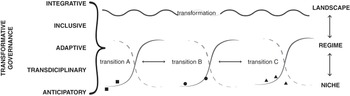
Figure 4.1 Integrating transformations and transitions through transformative governance
Transformative governance enables transformative change through governance mixes that include instruments focused on niches, transitions (and their interactions) and transformations. Transformative change encompasses both transformations and transitions, and is thereby focused on both the generic societal underlying causes and those specific to certain regimes.
While both literatures highlight the need for adaptive, anticipatory and transdisciplinary governance, the transformation literature is more explicit about the need for integrative governance. Also, some authors from both literatures agree on the need to strategically think about participatory processes, highlighting the crucial role of those actors with transformative ambitions and the danger of including actors with vested interests in the old regime too early on in the process. However, many authors, especially from the transformative change literature, see inclusive governance in terms of its representativeness of different views, and promote pluralist approaches. We here follow the former, more strategic approach, also in light of the “problem-solving through prioritization” approach we are proposing, as elaborated below.
4.3 Four Sustainability Problem Conceptions, Not One
The role of cognitive frames in shaping policy and governance in general (Reference Douglas and WildavskyDouglas and Wildavsky, 1982; Reference StoneStone, 1997) and on the environment in particular (Reference BernsteinBernstein, 2001) has long been recognized by a range of scholars within public policy, transnational governance and global environmental politics (e.g. Reference HaasHaas, 2002). Cashore and colleagues contributed to this literature by reflecting on the types of problems that confronted environmental and sustainability challenges. Doing so led to three observations. First, practitioners and applied scholars were involved, often unwittingly, in a narrowing of attention to environmental problems to those that, when solved, created “win-win” outcomes with economic goals. Second, the championing of “evidence-based” science often narrowed data collection that reinforced, rather than confronted, this bias (Reference CashoreCashore, 2019). Third, widespread emphasis among the private sector and international agencies on sustainable development tended to drift toward ameliorating economic sustainability challenges that, ironically, contributed to environmental degradation (Reference Cashore and BernsteinCashore and Bernstein, 2020). Overcoming this drift required consciously identifying a “learning protocol” among scientists and stakeholders through which four different types of sustainability problem conceptions, and corresponding evidence, would be rendered explicit (Reference Cashore, Bernstein, Humphreys, Visseren-Hamakers and RietigCashore et al., 2019). Such exercises, they argued, can lead to innovating insights for ameliorating environmental and social problems (Reference Humphreys, Cashore and Visseren-HamakersHumphreys et al., 2017) rather than “drifting” away from them (Reference Cashore and BernsteinCashore and Bernstein, 2022).
This quest to help ameliorate the environmental (and social) problems that were usually caused by championing economic goals led Cashore and colleagues to offer a three-part framework that is relevant to, and helps frame, the literature on transformative governance.
First, they identified two ways to disentangle four types of approaching sustainability issues: those that champion economic utility as the goal versus those that do not; and those that justify their approach to applied policy analysis based on the particular features of a problem in question versus those that offer universalistic frameworks (Reference Cashore, Bernstein, Humphreys, Visseren-Hamakers and RietigCashore et al., 2019). The corresponding four types (Table 4.1) are innovative in that they simultaneously capture (subjective) constructed notions of particular problems but also point researchers to collect (seemingly objective) empirical evidence that narrows “lessons learned” to those that reinforce particular problem conceptions over others (Reference Cashore and BernsteinCashore and Bernstein, 2022).
Table 4.1 The four problem conceptions
| Rationale | ||||
|---|---|---|---|---|
| Do economic or utility rationales dominate the underlying moral philosophy? | ||||
| Yes | No | |||
| Problem orientation | Analysis justified based on features of a specific kind of problem? | Yes | Type 1: Commons | Type 4: Prioritization |
| No | Type 2: Economic optimization | Type 3: Compromise | ||
Second, they found that four different sustainability schools tended to reinforce each type.
The Type 1 reinforcing commons school captures those sustainability scholars who target overuse of resources (Reference AraralAraral, 2014; Reference OstromOstrom, 1990) commonly referred to as “tragedies of the commons.” This orientation, which dominates schools of resource and agricultural economics, leads experts to focus on developing policies and institutions that limit the extraction of any resource to the same level as they reproduce. This approach also shows up in biodiversity cases when viewing them as a global tragedy of the commons that stems from a failure or absence of collective action that produces suboptimal economic results.
The Type 2 reinforcing economic optimization school shares Type 1 conceptions advancing overall economic utility or welfare. However, it is guided by a moral philosophy that evaluates solutions to any problem on whether they enhance economic welfare in society as a whole. It finds economically optimal solutions through cost–benefit analyses in which a range of environmental, social and economic outcomes are all granted some type of utility decreasing or increasing value, which then allows comparison across all outcomes (Reference Arrow, Cropper and EadsArrow et al., 1996). Environmental goals are often converted into economic values through willingness to pay by consumers. Only those solutions that are deemed to enhance, rather than reduce, economic utility are considered rationally appropriate (Reference Sinden, Kysar and DriesenSinden et al., 2009). The economic optimization school has dominated the vast majority of environmental governance over the last thirty years (Reference Hepburn and SternHepburn and Stern, 2008; Reference Nordhaus and EstyNordhaus, 2019). It explains why Reference Nordhaus and EstyNordhaus (2019) has found that limiting carbon emissions to a 3.1 degree world is the rational approach, even though environmental scientists have found that maintaining 1.5 degrees is required to avert catastrophic ecological outcomes.
The Type 3 reinforcing compromise school emerged out of a critique of the economic optimization school and advances a moral philosophy championed by many applied political scientists and sociologists who seek balance and compromise across different values. Also disconnected from problem structure, it advances multistakeholderism and “multigoal” policy analysis as the appropriate and legitimate way to understand and manage trade-offs that seek some type of balance among competing perspectives (Reference EckersleyEckersley, 2019; Reference Weimer and ViningWeimer and Vining, 1999). This school has dominated many global processes over the past thirty years, including the United Nations Sustainable Development Goals (SDGs) (Reference Bebbington and UnermanBebbington and Unerman, 2018). This school and its Type 3 reinforcing approach also tends to dominate high-level global reports on sustainability challenges (Reference Cashore and NathanCashore and Nathan, 2020; IPBES, 2019; IPCC, 2019). Moreover, the formal goals of the Convention on Biological Diversity (CBD) actually include three main pillars, namely conservation, sustainable use and the equitable sharing of the benefits of the use. Such a problem conception can also be considered a Type 3 typology.
In contrast, Type 4 reinforcing prioritization conceptions identify those problems that, for either moral or scientific reasons, cannot, by definition, be ameliorated by subjecting them to Type 3, 2 or 1 schools. Cashore and Bernstein refer to antislavery as an undisputed example of a moral argument for prioritization. Adjudicating whether society should be against allowing humans to own other humans based on optimality or compromise calculations to permit some types of slavery is considered abhorrent and absurd by almost every country and citizen across the world (although modern slavery still exists). Since the nineteenth century, antislavery is considered a universal norm, which means that it cannot be addressed by a universal framework meant to apply to any class of problems.
A second kind of Type 4 conception emerges from scientific evidence about the problem at hand, for example about what type of conservation efforts must be in place to ensure addressing an irreversible problem like extinction. Disciplines that tend to treat problems as Type 4 include scientists who study biodiversity loss, as well as philosophers and social scientists who focus on ways in which universally shared norms emerge and permeate societal attitudes. Their general agreement is based on science: The rate of biodiversity loss is real, alarming and caused by human activity.
This Type 4 school, for instrumental reasons, turns to “lexical” or sequential policy analysis in which policy solutions are adjudicated against a particular problem at hand, and then, once resolved, it turns to second and third order challenges – but only in ways that do not undermine the higher level problems. Long ago, Reference Cashore and BernsteinCashore and Bernstein (2022) point out, Tribe made this point when referring to species extinction (Reference TribeTribe, 1972). Put succinctly, he posited that since extinctions are irreversible and often caused by championing economic utility, the only way to address them is to grant them lexical status. The point here is that the underlying moral philosophy of the universalism of the compromise school or economic optimization school usually works against solving Type 4 problems, when, tragically, in today’s world they are often offered as transformative solutions for doing so. While Type 4 conceptions were prevalent in global and domestic environmental governance in the 1970s (Reference BernsteinBernstein, 2001; Reference YaffeeYaffee, 1994), this thinking has been marginalized owing to the dominance of Type 2 and 3 frames. Recently, however, Type 4 conceptions are again gaining increasing salience (Reference GeelsGeels, 2020; Reference Lockwood, Kuzemko, Mitchell and HoggettLockwood et al., 2017).
Third, they offered that “fit for purpose” governance requires explicit and continuous attention to problem conception, instead of applying “ill-fit for purpose” policy analyses and solutions. This contributes to the literature on transformative governance as it reinforces the need to be very clear about what actual problems, and corresponding outcomes, are being advocated when the literature makes conclusions about how to foster transformations. Put another way, proposed solutions that seek to value the environment through its economic values and that pose no threat to economic growth will look fundamentally different to those that champion the environment and justice. We therefore argue that if governments and scholars seek to address the environment then they must begin, and end, with attention to the problem at hand, rather than narrowing it to those cases that appear synergistic with other problems.
The question then becomes how we can accelerate such a norm shift from Type 2 or 3 conceptions to Type 4 for biodiversity conservation, as part of transformative change in terms of goals, values and paradigms (see Section 4.2 for the definition of transformative change used in this volume). Reference Cashore and BernsteinCashore and Bernstein (2022) argue that doing so requires greater interrogation of disciplines and literatures that have tended to maintain Type 4 conceptions in the midst of so much drift over the last thirty years to Types 1, 2 and 3. These tend to include critical and discursive political scientists, legal scholars and some strands of philosophy – the very disciplines that have been undermined in the shift toward a “data driven,” “evidence-based” and artificial intelligence (AI) world – while their general agreement is based on science: The rate of biodiversity loss is real, alarming and caused by human activity.
However, one of the complications of academic debates on biodiversity loss is not only that scholars do not conceptualize biodiversity-related issues as Type 4 problems, but that different scholars actually prioritize different biodiversity-related issues, and therefore also propose different solutions, as shown in the different chapters in this volume (see Chapter 2 for an overview of different perspectives). A first group (e.g. Reference Dinerstein, Vynne and SalaDinerstein et al., 2019 and Chapter 11) places biodiversity conservation at the top of the lexical ordering, and, as a result, proposes to protect large areas of land and ocean to halt biodiversity loss. A second group prioritizes improving the lives and livelihoods of local communities living in biodiversity-rich landscapes, which often leads them to oppose formal protection. Yet another, third, group prioritizes moving away from the human–nature dichotomy, and promotes addressing the indirect drivers of biodiversity loss and integrating multiple land uses, and thereby are also often against formal protection (see e.g. Chapter 12). A fourth prioritizes rights of nature, animal rights, antispeciesism, or posthumanism, thereby also moving beyond the human–nature dichotomy but in a different manner, criticizing positioning human wellbeing as more important than that of animals or nature (see Chapter 9). And even when prioritizing biodiversity conservation, scientists often disagree on what types of biodiversity can be best conserved and how, for example ecosystem approaches, focused approaches for specific species, or ex-situ approaches (Reference Cashore and BernsteinCashore and Bernstein, 2020).
So, while the scientific evidence for the fragile state of global biodiversity is clear, academic conceptualizations of the problem and solutions that should be prioritized differ among different groups of scholars. Many scholars would therefore actually disagree with framing the problem as “how to save a million species” – the title of this chapter. Obviously, these groups overlap, as the boundaries are not set in stone, and views evolve over time. Also, different arguments are used by different groups for the prioritization, with the first and fourth groups mainly recognizing the intrinsic value and rights of nature and animals, the second group mainly arguing for biodiversity conservation because humans depend on it, based on instrumental values, and the third group mostly representing relational values. Interestingly, academics representing the different schools of prioritization often collaborate without being explicit about these problem conceptions (see Reference Pascual, Adams and DíazPascual et al., 2021). So not only in policymaking in general, but also within Type 4 problem analysis, more explicit attention to problem conception is needed.
Integrating explicit attention to problem typologies in biodiversity governance requires that actors first ask how they conceptualize the problem at hand. If they have determined that they conceive of the problem as akin to antislavery norms, or in line with scientific knowledge of ecological tragedies, then they also need to be careful not to inadvertently undertake policy options in ways that are based on or strengthen Type 1, 2 or 3 rationales. Following Cashore and Bernstein, we argue that only Type 4 is “fit for purpose” to ameliorate the problem of global biodiversity loss that threatens one million species with extinction, since it’s the only one that addresses the problem as an ecological catastrophe or moral obligation. This does not mean that governance instruments identified by other schools have become obsolete, but that they need to be converted in service of ameliorating Type 4 problems, as elaborated below.
4.4 Implications for Transformative Biodiversity Governance
4.4.1 Prioritizing Biodiversity
What does all of this mean for halting biodiversity loss, or in other words, saving one million species? As shown, among others, in Chapter 6, most biodiversity policies have recently been based on Type 2 and Type 3 thinking, with local initiatives sometimes based on Type 1. Perhaps some protected areas (PAs) could be considered as fitting a Type 4 conception, although the trend in PAs is moving from strict protection to combining land uses, so moving toward Type 3 thinking. Also, PA policy, including deciding where to realize PAs, is often based on Type 2 or 3 thinking. Perhaps the emerging rights-based approaches (see Chapters 2 and 9) could be considered as representing Type 4 thinking. But overall, we have to conclude that most biodiversity policies and initiatives have not been based on Type 4 thinking – biodiversity loss is not treated as a priority in biodiversity governance.
When integrating problem-type analysis into the debate on transformative change and governance, we can conclude that defining biodiversity loss as a Type 4 problem in essence represents an integral part of transformative change: a change in terms of values, goals and paradigms. This would mean transforming biodiversity governance – this volume’s title – would mean prioritizing biodiversity concerns.
Interestingly, the transformation and transition literatures are not explicit about how they conceptualize sustainability problems. In general, sustainability transitions research (Reference Loorbach, Frantzeskaki and AvelinoLoorbach et al., 2017; Reference Rotmans, Kemp and Van AsseltRotmans et al., 2001) acknowledges the importance of problem framings and implicitly makes the case for transition governance that supports the shift from Type 2 and 3 thinking to Type 4. Also, by highlighting the need for fundamental change, the transformative change literature implicitly tries to address the fact that existing institutions and governance systems do not prioritize biodiversity or sustainability concerns, so could be seen as Type 4 thinking. However, the dominance of pluralist approaches in the transformative change literature and (science) policy debates, as discussed in the above, reflect Type 3 typologies.
Incorporating the focus on Type 4 problems thus provides a goal to transformative change, for example the goal of saving one million species. So, while we agree with the often-heard argument that different actors have different perspectives on the envisioned goal of transformative change and the ways to achieve these, we suggest another way forward. Instead of trying to accommodate all of these different views in the proposed solutions (which in essence reflects Type 2 or 3 thinking), we propose to explicitly discuss these different perspectives in order to come to a clearer understanding of what the problem is that needs to be prioritized and what types of solutions would be appropriate. Being aware of the differentiation between the four problem types thus makes governance more problem-focused.
In other words, explicitly prioritizing biodiversity conservation, and transforming to a truly sustainable society in order to avoid biodiversity loss, has consequences for the types of governance instruments that are required – and perhaps more importantly, those that are less relevant. Taking such a starting point would thereby radically change the way governance would be implemented, since the prioritization would be the basis for strategies and interventions, as discussed in more detail below.
4.4.2 Toward Ecocentric, Compassionate and Just Sustainable Development
Integrating problem-type thinking into transformative governance has consequences for the latter concept, defined in Chapter 1 as “the formal and informal (public and private) rules, rule-making systems and actor-networks at all levels of human society (from local to global) that enable transformative change, in our case, toward biodiversity conservation and sustainable development more broadly.” Especially the reference to the concept of sustainable development, currently operationalized around the world through the SDGs, needs further thought (see Chapter 1 for an overview of the SDGs). With the currently dominant Type 2 and 3 thinking, implementing the SDGs quickly becomes a matter of optimizing, or compromising between, the different goals.
Instead, approaches such as Raworth’s doughnut economy prioritize the ecological and social SDGs to inform how to operationalize the economic ones to create a “safe and just space for humanity” (Reference RaworthRaworth, 2017: 218). However, Raworth’s doughnut mainly focuses on human justice, since the planetary boundaries are based on an instrumental perspective, and not necessarily on the intrinsic value of nature. Two important omissions of the doughnut include: (a) attention to the interests of the individual animal – it does not address speciesism, and (b) the intrinsic value and rights of nature. Therefore, we propose to include nonhuman animals and nature in the consideration of the safe and just space – so an ecocentric, compassionate (Reference BekoffBekoff, 2013) and just doughnut economy (see Burgerboerderijen, 2021 and The Vegan Society, 2021) (Figure 4.2). In line with the proposal by Reference Visseren-HamakersVisseren-Hamakers (2020) for an eighteenth SDG on animal health, welfare and rights, this would represent a transformation of the definition of sustainable development, from “meeting the needs of current generations without compromising the ability of future [human] generations to meet their own needs” (Reference Brundtland, Khalid, Agnelli, Al-Athel and ChidzeroBrundtland et al., 1987), a rather anthropocentric definition, to a definition that includes more ecocentric approaches: “meeting the needs of humans and nonhumans, while respecting the constraints of the planetary boundaries and the intrinsic value of nature.” This implies a prioritization of People and Planet over Profit, instead of regarding the three Ps as equal, while also recognizing animal interests (see Chapter 9). So, integrating Type 4 thinking into the definition of transformative governance changes the interpretation of the concept of sustainable development. Redefining sustainable development thus also represents an integral part of transformative change – a change in terms of values, goals and paradigms. This would mean transforming biodiversity governance would not only mean prioritizing biodiversity concerns, but prioritizing ecological, justice and equity concerns over economic ones more broadly, with a view to enabling ecocentric, compassionate and just sustainable development (Reference Elder and OlsenElder and Olsen, 2019; Reference GerickeGericke, 2021; Stockholm Resilience Centre, 2016; United Nations Environment Programme, 2021).
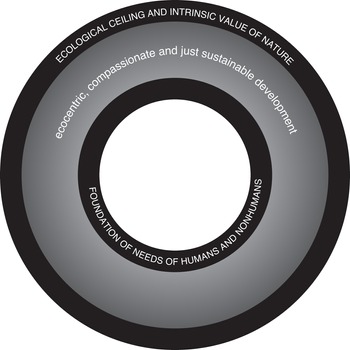
Figure 4.2 The ecocentric, compassionate and just doughnut economy
4.4.3 Further Operationalizing Transformative Governance
So how can governance support and accelerate this change in problem definition from optimization or compromise to prioritization? As previously stated, transformative governance, as operationalized in Chapter 1 (focused on the indirect drivers, and operationalizing integrative, inclusive, adaptive, transdisciplinary and anticipatory governance in a specific manner), implicitly already starts from Type 4 problem-solving. However, the concept can be further specified to enable prioritization approaches in the following manners.
This focus of transformative governance on the indirect drivers should include addressing those institutions, modes of governance and characteristics of our economic structures that do not prioritize ecocentric, compassionate and just sustainable development, since these actually represent an integral part of the indirect drivers (or underlying societal causes) of biodiversity loss. With this, addressing the indirect drivers becomes focused on enabling the prioritization of ecological and social societal goals.
The definitions of integrative, inclusive and anticipatory governance already implicitly reflect Type 4 thinking, with integrative governance (working through governance mixes) basically aimed at ensuring that biodiversity conservation (and ecocentric, compassionate and just sustainable development more broadly) is a priority across sectors, issues, levels of governance and places, and inclusive governance, operationalized in a manner that emancipates those stakeholders who prioritize biodiversity conservation (and ecocentric, compassionate and just sustainable development). With this, transformative inclusive governance could strengthen, support, emancipate and empower those parts of society and the economy where biodiversity loss and its associated negative impacts are already perceived and treated as a Type 4 problem. Anticipatory governance ensures prioritization in contexts of uncertainty by applying the precautionary approach. Adaptive governance then becomes focused on reflecting on whether governance still reflects Type 4 thinking, or whether the process is “drifting” (Reference Cashore and BernsteinCashore and Bernstein, 2022) toward optimization or compromise approaches. Stakeholders can together reflect on the extent to which governance is becoming and remains transformative. When integrating priority type thinking, transdisciplinary governance becomes focused on ensuring the needed types of knowledge are available and applied, as elaborated in Section 4.5. Through the iterative process of governance that combines these five approaches in this manner, over time, governance becomes increasingly transformative and thereby able to address indirect drivers (see Reference Visseren-Hamakers, Razzaque and McElweeVisseren-Hamakers et al., 2021).
Type 4 problem-solving thereby has significant consequences for governance mixes (combinations of public, private and hybrid governance instruments): as they become more transformative over time, they will increasingly include Type 4 solutions, with the aim of becoming fully focused on the prioritized objective. The question then becomes what types of governance instruments enable Type 4 solutions. Clear examples include prohibiting biodiversity-unfriendly practices, or conservation on the ground through well-placed, strictly protected and effectively managed PAs or other conservation measures. During the evolution of governance becoming increasingly transformative, Type 1 self-governing, Type 2 market-based, cost–benefit solutions and Type 3 deliberative or synergies-oriented approaches can play a role in the governance mix, applied in ways that contribute to Type 4 problem-solving and with this mix changing over time.
Reference Diercks, Loorbach and Van der SteenDiercks et al. (2020) discuss four governance roles and four processes in transitions. We here apply these in reflecting on transformative governance, as operationalized in the above to include both transitions and transformations. The four governance roles include:
Regulating,
Collaborating,
Stimulating and
Facilitating.
The four processes, which take place in parallel, include:
Emergence (developing new ways of thinking, working and organizing),
Changing (changing existing elements for new applications or a new context),
Institutionalization (becoming the norm),
Phasing out (of ways of thinking, working and organizing).
When combining these governance roles and processes with the four problem conceptions and the main governance instruments based on their logics, the following contributions to transformative governance emerge (see Table 4.2).
Table 4.2 Problem conceptions and transformative governance
| Problem conception | Main governance roles | Main processes | Main governance instruments | Contributions to transformative governance |
|---|---|---|---|---|
| Type 1 self-govern | Collaborating, regulating | Institutionalization | Informal local rules |
|
| Type 2 optimize | Stimulating | Phasing out, changing, institutionalization | Market-based, financial instruments | - Decreasing role as transformation evolves |
| Type 3 compromise | Collaborating, facilitating | Changing, emergence, institutionalization | Deliberative, synergies-oriented instruments |
|
| Type 4 prioritize | Regulating | Phasing out, institutionalization | Formal rules | - Increasing role as norms change |
Type 1 self-governing solutions have a role to play throughout the transformation, in specific contexts in which local communities informally regulate natural resource use in a collaborative manner. These processes, however, need to be aligned with generic societal priorities. Type 2 market-based and financial solutions (e.g. subsidies, taxation, certifications schemes) can support actors (companies, consumers) during the transformation toward a fully sustainable economy by making sustainable options more competitive. They can especially play a role in phasing out, changing and institutionalization processes, and represent stimulating governance roles. Type 3 deliberative, synergies-oriented solutions (multistakeholder processes, partnerships) can facilitate discussing the perspectives of different stakeholders on what priorities should be. They can especially play a role in changing, emergence and institutionalization processes, and represent collaborating and facilitating governance roles. They have a role to play throughout the transformation to avoid “drifting” to nonprioritizing solutions, and to find synergies among different Type 4 problems within the context of ecocentric, compassionate and just sustainable development. Type 4 solutions, including formal rules that enable prioritization, have a regulating role and mainly play a role in phasing out nonsustainable practices and the institutionalization of sustainable ones.
Transformative governance thus evolves over time. As the indirect drivers become increasingly addressed over time, the governance mix can become more focused on Type 4 solutions, since economic structures and institutions, and societal values, paradigms and goals, are evolving to become more sustainable, making Type 4 solutions more feasible. Also, as a Type 4 understanding of the issue of biodiversity loss (and ecocentric, compassionate and just sustainable development more generally) gains prominence in society, Type 1, 2 and 3 policy approaches can be revisited in the light of the emerging transformations. Type 2 policy analysis starts to change, as can be seen with the Stern review and the Dasgupta review (Reference DasguptaDasgupta, 2021; Reference SternStern, 2007), and there will be gradually growing attention for concerns beyond gross domestic product (GDP) and post-growth approaches. In order to accelerate the process, different actors can reflect on the most appropriate governance mix in different phases of the transformation, through the transformative governance approach discussed in the above.
Some interesting questions remain. What does Type 4 thinking mean for trade-offs between different sustainability or societal concerns, for example climate change mitigation and biodiversity conservation, or biodiversity conservation and local livelihoods, or biodiversity conservation and animal rights? In other words – what should be done if two Type 4 problems meet? In essence, most transformative solutions address multiple sustainability concerns simultaneously, since the same societal structures cause various sustainability issues, as discussed above, so in theory Type 4 governance mixes to address biodiversity loss would simultaneously help mitigate climate change, and vice versa. However, sometimes trade-offs are unavoidable, for example in the case of Invasive Alien Species (IAS). We could have avoided, and still can prevent, IAS through preventative measures (less trade and travel), but the damage in some cases has already been done. The rights of which animal then has priority in a situation where they cannot coexist – the one considered local or the one considered invasive? In such cases, the only way forward would be for actors to explicitly discuss what the priority should be.
4.5 Implications for the Role of Science in Transformative Governance
What is the role of science in transformative governance focused on prioritizing biodiversity conservation? It is important to realize that knowledge, science and the scientific community can be considered part of the problem, or perhaps more gently, not part of the solution; (parts of) our knowledge systems may be part of the indirect drivers of biodiversity loss, including our perception of the problem, how we relate to nature and how we understand what nature is (Reference StengersStengers, 2011).
As discussed in Section 4.3, parts of the scientific community represent Type 4 thinking but prioritize different biodiversity-related problems, while other parts of the scientific community represent other problem types. The main social scientific theories also represent different problem conceptions. While recognizing many possible exceptions, one could say that rational choice scholars mostly represent Types 1 and 2; different institutionalist approaches cover Types 1–3; discursive theories are mainly aimed at understanding different perspectives, thereby best matching Type 3; and critical theory is clearly focused on a Type 4 problem conception.
Moreover, there are significant epistemological differences between the natural sciences promoting prioritizing biodiversity conservation and those social sciences and humanities also representing Type 4 problem conceptions. So, while their problem conceptions converge, their scientific practices differ to the extent that collaboration becomes difficult. Instead, and as a result, ecologists tend to gravitate toward Type 2 environmental economists, with whom they share similar methods, but who reinforce moral philosophies representing “rational” approaches to addressing ecological catastrophes.
The consequence is that the message in science–policy interfaces is diffuse. While there is academic consensus that biodiversity loss is a problem, scientists characterize the problem and its solutions in many different ways. Moreover, because most current policy processes actually represent Type 2 and 3 conceptions, Type 4 messages on prioritizing biodiversity conservation do not match policy practices and are not integrated in governance efforts. What can we learn from different scientific schools of thought in addressing these dilemmas?
Research on uncertainties (Reference Van Asselt, Beusen and Hilderinkvan Asselt et al., 1996) postulates the idea that reductionist and logical empiricist or positivist knowledge approaches are not able to effectively address the most wicked or unstructured problems. In these approaches, “scientific evidence” is used as a basis for policymaking aimed at tackling the complexity of sustainability problems. However, this evidence is never neutral, as is also stressed in literature about political epistemology: Its nuances and uncertainties will be used to misinterpret, modify or motivate interventions in line with powerful interests or dominant perspectives. The objective position of the research(ers) related to policy and, in general, the science–policy interface has already been the subject of debate for decades (e.g. Reference Hoppe and HisschemollerHoppe and Hisschemoller, 1996; Reference WildavskyWildavsky, 1979), but has been revived in the context of sustainable development and biodiversity loss.
While the unstructured nature of complexity points at a need for the involvement of diverse knowledge systems and sources in science for policy, given the inherent uncertainties and values in policy-related science, we need to critically reflect on the “contributions” of academia to noneffective approaches or reinforcing certain typologies, including the synergies norm of Type 3 thinking.
Examples include sustainability science (Reference Clark and DicksonClark and Dickson, 2003) and integrated assessment (Reference Rotmans and Van AsseltRotmans and Van Asselt, 1996), developed as integrated sciences to deal with unstructured “sustainability problems.” The core idea, for example, is that the future effects of biodiversity loss are unknown and will also be interpreted and perceived in different ways depending on context. Integrated assessment, transdisciplinarity, co-creation and participatory research engage different types of scientific and practitioner knowledge to create shared analyses and consensus about complex problems as a basis for solutions. However, while we agree that such processes of sense-making and problem-structuring (Reference RosenheadRosenhead, 2006) are critical in order to explore why persistent and unstructured problems are seemingly unsolvable, the danger of “drifting” to Type 2 and 3 solutions is tremendous. So, transformative change and governance need a realist ontology: Problems are real but our way of understanding them differs. Therefore, regular deliberation on what exactly are the priorities is vital.
Disciplinary knowledge remains important. Political theory, for example, showcases how vested interests may be reinforced within current regimes, by analyzing processes through which dominant regime-actors (within policy and markets) are able to influence innovation, thereby maintaining their influential position. In other words, these dominant regime-actors make sure that their interests flow into the mainstream debate and policy discourse. This helps them to improve their position and work against potential emerging disruptors (Reference SterlingSterling, 2001). This tendency is also elaborated in institutional theory, which points at the inertia and incremental nature of policymaking and change, and also addresses how powerful actors seek to reinforce and maintain their position. More broadly, institutional theory addresses how organizational structures keep cultural norms and behavioral routines intact in order to stabilize societal systems.
In order for science–policy interfaces to be able to contribute to transformative governance, stakeholders and academics can together codesign governance approaches focused on Type 4 problem-solving. The role of researchers within a Type 4 conception also changes: they are not simply knowledge providers or “experts that resolve needs” (Reference IllichIllich, 1977: 11), but they also act as change agents to establish the much-needed modes of thinking, participation and dialogue for the purpose of transformative change (Reference Fazey, Schäpke and CanigliaFazey et al., 2018; Reference Wittmayer and SchäpkeWittmayer and Schäpke, 2014).
Natural science can continue providing scientific evidence for biodiversity loss, through which biophysical nature – one millions species – gains a voice through the scientists’ activities and their instruments (Reference LatourLatour, 2020). In biodiversity governance, this marks the role of the natural sciences: They provide species with a voice, and as biodiversity declines, this voice also increasingly demands political representation. Social sciences that are especially needed in transformative governance include knowledge on institutional change and stability, path dependency, economics that moves beyond the economic growth paradigm, and governance focused on changing values, paradigms and goals. Reference CashoreCashore (2019) proposes an emphasis on qualitative disciplines in history, philosophy, law, historical sociology, political science, sociology and some strands of geography in order to address the nature of Type 4 problems properly.
Transformative governance perhaps also includes a more fundamental reflection of the institutional structures of academia, and in our case the science–policy interfaces around biodiversity. These are in many ways intimately linked to the dominant discourses in science (disciplinary, descriptive, objective) and policy (solution-oriented, formal, power-based) rather than around the transformative governance principles (integrative, inclusive, transdisciplinary, adaptive and anticipatory). If we take these as design principles for transformative science–policy interfaces, it would mean a completely different way of bringing together knowledge perspectives and societal governance. It would mean facilitating communities of stakeholders that work on transformative change in practice, and working with them to identify the institutional principles and conditions needed to mainstream their practices (e.g. regenerative agriculture, biodiversity conservation, cooperative models, de-growth economies, circular economic models and social enterprises). In other words, such a new institutional design would provide mechanisms for transforming biodiversity governance by actually prioritizing the new practices of governance that prioritize biodiversity governance. Together, practitioners and academics could reflect on the main bottlenecks in the transformation, and address them together, whether they be at the landscape, regime or niche level, and whether they would be relevant for only one transition or for sustainability transformations more generally.
4.6 Conclusions
In this chapter we have combined various literatures in order to provide answers to the question of how to save one million species. We have combined the literatures on transformative change, transformations, transitions, transformative governance and problem typologies, which has allowed us to develop the following unique insights.
Bringing together the literature on (governing) transformations and transitions combines the strengths of both bodies of knowledge. The combined perspective allows more focused attention to the generic societal underlying causes of sustainability issues than the transition literature has done so far. These indirect drivers are now better represented as not only influencing transitions in regimes, but also as objects to be changed through transformative governance. The renewed perspective also allows sustainability transformations scholars to operationalize the transformation to – in essence – sustainable societies as “a family of transitions,” thereby enabling integrative governance (Reference Visseren-HamakersVisseren-Hamakers, 2015; Reference Visseren-Hamakers2018) of transitions, focused on the interrelationships between different transitions and the underlying causes they have in common. It’s perhaps through this enhanced attention to the underlying causes of sustainability problems in multiple transitions that both the transitions and the transformations they are embedded in can be accelerated.
Integrating problem-type thinking (Reference Cashore and BernsteinCashore and Bernstein, 2020) into the transformative change and governance literature has contributed to furthering the conceptualization and operationalization of the concept of transformative governance in the following ways.
First, through the development of this chapter, we have come to realize that most biodiversity policies and initiatives have (purposefully or inadvertently) not been based on Type 4 thinking: Biodiversity loss is not considered as a priority, but instead often regarded as part of problems of optimization or compromise. Based on this analysis, we conclude that defining biodiversity loss as a Type 4 problem in essence represents an integral part of transformative change: a change in terms of values, goals and paradigms. Transforming biodiversity governance would then mean prioritizing biodiversity concerns. Incorporating the focus on Type 4 problems thus provides a goal to transformative change, in our case the goal of saving one million species.
Integrating problem-type thinking also has consequences for the reference to the concept of sustainable development in the definition of transformative governance, as introduced in Chapter 1. Transforming biodiversity governance would then mean prioritizing ecological, justice and equity concerns over economic ones to come to mean ecocentric, compassionate and just sustainable development, which can be defined as meeting the needs of humans and nonhumans, while respecting the constraints of the planetary boundaries and the intrinsic value of nature.
Transformative governance then becomes focused on the role of current institutions, modes of governance or characteristics of our economic structures that do not prioritize ecocentric, compassionate and just sustainable development as part of addressing the indirect drivers (or underlying societal causes) of biodiversity loss.
Type 4 problem-solving also radically changes governance. Governance mixes will need to increasingly include Type 4 solutions with the aim of becoming fully focused on prioritization. During the evolution of governance becoming increasingly transformative, Type 1 self-governing, Type 2 market-based, cost–benefit solutions and Type 3 deliberative or synergies-oriented approaches can play a role in the governance mix, adjusted and applied in such ways that they contribute to Type 4 problem-solving, and with this mix changing over time. Through adaptive governance, actors can reflect on whether governance mixes are focused enough on Type 4 problem-solving, or whether implemented solutions are “drifting” toward optimization or compromise solutions. Only if we treat the threat of losing one million species as a priority will we succeed in avoiding this potentially historic loss of life.


 Open access