
Skip to main content Accessibility help
×
  • Cited by 7
    • Show more authors
    • You may already have access via personal or institutional login
    • Select format
    • Publisher:
      Cambridge University Press
      Publication date:
      13 March 2020
      02 April 2020
      ISBN:
      9781108862417
      9781108495622
      9781108797139
      Dimensions:
      (228 x 152 mm)
      Weight & Pages:
      0.44kg, 220 Pages
      Dimensions:
      (229 x 152 mm)
      Weight & Pages:
      0.35kg, 222 Pages
    You may already have access via personal or institutional login
  • Selected: Digital
    Add to cart View cart Buy from Cambridge.org

    Book description

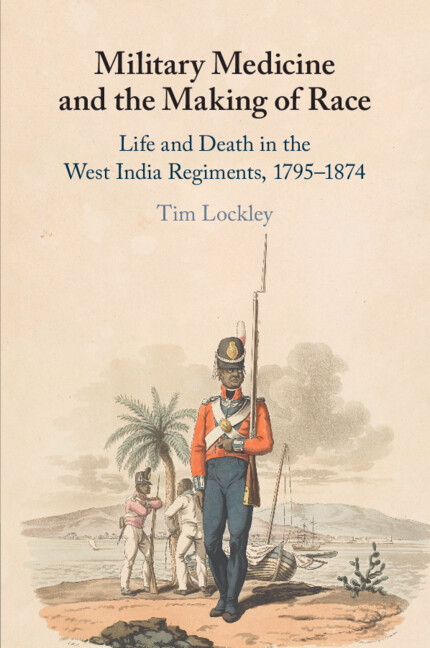
    This book demonstrates how Britain's black soldiers helped shape attitudes towards race throughout the nineteenth century. The West India Regiments were part of the British military establishment for 132 years, generating vast records with details about every one of their 100,000+ recruits which made them the best-documented group of black men in the Atlantic World. Tim Lockley shows how, in the late eighteenth century, surgeons established in medical literature that white and black bodies were radically different, forging a notion of the 'superhuman' black soldier able to undertake physical challenges far beyond white soldiers. By the late 1830s, however, military statisticians would contest these ideas and highlight the vulnerabilities of black soldiers instead. The popularity and pervasiveness of these publications spread far beyond British military or medical circles and had a significant international impact, particularly in the US, both reflecting and reinforcing changing notions about blackness.

    Reviews

    `In this brilliant, perceptive and deeply researched meditation, Tim Lockley shows how the famous West Indian regiments in the Age of Revolution and beyond were crucial in reshaping European attitudes to the racial and medical capacities of black men. His thought-provoking and compelling thesis argues that racial thinking evolved as much through contemplating black soldiers as through the lens of enslavement. Ever stimulating, Military Medicine and the Making of Race encourages us to question what we thought we knew about race thinking.'

    Trevor Burnard - University of Hull

    ‘This important study sheds new light on the West India Regiments, demonstrating how racial and medical debates underpinned their creation and informed the selection, treatment and the daily lives of the African troops who served. By telling this story, Lockley demonstrates the medical and other hardships experienced by African soldiers, and provides a fresh perspective on how and why the British relied on these regiments to extend their imperial power.'

    Deborah Neill - University of York

    ‘In clear and accessible prose, Lockley offers cogent analysis of the role the WIR [West India Regiments] and, importantly, the physicians who administered to their men, played in the making of race. Lockley ably mines the rich records generated by the WIR's officers and medical practitioners to chart the evolution of assumptions and attitudes regarding blackness that developed as a result of their comparison of white and black bodies – and the influence these shifting racial ideologies had beyond the bounds of the WIR.'

    Maria Alessandra Bollettino - Framingham State University, Massachusetts

    ‘… a detailed examination of … notions of race.’

    R. T. Ingoglia Source: Choice

    Refine List

    Actions for selected content:

    Select all | Deselect all
    • View selected items
    • Export citations
    • Download PDF (zip)
    • Save to Kindle
    • Save to Dropbox
    • Save to Google Drive

    Save Search

    You can save your searches here and later view and run them again in "My saved searches".

    Please provide a title, maximum of 40 characters.
    ×

    Contents

    • 1 - Medical Necessity and the Founding of the West India Regiments
      pp 19-53

    Metrics

    Altmetric attention score

    Full text views

    Total number of HTML views: 0
    Total number of PDF views: 0 *
    Loading metrics...

    Book summary page views

    Total views: 0 *
    Loading metrics...

    * Views captured on Cambridge Core between #date#. This data will be updated every 24 hours.

    Usage data cannot currently be displayed.

    Accessibility standard: Unknown

    Why this information is here

    This section outlines the accessibility features of this content - including support for screen readers, full keyboard navigation and high-contrast display options. This may not be relevant for you.

    Accessibility Information

    Accessibility compliance for the HTML of this book is currently unknown and may be updated in the future.
